"Yisro — Part III — Sinai as Public Reality: The Anti-Metaphor Parsha"

Mitzvah Minute Logo Icon

3.3 — Four Elements Subjugated: Why Abarbanel Needed “Totality”

Har Sinai
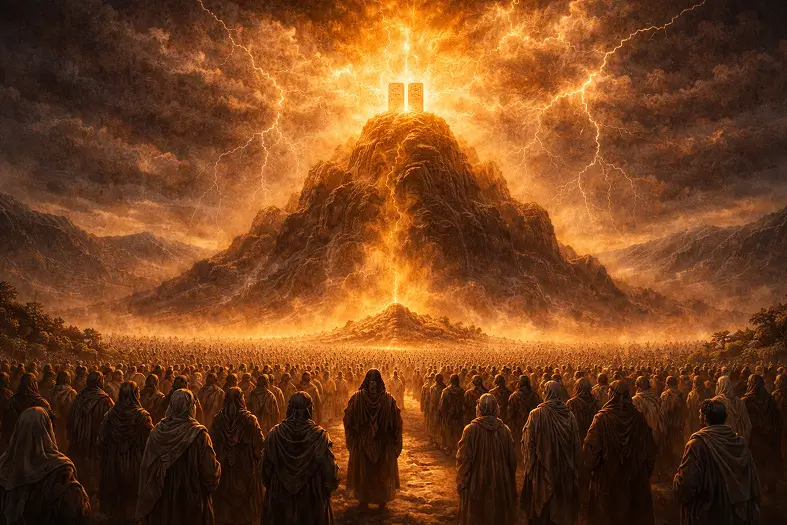
Abarbanel explains that Sinai was designed as a total event, not a single miracle. Air, fire, water, and earth are all subjugated so no part of nature remains autonomous. This elemental totality blocks partial explanations—weather, psychology, symbolism—and forces certainty. Sinai is cosmic by necessity: only when all elements respond can revelation be public, undeniable, and incapable of reduction.

"Yisro — Part III — Sinai as Public Reality: The Anti-Metaphor Parsha"

3.3 — Four Elements Subjugated: Why Abarbanel Needed “Totality”

Why One Miracle Was Not Enough

Abarbanel notices something others pass over: Sinai is not described as a miracle, but as a coordinated suspension of reality itself. Fire burns, smoke rises, the air carries thunder and shofar, the mountain quakes. The Torah does not rely on a single sign because a single sign can be minimized. Abarbanel insists on totality—a revelation that engages air, fire, water, and earth so that no domain of nature can be left untouched.

Sinai had to be cosmic, or it would be dismissible.

Abarbanel’s Structural Insight

According to Abarbanel, the Torah deliberately orchestrates revelation across the elemental order of creation. Each element is not merely present; it is subjugated—behaving in ways that contradict its own laws.

This is not excess. It is proof design.

  • Air carries thunder and an intensifying shofar that does not fade.
  • Fire burns visibly yet does not consume in the ordinary way.
  • Water (via cloud and vapor) veils sight while amplifying sound.
  • Earth—the mountain itself—trembles: [וַיֶּחֱרַד כָּל הָהָר — “the whole mountain trembled”].

Abarbanel’s claim is sharp: when every element is overridden, no naturalistic refuge remains.

Blocking the “Partial Explanation”

Human skepticism thrives on partitioning: maybe it was weather, maybe emotion, maybe mass psychology. Abarbanel shows why Sinai refuses partition. Each element independently contradicts expectation; together they annihilate reduction.

  • Explain fire? Air defies you.
  • Explain sound? Earth convulses.
  • Explain vision? Cloud obscures while certainty increases.

Totality is not drama. It is epistemic closure.

Why This Had to Be Public

Private miracles can be internalized. Partial miracles can be localized. A total, elemental event cannot. When the very categories of nature respond, the event becomes public reality. Creation itself testifies.

This is why Abarbanel insists that Sinai could not be a heightened human experience. Experiences do not command mountains.

Creation Recognizes Its Creator

There is a deeper implication in Abarbanel’s reading. Sinai mirrors creation. The same elements brought into being now suspend their autonomy to announce their Source. Revelation is not an interruption of the world; it is the world acknowledging its Author.

Sinai thus teaches: Torah is not foreign to reality. It stands above it.

Why “Totality” Precedes Command

Commandments presuppose authority. Authority presupposes certainty. Abarbanel’s totality ensures that law is not heard as opinion. Before “Thou shalt,” the world itself bows.

Only then can obligation be meaningful rather than coercive.

Chassidic Insight: When All Vessels Empty

Chassidic masters explain that when every element is shaken, the inner elements of the self are shaken as well. Partial disturbance leaves room for resistance. Total disturbance clears space. The human being becomes receptive not because he is persuaded, but because there is nowhere left to stand against truth.

Application for Today

Modern thought prefers fragments: data points, perspectives, interpretations. Sinai refuses fragmentation. Abarbanel reminds us that truth sometimes announces itself by overwhelming every category at once.

The question is not whether we would prefer a gentler revelation, but whether a gentler revelation would have been believed at all.

📖 Sources

  • Full sources available on the Mitzvah Minute Parshas Yisro page under insights and commentaries.

Organized by:
Boaz Solowitch
February 2, 2026
Mitzvah Minute Logo Icon

Connections

Mitzvah Minute Logo Icon

Mitzvah Links

Mitzvah 1

To know there is a G‑d
A Siddur
Learn this Mitzvah

Mitzvah 1

1
To know there is a G‑d

Mitzvah 2

Not to entertain thoughts of other gods besides Him
A Siddur
Learn this Mitzvah

Mitzvah 2

2
Not to entertain thoughts of other gods besides Him

Mitzvah 3

To know that He is One
A Siddur
Learn this Mitzvah

Mitzvah 3

3
To know that He is One

Mitzvah 5

To fear Him
A Siddur
Learn this Mitzvah

Mitzvah 5

5
To fear Him
The Luchos - Ten Commandments
View Mitzvah Notes

Mitzvah Reference Notes

"x" close page navigation button

Mitzvah Reference Notes

“Four Elements Subjugated: Why Abarbanel Needed ‘Totality’”

Mitzvah #1 — To know there is a G-d (Exodus 20:2)

אָנֹכִי ה׳ אֱלֹקֶיךָ

The elemental totality of Sinai establishes emunah as knowledge. When all domains of nature are overridden simultaneously, Divine authorship becomes unavoidable, grounding this mitzvah in certainty rather than belief alone.

Mitzvah #2 — Not to entertain thoughts of other gods besides Him (Exodus 20:3)

לֹא יִהְיֶה לְךָ אֱלֹקִים אֲחֵרִים עַל פָּנָי

No competing power can claim authority when every element responds to one command. Sinai’s totality eliminates theological pluralism by demonstrating unified control over creation.

Mitzvah #3 — To know that He is one (Deuteronomy 6:4)

שְׁמַע יִשְׂרָאֵל ה׳ אֱלֹקֵינוּ ה׳ אֶחָד

Multiplicity of phenomena converging under one source teaches Divine oneness experientially. The unity of command across all elements reflects the unity proclaimed in Shema.

Mitzvah #5 — To fear Hashem (Deuteronomy 6:13)

אֶת ה׳ אֱלֹקֶיךָ תִּירָא

Elemental subjugation produces epistemic yirah—the recognition of standing before a Presence that governs all layers of reality. Fear here emerges from knowledge, not emotion.

Parsha Links

יִתְרוֹ - Yisro

Haftarah: Isaiah 6:1-13
A Siddur
Learn this Parsha

יִתְרוֹ - Yisro

יִתְרוֹ - Yisro
The Luchos - Ten Commandments
View Parsha Notes
"x" close page navigation button

Parsha Reference Notes

“Four Elements Subjugated: Why Abarbanel Needed ‘Totality’”

Parshas Yisro (Shemos 18:1–20:23)

Parshas Yisro presents revelation as a coordinated upheaval of creation. By engaging all elements simultaneously, the Torah establishes Sinai as a public, total event that cannot be divided into natural components. This prepares the nation to receive law with certainty grounded in shared reality rather than interpretation.

Mitzvah Minute
Mitzvah Minute Logo

Learn more.

Dive into mitzvos, tefillah, and Torah study—each section curated to help you learn, reflect, and live with intention. New insights are added regularly, creating an evolving space for spiritual growth.

Luchos
Live a commandment-driven life

Mitzvah

Explore the 613 mitzvos and uncover the meaning behind each one. Discover practical ways to integrate them into your daily life with insights, sources, and guided reflection.

Learn more

Mitzvah #

1

To know there is a G‑d
The Luchos - Ten Commandments
Learn this Mitzvah

Mitzvah Highlight

Siddur
Connection through Davening

Tefillah

Learn the structure, depth, and spiritual intent behind Jewish prayer. Dive into morning blessings, Shema, Amidah, and more—with tools to enrich your daily connection.

Learn more

Tefillah

COMING SOON.
A Siddur
Learn this Tefillah

Tefillah Focus

A Sefer Torah
Study the weekly Torah portion

Parsha

Each week’s parsha offers timeless wisdom and modern relevance. Explore summaries, key themes, and mitzvah connections to deepen your understanding of the Torah cycle.

Learn more

יִתְרוֹ - Yisro

Haftarah: Isaiah 6:1-13
A Sefer Torah
Learn this Parsha

Weekly Parsha