www.Mitzvah-Minute.com
"Yisro — Part V — Mitzvah #1 and the First Word of Obligation"
5.2 — Rambam vs. Abarbanel: Belief, Knowledge, and the Shape of Mitzvah #1
Machlokes in Foundations
Two Giants, One Opening Word
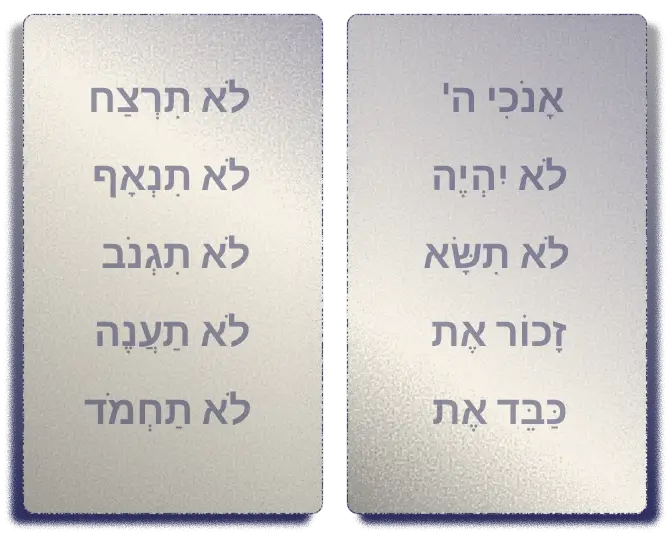
Few disagreements cut as deeply into Torah architecture as the dispute between Rambam and Abarbanel over Mitzvah #1. Both stand before the same verse—[אָנֹכִי ה׳ אֱלֹקֶיךָ — “I am Hashem your G-d”]—and draw opposite conclusions about what a mitzvah can be.
Rambam counts Anochi as the first commandment: to know that there is a G-d. Abarbanel resists: belief cannot be commanded; obligation must presuppose authority. What appears technical is, in truth, a machlokes about the very shape of mitzvah.
Rambam: Knowledge as a Command
Rambam’s position is explicit and uncompromising. In his count of the mitzvos, Anochi is Mitzvah #1—the obligation to know that Hashem exists. Crucially, Rambam does not say “to believe.” He says leida—to know.
For Rambam, knowledge is an act:
- it can be pursued,
- clarified,
- defended,
- and preserved.
Because knowledge admits degrees and discipline, it can be commanded. The mitzvah does not ask the impossible (“believe at will”), but the necessary: align one’s intellect with reality.
Abarbanel: The Logical Objection
Abarbanel’s objection is surgical. A command only binds if authority is already accepted. But Anochi is the first articulation of authority. To command belief at that moment is circular: why should I obey a command whose authority has not yet been established?
Abarbanel therefore insists:
- belief cannot be legislated,
- authority cannot command itself into existence,
- and mitzvah must rest on a prior ground.
From this angle, Anochi cannot be a mitzvah among mitzvos.
What Is Actually at Stake
This is not merely a disagreement about counting. It is a disagreement about what mitzvah is.
- For Rambam, mitzvah reaches inward, shaping cognition itself.
- For Abarbanel, mitzvah governs action and allegiance, presupposing truth rather than producing it.
Rambam trusts the intellect to receive command. Abarbanel insists the intellect must first encounter authority.
Two Languages, One Reality
The tension dissolves when we notice that Rambam and Abarbanel may be describing different stages of the same process.
At Sinai:
- Authority is encountered (Abarbanel’s point).
After Sinai: - Knowledge must be maintained (Rambam’s point).
Rambam’s mitzvah is not the birth of belief, but its custody. Abarbanel guards the doorway; Rambam regulates life inside.
Why “Belief” Is the Wrong Word
Both thinkers quietly agree on one thing: belief is too weak a category. Sinai does not produce belief; it produces knowledge. The disagreement is about whether that knowledge is the object of command or the condition for command.
This reframes the debate as a machlokes in foundations, not conclusions.
Unity Without Reduction
Notice what neither side allows:
- no faith by coercion,
- no law without truth,
- no obligation without encounter.
Rambam gives mitzvah philosophical reach. Abarbanel gives it logical integrity. Together, they preserve Torah from both mysticism and reductionism.
Chassidic Synthesis: Knowledge That Becomes Life
Chassidic masters often reconcile the two by distinguishing etzem and hisgalus: essence and expression. The truth of Anochi is encountered; the work of knowing it is commanded. What is given once must be lived daily.
Thus, Anochi is both foundation and mitzvah—depending on where one stands.
Application for Today
Modern culture treats belief as opinion and knowledge as power. Rambam and Abarbanel jointly reject both. Truth is not chosen, and it is not weaponized. It is received—and then guarded.
Mitzvah #1 teaches that obligation begins where reality is acknowledged and continues wherever knowledge is protected.
📖 Sources
- Full sources available on the Mitzvah Minute Parshas Yisro page under insights and commentaries.