"Yisro — Part VIII — Application for Today"

Mitzvah Minute Logo Icon

“Sinai Now”: Living as a Covenantal People in a World of Noise

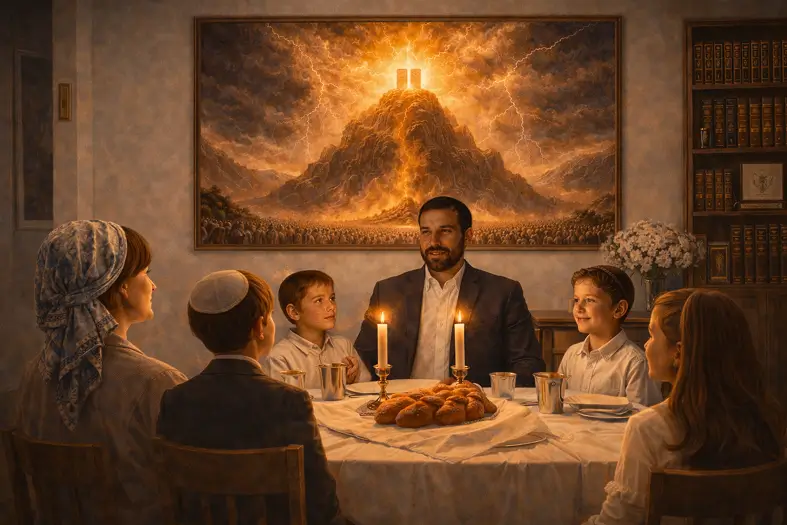
Shabbat dinner with Mount Sinai backdrop
“Sinai Now” asks how a people overwhelmed by noise can live covenantally. Drawing together all parts of the Parshas Yisro Divrei Torah series, it presents emunah as knowledge, structure as sustainability, memory as moral stability, clarity as perception, two-tablet ethics, and restraint as true holiness. “Standing from afar” describes modern distance; covenant calls us back to disciplined closeness.

"Yisro — Part VIII — Application for Today"

“Sinai Now”: Living as a Covenantal People in a World of Noise

Standing From Afar

The Torah describes the people at Sinai with a haunting phrase:
[וַיַּעַמְדוּ מֵרָחֹק — “and they stood from afar”].
It is not condemnation; it is diagnosis. Awe created distance. Fear preserved reverence—but it also risked disengagement. The covenant cannot survive at a distance. Sinai demands closeness disciplined by restraint, not withdrawal disguised as humility.

Our generation stands “from afar” in a different way. We are flooded with information, noise, opinion, and stimulation, yet starved of covenantal presence. Part VIII asks: what does it mean to live Sinai now?

Emunah as Knowledge, Not Mood (Part V)

Sinai does not ask us to feel G-d intermittently; it commands us to know Him consistently. Emunah, as developed in the “Anochi” part V divrei Torah series, is not sentiment but recognition—trained awareness that Hashem is real, involved, and authoritative.

In a world where belief is reduced to opinion and identity, Torah insists on disciplined thought. Living Sinai now means reclaiming emunah as intellectual avodah: reviewing truth until it becomes instinct, not slogan.

Distance begins when G-d is relegated to inspiration instead of reality.

Structure Before Burnout (Part II)

Yisro’s intervention reminds us that even holy work collapses without structure. Sinai does not create charismatic heroes; it builds sustainable systems. Delegation is not weakness—it is covenantal wisdom.

Our age prizes hustle and self-sacrifice. Torah insists on shared responsibility. A people who serve Hashem without structure eventually serve themselves or burn out entirely.

Covenantal life requires organization, boundaries, and trust in others.

Public Moral Memory (Part III)

Sinai was public because Torah rejects private mysticism as a foundation for society. Revelation that cannot be transmitted becomes fantasy. Truth that cannot be remembered dissolves.

In a culture that forgets quickly and reinvents constantly, Torah insists on memory—especially memory of redemption. Public rituals, shared narratives, and moral testimony are not nostalgic; they are stabilizing.

Standing “from afar” today often means outsourcing memory to devices and trends. Covenant demands we remember together.

Clarity of Perception (Part IV)

At Sinai, the senses unified. Sound was seen; fear clarified rather than confused. Truth arrived with objectivity. Today, perception is fragmented. We see endlessly, hear constantly, and understand little.

Living Sinai now means cultivating clarity—slowing down perception until truth can be distinguished from noise. Torah does not overwhelm; it orders.

Distance grows when clarity is lost.

Two Tablets, One Life (Part VI)

The two tablets insist that ethics and faith are inseparable. A Jew cannot claim closeness to Hashem while mistreating people, nor claim moral seriousness while dismissing transcendence.

Our age splits the tablets: spirituality without ethics, ethics without G-d. Sinai reunites them. Covenant means upward reverence and outward responsibility at once.

Standing from afar is choosing one tablet over the other.

Restraint as the Measure of Holiness (Part VII)

The altar laws teach that holiness must refuse violence—symbolic and actual. No iron. No steps. No spectacle. True avodah restrains power rather than displaying it.

In a world where religious passion can turn aggressive and ideology becomes weaponized, Torah insists: worship must be life-giving. Reverence is measured not by intensity, but by dignity.

Distance today often masquerades as zeal.

From Distance to Covenant

The people stood from afar because they were overwhelmed. We stand from afar because we are distracted. Sinai now calls for a different posture—not retreat, not frenzy, but disciplined closeness.

Covenantal life is not louder belief, purer feeling, or higher ascent. It is structured emunah, shared responsibility, remembered truth, clarified perception, unified ethics, and restrained holiness.

Sinai is not behind us. It is waiting for us to step closer—carefully, humbly, together.

📖 Sources

  • Full sources available on the Mitzvah Minute Parshas Yisro page under insights and commentaries.

Organized by:
Boaz Solowitch
February 3, 2026
Mitzvah Minute Logo Icon

Connections

Mitzvah Minute Logo Icon

Mitzvah Links

Mitzvah 1

To know there is a G‑d
A Siddur
Learn this Mitzvah

Mitzvah 1

1
To know there is a G‑d

Mitzvah 3

To know that He is One
A Siddur
Learn this Mitzvah

Mitzvah 3

3
To know that He is One

Mitzvah 5

To fear Him
A Siddur
Learn this Mitzvah

Mitzvah 5

5
To fear Him

Mitzvah 87

To rest on the seventh day
A Siddur
Learn this Mitzvah

Mitzvah 87

87
To rest on the seventh day

Mitzvah 88

Not to do prohibited labor on the seventh day
A Siddur
Learn this Mitzvah

Mitzvah 88

88
Not to do prohibited labor on the seventh day

Mitzvah 302

Not to build the altar with stones hewn by metal
A Siddur
Learn this Mitzvah

Mitzvah 302

302
Not to build the altar with stones hewn by metal

Mitzvah 303

Not to climb steps to the altar
A Siddur
Learn this Mitzvah

Mitzvah 303

303
Not to climb steps to the altar

Mitzvah 576

Not to testify falsely
A Siddur
Learn this Mitzvah

Mitzvah 576

576
Not to testify falsely

Mitzvah 6

To sanctify His Name
A Siddur
Learn this Mitzvah

Mitzvah 6

6
To sanctify His Name

Mitzvah 7

Not to profane His Name
A Siddur
Learn this Mitzvah

Mitzvah 7

7
Not to profane His Name
The Luchos - Ten Commandments
View Mitzvah Notes

Mitzvah Reference Notes

"x" close page navigation button

Mitzvah Reference Notes

“Sinai Now”: Living as a Covenantal People in a World of Noise

Mitzvah #1 — To know there is a G-d

אָנֹכִי ה׳ אֱלֹקֶיךָ
(Part V)

The foundation of covenantal life. Emunah as disciplined knowledge anchors all obligation and guards against faith becoming mood or ideology.

Mitzvah #3 — To know that He is One

שְׁמַע יִשְׂרָאֵל ה׳ אֶחָד
(Parts IV–V)

Unity restores perceptual clarity. Fragmented perception produces distance; unified truth enables covenantal closeness.

Mitzvah #5 — To fear Hashem

אֶת ה׳ אֱלֹקֶיךָ תִּירָא
(Parts IV & VII)

Yirah is expressed through restraint, humility, and design—not emotional excess. Reverence governs how one approaches power and presence.

Mitzvah #87 — To rest on the seventh day

(Part VI)

Shabbos structures time to preserve moral memory, clarity, and trust in Divine governance. It is lived emunah.

Mitzvah #88 — Not to do prohibited labor on the seventh day

(Part VI)

Restraint protects holiness. Without boundaries, sacred time dissolves into symbolism.

Mitzvah #302 — Not to build the altar with stones hewn by metal

(Part VII)

Holiness must reject violence and domination, even symbolically. Covenant refuses coercive power.

Mitzvah #303 — Not to climb steps to the altar

(Part VII)

Reverence is expressed through humility and dignity, not spectacle or self-display.

Mitzvah #576 — Not to testify falsely

(Part VI)

Truth in human speech sustains Divine testimony in the world. Moral collapse below erodes belief above.

Mitzvah #6 — To sanctify His Name

(Parts VI–VII)

Kiddush Hashem occurs when covenantal values shape public ethics, restraint, and dignity.

Mitzvah #7 — Not to profane His Name

(Parts VI–VII)

Unrestrained religiosity that harms others constitutes chillul Hashem. Covenant demands responsibility.

Parsha Links

יִתְרוֹ - Yisro

Haftarah: Isaiah 6:1-13
A Siddur
Learn this Parsha

יִתְרוֹ - Yisro

יִתְרוֹ - Yisro
The Luchos - Ten Commandments
View Parsha Notes
"x" close page navigation button

Parsha Reference Notes

“Sinai Now”: Living as a Covenantal People in a World of Noise

Parshas Yisro (Shemos 18:1–20:23)

Parshas Yisro moves from revelation to responsibility, teaching that covenant must be lived through knowledge, structure, memory, ethics, and restraint. Sinai becomes enduring only when its truths shape communal life.

Mitzvah Minute
Mitzvah Minute Logo

Learn more.

Dive into mitzvos, tefillah, and Torah study—each section curated to help you learn, reflect, and live with intention. New insights are added regularly, creating an evolving space for spiritual growth.

Luchos
Live a commandment-driven life

Mitzvah

Explore the 613 mitzvos and uncover the meaning behind each one. Discover practical ways to integrate them into your daily life with insights, sources, and guided reflection.

Learn more

Mitzvah #

1

To know there is a G‑d
The Luchos - Ten Commandments
Learn this Mitzvah

Mitzvah Highlight

Siddur
Connection through Davening

Tefillah

Learn the structure, depth, and spiritual intent behind Jewish prayer. Dive into morning blessings, Shema, Amidah, and more—with tools to enrich your daily connection.

Learn more

Tefillah

COMING SOON.
A Siddur
Learn this Tefillah

Tefillah Focus

A Sefer Torah
Study the weekly Torah portion

Parsha

Each week’s parsha offers timeless wisdom and modern relevance. Explore summaries, key themes, and mitzvah connections to deepen your understanding of the Torah cycle.

Learn more

יִתְרוֹ - Yisro

Haftarah: Isaiah 6:1-13
A Sefer Torah
Learn this Parsha

Weekly Parsha