Praying in the Dark: Yaakov’s Ladder and the Birth of Nighttime Faith
Vayifga BaMakom
1. Yaakov’s First Night in Exile
Vayeitzei opens with a simple line that hides a whole world of feeling:
“וַיֵּצֵא יַעֲקֹב מִבְּאֵר שָׁבַע וַיֵּלֶךְ חָרָנָה”
“Yaakov left Be’er Sheva and went to Charan.” (28:10)
Rashi notes that the Torah didn’t need to say “he went out.” It could have said only “he went to Charan.” From here Chazal teach: when a tzaddik leaves a place, he takes with him its hod, ziv, hadar—its glory, radiance, and beauty. Be’er Sheva is dimmer because Yaakov is gone.
That’s the emotional backdrop of the scene: a man who has just emptied his parents’ home of its last son, running from a murderous brother, walking alone into exile.
Then something strange happens.
The sun “jumps” down early. Yaakov is forced to stop for the night. He gathers stones around his head for protection, lies down on hard ground, and falls asleep.
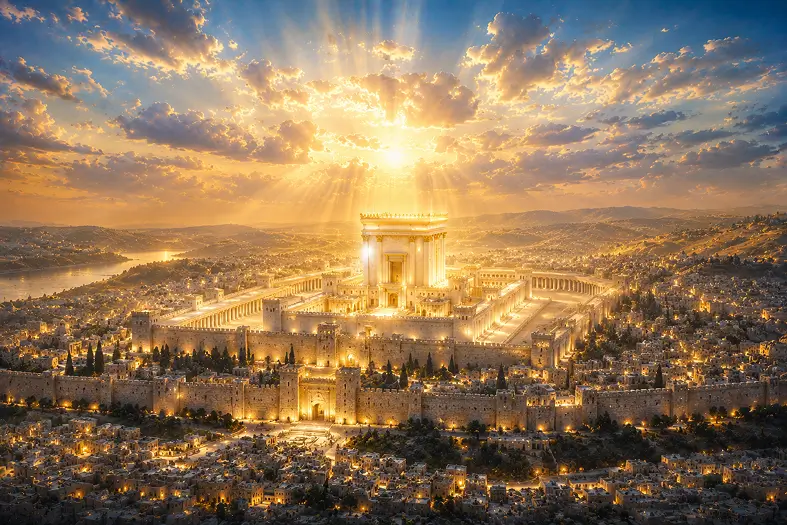
He does not yet know that the “random” place where exhaustion finally catches him is Har HaMoriah—the future Makom HaMikdash. Rashi, following Chazal, says this is the very site of the Akedah, the point on earth where heaven and earth will one day meet.
Yaakov thinks he’s just grabbing a night’s sleep on the road.
Hashem has set the stage for the birth of nighttime tefillah.
2. “Vayifga BaMakom” – When Prayer Finds You
The Torah describes the moment like this:
“וַיִּפְגַּע בַּמָּקוֹם” – “He encountered the place.” (28:11)
Rashi unpacks two words.
- “HaMakom” – the Place, not a place. It’s the same “Makom” Avraham saw “from afar” at the Akedah. Yaakov has been brought—without realizing it—to Har HaMoriah, the future Beit HaMikdash.
- “Vayifga” – On the surface, “he happened upon.” But Rashi brings the verse in Yirmiyahu, “אַל תִּפְגַּע בִּי – do not pray/intercede to Me,” and says vayifga also means tefillah. From here Chazal say: Yaakov instituted Tefillat Arvit.
Fascinatingly, the Torah does not say “vayitpallel.” Instead, it uses this softer, accidental-feeling word, vayifga—he bumped into, he collided with, he was struck by.
There’s a message in that:
Sometimes we don’t come to prayer.
Prayer comes to us.
Rashi adds another layer: kefitzat ha’aretz. The land “shrinks”; the holy mountain, so to speak, comes to meet Yaakov. He thought he had passed Har HaMoriah. Hashem folds the map, brings the Mikdash under his feet, and forces the encounter. The sun sets early just so he’ll have to stop here.
Ramban develops the geography. Yaakov’s stone pillow is not just a makeshift mattress; it’s aligned with the very axis of the future Beit HaMikdash—“Beit Elokim” and “Sha’ar HaShamayim,” the house of G-d and the gate of heaven. Prayer and Mikdash are welded together in this first night of exile. This is the place where tefillah goes straight up.
Yaakov wakes and says:
“אָכֵן יֵשׁ ה׳ בַּמָּקוֹם הַזֶּה וְאָנֹכִי לֹא יָדָעְתִּי… מַה נּוֹרָא הַמָּקוֹם הַזֶּה, אֵין זֶה כִּי אִם בֵּית אֱלֹקִים וְזֶה שַׁעַר הַשָּׁמָיִם.”
“Surely Hashem is in this place and I did not know… How awesome is this place! This is none other than the house of G-d, and this is the gate of heaven.” (28:16–17)
Rashi notes: “Had I known, I would not have slept here.” You don’t nap casually on Har HaMoriah. But that’s exactly the point: holiness here is discovered after the fact. The place was holy even when Yaakov didn’t feel it.
That’s a lifelong lesson in how tefillah works in exile. We often realize only later: “Achen yesh Hashem baMakom hazeh va’anochi lo yadati—Hashem was in that dark place, and I didn’t know.”
3. Rambam, Ralbag, and the Ladder of Reality
In the dream itself, Yaakov sees:
A ladder “set on the earth and its head in the heavens,”
malachim going up and down,
and Hashem standing above it.
For Rambam (Moreh II:6, II:10), the “angels” are not winged figures but the incorporeal forces and laws through which Hashem governs the world. They “ascend” to receive command, they “descend” to carry it out. The ladder is the ordered structure of reality itself.
Ralbag pushes this even more philosophically: the ladder is the total chain of being—from matter and life up through the separate intellects—all ultimately dependent on a single First Cause. Prophecy here is a crash course in metaphysics.
What does that have to do with praying in the dark?
Rambam in Moreh III:17–18 says that hashgachah pratit—personal providence—intensifies in proportion to a person’s knowledge of Hashem and moral refinement. In other words:
The more your mind and character line up with the true structure of the world,
the more your life is held and guided within that structure.
Yaakov’s ladder moment is not an escape from reality. It’s a revelation of reality.
Later in the parsha, Lavan relies on nichush and teraphim—superstitious tools to control the future. Yaakov’s response is completely different: he prays, works honestly, and lives as if the world is genuinely in Hashem’s hands.
Prayer, in the Rambam/Ralbag frame, is not magic. It’s the human being aligning with the ladder—turning fear, confusion, and desire into words addressed to the One who actually runs the system.
At night, when things feel chaotic, Ma’ariv is our way of climbing a few rungs into clarity.
4. Rav Kook – Night, Exile, and Kriyat Shema al haMitah
Chazal link each of the Avot with a daily tefillah:
- Avraham – Shacharit
- Yitzchak – Minchah
- Yaakov – Ma’ariv
Rav Kook sees more than a schedule here. Each prayer expresses a different mode of emunah:
- Morning is bright renewal – Avraham’s new world of chessed.
- Afternoon is steady continuity – Yitzchak’s avodah in the field.
- Night is darkness – Yaakov’s faith in exile, when you can’t see the road ahead.
At Beit El, Yaakov lies down with no guarantees. Esav is behind him, Lavan is ahead of him, and he has nothing but a staff in his hand. In that place, Ma’ariv is born.
Rav Kook connects this to Kriyat Shema al haMitah:
Before sleep, a person is asked to say Shema, review the day, forgive, entrust the soul to Hashem. Sleep is a mini-death; the future is hidden. Saying Shema on the pillow is reliving Yaakov’s act: lying down in an uncertain world and praying.
Nighttime faith is different from daytime faith.
- Daytime: I see the ladder; I feel the ascent.
- Nighttime: I see stones and fear. I trust that the ladder is there.
Ma’ariv and Shema al haMitah are the daily training in that kind of emunah.
5. Rabbi Sacks – Encountering G-d in the In-Between Places
Rabbi Jonathan Sacks zt”l points out that Yaakov’s Beit El moment comes not in a beit midrash or a family tent, but on the road, at a nameless “nowhere” between Be’er Sheva and Charan.
Yaakov is:
- far from parents,
- far from the Land,
- with no community and no plan beyond survival.
And there—specifically there—he discovers that “this place” is a gate of heaven.
Rabbi Sacks reads Vayifga BaMakom as the paradigm of spiritual awakening in the in-between spaces:
- airport lounges,
- hospital corridors,
- late-night car rides,
- hotel rooms on business trips,
- the insomniac moment at 2 a.m.
He writes that Jewish history begins to learn in Vayeitzei how to find Hashem not only in sanctuaries but in exile, not only in stability but in movement.
Prayer, then, is not reserved for ideal moods and holy settings. The first Ma’ariv is a scared man on cold ground who didn’t even mean to daven there.
The message:
If Yaakov’s rock can become a Mizbe’ach,
your bus stop, dorm room, or office stairwell can become a Beit El.
You don’t have to “feel ready.” Sometimes you say a pasuk, a Tehillim, a half-whispered “Ribono shel Olam, I’m lost,” and only afterwards realize: “Achen yesh Hashem baMakom hazeh.”
What does this teach us?
Here are the core teachings this moment gives us:
1. Holiness Can Appear in Unplanned Places
Yaakov was not in a synagogue. He was not preparing for davening. He was not spiritually “ready.”
He simply stopped because the sun went down too fast.
Lesson:
We often imagine that spiritual moments require preparation, quiet, atmosphere, or inspiration.
Vayeitzei teaches the opposite:
The holiest moments of life are sometimes the ones we didn’t plan, didn’t want, and didn’t recognize until later.
Jewish spirituality is not escapist. It happens in the middle of real life — on the road, while exhausted, confused, and scared.
2. Spiritual awareness is often hindsight
Yaakov says:
“אָכֵן יֵשׁ ה׳ בַּמָּקוֹם הַזֶּה וְאָנֹכִי לֹא יָדָעְתִּי —
Hashem was here, and I didn’t know.”
We almost always discover Divine presence retroactively:
- The crisis ends and only then do we see that we weren’t alone.
- The difficult journey finishes and only then do we see guidance woven through it.
- The “random moment” becomes the turning point of a life.
Lesson:
Spiritual awareness is often hindsight.
The work of Emunah is trusting that truth during the darkness.
3. Exile Is Not Absence — It Is Transformation
Vayeitzei is the first Jewish exile.
But look at what happens:
- Yaakov becomes the father of Israel in exile.
- He experiences his first nevuah in exile.
- He builds the foundations of prayer in exile.
- He becomes a “machaneh Elokim” (a camp of G-d) in exile.
This reframes a huge piece of Jewish history:
Exile is not a break from holiness.
Exile is where holiness matures.
Yaakov enters the night a fugitive.
He leaves the night a prophet.
The message for us:
Darkness does not diminish you.
Darkness shapes you.
4. Every Jew Has a “Beit El Moment” Waiting for Them
Maybe the biggest teaching of all:
Yaakov did not seek the dream.
He did not plan the tefillah.
He did not expect revelation.
But his moment came anyway.
It tells us:
- No Jew is too distant.
- No moment is too ordinary.
- No night is too dark.
- No place is too random.
- No heart is too unprepared.
Yaakov’s holiest moment came while he lay on the rocks, terrified and alone — because Hashem is everywhere, the orchestrator of all. The task of a Jew is to awaken that awareness, to recognize that G-d is with you anywhere, at any time, and in any emotional state.
📖 Sources
- Full sources available on the Mitzvah Minute Parshas Vayeitzei page.