2.1 — One Torah, Many Banners: Unity Without Losing the Self
Parshas Bamidbar does not gather Klal Yisrael into one color. It gathers them into one camp.
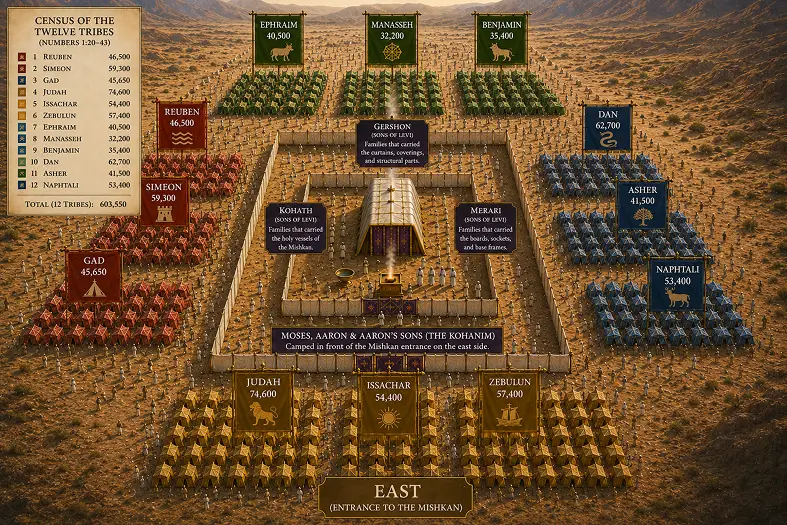
The Torah says, איש על דגלו באתת — “each person by his banner, with signs.” Every shevet — tribe has a place, a direction, and a visible identity. Yet the same pasuk continues, מנגד סביב לאהל מועד יחנו — “at a distance, around the Ohel Moed — Tent of Meeting they shall encamp.” The banners do not stand alone. They face the center.
This is the Torah’s answer to one of the deepest struggles of communal life. Some people fear that belonging means becoming ordinary. Others fear that being unique means standing apart. Bamidbar rejects both fears. Torah unity is not sameness. It is the harmony created when many different strengths serve one Hashem, one Torah, and one Mishkan — Sanctuary.
Rashi makes the banners concrete. Each shevet had its own color, connected to the stones of the חושן — breastplate. The camp order also followed the signs Yaakov Avinu gave his sons when they carried his aron — coffin. This means that the wilderness formation was not random organization. It grew from family root, inherited mission, and visible spiritual identity.
Ramban gives the camp majesty. The four camps below reflect higher order Above, connected to the חיות — living and the כסא הכבוד — Throne of Glory. Klal Yisrael is not inventing unity from human preference. The camp becomes a lower reflection of Divine order. Difference has dignity because it serves a heavenly pattern.
Abarbanel gives the image its clearest form. The Mishkan is the לב — heart, and the tribes are the איברים — limbs. A hand is not a foot. An eye is not an ear. Their greatness is not in becoming identical, but in receiving life from the same heart. When every limb stands in its proper place, the body has שלום — peace, and is complete.
Rav Kook reveals the inner Torah of the banners. Torah itself is one. It does not become twelve because there are twelve shevatim. Moshe Rabbeinu represents תורת משה — the Torah of Moshe: unified, central, and absolute. Yaakov Avinu represents the readiness of many different souls to receive that one Torah in different ways.
One soul approaches Torah through leadership. Another through learning. Another through support. Another through courage, compassion, song, discipline, or longing. These differences are not flaws. They are the many colors through which Klal Yisrael receives one light. Unity therefore does not require everyone to be the same. The camp becomes holy precisely because different strengths face the same center. Torah does not flatten the tribes into one personality. It teaches them how distinct paths can serve one Divine purpose without breaking apart the nation.
The Sfas Emes adds that a דגל — banner is also connected to דילוג — spiritual leaping. A person has a place, but he also has רצון — holy desire. He may not yet be where he longs to be, but longing itself can lift him. The banner gives direction; the leap gives life.
Rambam keeps this vision grounded. Difference becomes holy only when shaped by mitzvos — commandments, duty, and ‘עֲבוֹדַת ה — service of Hashem. A banner detached from the Mishkan becomes ego. A banner facing the Mishkan becomes service.
The camp of Bamidbar is therefore not decoration. It is redeemed individuality. Many banners, one center. Many soul-roots, one Torah. Many forms of avodah, one שכינה — Divine Presence.
A Torah community does not need every person to sound the same, think the same, or contribute in the same way. It needs every strength turned toward the same center.
One person builds. Another teaches. Another organizes. Another encourages. Another notices pain that others miss. Another brings discipline, warmth, beauty, clarity, or quiet loyalty. These differences become holy when they do not become competition.
The modern world often pulls people toward two mistakes: self-erasure or self-display. Bamidbar offers a better path. A person can honor his own color without worshiping it. He can contribute without surrendering the strengths Hashem gave him. He can stand under his banner while facing the Mishkan.
That is the peace of איש על דגלו — each person by his banner. The goal is not to become someone else. The goal is to bring one’s own strength into the shared service of Hashem.
📖 Sources


2.1 — One Torah, Many Banners: Unity Without Losing the Self
Parshas Bamidbar does not gather Klal Yisrael into one color. It gathers them into one camp.
The Torah says, איש על דגלו באתת — “each person by his banner, with signs.” Every shevet — tribe has a place, a direction, and a visible identity. Yet the same pasuk continues, מנגד סביב לאהל מועד יחנו — “at a distance, around the Ohel Moed — Tent of Meeting they shall encamp.” The banners do not stand alone. They face the center.
This is the Torah’s answer to one of the deepest struggles of communal life. Some people fear that belonging means becoming ordinary. Others fear that being unique means standing apart. Bamidbar rejects both fears. Torah unity is not sameness. It is the harmony created when many different strengths serve one Hashem, one Torah, and one Mishkan — Sanctuary.
Rashi makes the banners concrete. Each shevet had its own color, connected to the stones of the חושן — breastplate. The camp order also followed the signs Yaakov Avinu gave his sons when they carried his aron — coffin. This means that the wilderness formation was not random organization. It grew from family root, inherited mission, and visible spiritual identity.
Ramban gives the camp majesty. The four camps below reflect higher order Above, connected to the חיות — living and the כסא הכבוד — Throne of Glory. Klal Yisrael is not inventing unity from human preference. The camp becomes a lower reflection of Divine order. Difference has dignity because it serves a heavenly pattern.
Abarbanel gives the image its clearest form. The Mishkan is the לב — heart, and the tribes are the איברים — limbs. A hand is not a foot. An eye is not an ear. Their greatness is not in becoming identical, but in receiving life from the same heart. When every limb stands in its proper place, the body has שלום — peace, and is complete.
Rav Kook reveals the inner Torah of the banners. Torah itself is one. It does not become twelve because there are twelve shevatim. Moshe Rabbeinu represents תורת משה — the Torah of Moshe: unified, central, and absolute. Yaakov Avinu represents the readiness of many different souls to receive that one Torah in different ways.
One soul approaches Torah through leadership. Another through learning. Another through support. Another through courage, compassion, song, discipline, or longing. These differences are not flaws. They are the many colors through which Klal Yisrael receives one light. Unity therefore does not require everyone to be the same. The camp becomes holy precisely because different strengths face the same center. Torah does not flatten the tribes into one personality. It teaches them how distinct paths can serve one Divine purpose without breaking apart the nation.
The Sfas Emes adds that a דגל — banner is also connected to דילוג — spiritual leaping. A person has a place, but he also has רצון — holy desire. He may not yet be where he longs to be, but longing itself can lift him. The banner gives direction; the leap gives life.
Rambam keeps this vision grounded. Difference becomes holy only when shaped by mitzvos — commandments, duty, and ‘עֲבוֹדַת ה — service of Hashem. A banner detached from the Mishkan becomes ego. A banner facing the Mishkan becomes service.
The camp of Bamidbar is therefore not decoration. It is redeemed individuality. Many banners, one center. Many soul-roots, one Torah. Many forms of avodah, one שכינה — Divine Presence.
A Torah community does not need every person to sound the same, think the same, or contribute in the same way. It needs every strength turned toward the same center.
One person builds. Another teaches. Another organizes. Another encourages. Another notices pain that others miss. Another brings discipline, warmth, beauty, clarity, or quiet loyalty. These differences become holy when they do not become competition.
The modern world often pulls people toward two mistakes: self-erasure or self-display. Bamidbar offers a better path. A person can honor his own color without worshiping it. He can contribute without surrendering the strengths Hashem gave him. He can stand under his banner while facing the Mishkan.
That is the peace of איש על דגלו — each person by his banner. The goal is not to become someone else. The goal is to bring one’s own strength into the shared service of Hashem.
📖 Sources


“One Torah, Many Banners: Unity Without Losing the Self”
אָנֹכִי ה׳ אֱלֹקֶיךָ
The banners have meaning only because they face one Divine center. Each shevet — tribe carries its own mission, but no mission stands apart from Hashem. Bamidbar teaches that individuality becomes holy when it is rooted in the knowledge that Hashem is the source, center, and purpose of every Jewish path.
וּבוֹ תִדְבָּק
The camp teaches דבקות — cleaving to Hashem through ordered belonging. A Jew does not serve alone as a detached individual. He stands within Klal Yisrael, near Torah, near those who carry Torah, and near the Mishkan-centered life of the nation. Holy attachment gives personal difference a covenantal home.
וְשִׁנַּנְתָּם לְבָנֶיךָ
Rav Kook’s teaching that Torah is one while the souls receiving it are many gives this mitzvah special force. Torah must be learned and taught to many different kinds of Jews, each with his own spiritual language and strength. The דגלים — banners show that one Torah can enter many souls without becoming divided.
וְעָשׂוּ לִי מִקְדָּשׁ
The Mishkan — Sanctuary is the heart of the camp. Abarbanel’s image of the Mishkan as the לב — heart and the tribes as איברים — limbs shows that communal harmony depends on a sacred center. The mitzvah to build a Sanctuary gives Klal Yisrael a visible center around which every banner, family, and role can find its proper place.
וּמִקְדָּשִׁי תִּירָאוּ
The banners do not crowd the Mishkan or treat it casually. They encamp סביב — around it, with reverent distance and order. מורא מקדש — reverence for the Sanctuary means recognizing that even holy individuality must stand with humility before the center. The Mishkan gives life to the camp, and reverence keeps every banner facing Hashem.


“One Torah, Many Banners: Unity Without Losing the Self”
Parshas Bamidbar arranges Klal Yisrael through איש על דגלו באתת — “each person by his banner, with signs,” while also commanding מנגד סביב לאהל מועד יחנו — “at a distance, around the Ohel Moed they shall encamp.” The banners express tribal color, family root, direction, and mission, but their meaning comes from the Mishkan at the center. כאשר יחנו כן יסעו — “as they encamp, so shall they travel” teaches that holy identity must remain ordered even through movement and change.

Dive into mitzvos, tefillah, and Torah study—each section curated to help you learn, reflect, and live with intention. New insights are added regularly, creating an evolving space for spiritual growth.

Explore the 613 mitzvos and uncover the meaning behind each one. Discover practical ways to integrate them into your daily life with insights, sources, and guided reflection.

Learn the structure, depth, and spiritual intent behind Jewish prayer. Dive into morning blessings, Shema, Amidah, and more—with tools to enrich your daily connection.

Each week’s parsha offers timeless wisdom and modern relevance. Explore summaries, key themes, and mitzvah connections to deepen your understanding of the Torah cycle.