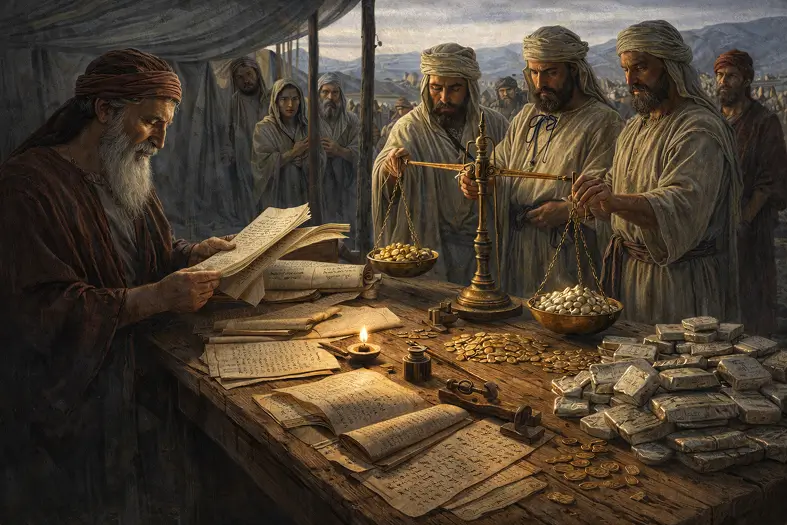
1.1 — Why the Torah Counts the Mishkan
Parshas Pekudei opens with a phrase that immediately shifts the tone of the Mishkan narrative:
שמות ל״ח:כ״א
“אֵלֶּה פְקוּדֵי הַמִּשְׁכָּן.”
“These are the accounts of the Mishkan.”
After the long description of generosity, craftsmanship, and construction in Parshas Vayakhel, the Torah now pauses to present a meticulous accounting of the materials used in building the sanctuary. Gold, silver, copper, and other contributions are enumerated carefully, detailing how the donations of the people were allocated in the creation of the Mishkan.
This moment might appear purely administrative, yet the Torah places it at the opening of an entire parsha. The structure of the narrative suggests that this accounting carries profound significance.
Rambam’s broader approach to communal leadership helps illuminate why the Torah emphasizes this inventory. In the Torah’s vision of society, leadership is not merely a position of authority but a responsibility rooted in trust. Those who manage communal resources must demonstrate integrity and accountability before the people they serve.
Even Moshe Rabbeinu—the greatest prophet and most trusted leader in Jewish history—does not assume that his authority alone is sufficient. Instead, the Torah records a detailed report of the materials entrusted to him.
This act establishes a fundamental principle of covenant society: holiness requires transparency.
Rashi explains that the accounting of the Mishkan was presented in order to remove any possibility of suspicion among the people. Although Moshe’s integrity was beyond question, the Torah nevertheless records that he publicly accounted for the materials donated for the sanctuary.
The Midrash describes how some individuals had begun whispering among themselves, wondering whether the vast quantities of gold and silver had been handled properly. Moshe therefore ordered that a full accounting be conducted.
The Torah records the result in precise detail.
By doing so, it demonstrates that leaders must avoid not only wrongdoing but even the appearance of wrongdoing. Public trust cannot depend solely on personal reputation; it must also be supported by transparency and clear accountability.
The Mishkan, which represents the dwelling place of the Divine Presence, must be built upon foundations of integrity that are visible to the entire community.
Rabbi Jonathan Sacks often wrote that one of the most fragile yet essential elements of any society is trust. Communities flourish when people believe that their leaders act with honesty and responsibility. When that trust erodes, institutions weaken and cooperation becomes difficult.
The Torah’s decision to record the accounting of the Mishkan reflects an awareness of this reality.
Moshe understood that even the most sacred project could not succeed without public confidence. By presenting a transparent record of how the donations were used, he ensured that the people could see that their contributions had been handled faithfully.
This act transforms the Mishkan from a private initiative into a shared national achievement.
Trust becomes the invisible structure supporting the visible sanctuary.
Rav Avigdor Miller often emphasized that the Torah places enormous importance on honesty in matters of money and public responsibility. Financial integrity is not merely a practical concern; it is a spiritual value that reflects reverence for the Divine presence within the community.
The Mishkan narrative illustrates this principle powerfully.
The sanctuary represents the highest expression of holiness in the Israelite camp. Yet the Torah makes clear that holiness cannot exist where suspicion or mistrust undermines the relationships between leaders and the people.
By publicly accounting for every contribution, Moshe establishes that sacred work must be accompanied by scrupulous honesty.
The spiritual atmosphere of the Mishkan depends not only on its rituals but also on the ethical conduct of those responsible for building it.
The opening of Parshas Pekudei therefore reveals a remarkable dimension of Torah leadership.
Moshe Rabbeinu, whose integrity was unquestioned, nevertheless subjects himself to public scrutiny. He does not rely on his authority to silence doubt or dismiss criticism. Instead, he responds by presenting a transparent record of the resources entrusted to him.
This act demonstrates that accountability strengthens leadership rather than weakening it.
By opening the books of the Mishkan to public view, Moshe transforms potential suspicion into renewed confidence.
The sanctuary that will soon host the Divine Presence is thus built upon a foundation not only of gold and craftsmanship but of trust.
The lessons of Parshas Pekudei remain deeply relevant in modern societies, where public trust in leadership is often fragile.
Communal institutions—whether religious, charitable, or civic—depend on the confidence of the people they serve. When leaders manage resources responsibly and transparently, communities are strengthened. When transparency is absent, suspicion and division quickly emerge.
The Torah therefore teaches that accountability is not merely a technical requirement of governance. It is a moral and spiritual responsibility.
Moshe Rabbeinu’s willingness to present a detailed accounting of the Mishkan demonstrates that even the most trusted leaders must remain accountable to the community.
In every generation, institutions flourish when leaders embrace transparency and integrity as essential components of sacred service.
The opening words of Parshas Pekudei remind us that holiness is sustained not only by devotion and creativity but also by trust.
📖 Sources


1.1 — Why the Torah Counts the Mishkan
Parshas Pekudei opens with a phrase that immediately shifts the tone of the Mishkan narrative:
שמות ל״ח:כ״א
“אֵלֶּה פְקוּדֵי הַמִּשְׁכָּן.”
“These are the accounts of the Mishkan.”
After the long description of generosity, craftsmanship, and construction in Parshas Vayakhel, the Torah now pauses to present a meticulous accounting of the materials used in building the sanctuary. Gold, silver, copper, and other contributions are enumerated carefully, detailing how the donations of the people were allocated in the creation of the Mishkan.
This moment might appear purely administrative, yet the Torah places it at the opening of an entire parsha. The structure of the narrative suggests that this accounting carries profound significance.
Rambam’s broader approach to communal leadership helps illuminate why the Torah emphasizes this inventory. In the Torah’s vision of society, leadership is not merely a position of authority but a responsibility rooted in trust. Those who manage communal resources must demonstrate integrity and accountability before the people they serve.
Even Moshe Rabbeinu—the greatest prophet and most trusted leader in Jewish history—does not assume that his authority alone is sufficient. Instead, the Torah records a detailed report of the materials entrusted to him.
This act establishes a fundamental principle of covenant society: holiness requires transparency.
Rashi explains that the accounting of the Mishkan was presented in order to remove any possibility of suspicion among the people. Although Moshe’s integrity was beyond question, the Torah nevertheless records that he publicly accounted for the materials donated for the sanctuary.
The Midrash describes how some individuals had begun whispering among themselves, wondering whether the vast quantities of gold and silver had been handled properly. Moshe therefore ordered that a full accounting be conducted.
The Torah records the result in precise detail.
By doing so, it demonstrates that leaders must avoid not only wrongdoing but even the appearance of wrongdoing. Public trust cannot depend solely on personal reputation; it must also be supported by transparency and clear accountability.
The Mishkan, which represents the dwelling place of the Divine Presence, must be built upon foundations of integrity that are visible to the entire community.
Rabbi Jonathan Sacks often wrote that one of the most fragile yet essential elements of any society is trust. Communities flourish when people believe that their leaders act with honesty and responsibility. When that trust erodes, institutions weaken and cooperation becomes difficult.
The Torah’s decision to record the accounting of the Mishkan reflects an awareness of this reality.
Moshe understood that even the most sacred project could not succeed without public confidence. By presenting a transparent record of how the donations were used, he ensured that the people could see that their contributions had been handled faithfully.
This act transforms the Mishkan from a private initiative into a shared national achievement.
Trust becomes the invisible structure supporting the visible sanctuary.
Rav Avigdor Miller often emphasized that the Torah places enormous importance on honesty in matters of money and public responsibility. Financial integrity is not merely a practical concern; it is a spiritual value that reflects reverence for the Divine presence within the community.
The Mishkan narrative illustrates this principle powerfully.
The sanctuary represents the highest expression of holiness in the Israelite camp. Yet the Torah makes clear that holiness cannot exist where suspicion or mistrust undermines the relationships between leaders and the people.
By publicly accounting for every contribution, Moshe establishes that sacred work must be accompanied by scrupulous honesty.
The spiritual atmosphere of the Mishkan depends not only on its rituals but also on the ethical conduct of those responsible for building it.
The opening of Parshas Pekudei therefore reveals a remarkable dimension of Torah leadership.
Moshe Rabbeinu, whose integrity was unquestioned, nevertheless subjects himself to public scrutiny. He does not rely on his authority to silence doubt or dismiss criticism. Instead, he responds by presenting a transparent record of the resources entrusted to him.
This act demonstrates that accountability strengthens leadership rather than weakening it.
By opening the books of the Mishkan to public view, Moshe transforms potential suspicion into renewed confidence.
The sanctuary that will soon host the Divine Presence is thus built upon a foundation not only of gold and craftsmanship but of trust.
The lessons of Parshas Pekudei remain deeply relevant in modern societies, where public trust in leadership is often fragile.
Communal institutions—whether religious, charitable, or civic—depend on the confidence of the people they serve. When leaders manage resources responsibly and transparently, communities are strengthened. When transparency is absent, suspicion and division quickly emerge.
The Torah therefore teaches that accountability is not merely a technical requirement of governance. It is a moral and spiritual responsibility.
Moshe Rabbeinu’s willingness to present a detailed accounting of the Mishkan demonstrates that even the most trusted leaders must remain accountable to the community.
In every generation, institutions flourish when leaders embrace transparency and integrity as essential components of sacred service.
The opening words of Parshas Pekudei remind us that holiness is sustained not only by devotion and creativity but also by trust.
📖 Sources


1.1 — Why the Torah Counts the Mishkan
Exodus 25:8 — וְעָשׂוּ לִי מִקְדָּשׁ
The commandment to build the Mishkan establishes the central institution through which the Divine Presence dwells among Israel. The detailed accounting presented in Parshas Pekudei demonstrates that the fulfillment of this mitzvah required careful stewardship of the materials entrusted to the leaders of the nation. Transparency in the management of communal resources ensured that the sanctuary would be built upon a foundation of integrity and public trust.
Deuteronomy 28:9 — וְהָלַכְתָּ בִּדְרָכָיו
The Torah commands human beings to imitate the attributes of Hashem, including justice, honesty, and integrity. Moshe’s decision to present a full accounting of the Mishkan materials reflects this principle. By acting with transparency and ethical responsibility, he demonstrates how leadership grounded in truthfulness mirrors the moral character that the Torah calls upon individuals to emulate.
Deuteronomy 10:20 — וּבוֹ תִדְבָּק
The Torah encourages individuals to attach themselves to leaders whose lives reflect devotion to Hashem and moral integrity. Moshe’s transparent accounting of the Mishkan resources exemplifies the type of leadership that inspires such trust. By openly demonstrating his accountability to the people, Moshe reinforces the covenantal relationship between righteous leadership and communal confidence.
Deuteronomy 15:8 — פָּתֹחַ תִּפְתַּח אֶת יָדֶךָ
The Mishkan was built through voluntary contributions offered by the people. The accounting recorded in Parshas Pekudei highlights the ethical responsibility of leaders to manage such donations faithfully. The Torah thus establishes that acts of generosity must be accompanied by responsible stewardship to preserve the trust that sustains communal life.


1.1 — Why the Torah Counts the Mishkan
"אֵלֶּה פְקוּדֵי הַמִּשְׁכָּן"
The Torah opens Parshas Pekudei with a detailed accounting of the materials used in constructing the Mishkan. This inventory demonstrates that the sacred project of building the sanctuary was accompanied by full transparency regarding the resources entrusted to its leaders.

Dive into mitzvos, tefillah, and Torah study—each section curated to help you learn, reflect, and live with intention. New insights are added regularly, creating an evolving space for spiritual growth.

Explore the 613 mitzvos and uncover the meaning behind each one. Discover practical ways to integrate them into your daily life with insights, sources, and guided reflection.

Learn the structure, depth, and spiritual intent behind Jewish prayer. Dive into morning blessings, Shema, Amidah, and more—with tools to enrich your daily connection.

Each week’s parsha offers timeless wisdom and modern relevance. Explore summaries, key themes, and mitzvah connections to deepen your understanding of the Torah cycle.