www.Mitzvah-Minute.com
"Pekudei — Part I — “אֵלֶּה פְקוּדֵי הַמִּשְׁכָּן”: Accountability and Sacred Trust"
1.2 — The Ethics of Sacred Stewardship
Rambam — Holiness and Responsibility
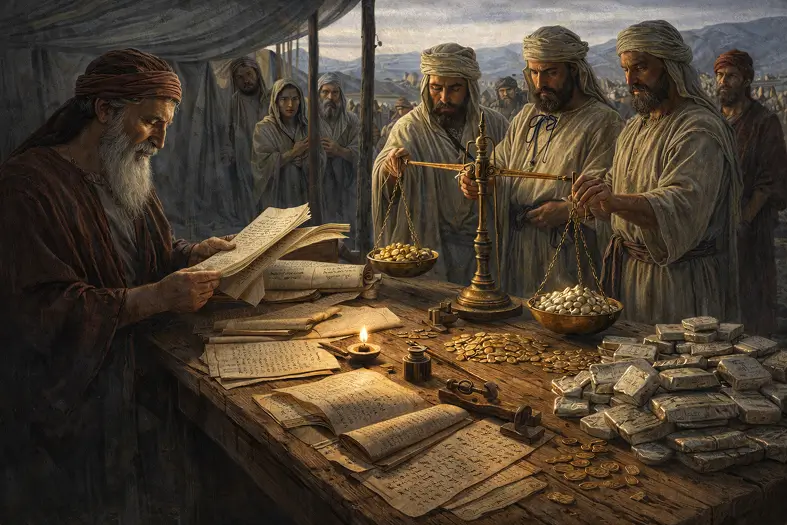
The opening section of Parshas Pekudei presents a detailed inventory of the materials used in the construction of the Mishkan. The Torah carefully enumerates the gold, silver, and copper that were donated by the people and explains how those resources were used in the creation of the sanctuary.
At first glance, the passage appears administrative. Yet the Torah devotes considerable attention to the accounting of these materials, indicating that the subject carries deep moral significance.
Rambam’s understanding of ethical leadership provides a framework for understanding why this accounting appears at such a critical moment in the narrative. In the Torah’s vision of communal life, those entrusted with public resources bear a profound responsibility. Leadership involves not only the authority to guide a sacred project but also the obligation to demonstrate integrity in managing the resources placed in one’s care.
The Mishkan represents the holiest institution within the Israelite camp. Yet precisely because of its sacred purpose, the Torah insists that every contribution be accounted for publicly.
Holiness does not exempt leaders from scrutiny. It requires a higher standard of responsibility.
Rashi — Guarding Against Suspicion
Rashi explains that the accounting of the Mishkan materials was conducted in order to remove any suspicion that might arise among the people. Although Moshe’s honesty was beyond question, the Torah nevertheless records that he presented a clear account of the donations.
Human communities are vulnerable to doubt and speculation, especially when large quantities of wealth are involved. Even in the context of a sacred project, whispers of uncertainty can undermine trust.
The Torah therefore demonstrates that ethical leadership requires vigilance not only against wrongdoing but also against the appearance of wrongdoing.
By presenting the accounting openly, Moshe ensures that the people understand exactly how their contributions were used.
Transparency becomes an essential safeguard for the integrity of the community.
Rabbi Jonathan Sacks — Institutions Built on Trust
Rabbi Jonathan Sacks often observed that trust functions as the invisible foundation of institutions. When individuals believe that leaders act responsibly and honestly, they are willing to support communal initiatives and contribute to shared projects.
When trust is damaged, even the most noble institutions struggle to survive.
The Torah’s detailed accounting of the Mishkan illustrates an early example of this principle. Moshe recognizes that the sanctuary cannot simply be built through generosity and craftsmanship. It must also be built upon confidence that the resources of the community have been handled with care.
The accounting recorded in Pekudei ensures that the Mishkan belongs to the entire nation.
By demonstrating transparency, Moshe reinforces the bond between the leaders of the community and the people they serve.
Rav Avigdor Miller — Integrity in Matters of Money
Rav Avigdor Miller frequently emphasized that honesty in financial matters occupies a central place in the Torah’s ethical system. Money has the power to influence human behavior in profound ways, and therefore the Torah demands extraordinary care when dealing with communal resources.
The construction of the Mishkan provides a powerful illustration of this principle.
The sanctuary is meant to house the Divine Presence. Yet the Torah teaches that such holiness cannot coexist with even the slightest suspicion of financial misconduct.
By accounting for every contribution, Moshe establishes a culture of integrity that protects the spiritual health of the community.
The Mishkan thus becomes not only a place of worship but also a symbol of ethical responsibility.
Holiness That Invites Scrutiny
The detailed accounting recorded in Parshas Pekudei conveys a powerful message about the nature of sacred leadership.
In many societies, individuals associated with religious institutions are sometimes assumed to operate beyond ordinary standards of accountability. The Torah rejects this notion entirely.
The Mishkan—the most sacred project undertaken by the nation—is accompanied by the most meticulous accounting.
Rather than shielding leadership from scrutiny, holiness invites greater scrutiny. Leaders entrusted with sacred responsibilities must demonstrate a level of ethical clarity that inspires confidence throughout the community.
The sanctuary built through such integrity becomes worthy of hosting the Divine Presence.
Application for Today
The lessons of Parshas Pekudei speak directly to the challenges faced by modern institutions, particularly those dedicated to religious and communal life.
Organizations that serve spiritual or charitable purposes often manage significant resources on behalf of the public. The Torah teaches that such responsibility must be accompanied by transparency and ethical discipline.
Leaders who openly account for their stewardship reinforce the trust that allows communities to flourish.
This principle extends beyond financial management. Ethical leadership requires a commitment to honesty, humility, and accountability in every aspect of communal life.
By insisting that even the holiest project be conducted with complete transparency, the Torah establishes a timeless standard for governance.
Sacred institutions thrive when their leaders recognize that integrity is not merely a practical necessity but a spiritual value.
📖 Sources
- Full sources available on the Mitzvah Minute Parshas Pekudei page under insights and commentaries