www.Mitzvah-Minute.com
"Tzav — Part VIII — לחיות אש תמיד: Living a Life of Steady Fire"
8.1 — A Life Built on Constancy
The Shift from Peak to Path
“אֵשׁ תָּמִיד תּוּקַד… לֹא תִכְבֶּה” does not describe a moment of greatness. It describes a condition that must be maintained.
The question is no longer how to reach moments of inspiration, but how to structure a life that sustains Torah and avodah every day.
Throughout Parshas Tzav, the Torah systematically dismantles the idea that avodas Hashem is defined by intensity. The fire is not meant to blaze unpredictably. It is meant to endure.
This is the final chidush of the parsha: a meaningful life is not built on peaks. It is built on continuity.
The אדם who seeks inspiration may experience moments of elevation. But the אדם who builds constancy creates a life.
Rav Kook: Life as Alignment, Not Experience
Rav Kook reframes avodah as alignment expressed through consistent actions, daily commitments, and lived patterns of behavior. The goal is not to feel close to Hashem in isolated moments, but to live in a way that is consistently aligned with His רצון.
Experience fluctuates. Alignment stabilizes.
The אש תמיד becomes the model for חיים של אמת — a life that reflects something unchanging. The אדם is no longer defined by what he feels in a given moment, but by the structure of his life as a whole.
This creates a profound shift:
- From seeking inspiration to sustaining direction
- From reacting to internal states to aligning with enduring truth
- From moments of connection to a continuous relationship
The fire does not define itself by how brightly it burns at any one time. It defines itself by the fact that it does not go out.
The Endurance That Outlasts Intensity
Intensity has a natural limitation. It cannot be sustained indefinitely. What rises sharply will inevitably fall.
The Torah does not build on what cannot last.
Instead, it builds on endurance — on actions that can be repeated, on commitments that can be maintained, on structures that do not collapse when emotion shifts.
This endurance is not dramatic. It is often quiet, unnoticed, even ordinary.
But it is powerful.
Over time, what is repeated becomes stable. What is stable becomes defining. And what is defining becomes the life itself.
Rabbi Jonathan Sacks: The Architecture of a Life
Rabbi Jonathan Sacks emphasizes that Torah does not only command individual acts; it designs a way of life. The mitzvos create rhythm — daily, weekly, yearly patterns that structure existence.
This rhythm transforms isolated acts into a coherent whole.
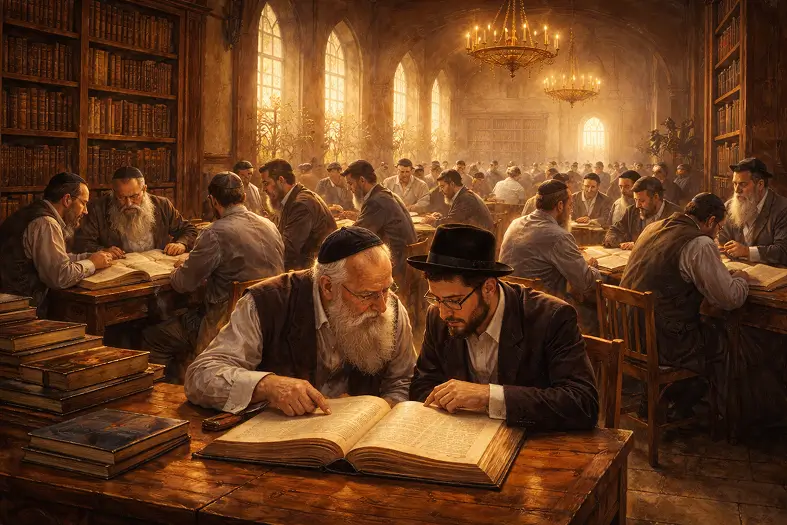
A person who lives within this structure is not constantly deciding how to act. He is living בתוך סדר — within an ordered framework that guides him.
This creates:
- Continuity across time
- Integration across different areas of life
- Stability across changing circumstances
The result is not a series of good moments, but a life that holds together.
Rav Avigdor Miller: The Greatness of the Ordinary
Rav Avigdor Miller consistently emphasizes that the greatness of avodas Hashem lies in what appears small. The daily mitzvos, the repeated actions, the quiet commitments — these form the substance of a meaningful life.
The dramatic moments are memorable. The repeated ones are formative.
A אדם who performs small acts consistently builds something far more enduring than one who relies on occasional intensity.
The אש תמיד reflects this principle. It is not extraordinary in any single moment. Its greatness lies in its persistence.
The Life That Does Not Break
A life built on inspiration is inherently unstable. When the inspiration fades, the structure weakens.
But a life built on constancy does not break.
It continues through difficulty, through distraction, through change. It does not depend on ideal conditions. It is sustained through commitment.
This creates a resilience that is not emotional, but structural.
The אדם does not need to recreate his connection each time. It is already in place.
From Fire to Life
The fire of the Mizbeach becomes a model not only for avodah, but for חיים.
It teaches that the goal is not to reach moments of intensity, but to build something that remains.
The אדם who internalizes this no longer measures his life by peaks, but by continuity. He looks not at how high he rises, but at how steadily he moves.
The fire burns. Not because it surges, but because it endures.
Application for Today
A life designed around constancy requires intentional structure. Without it, even strong intentions dissipate. The challenge is not knowing what matters, but ensuring that what matters is sustained.
This begins with defining anchors — fixed points in the day and week that do not shift with mood or circumstance. These may be small — a fixed time for tefillah, a daily moment of learning, a consistent act of chessed — but their power lies in their stability. These anchors create continuity, allowing growth to accumulate rather than reset.
It also requires reducing dependence on internal fluctuation. When actions are tied to feeling, they become inconsistent. When they are tied to structure, they become reliable.
Over time, this creates a system in which growth is not fragile. It does not depend on ideal conditions. It is built into the rhythm of life itself.
The result is a different kind of strength. Not the strength of intensity, but the strength of endurance.
A life that does not burn out, because it was never built on burning.
📖 Sources
- Full sources available on the Mitzvah Minute Parshas Tzav page under insights and commentaries