Each Parsha page on Mitzvah Minute is designed as a guided, three-level journey through the weekly Torah reading—integrating the narrative, the mitzvos, and the classical commentaries into one unified experience.
Begin with the foundations of the Parsha:
This level gives you the storyline, the key mitzvos, and the essential connections between them.
A complete journey through the parsha—moving from clarity and depth to inner connection and real-world meaning, culminating in a way to live its ideas in everyday life.
These sections show how the Parsha speaks to the mind, the heart, and the real world — offering wisdom rooted in enduring Torah.
A complete, structured commentary on the parsha—presented pasuk by pasuk, with chapter and overall summaries for clarity and flow.
This level reveals the structural depth of the Parsha and the classical underpinnings of each theme.
Together, these layers create a complete Parsha journey —
narrative, mitzvah, and commentary — all flowing toward deeper understanding, spiritual insight, and meaningful growth.
Tap the Page Navigation tab on the right side of your screen anytime to access quick-links to the entire Parsha page.
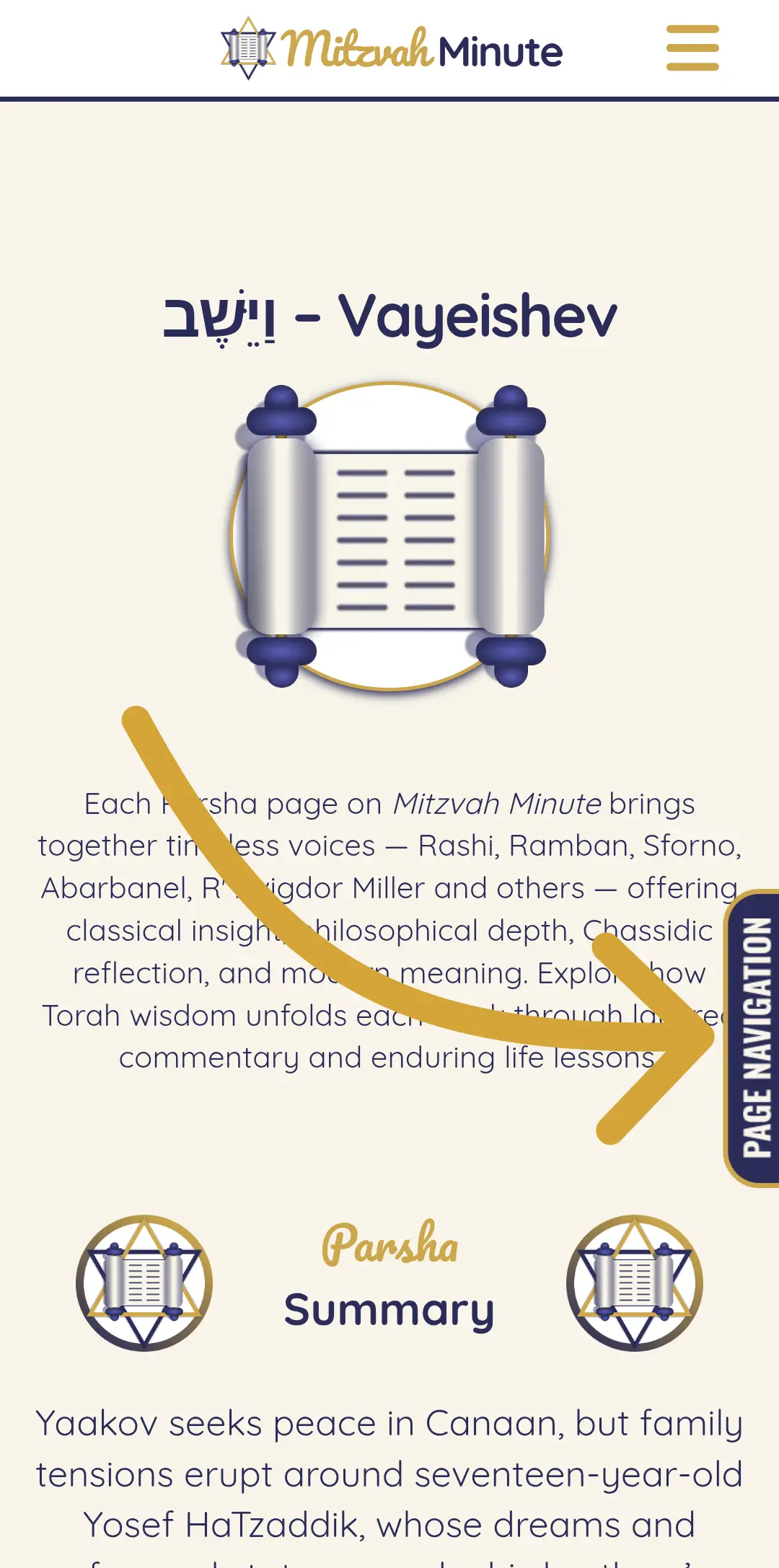
The quick-link panel gives instant access to every section — Parsha Summary, Mitzvos, Divrei Torah, Insights, and Commentaries.
“Every word of Torah and every mitzvah lifts us higher — may your learning bring you closer to Hashem.”

Parshas Tzav continues the laws of korbanos with a new emphasis on constancy, precision, and the daily discipline of avodas Hashem. The Torah details the ongoing service of the Mizbeach — the perpetual fire that must never be extinguished, the daily removal of ashes, and the structured rhythm through which offerings are maintained. It outlines the specific laws governing the עולה, מנחה, חטאת, אשם, and שלמים, clarifying how each korban is brought, consumed, and safeguarded within a system of קדושה that extends to people, garments, and vessels alike. The parsha culminates in the שבעת ימי המילואים, the inauguration of Aharon and his sons into the כהונה. In a public and meticulously ordered ceremony, they are washed, clothed, anointed, and consecrated through korbanos and symbolic acts, formally establishing the avodah of the Mishkan. Tzav thus transforms the concept of korbanos from individual offerings into a continuous, communal system — a structured path through which Klal Yisroel sustains an enduring relationship with Hashem.

"The Fire That Must Not Go Out — Constancy, Discipline, and the Architecture of Avodah"
אֵשׁ תָּמִיד תּוּקַד עַל־הַמִּזְבֵּחַ לֹא תִכְבֶּה
At the heart of Parshas Tzav stands the אש תמיד — a fire that must never cease. This mitzvah establishes that עבודת ה׳ is not defined by moments of elevation, but by uninterrupted continuity. The Kohanim are charged not simply with kindling, but with sustaining — building a system in which the presence of the fire is constant, guarded, and renewed daily.
Rashi reveals that the מזבח is not a stage of isolated acts, but a living מערכת — a continuous flow of avodah. Ramban deepens this by framing the fire as governed by both obligation and prohibition: it must be actively maintained and never extinguished.
Parshas Tzav teaches that true connection to Hashem is not created in a single act of inspiration. Like the fire, it must be tended, structured, and protected — until constancy itself becomes the highest form of avodah.
לֹא תִכְבֶּה
This mitzvah safeguards the continuity established by the אש תמיד. If the previous command builds the system, this one preserves it.
Ramban emphasizes that even diminishing a single flame violates this prohibition, revealing how fragile continuity can be. קדושה is not only created through action, but sustained through restraint.
Parshas Tzav teaches that עבודת ה׳ requires vigilance. Growth is not only about advancing, but about protecting what has already been achieved from erosion and neglect.
וְהֵרִים אֶת־הַדֶּשֶׁן
The תרומת הדשן transforms maintenance into avodah. What appears to be residue is elevated and integrated into the ongoing service.
Rashi shows that even this act is governed by סדר — structure and dignity — reflecting that nothing in the Mishkan is incidental. The ashes represent yesterday’s avodah carried into today.
Parshas Tzav teaches that עבודת ה׳ includes refinement and continuity. Even what remains after the fire has burned becomes part of the next stage of growth.
אֶת־הַכֶּבֶשׂ הָאֶחָד תַּעֲשֶׂה בַבֹּקֶר
The קרבן תמיד establishes the fixed rhythm of avodah, anchoring the day with constancy at its beginning and end.
Rashi teaches that all offerings are framed around it, creating a hierarchy of service. Rambam sees in this repetition the formation of character through consistent action.
Parshas Tzav reveals that time itself is structured for connection — a life aligned with Hashem is built through daily return, not occasional intensity.
אִם־עֹלָה קָרְבָּנוֹ
The עולה represents total elevation, entirely consumed upon the מזבח. In Tzav, its burning continues through the night, extending the avodah beyond the moment of offering.
Ramban explains that this continuation reflects a process, not a point. Avodah unfolds over time, not only in action.
Parshas Tzav teaches that true dedication persists beyond the רגע — it continues to shape the person even after the act is complete.
זֹאת תּוֹרַת הַחַטָּאת
The חטאת defines the structure of repair. Its laws establish who may partake and under what conditions, reinforcing boundaries within קדושה.
Rashi emphasizes eligibility, while Ramban frames it within precise categories of sanctity.
Parshas Tzav teaches that correction is not abstract. Teshuvah is expressed through defined action, restoring alignment through structured avodah.
זֹאת תּוֹרַת הָאָשָׁם
The אשם addresses more subtle forms of responsibility, including doubt and misuse.
Ramban highlights that each korban reflects a distinct category of failure, not interchangeable with others.
Parshas Tzav teaches that עבודת ה׳ recognizes nuance. Growth requires clarity — understanding the nature of one’s actions and responding with the appropriate תיקון.
זֹאת תּוֹרַת זֶבַח הַשְּׁלָמִים
The שלמים create a shared experience of avodah between האדם, the כהנים, and the מזבח.
Rashi emphasizes that even harmony is structured through precise זמן and מקום.
Parshas Tzav teaches that connection to Hashem includes integration — bringing multiple dimensions of life into a unified framework of קדושה.
The law of פיגול reveals that מחשבה has halachic consequence.
Rashi teaches that improper intent during avodah invalidates the korban itself, while Ramban explores the role of intention in defining status.
Parshas Tzav teaches that עבודת ה׳ requires alignment of inner and outer worlds. Thought is not secondary — it defines the act.
וְהַנּוֹתָר בָּאֵשׁ תִּשְׂרֹפוּ
What remains beyond its proper זמן must be completed through burning, preserving the integrity of the system.
This parallels the תרומת הדשן — both address what remains after the primary act.
Parshas Tzav teaches that even endings require structure. Completion is part of avodah, not separate from it.
וְקִדַּשְׁתּוֹ
The Kohen is honored because he embodies the system of avodah.
In Tzav, where the Kohanim are formed through precise obedience “כאשר צוה ה׳,” this mitzvah reflects the dignity of their role.
Honoring the Kohen affirms that עבודת ה׳ depends not only on structure, but on those entrusted to sustain it.
בִגְדֵי־קֹדֶשׁ
The בגדי כהונה express כבוד העבודה — the dignity of service.
Ramban teaches that garments reflect hierarchy within avodah, distinguishing levels of קדושה.
Parshas Tzav teaches that how one serves matters — presence, dignity, and awareness are part of עבודת ה׳.
וְרָחֲצוּ
The Kohen prepares before entering avodah, transitioning from ordinary state to sacred service.
This act establishes readiness and awareness.
Parshas Tzav teaches that one does not enter קדושה casually — preparation itself is part of avodah.
וַעֲבַדְתֶּם אֵת ה׳ אֱלֹקֵיכֶם
Tefillah mirrors the תמיד, creating a daily rhythm of connection.
Chazal define it as עבודה שבלב, continuing the structure of korbanos in the absence of the Mikdash.
Parshas Tzav teaches that avodah must remain constant — the form may change, but the rhythm endures.
וְהִתְוַדּוּ
Teshuvah is expressed through recognition, confession, and realignment.
Rambam defines it as a structured process, not an emotional impulse.
Parshas Tzav teaches that repair follows order — just as korbanos follow precise סדר, so too does return to Hashem.
אָנֹכִי ה׳ אֱלֹקֶיךָ
All avodah rests on awareness of Hashem’s presence.
The Mishkan transforms this awareness into lived reality.
Parshas Tzav teaches that the אש תמיד reflects constant consciousness — knowing that one stands before Hashem at all times.
ה׳ אֶחָד
Unity of Hashem underlies the entire system of avodah.
Despite many actions and categories, all service is directed toward one source.
Parshas Tzav teaches that multiplicity in avodah is unified in purpose — everything returns to אחד.
וְאָהַבְתָּ אֵת ה׳ אֱלֹקֶיךָ
Love is expressed through sustained devotion.
The עולה, entirely consumed, reflects total dedication.
Parshas Tzav teaches that love is not only emotional — it is expressed through constancy and commitment.
אֶת ה׳ אֱלֹקֶיךָ תִּירָא
Yirah establishes boundaries within avodah.
The precision of korbanos reflects reverence — awareness of standing before Hashem.
Parshas Tzav teaches that awe creates structure, ensuring that closeness does not become casual.
Parshas Tzav reveals a complete system of life:
A fire that must be maintained,
A structure that must be followed,
A heart that must be aligned,
And a belief that must be constant.
Every mitzvah becomes part of a single truth:
Avodas Hashem is not a moment — it is a sustained, living system of connection.

Rashi opens the parsha with a foundational lens: the word “צו” is not merely a command, but a לשון זירוז — an expression of urgency that applies both immediately and לדורות. This framing is not incidental; it establishes that עבודת הקרבנות is not sustained by inspiration alone, but by disciplined consistency. Rashi, citing חז״ל, emphasizes that where there is חסרון כיס — financial cost — the Torah intensifies its language to counter human resistance.
The deeper insight is that עבודת ה׳ requires overcoming טבע האדם — human inertia. The avodah of the Mishkan is structured to cultivate זריזות not only in action, but in attitude: a readiness to serve even when there is effort, expense, or routine. The קורבנות thus become not only offerings, but a training ground for רצון aligned with Divine command.
Throughout the opening פרשיות, Rashi consistently shifts the reader away from viewing korbanos as isolated rituals. Instead, he presents the מזבח as a continuous system. The אש תמיד — perpetual fire — is not symbolic alone; it is halachically structured, with multiple מערכות (wood arrangements), each derived from the Torah’s repeated language (יומא מה ע״ב).
The תרומת הדשן — removal of ashes — further reinforces this idea. What might appear as mere maintenance is elevated into avodah. The Kohen carefully lifts ashes from the innermost consumed area and places them beside the מזבח, transforming residue into ritual. Even the act of changing garments before removing excess ash teaches that continuity requires both reverence and סדר (order).
Rashi reveals that the Mishkan is not a place of sporadic holiness, but a living מערכת — a system sustained through ongoing care. קדושה is preserved not only in peak moments of offering, but in the quiet constancy of daily service.
A central theme in Rashi’s reading is the precise boundary of what belongs on the מזבח. The phrase “זאת תורת העלה” introduces a sweeping principle: תורה אחת — a unified law governs all that ascends the altar. Even פסולין — disqualified offerings — may remain if their פסול occurred after reaching the מזבח (זבחים כז ע״ב).
Yet Rashi sharply limits this inclusion through the word “הוא.” Certain categories, such as רובע ונרבע (animals involved in prohibited acts), whose פסול existed prior to entering קדש, must be removed.
This distinction reflects a deeper idea:
The מזבח becomes a מקום הכרעה — a place of determination — defining the line between elevation and rejection. Not everything can be uplifted; entry into קדושה requires prior fitness.
Rashi highlights that avodah is governed by strict סדר. The תמיד של שחר — the morning offering — must precede all other korbanos (מנחות מט ע״א). Likewise, no offering may follow the תמיד של בין הערבים (פסחים נח ע״א).
This establishes that korbanos are not a collection of independent acts, but part of a structured sequence. Each offering has its מקום and זמן. Even the fats of שלמים are integrated into this system, placed upon the ongoing framework of the תמיד.
The insight is that עבודת ה׳ requires hierarchy. Not all actions are equal; some serve as foundations upon which others rest. The תמיד functions as the axis of the day’s avodah, anchoring all subsequent offerings within a unified order.
Rashi repeatedly returns to the principle that קדושה transfers when another food absorbs from the korban; at which point it takes on the korban’s status and restrictions. In other words, food — whether קדשים קלים or even חולין — touches a sacred offering and absorbs from it, it assumes its status (זבחים צ״ז ע״ב).
This transformation is precise:
Similarly, garments that absorb blood from a חטאת require washing in a מקום קדוש. Vessels absorb and retain sanctity differently: כלי חרס must be broken, while כלי מתכת can be purified.
Rashi’s consistent message is that קדושה is not static. It is dynamic, contagious, and exacting. Contact with holiness elevates — but also obligates. One who enters the realm of קדושה cannot remain unchanged.
Rashi carefully defines who may partake in korbanos. The phrase “הכהן המחטא אותה יאכלנה” does not restrict eating to a single Kohen, but to those ראויים לעבודה — fit for service.
This excludes individuals in transitional or deficient states, such as:
At the same time, Rashi includes even a כהן בעל מום in the חלוקה — distribution — of offerings, though his participation is limited.
The deeper structure here is that avodah is both inclusive and bounded. It recognizes belonging to the כהונה while maintaining strict standards for participation. קדושה demands eligibility, not merely identity.
Rashi’s treatment of the קרבן תודה reveals a powerful synthesis of experience and halacha. The תודה is brought in response to salvation — journeys through danger, illness, or captivity — echoing תהילים ק״ז.
Yet gratitude is not left as emotion alone. It is structured through:
This compression of זמן (one day and one night) intensifies the act of gratitude, forcing it into immediacy and awareness.
Rashi shows that recognition of חסדי ה׳ must be expressed concretely, with form and limitation. Gratitude becomes avodah when it is disciplined, measured, and directed.
One of Rashi’s most striking insights emerges in the laws of פגול. The invalidation of a korban can occur not through action, but through מחשבה — intent during the avodah (זבחים כ״ט ע״א).
If one intends to eat the offering outside its permitted time, the korban becomes פגול at the moment of service. The act of eating later merely reveals the status already determined.
This reveals a profound dimension:
Rashi highlights that designated מחשבה during the avodah — such as intent to eat outside the permitted time — can itself determine the korban’s status.
Avodah is not merely physical precision; it is alignment of thought. The Mishkan becomes a מקום where פנימיות — inner intention — carries halachic consequence.
Rashi’s treatment of the שבעת ימי המילואים — the seven days of inauguration — brings Parshas Tzav to its climax by shifting from the system of korbanos to the formation of those who will sustain it. If the earlier sections establish the laws of avodah, the miluim establish the האדם העובד — the Kohen himself — as a vessel of קדושה.
At the center of this process is exact obedience. Rashi repeatedly emphasizes that every act performed by Moshe during these days — the dressing of Aharon and his sons, the משיחה — anointing, the offering of the special korbanos, and the שבעת ימים of repetition — follows precisely “כאשר צוה ה׳.” The Torah underscores this refrain to teach that consecration is not achieved through inspiration or elevation alone, but through complete alignment with the רצון ה׳ as commanded.
Rashi also highlights the unique nature of the קרבנות המילואים themselves. These offerings are not merely functional sacrifices, but formative acts that initiate the כהנים into their role. Through the application of blood to specific parts of the body — ear, thumb, and toe — the Kohen is symbolically and halachically dedicated in all dimensions of action:
In Rashi’s framework, this is not allegory alone, but a concrete process of designation. The Kohen becomes set apart through a structured סדר of actions that define his identity as one who serves.
Equally significant is the requirement that Aharon and his sons remain within the פתח אהל מועד — the entrance of the Tent of Meeting — for seven consecutive days. Rashi explains that they may not depart, emphasizing that consecration requires immersion — a total dwelling within the environment of קדושה. The Mishkan is not only a מקום עבודה, but a formative space in which the Kohen is shaped through presence and continuity.
Finally, Rashi stresses that these seven days are not a one-time event, but a model לדורות — for future generations. The miluim establish the paradigm for initiation into avodah: precision, repetition, and unwavering adherence to command. Just as the אש תמיד must be maintained without interruption, so too the transmission of כהונה depends on faithful reenactment of this foundational moment.
Through the miluim, Rashi reveals the ultimate message of Parshas Tzav: avodah is not sustained by structure alone, but by individuals who have been formed through obedience. קדושה resides not only in the korban and the מזבח, but in the disciplined האדם who serves — one whose actions, movements, and presence are entirely aligned with the will of Hashem.
Rashi’s presentation of Parshas Tzav constructs a unified vision: עבודת הקרבנות is a system defined by constancy, order, and גבולות (boundaries). From the urgency of צו, to the perpetual fire, to the structured סדר of offerings, the parsha reveals that closeness to Hashem is not achieved through isolated acts, but through sustained discipline.
קדושה emerges where precision, intention, and continuity converge. The Mishkan is not only a מקום הקרבה — a place of offering — but a model of חיים מסודרים, a life ordered around Divine service.
Through Rashi, Tzav teaches that true elevation lies not in moments of inspiration alone, but in the steady, exacting rhythm of avodah that transforms every act into חלק מעבודת ה׳.
📖 Source
Ramban opens Parshas Tzav by identifying a fundamental transition in Sefer Vayikra. In Parshas Vayikra, the Torah speaks to כלל ישראל — those who bring korbanos. Here, the Torah addresses the כהנים, those who perform them. This is not a stylistic shift, but a conceptual one: from obligation to execution, from intent to realized avodah.
The language of “צו” reflects this transition. Ramban challenges applying Rabbi Shimon’s concept of חסרון כיס directly in this context, since the כהנים receive portions of the korbanos and appear to benefit rather than incur loss. However, he briefly considers whether the later obligations placed upon the כהנים — such as “זה קרבן אהרן ובניו” — might introduce an element of expense. Ultimately, Ramban concludes that the Sifra presents these views as fundamentally distinct: the תנא קמא understands “צו” as a general expression of זירוז — urgency — while רבי שמעון limits its usage to cases involving חסרון כיס. Ramban thus frames the term as part of a broader מחלוקת in חז״ל regarding how language functions in Torah. The result is a deeper insight: the Torah speaks differently when addressing those responsible for carrying out the system of קדושה. The כהנים are not merely participants; they are custodians of the avodah’s integrity.
Where Rashi often reads “תורת” as expansive — a ribui (inclusion) — Ramban sharply refines its scope. “זֹאת תּוֹרַת הָעֹלָה” does not create a universal rule for everything placed on the מזבח, but defines a specific halachic category: עולה-type offerings.
Ramban carefully distinguishes between components of the korban system:
This distinction is crucial. Ramban demonstrates that halachic categories are not interchangeable; each element — animal, blood, libations — has its own דין rooted in the פסוק. The Torah’s language is not poetic redundancy, but a precise legal architecture.
Ramban develops a sophisticated framework of זמן — sacred time — within the avodah. The פסוק teaches that while the essential acts of הקרבה — slaughter and זריקת הדם (blood application) — must occur ביום, the הקטרת האיברים (burning of limbs) extends into the night.
However, Ramban emphasizes that this nighttime process is not independent. It is an extension of the day’s avodah:
Even the requirement to bring limbs onto the מזבח at night is not derived from this פסוק, but from “לֹא יָלִין חֵלֶב חַגִּי” (שמות כג:יח). Thus, Ramban distinguishes between:
Time in the Mikdash is not continuous in a simple sense — it is structured, segmented, and governed by halachic boundaries.
Ramban develops the אש תמיד into a fully defined halachic system. The fire on the מזבח is governed by two simultaneous dimensions:
This duality reveals that avodah is not merely about performing acts, but about preserving conditions. The כהנים must actively sustain the fire during the day to ensure its survival at night.
Ramban further expands the scope: The prohibition of extinguishing applies broadly — even to extinguishing a single coal — though Ramban clarifies that despite multiple expressions, this constitutes a single לאו. The אש המזבח thus becomes a universal point of קדושה, whose continuity is guarded by both action and restraint.
In Ramban’s reading, the בגדי כהונה — priestly garments — are not merely functional, but expressive of כבוד העבודה — the dignity of Divine service. He disputes Rashi’s suggestion that changing garments for removing ashes is merely דרך ארץ. Instead, Ramban frames it as a halachic and conceptual necessity.
Ramban treats the change of garments as a matter of avodah dignity rather than mere etiquette, while also noting the view that the removal of ashes may be done in non-sacred garments, which he says fits the פשוטו של מקרא. Therefore:
This reflects a broader principle: עבודת ה׳ requires not only correctness, but presentation. The Mikdash demands a visible hierarchy of dignity, where even clothing reflects the structure of קדושה.
Ramban consistently reframes halacha in terms of categories rather than isolated rules. This is especially evident in his treatment of:
For example, the phrase “כחטאת וכאשם” is not merely comparative — it establishes shared halachic properties:
Similarly, Ramban explains that the prohibition of חלב (forbidden fats) is not tied to specific korbanos, but to species — שור, כשב, עז. The Torah defines systems through classification, not circumstance.
Ramban develops the laws of בליעה — absorption — into a broader theory of קדושה. When sacred substances are absorbed into garments or vessels, their sanctity persists and demands response:
He emphasizes that all of these laws are governed by the phrase “במקום קדוש.” Sanctity is not only about objects, but about where and how they are treated.
The insight is that קדושה penetrates — it leaves an imprint that cannot be ignored. Contact with holiness creates obligation, even after the original act is complete.
Ramban deepens the concept of פסול by analyzing the role of intent. In the case of bringing blood into the wrong מקום (e.g., into the היכל), the פסול may depend not only on the action, but on the intention “לכפר” — to effect atonement.
He distinguishes between:
Ramban analyzes whether bringing the blood inward with the intent of פנימית כפרה already invalidates the korban, or whether actual performance is required, depending on the view.
Ramban’s analysis of חלוקת הקרבנות — distribution of offerings — reveals a social philosophy embedded in halacha. While the פסוקים might suggest that the כהן המקריב receives specific portions, חז״ל establish that all כהנים of the משמר share equally.
Ramban explains this through a powerful model:
The כהן who performs the עבודה acts as a שליח — a representative — of the entire כהונה.
He compares this to soldiers dividing spoils: those who fight and those who guard share equally. This ensures:
The avodah is thus not individualistic, but collective. The Mikdash operates as a unified גוף, not as a collection of private roles.
In the קרבן תודה, Ramban uncovers a layered structure of meaning. Ramban insists that the term ‘על’ retains its literal force, so the bread is structured upon the תודה rather than merely accompanying it, and its sanctity takes effect with the שחיטה. The presence of חמץ alongside מצה reflects a complex system of balance and composition.
He also clarifies that the bread does not attain קדושה until the moment of שחיטה, linking intention and action into a unified moment of sanctification.
Gratitude, in Ramban’s framework, is not spontaneous. It is constructed, measured, and integrated into the system of korbanos. The תודה becomes a model of how human response is shaped into avodah.
Ramban concludes by anchoring the entire system of korbanos in הר סיני — not only as a historical event, but as an ongoing source of authority. The תורה’s reference to “בהר סיני” does not mean on the mountain itself, but in its surrounding encampment — where the Mishkan stood.
This unites two worlds:
The Mikdash becomes the מקום where Sinai is lived. The laws of korbanos are not new instructions, but the unfolding of what was already given — now translated into daily avodah.
Ramban’s treatment of the פרשת המילואים brings Parshas Tzav to its conceptual conclusion by addressing not only how the avodah is performed, but how authority to perform it is established. The שבעת ימי המילואים — the seven days of inauguration — are not merely preparatory; they are the moment in which כהונה is formally constituted through a precise סדר of commanded actions.
Ramban strongly resists the notion that this section is out of chronological order. Against the principle of אין מוקדם ומאוחר בתורה as applied by Rashi, he argues that the Torah maintains a coherent narrative flow. The command to erect the Mishkan, followed by Hashem’s calling to Moshe from within it, naturally leads into the consecration of Aharon and his sons. This preserves the integrity of the sequence: revelation, construction, and then activation through avodah.
Within this framework, the miluim represent the transition from potential to authorized service. Aharon and his sons do not assume their roles independently; they are installed through Moshe acting by Divine command. Every detail — the garments, the משיחה — anointing, the korbanos, and the שבעת ימים of repetition — is governed by exact instruction. Authority in the Mikdash is therefore not inherent, but conferred through precise obedience to the ציווי ה׳.
Ramban emphasizes that this process establishes not only individuals, but a system of continuity. The כהן הגדול is described as “המשיח תחתיו מבניו” — the one anointed in his place from among his sons — underscoring that leadership in avodah is transmitted through an unbroken chain. The miluim thus serve as the prototype for all future generations: consecration is not an event, but a structured inheritance grounded in command.
At the same time, Ramban introduces a note of profound caution. The repeated phrase “כאשר צוה ה׳” throughout the miluim is not merely descriptive; it is prescriptive. The entire legitimacy of the avodah depends on adherence to command. Even slight deviation — whether in זמן, מקום, or אופן המעשה — undermines the structure itself. The system of korbanos that Ramban has carefully built throughout the parsha — defined by categories, boundaries, and precision — is sustained only so long as it is executed exactly as commanded.
This concern is sharpened by what follows immediately in the Torah narrative. The meticulous obedience of the miluim stands in stark contrast to the later deviation of נדב ואביהוא, whose unauthorized act disrupts the very framework established here. Ramban’s reading of the miluim therefore carries an implicit warning: closeness to Hashem in the Mikdash is not achieved through initiative alone, but through disciplined submission to Divine structure.
In Ramban’s vision, Parshas Tzav culminates in a unified principle. Consecration creates authority, authority enables avodah, and avodah demands precision. The Mishkan is a מקום of revealed קדושה, but that קדושה is sustained only through exact alignment with the will of Hashem. Where there is obedience, there is continuity; where there is deviation, the system itself is at risk.
Ramban presents Parshas Tzav as a fully integrated מערכת — a system governed by precision, distinction, and layered meaning. Every element — language, time, מקום, intention, and action — is carefully defined and interconnected.
Where Rashi emphasizes clarity and accessibility, Ramban reveals structure and depth. The avodah is not only about performing mitzvos, but about understanding their categories, boundaries, and relationships.
Through Ramban, Tzav becomes a blueprint of ordered קדושה — a world where nothing is arbitrary, and every detail contributes to a coherent, living system of עבודת ה׳.
📖 Source
Parshas Tzav opens with the command of the תמיד — the continual burnt-offering (עֹלַת תָּמִיד — continual elevation offering), accompanied by the requirement that the fire upon the מזבח — altar never be extinguished (ויקרא ו:ו׳). Within the framework of Rambam’s thought, this constancy reflects a foundational principle of human perfection: stability in action shapes stability in character. In הלכות דעות (Hilchos De’os), Rambam emphasizes that moral development is not achieved through isolated acts of inspiration, but through habituation — repeated, disciplined behavior that forms the soul.
The perpetual fire becomes a philosophical model: true עבודת ה׳ — service of Hashem is not episodic fervor but sustained commitment. Just as the כהנים — priests must tend the fire daily, so too must a person maintain consistent engagement in mitzvos and ethical refinement. Interruption leads to regression; continuity builds perfection. The Torah here legislates not only ritual constancy but the psychology of growth.
Rashi notes the language “צו” implies זריזות — alacrity, particularly where there is financial loss (ויקרא ו:ב׳; תורת כהנים). Rambam would frame this not merely as behavioral encouragement, but as part of a broader system of self-mastery. In his ethical writings, especially הלכות דעות and שמונה פרקים, he teaches that human beings must actively govern their inclinations, not passively follow them.
The צורך בזירוז — need for alacrity in korbanos reflects a deeper truth: when mitzvos demand sacrifice — whether financial, physical, or emotional — the natural human tendency is hesitation. Torah therefore cultivates זריזות as a corrective trait. Acting swiftly in the service of mitzvos trains the will to overcome resistance, aligning action with intellect.
Thus, the command of צו is not situational but philosophical: it establishes a model where obedience to divine law disciplines human nature, refining it toward purposeful action rather than reactive inclination.
Rambam famously addresses the institution of קרבנות — sacrificial offerings in Moreh Nevuchim (Guide for the Perplexed III:32), explaining them as a concession to human psychological and historical realities. Bnei Yisroel, emerging from a world steeped in sacrificial worship, required a structured system to redirect those instincts toward the service of Hashem.
In Parshas Tzav, the detailed laws of עולה — burnt-offering, מנחה — meal-offering, חטאת — sin-offering, and שלמים — peace-offering reflect this systematization. Yet within Rambam’s framework, the ultimate goal is not the act itself but what it produces: a האדם השלם — perfected person, whose intellect governs behavior.
Korbanos serve as a bridge:
Thus, the precision and repetition in Tzav are not ends in themselves but steps in a pedagogical process. The Torah meets האדם where he is, guiding him toward where he must become.
Parshas Tzav emphasizes exact procedures — what may be eaten, by whom, when, and where. קדשים — sacred offerings are governed by strict boundaries, and deviation renders them פסול — invalid. Rambam, in הלכות פסולי המוקדשין, codifies these laws with rigorous detail, underscoring a core philosophical stance: holiness is not defined by feeling but by law.
This reflects Rambam’s broader opposition to unstructured religiosity. In his system, authentic עבודת ה׳ emerges from alignment with halachah — not from emotional spontaneity. Emotion has a role, but it must be guided and contained within the framework of divine command.
The korban system in Tzav therefore teaches:
This creates a disciplined religious life, where האדם’s inner world is shaped by adherence to external law, rather than the reverse.
The פרשיות of Tzav place significant focus on the כהנים — priests, who perform the avodah on behalf of the nation. Rambam, particularly in הלכות כלי המקדש והעובדין בו, describes the כהן as a figure set apart for service, embodying both discipline and sanctity.
Philosophically, this reflects Rambam’s model of leadership: the ideal leader is not merely authoritative but exemplary. The כהן גדול — High Priest represents the highest level of human refinement, whose actions impact the כלל — collective. This parallels Rambam’s view in הלכות תשובה that individuals of stature bear greater responsibility, as their behavior shapes communal reality.
Thus, the avodah of the כהנים is not only functional but symbolic:
Leadership, in Rambam’s framework, is therefore inseparable from personal perfection.
The laws governing טומאה — ritual impurity and טהרה — ritual purity in Tzav establish a system of spiritual sensitivity. Certain states disqualify participation in korbanos, requiring purification before re-entry. Rambam, in הלכות טומאת אוכלין and related sections, systematizes these laws, treating them as part of a coherent legal structure.
Philosophically, these categories train awareness. They teach that not all states of being are equal; readiness for קדושה — holiness requires preparation. Even if the underlying reasons are not always intellectually accessible, the system itself shapes perception.
Through this framework, a person learns:
This aligns with Rambam’s broader approach: even when laws transcend full rational explanation, their observance cultivates intellectual and moral awareness.
A recurring theme in Tzav is adherence to commanded procedure without deviation. The avodah must be performed exactly as prescribed. Rambam, in הלכות ממרים and throughout Mishneh Torah, stresses that the Torah system leaves no room for unauthorized innovation in divine service.
This reflects a critical philosophical boundary: האדם does not define עבודת ה׳; he receives it. While human intellect seeks understanding, it does not legislate new forms of worship. The danger of deviation is not merely technical but theological — it replaces divine command with human preference.
Thus, Tzav reinforces:
In Rambam’s system, this obedience is not blind but principled: it reflects recognition of the perfection of the Torah’s structure, even when its full reasoning remains beyond immediate grasp.
Through the lens of Rambam, Parshas Tzav emerges as a blueprint for disciplined spiritual life. The detailed laws of korbanos, the constancy of the fire, the structure of the avodah, and the role of the כהנים all converge toward a single aim: the formation of the אדם השלם — the perfected human being.
The Torah does not rely on inspiration alone. It builds a system where:
In this way, Tzav is not merely a manual of sacrificial law but a philosophical guide to avodas Hashem — teaching that through precise, consistent, and obedient action, a person ascends from the physical to the intellectual, and ultimately, toward closeness with Hashem.
📖 Sources
Ralbag opens by explaining that the סדר הקרבנות — order of the offerings in Parshas Tzav reflects not merely halachic organization but conceptual hierarchy. קדשי קדשים — most sacred offerings are presented first, followed by קדשים קלים — lesser sanctities, teaching a graded structure of holiness and human refinement.
He then develops a deeply philosophical model of the מזבח — altar. Its physical structure reflects the metaphysical composition of existence:
The burning upon the altar symbolizes the tendency of matter toward פירוד — disintegration into its elemental components, while the structured form represents the כוח הצורה — the power of form to unify and sustain existence.
This model becomes the basis for the entire מערכת הקרבנות: the avodah is not only ritual, but an enacted philosophy of the relationship between גוף — material existence and נפש/שכל — the intellectual soul.
Ralbag explains that חטאת — sin-offerings correspond to failures rooted in חומר — the material drives of the האדם. Therefore, their blood is applied on the upper part of the altar, the section associated with matter and its disintegration.
This act is symbolic: the sinner must recognize that his failure stems from the dominance of material impulses and must work to subordinate them.
The avodah teaches that a person must:
Ralbag gives concrete examples: one who eats or engages in marital relations must do so only with the intention of serving Hashem. Such a person will naturally avoid sin, because his desires are subordinated to purpose.
Thus, korbanos function as a structured system of מוסר — ethical training: they reorient the האדם from חומר-dominated living to purposeful, directed existence.
The fact that בשר החטאת — the flesh of the sin-offering is eaten by כהנים — priests is not incidental. Ralbag explains that this teaches the sinner must attach himself to יודעי ה׳ — those who know Hashem.
The כהנים are described as:
Their role is to guide others toward שלמות — human perfection. Therefore, the sinner’s תיקון — correction is not only ritual but relational: he must draw near to those who embody intellectual and spiritual clarity.
Ralbag makes a striking philosophical claim: true perfection requires alignment with those who possess knowledge, not isolation. The korban system thus embeds a model of transmission — from the knowledgeable elite to the broader nation.
Ralbag emphasizes that the Torah’s declaration “כי הדם הוא הנפש” teaches a profound metaphysical truth: the existence of the נפש — soul.
דם — blood serves as the כלי — instrument of the vital force, and its role in כפרה — atonement indicates that life itself is bound up with moral accountability.
This has philosophical implications:
Ralbag stresses that denial of the soul leads to denial of intellect and ultimately denial of Hashem. Thus, the korban system is not only ritual but epistemological — it teaches correct beliefs about human nature and reality.
The spatial structure of the avodah carries meaning. שחיטה — slaughter is performed in the north, while הקרבה — offering is associated with movement toward the south/right.
Ralbag interprets this as a symbolic transition:
Thus, the entire process of korbanos is an enacted movement of transformation: from flawed material existence toward refined, purposeful life.
Ralbag states explicitly that the primary benefit of korbanos lies in מחשבה — thought.
The physical actions are designed to provoke reflection:
From this reflection emerges the true goal: alignment of the inner world with divine purpose.
He further warns that מחשבות רעות — improper thoughts are the root of sin. Even without action, they are dangerous because:
Therefore, the Torah’s strict regulation of מחשבת הקרבן — improper intent (e.g., פיגול — invalidating thought) teaches that inner life is as significant as external action.
Ralbag carefully explains the distinctions between various offerings:
These distinctions reflect a graded moral psychology:
This also explains differences such as:
Every detail encodes a philosophical message about the האדם and his moral condition.
The אש תמיד — perpetual fire represents fundamental principles of existence.
Ralbag distinguishes between:
These correspond to two processes:
The command not to extinguish the fire teaches that these processes are constant, governed by the laws Hashem embedded in creation.
Thus, the Mizbeach becomes a microcosm of the universe, and the avodah reflects the dynamics of existence itself.
The requirement of מלח — salt on every offering teaches that korbanos are not arbitrary.
Ralbag interprets salt as the opposite of תפל — tastelessness, which represents something lacking reason or purpose.
By including salt, the Torah signals:
This aligns with Ralbag’s broader rationalist approach: Torah invites inquiry and understanding.
Ralbag concludes by explaining that the entire system of korbanos functions like the method of a skilled רופא — physician.
Just as a doctor may use the patient’s current inclinations to guide him toward healing, so too the Torah:
This system also serves to distance Bnei Yisroel from עבודה זרה — idolatrous practices, while simultaneously embedding profound philosophical truths.
In Ralbag’s framework, Parshas Tzav is not primarily about sacrifice but about transformation.
Through the precise system of korbanos, the Torah teaches that:
The result is a system where ritual becomes philosophy enacted — leading the אדם from instinct to intellect, from חומר to צורה, and ultimately toward knowledge of Hashem.
📖 Source
(Baal Shem Tov · Kedushas Levi · Sfas Emes)
The Baal Shem Tov reveals a foundational principle: “כל העוסק בתורת עולה כאילו הקריב עולה” — whoever engages in the study of the עולה (burnt offering) is considered as if he actually brought it. But this is not metaphor alone; it reflects a profound metaphysical reality.
When a person generates a חידוש — original insight in Torah — he is not merely thinking; he is infusing life into the very words of Torah. These words already contain concealed מוחין — Divine consciousness — but in a hidden state. Through learning, especially with דחילו ורחימו — awe and love of Hashem — one strips away their concealment, allowing them to expand and become revealed.
This act is described as קישוטי כלה — “adornments of the Bride,” meaning that Torah study beautifies and elevates the Divine presence itself. Even words that were “damaged” through sin remain לבושין דמלכא — garments of the King — and can be revitalized through proper engagement.
Thus, in the absence of the Beis HaMikdash, the avodah has not ceased; it has been internalized. Where the korban once energized the physical world, Torah study now animates the inner worlds — and through that, ultimately elevates reality itself.
The Baal Shem Tov further teaches that speech itself is a כלי — vessel — for drawing down goodness.
A person in distress — whether captivity, illness, or hardship — can speak words aligned with the spiritual structure of that condition. By articulating concepts rooted in Torah and the corresponding ספירות — Divine emanations — one draws healing and redemption into that very space.
Speech is not neutral. It reveals what lies beneath. Even sin, the Baal Shem Tov teaches, cannot remain hidden: a person will inevitably “tell” his actions, though neither he nor others may recognize it. The story of the wagon driver illustrates this hidden revelation — how careless words exposed a deep spiritual truth.
This teaches a powerful יסוד:
Thus, the avodah of תודה — thanksgiving — is not only gratitude but transformative speech, aligning one’s words with Divine structure and drawing טוב — goodness — into existence.
The Kedushas Levi uncovers a deep structure within the korbanos: the relationship between אור ישר — direct Divine light — and אור חוזר — reflected human response.
The חטאת — sin-offering — comes first because it represents אור ישר, the flow from above to below, initiating תיקון — repair. But the עולה — burnt offering — represents אור חוזר, the האדם’s response, rising upward entirely to Hashem.
This explains why the עולה is completely consumed: it embodies total return, total elevation. The ריח ניחוח — pleasing fragrance — signifies that man has responded properly to Divine giving.
This dynamic mirrors:
Even the reference to תשרי — whose letters appear in reverse order — hints to this process of reversal and return. The deepest עבודת האדם is not merely to receive, but to reflect back, transforming existence into a response to Hashem.
The Sfas Emes develops a critical distinction: עבירה מכבה מצוה ולא תורה — a sin can extinguish a mitzvah, but not Torah.
A mitzvah creates דביקות — attachment — but it is external and can be disrupted. Torah, however, is פנימיות — it enters into the person, becoming part of his very being. Once internalized, it cannot be extinguished.
This leads to a profound insight:
When mitzvos are performed with awareness of their source in Torah — through ברכה — blessing — they become unified with their root and gain permanence. The difference between a תלמיד חכם and an עם הארץ is not in the action, but in the consciousness behind it.
Thus, the fire of Torah is the אש תמיד — the eternal fire — that sustains all avodah.
A central theme throughout the Sfas Emes is that the Mizbeach — altar — represents the human heart.
The עולה corresponds to הרהור הלב — thoughts of the heart, especially negative or foreign thoughts. These must be burned through אש — fire — which is the passion and longing for Hashem.
The process unfolds in stages:
Remarkably, even the “ash” — the residue of sin — is elevated. This reflects the principle: אין ירידה אלא לצורך עליה — there is no descent except for the sake of ascent.
Thus, the avodah is not to avoid struggle, but to transform it. The very מחשבות זרות — foreign thoughts — become the חומר — raw material — for elevation.
The repeated emphasis on אש תמיד תוקד — a constant fire shall burn — reflects a core Chassidic teaching: the heart must always contain a נקודה של התלהבות — a point of burning desire for Hashem.
This fire is both:
Each day brings a new הארה — illumination — as the Torah says, ובער עליה הכהן עצים בבוקר בבוקר. The האדם must actively renew this fire, ensuring that its “impression” remains throughout day and night.
From this fire:
This is not only personal but cosmic:
The עבודה of the individual mirrors the unfolding of history.
Finally, the Sfas Emes teaches that within every Jew exists a נקודה פנימית — inner point — of love for Hashem that can never be extinguished.
Even when sin appears to distance a person, it does not touch the essence. When that inner אהבה — love — remains, it has the power to cover all transgressions:
על כל פשעים תכסה אהבה
This explains:
Sin is not essence — it is external. The פנימיות remains pure, and through awakening that love, all can be rectified.
Across the Baal Shem Tov, Kedushas Levi, and Sfas Emes, a unified vision emerges:
Parshas Tzav, in the Chassidic lens, is no longer about offerings alone — it is about the האדם himself becoming the מקום הקרבן — the place of offering — where every thought, word, and פעולה is elevated into a continuous אש תמיד that never ceases.
📖 Sources
Parshas Tzav, with its detailed presentation of the avodah — the sacrificial service — confronts the modern reader with a fundamental question: how are we to understand korbanos in a world that has lived without them for nearly two millennia? Rabbi Jonathan Sacks reframes this question entirely. Rather than asking only what sacrifices were, he asks what they reveal about the human condition. In doing so, he uncovers a sweeping vision in which korbanos serve as a window into the deepest structures of human nature — our capacity for violence, our longing for closeness, our need for gratitude, and our search for meaning within society and before G-d.
Across these essays, sacrifice emerges not as an isolated ritual system, but as part of a broader Torah response to enduring tensions within human life. The Torah recognizes that human beings are not purely rational or purely moral creatures; we are driven by powerful instincts — toward aggression, self-interest, and emotional attachment — that must be shaped rather than denied. Korbanos, in this sense, function as a disciplined language through which these instincts are redirected: violence is channeled, love is expressed, gratitude is formalized, and distance from G-d is transformed into closeness.
At the same time, Rabbi Sacks situates the sacrificial system within a larger dialectic that runs throughout Judaism — the tension between ritual and ethics, between the precise demands of avodah and the prophetic insistence on justice and compassion. Parshas Tzav does not stand alone; it is paired with voices that challenge, refine, and contextualize it. The result is not contradiction, but complexity: a Torah that speaks in multiple registers, insisting that no single mode of religious expression is sufficient on its own.
Ultimately, these essays guide us toward a profound reorientation. The question is not whether we still offer sacrifices, but whether we still understand the principles they embodied. For Rabbi Sacks, the enduring message of Tzav is that a life of Torah requires transformation — of instinct into discipline, of self-interest into relationship, and of existence itself into an offering. In this way, the world of korbanos becomes not a relic of the past, but a conceptual framework for living a life of קדושה — holiness — in the present.
At the heart of Rabbi Jonathan Sacks’ reading of Parshas Tzav lies a striking and deeply challenging proposition: the institution of korbanos must be understood against the backdrop of human violence. Rather than emerging from an ideal spiritual state, sacrifice enters the Torah as a response to a fractured human reality — a world in which aggression, rivalry, and the drive for domination are woven into the fabric of human nature. The question is not why a perfect humanity would need sacrifices, but how an imperfect humanity can be guided away from its most destructive tendencies.
Drawing on the approach of Rabbi Yosef Albo, Rabbi Sacks explains that the permission to offer animal sacrifices — and even to consume meat — reflects a Divine concession to this reality. In an ideal world, the taking of life, even animal life, would be morally troubling. Yet after the Flood, when the Torah testifies that “every inclination of the human heart is evil from youth,” a new framework becomes necessary. If violence cannot be eradicated, it must be redirected. Better, the Torah teaches, that human beings channel their aggressive instincts toward animals rather than toward one another, thereby preserving the sanctity of human life, which is created בצלם אלקים — in the image of G-d.
This insight is deepened through the parallel theory of René Girard, who sees sacrifice as a social mechanism designed to prevent cycles of revenge. Human societies, left to themselves, are prone to spirals of retaliatory violence — one act of harm leading to another in an endless chain. Sacrifice, in this framework, functions as a kind of release valve. By directing collective aggression toward a symbolic or substitute object, it restores equilibrium to the community and prevents internal collapse. While Rabbi Sacks carefully distinguishes between justice and vengeance, he affirms the underlying truth: without structures that contain and redirect violence, societies are at constant risk of disintegration.
Yet the Torah does not present sacrifice as the final solution. It is, at best, an interim measure — a way of managing human nature while pointing beyond it. The true antidote to violence is not ritual substitution but the establishment of justice: a system in which wrongdoing is addressed not through personal revenge but through impersonal law. This is why the Torah’s broader vision, echoed by the Nevi’im, moves steadily from sacrifice toward משפט וצדקה — justice and righteousness. Korbanos may stabilize society, but only the rule of law can ultimately transform it.
What emerges from this analysis is a profound reframing of avodah. Sacrifice is not about appeasing G-d, nor about ritual for its own sake. It is about the moral architecture of society and the inner architecture of the human soul. It acknowledges that violence exists, refuses to deny it, and instead seeks to discipline and contain it. In doing so, it becomes part of a larger Torah project: to move humanity, step by step, from a world governed by כוח — force — to a world governed by דין — justice — and ultimately by חסד — compassion.
Alongside the Torah’s confrontation with violence, Rabbi Jonathan Sacks uncovers a second, equally foundational dimension of korbanos: the human capacity for gratitude. In Parshas Tzav, this finds expression in the korban todah — the thanksgiving offering — brought in response to salvation from danger. Yet for Rabbi Sacks, this korban is not merely one category among many; it reveals something essential about the inner life of the Jew and the nature of the relationship between האדם and G-d.
The Sages identify specific moments that call forth thanksgiving — survival at sea, passage through the desert, recovery from illness, and release from captivity — all situations in which human vulnerability is laid bare. In such moments, a person senses that life is not self-generated, nor fully within human control. Even when natural or human agents are involved — a pilot, a doctor, a rescuer — there remains an intuitive awareness that something greater is at work. This instinctive turning outward in gratitude is what Rabbi Sacks, drawing on broader philosophical language, identifies as a “signal of transcendence”: a human experience that points beyond itself to a Divine reality.
Gratitude, in this sense, is more than etiquette or moral decency. It is a form of perception — the ability to recognize that existence itself is a gift. The Hebrew language captures this duality in the word todah, which means both acknowledgment and thanks. To give thanks is not only to express appreciation but to acknowledge dependence, to admit that what we have and who we are is not solely the result of our own efforts. It is this awareness that underlies some of the most basic structures of Jewish life, from the daily prayer Modeh Ani to the public blessing of Hagomel.
Rabbi Sacks deepens this idea by linking gratitude to Jewish identity itself. The very name Yehudi derives from Leah’s declaration at the birth of Yehudah: “הפעם אודה את ה׳” — “This time I will thank Hashem” (בראשית כ״ט:ל״ה). To be a Jew, then, is not merely to belong to a people or uphold a tradition; it is to embody a posture of thanksgiving. Against interpretations of Jewish history that define identity through suffering alone, Rabbi Sacks insists that the defining gesture of Jewish existence is not pain, but הודאה — the capacity to give thanks even in a world marked by challenge and loss.
This perspective transforms the meaning of korban. The offering is no longer only about atonement or obligation; it becomes an expression of relationship. Gratitude draws a person outward, beyond the self, toward both G-d and others. It is the beginning of connection, the recognition that we are recipients before we are actors. In this way, the korban todah and its contemporary expressions do more than commemorate moments of rescue — they cultivate a way of seeing the world, one in which life is continually received, and therefore continually offered back.
If Part I revealed sacrifice as a response to human violence, and Part II uncovered its connection to gratitude, Rabbi Jonathan Sacks now advances a deeper and more intimate claim: at its core, sacrifice in Judaism is an expression of love. Korbanos are not primarily about fear, appeasement, or even atonement; they are the language through which a relationship with G-d is enacted and sustained. To understand sacrifice, therefore, is to understand the nature of אהבה — love — within Torah life.
The key lies in the very word korban, derived from the root ק־ר־ב, meaning “to come close.” A korban is not simply an offering given; it is an act of drawing near. In the biblical world, where people’s wealth and sustenance were bound up in their animals, grain, and produce, bringing a sacrifice meant offering a portion of one’s very life. It was not symbolic in the thin sense of gesture alone; it was a concrete expression of devotion. In this light, Rabbi Sacks formulates a profound principle: we love what we are willing to make sacrifices for.
This insight extends far beyond the Beis HaMikdash. The structure of sacrifice is embedded in every enduring human relationship. A marriage is sustained not by convenience but by mutual acts of giving. Parenthood is defined by ongoing sacrifice for the sake of children. Communities are built when individuals are willing to forgo personal gain for collective well-being. Even in professional and moral life, those who dedicate themselves to healing, justice, or the service of others do so through sacrifice — often relinquishing comfort, status, or wealth. In each case, sacrifice is not a loss but a bond; it is what transforms connection into commitment.
Judaism, in this sense, offers a radical alternative to ancient religious cultures. In many traditions, sacrifice was driven by fear — fear of capricious or angry gods who needed to be appeased. In Torah, however, the dominant Divine Name associated with korbanos is Hashem, the Name of compassion and closeness, not Elokim, the Name of דין — strict justice. The act of offering is thus rooted in love rather than dread. It is the fulfillment of the command: “ואהבת את ה׳ אלקיך” — “You shall love Hashem your G-d” (דברים ו׳:ה׳).
Yet Rabbi Sacks does not leave this idea in the realm of abstraction. He turns to the modern world and issues a quiet but powerful warning. The great institutions of contemporary society — liberal democracy and the market economy — were built on the model of rational self-interest. While this brought stability and prosperity, it also eroded the centrality of sacrifice in personal life. Where sacrifice declines, relationships weaken. Marriage becomes fragile, family life diminishes, and communities lose their cohesion. A society that forgets how to give eventually forgets how to love.
In this light, the enduring relevance of korbanos becomes clear. Even in their absence, the principle they embody remains indispensable. To live a life of Torah is to recognize that love is not sustained by feeling alone, but by action — by what we are willing to give up for the sake of something greater than ourselves. Sacrifice, then, is not a relic of an ancient Temple service. It is the very grammar of relationship, binding האדם to G-d, and אדם לחברו — one person to another — in a shared structure of devotion, responsibility, and care.
In one of his most sweeping and historically grounded essays, Rabbi Jonathan Sacks shifts the discussion from the individual to the civilizational level, asking not only what sacrifice means, but what happens to societies when they can no longer sustain meaning. Drawing on contemporary analysis, he describes how great civilizations collapse when their problems become too complex to solve — when they reach what has been called a cognitive threshold, a point at which the sheer weight of challenges overwhelms their ability to respond coherently.
The pattern, he explains, is tragically consistent. As pressures mount — environmental, social, political — societies begin to exhibit signs of breakdown. One is paralysis: an inability to act decisively in the face of mounting crises. Another is retreat into irrationality, as people turn away from difficult realities and seek comfort in symbolic or extreme practices. In ancient cultures, this often took the form of intensified sacrificial systems, even to the point of human sacrifice, as societies attempted to placate forces they no longer understood or could control.
It is here that the uniqueness of Judaism becomes strikingly clear. The Jewish people, too, faced a moment of existential crisis with the destruction of the Second Beis HaMikdash. The entire sacrificial system — central to religious life for centuries — was suddenly gone. By all historical precedent, this should have marked the collapse of the civilization. Yet Judaism did not disintegrate. Instead, it underwent one of the most remarkable transformations in religious history.
Rather than clinging rigidly to a lost structure or retreating into irrational extremes, the Chachamim reinterpreted and restructured avodah itself. They identified alternative modes through which the essence of korbanos could be preserved and lived:
Each of these did not replace korbanos in a superficial sense, but translated their inner meaning into new forms accessible in a post-Temple reality.
What emerges is a model of extraordinary resilience. Judaism preserved continuity without rigidity, adapting form while safeguarding essence. It did not abandon the language of sacrifice — indeed, it remains embedded throughout tefillah — but it refused to allow the loss of one structure to become the loss of meaning itself. This capacity to reinterpret, to think forward rather than retreat backward, became the key to Jewish survival across centuries of exile and upheaval.
Rabbi Sacks draws from this a powerful and timely lesson. The survival of a civilization depends not only on faith or tradition, but on the ability to respond creatively and rationally to changing circumstances. The leaders of that generation did not deny the past, nor did they surrender to despair. They asked a different question: not “How do we preserve what was?” but “How do we carry its meaning into what will be?” In doing so, they ensured that Judaism would remain a living covenant rather than a relic of history.
In a striking shift from societal structures to the inner life of the individual, Rabbi Jonathan Sacks explores one of the most subtle and psychologically penetrating themes of Parshas Tzav: the moment of identity crisis that defines true leadership. This is revealed through a rare feature of the Torah’s musical notation — the שַׁלְשֶׁלֶת (shalshelet — chain-like cantillation), which appears only four times in the entire Torah. Each instance marks a moment of deep internal struggle, when a person must decide not merely what to do, but who to be.
The first three occurrences — Lot in Sedom, Eliezer on his mission, and Yosef in Egypt — all reflect individuals caught between competing identities. Lot hesitates between his past as part of Avraham’s household and his present assimilation into Sedom’s culture. Eliezer struggles between loyalty to Avraham and his own personal ambition. Yosef confronts a profound question of belonging: rejected by his brothers and immersed in Egyptian society, he must choose whether he is an Egyptian or remains a בן יעקב — a son of Yaakov. In each case, the shalshelet signals a moment of existential tension, where identity is forged through choice.
The fourth and final instance appears in our parsha, in a far less obvious context — during the inauguration of Aharon as Kohen Gadol. Over the word “וַיִּשְׁחָט” — “and he slaughtered” (ויקרא ח׳:כ״ג) — the Torah places a shalshelet, indicating that even here, beneath the surface of ritual precision, a profound inner struggle is taking place. Moshe Rabbeinu, the greatest of prophets and the leader who brought Bnei Yisrael out of Mitzrayim, is now inducting his brother into a role he himself will never occupy.
Chazal deepen this moment by teaching that Moshe was originally destined for the Kehunah, but lost that opportunity at the סנה — the burning bush — when he hesitated to accept his mission (זבחים ק״ב ע״א). Now, at the very moment of Aharon’s elevation, Moshe must confront the reality of what might have been. He is called upon to celebrate his brother’s ascent while relinquishing a role that could have been his own. This is not a conflict of right and wrong, but of identity and limitation — a recognition that even the greatest leader cannot be everything.
What emerges is a profound insight into the nature of leadership. True greatness lies not in occupying every role, but in the clarity to embrace one’s unique mission. Moshe is a נביא — a prophet — not a כהן — a priest. His greatness is not diminished by what he cannot be; it is defined by his ability to accept it. Leadership, therefore, requires not only vision and strength, but humility — the capacity to acknowledge limits and to empower others to fulfill roles beyond one’s own domain.
These moments of crisis are not signs of weakness but of authenticity. Every individual, and especially every leader, encounters moments when competing possibilities must be resolved. To say “yes” to one identity is to say “no” to another. This process is often painful, marked by hesitation and inner conflict, yet it is precisely through this struggle that clarity emerges. The shalshelet, then, is not merely a musical note; it is a symbol of the human journey toward self-definition.
In the end, Parshas Tzav teaches that avodah is not only external service but inner alignment. Just as the korban brings the individual close to G-d, so too does the act of embracing one’s true identity bring a person into harmony with their purpose. And for leaders especially, the courage to be who they are — and to relinquish what they are not — becomes the foundation of their ability to guide others with integrity and truth.
In one of his most profound syntheses, Rabbi Jonathan Sacks turns to what appears, at first glance, to be a contradiction at the very heart of Parshas Tzav. The parsha itself is saturated with detail — precise laws governing the korbanos, the procedures of the avodah, and the structure of Divine service. Yet the haftarah that accompanies it, drawn from Yirmiyahu, seems to undercut the entire enterprise: “For I did not speak to your ancestors… concerning burnt offerings and sacrifices, but rather this command: Obey Me…” (ירמיהו ז׳:כ״ב–כ״ג). The tension is unmistakable. How can a Torah so invested in ritual be paired with a prophetic voice that appears to diminish its importance?
Rabbi Sacks argues that this is not a contradiction, but a deliberate and essential duality. Judaism speaks in more than one voice, and only by holding those voices together can we grasp its full depth. On the one hand, there is the כהני — the Priestly voice — which teaches the structure of avodah: what to do, how to do it, and how to create a disciplined life of sanctity through repeated action. On the other hand, there is the נבואי — the Prophetic voice — which insists on the moral purpose behind those actions: justice, compassion, and righteousness. Ritual without ethics becomes hollow; ethics without structure becomes unstable and unsustained.
This duality can be understood through several interpretive lenses. One approach reads Yirmiyahu not as denying the validity of korbanos, but as asserting their secondary status: they are not the entirety of the Torah, nor its ultimate goal. Another, associated with the Rambam, views sacrifices as a concession to historical reality — a bridge from the forms of worship familiar in the ancient world toward a more refined avodah shebalev — service of the heart. A third sees the entire system of the Mishkan and its offerings as a response to the חטא העגל — the sin of the Golden Calf — reflecting the people’s need for a tangible, ongoing sense of closeness to the Divine. In each case, the underlying message is the same: korbanos are not ends in themselves, but means toward a deeper spiritual and moral transformation.
The brilliance of the Torah’s structure lies in its refusal to resolve this tension in favor of one side. Instead, it preserves both voices in a kind of sacred dialogue. The Priestly voice provides form, discipline, and continuity; the Prophetic voice provides direction, purpose, and moral urgency. Rabbi Sacks compares this to the two hemispheres of the brain, or to the experience of hearing in stereo — depth emerges only when both channels are active. Without the “how,” religious life loses coherence; without the “why,” it loses vision.
This interplay has lasting implications far beyond the Temple era. The performance of mitzvos — repeated, structured, embodied actions — shapes the האדם from the outside in. As Chazal teach, the mitzvos were given לצרף בהן את הבריות — to refine human beings, and “the heart follows the deed.” Ritual, then, is not mechanical; it is transformative. At the same time, that transformation must express itself in ethical conduct — in how one treats others, builds society, and embodies צדק וחסד — justice and compassion.
Parshas Tzav, read together with its haftarah, thus becomes a profound lesson in spiritual integration. It teaches that closeness to G-d is achieved not through ritual alone, nor through ethics alone, but through their fusion. The avodah of the Mikdash and the demands of the נביאים are not competing systems, but complementary dimensions of a single covenantal life. Only when the precision of practice and the passion of morality converge does Judaism achieve its full expression — a life that is both structured and meaningful, disciplined and alive.
Taken together, Rabbi Jonathan Sacks’ essays on Parshas Tzav form a single, coherent vision: korbanos are not about the needs of G-d, but about the formation of the human being and the ordering of human society. What begins as a detailed system of ritual law unfolds into a profound exploration of the forces that shape our lives — violence, gratitude, love, identity, and moral responsibility — and the ways in which Torah seeks to refine and elevate them.
At the most basic level, the Torah acknowledges that human beings are not purely rational or serene. We carry within us the capacity for aggression and rivalry, and without structure these can spiral into cycles of destruction. Korbanos emerge, in this light, as a disciplined redirection of those instincts — a way of channeling destructive energy into controlled, symbolic forms while preserving the sanctity of human life. Yet this is only the beginning. Alongside the containment of violence stands the cultivation of gratitude, the recognition that life is a gift, and that the proper response to existence itself is הודאה — acknowledgment and thanks.
From there, the meaning of sacrifice deepens into the language of relationship. To offer is to draw near; to sacrifice is to love. Whether in our relationship with G-d or with one another, what we are willing to give defines the depth of our connection. A world that loses the concept of sacrifice risks losing the very bonds that sustain family, community, and covenantal life. At the same time, Parshas Tzav situates this entire system within a broader moral horizon. The prophetic voice reminds us that ritual alone is insufficient; without justice and compassion, even the most precise avodah becomes empty.
History itself reinforces this message. When the Beis HaMikdash was destroyed, Judaism did not collapse. Instead, it translated the inner meaning of sacrifice into new forms — tefillah, Torah study, chesed, and teshuvah — preserving the essence while transforming the expression. This capacity to adapt without losing identity reflects the same inner courage described in the אישי moments of crisis throughout the Torah: the ability to accept limitation, to redefine oneself, and to remain faithful to purpose even as circumstances change.
In the end, the movement of Torah is clear. It begins with action and leads toward transformation. The external act of korban is meant to reshape the internal world of the אדם, refining instinct into discipline, emotion into devotion, and existence into offering. The ultimate goal is not sacrifice itself, but a life in which everything — thought, feeling, and deed — becomes an expression of closeness to G-d and responsibility to others.
Parshas Tzav, then, is not a relic of a lost Temple service. It is a blueprint for a life of קדושה — holiness — in which the האדם becomes the offering, and the world itself becomes the place where Divine presence is revealed.
📖 Source
Rav Kook approaches Parshas Tzav with a fundamentally different lens than a purely halachic or structural reading. Where the Torah presents the intricate details of korbanos — the offerings, the fire, the procedures of the avodah — Rav Kook sees a map of the inner spiritual life of the individual and the collective soul of Klal Yisrael. The Beis HaMikdash is not only a מקום קדוש — sacred space — but a living model of the human being, and the avodah is the language through which the material world is elevated into the realm of the רוח — the spirit.
Across these five essays, a unified vision emerges: korbanos are stages in the האדם’s journey toward closeness with G-d. They are not isolated rituals, but expressions of deeper processes unfolding within the soul. Gratitude awakens awareness of something beyond the self. Boundaries define and refine human behavior. The fire of the olah represents the כוח פנימי — inner force — that elevates even the lowest aspects of existence. And the detailed halachos governing what may or may not be consumed cultivate a heightened moral sensitivity toward life itself.
Rav Kook consistently moves from the external to the internal, from פעולה — action — to הכרה — awareness. The avodah of the Mikdash is thus not merely something performed by the כהנים — priests — on behalf of the nation, but a reflection of the avodah required of every individual. Each element of the service corresponds to a dimension of the human being: the שכל — intellect, the רגש — emotion, and the גוף — physical self. The goal is not only to perform the avodah correctly, but to become transformed by it.
At the same time, Rav Kook expands the scope of korbanos beyond the individual, situating them within the life of the כלל — the collective. The spiritual elevation of one person, especially a leader or tzaddik, reverberates through the entire community. Likewise, the refinement of society depends on shared awareness, gratitude, and moral responsibility. In this sense, the avodah is both deeply personal and profoundly national, linking the inner life of the individual with the destiny of Klal Yisrael as a whole.
Ultimately, Rav Kook reveals Parshas Tzav as a parsha of ascent. It begins with the concrete realities of offerings and concludes with a vision of continual spiritual growth — an אש תמיד — an unceasing inner fire — that must be kindled and sustained within the האדם. The korban becomes not merely something brought upon the mizbeach, but a paradigm for life itself: the ongoing elevation of the physical toward the spiritual, and of the individual toward closeness with G-d.
Rav Kook opens his treatment of Parshas Tzav with a striking redefinition of gratitude, shifting it from a purely individual obligation to a deeply communal experience. At first glance, the requirement to offer thanks after deliverance from danger — whether through Birkat HaGomeil or, in earlier times, a korban todah — appears to be an אישי — personal — response to salvation. Yet Rav Kook reveals that in certain cases, the true locus of gratitude lies not with the individual who suffered, but with the community that stands to benefit from that individual’s continued presence.
This idea is illustrated through the episode of Rav Yehudah, who, upon recovering from illness, was greeted by his תלמידים and colleagues with a blessing of thanksgiving. His surprising response — that their declaration exempted him from offering his own prayer of thanks — reflects a profound insight. Rav Yehudah understood that his illness was not merely a personal event, but a moment of awakening for the ציבור — the community. His suffering revealed to them what they had previously taken for granted: the immense spiritual benefit of his leadership, his Torah, and his moral influence. The true thanksgiving, therefore, belonged to them, not to him.
Rav Kook deepens this further by suggesting that the circumstances leading to danger are often tied to broader social or moral conditions. In the case of a צדיק — a righteous individual — suffering may arise not from personal failing, but from deficiencies within the surrounding society. When such a figure falls ill, it serves as a form of תוכחה — moral rebuke — awakening the community to its own shortcomings. The פחד — fear — of losing a source of spiritual light compels the ציבור to re-evaluate its priorities and renew its commitment to higher values.
The language used by Rav Yehudah’s visitors further underscores this transformation. Their words are simple, even coarse, spoken not in לשון הקודש — the holy tongue — but in Aramaic, the language of the masses. This reflects their recognition of their own spiritual distance prior to this event. Only now, confronted with the possibility of loss, do they begin to grasp the depth of what they had been given. Their gratitude is thus not only for Rav Yehudah’s recovery, but for the renewed awareness that his presence has awakened within them.
In this light, gratitude becomes an instrument of elevation. It is not merely a response to kindness, but a catalyst for growth. Rav Yehudah’s acceptance of their blessing — answering “Amen” — signifies his recognition that his suffering itself was part of a larger חסד — Divine kindness — directed toward the community. Through his illness, they were stirred to greater appreciation, deeper engagement with Torah, and a renewed sense of spiritual aspiration.
Part I thus establishes a foundational principle in Rav Kook’s reading of korbanos: the avodah of thanksgiving is never limited to the individual. It is an expression of the interconnectedness of כלל ישראל, in which the experiences of one can awaken the many. True תודה is not only the acknowledgment of salvation, but the recognition of shared dependence on spiritual sources of חיים — life — and the commitment to live in a way that reflects that awareness.
Rav Kook’s second theme develops the idea that gratitude does not arise naturally from comfort or abundance, but דווקא — specifically — from the encounter with גבולות — boundaries. The human soul, by its very nature, is never fully satisfied. As Shlomo HaMelech teaches, “אֵין נֶפֶשׁ שְׂבֵעָה” — the soul is never satiated (קהלת ו׳:ז׳). There is within האדם a constant striving to expand, to acquire more, to push beyond the present מצב — condition. While this drive fuels growth and discovery, it also leads to a tendency to challenge and even ignore the limits that sustain life.
It is precisely this tension that lies at the heart of the ארבעה צריכים להודות — the four categories of individuals who must give thanks. Each represents a person who, in one way or another, stepped beyond the natural or moral framework that ordinarily governs human life, and encountered the consequences of doing so. The one who travels by sea leaves the stability of land and confronts the unpredictable forces of nature. The one who traverses the desert steps outside the ordered structure of society. The sick individual has neglected, or been subjected to, the vulnerabilities of the body. The prisoner represents a person who has violated the ethical or legal boundaries that preserve communal order.
In each case, the experience of danger serves as a form of revelation. What was once taken for granted — the safety of land, the protection of law, the balance of health, the value of moral restraint — becomes newly visible precisely because it was lost or threatened. Gratitude, then, is born from contrast. Only when one has stepped beyond the גבול — the boundary — and suffered its absence does one fully appreciate the necessity of its presence.
Rav Kook does not present this as a purely negative phenomenon. On the contrary, the human impulse to test limits is itself part of the developmental process. It is through exploration, even through error, that individuals grow in awareness and maturity. However, this process carries risk, and not all boundaries can be crossed without consequence. The Torah, therefore, does not seek to eliminate this striving, but to frame it within a system that allows for growth while preserving חיים — life — and סדר — order.
The act of giving thanks in these situations thus takes on a broader significance. It is not merely an expression of relief at having survived, but a public acknowledgment of the importance of limits. The individual who has returned from danger becomes, in effect, a living testimony to the value of the structures that make life possible. Their gratitude serves not only themselves, but the wider community, reminding others of the necessity of respecting the natural, social, physical, and moral frameworks within which human life flourishes.
In this way, Rav Kook reveals that גבולות are not constraints that diminish human potential, but conditions that enable it. True freedom is not the absence of limits, but the ability to live meaningfully within them. The korban todah, and its modern expressions, become acts through which האדם acknowledges this truth — that life, stability, and growth all depend on the boundaries that G-d has woven into the fabric of existence.
Rav Kook’s third theme elevates the discussion from ethical structure to spiritual transcendence, focusing on the korban עולה — the burnt offering — as a model for the highest form of קשר — connection — between האדם and G-d. Unlike other offerings, the olah is completely consumed upon the מזבח — altar — leaving nothing for human consumption. This totality expresses a state in which the physical is entirely subsumed within the spiritual, pointing toward a level of existence in which material concerns no longer define the האדם’s awareness.
For Rav Kook, this process mirrors the phenomenon of נבואה — prophecy. Just as the olah is wholly given over to the fire, so too the prophetic experience is one in which the human soul becomes fully receptive to Divine illumination. The אש — fire — upon the altar is thus not merely physical combustion, but a symbol of the intense inner light that can ignite within the human consciousness. In that moment, the ordinary boundaries of perception are transcended, and the האדם encounters a reality that lies beyond the confines of the material world.
Rav Kook identifies within the avodah of the olah a structured progression of three stages, each reflecting a different level of spiritual expression. The first stage is the initial burning of the offering upon the altar, representing the height of spiritual encounter — a moment of pure elevation in which the physical self is entirely uplifted. The second stage is the placement of a portion of the ashes beside the altar, symbolizing the internalization of that experience. Here, the intense light of the encounter is preserved in a refined form, allowing it to shape the אדם’s מידות — character traits — and inner life. The third stage is the removal of the remaining ashes to a מקום טהור — ritually pure place — outside the camp, representing the transmission of that spiritual insight into the broader world, where it can influence society and infuse everyday life with קדושה — holiness.
This final stage is particularly significant. It teaches that true spirituality does not remain confined to moments of transcendence, but must ultimately descend into the realm of action and communication. The כהן, who performs this service, changes into less significant garments before removing the ashes, indicating that in order to engage with the outer world, one must adapt and descend from the peak of spiritual experience. Yet even this descent must occur within a framework of purity, ensuring that the influence of the sacred remains intact as it enters the domain of the ordinary.
Rav Kook thus presents the olah not as a singular act, but as a paradigm of spiritual חיים — life. It begins with ascent, continues with internalization, and culminates in dissemination. The ultimate goal is not to escape the physical world, but to transform it — to carry the light of the highest experiences into the fabric of daily existence. In this way, the avodah of the olah becomes a model for the האדם’s journey: to rise beyond the self, to refine the inner being, and to illuminate the world with the אור — light — that has been kindled within.
Having described the olah as a moment of spiritual ascent and transformation, Rav Kook turns to a critical question: how is such elevation sustained? Spiritual experiences, no matter how intense, are fleeting by nature. Without continuity, even the greatest moments of illumination risk fading into memory, leaving the אדם unchanged. It is precisely here that the Torah introduces the concept of the אש תמיד — the continual fire upon the מזבח — which must never be extinguished. This fire, Rav Kook explains, represents the enduring inner flame within the human soul, a כוח פנימי — inner force — that must be constantly nourished and renewed.
The placement of this command within the context of the olah is deliberate. After describing the stages of ascent, internalization, and outward expression, the Torah emphasizes that the process does not end. The fire must continue to burn, even when the אדם descends from moments of heightened awareness into the rhythms of daily life. This continuity ensures that the influence of the sacred is not confined to isolated experiences, but becomes a stable and defining feature of one’s spiritual existence.
Rav Kook further develops this idea through the requirement that the כהן adds wood to the fire each morning — “וּבִעֵר עָלֶיהָ הַכֹּהֵן עֵצִים בַּבֹּקֶר בַּבֹּקֶר” (ויקרא ו׳:ה׳). This daily act of replenishment reflects the necessity of ongoing spiritual renewal. Just as a physical fire cannot sustain itself without fuel, so too the inner life of the אדם requires constant הזנה — nourishment — through Torah study, contemplation, and awareness of the Divine. Without this регуляр renewal, the initial flame, no matter how powerful, will gradually diminish.
This dynamic is echoed in the prophetic imagery of daily awakening: “בַּבֹּקֶר בַּבֹּקֶר יָעִיר” — each morning brings a renewed capacity to hear and to grow (ישעיהו נ׳:ד׳). Rav Kook understands this not merely as poetic expression, but as a fundamental principle of spiritual חיים. Every day presents an opportunity to rekindle the inner fire, to re-engage with the sources of קדושה — holiness — and to infuse one’s actions with renewed vitality and purpose.
At the same time, Rav Kook emphasizes that the true test of this inner fire lies in its ability to endure amidst the mundane. The אדם inevitably returns from moments of spiritual intensity to the practical demands of life — work, relationships, and the complexities of the physical world. The challenge is not to avoid this descent, but to carry the fire within it. Even when engaged in the ordinary, the inner flame must continue to warm, guide, and uplift.
In this way, the אש תמיד becomes a defining symbol of Rav Kook’s vision. Holiness is not a momentary ascent, but a sustained state of being. It requires vigilance, renewal, and conscious effort. The avodah of the Mikdash thus teaches that true spiritual life is not measured by isolated peaks, but by the continuity of the flame — a steady, enduring fire that illuminates every aspect of the האדם’s journey toward closeness with G-d.
Rav Kook’s final theme returns the discussion from the heights of spiritual ascent to the grounded reality of everyday life, demonstrating that true קדושה — holiness — must ultimately express itself in the refinement of even the most ordinary human actions. In his treatment of the prohibition of חֵלֶב — certain forbidden fats — Rav Kook reveals that the Torah’s concern is not only with what is permitted or forbidden, but with cultivating a deep moral sensitivity toward life itself.
At first glance, the prohibition of cheilev appears technical, perhaps even physiological. Some explain it as a matter of health, yet Rav Kook rejects this as a sufficient explanation. If the concern were purely physical, the Torah would not limit the prohibition specifically to domesticated animals — cattle, sheep, and goats. Nor would it create a complementary distinction with the mitzvah of כיסוי הדם — covering the blood — which applies דווקא — specifically — to wild animals and birds. The Torah is not merely regulating consumption; it is educating sensitivity.
Rav Kook distinguishes between two fundamental categories of animals, each carrying a different moral implication. The first consists of wild animals and birds — creatures that live independently of human care. When a person hunts and kills such an animal, the act carries a certain cruelty, a confrontation with untamed life. The Torah therefore commands that the blood be covered, symbolizing a sense of בושה — shame — and moral discomfort. This act acknowledges that taking life, even when permitted, is not morally neutral.
The second category includes domesticated animals, those raised and sustained by human beings for practical purposes such as labor, milk, and wool. When such animals are eventually slaughtered, the ethical dynamic is different. Their lives have been intertwined with human existence, and their use for sustenance can be understood as part of an ordered relationship between האדם and the natural world. For this reason, the Torah does not require covering their blood. Yet precisely here, where the act could become normalized and emotionally desensitized, the Torah introduces the prohibition of cheilev.
The meaning of this prohibition, Rav Kook explains, is to draw a boundary between necessity and indulgence. It is permitted to consume meat for the sake of חיים — life — to sustain strength and vitality. But to kill an animal merely for the pleasure of its richest and most luxurious portions reflects a coarsening of moral awareness. The cheilev, associated with indulgence and excess, becomes forbidden in order to instill restraint. It teaches that even within the realm of the permissible, האדם must remain guided by purpose and moderation.
This distinction also clarifies why the Torah does not prohibit the fats of wild animals and birds. In those cases, the entire act of taking life already carries an element of moral discomfort, expressed through כיסוי הדם. Introducing further distinctions between necessity and pleasure would dilute that primary message. The Torah therefore tailors its guidance to each context, ensuring that the ethical awareness remains sharp and focused.
Through this analysis, Rav Kook reveals a central principle: the goal of Torah is not only to regulate behavior, but to refine perception. Even acts that are permitted must be approached with awareness, sensitivity, and a sense of responsibility. The physical world is not to be rejected, but elevated — transformed through disciplined engagement into a vehicle for קדושה.
Part V thus completes Rav Kook’s vision of Parshas Tzav. The avodah that begins with lofty fire and prophetic ascent culminates in the quiet refinement of daily life. True spiritual greatness is measured not only by moments of transcendence, but by the ability to infuse even the most mundane actions with ethical depth and Divine consciousness.
Rav Kook’s reading of Parshas Tzav reveals a single, unified movement: the elevation of the האדם from instinct to illumination, from פעולה — external action — to פנימיות — inner transformation. What begins as a system of korbanos unfolds into a comprehensive vision of spiritual life, in which every element of the avodah reflects a process occurring within the human soul and within the collective life of Klal Yisrael.
The progression is deliberate and deeply structured. It begins with gratitude, the awakening of awareness that life and its blessings are not self-generated. From there, it moves to the recognition of גבולות — boundaries — the frameworks that give shape and stability to human existence. With this foundation in place, the האדם is capable of ascent, symbolized by the olah, rising beyond the confines of the physical toward a higher encounter with the Divine. Yet this ascent is not an endpoint. It must be internalized, sustained through the אש תמיד — the constant inner fire — and renewed daily through conscious engagement with Torah and reflection.
Finally, this entire process descends into the realm of action, where it expresses itself in the refinement of the most basic aspects of life. The prohibition of חֵלֶב teaches that even within what is permitted, there must be restraint, awareness, and moral sensitivity. The physical world is not rejected, but elevated, transformed into a vehicle for קדושה. In this way, the האדם becomes a living Mikdash, and life itself becomes an ongoing avodah.
Rav Kook thus presents a vision in which spirituality is not confined to moments of transcendence, but is woven into the fabric of existence. The fire that burns upon the מזבח must be kindled within the heart; the ascent of the korban must be mirrored in the ascent of the soul; and the ethical sensitivity cultivated through mitzvos must permeate every action. The ultimate goal is not escape from the physical, but its refinement — to live in such a way that the אור — Divine light — is revealed through the fullness of human life.
Parshas Tzav, in this light, is a parsha of transformation. It teaches that holiness is not found only in the extraordinary, but in the continual process of elevation — a steady movement in which every aspect of the אדם, from the highest aspiration to the most ordinary act, is drawn closer to G-d.
📖 Sources
Modern life often glorifies inspiration — the breakthrough moment, the burst of motivation, the emotional high. Yet Parshas Tzav reframes where real growth happens. It is not in the dramatic moment, but in the quiet, repeated act of showing up.
The אש תמיד — the constant fire — teaches that what defines a person is not what they do occasionally, but what they sustain consistently. In a world of distraction, where attention is fragmented and commitment is easily broken, the ability to maintain even a small, steady rhythm becomes a profound form of עבודת ה׳.
Whether it is learning, davening, building relationships, or refining character, the real transformation happens through continuity. The fire is not meant to flare and disappear — it is meant to endure. A life of meaning is built not through intensity alone, but through reliability.
At first glance, structure can feel restrictive. Schedules, obligations, systems — they seem to limit spontaneity. But Tzav reveals the opposite: structure is what makes depth possible.
The entire system of the Mishkan operates with סדר — order, priority, and boundaries. Nothing is random. Each act has its זמן, its מקום, its role. And precisely because of that structure, the avodah becomes elevated and meaningful.
In today’s world, where flexibility is prized, there is a hidden cost: without structure, things drift. Time is consumed without intention. Energy is scattered. The parsha teaches that structure is not control for its own sake — it is alignment. It allows a person to live deliberately rather than reactively.
A structured life is not rigid; it is anchored. It creates space where growth can actually take root.
One of the most striking lessons of Tzav is that even the most “minor” acts — like removing ashes — are elevated into avodah. Nothing is beneath significance when it is part of a larger system of purpose.
This directly challenges the modern tendency to separate “important” moments from “unimportant” ones. We often think meaning is found only in big achievements, milestones, or visible successes. But Tzav teaches that the smallest consistent actions shape the entire system.
A quiet act of discipline. A moment of restraint. A decision to do something properly even when no one is watching.
These are not side notes. They are the foundation.
A meaningful life is not built only on what is seen — it is built on what is sustained.
One of the deepest insights in the parsha is that מחשבה — thought — carries real consequence. A korban can be invalidated not by what is done, but by what is intended.
In a world that often judges only outcomes, this is a radical idea. It affirms that inner life is not secondary — it is central. What a person thinks, how they frame their actions, what they intend — all of this shapes reality.
Today, this plays out constantly. Two people can do the same action, but live entirely different inner experiences. One acts with purpose, clarity, and alignment. The other acts out of habit, pressure, or distraction.
The external world may not distinguish between them — but the Torah does.
A refined life is not only about doing the right things. It is about becoming someone whose inner world is aligned with what they do.
The Chassidic reading of the Mizbeach as the heart reframes struggle entirely. The “fire” is not only external — it is the inner energy that transforms what we experience.
Modern life is filled with distraction, frustration, and internal conflict. Thoughts arise that feel misaligned, emotions that feel heavy, moments that feel like setbacks. The instinct is often to suppress or escape them.
Tzav offers a different model: transformation.
Even the “ash” — what remains after something has burned — is elevated. Nothing is wasted. Even struggle becomes חומר — raw material — for growth when it is processed through awareness and intention.
This creates a powerful shift: instead of seeing challenges as interruptions to growth, they become part of it.
The קרבן תודה teaches that gratitude is not meant to remain abstract. It must take form. It must be expressed, structured, and brought into the world.
In modern life, gratitude is often reduced to a feeling — something acknowledged briefly and then forgotten. But the Torah insists that recognition of good must be embodied.
Gratitude changes how a person lives:
When gratitude is structured, it becomes sustaining. It is no longer dependent on mood or circumstance. It becomes part of how a person sees the world.
There is a strong modern emphasis on intention — on meaning, authenticity, and personal expression. These are valuable, but Tzav adds something essential: precision.
The avodah is exact. Not because Hashem “needs” the details, but because the האדם does. Precision trains awareness. It builds discipline. It forces a person to move from vague intention into concrete action.
A life built only on intention can drift. A life shaped by precision becomes anchored.
The goal is not perfectionism — it is alignment. To do things thoughtfully, carefully, and with presence.
The miluim — the consecration of the Kohanim — shift the focus from the system to the person. The ultimate message of Tzav is that the system alone is not enough. It requires people who are shaped by it.
The Kohen becomes a vessel through:
In modern terms, this is about identity. Not just what a person does, but who they become through what they do consistently.
We live in a world that emphasizes expression — “be yourself.” Tzav introduces a complementary truth: we become ourselves through what we commit to.
A person is shaped by their habits, their discipline, and their alignment.
The unifying message of Parshas Tzav is simple, yet demanding:
A meaningful life is not built on moments — it is built on systems.
Not on intensity alone — but on consistency.
Not on inspiration — but on sustained alignment.
The אש תמיד is not meant to overwhelm — it is meant to endure.
And in a world that constantly pulls toward distraction, speed, and fragmentation, there is something profoundly powerful about a life that burns steadily — quietly, consistently, and with purpose.
Parshas Tzav, as illuminated through Rashi, shifts the focus of Sefer Vayikra from the structure of korbanos to the continuity of avodah. Where Parshas Vayikra introduced the individual offerings, Tzav reveals the discipline, precision, and constancy required to sustain them. Rashi consistently highlights this theme through halachic nuance and textual sensitivity—expounding on זריזות (alacrity), the eternal fire upon the מזבח, and the daily responsibilities of the כהנים. From the removal of ashes to the proper sequencing of offerings, the עבודת המקדש emerges not as isolated acts, but as a continuous, living system of service. Rashi further clarifies the boundaries of קדושה—what may ascend the מזבח, what must descend, who may partake, and under what conditions—transforming the parsha into a detailed map of sacred order. Through his commentary, the avodah is revealed as both exacting and elevating, rooted in obedience yet expressive of an ongoing relationship between Klal Yisroel and Hashem.
Command Aaron and his sons thus: This is the ritual of the burnt offering: The burnt offering itself shall remain where it is burned upon the altar all night until morning, while the fire on the altar is kept going on it.
Rashi explains that the expression “צו” is a לשון זירוז — an urging. It conveys both immediacy and continuity: the command must be fulfilled at once and remains binding לדורות.
Rabbi Shimon adds that the Torah especially uses such language in cases of חסרון כיס — financial loss — since a person is naturally resistant where there is expense, and therefore requires greater זריזות (ספרא; קידושין כט ע״א).
Rashi explains that this section establishes foundational halachos of the עולה.
It teaches two primary areas:
Rashi limits the previous inclusion. The phrase “הוא” excludes specific cases such as רובע ונרבע and similar categories.
These are animals whose פסול occurred prior to entering the עזרה. Since their disqualification did not arise within קדש, they must be removed even if they were placed on the מזבח (ספרא).
The Kohen shall wear his linen garment, and linen pants he shall wear upon his flesh, and he shall lift the ashes that the fire consumed of the burnt offering upon the altar and place it beside the altar.
Rashi explains that “מדו” refers to the כתונת. The additional term teaches that the garment must be made precisely to his measure — שתהא כמדתו (ספרא; יומא כג ע״ב).
Rashi derives that there must be no חציצה — nothing may interpose between the garments and the Kohen’s flesh (זבחים יט ע״א).
Rashi describes the procedure of תרומת הדשן. The Kohen would take a full pan of ashes from the innermost consumed area and place them on the eastern side of the כבש (ספרא; יומא כ ע״א).
Rashi clarifies that the ashes referred to are those produced by the fire consuming the עולה. From these ashes, a portion is taken as תרומה and placed beside the מזבח.
Rashi adds that if the Kohen finds limbs that have not yet been fully consumed, he must return them to the fire. After arranging the coals and removing the inner ashes, anything still considered “עולה” must remain on the מזבח (ספרא; יומא מה ע״ב).
He shall remove his garments and wear other garments, and he shall take the ashes outside the camp to a pure place.
Rashi explains that this is not an absolute חובה but a matter of דרך ארץ. The Kohen should not soil the garments used for regular avodah when performing the removal of ashes.
He illustrates with a mashal: garments used for cooking for one’s master should not be used to pour wine for him. Therefore, the Kohen changes into inferior garments for this task (ספרא; שבת קיד ע״א).
Rashi distinguishes between two types of ash removal.
The fire on the altar shall burn on it; it shall not go out. The Kohen shall burn wood on it every morning, and arrange the burnt offering upon it, and burn upon it the fats of the peace offerings.
Rashi notes that the Torah repeats multiple expressions from the root יקד — מוקדה, תוקד, אש תמיד. These repetitions are expounded by Chazal to derive the number and structure of the מערכות (wood-piles) on the מזבח, as discussed in מסכת יומא מה ע״ב.
Rashi explains that the תמיד של שחר — the morning burnt offering — must precede all other offerings (מנחות מט ע״א).
Rashi explains that if שלמים are brought, their fats are offered at this stage.
Chazal further derive from the word “עליה”:
(יומא לג ע״א; פסחים נח ע״א)
A continual fire shall burn upon the altar; it shall not go out.
Rashi explains that the word “תמיד” is extra and therefore teaches an additional law. The fire used to kindle the מנורה — about which it is written “להעלות נר תמיד” (שמות כ״ז:כ׳) — must be taken from the fire of the מזבח החיצון (יומא מה ע״ב).
Rashi derives that one who extinguishes the fire of the מזבח transgresses two negative commandments. The repetition of this prohibition establishes the permanence and inviolability of the fire upon the מזבח.
“And this is the law of the meal-offering: the sons of Aharon shall bring it before Hashem, to the front of the altar.”
Rashi explains that “תורת” teaches a unifying principle: תורה אחת לכולן — one law applies to all מנחות. All meal-offerings require שמן ולבונה as stated earlier (ויקרא ב:א).
This inclusion is necessary because one might have thought that only a מנחת ישראל — from which a קומץ is taken — requires oil and frankincense. But a מנחת כהנים, which is entirely burned and has no קמיצה, might have been excluded. Therefore, the Torah teaches that all מנחות share this requirement (ספרא).
Rashi explains that this does not refer to burning, but to הגשה — bringing the מנחה close to the מזבח.
Specifically, it is brought to the קרן דרומית מערבית — the south-west corner of the מזבח (ספרא).
Rashi identifies this as the מערב side, the side facing the אהל מועד where the שכינה is revealed.
Rashi explains this refers to the דרום side, which is considered the “front” of the מזבח, since the כבש (ramp) is located there.
Together, “לפני ה׳” (west) and “אל פני המזבח” (south) indicate the precise location: the south-west corner of the מזבח (סוטה י״ד; ספרא).
“He shall take from it in his grasp, from the flour of the meal-offering and from its oil, and all the frankincense that is upon the meal-offering, and he shall cause it to go up in smoke on the altar, a pleasing aroma, its memorial portion to Hashem.”
Rashi explains that “ממנו” teaches that the מנחה must be taken as a unified mass. The full עשרון must be present at the time of קמיצה — not divided or lacking (ספרא; מנחות כ״ד ע״א).
Rashi derives that the קמיצה must be done by hand — with his actual grasp — and not by using a measuring vessel. One may not substitute a כלי for the natural קמיצה (ספרא; יומא מ״ז ע״א).
Rashi explains that the קמיצה is taken from the portion where the oil is most concentrated. The Kohen selects from the richer area of the mixture (סוטה י״ד).
Rashi teaches that the מנחה must remain distinct. It may not be mixed with another מנחה; each offering retains its independent identity (ספרא).
Rashi explains that after the קמיצה, the Kohen gathers all of the לבונה and burns it on the מזבח.
This repetition is necessary because the Torah only explicitly stated this procedure regarding one type of מנחה earlier (ויקרא ב:ב). Here, it is generalized to apply to all מנחות, ensuring uniform halachic treatment across all types.
“The remainder of it shall be eaten by Aharon and his sons; it shall be eaten as matzos in a holy place; in the courtyard of the Tent of Meeting they shall eat it.”
Rashi explains that this refers specifically to the חצר אהל מועד — the courtyard of the Mishkan. That is the designated holy place for eating the מנחה (ספרא).
“It shall not be baked as leaven; I have given it as their portion from My offerings; it is most holy, like the sin-offering and like the guilt-offering.”
Rashi explains that even the שיירים — the portion eaten by the Kohanim — may not be baked as חמץ. The prohibition applies not only to the offering itself but also to what remains (מנחות נ״ה ע״א).
Rashi draws a comparison that yields two distinct halachic outcomes:
This comparison defines the differing halachic statuses of obligatory versus voluntary meal-offerings (ספרא; זבחים י״א ע״א).
“Every male among the sons of Aharon shall eat it; it is an eternal statute for your generations from the offerings of Hashem; whatever touches them shall become holy.”
Rashi explains that this includes even a כהן בעל מום.
This inclusion is not to permit eating — that is already known from elsewhere (ויקרא כ״א:כ״ב). Rather, it teaches that even a בעל מום participates in the חלוקה — the apportionment of the מנחה among the Kohanim (ספרא; זבחים ק״ב ע״א).
Rashi explains that this refers to קדשים קלים or even חולין that come into contact with the מנחה and absorb from it.
Rashi explains that such items take on the status of the מנחה itself:
That includes:
(ספרא; זבחים צ״ז ע״ב)
“This is the offering of Aharon and his sons that they shall offer to Hashem on the day he is anointed: a tenth of an ephah of fine flour as a continual meal-offering, half of it in the morning and half of it in the evening.”
Rashi explains that an ordinary Kohen brings this offering only once — on the day of his inauguration into the avodah.
In contrast, the Kohen Gadol brings it daily, as indicated by the phrase מנחה תמיד and the continuation describing the anointed Kohen who follows him. This establishes it as a perpetual חובה for the Kohen Gadol (ספרא; מנחות נ״א ע״ב).
“It shall be made on a pan with oil; it shall be brought scalded; repeatedly baked, a meal-offering of broken pieces; you shall offer it as a pleasing aroma to Hashem.”
Rashi explains that this means the מנחה is scalded thoroughly in boiling oil — חלוטה ברותחין כל צרכה (ספרא).
Rashi explains that it is baked multiple times:
This double process defines its preparation (מנחות נ׳ ע״ב).
Rashi teaches that the מנחה must be broken into pieces — it requires פתיתה as part of its preparation (ספרא; מנחות ע״ה ע״ב).
“And the Kohen who is anointed in his stead from among his sons shall perform it; it is an eternal statute to Hashem; it shall be wholly burned.”
Rashi explains that the phrase should be understood as: המשיח מבניו תחתיו — the Kohen who is anointed from among his sons in his place. This clarifies the succession of the כהן גדול, emphasizing continuity within the lineage.
Rashi explains that this מנחה is entirely burned — it is not subject to קמיצה with שיירים left for eating. Rather, the entire offering ascends on the מזבח.
This establishes a broader principle:
Every מנחת כהן נדבה is likewise כליל — wholly burned, with no portion consumed by the Kohanim (ספרא).
“And every meal-offering of a Kohen shall be wholly burned; it shall not be eaten.”
Rashi explains that “כליל” means entirely for Hashem — כולה שוה לגבוה. No portion is given to the Kohanim; the offering is completely dedicated upward.
“The Kohen who performs its sin-offering service shall eat it; in a holy place, in the courtyard of the Tent of Meeting, they shall eat it.”
Rashi explains that “המחטא” refers to the Kohen who performs the עבודות of the חטאת — specifically the זריקת הדם. It is through his service that the offering attains its status as a חטאת.
Rashi clarifies that this does not mean only that specific Kohen may eat it. Rather, it refers to any Kohen who is ראוי לעבודה — fit to perform the service.
This excludes:
Rashi emphasizes that this verse does not restrict eating to a single Kohen, since it is explicitly stated later: “כל זכר בכהנים יאכל אותה” — all male Kohanim may eat (זבחים צ״ט ע״א).
“Anything that touches its flesh shall become holy; and if any of its blood is splashed upon a garment, that upon which it was splashed shall be washed in a holy place.”
Rashi explains that this refers to any food item — whether קדשים קלים or חולין — that comes into contact with the חטאת and absorbs from it.
Rashi explains that the absorbed item takes on the status of the חטאת itself.
That includes its stringencies of מקום and manner of consumption.
Rashi explains that if blood from the חטאת is splashed onto a garment, the affected area must be washed in the עזרה — specifically in a מקום קדוש.
Rashi clarifies the language: “יזה” means “shall be splashed,” a passive form, similar to usage in איוב ט״ו, indicating something spread or cast.
“And an earthen vessel in which it is cooked shall be broken; and if it was cooked in a copper vessel, it shall be scoured and rinsed in water.”
Rashi explains that an earthen vessel must be broken because what it absorbs becomes נותר after its time has passed. Since the absorbed substance cannot be removed, the vessel must be destroyed.
This rule applies broadly to all קדשים (עבודה זרה ע״ו ע״א).
Rashi explains that this term means scouring, similar to תמרוקי נשים (אסתר ב׳). It refers to a cleansing process.
Rashi explains that metal vessels can be purged of what they absorbed through scouring and rinsing. In contrast:
(עבודה זרה ל״ד ע״א; פסחים ל׳ ע״ב)
“All males among the Kohanim shall eat it; it is most holy.”
Rashi explains that this pasuk clarifies the earlier statement “המחטא אותה יאכלנה.”
It teaches that:
Thus, all eligible male Kohanim may partake, not just the one who performed the service.
“And any sin-offering from whose blood is brought into the Tent of Meeting to atone in the holy place shall not be eaten; it shall be burned in fire.”
Rashi explains that if blood from an external חטאת — one whose blood is meant for the outer מזבח — is brought inside the אהל מועד, the offering becomes פסול and must be burned.
Rashi explains that the word “וכל” extends this law beyond חטאת:
(ספרא; זבחים פ״א ע״ב)
Rashi presents Chapter 6 as the foundation of constant avodah, emphasizing discipline, continuity, and זריזות in the service of the Mishkan. The parsha opens with the command of צו, which Rashi explains as an expression of urgency—especially in matters involving financial loss—establishing that the עבודת הקרבנות requires both precision and diligence. Central to the chapter is the אש תמיד, the perpetual fire on the מזבח, which must never be extinguished; Rashi highlights the structure of multiple fire arrangements and the daily removal of ashes (תרומת הדשן), transforming what may seem like routine maintenance into a sacred act. The chapter then transitions into the detailed laws of various offerings—מנחה, חטאת, and אשם—where Rashi carefully delineates who may eat them, where they must be eaten, and under what conditions they become invalid. Through these halachic clarifications, Rashi reinforces the boundaries of קדושה: what is designated for the מזבח, what is reserved for the כהנים, and how sanctity is preserved through exact adherence to Divine instruction. The result is a portrait of avodah not as a momentary act, but as an ongoing system sustained through consistency and care.
“And this is the law of the guilt-offering; it is most holy.”
Rashi explains that “קדש קדשים הוא” teaches a limitation: the אשׁם itself is offered, but its תמורה — an animal substituted for it — is not brought as a קרבן (ספרא).
“In the place where they slaughter the burnt-offering shall they slaughter the guilt-offering, and its blood shall be sprinkled upon the altar all around.”
Rashi explains the plural form “ישחטו” as including multiple cases. Since an אשׁם is not brought by the ציבור, the plural here parallels the plural used by the עולה.
This linkage teaches that:
Thus, the plural expression expands the halachic scope through association with עולה (ספרא).
“And all its fat he shall offer from it: the fat tail and the fat that covers the innards.”
Rashi explains that until this point, the אימורין of the אשׁם had not been explicitly detailed. Therefore, the Torah specifies them here.
In contrast, the חטאת already had its fats described earlier in פרשת ויקרא, making repetition unnecessary there.
Rashi explains that since an אשׁם is brought specifically from an איל or כבש, both of which possess an אליה (fat tail), it is included here among the portions burned on the מזבח.
“And the Kohen shall burn them upon the altar as a fire-offering to Hashem; it is a guilt-offering.”
Rashi explains that the offering retains its identity as an אשׁם — “הוא” — until that designation is formally removed.
This teaches a halacha regarding an אשׁם whose owner:
Although its value may ultimately be used for a נדבה (such as קיץ המזבח), the animal itself:
Rashi further clarifies that “אשם הוא” does not function like “חטאת היא” to invalidate the offering if performed שלא לשמה.
This is because:
Therefore, even without proper הקטרה, the אשׁם remains כשר (זבחים ה׳ ע״ב).
“Every male among the Kohanim shall eat it; it shall be eaten in a holy place; it is most holy.”
Rashi notes that although this phrase appears repetitive, it is expounded in תורת כהנים (ספרא) to derive additional halachos.
“As is the sin-offering, so is the guilt-offering; one law shall be for them; the Kohen who effects atonement with it shall have it.”
Rashi explains that the equality between חטאת and אשׁם applies specifically to the matter described here.
Rashi explains that the Kohen who is ראוי לכפרה — fit to perform the service — receives a share.
This excludes:
Such individuals are disqualified from sharing in the offering (ספרא).
“And the Kohen who offers a man’s burnt-offering — the skin of the burnt-offering which he offered shall belong to the Kohen.”
Rashi explains that the skin is given to the Kohen who performs the offering.
However, this excludes:
These do not share in the distribution of the hides (ספרא; זבחים ק״ג ע״ב).
“And every meal-offering that is baked in an oven, and all that is prepared in a pan or on a griddle — it shall belong to the Kohen who offers it.”
Rashi addresses an apparent contradiction:
Rashi resolves:
Rather, it belongs to:
“And every meal-offering mixed with oil or dry shall belong to all the sons of Aharon, each man like his brother.”
Rashi explains that this refers to a מנחת נדבה — a voluntary offering, which includes oil (ויקרא ב).
Rashi explains that this refers to:
These lack oil and are therefore described as “dry.”
“If he offers it for a thanksgiving, he shall offer with the sacrifice of thanksgiving unleavened loaves mixed with oil, and unleavened wafers spread with oil, and fine flour scalded loaves mixed with oil.”
Rashi explains that this refers to a קרבן תודה brought in response to a נס — a miraculous salvation.
Examples include:
These are obligated to give thanks, as expressed in תהילים ק״ז: “יודו לה׳ חסדו ונפלאותיו לבני אדם.”
If one vows a שלמים under such circumstances, it becomes a שלמי תודה:
Rashi explains that four types of bread accompany the תודה:
Each category consists of ten loaves.
The total measure is:
(מנחות ע״ו–ע״ז)
Rashi explains that this refers to bread thoroughly scalded in boiling oil — prepared to full saturation.
“With loaves of leavened bread he shall bring his offering, with the sacrifice of thanksgiving of his peace-offerings.”
Rashi explains that the extra word “קרבנו” teaches that the accompanying bread does not attain full קדושת הגוף (intrinsic sanctity) until the זבח itself is slaughtered.
Therefore, prior to שחיטה:
Only once the זבח is slaughtered does the bread receive full sanctity (מנחות ע״ח ע״ב).
“And from it he shall offer one from each offering as a portion to Hashem; it shall belong to the Kohen who sprinkles the blood of the peace-offering.”
Rashi explains that one loaf is taken from each category of bread and given as תרומה to the Kohen performing the avodah.
The structure is as follows:
Additionally:
This aligns the תודה with the broader category of שלמים (מנחות ע״ז; זבחים ד׳ ע״א).
“And the flesh of the sacrifice of his thanksgiving peace-offering shall be eaten on the day of its offering; he shall not leave any of it until morning.”
Rashi explains that the Torah includes additional offerings through seemingly redundant wording (ריבויים):
All of these share the same time limitation:
(ספרא; זבחים ל״ו ע״א)
Rashi teaches that the זמן אכילה of the bread matches that of the meat — both share the same consumption window.
Rashi explains that מדאורייתא, the meat may be eaten throughout the entire night.
However, Chazal instituted a safeguard:
(זבחים נ״ה ע״א; ברכות ב׳ ע״א)
“But if his offering is a vow or a voluntary offering, on the day he offers his sacrifice it shall be eaten, and on the next day, what remains of it may be eaten.”
Rashi explains that this refers to a שלמים not brought as thanksgiving for a נס.
Therefore:
Rashi explains that the extra “ו” is stylistic and appears frequently in Tanach.
The meaning is:
“And if any of the flesh of the sacrifice of his peace-offering is eaten on the third day, it shall not be accepted; it shall not be credited to the one who offers it; it shall be piggul, and the soul that eats from it shall bear its iniquity.”
Rashi explains that the פסוק refers to improper intent at the time of שחיטה.
If one intends:
Then the offering becomes פגול.
Rashi clarifies:
Thus:
(זבחים כ״ט ע״א)
Rashi teaches that liability applies even if one eats within the permitted time, once the offering has become פגול.
“And the flesh that touches anything impure shall not be eaten; it shall be burned in fire; and the flesh — anyone who is pure may eat the flesh.”
Rashi explains that this refers specifically to קדשי שלמים that become טמא through contact.
Such meat:
Rashi explains that the repetition of “והבשר” includes a specific case:
The ruling:
(ספרא)
Rashi explains that this teaches a key contrast:
Additionally, unlike חטאת ואשם:
“And the soul that eats flesh from the sacrifice of the peace-offerings that belong to Hashem while his impurity is upon him — that soul shall be cut off from its people.”
Rashi explains that the פסוק refers to טומאת הגוף — personal impurity of the individual.
Thus:
However:
Rashi further explains that:
Additionally, the Torah mentions כרת three times regarding this דין:
This structure defines the full halachic framework of טומאה in relation to קדשים (שבועות ז׳ ע״א).
“And the fat of a carcass and the fat of a torn animal may be used for any work, but you shall not eat it.”
Rashi explains that although the חלב of a נבילה or טרפה is forbidden to eat, it does not assume the status of טומאת נבלות.
This teaches:
Thus, it remains permitted for functional use despite its prohibition in consumption (פסחים כ״ג).
Rashi explains that this is not introducing a new prohibition of eating חלב — that was already stated earlier.
Rather, the Torah teaches that:
This establishes that:
Contrary to the principle that “אין איסור חל על איסור,” here the Torah explicitly imposes an additional layer (זבחים ע׳ ע״א).
“And you shall not eat any blood in all your dwellings, whether of bird or of animal.”
Rashi explains that this prohibition applies everywhere because it is a חובת הגוף — a personal obligation — not dependent on the land.
Therefore:
Rashi explains that this specifies inclusion and exclusion:
(כריתות כ׳ ע״א)
“His hands shall bring the fire-offerings of Hashem: the fat upon the breast he shall bring; the breast, to wave it as a wave-offering before Hashem.”
Rashi explains that the offering is physically brought by the owner, with a specific arrangement:
(מנחות ס״א ע״ב)
Rashi asks: what constitutes these fire-offerings?
He answers:
Rashi explains the sequence and positioning:
From this process we learn:
(מנחות ס״ב ע״א)
Rashi clarifies that:
This prevents misunderstanding from the earlier phrasing “את אשי ה׳” — which applies only to the חלב.
“And the Kohen shall burn the fat on the altar, and the breast shall belong to Aharon and his sons.”
Rashi explains that the burning of the חלב precedes the consumption of the meat.
This teaches:
(ספרא; פסחים נ״ט ע״ב)
“And the right thigh you shall give as a portion to the Kohen from your peace-offerings.”
Rashi defines the anatomical portion:
This clarifies precisely which section is given to the Kohen (חולין קל״ד ע״ב).
“He among the sons of Aharon who offers the blood of the peace-offering and the fat shall have the right thigh as his portion.”
Rashi explains that this refers to one who is ראוי לעבודה — fit to perform the service.
This excludes:
Such a Kohen:
(זבחים צ״ח ע״ב)
“For the breast of waving and the thigh of raising I have taken from the children of Israel, from their peace-offerings, and I have given them to Aharon the Kohen and to his sons as an eternal statute.”
Rashi explains the motions:
These movements symbolize elevation and dedication (מנחות ס״ב).
“This is the law of the burnt-offering, of the meal-offering, of the sin-offering, of the guilt-offering, of the consecration-offering, and of the peace-offering.”
Rashi explains that this refers to the קרבנות brought on the day of the inauguration of the כהונה — the consecration of Aharon and his sons.
It designates:
(שמות כ״ח:מ״א)
In Chapter 7, Rashi expands the framework of korbanos by focusing on participation, distribution, and intention, particularly within the realm of שלמים and תודה offerings. He clarifies the intricate laws governing the accompanying breads, the portions given to the כהנים, and the timeframes for consumption—distinguishing sharply between offerings eaten for one day versus two. Rashi emphasizes that sanctity extends beyond the act of offering to the proper handling and consumption of the korban, with strict limitations on time, purity, and location. The concept of פיגול emerges as a defining principle: improper intent at the time of the avodah can invalidate an otherwise valid offering, demonstrating that מחשבה (thought) is as critical as action. Additionally, Rashi outlines the prohibitions of consuming חלב and דם, reinforcing that certain elements remain entirely designated for Hashem. The chapter also details the rights and responsibilities of the כהנים, including their designated portions (חזה ושוק) and their eligibility to partake based on their state of purity. Through these teachings, Rashi presents a מערכת של קדושה that integrates action, ownership, and intention—where every stage, from offering to consumption, must align with the will of Hashem.
“Take Aharon and his sons with him, and the garments, and the anointing oil, and the bull of the sin-offering, and the two rams, and the basket of matzos.”
Rashi explains that this parsha was stated seven days prior to the erection of the Mishkan. From here we learn the principle:
Additionally, “קח” means:
(ספרא)
Rashi explains that these offerings were already commanded earlier in פרשת ואתה תצוה (שמות כ״ט).
Here:
“And assemble the entire congregation at the entrance of the Tent of Meeting.”
Rashi explains this as one of the miraculous occurrences:
Despite the physical limitation, all of Klal Yisroel were present (ויקרא רבה).
“And Moshe said to the congregation: This is the thing that Hashem commanded to do.”
Rashi explains that Moshe emphasized:
He directs them:
“And he placed upon him the breastplate, and he put into the breastplate the Urim and the Tumim.”
Rashi explains that the אורים refers to:
This enabled the miraculous illumination of the letters.
“And he placed the mitre upon his head, and he placed upon the mitre, toward the front of it, the golden plate, the holy crown.”
Rashi explains that:
Thus:
“And he sprinkled from it upon the altar seven times, and he anointed the altar and all its vessels, and the laver and its base, to sanctify them.”
Rashi notes:
This stands as a point of textual difficulty.
“And he poured from the anointing oil upon Aharon’s head, and he anointed him to sanctify him.”
Rashi explains the process in two stages:
From there:
This drawing constitutes the act of משיחה (הוריות י״ב).
“And Moshe brought near the sons of Aharon and clothed them with tunics, and girded them with sashes, and bound caps upon them, as Hashem commanded Moshe.”
Rashi explains:
“And he slaughtered, and Moshe took the blood and placed it on the corners of the altar… and purified the altar… and sanctified it to atone upon it.”
Rashi explains that Moshe:
So that it could:
Rashi explains:
Rashi explains:
“And he took all the fat… and the lobe of the liver… and the two kidneys… and Moshe burned them upon the altar.”
Rashi explains:
“And he brought the second ram, the ram of inauguration, and Aharon and his sons leaned their hands upon the head of the ram.”
Rashi explains:
The term “מילואים” reflects:
“And from the basket of matzos… he took one matzah loaf, and one oil loaf, and one wafer…”
Rashi explains that this refers to:
It contains:
(מנחות פ״ט)
“And Moshe took them from their hands and burned them on the altar upon the burnt-offering…”
Rashi explains:
Rashi explains:
Additionally:
“As was done on this day, Hashem commanded to do, to atone for you.”
Rashi explains:
Chazal further derive:
From here we learn:
(יומא ב׳)
“And at the entrance of the Tent of Meeting you shall sit day and night for seven days… and you shall not die…”
Rashi explains:
If they fail to comply:
“And Aharon and his sons did all the things that Hashem commanded through Moshe.”
Rashi concludes with their praise:
This emphasizes:
Rashi frames Chapter 8 as the culmination of the entire process: the שבעת ימי המילואים, during which Aharon and his sons are formally inaugurated into the כהונה. He first addresses the Torah’s non-chronological structure, noting that these events were commanded prior to the completion of the Mishkan, reinforcing the principle of אין מוקדם ומאוחר בתורה. The chapter unfolds as a carefully orchestrated sequence of actions performed by Moshe—garbing the כהנים, anointing them, sanctifying the מזבח, and offering the inaugural קרבנות—each step executed with exact precision. Rashi highlights both technical details, such as the method of anointing and the unique aspects of the inauguration offerings, and broader themes, such as the miraculous gathering of the entire nation into a confined space. He also draws connections to future halachic frameworks, including the requirement for separation prior to יום הכיפורים and the preparation for the פרה אדומה. The chapter concludes with a powerful affirmation of obedience: Aharon and his sons fulfill every command without deviation, embodying the ideal of complete submission to the Divine will. Through Rashi’s lens, the inauguration is not merely ceremonial—it establishes the enduring structure of כהונה, קדושה, and עבודת ה׳ for all generations.
In concluding Parshas Tzav, Rashi brings into focus the culmination of this structured avodah in the שבעת ימי המילואים—the seven days of inauguration that established the כהונה for all generations. Here, the themes of precision and obedience reach their peak. Every action of Moshe, and every response of Aharon and his sons, reflects exact adherence to the Divine command—“ולא הטו ימין ושמאל.” Rashi underscores that the sanctification of the Mishkan, the מזבח, and the כהנים themselves was not achieved through inspiration alone, but through disciplined execution of each detail. At the same time, deeper layers emerge: the requirement of preparation before sacred service, the concept of separation prior to moments of atonement, and the transformation of physical actions into enduring spiritual frameworks. The parsha closes not merely with the completion of a ritual, but with the establishment of a system—one that unites action, intention, and קדושה into a lasting model of עבודת ה׳ that extends far beyond the Mishkan itself.
📖 Source
Ramban’s commentary on Parshas Tzav presents a systematic unfolding of עבודת הקרבנות — the sacrificial service — not merely as a collection of procedures, but as a deeply ordered framework of קדושה, responsibility, and precision. Moving from the instructions directed to כלל ישראל in Parshas Vayikra to the execution entrusted to the כהנים, Ramban highlights a fundamental shift: from obligation to performance, from bringing the korban to sustaining its sanctity within the Mikdash. Throughout the parsha, he carefully distinguishes between categories of offerings, clarifies the boundaries of זמן (time), מקום (place), and פעולה (action), and demonstrates how each detail — linguistic, structural, and halachic — contributes to a unified system. At the same time, Ramban weaves together פשט and דרש, refining the interpretations of earlier commentators while grounding all derivations in the precise language of the פסוקים. The result is a vision of the Mikdash as a מקום where order, discipline, and clarity transform physical actions into enduring עבודת ה׳.
Command Aharon and his sons, saying: This is the law of the burnt-offering…
Ramban explains that the Torah’s shift in language from “דַּבֵּר אֶל בְּנֵי יִשְׂרָאֵל” in Parshas Vayikra to “צַו אֶת אַהֲרֹן” here is deeply intentional. There, the Torah addressed the בעלי הקרבן — the people bringing offerings. Here, the focus is on the מעשה הקרבנות — the actual performance of the service — which belongs to the כהנים.
Thus, the שינוי לשון reflects a שינוי מהותי:
Ramban then engages Rashi’s citation (ויקרא ו:ב), that “אין צו אלא זירוז מיד ולדורות” — the term צו implies urgency, both immediate and for all generations, with Rabbi Shimon adding that it is especially used where there is חסרון כיס (financial loss).
Ramban challenges the application of Rabbi Shimon’s teaching to this context. Here, the כהנים do not experience loss — quite the opposite:
Therefore, Rabbi Shimon’s principle cannot be referring specifically to this צו.
Rather, Ramban clarifies the מחלוקת:
He supports Rabbi Shimon’s broader usage with examples:
Ramban then suggests a possible reconciliation: perhaps even here there is some חסרון כיס for the כהנים, due to the continuation of the passage — “זֶה קָרְבַּן אַהֲרֹן וּבָנָיו” — which includes obligations placed upon them.
However, he concludes that the Sifra presents the opinions as fundamentally חולקים — a genuine dispute in how to interpret the term “צו”.
Ramban now turns to the phrase “זֹאת תּוֹרַת הָעֹלָה”, engaging directly with Rashi’s interpretation.
Rashi explained that the word “תורת” implies ריבוי — inclusion — teaching that:
Ramban refines this significantly. The inclusion of “תורת העולה” applies specifically to עולה-type offerings, not universally to everything that ascends the מזבח.
He establishes a precise distinction:
This aligns with the teaching of רבי יהושע (ת״כ; זבחים ט ע״א), that “תורת העולה” creates a unified דין for offerings themselves — not for ancillary elements like libations or blood.
He further clarifies several halachic principles embedded in the פסוק:
Ramban then analyzes the phrase “הִוא הָעֹלָה”:
He emphasizes that this פסוק is not the source for bringing limbs up to the מזבח at night. That דין is learned from:
“לֹא יָלִין חֵלֶב חַגִּי עַד בֹּקֶר” (שמות כג:יח), interpreted by the מכילתא
From there we learn:
Our פסוק, however, speaks only of limbs already on the מזבח during the day — teaching that:
Finally, Ramban adds:
Thus, Ramban carefully narrows and defines the scope of Rashi’s כלל, anchoring each distinction in the language of the פסוק and the דרשות of Chazal.
Ramban explains that this פסוק establishes the requirement that the fire of the מזבח burn continuously throughout the night.
This is not passive — it is an active מצוה:
He then interprets the later פסוק:
“אֵשׁ תָּמִיד תּוּקַד… לֹא תִכְבֶּה” (ויקרא ו:ו)
This contains two dimensions:
Thus:
Ramban connects this to the teaching of Chazal (יומא מה ע״ב):
He then addresses an apparent redundancy in the פסוקים:
“וְהָאֵשׁ… לֹא תִכְבֶּה”
Chazal (תורת כהנים פרק ב ז) interpret this as expanding the prohibition:
This applies:
Ramban concludes with his own analysis:
Thus, Ramban presents a fully structured system:
All anchored in the precise repetition and formulation of the פסוקים.
In this opening marker, Ramban establishes the methodological foundation for Parshas Tzav: the shift from ישראל to כהנים, from obligation to execution. He carefully dissects the Torah’s language — particularly “צו” and “תורת” — to reveal layered halachic structures, distinguishing between categories of offerings and their components. Throughout, he refines Rashi’s framework, grounds דרשות in precise textual limits, and reveals how even repetition in the פסוקים encodes distinct מצוות and לאוין.
And the Kohen shall put on his linen garment…
Ramban begins with Rashi’s explanation that “מִדּוֹ” refers to the כתונת and implies that it must be fitted “כמדתו” — tailored precisely to the Kohen’s size. Additionally, “על בשרו” teaches that there must be no חציצה between the בגדים and the body.
Ramban clarifies the broader halachic framework. Although the פסוק mentions only two garments (כתונת and מכנסיים), this does not mean that the עבודה of תרומת הדשן is performed with only two בגדים. No עבודה may be done with fewer than the full set:
Rather, the Torah mentions specifically these two garments because of the חידושים contained within them:
From the fact that the Torah requires בגדי כהונה for this עבודה, we derive the full דין of wearing all required garments, as explained in יומא כג and תורת כהנים (צו ב א). The repetition of “ילבש” includes additional garments such as the מצנפת and אבנט.
Ramban then presents the approach of אונקלוס, who translates “מִדּוֹ” broadly as “לבושין” — garments. According to this, the term “מדו” is not limited to one garment but refers collectively to the כהן’s attire. He supports this usage from other פסוקים:
This interpretation aligns with the view that the אבנט of a כהן הדיוט differs from that of a כהן גדול (יומא יב).
And he shall remove his garments…
Ramban cites Rashi, who explains that changing garments before removing the ashes is not strictly obligatory, but rather דרך ארץ — proper conduct. One should not soil the garments used for עבודה when performing the more “menial” act of removing ashes, comparable to not serving a master wine in garments used for cooking.
However, Ramban strongly questions this assumption. He argues that this is not merely etiquette, but a מצוה:
Thus, the requirement to change garments reflects a deeper principle:
עבודת ה׳ demands dignity and distinction in presentation.
He frames this as מוסר העבד לרבו — the proper conduct of a servant before his master. Accordingly:
Ramban then notes an alternative דעת in יומא (כג):
Some חכמים hold that הוצאת הדשן does not require בגדי כהונה at all, and “בגדים אחרים” refers to בגדי חול.
He concludes that this latter view aligns with פשט המקרא:
Thus, Ramban presents both interpretations while emphasizing the conceptual principle of כבוד העבודה.
And this is the law of the meal-offering…
Ramban explains that this section adds new מצוות to those already stated earlier regarding מנחה offerings.
According to פשט, four primary laws are introduced:
However, מדרש חז״ל reveals many additional הלכות embedded in this section:
Regarding “לא תֵאָפֶה חמץ,” Ramban explains that the Torah equates all stages of preparation to baking. Therefore:
Thus, Ramban shows how a seemingly simple phrase expands into a full halachic system governing the מנחה.
I have given it as their portion from My fire-offerings…
Ramban explains that the כהנים may not even divide their portion of the מנחה until after the חלק ה׳ — the קומץ — has been offered on the מזבח. From here we derive a general rule for all קדשי קדשים (תורת כהנים פרק ג ב).
The prohibition of חמץ applies not only to the original offering but also to the שיריים — the portion eaten by the כהנים (מנחות נה).
Ramban explains that the מנחה is compared to חטאת and אשם, teaching several parallels:
Even כהנים בעלי מומים may partake in the distribution and eating of the מנחה (זבחים צח), though they may not perform the עבודה.
Regarding a כהן’s own מנחה, Ramban cites the Rambam (מורה נבוכים ג מו), explaining why it is entirely burned:
Therefore, the Torah requires that it be entirely burned, preserving the integrity and perception of the korban as a true offering to Hashem.
In 6:3-10, Ramban develops the internal discipline of the Mikdash: the precision of בגדי כהונה, the dignity of עבודה, and the structured halachos of מנחה. He moves seamlessly between פשט and מדרש, showing how each phrase in the תורה encodes layered systems — from garment integrity and avodah etiquette to the intricate legal architecture of korbanos.
This is the law of the sin-offering…
Ramban begins by analyzing the structure of the סדר הפרשיות. In Parshas Vayikra, the Torah first presented קרבנות נדבה (עולה, מנחה, שלמים), and only afterward קרבנות חובה (חטאת ואשם).
Here, however, the order shifts. After explaining עולה and מנחה, the Torah now turns to חטאת ואשם because it seeks to group together קדשי קדשים — offerings of the highest sanctity — which share a unified דין, as already indicated:
“קֹדֶשׁ קָדָשִׁים הִיא כַּחַטָּאת וְכָאָשָׁם” (ויקרא ו:י).
Only afterward will the Torah address קדשים קלים.
Ramban then identifies the חידושים introduced in this section:
He then analyzes the פסוק:
“בִּמְקוֹם אֲשֶׁר תִּשָּׁחֵט הָעֹלָה… תִּשָּׁחֵט הַחַטָּאת”
This teaches that all חטאות must be slaughtered בצפון. Previously, this requirement was stated only for:
Here, the Torah expands the rule to include:
Chazal further derive:
These do not require slaughter in the northern side, as they are קדשים קלים.
Ramban continues:
Additionally, this section introduces many דינים concerning בליעות — absorption of the חטאת into vessels and garments.
It shall be washed in a holy place…
Ramban explains that the Torah imposes a stringency regarding blood of the חטאת absorbed into garments. It retains its קדושה even after contact, and therefore:
He extends this principle to vessels:
In contrast:
Ramban emphasizes that all the פסוקים in this section are governed by the phrase “במקום קדוש” — it applies across the entire דין of garments and vessels.
And every sin-offering whose blood is brought…
Ramban begins with Rashi’s interpretation:
If the blood of an outer חטאת is brought into the היכל, the korban becomes פסול and must be burned.
However, this raises a difficulty in the phrase:
“לְכַפֵּר בַּקֹּדֶשׁ” — since no כפרה actually occurs (the korban is פסול).
Ramban explains that “לכפר” refers to intent:
He then suggests a possible distinction:
Ramban then cites the view of רבי שמעון (זבחים פב):
He clarifies the term “לפנים” as referring to the היכל.
Ramban expands the principle further:
Finally, Ramban offers a פשט interpretation:
This aligns with the teaching of רבי יוסי הגלילי (תורת כהנים; זבחים).
In 6:18-23, Ramban completes the halachic architecture of the חטאת. He reveals how the Torah reorganizes the korban system around categories of קדושה, then develops precise laws governing שחיטה, אכילה, בליעה, and פסול. Through careful attention to each word — “זאת,” “הוא,” “לכפר,” “מדמה” — Ramban shows how the תורה encodes both inclusion and limitation, building a finely structured system where intent, מקום, and פעולה all determine the status of the korban.
In Chapter 6, Ramban establishes the foundational framework of עבודת הקרבנות as performed by the כהנים, emphasizing the shift from כלל ישראל bringing offerings to the כהנים executing them. He develops the halachic structure of the עולה and מנחה, clarifying distinctions between essential components of the korban and ancillary elements such as נסכים and דם, and carefully limits the scope of דרשות like “תורת העולה.” Ramban further defines the continuous מצוה of אש המזבח — the fire of the altar — as both an active obligation and a prohibition against extinguishing it. He then turns to the internal discipline of the Mikdash: the precision of בגדי כהונה, the dignity required in עבודה, and the structured halachos governing מנחה consumption and preparation. Finally, in his treatment of חטאת, Ramban organizes the system of קדשי קדשים, clarifying laws of שחיטה, מקום אכילה, בליעות (absorption), and פסול, demonstrating how each phrase in the תורה encodes a layered and exact halachic system rooted in זמן, מקום, and intent.
And the Kohen who offers a man’s burnt-offering…
Ramban explains that although the פסוק mentions specifically the עולה, this דין applies broadly to all קדשי קדשים — most holy offerings — such as:
In all these cases, the כהנים receive both the meat and the skin.
However, this is not true for קדשים קלים — offerings of lesser sanctity — such as:
In those cases, the עור (skin) belongs to the בעלים — the owners.
This distinction explains why the תורה places this דין here, before introducing שלמים — to clarify that this law applies only to קדשי קדשים.
Chazal derive from the phrase “אֲשֶׁר הִקְרִיב” that the law extends beyond עולה to other קדשי קדשים. However, the word “עוֹלָה” limits the inclusion:
According to פשט, Ramban explains:
However, by עולה:
Therefore, the תורה teaches explicitly:
This aligns with the teaching of רבי:
“We only needed this פסוק for the עור of the עולה, since in all other cases the עור follows the meat.”
Thus, Ramban shows how the פסוק both teaches a specific דין and reveals a general principle governing distribution of korbanos.
And every meal-offering that is baked in the oven…
Ramban first presents the straightforward understanding of the פסוק, which distinguishes between two categories of מנחות. On the level of פשט, the offerings divide as follows:
However, Ramban explains that חז״ל reject this distinction. From the phrase “וְכָל מִנְחָה בְלוּלָה בַשֶּׁמֶן וַחֲרֵבָה,” Chazal derive that all מנחות, without exception, are distributed equally. Accordingly, the phrase “לַכֹּהֵן הַמַּקְרִיב אֹתָהּ” is not to be understood literally as referring to a single individual כהן, but rather to all כהנים טהורים present at the time of the עבודה.
Ramban explains the conceptual foundation of this halacha. Even when one כהן performs the עבודה in practice, he does so as a שליח — a representative — of all the כהנים. The act is therefore not considered his alone, but a shared service, and the distribution of the מנחה reflects that collective role.
He illustrates this with the analogy, “כְּחֵלֶק הַיֹּרֵד בַּמִּלְחָמָה וּכְחֵלֶק הַיֹּשֵׁב עַל הַכֵּלִים,” comparing the כהנים to soldiers who divide the spoils equally whether they go out to battle or remain behind guarding the vessels. This model ensures both תקנת הכהנים and שלום, preserving fairness and unity within the system of עבודת הקרבנות.
Ramban concludes that although the פשט suggests a distinction based on effort and involvement, the מסורת of חז״ל determines the halacha in favor of equal distribution, reflecting a deeper principle of shared avodah within the Mikdash.
Ramban concludes that although the פשט suggests differentiation, the קבלה (tradition) determines the halacha in accordance with Chazal.
And he shall offer upon the thanksgiving-offering…
Many commentators explain “עַל” as:
Meaning:
However, Ramban rejects this and explains:
Thus:
The קרבן תודה includes:
Ramban explains:
This reflects:
From the phrase:
“עַל זֶבַח תּוֹדַת שְׁלָמָיו”
Chazal derive:
Ramban elaborates on the structure (based on חז״ל):
Derived from:
“עַל חַלֹּת לֶחֶם חָמֵץ”
Meaning:
Thus:
Ramban notes that Rashi cited the total measurements but did not spell out this full internal breakdown, which חז״ל derive from the פסוקים.
In 7:8-12, Ramban clarifies the מערכת החלוקה — the system of distribution — within the Mikdash. He distinguishes between levels of קדושה in korbanos, defines how portions are allocated to the כהנים, and explains how fairness and unity are preserved through halachic structure. In the תודה, he reveals how even the relationship between bread and sacrifice encodes deeper principles of קדושה, intention, and completeness within the עבודת הקרבנות.
And from it he shall bring one from each offering…
Ramban explains that from the ארבעים חלות — the forty loaves of the קרבן תודה — one separates a single complete loaf from each type, resulting in ארבע חלות that are given as תרומה to the כהן. This portion is distinct from the rest of the loaves and represents the כהן’s designated share within the broader structure of the offering.
Ramban then raises a fundamental question regarding the presence of חמץ in the קרבן תודה. The תורה explicitly excludes certain cases from the prohibition of חמץ upon the מזבח, such as in the phrase “קָרְבַּן רֵאשִׁית תַּקְרִיבוּ,” yet it does not explicitly include קרבן תודה among these exceptions, despite the fact that it contains חמץ.
He answers that no explicit היתר is necessary, because the לחמי תודה are never brought upon the מזבח at all. Although they are טעונין תנופה — they require waving — no part of them is burned as part of the sacrificial process. Accordingly, the prohibition of חמץ on the מזבח simply does not apply in this context.
Ramban contrasts this with לחם הפנים, where חמץ would present a problem because לבונה is placed upon it and subsequently burned on the מזבח. In that case, the presence of an element that is actually offered creates a halachic concern. By contrast, the תודה loaves remain entirely outside the realm of הקטרה, and therefore fall outside the scope of the prohibition.
He further suggests that the פסוק mentioning “ראשית” may primarily be addressing דבש, whose permissibility required clarification, with חמץ included alongside it. However, where an exception is already ברור from the structure of the עבודה, the תורה does not restate it explicitly. This reflects a broader interpretive principle: the תורה avoids redundancy and does not enumerate exceptions when they are already evident from the nature of the mitzvah itself.
And the flesh of the thanksgiving peace-offering…
Rashi explains that the multiple expressions in the פסוק expand the law to include:
All to be eaten:
Ramban strongly disagrees.
He proves from מסכת פסחים:
He notes that:
But here, Rashi follows the דעת בן תימא:
Ramban rejects this application.
Ramban explains that the ברייתא in תורת כהנים (upon which Rashi relied) should be understood differently.
The phrase:
Does not refer to חגיגת ארבעה עשר
Rather, it refers to:
Examples:
Since these:
They retain that limitation:
However:
And therefore:
Ramban supports this from the continuation of the same ברייתא, which clearly distinguishes:
And explicitly includes חגיגה in the latter category.
Thus, Ramban carefully corrects the scope of the דרשה and restores the halachic classification.
And on the morrow, that which remains…
Rashi explains that the ו׳ in:
Is superfluous.
However, Ramban offers a deeper reading of the פסוק.
The פסוק states:
One might mistakenly think:
Therefore, the תורה clarifies:
Meaning:
Thus:
However:
This interpretation is supported by תורת כהנים:
Ramban concludes:
The תורה is teaching proper conduct in consumption:
In 7:14-16, Ramban refines the structure of קרבן תודה and שלמים, clarifying both their physical components and their temporal boundaries. He addresses apparent textual redundancies to reveal precise halachic intent — distinguishing between primary mitzvah and secondary allowance, between categories of offerings, and between interpretations of חז״ל. Through this, Ramban demonstrates how careful reading of the פסוקים preserves both halachic accuracy and conceptual clarity in the עבודת הקרבנות.
And that which remains of the flesh of the offering…
Ramban clarifies that the פסוק must be read with precision, against a possible misunderstanding. One might think that the meat remains permissible to eat during the night leading into the third day, and only then must be burned. However, this is incorrect.
Rather, the phrase “בַּיּוֹם הַשְּׁלִישִׁי” — on the third day — is not modifying “הנותר” (that which remains), but rather “יִשָּׂרֵף” (shall be burned). The correct reading is:
This yields a precise halachic structure:
The reason is fundamental:
שריפת פסולי מוקדשים — the burning of disqualified sanctified offerings — must take place during the day, just like valid הקרבה — sacrificial service — which is also confined to daytime.
Thus, Ramban shows that the פסוק is not introducing a new זמן, but rather clarifying the relationship between אכילה (consumption) and שריפה (burning), anchoring both in the broader system of Mikdash עבודה.
Or an unclean animal…
Ramban explains that the תורה here employs לשון קצרה — a shorthand expression. It mentions only a limited case of טומאה — impurity — but intends to include all forms.
Thus, although the פסוק refers to:
The same דין applies broadly:
Is liable to:
The תורה therefore:
Ramban notes that the full nature of כרת will be explained later in the context of עריות — forbidden relationships — indicating that this punishment has a deeper conceptual framework beyond the immediate halachic application.
For anyone who eats fat…
Ramban addresses a critical interpretive error in understanding the phrase “מִן הַבְּהֵמָה אֲשֶׁר יַקְרִיב מִמֶּנָּה.” One might mistakenly read this as referring specifically to an individual animal that is actually brought as a קרבן, which would imply that the prohibition of חלב applies only to consecrated animals. Ramban firmly rejects this reading and demonstrates that such an interpretation is inconsistent with the broader language of the תורה.
He shows from earlier פסוקים that the תורה already prohibited “כָּל חֵלֶב” — all forbidden fat — without qualification, a prohibition that clearly includes even animals that are נבילה — those that died without proper שחיטה — and טרפה — those that are mortally injured. Accordingly, the phrase here cannot be limited to actual korbanos, but must instead be understood categorically: מן המין הקרב — from the species from which offerings are brought — rather than from a specific consecrated animal.
This yields a precise halachic definition. The prohibition of חלב applies to the species designated for korbanos:
This remains true whether the animals are חולין — non-consecrated — or קדשים — consecrated, as the איסור is rooted in the nature of the species themselves and not in the sanctity status of any particular animal.
Ramban strengthens this reading through parallel formulations in the תורה, such as “בהמה אשר יקריבו ממנה” and “בהמה טמאה אשר לא יקריבו ממנה,” which consistently refer to categories of animals rather than individual cases. The תורה thus uses this linguistic structure to define halachic groupings, not situational applications.
He further explains why the פסוק must explicitly include חלב נבילה וטרפה. One might have thought that since such animals are unfit for the מזבח, they would fall outside the prohibition. The תורה therefore clarifies that the איסור חלב applies across the entire category, even in cases where the specific animal cannot be offered.
Additionally, the פסוק states “יֵעָשֶׂה לְכָל מְלָאכָה” — it may be used for any purpose. Ramban explains that this teaches that חלב does not carry טומאת נבילה; one may handle and derive benefit from it, even though it remains prohibited for consumption.
Finally, Ramban advances a broader conceptual argument. If the prohibition of חלב were limited only to animals actually brought as korbanos, there would be no need for the תורה to prohibit it universally or to specify these particular species. Rather, the only coherent reading is that the prohibition is global and categorical — defined by species designation, not by sacrificial status — thereby establishing a consistent and comprehensive halachic framework.
In 7:17-25, Ramban sharpens the precision of זמן, טומאה, and איסור. He clarifies the exact boundary between permitted consumption and required burning, reveals how the תורה speaks in shorthand while intending broader legal systems, and firmly establishes that the prohibition of חלב is category-based rather than korban-specific. Through careful linguistic analysis, Ramban ensures that each phrase is read not only correctly, but within the full conceptual framework of Torah law.
The fat upon the breast…
Ramban begins with the פשוטו של מקרא, noting that the פסוק appears to describe the חזה — the breast — as being waved together with the חלבים — the fats — while the שוק — the thigh — is not mentioned in this initial act of תנופה. This suggests, at first glance, a two-stage process in which the חזה is first waved יחד עם החלבים, and only afterward are the portions of חזה and שוק addressed independently.
However, Ramban brings the דרשת חז״ל, who describe a more unified procedure. According to Chazal, the כהן places the חלבים upon the hands of the בעלים, with the חזה and שוק positioned above them, and all of these components are waved together as a single integrated unit. This interpretation presents תנופה not as a fragmented sequence, but as one cohesive act that includes all the relevant portions of the קרבן.
Ramban then explains why the פסוק singles out the חזה in the expression “חזה להניף אותו.” This is not merely descriptive, but serves as the basis for a halachic teaching: even if some of the required parts became טמא and are no longer fit to be included, the remaining portion still requires תנופה. The mention of the חזה thus establishes that the obligation of waving applies even when the full set of components is not present.
Through this analysis, Ramban moves from the surface reading of the פסוק to the halachic system derived by Chazal, showing how the תורה’s formulation both reflects the physical act of תנופה and encodes a broader principle — that the requirement of waving persists even in partial or diminished circumstances, so long as an essential component remains.
Which Hashem commanded Moshe on Mount Sinai…
Ramban first brings the teaching of חז״ל that:
And later:
Thus, Sefer Vayikra represents:
On the level of פשוטו של מקרא, Ramban offers a nuanced geographical clarification. The פסוק states both:
This is not redundant, but precise.
Ramban explains that:
Namely:
This resolves an apparent difficulty, since many of these korbanos:
Thus, the פסוק teaches:
Ramban reinforces this with parallel expressions:
All of which refer not to the mountain peak itself, but to the surrounding encampment area.
The Torah therefore concludes this section by anchoring all דיני הקרבנות — the laws of offerings — in both:
Uniting revelation and avodah into a single continuous framework.
In Chapter 7, Ramban develops the מערכת החלוקה — the system of distribution — within the Mikdash, distinguishing between levels of קדושה and how they determine ownership, consumption, and procedure. He explains the allocation of portions to the כהנים, showing how fairness and unity are preserved through halachic structure, where even the כהן who performs the עבודה acts as a שליח for all. In his analysis of the קרבן תודה, Ramban reveals the intricate relationship between the korban and its accompanying breads, clarifying how קדושה takes effect and how the structure of חמץ and מצה reflects deeper principles of completion and intent. He then refines the laws of זמן אכילה, establishing the precise boundary between permitted consumption and required burning, and distinguishes between primary mitzvah and secondary allowance. Ramban also expands broader categories of טומאה and איסור, demonstrating how the תורה often speaks in representative terms while intending comprehensive systems. His analysis of the איסור חלב solidifies that prohibitions are category-based — applying to species rather than individual korban status — reinforcing the consistency and universality of Torah law.
Take Aharon…
Ramban challenges the approach of רש״י, who explains that this פרשה of the מילואים — inauguration — was stated seven days before the erection of the Mishkan, based on the principle אין מוקדם ומאוחר בתורה — there is no strict chronological order in the Torah.
Ramban strongly resists this reading. He argues that it is difficult to say that the Torah would split one continuous subject into separate sections and reverse their order. In שמות, the Torah already described:
Yet it did not narrate the actual consecration process until here. According to Ramban, it is far more consistent to maintain chronological flow.
He therefore explains that:
At that point, all the parshiyos from the beginning of ויקרא until here were taught, in order to:
Only after this complete preparation did Hashem command:
Additionally, Ramban highlights a key dimension:
This teaches that the inauguration was performed publicly:
On a deeper level, Ramban integrates this with the broader timeline:
Thus, Ramban concludes:
And he washed them with water…
Ramban clarifies that although the פסוק states that Moshe washed “them” — implying all of them — this was not done simultaneously.
Rather, the process was sequential:
Only afterward:
This preserves both:
And he placed upon him the tunic…
Ramban addresses a discrepancy between:
In the command, the garments are listed in a broader grouping. However, in practice, Moshe followed the natural order of dressing.
The guiding principle is:
Thus:
This ensures that:
Ramban explains that the תורה, in the command, abbreviated certain steps because:
Therefore, Moshe’s actions reflect:
And Moshe took the anointing oil…
Ramban explains that Moshe followed a deliberate and meaningful order in the anointing process.
Although the command lists:
Moshe ensured that:
So that:
Thus, the anointing of:
Forms a unified moment of consecration:
Ramban addresses the sprinkling — הזאה — of the anointing oil on the מזבח — altar, noting that this is not explicitly commanded.
He explains that this פעולה is derived from the requirement:
This implies an additional level of קדושה — sanctity — beyond mere anointing.
The principle is:
This parallels:
Thus, the מזבח:
Ramban makes a striking distinction regarding the anointing of Aharon’s sons.
Unlike Aharon:
The sons were not anointed in the same manner.
Rather, Ramban suggests:
This is supported by the absence of any explicit command to:
Instead, the Torah states more generally:
Which Ramban interprets as:
Thus, the distinction emerges:
Reinforcing Aharon’s unique role as כהן גדול — High Priest
In 8:2-11, Ramban establishes a deeply ordered vision of the מילואים — the inauguration of the Mishkan and the כהונה. He defends the chronological integrity of the Torah, clarifies the precise sequence of preparation and sanctification, and highlights the distinction between Aharon and his sons. Through careful attention to both לשון הכתוב — the language of the text — and מעשה בפועל — the actual performance — Ramban reveals a unified system in which place, person, and process are all aligned in קדושה — holiness.
And he purified the Mizbeach…
Ramban builds upon רש״י’s explanation that the Mizbeach was purified from זרות — any element of non-sanctity — and thereby made fit to enter into קדושה.
He explains that this process establishes the Mizbeach as:
This parallels the process described in יחזקאל, where the Mizbeach undergoes a שבעת ימים — seven-day consecration before becoming fully operative.
A key principle emerges:
The חינוך המזבח — inauguration of the altar — is accomplished specifically through:
While:
Ramban then brings a striking teaching from תורת כהנים, offering a deeper moral dimension. The “כפרה” — atonement — of the Mizbeach addresses a potential flaw in the donations:
Thus, this consecration serves:
Grounded in the principle:
And the bull…
Ramban analyzes the phraseology of the פסוק, noting that the term “הפר” — the bull — includes more than what is explicitly listed.
Beyond:
The כלל — the general term — also encompasses:
Alternatively, Ramban suggests that the structure of the פסוק may use an expanded linguistic form, where the ו׳ (vav) serves to elaborate rather than strictly separate, similar to other places in the תורה.
And the ram was cut into pieces…
Ramban clarifies that:
The תורה omits mention of הפשט here because it was already taught earlier in פרשת עולה.
He further explains the sequence:
The פסוקים separate these steps not to indicate different times, but to teach a halachic nuance:
Thus, the structure of the text conveys:
The ram of consecration…
Ramban explains that the concept of מילואים refers to:
All the offerings of the inauguration serve this purpose. However, the second ram is uniquely called:
Because it is:
Ramban offers a layered understanding of the three offerings:
Thus, specifically the שלמים:
And Moshe took from the anointing oil and from the blood…
Ramban raises two uncertainties:
He resolves this by focusing on the purpose of the act.
The פסוק states:
From here Ramban derives:
Earlier steps:
Did not fully complete the process
Only now, through the combined הזאה:
Thus, this act is deliberately placed at the end:
Chazal affirm this principle:
And that which remains of the meat and the bread…
Ramban explains a grammatical nuance:
Thus:
He notes that the תורה omits specifying:
Because:
Thus, the פסוק relies on:
And at the entrance of the Tent of Meeting you shall sit…
Ramban explains, based on תורת כהנים, that this command is not merely historical, but establishes a לדורות — eternal principle.
The requirement:
Applies to all כהנים in all generations.
This yields a clear halachic structure:
This is derived from:
And reinforced by the verse regarding the כהן גדול:
The phrase:
Indicates that:
And Aharon and his sons did…
Ramban notes a subtle but powerful שינוי — shift — in language.
Typically, the תורה states:
But here it says:
Without the word “כאשר” — as
Ramban explains that this alludes to a later event:
Thus, the פסוק subtly reflects:
A deviation that would carry profound consequences
In this final section of the מילואים, Ramban reveals the full architecture of consecration: the Mizbeach is purified through blood, the Kohanim are progressively sanctified until completion, and each offering plays a distinct role in establishing both atonement and authority. At the same time, he highlights the precision required in עבודת ה׳ — even the slightest addition beyond what was commanded can alter the entire spiritual reality. The process concludes with complete קדושה, yet carries within it a subtle warning about the boundaries of Divine service.
In Chapter 8, Ramban presents the culmination of the entire parsha: the process of מילואים — the inauguration of the Mishkan and the כהונה — as a fully ordered and chronological system. He defends the integrity of the סדר הפרשיות, arguing that the events unfold sequentially, with the laws of הקרבנות taught first to prepare Moshe for the execution of the inauguration. Ramban details the precise סדר of רחיצה, לבישה, and משיחה, highlighting both the dignity of אהרן as כהן גדול and the structured progression of sanctification. He explains how the Mishkan, the מזבח, and the כהנים are consecrated through layered stages, with the application of דם and הזאה serving as the decisive act that completes their קדושה. At the same time, Ramban uncovers the conceptual meaning of מילוי ידיים — the granting of full authority to serve — and shows how each korban contributes to this transformation: חטאת for purification, עולה for כפרה, and שלמים as thanksgiving and completion. The chapter concludes with a powerful balance: the system reaches full קדושה and readiness for עבודת ה׳, yet the subtle שינוי in language foreshadows the danger of deviation, underscoring that true sanctity depends not only on structure, but on unwavering adherence to the Divine command.
In his overall treatment of Parshas Tzav, Ramban constructs a comprehensive architecture of הקרבנות, where every element — from the fire on the מזבח to the garments of the כהנים — operates within a precise and interdependent system. He emphasizes that the תורה is not merely describing ritual, but encoding a structured עולם of קדושה governed by exact definitions: what may ascend the מזבח, what must be removed, what is eaten, and what is burned. Across the parsha, Ramban consistently refines categories — קדשי קדשים versus קדשים קלים, עבודת יום versus עבודת לילה, כפרה versus קידוש — ensuring that each halachic outcome emerges from careful reading of the text. He also highlights the progression of sanctification, culminating in the מילואים, where the מזבח, the כהנים, and the עבודה itself are fully established. Yet alongside this structure, Ramban underscores a critical principle: עבודת ה׳ demands absolute fidelity to command. Even a subtle deviation, an addition not commanded, disrupts the system entirely. Thus, Parshas Tzav becomes, in Ramban’s hands, both a blueprint of Divine service and a lasting lesson in the balance between precision, discipline, and devotion.
📖 Source
Sforno approaches Parshas Tzav by uncovering the inner purpose (“Torah”) of each korban. He does not merely describe the mechanics of avodah, but reveals how each offering reflects human intention, spiritual state, and relationship to Hashem. The diversity of korbanos mirrors the diversity of האדם — human personality — and each avodah expresses a distinct pathway of closeness, atonement, or gratitude. Throughout, Sforno consistently frames the korban system as a symbolic and teleological structure, where every detail reflects a deeper spiritual reality.
“And command Aharon… this is the Torah of the burnt-offering.”
Sforno explains that after outlining the general procedures of korbanos, the Torah now presents the specific “Torah” — inner meaning — of each offering. These korbanos correspond to the varied motivations and inner states of people, as human beings differ greatly in their actions and intentions.
The עולה — burnt offering — is described as entirely ascending to Hashem, a ריח ניחוח — pleasing fragrance. However, Sforno emphasizes that in actuality:
This layered process reflects a deeper symbolic structure:
Even when removed, the ash must be placed in a מקום טהור — a ritually pure place — teaching that even the residue of avodah retains sanctity.
Sforno highlights the concept of the מוקד — the burning center of the mizbeach — as unique to the עולה, symbolizing the האדם’s upward striving toward Heaven.
“And this is the Torah of the meal-offering.”
Sforno explains that the מנחה — meal offering — is entirely brought לפני המזבח — before the altar, emphasizing that the offering is directed exclusively to Hashem.
The kohanim do not receive their portion from the owner, but rather:
This reflects a fundamental principle:
Additionally:
Sforno further distinguishes:
This reflects differing spiritual roles — the כהן’s avodah is wholly directed upward.
“This is the Torah of the sin-offering.”
Sforno explains that the חטאת varies depending on the severity of the sin.
When the sin is of greater weight:
This teaches that:
“As is the sin-offering, so is the guilt-offering — one law for them.”
Sforno explains that although חטאת and אשם differ in technical halachic categories:
Nevertheless, they share a deeper commonality:
“And this is the Torah of the peace-offering.”
Sforno explains that although שלמים are categorized as קדשים קלים — offerings of lesser sanctity — there are important internal distinctions.
In the case of a קרבן תודה — thanksgiving offering:
Sforno explains the symbolism:
However:
Additionally:
Thus, the תודה transforms personal salvation into public recognition of Hashem.
Sforno clarifies that:
This contrasts with the תודה, reinforcing its urgency and public nature.
“And the meat that touches anything impure…”
Sforno explains that even though שלמים are קדשים קלים:
Furthermore:
The reason:
“His hands shall bring the offerings of Hashem…”
Sforno explains the symbolism of תנופה — the waving:
Specifically:
The חלב — fat — does not require this symbolism, as:
Thus, תנופה teaches that even what appears “retained” is fundamentally Divine.
“And the right thigh you shall give as a gift to the kohen.”
Sforno explains this through analogy:
This act:
“And the bull of the sin-offering and the two rams…”
Sforno explains the order and meaning of the inauguration korbanos:
As David says:
“עוֹלָה וְחַטָּאָה לֹא שָׁאָלְתָּ” (תהלים מ:ז)
Additional points:
The עולה still contains an element of כפרה:
“וְנִרְצָה לוֹ לְכַפֵּר עָלָיו” (ויקרא א:ד)
Therefore:
Sforno explains the distinctions in portions given in different שלמים contexts:
Symbolically:
“Day and night…”
Sforno explains that the kohanim remained continuously in place:
This reflects:
Sforno’s commentary on Parshas Tzav reveals that korbanos are not merely ritual acts, but expressions of the האדם’s inner world. Each offering reflects a different spiritual condition — sin, gratitude, aspiration, or consecration — and each is structured to transform that state into closeness to Hashem. Through distinctions in burning, eating, timing, and distribution, the Torah teaches that every dimension of human existence — action, intention, and even residue — can be elevated when directed toward the Divine.
📖 Source
Abarbanel approaches Parshas Tzav not as a repetition of the korbanos — offerings already presented in Parshas Vayikra, but as a fundamental reframing of the entire מערכת הקרבנות — sacrificial system. Where Sefer Vayikra speaks to the אדם המקריב — the individual bringing the offering, Parshas Tzav shifts its address to the כהן — priest, the one who performs and completes the avodah — Divine service. This transition is not merely stylistic; it restructures the entire סדר הקרבנות — order of the offerings, the לשון הפסוקים — language of the verses, and the דיני העבודה — laws governing the process. Through a carefully constructed סדר of שאלות — penetrating questions, Abarbanel reveals that what initially appears as שינוי הסדר — inconsistency or repetition is in fact a deliberate shift in perspective: from the external act of הקרבה — bringing near, to the internal mechanics of עיבוד והשלמה — processing and completion upon the מזבח — altar. From this vantage point, every פרט — detail becomes precise, every repetition purposeful, and every structural deviation meaningful.
At the same time, Abarbanel uncovers a deeper layer of רמז — inner meaning embedded within this structural shift. The transition from Yisroel to the כהן reflects not only two roles in the Mikdash, but two dimensions within the אדם — person himself. The outer impulse to draw close to Hashem must be met with an inner system that refines, orders, and sustains that closeness. Thus, the korbanos are no longer only actions performed in the Mishkan, but a living model of עבודת הנפש — inner spiritual work. The אש המזבח — fire of the altar becomes the enduring flame of אהבת ה׳ — love of Hashem; the עולה — burnt-offering represents total elevation; and the דשן — ash becomes the residue of past actions that must be lifted, refined, and integrated. In this way, Parshas Tzav establishes not only the avodah of the Mikdash, but a continuous model of עבודת ה׳ — Divine service that extends into the rhythm of daily life, culminating in the alignment between קרבנות and תפילה — prayer, as the enduring expression of that inner connection.
Abarbanel opens by noting a fundamental shift in the Torah’s address. In Parshas Vayikra, the Torah says “דבר אל בני ישראל — speak to the Children of Israel”, because that section deals with the bringing of korbanos — offerings, which is the responsibility of the people.
Here, however, the Torah says “צו את אהרן ואת בניו — command Aharon and his sons”, because the focus is now on the מעשה הקרבנות — the performance of the offerings, which belongs to the כהנים — priests. Since the avodah — Temple service includes actions performed both by the כהן גדול — High Priest and by the כהנים הדיוטים — regular priests, the Torah explicitly addresses both Aharon and his sons.
Thus, the opening formulation signals a structural transition: from korban as brought by Yisroel to korban as executed by the kohanim.
Abarbanel introduces a structured סדר of שאלות — analytical questions, designed to uncover apparent inconsistencies in the ordering, language, and conceptual framing of the korbanos — offerings.
These questions are not incidental. They form the intellectual framework through which the entire parsha will be explained. Each difficulty — whether in סדר הקרבנות — ordering of offerings, לשון הפסוקים — wording of the verses, or דיני העבודה — laws of the service — will ultimately be resolved through a unified interpretive approach.
Abarbanel asks why the Torah changes the sequence of the קרבנות — offerings between Parshas Vayikra and Parshas Tzav.
In Parshas Vayikra, the שלמים — peace-offering appears before the חטאת — sin-offering and אשם — guilt-offering. Here, however, the order is reversed, and the חטאת and אשם precede the שלמים.
This raises a structural difficulty: why would the Torah alter the order within what appears to be the same general discussion? What conceptual purpose explains this שינוי הסדר — change in sequence?
The pasuk states:
“זאת תורת העולה… היא העולה על מוקדה… כל הלילה” — “This is the law of the burnt-offering… it is the offering upon the fire… all night.”
This formulation appears to imply that every עולה — burnt-offering remains on the מוקד — burning place of the מזבח — altar throughout the entire night.
However, in practice, many עולות are fully consumed during the day and do not remain overnight. This creates a tension between the apparent universal language of the pasuk and the actual halachic reality.
Abarbanel therefore asks: why does the Torah present a formulation that seems to describe a universal rule that does not apply in all cases?
The Torah states:
“היא העולה” — “it is the burnt-offering.”
This phrasing implies a specific, already known offering. Yet the תמיד — daily offering has not been explicitly introduced earlier in Sefer Vayikra.
This raises two difficulties:
First, how can the Torah refer to “the עולה” as though it is already defined and familiar?
Second, if this refers specifically to the תמיד של בין הערבים — afternoon daily offering, why is no parallel phrasing used for the תמיד של שחר — morning offering?
Thus, the definite language of the pasuk requires explanation.
The Torah specifies that the כהן — priest wears:
מדו בד — a linen tunic and מכנסי בד — linen pants.
However, a כהן הדיוט — regular priest is required to wear four garments, as taught in פרשת תצוה:
If any of these are missing, the עבודה — service is invalid.
Why, then, does the Torah here mention only two garments? What is being emphasized by highlighting specifically these items?
The pasuk states:
“כל הלילה עד הבקר” — “all night until morning.”
Abarbanel asks: once the Torah has said “all night,” why is it necessary to add “until morning”?
Elsewhere, the Torah uses the phrase “כל הלילה” — all night without further qualification. The addition of “עד הבקר” therefore appears redundant.
Does this phrase introduce an additional halachic teaching or conceptual nuance, or is it merely stylistic?
The Torah states:
“והוציא את הדשן אל מחוץ למחנה” — “he shall remove the ashes outside the camp.”
Abarbanel raises two related questions.
First, why does the Torah not mention the removal of מוראות — crop contents and נוצות — feathers, which were also placed near the מזבח — altar in the מקום הדשן — ash area? If they are present there, they would seemingly be removed together with the ash.
Second, the Torah states that the ashes are taken “אל מקום טהור” — to a pure place, yet it does not define what this place is. Why is this location left unspecified?
Abarbanel asks why the Torah repeats the command regarding the אש המזבח — fire of the altar multiple times within a short span.
The pesukim state:
At first glance, these statements appear repetitive, conveying the same basic instruction.
Abarbanel therefore asks: is each formulation teaching a distinct דין — law or conceptual nuance, or is this an instance of unnecessary repetition? What additional meaning is conveyed through the threefold expression?
Abarbanel further explains why the Torah mentions only דשן — ash, and not explicitly the מוראות — crop contents and נוצות — feathers that are also placed near the מזבח.
First, the presence of ash is constant, whereas the presence of מוראות and נוצות is not guaranteed in every case. The Torah therefore speaks in terms of the primary and inevitable category.
Second, even when these elements are present, they become absorbed and mixed into the ash itself. Thus, by removing the דשן, all associated remnants are included implicitly.
Regarding the phrase “אל מקום טהור — to a pure place”, Abarbanel clarifies that the Torah relies on another verse:
“אל שפך הדשן — to the ash-deposit area”, indicating that there was a designated מקום — place outside the מחנה — camp.
He explains that near the מזבח there existed a designated accumulation area where ash and remnants would gather and be absorbed. Only when this accumulation became excessive would it be transported outside the camp to a defined מקום טהור.
Thus, the Torah omits explicit detail because the system itself is structured and understood, and the mention of דשן includes all associated elements.
The pasuk states:
“והקטיר עליה חלבי השלמים” — “and he shall burn upon it the fats of the peace-offering.”
Rashi explains that if a שלמים — peace-offering is brought, its fats are burned upon the existing fire of the מזבח.
Abarbanel asks: why does the Torah single out the שלמים specifically?
If the principle applies broadly to other korbanos — offerings, the Torah could have stated:
Why, then, does the Torah choose to highlight only the שלמים?
Abarbanel observes that across different korbanos, the Torah uses varying expressions to describe the offering’s acceptance before Hashem.
At times, it says:
At other times:
This inconsistency raises a question: if these offerings all serve a similar function of drawing close to Hashem, why is the language not uniform? What determines which formulation is used in each context?
The Torah states:
“לא תאפה חמץ… קדש קדשים הוא” — “it shall not be baked as chametz… it is most holy.”
Abarbanel asks why the prohibition of חמץ — leaven is connected to the designation קדש קדשים — most holy.
After all, elsewhere the Torah already prohibits bringing שאור — leaven and דבש — honey on the מזבח — altar. Why is the prohibition restated here in connection with the status of sanctity?
Additionally, the Torah compares this offering to חטאת — sin-offering and אשם — guilt-offering, saying “קדש קדשים הוא כחטאת וכאשם,” even though earlier it was not clearly established that those offerings carry this designation.
What is the conceptual link between the prohibition of chametz and the level of sanctity?
The Torah introduces the section:
“זה קרבן אהרן ובניו” — “this is the offering of Aharon and his sons.”
Abarbanel asks why this section appears in the middle of the סדר הקרבנות — sequence of offerings.
Logically, one would expect:
Instead, the Torah inserts this section in the middle.
Why does it interrupt the flow? What structural or conceptual reason explains this placement?
The Torah states:
“במקום אשר תשחט העולה תשחט החטאת” — “in the place where the burnt-offering is slaughtered, the sin-offering shall be slaughtered.”
However, this law was already stated multiple times in Parshas Vayikra regarding:
Abarbanel therefore asks: why is this law repeated here?
What new teaching is added by restating a principle that was already established earlier?
The Torah states two formulations regarding the consumption of the חטאת — sin-offering:
Abarbanel asks why both expressions are necessary.
If the Torah had said only the first, one might conclude that only the specific כהן who performed the חיטוי — atoning service may eat from it. If it had said only the second, one might conclude that any male כהן, even one unfit for the עבודה — Temple service, may eat.
Why, then, does the Torah employ both formulations? What precise boundary is being established through this dual language?
The Torah states that if the חטאת is cooked in a כלי חרש — earthenware vessel, the vessel must be broken.
Abarbanel asks why this law is stated specifically here, in the context of the חטאת.
The principle that vessels absorb and retain flavor — and thereby create issues of נותר — leftover sanctified material beyond its permitted time — would seemingly apply to other קדשים — sacred offerings as well.
Why, then, is the דין — law emphasized here? What is unique about the חטאת that warrants this explicit formulation?
The Torah designates the חטאת and אשם as קדש קדשים — most holy, while the שלמים are classified as קדשים קלים — lesser sanctity.
Abarbanel asks: why are the offerings brought for sin elevated to a higher level of sanctity than those brought voluntarily?
At first glance, one might expect the opposite: that offerings brought out of love and devotion would be considered more elevated than those brought to correct wrongdoing.
What, then, is the conceptual basis for this hierarchy?
The Torah teaches that the שלמי תודה — thanksgiving offering must be eaten within יום ולילה — one day and one night, whereas other שלמים may be eaten over two days.
Abarbanel asks: what is the reason for this stricter limitation?
What distinguishes the תודה from other forms of שלמים that necessitates a shorter time frame for consumption?
The Torah requires that the שלמי תודה be accompanied by multiple types of bread.
Abarbanel asks: what is the purpose of this addition?
If the offering itself consists of meat, why is there a requirement to include bread, and specifically a variety of breads?
What conceptual or practical function does this serve within the framework of the תודה?
The Torah does not explicitly restate the זמן אכילה — time limit for קדשי קדשים — most holy offerings in this section.
Abarbanel asks why this is omitted.
Given the importance of these laws, why does the Torah rely on prior statements rather than reiterating them here?
Does this omission reflect a broader principle regarding how the Torah presents halachic information?
The Torah states:
“לכהן הזורק את דם השלמים לו יהיה” — “to the kohen who sprinkles the blood of the peace-offering, it shall belong.”
Abarbanel asks why the Torah specifies that the portion is given specifically to the כהן who performs the זריקת הדם — application of the blood.
One might have expected the Torah to attribute the portion to:
Why is the act of זריקה singled out as the defining פעולה — act for receiving the portion?
What does this reveal about the role of blood application in the process of כפרה — atonement?
The Torah designates the חזה — breast and שוק — thigh of the שלמים for the כהנים.
Abarbanel asks why specifically these parts are chosen.
Is there a conceptual or symbolic reason that these portions — rather than others — are assigned to the כהנים? What distinguishes the חזה ושוק within the structure of the korban?
The Torah repeats the warning that one who eats from the korban while in a state of טומאה — ritual impurity incurs the penalty of כרת — spiritual excision.
Abarbanel asks why this warning appears more than once.
If the prohibition has already been stated, what is added by repeating it? Does each mention refer to a different case or aspect of impurity?
The Torah introduces the prohibition of חלב — forbidden fat and דם — blood with a new דיבור — Divine speech:
“וידבר ה׳ אל משה לאמר” — “And Hashem spoke to Moshe, saying.”
Abarbanel asks why this section is separated from the previous discussion.
Since the prohibition of eating fat and blood is already known, why is it presented here as a new communication? What additional dimension or clarification necessitates this separate introduction?
The Torah states:
“ידיו תביאינה את אשי ה׳” — “his hands shall bring the fire-offerings of Hashem.”
Abarbanel asks why the Torah emphasizes that the owner himself must bring the offering with his hands.
Given that the כהנים perform the עבודה — Temple service, what is the significance of the owner’s direct involvement at this stage?
What conceptual role does this action play within the process of הקרבה — bringing the offering?
The Torah concludes the section with a summary:
“זאת התורה לעולה למנחה…” — “This is the law of the burnt-offering, the meal-offering…”
Abarbanel asks why this summary is necessary.
After detailing the laws of the various korbanos, what is gained by restating them collectively at the end? Does this summary introduce a new perspective on the entire system?
Abarbanel now turns from presenting the questions to establishing his unified פירוש — interpretation of the parsha.
He explains that the entire section of Parshas Tzav is not repeating the content of Parshas Vayikra, but rather presenting the korbanos — offerings from a fundamentally different perspective.
In Parshas Vayikra, the Torah speaks from the standpoint of the המקריב — the one who brings the offering, namely Yisroel. The focus there is on the categories of korbanos as brought by the people.
Here, however, the Torah speaks from the standpoint of the הכהן — priest, focusing on the מעשה העבודה — the performance of the service. The emphasis is on how the korban is handled, processed, and completed upon the מזבח — altar.
This distinction resolves the apparent שינוי הסדר — change in order between the two parshiyos. Since the organizing principle has shifted, the sequence is no longer governed by the same logic.
Abarbanel explains that once this framework is established, all the earlier שאלות — questions can be resolved naturally.
The differences in:
Are not inconsistencies, but reflections of the Torah presenting the same system from two different vantage points:
Thus, what appeared to be contradictions are in fact complementary perspectives within a single coherent system.
Abarbanel explains that the section opens with the עולה — burnt-offering because it represents the most complete form of offering, entirely consumed upon the מזבח.
Here, the Torah emphasizes not the act of bringing the עולה, but the הקטרה — burning process itself. This is why the pasuk states:
“היא העולה על מוקדה… כל הלילה” — “it is the burnt-offering upon the burning place… all night.”
The focus is on the continuous state of burning — the עולה as it remains on the fire of the מזבח throughout the night.
He explains that the phrase does not mean that every individual עולה must remain all night, but rather that the system of the מזבח includes an ongoing burning process, with offerings continuing into the nighttime.
This resolves the earlier difficulty (שאלה ב׳) regarding the implication that all offerings remain overnight.
Abarbanel explains that the phrase “היא העולה” — “it is the burnt-offering” refers specifically to the תמיד של בין הערבים — the afternoon daily offering.
This offering is unique in that it is regularly left to burn throughout the night, making it the paradigmatic case for this description.
The Torah therefore uses the definite language “היא” to identify this specific עולה, even though it was not explicitly introduced earlier in Sefer Vayikra, because it is already known from prior teachings.
This resolves שאלה ג׳.
Abarbanel explains that the phrase “כל הלילה עד הבקר” — “all night until morning” is not redundant.
The expression “כל הלילה” might be understood to mean the majority of the night or an indefinite nighttime period. The addition of “עד הבקר” clarifies that the burning continues until the precise endpoint of the night — the arrival of morning.
Thus, the phrase establishes a complete and defined זמן — time frame for the ongoing burning of the עולה.
This resolves שאלה ה׳.
Abarbanel explains why the Torah mentions specifically the מדו בד — linen tunic and מכנסי בד — linen pants, rather than listing all four garments of the כהן הדיוט.
He explains that the Torah is not attempting to restate the full requirements of בגדי כהונה — priestly garments, which are already known. Rather, it highlights the garments most relevant to the specific פעולה — action being described, namely the הוצאת הדשן — removal of ashes.
These garments are emphasized because they are directly associated with this type of עבודה — service, which involves proximity to the ashes and the fire.
Thus, the omission of the other garments is not a deficiency, but a deliberate focus on what is relevant to the context.
Abarbanel adds that the Torah is also teaching a structural distinction between two separate פעולות — actions:
These are not a single פעולה, but two distinct stages.
The lifting is performed in בגדי כהונה — full priestly garments, reflecting כבוד — dignity in the avodah. The transporting, however, is performed in בגדים אחרים — different, lesser garments.
The Torah therefore enforces separation between these stages. If one were to combine them, it would result in either removing ash in dignified garments or performing the lifting in diminished garments, both of which would undermine the structure of the עבודה.
Thus, the distinction preserves both סדר — order and כבוד העבודה — dignity of the service.
This resolves שאלה ד׳.
Abarbanel explains that the repeated phrases regarding the אש המזבח — fire of the altar are not redundant, but each conveys a distinct aspect of the avodah — Temple service.
The Torah first states that the fire must be maintained upon the מזבח, then emphasizes that it must not be extinguished, and finally establishes it as an אש תמיד — continual fire.
These expressions together teach a layered requirement: the fire must exist, it must be actively sustained, and it must never be allowed to cease. Thus, what appears as repetition is in fact a progressive strengthening of the obligation.
Abarbanel’s formulation, however, is more precise than a general layering. The three expressions correspond to three distinct stages within the ongoing avodah — service — of the מזבח:
Thus, the Torah is not repeating itself, but mapping the full lifecycle of the fire:
night continuity → morning preservation → perpetual maintenance.
This resolves שאלה ז׳.
Abarbanel addresses the repeated expression “עליה — upon it”, which appears multiple times in close succession and seems, at first glance, redundant.
He explains that each instance refers to a different layer of the avodah — service:
The repetition therefore reflects not duplication, but precision. The Torah is describing a structured סדר — order:
אש — fire → עצים — wood → קרבן — offering
Each stage builds upon the previous one, forming a complete and integrated process of הקטרה — burning upon the מזבח.
Abarbanel explains why the Torah specifies the שלמים — peace-offering when describing the burning of fats.
The שלמים are uniquely characterized by having portions eaten by both the כהנים — priests and the בעלים — owners, while other parts — such as the חלב — forbidden fats — are burned upon the מזבח.
By highlighting the שלמים, the Torah emphasizes that even in offerings where human consumption is permitted, the designated portions of Hashem must still be burned properly.
Thus, the שלמים serve as the most illustrative case for this principle.
This resolves שאלה ח׳.
Abarbanel explains the variation between the expressions אשה — fire-offering and ריח ניחוח — pleasing aroma.
These terms are not independent descriptions, but interrelated expressions. When one appears, the other is conceptually included, as both describe an offering accepted favorably before Hashem.
However, the Torah varies its language depending on the nature of the korban:
An exception exists in the חטאת היחיד — individual sin-offering, where the description appears because the sin is often due to limited awareness.
Thus, the terminology reflects the spiritual character and context of each offering.
This resolves שאלה ט׳.
Abarbanel explains that the prohibition of חמץ — leaven in the מנחה is connected to its status as קדש קדשים — most holy.
Since the מנחה is taken מאשי ה׳ — from the fire-offerings of Hashem, it is considered as coming from the “table of the King.” Just as what is placed upon the מזבח is free of חמץ, so too what is given to the כהנים must retain that same form.
This distinguishes the מנחה from other gifts such as תרומות ומעשרות — priestly gifts, which are not taken from the מזבח and may therefore be consumed as חמץ.
He further explains that the comparison to חטאת and אשם establishes that all of these offerings share the same level of קדושה — sanctity, and therefore similar restrictions apply.
This resolves שאלה י׳.
Abarbanel explains why the section of קרבן אהרן ובניו — the offering of Aharon and his sons appears in the middle of the discussion.
Since the Torah is addressing תורת המנחה — the law of the meal-offering, it immediately includes the specific מנחה brought by the כהנים, both the inaugural offering of the כהן הדיוט and the continual offering of the כהן גדול.
Because this offering belongs to the same category, its placement is not an interruption but a continuation of the subject.
This resolves שאלה י״א.
Abarbanel explains that although the Torah had already stated that the חטאת — sin-offering is slaughtered in the same place as the עולה, this was not explicitly applied to all categories of חטאת.
Specifically, the earlier text did not clearly include:
Therefore, the Torah repeats the law here to establish a general principle that applies universally to all חטאות.
This resolves שאלה י״ב.
Abarbanel explains that the Torah combines two expressions in order to define eligibility precisely.
Together, these phrases establish that the right to eat the חטאת is limited to those who are both male kohanim and qualified for avodah.
This resolves שאלה י״ג.
Abarbanel explains that the law requiring a כלי חרש — earthenware vessel to be broken applies because such vessels absorb the flavor of the offering, which becomes נותר — leftover sanctified material after its permitted time.
Although this principle applies to all קדשים, it is emphasized here because the חטאת is a קדש קדשים — most holy offering, which is eaten within a shorter time frame. As a result, the issue of נותר arises more quickly and is therefore highlighted in this context.
This resolves שאלה י״ד.
Abarbanel explains that the designation of קדש קדשים — most holy for חטאת and אשם reflects the elevated status of בעלי תשובה — those who return to Hashem after sin.
Although one might assume that sin diminishes a person, the Torah teaches the opposite: through repentance and correction, a person attains a unique closeness to Hashem.
Therefore, offerings associated with sin are elevated in sanctity, reflecting the transformative power of תשובה.
This resolves שאלה ט״ו.
Abarbanel’s framework now reveals a deeper dimension beyond the halachic system of korbanos — offerings. The shift from דבר אל בני ישראל — speak to the Children of Israel to צו את אהרן — command Aharon is not only procedural, but symbolic.
In Parshas Vayikra, the focus is on the האדם המקריב — the person bringing the offering. Here, the focus shifts to the כהן — priest, who represents the inner mechanism of תיקון — rectification. This reflects a transition from the external act of הקרבה — bringing close, to the internal process of עיבוד — transformation.
Thus, the parsha encodes two dimensions of avodah — Divine service:
The עולה — burnt-offering is described as remaining upon the מוקד — burning place throughout the night. On the level of רמז — symbolic meaning, this reflects a state of total עלייה — elevation.
The עולה is entirely consumed, representing a person who offers not only actions, but his entire being to Hashem. The fact that it remains burning כל הלילה — all night alludes to continuity even in states of darkness — times when clarity is absent.
Thus, the עולה teaches that true עבודת ה׳ — service of Hashem is not limited to moments of illumination, but continues through concealment, uncertainty, and spiritual night.
Abarbanel further connects this structure to the cycle of תפילה — prayer. The עולה that remains כל הלילה — all night corresponds to תפלת ערבית — the evening prayer, which unfolds in a state of הסתר — concealment.
Night represents:
The avodah of this time is not clarity, but endurance — allowing the fire of the נפש — soul to continue burning even when illumination is absent.
Thus, “על מוקדה כל הלילה” reflects a form of עבודת ה׳ that persists specifically within darkness, transforming it gradually into אור — light by the time of “עד הבקר”.
The command of אש תמיד — a continual fire reflects more than a physical requirement. It symbolizes the inner אש — fire within the האדם — person.
This fire represents:
The Torah’s insistence that this fire must לא תכבה — never be extinguished teaches that even when external conditions fluctuate, the inner connection must remain alive.
The מזבח — altar thus becomes a model for the heart of the האדם, which must remain constantly ignited.
Abarbanel deepens this further by identifying the אש — fire with אהבת ה׳ — love of Hashem, drawing from the verse:
“רשפיה רשפי אש שלהבת יה” — its flames are flames of fire, a Divine blaze (שיר השירים ח׳:ו׳).
Just as physical fire consumes the offering, so too אהבה אלוקית — Divine love consumes:
Thus, the מזבח becomes a model for the לב — heart of the אדם — person, and the command “לא תכבה — it shall not be extinguished” becomes a directive that this love must remain constant, regardless of changing conditions.
The removal of the דשן — ash is not merely a technical act, but carries symbolic meaning.
The ash represents what remains after the fire has consumed the offering — the residue of prior avodah. The act of הרמה — lifting the ash teaches that even what appears to be spent or diminished still contains value and must be elevated.
Nothing in עבודת ה׳ is lost. Even past actions, even what seems like residue, becomes part of an ongoing process of קדושה — holiness.
Abarbanel connects the דשן — ash to the state described in the verse:
“ואכל ושבע ודשן” — and he will eat, be satisfied, and become satiated (דברים ל״א:כ׳).
The דשן represents:
The עבודה is not only to burn, but to identify and lift this residue — to recognize what has accumulated within the אדם and to elevate it before removing it.
Thus, even what appears as “leftover” becomes part of the conscious process of תיקון — rectification.
Abarbanel explains that although the Torah does not emphasize the direction here explicitly, elsewhere it associates the מקום הדשן — ash area with the מזרח — east.
He explains that in ancient cultures, the east was associated with solar worship — עבודה זרה — idolatry centered on the sun.
The structure of the מקדש — Temple therefore reflects a deliberate theological orientation:
Thus, placing the ash toward the east serves as a symbolic rejection of idolatrous systems and reinforces the orientation of עבודת ה׳ — service of Hashem toward true Divine focus.
The Torah requires the כהן to change garments when removing the ash and taking it outside the מחנה — camp.
On the level of רמז, garments — בגדים — garments represent external identity and role. Changing garments reflects the idea that different stages of avodah require different modes of engagement.
There is a mode of עבודה בתוך הקדושה — service within holiness, and a mode of עבודה מחוץ למחנה — engagement with what lies outside. Each requires its own לבוש — expression.
Thus, the כהן embodies the ability to move between domains while maintaining fidelity to קדושה.
Abarbanel interprets the בגדים — garments as representing מידות — character traits and external modes of expression.
The transition to בגדים אחרים — other garments reflects a second stage beyond balance:
פרישות — deliberate separation from excess.
Thus, the תורה describes a progression:
Each stage requires its own לבוש — expression, indicating that avodah evolves and deepens over time.
The change in the order of the korbanos between Vayikra and Tzav reflects two different internal processes.
On the level of רמז, this reflects two paths in עבודת ה׳:
Both are necessary, and the Torah presents them in complementary sequences.
Abarbanel further aligns this structure with the full cycle of תפילה:
Thus, the progression of the korbanos mirrors the daily spiritual rhythm of the אדם — person, moving from concealment to clarity to integration.
The designation of קדש קדשים — most holy for offerings associated with sin reflects a deep truth.
A person who returns — a בעל תשובה — does not merely restore what was lost. He reaches a new level of closeness, forged through struggle and transformation.
Thus, the very offerings that emerge from failure become the most elevated, because they reflect the power of שינוי — change and תיקון — rectification.
Abarbanel’s structure now translates into the inner avodah — Divine service — of the אדם — person.
In Parshas Vayikra, the Torah speaks to the individual bringing a korban — offering. In Parshas Tzav, the Torah speaks to the כהן — priest, representing the system that processes and elevates that offering.
On the level of application, this teaches that inspiration alone is not sufficient. A person may feel a desire to draw close to Hashem, but without a structured process of עבודה — disciplined service — that desire remains incomplete.
Thus, the האדם must become both:
Abarbanel’s structure reflects a deeper model described in the כוזרי, where the נשמה — soul requires constant nourishment just as the גוף — body does. תפילה — prayer serves as that nourishment, sustaining the inner life of the אדם.
Just as korbanos were brought regularly upon the מזבח, so too תפילה must be regular and structured. Without this rhythm, the inner connection weakens; with it, the אדם remains spiritually alive and aligned.
Thus, the transition from מקריב — one who brings, to כהן — one who processes, becomes the transition from inspiration to sustained עבודת ה׳ — Divine service.
The command of אש תמיד — a continual fire becomes a directive for the inner life.
A person must cultivate a steady connection to Hashem that does not depend on fluctuating moods or external conditions. Moments of inspiration may ignite the fire, but the עבודה — service is to sustain it.
This requires:
The heart becomes a מזבח — altar upon which this fire is maintained.
The עבודה of maintaining the אש תמיד — continual fire translates into the discipline of daily תפילה.
Chazal teach:
תפילות כנגד תמידין תקנום — the daily prayers correspond to the daily offerings (ברכות כ״ו).
Thus:
The constancy of these תפילות ensures that the inner fire is never extinguished.
The teaching that the עולה burns כל הלילה — all night reflects the reality that much of a person’s spiritual life unfolds in periods of concealment.
There are times when clarity is absent, when understanding is limited, and when the presence of Hashem is not readily felt. The עבודה of these moments is not to wait for light, but to continue the process of הקרבה — drawing close.
Thus, the night becomes part of the avodah, not an interruption of it.
The removal of the דשן — ash teaches that even what appears to be residue in one’s life has value.
Past efforts, even those that feel incomplete or distant, are not discarded. They are lifted and placed in a מקום טהור — pure place, meaning they are integrated into a larger process of growth.
A person must learn not to dismiss his past, but to elevate it.
תפלת ערבית — the evening prayer uniquely embodies this dimension. Unlike other תפילות, it was originally רשות — optional, reflecting a form of עבודה that emerges not from obligation, but from פנימיות — inner depth.
In moments of הסתר — concealment, when clarity is absent, תפילה becomes an act of אמונה — faith rather than understanding. The אדם turns toward Hashem not because he sees clearly, but because he remains connected.
Thus, the avodah of the night is the ability to continue speaking, even without light.
In the language of avodah, the דשן — ash represents the emotional and spiritual residue a person carries — past experiences, distractions, and accumulated weight.
The act of תרומת הדשן — lifting the ash corresponds to a daily moment of חשבון הנפש — self-reflection, where a person pauses to identify what has accumulated within him.
Rather than ignoring or discarding it, he:
This becomes an essential part of sustaining clarity in עבודת ה׳.
The כהן changes garments when moving between stages of service. On the level of application, this teaches that a person must know how to adapt his עבודת ה׳ — service of Hashem to different contexts.
There are times for:
Each requires a different לבוש — mode of expression, yet both remain part of a unified avodah.
On the level of personal avodah, the שינוי בגדים — change of garments reflects the need for different modes of serving Hashem in different contexts.
There are times for:
A person must learn when to “wear” each mode. Attempting to serve in one way at all times leads either to detachment from the world or loss of inner grounding.
True עבודת ה׳ requires flexibility within consistency.
The designation of קדש קדשים — most holy for offerings associated with sin teaches that failure is not the end of the spiritual process.
Through תשובה — return, a person can transform distance into closeness. The מקום — place of previous failure becomes the point of greatest elevation.
This reframes the entire experience of חטא — sin, not as a terminal state, but as an opportunity for deeper connection.
The dual structure of Vayikra and Tzav teaches that עבודת ה׳ must contain two complementary elements:
A person who relies only on inspiration may burn brightly but inconsistently. A person who relies only on structure may act correctly but without vitality.
The complete avodah integrates both, creating a sustained and living relationship with Hashem.
Abarbanel’s structure ultimately describes a complete daily cycle of avodah:
This cycle ensures that the אדם does not drift. Instead, he continually returns to a center of קשר — connection with Hashem.
Abarbanel grounds this symbolic system in the teaching of Chazal that תפילות כנגד תמידין תקנום — the daily prayers were established corresponding to the daily offerings (ברכות כ״ו).
He further aligns this with the philosophical model expressed in the כוזרי, where תפילה functions as nourishment for the נשמה — soul, just as food sustains the גוף — body.
Just as the תמיד — continual offering sustains the מזבח, so too תפילה sustains the inner life of the אדם. Without it, the fire diminishes; with it, the connection remains active and alive.
Thus, the entire מערכת הקרבנות — system of offerings becomes a map for the ongoing spiritual maintenance of the human being.
The נביא describes תפילה as:
“ונשלמה פרים שפתינו” — “we will offer the bulls of our lips” (הושע י״ד:ג׳).
Abarbanel’s framework thus finds its fulfillment in the present: when korbanos are no longer brought physically, the אדם himself becomes the מזבח, and his words become the קרבן.
תפילה is not only a substitute, but a transformation — the external system of הקרבה becomes an internal מערכת of עבודת הלב — service of the heart.
Through this, the אדם lives the structure of the מקדש within his own life.
Abarbanel concludes this section by emphasizing that the parsha has been explained through two complementary paths, each fully resolving the earlier שאלות — questions and revealing a different dimension of the avodah — Divine service.
The first דרך — approach is the דרך הפשט — the plain, structural understanding. Through careful analysis, Abarbanel demonstrated that every apparent inconsistency in סדר הקרבנות — the ordering of offerings, לשון הפסוקים — the language of the verses, and דיני העבודה — the laws of the service, is in fact precise and intentional. The Torah is not repeating or rearranging arbitrarily; rather, it is shifting perspective—from the standpoint of the מקריב — the one who brings the korban in Sefer Vayikra, to the standpoint of the כהן — the one who performs the avodah in Parshas Tzav. Within that framework, distinctions such as קדשי קדשים — most holy offerings and קדשים קלים — lesser sanctity, the timing of הקטרה — burning, the role of בגדי כהונה — priestly garments, and the maintenance of אש המזבח — the altar’s fire all emerge as parts of a unified and ordered system. What first appeared as redundancy or disorder is revealed as layered precision.
The second דרך — approach is דרך הרמז — the interpretive, inner dimension. Here, the entire מערכת הקרבנות — system of offerings is understood as a map of עבודת הנפש — inner spiritual work. The עולה — burnt offering becomes the נשמה השכלית — intellectual soul ascending toward its source; the אש המזבח — fire of the altar becomes אהבת ה׳ — love of Hashem burning within the לב — heart of a person; and the דשן — ash represents the residue of תאוות גשמיות — material desires that must be recognized, refined, and ultimately removed. The סדר העבודה — order of the Temple service is thus mirrored in the סדר התפילות — order of daily prayer, as taught by Chazal (ברכות כ״ו), where תפלת ערבית, שחרית, and מנחה correspond to the תמידין — daily offerings and sustain the ongoing קשר — relationship between האדם — the person and his Creator.
In bringing these two paths together, Abarbanel reveals that the parsha operates simultaneously on multiple planes. On the level of halachah — law and practice, it establishes the precise structure of korbanos and כהונה — priestly service. On the level of פנימיות — inner meaning, it articulates a continuous process of purification, alignment, and דבקות — cleaving to Hashem. The external avodah of the מזבח and the internal avodah of the heart are not separate systems, but reflections of one another.
Thus, what begins as a technical סדר of offerings culminates in a comprehensive vision of עבודת ה׳ — Divine service, in which action, emotion, and understanding are unified, and in which the אש תמיד — constant fire symbolizes an unbroken attachment between האדם and ה׳.
Abarbanel opens by analyzing the transition from the laws of the עולה — burnt offering to the מנחה — meal-offering, focusing on subtle linguistic distinctions and structural implications. His approach here is less question-driven than 6:2, but still deeply analytical, uncovering precision in wording, halachic implications, and conceptual hierarchy within the korbanos.
Abarbanel explains a key linguistic distinction. In the section of the עולה — burnt-offering, the Torah states: “זאת תורת העולה היא העולה,” explicitly adding the word “היא.” However, here by the מנחה — meal-offering, and similarly by the חטאת — sin-offering, אשם — guilt-offering, and שלמים — peace-offering, the Torah does not say “היא.”
He explains that in the case of the עולה, the Torah is referring specifically to the תמיד של בין הערבים — the daily afternoon offering, and therefore it must say “היא” in order to distinguish it from other types of burnt-offerings, such as עולת נדבה — voluntary burnt-offering or עולת הבקר — morning offering.
However, the מנחה, חטאת, אשם, and שלמים discussed here are the same categories already presented earlier in Parshas Vayikra. Since there is no need to distinguish them from other subcategories, the Torah does not use the word “היא.”
Abarbanel cites Ramban, who explains that on the level of פשט — straightforward meaning, this section introduces four foundational laws regarding the מנחה:
In addition to these, Chazal derive further halachic details from this section. These include that even מנחת כהנים — meal-offering of priests requires קמיצה — taking a handful, and that the מנחה must be brought to a specific location:
From this, it emerges that the מנחה requires הגשה — presentation specifically at the קרן מערבית דרומית — southwest corner of the מזבח.
Abarbanel explains a textual shift from Parshas Vayikra. There the Torah says “מלא קומצו — a full handful,” teaching that if even a small foreign substance, such as מלח — salt or לבונה — frankincense, enters the handful, the קמיצה is invalid.
Here, however, the Torah says only “בקומצו — with his handful,” and then separately states “ואת כל הלבונה אשר על המנחה — and all the frankincense that is upon the offering.”
He explains that this formulation is deliberate. The Torah avoids repeating “מלא קומצו” in order not to imply that the לבונה could be included in the handful. Instead, it teaches that:
This demonstrates that no part of the לבונה is included in the קמיצה itself.
From the earlier teaching that even a small amount of salt or frankincense invalidates the handful, Abarbanel derives two additional principles regarding מלח — salt:
This is necessary because if the salt were added afterward, it could not invalidate the handful, and if it were mixed throughout, it would be impossible to avoid including it in the קמיצה. Thus, its placement parallels that of the לבונה, which is placed only on part of the מנחה, unlike the שמן — oil, which is spread throughout.
Abarbanel explains that the term נותר — remainder refers to anything left after a portion has been removed, regardless of how much was taken.
He illustrates that this applies in multiple contexts:
Thus, “נותר” is not a quantitative term but a conceptual one, referring to whatever remains after a designated portion has been separated.
Abarbanel addresses the variation in terminology used across korbanos, where sometimes the Torah says אשה — fire-offering, sometimes ריח ניחוח — pleasing aroma, and sometimes both or neither.
He establishes a principle: wherever the Torah says one of these expressions, the other is implicitly included. That is, “אשה” always implies “ריח ניחוח,” and “ריח ניחוח” implies “אשה,” because both describe the same accepted offering brought upon the fire of the מזבח.
However, when neither term appears, it indicates that the offering is not of the same רצוי — favorable character.
He explains that:
An exception is the חטאת ההדיוט — sin-offering of an ordinary individual, which is described as “ריח ניחוח,” because the sin is less severe, often due to limited awareness.
Thus, the terminology reflects the spiritual character of the offering.
This resolves שאלה ט׳.
Abarbanel explains that the Torah states both “במקום קדוש — in a holy place” and “בחצר אהל מועד — in the courtyard of the Tent of Meeting” in order to convey both definition and reason.
If the Torah had said only “במקום קדוש,” one might think this includes even the most inner sanctum. Therefore, it specifies “בחצר אהל מועד” to define the exact מקום — place.
Conversely, if it had said only “בחצר אהל מועד,” we would know the location but not the reason. Therefore, it adds “במקום קדוש” to indicate that the requirement stems from the sanctity of the offering.
He then explains the connection to the next verse, “לא תאפה חמץ — it shall not be baked as chametz.” The reason the מנחה must be eaten as מצה is because it is taken מאשי — from the fire-offerings of Hashem, meaning from the “table of the King.” Just as what is offered on the מזבח is מצה, so too what is given to the כהנים must remain in that same form.
This differs from תרומות ומעשרות — priestly gifts, which are not taken from the מזבח and therefore may be eaten either as חמץ or מצה.
He further explains that the requirement to eat it in a holy place is because it is קדש קדשים — most holy, like the חטאת and אשם, which are also eaten in the courtyard. Although this status is explained later, the Torah relies on what will be clarified subsequently, similar to other instances where a concept is referenced before being fully defined.
This resolves שאלה י׳.
Abarbanel explains that the phrase כל זכר בבני אהרן — every male among the sons of Aharon excludes women, teaching that the מנחה is eaten only by male כהנים.
However, this does not mean that every individual must eat. Rather, it means that any eligible כהן may eat his designated portion.
Abarbanel explains, based on Rashi, that there are two forms of מנחה — meal-offering associated with the כהנים — priests.
The כהן הדיוט — regular priest brings a מנחה of עשירית האיפה — one-tenth of an ephah only once, on the day of his חינוך — initiation into service. However, the כהן גדול — High Priest brings this same מנחה every day throughout his life, dividing it into two parts: half in the morning and half in the evening.
From the phrase “ביום המשח אותו — on the day he is anointed,” Chazal derive both applications: the one-time inaugural offering of the regular priest and the continual daily offering of the כהן גדול. Thus, a single pasuk encodes two distinct halachic frameworks.
Abarbanel explains that this section elaborates details of preparation that were not fully explained earlier.
The מנחה must be prepared על מחבת — on a pan with oil and possesses a unique preparation process described through the terms מורבכת — scalded/softened and תופיני — repeatedly baked.
He explains, following the tradition of the חכמים:
This creates a multi-stage process combining several forms of preparation, distinguishing this מנחה from standard offerings.
Abarbanel explains a fundamental distinction: unlike other מנחות, this offering is not subject to קמיצה — taking a handful for burning with the remainder eaten by the כהנים.
Rather, this מנחת כהן is כליל — entirely burned on the מזבח — altar.
He cites the Rambam (מורה נבוכים), who explains that if the כהן were to eat his own offering, it would appear as if he had not offered anything at all. Therefore, the Torah commands that it be completely consumed, demonstrating that it is entirely given to Hashem.
Abarbanel explains that the מנחת כהן הדיוט — offering of the regular priest at inauguration resembles the act of an עבד — servant entering the service of his master, bringing a gift upon entering his role.
However, the daily מנחה of the כהן גדול requires deeper explanation, as it is not a one-time act but a continual obligation.
Abarbanel presents multiple reasons explaining the purpose of the כהן גדול’s daily מנחה. These reasons are inherently structured and therefore appropriately presented as a single, controlled list:
These reasons together portray the כהן גדול as both representative and exemplar of the entire nation.
Abarbanel explains that although the Torah previously described several types of מנחות, this offering — known as מנחת חביתין — uniquely incorporates elements of all of them.
He explains that earlier מנחות include:
This מנחה contains characteristics of all four:
Thus, it serves as a comprehensive מנחה, standing in place of all types.
Abarbanel explains that the phrase הכהן המשיח תחתיו מבניו — the anointed priest from among his sons who succeeds him reflects a broader principle of leadership in Israel.
The two primary leaders are:
In both roles, succession passes to their sons, as indicated in the Torah.
He explains that such positions require two essential qualities:
These qualities must also be present in the son who inherits the position.
Abarbanel explains why this section appears in the middle of the discussion of korbanos.
Since the Torah had just presented תורת המנחה — the law of the meal-offering, it immediately follows with the מנחה of the כהנים — both the inaugural offering of the כהן הדיוט and the daily offering of the כהן גדול.
Because this offering is itself a מנחה, its placement is not an interruption but a continuation of the same category.
This resolves שאלה י״א.
Abarbanel explains that although the laws of the חטאת — sin-offering were already presented earlier in Parshas Vayikra, this section introduces many new elements and therefore requires a separate דיבור — Divine speech.
He first establishes a broader structural principle: in Parshas Vayikra there were ארבעה דבורים — four Divine communications, while in Parshas Tzav there are חמישה דבורים — five. These are divided as follows:
Abarbanel explains that whenever the Torah introduces a חידוש — new element, it is presented with a new דיבור. Thus, the repetition of the sin-offering here is not redundant but necessary, as it introduces new halachic principles not previously stated.
Among these new teachings:
He further explains that the Torah adds a major principle: any חטאת whose blood is brought into the אהל מועד — Tent of Meeting for atonement (חטאות הפנימיות — inner sin-offerings) may not be eaten and must be burned. This adds a לא תעשה — prohibition to what was previously only a positive instruction to burn them.
Thus, the entire section is מחדש — introducing new content, justifying its independent formulation.
Abarbanel explains why the Torah repeats that the חטאת is slaughtered in the same place as the עולה — burnt-offering.
Although this was already stated earlier, it was not explicitly said regarding the more severe offerings:
One might therefore have thought that these more stringent offerings differ in their place of slaughter. The Torah therefore establishes a unified rule: all חטאות, without exception, are slaughtered in the צפון.
This resolves שאלה י״ב.
Abarbanel explains the necessity of the two phrases:
Each phrase limits and expands the law in a different direction. If only the first were stated, one might think that only the specific officiating כהן may eat. If only the second were stated, one might think that any male kohen, even one unfit for service, may eat.
The Torah therefore combines both to teach that only a כהן הראוי לחטוי — a kohen fit to perform the avodah — may partake.
Abarbanel contrasts this with the מנחה — meal-offering, where the Torah states only “כל זכר,” teaching that even a כהן בעל מום — blemished priest, who is unfit for service, may eat from it.
Abarbanel clarifies that the phrase קדש קדשים היא — it is most holy is not giving a reason why the כהנים eat the offering. Rather, it governs all the laws stated in the section.
It applies to:
Thus, all of these halachic requirements stem from the elevated sanctity of the חטאת.
He supports this interpretation by comparing the parallel language used in the אשם — guilt-offering, where “קדש קדשים” clearly governs multiple laws together.
Abarbanel explains why the Torah specifies that if blood from the חטאת splashes onto a garment, it must be treated in a particular way.
This law is unique to the חטאת because of the nature of חטאות הפנימיות — inner sin-offerings, whose blood is brought into the sanctuary and applied multiple times — on the פרוכת — curtain and the מזבח הזהב — golden altar.
Because the כהן repeatedly dips his finger into the blood, it is likely that the blood will splash onto his garments. This situation is far less likely in other korbanos, whose blood is not brought into the inner sanctum.
Abarbanel explains that an earthenware vessel in which the חטאת is cooked must be broken because it absorbs the flavor, which becomes נותר — leftover beyond its permitted time.
He addresses why this law is stated specifically for the חטאת and not for other offerings, even though the principle applies to all קדשים — sacred offerings.
He explains that the timing of consumption differs:
Because נותר arises more quickly in קדשי קדשים, the practical need for this law arises sooner, and therefore it is taught in the context of the חטאת.
Additionally, the חטאת is more common than the אשם — guilt-offering, and therefore the Torah presents the law in its most frequently encountered case.
This resolves שאלה י״ד.
Chapter 6 marks the opening of Abarbanel’s central framework in Parshas Tzav, where the Torah transitions from the perspective of the מקריב — the individual bringing the korban — to that of the כהן — the one who performs and completes the avodah — service. Through a structured סדר of שאלות — questions, Abarbanel exposes apparent inconsistencies in סדר הקרבנות — the ordering of offerings, לשון הפסוקים — the language of the verses, and דיני העבודה — the laws of the service, and then resolves them through a single unifying principle: the Torah is now describing the internal mechanics of the מזבח — altar rather than the external act of offering. Within this framework, the עולה — burnt-offering is presented as an ongoing process of הקטרה — burning, embodied most clearly in the תמיד של בין הערבים — the afternoon offering that continues כל הלילה עד הבקר — throughout the night until morning. The repeated commands of אש המזבח — the altar’s fire are revealed not as redundancy but as a precise system governing its constant maintenance, while the distinctions in בגדי כהונה — priestly garments reflect separate stages of avodah — lifting and removing the דשן — ash. The chapter further clarifies laws of the מנחה — meal-offering, חטאת — sin-offering, and אשם — guilt-offering, establishing distinctions of קדש קדשים — most holy status, מקום — place of consumption, and the role of the כהנים in completing the process. On a deeper level, Abarbanel uncovers the רמז — inner dimension of these laws, where the אש תמיד — continual fire represents אהבת ה׳ — love of Hashem within the לב — heart, the דשן reflects the residue of past actions requiring elevation, and the entire סדר העבודה becomes a model of עבודת הנפש — inner refinement. This structure ultimately finds expression in תפילה — prayer, where the daily cycle of תמידין is mirrored in ערבית, שחרית, and מנחה, transforming the avodah of the מזבח into a sustained, lived relationship between האדם — person and Hashem.
Abarbanel explains that after presenting תורת החטאת — the law of the sin-offering, the Torah immediately introduces תורת האשם — the law of the guilt-offering, because the אשם — guilt-offering is closely connected to the חטאת and naturally follows it. However, this section is not merely a continuation; it introduces new elements that were not previously clarified.
Here the Torah establishes explicitly that the אשם is קדש קדשים — most holy, meaning it belongs to the highest level of sanctity and is not among קדשים קלים — lesser sanctity offerings. It also clarifies the מקום שחיטה — place of slaughter, teaching that the אשם is slaughtered in the same northern location as the עולה — burnt offering. In addition, Rashi notes that the אימורים — sacrificial fats of the אשם had not yet been explained earlier, and therefore they are detailed here.
Abarbanel raises a structural question: why were the אימורים — sacrificial portions of the חטאת — sin-offering and שלמים — peace-offering explained earlier in Parshas Vayikra, while those of the אשם were deferred until here?
He explains that the earlier korbanos required detailed specification because they vary significantly. In both חטאת and שלמים, the offerings differ depending on the type of animal — such as שור — ox, כשב — sheep, or עז — goat — and also depending on whether the variation stems from the רצון המקריב — voluntary nature of the offering or from מדרגות המקריב — the status of the person bringing it. Because of these differences, the structure of the אימורים changes, and therefore each case had to be described individually.
By contrast, the אשמות — guilt-offerings — although they correspond to different sins, share a uniform physical structure. Their sacrificial portions do not vary. Abarbanel explains that if the Torah had attempted to present the laws of the אשם earlier, it would have faced three possible approaches:
Since none of these approaches are appropriate, the Torah instead delays the explanation and presents it once, in a dedicated section, where it applies equally to all אשמות — whether from an איל — ram or a כבש — sheep. This preserves clarity and avoids redundancy.
Abarbanel explains why both the חטאת — sin-offering and the אשם — guilt-offering are designated as קדש קדשים — most holy, while the שלמים — peace-offering is classified as קדשים קלים — lesser sanctity.
This distinction reflects a profound idea regarding בעלי תשובה — those who return to Hashem after sin. A person might assume that sin distances him from spiritual greatness, but in truth, he is beloved and cherished before Hashem as if he had never sinned. Moreover, he possesses an added distinction: he has experienced sin, separated from it, and overcome his inclination. This is the meaning of the teaching that the place of בעלי תשובה surpasses that of completely righteous individuals.
For this reason, the Torah elevates the offerings associated with sin — חטאת and אשם — designating them as קדש קדשים, signaling their great value. In contrast, the שלמים, which are brought by those who have not sinned and therefore do not require atonement, are classified as קדשים קלים.
Abarbanel extends this idea further to the מנחה — meal-offering, which is also called קדש קדשים. This reflects the spiritual stature of the עניים ואביונים — the poor, who bring it. As Chazal explain, when a poor person brings a מנחה, it is considered as if he has offered his very soul. Thus, both the בעל תשובה and the humble individual are elevated through their offerings.
This resolves שאלה ט״ו.
Abarbanel explains that the Torah now clarifies the portions of the korbanos given to the כהנים — priests. It teaches that the כהן המקריב — the priest who performs the offering receives the עור — hide of the animal. Even though the עולה — burnt offering is entirely burned on the מזבח — altar, its hide is not burned, but instead belongs to the כהן.
From here, Abarbanel derives a general principle: even in offerings that are entirely devoted to Hashem, there remains a designated portion for the כהן. This principle extends as well to the חטאת — sin-offering and אשם — guilt-offering.
Abarbanel concludes by explaining how the Torah transitions from the general laws of זבחים — animal offerings to the division of מנחות — meal-offerings among the כהנים.
He explains that there is a distinction between types of מנחות. Those that involve significant preparation — such as those baked or cooked — are given entirely to the כהן המקריב — the officiating priest, because of his direct involvement. Other מנחות, which do not involve that same level of effort, are distributed among all the בני אהרן — sons of Aharon.
Ramban explains that this reflects the principle that the כהן who exerts effort receives the be
Abarbanel explains that the Torah now turns to clarify the full system of שלמים — peace-offerings, completing the סדר הקרבנות — order of offerings. He notes that from elsewhere in the Torah (Parshas Shelach), it is already established that שלמים require accompanying elements: a מנחה — meal-offering of flour mixed with oil and a נסך יין — wine libation.
He explains that the מנחה and oil are included in what the Torah calls אשה ריח ניחוח — a fire-offering of pleasing aroma, meaning they are burned on the מזבח — altar. However, the wine is not burned, because it would extinguish the fire, which the Torah forbids. Therefore, there were specific outlets in the מזבח through which the wine would be poured, preserving both the dignity of the Mikdash and the integrity of the fire.
Up to this point, however, the כהנים — priests received from the שלמים only the חזה — breast and שוק — thigh. This section introduces a major חידוש — new law: that when the שלמים are brought as a תודה — thanksgiving offering, they require accompanying bread.
Abarbanel explains that when the שלמים are brought as a קרבן תודה — thanksgiving offering, they must be accompanied by bread, and both the כהנים and the בעלים — owners receive portions from both the meat and the bread.
The Torah specifies four types of bread, as explained by Rashi:
Three of these are מצה — unleavened, and one is חמץ — leavened.
Abarbanel explains that the inclusion of bread serves to expand and enhance the שמחה — joy of the offering, allowing both the כהנים and the בעלים to participate in a fuller celebratory meal, in the manner of people who rejoice and share their joy with others.
Abarbanel offers a deeper explanation for the structure of the ארבעה מיני לחם — four types of bread.
He explains that the predominance of מצה over חמץ alludes to a fundamental truth: the good in the world outweighs the evil, contrary to the perception of those who focus only on suffering. Drawing from philosophical teachings, he explains that the evils that befall a person fall into three categories:
A person, when faced with suffering, often reacts quickly — with complaint, conflict, or inner protest against Hashem. This reaction is symbolized by מצה, which Abarbanel associates with contention and immediacy.
In contrast, חמץ represents delay and deliberation — the ability to pause, reflect, and judge properly. Therefore, the Torah commands that alongside the three מצות, one brings a חלת חמץ, symbolizing that when a person comes to “argue” with Hashem, he should restrain himself, reflect, and recognize that Hashem is just and faithful.
Thus, the structure of the bread teaches a spiritual discipline: to transform instinctive protest into thoughtful trust.
Abarbanel offers an additional explanation for the large quantity of bread brought with the קרבן תודה.
The purpose is practical: to ensure that the בעל הקרבן — owner of the offering has enough food to host others. Since the meat of the שלמים is substantial, it must be accompanied by sufficient bread to form a proper meal. If bread were lacking, the owner might refrain from inviting others.
Therefore, the Torah mandates a large quantity of bread so that the owner will invite guests and share the meal.
Abarbanel explains why שלמי תודה — thanksgiving offerings are eaten only for יום ולילה — one day and one night, unlike regular שלמים which are eaten for two days.
This limitation is designed to publicize the נס — miracle. Because the food must be consumed within a short time, the owner is compelled to invite many people to partake in the meal. As they gather, they will ask about the reason for the offering, and he will recount the miracles and wonders that Hashem performed for him.
If the offering could be eaten over a longer period, he might consume it privately and the miracle would not be publicized. Thus, the time constraint ensures that the thanksgiving becomes a public expression of praise.
This resolves שאלות ט״ז–י״ז.
Abarbanel explains why the כהן receives exactly four loaves from the offering — one from each type.
He explains that the portion of the כהן from the animal is the חזה ושוק — breast and thigh. The Torah estimates that these portions correspond proportionally to one-tenth of the animal, and therefore assigns one-tenth of the bread — four loaves out of the forty — to the כהן.
From this, Abarbanel notes, the חכמים — sages derive the proportional measure of the חזה ושוק relative to the animal.
Abarbanel addresses why the Torah does not restate the זמן אכילה — time limit for קדשי קדשים — most holy offerings in this section.
He explains that this law was already established earlier in the context of איל המלואים — the inauguration ram, where it is stated that such offerings are eaten for only one day and one night. Since the Torah already established that anything eaten במקום קדוש — in a sacred place (the courtyard) shares this דין, it does not need to repeat it here.
This resolves שאלה י״ח.
Abarbanel explains that after discussing שלמי תודה — thanksgiving offerings, the Torah turns to שלמי נדר ונדבה — vowed and voluntary offerings.
He notes that שלמי תודה are mentioned first because they are more common. Additionally, they are positioned between categories:
Thus, they function as an intermediate category.
Abarbanel explains why the Torah does not explicitly state that קדשים קלים — lesser sanctity offerings are eaten throughout the city.
Since the Torah already specifies that קדשי קדשים — most holy offerings must be eaten במקום קדוש — in a sacred place, and does not assign a specific מקום — place to קדשים קלים, it follows that they may be eaten throughout מחנה ישראל — the Israelite camp, which corresponds to the entire city of Yerushalayim.
He further supports this from the requirement that they be eaten in a place of טהרה — ritual purity, which excludes areas such as those inhabited by מצורעים — individuals with tzaraas, thereby defining the גבולות — boundaries of where they may be consumed.
Abarbanel explains why the Torah specifies:
Rather than:
He explains that the essence of כפרה — atonement is accomplished through זריקת הדם — the application of the blood, as the Torah states that the blood atones for the soul. Therefore, the kohen who performs the sprinkling is the one who is considered the primary agent of atonement, and he receives the designated portion.
This resolves שאלות י״ט–כ׳.
Abarbanel addresses the apparent repetition of the warning regarding טומאה — ritual impurity when eating from the שלמים.
He presents several possible explanations, analyzing earlier commentators, but concludes with what he considers the most straightforward reading:
Thus, the Torah teaches that both cases — impurity in the person or in the offering — result in the severe consequence of כרת.
This resolves שאלה כ״א.
Abarbanel explains that this section introduces the prohibition of חלב — forbidden animal fat and דם — blood, specifically in response to the earlier discussion of שלמים — peace-offerings, where both the כהנים — priests and the בעלים — owners are permitted to eat the meat.
Since the Torah had just permitted consumption — “כל טהור יאכל בשר” — one might mistakenly think that all parts of the animal, including the חלב, are permitted like the rest of the meat. Therefore, the Torah interrupts here to clarify that although the meat is permitted, the חלב and הדם remain prohibited.
He further explains that although this prohibition was already stated earlier — “כל חלב וכל דם לא תאכלו” — a new דיבור — Divine speech is introduced here because additional clarification is now being provided. Specifically, this section adds new dimensions to the law and therefore warrants its own formal presentation.
This also explains why this passage is placed here, in the middle of the laws of שלמים: it is conceptually tied to what may and may not be eaten from the korban, and therefore it is סמוך — juxtaposed to those laws. Additionally, because it is a continuation of the same topic, it is not introduced as a separate פתוחה — independent section.
This resolves שאלה כ״ב.
Abarbanel explains that even though the meat of these animals — שור — ox, כשב — sheep, and עז — goat — is pure and permitted for consumption, the Torah specifically prohibits their חלב — fat.
However, this prohibition applies only to eating, not to benefit. The Torah explicitly permits deriving benefit from such fat, as seen in the case of חלב נבלה — fat of a carcass and חלב טרפה — fat of a mortally wounded animal, which may be used for מלאכה — practical use, even though they may not be eaten.
Thus, the Torah equates the fat of kosher animals with that of non-kosher carcasses in this regard: both are forbidden in consumption but permitted in benefit.
Abarbanel further notes that this also teaches that חלב does not impart טומאה — ritual impurity through contact in the same way as other impure substances, because the primary prohibition relates to eating, not impurity.
Abarbanel explains that the Torah here adds an important element that was not stated earlier: the punishment for eating forbidden fat is כרת — spiritual excision.
The reason for this severity is that the חלב of korbanos is designated as the portion of the מזבח — altar, belonging to Hashem. Therefore, one who eats it is, in effect, taking what belongs to the Master for himself — “איך יאכל העבד מאכל אדוניו”.
Thus, the prohibition is not merely dietary, but expresses a fundamental boundary between what is given to Hashem and what is permitted to man.
Abarbanel explains that the phrase בכל מושבותיכם — in all your dwelling places applies not only to the prohibition of blood, but also to the prohibition of fat. This teaches that these are not מצוות התלויות בארץ — land-dependent commandments, but rather חובת הגוף — personal obligations that apply everywhere, both in Eretz Yisrael and outside of it.
He also clarifies that the prohibition applies specifically to the blood of בהמה — domesticated animals and עוף — birds, but not to the blood of fish or locusts, which are permitted.
Abarbanel notes that, just as with fat, the Torah here clarifies the punishment for consuming blood: it too incurs כרת.
Thus, both prohibitions — חלב and דם — are now fully defined:
Abarbanel explains that after prohibiting the eating of the forbidden portions, the Torah continues by clarifying the proper mindset of the person bringing a זבח שלמים — peace-offering.
The בעל הקרבן — owner should not think that he is bringing part of his offering to the כהן for the sake of the כהן. Rather, he must recognize that his entire offering is being brought to Hashem. It is only Hashem who, from His table, grants portions to the כהנים.
Therefore, the offering is not a gift from the owner to the כהן, but from Hashem to His servants.
Abarbanel explains the symbolic meaning behind the requirement that the owner bring the חלב — fats together with the חזה — breast for תנופה — waving before Hashem.
He explains that the selection of the חזה — breast and שוק — thigh is not arbitrary, but represents two foundational principles of אמונה — faith:
He further explains that:
Thus, the ritual actions themselves embody fundamental theological truths.
This resolves שאלה כ״ג.
Abarbanel explains why the Torah specifies that the שוק הימין — right thigh is given specifically to the כהן who performs the זריקת הדם — sprinkling of the blood.
He explains that although both the חזה and שוק are given to the כהנים, the Torah distinguishes between them to teach that only a כהן who is ראוי לעבודה — fit for service may receive this portion. Since the essence of the עבודה — Temple service is the זריקת הדם, the כהן who performs that act is the one entitled to the portion.
This excludes a כהן who is טמא — impure or otherwise unfit, who may not participate in the avodah.
Abarbanel concludes by explaining that the Torah emphasizes that the חזה ושוק — breast and thigh are not taken by the כהנים on their own initiative. Rather, Hashem Himself has taken them from the offerings and given them to the כהנים.
This teaches that the כהנים are not recipients of human generosity, but of Divine allocation. The gifts belong to Hashem, and He grants them to His servants.
Abarbanel explains that the Torah now concludes the entire section by summarizing all the laws that were given: the laws of the עולה — burnt offering, מנחה — meal-offering, חטאת — sin-offering, אשם — guilt-offering, מלואים — inauguration offerings, and שלמים — peace-offerings.
He clarifies that although the phrase “בהר סיני — at Mount Sinai” is used, this does not mean that these laws were given on the mountain itself, but rather that they were given in the מדבר סיני — wilderness of Sinai, at the אהל מועד — Tent of Meeting, after the Mishkan was established.
This ensures that one does not mistakenly think these instructions were part of the earlier revelation at the mountain itself.
Chapter 7 continues Abarbanel’s analysis by moving from the חטאת — sin-offering to the אשם — guilt-offering and finally to the שלמים — peace-offering, further developing the Torah’s perspective from the standpoint of the כהן and the internal סדר העבודה — order of the service. Abarbanel explains that the Torah introduces תורת האשם as a new דיבור — Divine communication because it contains חידושים — new elements not previously clarified, including the uniform structure of its אימורים — sacrificial portions and its classification as קדש קדשים — most holy. He resolves why certain details, such as the fats of the אשם, were deferred until this point, demonstrating that the Torah organizes information based on conceptual clarity rather than simple sequence. The chapter then elaborates the laws of שלמים — peace-offerings, including תודה — thanksgiving offerings, whose unique requirements — additional breads and a shorter זמן אכילה — time for consumption — reflect their function in expressing gratitude publicly and expansively. Abarbanel addresses the distribution of portions such as the חזה ושוק — breast and thigh, explaining their symbolic and structural roles within the avodah, as well as the assignment of portions to the כהן הזורק — the priest who performs the זריקת הדם — application of the blood, emphasizing that this act represents the core moment of כפרה — atonement. He further clarifies the repeated warnings regarding טומאה — ritual impurity and the prohibition of eating חלב and דם — forbidden fat and blood, explaining their separation as a distinct Divine communication due to their foundational significance. On the level of רמז, the שלמים represent harmony and integration, where the מזבח, כהנים, and בעלים — owners all partake, reflecting a state of alignment between האדם and Hashem. In terms of תפילה and עבודת האדם, this chapter highlights the movement from תיקון — correction to שלמות — wholeness, where the individual not only rectifies failure but also expresses gratitude, balance, and connection, completing the cycle of avodah established in the parsha.
Abarbanel explains that Hashem commands Moshe to take אהרן — Aharon and his sons together, along with the בגדים — priestly garments, the שמן המשחה — anointing oil, the משכן — Tabernacle, and all its vessels, in order to initiate them into their sacred service.
Additionally, Moshe is commanded to gather the entire העדה — congregation at the entrance of the אהל מועד — Tent of Meeting, so that all of Israel will witness the anointing. This public setting ensures that the people will recognize the authority of Aharon and his sons and conduct themselves toward them with proper כבוד — honor and מורא — reverence.
Moshe therefore declares to the people:
“זה הדבר אשר צוה ה׳ לעשות” — this is the matter that Hashem has commanded.
He emphasizes that these actions are not motivated by personal preference or familial honor, but are entirely in fulfillment of the Divine command.
Abarbanel explains that Moshe brought Aharon and his sons together in one place because the Torah states “אתו” — with him — indicating that they must be present as a unified group during the anointing process.
He then washed them with water — רחיצה — ritual washing — as part of their preparation. Moshe first dressed Aharon in the garments of the כהן גדול — High Priest, beginning with the כתונת — tunic and continuing with the full סדר הבגדים — order of the priestly garments as described earlier.
Abarbanel notes that the מכנסים — linen breeches are not mentioned here, not because they were absent, but because they were always worn as a basic garment and therefore did not require special mention at this stage.
After dressing Aharon, Moshe anointed the משכן — Tabernacle and all its vessels, thereby sanctifying them — לקדש אותם — to consecrate them for Divine service.
Abarbanel explains that the order is deliberate. Although the Torah commands both the anointing of the Mishkan and of Aharon, Moshe first dresses Aharon so that immediately after anointing the Mishkan, he can proceed directly to anoint Aharon without interruption. This preserves continuity between the sanctification of the מקום — place and the sanctification of the כהן — priest.
The Torah states that Moshe sprinkled from the anointing oil upon the מזבח — altar seven times.
Abarbanel brings the question raised by Rashi, who notes that this specific instruction is not explicitly mentioned earlier. He then cites Ramban, who explains that this was understood from the command “וקדשת את המזבח” — to sanctify the altar. Since sanctification elsewhere (such as on Yom Kippur) is performed through sprinkling, Moshe understood that this too required הזאות — sprinklings.
Thus, the sanctification of the altar is achieved not only through anointing but also through repeated sprinkling, establishing an additional level of קדושה — holiness.
Abarbanel addresses whether Aharon’s sons were anointed in the same way as Aharon.
He notes that Ramban assumes they were anointed, based on the general command that Moshe should do to them as he did to Aharon. However, Abarbanel disagrees and maintains that the primary anointing was unique to Aharon alone. The distinction, he explains, will become clearer later in the parsha when the Torah describes the two different משיחות — anointings.
Abarbanel explains that Moshe then proceeds to offer three types of korbanos as part of the מילואים — inauguration service:
He notes that these correspond to the same categories previously explained in Parshas “ואתה תצוה,” and their meanings have already been elaborated there.
Ramban explains that:
Abarbanel analyzes the unusual handling of the איל המלואים — inauguration ram.
In this case, the Torah indicates that the שוק הימין — right thigh, which is normally given to the כהן, is instead burned along with the other portions on the מזבח, while the חזה — breast is given to Moshe.
He explains that this deviation is due to the unique circumstance: Moshe is serving in the role of the כהן גדול during this inauguration. Since Moshe alone could not reasonably consume both portions within the limited time, the Torah directs that the thigh be burned and only the breast be given to him.
In contrast, in regular practice, where many כהנים are present, both the חזה and שוק are distributed among them.
Abarbanel addresses why Aharon was anointed twice:
He explains that these represent two distinct roles:
The mixture of oil and blood signifies that their role is tied to the עבודה — Temple service, which centers on the מזבח.
Abarbanel explains that Aharon and his sons are commanded to remain at the entrance of the אהל מועד — Tent of Meeting for seven days.
This does not mean absolute confinement, but rather that they must maintain a constant presence, especially during times of עבודה — service. Their staying there ensures that they become accustomed to the procedures and responsibilities of their role.
He adds two important insights:
Additionally, according to Chazal, during these seven days Moshe repeatedly assembled and dismantled the Mishkan to train them in its setup and disassembly.
Abarbanel concludes by explaining that the Torah now summarizes all the korbanos discussed:
He clarifies that although the Torah states these were commanded “בהר סיני — at Mount Sinai,” this refers not to the mountain itself, but to the broader period in the מדבר סיני — wilderness of Sinai, specifically at the אהל מועד — Tent of Meeting after the Mishkan was established.
This prevents misunderstanding that these laws were given during the earlier revelation at the mountain.
Chapter 8 shifts from the laws of korbanos to the מעשה המילואים — the inauguration of Aharon and his sons into the כהונה — priesthood, presenting the transition from system to embodiment. Abarbanel explains that after establishing the full structure of the avodah — Divine service, the Torah now demonstrates its implementation through the consecration of the כהנים, who will carry that system forward. The detailed actions — the vesting in בגדי כהונה — priestly garments, the משיחה — anointing with oil, and the סדר הקרבנות — sequence of offerings — are not merely ceremonial, but formative, establishing the identity and role of the כהן as the one who bridges between האדם and Hashem. Each element of the process reflects a movement from ordinary status to קדושה — sanctity, embedding within the כהנים the responsibility to maintain the אש תמיד — continual fire and the integrity of the avodah. Abarbanel highlights that this chapter is not driven by שאלות in the same structured manner as earlier sections, but rather unfolds as a narrative demonstration of the principles already established. On the level of רמז, the מילואים represent the consecration of the inner faculties of the אדם, where each “garment” and action corresponds to refinement of מידות — character traits and alignment of the self toward Divine service. In the dimension of תפילה and עבודת האדם, this chapter teaches that the goal of the entire מערכת הקרבנות is not only correct action, but transformation of identity — that a person must not only perform avodah, but become an עובד ה׳ — one whose entire being is dedicated to sustaining a חיים של קדושה — a life of holiness and continuous connection to Hashem.
Through his integrated approach, Abarbanel demonstrates that Parshas Tzav is not a secondary presentation of korbanos, but the completion of their meaning. On the level of פשט — the structured, halachic framework, the parsha reveals the precision of the avodah — every detail of fire, garments, placement, and sequence forming a coherent system centered on the כהן as the agent of completion. What appeared at first as repetition or שינוי — alteration is resolved as perspective: the same korbanos viewed through the lens of execution rather than offering. This shift clarifies the distinctions between קדשי קדשים — most holy offerings and קדשים קלים — lesser sanctity, the role of זמן — time in burning and consumption, and the layered structure of אש תמיד — the continual fire, all emerging as expressions of a unified סדר — order rooted in Divine wisdom.
On the level of רמז and תפילה, however, this system becomes a map of the inner life. The אדם is called not only to bring himself forward, but to become the כהן — the one who tends the fire, maintains consistency, and transforms inspiration into sustained עבודת ה׳. The cycle of the מזבח — altar is mirrored in the cycle of תפילות — daily prayers, as taught by Chazal, where תפלת ערבית, שחרית, and מנחה correspond to the תמידין — continual offerings and ensure that the inner אש — fire is never extinguished. Even moments of הסתר — concealment, symbolized by the night in which the עולה continues to burn, become part of the avodah rather than interruptions of it. The דשן — ash, far from being discarded, is elevated, teaching that no aspect of a person’s journey is lost.
Thus, Abarbanel reveals that the מערכת הקרבנות — system of offerings is ultimately a system of transformation. The external service of the מקדש and the internal עבודת הלב — service of the heart are reflections of one another, and the command of אש תמיד תוקד — a continual fire shall burn becomes the defining principle of a חיים של עבודת ה׳ — a life of sustained, disciplined, and ever-deepening connection to Hashem.
📖 Source
Parshas Tzav, in the hands of Rav Avigdor Miller, emerges not as a technical continuation of korbanos, but as a sweeping revelation of what it means to live as an eved Hashem in every dimension of existence. Across the five booklets—Tzav 5779 – A Life of Service, Tzav-Pesach 5781 – Bread of Many Lessons, Tzav 5782 – Lessons in Humility, Pesach – Tzav 5783 – Greatness At The Seder, and Tzav 5784 – Excited Over Me—Rav Miller constructs a unified worldview in which the avodah of the Beis Hamikdash becomes the blueprint for the inner and outer life of every Jew .
At first glance, Tzav appears to be the domain of the kohanim—laws of ashes, fats, blood, and offerings, a sacred system belonging to a spiritual elite. But Rav Miller reveals that this perception is itself the first illusion the Torah seeks to dismantle. The kohen is not a distant figure to be admired from afar; he is a model of what every Jew is meant to become. The avodah of the Mizbeach is not confined to the Beis Hamikdash—it radiates outward into the kitchen, the street, the mind, and the heart. The Jew is called upon to live with the awareness that he stands תמיד לפני ה׳, always in the presence of Hashem.
This commentary unfolds along a deliberate inner progression. It begins by redefining identity: the Jew is not merely a believer or practitioner, but a servant whose entire existence is oriented toward avodas Hashem. It then expands that identity into a national mission—ממלכת כהנים, a people whose collective purpose is to embody the service once localized in the Mikdash. From there, Rav Miller turns inward, exposing the greatest obstacle to that mission: the subtle but pervasive arrogance of the human heart, and the lifelong עבודה of cultivating true הכנעה before Hashem.
But the Torah does not stop at humility. It demands growth, ambition, and greatness. The memory of Yetzias Mitzrayim becomes not a recollection of the past, but a constant charge to refine one’s middos, to elevate one’s character, and to fulfill the obligation of להיות לכם לאלקים—to live a life wholly dedicated to Hashem. And finally, Rav Miller reveals that even this is not enough: avodah must be alive. It must be filled with excitement, with visible enthusiasm, with a burning desire to seize every opportunity to serve. The noise of the Azarah, the running of the kohanim, the clamor of mitzvah-seekers—all become the model for a life of passionate עבודת ה׳.
In this way, Parshas Tzav becomes a complete system of avodas Hashem: a life defined by service, grounded in humility, driven by ambition, and expressed with joy and fervor. The Mishkan is no longer a place—it is a pattern. And the kohen is no longer a role—it is an identity that every Jew is summoned to live.
Rav Avigdor Miller opens his understanding of Parshas Tzav by confronting us with a powerful emotional truth: we are meant to feel jealous of the kohanim. As the Torah unfolds the עולם of avodas hakorbanos, detailing the privileges and distinctions of the descendants of Aharon, it becomes clear that kehunah is not merely a functional role—it is an exalted מצב of existence, a life lived in constant proximity to Hashem .
The kohen is not simply someone who performs rituals. He is described as belonging to Hashem in a permanent and absolute way—והיו לי הלויים (במדבר ג:י״ב), which Chazal interpret: wherever the Torah says “לי,” it signifies an eternal designation, in this world and the next (ויקרא רבה ב:ב). Kehunah is therefore not an assignment; it is an identity of eternal closeness, a החיים של שירות לפני ה׳.
And yet, just as we begin to feel that this עולם of kedushah is distant from us—that we are merely observers peering into a sacred domain—the Torah disrupts that assumption.
In the midst of Toras Kohanim, the Torah introduces laws that apply not to kohanim alone, but to every Jew:
These are not laws of the Mizbeach—they govern our kitchens, our everyday meals, our private lives (ויקרא ז:כ״ג–כ״ז). And the Torah emphasizes: בכל מושבותיכם — in all your dwelling places.
This intrusion is deliberate and foundational.
Rav Miller explains that the Torah is teaching a revolutionary principle: there is no true boundary between kodshim and chullin. Even when a Jew eats ordinary meat at home, he is bound by laws that originate in the Beis Hamikdash. Why? Because that very animal could have been offered upon the Mizbeach. Its blood belongs on the altar—כי הדם הוא בנפש יכפר (ויקרא י״ז:י״א)—and therefore, even when it is not brought, the Jew must treat it with the same reverence.
Instead of pouring the blood on the Mizbeach, we pour it על הארץ תשפכנו כמים (דברים י״ב:ט״ז)—a symbolic echo of the avodah.
The message is unmistakable:
You are not “playing Beis Hamikdash” in your kitchen—your kitchen is an extension of the Beis Hamikdash.
This idea expands further. The Torah commands the kohanim:
They must maintain a dignified, princely appearance, befitting those who stand in service of Hashem. But then, strikingly, the Torah repeats these same laws to כלל ישראל:
And the reason given is decisive:
כי עם קדוש אתה להשם אלוקיך… ובך בחר ה׳ להיות לו לעם סגולה (דברים י״ד:ב׳)
What was once the defining behavior of kohanim is now demanded of the entire nation.
Rav Miller emphasizes that this is not imitation—it is identity. The Torah is not asking us to act like kohanim; it is revealing that we are, in essence, a nation of kohanim. The קדושה of the Mikdash has been extended into the fabric of Jewish life.
This transformation redefines everything.
The nations of the world live within the natural order, fulfilling necessary roles in maintaining society. They build, protect, transport, and sustain the infrastructure of the world. And these roles are valuable; they are part of Hashem’s plan for humanity.
But at Har Sinai, Klal Yisroel was lifted into an entirely different category. The Jew is not defined by his profession, his social function, or his place in the material order. He is defined by one central reality:
He is a servant of Hashem.
Even when he works, earns a livelihood, or engages in the ordinary activities of life, these are not independent identities. They are secondary—טפל—to his primary role. Just as a kohen may engage in parnassah but remains fundamentally a servant in the Mikdash, so too every Jew must understand that his true occupation is avodas Hashem.
This is not a poetic idea. It is the Torah’s description of reality.
Parshas Tzav, then, is not merely teaching the procedures of korbanos. It is teaching a radical redefinition of human existence.
The kohen, standing in the Beis Hamikdash, becomes the archetype of what a human being can be: someone whose entire being is oriented toward Hashem. And the Torah extends that model outward, dissolving the boundaries between sacred and mundane, until the life of every Jew becomes a continuous avodah.
The result is a new consciousness:
The Jew no longer lives in a neutral world. He lives in a world saturated with meaning, where every action is measured against the standard of avodas Hashem.
And that is the opening foundation of Rav Avigdor Miller’s vision:
You are not visiting the Beis Hamikdash.
You are living in it.
Having established that the life of a Jew is defined by avodas Hashem, Rav Avigdor Miller now expands that identity beyond the individual and into the national mission of Klal Yisroel. The Torah does not merely demand that isolated individuals live like kohanim—it declares that the entire people are to become a ממלכת כהנים, a kingdom in which every member embodies the role of a servant of Hashem .
This transformation is not theoretical. It is expressed through concrete mitzvos that reshape how we understand ourselves, most notably through the mitzvah of matzah.
In Parshas Tzav, the Torah describes the korban מנחה — meal-offering — and commands:
וְזֹאת תּוֹרַת הַמִּנְחָה… מַצּוֹת תֵּאָכֵל… לֹא תֵאָפֶה חָמֵץ (ויקרא ו:ז–י׳)
The kohanim, when eating their portion of the korban, must eat it specifically as matzah. Chametz is excluded. This is not a dietary preference—it is a defining feature of the kohen’s avodah. The food consumed in the Mikdash reflects a state of purity, restraint, and הקדשה.
Yet, once a year, something remarkable occurs.
On Pesach, the entire Am Yisroel is commanded to eat matzah. Men, women, and children alike—without distinction—enter into the same dietary framework as the kohanim. What is normally restricted to the sanctified sphere of the Mikdash becomes the universal practice of the nation.
Rav Miller explains that this is not incidental. It is a deliberate reenactment of identity.
When we eat matzah, we are not merely commemorating an event—we are stepping into the role of kohanim. For those days, the entire nation adopts the behavior of the servants of Hashem in His house. The שולחן in every Jewish home becomes a מזבח קטן, and the act of eating becomes an expression of avodah.
This idea traces back to the defining moment of Jewish history—Matan Torah. Before the Torah is given, Hashem declares:
וְאַתֶּם תִּהְיוּ לִי סְגֻלָּה… וְאַתֶּם תִּהְיוּ לִי מַמְלֶכֶת כֹּהֲנִים (שמות י״ט:ה–ו׳)
These words are often heard as poetic or symbolic, but Rav Miller insists that they must be understood literally.
ממלכת כהנים does not mean:
It means:
Every Jew—regardless of tribe, status, or role—is charged with the identity of a kohen. The avodah of the Mikdash is not confined to a subgroup; it is the blueprint for the entire people.
This declaration carries profound implications.
A kohen’s life is structured around one central reality: service of Hashem. He may engage in the practical necessities of life—earning a livelihood, supporting a family—but these are secondary. His true function remains unchanged: he is a servant standing before Hashem.
Rav Miller applies this model to every Jew.
The common perception is that a person has multiple identities:
But the Torah overturns this framework. The Jew has one identity, and everything else is subordinate to it:
He is an eved Hashem.
Parnassah, social roles, and daily responsibilities are not separate domains—they are contexts within which avodas Hashem is carried out. Just as a kohen remains a kohen even when he is not actively performing a korban, so too a Jew remains a servant of Hashem in every moment of his life.
This is why matzah becomes so central.
All year long, a person might forget his true identity. He becomes absorbed in the routines and pressures of life, and the awareness of his role as a servant of Hashem fades into the background. Pesach interrupts that drift.
For seven days, the Jew is commanded to eat like a kohen.
And in doing so, he declares—to himself and to the world:
“I am not merely living a life. I am living a mission.”
The matzah becomes a symbolic כלי through which this identity is internalized. It is not only nourishment; it is a statement of purpose.
Rav Miller emphasizes that this identity must not remain confined to Pesach. The purpose of the reenactment is to carry its lesson into the rest of the year.
The Jew must learn to see himself always as part of the ממלכת כהנים:
Wherever he is, he stands before Hashem.
This awareness transforms even the most ordinary activities into avodah. Eating, working, speaking—all become opportunities to fulfill the role assigned at Har Sinai.
Thus, the teaching of Parshas Tzav reaches its next stage.
In Part I, we learned that the life of the individual Jew mirrors the avodah of the kohen. Now, in Part II, we see that this is not merely a personal aspiration—it is the defining mission of the nation as a whole.
Klal Yisroel is not simply a collection of individuals who serve Hashem. It is a people whose very existence is structured around that service.
The kohen in the Mikdash is no longer the exception.
He is the model.
And the nation is called upon to become:
A living, breathing Beis Hamikdash.
Having established the identity of the Jew as an eved Hashem and the national mission of ממלכת כהנים, Rav Avigdor Miller now turns inward to confront the greatest obstacle to that mission. The problem is not external—it is not a lack of opportunity, knowledge, or even mitzvos. The problem lies within the human heart itself: the deeply rooted tendency toward self-importance, toward subtle and pervasive arrogance before Hashem .
Parshas Tzav introduces a mitzvah that appears, at first glance, to be incidental—the daily removal of ashes from the Mizbeach:
וְהֵרִים אֶת הַדֶּשֶׁן (ויקרא ו:ג׳)
But Rav Miller reveals that this seemingly menial task is, in truth, one of the most profound יסודות of avodas Hashem.
The question is immediate and compelling. If ashes must be removed from the Mizbeach, that is understandable. But why must the kohen himself perform this task? Why should the one engaged in the most exalted עבודות—the offering of korbanos, the service in the בית ה׳—be assigned what appears to be the lowest labor?
Surely, this could have been delegated:
וּבָא הָעֶבֶד וְהוֹצִיא אֶת הַדֶּשֶׁן — let a servant remove the ashes.
And yet, the Torah insists: the kohen himself must do it.
This is not a logistical requirement. It is a deliberate act of spiritual formation.
To understand this, Rav Miller introduces a foundational distinction drawn from the חובות הלבבות:
There are two domains of avodas Hashem:
A person may fulfill countless mitzvos externally and yet remain fundamentally misaligned internally. He may perform avodah while still centered upon himself.
And it is precisely this inner עבודה that the Torah now addresses.
In common understanding, humility—ענוה—is primarily a social virtue. It governs how one behaves toward others:
But Rav Miller demonstrates that this definition is insufficient. Even a person devoid of אמונה can cultivate such humility. A businessman, a bank executive, may train himself to speak politely, to appear modest, to accommodate others—because it benefits him. This is not true ענוה.
True humility is not measured in relation to other people. It is measured in relation to Hashem.
And in that domain, Rav Miller makes a startling claim:
Every human being is arrogant before Hashem.
Even the אדם שומר תורה ומצוות, who speaks words of submission—“I am nothing before You”—may, in the inner chambers of his mind, still operate from a place of self-centrality.
The Navi captures this tendency:
אֲנִי וְאַפְסִי עוֹד — “I am, and nothing else exists” (ישעיהו מ״ז:ח׳)
And Chazal express it with even greater force:
אין אני והוא יכולים לדור בעולם — “He and I cannot dwell together in one world” (סוטה ה.).
This is not a description of the wicked alone. It is a description of the human condition.
A person instinctively experiences himself as the center of existence. Even when he acknowledges Hashem intellectually, emotionally he often lives as though Hashem is secondary, as though the world revolves around his own needs, desires, and significance.
This is why the Torah assigns the kohen—the very symbol of spiritual greatness—the task of removing ashes.
No matter how elevated a person becomes, no matter how much he serves Hashem, he must confront the danger of subtle arrogance. The greater the אדם, the greater the risk.
And so, the kohen begins his day not with grandeur, but with lowering himself:
This act engraves into his consciousness a fundamental truth:
Before Hashem, you are not great. You are a servant.
Rav Miller emphasizes that this is not incidental to avodah—it is its foundation. Without humility, all external service is compromised. The korbanos, the rituals, the עבודות—all lose their meaning if they are performed without the awareness of Whom one stands before.
This עבודה requires constant reinforcement.
Rav Miller points to the example of דוד המלך, who declared:
וְאָנֹכִי תוֹלַעַת וְלֹא אִישׁ — “I am a worm and not a man” (תהילים כ״ב:ז׳)
Whether as a shepherd or as a king, Dovid maintained this internal posture. He actively trained himself to perceive his own smallness before Hashem.
Similarly, great individuals in later generations adopted practices of self-lowering. The Chofetz Chaim, despite his towering stature, would whisper to himself words of insignificance, reminding himself that all greatness is relative and that before Hashem, one must remain in a state of הכנעה.
This is not self-deprecation for its own sake. It is a deliberate method of aligning one’s consciousness with reality.
In this light, the mitzvah of תרומת הדשן becomes a central teaching of Parshas Tzav.
The Torah is not merely instructing the kohen in a procedural task. It is shaping the inner world of the servant of Hashem.
The ultimate achievement is not the performance of great deeds. It is not status, recognition, or even spiritual accomplishment.
The ultimate achievement is this:
To stand before Hashem with אמת—true humility.
Every act of הכנעה, every moment in which a person recognizes his dependence upon Hashem, every effort to remove the illusion of self-importance—these are the building blocks of genuine avodas Hashem.
And thus, the ashes on the Mizbeach—seemingly the residue of yesterday’s avodah—become the כלי through which the avodah of today is made possible.
Because before a person can rise,
he must first learn how to bow.
After establishing that the Jew is a servant of Hashem, part of a ממלכת כהנים, and that the foundation of this identity is humility, Rav Avigdor Miller now advances to the next stage: what is the direction of that service? What is the יעד, the goal toward which all of this avodah is meant to move?
The answer, rooted in the themes of Pesach and woven into Parshas Tzav, is clear:
The Jew is commanded to pursue greatness.
But this greatness is not self-generated ambition. It is a response to a defining historical and theological reality—יציאת מצרים.
The Torah commands:
לְמַעַן תִּזְכֹּר אֶת יוֹם צֵאתְךָ מֵאֶרֶץ מִצְרַיִם כֹּל יְמֵי חַיֶּיךָ (דברים ט״ז:ג׳)
At first glance, this seems to require remembrance. But Rav Miller emphasizes that this mitzvah cannot be reduced to mere recollection. It is not fulfilled by a passing thought or a daily verbal mention.
“כֹּל יְמֵי חַיֶּיךָ” means always—a constant awareness that shapes the entire orientation of a person’s life.
The question then becomes:
What exactly are we remembering?
When Moshe Rabbeinu first confronts Pharaoh, he delivers a message that encapsulates the entire purpose of the Exodus:
בְּנִי בְכֹרִי יִשְׂרָאֵל (שמות ד:כ״ב)
This declaration is not symbolic. It is the foundational truth that Yetzias Mitzrayim was designed to reveal:
All the miracles, all the מכות, all the events of the Exodus serve as a commentary on this single idea.
And this truth is reiterated by the Navi:
כִּי נַעַר יִשְׂרָאֵל וָאֹהֲבֵהוּ… וּמִמִּצְרַיִם קָרָאתִי לִבְנִי (הושע י״א:א׳)
The Exodus is the moment in which Hashem declares His relationship to Klal Yisroel—not merely as Creator, but as Father.
This idea, however, must be properly understood.
It is easy to interpret chosenness as privilege, as an elevated status that confers honor and distinction. But Rav Miller insists that this is a fundamental misunderstanding.
Chosenness is not a certificate.
It is not a title.
It is a responsibility.
Every day we articulate the purpose of Yetzias Mitzrayim:
הוֹצֵאתִי אֶתְכֶם… לִהְיוֹת לָכֶם לֵאלֹקִים
“I took you out… to be your Elokim.”
This means that the entire Exodus was for one purpose:
that we should dedicate our lives to Hashem.
The Jew is not merely someone who serves Hashem occasionally or in certain domains. His entire existence is claimed by that relationship.
From this emerges a powerful and often overlooked demand.
If Hashem has chosen us, if He has taken us out of Mitzrayim for the purpose of serving Him, then it follows that He expects us to maximize our potential.
Rav Miller articulates this as a call to ambition.
Not the ambition of honor or recognition, but the ambition to grow, to improve, to become greater in avodas Hashem.
Many people mistakenly assume that ambition is a flaw, a form of שלא לשמה. But in truth, the opposite is the case:
Hashem demands ambition.
He expects a person to strive—to push beyond complacency, to seek continual improvement, to refuse to remain static.
The Exodus is not only a liberation from slavery. It is a summons to greatness.
At this point, Rav Miller introduces a critical clarification.
If the goal is greatness in avodas Hashem, one might assume that this is achieved primarily through increased mitzvah observance, greater לימוד התורה, or heightened ritual performance.
But the Rambam teaches otherwise:
The primary arena of avodas Hashem is תיקון המידות—the refinement of character.
This is the most important and most difficult dimension of spiritual growth.
Other areas of avodah can often be managed through avoidance:
But middos cannot be escaped.
A person can change his surroundings, his occupation, even his lifestyle—but his character accompanies him wherever he goes. And if left unrefined, it becomes a constant source of failure.
Therefore, the pursuit of greatness must focus first and foremost on the inner world:
This is the arena in which the true עבודה takes place.
This brings us back to Pesach and to one of its central mitzvos: bedikas chametz.
On the surface, this mitzvah concerns the removal of leaven from one’s home. But Chazal reveal a deeper layer:
Chametz represents the yetzer hara, the inflated, fermenting tendencies within the human psyche.
The process of searching for chametz—of examining every corner, every crevice—is a model for the עבודה of self-examination:
This is not a poetic metaphor. It is a directive.
Just as one cannot leave even a small amount of chametz in his home, so too one must not ignore even subtle deficiencies in his character.
In this light, the themes of Parshas Tzav and Pesach converge.
The Jew, as an eved Hashem, part of a ממלכת כהנים, grounded in humility, is now given his direction:
He must grow.
He must strive toward:
And this striving is not optional. It is the very purpose for which he was redeemed.
Rav Miller’s teaching in this section is both elevating and demanding.
To be chosen by Hashem is not to be elevated above responsibility—it is to be bound by it more deeply than any other people.
The memory of Yetzias Mitzrayim is meant to generate a constant awareness:
“I was taken out for a purpose.”
And that purpose is not static. It is dynamic. It requires movement, effort, ambition.
It requires a life of continual ascent.
Having established the identity of the Jew as an eved Hashem, the national mission of ממלכת כהנים, the inner עבודה of humility, and the lifelong obligation to strive for greatness, Rav Avigdor Miller arrives at a final, transformative dimension of avodas Hashem:
Avodah must be alive. It must be felt. It must be done with excitement.
Without this element, even a life of service, humility, and growth risks becoming mechanical. The Torah demands not only correct פעולה, but vibrant רגש—a heart that burns with desire to serve Hashem.
This principle is revealed through the very same mitzvah that earlier taught humility: תרומת הדשן.
Each morning, before dawn, the kohanim would gather in the Beis Hamikdash, preparing for the first avodah of the day. And instead of assigning the task passively, a remarkable system was in place:
They ran.
At a signal, the kohanim would race toward the Mizbeach, each striving to be the one who would merit removing the ashes. This was not a trivial task—it was a coveted opportunity, a זכות for which they were willing to exert themselves fully.
Rav Miller paints the scene vividly:
This was not discipline alone. It was passion.
Each kohen wanted to say:
“I was zocheh to serve Hashem.”
But the Torah does not hide the complexity of human emotion.
The Gemara (יומא כ״ג.) records a tragic incident: in the intensity of competition, one kohen, overcome by jealousy and desperation, stabbed another in the Azarah. The very passion that drove the pursuit of mitzvos became distorted into destruction.
This moment forced a reevaluation.
The Chachamim abolished the race and instituted the system of פייס—a lottery to assign the avodos. Order replaced competition. Structure replaced chaos.
And yet, something unexpected remained.
Even after instituting the lottery system, the Sages did not streamline the process into quiet efficiency. Instead, they required multiple gatherings throughout the day:
Each time, the kohanim would assemble again, creating noise, movement, and visible activity in the Azarah.
The Gemara asks:
למה מפיסין וחוזרין ומפיסין? (יומא כ״ד:)
Why repeat the process? Why not assign everything at once?
The answer is striking:
כדי להרגיש את העזרה
To create a feeling—a sensation—of activity in the Beis Hamikdash.
Rashi explains:
להשמיע קול המון עם רב… שהוא כבוד למלך
The noise, the commotion, the visible enthusiasm—it is an honor to the King.
This teaching reveals a profound יסוד.
In most areas of life, efficiency is valued. Quiet order is preferred. Systems are designed to minimize disruption.
But avodas Hashem operates differently.
Noise is not a flaw—it is a feature.
When people are excited:
And this visible enthusiasm proclaims:
“This matters.”
The Beis Hamikdash was meant to be filled not only with precise ritual, but with palpable excitement—a place where the importance of serving Hashem could be felt by anyone who entered.
The Sages did not invent this model. They derived it from the highest source.
The nevi’im describe how the מלאכים serve Hashem:
Their avodah is not silent. It is dynamic, expressive, filled with movement and sound.
And we say in tefillah:
נקדש את שמך בעולם כשם שמקדישים אותו בשמי מרום
We sanctify Hashem’s Name in this world just as it is sanctified in the heavens.
The behavior of the malachim becomes the template for human avodah.
From here, Rav Miller derives a critical conclusion:
It is not enough to serve Hashem correctly.
It is not enough to serve Hashem consistently.
One must serve Hashem enthusiastically.
This means:
The kohanim running toward the Mizbeach were not merely performing a task—they were demonstrating what it means to value avodas Hashem.
At the same time, the Torah acknowledges that emotion must be guided.
Uncontrolled passion can lead to:
And therefore, structure is necessary. The פייס system ensures fairness and order.
But the solution is not to eliminate emotion. It is to channel it properly.
The ideal avodas Hashem is therefore a synthesis:
This final stage completes the progression of Rav Miller’s teaching.
A person may:
But if his avodah is lifeless—if it lacks energy, desire, and feeling—then something essential is missing.
The Torah demands more.
It demands that avodas Hashem be:
That it resemble the Azarah filled with movement,
the kohanim running with purpose,
the sound of רבים engaged in serving their King.
Ultimately, this is not about personal experience alone. It is about כבוד שמים.
When avodas Hashem is performed with excitement, it proclaims the greatness of Hashem. It demonstrates that serving Him is not a burden, but a privilege—something worth pursuing with all one’s strength.
And that is the final lesson of Parshas Tzav in Rav Avigdor Miller’s teaching:
Not only must you serve Hashem.
Not only must you grow in that service.
You must be excited to serve Him.
Rav Avigdor Miller’s reading of Parshas Tzav culminates in a unified vision of avodas Hashem that encompasses the entirety of a person’s life—identity, purpose, inner refinement, aspiration, and emotional expression. What begins as a parsha about korbanos and kohanim unfolds into a comprehensive system for living as a Jew in every moment and in every מקום.
At its foundation lies a radical redefinition of identity. The Jew is not merely someone who performs mitzvos; he is an eved Hashem, a servant whose entire existence is oriented toward the service of the Creator. The kohen in the Beis Hamikdash is not a distant figure, but the prototype of what every Jew is meant to be. And through the declaration of Har Sinai—וְאַתֶּם תִּהְיוּ לִי מַמְלֶכֶת כֹּהֲנִים—the Torah reveals that this identity is not limited to a select few, but defines the mission of the entire nation.
Yet this mission cannot be fulfilled without inner alignment. The עבודה of the heart—חובות הלבבות—demands that a person confront the most subtle and persistent obstacle: the illusion of self-importance. Through the mitzvah of תרומת הדשן, the Torah teaches that even the greatest servant must begin with humility, with the recognition that before Hashem, all human greatness dissolves into dependence. True avodah is built upon הכנעה, upon the willingness to remove not only the ashes from the Mizbeach, but the arrogance from one’s own heart.
From that foundation, the Torah calls the Jew to greatness. The memory of יציאת מצרים is not a historical recollection but a constant charge—לִהְיוֹת לָכֶם לֵאלֹקִים—to dedicate one’s life entirely to Hashem. Chosenness is not a badge of honor but a demand for growth, for ambition in avodas Hashem, and for the continual refinement of one’s middos. The work of bedikas חמץ becomes the model for this inner striving, teaching that just as no trace of chametz may remain, so too no flaw of character may be ignored.
And yet, even this is not the full picture. Avodah must not only be correct and sincere—it must be alive. The running of the kohanim, the noise of the Azarah, and the model of the מלאכים all teach that serving Hashem requires enthusiasm, desire, and visible passion. It is not enough to fulfill the will of Hashem; one must rejoice in it, pursue it, and express its importance through energetic engagement.
When these elements are combined, a complete portrait emerges:
In this way, the Mishkan ceases to be merely a מקום. It becomes a paradigm. The boundaries between sacred and mundane dissolve, and every domain of life—home, work, thought, and action—becomes part of a continuous avodah.
The Jew no longer visits holiness.
He lives within it.
And the kohen is no longer a role observed from afar.
It is an identity that every Jew is called to embody:
To stand תמיד לפני ה׳,
to serve with אמת,
to grow without limit,
and to do so with a heart that is fully awake to the privilege of serving the King.
📖 Sources

Dive into mitzvos, tefillah, and Torah study—each section curated to help you learn, reflect, and live with intention. New insights are added regularly, creating an evolving space for spiritual growth.
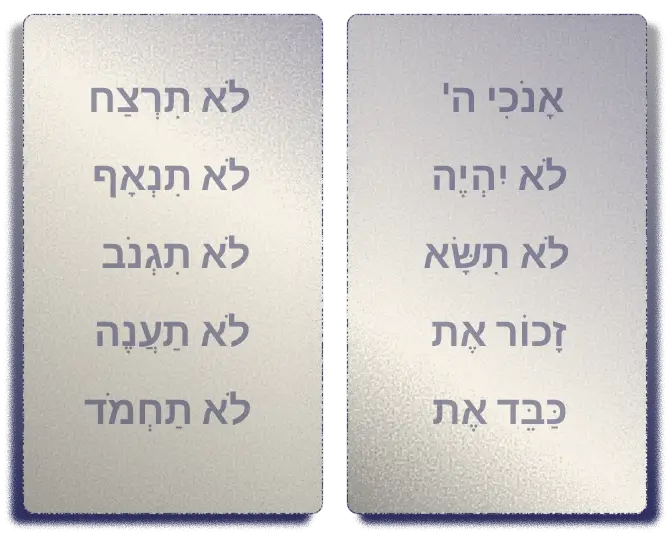
Explore the 613 mitzvos and uncover the meaning behind each one. Discover practical ways to integrate them into your daily life with insights, sources, and guided reflection.
Learn the structure, depth, and spiritual intent behind Jewish prayer. Dive into morning blessings, Shema, Amidah, and more—with tools to enrich your daily connection.
Each week’s parsha offers timeless wisdom and modern relevance. Explore summaries, key themes, and mitzvah connections to deepen your understanding of the Torah cycle.