Each Parsha page on Mitzvah Minute is designed as a guided, three-level journey through the weekly Torah reading—integrating the narrative, the mitzvos, and the classical commentaries into one unified experience.
Begin with the foundations of the Parsha:
This level gives you the storyline, the key mitzvos, and the essential connections between them.
A complete journey through the parsha—moving from clarity and depth to inner connection and real-world meaning, culminating in a way to live its ideas in everyday life.
These sections show how the Parsha speaks to the mind, the heart, and the real world — offering wisdom rooted in enduring Torah.
A complete, structured commentary on the parsha—presented pasuk by pasuk, with chapter and overall summaries for clarity and flow.
This level reveals the structural depth of the Parsha and the classical underpinnings of each theme.
Together, these layers create a complete Parsha journey —
narrative, mitzvah, and commentary — all flowing toward deeper understanding, spiritual insight, and meaningful growth.
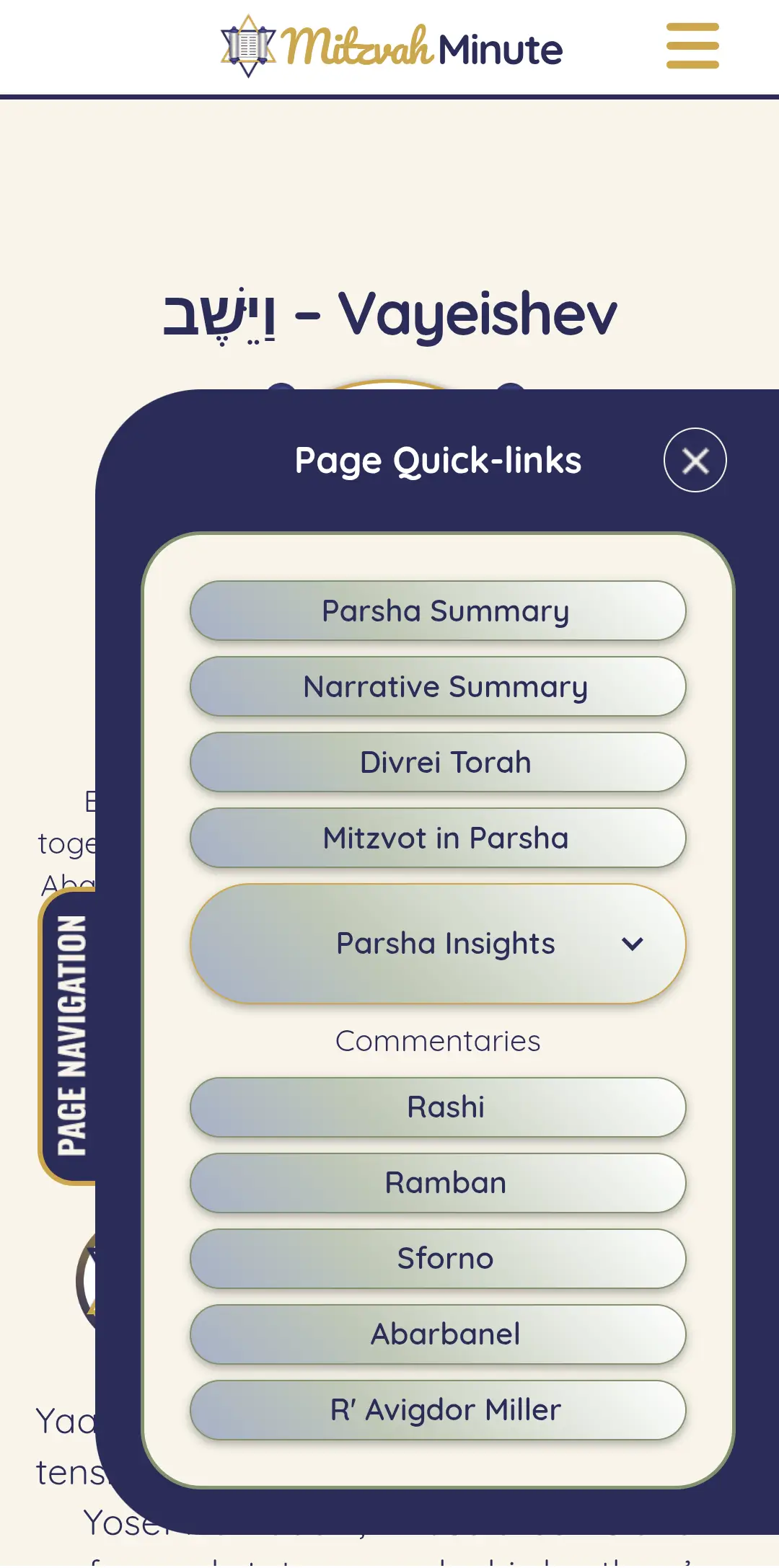
Tap the Page Navigation tab on the right side of your screen anytime to access quick-links to the entire Parsha page.
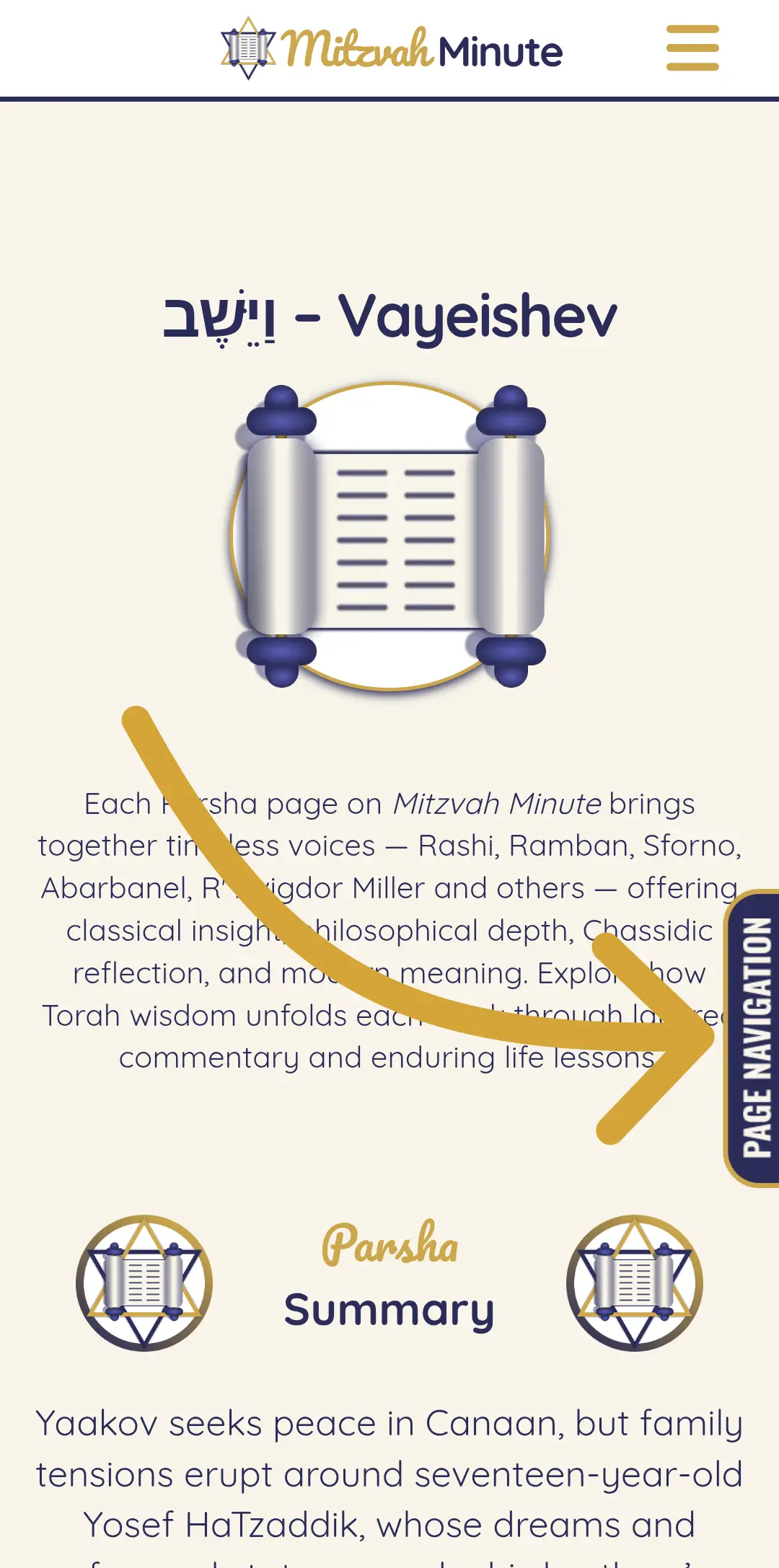
The quick-link panel gives instant access to every section — Parsha Summary, Mitzvos, Divrei Torah, Insights, and Commentaries.
“Every word of Torah and every mitzvah lifts us higher — may your learning bring you closer to Hashem.”

Parshas Bechukosai presents the covenantal vision that stands at the heart of Sefer Vayikra. If Klal Yisrael walks in Hashem’s statutes and faithfully keeps His mitzvos, the result is a world aligned with blessing—rain in its time, abundant harvest, peace in the land, victory over enemies, and most of all, Hashem’s presence dwelling among them. The relationship is defined by closeness: “וְהִתְהַלַּכְתִּי בְּתוֹכְכֶם” — Hashem walking among His people. If the covenant is rejected, the parsha describes a structured progression of consequences. Suffering unfolds in stages—fear, famine, defeat, exile—each step intended to awaken the nation to return. The breakdown is not random but relational, reflecting distance from Hashem. Yet even in the harshest exile, the covenant is never broken. Through confession and humility, the path of return remains open, and Hashem promises to remember His covenant with the Avos and restore the relationship. The parsha concludes with the laws of vows and consecrations, grounding the grand covenantal vision in everyday responsibility. Words, property, and personal commitments can all be sanctified, teaching that holiness is not limited to the Mishkan but extends into daily life. Bechukosai closes Sefer Vayikra by framing Torah life as a lived covenant—expressed through faithfulness, accountability, and enduring connection to Hashem.


"Walking the Covenant — From Torah Constancy to Sanctified Living"
וְשִׁנַּנְתָּם לְבָנֶיךָ
Parshas Bechukosai opens with “אִם־בְּחֻקֹּתַי תֵּלֵכוּ,” which Chazal, as brought by Rashi, understand as עמל בתורה — toil in Torah. This mitzvah is not only about knowledge but about shaping a life through consistent engagement with Torah. The blessings of the parsha begin not with material success but with a people immersed in Torah learning, where study leads to observance and observance sustains covenantal life. Torah here becomes the root system from which all blessing flows.
וְהָדַרְתָּ פְּנֵי זָקֵן
Rashi’s description of the seven-step spiritual collapse begins with abandoning Torah learning and leads to hatred of חכמים — Torah sages. This mitzvah highlights the opposite path. Honoring those who carry Torah ensures that Torah remains central in communal life. Bechukosai teaches that when reverence for Torah leadership weakens, the entire covenantal structure begins to unravel.
וְהִתְוַדּוּ אֶת־חַטָּאתָם
Toward the end of the תוכחה — rebuke, the Torah states, “וְהִתְוַדּוּ אֶת־עֲוֹנָם.” Ramban explains that confession is not symbolic regret but the beginning of real repair. This mitzvah expresses the covenant’s resilience: failure does not end the relationship. When a person or a nation names its wrongdoing and returns, the path back to Hashem reopens.
וַהֲרֵעֹתֶם בַּחֲצֹצְרֹת
Rambam teaches that when suffering comes, it must not be treated as מקרה — chance. Bechukosai repeatedly warns against walking with Hashem בקרי — casually. This mitzvah transforms crisis into connection. Instead of hardening the heart, a person responds with tefillah — prayer and זעקה — outcry, recognizing that difficulty is a call to return and realign.
וְאָהַבְתָּ לְרֵעֲךָ כָּמוֹךָ
The blessing of שלום — peace stands at the center of Bechukosai. Ramban explains that this peace begins within Klal Yisrael itself. This mitzvah is not abstract emotion but covenantal responsibility. A society that lives with mutual care becomes a vessel for blessing, while a society that fractures internally cannot sustain even material success.
לֹא־תִשְׂנָא אֶת־אָחִיךָ בִּלְבָבֶךָ
Where love is absent, silent resentment grows. Bechukosai’s description of collapse includes internal breakdown, where relationships weaken alongside Torah commitment. This mitzvah guards the heart itself, preventing the hidden erosion that leads to open division. Covenantal life requires inner discipline as much as outward behavior.
הוֹכֵחַ תּוֹכִיחַ אֶת־עֲמִיתֶךָ
The entire תוכחה — rebuke of Bechukosai reflects this mitzvah on a national level. Rebuke is not rejection; it is responsibility. It exists to prevent deeper collapse and guide return. This mitzvah teaches that care for another includes the courage to speak truth, ensuring that the covenant remains alive within the community.
אִישׁ כִּי יַפְלִא נֶדֶר בְּעֶרְכְּךָ נְפָשֹׁת לַה׳
Chapter 27 begins with ערכין — fixed valuations. A person may dedicate his worth to Hashem, but the Torah defines that value. This mitzvah teaches that human dignity is real, yet it must be expressed within Torah structure. Emotion alone cannot determine obligation; the covenant gives it form and fairness.
וְאִישׁ כִּי יַקְדִּשׁ אֶת־בֵּיתוֹ קֹדֶשׁ לַה׳
A house, the center of personal life, can become הקדש — consecrated property. Bechukosai extends holiness beyond the Beis Hamikdash into daily existence. This mitzvah shows that a person’s environment is not spiritually neutral; it can be elevated and brought into relationship with Hashem.
וְאִם מִשְּׂדֵה אֲחֻזָּתוֹ יַקְדִּישׁ אִישׁ לַה׳
Fields connect directly to יובל — Jubilee and the broader covenant of land. Ownership in Torah is never absolute. This mitzvah reinforces that land belongs ultimately to Hashem, and human possession exists within covenantal limits. Bechukosai’s blessings and curses surrounding the land find halachic expression here.
כָּל־חֵרֶם אֲשֶׁר יַחֲרִם אִישׁ לַה׳
חרם — devoted property represents a higher level of dedication. It removes something entirely from ordinary use. This mitzvah teaches that some commitments to Hashem are absolute. Bechukosai’s closing emphasizes that sanctity can demand total separation, not partial involvement.
לֹא יִמָּכֵר
Once something becomes חרם, it cannot return to the marketplace. This mitzvah protects the seriousness of sacred designation. Holiness cannot be treated as reversible or transactional.
כָּל־מַעְשַׂר בָּקָר וָצֹאן
בהמה מעשר — animal tithe is determined through counting, not selection. The tenth animal becomes holy automatically. This mitzvah trains obedience and removes manipulation. Kedushah emerges through submission to Hashem’s system, not personal preference.
לֹא יַחֲלִיפֶנּוּ וְלֹא יָמִיר אֹתוֹ
תמורה — substitution is forbidden because הקדש is not subject to revision based on changing feelings. Once something is designated for Hashem, it must remain so. This mitzvah guards the integrity of commitment.
וְהָיָה הוּא וּתְמוּרָתוֹ יִהְיֶה קֹּדֶשׁ
If a person attempts substitution, both animals become holy. The Torah transforms attempted control into increased obligation. Bechukosai ends by teaching that covenantal life demands seriousness: attempts to manipulate holiness only deepen responsibility.

Rashi opens Parshas Bechukosai by defining “אִם־בְּחֻקֹּתַי תֵּלֵכוּ” not as simple mitzvah observance, but as עמל בתורה — labor in Torah. This is the foundation of the entire parsha. The blessings do not begin with external success. They begin with a person and a nation walking steadily in Torah, learning with effort so that the mitzvos — commandments are guarded and fulfilled.
This explains why the blessings that follow are so complete. Rain comes בעתם — in its proper time. The land gives produce. Even אילני סרק — non-fruit-bearing trees, become fruitful. Food satisfies from within, so a small amount carries berachah — blessing. Peace then becomes the vessel for everything else, because without שלום — peace, even abundance cannot be enjoyed. For Rashi, the world of blessing is not random prosperity. It is creation itself becoming ordered around Torah.
When the Torah promises “וְנָתַתִּי שָׁלוֹם בָּאָרֶץ,” Rashi explains that peace is equal to everything. Food, drink, produce, and strength all lose their value if people cannot live securely. שלום — peace, is therefore not a side blessing. It is the condition that allows every other blessing to become livable.
Rashi deepens this further with “וְחֶרֶב לֹא־תַעֲבֹר בְּאַרְצְכֶם.” The promise is not only that war will not enter the land. Even foreign armies will not pass through it on the way to another battle. The land itself becomes protected from the presence of the sword. This is peace in its fuller form: not only victory after danger, but a life where the atmosphere of danger does not enter.
Rashi reads the military blessings as another expression of covenantal order. “Five of you will pursue one hundred” already shows strength beyond normal measure. But when the Torah says that one hundred will pursue ten thousand, Rashi notes that the numbers are no longer proportional. A larger group keeping Torah does not merely add more people. It creates a greater force of shared merit and unity.
This is why the victory does not follow ordinary arithmetic. The strength of Klal Yisrael is not only physical. When Torah is kept by many together, the power of the people grows beyond the sum of its parts. Even the weaker members of the nation can become part of this victory, because the blessing comes from Hashem, not from human strength alone.
The blessings reach their peak when Hashem says, “וְנָתַתִּי מִשְׁכָּנִי בְּתוֹכְכֶם.” Rashi explains that מִשְׁכָּנִי — My dwelling, refers to the Beis Hamikdash. This shows that the goal of blessing is not merely comfort, security, or success. The highest blessing is the Shechinah — Divine Presence, resting among Klal Yisrael.
Rashi then explains “וְהִתְהַלַּכְתִּי בְּתוֹכְכֶם” as Hashem walking with Klal Yisrael in Gan Eden — the Garden of Eden, as though He were one of them. Yet this closeness does not remove יראה — awe. The pasuk continues, “וְהָיִיתִי לָכֶם לֵאלֹקִים,” teaching that intimacy with Hashem must still carry reverence. The ideal relationship is closeness without casualness, love without loss of awe.
When the parsha turns to rebuke, Rashi shows that the descent begins at the same point where the blessing began: Torah learning. “וְאִם־לֹא תִשְׁמְעוּ לִי” means refusing to be עמלים בתורה — laborers in Torah. Once Torah learning is abandoned, mitzvah observance weakens. From there, the decline moves further: scorning those who perform mitzvos, hating the חכמים — Sages, preventing others from doing mitzvos, denying that Hashem commanded the mitzvos, and finally כופר בעיקר — denial of the root principle itself.
This is one of Rashi’s sharpest teachings in the parsha. Spiritual collapse rarely begins with open denial. It begins when Torah no longer demands effort. Once learning is weakened, action loses its root. Once action is weakened, respect for Torah people and Torah authority begins to break. The end of the process is not merely failure in practice, but rupture from the covenant itself.
Rashi’s reading of the tochachah — rebuke, is exact and structured. The punishments are not random disasters. They answer the seven-step collapse with sevenfold discipline. Sickness, failed hope, wasted planting, enemy domination, fear, drought, famine, wild beasts, sword, siege, exile, and desolation all unfold as stages of covenantal breakdown.
Rashi also shows how carefully the Torah’s language builds each punishment. The sickness of שַּׁחֶפֶת — consumption, weakens the body. קַּדַּחַת — fever, burns within. מְכַלּוֹת עֵינַיִם — pining of the eyes, describes hope stretched out and disappointed. מְדִיבֹת נָפֶשׁ — sorrow of soul, describes the grief of those watching the suffering. The curse enters the body, the home, the field, the city, and the heart.
A major word in the rebuke is קֶרִי — casualness. Rashi explains it as עראי — irregular, and במקרה — by chance. It means serving Hashem only from time to time, without steady commitment. He also brings the meaning of holding back and stubbornness: the heart restrains itself from drawing close.
This word captures the inner problem of the parsha. The opposite of “בְּחֻקֹּתַי תֵּלֵכוּ” is not only sin. It is a casual relationship with Hashem. Torah is meant to be a path of walking. קרי — casualness, turns that path into something occasional, resistant, and disconnected. The punishments intensify because the people keep treating Hashem’s messages as chance rather than as a call to return.
Even in the harshest parts of the tochachah — rebuke, Rashi finds order and purpose. When the land becomes desolate, it receives the rest it was denied during the years when shemittah — the sabbatical year, was not observed. The land’s emptiness is not meaningless destruction. It is a painful restoration of a broken covenant with the land itself.
Rashi also explains that the desolation protects the land from being fully settled by enemies. Klal Yisrael may be exiled, but the land does not simply pass into another nation’s full possession. This means that even punishment carries a hidden sign of connection. The covenant is wounded, but not erased.
Near the end of the rebuke, Rashi highlights the remembrance of the covenant with Yaakov, Yitzchok, and Avraham. The spelling יעקוב with a ו becomes, in Rashi’s reading, a pledge connected to Eliyahu and the future announcement of גאולה — redemption. Even in exile, the name of Yaakov carries a hidden promise.
Rashi also notes that Hashem does not reject Klal Yisrael completely. Even when they are in the land of their enemies, the covenant remains. The punishments may bring הכנעה — humbling of the heart, and through that, כפרה — atonement. The rebuke is severe, but it is not abandonment. Its purpose is to return the people to the covenant that still holds them.
Chapter 27 shifts from blessing and rebuke to ערכין — valuations, נדרים — vows, הקדש — consecrated property, חרם — devoted property, and מעשרות — tithes. Rashi shows that this is not a separate ending. After the parsha describes the great covenantal system, it teaches how daily life is ordered through halachah — Torah law.
Speech can create obligation. Property can become sacred. Animals, fields, homes, and produce all enter systems defined by Hashem. Yet these systems are precise. A person’s ערך — fixed valuation, is not based on social worth. If someone is poor, the Kohen evaluates what he can afford and leaves him with basic needs. קדושה — holiness, is binding, but it is not cruel. It is structured with justice and compassion.
Rashi’s Bechukosai is a full picture of covenantal life. Torah labor creates blessing. Blessing brings order into nature, society, the body, the land, and the Beis Hamikdash. When Torah is abandoned, that same order unravels step by step. Yet even the rebuke remains measured, purposeful, and tied to return.
The parsha closes by showing that covenant is not lived only in dramatic moments of blessing or exile. It is lived through speech, vows, property, holiness, tithes, and boundaries. For Rashi, Bechukosai teaches that a Torah life is built through constancy. When Klal Yisrael walks with Hashem, the world becomes a dwelling place for blessing. When that walk becomes casual, the structure begins to break. But the covenant itself remains, waiting for return.
📖 Source
Ramban reads Parshas Bechukosai as a complete vision of ברית — covenant. The parsha is not only promising reward and warning of punishment. It describes a world where Hashem’s הנהגה — Divine conduct, becomes visible through the life of Klal Yisrael. When the nation is שלם — whole, with Hashem, rain, land, health, peace, strength, and the Beis Hamikdash all become parts of one living system.
The blessings begin with גשמים בעתם — rains in their proper time, because rain is the root of physical blessing. When rain comes at the right time, the air is healthy, the springs and rivers are strengthened, the body is protected from sickness, and the land produces with abundance. For Ramban, this is not only agriculture. It is the lower world returning to order under Hashem’s direct blessing.
On “וְנָתַתִּי שָׁלוֹם בָּאָרֶץ,” Ramban first explains שלום — peace, as peace within Klal Yisrael itself. The blessing is not only that enemies will be held back. It is that brother will not fight brother, and the nation will not be torn apart from within.
Ramban then deepens the blessing of peace through the promise that harmful animals will cease from the land. He accepts the view of Rabbi Shimon that Hashem will not remove the animals themselves, but will remove their harmful nature. Eretz Yisrael will return to the condition of creation before the חטא אדם הראשון — sin of Adam HaRishon, when animals were not predators and death did not yet shape the world in its broken form. This is why Yeshayahu describes a future where the wolf, lamb, lion, cow, bear, and child can exist together without harm (ישעיהו יא:ז–ח). Peace is not merely political calm. It is creation itself being healed.
Ramban’s central principle is that the blessings and curses of Bechukosai are נסים נסתרים — hidden miracles. Rain, health, food, war, sickness, and famine may all appear natural. Yet when they respond constantly to the covenantal state of one nation in one land, they reveal Hashem’s hand.
For an individual, a hidden miracle can remain unnoticed. A tzaddik — righteous person, may live long, recover, or be protected, while others may explain it naturally. But when all of Eretz Yisrael experiences rain in season, national health, inner peace, enemy fear, and miraculous strength in battle, the miracle becomes public. The nations see that the Name of Hashem is called upon Yisrael and fear them (דברים כח:י). The same is true in reverse. When one land is struck by drought, sickness, exile, and desolation in a way tied to covenantal betrayal, the nations ask why Hashem did this to the land (דברים כט:כג–כד).
Ramban explains that when Yisrael is fully aligned with Hashem, their life is not governed by ordinary nature. Their bodies, their land, their food, and their national security all stand under direct Divine care. This is why the Torah can say, “כִּי אֲנִי ה׳ רֹפְאֶךָ” — “For I am Hashem, your healer” (שמות טו:כו).
This principle shapes Ramban’s famous discussion of medicine. In the highest state of Torah life, sickness is treated at its spiritual root. The tzaddikim — righteous people, in the days of nevuah — prophecy, would turn to the neviim — prophets, not to doctors. Ramban’s point is not that doctors have no halachic role. Once people live within the natural order and seek medical treatment, the Torah gives the doctor permission to heal, and the doctor must not refuse. Civil law itself requires payment for ריפוי — medical healing costs, because the Torah speaks to the real world in which people live. Yet the ideal state described in Bechukosai is higher: a nation so close to Hashem that healing comes through the covenant itself.
The blessings rise toward “וְנָתַתִּי מִשְׁכָּנִי בְּתוֹכְכֶם” — Hashem placing His Mishkan among Yisrael. Ramban begins with Rashi’s explanation that מִשְׁכָּנִי — My dwelling, refers to the Beis Hamikdash. The land becomes blessed, the nation becomes secure, and then the Shechinah — Divine Presence, rests among them.
Ramban then explains “וְלֹא תִגְעַל נַפְשִׁי אֶתְכֶם” as one of the hidden secrets of the Torah. It does not merely mean that Hashem will not reject Yisrael in a simple emotional sense. It means that the inner source connected to the Mishkan will not cast them out. They will remain fit for closeness, not like something absorbed and then expelled. The blessing is that Yisrael remains clean, connected, and worthy of the Shechinah.
Ramban states that these blessings have never yet been fulfilled in their full perfection. Even the greatest generations did not reach the total national merit required for the complete state described here. The Torah’s words therefore look forward to לעתיד לבוא — the future redemption.
In that future, “וְהִתְהַלַּכְתִּי בְּתוֹכְכֶם” will become a lived reality. Hashem’s presence will be open among the people like a king walking in his camp. The world will be restored, the Shechinah will dwell clearly below, and the blessings will reach their השלמות — complete perfection.
When the rebuke begins, Ramban explains that חוקים — statutes, are mitzvos whose reasons are hidden from most people. Foolish people reject them because they do not see what Hashem “gains” from them. משפטים — civil ordinances, are different. Every society understands the need for justice, damages, courts, and order. Yet the wicked despise the punishments attached to mitzvos because they want to live without the yoke of Torah.
This is why the pasuk ends with “לְהַפְרְכֶם אֶת־בְּרִיתִי” — to break My covenant. The rebellion is not only against one law. It is a desire to annul the entire ברית — covenant, so that the person can live openly by his desires. On the inner level, Ramban explains that this breaks the ברית שלום — covenant of peace. When peace is broken, the relationship changes from closeness into דין — judgment.
Ramban emphasizes that the curses in Bechukosai are אלות הברית — oaths of the covenant. They are spoken in the first person: “I will do,” “I will strike,” “I will discipline,” “I will make desolate.” This means the punishment is not an ordinary collapse of history. It is Hashem Himself enforcing the covenant.
Ramban sharply distinguishes this tochachah — rebuke, from the curses in Mishneh Torah, in Parshas Ki Savo. The curses in Vayikra were said מפי הגבורה — from the mouth of the Almighty, and they refer to the first exile, the Babylonian exile after the destruction of the first Beis Hamikdash. Their details fit that time: avodah zarah — idol worship, high places, sun-images, desolation of the Mikdash, famine, sword, wild beasts, plague, exile, and the land receiving its missed shemittah — sabbatical rests.
The curses in Devarim point to the later and longer exile. There, Ramban notes, no fixed end date is given, because that redemption depends on teshuvah — repentance. In Vayikra, the seventy-year exile answers the land’s missed rests. In Devarim, the exile stretches until the nation returns to Hashem.
Ramban gives great weight to “וְהִתְוַדּוּ אֶת־עֲוֹנָם וְאֶת־עֲוֹן אֲבֹתָם” — they will confess their sin and the sin of their fathers. This is not empty regret. It is the beginning of covenantal repair. Daniel, Ezra, and Nechemiah all confessed both the sins of their generation and the sins of their fathers, following the pattern of this parsha.
This matters because exile is not healed only by political return. It requires recognition of the covenantal failure that produced exile. The people must name the betrayal, accept the justice of Hashem’s judgment, and return from walking with Hashem בקרי — with casualness and resistance.
For Ramban, Eretz Yisrael is not passive ground. The land itself is part of the covenant. When Yisrael fails to keep shemittah — the sabbatical year, the land is denied its commanded rest. During exile, its desolation becomes a form of covenantal correction, as the land receives the rest it was denied.
Ramban also sees the desolation of the land as a sign of preservation. Eretz Yisrael does not fully accept foreign settlement in place of Yisrael. Its emptiness becomes a testimony that the covenant still stands. The land waits for its people, and its ruin itself declares that Jewish history is bound to Hashem.
Chapter 27 completes the parsha by turning from national covenant to personal sanctity. Ramban shows that ערכין — valuations, הקדש — consecrated property, בכור — firstborn animals, חרם — irrevocable devotion, and מעשר — tithes, are not random laws placed after the rebuke. They teach how a person approaches Hashem within the boundaries of Torah.
A person can dedicate value, property, animals, and fields to הקדש — sanctity, but he cannot invent sanctity however he wishes. A בכור — firstborn animal, already belongs to Hashem from birth. It does not need a person’s declaration to make it holy. Its קדושה — sanctity, is inherent. This teaches that some relationships to Hashem are not created by human feeling; they are built into Torah reality.
Ramban also uses חרם — irrevocable devotion, to define the limits of human power. A communal חרם made by the Sanhedrin or a king can carry binding authority over the people, even in matters of life and death. But a private person cannot create new categories of sanctity outside the Torah’s structure. This is why Ramban criticizes Yiftach’s tragic misunderstanding. A vow must submit to halachah — Torah law; it cannot override it.
Ramban’s Bechukosai is a sweeping vision of covenantal existence. Chapter 26 teaches how Hashem governs the nation, the land, nature, sickness, peace, exile, and redemption. Chapter 27 teaches how Yisrael must approach Hashem through precise halachic boundaries, not through uncontrolled religious impulse.
The full picture is clear. קדושה — holiness, is not vague inspiration. It is ordered life under the ברית — covenant. When Yisrael lives with Hashem in wholeness, nature itself becomes a vessel for blessing, the Shechinah dwells openly among them, and peace reaches even the animals of the field. When the covenant is broken, history itself becomes rebuke. Yet even exile does not erase the bond. It pushes the nation toward confession, return, and the future השלמות — perfection, when Hashem will walk among His people and the covenant will stand complete.
📖 Source
Parshas Bechukosai presents the ברית — covenant as a moral structure. Blessing is not random reward, and punishment is not blind anger. The Torah describes a world where human choices matter because Hashem created man with בחירה חופשית — free will. For Rambam, this is the foundation of תורה — Torah and מצוות — commandments. A person is not forced to be righteous or wicked. He chooses his direction, and that choice gives his life weight.
This helps explain the force of the תוכחה — rebuke. The Torah does not describe suffering as meaningless. It describes it as a response to a nation that refuses to listen, refuses to learn, and walks with Hashem בקרי — casually, as if events have no message. In Rambam’s language, ignoring the meaning of trouble is itself a spiritual failure. When difficulty comes, the proper response is תשובה — repentance, reflection, and return. To call everything accident hardens the heart and blocks repair.
The blessings of Bechukosai are deeply physical: rain, crops, peace, security, and abundance. Rambam’s view helps frame this carefully. The highest reward of the soul is not material comfort. Yet Torah promises material blessing because a stable world gives people the conditions needed for עבודת Hashem — service of Hashem.
Rain in its season, food in plenty, and peace in the land are not merely comforts. They free the nation from fear, hunger, and chaos. They allow Torah study, mitzvah observance, family life, communal order, and national holiness to flourish. In this sense, the blessing is not “wealth for its own sake.” It is the physical setting in which a Torah society can grow.
The curses in Bechukosai are severe because the covenant is serious. Rambam teaches that when suffering comes, the community must not treat it as מקרה — mere chance. The Torah’s repeated warning against walking בקרי — casually means that the nation refuses to see Hashem’s guidance inside history.
This does not mean every private pain can be explained by human beings. Rambam’s point is not that people should judge others. It is that a Torah community must remain morally awake. National crisis should lead to fasting, prayer, self-examination, and תיקון המעשים — correction of deeds. The goal of punishment is not destruction. It is to break spiritual numbness and reopen the path to תשובה — repentance.
Bechukosai begins with “אם בחקתי תלכו” — “If you walk in My statutes.” Rambam sees mitzvos not only as commands to obey, but as a system that forms the human being. Repeated action shapes desire, thought, discipline, and character. The person who “walks” in Hashem’s laws becomes trained by them.
This is why the parsha joins national blessing to steady observance. A holy society is not built through emotion alone. It is built through law, habit, restraint, and responsibility. The חוקים — statutes teach a Jew to serve Hashem even when the reason is not fully grasped. The משפטים — laws teach justice and order. Together, they form a people whose outer behavior slowly shapes inner character.
The parsha’s warning that the land will finally receive its שבתות — sabbatical rests shows that Eretz Yisrael is not a neutral place. For Rambam, Jewish national life is bound to mitzvah responsibility. The land is the setting where Torah becomes public, legal, agricultural, economic, and national.
When the people ignore שמיטה — the sabbatical year, the failure is not only agricultural. It reveals a deeper refusal to live as tenants under Hashem’s rule. The land must rest because ownership itself is limited by the covenant. Human power is real, but it is never absolute.
Even after the תוכחה — rebuke, the parsha does not end with rejection. Hashem remembers the ברית אבות — covenant of the fathers. For Rambam, תשובה — repentance is always possible because man is never locked into his failure. A nation can fall, but it can also return.
This gives Bechukosai its philosophical depth. The covenant demands responsibility, but it also preserves hope. Blessing teaches what life can become when Torah shapes society. Punishment teaches that history has moral meaning. תשובה teaches that even after failure, the door back to Hashem remains open.
📖 Sources
Ralbag frames Parshas Bechukosai as a closing statement for Sefer Vayikra. The Torah first presents the good that Hashem brings upon those who walk in His חוקים — statutes, and then the harm that follows when they abandon them. This structure teaches that the מצוות — commandments are not empty acts. They reveal Hashem’s purpose in shaping a holy nation through law, consequence, and moral order.
For Ralbag, the blessings and punishments are not separate from the mitzvos. They show the purpose of the mitzvos. When the nation walks in Torah, השגחה אלקית — Divine providence attaches itself to them even in physical matters. Rain, food, peace, and protection become part of Hashem’s care for those who live with spiritual order. When the nation leaves the Torah, that loss of שלמות — perfection brings rebuke, step after step, so they do not sink permanently into false beliefs. The punishments are therefore corrective. They are meant to move the people back toward the perfection they abandoned.
Ralbag adds that the strength of Hashem’s השגחה — providence over the righteous can extend to their descendants. This does not remove personal responsibility from later generations. Rather, it shows that goodness creates a spiritual inheritance. A nation shaped by Torah builds conditions that can protect and elevate its children.
Yet if those children turn away from the דרך התורה — path of Torah, the very source of their completeness is weakened. Ralbag describes the punishments as מוסר אחר מוסר — discipline after discipline. Each stage is meant to prevent deeper collapse. The goal is not revenge. It is to stop the people from becoming fixed in דעות נפסדות — corrupt beliefs, and to help them return to the שלמות — perfection they lost.
Ralbag then explains why the Torah moves from the תוכחה — rebuke into the laws of נדרים — vows, הקדשות — consecrated property, ערכין — fixed Torah valuations, and קדשים — sacred items. These laws complete the discussion of korbanos and sacred property, while also continuing the themes of יובל — Jubilee, especially regarding ancestral fields and purchased fields.
He notes that the Torah arranges these laws in a clear order, moving by levels of importance. It begins with ערכי אדם — human valuations, because man is the most dignified subject. It then moves to animals: first an unblemished animal fit for the מזבח — altar, then a blemished animal. After that it turns to land: first a house, then a שדה אחוזה — ancestral field, and then a שדה מקנה — purchased field, which has a weaker hold for its owner. The Torah then discusses things whose קדושה — sanctity should not be changed, then a בהמה טמאה — non-kosher animal, then קדשי כהנים — sacred gifts of the Kohanim, and finally קדשי ישראל — sacred portions of Yisrael, such as מעשר שני — second tithe and מעשר בהמה — animal tithe. The order itself teaches that kedushah is not vague feeling. It is structured, ranked, and guarded through precise Torah law.
Ralbag explains the mitzvah of ערכין — fixed Torah valuations as a realistic response to human feeling. A person may wish to dedicate the “value” of someone to Hashem so that Hashem should guard him and grant him life. Since human life is far beyond silver and gold, a person might think that no monetary value could ever match it. The Torah therefore fixes a defined value. It honors the human being while preventing the vow from becoming impossible.
Ralbag also notes that the Torah is merciful with one who cannot afford the full amount. If the נודר — one who made the vow lacks the means, the Torah reduces the obligation according to what he can pay. This protects both sides of the mitzvah: the seriousness of a vow to Hashem, and the reality of human limitation.
Ralbag gives a clear reason for the law that one may not exchange a consecrated animal for another animal. A person’s heart is close to his money. He may persuade himself that switching one animal for another does no harm, since an animal will still be brought. He may even think it is better to substitute a weaker animal, because the animal being offered will be “lost” from his possession anyway.
The Torah blocks this attitude at its root. If exchange were allowed, people would slowly cheapen הקדש — consecrated property and lower the dignity of korbanos. Therefore, the Torah penalizes the person by making both the original animal and its substitute קדש — sacred. The law trains the owner to treat holiness as real, not as a flexible label that can be adjusted for convenience.
Ralbag applies the same logic to houses and fields that were consecrated. A שדה אחוזה — ancestral field does not simply return to the one who consecrated it at יובל — Jubilee. If it did, people might think הקדש — consecrated property can leave holiness without proper פדיון — redemption. That would weaken the awe people must feel toward sacred property.
This is also why the Torah commands that הקדשות — consecrated items not be changed from one קדושה — sanctity to another. The purpose is to place great weight in the soul toward קדשים — sacred matters. Kedushah requires stability. Once something has been given to Hashem, man must not treat it as his own system to manage casually.
Ralbag explains חרמי כהנים — devoted property given to the Kohanim as a way to strengthen their portion. Such property may not be sold or redeemed. This allows their inheritance to grow in a way that can sustain them as their numbers increase.
This is not merely financial support. It reflects the honor due to the family devoted to עבודת Hashem — service of Hashem. The Torah creates a system in which people are moved to give from their wealth to those whose life mission is sacred service. A holy society must support those who carry its avodah — Divine service.
Ralbag ends by noting the mitzvos of מעשר שני — second tithe from produce and מעשר בהמה — animal tithe. These complete the parsha’s chain of sacred laws and bring Sefer Vayikra to its close.
The philosophical arc is clear. Bechukosai begins with the moral meaning of blessing and punishment, then closes with laws that regulate vows, valuations, animals, houses, fields, gifts to Kohanim, and tithes. For Ralbag, this is one continuous structure. Torah guides belief, disciplines desire, protects kedushah, supports sacred service, and orders national life around Hashem. The book of korbanos and holiness ends by showing that holiness must enter money, property, speech, land, and responsibility.
📖 Source
(Baal Shem Tov · Kedushas Levi · Sfas Emes)
Parshas Bechukosai begins with הליכה — walking: “If you walk in My statutes.” In the Chassidic reading, this is not only movement through life, but movement through the hidden layers of the soul. A Yid is not meant to stand still in one מדרגה — spiritual level. Torah draws him forward, from thought to speech, from speech to action, and from action back to its root above. עמל התורה — toil in Torah means learning until the mind itself becomes humble before the רצון Hashem — will of Hashem.
The Baal Shem Tov teaches that true דבקות — cleaving to Hashem refines even the body. The breath of Torah and tefillah joins the higher breath; the voice joins the higher voice; the thought joins the higher thought. In this light, the inner mechanics of avodah become clearer: אותיות — letters are כלים — vessels, and נקודות — vowel points are their חיות — life-force. A person always thinks in letters, and those letters can be purified or elevated. This is the meaning of “כלים בתוך כלים” — vessels within vessels: the coarse letters of a wandering thought can be immersed and refined בתוך — within the holy letters of Torah and tefillah, until everything returns to קדושה — holiness.
Even a מחשבה זרה — foreign thought is not random. It may be a fallen ניצוץ — holy spark arriving at its appointed moment, an עת לנערה — a destined time for that spark to rise from its concealment. It appears specifically now, within the context of one’s tefillah or learning, because this is its שער עלייה — gateway of ascent. The person who walks in Hashem’s statutes does not merely fight distraction; he recognizes a call to elevate what has come to him.
This process is not a disturbance but a refinement. It is like a father who challenges his son in learning, raising difficulties and objections not to confuse him, but לחדודי — to sharpen him, so that he reaches the truth with greater clarity and strength. So too, the resistance a person encounters in thought is not meant to push him away, but to draw out a deeper attachment and a more precise return to truth. The person who walks in Hashem’s statutes learns not only to ascend, but to transform every interruption into a step upward, until even the struggle itself becomes part of the path.
“ונתתי גשמיכם בעתם — I will give your rains in their time” becomes a promise that גשמיות — physical life can return to its source. Rain is not only water from the sky. It is שפע — Divine flow entering the world in a way that can bless rather than overwhelm. Rabbi Chanina ben Dosa could stop rain because his pain affected the flow of blessing to the world. But when all of Klal Yisrael become צדיקים — righteous people, the blessing no longer depends on one conduit. The whole nation becomes a vessel.
Kedushas Levi deepens this: the reward of a mitzvah in this world is not payment. שכר מצוה מצוה — the reward of a mitzvah is another mitzvah. Rain gives food, strength, and means, so a person can give tzedakah, serve Hashem, and continue the chain of mitzvos. The blessing is not a break from avodah — service of Hashem. It is the next doorway into avodah.
The Sfas Emes explains why the Torah speaks here about worldly blessing rather than עולם הבא — the World to Come. עולם הבא is certain and prepared. The greater wonder is that this world, with fields, rain, food, work, pleasure, body, and time, can become attached to Torah. When גשמיות — physicality follows its שורש — spiritual root, this world becomes a place where Hashem’s will is revealed.
This is why the blessings echo the world before the חטא אדם הראשון — sin of Adam HaRishon. Trees that seemed barren will produce fruit. The ground that was cursed will be repaired. The person is an עולם קטן — small world, containing all levels of creation. When the person refines the dull and hidden places inside himself, he awakens fruitfulness in the world around him.
The Tochachah — rebuke also has an inner voice. The Baal Shem Tov teaches that the בת קול — Heavenly voice is not usually heard as sound. Above, “there is no speech and there are no words.” It enters as הרהורי תשובה — thoughts of return, a quiet stirring toward good. Even a רשע — wicked person receives these thoughts each day. The tragedy is not that Hashem is silent. The tragedy is that a person may push away the treasure when it reaches his heart.
This inner call does not meet every person the same way. It is like a king who entrusted his treasury to four ministers, and they fled with it. One returned on his own, awakened by his own inner clarity. Another returned only after someone guided him and spoke to his heart. A third returned only when he saw judgment and was moved by fear. The fourth did not return at all. Each path reflects a different response to the same call. When a person hears the stirring within and returns on his own, the transformation is deepest, because the call has become his own voice.
Fear in the world, joy in the world, sudden awakening, the words of children, even the speech of people who do not understand what they are saying — all can become hints from Above. A wise heart learns to read these signs. The “sound of a driven leaf” can pursue a person when Torah is learned שלא לשמה — not for its proper purpose, especially to provoke or attack. Even the daf Gemara itself can become a voice chasing him back toward truth.
At the end of the rebuke, Hashem remembers the ברית אבות — covenant of the Avos. The Baal Shem Tov explains why Avraham, Yitzchok, and Yaakov alone are called Avos. Their avodah and tefillah were never only for themselves. They lived for all generations. A tzaddik whose life was devoted to the generation continues that mission even after passing; his soul remains bound to the work of תיקון הדור — repairing the generation.
The Sfas Emes adds that Klal Yisrael are not only servants; they are children. A servant can be sent away, but a child is disciplined in order to be brought back. Even punishment in this world is part of the covenant, because it prevents the deeper cutting off of the soul from its root. זכות אבות — the merit of the Avos may have limits in how visibly it helps us walk in their ways, but ברית אבות — the covenant of the Avos does not end.
The blessing of קוממיות — uprightness is not arrogance. In this world, a person often needs lowered posture and deep הכנעה — submission to hold יראת שמים — awe of Heaven. But when the world is repaired, a person can stand upright and still be full of awe. His body itself becomes a garment for the נשמה — soul.
This is the full arc of Bechukosai in Chassidus. Torah begins as חוקה — a statute beyond understanding, and through עמל — toil, ביטול — self-nullification, and love of Klal Yisrael, it becomes engraved in the heart. Then the body, the land, the rain, the trees, the home, the field, and even the hidden thoughts of the day begin to testify: everything has a root in Hashem, and everything can be brought back home.
📖 Sources
Parshas Bechukosai presents one of the most overwhelming passages in the Torah: the תוכחה — rebuke, a vision of blessing and curse that traces the full arc of a nation’s fate. It speaks in stark, unyielding terms. If Klal Yisrael — the Jewish people remain faithful to the ברית — covenant, they will flourish with חיים — life, שלום — peace, and שפע — abundance. If they turn away, the consequences unfold with terrifying force: פחד — fear, חורבן — destruction, גלות — exile, and despair. Yet at the very end, in a sudden and decisive turn, the Torah reveals a truth that reshapes everything: “ואף גם זאת… לא מאסתים ולא געלתים לכלותם להפר בריתי אתם” — even then, I will not reject them nor destroy them, to break My covenant with them. The covenant endures.
Rabbi Jonathan Sacks reads this moment not as a closing consolation, but as the key to the entire parsha. Bechukosai is not merely a warning about consequences. It is a revelation about the nature of Jewish history itself. History, in the Torah’s vision, is not governed by fate, power, or accident. It is shaped by responsibility. The destiny of a people is bound to its moral and spiritual choices, yet it is held within the unbreakable commitment of G-d, who does not abandon His promise even when His people falter.
From this emerges a set of ideas that define the Jewish experience across time. The covenant is eternal; it cannot be revoked or replaced. Responsibility is collective; every Jew is bound to every other Jew in a shared moral destiny. Meaning is essential; history is not מקרֶה — chance, but a purposeful unfolding in which each generation is called to respond. And above all, hope is not a wish or illusion, but a structure within reality itself, born from the certainty that G-d’s word will never fail.
These teachings transform how we understand exile, suffering, and renewal. A nation may fall, but it is not rejected. A people may be scattered, but it is not alone. Even in the darkest moments, when the curses seem to define reality, they do not have the final word. The covenant remains, and with it, the possibility of return.
Bechukosai therefore becomes more than a prophecy of warning. It becomes a map of moral history. It asks not only what will happen, but what kind of people we choose to be. It teaches that freedom is inseparable from responsibility, that identity is inseparable from covenant, and that the Jewish story is, at its core, the ongoing refusal to surrender to despair.
At the heart of Parshas Bechukosai lies a claim that defines the entire structure of Jewish faith: the rejection of rejection itself. The Torah describes a future in which Klal Yisrael — the Jewish people may experience חטא — sin, punishment, and even גלות — exile. Yet it concludes with an unqualified declaration that overturns every assumption about the fragility of relationships: “לא מאסתים ולא געלתים לכלותם להפר בריתי אתם” — G-d will not reject them, will not destroy them, and will not break His covenant.
Rabbi Jonathan Sacks explains that this is not simply comfort after catastrophe. It is a fundamental principle of אמונה — faith. Human beings may break their commitments, but G-d does not. The covenant is not conditional in its existence, even if its blessings are conditional in their expression. ישראל may be faithless, but G-d remains faithful. The relationship may be strained, disciplined, or concealed, but it is never terminated.
This idea stands in direct opposition to any theology that suggests that G-d abandons His people and replaces them with another. The very passage that speaks most forcefully about punishment also contains the clearest denial of abandonment. Exile is not a גירושין — divorce. Suffering is not a cancellation of the relationship. The bond between G-d and His people is enduring, rooted in promises made to the אבות — Avraham, Yitzchok, and Yaakov, and sustained across all generations.
This pattern is already woven into the earliest chapters of the Torah. Humanity itself is nearly destroyed in the דור המבול — generation of the Flood, yet G-d vows never again to wipe out life. The covenant passes through Yitzchok rather than Yishmael, and through Yaakov rather than Eisav, yet those who are not chosen are not rejected entirely. Even Levi, initially criticized for his anger, becomes the source of spiritual leadership. Again and again, the Torah affirms that while הבחירה — chosenness defines a mission, it does not erase the dignity or place of others. The covenant refines, but it does not negate.
This principle reaches its most powerful expression in the context of exile. One might assume that גלות — exile signals the end of the relationship, as if a master had sold a servant or a husband had divorced his wife. Yet the נביא — prophet rejects this comparison entirely: “אי זה ספר כריתות אמכם” — where is the bill of divorce? There is none. The exile is real, but it is not abandonment. The people remain bound to G-d even in distance, even in suffering, even in apparent silence.
From here emerges one of the most far-reaching ideas in Jewish thought: the eternity of the Jewish people is not a historical accident. It is a covenantal reality. Nations rise and fall according to the usual patterns of power, geography, and culture. ישראל exists under a different principle. Its survival is tied to a promise that cannot be broken. This does not remove consequence; it transforms it. Punishment may come, but annihilation will not. Darkness may descend, but it will not be final.
This is what gives birth to תקוה — hope in its deepest sense. Not hope as wishful thinking, but hope as a structural truth about reality. Because the covenant endures, the future is never closed. Because G-d does not abandon His people, history cannot end in rejection. Even in the land of their enemies, even at the edge of despair, the relationship remains intact.
The result is a vision of Jewish existence unlike any other. It is a people defined not only by its past, but by a promise that reaches forward through time. It is a people that may fall, but cannot be erased. The covenant binds them to G-d, and through that bond, binds them to an unbreakable future.
Parshas Bechukosai presents a vision of national life built on a single, demanding principle: freedom is inseparable from אחריות — responsibility. The blessings and curses are not arbitrary rewards and punishments. They describe the moral structure of a covenantal society. If Klal Yisrael lives by the will of G-d, it will flourish. If it abandons that calling, the consequences will unfold with equal clarity. History itself becomes a reflection of moral choice.
Rabbi Jonathan Sacks explains that this is the essence of ברית — covenant. Unlike other models of politics, which see the rise and fall of nations as determined by כוח — power, geography, or fate, the Torah frames national destiny in ethical terms. A society is not sustained by strength alone. It depends on whether it remains faithful to its purpose: to build a community rooted in justice, dignity, and awareness of G-d. When that purpose weakens, the structure itself begins to collapse.
This creates what R’ Sacks calls a politics of responsibility. A nation must constantly ask not, “Who did this to us?” but “What did we do wrong?” The difference between these two questions shapes the entire future. To blame others is to see oneself as a victim — acted upon, powerless, defined by circumstance. That path leads to anger, resentment, and ultimately the loss of freedom. But to accept responsibility, even when it is difficult, is to reclaim agency. It means that change is possible, that the future is still open, and that the nation retains the ability to rebuild.
This idea is already present at the dawn of human history. When Kayin — Cain is warned, “אם תיטיב… ואם לא תיטיב לפתח חטאת רובץ” — if you act well, you will be uplifted, and if not, sin crouches at the door, the message is clear. Human beings are free, but their choices carry consequences. That same structure applies to an entire nation. Freedom is real, but it operates within a moral framework that cannot be ignored.
From this emerges a deeper understanding of liberty itself. True חירות — freedom is not the ability to do whatever one wishes. It is the ability to build a society aligned with truth and responsibility. A nation that worships itself, that places its own power or success at the center, will eventually decay. If inequality grows unchecked, the sense of shared purpose disappears. If leadership becomes corrupt, trust erodes. These are not punishments imposed from outside. They are consequences that grow from within.
The covenant therefore creates a unique form of collective life. Responsibility is not limited to leaders alone. It extends across the entire people. “וכשלו איש באחיו” — they will stumble one over another, is understood by Chazal as “because of one another.” כל ישראל ערבים זה בזה — all of Israel are responsible for one another. This responsibility does not disappear in times of strength; it becomes most visible in times of weakness. Even in exile, when the people are scattered across lands and cultures, the covenant binds them into a single moral community.
This transforms the meaning of leadership. Leadership is not defined by authority or position. It is defined by the willingness to take responsibility. When each individual accepts a share in the fate of the whole, leadership becomes distributed across the nation. In the family, in the community, in every sphere of life, each person becomes a guardian of the collective future. The covenant does not create passive subjects. It creates active participants in a shared destiny.
This vision is demanding. It leaves little room for complacency or denial. Yet it is also deeply empowering. A nation that accepts responsibility for its failures also possesses the power to change them. A people that sees itself as accountable is a people that can recover, rebuild, and renew.
Bechukosai thus teaches that freedom is never given once and for all. It must be sustained through constant moral effort. The blessings describe what a responsible society can become. The curses describe what happens when that responsibility is abandoned. Between them stands the enduring call of the covenant: to choose life, to choose responsibility, and to shape a future worthy of G-d’s presence.
At the center of the תוכחה — rebuke in Parshas Bechukosai appears a striking and unusual word: קרי — keri. It repeats again and again, forming the rhythm of the curses. “אם תלכו עמי קרי” — if you walk with Me in keri, says the Torah, then “והלכתי אף אני עמכם בקרי” — I too will walk with you in keri. The repetition demands interpretation. What does this word mean?
Rabbi Jonathan Sacks, following the approach of the Rambam, connects קרי — keri to מקרה — mikreh, meaning chance, coincidence, randomness. The Torah is describing not only behavior, but a worldview. To live with keri is to see events as accidental, history as meaningless, and life as a series of disconnected occurrences without purpose or direction. It is to interpret existence without reference to G-d, without seeing His presence in the unfolding of events.
The consequence of such a worldview is profound. When a nation sees its history as mikreh — chance, it loses its sense of calling. Without purpose, there is no direction. Without direction, there is no structure to guide decision-making. The covenant becomes irrelevant, because the very idea of a relationship with G-d has been set aside. In response, G-d does not so much punish as withdraw. The Torah describes this as הסתר פנים — the hiding of the Divine face.
This distinction is essential. There is a difference between punishment and absence. When G-d punishes, He targets wrongdoing. But when He withdraws His presence, even the innocent may suffer. The world is left to its own forces, to the unpredictability of circumstance, to the instability of human behavior. A small nation surrounded by stronger powers, lacking a stable natural environment, becomes vulnerable. Without Divine guidance, history reverts to the harsh logic of power and survival.
In this sense, the curse is not an imposed decree but a natural outcome. A people that abandons meaning is left to chance. And chance, by its nature, offers no protection, no direction, and no guarantee. It is indifferent, blind, and often destructive. The Torah is warning that when a nation ceases to interpret its life through the lens of covenant, it loses the very framework that sustains it.
Against this stands the Jewish insistence on meaning. To live with אמונה — faith is to affirm that history is not random. Events may be complex, painful, and difficult to understand, but they are not empty. There is a deeper structure, a Divine presence that gives shape to the unfolding of time. This belief does not eliminate suffering, but it transforms how suffering is understood. It becomes part of a larger narrative, not an isolated accident.
R’ Sacks connects this idea to a broader human truth: without meaning, life becomes unbearable. A person can endure hardship if there is a reason, a purpose, a “why.” Without that, even comfort can feel empty. A world stripped of meaning becomes what philosophers describe as a void — infinite space without direction, existence without significance. In such a world, human beings drift, lacking the inner strength to navigate difficulty.
Judaism offers a radically different vision. Life is not mikreh — chance. It is a story. Each generation stands within that story, inheriting a mission and contributing to its continuation. The covenant provides the framework, and within that framework each individual is called to discover a personal role. This is not abstract philosophy. It is a practical orientation that shapes how a person responds to challenge, failure, and uncertainty.
The search for meaning therefore becomes an act of survival. When a person or a nation asks, “Why did this happen?” the question is not always answered in terms of cause. Often, it is answered in terms of response: given that this has happened, what is now required? What action must be taken? What growth must occur? In this way, even suffering can be transformed into a source of strength.
Bechukosai thus draws a clear line between two ways of living. One sees life as random, fragmented, and ultimately empty. The other sees it as purposeful, guided, and filled with possibility. The first leads to vulnerability and decline. The second creates resilience, direction, and hope.
To reject mikreh is to affirm that history matters, that choices matter, and that every moment carries the potential for meaning. It is to live not as a passive observer of events, but as an active participant in a story that continues to unfold under the enduring presence of G-d.
Parshas Bechukosai contains one of the most difficult passages in the Torah, yet it also gives birth to one of the most powerful ideas in all of Jewish thought: תקוה — hope. Not hope as a feeling, nor as a wish, but as a way of understanding time itself. The תוכחה — rebuke describes history at its worst — failure, destruction, exile, and פחד — fear. Yet it does not end there. It turns, sharply and deliberately, to promise: “וזכרתי את בריתי” — I will remember My covenant. From this turning point emerges a new vision of history.
Rabbi Jonathan Sacks explains that this moment marks a decisive break from the way other cultures understood time. In the ancient world, there were two dominant views. One saw history as tragedy — a story in which human aspirations are inevitably crushed by forces beyond control. The other saw time as cyclical — endless repetition, where what has been will always be, and nothing truly changes. Both views leave little room for lasting hope.
The Torah introduces a third possibility. Time is not a closed cycle, nor a descent into inevitable loss. It is a journey with direction. It moves toward גאולה — redemption. Even when the present is dark, the future remains open. The covenant ensures that history is not abandoned to chaos. G-d may conceal His presence, may allow suffering, but He does not withdraw His promise. The story continues, and it moves forward.
This is why Bechukosai can contain both the deepest curses and the strongest consolation. The suffering is real and fully acknowledged. The Torah does not soften its description. Yet it refuses to grant suffering the final word. The closing promise transforms everything that came before it. No defeat is permanent. No exile is endless. No tragedy is absolute.
From here emerges a uniquely Jewish understanding of hope. Hope is not optimism — not the belief that things will naturally improve. Nor is it denial — not a refusal to see reality as it is. It is the conviction that, because of the covenant, reality itself contains the possibility of renewal. G-d’s commitment to His people guarantees that history cannot end in destruction.
This idea echoes throughout the words of the נביאים — prophets. They speak to a people facing חורבן — devastation and גלות — exile, yet they insist on return and rebuilding. Even the most desolate vision — a valley of dry bones — becomes a promise of life. The future is not determined solely by present conditions. It is shaped by a Divine promise that reaches beyond them.
R’ Sacks describes this as the birth of hope within human consciousness. It is the introduction of a new way of seeing the world. A person is no longer trapped within the present moment or bound by the past. Instead, life is oriented toward what can still be achieved. The future becomes a space of possibility, not merely an extension of what already exists.
This transforms how a person lives. Hope enables risk, commitment, and endurance. It allows individuals to build, to create, and to continue even when circumstances are difficult. Without hope, there is no reason to strive. With hope, even great hardship can be faced, because it is not the end of the story.
Bechukosai therefore teaches that time itself is covenantal. It is shaped by the relationship between G-d and His people. That relationship ensures that history is never closed. Even when it appears to be moving toward destruction, it contains the seeds of renewal.
This is the deeper meaning of the closing promise. “ואף גם זאת” — even then. Even at the lowest point, even in exile, even after failure, the covenant remains. And because it remains, hope remains. The Jewish people becomes the bearer of this idea through history: that no darkness is final, and that the future, guided by G-d’s promise, is always still unfolding.
Parshas Bechukosai confronts us with one of the most difficult elements in the Torah: the language of קללה — curse. The תוכחה — rebuke is not merely a description of suffering. It is spoken as a series of words, warnings articulated with force and intensity. This raises a fundamental question: what is the nature of these words? Are they predictions, punishments, or something deeper?
Rabbi Jonathan Sacks explains that in the Torah, words are never neutral. They do not simply describe reality; they help shape it. From the beginning of creation, where G-d brings the world into being through speech — “ויאמר אלקים” — and G-d said, language carries creative power. In human life as well, words can build or destroy, heal or harm, unite or divide. The קללות — curses of Bechukosai must therefore be understood not as magical incantations, but as expressions of moral reality.
The covenant is sustained through speech. It is articulated in promises, obligations, and commitments. When those commitments are honored, the words of the covenant generate ברכה — blessing. When they are broken, the same structure produces the opposite effect. The curses are not arbitrary decrees imposed from outside. They are the unfolding consequences of a relationship that has been violated.
This gives the language of Bechukosai a particular weight. The repeated phrases — “ואם לא תשמעו לי” — if you do not listen to Me, and “ואם תלכו עמי קרי” — if you walk with Me in indifference or chance, create a rhythm that mirrors the moral breakdown being described. Each stage of refusal leads to a deeper level of consequence. The words themselves trace the path from neglect to collapse.
At the same time, the Torah reveals the vulnerability of human beings to language. Fear can be created not only by real danger, but by perception. The image of “עלה נדף” — a driven leaf causing panic captures this precisely. A person can be overtaken by dread even when no one is pursuing them. Words, expectations, and inner narratives can generate a reality that feels overwhelming, even when its source is intangible.
This insight extends beyond individual psychology to collective life. A society is shaped by the language it uses. If its discourse is filled with trust, responsibility, and shared purpose, it builds stability. If it is filled with suspicion, blame, and fragmentation, it weakens from within. The curses describe not only external events, but the internal unraveling of a people that has lost its moral and spiritual center.
Yet the same power that gives words their destructive potential also gives them the ability to heal. The covenant itself is sustained through speech — through תורה — teaching, תפילה — prayer, and דברי אמונה — words of faith. Just as negative language can create פחד — fear and disintegration, positive language can create חיזוק — strength and renewal.
R’ Sacks emphasizes that the Torah does not present the curses as inevitable. They are conditional, tied to choices and responses. This means that the trajectory they describe can be altered. Words of warning can become words of awakening. Recognition can lead to תשובה — return. The same speech that once expressed failure can become the starting point for rebuilding.
This is why the תוכחה ends with promise. The final words do not echo the curses, but transcend them. They reassert the covenant, reminding the people that the relationship still stands. The language shifts from consequence to commitment, from breakdown to remembrance: “וזכרתי את בריתי” — I will remember My covenant.
The power of a curse, then, lies not in its ability to seal fate, but in its ability to reveal reality. It names the consequences of a path so that the path can be changed. It confronts a people with the truth of their situation, not to condemn them, but to call them back.
Bechukosai teaches that words matter. They shape how individuals think, how communities function, and how history unfolds. When aligned with the covenant, they become a source of blessing. When misused, they contribute to breakdown. But even then, they retain the power to turn. Through recognition, through renewed commitment, and through the enduring promise of G-d, even the language of curse can be transformed into the beginning of hope.
Parshas Bechukosai does not speak only about the relationship between אדם — the individual and G-d. It reveals how that relationship must take form within society itself. The covenant is not lived in isolation. It creates a people bound together by אחריות — responsibility, by אחוה — brotherhood, and by a shared commitment to dignity.
Rabbi Jonathan Sacks highlights that one of the Torah’s most striking assumptions is that Klal Yisrael is not merely a nation in the political sense. It is a משפחה — family. This idea becomes most visible precisely in moments of breakdown. When the Torah commands, “וכי ימוך אחיך” — when your brother becomes impoverished, it does not describe a stranger or a distant citizen. It speaks of a brother. The obligation to help is not based on contract or convenience, but on relationship.
This transforms the entire structure of social life. In many systems, individuals compete for resources, and society is governed by power or wealth. The Torah introduces limits to that dynamic. Through שמיטה — the Sabbatical year and יובל — the Jubilee, ownership is relativized. Land returns to its original families, debts are released, and economic inequality is restrained. These mitzvos declare that no human being has absolute control over property or power. Everything ultimately belongs to G-d, and must be used in a way that preserves human dignity.
This places boundaries on what might otherwise become unchecked systems. A purely free market, left without moral constraint, can lead to deep inequality, where some rise while others fall beyond recovery. The Torah refuses to accept this as inevitable. It insists that society must continually restore balance, ensuring that no one is permanently excluded. Wealth is permitted, but it is not ultimate. Human worth is not defined by economic success.
At the same time, the covenant demands sensitivity to the emotional and human reality of those in need. Poverty is not treated as failure, but as a מצב — situation that calls forth compassion and support. The התורה requires that a person who has fallen be strengthened before reaching complete collapse. Assistance must be given in a way that preserves dignity, allowing the individual to stand again rather than remain dependent.
This sense of family extends beyond immediate proximity. Even when the Jewish people are scattered across lands and cultures, the covenant continues to bind them. Communities separated by distance, language, and circumstance still act for one another. Responsibility does not disappear with exile; it becomes even more essential. A small group, connected to the wider people, can draw upon a collective strength far greater than its numbers.
R’ Sacks illustrates that this bond creates a unique social reality. When Jews act מתוך חסד — kindness and mutual care, they become a force capable of extraordinary impact. The network of responsibility that links one community to another allows even the smallest group to contribute meaningfully to the larger world. This is not incidental. It is the direct result of covenantal thinking, where each individual and each community sees itself as part of a greater whole.
From this perspective, society is not sustained by law alone. It is sustained by relationships. The covenant calls for a community in which people see one another not as competitors, but as partners. It demands that strength be used to support, not to dominate, and that success be measured not only by personal achievement, but by the well-being of others.
Bechukosai therefore completes its vision of covenant by bringing it into the structure of daily life. Faith is not only expressed in belief or ritual. It is expressed in how a person treats another human being, how a community responds to vulnerability, and how a society balances power with responsibility.
The result is a model of life in which economics, relationships, and spirituality are intertwined. The covenant shapes them all. It ensures that even within systems of wealth and power, the values of dignity, compassion, and brotherhood remain at the center.
A people that lives this way becomes more than a collection of individuals. It becomes a true community — one bound not only by shared history, but by shared responsibility, guided by the enduring presence of G-d.
Parshas Bechukosai draws a line through the entire landscape of Jewish existence. On one side stands ברכה — blessing: חיים — life, שלום — peace, and a society aligned with the will of G-d. On the other stands קללה — curse: פחד — fear, חורבן — destruction, and גלות — exile. The Torah does not soften this contrast. It presents it with clarity and force. Yet it refuses to allow that contrast to define the end of the story.
Rabbi Jonathan Sacks reveals that the deepest message of the parsha lies in what follows the curses. “ואף גם זאת” — even then. Even after failure, even in exile, even at the edge of despair, the covenant remains. G-d does not abandon His people. The relationship endures. From this single truth unfolds an entire vision of history, identity, and human purpose.
The covenant teaches that existence is not מקרֶה — chance. It carries meaning. History is not a closed cycle or a tragic inevitability. It moves toward redemption. A nation is not sustained by power alone, but by אחריות — responsibility. A people is not merely a political entity, but a משפחה — family bound by mutual care. Even language itself is not neutral; it shapes reality, calling either toward breakdown or toward renewal.
Each of these ideas converges into a single, demanding claim: that the Jewish people is called to live with purpose. Freedom is real, but it must be guided. Failure is possible, but it is not final. Suffering may come, but it does not erase the future. The covenant transforms every moment into a point of decision, every challenge into a call to respond.
From this emerges the defining stance of Jewish life: the refusal to surrender to despair. תקוה — hope is not a luxury. It is a necessity rooted in the certainty that G-d’s promise endures. Because He does not break His covenant, the future remains open. Because the relationship is unbroken, return is always possible.
This is the quiet strength that has carried Klal Yisrael across generations. A people scattered, tested, and often wounded, yet never abandoned and never extinguished. A people that continues to build, to return, and to believe — not because circumstances guarantee success, but because the covenant guarantees meaning.
Bechukosai leaves us with a choice that echoes through every generation. To see life as random or as purposeful. To shift blame or to accept responsibility. To close the future or to remain open to hope. The Torah does not compel the choice. It reveals its consequences and calls upon us to respond.
A people that chooses covenant chooses life. A people that chooses responsibility chooses renewal. And a people that holds fast to hope becomes, even in the darkest times, a living testimony that the story is not over, and that with G-d, it never will be.
📖 Source
Parshas Bechukosai reveals a pattern that is easy to miss at first glance. The תוכחה — rebuke unfolds with increasing intensity, describing collapse, גלות — exile, and the unraveling of national life. Yet Rav Kook teaches that these events cannot be understood only from their beginning. Their meaning is revealed from their end. Just as the final letters of the Hebrew alphabet take on a more complete and elevated form, so too the end of a process reveals a deeper light that was hidden all along.
The prophets are called צופים — visionaries because they possess this ability. They do not see only the broken present. They perceive the final form, the perfected outcome toward which history moves. In their vision, what appears now as darkness is part of a larger unfolding. The apparent decline is not the full story. It is a stage within a process that leads toward completion.
This principle shapes Rav Kook’s entire reading of the parsha. The curses are not merely punishments. They are stages in a moral and national process. When justice is corrupted, society begins to collapse. When the nation loses its sense of purpose, exile becomes necessary. When the people are separated from their land, they rediscover who they are. Each stage, however painful, carries within it the potential for renewal.
At the same time, the end is not only a future moment. It is already present, concealed within the process itself. Just as the final form of a letter expresses its full strength, the ultimate redemption expresses the true nature of the Jewish people and their mission. The light is there from the beginning, but it is only fully revealed at the end.
This is why Bechukosai can speak in such stark terms and still point toward hope. The severity of the rebuke reflects the depth of the calling. A nation tasked with carrying the presence of G-d into the world must undergo a process that refines and restores it when it strays. The הדרך — path may include descent, but its direction remains upward.
Rav Kook therefore invites us to read the parsha with a different lens. Not only to see what is happening, but to ask what it is becoming. Not only to respond to the present, but to hold onto the vision of the future that gives the present its meaning. The end, in this sense, is not separate from the beginning. It is the key that unlocks it.
Bechukosai becomes a teaching about how to live within a process that is not yet complete. It calls for patience, vision, and trust that beneath the visible reality, a deeper light is steadily unfolding — a light that will ultimately bring the nation, and the world, to its perfected form.
Rav Kook opens with a striking image drawn from the very structure of the Hebrew alphabet. Five letters — מנצפ״ך — Mem, Nun, Tzadi, Peh, and Chaf — possess two forms: a regular form used at the beginning and middle of a word, and a final form used at the end. Chazal teach that this knowledge was clarified by the נביאים — prophets, the צופים — visionaries, who restored the correct placement of these forms.
At first glance, this seems technical, even incidental. But Rav Kook reveals that it expresses a deep truth about reality itself. The letters are not merely symbols of speech. They are יסודות — foundational forces of creation, through which the world is formed. Each letter carries a certain כח — inner power, a spiritual content that unfolds as the word develops.
The difference between the regular and final forms is not stylistic. It reflects two stages of expression. The regular form is constrained, its shape somewhat bent or limited. It represents a stage where the inner potential has not yet fully emerged. The final form, by contrast, is extended, open, and complete. It allows the letter’s full כוח — power to be expressed without restriction.
This distinction becomes even clearer in the case of the letter Mem. The open Mem — מ — contains a small opening, revealing what lies within. It is called פתוחה — open. The final Mem — ם — is entirely closed, sealed on all sides. It conceals its inner content. Yet Rav Kook explains that this sealed form is actually higher. It guards a deeper אור — light, one that is too elevated to be revealed in an incomplete state.
From here emerges a powerful idea. The highest form of something is often hidden at the beginning. It is only at the end that its true nature becomes fully expressed. The process moves from partial revelation to complete manifestation, from limitation to fullness, from exposure to a deeper, more refined concealment that carries greater depth.
This is why the final form appears specifically at the end of the word. The end is not merely the conclusion of a sequence. It is the point at which the inner meaning is realized. What was latent becomes revealed. What was constrained becomes expanded. The letter reaches its true form only when the process is complete.
The role of the prophets now becomes clear. They are called צופים — those who see ahead, because they perceive this final form even while the process is still unfolding. They live within an imperfect present, yet they grasp the perfected future. Their vision allows them to interpret present reality not as it appears on the surface, but as part of a movement toward completion.
This insight reshapes how we understand the entire parsha. The תוכחה — rebuke describes a present filled with fragmentation, פחד — fear, and גלות — exile. But Rav Kook teaches that this is not the final form. It is the regular form of the letter — constrained, incomplete, and awaiting its full expression. The final form, the stage of גאולה — redemption, carries within it the true light of the process.
The hidden light belongs to the end. It is not always visible in the middle of the journey. Yet it is already present, guiding the process toward its fulfillment. Just as the prophets restored the knowledge of the final letters, they also reveal how to read history itself — not only from where it stands, but from where it is going.
Bechukosai, through this lens, becomes more than a description of consequence. It becomes a teaching about vision. To live with אמונה — faith is to see beyond the immediate form of events and to recognize the deeper reality that is still unfolding. It is to trust that the end will reveal a light that the present can only partially contain.
Rav Kook turns from the inner structure of letters to the structure of society itself. The תוכחה — rebuke describes disease, famine, פחד — fear, and collapse. Chazal identify a central cause behind these calamities: קלקול הדין — corruption of justice, the distortion and delay of משפט — judgment, together with ביטול תורה — neglect of Torah.
This connection is not incidental. A corrupt system of justice does not merely produce isolated wrongdoing. It signals that the very foundation of society has been shaken. When courts acquit the guilty and convict the innocent, the system that should protect the weak instead empowers the strong to exploit them. Society no longer operates as a community bound by fairness and responsibility. It degenerates into a struggle of כוח — power, where individuals act like predatory forces rather than moral agents.
In such a condition, collapse becomes inevitable. If a society refuses to correct itself, Divine providence intervenes not simply to punish, but to uproot. The destruction described in the parsha is not random devastation. It is a dismantling of a structure that has lost its moral integrity, clearing the way for rebuilding on foundations of צדק — justice and אמת — truth.
Rav Kook deepens this idea by explaining the role of ביטול תורה — neglect of Torah. This does not refer only to the absence of study. It describes a deeper erosion of רוח — spirit, when Torah no longer serves as the guiding force of life. When its teachings cease to shape aspiration, society loses its orientation toward higher ideals. Goals become limited to material success, to what can be taken and consumed.
This shift produces a subtle but devastating effect. A person’s sense of dignity is tied to inner alignment with truth and goodness. When those values are abandoned, even material satisfaction cannot fill the void. Chazal describe this as a state in which people “eat, yet remain hungry.” The body may be sustained, but the נשמה — soul remains unfulfilled.
The punishments described in the parsha now take on a deeper meaning. They are not only physical conditions. They are reflections of inner states. Hunger becomes the expression of spiritual emptiness. Instability in society reflects instability within the moral consciousness of its members. What appears as external suffering mirrors an internal breakdown.
Even the detail that people will “eat their bread by weight” carries this dual significance. In times of abundance, people may become careless, insensitive to the value of what they possess. But when resources become scarce, every measure matters. The awareness of value returns. This heightened sensitivity corrects the earlier disregard for the rights and property of others.
Through this lens, the תוכחה becomes a process of correction. It exposes the consequences of abandoning justice and Torah, not only to punish, but to restore awareness. It forces a society to confront what it has lost — not only stability, but its moral and spiritual core.
Rav Kook’s insight reveals that the health of a nation depends on more than laws or institutions. It depends on the inner commitment to צדק — justice and on the guiding light of Torah. When these are present, society is sustained. When they are weakened, the structure begins to collapse from within.
Bechukosai therefore teaches that justice is not one value among many. It is the foundation upon which all else stands. A society that protects justice protects itself. A society that distorts justice undermines its own existence.
The rebuke is severe because the calling is great. A nation meant to reflect the presence of G-d in the world must embody His justice. When it fails, the consequences reach every level of life. But within that very collapse lies the possibility of rebuilding — a return to truth that can restore both the outer structure of society and the inner life of its people.
Rav Kook approaches גלות — exile not only as punishment, but as a purposeful stage in the life of the nation. The תוכחה describes exile as the final and most severe consequence: “והפיצותי אתכם בגויים” — I will scatter you among the nations. To understand this, one must first understand the role of Eretz Yisrael — the Land of Israel in the life of Klal Yisrael.
The purpose of the Jewish people is not limited to individual righteousness. It is to establish a nation in which כבוד ה׳ — the honor of G-d rests openly upon its collective life. In the Land of Israel, the nation is meant to demonstrate that Divine morality can shape not only private behavior, but public existence — law, society, and national conduct. The land is the setting in which Torah becomes a lived reality at every level.
When the nation fulfills this role, it becomes a source of light for the world. Other peoples can look to it and learn how a society can be built upon צדק — justice, אמת — truth, and awareness of G-d. But when the nation abandons this calling, something essential is lost. Even if individuals continue to observe certain mitzvos, the collective identity dissolves. The people no longer appear as a nation uniquely bound to G-d. They become, in their own eyes, like all other nations.
At that point, exile becomes necessary. It is not merely a removal from the land. It is a process that strips away external forms of national existence — land, sovereignty, and visible structure — in order to reveal the deeper essence of the people. Dispersed among the nations, without the usual markers of nationhood, the Jewish people is forced to confront what truly defines it.
Through this process, a new recognition emerges. The identity of Israel does not depend solely on territory or political power. It is rooted in שם ה׳ — the Name of G-d that is associated with the nation. This realization can only be fully internalized when all other supports are removed. Exile, painful as it is, becomes a stage of clarification, revealing the inner nature of the people.
Rav Kook illustrates this idea through the teaching of Rabbi Yehudah regarding Babylonia. Even when individuals were spiritually prepared to return to Eretz Yisrael, Rabbi Yehudah held that they should remain in exile. This was not a rejection of the Land’s holiness. It was a recognition that the purpose of exile is not the refinement of isolated individuals, but the transformation of the nation as a whole.
Babylonia, as a center of תורה — Torah study, played a critical role in this process. There, Jewish life became centered around Torah itself. This focus allowed the people to rediscover their essence independent of land and state. Only when this understanding becomes fully embedded within the nation can the return to the Land fulfill its true purpose.
Rav Kook offers a powerful analogy to explain this point. Each individual Jew is like a כלי — vessel of the Beis HaMikdash — Temple. A vessel, however holy, cannot fulfill its role in isolation. Its purpose is realized only within the complete structure of the Temple. In the same way, individual spiritual growth, while essential, does not replace the need for a fully restored national life.
This distinction reshapes how exile is understood. It is not simply a fall from a previous state. It is a stage within a larger process, one that prepares the nation for a more complete and authentic return. The loss of external identity leads to the discovery of inner identity. The absence of land leads to a deeper appreciation of what the land represents.
Bechukosai, through Rav Kook’s teachings, reveals that exile is part of the journey toward redemption. It is a קשה — difficult stage, filled with suffering and uncertainty. Yet it carries within it a transformative purpose. It ensures that when the people return to their land, they do so not merely as a collection of individuals, but as a nation fully aware of its mission.
The path of exile thus leads back to Eretz Yisrael, but on a higher level. The nation returns not only to its place, but to its purpose — to become once again a people upon whom the presence of G-d is revealed in the fullness of its collective life.
Within the harsh warnings of the תוכחה — rebuke, Rav Kook uncovers a quiet and remarkable אור — light. The Torah declares that the land will become desolate: “והשימותי אני את הארץ… ושממו עליה אויביכם” — I will make the land desolate, and your enemies who dwell upon it will be astonished. What appears to be part of the punishment contains, in truth, a hidden promise.
The Ramban already noted this paradox. The desolation of the land is not only a sign of loss. It is a testimony to a unique relationship. Eretz Yisrael does not fully accept any other nation. Despite its natural goodness, despite its beauty and potential, it remains barren in the hands of others. This enduring desolation becomes a sign that the land belongs in a deeper way to Klal Yisrael — the Jewish people.
Rav Kook expands this idea by turning to the language of נַחֲלָה — inheritance. The verse in Tehillim repeats the phrase: “נחלה… נחלה לישראל עמו” — an inheritance, an inheritance to Israel His people. This repetition is not stylistic. It points to two distinct gifts. The first is that the land was given to Israel. The second is that the land itself was formed with a unique קדושה — holiness, making it unsuitable for any other nation to fully inhabit.
This second point is decisive. The connection between the people and the land is not external. It is intrinsic. The land is shaped in such a way that it responds fully only to the presence of Israel living according to its calling. Without that alignment, it remains incomplete, resistant, and desolate. The land itself becomes a participant in the covenant.
This reality transforms how exile is understood. Even when the people are removed, the bond is not broken. The land continues to “wait,” holding its potential in reserve. Its refusal to flourish under others preserves the connection, ensuring that the return of the people will not be to something lost, but to something guarded and intact.
Rav Kook then points to a further dimension of this relationship: the signs of redemption. Chazal teach that when the land begins to give forth its fruit abundantly, it signals that the end of exile is approaching. The land itself announces the שינוי — change. Its renewed fertility reflects the reawakening of the bond between the people and their inheritance.
This idea reveals that redemption is not only a historical or political event. It is a natural and spiritual process in which the land and the people respond to one another. As the nation begins to return to its identity, the land begins to return to its fullness. The two are intertwined, each reflecting the state of the other.
The desolation described in Bechukosai is therefore not an empty void. It is a suspended state, a holding of potential. What appears as absence is, in truth, preservation. The land does not move on. It does not fully attach itself to another people. It remains bound to Israel, awaiting the moment when that bond will once again be revealed.
This perspective transforms the meaning of loss. The exile removes the people from their land, but it does not sever the relationship. The connection endures beneath the surface, guarded within the very nature of the land itself. When the time comes for return, that connection reemerges, not as something newly created, but as something always present.
Bechukosai thus teaches that even in the midst of destruction, there are signs of continuity. The covenant is not only written in the people. It is written in the land. And just as the people carry their identity through exile, so too the land carries its identity through desolation.
Together, they move toward the moment when both will be restored — the people to their place, and the land to its full expression — revealing once again the unity that has never truly been lost.
Rav Kook concludes with a teaching that cuts to the core of Jewish survival: the role of תורה — Torah as the sustaining force of the nation. In a time of גזירות — decrees and persecution, Rabbi Akiva continued to teach Torah publicly, despite the mortal danger. When challenged, he responded with a משל — parable: the Jewish people are like fish in water. Just as fish cannot survive without water, so too Israel cannot live without Torah.
This analogy is not poetic. It is exact. Torah is not an external system of belief or practice. It is the very חיים — life-force of the nation. To abandon it, even for the sake of temporary safety, is not preservation. It is self-destruction. What appears to be a strategy for survival becomes the loss of the very thing that makes survival possible.
Pappos ben Yehudah represents a different approach. He believed that the hatred of the surrounding powers was directed primarily at Jewish religious expression. If that expression were minimized or concealed, perhaps the hostility would subside. This perspective sees Torah as the cause of danger, and therefore something that can be set aside when necessary.
Rabbi Akiva saw deeper. The hostility was not rooted only in specific practices. It stemmed from a deeper opposition to the unique identity of Israel. Even if one pretext were removed, another would arise. Hatred does not depend on a single cause. It seeks justification wherever it can. Therefore, abandoning Torah does not remove the threat. It removes the strength needed to endure it.
This insight reveals a fundamental principle. The unity and resilience of the Jewish people do not come from external forms of cohesion. They come from the inner bond created by Torah. It is Torah that sustains the national רוח — spirit, that gives direction, meaning, and identity. Without it, the people fragment. With it, they endure even under the most difficult conditions.
Rav Kook emphasizes that this is especially true in times of exile. When external structures of nationhood — land, sovereignty, and political power — are absent, Torah becomes the מרכז — center around which life is organized. It elevates the people, strengthens their identity, and preserves their connection to their purpose.
Attempts to replace this foundation with other forms of identity are ultimately ineffective. They do not reduce external hostility, nor do they create internal strength. On the contrary, they weaken both. A nation that distances itself from Torah loses its defining character without gaining acceptance in return. The result is both internal erosion and continued external pressure.
The courage of Rabbi Akiva therefore becomes a model. To remain connected to Torah, even when it is difficult, is to remain connected to life itself. It is to hold onto the עץ חיים — tree of life that sustains the nation across generations. This connection is not only a matter of personal faith. It is the foundation of collective endurance.
Bechukosai, through this lens, reveals that the ultimate stronghold of Israel is not physical strength or political strategy. It is the spiritual bond created by Torah. This bond gives the nation the ability to withstand exile, to maintain identity, and to continue moving toward redemption.
In times of darkness, the temptation may be to loosen that bond, to seek safety in assimilation or concealment. Rav Kook teaches that this path leads only to further weakness. The true response is the opposite: to deepen the connection, to strengthen the commitment, and to draw from Torah the כוח — strength needed to endure.
The parable of the fish and the water thus becomes a guiding principle. Life is sustained not by escaping the environment that defines it, but by remaining fully within it. For Klal Yisrael, Torah is that environment. It is the source of life, the anchor of identity, and the כוח that carries the nation through every stage of its journey — until the hidden light at the end is fully revealed.
Rav Kook reads Parshas Bechukosai through a single unifying principle: the סוף — end reveals the אמת — truth of the entire process. What appears in the present as פחד — fear, חורבן — destruction, and גלות — exile is not the final form. It is a stage within a movement that leads toward תיקון — repair and גאולה — redemption. The hidden light belongs to the end, and from that end the meaning of every stage becomes clear.
The pattern begins at the level of creation itself. The letters of the Hebrew alphabet reach their fullest expression only in their final form. What is constrained at the beginning becomes expanded at the end. What is partially revealed becomes complete. The נביאים — prophets, as צופים — visionaries, possess the ability to perceive this final form even while living within an incomplete present. They teach how to read reality not only from where it stands, but from where it is going.
This same structure governs the life of the nation. When משפט — justice is corrupted and תורה — Torah is neglected, society begins to unravel. The collapse described in the תוכחה is not arbitrary. It reflects a deeper breakdown in the moral and spiritual foundations of the people. Yet even this destruction carries within it a purpose: to uproot what is false so that it may be rebuilt upon truth.
Exile continues this process on a national level. Removed from Eretz Yisrael — the Land of Israel, stripped of external identity, the people are forced to rediscover their פנימיות — inner essence. They learn that their identity is not dependent on land or power alone, but on their connection to G-d and to Torah. Only through this clarification can the nation eventually return in a complete and authentic way.
At the same time, the land itself remains bound to the people. Its desolation is not abandonment, but preservation. Its refusal to fully accept other nations testifies to a deeper bond. When the time of redemption approaches, the land responds, giving forth its fruit and signaling the renewal of the connection.
Throughout this entire process, תורה remains the יסוד — foundation that sustains everything. It is the עץ חיים — tree of life that preserves the nation in exile, strengthens its identity, and provides the כוח — strength to endure. Attempts to abandon it in pursuit of security only weaken the people further. True resilience comes from deepening this connection, not loosening it.
All of these elements converge into a single vision. The descent described in Bechukosai is not a contradiction to redemption. It is part of its unfolding. The middle of the journey may be dark, fragmented, and difficult to understand. But the end holds the key. It reveals that every stage, even the most painful, is directed toward a greater wholeness.
This perspective transforms how one lives within the present. Instead of seeing only what is lacking, one learns to recognize what is developing. Instead of responding only to immediate conditions, one holds onto the larger trajectory that gives those conditions meaning. The hidden light of the end becomes a source of strength in the middle.
Bechukosai, in Rav Kook’s reading, is therefore not only a warning. It is a teaching in vision. It calls upon Klal Yisrael — the Jewish people to see beyond the surface of history, to remain anchored in תורה, to uphold justice, to preserve identity, and to trust that beneath all upheaval, a deeper process is unfolding.
A people that lives with this vision does not break under pressure. It endures, it grows, and it moves forward. Because it knows that the end has already been planted within the beginning — and that the light, though sometimes hidden, is always leading toward its full revelation.
📖 Source
Parshas Bechukosai begins with walking. Not standing still. Not visiting Torah only when life feels inspiring. Walking means direction, rhythm, and constancy. In today’s world, this is one of the hardest forms of avodah — service of Hashem, because modern life trains a person to live by interruption. Notifications, pressure, noise, news, comparison, and endless movement can make the soul feel scattered.
Rashi’s teaching that “If you walk in My statutes” means עמל בתורה — toil in Torah speaks directly to this struggle. A person becomes what he repeatedly gives attention to. The screen teaches speed. Torah teaches depth. The world teaches reaction. Torah teaches rootedness. The modern Jew is asked to become someone whose inner life is not owned by whatever is loudest at the moment.
This is identity. A Torah life does not begin with perfect emotion. It begins with becoming the kind of person who keeps walking. Even when learning feels dry. Even when tefillah feels distracted. Even when mitzvos feel routine. The steady walk itself shapes the person. Over time, the soul becomes less casual, less reactive, and more faithful.
Bechukosai’s blessings are structured: rain in its time, produce in its season, peace in the land, security from fear, and the Shechinah — Divine Presence among Klal Yisrael. The parsha describes a world where blessing flows through order. This is deeply relevant to modern life, where many people wait to feel ready before doing what matters.
Rambam’s approach helps clarify this. A holy life is not built through emotion alone. It is built through law, habit, restraint, and responsibility. Feelings are real, but they are not stable enough to carry a life. A person may feel inspired one day and numb the next. Systems hold the soul when mood cannot.
That means a Jewish home, schedule, and community need structure. Time for learning. Fixed tefillah. Shabbos protected from the weekday. Speech guarded even when anger rises. Tzedakah given before generosity feels easy. These are not technical details. They are the architecture of a life that does not depend on impulse.
The opposite of this is קרי — casualness. Rashi and Ramban show that קרי means treating Hashem’s messages as chance, irregular, or occasional. In modern language, it is the life of “when I get around to it.” The parsha warns that a casual relationship with Hashem eventually weakens the whole structure. The soul needs rhythm. Without rhythm, even sincere values can fade.
The Tochachah — rebuke is frightening, but it also reveals something honest about human life. People do not drift only because they lack knowledge. They drift because resistance is real. A person may know what is right and still feel blocked. He may want to grow, yet feel tired, defensive, embarrassed, or afraid of change.
The Chassidic reading gives this struggle dignity. A foreign thought, an interruption, or an inner pushback is not always meaningless. It can become part of the avodah — service of Hashem. The Baal Shem Tov teaches that even quiet thoughts of תשובה — repentance can be a בת קול — Heavenly voice entering the heart. The tragedy is not that Hashem stops calling. The tragedy is when a person becomes too distracted or hardened to hear the call.
In today’s life, that call may come through discomfort after a conversation, a sudden longing for more meaning, a child’s innocent question, a moment of fear, or the strange emptiness that comes after chasing things that do not satisfy. These moments are easy to dismiss. Bechukosai teaches that they may be invitations.
A person does not become holy by never struggling. He becomes holy when struggle itself becomes a doorway back to Hashem.
Rabbi Jonathan Sacks’ reading of Bechukosai speaks powerfully to the modern habit of blame. Much of public culture teaches people to ask, “Who did this to me?” The Torah teaches a harder and more freeing question: “What responsibility is mine?” This is not victim-blaming. It is agency. It means the future is not closed.
A family can ask this after conflict. A community can ask this after decline. A person can ask this after drifting spiritually. Responsibility is painful because it removes excuses, but it is also hopeful because it means repair is possible. If choices matter, then better choices matter too.
This is why Bechukosai never ends in rejection. Even after failure, Hashem remembers the ברית אבות — covenant of the Avos. The covenant remains. The relationship remains. The door remains open. A Jew is never only the sum of his worst seasons.
The parsha gives great power to words: blessings, curses, vows, valuations, declarations of הקדש — consecrated property. Chapter 27 shows that speech is not casual. A word can create obligation. A promise can change reality. A statement can make something holy.
This is urgently modern. A person today can speak to hundreds or thousands in seconds. Words move through texts, posts, comments, voice notes, group chats, and public platforms. Speech has become faster, but not always holier. Bechukosai reminds us that language is never “just words.”
Words can make a home feel safe or tense. They can restore dignity or quietly shame. They can turn a community into a place of trust or suspicion. They can train the speaker’s own soul toward cynicism or toward emunah — faith. The Torah’s world is built through speech, and a Torah life means speaking as someone who knows that words carry weight.
Bechukosai is not only about private spirituality. It is about Klal Yisrael as a covenantal people. Peace, rain, land, poverty, exile, return, and national destiny all appear together because Torah is meant to shape society.
That matters deeply in an age of loneliness. Many people live connected digitally but disconnected emotionally. Communities can become transactional: people show up when they need something, disappear when they do not, and measure belonging by convenience. The parsha offers a different model. A community is not a crowd. It is a shared responsibility.
Ramban’s vision of ברית — covenant means that one person’s life affects another. Ralbag’s structure of kedushah — holiness shows that even money, property, support for Kohanim, and sacred gifts must be ordered by Torah. R’ Sacks brings this into modern language: society is sustained not only by law, but by responsibility, dignity, compassion, and mutual care.
A Torah community becomes holy when people are not treated as competitors, burdens, or background characters. The poor are strengthened before collapse. The vulnerable are seen. Success is measured not only by what one builds for himself, but by who can stand because of him.
Rav Kook’s reading adds a final layer. Bechukosai does not only describe collapse. It reveals a process moving toward redemption. Even exile has a hidden direction. Even the desolate land is not empty of meaning. Eretz Yisrael waits for its people, and when it begins to give fruit again, it signals that history is awakening.
This teaches a way to live in unfinished times. A person may look at his own life and see broken patterns. A community may look at the world and see confusion. Klal Yisrael may look at history and see pain. Rav Kook teaches that the present is not the whole story. The final form is not yet visible, but it is already being prepared.
That is not shallow optimism. It is covenantal hope. It is the courage to keep building before everything looks fixed. It is the strength to keep learning, keep davening, keep repairing, keep caring, and keep believing that the future is still being shaped by Hashem.
Bechukosai speaks to a generation surrounded by noise, speed, uncertainty, and pressure. It answers with a path of steadiness. Walk with Hashem. Build systems that hold the soul. Treat struggle as a call, not a defeat. Take responsibility without falling into despair. Guard speech. Strengthen community. See history, and personal life, as unfinished rather than abandoned.
The parsha’s deepest message is not fear. It is covenant. A Jew can fall, but he is not thrown away. A people can suffer, but it is not rejected. A world can feel broken, but it is still moving toward repair.
The modern application of Bechukosai is to become a person who keeps walking — with humility, discipline, hope, and trust — until daily life itself becomes a place where Hashem’s presence can rest.
Rashi approaches Parshas Bechukosai as a complete covenantal structure — a system that begins with עמל בתורה — labor in Torah, unfolds into a world of blessing shaped by that labor, and then traces the exact process by which that structure can collapse. The parsha is not only a list of rewards and punishments. It is a map of relationship: how Klal Yisrael walks with Hashem, how that walk brings order into nature, society, and the human body, and how distancing from that walk gradually unravels every layer of life.
At the center of Rashi’s reading is the opening phrase, “אִם־בְּחֻקֹּתַי תֵּלֵכוּ” — “If you walk in My statutes.” Rashi defines this not as simple observance, but as steady immersion in Torah learning. From that foundation, the blessings flow outward with precision — rain at the right time, land that produces beyond its nature, food that satisfies from within, peace that gives meaning to all abundance, and ultimately the presence of the Shechinah — Divine Presence dwelling among the people. The blessings are not isolated gifts. They form a single system, where Torah effort reshapes reality itself.
When the parsha turns to rebuke, Rashi shows that the descent follows a structured path. It begins quietly — with the abandonment of Torah learning — and moves step by step until it becomes rejection of mitzvos, rejection of the Sages, denial of Divine command, and ultimately breaking the covenant itself. The punishments mirror this descent with equal precision. They move from external disruption to internal collapse: from agriculture to the body, from fear to confusion, from enemy attack to inner breakdown, until even the land and the Beis Hamikdash are affected.
Throughout the parsha, Rashi emphasizes that nothing here is random. Every stage of blessing and every stage of punishment is measured, ordered, and connected to the covenant. The parsha becomes a full picture of Torah life — its strength, its beauty, and the consequences of turning away from it.
Rashi opens Parshas Bechukosai by showing that the Torah’s blessings do not begin with surface-level observance alone. The words אִם בְּחֻקֹּתַי תֵּלֵכוּ point to עמל בתורה — laboring in Torah. The blessings that follow are not only material rewards. Rain, crops, peace, strength, and covenant all become signs of a world arranged around Torah effort, where Hashem’s blessing enters both nature and the life of Klal Yisrael.
If you walk in My statutes, and keep My commandments, and do them.
Rashi explains that אִם בְּחֻקֹּתַי תֵּלֵכוּ cannot simply mean keeping the mitzvos — commandments. The pasuk itself continues, וְאֶת מִצְוֹתַי תִּשְׁמְרוּ וַעֲשִׂיתֶם אֹתָם, “and keep My commandments and do them,” so mitzvah observance has already been stated clearly. Therefore, Rashi, from the Sifra, explains that אִם בְּחֻקֹּתַי תֵּלֵכוּ means שתהיו עמלים בתורה — that you should labor in Torah.
This is a major opening. The Torah does not describe a passive connection to Torah, or even only careful observance. It begins with walking in Hashem’s statutes as a life of steady exertion in learning. The word תֵּלֵכוּ — you shall walk, gives the feeling of movement and constancy. Torah must become the path a person travels, not only a set of commands he fulfills.
Rashi then explains that this Torah labor must have a purpose. הוו עמלים בתורה על מנת לשמור ולקיים — labor in Torah in order to guard and fulfill. Torah study is not detached from action. It is meant to shape a person until the mitzvos — commandments are guarded with care and performed with loyalty.
Rashi supports this from the pasuk, וּלְמַדְתֶּם אֹתָם וּשְׁמַרְתֶּם לַעֲשֹׂתָם — “you shall learn them, and guard them to do them” (דברים ה:א). Learning and doing are not two separate worlds. Learning gives depth, clarity, and strength to mitzvah observance. The Torah’s blessings begin when study becomes the root of faithful action.
Then I will give your rains in their proper time, and the land will give its produce, and the tree of the field will give its fruit.
Rashi explains בְּעִתָּם — in their proper time, to mean that rain will fall at times when it is truly convenient and beneficial. It will come when people do not usually go outside, such as on Friday nights. The blessing is not only that rain will fall. It will fall with precision, in a way that supports life without disturbing it.
This shows that Hashem’s blessing reaches into the timing of nature. Rain can be abundant, but if it comes at the wrong time, it can trouble people or damage crops. Here, the rain itself becomes ordered around human need and covenantal blessing, as the Sifra teaches and as the Gemara discusses in תענית כג ע״א.
Rashi explains that עֵץ הַשָּׂדֶה — the tree of the field, refers to אילני סרק — non-fruit-bearing trees. In the future, even these trees will produce fruit. The blessing is not limited to ordinary agricultural success. It expands nature beyond its present limits.
According to Rashi, the Torah is describing a world so full of blessing that even what normally does not produce becomes productive. The field itself changes character. Barren trees become fruitful trees, showing that Hashem’s blessing can awaken hidden potential in creation.
Your threshing will reach the vintage, and the vintage will reach the sowing; you will eat your bread to satisfaction, and you will dwell securely in your land.
Rashi explains that the דיש — threshing, will be so abundant that you will still be occupied with it until בציר — the grape harvest. Then the grape harvest itself will continue until the time of זרע — sowing. This is not merely a promise of crops. It is a picture of overflowing productivity, where one blessing runs directly into the next.
The seasons will not feel empty or anxious. Each stage of work will be filled with blessing until the next stage arrives. The Sifra reads this as agricultural abundance so great that the normal calendar of labor becomes filled from end to beginning.
Rashi explains לָשֹׂבַע — to satisfaction, in a deeper way. A person will eat only a small amount, yet it will become blessed in his stomach and fully satisfy him. The blessing is not only in quantity outside the person, but also in the body’s ability to receive satisfaction.
This means the food itself carries berachah — blessing. The person does not need endless consumption to feel full. A little becomes enough, because Hashem’s blessing rests upon it. Rashi connects this to the same idea he explained earlier regarding וַאֲכַלְתֶּם לָשֹׂבַע in Vayikra 25:19.
I will give peace in the land, and you will lie down with none to frighten you; I will remove wild beasts from the land, and no sword will pass through your land.
Rashi explains that after the Torah promises food and drink, one might still say: if there is no peace, all the food and drink are nothing. Therefore, the Torah adds וְנָתַתִּי שָׁלוֹם בָּאָרֶץ — “I will give peace in the land.” From here, Rashi brings the Sifra’s teaching that השלום שקול כנגד הכל — peace is equal to everything.
Peace is not one blessing among many. It is the vessel that allows every other blessing to matter. Without peace, abundance cannot be enjoyed with security. Rashi supports this with the pasuk עוֹשֶׂה שָׁלוֹם וּבוֹרֵא אֶת הַכֹּל — “He makes peace and creates everything” (ישעיה מה:ז). Peace holds together the world in which all other good can be received.
Rashi explains that וְחֶרֶב לֹא תַעֲבֹר בְּאַרְצְכֶם — no sword will pass through your land, cannot only mean that enemies will not come to wage war. That was already included in the promise of peace. Rather, it means that armies will not even pass through your land on their way from one country to another.
This is a more complete kind of peace. The land will not become a battlefield, and it will not even become a road for someone else’s battlefield. The sword will have no place there at all. Rashi, following the Sifra, shows that the Torah’s promise removes even indirect contact with war.
You will pursue your enemies, and they will fall before you by the sword.
Rashi explains לֶחָרֶב — by the sword, to mean איש בחרב רעהו — each one will fall by the sword of his fellow. The enemies will collapse through confusion and internal destruction.
This blessing is not only that Klal Yisrael will defeat its enemies. The enemies themselves will lose unity and strength. Their own swords will turn against them, and they will fall before Yisrael through a downfall caused from within, as the Sifra explains.
Five of you will pursue one hundred, and one hundred of you will pursue ten thousand; and your enemies will fall before you by the sword.
Rashi explains מִכֶּם — of you, to mean even מן החלשים שבכם — from the weakest among you, not only from the strongest. The Torah is not describing a victory that depends only on warriors of unusual strength. Even the weaker members of the people will be able to pursue many enemies.
This makes the victory clearly a Divine blessing. Natural power alone cannot explain it. When Hashem’s blessing rests on Klal Yisrael, strength is not measured only by ordinary human ability.
Rashi asks: is this the correct calculation? If five pursue one hundred, then one hundred should pursue two thousand, not ten thousand. The numbers do not follow a simple ratio. Rashi answers from the Sifra: אינו דומה מועטין העושין את התורה למרובין העושין את התורה — a small group that fulfills the Torah cannot be compared to a large group that fulfills the Torah.
The power of Torah observance increases when more people are joined together in it. A larger group of Torah-keepers does not merely add numbers. It creates a greater force of merit, unity, and blessing. Therefore, one hundred can pursue far more than the expected calculation. The blessing grows beyond ordinary arithmetic because the communal strength of Torah is greater than the sum of its individuals.
Rashi explains that the repeated phrase וְנָפְלוּ אֹיְבֵיכֶם — your enemies will fall, teaches that they will fall שלא כדרך הארץ — not in the normal way of the world. Since the Torah had already said in the previous pasuk that the enemies would fall, the repetition adds a new point.
The victory will not look like an ordinary military victory. It will carry the mark of Hashem’s direct blessing. Their fall will be beyond the expected pattern of nature, as the Sifra explains.
I will turn toward you, and I will make you fruitful, and I will multiply you, and I will establish My covenant with you.
Rashi explains וּפָנִיתִי אֲלֵיכֶם — I will turn toward you, as אפנה מכל עסקי לשלם שכרכם — I will turn away from all My concerns to pay you your reward. Rashi brings the mashal — parable, of a king who hired workers, as explained in Toras Kohanim.
The language is powerful. Hashem’s “turning” means focused attention, as if all other matters are set aside in order to give reward to those who walk in His statutes. Of course, Hashem has no distraction or limitation. Rashi is explaining the pasuk’s language in human terms, so we can understand the closeness and directness of the reward.
Rashi explains וְהִפְרֵיתִי אֶתְכֶם — I will make you fruitful, as פריה ורביה — fruitfulness and multiplication through having children. This blessing speaks to the growth of the people through family and life.
The promise is not only that the land will produce. Klal Yisrael itself will produce. The same Divine blessing that fills the field also fills the home, extending life forward through generations.
Rashi explains וְהִרְבֵּיתִי אֶתְכֶם — I will multiply you, as בקומה זקופה — with upright stature. This is not simply another phrase for having many children. Rashi reads it as a blessing of dignity, strength, and full human bearing.
The people will not grow in number while remaining low or diminished. They will stand upright. Their increase will be marked by strength and honor, as the Sifra teaches.
Rashi explains וַהֲקִימֹתִי אֶת בְּרִיתִי אִתְּכֶם — I will establish My covenant with you, as ברית חדשה — a new covenant. It will not be like the first covenant, which was broken. Rather, it will be a new covenant that will not be broken.
Rashi supports this with the pasuk in Yirmiyahu: וְכָרַתִּי אֶת בֵּית יִשְׂרָאֵל וְאֶת בֵּית יְהוּדָה בְּרִית חֲדָשָׁה לֹא כַבְּרִית וגו׳ — “I will make a new covenant with the house of Yisrael and with the house of Yehudah, not like the covenant…” (ירמיהו לא:ל–לא). The blessing reaches beyond produce, peace, and victory. It points toward a covenant that becomes lasting and inward, no longer subject to being broken as before.
You will eat old store, long kept, and you will clear out the old because of the new.
Rashi explains יָשָׁן נוֹשָׁן — old store that has become old, as a blessing that the produce will keep well and improve with age. The grain from three years earlier will be better to eat than the grain from the previous year.
This is not merely preservation. It is improvement. The old produce will not spoil or lose value. It will remain good, and even become better, as the Sifra teaches and as the Gemara discusses in בבא בתרא צא ע״ב. The blessing makes storage itself part of abundance.
Rashi explains that וְיָשָׁן מִפְּנֵי חָדָשׁ תּוֹצִיאוּ means the threshing floors will be full of new produce while the storehouses are still full of old produce. Because of this, you will need to move the old produce elsewhere in order to make room for the new.
The image is one of overflowing blessing. The problem is not shortage, but space. The old produce still remains good, yet the new produce arrives in such abundance that the storehouses must be cleared. Rashi shows that the Torah’s promise is abundance layered upon abundance: last year’s blessing remains, and the new year’s blessing presses in behind it.
I will place My dwelling among you, and My soul will not reject you.
Rashi explains that מִשְׁכָּנִי — My dwelling, refers to בית המקדש — the Beis Hamikdash. The blessing reaches beyond rain, produce, peace, and military security. Hashem promises that His dwelling will be placed among Klal Yisrael.
This means the highest point of the blessings is not material comfort alone. The land becomes the place where the Shechinah — Divine Presence rests among the people through the Beis Hamikdash, as taught in the Sifra and Eruvin 2a.
Rashi explains וְלֹא תִגְעַל נַפְשִׁי אֶתְכֶם to mean: My spirit will not be disgusted with you or reject you. He then explains the root געל as לשון פליטת דבר הבלוע בדבר — language of something absorbed inside another thing being cast out.
Rashi brings the pasuk כִּי שָׁם נִגְעַל מָגֵן גִּבּוֹרִים — “there the shield of the mighty was rejected” (שמואל ב א:כא). A leather shield would be smeared with boiled fat so that arrows or spears would slide off and not pierce the leather. If the shield did not absorb the oil, it was called נִגְעַל — rejected, meaning it pushed away what was meant to enter it. So too here, Hashem promises that His closeness to Klal Yisrael will not be cast away or rejected.
I will walk among you, and I will be Elokim to you, and you will be My people.
Rashi explains וְהִתְהַלַּכְתִּי בְּתוֹכְכֶם as Hashem saying: I will walk with you in Gan Eden — the Garden of Eden, as though I were one of you. You will not tremble before Me in fear and shock.
Yet Rashi immediately adds the balance from the Sifra. One might think this means there will be no יראה — reverence at all. Therefore the pasuk continues, וְהָיִיתִי לָכֶם לֵאלֹקִים — “I will be Elokim to you.” The closeness does not erase awe. The blessing is intimacy with reverence: Hashem is near, yet He remains Elokim.
I am Hashem your Elokim, Who took you out of the land of Mitzrayim from being slaves to them; I broke the bars of your yoke, and I led you upright.
Rashi explains that Hashem says: I am worthy that you should trust Me that I can do all these things. The proof is yetzias Mitzrayim — the Exodus from Egypt. Hashem already took Klal Yisrael out of Mitzrayim and performed great miracles for them.
The pasuk is therefore not only identifying Hashem. It is grounding the trust required to believe the blessings. The One Who broke Egypt can also bring rain, peace, victory, covenant, and closeness.
Rashi explains מֹטֹת — bars, as pegs placed at both ends of a yoke. These pegs prevent the strap from slipping off the ox’s head and loosening the knot. He connects this to עֲשֵׂה לְךָ מוֹסֵרוֹת וּמֹטוֹת — “make for yourself straps and bars” (ירמיהו כז:ב).
The image is exact. Mitzrayim was not only a burden; it was a secured yoke. The מֹטֹת — pegs held the slavery in place. Hashem did not merely lighten the load. He broke the fastening structure that kept Klal Yisrael trapped.
Rashi explains קוֹמְמִיּוּת as בקומה זקופה — with upright stature. This is the opposite of the bent posture of a person crushed under a yoke.
The Exodus restored dignity. Klal Yisrael left not as broken slaves, but as a people led upright by Hashem. The same word also connects back to the blessing of וְהִרְבֵּיתִי אֶתְכֶם, where Rashi explained growth as upright stature.
But if you will not listen to Me, and you will not do all these commandments.
Rashi explains that וְאִם לֹא תִשְׁמְעוּ לִי means refusing to be עמלים בתורה — laborers in Torah, in order to know מדרש חכמים — the teaching of the Sages. It cannot simply mean failure to keep the mitzvos — commandments, because the pasuk immediately continues, וְלֹא תַעֲשׂוּ — “and you will not do.”
Rashi then focuses on the word לִי — to Me. This means the rebellion is directed against Hashem. Rashi explains that this refers to someone who recognizes his Master and deliberately intends to rebel against Him. He compares this to Nimrod, called גִּבֹּר צַיִד לִפְנֵי ה׳ — “a mighty hunter before Hashem” (בראשית י:ט), meaning he knew Hashem and intended to rebel. He also compares it to the people of Sedom, רָעִים וְחַטָּאִים לַה׳ מְאֹד — “evil and sinful to Hashem exceedingly” (בראשית יג:יג), meaning they recognized their Master and chose rebellion.
Rashi explains that because they will not learn, they will not do. Refusal to labor in Torah leads to failure in mitzvah observance.
This creates two separate sins. The first is not learning. The second is not doing. Rashi shows that the descent begins with abandoning Torah study, because without learning, practice loses its root.
And if you scorn My statutes, and if your soul rejects My judgments, so as not to do all My commandments, to break My covenant.
Rashi explains תִּמְאָסוּ — you will scorn, as scorning others who keep the mitzvos. This is no longer only personal failure. The person begins to look down on those who still serve Hashem faithfully.
Rashi explains that תִּגְעַל נַפְשְׁכֶם — your soul will loathe, refers to hating the חכמים — Sages. The descent moves from neglecting learning, to neglecting practice, to rejecting those who represent Torah authority.
Rashi explains לְבִלְתִּי עֲשׂוֹת — so that they should not be done, as preventing others from doing mitzvos. The pasuk does not only mean that the sinner himself fails to act, because that was already stated earlier. Here, he actively blocks others from fulfilling Hashem’s commandments.
Rashi explains אֶת כָּל מִצְוֹתַי — all My commandments, as denying that Hashem commanded the mitzvos. That is why the pasuk says מִצְוֹתַי — My commandments, and not simply הַמִּצְוֹת — the commandments.
The failure has now become denial of Divine command. The person no longer treats mitzvos as Hashem’s will. He claims they were not commanded by Hashem at all.
Rashi explains לְהַפְרְכֶם אֶת בְּרִיתִי — to break My covenant, as כופר בעיקר — denying the root principle, meaning denial of Hashem.
Rashi then lays out the seven-step descent. The first sin pulls the next after it, until the process reaches the seventh:
This is one of Rashi’s clearest descriptions of spiritual collapse. It begins with abandoning עמל בתורה — labor in Torah, and ends with breaking the covenant at its root.
Then I too will do this to you: I will appoint terror over you, consumption and fever, which cause the eyes to pine and the soul to suffer; you will sow your seed in vain, and your enemies will eat it.
Rashi explains וְהִפְקַדְתִּי עֲלֵיכֶם to mean: I will command or appoint these calamities over you. The punishments are not random events. They are directed consequences placed upon the people.
Rashi explains שַּׁחֶפֶת — consumption, as a sickness that causes the flesh to swell or waste. He gives the Old French term אנפו"ליש, and describes it as resembling something once inflated whose swelling has gone down, leaving the person’s face thin, drawn, and darkened with suffering.
The punishment is therefore not described in general terms. Rashi identifies the physical condition and its visible effect on the body and face.
Rashi explains קַּדַּחַת — fever, as a sickness that heats the body, warms it, and burns it. He connects it to the pasuk כִּי אֵשׁ קָדְחָה בְאַפִּי — “for a fire burned in My anger” (דברים לב:כב).
The word itself carries the sense of burning. The body becomes fevered, as if fire has been kindled within it.
Rashi explains מְכַלּוֹת עֵינַיִם וּמְדִיבֹת נָפֶשׁ as the pain of hope that fails. The eyes look and long to see the sick person recover. They keep waiting for relief and healing, but in the end he is not healed. Then the souls of his family grieve when he dies.
Rashi adds that any desire that does not come, and any hope that is drawn out without fulfillment, is called כליון עינים — pining of the eyes. The phrase describes not only sickness, but the emotional suffering of watching, hoping, and being disappointed.
Rashi explains וּזְרַעְתֶּם לָרִיק — you will sow in vain, to mean that they will plant seed and it will not grow. If it does grow, then וַאֲכָלֻהוּ אֹיְבֵיכֶם — your enemies will eat it.
The curse reverses the earlier blessing of overflowing produce. Instead of threshing reaching vintage, the seed may not grow at all. Even when it does grow, the people will not enjoy it. Their labor will be emptied of its fruit.
I will set My face against you; you will be struck before your enemies; those who hate you will rule over you; you will flee though no one is pursuing you.
Rashi explains וְנָתַתִּי פָנַי as פְּנַאי שֶׁלִּי — My attention, or My turned focus. Hashem says, as it were: I will turn away from all My affairs in order to bring harm upon you.
This phrase mirrors the earlier blessing of וּפָנִיתִי אֲלֵיכֶם — “I will turn toward you.” In the blessings, Hashem’s turned attention means reward and covenantal closeness. Here, the same kind of focused turning becomes frightening, because it is directed toward punishment.
Rashi first explains the phrase according to its simple meaning: שֹׂנְאֵיכֶם — those who hate you, will rule over you. The words mean exactly what they say. The curse is political and social domination. Those who hate Klal Yisrael will gain power over them.
Rashi then introduces the Aggadic explanation of Toras Kohanim on this whole section. The following comments explain how each phrase describes a layered punishment, where one blow leads into another and the curse becomes more inward and more painful.
Rashi explains that the phrase אַף אֲנִי אֶעֱשֶׂה זֹּאת means Hashem speaks with the expression אַף — anger or “also/too.” This language appears again later: אַף אֲנִי אֵלֵךְ עִמָּכֶם בְּקֶרִי — “so too, I will walk with you with casualness” (ויקרא כו:מא).
Rashi is showing that the Torah marks these punishments with repeated language. The word אַף carries the sense that the punishment answers the rebellion measure for measure, with Hashem’s response now coming in a sharpened form.
Rashi explains that וְהִפְקַדְתִּי עֲלֵיכֶם means the blows will be פוקדות אתכם מזו לזו — visiting you one after another. While the first blow is still present and “appointed” over you, Hashem will bring another and attach it to the first.
The punishment is therefore not one isolated calamity. It is a chain. One suffering has not yet left when the next one arrives, so the people cannot recover between blows.
Rashi explains בֶּהָלָה — terror, as a plague that frightens people. He identifies it as מכת מותן — a deadly epidemic plague.
The word does not describe only fear in the mind. It refers to a frightening plague that spreads dread because death itself is moving through the people.
Rashi explains that שַּׁחֶפֶת — consumption, teaches that the sickness causes the person to waste away. A person may be sick and lying in bed, yet his flesh may still remain preserved. Therefore the Torah says שַּׁחֶפֶת, meaning his flesh becomes worn down and wasted.
Rashi then shows how each phrase adds another layer. A person might waste away but remain calm and not feverish, so the Torah adds קַּדַּחַת — fever. A person might have fever but still believe he will recover, so the Torah adds מְכַלּוֹת עֵינַיִם — causing the eyes to pine. Even if he himself no longer expects to live, others may still hope for his recovery, so the Torah adds מְדִיבֹת נָפֶשׁ — causing sorrow of soul. The curse moves from bodily sickness, to fever, to failed hope, to the grief of those around him.
Rashi explains that וּזְרַעְתֶּם לָרִיק זַרְעֲכֶם means a person will sow the soil and it will not grow. But then the pasuk says, וַאֲכָלֻהוּ אֹיְבֵיכֶם — your enemies will eat it. Rashi asks: if it did not grow, what will the enemies eat?
He answers that in the first year the field will not yield, so the people will gather no grain. In the second year it will yield, but enemies will come and find grain for the time of siege. Those inside the city will die of hunger because they had no grain from the previous year. The curse is exact: their own land finally produces, but at the wrong time and for the enemy’s benefit.
Rashi also gives another explanation. זַרְעֲכֶם — your seed, refers to sons and daughters. A person labors over them and raises them, but חטא — sin, comes and destroys them. Rashi supports this from אֲשֶׁר טִפַּחְתִּי וְרִבִּיתִי אֹיְבִי כִלָּם — “those whom I nurtured and raised, my enemy consumed” (איכה ב:כב). In this reading, the curse is not only agricultural loss. It is the grief of raising children with effort, only to see sin and enemy destruction consume them.
Rashi returns to וְנָתַתִּי פָנַי בָּכֶם and explains it through contrast. Just as the Torah said in blessing, וּפָנִיתִי אֲלֵיכֶם — “I will turn toward you,” so too here it says in punishment, וְנָתַתִּי פָנַי — “I will set My face.”
The Sages gave a mashal — parable, to a king who said to his servants: I will turn from all My affairs and involve Myself with you for evil. The same focused attention that can become the greatest kindness can, when directed against rebellion, become the most frightening punishment.
Rashi explains וְנִגַּפְתֶּם לִפְנֵי אֹיְבֵיכֶם as death striking them inside the city while their enemies surround them outside. The word נֶגֶף — plague or striking, points to death within, while the enemy pressure remains without.
This is a terrible doubling of danger. The people are trapped between inner death and outer siege. The enemy does not even need to break in immediately, because the plague is already destroying from the inside.
In the Aggadic reading, Rashi explains בָכֶם as “from among you.” Hashem will raise up haters from within Klal Yisrael itself. These internal שונאים — haters, are worse than outside enemies.
Rashi explains the difference. When the nations attack Yisrael, they seek only what is visible, as in the days of Midyan and Amalek: וַיַּשְׁחִיתוּ אֶת יְבוּל הָאָרֶץ — “they destroyed the produce of the land” (שופטים ו:ג–ד). But when enemies arise from within, they search for hidden treasures too. Rashi supports this with the pasuk describing corrupt leaders who consume the people: וַאֲשֶׁר אָכְלוּ שְׁאֵר עַמִּי וְעוֹרָם מֵעֲלֵיהֶם הִפְשִׁיטוּ — “who eat the flesh of My people and strip their skin from upon them” (מיכה ג:א–ג). Internal corruption reaches places an outside enemy cannot reach.
Rashi explains וְנַסְתֶּם — you will flee, as fleeing מִפְּנֵי אֵימָה — because of terror. The fear itself drives them to run.
This is not a normal retreat from an actual pursuer. It is panic that breaks the spirit and makes a person flee even before danger is directly present.
Rashi explains וְאֵין רֹדֵף אֶתְכֶם — though no one pursues you, to mean that the enemies have no strength to pursue. The people are not running because a powerful army is chasing them at that moment. They run because terror has taken hold of them.
The curse is therefore inward as well as outward. Fear itself becomes a pursuer.
And if, even with these, you will not listen to Me, then I will add to punish you sevenfold for your sins.
Rashi explains וְאִם עַד אֵלֶּה to mean: if, while these punishments are still with you, you still will not listen. The words do not mean only “after these things.” They mean that even during the suffering itself, while the earlier blows remain present, the people still refuse to hear.
The point is the hardness of continued rebellion. The punishments are meant to awaken listening, but if they do not, the next stage begins.
Rashi explains וְיָסַפְתִּי, together with לְיַסְּרָה — to discipline, as “I will add still other afflictions.” The suffering increases because the earlier punishment did not bring the people back.
The word shows escalation. The first punishments are not the end. If there is still no listening, more יסורין — afflictions are added.
Rashi explains שֶׁבַע עַל חַטֹּאתֵיכֶם as seven punishments for the seven sins mentioned earlier. The structure is exact. The earlier descent had seven steps, from not learning Torah to denying the root of the covenant. Now the punishment is also sevenfold.
Rashi’s reading shows measure for measure. The collapse of covenantal life was not random, and the punishment is not random either. It answers the seven-part rebellion with seven-part discipline.
I will break the pride of your strength; I will make your heavens like iron and your land like copper.
Rashi explains גְּאוֹן עֻזְּכֶם — the pride of your strength, as בית המקדש — the Beis Hamikdash. He supports this from Yechezkel: הִנְנִי מְחַלֵּל אֶת מִקְדָּשִׁי גְּאוֹן עֻזְּכֶם — “Behold, I will profane My Sanctuary, the pride of your strength” (יחזקאל כד:כא).
This is a devastating reversal of the earlier blessing, וְנָתַתִּי מִשְׁכָּנִי בְּתוֹכְכֶם — “I will place My dwelling among you.” When the covenant is upheld, the Beis Hamikdash is the center of closeness. When the covenant is broken, the pride of that strength is shattered.
Rashi explains that this curse is harsher than the curse Moshe later states in Devarim. There the Torah says, וְהָיוּ שָׁמֶיךָ אֲשֶׁר עַל רֹאשְׁךָ נְחֹשֶׁת וְהָאָרֶץ אֲשֶׁר תַּחְתֶּיךָ בַּרְזֶל — “your heavens over your head will be copper, and the earth beneath you iron” (דברים כח:כג). Copper sweats, meaning it gives some moisture. Iron does not sweat. In Devarim, the heavens at least give some moisture like copper, while the earth is like iron and does not give extra dampness, so it can still preserve its fruit.
Here, however, the heavens are like iron and give no moisture at all, bringing drought into the world. The earth is like copper and “sweats,” meaning it has harmful dampness that causes its fruits to rot. The curse attacks both sides of growth: no moisture comes from above, and destructive moisture ruins below, as the Sifra explains.
Your strength will be spent in vain; your land will not give its produce, and the tree of the land will not give its fruit.
Rashi explains וְתַם לָרִיק כֹּחֲכֶם — your strength will be spent in vain, through a sharp agricultural image. If a man did not work his field, did not plow, sow, weed, remove thorns, or hoe, and then blight comes at harvest time and strikes whatever grew by itself, the loss is not so painful. He did not invest himself in it.
But if a man did labor, plowed, sowed, weeded, cleared thorns, and hoed, and then blight comes and destroys the crop, his teeth become blunt. This phrase means he is left stunned, bitter, and broken by the wasted effort. The curse is not only loss. It is the anguish of seeing hard work collapse at the finish.
Rashi explains that לֹא תִתֵּן אַרְצְכֶם אֶת יְבוּלָהּ means the land will not even return what you brought to it at sowing time. The word יְבוּלָהּ can be read as what was brought into the land, the seed placed in it.
This makes the curse more severe. The land does not merely fail to produce a full harvest. It does not even give back the seed invested into it.
Rashi explains עֵץ הָאָרֶץ — the tree of the land, to mean that even from the earth itself the tree will be stricken. It will not bring its fruit to development at the stage of חנטה — initial fruit formation.
The damage begins early, before the fruit can mature. The tree is harmed from its connection to the ground, so its fruit does not properly form.
Rashi explains that לֹא יִתֵּן serves both what came before and what comes after. It applies to the tree and also to the fruit. The phrase therefore teaches two connected failures.
The pasuk reads as: the tree will not give, and its fruit will not give. Rashi is showing how the words create an added layer of curse from the grammar itself.
Rashi explains לֹא יִתֵּן פִּרְיוֹ to mean that even when the tree does produce fruit, it will cast off its fruits. They will fall and not remain.
This creates two curses: first, the tree is struck at the stage of fruit formation; second, even when fruit appears, it drops away. Rashi concludes that together with the earlier punishments, there are seven punishments here, matching the sevenfold punishment mentioned above.
If you walk with Me casually, and you refuse to listen to Me, I will add upon you a plague sevenfold according to your sins.
Rashi explains קֶרִי in two ways. First, our Rabbis explain it as עראי — irregular, and במקרה — by chance. It describes something done only from time to time. According to this, the pasuk means that Klal Yisrael keeps the mitzvos — commandments only irregularly, without steady commitment.
Rashi then brings Menachem’s explanation. He explains קֶרִי as לשון מניעה — language of holding back or refraining. Rashi compares this to הֹקַר רַגְלְךָ — “hold back your foot” (משלי כה:יז), and יְקַר רוּחַ — “one who restrains his spirit” (משלי יז:כז). This is close to Onkelos, who renders it as לשון קושי — language of stubbornness. The meaning is that they harden their hearts and hold themselves back from drawing near to Hashem.
Rashi explains שֶׁבַע כְּחַטֹּאתֵיכֶם as seven additional punishments, corresponding to their sins. The Torah has already described one cycle of punishment, and now a further cycle begins.
This continues the structure of the tochachah — rebuke. Sin is not answered randomly. Each added stage has order and measure, matching the spiritual refusal that came before it.
I will incite against you the wild beast of the field; it will bereave you, destroy your cattle, reduce your numbers, and your roads will become desolate.
Rashi explains וְהִשְׁלַחְתִּי as לשון גירוי — language of inciting. Hashem does not merely “send” the wild animals. He provokes or incites them against the people.
The word therefore gives the punishment force. The animals become stirred up as agents of the curse.
Rashi first explains וְשִׁכְּלָה אֶתְכֶם as wild animals bereaving people of their children. One might think this applies only to חיה — wild beasts, whose nature is to attack. But Rashi brings the pasuk וְשֶׁן בְּהֵמוֹת אֲשַׁלַּח בָּם — “and the teeth of cattle I will send against them” (דברים לב:כד), teaching that even בהמה — domestic animals, whose nature is not usually to attack people, will also become dangerous.
Rashi then asks how we know that these animals will kill through their bite. The same pasuk continues, עִם חֲמַת זֹחֲלֵי עָפָר — “with the venom of crawling things of the dust” (דברים לב:כד). Just as crawling creatures bite and kill through venom, so too these animals will bite and kill. Rashi adds that there were indeed years in Eretz Yisrael when a donkey bit and caused death, and an ערוד — wild donkey, bit and caused death.
Rashi gives a second explanation of וְשִׁכְּלָה אֶתְכֶם: it refers specifically to הקטנים — the little children. The curse of bereavement strikes the most vulnerable members of the people.
This is why the word is so painful. It does not describe only general loss. It describes parents being deprived of their young children.
Rashi explains וְהִכְרִיתָה אֶת בְּהֶמְתְּכֶם — it will destroy your cattle, as referring to the animals outside in the fields. The cattle are exposed and unable to escape the wild beasts.
The punishment reaches a person’s livelihood and resources. The animals that should sustain the household become destroyed outside.
Rashi explains וְהִמְעִיטָה אֶתְכֶם — it will reduce your numbers, as referring to the people inside their houses. Unlike the cattle outside, the people are not entirely destroyed, because some can escape or remain protected.
Still, the curse reduces the population. Safety inside the home is weakened, and human life becomes diminished.
Rashi explains וְנָשַׁמּוּ דַּרְכֵיכֶם — your roads will be desolate, as both large roads and small paths. Since the pasuk says דַּרְכֵיכֶם in the plural, Rashi includes every kind of route.
Rashi then counts seven punishments in this section: the teeth of domestic animals, the teeth of wild animals, the venom of crawling creatures, bereavement, destruction of cattle, reduction of people, and the desolation of the roads. The result is a land where danger empties public life and movement becomes impossible.
And if through these you will not be chastened toward Me, and you walk with Me casually.
Rashi explains לֹא תִוָּסְרוּ לִי to mean that the punishments do not discipline you לשוב אלי — to return to Me. The purpose of the suffering is not destruction for its own sake. It is meant to awaken return.
If the people refuse to be chastened, then the punishment has not achieved its intended purpose. They remain in קֶרִי — casualness or stubborn distance, instead of returning to Hashem.
I will bring upon you a sword avenging the vengeance of the covenant; you will gather into your cities; I will send pestilence among you; and you will be given into the hand of the enemy.
Rashi explains נְקַם בְּרִית — vengeance of the covenant, in two ways. First, the Torah calls this “vengeance of the covenant” because there is also vengeance that is not part of the covenantal punishments written here. Such vengeance may resemble ordinary acts of revenge among nations, like the blinding of Tzidkiyahu’s eyes, as the Sifra notes.
Rashi’s second explanation is that נְקַם בְּרִית means vengeance for My covenant that you transgressed. The sword comes because the covenant was violated. Rashi adds that whenever Scripture speaks of “bringing a sword,” it means war waged by enemy armies.
Rashi explains וְנֶאֱסַפְתֶּם — you will gather yourselves, as gathering from the outside into the cities because of the siege. People will leave the open fields and enter fortified places.
The movement into the city is not security. It is a sign that the sword has come close enough to force the population inward.
Rashi explains that Hashem will send דֶבֶר — pestilence, within the cities, and through that pestilence the people will be given into the hand of the enemies who are besieging them.
He explains the mechanism. Since no corpse was allowed to remain overnight in Yerushalayim, they would carry the dead body outside the city to bury it. When they went out to bury the dead, they would fall into the hands of the enemy. The plague inside therefore becomes the cause of capture outside.
When I break for you the staff of bread, ten women will bake your bread in one oven, and they will return your bread by weight; you will eat and not be satisfied.
Rashi explains מַטֵּה לֶחֶם — the staff of bread, as לשון משען — language of support. Just as a staff supports a person, bread supports human life. Rashi compares this to מַטֵּה עֹז — “staff of strength” (ירמיהו מח:יז).
Bread is called a staff because it holds a person up. The curse begins by attacking the basic support of life.
Rashi explains בְּשִׁבְרִי לָכֶם מַטֵּה לֶחֶם as “when I break for you every support of food.” These are the חִצֵּי רָעָב — arrows of famine, mentioned by Yechezkel, who uses the same language: וְשָׁבַרְתִּי לָכֶם מַטֵּה לָחֶם — “I will break for you the staff of bread” (יחזקאל ה:טז).
The phrase means that famine strikes like arrows. It does not remove only luxury or comfort. It breaks the food structure that sustains life.
Rashi explains that ten women will bake in one oven because of מחסר עצים — lack of wood. There will be so little fuel that many households will need to share one oven.
The image shows scarcity in a simple, painful way. Even baking bread becomes difficult because the basic materials needed for baking are missing.
Rashi explains that the grain will rot, and the bread will become פת נופלת — crumbly bread. It will break apart in the oven. The women will sit and weigh the broken pieces in order to divide them among themselves.
This is not ordinary bread being measured carefully. It is broken, poor-quality bread, weighed because every piece matters in a time of hunger.
Rashi explains וַאֲכַלְתֶּם וְלֹא תִשְׂבָּעוּ — you will eat and not be satisfied, as a curse within the intestines. Even after eating, the bread will not satisfy.
This is the reverse of the earlier blessing, וַאֲכַלְתֶּם לַחְמְכֶם לָשֹׂבַע — “you will eat your bread to satisfaction.” There, a little food became blessed in the stomach. Here, even eaten bread carries a curse in the stomach. Rashi counts seven punishments in this section: sword, siege, pestilence, breaking the staff of bread, lack of wood, crumbly bread, and a curse in the intestines. וְנִתַּתֶּם — being given into enemy hands, is not counted separately, because it is part of the sword.
I will destroy your high places, cut down your sun images, place your carcasses upon the carcasses of your idols, and My soul will reject you.
Rashi explains בָּמֹתֵיכֶם — your high places, as מגדלים ובירניות — towers and castles. These elevated structures become part of what is destroyed.
The curse strikes the heights of human pride and power. What stood tall becomes brought down.
Rashi explains חַמָּנֵיכֶם as a kind of עבודה זרה — idol worship, placed on rooftops. Because they were set up in the חמה — sun, they were called חַמָּנִים — sun images.
The word itself teaches the form of the idolatry. These were idols exposed to the sun, and the curse cuts them down together with the high places.
Rashi explains וְנָתַתִּי אֶת פִּגְרֵיכֶם — I will place your carcasses, through a terrible account brought in the Sifra and Sanhedrin 63b. During a siege, people were swollen from hunger. Yet they took their idols out from their bosoms and kissed them. While doing so, their stomachs burst open, and each person fell upon the idol.
The punishment exposes the emptiness of the idolatry. Even in starvation and collapse, they clung to their idols, and their bodies fell upon the very objects they trusted.
Rashi explains וְגָעֲלָה נַפְשִׁי אֶתְכֶם as סילוק שכינה — the departure of the Shechinah — Divine Presence. This is the deepest loss in the section.
Earlier, the blessings promised וְלֹא תִגְעַל נַפְשִׁי אֶתְכֶם — “My soul will not reject you,” together with וְנָתַתִּי מִשְׁכָּנִי — “I will place My dwelling.” Here, the opposite occurs. The Shechinah withdraws, and the people lose the Divine closeness that was meant to dwell among them.
I will make your cities ruined; I will make your sanctuaries desolate; and I will not smell your pleasing aroma.
Rashi explains that חָרְבָּה — ruined, does not simply mean empty of people. The next pasuk says, וַהֲשִׁמֹּתִי אֲנִי אֶת הָאָרֶץ — “I will make the land desolate,” and that already teaches emptiness from human settlement.
Therefore, Rashi explains that וְנָתַתִּי אֶת עָרֵיכֶם חָרְבָּה means the cities will be empty even from עובר ושב — travelers passing through. They will not only lose residents. They will lose even occasional movement and visitation. The cities become so ruined that no one even crosses through them.
Rashi explains that וַהֲשִׁמּוֹתִי אֶת מִקְדְּשֵׁיכֶם — I will make your sanctuaries desolate, cannot mean desolate from korbanos — offerings, because the pasuk continues, וְלֹא אָרִיחַ — “I will not smell,” which already refers to the korbanos.
Instead, Rashi explains that the desolation is מן הגדודיות — from the pilgrim bands, the caravans of Yisrael who would prepare and gather together to come there. The Beis Hamikdash is not only missing offerings; it is missing the living movement of Klal Yisrael coming together in holiness.
Rashi then counts the seven punishments in this stage. The eating of the flesh of sons and daughters and the destruction of the high places are two. The cutting down of the חַמָּנִים — sun images is not counted separately, because it happens through the destruction of the towers on which they stood. וְנָתַתִּי אֶת פִּגְרֵיכֶם — placing their carcasses upon their idols, is the third. סילוק שכינה — the departure of the Shechinah, is fourth. The ruined cities, the sanctuary emptied of pilgrim bands, and the loss of the pleasing aroma of korbanos complete the seven.
I Myself will make the land desolate, and your enemies who dwell in it will be desolate upon it.
Rashi explains that this phrase contains a מידה טובה — a good measure, for Yisrael. The land will become so desolate that the enemies who live in it will find no נחת רוח — satisfaction, in it.
This means that even within punishment, Hashem preserves a hidden kindness for Klal Yisrael. The enemies will not enjoy their land. The land will not fully accept them or give them settled comfort, and this leaves room for Yisrael’s future return.
I will scatter you among the nations; I will draw out the sword after you; your land will be desolate, and your cities will be ruined.
Rashi explains that וְאֶתְכֶם אֱזָרֶה בַגּוֹיִם — I will scatter you among the nations, is a מידה קשה — a harsh measure. When people from one country are exiled to one place, they can see each other and find comfort. But Yisrael will be scattered like barley tossed by a winnowing fan.
The image is sharp. A person winnows barley with a fan, and the grains fly apart so that one does not remain attached to another. So too, Klal Yisrael’s exile will not only be displacement. It will be separation, loneliness, and dispersion among many nations.
Rashi explains וַהֲרִיקֹתִי — I will empty out, as drawing a sword from its sheath. When the sword is pulled out, the sheath becomes empty.
Rashi then gives the Midrashic explanation. The sword drawn after them will not return quickly, like water poured out from a vessel that cannot return to where it was. The image means that once the sword is released to pursue them, it continues after them and does not quickly go back into its sheath.
Rashi explains וְהָיְתָה אַרְצְכֶם שְׁמָמָה — your land will remain desolate, as meaning they will not return to it quickly. Because their return is delayed, their cities will be חָרְבָּה — ruined, meaning they will appear ruined to them.
Rashi explains the emotional meaning. When a person is exiled from his house, vineyard, or city, but knows he will soon return, it does not feel fully ruined to him. His connection remains alive. But if he will not return soon, the house, vineyard, and city appear truly ruined. The long exile makes the desolation feel complete.
Then the land will appease its Sabbaths, all the days of its desolation, while you are in the land of your enemies; then the land will rest and appease its Sabbaths.
Rashi explains אָז תִּרְצֶה — then it will appease, as the land appeasing the anger of HaMakom — the Omnipresent, Who was angered because of the neglected Shemittos — Sabbatical years.
The land had been denied its commanded rests. During exile, its desolation becomes the way those missed rests are repaid. The land’s resting is not empty silence; it is covenantal correction.
Rashi explains וְהִרְצָת — it will give satisfaction, as the land giving satisfaction to the King regarding its Sabbatical years. The land finally receives the rest that had been withheld.
Rashi’s language makes the Shemittah — Sabbatical year, personal to the land and to Hashem. The land must “appease” and “satisfy” because its missed rests had been part of the people’s rebellion.
All the days of its desolation it will rest, for what it did not rest during your Sabbaths when you dwelled upon it.
Rashi explains הָשַּׁמָּה as לשון העשות — a passive form, meaning “being made desolate.” The מ has a dagesh — strengthening dot, in place of a doubled letter from the root שמם.
Here Rashi is explaining the grammar. The word points to the land’s state of being desolated, not merely a description of ruin.
Rashi explains that the seventy years of גלות בבל — Babylonian exile, corresponded exactly to the seventy Shemittah — Sabbatical, and Yovel — Jubilee, years that were not kept during the years when Yisrael angered Hashem in the land.
He gives the full calculation. There were 430 years of sin in the land. From the time Yisrael entered the land until the exile of the Ten Tribes, there were 390 years of sin. After that, the people of Yehudah angered Hashem for another forty years, from the exile of the Ten Tribes until the destruction of Yerushalayim. Rashi connects this to Yechezkel’s prophecy, where he was told to lie on his left side for 390 days to bear the sin of the House of Yisrael, and then on his right side for forty days to bear the sin of the House of Yehudah (יחזקאל ד:ד–ו).
Rashi then clarifies the chronology. That prophecy was said to Yechezkel in the fifth year of the exile of King Yehoyachin. There were still six more years until the exile of Tzidkiyahu, making forty-six years in total for this final period. If one asks that Menasheh ruled fifty-five years, Rashi answers that Menasheh did teshuvah — repentance, for thirty-three years. His years of wickedness were only twenty-two, as Chazal explain in Chelek, Sanhedrin 103a. Together with two years of Amon, eleven years of Yehoyakim, and eleven corresponding years of Tzidkiyahu, the total is forty-six.
Rashi then says to calculate the Shemittah and Yovel cycles within 436 years. For every hundred years, there are sixteen such years: fourteen Shemittah years and two Yovel years. Four hundred years therefore contain sixty-four. The remaining thirty-six years contain five Shemittah years, making sixty-nine, with one additional year entering the cycle that completes the seventieth. Because of those seventy neglected rests, seventy full years of exile were decreed. Rashi supports this from Divrei HaYamim: עַד רָצְתָה הָאָרֶץ אֶת שַׁבְּתוֹתֶיהָ... לְמַלֹּאות שִׁבְעִים שָׁנָה — “until the land had appeased its Sabbaths... to complete seventy years” (דברי הימים ב לו:כא), following Seder Olam.
Those who remain among you: I will bring faintness into their hearts in the lands of their enemies; the sound of a driven leaf will pursue them; they will flee as one flees from the sword, and they will fall though no one pursues.
Rashi explains מֹרֶךְ as פחד ורך לבב — fear and softness of heart. It means timidity and faint-heartedness. He also explains the grammar: the מ of מֹרֶךְ is part of the noun’s root structure, like the מ in מוֹעֵד and מוֹקֵשׁ.
The curse now moves inside the heart. Even among those who survive, exile brings a weakened spirit. The heart becomes soft with fear.
Rashi explains וְנָסוּ מְנֻסַת חֶרֶב — they will flee as one flees from the sword, as though pursuers were chasing them to kill them.
The terror is so strong that even without an actual attacker, they experience themselves as hunted. Fear becomes a living force.
Rashi explains עָלֶה נִדָּף — a driven leaf, as a leaf that the wind pushes until it strikes another leaf and makes a sound. That faint tapping sound will be enough to make them flee.
Rashi then explains the Targum’s language. Onkelos renders it as קַל טַרְפָּא דְשָׁקִיף — the sound of a beaten leaf. The root שקף means striking or beating. Rashi compares this to שְׁדֻפֹת קָדִים — “blasted by the east wind” (בראשית מא:ו), which the Targum renders as beaten by the east wind. He also connects it to מַשְׁקוֹף — lintel, the place where a door strikes, and to the Targum’s rendering of חַבּוּרָה — wound (שמות כא:כה), as a beaten place. The word therefore describes not just a leaf moving, but a leaf struck into sound, and even that tiny sound becomes terrifying.
They will stumble, one over another, as if fleeing before the sword, though no one pursues; and you will have no standing before your enemies.
Rashi explains that when they run to escape, they will stumble over one another because they are panicked and rushing. The punishment is not only that they flee. Their fear becomes so disordering that they trip over each other in the very act of escape.
Rashi explains כְּמִפְּנֵי חֶרֶב — as if before the sword, to mean that they will feel as though they are fleeing from murderers. Their hearts will be filled with פחד — fear, and at every moment they will think someone is pursuing them.
Rashi then brings the Midrashic reading of וְכָשְׁלוּ אִישׁ בְּאָחִיו — one man will stumble through his brother. This means one person will stumble because of another person’s sin, because כל ישראל ערבים זה לזה — all Yisrael are responsible for one another. The pasuk therefore teaches not only panic in exile, but also the shared covenantal responsibility of Klal Yisrael, as taught in the Sifra and Sanhedrin 27b.
You will be lost among the nations, and the land of your enemies will consume you.
Rashi explains וַאֲבַדְתֶּם בַּגּוֹיִם — you will be lost among the nations, to mean that when they are scattered among the nations, they will be lost from one another. Exile will not only remove them from the land. It will separate them from each other.
This continues Rashi’s earlier image of Yisrael scattered like grain through a winnowing fan. The pain of exile is not only distance from home, but distance from brothers.
Rashi explains וְאָכְלָה אֶתְכֶם — it will consume you, as referring to those who die in exile. The land of the enemies becomes a place that swallows lives.
This is the harshest form of exile. Some are scattered and separated, while others are consumed by the lands into which they were driven.
Those who remain among you will melt away in their iniquity in the lands of your enemies; and also in the iniquities of their fathers with them, they will melt away.
Rashi explains בַּעֲוֹנֹת אֲבֹתָם אִתָּם to mean when the sins of their fathers are still with them. That is, they hold onto the deeds of their fathers and continue their ways.
This is important because the children are not punished merely for the past by itself. The past becomes theirs when they grip it in their own hands and imitate it. The inherited sin continues because they choose to keep living by it.
Rashi explains יִמַּקּוּ as לשון המסה — language of melting away. It means like יִמַּסּוּ — they will dissolve or waste away. He compares this to תִּמַּקְנָה בְחֹרֵיהֶן — “their eyes will melt in their sockets” (זכריה יד:יב), and נָמַקּוּ חַבּוּרֹתָי — “my wounds melt” (תהלים לח:ו).
The word describes slow wasting. Those who remain do not simply suffer one blow. They melt under the weight of sin and exile.
They will confess their iniquity and the iniquity of their fathers, in their betrayal that they betrayed Me, and also that they walked with Me casually.
Rashi has no comment on this pasuk in the uploaded source.
So too, I will walk with them casually, and I will bring them into the land of their enemies; perhaps then their blocked heart will be humbled, and then they will appease their iniquity.
Rashi explains וְהֵבֵאתִי אֹתָם — I will bring them, to mean אני בעצמי אביאם — I Myself will bring them. This is a מידה טובה — a good measure, for Yisrael.
Hashem will not allow them to say, “Since we have been exiled among the nations, let us act like the nations.” Rather, Hashem says He will not leave them to disappear spiritually. He will raise His prophets and bring them back under His wings. Rashi supports this from Yechezkel: וְהָעֹלָה עַל רוּחֲכֶם הָיוֹ לֹא תִהְיֶה... חַי אָנִי... אִם לֹא בְּיָד חֲזָקָה — “what enters your mind shall not be... As I live... surely with a strong hand...” (יחזקאל כ:לב–לג). Even exile cannot cancel Hashem’s claim upon Klal Yisrael.
Rashi explains או here like או in אוֹ נוֹדַע כִּי שׁוֹר נַגָּח הוּא — “if it was known that the ox was dangerous” (שמות כא:לו). According to this, the phrase means: if then their blocked heart will be humbled.
Rashi also gives another explanation: או means perhaps. The pasuk then reads: perhaps then their blocked heart will be humbled. Either way, the point is that exile and suffering are meant to lead toward הכנעה — humbling of the heart.
Rashi explains וְאָז יִרְצוּ אֶת עֲוֹנָם to mean that they will atone for their sins through the punishments they have suffered. Their suffering becomes part of the process of כפרה — atonement.
The word יִרְצוּ carries the sense of appeasement. When the heart is humbled, the punishment is no longer only pain. It becomes part of the repair of sin.
I will remember My covenant with Yaakov, and also My covenant with Yitzchok, and also My covenant with Avraham I will remember; and the land I will remember.
Rashi explains that יעקוב is written מלא — full, with a ו, in five places, while אליהו is written חסר — missing, without a ו, in five places. Yaakov, as it were, took a letter from Eliyahu’s name as an ערבון — pledge, that Eliyahu will one day come and announce the redemption of his children.
This small spelling change becomes a promise. Even in the middle of exile and punishment, the name יעקוב carries a hidden sign of גאולה — redemption. Yaakov holds the pledge until Eliyahu comes to announce that his descendants will be redeemed.
Rashi then asks why the Avos — Patriarchs, are listed in reverse order: Yaakov, then Yitzchok, then Avraham. He explains that Yaakov, the youngest, is worthy for his children to be redeemed through his merit. If his merit is not enough, Yitzchok is with him. If that is still not enough, Avraham is with him, and Avraham is certainly worthy.
Rashi then asks why the word זְכִירָה — remembrance, is not stated by Yitzchok. The answer is that no explicit remembrance is needed for Yitzchok, because אפרו של יצחק — the ashes of Yitzchok, are visible before Hashem, piled and resting on the mizbeach — altar. This refers to the עקידה — binding of Yitzchok, whose merit is constantly present before Hashem.
The land will be abandoned by them and will appease its Sabbaths while desolate from them; and they will appease their iniquity, because and because they rejected My judgments and their soul rejected My statutes.
Rashi explains יַעַן וּבְיַעַן as גמול ובגמול — a retribution and a retribution. The repeated language emphasizes that the punishment is a response to their rejection of Hashem’s laws.
The pasuk returns to the root of the matter. They despised Mishpatim — judgments, and their soul rejected Chukim — statutes. The doubled phrase shows a doubled payment for that rejection.
And yet even this, while they are in the land of their enemies, I will not despise them and I will not reject them to destroy them, to break My covenant with them, for I am Hashem their Elokim.
Rashi explains the phrase וְאַף גַּם זֹאת as follows: even though I will do to them this punishment that I have described while they are in the land of their enemies, I will not reject them completely, destroy them, or break My covenant with them.
This is the turning point of the section. The punishments are real, but they are not annihilation. The covenant remains. Hashem remains their Elokim, and therefore the exile cannot end in total rejection.
I will remember for them the covenant of the first ones, whom I took out from the land of Mitzrayim before the eyes of the nations, to be Elokim to them; I am Hashem.
Rashi explains בְּרִית רִאשֹׁנִים — the covenant of the first ones, as the covenant of the twelve Shevatim — Tribes. Hashem remembers the covenant made with the earlier generations of Klal Yisrael.
The pasuk ties that covenant to yetzias Mitzrayim — the Exodus from Egypt, when Hashem took them out before the eyes of the nations in order to be Elokim to them. The same covenant remains active even after exile.
These are the statutes, the judgments, and the Torahs that Hashem gave between Himself and Bnei Yisrael at Har Sinai through Moshe.
Rashi explains הַתּוֹרֹת — the Torahs, in the plural, as two Torahs: אחת בכתב ואחת בעל פה — one in writing and one orally. The pasuk teaches that both the Written Torah and the Oral Torah were given to Moshe at Sinai.
This final Rashi closes the section by returning everything to Har Sinai. The blessings, curses, covenant, exile, return, and remembrance all stand within the Torah given through Moshe: Torah Shebichsav — the Written Torah, and Torah Shebe’al Peh — the Oral Torah.
Rashi presents Chapter 26 as a fully ordered covenant system that begins with עמל בתורה — labor in Torah, and unfolds into a world shaped by that labor. “אִם־בְּחֻקֹּתַי תֵּלֵכוּ” means not passive observance, but sustained immersion in Torah learning, with the goal of שמירה וקיום — guarding and fulfilling mitzvos. From that foundation, the blessings expand outward with precision: rain falls at the right time, even non-fruit-bearing trees produce fruit, agricultural cycles overflow into one another, and food carries פנימיות הברכה — inner blessing, satisfying even in small amounts. Peace — שלום — becomes the vessel that gives meaning to all other blessings, removing not only war but even the presence of passing armies. Victory over enemies transcends natural calculation, showing that communal Torah observance generates כוח — strength, beyond ordinary measure.
The blessings then deepen into relationship. Hashem “turns” toward Klal Yisrael, establishes a ברית חדשה — renewed covenant, multiplies them with dignity, and ultimately places the משכן — the Beis HaMikdash, among them. The highest expression of blessing is not material success, but the presence of the שכינה — Divine Presence, walking among them with both closeness and יראה — reverence. The Exodus from Mitzrayim anchors this promise, proving that Hashem has already broken the structures of oppression and can lead the people קוממיות — upright, in dignity and freedom.
When the chapter turns to rebuke, Rashi shows that the collapse follows an exact seven-stage descent. It begins with abandoning Torah learning, then failing to perform mitzvos, scorning those who do, hating the חכמים — Sages, preventing others from observing, denying that mitzvos are Divinely commanded, and finally כופר בעיקר — denying the root principle of faith itself. The punishments mirror this structure in escalating cycles. First come fear, illness, and agricultural failure; then deeper breakdowns of strength, dignity, and environment; then wild animals, desolation of roads, and internal collapse; then siege, famine, and disease; and finally the destruction of the Beis HaMikdash and the removal of the שכינה.
Rashi emphasizes that these punishments are not random. They are מדה כנגד מדה — measure for measure, unfolding in structured stages, each one responding to a deeper level of rebellion. Even within this devastation, there remains a hidden חסד — kindness: the land becomes desolate so that enemies cannot fully settle it, preserving it for Klal Yisrael’s future return. Chapter 26 therefore presents both the full height of covenantal blessing and the precise mechanics of its breakdown, showing that every aspect of life — physical, emotional, and spiritual — is bound to the relationship between Torah and Hashem.
Speak to Bnei Yisrael and say to them: If a man expresses a vow, according to the valuation of lives to Hashem.
Rashi explains כִּי יַפְלִא as יפריש בפיו — he separates or declares it with his mouth. The vow takes effect through spoken expression. It is not only an inner decision; it must be stated clearly.
Rashi explains בְּעֶרְכְּךָ נְפָשֹׁת as a vow to give the ערך — fixed valuation, of a life to Hekdesh — consecrated Temple property. A person says, “The valuation of something upon which this person’s life depends is upon me.”
This begins the parsha of ערכין — fixed Torah valuations. The payment is not based on personal market value or wealth. It follows the Torah’s fixed schedule for the life-category being vowed.
Your valuation for a male from twenty years old until sixty years old shall be fifty silver shekels, by the holy shekel.
Rashi explains that ערך — valuation, here does not mean דמים — market value. Market value changes depending on the person’s condition, strength, skills, and sale price. ערך is different. Whether the person is worth much or little in ordinary value, the Torah fixes the amount according to age and gender in this section.
This is the foundation of ערכין — fixed valuations. The Torah creates a set amount that does not rise or fall with social status, ability, or market demand.
Rashi explains that עֶרְכְּךָ here is the same as ערך — valuation. The second כ is not a second-person suffix. Rashi adds that he does not know the grammatical form behind this doubled כ.
This is a grammatical note. Rashi preserves the meaning clearly while acknowledging that the exact form of the word is not known to him.
If from five years old until twenty years old, your valuation for the male shall be twenty shekels, and for the female ten shekels.
Rashi explains that the pasuk is not speaking about a minor making the vow. A קטן — minor, has no halachic force in his words. Rather, the case is an adult who says, “The valuation of this child, who is five years old, is upon me.”
The age mentioned belongs to the נערך — the person being valued, not to the מעריך — the person making the vow. This keeps the halacha precise: the obligation must come from an adult’s valid speech.
If from sixty years old and above, if male, your valuation shall be fifteen shekels, and for the female ten shekels.
Rashi explains that when a person reaches old age, the Torah’s valuation of a woman becomes closer to that of a man. A man’s ערך — fixed valuation, drops from fifty shekels to fifteen, which is more than a two-thirds decrease. A woman’s valuation drops from thirty to ten, exactly one third.
Rashi explains this through the saying in Arachin 19a: “An old man in the house is a snare in the house; an old woman in the house is a treasure in the house and a good sign in the house.” In old age, the woman’s household value remains stronger in comparison, so her valuation decreases less sharply.
If he is too poor for your valuation, he shall present him before the Kohen, and the Kohen shall value him; according to what the hand of the one who vowed can afford, the Kohen shall value him.
Rashi explains מָךְ — poor, as one whose means are not enough to pay the full fixed valuation. The Torah does not erase the vow, but it creates a process for assessment when the person cannot afford the amount.
Rashi explains וְהֶעֱמִידוֹ — he shall present him, as presenting the נערך — the person being valued, before the Kohen. The Kohen then evaluates the obligation based on the financial ability of the מעריך — the one who made the vow.
The key point is that the Kohen does not change the Torah’s fixed ערך because the person is worth less. Rather, he adjusts payment because the one who vowed lacks the means to pay.
Rashi explains עַל פִּי אֲשֶׁר תַּשִּׂיג — according to what his hand can afford, as an assessment based on what the person owns. The Kohen must leave him enough to live: a bed, mattress, cushion, and the tools of his trade.
If he is a donkey-driver, the Kohen leaves him his donkey. The Torah’s demand for payment does not strip a poor man of basic life and livelihood. Even when Hekdesh — consecrated Temple property, is owed money, the person must be left with the means to live and work.
If it is an animal from which one may bring a korban to Hashem, whatever he gives from it to Hashem shall be holy.
Rashi explains כֹּל אֲשֶׁר יִתֵּן מִמֶּנּוּ — whatever he gives from it, even if one says, “The foot of this animal shall be an עולה — burnt offering,” his words take effect.
The animal is then sold to someone who needs an עולה — burnt offering. The money from the sale remains חולין — non-holy, and returns to the owner, except for the value of that limb, which became holy through his declaration. Rashi preserves the exact halachic point: even partial dedication of a sacrificially fit animal has binding force.
He shall not exchange it and shall not substitute it, good for bad or bad for good; and if he does substitute one animal for another, then it and its substitute shall be holy.
Rashi explains טוֹב בְּרָע — good for bad, as a תם — unblemished animal, being exchanged for a בעל מום — blemished animal. The Torah forbids replacing a consecrated blemished animal with an unblemished non-holy one.
Rashi explains אוֹ רַע בְּטוֹב — or bad for good, and adds that certainly one may not exchange טוב בטוב — good for good, or רע ברע — bad for bad. If even an apparently beneficial exchange is forbidden, then all forms of substitution are forbidden.
The halacha of תמורה — substitution, does not depend on whether the replacement seems better or worse. Once an animal is holy, it may not be exchanged.
If it is any impure animal from which one may not bring a korban to Hashem, he shall present the animal before the Kohen.
Rashi explains that בְּהֵמָה טְמֵאָה here does not mean a non-kosher species. The pasuk is speaking about a בעלת מום — blemished animal, which is טמאה להקרבה — unfit for offering on the mizbeach — altar.
From here, Rashi explains that קדשים תמימים — unblemished sacred animals, do not leave holiness through redemption unless they first become blemished. A holy animal that is still fit for the mizbeach cannot simply be redeemed back into ordinary use.
The Kohen shall value it, whether good or bad; according to your valuation, the Kohen, so shall it be.
Rashi explains that the Kohen’s valuation applies to any other person who comes to buy the animal from Hekdesh — the Temple treasury. If a stranger redeems it, he pays the Kohen’s valuation.
This stands in contrast to the owner, who must add a fifth if he redeems it, as the next pasuk teaches. The Kohen’s amount is the base price; the added fifth is a special stringency for the original owner.
If he will redeem it, he shall add its fifth upon your valuation.
Rashi explains that the Torah is stricter with the owner. If the owner redeems his consecrated animal, he must add חומש — a fifth, to its value.
Rashi then explains that the same rule applies in several areas: one who dedicates a house, one who dedicates a field, and one who redeems מעשר שני — Second Tithe. In these cases, the owner adds a fifth, but another person does not. The added fifth is therefore not a general redemption fee; it is specifically imposed on the owner who redeems his own sanctified property.
If a man consecrates to Hashem part of the field of his ancestral holding, your valuation shall be according to its seed: the seed of a chomer of barley for fifty silver shekels.
Rashi explains that the field is valued לְפִי זַרְעוֹ — according to its seed capacity, not according to its market value. A good field and a poor field have the same redemption value if they require the same amount of seed. A בית כור — field requiring a kor, of barley seed is redeemed for fifty shekels.
This is גזירת הכתוב — a decree of Scripture. However, Rashi explains that this full amount applies only when one redeems the field at the beginning of the Yovel — Jubilee, cycle. If he redeems it in the middle of the cycle, he pays according to the remaining years: one sela and one pundion per year.
Rashi explains the reason. The field is in Hekdesh — Temple treasury ownership only until Yovel. If the owner redeems it, well and good. If not, the treasurer sells it to someone else for that same calculated value, and the buyer keeps it until Yovel like any other sold field. When Yovel arrives, the field leaves the buyer and goes to the Kohanim of the mishmar — priestly shift, serving when Yovel falls, and it is divided among them.
Rashi says that this is the basic law of one who consecrates a field, and now he will explain it in the order of the pesukim.
If he consecrates his field from the year of Yovel, it shall stand according to your valuation.
Rashi explains that this means if, immediately after the Yovel year has passed, he consecrates the field to Hekdesh, and then comes to redeem it immediately. In that case, the field could have remained in Hekdesh for the full Yovel cycle, and Hekdesh had not yet received any benefit from its use.
Rashi explains כְּעֶרְכְּךָ יָקוּם — it shall stand according to your valuation, as the full valuation already stated: fifty silver shekels for each area that requires a kor of barley seed.
Since the field was consecrated at the beginning of the cycle and redeemed immediately, no years are deducted. The full Torah valuation applies.
If he consecrates his field after the Yovel, the Kohen shall calculate the money for him according to the remaining years until the Yovel year, and it shall be reduced from your valuation.
Rashi explains that אַחַר הַיֹּבֵל means some years after the Yovel — Jubilee. The same law also applies if he consecrated the field immediately after Yovel, but it remained in the possession of the gizbar — Temple treasurer, for some time, and only later the owner came to redeem it.
The point is that the full fifty-shekel valuation applies only when the field is redeemed at the beginning of the Yovel cycle. If years have already passed, the value must be reduced according to the years still remaining.
Rashi explains that the Kohen must calculate the money according to a fixed reckoning. The Torah set the value of forty-nine years at fifty shekels. That means one shekel for each year, with one extra shekel spread across all the years.
Since a shekel contains forty-eight pundyonim, the yearly amount becomes one sela — shekel, and one pundion per year, except that one pundion is short from the total. Chazal explain that this missing pundion is treated as the kalbon — money-changing fee, for changing larger coins into smaller coins. Therefore, one who redeems the field after some years have passed pays one sela and one pundion for each year remaining until Yovel.
Rashi explains וְנִגְרַע מֵעֶרְכֶּךָ — it shall be reduced from your valuation, as subtracting the number of years that passed from Yovel until the year of redemption. The fewer years remaining until Yovel, the less the field is worth to Hekdesh — consecrated Temple property.
The field’s value is not being judged by market price. It is being measured by how many years of use remain before the Yovel return.
If the one who consecrated it will redeem the field, he shall add a fifth of the valuation money upon it, and it shall stand for him.
Rashi explains that the one redeeming here is הַמַּקְדִּישׁ — the one who consecrated the field. If he redeems his own field, he adds חומש — a fifth, to the fixed redemption amount.
This fifth is not added to the original fifty shekels in every case. It is added to the calculated amount due at the time of redemption. If years have passed and the base amount is lower, the fifth is added to that reduced amount.
If he does not redeem the field, or if he sold the field to another man, it shall not be redeemed anymore.
Rashi explains that “he” refers to הַמַּקְדִּישׁ — the one who consecrated the field. If he does not redeem it, then the next part of the pasuk applies.
Rashi explains that “he sold” refers to the gizbar — Temple treasurer. If the treasurer sold the consecrated field to another person, the field now enters a different halachic track.
Rashi explains that לֹא יִגָּאֵל עוֹד means the field can no longer be redeemed in order to return to the one who originally consecrated it. Once the owner failed to redeem it and the gizbar sold it to another person, the original owner loses the right to bring it back to himself through redemption.
The phrase does not mean no one can ever buy or use the field. It means it will no longer return to the original consecrator.
When the field goes out in the Yovel, it shall be holy to Hashem, like a field devoted; it shall become the Kohen’s possession.
Rashi explains that this means when the field leaves the possession of the person who bought it from the gizbar in the Yovel year. It leaves his hand just as other sold fields leave their buyers at Yovel.
The field does not remain permanently with the buyer. Like all fields affected by Yovel, it leaves the purchaser’s possession when the Yovel arrives.
Rashi explains that קֹדֶשׁ לַה׳ does not mean the field returns to Hekdesh Bedek HaBayis — the Temple repair treasury, in the hand of the gizbar. Rather, it becomes like שדה החרם — a devoted field, which is given to the Kohanim, as the pasuk says, כָּל חֵרֶם בְּיִשְׂרָאֵל לְךָ יִהְיֶה — “Every devoted thing in Yisrael shall be yours” (במדבר יח:יד).
This field is therefore divided among the Kohanim of the mishmar — priestly shift, serving when Yom Kippur of the Yovel year falls. The field’s holiness results in transfer to the Kohanim, not return to the Temple treasury.
If he consecrates to Hashem a field of his purchase, which is not from his ancestral field.
Rashi explains that there is a difference between שדה מקנה — a purchased field, and שדה אחוזה — an ancestral field. A purchased field is not divided among the Kohanim at Yovel. The reason is that the buyer had the right to consecrate it only until Yovel, because at Yovel it would leave his possession anyway and return to the original owner.
Therefore, if the one who consecrated the purchased field redeems it, he redeems it according to the fixed values used for a שדה אחוזה — ancestral field. If he does not redeem it, and the gizbar sells it to someone else, or even if he himself redeems it, the field returns in Yovel to the person from whom the consecrator originally bought it.
Rashi clarifies the phrase לַאֲשֶׁר קָנָהוּ מֵאִתּוֹ — to the one from whom he bought it. One might think this means the last buyer, namely the gizbar, since the field was last acquired from him. Therefore, the Torah adds לַאֲשֶׁר לוֹ אֲחֻזַּת הָאָרֶץ — to the one who has the ancestral possession of the land. That can only mean the original owner who sold the field to the person who later consecrated it.
Every valuation shall be by the holy shekel; twenty gerah shall be the shekel.
Rashi explains that every valuation in this section where shekalim — shekels, are mentioned must be calculated by the shekel hakodesh — holy shekel.
This fixes the currency standard for all the Torah’s valuations. They are not paid by ordinary or uncertain weights, but by the sacred shekel measure.
Rashi explains that עֶשְׂרִים גֵּרָה means twenty ma’os — small silver coins. Originally, a shekel contained twenty ma’os. Later, they added one sixth, and Chazal said that six silver ma’os make one silver dinar, and twenty-four ma’os make one sela — shekel.
Rashi is explaining both the Torah’s original measure and the later rabbinic currency reckoning used in halachic discussion.
But a firstborn animal, which is born as a firstborn to Hashem among animals, no man may consecrate it; whether ox or sheep, it is Hashem’s.
Rashi explains that no one may consecrate a bechor — firstborn animal, for another type of korban — offering. The reason is that it is not his. It already belongs to Hashem from birth.
A person cannot redirect existing kedushah — holiness, into a different consecration. Since the bechor is already sacred as a firstborn, the owner has no power to make it into another korban.
If it is among the impure animals, he shall redeem it by your valuation and add its fifth upon it; and if it is not redeemed, it shall be sold by your valuation.
Rashi explains that this pasuk does not refer back to the bechor — firstborn, mentioned in the previous pasuk. It cannot mean the firstborn of a non-kosher animal, because one cannot say that such a firstborn is redeemed “by valuation.” Among non-kosher firstborn animals, only a firstborn donkey is redeemed, and its redemption is specifically with a lamb. That lamb is given to the Kohen and is not given to Hekdesh — the Temple treasury.
Rather, this pasuk returns to the earlier topic of Hekdesh. Above, the Torah discussed redeeming a kosher animal that became blemished. Here, it discusses someone who consecrates a non-kosher animal for Bedek HaBayis — Temple repair.
Rashi explains וּפָדָה בְעֶרְכֶּךָ — he shall redeem it by your valuation, as redemption according to the value set by the Kohen. The animal’s worth is assessed, and that amount becomes the redemption price.
Rashi explains that וְאִם לֹא יִגָּאֵל means if it is not redeemed by the owners. The owner has the opportunity to redeem it, adding the required fifth.
Rashi explains that if the owners do not redeem it, then וְנִמְכַּר בְּעֶרְכֶּךָ — it is sold according to your valuation, to others. The animal is sold based on the Kohen’s assessment, and its value goes to Hekdesh.
But any devoted thing that a man devotes to Hashem from anything that is his, whether from man, animal, or ancestral field, shall not be sold and shall not be redeemed; every devoted thing is holy of holies to Hashem.
Rashi explains that Chazal disagree about the meaning of סתם חרמים — unspecified devoted property. Some say that when a person declares something חרם — devoted, without explaining its destination, it goes to Hekdesh — the Temple treasury. According to this view, the pasuk כָּל חֵרֶם בְּיִשְׂרָאֵל לְךָ יִהְיֶה — “Every devoted thing in Yisrael shall be yours” (במדבר יח:יד), refers only to חרמי כהנים — devoted items expressly given to Kohanim, where the person said clearly, “This is חרם for the Kohen.”
Others say that סתם חרמים — unspecified devoted property, goes to the Kohanim. According to this view, the pasuk in Bamidbar is read more broadly: devoted property belongs to the Kohen unless the person specified otherwise.
Rashi explains that לֹא יִמָּכֵר וְלֹא יִגָּאֵל means it may not be sold or redeemed, but must be given to the Kohen. According to the view that סתם חרמים — unspecified devoted property, goes to Kohanim, this pasuk refers to ordinary unspecified חרם. According to the view that unspecified חרם goes to Bedek HaBayis — Temple repair treasury, this pasuk refers specifically to חרמי כהנים — devoted items assigned to Kohanim.
Rashi then clarifies the shared halachic point. Everyone agrees that חרמי כהנים — devoted property for Kohanim, cannot be redeemed before it reaches the Kohen’s hand. Once it reaches the Kohen, it becomes חולין — non-sacred property, and he may do with it as he wishes. By contrast, חרמי גבוה — property devoted to the Sanctuary, can be redeemed.
Rashi explains that the opinion that סתם חרמים — unspecified devoted property, goes to Bedek HaBayis — Temple repair treasury, brings proof from the phrase קֹדֶשׁ קָדָשִׁים הוּא לַה׳ — it is holy of holies to Hashem. This sounds like property that belongs to Hekdesh.
The opinion that סתם חרמים goes to the Kohanim explains the phrase differently. He reads כָּל חֵרֶם קֹדֶשׁ קָדָשִׁים as “any devoted item of that which is holy of holies.” This teaches that חרמי כהנים — devoted items for Kohanim, can take effect even on קדשי קדשים — offerings of the highest sanctity, and on קדשים קלים — offerings of lesser sanctity. In such a case, the person gives the value to the Kohen. As taught in Arachin 28b, if the original korban — offering, was a נדר — vow, he gives its full value. If it was a נדבה — voluntary donation, he gives only the value of the benefit he would have had from it.
Rashi explains מֵאָדָם — from man, as a case where a person declared his Canaanite servants or maidservants to be חרם — devoted property. This shows that the Torah’s law of חרם applies not only to animals and land, but also to human property under the ownership structure of the Torah’s laws.
Any doomed person who is doomed from man shall not be redeemed; he shall surely be put to death.
Rashi explains that this pasuk refers to a person going out to be executed. If someone says, “His ערך — fixed valuation, is upon me,” he has said nothing. The vow does not take effect.
The reason is that a person who has already been sentenced to death is not subject to an ערכין — valuation obligation in this way. His life is no longer redeemable through payment.
Rashi explains מוֹת יוּמָת — he shall surely be put to death, as the reason he cannot be redeemed. Since he is going to die, he has neither דמים — market value, nor ערך — fixed Torah valuation.
This is a sharp halachic boundary. The Torah’s valuation system applies to living persons within ordinary legal life. Someone already condemned to death is outside that structure.
Every tithe of the land, from the seed of the land and from the fruit of the tree, belongs to Hashem; it is holy to Hashem.
Rashi explains that this pasuk speaks about מעשר שני — Second Tithe. It is not discussing all tithes in general, but the tithe that must be taken to Yerushalayim and eaten there, or redeemed onto money that is brought there.
Rashi explains מִזֶּרַע הָאָרֶץ — from the seed of the land, as דגן — grain. This identifies the produce included in the pasuk’s language.
Rashi explains מִפְּרִי הָעֵץ — from the fruit of the tree, as תירוש ויצהר — wine and oil. Together with grain, these are the main produce categories of מעשר שני — Second Tithe.
Rashi explains לַה׳ הוּא — it belongs to Hashem, as meaning Hashem has acquired it. It is His possession. From His table, He commands the owner to bring it up and eat it in Yerushalayim.
Rashi supports this from the pasuk, וְאָכַלְתָּ לִפְנֵי ה׳ אֱלֹקֶיךָ מַעְשַׂר דְּגָנְךָ תִּירֹשְׁךָ וְיִצְהָרֶךָ — “You shall eat before Hashem your Elokim the tithe of your grain, your wine, and your oil” (דברים יד:כג). The owner eats it, but he eats it as food from Hashem’s table.
If a man redeems from his tithe, he shall add its fifth upon it.
Rashi explains מִמַּעַשְׂרוֹ — from his tithe, but not from another person’s tithe. If a person redeems his fellow’s מעשר שני — Second Tithe, he does not add a fifth. The added חומש — fifth, applies only when the owner redeems his own מעשר שני.
Rashi then explains what redemption means here. Since מעשר שני is already permitted to the owner as food, redemption does not make it “permitted” in the usual sense. Rather, it permits the produce to be eaten anywhere, because the holiness moves onto the money. The owner then brings the money to Yerushalayim, buys food there, and eats it there, as the Torah says, וְנָתַתָּה בַּכָּסֶף — “you shall put it into money” (דברים יד:כה–כו).
Every tithe of cattle and flock, whatever passes under the rod, the tenth shall be holy to Hashem.
Rashi explains תַּחַת הַשָּׁבֶט — under the rod, as the process of animal tithing. When the owner comes to tithe his animals, he passes them through a doorway one after another. He strikes the tenth animal with a rod painted with red dye, so it will be recognizable as מעשר בהמה — animal tithe.
Rashi adds that this is done with the lambs and calves of each year separately. Each year’s newborn animals are counted and tithed as their own group.
Rashi explains יִהְיֶה קֹדֶשׁ — it shall be holy, to mean that its blood and אימורים — sacrificial fats and portions, are offered on the mizbeach — altar. However, the meat is eaten by the owner.
Rashi proves this from the fact that מעשר בהמה — animal tithe, is not counted among the מתנות כהונה — gifts to the Kohanim, in Bamidbar 18. Nor do we find anywhere else in the Torah that its meat must be given to the Kohanim. Its holiness therefore requires altar service, but its meat remains for the owner to eat.
He shall not inspect between good and bad, and he shall not substitute it; and if he does substitute it, then it and its substitute shall be holy; it shall not be redeemed.
Rashi explains why the Torah says לֹא יְבַקֵּר — he shall not inspect. Since the Torah says elsewhere, וְכֹל מִבְחַר נִדְרֵיכֶם — “all the choicest of your vows” (דברים יב:יא), one might think that here too he should choose the best animal for the tithe. Therefore the Torah says, לֹא יְבַקֵּר בֵּין טוֹב לָרַע — he shall not inspect between good and bad.
Whether the tenth animal is תם — unblemished, or בעל מום — blemished, the kedushah — holiness, of מעשר בהמה — animal tithe, takes effect on it. This does not mean that a blemished animal may be offered on the mizbeach — altar. Rather, it is eaten with the laws of מעשר בהמה. It may not be shorn for wool, and it may not be used for work.
Rashi presents Chapter 27 as the restoration of structure after the sweeping covenant of Chapter 26. The focus shifts to נדרים — vows, ערכין — fixed Torah valuations, חרם — devoted property, and מעשרות — tithes, all of which define how a person uses speech and ownership to relate to Hashem. A vow takes effect through explicit verbal expression — הפרשה בפה — and once spoken, it creates binding obligation. The Torah’s system of ערכין establishes fixed values based on age and gender, not market worth, teaching that human value in this framework is determined by Divine decree rather than social or economic standing.
Rashi emphasizes that even within obligation, the Torah preserves human dignity. If a person is מך — poor, the Kohen evaluates what he can afford and leaves him with basic needs and tools of livelihood. Sanctity does not strip a person of life; it is applied with צדק — justice, and רחמים — compassion. The laws of consecrated animals establish firm boundaries: קדושה — holiness, once applied, cannot be casually exchanged (תמורה), and even partial dedication has binding effect. Unblemished consecrated animals cannot be redeemed unless they become blemished, preserving the integrity of what has been dedicated to Hashem.
The laws of fields introduce the rhythm of יובל — Jubilee, showing that land ownership itself is temporary and covenantal. A שדה אחוזה — ancestral field, is valued according to years remaining until Yovel, while a שדה מקנה — purchased field, ultimately returns to its original owner. If not redeemed, certain consecrated fields pass to the כהנים — Kohanim, reinforcing that land is never absolutely owned, but held within a Divine system. Currency itself is fixed by the שקל הקדש — holy shekel, ensuring that all valuations follow a stable and sacred standard.
The final section expands to חרם — devoted property, where Rashi distinguishes between property given to כהנים and property dedicated to Hekdesh — Temple treasury, and to מעשר שני — Second Tithe, which is eaten in Yerushalayim as food from Hashem’s table. מעשר בהמה — animal tithe, becomes holy through counting, without selection, teaching that sanctity can emerge through simple obedience rather than human preference. Even a בכור — firstborn animal, cannot be reassigned, because its קדושה already belongs to Hashem.
Chapter 27 closes Sefer Vayikra by returning to control, order, and definition. After the sweeping vision of blessing and rebuke, Rashi shows that covenantal life is sustained through precise halachic structures governing speech, property, sanctity, and obligation. Every declaration, every asset, and every act of consecration operates within a system defined by Hashem. Where Chapter 26 shows the consequences of alignment or rupture, Chapter 27 shows how that alignment is built and maintained in daily life.
Rashi’s reading of Parshas Bechukosai presents a complete arc of covenantal life, beginning with Torah effort and ending with the ultimate question of whether that relationship will endure. The blessings describe a world where everything aligns around Torah — nature responds with precision, human life becomes stable and dignified, and the Shechinah rests among Klal Yisrael. Even physical realities such as food, rain, and strength become expressions of a deeper order shaped by closeness to Hashem.
The rebuke reveals how that same system unravels when Torah is abandoned. Rashi traces the decline carefully: first the loss of עמל בתורה — labor in Torah, then the weakening of mitzvah observance, followed by rejection of those who uphold Torah, and finally denial of the covenant itself. The punishments respond in parallel, moving from disruption of the outer world to collapse within the individual and the nation. Fear replaces confidence, effort loses its fruit, society weakens, and the presence of the Shechinah withdraws.
Yet even within the tochachah — rebuke, Rashi shows that the structure remains purposeful. The punishments are not chaos; they are stages meant to awaken return. Even the desolation of the land carries a hidden preservation, ensuring it does not fully settle under others. The covenant is strained, but not erased.
The parsha closes with the laws of ערכין — valuations, נדרים — vows, חרם — devoted property, and מעשרות — tithes, returning to the theme of how a person relates to Hashem through speech, ownership, and sanctification. Rashi’s full commentary shows that the same Torah which builds a world of blessing also defines its boundaries and restores its structure. The question that remains is whether Klal Yisrael will walk in that system with constancy, or step away from it — and how that choice shapes everything that follows.
📖 Source
Parshas Bechukosai stands as the closing seal of Sefer Vayikra, gathering the entire covenantal relationship between Yisrael and Hashem into one unified vision. Ramban reveals that this parsha is not merely a list of blessings and curses, but a complete system of הנהגה — Divine conduct, where the fate of a nation, its land, and even the natural order itself are bound to its spiritual state. When Yisrael walks in the ways of Hashem, reality itself aligns: rain falls בעתם — in its proper time, the land produces abundance, peace settles within and without, and the שכינה — Divine Presence rests openly among them. This is not symbolic language, but a description of a world governed directly by Hashem, where nature becomes a transparent כלי — vessel for Divine will.
At the same time, the parsha presents the inverse with equal clarity. When the covenant is rejected, the breakdown is not random but covenantal: the same מערכת — system that once produced harmony now produces פחד — terror, חולי — illness, and גלות — exile. Ramban emphasizes that these are not ordinary historical events, but הברית אלות — the oaths of the covenant itself, spoken directly מפי הגבורה — from the mouth of the Almighty. This parsha therefore defines Jewish history, mapping both the first exile and its return, and pointing forward to the ultimate redemption, when the full vision of these blessings will finally be realized בשלמות — in complete perfection.
“I will give your rains in their proper time, and the land will give its produce, and the tree of the field will give its fruit.”
Ramban explains that the Torah begins the blessings with rain because גשמים בעתם — rains in their proper time — are the root of physical blessing. When rain comes at the fitting season, the air becomes clear and healthy, and the מעיינות — springs and נהרות — rivers become good and fresh. This creates בריאות הגוף — bodily health, because the whole environment becomes balanced and life-giving.
From this healthy order, the produce of the land increases and becomes blessed. That is why the pasuk continues, “וְנָתְנָה הָאָרֶץ יְבוּלָהּ וְעֵץ הַשָּׂדֶה יִתֵּן פִּרְיוֹ” — the land gives its produce and the trees give their fruit. Ramban sees these not as separate blessings, but as one chain. Proper rain purifies the air, strengthens the waters, heals the body, and brings abundance to the ground.
Because of this, people will not become sick, and there will be no משכלה — miscarriage or עקרה — barrenness, neither among people nor among animals. They will live out their full days. Ramban adds that when bodies are large, strong, and healthy, they can endure like the long-lived bodies in the days of Adam. This is why he calls the blessing of proper rain the greatest of the blessings.
Ramban then widens the meaning of “וְנָתְנָה הָאָרֶץ יְבוּלָהּ.” The word הארץ — the earth — does not refer only to farmland. It can include the whole lower world: plants, animals, beasts, creeping creatures, birds, and even fish. He proves this from the Torah’s broad use of הארץ in “בְּרֵאשִׁית בָּרָא אֱלֹקִים אֵת הַשָּׁמַיִם וְאֵת הָאָרֶץ” and “וַיְכֻלּוּ הַשָּׁמַיִם וְהָאָרֶץ” (בראשית א:א; ב:א). He also cites “הַלְלוּ אֶת ה׳ מִן הָאָרֶץ תַּנִּינִים וְכָל תְּהֹמוֹת” (תהלים קמח:ז), where creatures of the sea are included under “earth.” Therefore, all living products of the lower world are included in יבול הארץ — the produce of the earth.
“I will give peace in the land, and you will lie down with none to frighten you; I will cause harmful beasts to cease from the land, and a sword will not pass through your land.”
Ramban first explains שלום בארץ — peace in the land — as peace among the Jewish people themselves. No person will fight against his brother. The blessing is not only protection from outside enemies, but inner harmony inside the nation.
He then offers another reading. “Peace” may refer to the next phrase, “וְהִשְׁבַּתִּי חַיָּה רָעָה מִן הָאָרֶץ” — harmful animals will cease from the land. According to this, the Torah describes a land so settled and calm that danger disappears from within, and “וְחֶרֶב לֹא תַעֲבֹר בְּאַרְצְכֶם” — no sword will pass through your land at all. Still, this does not mean Yisrael will never fight. Rather, they will go out from their land to pursue their enemies, and the enemies will flee before them.
Ramban then adds דרך האמת — the inner mystical path. On this level, Hashem will give a peace that is מחובר בארץ — joined to the higher “earth.” This is שלום הכל — the peace of the whole, a peace weighed against everything. Ramban is showing that שלום — peace — is not only the absence of war. It is the deep state in which all parts of existence are held together in proper balance.
Ramban brings the dispute in Toras Kohanim. According to Rabbi Yehudah, “וְהִשְׁבַּתִּי חַיָּה רָעָה” means Hashem will remove harmful animals from the world. This follows the plain sense: harmful beasts will not enter the land. Ramban explains that when there is plenty, blessing, and cities full of people, wild animals naturally do not come into settled places.
According to Rabbi Shimon, Hashem will not remove the animals themselves. He will remove their harmful nature. The pasuk means that Hashem will cause רעת החיות — the evil of the beasts — to cease from the land. Ramban says this is the correct explanation. When Yisrael keeps the mitzvos, Eretz Yisrael returns to the state of the world before the חטא אדם הראשון — sin of Adam HaRishon. At that time, no beast or creeping creature killed a human being.
Ramban supports this with Chazal’s statement: “אין ערוד ממית אלא חטא ממית” — it is not the wild creature that kills; sin kills (ברכות לג). Harmful nature enters the world through human sin. This is why Yeshayahu describes the future redemption as a world where “וְשִׁעֲשַׁע יוֹנֵק עַל חֻר פָּתֶן” — a nursing child will play by the cobra’s hole, and “וּפָרָה וָדֹב תִּרְעֶינָה... וְאַרְיֵה כַּבָּקָר יֹאכַל תֶּבֶן” — the cow and bear will graze together, and the lion will eat straw like cattle (ישעיהו יא:ז–ח).
Ramban explains that predatory behavior was not the original nature of animals. At Creation, Hashem gave animals plants for food: “וּלְכָל חַיַּת הָאָרֶץ... אֶת כָּל יֶרֶק עֵשֶׂב לְאָכְלָה” (בראשית א:ל), and the Torah says, “וַיְהִי כֵן” — and it was so. That means this peaceful nature was placed into them forever. Only afterward, because human sin brought death into the world, animals learned to prey.
After the מבול — Flood, slaughtering animals was permitted to the בני נח — children of Noach. Hashem warned about human blood, saying, “וְאַךְ אֶת דִּמְכֶם לְנַפְשֹׁתֵיכֶם אֶדְרֹשׁ” and “אֶת נֶפֶשׁ הָאָדָם” (בראשית ט:ה), but He did not forbid one animal from killing another. Therefore, animals remained in their predatory pattern.
But when Eretz Yisrael reaches its שלמות — state of perfection, the harmful habit of animals will cease, and they will return to the first nature placed in them at Creation. Ramban notes that he already explained part of this in Parshas Noach (בראשית ט:ו). Therefore, Yeshayahu’s prophecy about the redeemer from “גֵּזַע יִשָׁי” teaches that peace will return to the world, and the predatory nature of animals will end. The original intention of that prophecy was Chizkiyahu, whom Hashem sought to make Mashiach (סנהדרין צד), but the generation’s merits were not enough. Its full fulfillment will therefore be with the future Mashiach.
“Five of you will pursue a hundred, and a hundred of you will pursue ten thousand; and your enemies will fall before you by the sword.”
Ramban notes that the Torah already promised in the previous pasuk that Yisrael would pursue their enemies and that the enemies would fall by the sword. Here the Torah repeats, “וְנָפְלוּ אֹיְבֵיכֶם לִפְנֵיכֶם לֶחָרֶב” — your enemies will fall before you by the sword.
This repetition teaches a further blessing. Hashem will give Yisrael אומץ לב — courage of heart and גבורה — strength, so that five will have the courage to pursue a hundred. At the same time, Hashem will place מורך בלב האויבים — softness and fear in the hearts of the enemies, so that a hundred will flee from five.
Ramban explains why the Torah must still say that the enemies will fall by the sword. It is possible for many enemies to flee in fear from a smaller group, yet the smaller group might still be unable to kill them because they are too few. Therefore, the Torah promises not only that the enemy will flee, but that they will all fall by the sword of the five.
Ramban then cites Ibn Ezra, who explains the repetition differently. According to Ibn Ezra, the repeated phrase means the enemies will fall again and again, continually, without recovery.
“I will turn toward you, and I will make you fruitful, and I will multiply you, and I will uphold My covenant with you.”
Ramban explains that “וְהִפְרֵיתִי” means all of them will produce פרי הבטן — fruit of the womb. There will be no עקר — barren man and no עקרה — barren woman among them.
Then the Torah adds, “וְהִרְבֵּיתִי” — I will multiply you. Ramban explains that this is not merely repetition. “וְהִפְרֵיתִי” means they will have children. “וְהִרְבֵּיתִי” means they will have many children, and they will not be bereaved of them. Their children will live out their days, and therefore the nation will become a large people.
“I will place My Mishkan among you, and My soul will not reject you.”
Ramban begins with Rashi’s explanation that “מִשְׁכָּנִי — My Mishkan” refers to the Beis HaMikdash — the Holy Temple. The blessing reaches beyond rain, produce, peace, and victory. It culminates in Hashem placing His dwelling among Yisrael.
This means that the earlier blessings prepare for a higher state. The land becomes blessed, the nation becomes secure, and then Hashem’s presence rests among them. The Beis HaMikdash is not an added blessing outside the parsha’s flow. It is the center toward which the blessings are moving.
Ramban first quotes Rashi’s explanation of תגעל — reject or spew out. Rashi explains that גְּעִילָה — rejection means the expelling of something absorbed inside another substance. He compares it to “כִּי שָׁם נִגְעַל מָגֵן גִּבּוֹרִים” — “there the shield of the mighty was rejected” (שמואל ב א:כא). A leather shield would be anointed with boiled fat so arrows and spears would slide off it. If the shield did not absorb the oil, it was called נִגְעַל — rejected.
Ramban accepts Rashi’s definition of the word, but questions its meaning in this pasuk. Why would Hashem need to promise that if Yisrael keeps all the mitzvos and does His will, He will not reject them with disgust? This seems too low a blessing for such a lofty moment. Ramban strengthens the question by noting that even later, when Yisrael violates the covenant and commits severe provocations, Hashem still says, “לֹא מְאַסְתִּים וְלֹא גְעַלְתִּים” — “I did not reject them and did not abhor them” (ויקרא כו:מד). Yirmiyahu also cries out in the time of curse, “הֲמָאֹס מָאַסְתָּ אֶת יְהוּדָה אִם בְּצִיּוֹן גָּעֲלָה נַפְשֶׁךָ” — “Have You utterly rejected Yehudah? Has Your soul loathed Tziyon?” (ירמיהו יד:יט).
Ramban therefore explains that this matter is סוד מסתרי התורה — a hidden secret of the Torah. The pasuk means that Hashem will place His Mishkan among us, and the נפש — soul-source from which the Mishkan comes will not cast us out. It will not be like a vessel being purged with boiling water, which releases what was absorbed inside it. Instead, Yisrael will remain close, clean, and fit for the Shechinah — Divine Presence.
Ramban keeps Rashi’s core word-definition: גְּעִילָה — rejection is פְּלִיטָה — expulsion. He adds another pasuk: “שׁוֹרוֹ עִבַּר וְלֹא יַגְעִל” — “his bull breeds and does not reject” (איוב כא:י), where the word carries the sense of casting out. When the pasuk says “נַפְשִׁי — My soul,” Ramban compares it to “נִשְׁבַּע ה׳ אֱלֹקִים בְּנַפְשׁוֹ” — “Hashem Elokim swore by His soul” (עמוס ו:ח).
This also explains Yirmiyahu’s language. The prophet asks in astonishment whether Hashem’s soul has rejected Tziyon herself, the עיר ואם בישראל — city and mother in Yisrael, casting her away so that her children are clothed in בגדים צואים — filthy garments. The image is not simply emotional rejection. It is the opposite of being kept clean and new before Hashem.
Ramban now turns to the broader meaning of the blessings. On the level of פשט — plain meaning, these blessings are many and general: rain, abundance, peace, and פריה ורביה — fruitfulness and multiplication. Yet they are not the same as the shorter blessings already given earlier in the Torah: “וּבֵרַךְ אֶת לַחְמְךָ וְאֶת מֵימֶיךָ וַהֲסִרֹתִי מַחֲלָה מִקִּרְבֶּךָ” — “He will bless your bread and your water, and I will remove sickness from your midst” (שמות כג:כה).
There, Hashem promises that food and drink will become blessed, so no sickness will occur in the body. Therefore, the organs of reproduction will be whole and healthy, people will give birth properly, and they will live full lives. That is why the Torah there continues, “לֹא תִהְיֶה מְשַׁכֵּלָה וַעֲקָרָה בְּאַרְצֶךָ אֶת מִסְפַּר יָמֶיךָ אֲמַלֵּא” — “There will be no woman who miscarries or is barren in your land; I will fill the number of your days” (שמות כג:כו). This also fits the earlier statement, “כִּי אֲנִי ה׳ רֹפְאֶךָ” — “For I am Hashem, your healer” (שמות טו:כו).
Ramban explains the difference. Those earlier blessings, though miraculous, are נסים נסתרים — hidden miracles. The Torah is full of such hidden miracles, as Ramban has explained elsewhere. They can apply even to one individual servant of Hashem. When a חסיד — pious person keeps all the mitzvos of Hashem, Hashem protects him from sickness, barrenness, and bereavement, and fills his days with goodness.
But the blessings in this parsha are כלליות — national and collective. They apply when the entire people are righteous. That is why the Torah repeatedly mentions הארץ — the land: “וְנָתְנָה הָאָרֶץ פִּרְיָהּ,” “וִישַׁבְתֶּם לָבֶטַח בְּאַרְצְכֶם,” “וְנָתַתִּי שָׁלוֹם בָּאָרֶץ,” “מִן הָאָרֶץ,” and “וְחֶרֶב לֹא תַעֲבֹר בְּאַרְצְכֶם.” The miracles here are not only for private life. They shape the whole condition of Eretz Yisrael and the whole nation living in it.
Ramban stresses that these blessings are all miracles. It is not natural that rain should come at the exact proper time because we keep the chukim — statutes and mitzvos — commandments. It is not natural that peace should come from enemies, or that fear should enter their hearts so that one hundred flee from five. It is also not natural that the opposite should happen because Yisrael plants during the shemittah — seventh year, when planting is forbidden.
Yet these are still hidden miracles, because the world seems to continue in its normal way. Rain falls, food grows, enemies retreat, and sickness comes or goes through natural-looking events. But when this happens constantly, across an entire land and an entire people, the miracle becomes public. If one tzaddik — righteous person lives long and Hashem removes sickness from him, people may not notice the miracle, because some wicked people also live long. But when one land and one nation always experience rain in season, abundance, calm, peace, health, strength, and the breaking of enemies in a way unmatched anywhere else, everyone knows that “מֵאֵת ה׳ הָיְתָה זֹּאת” — this came from Hashem.
That is why the Torah says, “וְרָאוּ כָּל עַמֵּי הָאָרֶץ כִּי שֵׁם ה׳ נִקְרָא עָלֶיךָ וְיָרְאוּ מִמֶּךָּ” — “All the peoples of the earth will see that the Name of Hashem is called upon you, and they will fear you” (דברים כח:י). The same pattern appears in reverse in the curses. Hashem says, “וְנָתַתִּי אֶת שְׁמֵיכֶם כַּבַּרְזֶל” — “I will make your heavens like iron” (ויקרא כו:יט), and the Torah speaks of “חֳלָאִים רָעִים וְנֶאֱמָנִים” — evil and enduring illnesses (דברים כח:נט), where food itself becomes spoiled and causes sickness.
The miracle of punishment also becomes public because it stays upon the whole people. Therefore, the Torah says that later generations and distant foreigners will see “מַכּוֹת הָאָרֶץ הַהִיא וְאֶת תַּחֲלֻאֶיהָ” — the plagues of that land and its illnesses (דברים כט:כא). They will not wonder over one individual upon whom all the curse falls, because private tragedies happen among all nations. They will wonder over that land, and all nations will ask, “עַל מֶה עָשָׂה ה׳ כָּכָה לָאָרֶץ הַזֹּאת” — “Why did Hashem do this to this land?” (דברים כט:כג). They will recognize that the hand of Hashem did it, and the answer will be, “עַל אֲשֶׁר עָזְבוּ אֶת בְּרִית ה׳ אֱלֹקֵי אֲבֹתָם” — “because they abandoned the covenant of Hashem, the G-d of their fathers” (דברים כט:כד).
Ramban summarizes the principle. When Yisrael is שלמים — whole and complete with Hashem, and they are many, their affairs are not governed by nature at all. This is true for their bodies and their land, for the nation as a whole and even for individuals within it. Hashem blesses their bread and water and removes sickness from their midst, until they have no need for a doctor or for medical precautions at all, as the pasuk says, “כִּי אֲנִי ה׳ רֹפְאֶךָ” — “For I am Hashem, your healer” (שמות טו:כו).
Ramban says this was the practice of the tzaddikim — righteous people in the days of nevuah — prophecy. Even if sin caused them to become sick, they would not seek doctors. They would seek the neviim — prophets, as Chizkiyahu did when he became ill (מלכים ב כ:ב–ג). This was because sickness, for such people, was not treated as a random physical event. It was addressed at its spiritual root.
Ramban brings a proof from Asa. The pasuk says, “גַּם בְּחָלְיוֹ לֹא דָרַשׁ אֶת ה׳ כִּי בָּרֹפְאִים” — “Even in his illness, he did not seek Hashem, but the doctors” (דברי הימים ב טז:יב). If going to doctors were normal for such people, why would the pasuk mention doctors at all? The only sin would have been that he failed to seek Hashem. Ramban says the pasuk is like saying, “This person did not eat matzah on Pesach; he ate chametz.” The second half defines the failure. One who truly seeks Hashem through the prophet does not turn to doctors.
Ramban then asks sharply: what place do doctors have in the house of those who do Hashem’s will, after Hashem promised, “וּבֵרַךְ אֶת לַחְמְךָ וְאֶת מֵימֶיךָ וַהֲסִרֹתִי מַחֲלָה מִקִּרְבֶּךָ” — “He will bless your bread and your water, and I will remove sickness from your midst” (שמות כג:כה)? Doctors mainly guide people about food and drink, warning them away from certain foods and commanding them to take others. But for those living fully under Hashem’s direct blessing, that entire framework is unnecessary.
Ramban cites Chazal that during the twenty-two years Rabbah led the academy, Rav Yosef did not even call a bloodletter to his house (ברכות סד). He also cites the mashal — parable: “תַּרְעָא דְּלָא פְתִיחַ לְמִצְוָתָא פְּתִיחַ לְאַסְיָא” — a gate not open to mitzvos is open to the doctor (במדבר רבה ט:יג). Where a home is not opened to mitzvos, it becomes opened to medical need.
Ramban then explains Chazal’s statement that people should not have needed medicines, but they became accustomed to them (ברכות ס). If people had not made medicine their normal path, sickness would come according to the punishment of sin and healing would come through the will of Hashem. But once people accustomed themselves to medicine, Hashem left them to natural events.
This is also how Ramban explains “וְרַפֹּא יְרַפֵּא” — “he shall surely heal” (שמות כא:יט), from which Chazal derive that permission was given to the doctor to heal (ברכות ס). They did not say permission was given to the sick person to seek healing from doctors. Rather, once a sick person comes to be healed because he has entered the path of medicine and is not living on the level of “עֲדַת ה׳” — the congregation of Hashem whose portion is in life, the doctor may not refuse to heal him. He should not refrain out of fear that the patient may die under his care, if he is skilled. He also should not say that Hashem alone heals all flesh, because people have already accustomed themselves to medical treatment.
Therefore, when two men fight and one strikes the other with a stone or fist, the one who struck must pay ריפוי — medical healing costs (שמות כא:יח–יט). The Torah does not build its civil laws on miracles. In the same way, the Torah says, “כִּי לֹא יֶחְדַּל אֶבְיוֹן מִקֶּרֶב הָאָרֶץ” — “the poor will never cease from the land” (דברים טו:יא), because the Torah speaks to the actual condition in which people live. But when a person’s ways are pleasing before Hashem, Ramban concludes, he has no involvement with doctors.
“I will walk among you, and I will be a G-d to you, and you will be a people to Me.”
Ramban explains that “וְהִתְהַלַּכְתִּי בְּתוֹכְכֶם” means Hashem’s הנהגה — guidance and conduct with Yisrael will be open and recognizable. It will be like a king walking through the middle of his camp, personally supplying his people with everything they need. The pasuk is not only promising that Hashem will help them from far away. It describes a close, visible מלכות — kingship, where the nation senses that the King is present among them.
Ramban says this is the simple meaning of the words of the ברית — covenant, and it is true. Hashem will certainly do this for Yisrael. Still, the Torah does not mention here the reward of the soul’s continued existence in עולם הנשמות — the World of Souls, or עולם הבא — the World to Come after תחיית המתים — resurrection of the dead. Ramban explains that this reward does not need to be stated here, because the soul’s continued existence follows from the nature of its creation. As he explained by כרת — spiritual excision, the punishment is that the guilty souls are cut off, while all other souls continue according to their created nature.
By דרך האמת — the inner mystical path, Ramban says these blessings also refer to ברכות שמים בעליונים — heavenly blessings in the higher worlds. The phrases “וְנָתַתִּי שָׁלוֹם בָּאָרֶץ,” “וְלֹא תִגְעַל נַפְשִׁי אֶתְכֶם,” and here “וְהִתְהַלַּכְתִּי בְּתוֹכְכֶם” all point to the Divine מידה — attribute that Chazal call שכינה — the Divine Presence. This is rooted in the earlier phrase “וְנָתַתִּי מִשְׁכָּנִי בְּתוֹכְכֶם” — “I will place My dwelling among you.” Chazal therefore say, “שכינה שורה בישראל” — the Shechinah rests among Yisrael (מנחות פו), and “עיקר שכינה בתחתונים היתה” — the main dwelling of the Shechinah was in the lower world (בראשית רבה יט:ז).
Ramban adds that for those who know the inner path, Gan Eden — the World of Souls, and עולם הבא — the World to Come, are hinted here. The Torah does not need to speak openly about the soul’s reward, because it belongs to the deeper structure of creation and the hidden meaning of these blessings.
These blessings in their full perfection will exist only when all Yisrael does the will of their Father in Heaven, and when the structure of שמים וארץ — heaven and earth stands complete on its proper foundation. Ramban says there are no complete blessings in the Torah like these. They are the words of the covenant and the conditions between Hashem and Yisrael.
Ramban then adds a major historical note. Yisrael has never yet reached these blessings in their full perfection, not as a nation and not through individuals, because their merit never rose to that level. He cites Chazal about Dovid: one of Dovid’s warriors killed eight hundred, yet Dovid was distressed about the missing two hundred. A בת קול — Heavenly Voice came out and said, “רק בדבר אוריה החתי” — only because of the matter of Uriyah HaChiti (מועד קטן טז; מלכים א טו:ה). Even Dovid’s generation did not fully reach the complete blessing.
Therefore, Ramban says, Chazal often explain these pesukim as referring to לעתיד לבוא — the future redemption. Toras Kohanim says that in the future, a Jewish child will stretch out his hand into the eye of a dangerous snake and remove its venom without harm. It also says that Hashem will in the future walk with the tzaddikim — righteous people in the World to Come. These blessings have not yet been fulfilled in full, but they will be fulfilled for us בזמן השלמות — in the time of perfection.
“And if you reject My statutes, and if your soul abhors My ordinances, so that you do not perform all My commandments, thereby breaking My covenant.”
Ramban explains that חוקים — statutes are mitzvos whose reasons are not revealed to most people. Because their reasons are hidden, foolish people reject them. They ask what Hashem gains if they do not wear a garment woven of linen and blue wool, and what benefit comes from burning the פרה — red heifer and sprinkling its ashes.
This rejection begins with mitzvos that are harder for the human mind to understand. The sinner does not first attack obvious civil order. He attacks Divine command where the reason is hidden. Ramban is showing that contempt for חוקים — statutes comes from the person placing his own understanding above Hashem’s command.
By contrast, משפטים — civil ordinances are desired and needed by everyone. No nation or society can exist without משפט — justice. No person naturally rejects laws such as “מַכֵּה אִישׁ וָמֵת” — one who strikes a man and he dies (שמות כא:יב), “וְכִי יִנָּצוּ” — when men fight (שמות כא:כב), or the laws of the ox, the pit, and the שומרים — guardians. These are the basic laws needed for public life.
But there is another kind of משפט — judgment. This is the judgment carried out against those who violate mitzvos, such as one who commits forbidden עריות — forbidden relationships, desecrates Shabbos, or practices אוב וידעוני — forms of forbidden sorcery. These judgments are despised by the wicked because the mitzvos themselves feel like a heavy yoke upon them. Therefore, the pasuk says, “וְאִם אֶת מִשְׁפָּטַי תִּגְעַל נַפְשְׁכֶם לְבִלְתִּי עֲשׂוֹת אֶת כָּל מִצְוֹתַי” — they abhor the judgments in order not to keep the mitzvos.
Ramban explains that “לְהַפְרְכֶם אֶת בְּרִיתִי” means they want the ברית — covenant to be fully annulled. They want to live without Torah, so they can permit themselves עריות בפרהסיא — forbidden relationships openly, and every desire that feels sweet to their souls.
By דרך האמת — the inner mystical path, Ramban explains that this means the covenant itself is broken and nullified. This is the opposite of “וְנָתַתִּי שָׁלוֹם בָּאָרֶץ” — “I will give peace in the land” (ויקרא כו:ו). The covenant is a covenant of peace, and when it is annulled, the inner order of peace is broken.
Ramban connects this to the pasuk in Yirmiyahu: “אֲשֶׁר הֵמָּה הֵפֵרוּ אֶת בְּרִיתִי וְאָנֹכִי בָּעַלְתִּי בָם” — “They broke My covenant, and I ruled over them” (ירמיהו לא:לא). Since they annulled My ברית שלום — covenant of peace, Ramban explains, “בָּעַלְתִּי בָם” means Hashem Himself ruled over them in judgment. The breaking of the covenant does not merely remove blessing. It reverses the relationship from peaceful closeness into direct Divine rule through punishment.
“Then I too will do this to you: I will appoint over you panic, consumption, and fever, which destroy the eyes and cause the soul to pine away; you will sow your seed for nothing, and your enemies will eat it.”
Ramban explains this phrase על דרך האמת — according to the inner mystical path. The words should be understood as though inverted: “אַף אֲנִי זֹאת אֶעֱשֶׂה לָכֶם” — even I, through the Divine attribute called זאת — this, will do this to you. The repeated word אני — I, is not incidental. It signals direct Divine involvement in the punishments of the covenant.
This is why the parsha repeatedly uses אני — I, in the curses: “וְהָלַכְתִּי אַף אֲנִי” — I too will walk, “וְהִכֵּיתִי אֶתְכֶם גַּם אָנִי” — I too will strike you, “וְיִסַּרְתִּי אֶתְכֶם אַף אָנִי” — I too will discipline you, “וַהֲשִׁמֹּתִי אֲנִי” — I will make desolate, and “אַף אֲנִי אֵלֵךְ עִמָּם” — I too will walk with them (ויקרא כו:כד, כח, לב, מא). Ramban cites the Midrash of Rabbi Nechunya ben HaKanah, which explains that it is not enough that Hashem is the Master of דין — judgment; He Himself will also administer the discipline.
Ramban then states the general principle. This entire section is the covenant Hashem Himself makes with Yisrael. That is why the Torah says “שֶׁבַע עַל חַטֹּאתֵיכֶם” and “שֶׁבַע כְּחַטֹּאתֵיכֶם” — sevenfold for your sins. These are not ordinary punishments. They are אלות הברית — the oaths of the covenant. The language comes directly מפי הגבורה — from the mouth of the Almighty, in first person: “אֶעֱשֶׂה” — I will do, “יִסַּרְתִּי” — I will discipline, “וְהִכֵּיתִי” — I will strike.
Therefore, at the end of this section the Torah says, “אֲשֶׁר נָתַן ה׳ בֵּינוֹ וּבֵין בְּנֵי יִשְׂרָאֵל” — which Hashem gave between Himself and Bnei Yisrael (ויקרא כו:מו). Ramban explains that Hashem, by His great Name, gave this covenant directly.
Ramban contrasts this with the covenant in Mishneh Torah — Sefer Devarim. There the Torah says, “אִם לֹא תִשְׁמַע בְּקוֹל ה׳ אֱלֹקֶיךָ” — if you do not listen to the voice of Hashem your G-d (דברים כח:טו). There the language is usually ארירה — curse, and it begins “אָרוּר אַתָּה” — cursed are you (דברים כח:טז), because the blessing is absent. It also says “יִתֵּן ה׳” — Hashem will give, rather than speaking throughout in the same direct first-person form.
This explains the statement of Chazal that the curses in Toras Kohanim — Sefer Vayikra are in plural form, and Moshe said them מפי הגבורה — from the mouth of the Almighty, while the curses in Mishneh Torah are in singular form, and Moshe said them מפי עצמו — from his own mouth (מגילה לא). Ramban clarifies that this does not mean Moshe invented them. Rather, Hashem made Moshe the שליח — messenger between Himself and all Yisrael.
Ramban then gives a major historical reading. These אלות — covenant-oaths in Vayikra refer to גלות ראשון — the first exile, meaning the Babylonian exile after the destruction of the first Beis HaMikdash. The entire covenant here, both the exile and the redemption from it, fits the period of the first Beis HaMikdash.
He proves this from the details of the tochachah — rebuke. The Torah says, “וְאִם בְּחֻקֹּתַי תִּמְאָסוּ” and “וְאִם אֶת מִשְׁפָּטַי תִּגְעַל נַפְשְׁכֶם,” and then “לְהַפְרְכֶם אֶת בְּרִיתִי” — rejecting the covenant (ויקרא כו:טו). Later it mentions במות — high places, חמנים — sun-images, and גלולים — idols (ויקרא כו:ל). These sins describe the generation of the first Beis HaMikdash, when they served avodah zarah — idol worship and committed every form of evil.
That is also why the Torah says, “וַהֲשִׁמּוֹתִי אֶת מִקְדְּשֵׁיכֶם וְלֹא אָרִיחַ בְּרֵיחַ נִיחֹחֲכֶם” — I will make your sanctuaries desolate, and I will not smell your pleasing aroma (ויקרא כו:לא). Ramban explains that Hashem was warning them that He would remove His Mikdash — Sanctuary and the acceptance of the korbanos — offerings that had been pleasing to Him there. The punishments listed here — sword, wild beasts, pestilence, famine, and finally exile — all happened at that time, as is clear in Sefer Yirmiyahu (ירמיהו לב:כד).
Ramban adds another proof. The Torah says of that exile, “אָז תִּרְצֶה הָאָרֶץ אֶת שַׁבְּתֹתֶיהָ” — then the land will be appeased for its Sabbaths, and “כָּל יְמֵי הָשַּׁמָּה תִּשְׁבֹּת” — all the days of its desolation it will rest (ויקרא כו:לד–לה). This matches the seventy years of the Babylonian exile, which corresponded to the shemittah — sabbatical years they had failed to keep. Divrei HaYamim says this openly: “לְמַלֹּאות דְּבַר ה׳ בְּפִי יִרְמְיָהוּ עַד רָצְתָה הָאָרֶץ אֶת שַׁבְּתוֹתֶיהָ... לְמַלֹּאות שִׁבְעִים שָׁנָה” — to fulfill the word of Hashem through Yirmiyahu, until the land was appeased for its Sabbaths, to complete seventy years (דברי הימים ב לו:כא). Since the warning and the fulfillment match exactly, Ramban says it is clear that this covenant speaks about the first exile.
Ramban then examines the redemption from that exile. The Torah only promises that Hashem will remember the ברית אבות — covenant of the Avos and remember the land (ויקרא כו:מב). It does not promise full forgiveness, a renewed love like before, or a complete ingathering of all the scattered people. That is exactly what happened when they returned from Bavel. Only Yehudah, Binyamin, some Leviim, and a small number from other tribes returned. They returned in poverty and under Persian rule.
The Torah also does not say they would return with complete teshuvah — repentance. It says only that they would confess their sin and the sin of their fathers: “וְהִתְוַדּוּ אֶת עֲוֹנָם וְאֶת עֲוֹן אֲבֹתָם” (ויקרא כו:מ). Ramban shows that this too happened in the time of the second Beis HaMikdash. Daniel confessed, “חָטָאנוּ וְעָוִינוּ וְהִרְשַׁעְנוּ וּמָרָדְנוּ” — we have sinned, acted wrongly, done evil, and rebelled, and he included “לְמַלְכֵינוּ לְשָׂרֵינוּ וְלַאֲבֹתֵינוּ” — our kings, officers, and fathers (דניאל ט:ה, ח). He also said, “כִּי בַחֲטָאֵינוּ וּבַעֲוֹנוֹת אֲבֹתֵינוּ יְרוּשָׁלַיִם וְעַמְּךָ לְחֶרְפָּה” — because of our sins and the sins of our fathers, Yerushalayim and Your people are a disgrace (דניאל ט:טז). Nechemiah confessed similarly (נחמיה א:ה–יא), and Ezra said, “מְלָכֵינוּ שָׂרֵינוּ כֹּהֲנֵינוּ וַאֲבֹתֵינוּ לֹא עָשׂוּ תּוֹרָתֶךָ” — our kings, officers, kohanim, and fathers did not keep Your Torah (נחמיה ט:לד). Ramban says they learned from this parsha to confess both their sin and the sin of their fathers.
All this proves that the covenant in Vayikra points to the first exile and the redemption from it. But the covenant in Mishneh Torah, in Parshas Ki Savo, points to our present exile and the redemption from it. Ramban says one should notice that in Devarim there is no fixed time limit and no end date. The redemption there depends on teshuvah — repentance.
Ramban notes that the sins described there are also different. Devarim does not speak about making אשרים — idolatrous trees, חמנים — sun-images, or worshipping avodah zarah — idols. It says more generally, “אִם לֹא תִשְׁמַע בְּקוֹל ה׳ אֱלֹקֶיךָ לִשְׁמֹר לַעֲשׂוֹת אֶת כָּל מִצְוֹתָיו וְחֻקֹּתָיו” — if you do not listen to the voice of Hashem your G-d to guard and perform all His mitzvos and statutes (דברים כח:טו). Ramban explains that punishment comes there because they transgressed some mitzvos and did not guard the whole Torah. This fits the second Beis HaMikdash. Chazal say the first Beis HaMikdash was destroyed because of avodah zarah — idol worship, giluy arayos — forbidden relationships, and shefichus damim — bloodshed, but the second Beis HaMikdash, though they learned Torah and did gemilus chasadim — acts of kindness, was destroyed because of sinas chinam — baseless hatred (יומא ט).
Ramban also notes that Devarim does not mention the Mikdash or the ריח ניחוח — pleasing aroma of korbanos as Vayikra does. This fits the second Beis HaMikdash, because the heavenly fire did not descend to consume the korbanos there, as Chazal teach in Yoma (יומא כא).
The curses in Devarim also say, “יִשָּׂא ה׳ עָלֶיךָ גּוֹי מֵרָחוֹק מִקְצֵה הָאָרֶץ כַּאֲשֶׁר יִדְאֶה הַנָּשֶׁר” — Hashem will bring against you a nation from far away, from the end of the earth, like the eagle flies (דברים כח:מט). Ramban says this refers to Rome, a nation very distant from Eretz Yisrael. Devarim also calls it “גּוֹי אֲשֶׁר לֹא יָדַעְתָּ” — a nation you did not know, and “גּוֹי אֲשֶׁר לֹא תִשְׁמַע לְשֹׁנוֹ” — a nation whose language you will not understand (דברים כח:לו, מט). This does not fit the Babylonian exile, because Bavel and Ashur were near Eretz Yisrael, they had often fought with Yisrael, and the Jewish people understood Aramaic, as the pasuk says, “דַּבֶּר נָא אֶל עֲבָדֶיךָ אֲרָמִית כִּי שֹׁמְעִים אֲנַחְנוּ” — speak to your servants in Aramaic, for we understand it (מלכים ב יח:כו).
Devarim also says, “וֶהֱפִיצְךָ ה׳ בְּכָל הָעַמִּים מִקְצֵה הָאָרֶץ וְעַד קְצֵה הָאָרֶץ” — Hashem will scatter you among all peoples, from one end of the earth to the other (דברים כח:סד). Ramban says this describes our present exile, where Yisrael is scattered across the entire world. It also says, “וֶהֱשִׁיבְךָ ה׳ מִצְרַיִם בָּאֳנִיּוֹת” — Hashem will bring you back to Mitzrayim in ships (דברים כח:סח). Ramban says this happened in our exile when Titus filled ships with Jewish captives, as recorded in Roman histories.
Ramban further proves this from the verses, “בָּנֶיךָ וּבְנֹתֶיךָ נְתֻנִים לְעַם אַחֵר וְעֵינֶיךָ רֹאוֹת” — your sons and daughters will be given to another people before your eyes, and “בָּנִים וּבָנוֹת תּוֹלִיד וְלֹא יִהְיוּ לָךְ כִּי יֵלְכוּ בַּשֶּׁבִי” — you will bear sons and daughters, but they will not be yours, because they will go into captivity (דברים כח:לב, מא). This is not the Babylonian exile, where fathers and children were exiled together. It refers to the Roman period, when fathers remained in the land while the Romans took sons and daughters captive at will.
The verse “וְעָבַדְתָּ אֶת אֹיְבֶיךָ אֲשֶׁר יְשַׁלְּחֶנּוּ ה׳ בָּךְ בְּרָעָב וּבְצָמָא” — you will serve your enemies whom Hashem sends against you in hunger and thirst (דברים כח:מח), also fits the Roman rule in Eretz Yisrael. Their officers ruled over the land, placed a heavy yoke on Yisrael, and took their bodies and wealth, as known from historical records.
Ramban gives another proof from the verse, “יוֹלֵךְ ה׳ אֹתְךָ וְאֶת מַלְכְּךָ אֲשֶׁר תָּקִים עָלֶיךָ אֶל גּוֹי אֲשֶׁר לֹא יָדַעְתָּ אַתָּה וַאֲבֹתֶיךָ” — Hashem will bring you and your king whom you set over yourself to a nation that neither you nor your fathers knew (דברים כח:לו). This refers to King Agrippas, who went to Rome at the end of the second Beis HaMikdash period, and because of his going the Beis HaMikdash was destroyed. The pasuk does not say “the king who will rule over you.” It says “your king whom you set over yourself,” hinting that he was not truly fit to be king according to Torah law, but the people set him and his fathers over themselves improperly, as mentioned in Sotah (סוטה מא).
Ramban says all these are clear hints to our present exile. The redemption in that second covenant is a complete redemption, greater than all. It says, “וְהָיָה כִי יָבֹאוּ עָלֶיךָ כָּל הַדְּבָרִים הָאֵלֶּה הַבְּרָכָה וְהַקְּלָלָה” — when all these things come upon you, the blessing and the curse (דברים ל:א), and then promises, “וְהֵיטִבְךָ וְהִרְבְּךָ מֵאֲבֹתֶיךָ” — He will do good to you and multiply you more than your fathers (דברים ל:ה). This is a promise to all the tribes of Yisrael, not only to one-sixth of the nation.
There, Hashem also promises to destroy the nations who exiled us: “וְנָתַן ה׳ אֱלֹקֶיךָ אֵת כָּל הָאָלֹת הָאֵלֶּה עַל אֹיְבֶיךָ וְעַל שֹׂנְאֶיךָ אֲשֶׁר רְדָפוּךָ” — Hashem your G-d will place all these curses upon your enemies and upon those who hate you, who pursued you (דברים ל:ז). Ramban says “your enemies” and “those who hate you” hint to the two nations that have constantly pursued Yisrael. These words promise the future redemption more completely than all the visions of Daniel.
Ramban returns to this parsha and says that even here, “וְשָׁמְמוּ עָלֶיהָ אֹיְבֵיכֶם” — your enemies will be desolate upon it (ויקרא כו:לב), is a good tiding in all exiles. It means our land does not accept our enemies. This is a great proof and promise to us. Ramban says there is no other good and broad land in the civilized world, settled from ancient times, that remains desolate like Eretz Yisrael. Since we left it, no nation or people has been able to settle it properly. Many have tried, but they have not succeeded.
Ramban concludes the covenant comparison. The first covenant in this parsha was made directly by Hashem, because His great Name was with us in the first Beis HaMikdash. The second covenant, in Parshas Ki Savo, was spoken through Moshe, hinting to the full withdrawal of the Shechinah — Divine Presence in the second Beis HaMikdash. There, only the honor of His Name was present, as the pasuk says, “וְאֶרְצֶה בּוֹ וְאֶכָּבְדָה” — I will be pleased with it and I will be honored (חגי א:ח). Ramban notes that the added ה״א — letter hei hints to the second hei of the great Name. Chazal also expound the word differently, as a hint to the five things missing from the second Beis HaMikdash (יומא כא).
“I too will walk with them with happenstance, and I will bring them into the land of their enemies; or then their uncircumcised heart will be humbled, and then they will gain acceptance for their iniquity.”
Ramban first brings Rashi’s explanation. The word אוֹ — or can mean “or,” as in “אוֹ נוֹדַע כִּי שׁוֹר נַגָּח הוּא” — “or it became known that the ox was a goring ox” (שמות כא:לו). Rashi also gives another reading: אוֹ means perhaps, as if the Torah says, “perhaps then their ערל לב — uncircumcised heart will be humbled.” Rashi explains “וְאָז יִרְצוּ אֶת עֲוֹנָם” to mean that they will achieve כפרה — atonement for their sin through their יסורים — sufferings.
Ramban says the correct interpretation is that the pasuk means: “I will bring them into the land of their enemies, either until the time when their uncircumcised heart becomes humbled, or until the time when they have gained acceptance for their sin through the length of exile.” The exile itself becomes the setting in which either inner humility finally emerges, or the long punishment runs its course.
Ramban then asks why this sentence appears here. After the Torah says, “וְהִתְוַדּוּ אֶת עֲוֹנָם” — “they will confess their sin” (ויקרא כו:מ), the next verse should have said immediately, “וְזָכַרְתִּי אֶת בְּרִיתִי יַעֲקוֹב” — “I will remember My covenant with Yaakov” (ויקרא כו:מב). Why insert “וְהֵבֵאתִי אֹתָם בְּאֶרֶץ אֹיְבֵיהֶם” — “I will bring them into the land of their enemies” at this point? This is not the moment when Hashem is beginning to exile them, since they have already confessed.
Ramban cites Ibn Ezra, who explains that the verse looks backward. Hashem is saying: “I also did this to them. I punished them and brought them into the land of their enemies in order to humble their uncircumcised heart.” According to Ibn Ezra, the verse is placed here to show that their confession came because Hashem caused the exile and suffering. Even during their downfall, His intention was that they should do teshuvah — repentance and confess.
Ramban then gives his own reading. In his view, the verse hints that even after confession, Hashem will continue to walk with them בְּקֶרִי — with apparent happenstance and opposition. He will bring them again into the land of their enemies until their uncircumcised heart is humbled. This alludes to the return from Bavel, when Hashem brought them back to Eretz Yisrael, but the land was not fully conquered before them. They had enemies and oppressors there.
Ramban proves this from Nechemiah, where the returning Jews speak of “צָרֵינוּ” — our adversaries, and the text says, “וַיְהִי כַּאֲשֶׁר שָׁמְעוּ אוֹיְבֵינוּ” — when our enemies heard (נחמיה ד:ה, ט). The land was still in the hands of foreign peoples. Ezra therefore said in his tefillah — prayer: “הִנֵּה אֲנַחְנוּ הַיּוֹם עֲבָדִים” — behold, we are servants today, and regarding the land Hashem gave to our fathers, “הִנֵּה אֲנַחְנוּ עֲבָדִים עָלֶיהָ” — we are servants upon it. Its produce went to the kings placed over them because of their sins, and those rulers controlled their bodies and animals as they wished. “וּבְצָרָה גְדוֹלָה אֲנַחְנוּ” — we are in great distress (נחמיה ט:לו–לז).
“I will remember My covenant with Yaakov, and also My covenant with Yitzchok, and also My covenant with Avraham I will remember, and I will remember the land.”
Ramban cites Ibn Ezra, who explains that this phrase is a case where one word carries another similar word with it. The pasuk means, “I will remember My covenant, the covenant with Yaakov.” Ibn Ezra compares this to “הַנְּבוּאָה עֹדֵד הַנָּבִיא” — the prophecy of Oded the prophet (דברי הימים ב טו:ח), and “רָאשֵׁיכֶם שִׁבְטֵיכֶם” — your heads, your tribes (דברים כט:ט), where the wording requires a supplied idea.
Ramban explains the plain meaning: Hashem will remember the land because it has now been paid back for its shemittos — sabbatical years and because it was left empty of them. He will also remember that Yisrael has gained acceptance for its sin through the exile.
Then Ramban adds דרך האמת — the inner mystical path. The verse may mean that Hashem will remember Yaakov, Yitzchok, and Avraham, who are בני ברית — men of covenant. All the middos — Divine attributes are called this way when they are within the covenant. “וְהָאָרֶץ” — and the land, which is included from them all, will also be remembered together with them.
Ramban says Chazal alluded to this. Vayikra Rabbah asks why the merit of the land is mentioned together with the Avos. Rabbi Shimon ben Lakish answers with a mashal — parable: a master had three daughters and one maidservant who raised them. Whenever the master asked about the welfare of his daughters, he would also say, “Ask on my behalf about the welfare of the one who raises them.” So too, the land is remembered together with the Avos, because it is the place that raises and carries their children (ויקרא רבה לו:ה).
“The land will be forsaken by them, and it will gain acceptance for its Sabbaths while it is desolate from them; and they will gain acceptance for their iniquity, because and because they rejected My ordinances, and their soul abhorred My statutes.”
Ramban explains that the land will remain forsaken from them even after the remembrance mentioned in the previous pasuk. This hints that even after the decree of Koresh — Cyrus, which allowed the Jews to return from Bavel and rebuild, the land still remained forsaken from them and continued gaining acceptance for its shemittos — sabbatical years.
This continued until nineteen years after the Beis HaMikdash was rebuilt. Then they sanctified Yerushalayim with two תודות — thanksgiving offerings, as described in Nechemiah (נחמיה יב:לא), and the קדושת הארץ — sanctity of the land returned. They also made an אמנה — covenantal pledge (נחמיה י:א), and declared, “וְנִטֹּשׁ אֶת הַשָּׁנָה הַשְּׁבִיעִית וּמַשָּׁא כָל יָד” — that they would leave the seventh year and release every debt (נחמיה י:לב).
Ramban concludes that all the events that happened to them during the return from Bavel are hinted in this parsha. The Torah’s wording does not only describe exile in broad terms. It also quietly maps the slow and incomplete return, the land’s continued desolation, the later restoration of kedushah — sanctity, and the renewed acceptance of shemittah.
“I will remember for them the covenant of the first ones, whom I brought out from the land of Mitzrayim before the eyes of the nations, to be a G-d to them; I am Hashem.”
Ramban explains that Hashem will remember the covenant of the first ones for Yisrael whether they are in the land or outside the land. This applies in the exile hinted to in this parsha, and also throughout all generations. The remembrance is not limited to one moment of history.
This is why the pasuk says “לְעֵינֵי הַגּוֹיִם” — before the eyes of the nations. Hashem will act for them because of His great Name, so that it not be desecrated among the nations. It is not because they have fully earned it. They have not done complete teshuvah — repentance, and their sins have not yet been fully atoned.
Ramban supports this from Toras Kohanim. Chazal read the words of the surrounding pesukim as a promise across later generations: “לֹא מְאַסְתִּים” — I did not reject them, refers to the days of Vespasian; “וְלֹא גְעַלְתִּים” — I did not abhor them, refers to the days of Greece; “לְכַלֹּתָם לְהָפֵר בְּרִיתִי אִתָּם” — to destroy them and break My covenant with them, refers to the days of Haman; and “כִּי אֲנִי ה׳ אֱלֹקֵיהֶם” — for I am Hashem their G-d, refers to the days of Gog and Magog (תורת כהנים פרק ח:י). Hashem’s covenant remains active in every exile, even when Yisrael is not yet worthy through complete repentance.
Chapter 26 presents the full structure of the ברית — covenant between Hashem and Yisrael, unfolding as a complete מערכת — system where spiritual alignment shapes physical reality. Ramban explains that the blessings begin with גשמים בעתם — rain in its proper time, because this is the root of all physical טוב — goodness. From properly timed rain flows a chain of harmony: the air becomes healthy, the waters become pure, the body becomes strong, and the land produces abundance. This extends beyond agriculture to the entire lower world — הארץ — including animals and all forms of life, all of which become aligned in a state of balance and ברכה — blessing.
The blessings then deepen into שלום — peace, first within the nation itself and then in its relationship with the surrounding world. Ramban emphasizes that this peace is not merely the absence of war, but a state of הכל שלום — total harmony, where even the טבע — nature of creation is restored. Harmful animals lose their destructive nature, reflecting a return to the original order before חטא אדם הראשון — the sin of Adam HaRishon. Strength and courage are also transformed: few overcome many, as Hashem places גבורה — strength in Yisrael and פחד — fear in their enemies. The culmination of all blessing is “וְנָתַתִּי מִשְׁכָּנִי בְּתוֹכְכֶם” — the dwelling of the שכינה — Divine Presence among them, where Hashem’s הנהגה — guidance becomes openly revealed, like a king walking among his people.
Ramban clarifies that all of these are ניסים נסתרים — hidden miracles. They operate through natural-looking processes, yet when sustained across an entire nation and land, they become openly recognizable as Divine. When Yisrael is שלמים — whole with Hashem, their existence rises above nature entirely. Health, prosperity, and security are not governed by ordinary cause and effect but by direct Divine רצון — will.
The chapter then turns to the opposite condition. Rejection of חוקים — Divine statutes begins a breakdown of the covenant itself. Ramban explains that this rejection reflects a האדם placing his own understanding above Hashem, leading to the collapse of both moral and spiritual order. The consequences are not random punishments but אלות הברית — the oaths of the covenant, expressed directly in the language of “אני” — I, showing that Hashem Himself administers the דין — judgment. Fear, illness, famine, and defeat emerge as the inversion of the earlier blessings.
Ramban identifies this section as referring primarily to גלות ראשון — the first exile, the destruction of the first Beis HaMikdash and the Babylonian exile. The details of sin, punishment, and even the seventy-year desolation of the land correspond exactly to that historical period. Yet even within the curse lies continuity of the covenant. Exile itself becomes a process of הכנעה — humbling and כפרה — atonement, leading to eventual remembrance of the ברית אבות — covenant of the Avos. However, this return is incomplete, reflecting the partial redemption of the Second Beis HaMikdash period.
Thus, Chapter 26 is not only a warning or promise. It is a map of Jewish history and destiny, revealing that the relationship between Hashem, Yisrael, and הארץ — the land operates as a single unified reality, moving toward its ultimate תיקון — restoration.
“Hashem spoke to Moshe, saying: Speak to Bnei Yisrael and say to them: When a man clearly utters a vow, according to your valuation of souls to Hashem.”
Ramban explains that this parsha is also connected to the earlier material given at Har Sinai — Mount Sinai. It is attached to the תוכחות — rebukes and covenant warnings because it deals with the laws of יובל — Jubilee. This appears clearly in the later laws of one who consecrates a שדה מקנה — purchased field and a שדה אחוזה — ancestral field, where the value depends on the years until יובל — Jubilee (ויקרא כז:יז–יח, כג–כד).
Ramban explains that although this section includes many kinds of vows and dedications, the Torah gathers all משפטי הנודרים — laws of those who vow into one parsha. That is why the Torah ends by saying, “אֵלֶּה הַמִּצְוֹת אֲשֶׁר צִוָּה ה׳ אֶת מֹשֶׁה אֶל בְּנֵי יִשְׂרָאֵל בְּהַר סִינָי” — “These are the mitzvos that Hashem commanded Moshe to Bnei Yisrael at Har Sinai” (ויקרא כז:לד). This closing line refers not only to the immediate laws of vows, but to all that was stated above in the Sinai unit.
Ramban then adds a structural point. From here onward, in Sefer Bamidbar, the Torah speaks about mitzvos given in the אהל מועד — Tent of Meeting. Therefore, this final section closes the Sinai material of Sefer Vayikra.
“However, a firstborn that is born as a firstborn to Hashem among animals, no man may consecrate it; whether ox or sheep, it belongs to Hashem.”
Ramban first brings Rashi’s explanation. Rashi says that a person may not consecrate a בכור — firstborn animal as another type of קרבן — offering, because it is not his. It already belongs to Hashem.
Ramban says the correct explanation is slightly different. The pasuk means that there is no need to consecrate it. If it is an ox or sheep that is a בכור — firstborn, it belongs to Hashem on its own. The verse is therefore written as a שלילות — negation. It is not saying only that a person lacks authority to redirect it. It is saying that his act of consecration is unnecessary because the קדושה — sanctity already exists.
Ramban then explains the pasuk in Mishneh Torah: “כָּל הַבְּכוֹר אֲשֶׁר יִוָּלֵד בִּבְקָרְךָ וּבְצֹאנְךָ הַזָּכָר תַּקְדִּישׁ לַה׳ אֱלֹקֶיךָ” — “Every firstborn male born in your herd and flock you shall sanctify to Hashem your G-d” (דברים טו:יט). There, “sanctify” means that one must treat it with קדושה — sanctity. He may not work with it, may not shear it, and must eat it before Hashem, as the Torah explains there.
“And if it is among the impure animals, he shall redeem it according to your valuation and add its fifth upon it; and if it is not redeemed, it shall be sold according to your valuation.”
Ramban first quotes Rashi. Rashi explains that this pasuk cannot be referring to the בכור — firstborn animal from the previous pasuk. One cannot say about the firstborn of a בהמה טמאה — impure animal, “he shall redeem it according to your valuation,” because among impure animals, only a פטר חמור — firstborn donkey is redeemed. Also, the redemption of a firstborn donkey is specifically with a שה — lamb, and that lamb is a מתנה לכהן — gift to the kohen, not hekdesh — consecrated property for the Temple treasury. Therefore, Rashi explains that this pasuk returns to the earlier topic of hekdesh. Above, the Torah discussed redeeming a kosher animal dedicated to the Beis HaMikdash that became blemished; here it discusses one who dedicates an impure animal for בדק הבית — Temple maintenance.
Ramban then suggests a way to answer Rashi’s concern. Since the Torah just said, “אַךְ בְּכוֹר אֲשֶׁר יְבֻכַּר לַה׳ בִּבְהֵמָה לֹא יַקְדִּישׁ אִישׁ אֹתוֹ,” it now returns and says that if the בכור — firstborn that he tried to dedicate was from a בהמה טמאה — impure animal, then “וּפָדָה בְעֶרְכֶּךָ” — it is redeemed according to valuation. The point is that the law of בכור — firstborn sanctity does not apply to impure animals, except for פטר חמור — the firstborn donkey, whose law was already explained (שמות יג:יג).
According to this, the Torah teaches that even if he dedicated such an animal, it does not become holy with the sanctity of a בכור — firstborn. Rather, it is treated like ordinary hekdesh — consecrated property, and it can be redeemed. Therefore, if the one who consecrated it redeems it, he adds a חומש — one-fifth. If another person redeems it, he buys it according to the valuation without that added fifth.
Ramban then explains the earlier pasuk, “וְאִם כָּל בְּהֵמָה טְמֵאָה אֲשֶׁר לֹא יַקְרִיבוּ מִמֶּנָּה קָרְבָּן לַה׳” (ויקרא כז:יא). On the plain level, that pasuk refers to an impure animal. But according to Chazal’s derashah — interpretation, the wording is extra because it repeats both “בְּהֵמָה טְמֵאָה” and “אֲשֶׁר לֹא יַקְרִיבוּ מִמֶּנָּה קָרְבָּן לַה׳.” Therefore, Chazal read it as including not only literally impure animals, but also בעלי מומין קבועין — animals with permanent blemishes, which cannot be brought as korbanos — offerings to Hashem (תמורה לב).
“Any condemned thing that shall be condemned from among men shall not be redeemed; he shall surely be put to death.”
Ramban first brings Rashi. Rashi explains that this refers to a person already going out to execution. If someone says, “עֶרְכּוֹ עָלַי” — I accept upon myself to give his valuation, he has said nothing. Since the condemned person is already going to die, he is not redeemed. He has neither דמים — market value nor ערך — fixed Torah valuation.
Ramban then notes that Chazal disagree about this matter (ערכין ו). Some say this verse is an אזהרה — prohibition regarding חייבי מיתות — people liable to the death penalty, that one may not take כופר — ransom from them to exempt them from execution. Ramban suggests that the Torah placed this warning here to teach that such a person cannot give money to Hashem like other חרמים — devoted things and thereby free himself from punishment.
On the level of פשט — plain meaning, Ramban explains the section as follows. When a person devotes something that belongs to him, whether an עבד — servant, an animal, or an ancestral field, it becomes קודש לה׳ — holy to Hashem. These חרמים — devoted properties go to the kohanim and have no redemption. But when a person devotes human beings who are not his, such as warriors who vow during battle, “אִם נָתֹן תִּתֵּן אֶת הָעָם הַזֶּה בְּיָדִי וְהַחֲרַמְתִּי אֶת עָרֵיהֶם” — “If You will surely deliver this people into my hand, I will utterly destroy their cities” (במדבר כא:ב), then all people found there are put to death. Their intent is not to give them to the kohanim. Their intent is to make them אסור בהנאה — forbidden for benefit, because they seek to destroy and wipe out the enemy.
Ramban supports this from the story of אנשי יבש גלעד — the men of Yavesh Gilad. They violated the oath of the assembly and did not come to Mitzpah. The text says the congregation sent twelve thousand warriors and commanded them to strike the inhabitants of Yavesh Gilad by the sword (שופטים כא:י). Ramban says reason does not allow us to say that the whole congregation committed such an evil act by killing many Jews who were not liable to death. Pinchas was there, and the matter was done through him.
Ramban also cites the Aggadah in Yelamdeinu. Rabbi Akiva teaches: חרם — ban/devotion is שבועה — oath, and שבועה — oath is חרם — ban/devotion. The people of Yavesh violated the חרם — ban, and therefore became liable to death.
From here Ramban derives a legal principle. If a king of Yisrael or the Sanhedrin Gedolah — Great Sanhedrin, in the presence of all Yisrael and with authority over communal law, declares a city חרם — banned for war, or declares a particular matter under חרם — ban, then one who violates it is liable to death. This was the liability of אנשי יבש גלעד — the men of Yavesh Gilad. It was also the liability that Shaul invoked against Yonasan when he said, “כֹּה יַעֲשֶׂה אֱלֹקִים וְכֹה יוֹסִף כִּי מוֹת תָּמוּת יוֹנָתָן” — “So may Elokim do and so may He add, for you shall surely die, Yonasan” (שמואל א יד:מד). Ramban asks: from where else would such death-liability come, if not from this pasuk?
Ramban then explains that this was Yiftach’s mistake with his daughter. Yiftach thought that just as the חרם — ban of a leader of Yisrael can take effect to put people to death, and one who violates such a ban becomes liable to death, so too a vow made during war to offer a person as a זבח — sacrifice would take effect. He did not know the difference. The חרם — ban of a king and Sanhedrin applies to rebels who must be destroyed, or to one who violates their decrees and enactments. But a vow cannot take effect to make an עולה — burnt offering from something not fit for Hashem. חס ושלום — Heaven forbid.
Ramban therefore cites Bereishis Rabbah (ס:ג), which says that Yiftach was not even obligated in הקדש דמים — monetary consecration, meaning he did not need to pay her value to hekdesh — the Temple treasury. He was punished for her blood.
Ramban strongly rejects Ibn Ezra’s explanation of “וְהַעֲלִיתִהוּ עֹלָה” — “I will offer it as a burnt offering” (שופטים יא:לא). Ibn Ezra explained it as “or I will offer it,” meaning that if a man or woman came out, the person would become holy to Hashem through separation from worldly life, prayer, and service; but if an animal fit for korban — offering came out, Yiftach would bring it as an עולה — burnt offering. Ibn Ezra further understood that Yiftach made his daughter a separate house outside the city, where she lived alone, was supported all her days, and no man knew her.
Ramban calls these words empty, because if one vows that a person should be “to Hashem,” that does not mean that the person becomes separated from worldly life. It would be like Shmuel, whose mother said, “וּנְתַתִּיו לַה׳” — “I will give him to Hashem” (שמואל א א:יא). Shmuel served in the Beis Hashem. He did not become a secluded ascetic. Also, according to Torah law, a person has no power to vow that whoever exits his doorway will become separated from normal life, just as he has no power to bring that person as an עולה — burnt offering.
Ramban adds that if Ibn Ezra’s reading were correct, the mourning of Yiftach’s daughter and her companions would be deeply improper. They would be acting like women praising a shameful reward, as if the tragedy were only that she never married while serving Hashem in purity. חס ושלום — Heaven forbid that such a practice should become a law in Yisrael, that daughters of Yisrael would go each year to mourn Yiftach’s daughter merely because she did not marry. Rather, Ramban says, the matter is according to its plain meaning, and Yiftach’s mistake was the one Ramban already explained.
Ramban then adds that according to Chazal, this pasuk may include several laws at once. This is like “לֹא תֹאכְלוּ עַל הַדָּם” — “Do not eat over the blood” (ויקרא יט:כו), which Chazal expound in several ways. It is also like “לֹא יוּמְתוּ אָבוֹת עַל בָּנִים” — “Fathers shall not be put to death for children” (דברים כד:טז), which Chazal expound as teaching the disqualification of relatives as witnesses (סנהדרין כז), even though the verse also speaks plainly about not killing children for fathers, as seen in Melachim II (מלכים ב יד:ו).
So too here, the pasuk includes multiple laws. It includes the law of one who vows the valuation of someone liable to death. It includes the law of one who is declared חרם — doomed in the time of conquest, as Ramban explained. It also includes one who violates a חרם — ban of the Beis Din HaGadol — Great Court or of a king of Yisrael, like the story of Shaul.
This is why, in the story of Yonasan, the pasuk says, “וַיִּפְדּוּ הָעָם אֶת יוֹנָתָן וְלֹא מֵת” — “the people redeemed Yonasan, and he did not die” (שמואל א יד:מה). The Torah says here, “לֹא יִפָּדֶה מוֹת יוּמָת” — he shall not be redeemed; he shall surely die. There, however, the people redeemed Yonasan because a miracle had happened through him, proving that he acted בשוגג — unintentionally. That is why the verse says, “אֲשֶׁר עָשָׂה הַיְשׁוּעָה הַגְּדוֹלָה הַזֹּאת בְּיִשְׂרָאֵל” — he had brought about this great salvation in Yisrael. Yonasan ben Uziel translates similarly, that it was revealed before Hashem that he acted unknowingly that day, and the people redeemed Yonasan.
Ramban closes the sefer with a tefillah — prayer that Hashem restore things to their proper order: Leviim to their song, kohanim to their service, and Yisrael to their strong dwelling. He prays that our eyes should see Yerushalayim, the Beis HaMikdash, and the Kodesh HaKodashim — Holy of Holies restored in place, with the daughters of Yehudah secure. Then the offering of Yehudah will again be pleasing to Hashem, and the תמידין — daily offerings and מוספין — additional offerings will be accepted on His mizbeach — altar according to their order and halachah.
Chapter 27 serves as the concluding seal of Sefer Vayikra, gathering the laws of נדרים — vows and הקדשות — consecrations into a final, ordered framework. Ramban explains that although these laws appear separate from the covenantal narrative of the previous chapter, they are deeply connected. They reflect the human capacity to designate value, sanctity, and ownership in relation to Hashem, completing the system established at Har Sinai — Mount Sinai. This is why the sefer closes with “אֵלֶּה הַמִּצְוֹת… בְּהַר סִינָי” — these are the mitzvos commanded at Sinai, marking the completion of that revelation.
Ramban shows that the laws of ערכין — valuations are not arbitrary financial measures, but structured expressions of how a person relates himself or others to הקדש — sanctity. The Torah assigns fixed values to human life in this context, not as a measure of intrinsic worth, but as a system that translates commitment into action. Similarly, the laws of consecrated animals distinguish between what already belongs to Hashem and what can be newly dedicated. A בכור — firstborn animal does not require consecration because its קדושה — sanctity exists from birth, teaching that certain relationships to Hashem are inherent, not created.
The chapter also explores the limits of human declaration. Not everything can be transformed through a vow. Ramban emphasizes that sanctity follows the structure defined by Torah, not subjective intention. This becomes especially clear in the laws of חרם — irrevocable devotion, where something is set apart completely, without redemption. In its deepest sense, חרם expresses total removal from ordinary human use, either toward קדושה or toward destruction in the context of war.
Ramban uses this to explain broader principles of authority and דין — judgment. A חרם declared by the Sanhedrin or a king carries binding כוח — force over the community, even to the point of life and death. Yet he sharply distinguishes this from personal vows, showing that human beings cannot create new forms of sanctity outside the boundaries of Torah. This distinction underlies his critique of Yiftach, who misunderstood the nature of vows and sanctity, leading to tragic consequences.
In closing, Ramban frames Chapter 27 as the final articulation of man’s role within the covenant. If Chapter 26 describes how Hashem governs reality in response to Yisrael, Chapter 27 describes how Yisrael must approach Hashem—with precision, humility, and submission to the structure of תורה — Divine instruction. Together, the two chapters complete the vision of Sefer Vayikra: a world in which קדושה — holiness is not abstract, but ordered, lived, and bound within the covenant between Hashem and His people.
Ramban closes the parsha by revealing that its promises have never yet been fully realized in history. Even in the greatest generations, the fullness of these ברכות — blessings did not come to completion, because the condition required is total alignment between Yisrael and Hashem. Therefore, the words of Bechukosai stretch beyond the past and present; they are ultimately a vision of the future, of זמן השלמות — a time of perfection, when the covenant will be lived in its entirety.
In that future state, the relationship between Hashem and Yisrael will be fully restored. The שכינה — Divine Presence will dwell openly among them, שלום — peace will define existence, and even the טבע — natural order will return to its original harmony, free from distortion and harm. The land of Eretz Yisrael, which remained desolate in exile as a silent testimony to the covenant, will once again flourish under its true people. Then the words “וְהִתְהַלַּכְתִּי בְּתוֹכְכֶם — I will walk among you” will no longer be a promise waiting for fulfillment, but a lived reality, where the presence of Hashem is felt with clarity and closeness.
This closing vision transforms the entire parsha. The blessings are not rewards alone, and the curses are not punishments alone—they are expressions of relationship. Bechukosai teaches that Jewish existence is never detached from Hashem. Whether in abundance or exile, history itself becomes the unfolding of the ברית — covenant, guiding the nation toward its ultimate return, where the connection will stand eternal and complete.
📖 Source
Sforno reads Parshas Bechukosai as the story of a covenant that begins with human completion and ends with Hashem’s purpose still standing after collapse. The parsha opens with הליכה — walking in Hashem’s statutes, where mitzvos are studied, guarded, and performed with love until Klal Yisrael reflects צלם אלקים — the Divine image. It then moves into the terrible danger of rejection, when a people does not merely fail, but despises the very laws meant to shape them. Through blessing, rebuke, exile, return, and future redemption, Sforno shows one steady line: Hashem’s covenant demands loyalty, but His original plan for Klal Yisrael is never erased.
Sforno reads the opening blessings of Bechukosai as a vision of human completion. The Torah is not only promising rain, crops, peace, and security. It is describing what happens when Klal Yisrael lives with conscious loyalty to Hashem’s will. The mitzvos become the path by which a person reflects צלם אלקים — the Divine image, and the land becomes the place where Hashem’s presence can rest openly among His people.
“If you walk in My statutes, guard My commandments, and perform them.”
Sforno explains that חוקים — royal decrees are the commands by which a person must guide himself while engaging in the work of life. The Torah calls this הליכה — walking, because a person does not merely “have” these laws. He moves through life by them. Sforno supports this from “וּבְחֻקֹּתֵיהֶם לֹא תֵלֵכוּ” and “וְאֶת חֻקֹּתַי תִּשְׁמְרוּ לָלֶכֶת בָּהֶם” (ויקרא יח:ג–ד), and from “בְּחֻקֹּת הַחַיִּים הָלַךְ” (יחזקאל לג:טו).
שמירה — guarding, says Sforno, means careful attention to the way mitzvos are performed and to the purpose they are meant to serve. The mitzvos cannot be done by habit alone. They must be studied, understood, and performed with awareness. This follows Chazal’s phrase, “שמור זו משנה,” that guarding includes learning and careful study.
Sforno therefore reads the pasuk as a complete spiritual program. If Klal Yisrael walks in Hashem’s practical ways, studies the mitzvos to know their correct form and their תכלית — purpose, then they fulfill Hashem’s intention that man become בצלמו כדמותו — in His image and likeness.
Sforno adds that doing the mitzvos in this way brings שלמות — completion. The mitzvos are not done like forced labor, out of fear alone. They are done as people who desire Hashem’s will and make His רצון — will their own רצון — will. This reflects the teaching in Avos: “עשה רצונו כרצונך” — make His will like your will.
“You will pursue your enemies, and they will fall before you by the sword.”
Sforno explains that this pursuit will take place חוץ לגבולכם — outside your borders. The blessing is not merely that enemies will fail inside Eretz Yisrael. Klal Yisrael will be secure enough that the threat is pushed beyond its land.
Their fall will come לחרב — by the sword, but without Klal Yisrael needing to fight them directly. Sforno connects this to “כִּי בָאֵשׁ ה׳ נִשְׁפָּט וּבְחַרְבּוֹ אֶת כָּל בָּשָׂר וְרַבּוּ חַלְלֵי ה׳” (ישעיהו סו:טז). The victory is therefore not only military. It is Hashem’s judgment acting in history.
“I will turn toward you, make you fruitful, multiply you, and uphold My covenant with you.”
Sforno reads “I will turn toward you” as taking place after the destruction of the nations that oppose Hashem’s purpose. He cites “כִּי אֶעֱשֶׂה כָלָה בְּכָל הַגּוֹיִם… וְאֹתְךָ לֹא אֶעֱשֶׂה כָלָה” (ירמיהו מו:כח). Hashem’s turning toward Klal Yisrael is therefore part of the final separation between the destiny of the nations and the survival of His people.
The ברית — covenant is the covenant first given to Avraham: “לִהְיוֹת לְךָ לֵאלֹקִים וּלְזַרְעֲךָ אַחֲרֶיךָ” (בראשית יז:ז). Sforno understands this as the renewal of that promise, that Hashem will be Elokim to Avraham’s children.
Sforno stresses that Hashem will establish the covenant with them בזכותכם — through their own merit, not only because of זכות אבות — ancestral merit. This is why he cites “וְכָרַתִּי לָהֶם בְּרִית שָׁלוֹם בְּרִית עוֹלָם” (יחזקאל לז:כו) and “וּבְרִית שְׁלוֹמִי לֹא תָמוּט” (ישעיהו נד:י). The covenant becomes something living within them, not only something remembered from the Avos.
“You will eat very old produce, and you will remove the old because of the new.”
Sforno explains that after the nations are diminished, the remaining farmers and vineyard workers who serve Klal Yisrael will gather enormous produce. Grain that once sufficed for one year will now suffice for many years. Even more, livelihood will come without צער — hardship and painful labor. Sforno connects this to “יְהִי פִסַּת בַּר בָּאָרֶץ בְּרֹאשׁ הָרִים יִרְעַשׁ כַּלְּבָנוֹן פִּרְיוֹ” (תהלים עב:טז), and to Chazal’s teaching that Eretz Yisrael will one day produce ready-made delicacies and fine garments.
Sforno explains that Klal Yisrael will have enough old produce for its own needs, even while exporting part of it to support surviving nations. This is possible only because the new harvest has already arrived, so there is no fear of shortage in Eretz Yisrael.
He cites “כִּי הַגּוֹי וְהַמַּמְלָכָה אֲשֶׁר לֹא יַעַבְדוּךְ יֹאבֵדוּ” (ישעיהו ס:יב), showing that the nations’ survival will depend on serving Hashem’s people. Sforno also notes the halachic concern that one may not export חיי נפש — life-sustaining essentials from Eretz Yisrael, such as grain, oil, and wine, when doing so would create local need. Here it is permitted because the new crop has already removed that concern.
“I will place My dwelling among you, and My soul will not reject you.”
Sforno explains that Hashem’s שכינה — Divine Presence will rest among Klal Yisrael wherever they are. This restores the closeness that existed before חטא העגל — the sin of the Golden Calf. Before that rupture, Hashem had said, “בְּכָל הַמָּקוֹם אֲשֶׁר אַזְכִּיר אֶת שְׁמִי אָבוֹא אֵלֶיךָ” (שמות כ:כא). Sforno’s point is striking: the ideal state does not require holiness to be locked into one central place. Hashem’s presence can come to His people wherever His Name is called.
This promise means לעולם — forever. Sforno connects it to “לֹא יוֹסִיף לְהַגְלוֹתֵךְ” (איכה ד:כב), and to “כֵּן נִשְׁבַּעְתִּי מִקְּצֹף עָלַיִךְ וּמִגְּעָר בָּךְ” (ישעיהו נד:ט). The blessing points to the final, settled future of Klal Yisrael in its land, when rejection and exile will no longer define the relationship.
“I will walk among you; I will be Elokim to you, and you will be a people to Me.”
Sforno explains that התהלכות — walking about means moving here and there, not being fixed in one place alone. Hashem is saying that His כבוד — glory will not descend only to one location, as it did in the Mishkan — Tabernacle and later the Mikdash — Temple. There, the model was “וְעָשׂוּ לִי מִקְדָּשׁ וְשָׁכַנְתִּי בְּתוֹכָם” (שמות כה:ח), and the place of meeting was defined by “אֲשֶׁר אִוָּעֵד לְךָ שָׁמָּה” (שמות ל:ו) and “וְנוֹעַדְתִּי שָׁמָּה לִבְנֵי יִשְׂרָאֵל” (שמות כט:מג).
Here, however, Sforno sees a higher future. Hashem’s glory will appear wherever Klal Yisrael is found. Wherever the צדיקי הדור — righteous people of the generation are present, that place becomes “קְדוֹשׁ מִשְׁכְּנֵי עֶלְיוֹן” — a holy dwelling of the Most High. This fulfills the intent expressed in “הַשָּׁמַיִם כִּסְאִי וְהָאָרֶץ הֲדֹם רַגְלָי… וְאֶל זֶה אַבִּיט אֶל עָנִי וּנְכֵה רוּחַ וְחָרֵד עַל דְּבָרִי” (ישעיהו סו:א–ב). Hashem’s presence rests not only on a building, but on people who are humble, brokenhearted, and trembling before His word.
Sforno explains that Hashem will be a special Elokim to Klal Yisrael alone. They will have no other power, leader, or intermediary shaping their destiny. Their נצחיות — eternal existence will come from Hashem directly, without an intervening force.
This is, for Sforno, the true meaning of being בצלמי כדמותי — in My image and likeness. It returns mankind to the purpose intended at creation and at Matan Torah — the giving of the Torah. When Hashem said, “וְלָקַחְתִּי אֶתְכֶם לִי לְעָם וְהָיִיתִי לָכֶם לֵאלֹקִים” (שמות ו:ז), the goal was to raise Klal Yisrael to the level of ימות המשיח — the days of Mashiach and עולם הבא — the World to Come. That level was offered at Sinai, but was damaged through sin.
Sforno contrasts this with “אַתֶּם נִצָּבִים” (דברים כט:יב), where the covenant establishes Klal Yisrael as Hashem’s people so that He will be their Elokim, but does not promise that this highest state will be fully realized immediately. He also contrasts it with the regular operation of the Mishkan, where “וְשָׁכַנְתִּי בְּתוֹךְ בְּנֵי יִשְׂרָאֵל וְהָיִיתִי לָהֶם לֵאלֹקִים” (שמות כט:מה) means Hashem’s presence dwells among them through the Mishkan structure.
In other places, Sforno explains, the phrase means that all of Klal Yisrael’s effort should be directed toward doing Hashem’s will and serving Him שכם אחד — with one united shoulder. This is what every true nation owes its king.
“I am Hashem your Elokim, Who took you out of the land of Mitzrayim from being slaves to them; I broke the bars of your yoke and led you upright.”
Sforno explains קוממיות — uprightness as the opposite of being crushed under enemies. He cites “לְנַפְשֵׁךְ שְׁחִי וְנַעֲבֹרָה וַתָּשִׂימִי כָאָרֶץ גֵּוֵךְ” (ישעיהו נא:כג), where the nations humiliate Klal Yisrael by demanding that they bend down so others can walk over them. קוממיות means the end of that humiliation. Klal Yisrael stands upright again.
“But if you will not listen to Me, and you will not perform all these commandments.”
Sforno explains this as refusal to walk in Hashem’s חוקים — statutes, as he explained above. The failure begins not only with action, but with not listening to the Divine path that is meant to guide life.
Once Klal Yisrael does not walk in Hashem’s statutes, Sforno says, they will not perform all the mitzvos. They will keep only what appears right in their own eyes. The danger is selective observance: mitzvos are no longer received as Hashem’s will, but filtered through personal preference.
“And if you despise My statutes, and if your soul rejects My judgments, so as not to perform all My commandments, thereby breaking My covenant.”
Sforno explains that this does not mean only that Klal Yisrael stops keeping the חוקים — statutes. It means they come to despise them. The failure has moved from neglect to rejection. The person does not merely fail to obey; he looks at Hashem’s decrees with contempt.
Sforno says that גיעול — rejection here is like a person deliberately spitting something out because he is disgusted by it. This is especially severe regarding משפטים — laws whose reason and fairness are known. Since these laws are understood to be just and fitting, there is no honest reason to despise them. Their rejection is not intellectual. It is willful.
Sforno explains that this rejection of משפטים — just laws comes from a deeper desire to throw off the entire עול מצוות — yoke of mitzvos. The person does not reject one law because it seems wrong. He rejects the law because he wants freedom from Hashem’s authority.
Sforno brings Chazal’s teaching that Klal Yisrael knew עבודה זרה — idol worship had no real substance, yet they worshipped idols in order to permit עריות — forbidden relationships publicly (סנהדרין סג:). He also cites Hoshea: “לֹא יִתְּנוּ מַעַלְלֵיהֶם לָשׁוּב אֶל אֱלֹקֵיהֶם כִּי רוּחַ זְנוּנִים בְּקִרְבָּם” (הושע ה:ד). The sin begins with desire, and the false theology is built afterward to justify it.
Sforno explains that the goal is to break the ברית — covenant in order to become like the other nations. They want to live without the burden of Torah and mitzvos, like nations that rule in this world without accepting Hashem’s special demands. He cites Yechezkel, where the people say, “נִהְיֶה כַגּוֹיִם כְּמִשְׁפְּחוֹת הָאֲרָצוֹת לְשָׁרֵת עֵץ וָאָבֶן” (יחזקאל כ:לב). Sforno sees this as the inner voice of rebellion: not only sin, but a wish to erase the distinct covenantal identity of Klal Yisrael.
“Then I too will do this to you: I will appoint panic over you, consumption and fever, which destroy the eyes and cause the soul to waste away; you will sow your seed in vain, and your enemies will eat it.”
Sforno explains that Hashem responds in kind. Since Klal Yisrael intended to break the ברית — covenant, Hashem says He will act as though the covenant has been broken from His side as well. Earlier He had promised, “וְהָיִיתִי לָכֶם לֵאלֹקִים” (ויקרא כו:יב), meaning direct Divine protection without intermediaries. Now, because they tried to remove themselves from the covenant, that direct protection is withdrawn.
Sforno reads בהלה — panic as appointed forces of terror and destruction. Hashem will place over them agents of alarm, similar to the image in Yechezkel: “עִבְרוּ בָעִיר אַחֲרָיו וְהַכּוּ אַל תָּחֹס עֵינֵיכֶם וְאַל תַּחְמֹלוּ” (יחזקאל ט:ה). The punishment is not only fear as a feeling. It is fear embodied in destructive forces sent against them.
Sforno explains that this was fulfilled in the period of the Shoftim — Judges, when foreign nations repeatedly entered the land and consumed its produce. He cites the pattern described in Shoftim: “וְהָיָה אִם זָרַע יִשְׂרָאֵל וְעָלָה מִדְיָן וַעֲמָלֵק וּבְנֵי קֶדֶם” (שופטים ו:ג). Klal Yisrael plants, but the blessing of ownership is lost; the enemy eats what they worked to grow.
“I will break the pride of your strength, and I will make your heavens like iron and your land like copper.”
Sforno explains גאון עוזכם — the pride of your strength as the destruction of Mishkan Shiloh — the Tabernacle at Shiloh. He cites “וַיִּתֵּן לַשְּׁבִי עֻזּוֹ” (תהלים עח:סא), where Hashem gives His strength into captivity. The breaking of national strength is not only political or military. It is the loss of the sacred center that held Klal Yisrael’s spiritual standing.
“I will bring upon you a sword avenging the vengeance of the covenant; you will be gathered into your cities, I will send plague among you, and you will be delivered into the hand of the enemy.”
Sforno explains that this happened repeatedly during the period of the kings of Yisrael, even while the Beis Hamikdash — Temple was still standing. He cites the words of Elisha, who foresaw the evil that Chazael would do to Klal Yisrael: “מִבְצְרֵיהֶם תְּשַׁלַּח בָּאֵשׁ וּבַחוּרֵיהֶם בַּחֶרֶב תַּהֲרֹג” (מלכים ב ח:יב). The sword comes as a historical fulfillment of the covenantal warning.
Sforno explains that this is vengeance written in the ספר הברית — Book of the Covenant. He connects it to Chazal’s teaching that even after Sanhedrin — the Supreme Torah court ceased to function, the דין ארבע מיתות — judgment of the four court-administered death penalties did not cease (כתובות ל.). In other words, covenantal justice does not disappear when the human court can no longer enforce it. Hashem’s justice still acts in history.
Sforno explains this as the fate of the עשרת השבטים — Ten Tribes, who were handed over to the king of Ashur — Assyria. The pasuk’s phrase becomes a marker of national collapse and exile, not only battlefield defeat.
“I will destroy your high places, cut down your sun-idols, place your corpses upon the corpses of your idols, and My soul will reject you.”
Sforno explains this in the setting of a city under siege. He brings the Gemara’s account of Eliyahu HaNavi finding a child weakened by hunger. Eliyahu told him to say Shema Yisrael and live, but the child refused even to mention the Name of Hashem. Instead, he took his idol from his chest, kissed it, and died upon it (סנהדרין סג:). Sforno uses this story to show how deep the attachment to idolatry had become: even at the edge of death, the sinner clings to the false god.
“I will make your cities desolate, lay waste your sanctuaries, and I will not smell your pleasing aromas.”
Sforno explains that the cities were made desolate through the king of Bavel — Babylon and his officers. The curse moves into the historical destruction of the land under the Babylonian empire.
Sforno identifies this with the destruction carried out by Nevuzaradan. The Mikdash — Sanctuary is not only spiritually rejected; it is physically laid waste through the army sent against Yerushalayim.
Sforno stresses that this rejection happened even though the Kohanim — priests descended from Tzadok were still serving faithfully. Their korbanos — offerings were certainly a ריח ניחוח — pleasing aroma in their own service. Yet they were not accepted because of the guilt of the people. The avodah — Temple service could not cover over a nation deeply stained by sin.
“I will scatter you among the nations, and I will draw out the sword after you; your land will be desolate, and your cities will be ruins.”
Sforno explains this as referring to those who went down to Mitzrayim — Egypt after the destruction of the Beis Hamikdash. The scattering is not only the main exile to Bavel. It includes the later dispersal of those who fled after the Churban — destruction.
Sforno explains this as the sword of Nevuchadnetzar reaching them in Mitzrayim. He cites Yirmiyahu’s warning: “הַחֶרֶב אֲשֶׁר אַתֶּם יְרֵאִים מִמֶּנָּה שָׁם תַּשִּׂיג אֶתְכֶם בְּאֶרֶץ מִצְרָיִם” (ירמיהו מב:טז). Even flight from the land does not escape the covenantal consequence. The sword follows.
“Then the land will appease its Sabbaths all the days of its desolation, while you are in the land of your enemies; then the land will rest and appease its Sabbaths.”
Sforno explains תרצה — appease as repayment. The land will collect the debt owed to it. The years of exile are not only punishment for the people; they are payment to the land for the rest it was denied.
Sforno explains that this refers to שמיטין ויובלות — Shemitah years and Yovel years that were not observed. He cites Divrei HaYamim, which says the land rested “עַד רָצְתָה הָאָרֶץ אֶת שַׁבְּתֹתֶיהָ… לְמַלֹּאות שִׁבְעִים שָׁנָה” (דברי הימים ב לו:כא). The seventy years of exile correspond to the sabbatical rests that Klal Yisrael failed to give the land.
“They will confess their sin and the sin of their fathers, for the treachery they committed against Me, and also for having walked with Me casually.”
Sforno explains that only some of them confessed. He points to figures such as Daniel, Ezra, and others. The movement toward teshuvah — repentance does begin, but it is not yet national and complete. It is carried by the righteous and the spiritually awake within the people.
“Then I too will walk with them casually, and I will bring them into the land of their enemies; perhaps then their uncircumcised heart will be humbled, and then they will appease their sin.”
Sforno explains this as the return from exile under the command of Koresh — Cyrus, king of Persia. Even when the exiles returned to Eretz Yisrael, the land remained under foreign rule. He cites Nechemyah: “וְהָאָרֶץ אֲשֶׁר נָתַתָּה לַאֲבֹתֵינוּ לֶאֱכֹל אֶת פִּרְיָהּ וְאֶת טוּבָהּ הִנֵּה אֲנַחְנוּ עֲבָדִים עָלֶיהָ. וּתְבוּאָתָהּ מַרְבָּה לַמְּלָכִים אֲשֶׁר נָתַתָּה עָלֵינוּ בְּחַטֹּאתֵינוּ” (נחמיה ט:לו–לז). They are back in the land, but not fully free. The return is real, but incomplete.
“I will remember My covenant with Yaakov, and also My covenant with Yitzchok, and also My covenant with Avraham I will remember, and I will remember the land.”
Sforno explains this remembrance as the building of the בית שני — Second Beis Hamikdash. Hashem’s remembering the covenant appears in history through the permission and possibility to rebuild. The covenant is not forgotten, even when the people return under foreign rule.
“The land will be abandoned by them and will appease its Sabbaths while desolate from them; and they will appease their sin, because and because they despised My judgments and their soul rejected My statutes.”
Sforno explains this as occurring through the destruction. The land is left by the people because of the Churban — destruction, and its abandonment becomes part of the process by which it receives its missed rest.
“I will remember for them the covenant of the first ones, whom I took out of the land of Mitzrayim before the eyes of the nations, to be Elokim to them; I am Hashem.”
Sforno explains this remembrance as קיבוץ גלויות — the ingathering of exiles. This is a later and fuller stage than the return under Koresh. The covenant is remembered not only through a partial restoration, but through the gathering of Klal Yisrael from exile.
Sforno explains that the purpose of Yetziyas Mitzrayim — the Exodus from Egypt was that Hashem should become their Elokim in an exclusive way. He cites “וְאַתֶּם תִּהְיוּ לִי מַמְלֶכֶת כֹּהֲנִים וְגוֹי קָדוֹשׁ” (שמות יט:ו). The corruption that entered later will be repaired after the ingathering of exiles, in ימות המשיח — the days of Mashiach and עולם הבא — the World to Come.
Sforno explains: Hashem has not changed. The קלקול — spiritual breakdown came only from Klal Yisrael. Hashem will still complete His original intention when all corruption is removed in the future. The timetable is hidden, but the purpose remains fixed.
“These are the statutes, the judgments, and the teachings that Hashem gave between Himself and the children of Yisrael at Har Sinai, through Moshe.”
Sforno explains that all the mitzvos stated before Parshas Bechukosai are the חוקים — statutes, משפטים — judgments, and תורות — teachings upon which the covenant of blessings and curses was made. This is the covenant Moshe later refers to when he says, “מִלְּבַד הַבְּרִית אֲשֶׁר כָּרַת אִתָּם בְּחֹרֵב” (דברים כח:סט).
Sforno explains that Hashem vowed to give the blessings when Klal Yisrael would be worthy, and Klal Yisrael accepted the curses if they would not be worthy. This covenant applies to the mitzvos already given before this point.
However, the laws that follow in chapter 27 are different. ערכי אדם — valuations of people, הקדש בית ושדה — consecration of a house or field, בכור — firstborn animal, חרמים — devoted property, and מעשר בהמה — animal tithe were all given after this covenant section. They too were stated at Har Sinai, but they were not included in the covenantal blessings and curses described in chapter 26.
“These are the commandments that Hashem commanded Moshe to the children of Yisrael at Har Sinai.”
Sforno explains that these mitzvos were indeed commanded at Har Sinai, but they were not given as part of the covenant between Hashem and Klal Yisrael described above. Chapter 27 therefore closes by clarifying that these laws also come from Sinai, while remaining outside the specific ברית — covenant of blessings and curses.
For Sforno, Bechukosai is not only a parsha of reward and punishment. It is a map of closeness, loss, and restoration. When Klal Yisrael walks with Hashem, the land becomes blessed, the covenant becomes alive in their own merit, and the שכינה — Divine Presence rests among them wherever they are. When they reject the covenant, history itself becomes the place where the consequences unfold: Shiloh, exile, Churban, and partial return. Yet the final word is not destruction. “אני ה׳” means Hashem has not changed, and His purpose will still be completed through קיבוץ גלויות — ingathering of exiles, ימות המשיח — the days of Mashiach, and עולם הבא — the World to Come.
📖 Source
Abarbanel reads Parshas Bechukosai as a covenantal system built with exact structure. The parsha begins with ברכות — blessings, but Abarbanel does not treat them as simple rewards. He asks why the Torah speaks so strongly about rain, produce, peace, and victory, and he explains that this covenant speaks to כלל ישראל — the nation as a whole. National life is measured through land, security, famine, war, exile, and return. The blessings describe a society aligned with Hashem, where nature, history, and שכינה — Divine Presence move together. The תוכחה — rebuke then becomes the reverse: not random suffering, but מדה כנגד מדה — measure-for-measure consequence, unfolding in stages as Israel refuses to recognize השגחה — Divine providence. Even at the end, Abarbanel finds not abandonment, but a covenant that survives exile and waits for true תשובה — repentance.
If you walk in My statutes, and keep My commandments, and perform them.
Abarbanel opens by asking why the Torah’s promised rewards are all גשמיים — physical and material. The covenant speaks of rain, crops, produce, security, peace, and victory. Yet the true perfection of a person is שלמות הנפש — perfection of the soul, and the deepest reward is שכר הנשמה אחר המות — the soul’s reward after death. Since death is the end of every human life in this world, and the soul’s success is the person’s true טוב עצמי — essential good, why does the Torah not state that reward directly?
Abarbanel adds that enemies of Torah used this silence as an argument against ישראל — Israel. They claimed that since this covenant speaks only of worldly reward, it proves that the Torah does not teach spiritual reward after death. Abarbanel rejects that claim, but he treats the question as serious. He also asks how crops and rain can be tied to mitzvah observance. Why should the one who keeps mitzvos receive rain in its time, while the sinner suffers closed heavens and no rain?
Abarbanel asks why the Torah seems to repeat the promise of peace many times. First it says וישבתם לבטח בארצכם — “you shall dwell securely in your land.” Then it says ונתתי שלום בארץ — “I will give peace in the land.” Then it adds ושכבתם ואין מחריד — “you shall lie down, and none shall make you afraid.” Finally it says וחרב לא תעבור בארצכם — “a sword shall not pass through your land.” At first glance, all these statements seem to promise the same thing.
Abarbanel asks why the Torah returns to the blessing of produce after already completing that topic. Earlier it promises ונתנה הארץ יבולה — “the land will give its produce,” ועץ השדה יתן פריו — “the tree of the field will give its fruit,” והשיג לכם דיש את בציר — “threshing will overtake vintage,” and ואכלתם לחמכם לשובע — “you will eat your bread to satisfaction.” After that, the Torah moves to peace. Why then does it later return and say ואכלתם ישן נושן — “you shall eat old, very old produce”? This appears to repeat the earlier blessing of abundance.
Abarbanel asks about the phrases ונתתי משכני בתוככם — “I will place My dwelling among you,” ולא תגעל נפשי אתכם — “My soul will not reject you,” and והתהלכתי בתוככם — “I will walk among you.” The idea of שכינה — Divine Presence dwelling in a place seems different from הליכה — movement or walking. In fact, they seem almost opposite. Dwelling implies fixed presence, while walking implies movement from place to place. Abarbanel also asks why the Torah needs to say ולא תגעל נפשי אתכם — “My soul will not reject you.” Why would rejection be expected after such great blessings?
Abarbanel asks why the blessings begin with חוקים — statutes, as the Torah says אם בחקותי תלכו — “If you walk in My statutes,” and only afterward mention מצוות — commandments. In the curses, the order is reversed. The Torah first says ואם לא תשמעו לי ולא תעשו את כל המצות האלה — “If you will not listen to Me and will not perform all these commandments,” and only afterward says ואם בחקותי תמאסו — “If you despise My statutes.” Abarbanel also notes that in the curses the Torah mentions משפטים — judgments, which were not mentioned in the blessings.
Abarbanel asks why the rebuke contains four separate התראות — warnings. In each warning, Hashem says He will punish them שבע על חטאתיכם — “sevenfold for your sins.” Why are there exactly four warnings, and why does the Torah not add more warnings beyond these?
Abarbanel asks that if the warnings are different from one another, the punishments should also be clearly different. Yet the Torah seems to repeat similar punishments across the warnings. In one place it says וזרעתם לריק זרעכם ואכלוהו אויביכם — “you will sow your seed in vain, and your enemies will eat it.” In another it says ותם לריק כחכם — “your strength will be spent in vain.” In another, it speaks again of enemies overcoming them, and later it speaks of famine when Hashem breaks מטה לחם — “the staff of bread.” Abarbanel’s question is that the punishments mentioned in one warning seem to return again in another.
Abarbanel asks about the phrase שבע כחטאתיכם — “sevenfold according to your sins.” From Hashem’s middos — attributes, we know that He does not punish beyond justice. As the verse says, He has held back from us below our sins. Why then does the Torah say שבע כחטאתיכם, which can sound as if the punishment is greater than the sin? At other times, the phrase sounds as if the punishment is exactly equal to the sin. Abarbanel asks how this language should be understood.
Abarbanel asks why the Torah repeatedly describes the destruction of the land and the exile of Israel from it. First it says ונתתי את עריכם חרבה — “I will make your cities ruined.” Then it says והשימותי אני את הארץ — “I will make the land desolate.” Then it says again והיתה ארצכם שממה ועריכם יהיו חרבה — “your land will be desolate, and your cities will be ruined.” The repeated language needs explanation.
Abarbanel asks about והתודו את עונם ואת עון אבותם — “they will confess their sin and the sin of their fathers.” Usually, confession should bring mercy, because מודה ועוזב ירוחם — one who admits and leaves the sin is shown mercy. Yet here, after confession, Hashem says אף אני אלך עמכם בקרי — “I too will walk with you with happenstance,” and והבאתי אותם בארץ אויביהם — “I will bring them into the land of their enemies.” Abarbanel asks why the punishment seems to become heavier after confession than before it.
Abarbanel asks about וזכרתי את בריתי יעקב — “I will remember My covenant with Yaakov,” followed by והארץ אזכור — “and I will remember the land.” If Hashem remembers the covenant of the Avos — forefathers and the merit of the land, why does the verse continue והארץ תעזב מהם — “the land will be abandoned by them”? Remembering the covenant should lead to mercy, not to continued exile.
Abarbanel asks why the Torah lists the Avos — forefathers in reverse historical order. It says יעקב — Yaakov first, then יצחק — Yitzchok, and only afterward אברהם — Avraham. Chronologically, Avraham should come first, then Yitzchok, then Yaakov. The reverse order must have meaning.
Abarbanel asks why the pesukim seem to contradict each other. Earlier the Torah says וגעלה נפשי אתכם — “My soul will reject you.” Later it says לא מאסתים ולא געלתים — “I did not despise them and I did not reject them.” How can both statements be true?
Abarbanel asks why Moshe Rabbeinu gives such a short נחמה — consolation here. The Torah says only וזכרתי להם ברית ראשונים — “I will remember for them the covenant of the first ones,” but it does not openly describe redemption. This is especially difficult according to the Ramban, who understands this rebuke as referring to גלות בית ראשון — the exile after the First Beis HaMikdash. If so, why did Moshe not state clearly that the exile would last seventy years, as Yirmiyahu later explained? Abarbanel asks sharply whether Moshe’s prophecy could be shorter or less clear than Yirmiyahu’s. He therefore announces that he will explain the pesukim and resolve all these questions.
Abarbanel now begins to resolve the first and most foundational question. After establishing that the Torah clearly does affirm שכר נפשי — spiritual reward of the soul in other places, he narrows the question specifically to this ברית — covenant section. If spiritual reward is the true goal, why does the Torah here describe only physical blessings and curses?
He introduces שבע תשובות — seven answers given by the חכמים — sages and thinkers of Israel. Each answer reflects a different conceptual approach to Torah reward and human purpose. He presents them faithfully, evaluates them, and will later identify the one he considers most correct.
The first answer states that the blessings and curses described here are not שכר ועונש — true reward and punishment at all. The real reward and punishment are entirely רוחניים — spiritual, belonging to the soul after death in עולם הנשמות — the world of souls.
According to this approach, שכר מצוה בהאי עלמא ליכא — there is no true reward for mitzvos in this world. The Torah deliberately does not mention spiritual reward here, so that a person will serve Hashem לשמה — for its own sake, not for reward.
The physical blessings described in the covenant—rain, peace, health, and abundance—are instead הסרת המונעים — removal of obstacles. If one keeps the mitzvos, Hashem removes the factors that block spiritual growth. If one sins, Hashem introduces מעכבים — obstacles such as war, illness, and famine, which distance a person from spiritual perfection.
In this view, the covenant does not describe reward, but תנאים — conditions that either enable or hinder the האדם — human being in acquiring שלמות — perfection.
Abarbanel notes that this approach appears in the words of the Rambam in פירוש המשנה — his commentary on the Mishnah, and also in ספר המדע — Sefer HaMadda. However, Abarbanel himself challenges this view and raises strong objections against it, which he has developed elsewhere at length.
The second answer explains that שכר רוחני — spiritual reward is conceptually deep and difficult for the human mind to grasp, especially while the soul is bound to the גוף — body.
Just as a blind person cannot perceive colors, so too most people cannot truly grasp spiritual realities while living in the physical world. The Torah was not given only to חכמים — sages, but to the entire nation, from the simplest to the most learned.
Therefore, because of the חולשת הדעת — limited understanding of most people, the Torah speaks in terms of גמולים גשמיים — physical rewards, which everyone can understand and imagine. These serve as an accessible language through which the Torah communicates its system of Divine justice.
At the same time, the חכמים — sages do understand the deeper concept of spiritual reward through other passages in the Torah that allude to it in a more refined way.
This approach is rooted in the words of the ראב״ע — Ibn Ezra, who explains that the Torah speaks in a language accessible to all, while the deeper truths are grasped only by those capable of understanding them.
Abarbanel brings a challenge raised by the בעל ספר העקרים — the author of Sefer HaIkkarim, who questions this answer. If the Torah can command belief in abstract truths like the non-physical nature of Hashem, why can it not also teach the concept of spiritual reward?
Abarbanel defends the answer by distinguishing between two types of knowledge. The denial of physicality in Hashem is ידיעה בשלילה — a negative concept, which can be accepted even without full understanding. But שכר הנפש — the reward of the soul is a positive, experiential concept that requires deep intellectual comprehension, which most people lack.
Therefore, the Torah communicates it only indirectly, while speaking explicitly about physical reward.
The third answer shifts the framework entirely. It explains that שכר הנפש — the reward of the soul is not unique to Torah revelation. It is a natural truth rooted in the structure of human existence.
According to this view, the success and continuation of the נפש — soul follow logically from its nature. Philosophical reasoning itself leads to the conclusion that the soul persists and attains its perfection. Therefore, it does not require special emphasis in the Torah’s covenantal promises.
In contrast, the physical blessings described in the Torah—rain in its time, abundance of crops, victory in war—are not natural outcomes. They are נסיים — miraculous, governed by השגחה עליונה — Divine providence beyond the normal order of nature.
The Torah’s purpose in this section is to teach that observance of mitzvos brings about a direct relationship with Hashem that overrides טבע — natural order. As the Torah says elsewhere, וצויתי את ברכתי לכם — “I will command My blessing for you,” indicating a supernatural system.
Because the covenant focuses on this miraculous relationship, it highlights physical outcomes that demonstrate Hashem’s direct involvement in the world.
Abarbanel notes that this approach appears in the teachings of רבנו בחיי — Rabbeinu Bachya, as well as in the writings of the ראב״ע — Ibn Ezra and the Ramban. It is a strong and well-supported explanation, emphasizing that the Torah’s blessings are signs of השגחה — Divine governance, not merely rewards.
שאלה א — Question 1 — Why does the Torah emphasize physical reward?
Abarbanel has not yet fully resolved the question. He has presented three major approaches:
The full resolution will emerge only after all seven answers are presented and evaluated.
Abarbanel now completes the presentation of the שבע תשובות — seven answers. These final answers deepen the framework and shift from philosophical explanations toward historical, educational, and national perspectives. Through them, the purpose of the ברית — covenant becomes clearer.
The fourth answer explains that the Torah’s emphasis on physical outcomes is pedagogical. It is meant to correct a fundamental error that dominated early human belief.
In earlier generations, most of humanity believed that the world operated under הכרח — necessity, governed by fixed natural forces or celestial systems. They denied that Hashem exercises השגחה פרטית — personal Divine providence over individuals. According to their view, there is no רצון — Divine will involved in human affairs, no אהבה — love, no שנאה — rejection, and no purposeful response to human action.
The Torah therefore addresses the root of this mistaken worldview. It teaches that Hashem actively governs the world, responds to human behavior, and directs טבע — nature according to His will. But this truth cannot be taught through abstract ideas alone. It must be demonstrated through מופתים — observable outcomes.
Therefore, the Torah promises blessings and punishments that are מוחשים — tangible and experiential. Rain that comes at the proper time, famine when it is withheld, victory or defeat in war—these are visible proofs that Hashem is actively involved in the world.
Abarbanel illustrates this with the example of נעמן — Naaman, the general of Aram. When he experienced a miraculous healing through the word of a נביא — prophet, he declared, “Now I know that there is no G-d in all the earth except in Israel.” The transformation came not from abstract teaching, but from a concrete experience.
In this framework, the physical blessings of the covenant are not merely rewards. They are demonstrations of השגחה and רצון אלוקי — Divine will. Once a person accepts that Hashem governs the world in this way, it becomes natural to accept deeper truths, including שכר הנפש — reward of the soul.
The fifth answer explains that the Torah’s emphasis on physical blessing responds directly to the worldview of עבודה זרה — idolatry.
Ancient idolaters believed that agricultural success, rain, and fertility were controlled by various celestial forces. They developed rituals and practices to influence these forces, believing that their prosperity depended on serving them.
When Hashem gave the Torah, He forbade all such practices. However, this created a potential concern. If the Jewish people abandoned these systems, they might fear losing access to physical prosperity.
Therefore, the Torah explicitly promises that all success in the physical world comes only from Hashem. By observing mitzvos and rejecting idolatry, they will not lose prosperity. On the contrary, they will receive greater blessing through השגחה — Divine providence.
This is expressed in pesukim such as ועבדתם את ה׳ אלקיכם וברך את לחמך ואת מימיך — “You shall serve Hashem your G-d, and He will bless your bread and your water,” and והסירותי מחלה מקרבך — “I will remove illness from your midst” (שמות כ״ג).
Thus, the physical promises of the covenant are not simply rewards. They are part of a theological correction, teaching that all success flows directly from Hashem and not from any external power.
The sixth answer argues that the covenant does, in fact, include שכר רוחני — spiritual reward, but in a deeper and more subtle form.
When the Torah says ונתתי משכני בתוככם — “I will place My dwelling among you,” and והתהלכתי בתוככם — “I will walk among you,” it is describing דבקות — attachment to Hashem. This closeness is itself the highest form of reward.
The covenant promises that the Divine Presence will dwell among Israel, that prophecy will exist, and that individuals will experience קרבת אלקים — closeness to Hashem. This is not merely symbolic. It reflects a real spiritual state in which the נפש — soul connects to its מקור — source.
Abarbanel explains that if the soul can achieve this level of connection while still bound to the גוף — body, then certainly it will achieve an even greater level after separation from the body. Thus, the Torah hints to the eternal success of the soul through the experience of spiritual closeness in this world.
He strengthens this idea through an analogy. Just as we infer the existence of the נפש — soul from its פעולות — actions, so too we infer its continuity from its ability to transcend the limitations of the body. When a person achieves true דבקות, it demonstrates that the soul is not dependent on the body for its existence.
Thus, the covenant includes both:
The seventh and final answer is the one Abarbanel declares as הישרה בעיני — the most correct in his view.
He explains that the covenant is addressed to כלל ישראל — the entire nation. The blessings and curses described—rain, famine, peace, war—are collective outcomes that affect the nation as a whole.
These types of outcomes cannot be individualized. Rain cannot fall for one righteous person and be withheld from his neighbor. Agricultural success, national security, and exile are realities that apply to the ציבור — the collective.
Therefore, the covenant must speak in terms of גמול גשמי — physical reward and punishment, because only physical conditions can apply to the nation as a whole.
In contrast, שכר הנפש — reward of the soul is entirely individual. It depends on the actions of each person. As the pasuk says, הנפש החוטאת היא תמות — “the soul that sins, it shall die” (יחזקאל י״ח). A righteous nation cannot save a wicked individual from spiritual consequence, and a wicked nation cannot prevent a righteous individual from receiving spiritual reward.
Because spiritual reward is inherently אישי — personal, it is not included in a covenant that addresses the nation collectively.
Abarbanel reinforces this with a principle: in matters of the physical world, the ציבור is judged לפי רובו — according to the majority. Therefore, even a צדיק — righteous individual may suffer with the nation if the majority is guilty. But in matters of the soul, each person is judged individually.
For this reason, the Torah reserves discussion of spiritual reward for other contexts, where it speaks to individual mitzvos. In the covenant, which is addressed to the nation, it focuses entirely on physical outcomes.
After presenting all seven answers, Abarbanel affirms that the seventh answer provides the most complete resolution.
The Torah does not omit spiritual reward. Rather, it is speaking within a specific framework. The ברית — covenant addresses כלל ישראל — the national body, and therefore speaks in terms of realities that operate on a national level.
Physical blessing and curse reflect the condition of the nation as a whole. Spiritual reward, however, belongs to each individual soul and is therefore addressed elsewhere in the Torah.
שאלה א — Question 1 — Why does the Torah emphasize physical reward?
Resolved through seven approaches, with Abarbanel affirming:
With this foundation established, Abarbanel now turns to the opening words of the parsha—אם בחקותי תלכו — and begins explaining the pesukim themselves in light of this framework.
With שאלה א — Question 1 fully resolved through the seven answers, Abarbanel now turns from the conceptual framework to the actual pesukim of the ברית — covenant. He begins with the opening condition: אם בחקותי תלכו — “If you walk in My statutes.”
Abarbanel explains that after Moshe Rabbeinu completed presenting the חקי האלקים — the statutes of Hashem and His תורות — teachings given at Sinai, he now addresses כלל ישראל — the entire nation with a condition. If they will walk in these חוקים — statutes that Hashem engraved for them, and not follow the practices of the כנעניים — Canaanites, then they will also naturally fulfill the rest of the מצוות — commandments.
He understands the phrase ואת מצותי תשמרו ועשיתם אותם — “and you will keep My commandments and perform them” as a progression. First comes שמירה — guarding and internalizing, and then עשייה — actual performance. Together, they represent the full structure of Torah life: intellectual acceptance and practical action.
Abarbanel introduces a key psychological principle. When a person becomes accustomed to carrying a heavy burden, lighter burdens become easier. In the same way, if one commits to keeping חוקים — statutes whose reasons are not easily understood, then keeping מצוות — commandments whose reasons are more accessible becomes much easier.
Thus, the pasuk teaches an order of spiritual growth. Mastery of the most demanding mitzvos strengthens a person to fulfill all others with greater ease and stability.
Abarbanel offers a second, deeper interpretation of חקותי — “My statutes.” He suggests that this term refers specifically to מצות השמיטה והיובל — the mitzvos of the Sabbatical year and Jubilee, which were discussed immediately before this parsha.
These mitzvos require a person to suspend normal agricultural activity. The land must rest, and one must trust that Hashem will provide. This creates a natural fear: if the land is not worked, how will the people survive?
Abarbanel explains that the Torah directly addresses this fear. If Israel observes these statutes properly, they will not lack sustenance. Instead, ונתתי גשמיכם בעתם — “I will give your rains in their time.” The rains will come precisely when needed, ensuring that the land produces sufficiently despite the agricultural restrictions.
He emphasizes the phrase גשמיכם — “your rains.” Rain is not merely a natural event. In ארץ ישראל — the Land of Israel, it is governed by השגחה עליונה — direct Divine providence, not by fixed natural systems. Therefore, the rains come “in their time,” tailored to the needs of the people and the land.
Abarbanel continues by explaining the relationship between rain and agricultural success. When rain comes בעתו — at the proper time, it creates balance in the natural world.
Thus, ונתנה הארץ יבולה — “the land will give its produce,” and ועץ השדה יתן פריו — “the tree of the field will give its fruit.” The blessing is not only quantity, but harmony. Every element functions in alignment.
He also notes that the word יבולה — “its produce” includes an extra letter, emphasizing abundance and completeness, similar to other expressions in Torah language that indicate fullness.
Returning to the opening condition, Abarbanel reinforces the relationship between חוקים — statutes and מצוות — commandments. The pasuk presents a progression:
This structure reflects the full process of עבודת ה׳ — service of Hashem. It begins with acceptance beyond understanding, moves into comprehension and discipline, and culminates in consistent action.
שאלה ה — Question 5 — Why do the blessings begin with חוקים before מצוות?
Abarbanel has now begun to resolve this question. The Torah begins with חוקים to establish the highest level of commitment—observance even without full understanding. From there, observance of all מצוות follows naturally. The full resolution will continue as the pesukim develop.
שאלה א — Question 1 — Why physical reward?
The explanation of rain and produce now reflects the earlier framework. These blessings are not merely rewards but expressions of השגחה — Divine providence operating at the national level, consistent with Abarbanel’s seventh answer.
Abarbanel will now continue to unfold the pesukim, explaining abundance, security, and the transition from material blessing to peace and national stability.
Abarbanel now continues the unfolding of the ברית — covenant, moving from agricultural blessing to the broader structure of national stability. He shows how each stage builds upon the previous one, forming a complete system of ברכה — blessing for כלל ישראל — the entire nation.
Abarbanel explains that the blessing of produce reaches a point of excess beyond normal capacity. The pasuk says והשיג לכם דיש את בציר — “the threshing will overtake the vintage,” and בציר ישיג את זרע — “the vintage will overtake the sowing.”
This means that the harvest cycle will overlap because of abundance. There will be so much produce that the people will not finish gathering one stage before the next begins. The system of agriculture itself will be transformed by blessing.
He emphasizes that this is not merely quantity, but continuity. The cycle of provision will become uninterrupted, ensuring that ואכלתם לחמכם לשובע — “you will eat your bread to satisfaction.” Here, לחם — bread refers broadly to all forms of sustenance.
Abarbanel now explains that the phrase וישבתם לבטח בארצכם — “you shall dwell securely in your land” does not refer primarily to peace from enemies.
Rather, it refers to economic and existential stability. Because of the abundance of food, no one will be forced to leave the land in search of sustenance. There will be no wandering or displacement due to hunger.
This resolves part of שאלה ב — Question 2. The first mention of security is not about military peace, but about internal stability rooted in prosperity.
Abarbanel now distinguishes a second level of peace. After establishing material abundance and internal stability, the Torah promises ונתתי שלום בארץ — “I will give peace in the land.”
This peace refers to harmony within the nation itself. Even when there is abundance, internal conflict can arise—jealousy, rivalry, and competition for resources.
Abarbanel explains that Hashem promises to remove this danger. There will be no division among the tribes, no internal strife. This echoes the idea of אפרים לא יקנא את יהודה ויהודה לא יצר את אפרים — “Ephraim will not envy Yehudah, and Yehudah will not oppress Ephraim.”
He adds that this peace is so complete that ושכבתם ואין מחריד — “you shall lie down, and none shall make you afraid.” Even in open fields and vineyards, people will feel secure.
Abarbanel continues with והשבתי חיה רעה מן הארץ — “I will remove wild beasts from the land.” This refers to the elimination of natural dangers that threaten human life.
חז״ל — the sages explain this in two ways. One view holds that the animals will be removed entirely. Another holds that they will remain but will no longer harm humans.
In either case, the message is clear: even the natural world will align with the security of Israel.
Abarbanel now addresses the next level of peace: protection from external אויבים — enemies.
He explains that וחרב לא תעבור בארצכם — “a sword will not pass through your land” does not mean that war will never exist. Rather, enemies will not successfully invade or dominate the land of Israel.
Instead, ישראל — Israel will take the initiative. As the Torah says ורדפתם את אויביכם — “you shall pursue your enemies.” The מלחמה — battle will take place outside their land, not within it.
This clarifies the structure of peace:
Through this layered explanation, Abarbanel resolves שאלה ב — Question 2. The repeated expressions of peace are not redundant. Each refers to a different dimension of security.
Abarbanel now explains the promise of military success. ישראל will not only be safe, but will actively defeat their enemies.
The pasuk states that small numbers will defeat much larger forces: ורדפו מכם חמשה מאה — “five of you will pursue one hundred,” and מאה מכם רבבה ירדפו — “one hundred of you will pursue ten thousand.”
This is not natural warfare. It reflects השגחה — Divine intervention. Fear and awe will fall upon the enemies, causing them to retreat and collapse before Israel.
Abarbanel addresses a well-known question: the numbers do not follow a simple ratio. If five pursue one hundred, then one hundred should pursue two thousand, not ten thousand.
He brings different explanations:
He also cites the ראב״ע — Ibn Ezra, who explains that the repetition emphasizes continuity. The enemies will fall again and again, with no ability to recover.
Abarbanel now shifts from external blessings to internal transformation. After describing material success and military victory, the Torah says ופניתי אליכם — “I will turn toward you.”
He explains that until now, the blessings described external conditions—produce, peace, and victory. Now the Torah speaks about Hashem’s direct השגחה — attention toward the people themselves.
This includes:
This refers not only to population increase, but to חיים — life itself. People will live longer, healthier lives. There will be no עקר — barrenness and no שכול — loss of children.
Abarbanel explains that until now, the blessings have been given בזכות האבות — in the merit of the forefathers. But now, with the fulfillment of mitzvos, the covenant becomes self-sustaining.
והקימותי את בריתי אתכם — “I will establish My covenant with you” means that the relationship will now stand on the merit of the current generation itself, not only on inherited merit.
This represents a deeper stage of connection, where ישראל — Israel becomes the active bearer of the covenant.
Abarbanel now returns to the phrase ואכלתם ישן נושן — “you shall eat old, very old produce,” which had raised שאלה ג — Question 3.
He offers two interpretations:
First, in its straightforward sense, it refers to the abundance created by שמיטה — the Sabbatical year and יובל — the Jubilee. The produce of one year will last for multiple years. Even when new crops arrive, the old produce will still remain in storage. There will be so much that the people will need to remove the old to make room for the new.
Second, he offers a deeper symbolic explanation. ישן נושן — “old, very old” refers to the ברית — covenant of the אבות — Avos, Avraham, Yitzchok, and Yaakov. The people will “eat” from the merit of the ancient covenant, but eventually will bring forth a new covenant of their own merit.
Thus, the phrase reflects both physical abundance and continuity of spiritual inheritance.
Through these explanations, Abarbanel resolves שאלה ג — Question 3. The apparent repetition is not redundant. It introduces a new dimension of abundance tied to long-term provision and covenantal continuity.
שאלה ב — Question 2 — Why is peace repeated?
Resolved. Each expression of peace refers to a distinct level: economic stability, social harmony, natural safety, and national security.
שאלה ג — Question 3 — Why return to produce?
Resolved. ואכלתם ישן נושן introduces a new concept of sustained abundance across years and connection to covenantal continuity.
Abarbanel now moves to the final stage of the blessings, where the covenant shifts from material and national success to the deepest level of דבקות — closeness to Hashem, expressed through the presence of the שכינה — Divine Presence among Israel.
Abarbanel now brings the ברית — covenant to its highest stage. After describing abundance, peace, and national strength, the Torah turns to the deepest dimension of blessing: השראת השכינה — the indwelling of the Divine Presence, and direct הנהגה — Divine leadership of כלל ישראל — the nation.
Abarbanel explains that ונתתי משכני בתוככם — “I will place My dwelling among you” refers to the השראת השכינה — the resting of the Divine Presence in the משכן — Mishkan and later in the בית המקדש — Beis HaMikdash.
This is not merely symbolic. It means that Hashem’s presence will be tangibly manifest within the nation, in a fixed and recognizable מקום קדוש — holy place. This promise directly affirms that השגחה — Divine providence extends not only to the nation as a whole, but to its inner spiritual life.
He addresses the earlier concern: ולא תגעל נפשי אתכם — “My soul will not reject you.” Abarbanel explains that even though human beings are imperfect and capable of sin, Hashem promises that He will not despise them or withdraw His presence entirely. The covenant ensures continued connection, even in the face of human limitation.
This begins the resolution of שאלה ד — Question 4.
Abarbanel now explains the phrase והתהלכתי בתוככם — “I will walk among you.” At first glance, this seems to contradict the idea of a fixed Divine Presence.
He resolves this by explaining that these two expressions describe different aspects of Hashem’s relationship with ישראל:
The term התהלכתי — “I will walk” reflects a dynamic relationship, like a מלך — king moving among his people, observing, guiding, and responding to their needs.
Abarbanel adds another dimension. Even in the מדבר — wilderness, which is not naturally suited to receiving Divine influence, Hashem did not leave ישראל under the governance of a מלאך — angel alone. Rather, He Himself led them directly, as the pasuk says ילך נא ה׳ בקרבנו — “Let Hashem go among us.”
Thus, the “walking” expresses closeness, responsiveness, and direct governance, not movement in a physical sense.
Abarbanel explains that והייתי לכם לאלקים ואתם תהיו לי לעם — “I will be for you a G-d, and you will be for Me a people” defines the nature of the covenantal relationship.
It means that ישראל — Israel will not be governed by שרי מעלה — celestial intermediaries or natural forces. Hashem Himself will be their מנהיג — leader and source of sustenance.
At the same time, ישראל will be His עם — people, uniquely bound to Him in identity and purpose. This mutual relationship reflects both responsibility and privilege.
Abarbanel explains that the reference to יציאת מצרים — the Exodus from Egypt establishes the foundation of this relationship.
Hashem declares that He took ישראל out of מצרים — Egypt for a purpose: to serve Him and to live under His direct governance. The Exodus demonstrated that Hashem has complete control over טבע — nature and human history.
Therefore, the covenant is not a new relationship, but a continuation of what was already revealed in Egypt.
Abarbanel explains the phrase ואשבור מוטות עלכם — “I broke the bars of your yoke” through a mashal — analogy.
He compares the Jewish people in Egypt to a שור — ox bound by a מוטות — yoke. The animal is forced to move according to its master’s will, bent over and unable to act freely.
In Egypt, ישראל were similarly subjugated, forced into עבודה בפרך — crushing labor. Hashem broke that yoke, freeing them from oppression.
Abarbanel concludes with ואולך אתכם קוממיות — “I led you upright.”
This means that ישראל were not only freed, but elevated. They walk בקומה זקופה — with upright stature, no longer bent under the weight of servitude.
קוממיות — uprightness reflects:
It represents the full restoration of human stature under Divine guidance.
שאלה ד — Why does the Torah describe both dwelling and walking?
Resolved. The two expressions describe complementary aspects of Divine relationship:
There is no contradiction. Together, they express both stability and dynamism in Hashem’s relationship with ישראל.
Abarbanel’s first marker moves from the deepest philosophical question to the most concrete expressions of covenantal life.
The covenant is not merely a list of rewards. It is a complete system of life under Divine guidance, where physical reality, national experience, and spiritual connection all align.
With this, Abarbanel completes the opening marker of Parshas Bechukosai and prepares to move into the subsequent markers, where the structure of קללות — curses and their meaning will be developed.
But if you will not listen to Me, and will not perform all these commandments.
Abarbanel opens by explaining that the Torah now turns from blessing to the explanation of the רעות — evils and suffering that will come upon ישראל if they fail to observe the Torah.
He establishes a foundational principle: Israel is bound by two distinct obligations in relation to the Torah.
The first is מצד הברית — from the covenant. At Sinai, the nation accepted upon itself the obligation to follow Hashem, declaring נעשה ונשמע — “we will do and we will hear.” This created a binding commitment independent of any individual mitzvah.
The second is מצד המצות עצמן — from the mitzvos themselves. The mitzvos are חקים ומשפטים צדיקים — righteous statutes and laws, inherently worthy of observance.
Abarbanel explains that the Torah here describes failure on both levels.
When the pasuk says ואם לא תשמעו לי — “if you will not listen to Me,” it corresponds to the failure of נשמע — “we will hear.” When it says ולא תעשו את כל המצות האלה — “and you will not perform all these commandments,” it corresponds to the failure of נעשה — “we will do.”
Thus, ישראל are not merely neglecting commandments. They are overturning the very ברית — covenant they accepted. What was once a declaration of loyalty becomes its opposite. They remove מעליהם עול בריתו — the yoke of His covenant.
Abarbanel now explains the second stage of failure: rejection of the mitzvos themselves.
He emphasizes that the Torah again begins with חוקים — statutes: ואם בחקותי תמאסו — “if you despise My statutes.” These are mitzvos whose reasons are not easily understood, and which the יצר הרע — evil inclination and the רשעים — wicked often attack and ridicule.
Here, the failure is not just neglect, but מיאוס — active rejection. They despise the mitzvos precisely because they are Divine commands beyond human logic.
But the rejection does not stop there. The pasuk continues ואת משפטי תגעל נפשכם — “and your soul will loathe My judgments.” משפטים — laws that are rational and align with human understanding are also rejected.
Abarbanel explains that this is not because of any flaw in the mitzvos, חס ושלום — Heaven forbid. Rather, the rejection comes from their identity as מצות אלהיות — Divine commandments. The האדם — human being rebels not against the content, but against the authority.
This leads to the phrase לבלתי עשות את כל מצותי — “so as not to perform all My commandments.” The rejection becomes total.
Abarbanel now clarifies that two sins are joined together in this description:
This dual failure explains the structure of the pesukim. The Torah is not repeating itself, but describing two dimensions of rebellion: against the system of mitzvos and against the relationship itself.
שאלה ה — Why do the blessings begin with חוקים, but the curses begin with מצוות?
Abarbanel now resolves this question fully.
Even in the curses, the Torah ultimately returns to חוקים first. The structure mirrors the blessings. The rejection begins with the abandonment of the covenant (נעשה ונשמע), and then extends to the mitzvos, beginning again with חוקים — the most difficult category.
Thus, both in blessing and in curse, חוקים — statutes stand at the center. They represent the deepest test of loyalty, because they require submission beyond understanding.
Having established the full nature of ישראל’s failure, Abarbanel now introduces the response:
אף אני אעשה זאת לכם — “I too will do this to you.”
This introduces the principle that the punishment will correspond exactly to the nature of the sin. The next section will explain how the curses reflect מדה כנגד מדה — measure-for-measure, mirroring Israel’s instability, forgetfulness, and rejection of Hashem.
שאלה ה — Question 5 — Order of חוקים and מצוות
Resolved. The structure reflects two dimensions: covenantal obligation and mitzvah observance, both beginning with חוקים as the core test.
Next, Abarbanel will explain the first wave of punishment: בהלה — panic, illness, instability, and the breakdown of human certainty.
Abarbanel now explains the transition from sin to punishment. The phrase אף אני אעשה זאת לכם — “I too will do this to you” teaches that the response of Hashem follows the principle of מדה כנגד מדה — measure-for-measure.
ישראל had abandoned stability in both אמונה — belief and מעשה — action. They were not constant. One day they served Hashem, and the next they turned to עבודה זרה — idolatry. One day they upheld the ברית — covenant, and the next they broke it. Their inner world became unstable and inconsistent.
Therefore, the punishment reflects that same instability. Just as they were not rooted in truth, their lives will no longer be rooted in stability.
Abarbanel explains that the first punishment is בהלה — panic, terror, and inner confusion.
This is not merely fear of an external threat. It is a breakdown of inner equilibrium. The person is no longer grounded. Thoughts become unsettled, and emotional stability disappears.
This corresponds to their abandonment of clarity in belief. Just as they moved from Hashem to false systems, so too their inner world becomes fragmented and unstable.
The Torah continues with two illnesses: שחפת — a wasting, trembling condition, and קדחת — burning fever.
Abarbanel explains that these two illnesses are opposites:
Together, they represent total lack of equilibrium. The body swings between extremes, unable to maintain balance.
This is directly parallel to the spiritual condition of ישראל. Just as they moved between opposing states—service of Hashem and rejection—so too their bodies will experience instability.
Abarbanel now explains the next stage: מכלות עינים — “failing eyes” and מדיבות נפש — “anguish of the soul.”
He connects this punishment to the past greatness of ישראל. They had seen מעשה ה׳ — the works of Hashem with their own eyes: יציאת מצרים — the Exodus, קריעת ים סוף — the splitting of the sea, and מעמד הר סיני — the revelation at Sinai.
Yet despite seeing these wonders, they forgot and turned away.
Therefore, their punishment affects their ראיה — vision. The eyes that once saw Divine truth now fail. Their נפש — soul, which once experienced revelation, now becomes anguished and broken.
This is not only physical suffering. It is the collapse of memory, awareness, and inner clarity.
Abarbanel now explains that the punishment continues into the realm of human effort.
וזרעתם לריק זרעכם — “you will sow your seed in vain.” The work will be done, but it will not produce benefit. The result will be lost.
ואכלוהו אויביכם — “your enemies will eat it.” The product of their labor will be taken by others.
Abarbanel frames this as a direct parallel to their behavior toward Hashem. Hashem had bestowed goodness upon them—blessing, התורה — Torah, and guidance—but they treated it לריק — as if it were empty. They wasted it and turned it into rejection.
Therefore, their own efforts will now become empty. Just as they nullified what was given to them, so too their own work will be nullified.
Abarbanel now contrasts the earlier blessing with the present curse.
In the blessings, the Torah said ופניתי אליכם — “I will turn toward you,” meaning Hashem would relate with favor.
Now it says ונתתי פני בכם — “I will set My face against you.” This refers to anger, judgment, and opposition.
The same closeness that once brought blessing now becomes a source of דין — judgment. The relationship has not disappeared, but it has reversed in its expression.
Abarbanel explains that the consequence of this reversal is defeat before enemies.
ונגפתם לפני אויביכם — “you will be struck down before your enemies.” When enemies come to consume their produce, ישראל will attempt to resist, but they will fail.
Because of their weakened state—illness, fear, and instability—they will not have the strength to stand in battle. Their enemies will overcome them, not because of superior strength, but because ישראל have lost their inner and physical stability.
The defeat leads to domination.
ורדו בכם שונאיכם — “those who hate you will rule over you.” This means not only military defeat, but ongoing subjugation.
ישראל will lose autonomy. Their enemies will control them, take their produce, and impose their will upon them.
This is the reversal of the earlier blessing of independence and dignity.
Abarbanel concludes this section with a striking image.
ונסתם ואין רודף אתכם — “you will flee, though no one is pursuing you.” Fear becomes internalized. Even without an external threat, they will feel pursued and endangered.
This represents the final stage of instability. Fear is no longer a response to reality, but a condition of the נפש — soul itself.
The structure of punishment now begins to illuminate earlier questions:
שאלה ז — Question 7 — Why do punishments repeat across warnings?
Abarbanel has begun to show that the punishments are not simple repetitions. They reflect layered expressions of instability—internal, physical, agricultural, and political. The full resolution will emerge as the stages continue.
שאלה ח — Question 8 — Meaning of “שבע כחטאתיכם”
The groundwork is laid here. Punishment is not arbitrary, but precisely aligned with the nature of the sin. The full explanation of שבע — “sevenfold” will be addressed in the next section.
Abarbanel will now continue to the next stage: escalation of punishment when ישראל do not respond even after suffering, and the deeper meaning of “sevenfold” discipline.
Abarbanel deepens the explanation of the agricultural curse. The Torah says וזרעתם לריק זרעכם — “you will sow your seed in vain.” This is not merely a failed harvest. It is a complete breakdown of the relationship between effort and result.
ישראל will invest labor, planning, and hope into the land, yet the outcome will not correspond. The normal expectation—that effort produces success—will be overturned.
This is מדה כנגד מדה — measure-for-measure. Just as they treated the goodness that Hashem gave them as empty and without value, so too their own actions will yield emptiness.
Abarbanel explains that the failure is intensified by the second phrase: ואכלוהו אויביכם — “your enemies will eat it.”
Not only will ישראל fail to benefit from their labor, but others will take its fruits. The produce will not simply be lost; it will be transferred to their enemies.
This reflects a deeper reversal. The blessings were meant to elevate ישראל, making them a source of ברכה — blessing in the world. Now, their labor becomes a source of benefit for those who oppose them.
Abarbanel continues by explaining the next stage: ונגפתם לפני אויביכם — “you will be struck down before your enemies.”
When the enemies come to take the produce, ישראל might attempt to resist. But they will not succeed. Their defeat is not only physical, but a result of their weakened condition.
Because they are already afflicted by בהלה — panic, and מחלות — illness, they lack the strength to fight. Their physical weakness mirrors their earlier spiritual weakness.
The next stage is domination: ורדו בכם שונאיכם — “those who hate you will rule over you.”
Abarbanel explains that this is the reversal of their earlier status. When ישראל kept the Torah, they were elevated מעל כל העמים — above all nations, for תהלה לשם ולתפארת — for praise, name, and glory.
Now, by breaking the covenant, they fall beneath the nations. Their enemies gain control over them, forcing them into submission.
This is not only political defeat. It is a loss of identity and dignity as a nation.
Abarbanel returns to the final phrase of this section: ונסתם ואין רודף אתכם — “you will flee, though no one pursues you.”
He explains that this represents a new level of punishment. Fear is no longer tied to an actual threat. It becomes internal.
The נפש — soul becomes unstable. Even without danger, they will feel pursued. Even in safety, they will experience פחד — fear.
This is the complete inversion of the earlier blessing of ושכבתם ואין מחריד — “you shall lie down, and none shall make you afraid.”
Abarbanel shows that each element of punishment directly mirrors a corresponding blessing:
The entire system of ברכה — blessing is reversed step by step.
שאלה ז — Why do punishments seem repeated?
Abarbanel now clarifies that what appears as repetition is actually progression.
Each stage intensifies the previous one:
The punishments are not repeated randomly. They form a structured descent from external loss to internal collapse.
Abarbanel now prepares for the next stage of the marker.
Until now, the Torah has described the first wave of punishment. But human nature is such that suffering can lead to reflection and return.
The Torah therefore introduces a critical turning point:
ואם עד אלה לא תשמעו לי — “and if even after these you do not listen to Me.”
This signals escalation. If ישראל do not respond even after experiencing these consequences, the punishment will intensify further.
The next section will explain the meaning of ויספתי ליסרה אתכם שבע על חטאתיכם — “I will increase to discipline you sevenfold for your sins,” and how this escalation operates.
Abarbanel now introduces a decisive turning point in the structure of the קללות — curses. The Torah states ואם עד אלה לא תשמעו לי — “and if even until these you do not listen to Me.”
He explains that this reflects a fundamental aspect of טבע האדם — human nature. When a person encounters צרה וצוקה — distress and suffering, especially illness or loss, the natural response is to seek healing and return. One turns to Hashem and says לכו ונשובה אל ה׳ כי הוא טרף וירפאנו — “let us return to Hashem, for He has torn and He will heal” (הושע ו׳).
Therefore, the first wave of punishment was meant to awaken reflection. The suffering itself was a call to תשובה — return. But if even after these experiences, ישראל remain סרבנים — stubborn and resistant, refusing to recognize the source of their suffering and to return to Hashem, then the process must intensify.
Abarbanel emphasizes the phrase ויספתי ליסרה אתכם — “I will add to discipline you.”
This does not mean a new and separate punishment. Rather, it is תוספת — addition. The earlier punishments remain, and further layers are added upon them.
The suffering becomes cumulative. Each stage builds upon the previous one, increasing pressure until the person or the nation is forced to confront reality.
Abarbanel now addresses the phrase שבע על חטאתיכם — “sevenfold for your sins,” which raised שאלה ח — Question 8.
He begins by rejecting a literal reading. The number שבע — seven does not mean that the punishment will be exactly seven times greater than the sin. That would contradict the principle that Hashem does not punish beyond justice, as it is said ואתה אלקינו חשכת למטה מעוננו — “You, our G-d, have withheld from us less than our sins deserve” (עזרא ט׳).
Instead, Abarbanel explains that שבע often functions as לשון רבוי — an expression of abundance or multiplicity. Just as the pasuk says כי שבע יפול צדיק וקם — “a righteous person falls seven times and rises” (משלי כ״ד), the number indicates repetition and intensification, not precise calculation.
Thus, שבע על חטאתיכם means that the punishment will be increased greatly and repeatedly because of their sins.
Abarbanel brings another interpretation that reads שבע more concretely.
According to this approach, the Torah is listing a structured set of seven punishments:
This reading understands שבע as a structured סדר — סדר of punishments, parallel to the structure of blessings.
Abarbanel notes that just as the blessings were arranged in groups of seven—from ונתתי גשמיכם to וישבתם לבטח, from ונתתי שלום to מאה מכם, and so on—so too the curses are arranged in corresponding groups.
Abarbanel presents a third explanation based on historical measure.
He explains that שבע על חטאתיכם may mean measure corresponding to sin, not multiplication. For example, the חכמים explain that ישראל violated שבעים שמטות — seventy Sabbatical cycles, and were therefore punished with שבעים שנה — seventy years of exile in בבל — Babylon.
In this approach, שבע represents correspondence, not excess. The punishment fits the structure of the sin.
Although Abarbanel presents multiple interpretations, his overall direction remains consistent. The phrase שבע על חטאתיכם expresses:
It is not a simple numerical statement, but a conceptual one, describing the depth and structure of Divine response.
שאלה ח — Question 8 — Why “שבע כחטאתיכם”?
Resolved. The term שבע does not imply unjust excess. It refers to multiplicity, structured stages, or correspondence to sin.
שאלה ז — Question 7 — Why do punishments seem repeated?
Further clarified. The repetition reflects escalation and structure, not redundancy.
Abarbanel now moves from the concept of escalation to its concrete expression.
The Torah will describe how this intensified punishment affects:
The next section will show how even טבע — the natural order itself is altered, bringing about famine, exhaustion, and the breakdown of the environment that sustains life.
Abarbanel now explains the next stage of punishment: ושברתי את גאון עזכם — “I will break the pride of your strength.”
He rejects the interpretation that this refers to the בית המקדש — Beis HaMikdash. Although a similar phrase appears in יחזקאל — Yechezkel regarding the Mikdash, Abarbanel insists that here it cannot carry that meaning, because the Torah later explicitly mentions והשימותי את מקדשיכם — “I will make your sanctuaries desolate.” It would not repeat the same idea in two adjacent phrases.
Rather, he explains that גאון עזכם — “the pride of your strength” refers to the arrogance and ביטחון — confidence of ישראל. They trusted in their own security, saying in their hearts that they were unassailable, that no enemy could harm them.
This inner sense of invincibility becomes the target of punishment. Hashem breaks not only their physical strength, but their גאוה — pride and false confidence.
Abarbanel now explains the transformation of the natural world.
ונתתי את שמיכם כברזל — “I will make your heavens like iron.” The heavens will no longer produce rain. Just as iron does not release moisture, so too the skies will be sealed.
ואת ארצכם כנחושה — “and your land like copper.” The earth will no longer receive or produce. Just as copper does not yield growth, so too the land will not respond to cultivation.
Abarbanel emphasizes the possessive language: שמיכם — “your heavens,” and ארצכם — “your land.” This indicates that the שינוי — change is specific to ארץ ישראל — the Land of Israel.
Other lands may still receive rain, but ישראל will be uniquely affected. This reflects השגחה פרטית — specific Divine providence directed toward them.
He alludes to the idea expressed in the pasuk חלקה אחת תמטר וחלקה אשר לא אמטיר — “one portion will receive rain, and another will not” (עמוס ד׳). The withholding of rain is not random, but targeted.
Abarbanel now explains the phrase ותם לריק כחכם — “your strength will be spent in vain.”
This teaches that even human effort will not succeed. ישראל might attempt to compensate for the lack of rain through עבודה — labor and cultivation, but it will not help.
Their כח — strength, effort, and השקעה — investment will all be wasted. The land will not respond, and the natural processes they rely on will fail.
Thus, the punishment removes all possible sources of reliance:
Abarbanel continues that the land will not give its יבול — produce, and the trees will not give their פרי — fruit.
He clarifies that this does not mean absolute sterility, but failure relative to expectation. The land and trees will not produce what is ראוי — appropriate for them to produce under normal conditions.
This intensifies the earlier curse of וזרעתם לריק — “you will sow in vain.” There, the focus was on loss after effort. Here, the very capacity of the land to produce is diminished.
Abarbanel emphasizes that this stage of punishment is more severe than what was described earlier.
Previously, the Torah said וזרעתם לריק זרעכם ואכלוהו אויביכם — “you will sow in vain, and your enemies will eat it.” That represented one form of רעב — famine, where produce exists but is taken.
Here, the famine is deeper. The land itself fails to produce. There is no yield to begin with.
This is why the Torah describes this stage as שבע — intensified and multiplied. It is not repetition, but escalation.
Abarbanel’s explanation reveals a layered structure in the development of famine:
This shows a movement from external loss to internal collapse of the system of sustenance.
שאלה ז — Question 7 — Why do punishments seem repeated?
Fully clarified. What appears as repetition is actually a progression from one level of famine and failure to a deeper and more complete breakdown.
שאלה ח — Question 8 — Meaning of “שבע”
Further reinforced. The term expresses escalation and intensification, not simple multiplication.
Abarbanel has now completed the explanation of the first expanded stage of the קללות — curses.
Each stage reflects מדה כנגד מדה — precise correspondence to ישראל’s actions.
From here, Abarbanel will continue into the next marker, where the punishments escalate further into additional dimensions, including חית השדה — wild beasts and deeper forms of societal collapse.
And if you walk with Me in happenstance and refuse to listen to Me.
Abarbanel opens by presenting a comprehensive framework for understanding the entire sequence of curses. He explains that all the punishments described in the parsha are arranged into חמש התראות — five warnings, each followed by a distinct category of punishment, which he calls חמשת שפטיו הרעים — five forms of severe judgment.
He clarifies that each warning introduces a new level of punishment, even though elements of earlier punishments may continue alongside it. The system is cumulative, not sequential replacement.
The first warning, from the beginning of the rebuke until ואם עד אלה לא תשמעו לי, centers primarily on חלאים רעים — severe illnesses.
Although that section also included elements of agricultural loss and enemy conflict, Abarbanel emphasizes that the core punishment there was disease. This establishes the first category of suffering: internal physical breakdown.
The second warning, introduced by ואם עד אלה לא תשמעו לי, centers on רעב מופלג — extreme famine.
This is expressed through the withholding of rain, as the Torah says ונתתי את שמיכם כברזל — “I will make your heavens like iron.” Here, the primary punishment shifts from the body to the environment, cutting off sustenance at its source.
The third warning introduces מלחמות — wars and the invasion of enemies into the land of ישראל.
Here, the suffering becomes national and political. The אויבים — enemies enter the land, plunder, and destabilize the nation. This marks a transition from internal suffering and environmental collapse to external threat and conflict.
The fourth warning introduces דבר — plague.
Although elements of war and famine continue in this stage, Abarbanel emphasizes that the primary new punishment is epidemic disease. This represents a new intensity, where death spreads rapidly and uncontrollably within the population.
The fifth and final warning introduces גלות — exile, along with the destruction of the land and the מקדש — Mikdash.
Although famine and suffering are still present, the central חדשה — new development here is the removal of ישראל from their land and the desolation of that land.
This represents the complete breakdown of the covenantal structure of life in ארץ ישראל.
Abarbanel emphasizes that these punishments are not isolated stages that replace one another.
Rather, כאשר יבוא האחד לא יסולק האחר — when one punishment arrives, the previous ones do not disappear. Instead, new punishments are added on top of existing ones.
This creates a layered system of suffering, where each stage intensifies the overall מצב — condition of the nation.
Abarbanel strengthens his framework by citing the נביא — prophet עמוס, who describes a similar סדר — sequence of warnings sent to ישראל before destruction.
עמוס lists:
After each stage, the refrain appears: ולא שבתם עדי נאם ה׳ — “yet you did not return to Me, says Hashem” (עמוס ד׳).
Abarbanel explains that although עמוס does not present the sequence in the exact same order as the Torah, the underlying structure is identical. The punishments are progressive warnings, each intended to bring about תשובה — return.
Through this framework, Abarbanel resolves several earlier questions:
שאלה ו — Question 6 — Why are there four (or multiple) warnings?
Resolved. There are structured stages of warning, each introducing a new category of punishment.
שאלה ז — Question 7 — Why do punishments appear repeated?
Resolved. The repetition reflects cumulative layering, not redundancy.
שאלה ח — Question 8 — Meaning of “שבע”
Further clarified. The intensification corresponds to structured escalation across multiple stages.
Having established the structure of the punishments, Abarbanel now turns to the defining condition of this marker:
ואם תלכו עמי קרי — “if you walk with Me in happenstance.”
This phrase introduces the inner failure that drives the escalation. The next section will explain how attributing events to מקרה — chance, rather than השגחה — Divine providence, becomes the root cause of increasing punishment.
Abarbanel now explains the defining condition of this stage: קרי — happenstance.
He teaches that this does not refer merely to behavior, but to interpretation. ישראל experience suffering—illness, famine, war—but instead of recognizing these as expressions of השגחה — Divine providence, they attribute everything to מקרה — chance.
He compares this to the פלשתים — Philistines, who said about their affliction לא ידו נגעה בנו מקרה הוא היה לנו — “His hand did not strike us; it was chance that happened to us” (שמואל א׳ ו׳). This represents a refusal to see the יד ה׳ — hand of Hashem in events.
Thus, even after multiple warnings, they remain unmoved. They do not say that Hashem has struck them, nor do they return to Him. Instead, they maintain that everything is random.
Abarbanel emphasizes that this is not a lack of knowledge. It is a lack of will.
ולא תאבו לשמוע לי — “you refuse to listen to Me” means that they choose not to accept the truth. The evidence is before them—repeated punishments aligned with their actions—but they resist the conclusion.
This transforms their sin from error into rebellion. It is not misunderstanding, but refusal.
Abarbanel explains that by this point, there are שלשה עדים — three witnesses to the truth of השגחה:
These three categories of suffering should have been enough to awaken recognition. Together, they demonstrate that the events are not random, but purposeful.
Yet even with these “witnesses,” ישראל continue to attribute everything to chance.
The phrase והלכתם עמי קרי — “you continue to walk with Me in happenstance” indicates that this is now a pattern.
It is not a one-time reaction, but an ongoing stance. Even as the evidence accumulates, they persist in their denial.
This persistence is what triggers escalation. The punishments are not only responses to sin, but responses to refusal to recognize the meaning of those punishments.
Abarbanel now explains the Divine response:
והלכתי אף אני עמכם בקרי — “I too will walk with you in happenstance.”
This does not mean that Hashem becomes random, חס ושלום — Heaven forbid. Rather, it means that He will treat them in a way that appears as if events are governed by chance.
Specifically, Abarbanel explains that two רעים — evils will now occur:
First, Hashem will remove השגחה עליונה — higher Divine protection. במקום שהיו שמורים מהשגחתו העליונה — where they were once guarded from all harm, they will now be left to the natural flow of events.
This means exposure to פגעי העולם — the dangers and accidents of the world. What once would have been prevented will now occur.
Second, beyond this apparent “natural” suffering, Hashem will still act with intentional punishment. Additional afflictions will come as direct acts of השגחה — Divine providence.
Abarbanel emphasizes the phrase והכיתי אתכם גם אני — “I too will strike you.”
This indicates that punishment will now operate on two levels:
Thus, what appears to them as random is actually a deeper and more complex system of judgment.
Abarbanel again explains that שבע — sevenfold does not mean a precise number. It refers to רבוי — multiplicity and intensification.
Because they persist in their denial, the punishments will multiply beyond what has already occurred. The suffering will deepen and expand.
This is not injustice. It is directly connected to their behavior: הכל יהיו על חטאתיכם — all of it will be because of their sins.
Abarbanel reveals a profound principle:
When a person denies the meaning of suffering, the suffering must increase until it becomes undeniable.
Thus:
The root cause of escalation is not only sin, but refusal to recognize the consequence of sin.
שאלה ו — Question 6 — Why multiple warnings?
Further clarified. Each warning responds not only to sin, but to failure to respond to prior warning.
שאלה ז — Question 7 — Why repetition?
Clarified. The repetition reflects continued denial, requiring renewed and intensified response.
שאלה ח — Question 8 — Meaning of שבע
Reinforced. שבע expresses intensification and multiplicity in response to persistent failure.
Abarbanel now moves to the concrete punishment that emerges from this stage:
והשלחתי בכם את חית השדה — “I will send upon you the beasts of the field.”
He will explain that this refers not only to natural danger, but to invading enemies who will devastate the land, reduce the population, and make חיים — life itself unstable.
The next section will develop this stage of מלחמה — war and national destruction in full detail.
Abarbanel now explains the next punishment: והשלחתי בכם את חית השדה — “I will send against you the beasts of the field.”
He first acknowledges the straightforward explanation: that this refers to literal wild animals. When ישראל serve Hashem, the natural order is aligned with them, and dangerous animals are restrained. When they sin, that harmony is broken, and the animals become destructive, as the pasuk states על כן הכם אריה מיער — “therefore a lion from the forest struck them” (ירמיהו ה׳).
However, Abarbanel emphasizes that the deeper and more correct interpretation here is that חית השדה refers metaphorically to a human enemy. Specifically, he identifies it with נבוכדנצר — Nevuchadnetzar, whom the נביא — prophet compares to an אריה — lion, as it says עלה אריה מסבכו — “a lion has risen from his thicket” (ירמיהו ד׳).
Thus, חית השדה — “beasts of the field” represents invading powers, particularly the כשדים — Chaldeans, who will repeatedly enter ארץ ישראל to destroy and plunder.
Abarbanel explains that ושכלה אתכם — “it will bereave you” refers to widespread death in war.
The invading forces will kill רבים — many of the people. This is not a localized event, but a broad loss of life across the nation.
The pasuk continues והכריתה את בהמתכם — “it will cut off your livestock.”
Abarbanel explains that this refers to the destruction of the nation’s economic foundation. Livestock represent wealth, sustenance, and agricultural stability.
Their loss intensifies the famine already described. Without animals, the ability to farm, transport, and sustain life is further weakened.
He connects this to what עמוס — Amos describes as the destruction of horses in war, emphasizing that war strips away not only life, but infrastructure.
Abarbanel explains that והמעיטה אתכם — “it will diminish you” refers to a reduction in population.
This includes:
The nation becomes smaller and weaker, both physically and socially.
The final phrase in this section is ונשמו דרכיכם — “your roads will become desolate.”
Abarbanel explains that this reflects a breakdown of normal life. Travel becomes impossible because of danger. The roads are empty, not from peace, but from fear.
No one can move freely through the land. Commerce stops. Communication breaks down. The society becomes fragmented and isolated.
Abarbanel concludes that all the elements in this section—death, loss of livestock, population decline, and desolate roads—are expressions of מלחמה — war.
This stage represents the full realization of invasion:
This is not a single event, but an ongoing מצב — condition of conflict and insecurity.
Abarbanel explains that this punishment is precisely aligned with ישראל’s actions.
They abandoned Hashem, who is צור עולמים — the Rock of eternity, the source of life and stability. When they were connected to Him, they were:
Now that they have turned away, the opposite occurs. The “beasts of the field”—the enemies—come to:
The blessing of growth becomes the curse of diminishment.
This section continues to resolve the structure of the rebuke:
שאלה ז — Question 7 — Why repeated punishments?
Further clarified. Each stage introduces a distinct category of suffering—here, war and invasion—while building upon previous stages.
שאלה ח — Question 8 — Meaning of שבע
Reinforced. The multiplicity of suffering reflects intensified and layered punishment.
Abarbanel now prepares for further escalation.
If even after war, destruction, and loss, ישראל still do not respond, the Torah continues:
ואם באלה לא תוסרו לי — “and if through these you are not corrected.”
The next stage will combine:
This will create a compounded condition where no escape is possible, and all systems collapse simultaneously.
Abarbanel now introduces the next escalation: ואם באלה לא תוסרו לי — “and if through these you are not corrected.”
He explains that by this stage, ישראל have already experienced three clear “עדים — witnesses” of השגחה — Divine providence:
These should have led them to recognize that their suffering is not מקרה — chance, but directed punishment. The accumulation of these experiences should awaken מוסר — correction and return.
However, if even after all this they remain unmoved, continuing to interpret everything as coincidence, then the punishment intensifies further.
Abarbanel reiterates and deepens the meaning of this phrase. Hashem responds measure-for-measure: since they treat events as קרי — happenstance, He will now deal with them in a way that appears governed by chance.
This introduces a dual system of suffering:
First, הסרת ההשגחה — removal of Divine protection. Where once they were guarded from harm, they are now exposed to פגעי העולם — the natural dangers of the world.
Second, תוספת עונש — additional punishment through direct השגחה — Divine action. Beyond what “chance” brings, Hashem actively brings further affliction.
This creates a מצב מורכב — complex condition, where both nature and providence combine against them.
Abarbanel emphasizes that והכיתי אתכם גם אני — “I too will strike you” reflects this twofold punishment.
Thus, their suffering becomes layered and unavoidable. What they perceive as random is in truth part of a deeper system of דין — judgment.
The phrase שבע — sevenfold again expresses ריבוי — multiplication and intensification. The suffering increases beyond what was previously experienced, all בעבור חטאתיכם — because of their sins.
Abarbanel now explains the next concrete punishment: והבאתי עליכם חרב נוקמת נקם ברית — “I will bring upon you a sword that avenges the covenant.”
He explains that this refers to the armies of the כשדים — Chaldeans, who will come as instruments of punishment.
The phrase נקם ברית — “revenge of the covenant” means that the punishment is specifically for violating the ברית — covenant at Sinai. What was once the source of blessing now becomes the basis of judgment.
He contrasts this with the earlier blessing: וחרב לא תעבור בארצכם — “a sword shall not pass through your land.” Now, the opposite occurs. The sword not only enters the land but dominates it.
Abarbanel explains that because of the invading armies, ישראל will be forced to retreat into their ערים — cities.
They will no longer be able to live freely in the open land. Instead, they will gather behind city walls in an attempt to protect themselves.
This marks a shift from open החיים — life in the land to defensive survival under pressure.
Abarbanel explains that once they are confined within the cities, another punishment emerges: דבר — plague.
Because they are crowded together and unable to escape, disease spreads rapidly. The same cities that were meant to provide protection become centers of death.
There is no possibility of flight. The conditions of מצור — siege trap them inside, and the plague consumes them within.
Abarbanel explains that the outcome of this situation is inevitable: ונתתם ביד אויב — “you will be delivered into the hand of the enemy.”
The combination of siege, plague, and weakness leaves them unable to resist. Eventually, they fall into the hands of their enemies.
This is not a sudden defeat, but the result of a systematic breakdown of all defenses.
Abarbanel now explains the phrase בשברי לכם מטה לחם — “when I break for you the staff of bread.”
לחם — bread is called a מטה — staff because it supports human life, just as a staff supports a person’s body.
Breaking this “staff” means removing the basic support of life. Food becomes scarce and unreliable.
This intensifies the famine beyond earlier stages. It is no longer only lack of production, but collapse of sustenance itself.
Abarbanel explains that in times of abundance, each household bakes its own bread, filling entire ovens.
But now, because of extreme scarcity, עשר נשים — ten women will bake their bread in a single oven. Each has only a small amount of dough.
This image reflects severe contraction of resources. What once required many ovens now fits into one.
Abarbanel explains that bread will now be distributed במשקל — by weight.
There are two dimensions to this:
First, because of scarcity, food must be rationed precisely. Every portion is measured carefully.
Second, he suggests that the bread itself may break into small pieces during baking, requiring redistribution by weight so that each person receives an equal share.
In either case, the abundance of earlier blessings is replaced by strict limitation and control.
Abarbanel concludes this section with ואכלתם ולא תשבעו — “you will eat, but you will not be satisfied.”
This reflects both physical and experiential deprivation.
Even when they eat, it will not satisfy hunger. Either the quantity is insufficient, or the food lacks the ability to sustain.
This is the final stage of famine: not only lack of food, but lack of satisfaction even when food is consumed.
Abarbanel emphasizes that this stage is more severe than all previous ones.
It combines:
These are no longer separate categories. They converge into a single מצב — condition of total collapse.
Abarbanel concludes that this punishment is precisely aligned with their earlier state.
When they served Hashem, they experienced:
Now, having abandoned Hashem, they experience the exact opposite:
שאלה ז — Question 7 — Why repeated punishments?
Fully resolved. Each stage introduces a new layer, and here all layers converge into compounded suffering.
שאלה ח — Question 8 — Meaning of שבע
Fully reinforced. שבע expresses intensified, multiplied suffering across multiple dimensions.
Abarbanel has now described the most severe compounded stage of punishment within this marker:
The system of חיים — life has fully broken down.
From here, the rebuke will continue toward its final stage: חורבן — destruction, גלות — exile, and the desolation of the land and the מקדש — Mikdash.
Abarbanel now completes the structure of this stage by explaining the convergence of מצור — siege and רעב — famine.
He emphasizes that ונתתם ביד אויב — “you will be given into the hand of the enemy” is not only the result of military defeat. It is the outcome of starvation.
When the pasuk says בשברי לכם מטה לחם — “when I break for you the staff of bread,” it means that the fundamental support of life is removed. Bread, which sustains existence, is called a מטה — staff because a person “leans” on it for survival.
Once that support is broken, resistance becomes impossible. Even without direct defeat in battle, the people will surrender themselves because they cannot survive.
Thus, the מסירה ביד אויב — being handed over to the enemy emerges from hunger itself.
Abarbanel explains that the combination of חרב — sword and דבר — plague forces ישראל to retreat into their ערים — cities.
However, this retreat becomes a trap. Because of the מצור — siege, they cannot leave. The enemy surrounds them, cutting off all movement and supply.
This creates a closed system:
There is no direction of escape. Every path is blocked.
Abarbanel deepens the image of famine.
In times of prosperity, each household bakes abundant bread. Each woman uses her own תנור — oven, filled with dough.
Now, however, עשר נשים — ten women will bake their bread in a single oven. This indicates that each has only a small amount of dough.
The image reflects more than scarcity. It reflects compression of life itself. What once filled space now barely occupies it.
Abarbanel explains that bread will now be returned במשקל — by precise weight.
He offers a layered understanding:
He also suggests that the bread itself may break into pieces in the oven, requiring redistribution. Since the women cannot identify their original portions, they must divide the bread by weight.
This creates a מצב — condition where even basic sustenance loses its natural form and becomes fragmented and controlled.
Abarbanel concludes with ואכלתם ולא תשבעו — “you will eat, but you will not be satisfied.”
This reflects the final stage of famine:
The אדם — human being continues to eat, yet remains in a state of lack.
This is not only physical hunger. It is a collapse of the natural relationship between need and fulfillment.
Abarbanel now shows that all the elements of this stage operate together as one system:
Each element reinforces the others. None can be escaped, and each intensifies the rest.
Abarbanel concludes by showing the full reversal of the earlier ברכות — blessings.
Previously, ישראל experienced:
Now, every element is reversed:
This is not random punishment. It is precise מדה כנגד מדה — correspondence to their abandonment of Hashem.
Because they rejected the system of blessing, they now experience its exact inversion.
At this point, Abarbanel has fully resolved the earlier structural difficulties:
שאלה ו — Question 6 — Why multiple warnings?
Resolved. Each warning introduces a new category of punishment, forming a structured escalation.
שאלה ז — Question 7 — Why repetition?
Resolved. What appears as repetition is layered intensification across stages.
שאלה ח — Question 8 — Meaning of “שבע”
Resolved. שבע expresses multiplicity, escalation, and correspondence, not literal numerical excess.
Abarbanel concludes this marker by completing one of the most severe stages of the rebuke.
The system of חיים — life has collapsed:
All dimensions—physical, social, and psychological—are broken.
From here, the rebuke will continue toward its final stages: חורבן — destruction, גלות — exile, and the desolation of the land, where the consequences of breaking the ברית — covenant reach their ultimate expression.
And if even with this you will not listen to Me, and you walk with Me in happenstance.
Abarbanel begins by noting that this warning is introduced differently than the previous ones. The Torah says ואם בזאת — “and if with this,” a phrase not used in earlier warnings.
He explains that this refers back to the immediately preceding punishments, which were already בתכלית ההזק וההשחתה — at the highest level of damage and destruction.
Because the prior stage already included compounded suffering—חרב — sword, דבר — plague, מצור — siege, and רעב — famine—the Torah now emphasizes: even after all this, אם בזאת לא תשמעו לי — “if you still do not listen to Me.”
This signals that the people have crossed a threshold. The punishments are no longer introductory or corrective, but are now confronting total resistance.
Abarbanel reiterates that the root problem remains unchanged: they continue to walk with Hashem בקרי — in happenstance.
Despite experiencing extreme suffering, they still attribute everything to מקרה — chance and מנהג העולם — the natural order of the world, rather than recognizing השגחה — Divine providence.
This is not ignorance, but stubbornness. The suffering itself should have revealed the truth, yet they refuse to acknowledge it.
Abarbanel sharpens this failure by contrasting ישראל with פרעה — Pharaoh.
Pharaoh, who initially denied Hashem’s involvement, eventually declared ה׳ הצדיק — “Hashem is righteous” (שמות ט׳), recognizing that the plagues were Divine.
ישראל, however, even after far greater and more sustained suffering, remain קשי עורף — stiff-necked. They do not arrive at the recognition that even Pharaoh reached.
This comparison intensifies the severity of their failure. Their refusal is not only wrong—it is worse than that of an אויב — enemy of Hashem.
Abarbanel now explains that Hashem’s response escalates accordingly.
והלכתי עמכם בחמת קרי — “I will walk with you with the fury of happenstance.”
Previously, the response was “קרי” — dealing with them in a way that appears like chance. Now it is בחמת קרי — with anger.
This means that the Divine response is no longer only measured correction, but includes חמה — anger directed at their refusal to recognize truth.
Their denial of השגחה becomes itself a cause for intensified punishment.
Abarbanel reiterates the dual structure of punishment, now intensified.
ויסרתי אתכם אף אני — “I will discipline you, I as well” means:
These two systems now operate together at a higher level of intensity.
Abarbanel emphasizes that the phrase שבע — sevenfold here indicates even greater intensification than before.
He explains that the punishments will be:
This marks the transition into the most severe stage of the קללות — curses.
Abarbanel concludes that all of this remains just:
והכל על חטאתיכם — “all of it is because of your sins.”
Even at this extreme level, there is no עול — injustice. The punishment corresponds to:
This section reinforces and completes earlier structural resolutions:
שאלה ח — Question 8 — Meaning of שבע
Further deepened. שבע now includes both multiplication and escalation beyond prior levels.
שאלה ו–ז — Questions of structure and repetition
Fully reinforced. The system progresses in stages based on response, not arbitrary repetition.
Abarbanel now turns to the consequences of this final refusal.
The next section will describe:
This marks the transition from suffering to חורבן — total destruction of the national and spiritual structure of ישראל.
Abarbanel now turns to the most severe expression of רעב — famine. The Torah says ואכלתם בשר בניכם ובשר בנותיכם תאכלו — “you will eat the flesh of your sons, and the flesh of your daughters you will eat.”
He explains that this is not metaphorical. It describes the final stage of starvation, when hunger becomes so overwhelming that people consume even their own children to preserve their lives.
This reveals the depth of the חורבן — destruction. It is not only physical collapse, but the breakdown of טבע האדם — basic human nature. The natural bond between parent and child is overturned.
This is the endpoint of the earlier phrase ואכלתם ולא תשבעו — “you will eat but not be satisfied.” Now, even what should never be eaten becomes consumed, and still does not bring true fulfillment.
Abarbanel adds a sharp moral contrast.
The people will not show רחמים — compassion for their own children. Yet at the same time, they will risk their lives to protect their גלולים — idols.
He explains that when the enemies enter the cities, they will destroy the במות וחמנים — the high places and sun-altars used for עבודה זרה — idolatry.
During this destruction, many of those serving these idols—including כומרים — priests or attendants—will be killed. Their bodies will fall together with the idols they served.
The pasuk describes this: פגריכם על פגרי גלוליכם — “your corpses upon the corpses of your idols.”
Abarbanel notes that the word על — “upon” may be understood as בעבור — “because of,” meaning that they will die for the sake of their idols.
This creates a profound contrast:
This reveals the depth of their עיוות — distortion and corruption.
Abarbanel explains that the destruction of the במות — high places and חמנים — sun-altars represents the dismantling of the system of עבודה זרה.
These were the centers through which they sought blessing, sustenance, and protection. Now, these very places are destroyed.
This is מדה כנגד מדה — measure-for-measure. They turned away from Hashem to these systems, and now those systems collapse completely.
Abarbanel now explains וגעלה נפשי אתכם — “My soul will reject you.”
He contrasts this with the earlier blessing ולא תגעל נפשי אתכם — “My soul will not reject you.”
Previously, Hashem promised that even with human imperfection, His שכינה — Divine Presence would remain among them.
Now, because of their continued rebellion and especially their attachment to עבודה זרה, Hashem removes His שכינה.
This means that:
This marks the transition from punishment within a relationship to withdrawal of that relationship itself.
Abarbanel shows that this stage represents a total breakdown across all dimensions:
Each level reflects a deeper layer of חורבן — destruction.
Abarbanel emphasizes that this stage corresponds precisely to their earlier blessings.
Previously, they experienced:
Now, all are inverted:
This section continues the unfolding of the rebuke:
שאלה ז — Question 7 — Why repetition?
Further clarified. Each stage introduces a deeper category of collapse—here, moral and spiritual.
שאלה ח — Question 8 — Meaning of שבע
Reinforced. The multiplicity now includes qualitative escalation into new domains.
Abarbanel now moves to the next phase of this marker:
This will explain how the physical structure of ישראל — the land and its holy center—are dismantled step by step.
Abarbanel now explains the destruction of the ערים — cities, emphasizing that the חורבן — destruction does not occur all at once, but unfolds in stages.
He teaches that the Torah’s language reflects a historical סדר — sequence. The destruction begins with peripheral regions and moves inward:
Thus, ונתתי את עריכם חרבה — “I will make your cities desolate” refers to a progressive collapse of the national structure, not a single moment of destruction.
Abarbanel focuses on the phrase והשמותי את מקדשיכם — “I will make your sanctuaries desolate,” noting the plural form מקדשיכם — “your sanctuaries.”
He explains that this refers to more than one מקדש — sanctuary, pointing to both the First and Second Temples.
However, he adds a deeper point. The Torah does not say מקדש ה׳ — “the sanctuary of Hashem,” but מקדשיכם — “your sanctuaries.”
This indicates that by the time destruction occurs, the בית המקדש — Beis HaMikdash is no longer truly a dwelling place of the שכינה — Divine Presence.
He explains that the שכינה departs in stages, known as עשרה מסעות — ten journeys. Once the שכינה leaves, the building remains physically standing, but it is no longer מקדש ה׳ — Hashem’s sanctuary. It becomes merely מקדשכם — “your sanctuary.”
Thus, the destruction of the Mikdash occurs only after its spiritual essence has already departed.
Abarbanel explains that the phrase ולא אריח בריח ניחוחכם — “I will not smell the pleasing aroma of your offerings” reflects the cessation of עבודה — sacrificial service.
Before destruction, the קרבנות — offerings no longer bring רצון — favor before Hashem. The connection between offering and Divine acceptance is broken.
This signals that the Mikdash is already spiritually inactive before its physical destruction.
Abarbanel now completes the explanation of וגעלה נפשי אתכם — “My soul will reject you.”
He explains that this refers specifically to the סילוק השכינה — removal of the Divine Presence from the Mikdash.
Previously, even in times of sin, the שכינה remained among ישראל. Now, because of persistent rebellion, especially עבודה זרה — idolatry, Hashem removes His presence entirely.
This marks the transition from punishment within a relationship to the breakdown of that relationship itself.
Abarbanel emphasizes that the חורבן — destruction of the Mikdash is not merely the result of external enemies.
Rather, it begins internally:
Thus, the enemy does not destroy the Mikdash while it is still fully מקדש ה׳. The destruction follows the spiritual collapse.
Abarbanel explains that this stage reflects precise מדה כנגד מדה — measure-for-measure.
ישראל abandoned Hashem and turned to עבודה זרה — idolatry. As a result:
Just as they removed Hashem from their lives, Hashem removes His presence from their central מקום קדוש — holy place.
שאלה ט — Question 9 — Why repeated descriptions of destruction?
Abarbanel now resolves this question. The repetition reflects stages of destruction:
There is no redundancy—only layered development.
Abarbanel now moves to the next stage:
This will explain how the land itself becomes part of the punishment, and how the exile fulfills a deeper דין — justice tied to the misuse of the land.
Abarbanel now explains the next stage: והשמותי אני את הארץ — “I will desolate the land.”
He emphasizes the phrase אני — “I,” teaching that this desolation is not merely the natural result of war and abandonment. It is an intentional act of השגחה — Divine providence.
The land will not simply be empty of inhabitants. It will lose its vitality. The systems that once produced abundance—rain, growth, fertility—will no longer function properly.
This transforms ארץ ישראל — the Land of Israel from a מקום ברכה — place of blessing into a מקום שממה — place of desolation.
Abarbanel explains that ושממו עליה אויביכם — “your enemies who dwell upon it will be desolate upon it” means that even the conquering nations will not be able to restore the land.
Normally, when a land is conquered, the new inhabitants cultivate it and benefit from it. Here, however, the land resists them.
The enemies themselves will experience its desolation. This demonstrates that the blessing of the land was tied specifically to ישראל.
Without them, the land does not function in its natural abundance.
Abarbanel now explains ואתכם אזרה בגוים — “I will scatter you among the nations.”
This refers to גלות — exile, not merely displacement within the land, but removal from it entirely.
The term אזרה — “I will scatter” indicates dispersal in multiple directions. The people will not remain together as a single national entity, but will be spread across many lands.
This breaks:
Abarbanel explains that והריקותי אחריכם חרב — “I will draw out the sword after you” means that exile does not bring security.
Even in foreign lands, ישראל will not be at rest. They will continue to experience danger, persecution, and instability.
The חרב — sword follows them, indicating that the consequences of their actions are not limited to the land itself.
Abarbanel explains that the repetition of desolation—והיתה ארצכם שממה ועריכם יהיו חרבה — “your land will be desolate and your cities ruined”—reflects the totality of collapse.
There is no functioning national structure remaining.
Abarbanel now addresses one of the deepest ideas in this section: אז תרצה הארץ את שבתותיה — “then the land will appease its Sabbaths.”
He explains that this refers to מצות שמיטה — the Sabbatical year, when the land must rest.
ישראל had failed to observe these laws properly. The land was worked continuously, without honoring its required periods of rest.
Therefore, during exile, the land itself “rests.” The years when it lies desolate correspond to the years of שמיטה that were not observed.
This is מדה כנגד מדה — measure-for-measure:
Abarbanel explains that כל ימי השמה תשבות — “all the days of its desolation it will rest” means that the land’s rest is achieved through absence of human activity.
No one cultivates it. No one plants or harvests. The land is left to itself.
This forced rest fulfills what was not done voluntarily.
Abarbanel emphasizes the connection between exile and the land’s rest.
As long as ישראל remain in the land, they are obligated to observe שמיטה. When they fail, the land cannot achieve its rest.
Therefore, their removal is necessary. Only when they are בארץ אויביכם — “in the land of your enemies” can the land complete its cycle of rest.
This reveals that exile is not only punishment for the people, but also a תיקון — correction for the land itself.
Abarbanel highlights the precise correspondence:
The relationship between people and land is reciprocal. When one is misused, both are affected.
שאלה ט — Why repeated descriptions of desolation?
Fully resolved. The Torah is describing different aspects:
Each phrase adds a new dimension, not repetition.
Abarbanel now prepares to explain the final consequences of this stage:
This will describe the lived experience of גלות — exile itself, and how the condition of dispersion affects the נפש — soul and identity of ישראל.
Abarbanel now explains the condition of those who survive the destruction: והנשארים בכם — “those who remain among you.”
He teaches that survival does not bring stability. Instead, והבאתי מורך בלבבם — “I will bring faintness into their hearts.”
This פחד — fear is not tied to immediate danger. It is internal, constant, and self-sustaining. The לב — heart becomes weak, uncertain, and unable to find rest.
This marks a new dimension of punishment: not external suffering, but inner collapse.
Abarbanel emphasizes that this fear exists specifically בארצות אויביהם — “in the lands of their enemies.”
Exile is not only geographic displacement. It is a psychological condition:
Even when no immediate threat is present, the condition of being in a foreign land produces constant insecurity.
Abarbanel explains the striking phrase: ורדף אותם קול עלה נדף — “the sound of a driven leaf will pursue them.”
Even the faintest noise—a leaf moving in the wind—will trigger פחד — fear. They will interpret harmless sounds as threats.
This reflects a complete breakdown of ביטחון — sense of security. The mind no longer distinguishes between real danger and imagined danger.
Abarbanel continues: ונסו מנוסת חרב — “they will flee as one flees from the sword.”
Even when there is no sword, they react as if one is present. Their responses are disproportionate to reality.
This mirrors the earlier phrase ונסתם ואין רודף — “you will flee, though no one pursues you,” but here it is intensified and sustained in exile.
Abarbanel explains that ונפלו ואין רודף — “they will fall, though no one pursues” describes physical and emotional collapse.
They stumble and fall not because they are attacked, but because they are weakened:
Their strength has been eroded to the point that they cannot sustain themselves.
Abarbanel now explains the phrase וכשלו איש באחיו — “they will stumble, one over another.”
He interprets this not only physically, but socially. The bonds between people weaken:
Instead of supporting one another, they become obstacles to one another.
This represents the breakdown of כלל ישראל — collective unity.
Abarbanel explains that כמפני חרב — “as if before a sword,” even when ורודף אין — “there is no pursuer,” reflects a מצב — condition where perception replaces reality.
They live in a constant state of imagined threat. Their inner world becomes disconnected from the actual environment.
This is the psychological culmination of the earlier concept of קרי — attributing events to chance. Now, their own perception becomes distorted and unreliable.
Abarbanel explains that ולא תהיה לכם תקומה לפני אויביכם — “you will have no standing before your enemies” means that they lose all ability to resist or assert themselves.
This is not only military weakness. It is a loss of כבוד — dignity and presence.
They cannot stand upright—physically, politically, or spiritually.
Abarbanel now explains ואבדתם בגוים — “you will be lost among the nations.”
This refers not only to physical death, but to disappearance as a distinct identity.
This is the culmination of גלות — exile.
Abarbanel explains that ואכלה אתכם ארץ אויביכם — “the land of your enemies will consume you” means that the environment itself wears them down.
Life in exile drains:
The land in which they live does not nourish them as their own land did. Instead, it consumes them.
Abarbanel now synthesizes the condition of exile:
This is not a temporary מצב — condition, but a sustained existence.
Abarbanel concludes that this stage reflects complete מדה כנגד מדה — measure-for-measure.
When ישראל were connected to Hashem, they experienced:
Now, having abandoned that relationship, they experience:
At this point, Abarbanel has fully resolved the structure of the rebuke:
שאלה ו — Why multiple warnings?
Resolved. Each stage responds to continued refusal and adds a new category of punishment.
שאלה ז — Why repetition?
Resolved. The system is cumulative and progressive, not repetitive.
שאלה ח — Meaning of שבע
Resolved. It expresses multiplicity, escalation, and correspondence.
שאלה ט — Why repeated destruction?
Resolved. Each phrase describes a distinct dimension of collapse.
Abarbanel completes this marker by describing the full reality of גלות — exile:
The covenantal structure of life has fully collapsed.
From here, Abarbanel will move to the final marker, where the Torah introduces וידוי — confession, זכרון ברית — remembrance of the covenant, and the beginning of נחמה — consolation, restoring the possibility of return and redemption.
And they will confess their sin and the sin of their fathers.
Abarbanel begins by connecting this pasuk to his earlier explanation of פקידת בית שני — the Divine remembrance that allowed the return from Bavel and the building of the Second Beis HaMikdash. That return was not yet a complete גאולה — redemption. Its purpose was to give the people a holy setting where they could return to Hashem, pray before Him, and prepare themselves for fuller restoration.
Therefore, the Torah now says והתודו את עונם ואת עון אבותם — “they will confess their sin and the sin of their fathers.” Abarbanel explains that this indeed happened during the Second Beis HaMikdash period. The leaders and righteous ones confessed before Hashem, as Daniel said חטאנו עוינו פשענו רשענו וסרנו ממצותיך — “we have sinned, acted crookedly, rebelled, acted wickedly, and turned away from Your commandments” (דניאל ט׳). Nechemyah and Ezra also confessed on behalf of the people.
This וידוי — confession was real, but Abarbanel stresses that it was not complete national תשובה — repentance. The חסידים — righteous ones cried out and confessed, but the generation itself did not fully abandon its sin.
Abarbanel focuses on the phrase במעלם אשר מעלו בי — “in their betrayal with which they betrayed Me.” He explains that the Torah itself exposes the weakness of that confession.
They confessed and expressed regret for their own sins and the sins of their fathers, but many among them continued to hold on to the same מעל — betrayal. They were like טובל ושרץ בידו — one who immerses in a mikveh while still holding an impure creature in his hand. The act of purification is present, but it cannot work because the source of impurity has not been released.
This is why the confession did not produce full mercy. וידוי — confession without עזיבת החטא — leaving the sin is incomplete. It can express pain, regret, and awareness, but it does not yet transform the people.
Abarbanel adds that their failure was not only in specific עבירות — sins. They also continued the deeper pattern described throughout the rebuke: הליכה בקרי — walking with Hashem as if events are happenstance.
Even after all the suffering, they still attributed punishments of השגחה — Divine providence to מקרה — chance. In this sense, they resembled the generation of the First Beis HaMikdash. The same root failure remained alive.
Their confession therefore did not fully answer the central issue of the rebuke. The Torah’s punishments were meant to awaken recognition of Hashem’s hand. But if the people still call those events “chance,” then the heart of the sin remains.
This begins to answer שאלה י — Question 10. Abarbanel had asked why the Torah says they confess, and yet Hashem still responds with further exile and suffering.
The answer begins here: the confession was not joined with full עזיבת החטא — leaving the sin. The righteous confessed, but the people as a whole still held on to betrayal and still interpreted השגחה — Divine providence as מקרה — chance.
שאלה י — Question 10 — Why does confession seem to bring further punishment?
Begun, but not yet fully resolved. Abarbanel’s first answer is that the confession described here was incomplete. It was וידוי — confession without full national תשובה — repentance, because the people continued in מעל — betrayal and קרי — treating Hashem’s providence as happenstance.
Abarbanel now completes the explanation of why, even after confession, the Torah continues with punishment.
He explains that because the confession was incomplete—וידוי — confession without עזיבת החטא — leaving the sin—the deeper problem remained. The people still held onto their מעל — betrayal and continued to walk with Hashem בקרי — as if events were happenstance.
Therefore, Hashem responds measure-for-measure: אף אני אלך עמם בקרי — “I too will walk with them in happenstance.” This means that they will not receive the protection of השגחה עליונה — higher Divine providence. Instead, they will be exposed to the apparent randomness of the world.
This is not a new punishment disconnected from the confession. It is the natural consequence of a confession that does not transform behavior.
Abarbanel now addresses the critical phrase: והבאתי אותם בארץ אויביהם — “I will bring them into the land of their enemies.”
He explains that this pasuk does not refer to the first exile of Bavel. That exile was already described earlier: ואתכם אזרה בגוים — “I will scatter you among the nations.”
Rather, this refers specifically to the generation of בית שני — the Second Beis HaMikdash.
After their return from Bavel, and after their partial confession, they did not complete the process of תשובה — repentance. Therefore, they were destined to go into another גלות — exile.
This is a distinct and later exile, which Abarbanel identifies as the long and extended גלות that follows the destruction of the Second Beis HaMikdash.
Abarbanel now resolves the question fully.
שאלה י — Why does the Torah say they confess, and yet continues with exile?
The answer is that there are two possible outcomes after confession:
In the case of בית שני, the confession existed, but the people did not fully abandon their sins. Therefore, the process continued, leading to a second exile.
Thus, the pasuk is not contradictory. It describes a confession that is real but insufficient to bring full redemption.
Abarbanel now introduces a fundamental principle.
He explains that the Torah presents two possible paths for the people at this stage:
If they humble their לבב הערל — “uncircumcised heart,” they can return and end the punishment.
If they do not, they will enter a longer גלות — exile, where the suffering itself will eventually bring about כפרה — atonement.
Abarbanel notes that the Ramban explains the phrase differently.
According to Ramban, והבאתי אותם בארץ אויביהם may refer to a time-bound process: either until their heart is humbled, or until their sin is appeased through the length of exile. This aligns with the teaching of Chazal: אני ה׳ בעתה אחישנה — “I am Hashem; in its time I will hasten it” (סנהדרין צ״ט), meaning that redemption can come sooner or later depending on merit.
Abarbanel accepts the structure of two possible paths, but emphasizes more strongly that the pasuk refers historically to a second exile following בית שני.
Abarbanel highlights a profound idea:
The return from Bavel was not the final stage. It was a פקידה — remembrance, an opportunity for restoration.
But because the people did not complete that process, the system of punishment resumed.
Thus, the history unfolds as:
The pasuk והבאתי אותם בארץ אויביהם reflects this continuation.
שאלה י — Question 10 — Why does confession lead to exile?
Fully resolved. The confession described was incomplete. Without full עזיבת החטא, the process of punishment continues, leading to a second exile.
Abarbanel now moves to the next stage of the pasuk:
וזכרתי את בריתי יעקב — “I will remember My covenant with Yaakov.”
This will raise new questions:
The next section will explain how זכות אבות — the merit of the forefathers remains active even within judgment.
Abarbanel now turns to the promise of זכרון — remembrance: וזכרתי את בריתי יעקב — “I will remember My covenant with Yaakov.”
He raises the structural question: why does the Torah list the אבות — Avos in reverse order—Yaakov, then Yitzchok, then Avraham—rather than chronologically?
Abarbanel explains that the order reflects strength of claim, not historical sequence.
Yaakov Avinu represents the most direct and complete covenantal relationship with כלל ישראל — the Jewish people. All twelve שבטים — tribes emerged from him in holiness. His זכות — merit is therefore fully and exclusively tied to ישראל.
Thus, the Torah begins with Yaakov, whose covenantal merit stands most directly upon the nation.
Abarbanel continues: ואף את בריתי יצחק — “and also My covenant with Yitzchok.”
He explains that Yitzchok Avinu also has covenantal merit, but there is a complexity. Yitzchok had another son—עשו — Esav—who did not continue in the covenantal path.
One might have argued that Yitzchok’s זכות should be shared or divided. Therefore, the Torah emphasizes that Hashem does not assign Yitzchok’s merit to Esav. Instead, He attributes all of Yitzchok’s זכות to ישראל.
This reinforces that the covenantal merit of Yitzchok remains fully with the Jewish people.
Abarbanel then explains: ואף את בריתי אברהם אזכור — “and also My covenant with Avraham I will remember.”
Avraham Avinu had multiple lines of descendants:
One might have thought that Avraham’s זכות would be distributed among all his descendants.
Abarbanel clarifies that Hashem chooses to assign Avraham’s covenantal merit entirely to ישראל. Despite the existence of other descendants, the covenant remains exclusively with Yitzchok’s line.
Thus, even Avraham’s merit stands fully behind ישראל.
Abarbanel now synthesizes the reasoning for the reverse order:
The Torah begins with the strongest, most direct claim, and moves backward to broader figures whose merit is nonetheless concentrated in ישראל.
This creates a cumulative strengthening of זכות אבות — the merit of the forefathers.
Abarbanel adds that the pasuk continues: והארץ אזכור — “and I will remember the land.”
He explains that this introduces another dimension beyond זכות אבות — the merit and claim of the land itself.
The land of ישראל is not passive. It has its own relationship to the covenant, particularly through מצות שמיטה — the Sabbatical year and יובל — Jubilee.
This sets up a tension:
This tension will be resolved in the next section.
This section addresses the implicit question:
If Hashem remembers the covenant of the Avos, why does punishment continue?
Abarbanel’s answer begins here:
The remembrance of the covenant does not cancel justice. It ensures that ישראל are not destroyed, but it does not remove the need for דין — judgment and תיקון — correction.
שאלה יא — Question 11 — Why mention the Avos in reverse order?
Resolved. The order reflects strength and exclusivity of covenantal merit, not chronology.
Abarbanel now moves to explain the next phrase:
והארץ תעזב מהם — “the land will be abandoned from them.”
This will address:
The next section will show how justice for the land balances the merit of the Avos.
Abarbanel now addresses the next phrase: והארץ תעזב מהם — “the land will be abandoned from them.”
He explains that even after Hashem says וזכרתי את בריתי — “I will remember My covenant,” the process of punishment does not immediately end. The land must still be left without its people.
This introduces a critical principle: זכרון הברית — remembrance of the covenant ensures survival, but does not cancel דין — justice.
The people will not be destroyed, but the consequences of their actions must still unfold.
Abarbanel connects this directly to מצות שמיטה — the Sabbatical year.
The Torah says that during the time of desolation, the land will rest and appease its Sabbaths: ותרץ את שבתותיה — “it will satisfy its Sabbaths.”
He explains that ישראל failed to observe שמיטה properly. The land was worked continuously, without honoring the cycles of rest commanded by Hashem.
Therefore, the land itself has a תביעה — claim. It was denied its rightful rest.
During exile, the land is left uncultivated. This forced rest compensates for the missed Sabbatical years.
Abarbanel emphasizes the precise מדה כנגד מדה — measure-for-measure relationship:
This shows that punishment is not arbitrary. It is directly tied to the misuse of the land.
Abarbanel explains that the pasuk continues: והם ירצו את עונם — “and they will appease their sin.”
He explains that the word ירצו — “they will appease” indicates כפרה — atonement.
This can occur in two ways:
If the people do not fully repent, then the suffering of exile itself becomes the means through which their sins are atoned.
Thus, exile is not only punishment. It is also a process of תיקון — correction.
Abarbanel explains that the pasuk now returns to the root cause:
יען וביען במשפטי מאסו — “because they rejected My judgments.”
This refers not only to failure in action, but to a deeper rejection of the system of תורה — Torah itself.
They did not merely sin. They despised the framework of משפטים — Divine laws, and rejected their authority.
The Torah adds: ואת חקותי געלה נפשם — “and My statutes their soul abhorred.”
Abarbanel emphasizes that this describes an emotional response. Their נפש — soul rejected the mitzvos, especially חוקים — statutes beyond human understanding.
This is the same pattern described earlier:
Thus, the punishment corresponds to a deep, internal rejection of Hashem’s system.
Abarbanel now resolves the tension raised in the previous section.
On one hand, Hashem remembers the covenant of the Avos. On the other, the land remains desolate and the people remain in exile.
The resolution is that these operate in parallel:
The people are preserved, but the process of correction continues.
שאלה יא — Why does the land remain desolate even after covenant remembrance?
Resolved. The covenant ensures that ישראל will not be destroyed, but it does not cancel the need for the land to receive its rest and for the sins to be atoned.
Abarbanel now prepares to explain the final stage:
ואף גם זאת בהיותם בארץ אויביהם לא מאסתים ולא געלתים — “even with this, when they are in the land of their enemies, I will not reject them and I will not despise them.”
This will raise a critical question:
The next section will resolve this apparent contradiction and explain the nature of enduring covenantal connection even in exile.
Abarbanel now explains the climactic reassurance of the rebuke: ואף גם זאת בהיותם בארץ אויביהם — “and even with this, when they are in the land of their enemies.”
He emphasizes that the Torah speaks specifically about the condition of גלות — exile. Even when ישראל are removed from their land, scattered among the nations, and subjected to suffering, the covenantal relationship does not end.
This introduces a fundamental principle: exile is punishment, but not abandonment.
Abarbanel now addresses the phrase לא מאסתים ולא געלתים לכלותם — “I have not rejected them and I have not despised them to destroy them.”
He raises the apparent contradiction: earlier, the Torah said וגעלה נפשי אתכם — “My soul will reject you.” How can both statements be true?
He resolves this by distinguishing between two levels:
When the Torah says וגעלה נפשי אתכם, it refers to the withdrawal of closeness, the removal of השראת שכינה — Divine indwelling.
But when it says לא מאסתים ולא געלתים, it means that Hashem will not completely destroy them or sever the covenant.
Thus, there is rejection in relationship, but not annihilation of identity.
Abarbanel explains that the Torah continues: להפר בריתי אתם — “to nullify My covenant with them.”
He emphasizes that this is stated as a negation: Hashem will not break His covenant.
The ברית — covenant made with the Avos is eternal. Even when ישראל fail, the covenant remains in force.
This means that:
But the identity of ישראל as Hashem’s people cannot be erased.
Abarbanel explains that the pasuk concludes: כי אני ה׳ אלקיהם — “for I am Hashem their G-d.”
This affirms that the relationship remains intact, even if it is concealed.
The Divine identity as אלקי ישראל — G-d of Israel does not change based on circumstances. Even in exile, Hashem remains their G-d.
This reflects a deeper level of קשר — connection that is not dependent on location or external condition.
Abarbanel notes that even this reassurance reflects מדה כנגד מדה — measure-for-measure.
Just as ישראל did not completely abandon Hashem—there were always צדיקים — righteous individuals who remained faithful—so too Hashem does not completely abandon them.
The covenant persists through continuity, even in weakened form.
שאלה יג — How can the Torah say both “וגעלה נפשי אתכם” and “לא מאסתים ולא געלתים”?
Resolved. The first refers to removal of closeness and שכינה. The second refers to preservation of existence and covenant. There is rejection of relationship, but not destruction of the people.
Abarbanel emphasizes that this נחמה — consolation is limited.
The Torah does not promise immediate redemption. It does not describe the rebuilding of the Mikdash or the return to the land.
Instead, it gives a foundational assurance:
This is the basis upon which future redemption can occur.
Abarbanel now prepares to conclude the entire section.
The final part will address:
This will close Abarbanel’s full treatment of the rebuke and its meaning.
Abarbanel now addresses the final structural question:
שאלה יד — Why does Moshe Rabbeinu present the נחמות — consolations so briefly, without describing a full גאולה — redemption?
He explains that this rebuke is not directed at a specific, limited exile, but at a long and extended גלות — exile whose duration is not defined. Unlike the נביא ירמיהו — Yirmiyahu, who spoke to a generation already in exile and therefore revealed a specific time frame of seventy years, Moshe Rabbeinu is speaking in advance, warning the people before the events unfold.
Because of this, Moshe does not specify a clear end. If he had revealed that redemption would come quickly, the עונש — punishment would appear light in their eyes. They would not fear the consequences of abandoning the תורה — Torah.
Therefore, he expands the מוסר — rebuke in great detail, describing the many layers of suffering, and deliberately קצר בנחמות — shortens the consolations. This preserves the seriousness of the warning and impresses upon the people the gravity of their choices.
Abarbanel sharpens the contrast:
Moshe must emphasize פחד — fear of consequence, so that the people remain faithful. Yirmiyahu must emphasize תקוה — hope, so that the people do not despair.
Thus, Moshe expands the קללות — curses and minimizes the נחמות — consolations, while Yirmiyahu does the opposite.
Abarbanel now explains the closing pasuk: אלה החקים והמשפטים והתורות אשר נתן ה׳ בינו ובין בני ישראל — “these are the statutes, the laws, and the teachings that Hashem placed between Himself and the children of Israel.”
He explains that the ברית — covenant described in this section is not separate from the Torah. It is a חיזוק — reinforcement of the entire system of מצוות — commandments given at Sinai.
The blessings and curses define the consequences of maintaining or abandoning that system.
Abarbanel explains that the closing words can be understood in two ways.
First, they refer to the general categories of mitzvos:
Second, they refer specifically to the אלות הברית — the curses and conditions of the covenant itself.
From the perspective of Hashem, these punishments are חקים — decrees established with Divine wisdom. From the perspective of ישראל, they are משפטים — just outcomes that correspond to their actions.
Thus, the entire system is both Divine decree and moral justice.
Abarbanel now explains a difficult statement from the נביא: וגם אני נתתי להם חקים לא טובים ומשפטים לא יחיו בהם — “I also gave them statutes that were not good and laws by which they could not live” (יחזקאל כ׳).
He clarifies that this does not refer to the mitzvos themselves, חס ושלום — Heaven forbid.
Rather, it refers to the קללות — curses and punishments. These are “not good” in the sense that they bring suffering and destruction.
They are still just, but they are not experienced as good by those who endure them.
Abarbanel now completes his explanation of the entire תוכחה — rebuke.
He shows that the system is structured and precise:
The punishments unfold in stages:
At each stage, the purpose is תיקון — correction, calling the people back to Hashem.
Abarbanel concludes with a foundational truth:
נצח ישראל לא ישקר — “the eternity of Israel does not lie.”
Even though the people suffer, are exiled, and experience the full weight of the covenant’s consequences, they are never destroyed.
The covenant remains. The relationship persists. The possibility of return is always present.
Abarbanel now completes the resolution of the entire system of questions:
Abarbanel’s commentary on the תוכחה reveals a complete מערכת — system:
The rebuke is not merely warning. It is a map of history, a framework of justice, and a foundation of hope.
Even at its darkest point, the covenant does not end. It waits for recognition, return, and renewal.
Abarbanel presents Chapter 26 as the full unfolding of the ברית — covenant between Hashem and ישראל — Israel, structured in two precise movements: ברכה — blessing and קללה — curse, followed by a final return to the enduring bond between Hashem and His people. The chapter begins with conditions of loyalty—אם בחקותי תלכו — if Israel walks in Hashem’s statutes—and describes a world in alignment. Rain comes בעתו — in its proper time, the land produces in harmony, society stabilizes, internal conflict disappears, and external enemies fall. This is not merely reward, but a system where טבע — nature, history, and human life operate under direct השגחה — Divine providence.
The chapter then reverses direction. The failure is not only in מעשה — action, but in ברית — the covenant itself. Abarbanel explains that the curses unfold in structured stages, each one deepening the collapse. It begins with בהלה — panic and inner instability, moves to מחלות — illness and wasted effort, then to defeat, subjugation, famine, and the breakdown of natural order. The process intensifies through repeated התראות — warnings, where punishment is not replaced but accumulated, reflecting מדה כנגד מדה — measure-for-measure. What appears repetitive is, in Abarbanel’s reading, a precise progression from external loss to internal collapse of the נפש — soul and national identity.
Yet the chapter does not end with destruction. Abarbanel emphasizes that even within exile, there is no absolute rejection. Confession emerges, though imperfect. The land lies desolate, yet retains its covenantal identity. Hashem remembers the Avos — forefathers, and the relationship is not severed. The tension remains unresolved on the surface—exile continues even after remembrance—but this itself teaches that the ברית — covenant is enduring beyond immediate redemption. Chapter 26 therefore becomes not only a warning, but a map of history: alignment, collapse, exile, and the quiet persistence of Divine commitment.
Hashem spoke to Moshe, saying.
Abarbanel first asks why these mitzvos appear after the דברי הברית — words of the covenant and its אלות — curses. Since these mitzvos were also commanded to Moshe at Har Sinai, as the Torah later says אלה המצוות אשר צוה ה׳ את משה אל בני ישראל בהר סיני — “these are the mitzvos that Hashem commanded Moshe to the children of Israel at Mount Sinai,” they should have been written earlier together with the other mitzvos in Parshas Behar. Why are they placed only after the covenant and rebuke?
Abarbanel asks why the Torah establishes fixed ערכין — valuation amounts for human beings. It would seem more fitting to give the matter to the כהן — kohen, so that he could evaluate each person according to actual worth. Some people are worth one hundred, while others may not be worth ten. Since fields, holdings, and animals are evaluated by the kohen, why does the kohen not also evaluate a human being?
Abarbanel asks why the Torah gives different values for זכר — male and נקבה — female. Both are נפש אדם — a human life, and the Torah says זכר ונקבה בראם ויקרא את שמם אדם — “male and female He created them, and He called their name Adam” (בראשית ה׳). In the laws of damages, the Torah gives the same payment for a male slave and a female maidservant: אם עבד יגח השור או אמה כסף שלשים שקלים יתן — “if the ox gores a male slave or a maidservant, thirty silver shekels shall be given” (שמות כ״א). Why then are they not equal here?
Abarbanel asks why the ערכין — valuations do not follow one consistent ratio between male and female. From twenty to sixty years, the female valuation is three-fifths of the male valuation. From five to twenty years, it is half. From one month to five years, it returns to three-fifths. From sixty and above, it becomes two-thirds. Why does the relationship between male and female valuation change across the stages of life?
Abarbanel asks about the law ואם המקדיש יגאל את ביתו ויסף חמישיתו — “if the consecrator redeems his house, he shall add its fifth.” Since the כהן — kohen already evaluates the house justly, why must the owner add a חומש — fifth? The added fifth makes sense when the owner himself estimated something incorrectly or when dealing with guilt payment, but why add it when the kohen has already set the value?
Abarbanel asks why the Torah says בערכך נפשות — “according to your valuation of souls.” These mitzvos were commanded to all ישראל — Israel, while the actual evaluation is performed by the כהן — kohen. Also, human valuations are fixed by the Torah itself, not by the owner or even by the kohen. Why then does the Torah attribute the ערך — valuation to Israel and say “your valuation”?
Abarbanel asks why the Torah uses the word אך — “however” specifically by בכור — firstborn and again by חרם — devoted property. This word is not used in the same way by the other mitzvos in the section. He also asks how the Torah can say about the firstborn, ואם בבהמה טמאה ופדה בערכך וחומש — “if it is an impure animal, he shall redeem it by your valuation and add a fifth,” since פטר חמור — firstborn donkey is redeemed only with a sheep, and is given to the kohen, not to hekdesh.
No questions are resolved yet. Abarbanel has introduced the full question structure of the final marker. The resolution begins in Part II, where he explains why these mitzvos appear after the covenant and rebuke.
Abarbanel begins his explanation by affirming the premise of שאלה א — Question 1. There is no doubt, he writes, that these mitzvos—נדרים — vows, ערכין — valuations, and הקדשות — consecrations—properly belong earlier in the Torah, within the section of בהר סיני — Har Sinai.
They are מן המצות שנזכרו שמה — of the same category as the mitzvos already given there, and they too were commanded at Sinai. This is confirmed by the closing pasuk of the parsha: אלה המצוות אשר צוה ה׳ את משה אל בני ישראל בהר סיני — “these are the mitzvos that Hashem commanded Moshe to the children of Israel at Mount Sinai.”
Thus, their natural place would have been together with the earlier mitzvos.
Abarbanel explains that despite this, the Torah deliberately places these mitzvos after the ברית — covenant and תוכחה — rebuke for two specific reasons.
The first reason is structural.
This ספר — book is תורת כהנים — the teaching of the kohanim, focused on the בית המקדש — Beis HaMikdash and the מזבח — altar. The Torah has been developing the system of קרבנות — offerings and עבודת המקדש — Temple service.
Therefore, before closing this unit, the Torah adds the laws of נדרים and הקדשות — vows and consecrations. These are directly connected to the Mikdash:
Thus, these mitzvos serve to להשלים ענין הקרבנות — complete the framework of offerings and Temple service.
They are placed here not by chronology, but by thematic completion.
The second reason is conceptual and tied to the תוכחה — rebuke.
Abarbanel explains that the Torah placed strong emphasis on שמיטה — the Sabbatical year and יובל — Jubilee earlier in the parsha, warning that failure to observe them will lead to גלות — exile.
Immediately after describing that exile, the Torah now presents mitzvos that are themselves rooted in the laws of יובל — Jubilee:
These mitzvos depend on the same land-based system that was violated.
Thus, the Torah juxtaposes:
This reinforces the message of the תוכחה — that misuse of the land leads to loss of the land.
Abarbanel notes that although these mitzvos relate to different areas—human valuations, animals, houses, and fields—the Torah gathers them into one פרשה — section.
This is because they all share a common theme: נדרים והקדשות — vows and consecrations.
This unified presentation strengthens their role as a closing unit to the ספר — book, tying together:
Abarbanel explains that the Torah itself signals this connection at the end of the section by repeating: בהר סיני — “at Mount Sinai.”
This teaches that:
שאלה א — Why are these mitzvos written after the covenant instead of earlier?
Resolved.
Abarbanel provides two complementary answers:
Their placement is deliberate, reinforcing the themes of the parsha.
Abarbanel now turns to the next set of questions:
The next section will explain the nature of ערכי נפשות — valuations of human life and the reasoning behind the Torah’s system.
Abarbanel begins by explaining the phrase איש כי יפליא נדר — “when a person expresses a vow.”
He explains that this refers specifically to a neder — vow made בשעת צרה — in a time of distress. A person, seeking salvation or relief, declares: הרי עלי ערך — “upon me is the valuation,” meaning that he obligates himself to give a fixed value corresponding to a human life—his own, or that of his son, daughter, or relative.
Thus, the mitzvah of ערכין — valuations is rooted in a moment of existential urgency, where a person seeks connection to Hashem through commitment.
Abarbanel now resolves שאלה ב — Question 2 — why the Torah does not allow the כהן — kohen to evaluate each individual based on personal worth.
He explains that the Torah deliberately avoids this approach for several reasons.
First, it would degrade human dignity. To have a kohen assess the “market value” of a person—as one evaluates a horse or donkey—would be a גנאי — disgrace to human beings, whose נפש — soul carries inherent value.
Second, it would create inequality and humiliation. One person might be assessed very highly, while another very low. This would lead to קנאה — jealousy and social tension.
Third, it would introduce subjectivity and potential bias. The kohen’s evaluation might differ based on perception, leading to disputes and emotional harm.
Therefore, the Torah establishes fixed values. Every person, regardless of wealth, wisdom, or strength, is assigned a set amount based on age and gender.
This removes comparison and preserves כבוד האדם — human dignity.
Abarbanel emphasizes that these values are not a measure of intrinsic worth.
A poor person and a wealthy person, a wise person and a simple person—all share the same ערך within each category.
The system is not measuring value. It is creating a framework for obligation that avoids humiliation and conflict.
Abarbanel now turns to שאלה ו — Question 6 — why the Torah says בערכך נפשות — “according to your valuation of souls.”
He explains that this phrase operates on two levels.
First, although the valuation is performed by the כהן — kohen, it is considered “your valuation” because the entire system is accepted and upheld by ישראל — Israel. The values are binding within the community.
Second, the term reflects a relational structure. Certain terms in the Torah are attributed sometimes to the פועל — the one who acts, and sometimes to the נפעל — the one affected.
He gives an analogy: עבודת סבלות — “labor of burdens” can refer either to the one imposing the burden or the one carrying it.
Similarly, ערכך — “your valuation” can refer:
Thus, the Torah attributes the valuation to both.
Abarbanel clarifies that while the base values are fixed, the כהן still plays a role.
When the נודר — one who vows cannot afford the fixed amount, the כהן evaluates what he is capable of paying, after leaving enough for his basic needs.
Thus, the כהן’s role is not to determine inherent worth, but to ensure that the obligation is fulfilled within the capacity of the individual.
Abarbanel’s explanation reveals a key principle:
The Torah avoids turning human life into a commodity.
Instead of subjective valuation, it creates a standardized system that:
שאלה ב — Question 2 — Why not evaluate each person individually?
Resolved. Individual valuation would degrade dignity, create jealousy, and introduce subjectivity. The Torah therefore establishes fixed values.
שאלה ו — Question 6 — Why say “בערכך נפשות”?
Resolved. The valuation is attributed both to the כהן as evaluator and to ישראל as the collective that accepts and fulfills the system.
Abarbanel now turns to the next set of questions:
The next section will explain the structure of these differences and the reasoning behind them.
Abarbanel now turns to שאלה ג — Question 3 — why the Torah assigns different valuations to זכר — male and נקבה — female.
He begins by clarifying a foundational point: these ערכין — valuations are not measuring the intrinsic worth of a נפש — soul. In that regard, זכר ונקבה בראם — “male and female He created them,” and both share equal human dignity and spiritual standing.
Rather, the valuation reflects כח הפעולה — capacity for action in the physical world. The Torah sets the amounts based on the typical ability to produce, work, and sustain obligations.
Since, in general, males possess greater physical strength and broader capacity for labor, their valuation is higher. This is not a statement about essence, but about functional capacity within society.
שאלה ג — Why are male and female valuations different?
Resolved. The valuations reflect practical capacity and strength, not intrinsic human worth. The system is structured around ability to act, not value of the soul.
Abarbanel now explains the age category from twenty to sixty.
This is the period of full strength, where a person is at the height of physical ability. Therefore, the male valuation is at its highest, and the gap between male and female is most pronounced.
The female valuation here is three-fifths of the male valuation, reflecting the difference in physical capacity at peak years.
From five to twenty years, strength is still developing.
Abarbanel explains that during this stage, the difference between male and female is less pronounced. Therefore, the ratio is adjusted, and the female valuation becomes half of the male valuation.
This reflects a more balanced stage of growth, where the distinction in capacity is not yet at its peak.
From one month to five years, both male and female are in early childhood.
Abarbanel explains that here, physical differences are minimal, but the Torah still assigns a distinction, returning to a ratio similar to the adult stage—three-fifths.
This reflects the beginning of differentiation, even before full development.
From sixty years and above, strength declines.
Abarbanel explains that in this stage, the difference between male and female diminishes again. The ratio becomes two-thirds, showing a narrowing of the gap.
As physical capacity decreases, the distinctions between genders become less pronounced.
שאלה ד — Why do the ratios between male and female change across age categories?
Resolved. The ratios reflect stages of human development:
The Torah aligns valuations with the natural progression of strength and capacity.
Abarbanel emphasizes that the Torah’s system is grounded in מציאות — observable reality.
It does not impose arbitrary values. It reflects:
At the same time, it avoids degrading human dignity by keeping values fixed within each category.
Abarbanel reiterates that despite these differences, the essential equality of human beings remains intact.
The distinctions are functional, not existential.
Thus, the system achieves a balance:
שאלה ג — Question 3 — Why differentiate between male and female?
Resolved. The difference reflects practical capacity, not intrinsic value.
שאלה ד — Question 4 — Why do ratios change with age?
Resolved. The ratios correspond to stages of development, reflecting changing levels of strength and ability.
Abarbanel now turns to the next category:
The next section will explain why one may not exchange a consecrated animal and how this system differs from human valuation.
Abarbanel now turns to נדרי בהמה — vows involving animals.
When a person consecrates a בהמה — animal fit for the מזבח — altar, the Torah states: כל אשר יתן ממנו לה׳ יהיה קדש — “whatever he gives to Hashem shall be holy.”
Abarbanel explains that unlike ערכי נפשות — human valuations, which create a monetary obligation, consecration of an animal creates immediate קדושה — sanctity in the object itself.
The animal is no longer ordinary property. It becomes קדשי מזבח — sanctified for offering, and its status is fundamentally transformed.
The Torah continues: לא יחליפנו ולא ימיר אותו — “he shall not exchange it nor substitute it.”
Abarbanel explains that this prohibition addresses a natural human tendency. A person might regret his original choice and attempt to replace the animal:
The Torah forbids both directions. Once sanctity has taken hold, it cannot be manipulated.
Abarbanel explains the deeper reasoning.
When a person consecrates something to Hashem, it is no longer subject to personal control. Allowing exchange would undermine the seriousness of הקדש — consecration.
If substitution were permitted, people would treat vows lightly, knowing they could later adjust or retract their commitment.
Therefore, the Torah fixes the act as binding and irreversible.
The Torah adds: ואם המר ימיר בהמה בבהמה והיה הוא ותמורתו יהיה קדש — “if he does substitute an animal for an animal, both it and its substitute shall be holy.”
Abarbanel explains that although substitution is forbidden, if a person attempts it, the result is not cancellation of sanctity but expansion of sanctity.
Both animals become קדש — holy.
This serves as a deterrent. Instead of benefiting from substitution, the person incurs a greater obligation.
Abarbanel highlights the contrast between this system and human valuation.
In ערכי נפשות:
In נדרי בהמה:
This distinction explains why substitution is relevant here but not in human valuation.
Abarbanel now explains the case of בהמה טמאה — animals unfit for the מזבח.
These cannot be offered as קרבן — offerings. Therefore, when they are consecrated, their value is assessed by the כהן — kohen.
The owner may redeem the animal by paying its value and adding a חומש — an additional fifth.
Here, unlike קדשי מזבח, the sanctity does not remain in the object permanently. It is transferable through redemption.
Abarbanel connects this to שאלה ה — Question 5, though its full resolution continues in the next section.
He explains that the added חומש — fifth functions as a reinforcement of seriousness. When a person redeems something he himself consecrated, the Torah adds an extra obligation.
This discourages casual consecration followed by easy retraction.
Abarbanel shows that the Torah establishes two models:
Each follows its own rules, reflecting different forms of dedication to Hashem.
This section prepares the resolution of שאלה ה — Question 5 and clarifies the system of animal consecration.
שאלה ה — Why add a fifth when redeeming?
Partially addressed. The חומש reinforces the seriousness of consecration and redemption. The full explanation continues in the next section.
Abarbanel now turns to the next category:
These mitzvos introduce new dynamics:
The next section will resolve שאלה ה fully and explain the structure of property consecration.
Abarbanel now returns to שאלה ה — Question 5 — why the Torah requires that when a person redeems his house, he must add a חומש — an additional fifth.
He explains that although the כהן — kohen evaluates the value of the house fairly, there remains a concern.
A person has natural אהבה — attachment to his property. Because of this, he might attempt to influence the כהן to set a lower valuation, so that he can redeem it more easily.
Therefore, the Torah requires that the owner add a fifth to the valuation when redeeming his own property. This ensures that he does not benefit from any potential bias or leniency.
The חומש serves as a corrective measure, protecting the integrity of the valuation system.
שאלה ה — Why add a fifth if the כהן already evaluated fairly?
Resolved. The added fifth prevents manipulation and accounts for the owner’s personal attachment, ensuring that redemption remains just and not self-serving.
Abarbanel now clarifies a structural distinction.
In ערכי נפשות — human valuations, the Torah sets fixed amounts. But in בהמה — animals, בית — houses, and שדות — fields, there is no fixed value.
Instead, the כהן evaluates each case לפי שוויים — according to its actual worth.
This reflects a fundamental difference:
Abarbanel now explains the law of שדה אחוזה — ancestral land.
When a person consecrates land inherited from his ancestors, the Torah assigns a structured valuation based on productivity: according to the amount of seed it can produce.
The base valuation is tied to a unit of agricultural capacity—חומר שעורים — a measure of barley seed—and is fixed at fifty שקלים — shekels.
However, this value is adjusted depending on the timing relative to יובל — Jubilee:
This introduces a dynamic system linking land value to time.
Abarbanel explains that the phrase ונגרע מערכך — “it shall be reduced from your valuation” refers to this calculation.
The כהן determines the remaining years until the Jubilee and reduces the valuation accordingly.
This ensures fairness. The closer the land is to returning to its original owner at Jubilee, the lower its value.
Abarbanel explains that if the original owner redeems the field, he must add a חומש — fifth, as with the house.
However, if he does not redeem it and the field is sold by the גזבר — Temple treasurer to another person, a critical change occurs.
At the Jubilee:
This distinguishes הקדש — consecrated property from ordinary transactions.
Abarbanel then explains שדה מקנה — a field that a person purchased, not inherited.
When such a field is consecrated:
At the Jubilee, however, the field returns not to the consecrator, but to the original ancestral owner.
This reflects the principle that ownership of land in ישראל is ultimately tied to ancestral inheritance.
Abarbanel emphasizes that the system reflects a deeper idea:
The land is not truly owned in an absolute sense by individuals. It is assigned to families as an inheritance from Hashem.
Therefore:
This preserves the structure of land distribution across generations.
Although שאלה ו — Question 6 was resolved earlier regarding “בערכך,” Abarbanel now reinforces the idea.
Valuation can be attributed:
In property cases, the כהן’s role becomes more prominent because valuation is not fixed.
שאלה ה — Question 5 — Why add a fifth?
Fully resolved. The חומש prevents bias and ensures fair redemption.
שאלה ו — Question 6 — Why “בערכך”?
Reinforced. The term reflects both the evaluator and the community.
Abarbanel now moves to the final category:
These will resolve שאלה ז — Question 7 and conclude the entire parsha.
Abarbanel now turns to שאלה ז — Question 7 — why the Torah uses the word אך — “however” specifically in the laws of בכור — the firstborn animal, and again in חרם — devoted property.
He explains that the word אך introduces a limitation or exclusion. After describing the general system of הקדשות — consecrations, the Torah must now clarify that not everything falls under that system.
The בכור — firstborn animal is not subject to voluntary consecration in the same way as other offerings. It is already קדש — sanctified from birth. Therefore, a person cannot say “this firstborn is consecrated,” because its sanctity does not depend on his declaration.
Thus, אך בכור — “however, the firstborn” comes to exclude it from the previous category of voluntary נדרים — vows and הקדשות.
Abarbanel explains that since the בכור already belongs to Hashem, the owner has no authority to consecrate it anew.
This reflects a fundamental distinction:
The word אך marks this boundary.
Abarbanel now addresses the continuation: ואם בבהמה טמאה ופדה בערכך ויסף חמישיתו — “if it is an impure animal, it shall be redeemed according to your valuation, and he shall add a fifth.”
He explains that this refers to animals not fit for the מזבח — altar, which may be consecrated לבדק הבית — for Temple use.
Such animals are not brought as קרבנות — offerings. Instead, they are evaluated and redeemed.
This resolves the apparent difficulty: the pasuk is not referring to פטר חמור — the firstborn donkey, which is redeemed differently, but to general consecrated impure animals.
Abarbanel now explains the second use of אך in חרם — devoted property.
חרם refers to something set apart completely for Hashem, beyond ordinary consecration. It cannot be redeemed or returned to private ownership.
The word אך again signals limitation:
Thus, אך כל חרם — “however, every devoted thing” distinguishes this category from other forms of הקדש.
Abarbanel explains that חרם cannot be sold or redeemed.
This reflects a higher level of קדושה — sanctity:
This creates a hierarchy within consecration.
שאלה ז — Why is the word “אך” used by בכור and חרם?
Resolved. The word אך introduces exceptions and limitations:
In both cases, אך defines the boundaries of the system.
Abarbanel now explains the final pasuk: אלה המצוות אשר צוה ה׳ את משה אל בני ישראל בהר סיני — “these are the mitzvos that Hashem commanded Moshe to the children of Israel at Mount Sinai.”
He emphasizes that this closing statement ties the entire section back to הר סיני — Har Sinai.
It teaches that:
Abarbanel now completes his explanation of the final marker.
He has shown that this section establishes a comprehensive system of הקדשה — consecration:
Each category reflects a different relationship between אדם — the person, ממון — property, and קדושה — sanctity.
Abarbanel now completes the resolution of all seven questions:
Abarbanel concludes the parsha by tying together its two major themes:
The תוכחה — rebuke describes what happens when the covenant is broken.
The laws of הקדש show how a person can willingly bind himself to קדושה — sanctity.
Together, they form a complete system:
The parsha closes at הר סיני — Mount Sinai, reminding us that all of this—covenant, consequence, and consecration—flows from that moment of connection.
Abarbanel reads Chapter 27 as a deliberate closing to Sefer Vayikra and to the covenantal structure of Bechukosai. After the overwhelming תוכחה — rebuke, the Torah turns to ערכין — valuations, נדרים — vows, and הקדשות — consecrations, shifting from imposed consequence to voluntary dedication. These mitzvos allow a person to take life, property, and land and bind them to קדושה — sanctity through personal commitment.
He explains that ערכי נפשות — human valuations are fixed, not because they measure worth, but to preserve כבוד האדם — human dignity and prevent comparison or humiliation. The system reflects capacity within society, not intrinsic value of the נפש — soul. In contrast, animals, houses, and fields are evaluated individually by the כהן — kohen, because they belong to the realm of ממון — property, where precision is required. The Torah introduces distinctions between קדשי מזבח — sanctity of offerings, which is immediate and irreversible, and הקדש לבדק הבית — consecration for Temple use, which can be redeemed, often with the addition of a חומש — a fifth to preserve integrity.
Abarbanel ties these laws to the earlier themes of יובל — Jubilee and שמיטה — Sabbatical cycles, showing that land is never fully owned by man but entrusted by Hashem. Even consecration operates within this system, where ancestral land, purchased land, and Temple property follow different paths of return and permanence. The final laws of בכור — firstborn and חרם — devoted property establish the limits of human control, distinguishing between what is inherently sanctified and what can be voluntarily dedicated.
Chapter 27 thus reframes the entire parsha. After the breakdown of the covenant described in Chapter 26, the Torah ends not with punishment, but with the possibility of recommitment. Abarbanel shows that even after failure, a person can still choose to dedicate, to sanctify, and to reconnect. The covenant is not only enforced through consequence; it is renewed through human willingness to bind life back to Hashem.
Abarbanel’s commentary on Bechukosai presents the parsha as a complete map of covenantal life. The blessings show what happens when ישראל — Israel walks with Hashem: the land gives produce, peace settles within the nation, enemies fall, the covenant is renewed, and the שכינה — Divine Presence dwells among them. The curses show the opposite movement, step by step: illness, famine, war, siege, plague, destruction, exile, fear, and long dispersion. Abarbanel insists that these stages are not repetition, but a structured progression meant to awaken recognition of Hashem’s hand. The final section turns from rebuke to endurance: confession may be incomplete, exile may continue, but Hashem remembers the Avos — forefathers, the covenant remains, and ישראל is never rejected to the point of destruction. The parsha closes with ערכין — valuations and הקדש — consecration, showing that after the warning of broken covenant, the Torah returns to voluntary dedication, where a person binds life, property, and land back to קדושה — sanctity.
📖 Source
Parshas Bechukosai opens with a promise that defines the entire Torah life: אִם־בְּחֻקֹּתַי תֵּלֵכוּ — “If you walk in My statutes.” Rav Avigdor Miller explains that the Torah does not speak here about standing, maintaining, or merely avoiding sin. It speaks about movement — about becoming a מהלך — one who walks, grows, and labors. The parsha begins with abundance — rain, peace, security — and then turns sharply into the tochachah — rebuke, describing exile, destruction, and loss. Rav Miller reveals that both sides of the parsha are one system: the brachos come from a life of עמלות — sustained labor in Torah and mitzvos, and the קללות — curses emerge when that labor is abandoned.
This commentary develops a single, demanding vision: a Jew was not created to coast through life, nor even to remain unchanged. אדם לעמל יולד — “Man was born to toil” (איוב ה:ז), and that toil is not limited to earning a livelihood. It is the work of building oneself — shaping the mind through תורה — Torah, refining the מידות — character traits, guarding the לשון — speech, and training the heart to recognize the constant gifts of Hashem. Rav Miller insists that even the most familiar mitzvos — Shabbos, tefillin, tzitzis — become transformative only when a person invests effort and thought into them. Without that effort, a person may perform mitzvos, yet remain unchanged; with it, every action becomes part of the lifelong mission of לַעֲשׂוֹת — “to do,” to create oneself anew.
From this foundation, the parsha expands outward. Exile is not merely a punishment of the past but a consequence of forgetting what Torah demands. Redemption, in turn, begins when a Jew stops drifting and returns to purposeful living — to valuing Torah, appreciating Hashem’s gifts, and remaining bound to the Jewish people. Rav Miller’s voice is urgent and deeply practical: growth does not come in dramatic leaps but through steady steps, through small programs of improvement, through daily decisions that move a person forward rather than leaving him standing still.
The result is a sweeping vision of Torah life. A Jew is a worker in Hashem’s world — a tenant entrusted with opportunity, a speaker whose words can build or destroy, and a member of a people whose strength lies in shared kedusha — holiness. When a person embraces that role, the blessings of Bechukosai are no longer distant promises; they become the natural outcome of a life lived in motion, a life of constant ascent toward Hashem.
Resource Title: Bechukosai 5779 – A World Of Doing
Rav Avigdor Miller begins with the famous opening of the parsha: אִם־בְּחֻקֹּתַי תֵּלֵכוּ — “If you walk in My statutes.” Rashi asks: does this refer to keeping mitzvos? But the pasuk already says וְאֶת־מִצְוֹתַי תִּשְׁמְרוּ — “and you shall observe My commandments.” Rather, it means שתהיו עמלים בתורה — that you should labor in Torah. Rav Miller builds an entire worldview on this point: Torah life is not passive observance. It is movement, effort, and constant progress. A Jew is meant to be a מהלך — one who walks, not an עומד — one who stands still.
This principle defines the purpose of life itself. אדם לעמל יולד — “Man was born for toil” (איוב ה:ז). Rav Miller emphasizes that while all creatures exert effort to survive, only man is created for the sake of effort itself. Animals work to live; man lives in order to work — to build himself. The world is not a place of rest but a workshop. The Torah’s phrase לַעֲשׂוֹת — “to do” (בראשית ב:ג) means that after creation, Hashem handed the task over to man: now you must act, you must build, you must create yourself.
He illustrates this with a mashal — a parable. A craftsman works in his shop while his young son watches. When the son matures, the father tells him, “Now you take over.” So too, Hashem created the world and then placed man into it with a charge: continue the work. This is the meaning of life — not simply to exist, but to produce growth, to transform oneself into something greater than one was born.
This demand changes how we understand mitzvos. Avoiding aveiros — sins is not the goal. It is only the beginning. Rav Miller’s sharp mashal makes the point: a truck driver returns from a long trip and proudly reports that he had no accidents and received no tickets. “Very good,” says the owner. “But did you deliver the goods?” “Oh,” he answers, “that I forgot.” So too, a person may arrive before Hashem and say, “I did no sins,” and the question will be: what did you accomplish? What did you build?
Mitzvos are therefore tools of transformation. The Midrash teaches that mitzvos were given לצרף בהן את הבריות — to refine the human being (בראשית רבה מד:א). Shabbos is not merely a day of rest; it is an opportunity to reshape the mind. Even a single spoonful of soup can become avodah — service, when a person thinks, “This celebrates בריאת העולם יש מאין — creation from nothing.” Tefillin are not just placed on the head; they are meant to change what is inside the head. Tzitzis are not ornaments; they are reminders that must be actively used. Without effort, mitzvos remain external. With effort, they become instruments of inner change.
The same principle governs Torah learning itself. עמלות בתורה — labor in Torah means not choosing the easiest path, but engaging deeply, struggling, reviewing, and returning again and again. Rav Miller describes the sweetness of chazara — review: just as bread becomes sweeter the longer it remains in the mouth, so too Torah becomes sweeter through repetition. The goal is not superficial familiarity but deep internalization — to know a perek so well that it flows naturally. The difficulty itself is the success, because לפום צערא אגרא — reward is according to effort (אבות ה:כג).
This is why even גדולי תורה — the great scholars experienced confusion and questions. Tosafos struggled deeply and ended with more questions than answers, because their learning was alive, active, and demanding. A person who feels no difficulty is often not truly laboring. The struggle is not a sign of failure; it is the very definition of success in Torah.
Rav Miller then broadens the concept: the עבודה — service of life is not limited to learning. It includes every area of growth. A person must become a מהלך — one who advances step by step. Growth is gradual. No one transforms in a single leap. Just as walking requires one step after another, so too self-development requires steady, incremental effort. The expectation is not instant perfection, but continuous movement.
To make this practical, he presents a structured system of עבודה — self-development, drawn from חשבון הנפש — a classic mussar work. A person takes one middah — character trait per week and works on it in small, focused ways. One week may be אהבת ישראל — loving a fellow Jew, by thinking daily about the good qualities of one person. Another week may be שתיקת הפה — guarding one’s speech, by committing to an hour of restraint each day. Another week may be blessing others silently when passing their homes. The emphasis is not on dramatic change, but on consistent, small acts of effort that accumulate over time.
These small efforts create lasting change. Even when the focused week ends, the impression remains. A person who practices restraint for a week becomes more capable of restraint afterward. A person who practices kindness begins to think differently. Over time, these steps form a life of movement. This is the meaning of בחוקותי תלכו — to walk continuously in the ways of Hashem.
Rav Miller stresses that most people will not do this work. They will hear, agree, and move on unchanged. But the opportunity remains: to live with a plan, to record goals, to revisit them, and to build a life of steady growth. Even a small commitment — a few minutes a day — becomes a treasure of accomplishment.
He concludes this foundation with a striking idea: even happiness requires labor. Simcha — joy is not automatic. It is a Torah subject that must be studied and practiced. A person must train himself to appreciate breathing, seeing, walking, eating — all the gifts of Hashem. Without effort, the world feels empty. With effort, it becomes full of delight. This too is עמלות — the labor of learning how to live.
The opening of Bechukosai is therefore not a simple condition for blessing. It is a definition of existence. A Jew is not meant to stand still, not meant to drift, and not meant to settle for minimal observance. He is meant to walk, to labor, and to build himself step by step. That lifelong movement is the fulfillment of לַעֲשׂוֹת — the purpose for which the world — and man within it — was created.
Resource Title: Bechukosai 5782 – Sin and Exile
When the baal korei — Torah reader reaches the words וַהֲשִׁמֹּתִי אֲנִי אֶת־הָאָרֶץ… וְנָתַתִּי אֶת־עָרֵיכֶם חָרְבָּה — “I will make the land desolate… I will make your cities ruins,” the natural reaction is sorrow. We think of destruction, of tragedy, of the long history of Jewish suffering. And immediately the familiar words rise to the mind: מִפְּנֵי חֲטָאֵינוּ גָּלִינוּ מֵאַרְצֵנוּ — “Because of our sins we were exiled from our land.” Rav Avigdor Miller insists that these words are not a slogan. They are a precise diagnosis. Exile is not an accident of history; it is the direct outcome of a failure in Torah living.
But he pushes the question further: which land did we lose? Which cities were destroyed? At first, the answer seems obvious — Eretz Yisroel — the Land of Israel. Yet Rav Miller teaches that the loss was deeper than geography. The land is described in the Torah as אֶרֶץ טוֹבָה — a good land, a place uniquely suited for a life of closeness to Hashem. To be exiled from such a land means more than displacement. It means a rupture in the relationship between a people and its purpose. The destruction of the land reflects a prior destruction within the האדם — the human being.
The tochachah — rebuke therefore becomes a mirror. It does not merely describe what happened; it explains why it had to happen. When the Torah life loses its centrality — when a Jew ceases to be a מהלך — one who moves and grows, and instead becomes an עומד — one who stands still, the entire system begins to unravel. The הארץ — land cannot sustain a people that no longer lives according to its conditions. The exile is not only a punishment; it is a consequence of misalignment between the nation and its mission.
Rav Miller’s tone here is deliberately sharp. There is a natural human instinct to shift blame — to see exile as the result of external forces, enemies, or historical circumstance. But the Torah rejects that view entirely. The repeated phrase מִפְּנֵי חֲטָאֵינוּ — “because of our sins” demands personal and national accountability. It is not meant to depress, but to awaken. If exile comes from within, then the path back must also begin from within.
This perspective transforms how a Jew views history. The destructions of the בתי מקדש — Temples, the dispersions, the suffering across generations — are not isolated events. They are expressions of a single pattern: when Torah is not lived with effort, when mitzvos are performed without inner עבודה — service, when gratitude fades and identity weakens, the קשר — connection to the land and to Hashem weakens as well. The result is גלות — exile, not only from a place, but from a state of closeness.
Yet within this קשה — difficulty lies a profound hope. If exile is rooted in failure of purpose, then it is not permanent. Rav Miller implies that the same clarity that identifies the cause of exile points directly to its resolution. A people that returns to עמלות בתורה — labor in Torah, that rebuilds appreciation for Hashem’s gifts, that strengthens its identity and its loyalty, begins to reverse the process.
Exile, then, is not only a punishment; it is a call. It calls a Jew to stop drifting, to stop attributing his מצב — situation to external forces, and to begin again the work of לַעֲשׂוֹת — building himself. The parsha’s harshest words are therefore also its most instructive. They reveal that the fate of the Jewish people is not random. It is tied directly to whether they live as a nation of mehalchim — those who walk forward in Torah — or whether they abandon that path.
In this light, the tochachah becomes a continuation of the opening promise. Just as the brachos flow from a life of effort and growth, so too the קללות emerge when that effort is abandoned. The difference between blessing and exile is not arbitrary; it is the difference between living with purpose and living without it.
Resource Title: Bechukosai 5784 – The Gifts of Torah
After revealing that exile is not accidental but rooted in failure, Rav Avigdor Miller turns to a deeper cause beneath the cause. It is not only that mitzvos were neglected or that Torah was abandoned in practice. More fundamentally, Torah was not treasured. The Jewish people lost their sense that Torah is the greatest gift ever given to mankind. When a gift is not appreciated, it is eventually lost.
The Torah is not merely a system of obligations. It is Hashem’s greatest expression of chessed — kindness to humanity. It is the guide to חיים — true life, the instruction manual for building the אדם — human being into something elevated. Yet Rav Miller points out that people can live within Torah and still fail to recognize its value. They learn, they perform, they observe — but without a deep awareness of what they have been given. That absence of appreciation weakens everything. When Torah becomes routine, it loses its power to transform.
This is why gratitude — הכרת הטוב — recognizing good, becomes central. A Jew must train himself to see Torah not as a burden but as a privilege. Every opportunity to learn, every mitzvah performed, every halachic detail is a form of closeness to Hashem. Without that awareness, the actions remain external. With it, they become alive.
Rav Miller expands this idea beyond Torah itself to the entire experience of existence. The same failure to appreciate Torah is part of a broader failure to appreciate the gifts of Hashem in this world. A person breathes, sees, walks, eats, and lives surrounded by constant goodness — yet often remains unaware. This lack of awareness produces dissatisfaction, restlessness, and ultimately distance from Hashem. A אדם — person who does not recognize gifts cannot feel connected to the Giver.
Gratitude, therefore, is not a secondary trait. It is a foundation of עבודת ה׳ — service of Hashem. When a person begins to notice and appreciate even the simplest experiences — breathing fresh air, seeing the world, walking on his own legs, eating bread and drinking water — he begins to live differently. These are not trivial pleasures. They are daily encounters with Hashem’s kindness. Rav Miller emphasizes that even these require עמלות — effort. Happiness is not automatic. It must be learned, practiced, and developed.
This applies even more strongly to Torah. Just as a person must train himself to appreciate physical gifts, he must train himself to appreciate spiritual ones. תורה — Torah is not simply studied; it is savored. The more one returns to it, thinks about it, reviews it, and invests effort into it, the sweeter it becomes. Like bread that grows sweeter the longer it is chewed, Torah reveals its depth only to those who labor in it.
The tragedy, then, is not only that Torah was neglected, but that it was taken for granted. When Torah is no longer seen as precious, it becomes easy to drift away from it. And once that happens, the chain that connects a person to Hashem begins to weaken. Exile is the external expression of an internal loss of appreciation.
Yet here too lies the path forward. Rav Miller’s teaching is not merely descriptive; it is corrective. A Jew can rebuild everything by beginning with gratitude. By learning to say ברוך אתה ה׳ — “Blessed are You, Hashem” with awareness, by thinking about the meaning of Torah, by recognizing the value of each mitzvah, a person restores his connection step by step.
This restoration is not dramatic. It happens quietly, through repeated acts of awareness. A person who thanks Hashem for Torah begins to love Torah. A person who loves Torah begins to invest effort in it. And a person who labors in Torah becomes once again a מהלך — one who moves forward.
In this way, Rav Miller reveals that the gifts of Torah are not only the foundation of Jewish life, but also the key to its recovery. When Torah is recognized as a gift, it is embraced. When it is embraced, it transforms. And when it transforms, the האדם — the individual and the nation — return to the path of ברכה — blessing.
Resource Title: Behar-Bechukosai 5781 – Tenants in This World
Rav Avigdor Miller now deepens the message by shifting the way a person understands his place in the world. The Torah teaches that the land ultimately belongs to Hashem, and man lives in it only as a גר ותושב — a sojourner and a resident, a tenant, not an owner. This is not a poetic idea; it is a practical foundation for how a Jew lives. A person who believes the world is his begins to live for comfort, control, and permanence. A person who knows he is only a visitor begins to live with responsibility, purpose, and urgency.
This awareness reshapes everything. Life is no longer a possession; it is an assignment. The בית — home, the גוף — body, the possessions, the opportunities — all are entrusted to a person for a limited time. Rav Miller explains that this perspective removes illusion. A tenant does not redesign the building for himself; he uses it according to the owner’s will. So too, a Jew must use the world according to the will of Hashem. The question is not “What do I want from life?” but “What does Hashem expect from me while I am here?”
This idea returns to the earlier teaching of לַעֲשׂוֹת — “to do.” If the world belongs to Hashem, then man’s role within it is defined: to build himself, to serve, to improve, and to fulfill a mission. The זמניות — temporariness of life is not meant to create fear, but clarity. Time is limited, and therefore every moment has weight. A person who lives with this awareness cannot afford to drift. He becomes a מהלך — one who moves with intention.
Rav Miller emphasizes that this mindset produces both humility and simcha — joy. Humility comes from recognizing that nothing is truly “mine.” A person is spared the arrogance that leads to spiritual decline. At the same time, joy emerges from knowing that every opportunity is meaningful. Even ordinary activities become part of the mission. Eating, working, speaking, learning — all can be directed toward עבודת ה׳ — service of Hashem when a person remembers that he is acting within Hashem’s domain.
This perspective also reframes success and failure. If a person sees himself as an owner, then success is measured by accumulation and control. If he sees himself as a tenant, success is measured by fulfillment of duty. The question becomes: did I use what I was given properly? Did I grow? Did I contribute? Did I become closer to Hashem? This shift removes much of the anxiety and confusion that come from chasing ownership in a world that was never ours.
Rav Miller ties this directly to the themes of Bechukosai. The brachos — blessings of the parsha are not rewards for ownership, but for proper stewardship. When a nation lives as tenants in Hashem’s world — using the land, the Torah, and their lives according to His will — then the system functions in harmony. Rain falls in its time, peace settles in the land, and life flourishes. But when a people begins to act as owners — ignoring the purpose of the land and the demands of Torah — the system breaks down. The land itself responds, and exile follows.
This idea strengthens the connection between Behar and Bechukosai. Behar teaches the laws that remind a person he does not own the land — shemittah — the sabbatical year, yovel — the jubilee, and the return of property. Bechukosai reveals what happens when those lessons are ignored. Together, they form a single message: the world is Hashem’s, and man’s role within it is to serve, not to possess.
Living as a tenant also intensifies responsibility toward others. A person who knows that everything he has is entrusted to him becomes more generous, more careful, and more aware of how he affects those around him. His relationships become part of his mission. His speech, his actions, his decisions — all are measured against the standard of what Hashem expects from someone placed temporarily in His world.
In this way, Rav Miller transforms a simple legal idea into a comprehensive worldview. A Jew does not merely believe that the land belongs to Hashem; he lives with that awareness. He walks through life as a visitor with purpose, using every moment to build, to improve, and to draw closer to Hashem.
When a person lives this way, he naturally returns to the path of בחוקותי תלכו — walking in Hashem’s statutes. He is no longer standing still, and he is no longer distracted by illusions of ownership. He is moving, step by step, fulfilling his role in a world that was never his — but was given to him to use wisely.
Resource Title: Behar-Bechukosai 5783 – The Lost Ones
Rav Avigdor Miller now confronts one of the most frightening phrases in the tochachah — rebuke: וַאֲבַדְתֶּם בַּגּוֹיִם — “You will become lost among the nations.” This is not merely a warning about physical exile. It describes something far more devastating: the possibility that a Jew can lose himself — his identity, his direction, and his connection to Hashem — even while continuing to live.
Exile, in this sense, is not only a matter of geography. A Jew can live among other nations and remain deeply connected, or he can dissolve into his surroundings and become unrecognizable. Rav Miller emphasizes that the Torah’s fear is not only that Jews will be scattered, but that they will disappear — not physically, but spiritually. To be “lost” means to forget who you are and why you are here.
This danger begins subtly. A person does not wake up one morning and decide to abandon his identity. It begins with small shifts — a weakening of commitment, a desire to blend in, a loss of pride in being part of the עם — the nation of Hashem. When Torah is no longer central, when gratitude fades, and when the sense of mission disappears, the pull of the surrounding culture becomes stronger. Slowly, the Jew begins to measure himself by foreign standards, until he no longer recognizes the difference.
Rav Miller speaks with urgency about this process. The world is full of influences that draw a person away from his purpose. Without vigilance, a Jew becomes absorbed into the environment around him. This is the tragedy of ואבדתם — becoming lost. It is not imposed from the outside; it happens from within, through neglect and inattention.
Yet the Torah does not present this as an inevitable outcome. The very warning implies a choice. A Jew can refuse to become lost. He can maintain clarity about his identity and remain anchored in Torah, even in exile. This requires effort — עמלות — the same labor that defines every part of Torah life. Identity is not preserved automatically; it must be cultivated and protected.
Rav Miller emphasizes that loyalty to the Jewish people is not a vague feeling. It is expressed through concrete actions: living a Torah life, maintaining connection to mitzvos, valuing one’s role as part of the nation, and refusing to distance oneself from fellow Jews. A person who seeks separation — who wishes to detach from the עם — places himself at risk of being lost. But one who remains connected, who identifies strongly with his people and their mission, remains anchored.
This idea also reshapes the concept of redemption. The gathering of the exiles is not only a physical return. It is a spiritual return — a process of being “found” again. When a Jew reclaims his identity, reconnects to Torah, and renews his sense of purpose, he begins to reverse the מצב — condition of exile within himself. The national redemption is built from countless individual returns.
Rav Miller’s tone here is both warning and encouragement. The danger is real, but so is the opportunity. Even in the most distant circumstances, a Jew retains the ability to choose connection over loss, clarity over confusion, purpose over drift. The path back is always open.
In this way, the phrase ואבדתם becomes a turning point in the parsha’s message. It reveals that the greatest threat is not external pressure, but internal surrender. And it teaches that the greatest strength of the Jewish people lies in their ability to remain loyal — to Hashem, to Torah, and to each other — even when scattered among the nations.
When that loyalty is preserved, a Jew is never truly lost. He remains a מהלך — one who continues to move forward, carrying his identity with him wherever he goes.
Resource Title: Behar-Bechukosai 5785 – The Powerful Tongue
Rav Avigdor Miller now turns from identity and belonging to one of the most immediate arenas of avodah — service: the כח הדיבור — power of speech. A person may imagine that growth lies only in great deeds or major decisions, but Rav Miller teaches that the everyday use of the mouth often determines whether a person builds or destroys himself and others.
The Torah warns against אונאת דברים — causing pain with words. Unlike monetary harm, which can be measured and repaid, the damage of speech penetrates the inner world of another person. A careless remark, a sharp comment, a moment of ridicule — these can remain with a person long after they are spoken. Rav Miller emphasizes that the tongue is not a neutral instrument. It is a force that creates reality. Words can strengthen, heal, and uplift, or they can wound, discourage, and break.
This power makes speech one of the clearest expressions of whether a person is living as a מהלך — one who is progressing. It is easy to speak without thinking. It requires עמלות — effort to restrain the mouth, to choose words carefully, and to consider their impact. The discipline of silence itself becomes a form of עבודה — service. A person who learns to hold back a harmful comment, to suppress a sharp response, or to avoid unnecessary criticism is actively building himself.
Rav Miller presents this not as an occasional challenge, but as a daily program. The mouth is constantly active, and therefore it constantly presents opportunities for growth. Every conversation becomes a test: will these words bring benefit or harm? Will they reflect awareness of Hashem’s expectations, or will they follow instinct and habit? The עבודה lies in transforming speech from something automatic into something intentional.
At the same time, Rav Miller emphasizes that speech is not only something to be restrained. It is something to be used positively. The same tongue that can harm can also create immense good. A kind word, a greeting, an expression of appreciation, a blessing — these are acts of building. A person who trains himself to speak positively begins to influence his environment. He creates an atmosphere of encouragement and connection, strengthening the people around him.
This dual nature of speech — its ability to destroy and to build — reflects a deeper truth about האדם — the human being. Man was created with the capacity to shape the world through words. Just as Hashem created through speech, so too man participates, in a limited way, in creation through his own words. This is part of לַעֲשׂוֹת — “to do,” to act within the world and transform it.
Rav Miller’s approach is practical and demanding. He does not speak in abstractions. He calls for specific effort: to think before speaking, to limit unnecessary talk, to avoid negative expression, and to actively seek opportunities to say something beneficial. This requires awareness, discipline, and repetition. Like all forms of growth, it is achieved step by step.
The importance of speech also connects back to the earlier themes of exile and identity. A nation that misuses its speech — through negativity, division, or lack of respect — weakens itself from within. Conversely, a people that speaks with care and kindness strengthens its unity and preserves its connection to Hashem. The rebuilding of the individual and the rebuilding of the nation both depend on how words are used.
In this way, Rav Miller reveals that the mouth is not a small detail in Torah life. It is one of its central battlegrounds. A person who masters his speech begins to master himself. He becomes more thoughtful, more aware, and more aligned with the purpose for which he was created.
When a Jew learns to use his tongue properly, he fulfills the deeper meaning of בחוקותי תלכו — walking in Hashem’s ways. He is no longer reacting automatically. He is choosing, shaping, and building. Through words alone, he can turn ordinary moments into acts of growth and bring himself closer to the life of ברכה — blessing that the parsha promises.
Resource Title: Behar-Bechukosai 5786 – Multitudes of Kedusha
Rav Avigdor Miller concludes by widening the lens from the individual to the ציבור — the collective. A Jew does not grow in isolation. The Torah life is strengthened, protected, and elevated within a community of kedusha — holiness. When the Torah speaks about cities, settlements, and the structure of Jewish living, it is not only addressing geography. It is shaping an environment where kedusha can multiply.
Kedusha has a unique quality: it expands when it is shared. A single Jew striving for growth is significant, but when many Jews live together with shared purpose, the effect is magnified. Rav Miller emphasizes that when frum Jews — Torah-observant Jews gather and build lives around Torah and mitzvos, they create a space where the Shechinah — Divine Presence rests more strongly. The environment itself begins to support growth. What is difficult alone becomes natural within a community.
This idea is rooted in the Torah’s vision of Jewish life. Cities are not merely places of residence; they are frameworks for קדושה — sanctity. The halachos that distinguish between types of cities, the emphasis on Jewish settlement, and the patterns of communal life all reflect a deeper principle: a Jew is meant to live among other Jews who share his values. In such a setting, the rhythms of Torah become the rhythms of daily life.
Rav Miller explains that this is not only a matter of convenience. It is a matter of survival. A person living alone, surrounded by influences that do not reflect Torah, faces constant pressure to conform. Even a strong individual can be worn down over time. But when a person lives among those who speak the same language of mitzvos, who value the same ideals, and who reinforce each other’s commitments, he is strengthened. The environment itself becomes a partner in his עבודה — service of Hashem.
This communal strength also protects against the danger described earlier: ואבדתם בגוים — becoming lost among the nations. A Jew who is part of a vibrant community is far less likely to drift. His identity is reinforced daily — through shared תפילה — prayer, לימוד תורה — Torah study, שמירת שבת — Shabbos observance, and acts of חסד — kindness. The presence of others who are also striving creates a constant reminder of who he is and what he is meant to be.
At the same time, Rav Miller stresses that community is not only protective; it is productive. It generates more kedusha than any individual effort alone. When Jews live together with intention, they create a ציבור — a collective entity that carries greater spiritual weight. The influence of such a community extends beyond its members. It becomes a source of light, drawing others toward Torah and strengthening the broader nation.
This concept returns us to the opening theme of the parsha. בחוקותי תלכו — walking in Hashem’s statutes is not only a personal journey. It is a shared journey. A community of מהלכים — individuals who are all striving to move forward — creates a powerful momentum. Each person contributes, and each person is carried by the whole.
Rav Miller’s message is both practical and visionary. A Jew must seek out and build environments of kedusha. He must value living among those who share his commitment, support communal institutions, and contribute to the strength of the ציבור. In doing so, he is not only helping others; he is securing his own growth.
In this way, the parsha’s vision comes full circle. The individual labors, builds himself, guards his speech, maintains his identity, and appreciates Hashem’s gifts. But all of this reaches its fullest expression within a community that amplifies these efforts. Multitudes of kedusha are created when Jews live together with purpose.
Such a community becomes the foundation for the brachos — blessings of Bechukosai. It is within this shared life of Torah that peace, stability, and spiritual growth can flourish. And it is through this collective kedusha that the Jewish people remain strong, connected, and ready for the ultimate return to Hashem.
Rav Avigdor Miller’s reading of Parshas Bechukosai forms a single, unbroken vision of Jewish life. The parsha does not begin with reward and end with punishment. It presents a system. When a Jew lives as a מהלך — one who walks, labors, and builds, the world responds with ברכה — blessing. When that movement stops, when effort fades and purpose is forgotten, the same system produces חורבן — destruction and גלות — exile.
At the center of everything stands the charge of לַעֲשׂוֹת — “to do.” A Jew is placed in this world not to remain as he is, and not even merely to avoid wrongdoing, but to create himself. Through עמלות בתורה — labor in Torah, through refinement of מידות — character traits, through discipline of speech, through gratitude for Hashem’s gifts, and through loyalty to the עם — the Jewish people, a person becomes something new. Life becomes a workshop of growth, a place where every moment carries the possibility of ascent.
The dangers described in the parsha now take on deeper meaning. Exile is not only the loss of land, but the loss of direction. ואבדתם בגוים — becoming lost among the nations is the result of forgetting who we are and why we are here. Yet that very insight reveals the path back. A Jew is never permanently lost. The moment he begins again — begins to move, to appreciate, to build — he returns to the הדרך — path of Torah.
Rav Miller’s voice throughout is urgent, but filled with possibility. Growth is not reserved for the exceptional. It is built through small, steady steps — a few minutes of thought, a word held back, a blessing offered, a moment of awareness. These acts accumulate into a life of movement. They transform a person from one who stands still into one who walks with purpose.
And this movement does not occur in isolation. Within a community of קדושה — holiness, among others who are striving, the individual is strengthened and the collective becomes elevated. Together, a nation of מהלכים creates an environment where the שכינה — Divine Presence rests, where Torah becomes alive, and where the blessings of the parsha can take root.
In the end, Bechukosai is not only a warning and not only a promise. It is a map of חיים — life itself. It teaches that success is not measured by what a person possesses, but by what he becomes. And it assures that when a Jew commits himself to the path of effort, of growth, and of closeness to Hashem, he fulfills the purpose for which he was created — to walk, to build, and to return to Hashem prepared, having truly lived a life of לַעֲשׂוֹת.
📖 Sources

Dive into mitzvos, tefillah, and Torah study—each section curated to help you learn, reflect, and live with intention. New insights are added regularly, creating an evolving space for spiritual growth.

Explore the 613 mitzvos and uncover the meaning behind each one. Discover practical ways to integrate them into your daily life with insights, sources, and guided reflection.

Learn the structure, depth, and spiritual intent behind Jewish prayer. Dive into morning blessings, Shema, Amidah, and more—with tools to enrich your daily connection.
Each week’s parsha offers timeless wisdom and modern relevance. Explore summaries, key themes, and mitzvah connections to deepen your understanding of the Torah cycle.