"Guarantor Until the End — עֲרֵבוּת עַד כְּלוֹת"

Mitzvah Minute Logo Icon

The Courage to Become Responsible for Another’s Life — and the Speech That Saves It

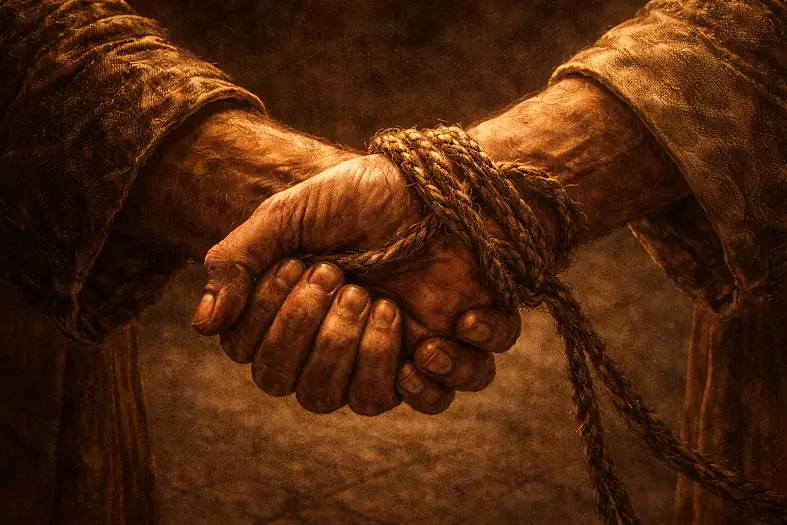
Yehuda binds his fate to Binyomin
Areivut עַד כְּלוֹת explores Yehudah’s radical declaration of responsibility in Parshas Vayigash. By binding his fate to Binyamin’s survival, Yehudah models existential areivut—to be the guarantor of responsibility without escape. Through the teachings of Ramban's commentary on Vayigash and Chassidic thought, this essay shows how true responsibility is measured by personal cost. It then reveals how Yehudah’s carefully timed, morally precise speech becomes an act of lifesaving intervention, fulfilling pikuach nefesh not through force, but through courage spoken before it is too late.

"Guarantor Until the End — עֲרֵבוּת עַד כְּלוֹת"

The Courage to Become Responsible for Another’s Life — and the Speech That Saves It

When Responsibility Becomes Existential

Parshas Vayigash marks the moment when responsibility in the Torah reaches its most radical form. Yehudah does not merely advocate, negotiate, or plead. He binds his life to another’s survival. In a single sentence, spoken without theatrics or qualification, Yehudah introduces a category of moral responsibility that exceeds obligation and enters the realm of existential commitment:

“כִּי עַבְדְּךָ עָרַב אֶת־הַנַּעַר”
[“For your servant has become guarantor for the lad”] (Bereishis 44:32)

This is not metaphor. Yehudah does not mean he feels responsible. He means his future, identity, and standing are now inseparable from Binyamin’s fate. If Binyamin does not return alive, Yehudah cannot return alive — morally, spiritually, or relationally.

This essay explores two intertwined Torah principles revealed in that declaration. First, areivut עד כלות — responsibility carried to its ultimate end, where one’s own existence is bound to another’s life. Second, the Torah’s insistence that speech itself can be an act of lifesaving intervention, fulfilling the obligation of pikuach nefesh even before force or rescue becomes necessary. Yehudah teaches that sometimes the act that saves a life is not physical heroism, but morally precise speech, spoken at the moment when silence would be lethal.

I. Areivut Reimagined — Beyond Legal Guarantee

The Torah uses the term areiv deliberately. In halachic contexts, an areiv is a guarantor — someone who assumes liability if another defaults. But Yehudah’s areivut is not contractual. It is existential.

He does not say:

  • “I will pay”
  • “I will compensate”
  • “I will bear consequences later”

He says:

“וְחָטָאתִי לְאָבִי כָּל־הַיָּמִים”
[“I will have sinned to my father for all my days”] (44:32)

This is a statement about permanent identity fracture. Yehudah declares that a life saved at the cost of another’s destruction is not life at all.

Areivut, here, means:

  • My fate is bound to yours
  • Your survival defines my legitimacy
  • My future is conditional on your return

This is responsibility without escape.

II. Ramban — Responsibility That Changes Destiny

Ramban frames Yehudah’s declaration as the culmination of teshuvah. Earlier, Yehudah suggested selling Yosef. His speech then severed responsibility. Now, speech restores it.

Ramban emphasizes that Yehudah does not merely regret the past. He rewrites the present by placing himself in the path of loss.

True teshuvah, Ramban teaches, is not:

  • Remorse alone
  • Emotional guilt
  • Retrospective sorrow

It is entering a similar situation and choosing self-sacrifice instead of self-preservation.

Yehudah’s areivut is not symbolic. It is operational.

III. Areivut Until the End — עַד כְּלוֹת

Chassidic masters seize on the phrase עָרַב not as past tense, but as present identity. Yehudah does not say, “I guaranteed.” He says, “I am guarantor.”

This introduces areivut עד כלות — responsibility carried until exhaustion, with no exit clause.

This form of areivut has three defining features:

  • Irreversibility — it cannot be undone without moral collapse
  • Personal cost — it demands sacrifice, not sympathy
  • Life-binding stakes — it concerns survival, not convenience

This is why Yehudah, not Yosef, becomes the ancestor of kings. Malchut begins when responsibility is embraced without safety net.

IV. Speech as Action — When Words Intervene Before Death

The Torah is precise about timing. Yehudah speaks before a life is taken, not after. Binyamin is not yet enslaved. Yaakov is not yet dead. The tragedy is approaching — but not complete.

This is critical.

Yehudah fulfills the logic of:

“לֹא תַעֲמֹד עַל דַּם רֵעֶךָ”
[“Do not stand idly by the blood of your fellow”] (Vayikra 19:16)

Standing idly by includes moral paralysis — waiting until danger becomes irreversible.

Yehudah intervenes with speech at the last possible moment when speech can still save a life.

V. Speech That Saves Lives — Not All Pikuach Nefesh Is Physical

The Torah does not restrict lifesaving to physical rescue. Preventing harm before it occurs is the highest form of pikuach nefesh.

Yehudah’s speech does three lifesaving things simultaneously:

  • It halts Binyamin’s enslavement
  • It prevents Yaakov’s death from grief
  • It stops the brothers from repeating murder by abandonment

None of this involves force. All of it involves courage.

Sometimes the holiest intervention is saying the sentence no one wants to say — at the moment when silence would be fatal.

VI. Precision, Not Passion — Why Yehudah’s Words Work

Yehudah does not shout. He does not accuse. He does not threaten. His speech is measured, personal, and morally exact.

Rashi notes that Yehudah’s words are layered — respectful, restrained, and relentless.

He speaks:

  • Personally — “your servant”
  • Relationally — invoking father and brother
  • Responsibly — offering himself

This is why Yosef breaks. Not because of emotion alone, but because Yehudah’s speech leaves no moral escape hatch.

VII. Areivut as the Foundation of Klal Yisrael

Chazal teach that all of Israel are guarantors for one another. But Vayigash shows that this principle is not abstract. It is forged in moments where one person is willing to collapse the distance between me and you.

Areivut means:

  • Your danger is my obligation
  • Your life is my concern
  • Your fate shapes my legitimacy

This is the moral DNA of the nation.

VIII. Application — Speaking Before It Is Too Late

The Torah’s lesson is uncomfortably relevant.

Lives are endangered not only by violence, but by:

  • Silence in the face of abuse
  • Avoidance of confrontation
  • Moral distancing masked as neutrality

Vayigash demands intervention before catastrophe.

We are asked:

  • Will we speak when speech still matters?
  • Will we bind ourselves to another’s survival?
  • Will we accept responsibility that costs us something?

The Sentence That Saves a Life

Yehudah does not draw a sword. He draws a line through his own future and says: If he does not return, neither can I.

This is areivut עד כלות — responsibility carried to its end.

Parshas Vayigash teaches that lives are often saved not by force, but by someone willing to speak with courage, precision, and personal cost — before blood is spilled.

Sometimes the most powerful act of pikuach nefesh is a sentence spoken in time.

And sometimes, redemption begins not with miracles — but with responsibility that refuses to let another person die alone.

📖 Sources

  • Full sources available on the Mitzvah Minute Parshas Vayigash page under insights and commentaries.

Organized by:
Boaz Solowitch
December 18, 2025
Mitzvah Minute Logo Icon

Connections

Mitzvah Minute Logo Icon

Mitzvah Links

Mitzvah 489

Not to stand idly by if someone's life is in danger
A Siddur
Learn this Mitzvah

Mitzvah 489

489
Not to stand idly by if someone's life is in danger

Mitzvah 75

To repent and confess wrongdoings
A Siddur
Learn this Mitzvah

Mitzvah 75

75
To repent and confess wrongdoings

Mitzvah 11

To emulate His ways
A Siddur
Learn this Mitzvah

Mitzvah 11

11
To emulate His ways

Mitzvah 13

To love other Jews
A Siddur
Learn this Mitzvah

Mitzvah 13

13
To love other Jews

Mitzvah 501

Not to insult or harm anybody with words
A Siddur
Learn this Mitzvah

Mitzvah 501

501
Not to insult or harm anybody with words
The Luchos - Ten Commandments
View Mitzvah Notes

Mitzvah Reference Notes

"x" close page navigation button

Mitzvah Reference Notes

"Guarantor Until the End — עֲרֵבוּת עַד כְּלוֹת"

Mitzvah #489 — Not to Stand Idly By if Someone’s Life Is in Danger (Leviticus 19:16)

לֹא תַעֲמֹד עַל דַּם רֵעֶךָ

Yehudah’s declaration of areivut is the clearest narrative embodiment of this mitzvah in the Torah. He intervenes before harm becomes irreversible, binding his own fate to Binyamin’s survival and refusing the moral neutrality of silence. Vayigash teaches that standing idly by includes delaying action when speech could still save a life. Yehudah fulfills this mitzvah not through force, but through timely, courageous intervention that prevents bloodshed before it occurs.

Mitzvah #75 — To Repent and Confess Wrongdoings (Numbers 5:7)

וְהִתְוַדּוּ אֶת־חַטָּאתָם

Yehudah’s speech functions as living confession. Without rehearsing past sins explicitly, he demonstrates teshuvah through changed behavior in the same moral configuration that once led to catastrophe. Rambam’s definition of complete repentance is fulfilled not through words of regret, but through responsibility accepted at personal cost. Confession here becomes existential rather than verbal alone.

Mitzvah #11 — To Emulate His Ways (Deuteronomy 28:9)

וְהָלַכְתָּ בִּדְרָכָיו

By assuming responsibility for another’s life without guarantee of success, Yehudah mirrors Divine conduct, in which Hashem sustains the vulnerable without obligation or benefit. Emulating Hashem means stepping forward where life is threatened and refusing to retreat behind self-interest. Vayigash teaches that halicha bidrachav sometimes demands binding oneself to another’s survival.

Mitzvah #13 — To Love Other Jews (Leviticus 19:18)

וְאָהַבְתָּ לְרֵעֲךָ כָּמוֹךָ

Yehudah’s areivut reframes love as responsibility rather than emotion. Loving another “as oneself” means refusing to preserve one’s own future at the cost of another’s destruction. Vayigash reveals that ahavah becomes fully real when one is willing to absorb loss so that another may live.

Mitzvah #501 — Not to Harm Others with Words (Leviticus 25:17)

וְלֹא תוֹנוּ אִישׁ אֶת־עֲמִיתוֹ

Yehudah’s speech is lifesaving precisely because it is morally precise. He neither accuses nor humiliates, understanding that reckless words can push situations past the point of repair. This mitzvah frames speech itself as a tool of pikuach nefesh: words spoken with care can halt destruction, while words spoken carelessly can hasten it.

Parsha Links

וַיִּגַּשׁ – Vayigash

Haftarah: Ezekiel 37:15-28
A Siddur
Learn this Parsha

וַיִּגַּשׁ – Vayigash

וַיִּגַּשׁ – Vayigash

וַיְחִי – Vayechi

Haftarah: Kings I 2:1-12
A Siddur
Learn this Parsha

וַיְחִי – Vayechi

וַיְחִי – Vayechi
The Luchos - Ten Commandments
View Parsha Notes
"x" close page navigation button

Parsha Reference Notes

"Guarantor Until the End — עֲרֵבוּת עַד כְּלוֹת"

Parshas Vayigash (Bereishis 44:18–47:27)

Vayigash presents the Torah’s most radical articulation of responsibility. Yehudah’s declaration—“כִּי עַבְדְּךָ עָרַב אֶת־הַנַּעַר”—is not advocacy but existential commitment, binding his own future to Binyamin’s survival. His speech intervenes before irreversible harm occurs, embodying the Torah’s demand not to stand idly by when life is at stake. By offering himself in place of another, Yehudah reveals that areivut is not abstract solidarity but responsibility carried to its end, where silence would itself become lethal.

Parshas Vayechi (Bereishis 47:28–50:26)

Vayechi confirms that areivut is not a momentary impulse but a sustaining moral posture. Yehudah’s leadership continues beyond crisis, while Yosef’s mercy ensures survival without humiliation. Read alongside Vayigash, the parsha teaches that responsibility for another’s life does not end when danger passes; it matures into long-term guardianship over dignity, continuity, and future generations. Areivut, once assumed, reshapes identity rather than receding with relief.

Mitzvah Minute
Mitzvah Minute Logo

Learn more.

Dive into mitzvos, tefillah, and Torah study—each section curated to help you learn, reflect, and live with intention. New insights are added regularly, creating an evolving space for spiritual growth.

Luchos
Live a commandment-driven life

Mitzvah

Explore the 613 mitzvos and uncover the meaning behind each one. Discover practical ways to integrate them into your daily life with insights, sources, and guided reflection.

Learn more

Mitzvah #

119

Each man must give a half shekel annually
The Luchos - Ten Commandments
Learn this Mitzvah

Mitzvah Highlight

Siddur
Connection through Davening

Tefillah

Learn the structure, depth, and spiritual intent behind Jewish prayer. Dive into morning blessings, Shema, Amidah, and more—with tools to enrich your daily connection.

Learn more

Tefillah

COMING SOON.
A Siddur
Learn this Tefillah

Tefillah Focus

A Sefer Torah
Study the weekly Torah portion

Parsha

Each week’s parsha offers timeless wisdom and modern relevance. Explore summaries, key themes, and mitzvah connections to deepen your understanding of the Torah cycle.

Learn more

כִּי תִשָּׂא – Ki Sisa

Haftarah: Ezekiel 36:16-36
A Sefer Torah
Learn this Parsha

Weekly Parsha