1.1 — From Crowd to Covenant Community
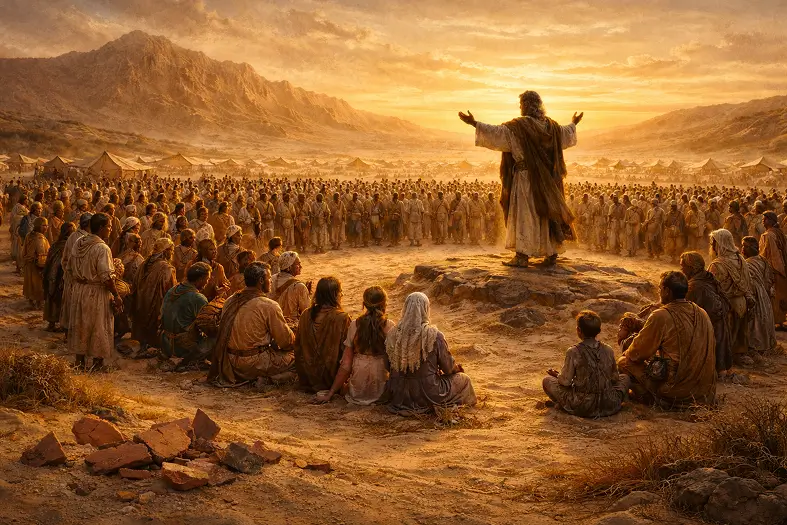
The opening word of Parshas Vayakhel is not merely logistical. It is therapeutic, covenantal, and national. After the catastrophe of the Golden Calf, the people of Yisrael still exist physically, but they no longer exist in the same way spiritually or socially. Trust has been damaged. Moral confidence has been shaken. Leadership has been tested under crisis. The nation that stood at Sinai as one people has discovered how quickly a frightened public can become a mob. When the Torah now says, וַיַּקְהֵל מֹשֶׁה אֶת כָּל עֲדַת בְּנֵי יִשְׂרָאֵל, it is describing far more than a public meeting. Moshe is doing the first necessary work of redemption after failure: he is gathering back together what sin has scattered.
Rashi’s chronology gives this moment even greater force. Vayakhel unfolds immediately after Yom HaKippurim, after forgiveness for the chet ha’eigel. That means the Mishkan does not begin as a neutral building campaign. It begins as the nation’s first collective act after pardon. Forgiveness alone does not yet rebuild a people. A sin can be absolved in Heaven while its social and spiritual consequences still linger below. Moshe therefore does not begin with analysis, protest, or rebuke. He begins with assembly. Before there can be sacred architecture, there must be restored society. Before there can be a sanctuary, there must be a people capable of building one together.
Rabbi Jonathan Sacks highlights the profound contrast between two gatherings in Sefer Shemos. At the Golden Calf, the people also assembled. But that earlier gathering was not a kehillah. It was a crowd.
A crowd forms in fear, volatility, and impulse. It feeds on anxiety. It weakens personal responsibility by dissolving the individual into collective emotion. In that earlier scene, the people could not bear uncertainty. Moshe was on Har Sinai. Fear rushed in. Impulse demanded immediacy. The result was not covenantal action but religious chaos dressed in spiritual language.
Now the same national energy must be transformed, not erased. Moshe does not attempt to suppress the people’s emotional power. He redirects it. The need for visible nearness to Hashem, the desire to act together, the longing for spiritual expression, and the impulse toward collective identity had all been misdirected in the eigel. In Vayakhel they are disciplined, ordered, and sanctified.
The people are not told to stop being a people. They are taught how to become one.
This is why the Mishkan begins with gathering rather than construction. The Torah is teaching that communal healing precedes communal achievement. A nation fractured by moral collapse cannot repair itself through private sincerity alone. It needs a shared act of rebuilding. The first miracle here is not artistic brilliance or material generosity. It is that a broken public can be turned back into an עדה, a covenantal collective under Torah leadership.
In that sense, וַיַּקְהֵל is the true foundation stone of the Mishkan.
Abarbanel approaches the opening of the parsha as a structural turning point. The question is not only what command is being delivered, but what kind of people are now able to receive it.
After the eigel, the central issue is no longer merely obedience. It is whether the nation can once again function as a vessel for the Shechinah. Moshe therefore gathers כָּל עֲדַת בְּנֵי יִשְׂרָאֵל, emphasizing that the Mishkan is not the project of spiritual elites. It is the work of the entire covenantal body.
The Mishkan is meant to house the Divine Presence among the people. But that presence cannot rest within a fractured society. The first task of Moshe is therefore social and spiritual reconstruction. The gathering itself becomes the first act of rebuilding the nation.
Only after the people are reassembled as a unified community can the construction of sacred space begin.
Ramban deepens the significance of this moment by emphasizing the historical context. The command of the Mishkan had originally been given before the sin of the Golden Calf. Now it is given again after forgiveness.
This repetition carries enormous meaning. It signals that the covenant has survived the rupture.
The Mishkan therefore becomes the visible sign that the relationship between Hashem and the people of Yisrael has been restored. Moshe gathers the entire nation because the renewal of that relationship must be national in scope. The people are not merely forgiven as individuals. They are restored as a covenantal society.
The sanctuary will stand at the center of the camp as testimony that closeness with Hashem is once again possible.
Rambam’s approach highlights another dimension of the gathering. Torah does not build holiness through inspiration alone. It forms a society through disciplined law, ordered service, and shared responsibility.
Sinai revealed truth. Vayakhel begins the process of building a nation capable of living by that truth.
A redeemed people cannot exist only as liberated individuals. It must become a structured moral community. The Mishkan will serve as the institutional center of that community, organizing national life around Divine service. But such institutions can only function if the people themselves are unified in purpose.
Moshe’s gathering therefore marks the moment when revelation begins to take social form.
Rav Avigdor Miller emphasizes that Moshe restores the people not only through words, but through action. After assembling the nation, he immediately invites them to participate in the building of the Mishkan.
This transforms the people from passive recipients into active builders of holiness.
Some bring gold, silver, and copper. Others bring fabrics, skins, and precious stones. Others contribute skill, craftsmanship, and wisdom. The Mishkan becomes a project in which every individual can participate.
This distinction is critical:
The Mishkan does not merely express the unity of the people. It creates it. Through shared contribution, the nation rediscovers itself as a collective capable of building something holy together.
Seen in this light, וַיַּקְהֵל becomes the first act of national teshuvah.
Teshuvah is not only confession or remorse. It is the reordering of life under the sovereignty of Hashem. In Parshas Vayakhel that reordering occurs on the scale of an entire nation.
Moshe takes a people wounded by failure and gives them a framework in which holiness can once again dwell. Isolation becomes fellowship. Fear becomes direction. A crowd becomes a covenant community.
The Mishkan begins not with wood, gold, or fabric, but with people learning how to stand together again.
Communities today often fracture not because people lack ideals or talent, but because trust has weakened. Shared purpose fades. Individuals live side by side yet feel disconnected from one another. Parshas Vayakhel speaks directly to this reality.
Moshe teaches that healing after a communal failure does not begin with reputation management or symbolic gestures. It begins with re-gathering people around a meaningful purpose.
Real restoration requires participation. Communities heal when people are invited back into responsibility, when dignity is restored through contribution, and when individuals rediscover that they are needed for something larger than themselves.
This principle applies everywhere:
Healing occurs when people begin building together again.
A community does not become whole simply because its members agree in principle. It becomes whole when individuals shoulder responsibility for a shared mission. That shared work transforms isolation into belonging.
The Torah’s answer to fragmentation is not louder emotion. It is deeper covenant. The world often produces crowds. Torah builds communities.
Whenever people gather with humility, responsibility, and devotion to something greater than themselves, the work of the Mishkan begins again.
📖 Sources


1.1 — From Crowd to Covenant Community
The opening word of Parshas Vayakhel is not merely logistical. It is therapeutic, covenantal, and national. After the catastrophe of the Golden Calf, the people of Yisrael still exist physically, but they no longer exist in the same way spiritually or socially. Trust has been damaged. Moral confidence has been shaken. Leadership has been tested under crisis. The nation that stood at Sinai as one people has discovered how quickly a frightened public can become a mob. When the Torah now says, וַיַּקְהֵל מֹשֶׁה אֶת כָּל עֲדַת בְּנֵי יִשְׂרָאֵל, it is describing far more than a public meeting. Moshe is doing the first necessary work of redemption after failure: he is gathering back together what sin has scattered.
Rashi’s chronology gives this moment even greater force. Vayakhel unfolds immediately after Yom HaKippurim, after forgiveness for the chet ha’eigel. That means the Mishkan does not begin as a neutral building campaign. It begins as the nation’s first collective act after pardon. Forgiveness alone does not yet rebuild a people. A sin can be absolved in Heaven while its social and spiritual consequences still linger below. Moshe therefore does not begin with analysis, protest, or rebuke. He begins with assembly. Before there can be sacred architecture, there must be restored society. Before there can be a sanctuary, there must be a people capable of building one together.
Rabbi Jonathan Sacks highlights the profound contrast between two gatherings in Sefer Shemos. At the Golden Calf, the people also assembled. But that earlier gathering was not a kehillah. It was a crowd.
A crowd forms in fear, volatility, and impulse. It feeds on anxiety. It weakens personal responsibility by dissolving the individual into collective emotion. In that earlier scene, the people could not bear uncertainty. Moshe was on Har Sinai. Fear rushed in. Impulse demanded immediacy. The result was not covenantal action but religious chaos dressed in spiritual language.
Now the same national energy must be transformed, not erased. Moshe does not attempt to suppress the people’s emotional power. He redirects it. The need for visible nearness to Hashem, the desire to act together, the longing for spiritual expression, and the impulse toward collective identity had all been misdirected in the eigel. In Vayakhel they are disciplined, ordered, and sanctified.
The people are not told to stop being a people. They are taught how to become one.
This is why the Mishkan begins with gathering rather than construction. The Torah is teaching that communal healing precedes communal achievement. A nation fractured by moral collapse cannot repair itself through private sincerity alone. It needs a shared act of rebuilding. The first miracle here is not artistic brilliance or material generosity. It is that a broken public can be turned back into an עדה, a covenantal collective under Torah leadership.
In that sense, וַיַּקְהֵל is the true foundation stone of the Mishkan.
Abarbanel approaches the opening of the parsha as a structural turning point. The question is not only what command is being delivered, but what kind of people are now able to receive it.
After the eigel, the central issue is no longer merely obedience. It is whether the nation can once again function as a vessel for the Shechinah. Moshe therefore gathers כָּל עֲדַת בְּנֵי יִשְׂרָאֵל, emphasizing that the Mishkan is not the project of spiritual elites. It is the work of the entire covenantal body.
The Mishkan is meant to house the Divine Presence among the people. But that presence cannot rest within a fractured society. The first task of Moshe is therefore social and spiritual reconstruction. The gathering itself becomes the first act of rebuilding the nation.
Only after the people are reassembled as a unified community can the construction of sacred space begin.
Ramban deepens the significance of this moment by emphasizing the historical context. The command of the Mishkan had originally been given before the sin of the Golden Calf. Now it is given again after forgiveness.
This repetition carries enormous meaning. It signals that the covenant has survived the rupture.
The Mishkan therefore becomes the visible sign that the relationship between Hashem and the people of Yisrael has been restored. Moshe gathers the entire nation because the renewal of that relationship must be national in scope. The people are not merely forgiven as individuals. They are restored as a covenantal society.
The sanctuary will stand at the center of the camp as testimony that closeness with Hashem is once again possible.
Rambam’s approach highlights another dimension of the gathering. Torah does not build holiness through inspiration alone. It forms a society through disciplined law, ordered service, and shared responsibility.
Sinai revealed truth. Vayakhel begins the process of building a nation capable of living by that truth.
A redeemed people cannot exist only as liberated individuals. It must become a structured moral community. The Mishkan will serve as the institutional center of that community, organizing national life around Divine service. But such institutions can only function if the people themselves are unified in purpose.
Moshe’s gathering therefore marks the moment when revelation begins to take social form.
Rav Avigdor Miller emphasizes that Moshe restores the people not only through words, but through action. After assembling the nation, he immediately invites them to participate in the building of the Mishkan.
This transforms the people from passive recipients into active builders of holiness.
Some bring gold, silver, and copper. Others bring fabrics, skins, and precious stones. Others contribute skill, craftsmanship, and wisdom. The Mishkan becomes a project in which every individual can participate.
This distinction is critical:
The Mishkan does not merely express the unity of the people. It creates it. Through shared contribution, the nation rediscovers itself as a collective capable of building something holy together.
Seen in this light, וַיַּקְהֵל becomes the first act of national teshuvah.
Teshuvah is not only confession or remorse. It is the reordering of life under the sovereignty of Hashem. In Parshas Vayakhel that reordering occurs on the scale of an entire nation.
Moshe takes a people wounded by failure and gives them a framework in which holiness can once again dwell. Isolation becomes fellowship. Fear becomes direction. A crowd becomes a covenant community.
The Mishkan begins not with wood, gold, or fabric, but with people learning how to stand together again.
Communities today often fracture not because people lack ideals or talent, but because trust has weakened. Shared purpose fades. Individuals live side by side yet feel disconnected from one another. Parshas Vayakhel speaks directly to this reality.
Moshe teaches that healing after a communal failure does not begin with reputation management or symbolic gestures. It begins with re-gathering people around a meaningful purpose.
Real restoration requires participation. Communities heal when people are invited back into responsibility, when dignity is restored through contribution, and when individuals rediscover that they are needed for something larger than themselves.
This principle applies everywhere:
Healing occurs when people begin building together again.
A community does not become whole simply because its members agree in principle. It becomes whole when individuals shoulder responsibility for a shared mission. That shared work transforms isolation into belonging.
The Torah’s answer to fragmentation is not louder emotion. It is deeper covenant. The world often produces crowds. Torah builds communities.
Whenever people gather with humility, responsibility, and devotion to something greater than themselves, the work of the Mishkan begins again.
📖 Sources


1.1 — From Crowd to Covenant Community
Numbers 5:7 — וְהִתְוַדּוּ אֶת חַטָּאתָם אֲשֶׁר עָשׂוּ
Parshas Vayakhel reflects the national process of teshuvah following the sin of the Golden Calf. Moshe’s gathering symbolizes the return of the people to covenantal life after failure. Repentance is not only regret but the rebuilding of a life ordered once again under the service of Hashem.
Deuteronomy 28:9 — וְהָלַכְתָּ בִּדְרָכָיו
The rebuilding of the nation in Vayakhel reflects the Torah’s vision of a society shaped by Divine values. A covenant community is formed when people structure their lives according to the moral order revealed by Hashem.
Deuteronomy 10:20 — וּבוֹ תִדְבָּק
After the confusion of the Golden Calf, the people are restored by gathering around Moshe, the faithful transmitter of Hashem’s word. The mitzvah of cleaving to those who know Hashem highlights the importance of spiritual leadership in guiding a community back to truth.
Leviticus 19:18 — וְאָהַבְתָּ לְרֵעֲךָ כָּמוֹךָ
The Mishkan begins with the reformation of the nation as a unified people. Love of fellow Jews becomes the social foundation of covenant life, enabling individuals to join together in building a dwelling place for the Divine Presence.
Exodus 25:8 — וְעָשׂוּ לִי מִקְדָּשׁ וְשָׁכַנְתִּי בְּתוֹכָם
The command to build the Mishkan reaches fulfillment in the events of Vayakhel. The sanctuary emerges not from isolated devotion but from a united people contributing together to create a dwelling place for the Shechinah.


1.1 — From Crowd to Covenant Community
וַיַּקְהֵל מֹשֶׁה אֶת כָּל עֲדַת בְּנֵי יִשְׂרָאֵל
Parshas Vayakhel opens with Moshe assembling the entire nation after the rupture of the Golden Calf. This gathering is the first public act of national repair following forgiveness. Before the Mishkan can be built, the people themselves must be re-formed as a covenantal society. The parsha teaches that sacred space emerges only after sacred community is restored through unity, responsibility, and obedience to Hashem.

Dive into mitzvos, tefillah, and Torah study—each section curated to help you learn, reflect, and live with intention. New insights are added regularly, creating an evolving space for spiritual growth.

Explore the 613 mitzvos and uncover the meaning behind each one. Discover practical ways to integrate them into your daily life with insights, sources, and guided reflection.

Learn the structure, depth, and spiritual intent behind Jewish prayer. Dive into morning blessings, Shema, Amidah, and more—with tools to enrich your daily connection.

Each week’s parsha offers timeless wisdom and modern relevance. Explore summaries, key themes, and mitzvah connections to deepen your understanding of the Torah cycle.