8.1 — Covenant After Crisis
Ki Sisa is one of the few parshiyos that shows the full life-cycle of the covenant: organization, collapse, intercession, forgiveness, and renewal. Because of this, it speaks not only about a moment in the wilderness but about the ongoing life of Klal Yisrael. The parsha describes how a covenant people continues to live even after failure and how holiness can be rebuilt again and again across generations.
Parshas Ki Sisa speaks directly to the reality of modern covenant life. Few generations live with open miracles or clear revelation, yet every generation faces moments of confusion, failure, and rebuilding. Ki Sisa teaches that covenant life does not depend on perfection. It depends on the ability to rebuild.
The covenant described in Ki Sisa is not a distant historical story. It is the structure through which Jewish life continues today. The same pattern that carried Klal Yisrael through the crisis of the Golden Calf continues to guide covenant life in every generation.
Holiness is built step by step.
Commitment is renewed again and again.
The covenant lives through those who sustain it.
The parsha begins with the half-shekel — a reminder that covenant life begins with contribution. A covenant community exists only when individuals accept responsibility for its existence.
Modern covenant life depends on the same principle. Communities endure when individuals give their time, energy, and resources to sustain Torah life.
Contribution takes many forms:
Each act of contribution strengthens the covenant.
The half-shekel teaches that no individual stands outside covenant responsibility. Covenant life survives when everyone gives a share.
Ki Sisa teaches that holiness cannot survive on inspiration alone. The Mishkan, the Kiyor, the Ketores, and Shabbos establish the disciplined structure that sustains covenant life.
Modern life presents endless distractions and pressures. Without structure, spiritual life becomes fragile and inconsistent.
Discipline protects holiness.
Stable covenant life depends on:
These practices create a framework within which holiness can endure.
Discipline transforms ideals into reality.
The Golden Calf teaches that spiritual confusion can arise even among people who seek closeness to Hashem. Covenant life therefore requires faithfulness even when clarity is lacking.
Every generation faces moments when faith becomes difficult or uncertain. Ki Sisa teaches that covenant life continues through commitment even when understanding is incomplete.
Faithfulness means:
Faithfulness sustains the covenant when conditions are difficult.
The covenant survives because commitment continues.
Ki Sisa teaches that renewal begins with responsibility. After the Golden Calf, Moshe calls the people to accountability and return. The covenant is restored because the nation accepts responsibility for its actions.
Renewal remains possible in every generation because responsibility remains possible.
When mistakes occur, covenant life does not end. It continues through honest return and renewed effort.
Responsibility transforms failure into growth.
The covenant becomes stronger when it passes through renewal.
Rav Kook taught that holiness develops within the realities of historical life. The covenant after the Golden Calf represents holiness capable of surviving the complexities of the real world.
Modern covenant life reflects this same principle. Holiness is built through daily effort rather than through extraordinary experiences.
Growth often occurs gradually.
Holiness becomes lasting when it becomes part of life itself.
The covenant endures because holiness develops within history.
Rabbi Jonathan Sacks emphasized that covenant life depends on responsibility rather than perfection. A covenant people survives not because individuals never fail but because they remain committed to rebuilding.
Ki Sisa shows that covenant life includes both failure and renewal.
The covenant endures because responsibility continues across generations.
Each generation receives the covenant and strengthens it through its own commitment.
Rav Avigdor Miller emphasized that covenant life becomes real when it is lived with seriousness and intention. Torah life grows through steady effort and conscious commitment.
Every mitzvah becomes an act of covenant renewal.
Daily choices shape covenant life.
When Torah becomes central to life, the covenant becomes stable and enduring.
The same structure that sustained Israel after the Golden Calf continues to sustain Jewish life today.
Ki Sisa teaches that covenant life is built through steady commitment rather than through moments of inspiration alone. The parsha presents a unified path through which holiness can be sustained even in the face of challenge and change.
Contribution builds belonging. When individuals give of themselves to the community, the covenant becomes a shared reality rather than an abstract idea. Each act of responsibility strengthens the life of the nation.
Discipline creates stability. Regular observance of mitzvos establishes a structure that supports spiritual growth and protects against confusion and drift.
Faithfulness sustains the relationship. Even during times of difficulty or uncertainty, continued commitment preserves the connection between Hashem and Israel.
Responsibility allows renewal. When failure leads to reflection and renewed effort, the covenant becomes stronger rather than weaker.
Ki Sisa teaches that covenant life is not the achievement of perfection but the ongoing process of building, repairing, and strengthening the relationship with Hashem. Through contribution, discipline, faithfulness, and responsibility, holiness becomes a lasting reality across generations.
📖 Sources

8.1 — Covenant After Crisis
Ki Sisa is one of the few parshiyos that shows the full life-cycle of the covenant: organization, collapse, intercession, forgiveness, and renewal. Because of this, it speaks not only about a moment in the wilderness but about the ongoing life of Klal Yisrael. The parsha describes how a covenant people continues to live even after failure and how holiness can be rebuilt again and again across generations.
Parshas Ki Sisa speaks directly to the reality of modern covenant life. Few generations live with open miracles or clear revelation, yet every generation faces moments of confusion, failure, and rebuilding. Ki Sisa teaches that covenant life does not depend on perfection. It depends on the ability to rebuild.
The covenant described in Ki Sisa is not a distant historical story. It is the structure through which Jewish life continues today. The same pattern that carried Klal Yisrael through the crisis of the Golden Calf continues to guide covenant life in every generation.
Holiness is built step by step.
Commitment is renewed again and again.
The covenant lives through those who sustain it.
The parsha begins with the half-shekel — a reminder that covenant life begins with contribution. A covenant community exists only when individuals accept responsibility for its existence.
Modern covenant life depends on the same principle. Communities endure when individuals give their time, energy, and resources to sustain Torah life.
Contribution takes many forms:
Each act of contribution strengthens the covenant.
The half-shekel teaches that no individual stands outside covenant responsibility. Covenant life survives when everyone gives a share.
Ki Sisa teaches that holiness cannot survive on inspiration alone. The Mishkan, the Kiyor, the Ketores, and Shabbos establish the disciplined structure that sustains covenant life.
Modern life presents endless distractions and pressures. Without structure, spiritual life becomes fragile and inconsistent.
Discipline protects holiness.
Stable covenant life depends on:
These practices create a framework within which holiness can endure.
Discipline transforms ideals into reality.
The Golden Calf teaches that spiritual confusion can arise even among people who seek closeness to Hashem. Covenant life therefore requires faithfulness even when clarity is lacking.
Every generation faces moments when faith becomes difficult or uncertain. Ki Sisa teaches that covenant life continues through commitment even when understanding is incomplete.
Faithfulness means:
Faithfulness sustains the covenant when conditions are difficult.
The covenant survives because commitment continues.
Ki Sisa teaches that renewal begins with responsibility. After the Golden Calf, Moshe calls the people to accountability and return. The covenant is restored because the nation accepts responsibility for its actions.
Renewal remains possible in every generation because responsibility remains possible.
When mistakes occur, covenant life does not end. It continues through honest return and renewed effort.
Responsibility transforms failure into growth.
The covenant becomes stronger when it passes through renewal.
Rav Kook taught that holiness develops within the realities of historical life. The covenant after the Golden Calf represents holiness capable of surviving the complexities of the real world.
Modern covenant life reflects this same principle. Holiness is built through daily effort rather than through extraordinary experiences.
Growth often occurs gradually.
Holiness becomes lasting when it becomes part of life itself.
The covenant endures because holiness develops within history.
Rabbi Jonathan Sacks emphasized that covenant life depends on responsibility rather than perfection. A covenant people survives not because individuals never fail but because they remain committed to rebuilding.
Ki Sisa shows that covenant life includes both failure and renewal.
The covenant endures because responsibility continues across generations.
Each generation receives the covenant and strengthens it through its own commitment.
Rav Avigdor Miller emphasized that covenant life becomes real when it is lived with seriousness and intention. Torah life grows through steady effort and conscious commitment.
Every mitzvah becomes an act of covenant renewal.
Daily choices shape covenant life.
When Torah becomes central to life, the covenant becomes stable and enduring.
The same structure that sustained Israel after the Golden Calf continues to sustain Jewish life today.
Ki Sisa teaches that covenant life is built through steady commitment rather than through moments of inspiration alone. The parsha presents a unified path through which holiness can be sustained even in the face of challenge and change.
Contribution builds belonging. When individuals give of themselves to the community, the covenant becomes a shared reality rather than an abstract idea. Each act of responsibility strengthens the life of the nation.
Discipline creates stability. Regular observance of mitzvos establishes a structure that supports spiritual growth and protects against confusion and drift.
Faithfulness sustains the relationship. Even during times of difficulty or uncertainty, continued commitment preserves the connection between Hashem and Israel.
Responsibility allows renewal. When failure leads to reflection and renewed effort, the covenant becomes stronger rather than weaker.
Ki Sisa teaches that covenant life is not the achievement of perfection but the ongoing process of building, repairing, and strengthening the relationship with Hashem. Through contribution, discipline, faithfulness, and responsibility, holiness becomes a lasting reality across generations.
📖 Sources


“Covenant After Crisis”
"זֶה יִתְּנוּ"
The half-shekel establishes the foundation of covenant life through shared contribution. Each individual participates equally in sustaining the communal service of the Mishkan, teaching that the covenant is built through collective responsibility.
This mitzvah expresses the first stage of covenant life: contribution. A covenant people exists only when individuals accept responsibility for building and sustaining the community.
The half-shekel transforms the nation from a collection of individuals into a unified covenant community.
"וְרָחֲצוּ אַהֲרֹן וּבָנָיו"
The washing at the Kiyor represents the disciplined preparation required for Divine service. Covenant life depends on conscious preparation and structured holiness rather than spontaneous religious emotion.
This mitzvah reflects the second stage of covenant life: discipline. Holiness becomes stable only when spiritual life is guided by consistent structure and deliberate practice.
Preparation transforms ordinary action into avodah.
"קֹדֶשׁ יִהְיֶה לָכֶם"
The prohibition against duplicating the Shemen HaMishchah teaches that holiness must remain within Divinely established boundaries. Spiritual creativity that ignores these boundaries leads to distortion, as demonstrated by the Golden Calf.
This mitzvah expresses the disciplined limits that preserve covenant life and protect holiness from misuse.
Boundaries safeguard the covenant.
"קֹדֶשׁ תִּהְיֶה לְךָ לַה׳"
The prohibition against reproducing the Ketores reinforces the principle that holiness cannot be reshaped according to personal preference. Covenant life depends on fidelity to the structure established by the Torah.
This mitzvah reflects the disciplined structure that sustains the covenant and prevents the distortions that lead to spiritual collapse.
Holiness remains stable when it remains faithful to its Divine form.
"וְהִתְוַדּוּ אֶת־חַטָּאתָם"
Teshuvah is the central mechanism that allows covenant life to continue after failure. The Golden Calf established repentance as a permanent feature of the covenant, ensuring that mistakes would not end the relationship between Hashem and Israel.
This mitzvah expresses the third stage of covenant life: renewal through repentance.
Through teshuvah, failure becomes the beginning of deeper commitment rather than the end of covenant life.
"וַעֲבַדְתֶּם אֵת ה׳ אֱלֹקֵיכֶם"
Prayer expresses the ongoing relationship between Hashem and Israel after the crisis of the Golden Calf. Through tefillah, the covenant remains active across generations.
Prayer sustains covenant life even during periods of difficulty and concealment.
Tefillah transforms covenant from historical event into living relationship.
"וּבַיּוֹם הַשְּׁבִיעִי תִּשְׁבֹּת"
Shabbos expresses the enduring covenant through sacred time. Each week the relationship between Hashem and Israel is renewed, making the covenant permanent rather than episodic.
Shabbos sustains covenant life across generations and historical change.
Sacred time anchors the covenant within the rhythm of life.
"זָכוֹר אֶת־יוֹם הַשַּׁבָּת לְקַדְּשׁוֹ"
Kiddush and Havdalah give verbal expression to the sanctity of Shabbos and affirm the covenant consciously each week.
Through sanctification of Shabbos, the covenant becomes not only practiced but declared and remembered.
The covenant is renewed through sacred speech as well as sacred action.
"וְשִׁנַּנְתָּם לְבָנֶיךָ"
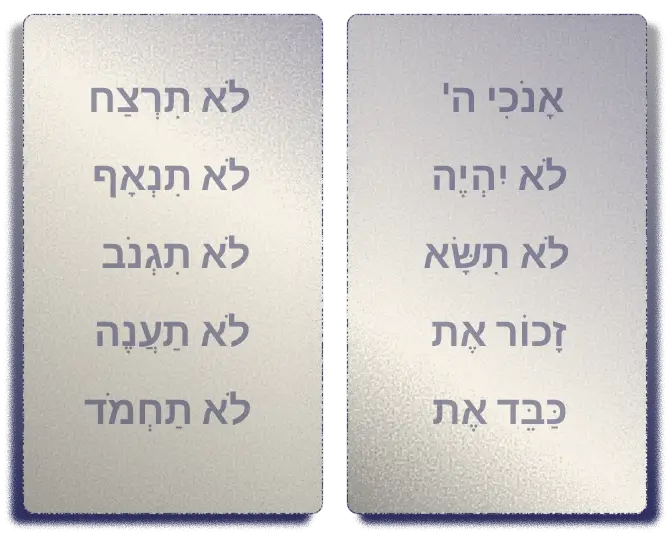
Transmission of Torah ensures that the covenant survives crisis and continues across generations. The second Luchos represent a Torah that lives within history, sustained through teaching and learning.
This mitzvah expresses the permanent structure of covenant life. Each generation receives the Torah and passes it forward.
Torah transmission transforms covenant from a single historical event into an eternal inheritance.
"אָנֹכִי ה׳ אֱלֹקֶיךָ"
Knowledge of Hashem forms the spiritual foundation of covenant life. The covenant established after the Golden Calf sustains awareness of Hashem even without constant revelation.
This mitzvah expresses the enduring goal of covenant existence — to live with awareness of Hashem within the realities of history.
Through knowledge of Hashem, covenant life becomes a conscious relationship.


"Covenant After Crisis"
The full arc of Ki Sisa traces the development of covenant life from the half-shekel census through the Mishkan commands, the Golden Calf, Moshe’s intercession, the Thirteen Middos, and the second Luchos. Together these sections establish the enduring structure of covenant life through contribution, discipline, repentance, and renewal.

Dive into mitzvos, tefillah, and Torah study—each section curated to help you learn, reflect, and live with intention. New insights are added regularly, creating an evolving space for spiritual growth.

Explore the 613 mitzvos and uncover the meaning behind each one. Discover practical ways to integrate them into your daily life with insights, sources, and guided reflection.

Learn the structure, depth, and spiritual intent behind Jewish prayer. Dive into morning blessings, Shema, Amidah, and more—with tools to enrich your daily connection.

Each week’s parsha offers timeless wisdom and modern relevance. Explore summaries, key themes, and mitzvah connections to deepen your understanding of the Torah cycle.