www.Mitzvah-Minute.com
"Finding Divine Purpose in the Darkness Before the Light"
Parshas Mikeitz — Lessons for Today
Parshas Mikeitz unfolds at the mysterious border between despair and redemption. Yosef emerges from years of imprisonment into sudden power. His brothers descend into Egypt unaware they are walking into a chapter of their own repentance. And beneath everything, unseen yet directing every movement, is the Hand of Hashem — weaving salvation slowly, silently, and perfectly.
Mikeitz arrives almost always during Chanukah — not by chance. Both the parsha and the festival teach one profound truth:
Geulah rarely bursts into the world all at once.
It begins as a small, flickering light —
fueled by faith in the darkness.
Below are practical ways the themes of Mikeitz apply to our lives today — at home, in community, and in our inner world.
Hidden Providence: Seeing Hashem When We Can’t See Anything
From the pit to Potiphar’s house, from false accusation to the dungeon — Yosef lived a life that looked like abandonment. Yet every descent was actually a preparation.
The Midrash teaches:
Wherever Yosef fell, Hashem cushioned the fall with purpose.
We often say “Everything happens for a reason.” Mikeitz demands more:
Everything is led by reason — orchestrated by Hashem specifically for your growth.
Modern life challenges faith in concealment:
- Delays that frustrate
- Career setbacks
- Medical uncertainty
- Relationships that fall apart
- Dreams seemingly slipping away
Mikeitz answers:
Whenever the script looks worst… the Author is closest.
How to live this today:
- When facing adversity, quietly say:
“Hashem, this too is from You, and therefore this too is good for me.” - Keep a small private notebook: “Hidden Blessings” — record times darkness led to light.
- When plans crumble, pause and ask:
“What middah or mission is Hashem training me for right now?”
This shift — from What is happening to me?
to Why is Hashem shaping me this way? —
changes everything.
The Delay Is the Lesson: Patience Shapes Our Greatness
Yosef interprets the cupbearer’s dream — and waits.
A day. A week. A year. Two years.
Not forgotten — being finished.
Chovos HaLevavos says:
Hashem trains us through life’s surprises —
both disappointments and sudden successes.
Why?
To soften the “lev ha’even” — the stone heart —
into a heart of living emunah.
In the waiting, Yosef learned:
- People may help — but only Hashem decides
- Escape doesn’t come from the cupbearer
- The sentence “Bil’adai — It is not from me” becomes his reflexive truth
Delays aren’t detours.
They are the curriculum.
How to live this today:
- Next time a door slams shut, immediately think:
“This is Hashem teaching me reliance, not rejection.” - Turn delays into tefillah: short whispers of emunah
“You run my life. I trust Your timing.” - Celebrate small wins — each is Hashem’s loving wink
The dungeon did not end Yosef —
it readied him to rise without forgetting Who lifted him.
Faithful Leadership: Success Is Stewardship, Not Self
Yosef becomes viceroy — but never the star.
He refuses Pharaoh’s praise:
“Bil’adai — Hashem will answer the peace of Pharaoh.”
Despite transformative power, he remains:
- Modest in speech
- Careful with credit
- Focused on saving others, not himself
Rav Sacks writes:
Yosef’s greatness was not in dreaming but in
helping others realize their dreams.
From Yosef we learn:
Leadership = responsibility without ego.
Success = service.
Achievement = accountability.
How to live this today:
- Use wins (professional, spiritual, family) to uplift others
- Replace “I earned this” with:
“Hashem gifted me this so I can serve.” - Seek quiet mitzvot with public impact
The world craves Yosef-leaders:
people who rise high but bow low — always facing Heaven.
Healing Relationships: Teshuvah Begins With Empathy
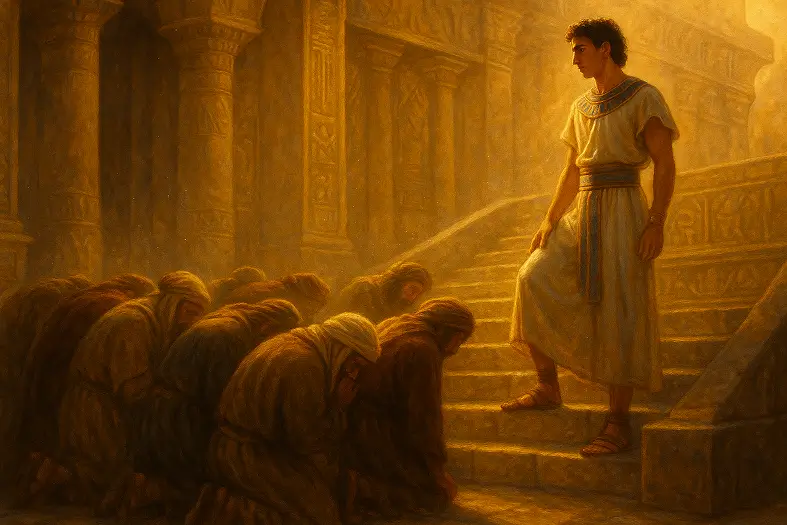
When the brothers bow to Yosef, the dream resurfaces — but Yosef doesn’t avenge.
Instead, he creates a plan for healing:
- Testing responsibility
- Stirring conscience
- Awakening brotherhood
Before we can become a nation, we must become a family.
Rav Kook teaches:
The light of redemption begins with the light of unity.
Modern division — politics, reputation, religious differences — tears Jews apart more than external enemies.
Mikeitz challenges us:
- Can we seek understanding before judgment?
- Can we pray for those who hurt us?
- Can we unify without uniformity?
How to live this today:
- Choose one strained relationship → take the first step
- Speak less about others, more to others
- Before reacting in anger, silently ask:
“How might this look from their story?” - Practice “Dan L’Kaf Zechut” — giving benefit of the doubt — 1x/day consciously
Forgiveness doesn’t erase the past.
It redeems it.
Managing Power, Money & Influence With Kedushah
Yosef is placed in charge of the world’s economy.
Absolute control. No supervision.
Yet he:
- Doesn’t exploit famine for personal gain
- Remains loyal to halacha, identity, modesty
- Uses prosperity to preserve life — not to indulge ego
The Chashmonaim, by contrast, began as heroes but later generations were corrupted by comfort and success.
As Rav Miller warns:
The wounds of struggle elevate us;
the kisses of success can destroy us.
In a world obsessed with material excess and image:
- Will financial blessing deepen our gratitude?
- Or dull our spiritual sensitivity?
- Will a higher position expand our giving?
- Or shrink our humility?
How to live this today:
- Don’t wait for abundance — give from the little you have
- Say “Thank You Hashem” each time a bracha arrives
- View every talent and dollar as on loan from Heaven
- Ask:
“Is this decision aligned with Yosef’s integrity?”
We are not judged by what we have —
but what we do with it.
Chanukah: A Light That Says “You Are Never Alone”
Mikeitz always falls on Chanukah because their message is one:
The Shechinah never left Klal Yisrael — even in exile.
The oil lasted eight days to proclaim:
- Hashem is here, even when invisible
- We don’t walk history alone
- Our mission still burns
Rav Miller describes the eruption of joy:
“A conflagration of exhilaration —
Hashem is here among us!”
Chanukah is not about presents.
It is about Presence.
How to live this today:
- When lighting candles, pause to feel:
“Hashem is with us. Right here. Right now.” - Bring light where darkness dwells:
kindness, Torah, friendship, hospitality - Express Jewish pride — mezuzah, tzitzit, Shabbos candles — visibly and joyfully
Every flame is a letter from Hashem:
I will never abandon you.
Personal Exile, Personal Redemption
Every Jew experiences Egypt — confusion, fear, loneliness.
And every Jew carries Yosef’s spark — resilience, loyalty, hope.
Your darkness is not a contradiction to your destiny.
It is the road to it.
Hashem writes stories slowly —
so that we grow into the people worthy of the ending.
Today, live with purpose:
- If you’re struggling → this is your training for greatness
- If you’re rising → stay humble and mission-focused
- If you’re in between → hold both gratitude and longing
The light may be small —
but the message is infinite.
Never confuse silence with absence.
Never confuse waiting with wasting.
Never confuse concealment with abandonment.
Hashem is here —
in the pit, in the palace, and everywhere in between.
A Closing Lesson
Mikeitz tells us that geulah works like sunrise:
First a whisper of light
Then a faint silhouette
Then suddenly — everything is illuminated
Our task is simple but not easy:
Keep lighting — even when it seems too dark to see.
This week, let us each choose:
- One disappointment → to turn into trust
- One relationship → to repair
- One success → to redirect toward service
- One mitzvah of light → to perform with pride and love
And may we merit to witness the fulfillment of Yosef’s words:
“Elokim Ye’aneh es Shalom Par’oh” —
Hashem will answer for peace.
May He illuminate our homes, our hearts,
and our entire nation with the everlasting light of redemption.
📖 Sources
- Full sources available on the Mitzvah Minute Parshas Mikeitz page under insights and commentaries.