"Recognition Deferred: A Pattern of Jewish History"

Mitzvah Minute Logo Icon

Parshas Mikeitz — Seeing and Being Seen

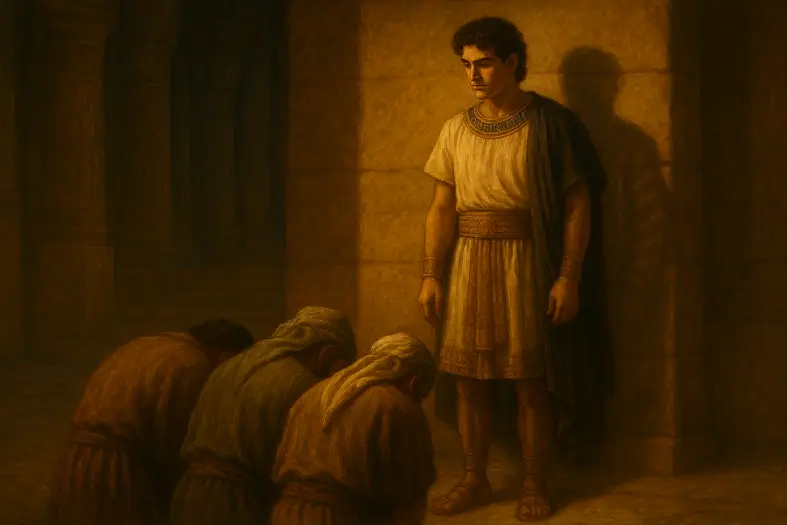
Yosef's brothers do not recognize him and bow. Yosef's shadow is wearing the  Ketonet Passim.
Yosef sees his brothers — but they do not see him. That single moment becomes a pattern throughout Jewish history: the world sees the Jewish people yet fails to recognize our mission, and even we sometimes fail to truly see each other. This article explores how misrecognition fuels conflict and exile, while genuine recognition — the courage to look past labels and see the Divine image within every Jew — becomes the first spark of redemption. When we help someone feel seen and valued, we heal Yosef’s tears and bring geulah closer.

"Recognition Deferred: A Pattern of Jewish History"

Parshas Mikeitz — Seeing and Being Seen

“Yosef recognized his brothers, but they did not recognize him.”
— Bereishis 42:8

It’s not just a moment of confusion — it’s a moment of pain.
Yosef knows them. They do not know him.
He sees them as family. They see him as foreign.

This is a core tension of Jewish destiny:

  • People who should see us — don’t
  • People who should understand us — can’t
  • People who should embrace us — sometimes reject

It hurts. And Yosef’s tears spill across generations.

The Pain of Being Misunderstood

Rashi says the brothers once saw Yosef — but did not recognize his greatness.
They saw a shepherd trying to dream like a king.

We all know that feeling:
When our potential isn’t believed in — yet.

Moments when people fail to see:

  • The change we’ve made
  • The growth we’ve earned
  • The soul within our struggles
  • The future Hashem is preparing for us

And like Yosef, sometimes we cry where no one sees —
wishing someone would truly see us.

Rav Sacks: The World Sees Us, But Rarely Understands Us

The nations look at Am Yisrael and see:

  • A tiny people that won’t disappear
  • A nation that builds wherever it lives
  • A culture that outlives every empire

But do they recognize the Divine story behind that survival?
Rarely. They see our actions — not our calling.

Misrecognition creates:

  • Misjudgment
  • Distrust
  • Antisemitism
  • Fear of what is misunderstood

When the world sees our existence, but not our essence,
our destiny becomes invisible to them.

Rav Kook: Redemption Begins With Recognizing One Another

Before we can be recognized by the world…
we must recognize each other.

Unity is not optional.
It is the first step of geulah.

When we see each other as:

  • Family before faction
  • Souls before labels
  • Stories before stereotypes

We create a world where Yosef can reveal himself
and not be feared — but embraced.

Rav Kook teaches:

“To love another Jew is to see the Divine within them.”

Recognition isn’t just noticing someone.
It’s acknowledging who they are in Hashem’s plan.

Yosef’s Leadership: Eyes That Search for the Good

Yosef could have weaponized power.
Instead, he choreographs reconciliation.

He tests not to punish — but to heal.
He hides not to harm — but to rebuild trust.

He models leadership that:

  • Aims for teshuvah, not revenge
  • Lifts people back into their mission
  • Reveals greatness in others
  • Makes space for change

Yosef refuses to define anyone by the worst thing they ever did.
He waits until they recognize their own growth too.

That is what lets redemption begin.

A Call for Our Generation

We live in a moment of increased Jewish visibility —
yet frightening Jewish misrecognition.

And not only from outsiders.

Our internal divisions include:

  • Religious vs. secular
  • Israeli vs. diaspora
  • Left vs. right
  • Labels that divide more than they clarify

Sometimes, we — like the brothers — don’t recognize the Yosef standing right in front of us.

Mikeitz asks us:

What if redemption hinges on our courage to see each other as family again?

How to Live This Today

Start small. One person. One moment of recognition.

Daily acts of geulah:

  • Say hello to someone who feels invisible
  • Ask someone’s name — and use it
  • Assume good intentions before judgment
  • Reach out to someone who stepped away
  • Replace criticism with curiosity:

“Help me understand your story.”

Recognition is not flattery.
It is saying:

I see you. You matter. You belong.

Final Thought

Exile began with a failure of recognition.
Redemption begins with the courage to look again.

May we be the generation that sees beneath the disguise…
and finds the Divine image shining in every Jew.

And may we soon hear those healing words echoed across our people:

Ani Yosef! Ani Achichem!
“I am Yosef — I am your brother.”

📖 Sources

  • Full sources available on the Mitzvah Minute Parshas Mikeitz page under insights and commentaries.

Organized by:
Boaz Solowitch
December 10, 2025
Mitzvah Minute Logo Icon

Connections

Mitzvah Minute Logo Icon

Mitzvah Links

Mitzvah 13

To love other Jews
A Siddur
Learn this Mitzvah

Mitzvah 13

13
To love other Jews

Mitzvah 15

Not to hate fellow Jews
A Siddur
Learn this Mitzvah

Mitzvah 15

15
Not to hate fellow Jews

Mitzvah 20

Not to take revenge
A Siddur
Learn this Mitzvah

Mitzvah 20

20
Not to take revenge

Mitzvah 21

Not to bear a grudge
A Siddur
Learn this Mitzvah

Mitzvah 21

21
Not to bear a grudge

Mitzvah 501

Not to insult or harm anybody with words
A Siddur
Learn this Mitzvah

Mitzvah 501

501
Not to insult or harm anybody with words

Mitzvah 495

Not to put a stumbling block before a blind man (nor give harmful advice)
A Siddur
Learn this Mitzvah

Mitzvah 495

495
Not to put a stumbling block before a blind man (nor give harmful advice)
The Luchos - Ten Commandments
View Mitzvah Notes

Mitzvah Reference Notes

"x" close page navigation button

Mitzvah Reference Notes

"Recognition Deferred: A Pattern of Jewish History"

13. To love other Jews — Leviticus 19:18

15. Not to hate fellow Jews — Leviticus 19:17

Recognizing another Jew’s value is the first step toward unity. Yosef initiates a path toward healing despite past wrongs.

20. Not to take revenge — Leviticus 19:18

Yosef has power to retaliate — but instead he orchestrates growth and transformation.

21. Not to bear a grudge — Leviticus 19:18

Past pain cannot define the future of the Jewish people. Yosef models redemption, not resentment.

501. Not to insult or harm anybody with words — Leviticus 25:17

Failure to see another person accurately leads to hurtful speech and damaged relationships — the original fracture in Yosef’s family.

495. Not to put a stumbling block before the blind — Leviticus 19:14

Yosef challenges the brothers to “see” what they were once blind to — their own spiritual potential and responsibility.

Parsha Links

וַיֵּשֶׁב – Vayeishev

Haftarah: Amos 2:6 - 3:8
A Siddur
Learn this Parsha

וַיֵּשֶׁב – Vayeishev

וַיֵּשֶׁב – Vayeishev

מִקֵּץ – Mikeitz

Haftarah : Kings I 3:15-4:1
A Siddur
Learn this Parsha

מִקֵּץ – Mikeitz

מִקֵּץ – Mikeitz

וַיִּגַּשׁ – Vayigash

Haftarah: Ezekiel 37:15-28
A Siddur
Learn this Parsha

וַיִּגַּשׁ – Vayigash

וַיִּגַּשׁ – Vayigash

שְׁמוֹת – Shemos

Haftarah: Isaiah 27:6 - 28:13; Isaiah 29:22-23
A Siddur
Learn this Parsha

שְׁמוֹת – Shemos

שְׁמוֹת – Shemos

וָאֵרָא – Va’eira

Haftarah: Ezekiel 28:25 - 29:21
A Siddur
Learn this Parsha

וָאֵרָא – Va’eira

וָאֵרָא – Va’eira
The Luchos - Ten Commandments
View Parsha Notes
"x" close page navigation button

Parsha Reference Notes

"Recognition Deferred: A Pattern of Jewish History"

Vayeishev

The brothers misjudge Yosef and refuse to recognize his spiritual potential — a failure of insight that becomes the root of exile.

Mikeitz

Yosef sees his brothers clearly, but they fail to see him (42:8) — symbolizing how truth can stand before us while remaining unseen.

Vayigash

Recognition triggers redemption: when Yosef declares “Ani Yosef!” the family sees again, wounds begin to heal, and unity becomes possible.

Shemos

Moshe leaves Egyptian royalty to recognize his brothers’ suffering — choosing identity over comfort, mission over disguise.

Va’eira

Pharaoh repeatedly “does not recognize” Hashem — a blindness to Divine revelation that leads to his downfall and Israel’s rise.

Mitzvah Minute
Mitzvah Minute Logo

Learn more.

Dive into mitzvos, tefillah, and Torah study—each section curated to help you learn, reflect, and live with intention. New insights are added regularly, creating an evolving space for spiritual growth.

Luchos
Live a commandment-driven life

Mitzvah

Explore the 613 mitzvos and uncover the meaning behind each one. Discover practical ways to integrate them into your daily life with insights, sources, and guided reflection.

Learn more

Mitzvah #

5

To fear Him
The Luchos - Ten Commandments
Learn this Mitzvah

Mitzvah Highlight

Siddur
Connection through Davening

Tefillah

Learn the structure, depth, and spiritual intent behind Jewish prayer. Dive into morning blessings, Shema, Amidah, and more—with tools to enrich your daily connection.

Learn more

Tefillah

COMING SOON.
A Siddur
Learn this Tefillah

Tefillah Focus

A Sefer Torah
Study the weekly Torah portion

Parsha

Each week’s parsha offers timeless wisdom and modern relevance. Explore summaries, key themes, and mitzvah connections to deepen your understanding of the Torah cycle.

Learn more

וָאֵרָא – Va’eira

Haftarah: Ezekiel 28:25 - 29:21
A Sefer Torah
Learn this Parsha

Weekly Parsha