מִקֵּץ – Mikeitz

A Sefer Torah
Each Parsha page on Mitzvah Minute brings together timeless voices — Rashi, Ramban, Sforno, Abarbanel, R' Avigdor Miller and others — offering classical insight, philosophical depth, Chassidic reflection, and modern meaning. Explore how Torah wisdom unfolds each week through layered commentary and enduring life lessons.

Parsha Page Navigation Guide

Page Navigation Guide

This page is incomplete.
Help complete the
Mitzvah Minute website.

Mitzvah Minute Logo Icon

Parsha Summary

Mitzvah Minute Logo Icon

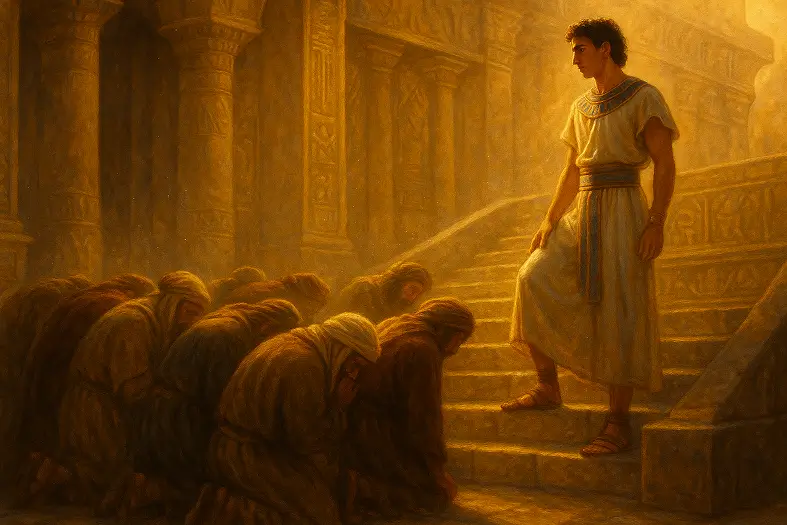
Pharaoh dreams of seven years of plenty followed by seven years of famine. Yosef interprets the dreams and is elevated to rule Egypt, gathering food to save the nation. When famine reaches Canaan, the brothers come to buy grain and bow to Yosef, unaware of his identity. After testing them through imprisonment and the demand to bring Binyamin, Yosef plants his goblet in Binyamin’s bag. The brothers refuse to abandon him, setting the stage for the family’s redemption.

Yosef's brother bowing to him in Egypt not knowing his identity.A Sefer Torah

Narrative Summary

After מִקֵּץ שְׁנָתַיִם יָמִים (two full years), פַּרְעֹה is shaken by two troubling חֲלוֹמוֹת (dreams). In the first, seven healthy cows are swallowed by seven weak ones; in the second, seven full ears of grain are devoured by seven thin ears שְׁדֻפוֹת קָדִים (scorched by the east wind). The חַרְטֻמִּים (Egyptian magician-priests) and חֲכָמִים (wise men) cannot interpret them. The שַׂר הַמַּשְׁקִים (chief cupbearer) finally remembers Yosef and confesses his חֵטְא (fault) for forgetting him.

Yosef, brought מִן־הַבּוֹר (from the pit/dungeon), tells פַּרְעֹה “בִּלְעָדָי — אֱלֹקִים יַעֲנֶה אֶת־שְׁלוֹם פַּרְעֹה” (It is not I — G-d will answer Pharaoh’s welfare). He reveals that the two dreams are one decree from אֱלֹקִים: שֶׁבַע שְׁנֵי שָׂבָע (seven years of abundance) will be followed by שֶׁבַע שְׁנֵי רָעָב (seven years of famine), and the doubling means the matter is נָכוֹן (firmly established) and near.

Yosef advises appointing אִישׁ נָבוֹן וְחָכָם (a discerning and wise man). Pharaoh proclaims Yosef that man — raising him to rule all Egypt, placing a רְבִיד זָהָב (golden chain) upon him, giving him the name צָפְנַת פַּעְנֵחַ, and appointing him over רַק הַכִּסֵּא אֶגְדַּל מִמֶּךָּ (only the throne above him). Yosef stores grain כַּחוֹל הַיָּם (like the sand of the sea). His sons are born: מְנַשֶּׁה (G-d has made me forget my hardship) and אֶפְרַיִם (G-d has made me fruitful).

As famine spreads עַל כָּל־פְּנֵי הָאָרֶץ (over all the earth), Yaakov sees יֶשׁ־שֶׁבֶר בְּמִצְרָיִם (there is grain in Egypt) and sends ten sons לִשְׁבֹּר־בָּר (to buy food). בִּנְיָמִין stays behind פֶּן־יִקְרָאֶנּוּ אָסוֹן (lest harm befall him). Arriving in Egypt, the brothers bow אַפַּיִם אָרְצָה (faces to the ground), unknowingly fulfilling Yosef’s earlier dreams. Yosef recognizes them וַיַּכִּרֵם (identifies them) but וַיִּתְנַכֵּר (acts as a stranger). He accuses them of being מְרַגְּלִים (spies), demanding they bring their youngest brother to prove כֵּנִים (honesty).

Yosef imprisons them שְׁלֹשֶׁת יָמִים (three days). Hearing them admit “אֲשֵׁמִים אֲנַחְנוּ” (we are guilty) for ignoring Yosef’s צָרַת נַפְשׁוֹ (anguished pleas), Yosef withdraws and בּוֹכֶה (weeps). He keeps שִׁמְעוֹן bound לְעֵינֵיהֶם (before their eyes) and sends the rest home with grain, secretly restored money, and the command to bring Binyamin. Yaakov refuses: “כֻּלָּנָה עָלַי” (everything is against me). Reuven offers his own sons — which Yaakov rejects.

When hunger worsens, יְהוּדָה steps forward: “אָֽנֹכִי אֶעֶרְבֶנּוּ” (I will be surety for him). Yaakov sends them with מִזִּמְרַת הָאָרֶץ (choice produce), double silver, and בִּרְכַּת אֵ־ל שַׁדַּי (prayer for mercy). Yosef seats them by birth order — they וַיִּתְמְהוּ (marvel). Binyamin receives חָמֵשׁ יָדוֹת (fivefold portions) as his brothers watch.

Then Yosef executes his final test of אַחְדוּת (unity) and תְּשׁוּבָה (repentance). He hides גְּבִיעַ הַכֶּסֶף (his silver divining goblet) in Binyamin’s bag and pursues them, accusing them of רָעָה תַּחַת טוֹבָה (repaying good with evil). The brothers, confident in innocence, declare “יָמוּת” (he shall die) if found guilty. The search runs from הַגָּדוֹל (eldest) to הַקָּטֹן (youngest). The goblet is revealed in Binyamin’s bag. They קָרְעוּ שִׂמְלֹתָם (tear their garments).

All return to Yosef together — refusing escape. Yehudah speaks: “הָאֱלֹקִים מָצָא אֶת־עֲוֺן עֲבָדֶיךָ” (G-d has uncovered our sin). He offers them all as slaves. Yosef insists only Binyamin must remain a slave while the rest go עֲלוּ לְשָׁלוֹם אֶל־אֲבִיכֶם (return in peace to your father) — a painful echo of their past betrayal. But they stand firm, united in loyalty to their brother, marking the turning point of the family’s spiritual repair — the cliffhanger ending of Mikeitz, just before Yehudah’s defining plea in Vayigash.

Divrei Torah on

מִקֵּץ – Mikeitz

...and other related content.

"Yosef and the Refusal of Moral Tyranny"

Parshas Vayechi — Why Power Must Yield to Hashem’s Judgment

5 - min read

Parshas Vayechi — Why Power Must Yield to Hashem’s Judgment

A Sefer Torah
Read
December 26, 2025

"Softness That Interprets History"

רַכּוֹת, רַקּוֹת, and the Hidden Path to Geulah

5 - min read

רַכּוֹת, רַקּוֹת, and the Hidden Path to Geulah

A Sefer Torah
Read
December 19, 2025

"The Light That Never Went Out"

Chanukah and the Hidden Presence of Hashem Within the World

9 - min read

Chanukah and the Hidden Presence of Hashem Within the World

A Sefer Torah
Read
December 17, 2025

"A Light in the Palace: Why Mikeitz Always Meets Chanukah"

Miracles Without Headlines

6 - min read

Miracles Without Headlines

A Sefer Torah
Read
December 13, 2025

"Bil’adai — Leadership Without Self"

Wisdom With No Ownership

7 - min read

Wisdom With No Ownership

A Sefer Torah
Read
December 13, 2025
Mitzvah Minute Logo Icon

Parsha Insights

Mitzvah Minute Logo Icon

Classical Insight

Rashi on Parshas Mikeitz

Rashi consistently reveals that the events of Mikeitz operate on two levels: the apparent politics and power of Egypt, and the hidden supervision of G-d directing every detail toward reconciliation and redemption.

  1. G-d’s Precise Providence
    Yosef’s rise to power and Pharaoh’s dreams arrive exactly at the preordained moment. Rashi emphasizes that the unfolding famine and the brothers’ journeys are part of a Divine plan that forces their past actions into the open. When Yehudah admits “G-d has found our sin” (44:16), Rashi explains that Heaven is collecting an old debt — the sale of Yosef.
  2. Prophetic Hints and Spiritual Revival
    Yehudah assures Yaakov “we shall live” (43:8), and Rashi notes ruach hakodesh stirring within him, foreseeing Yaakov’s spirit later being revived. Yaakov invokes the name E-l Sha-dai (43:14), and Rashi explains this as a prayer that G-d call an end to his lifelong suffering. Hidden light is already breaking into the story even within pain.
  3. Tension Between Hebrew Identity and Egyptian Culture
    Egyptians refuse to eat with Hebrews, calling it a “to’eivah” (43:32). Hospitality becomes humiliation, foreshadowing the future dynamic of exile. Yosef seats his brothers in exact birth order (43:33); Rashi highlights how this display of knowledge heightens their fear. They feel small and vulnerable in a foreign land — the psychological beginning of galus.
  4. Brotherhood Tested Through Binyamin
    Rashi details how each of Binyamin’s sons’ names expresses longing and grief for Yosef (43:30). This revelation stirs Yosef’s compassion to the point of nearly breaking his concealment. Yet he restrains himself; he must know if his brothers will now protect the younger son rather than abandon him as they did Yosef.
  5. Gifts, Suspicion, and Conscience
    The brothers arrive with delicacies “the praise of the land” (43:11), yet fear grips them when they are taken to Yosef’s house (43:18). Rashi says their dread stems from an assumption of guilt — that an accusation is being piled upon them. Their own conscience is the accuser; what they did to Yosef never truly left them.

Rashi’s commentary on Mikeitz shows that every movement in the narrative is measured toward teshuvah. The test of Binyamin is the test of whether the brothers have changed. And through famine, fear, and mysterious kindness, G-d quietly guides them to repair the wound that reshaped their family and destiny.

See Commentaries Section below for deeper review.

📖 Source

Ramban on Parshas Mikeitz

Ramban teaches that Mikeitz marks the moment Yosef’s personal fate becomes inseparable from the destiny of Klal Yisrael. The famine, Pharaoh’s dreams, the rise of Yosef — all unfold as the hidden fulfillment of G-d’s earlier decrees.

Key themes:

  • Providence disguising itself as politics
    Yosef’s sudden elevation is not due to Egyptian wisdom but because G-d implants insight in Yosef and removes it from the חַרְטֻמִּים (magicians). Egyptian power earns its own downfall through spiritual blindness.
  • Yosef’s tests are structured repentance
    Yosef orchestrates events to reveal whether the brothers have changed. He forces them to protect Binyamin with a loyalty they once denied to him — the core of their t’shuvah process.
  • Yaakov’s tefillah contains prophecy
    When Yaakov says וְשִׁלַּח לָכֶם אֶת אֲחִיכֶם אַחֵר (43:14), Ramban notes that he unknowingly prays for Yosef — hinting that the “missing brother” is alive. The moment carries a dual vision of present danger and future redemption.
  • Hidden Divine Compassion
    Ramban explains that returned money in the sacks resembles hidden mercy within judgment — as Yosef acts harshly outwardly while inwardly ensuring their survival with extra sustenance.
  • Foreshadowing national exile
    Ramban famously writes that Yaakov’s descent toward Egypt alludes to future exiles — especially under Edom. The narrative is a microcosm of Jewish history: fear, displacement, and ultimate return under the promise of El-Shaddai.

Mikeitz therefore becomes the hinge between family memory and national identity — the beginning of galus emerging through the very path that will one day lead to geulah.

See Commentaries Section below for deeper review.

📖 Source

Philosophical Thought

Rambam's application to Parshas Mikeitz

Parshat Mikkeitz presents Yosef as an exemplar of the Rambam’s ideal balanced personality — a chacham ba-ma’aseh, intellectually refined yet practically wise. His rise to power is not merely political fortune; it exemplifies the golden mean (derech ha-emtza’it) that the Rambam teaches in Hilchot De’ot.

Key applications:

  • Power paired with humility
    Yosef receives unparalleled authority — “רַק הַכִּסֵּא אֶגְדָּל מִמֶּךָּ” — yet speaks constantly of Hashem as the source of wisdom. Rambam notes that leadership must never lead to ga’avah (arrogance). Yosef attributes victory to Hashem, not to his own genius.
  • Speech guided by truth and restraint
    When Pharaoh praises him, Yosef responds:
    “בִּלְעָדָי — אֱלֹקִים יַעֲנֶה אֶת שְׁלוֹם פַּרְעֹה”
    Rambam stresses the obligation to sanctify speech — avoiding exaggeration, self-promotion, or false humility. Yosef models the alignment of intellect and speech dedicated to emet.
  • Providence and Human Responsibility
    Rambam’s view of hashgachah: Hashem’s providence attaches to those who attach their minds to Him. Yosef interprets dreams through Divine insight — yet devises an economic solution through sechel. Mikkeitz teaches:

Hashem’s plan unfolds through human reasoned action.

  • Teshuvah through Ethical Repair
    The brothers’ crisis is engineered so they can confront earlier wrongdoing. Rambam defines complete repentance (teshuvah gemurah) as facing one’s sin under identical circumstances — and choosing differently.
    In Mikkeitz, Yehudah will do exactly that — a fulfillment of Rambam’s ideal.
  • Creation of a Just Society
    By centralizing grain, Yosef protects life across nations. Rambam views chesed and social welfare as the highest calling of governance — a leader becomes an agent of Hashem when he sustains His world.

Even in a foreign palace, Yosef lives as a Jewish philosopher-statesman: intellect, ethics, and emunah woven together. Mikkeitz — through the lens of Rambam — becomes a parsha about aligning human greatness with Divine will, ensuring that every gift of power, intellect, or opportunity becomes a channel of chesed and justice in Hashem’s world.

📖 Sources

Ralbag on Parshas Mikeitz

רלב״ג על מקץ — פירוש ותועלות

The Ralbag (Rabbi Levi ben Gershon) structures his commentary on Parshat Mikeitz not by analyzing each verse individually, but by extracting ethical and philosophical תּוֹעָלוֹת (practical benefits) from the narrative. Yosef’s rise to power, his conduct before Par‘oh, and his strategic testing of his brothers — all become lessons in מִדּוֹת (refined character), דֵעוֹת (proper beliefs), and משפטי התורה (Torah-based conduct).

תּוֹעָלוֹת 1-8:

The first eight benefits come from Yosef’s encounter with Par‘oh and his appointment as royal administrator.

  • תּוֹעֶלֶת 1 — Refinement in appearance
    A person presenting himself before great leaders should appear dignified and properly groomed. Yosef shaved and changed garments before standing before Par‘oh. Chassidim likewise beautified themselves in תפִלָּה to honor ה׳ — as Chazal say:
    זה אֵ-לִי וְאַנְוֵהוּ — “This is my G-d and I shall beautify Him.”
  • תּוֹעֶלֶת 2 — Brevity before authority
    Yosef expresses profound philosophical and prophetic truths in only a few words:
    בִּלְעָדָי אֱ-לֹקִים יַעֲנֶה אֶת שְׁלוֹם פַּרְעֹה
    Concise speech is more acceptable to rulers.
  • תּוֹעֶלֶת 3 — Pre-emptive humility to avoid offense
    Yosef apologizes in advance that interpretation belongs to ה׳ — not himself — in case the interpretation displeases Par‘oh.
  • תּוֹעֶלֶת 4 — A scholar must speak within his wisdom
    When asked about dream interpretation, Yosef does not feign ignorance but demonstrates his capability through acknowledgment of Divine insight. This earns Par‘oh’s trust:
    הֲנִמְצָא כָזֶה אִישׁ אֲשֶׁר רוּחַ אֱ-לֹקִים בּוֹ
  • תּוֹעֶלֶת 5 — Interpretation is from ה׳ alone
    One cannot choose a favorable or unfavorable meaning arbitrarily; only the interpretation decreed Above is true.
  • תּוֹעֶלֶת 6 — Repetition of a dream shows certainty and imminence
    When ה׳ causes a true dream through השָׁפָעָה from heavenly forces, repetition confirms urgency. A matter decreed by ה׳ transpiring soon.
  • תּוֹעֶלֶת 7 — Wisdom elevates a person
    Because Yosef pursued חָכְמָה, he rose from prison to royalty.
    וחָכְמָה תְחַיֶּה בְעָלֶיהָ
  • תּוֹעֶלֶת 8 — Human plots cannot overturn Divine decree
    Yosef’s brothers tried to prevent his rule, yet their actions caused his rise. Ralbag cites the story of Romulus and Remus as a parallel: human resistance cannot cancel Divine destiny — only תשובה or escape from danger can alter one’s fate.
תּוֹעָלוֹת 9-28:

These derive from Yosef’s agricultural management, birth of his sons, and the brothers’ arrival in Egypt during famine.

  • תּוֹעֶלֶת 9 — Strategy in leadership
    Yosef stores each city’s produce locally so the populace accepts the plan willingly.
  • תּוֹעֶלֶת 10 — Sensitivity during communal suffering
    Yosef abstains from marital relations during famine years — source for Chazal forbidding תשמיש in such times, except for one without children.
  • תּוֹעֶלֶת 11 — All blessing flows from ה׳
    Yosef names his sons to credit ה׳:
    נַשַּׁנִי אֱ-לֹקִים… הִפְרַנִי אֱ-לֹקִים
  • תּוֹעֶלֶת 12 — Avoid danger even remotely
    Yaakov sends his sons to Egypt, not to dangerous neighboring regions where they might be targets after Shechem.
  • תּוֹעֶלֶת 13 — When two tragedies occur in one family, avoid exposing a third
    Since Rachel died on the road and Yosef was lost, Yaakov fears sending Binyamin.
  • תּוֹעֶלֶת 14 — Reduce activity when danger looms
    One should remain home to avoid exposure to harm — reason Yaakov delays Binyamin’s travel.
  • תּוֹעֶלֶת 15 — Responsible guardianship
    Even a ruler must personally oversee entrusted goods. Yosef oversees distribution himself despite rank.
  • תּוֹעֶלֶת 16 — Do not repay evil with evil
    Yosef restrains vengeance, causing only minor distress to fulfill higher ethical testing.
  • תּוֹעֶלֶת 17 — Hashem punishes even the righteous for wrongdoing
    The brothers attribute their suffering to selling Yosef.
  • תּוֹעֶלֶת 18 — Accept justice and introspect
    One should attribute misfortune to personal sins, not accuse ה׳.
  • תּוֹעֶלֶת 19 — Compassion even toward those who harmed you
    Yosef turns aside and weeps when he sees the brothers’ fear.
  • תּוֹעֶלֶת 20 — Integrity in financial matters
    Yosef returns only the money specifically sent to him by Yaakov, not additional wealth belonging to Par‘oh.
  • תּוֹעֶלֶת 21 — Avoid immoral relationships
    Reference to Reuven’s sin — lack of דעת — contrasted with Yehudah’s wiser negotiation.
  • תּוֹעֶלֶת 22 — Appeasing anger with a quality gift
    Yaakov sends a tasteful, modest מנחה to Yosef (as “the man”).
  • תּוֹעֶלֶת 23 — Do not give a lavish gift when under suspicion
    Unlike Esav’s gift, Yaakov’s gift is measured to avoid appearing guilty.
  • תּוֹעֶלֶת 24 — Not relying only on prayer
    Combine hishtadlut with תפילה.
    Example: Hashem instructs Shmuel to use a calf as a cover story.
  • תּוֹעֶלֶת 25 — Remove suspicion proactively
    The brothers return the money before accusation arises.
  • תּוֹעֶלֶת 26 — Halachic ruling: metzi’ah inside purchased goods
    If produce is bought from many sources and hidden treasure is found in it — the finder acquires it.
  • תּוֹעֶלֶת 27 — Order of seating reflects honor
    Eldest should sit first; Yosef seats the brothers accordingly.
  • תּוֹעֶלֶת 28 — Guard one’s home and be cautious of guests
    Assume possible threat; test trustworthiness appropriately. Yosef acts with vigilance when orchestrating Binyamin’s test.

Through these twenty-eight תועלות, Ralbag transforms Yosef’s narrative into a textbook of ethical formation and practical wisdom. Yosef becomes a model of how Divine decree, human strategy, and upright character harmonize under the guidance of hashgachah. Mikkeitz teaches that success is not luck but the fruit of:

• disciplined governance
• humility before ה׳
• vigilance in morality
• compassion even toward adversaries

Ralbag’s lessons make Mikkeitz a blueprint for Jewish leadership — intellect guided by fear of Heaven, compassion guided by responsibility, and destiny guided by the hand of ה׳.

📖 Source

Chassidic Reflection

Mikeitz — The Hidden Light That Rises in the Darkest Night

Mikkeitz begins with silence. Yosef has been forgotten. Two full years pass. Darkness appears to win. Yet the Zohar teaches that geulah arrives not in the absence of darkness, but from within it. “וַיְהִי מִקֵּץ שְׁנָתַיִם יָמִים” marks not the passage of time — but the end of concealment. The moment the darkness completes its mission, the hidden light breaks through.

The Baal Shem Tov explains that exile is the slow uncovering of what the soul has always possessed. Yosef’s journey from prison to palace reveals how sudden elevation can come when a person holds steadfast to inner truth. One moment, he is the forgotten Hebrew slave; the next, Par‘oh declares:
“אִישׁ אֲשֶׁר רוּחַ אֱ-לֹקִים בּוֹ”
It only appears sudden — yet every unseen choice, every quiet moment of emunah, was preparing his rise. In the deepest night, our greatness is gestating. Redemption does not erupt. It emerges.

The Kedushas Levi sees Yosef as embodying the paradox of geulah: the more the light descends, the higher it ascends. Why does Yosef first enter the darkness of Egypt? Because Hashem places the tzaddik exactly where his holiness is most needed. Yosef interprets Par‘oh’s dreams — the visions that define Egypt’s future — so that the destiny of a foreign empire becomes a vehicle for Hashem’s plan. The Kedushas Levi writes that geulah begins when kedushah refuses to remain hidden. Yosef does not wait for better conditions; he serves Hashem in the heart of exile and transforms it into a throne.

The Sfas Emes returns to the dream. A dream in Torah is רחמים — Divine compassion disguised as possibility. Yosef teaches that a true dream never belongs to the dreamer alone. It is always connected to the future of Klal Yisrael. When Yosef sees hunger on the horizon, he turns revelation into responsibility. The Sfas Emes says the greatest danger is not famine, but forgetting purpose. Yosef’s avodah is to preserve life, to protect the world from despair, to be the heart that sustains others even when his own story is unfinished. Geulah begins when we turn private inspiration into shared nourishment.

Mikkeitz invites us to look at our own “two years” — the long stretches where nothing seems to change, where prayers hang unanswered, where dreams fade in the darkness. The parsha teaches that waiting is never passive. Every moment of faithfulness in exile stores spiritual grain that will one day feed a famine-stricken world. Like Yosef, we are called to remain dignified when unseen, to cultivate wisdom when unheard, and to remember that the darkness that surrounds us is also the womb of redemption.

The hidden light will rise.
And when it does, the night itself will testify that it was always carrying the dawn.

📖 Sources

Modern Voice

Rabbi Jonathan Sacks on Parshas Mikeitz

A Unified Overview of Rabbi Sacks’ Teachings (Across 7 Essays)

Divine Providence and Human Choice

Joseph’s rise from dungeon to viceroy is astonishingly swift — and guided by an unseen Hand. Pharaoh has two dreams, paralleling Joseph’s own double dreams. Only now does the Torah reveal the meaning of such duplication: a dream repeated signals a decree that will soon occur.

This delayed disclosure is the Torah’s way of teaching a profound truth:
We only understand our lives in hindsight.
At the moment, events seem random. Later, a pattern emerges. We act with free choice in the present, yet only looking back do we perceive Hashgachah — that Hashem was guiding us toward where we were meant to be.

  • Judaism holds the tension: “Hakol tzafui v’hareshut netunah” — All is foreseen, yet the freedom of choice is given
  • We choose the path; Hashem reveals the meaning
  • Narrative perspective shapes spiritual understanding

Judaism unites Halachah — choosing well in the present — and Aggadah — finding divine meaning in the past.

Joseph and the Risks of Power

Miketz introduces political leadership for the first time within the covenantal family. Joseph saves Egypt from starvation — but also centralizes its wealth and land under Pharaoh. Egyptians themselves say, “We are slaves to Pharaoh” (Bereishis 47).

Power solved one crisis while planting the seeds of a future one.

  • Even a tzaddik may unintentionally create systems that later harm his people
  • Good intentions do not negate political consequences
  • Power is dangerously seductive and morally ambiguous

Judaism admires leadership but fears domination. The challenge is ensuring that power remains humble and humane — never absolute.

Man Proposes, Hashem Disposes

Joseph acts for the first time to secure his freedom — asking the butler to remember him. The Torah highlights the failure with a double verb: the butler “did not remember…and forgot”.

Why? Because prayer is answered, but
not when or how we expect.

  • Our efforts are necessary — but insufficient
  • We must work, and we must wait
  • Hashem’s timing is precise — yet not ours

Miketz means “at the end.” Redemption comes not at our deadline but when Hashem determines the moment is ripe.

Appearance and Reality

Three times clothes shape Joseph’s destiny — the tunic, the cloak, the royal garments. Each conceals truth; appearances deceive. His brothers do not recognize him because they see only the Egyptian uniform.

Jewish spirituality is not built on vision but on voice:

  • Paganism is about what the eye sees
  • Judaism begins with Shema Yisrael — listening deeply
  • What looks real may be false; what we hear from Hashem is eternal

The Torah warns: never confuse outer status with inner worth. The heart — not clothing — reveals the image of Hashem.

To Wait Without Despair

Between Joseph’s plea and his release two years pass. The parsha break itself forces us to feel that delay.

Waiting is not the absence of progress —
it is the arena of emunah.

  • Joseph learns patience and humility
  • His gifts mature in the darkness
  • Hashem prepares salvation behind the scenes

Greatness often grows in hidden places. Hope is a discipline. Waiting — without surrender — is faith in motion.

Sibling Rivalry — The Jewish Condition

“וַיַּכֵּר יוֹסֵף אֶת־אֶחָיו וְהֵם לֹא הִכִּרֻהוּ” — Joseph recognized his brothers, but they did not recognize him.

This describes more than a moment — it is Jewish history.

  • Cain & Hevel, Yishmael & Yitzchak, Esav & Yaakov — rivalry is recurring
  • Judaism is the “younger brother” — too often rejected by the nations
  • Israel seeks peace; many deny its right to exist

Until נַכִּיר — mutual recognition — emerges, peace remains beyond reach. When siblings finally see one another as family, redemption begins.

The Author of Our Lives

The Joseph story is the Torah’s clearest exposition of fate intertwined with freedom. Joseph chooses; Hashem guides. His initiatives fail — until Hashem opens the door.

Judaism rejects both extremes:

  • Not like the Sadducees — “all is human choice”
  • Not like the Essenes — “all is predestined”
  • Rather, we act — and Hashem co-authors the outcome

We shape our lives through responsibility. We interpret our lives through emunah.

For the bad, we accept responsibility;
for the good, we thank Hashem.

This is Joseph’s legacy — and ours.

The Light Behind the Story

Miketz teaches that destiny is not a straight line but a divine choreography of shadows and light.
We choose — and Hashem reveals meaning.
We wait — and Hashem brings the moment.
We fall — and Hashem raises us higher than imagination dared.

Joseph discovers that Hashem writes the script,
but hands us the pen.

May we learn from him to act with courage,
wait with faith,
and look back with gratitude —
recognizing the Author of our lives.

📖 Sources

Rav Kook on Parshas Mikeitz

Yosef and Yehudah: National Mission and Universal Mission

The struggle between Yosef and Yehudah reflects two visions of Jewish destiny. Yehudah protects the spiritual uniqueness of Am Yisrael in the present, emphasizing separation from the surrounding nations so that holiness is not diluted. Yosef sees the future, a world transformed when all nations will walk in the light of Hashem. He looks beyond present fragmentation, sensing the hidden potential of humanity when the sovereignty of Heaven will be fully revealed.

This divide originates in Creation itself. On the second day, the upper and lower waters were separated. The Torah omits the phrase that this day was good. The gap between what is and what could be is the root of tension in history, and its healing is the essence of redemption.

  • Yehudah grounds holiness in present reality to safeguard identity and covenant.
  • Yosef reveals the future potential embedded within every nation and culture.
  • Their ultimate harmony represents the repair of the primordial rupture between present and future.

Yosef’s ability to speak seventy languages signifies his insight into each nation’s purpose in the final revelation of Hashem. The extra letter hey added to his name allows him to translate hidden future holiness into the framework of this world. Yehudah sanctifies the Name in public; Yosef sanctifies the Name in private. Each holds part of the truth, awaiting synthesis.

This cooperation appears in history. The monarchy to preserve national holiness arises from Yehudah. The Beis HaMikdash, a house of prayer for all peoples, stands in Binyamin’s portion, representing Yosef’s universal mission. Redemption arrives when these forces unite and the world’s potential becomes revealed reality.

Yosef and the Power of Inner Resolve

Yosef’s greatness emerges in exile as he resists every corrupting influence. Isolated, young, and vulnerable in Mitzrayim, he still refuses to violate the trust of his master or the moral will of Hashem. His spiritual identity becomes unshakable.

  • Outside negativity affects the soul only when inner desire allows it entry.
  • Yosef’s steadfastness builds protection from envy, corruption, and the evil eye.
  • His descendants inherit a spiritual resilience against corrosive outside forces.

The evil eye represents jealousy’s invisible damage. Yosef is unaffected because he never took what was not his. He triumphed over temptation not by isolation but by fidelity to a higher calling. He becomes the model of remaining holy while engaged with the world.

Waiting Twenty-Two Years: The Pace of Redemption

Yosef’s dreams take twenty-two years to be fulfilled. This delay is not failure but design. The Hebrew alphabet has twenty-two letters, the fundamental components of expression. Just as language requires all twenty-two to reveal any idea fully, so events in history require the full unfolding of hidden forces before a vision can materialize.

  • Every true dream has an element of truth, even if deeply buried.
  • Time refines potential, aligning inner soul forces with outward possibility.
  • Waiting is not wasted time but the maturation of destiny.

A dream may not appear realizable in its moment, yet it sets transformation in motion. Anticipation and confidence nurture its unfolding. Faith means recognizing that the slow work of redemption is still real progress.

Interpreting Dreams and Shaping Reality

A dream is not merely a forecast but a spiritual catalyst. It reveals the soul’s trajectory, warning or encouraging us to align life with purpose. Interpretation intensifies this influence, turning possibility into direction.

  • A dream without interpretation is dormant, like a message unread.
  • Insightful interpretation draws hidden moral qualities toward expression.
  • Positive interpretation nurtures virtue toward actuality.

Dreams also operate at the collective level. Both Yosef and Daniel rise through the dreams of nations because Am Yisrael carries a concealed mission of guidance and leadership. When we yearn for geulah, we activate this inner national force, drawing the future nearer.

The essence of Yosef’s path is faith in the unseen: allowing Hashem’s Providence to shape outcomes while using every opportunity given. Yosef works with immense responsibility yet knows that the ultimate script is written Above. Our role is to hold on to the dream, speak it into the world, and live in its direction until it comes to light.

📖 Sources

Application for Today

Finding Divine Purpose in the Darkness Before the Light

Parshas Mikeitz unfolds at the mysterious border between despair and redemption. Yosef emerges from years of imprisonment into sudden power. His brothers descend into Egypt unaware they are walking into a chapter of their own repentance. And beneath everything, unseen yet directing every movement, is the Hand of Hashem — weaving salvation slowly, silently, and perfectly.

Mikeitz arrives almost always during Chanukah — not by chance. Both the parsha and the festival teach one profound truth:

Geulah rarely bursts into the world all at once.
It begins as a small, flickering light —
fueled by faith in the darkness.

Below are practical ways the themes of Mikeitz apply to our lives today — at home, in community, and in our inner world.

Hidden Providence: Seeing Hashem When We Can’t See Anything

From the pit to Potiphar’s house, from false accusation to the dungeon — Yosef lived a life that looked like abandonment. Yet every descent was actually a preparation.

The Midrash teaches:
Wherever Yosef fell, Hashem cushioned the fall with purpose.

We often say “Everything happens for a reason.” Mikeitz demands more:

Everything is led by reason — orchestrated by Hashem specifically for your growth.

Modern life challenges faith in concealment:

  • Delays that frustrate
  • Career setbacks
  • Medical uncertainty
  • Relationships that fall apart
  • Dreams seemingly slipping away

Mikeitz answers:
Whenever the script looks worst… the Author is closest.

How to live this today:
  • When facing adversity, quietly say:
    “Hashem, this too is from You, and therefore this too is good for me.”
  • Keep a small private notebook: “Hidden Blessings” — record times darkness led to light.
  • When plans crumble, pause and ask:
    “What middah or mission is Hashem training me for right now?”

This shift — from What is happening to me?
to Why is Hashem shaping me this way? —
changes everything.

The Delay Is the Lesson: Patience Shapes Our Greatness

Yosef interprets the cupbearer’s dream — and waits.
A day. A week. A year. Two years.

Not forgotten — being finished.

Chovos HaLevavos says:

Hashem trains us through life’s surprises —
both disappointments and sudden successes.

Why?
To soften the “lev ha’even” — the stone heart —
into a heart of living emunah.

In the waiting, Yosef learned:

  • People may help — but only Hashem decides
  • Escape doesn’t come from the cupbearer
  • The sentence “Bil’adai — It is not from me” becomes his reflexive truth

Delays aren’t detours.
They are the curriculum.

How to live this today:
  • Next time a door slams shut, immediately think:
    “This is Hashem teaching me reliance, not rejection.”
  • Turn delays into tefillah: short whispers of emunah
    “You run my life. I trust Your timing.”
  • Celebrate small wins — each is Hashem’s loving wink

The dungeon did not end Yosef —
it readied him to rise without forgetting Who lifted him.

Faithful Leadership: Success Is Stewardship, Not Self

Yosef becomes viceroy — but never the star.

He refuses Pharaoh’s praise:
“Bil’adai — Hashem will answer the peace of Pharaoh.”

Despite transformative power, he remains:

  • Modest in speech
  • Careful with credit
  • Focused on saving others, not himself

Rav Sacks writes:

Yosef’s greatness was not in dreaming but in
helping others realize their dreams.

From Yosef we learn:

Leadership = responsibility without ego.
Success = service.
Achievement = accountability.

How to live this today:
  • Use wins (professional, spiritual, family) to uplift others
  • Replace “I earned this” with:
    “Hashem gifted me this so I can serve.”
  • Seek quiet mitzvot with public impact

The world craves Yosef-leaders:
people who rise high but bow low — always facing Heaven.

Healing Relationships: Teshuvah Begins With Empathy

When the brothers bow to Yosef, the dream resurfaces — but Yosef doesn’t avenge.
Instead, he creates a plan for healing:

  • Testing responsibility
  • Stirring conscience
  • Awakening brotherhood

Before we can become a nation, we must become a family.

Rav Kook teaches:

The light of redemption begins with the light of unity.

Modern division — politics, reputation, religious differences — tears Jews apart more than external enemies.

Mikeitz challenges us:

  • Can we seek understanding before judgment?
  • Can we pray for those who hurt us?
  • Can we unify without uniformity?
How to live this today:
  • Choose one strained relationship → take the first step
  • Speak less about others, more to others
  • Before reacting in anger, silently ask:
    “How might this look from their story?”
  • Practice “Dan L’Kaf Zechut” — giving benefit of the doubt — 1x/day consciously

Forgiveness doesn’t erase the past.
It redeems it.

Managing Power, Money & Influence With Kedushah

Yosef is placed in charge of the world’s economy.
Absolute control. No supervision.

Yet he:

  • Doesn’t exploit famine for personal gain
  • Remains loyal to halacha, identity, modesty
  • Uses prosperity to preserve life — not to indulge ego

The Chashmonaim, by contrast, began as heroes but later generations were corrupted by comfort and success.

As Rav Miller warns:

The wounds of struggle elevate us;
the kisses of success can destroy us.

In a world obsessed with material excess and image:

  • Will financial blessing deepen our gratitude?
  • Or dull our spiritual sensitivity?
  • Will a higher position expand our giving?
  • Or shrink our humility?
How to live this today:
  • Don’t wait for abundance — give from the little you have
  • Say “Thank You Hashem” each time a bracha arrives
  • View every talent and dollar as on loan from Heaven
  • Ask:
    “Is this decision aligned with Yosef’s integrity?”

We are not judged by what we have —
but what we do with it.

Chanukah: A Light That Says “You Are Never Alone”

Mikeitz always falls on Chanukah because their message is one:

The Shechinah never left Klal Yisrael — even in exile.

The oil lasted eight days to proclaim:

  • Hashem is here, even when invisible
  • We don’t walk history alone
  • Our mission still burns

Rav Miller describes the eruption of joy:
“A conflagration of exhilaration —
Hashem is here among us!”

Chanukah is not about presents.
It is about Presence.

How to live this today:
  • When lighting candles, pause to feel:
    “Hashem is with us. Right here. Right now.”
  • Bring light where darkness dwells:
    kindness, Torah, friendship, hospitality
  • Express Jewish pride — mezuzah, tzitzit, Shabbos candles — visibly and joyfully

Every flame is a letter from Hashem:
I will never abandon you.

Personal Exile, Personal Redemption

Every Jew experiences Egypt — confusion, fear, loneliness.

And every Jew carries Yosef’s spark — resilience, loyalty, hope.

Your darkness is not a contradiction to your destiny.
It is the road to it.

Hashem writes stories slowly —
so that we grow into the people worthy of the ending.

Today, live with purpose:
  • If you’re struggling → this is your training for greatness
  • If you’re rising → stay humble and mission-focused
  • If you’re in between → hold both gratitude and longing

The light may be small —
but the message is infinite.

Never confuse silence with absence.
Never confuse waiting with wasting.
Never confuse concealment with abandonment.

Hashem is here —
in the pit, in the palace, and everywhere in between.

A Closing Lesson

Mikeitz tells us that geulah works like sunrise:

First a whisper of light
Then a faint silhouette
Then suddenly — everything is illuminated

Our task is simple but not easy:
Keep lighting — even when it seems too dark to see.

This week, let us each choose:

  • One disappointment → to turn into trust
  • One relationship → to repair
  • One success → to redirect toward service
  • One mitzvah of light → to perform with pride and love

And may we merit to witness the fulfillment of Yosef’s words:

“Elokim Ye’aneh es Shalom Par’oh” —
Hashem will answer for peace.

May He illuminate our homes, our hearts,
and our entire nation with the everlasting light of redemption.

Mitzvah Minute Logo Icon

Rashi

Mitzvah Minute Logo Icon

Rashi on Parshas Mikeitz – Commentary

Rashi’s comments on this section of the narrative open a window into the inner drama behind the polished surface of the Yosef story. The “גְּבִיעַ” is not a random prop but a royal goblet that becomes the focal point of Yosef’s carefully staged test, a symbol of power, knowledge, and supposed “divination.” When the brothers protest, “חָלִילָה לְעַבְדֶּיךָ” and invoke their earlier honesty in returning the misplaced money, Rashi underscores the force of their argument as a full kal va’chomer and even notes that, in strict law, all ten could have been held liable once the stolen item was found among them. Yosef’s steward, however, responds “גַּם עַתָּה כְּדִבְרֵיכֶם” and yet chooses to act “lifnim mi’shuras ha’din,” taking only the one with whom the goblet is found. The search itself is choreographed—beginning with the eldest, ending with Binyamin—so that no one will suspect foreknowledge, while the brothers’ physical strength (each loading his own donkey) and their readiness to face “the city” as though it were a small town of ten reveal their growing resolve not to abandon Rachel’s remaining son. When they return and find Yosef still waiting, he presses them with the claim that a man of his stature can surely “נַחֵשׁ יְנַחֵשׁ,” whether by supposed magic or by sharp human reasoning, and Yehudah responds with profound theological surrender: “הָאֱלֹקִים מָצָא אֶת עֲוֺן עֲבָדֶיךָ.” Even as Rashi takes us deep into their consciousness of guilt and Divine accounting, he simultaneously pauses to teach the fine grain of lashon ha’kodesh—how “מַה נִּצְטַדָּק” is built from the root צדק and how certain roots in hitpa’el behave, reminding us that in Torah, grammar and ethics, syntax and providence, are never fully separable.

41:1 – Pharaoh’s Dream Begins

  • "וַיְהִי מִקֵּץ" — “And it was at the end”
    • קֵץ = “end / termination.” Rashi: like the Targum "מִסּוֹף" (from the end).
    • Every use of קֵץ in Tanach refers to some kind of end point.
  • "עַל הַיְאֹר" — “by the river”
    • Only the Nile is called יְאֹר in Tanach.
    • Reason: Egypt is full of man-made canals (יְאוֹרִים), fed by the Nile which rises and irrigates them.
    • Since rain is not frequent in Mitzrayim, unlike other lands, everything depends on the Nile.

41:2 – Seven Beautiful Cows

  • "יְפֹת מַרְאֶה" — “beautiful of appearance”
    • Symbol of years of plenty.
    • In times of abundance, people look kindly at one another; no one is jealous, and no eye is “narrow” toward his fellow.
  • "בָּאָחוּ" — “in the reed-grass / marsh”
    • Means marshland, swampy grass, like אֲחוּ in Iyov 8:11.
    • Rashi: a low, wet place suitable for reeds.

41:3 – The Thin Cows

  • "דַּקּוֹת בָּשָׂר" — “thin of flesh”
    • Means emaciated / very lean, lacking flesh.

41:4 – The Lean Cows Devour the Fat Ones

  • "וַתֹּאכַלְנָה" — “and they ate them”
    • Symbol: the years of famine will be so severe that all joy and memory of the plenty will be swallowed and forgotten by comparison.

41:5 – The Healthy Ears

  • "בְּקָנֶה אֶחָד" — “on one stalk”
    • All seven ears growing from a single stalk — a sign of unusually rich growth.
  • "בְּרִיאוֹת" — “healthy / full”
    • Thick, strong, robust ears — again signaling abundance.

41:6 – The East-Wind-Blighted Ears

  • "וְשְׁדוּפֹת קָדִים" — “parched by the east wind”
    • שְׁדוּפוֹת = struck, blasted, battered, like something repeatedly hit.
    • Rashi links it to "מַשְׁקוֹף" (lintel): the lintel is constantly hit by the door, so שְׁדוּפוֹת evokes something constantly struck and damaged.
  • "קָדִים" — “east wind”
    • The dry, burning east wind known for withering crops.

41:7 – Completion of the Dream

  • "הַבְּרִיאוֹת" — “the healthy ones”
    • Again, robust and full.
  • "וְהִנֵּה חֲלוֹם" — “and behold, it was a dream”
    • Rashi: a complete, self-contained dream-unit passed before Pharaoh; it formed a unified whole that clearly demanded interpretation.

41:8 – Pharaoh’s Agitation & the חַרְטֻמִּים

  • "וַתִּפָּעֶם רוּחוֹ" — “his spirit was troubled”
    • Targum: his spirit was agitated, “beaten within him” like a bell (פַּעֲמוֹן) that keeps ringing.
    • By Nevuchadnetzar (Daniel 2:1) it says "וַתִּתְפָּעֶם רוּחוֹ" (Hithpael, with a double ת), because there he had two disturbances:
      1. He forgot the dream.
      2. He did not know its interpretation.
  • "חַרְטֻמֵּי מִצְרַיִם" — “Egypt’s occult scribes”
    • Rashi: from a root associated with bones of the dead.
    • They were those who consulted the dead using bones:
      • טִימֵי (Aramaic) = bones.
      • Mishnah Ohalot 17: “בַּיִת שֶׁהוּא מָלֵא טִימַיָּא” = a house filled with bones.
    • These chartumim are thus necromantic magicians / engravers of hieroglyphic lore.
  • "וְאֵין פּוֹתֵר אֹתָם לְפַרְעֹה" — “none interpreted them to Pharaoh”
    • They did offer interpretations, but not in a way that applied to Pharaoh as king (לְפַרְעֹה).
    • Their explanations gave him no satisfaction.
    • For example, they said: “You will father seven daughters and bury seven daughters” — private, not royal destiny, and it did not ‘enter his ears’ or calm his spirit.

41:11–13 – The Butler’s Recollection

  • "אִישׁ כְּפִתְרוֹן חֲלֹמוֹ" (41:11) — “each man according to the interpretation of his dream”
    • Each of them dreamed a dream exactly suited to the interpretation they later received from Yosef — unlike Pharaoh’s wise men, who were forcing irrelevant interpretations.
  • "נַעַר עִבְרִי עֶבֶד" (41:12) — “a young Hebrew slave”
    • Rashi: “אַרוּרִים הָרְשָׁעִים” — cursed are the wicked, for even when they do good, it is not complete.
    • The butler deliberately describes Yosef in demeaning terms:
      • "נַעַר" — a lad, meaning foolish and unfit for greatness.
      • "עִבְרִי" — a Hebrew; he doesn’t even know our language.
      • "עֶבֶד" — a slave; and Egyptian law states that a slave may not rule nor wear princely garments.
    • So even when recommending Yosef, he does so with contempt.
  • "אִישׁ כַּחֲלֹמוֹ" (41:12) — “each man according to his dream”
    • Yosef interpreted in line with the content and spirit of each dream — appropriate and coherent to the dream’s own imagery.
  • "הֵשִׁיב עַל כַּנִּי" (41:13) — “he restored me to my office”
    • Subject (“who restored?”) is elliptical; clearly it is Pharaoh:
      • Earlier: “וַיִּקְצֹף פַּרְעֹה עַל עֲבָדָיו” – Pharaoh is the one with power to restore.
    • Rashi: many pesukim are short-hand like this — they omit the subject when it is obvious.

41:14 – Yosef’s Ascent from the Pit

  • "מִן הַבּוֹר" — “from the pit”
    • Here: the prison, constructed like a pit / cavity.
    • Anytime the Torah says "בּוֹר", it means a hollow / cistern-like cavity, even dry ones.
  • "וַיְגַלַּח" — “and he shaved”
    • Done out of respect for the monarchy.
    • Yosef must appear before Pharaoh properly groomed.

41:15–16 – Pharaoh’s Claim & Yosef’s Deflection

  • "תִּשְׁמַע חֲלוֹם לִפְתֹּר אֹתוֹ" (41:15) — “you hear a dream to interpret it”
    • "תִּשְׁמַע" = to pay heed and to understand.
    • Examples:
      • “יוֹסֵף שֹׁמֵעַ” (42:23) — Yosef understood.
      • “אֲשֶׁר לֹא תִּשְׁמַע לְשֹׁנוֹ” (Devarim 28:49) — “whose language you do not understand.”
    • So Pharaoh is saying: “You have a gift of comprehension that leads to interpretation.”
  • "בִּלְעָדָי אֱלֹקִים יַעֲנֶה אֶת שְׁלוֹם פַּרְעֹה" (41:16)
    • "בִּלְעָדָי" — “not from me; it does not extend to me.”
    • Yosef: “The wisdom is not mine. אֱלֹקִים (Elokim) will answer.”
    • Hashem will place the answer in my mouth for Pharaoh’s good and welfare (שָׁלוֹם פַּרְעֹה).

41:19–21, 23 – The Second Description of the Cows & Ears

  • "דַּלּוֹת" (41:19) — “wretched, lean”
    • Means frail / wasted, as in “מַדּוּעַ אַתָּה כָּכָה דַּל” (2 Shmuel 13:4) — “Why are you thus so lean?”
  • "וְרַקּוֹת בָּשָׂר" — “lean of flesh”
    • Every instance of "רַקּוֹת" in Tanach implies deficient in flesh, thin and undernourished.
  • "צְנֻמּוֹת" (41:23) — “parched, shriveled”
    • Linked to Aramaic "צוּנְמָא" = rock.
    • The ears are hard, dry like wood or rock, with no moisture.
    • Targum: "נָצָן לָקְיָן" — the blossom is stricken, only the withered flower remains; they are empty of grain.

41:26–32 – Interpreting the Doubling

  • "שֶׁבַע שָׁנִים וְשֶׁבַע שָׁנִים" (41:26)
    • All told, the dream points to one block of seven years of plenty followed by seven years of famine; Rashi on “שֶׁבַע שָׁנִים וְשֶׁבַע שָׁנִים” explains that the language still functions as a single count in the structure of the dream.
    • The doubling of the dream indicates the matter is fixed and imminent, as Yosef later says:
      • “וְעַל הִשָּׁנוֹת הַחֲלוֹם… נָכוֹן הַדָּבָר וּמְמַהֵר הָאֱלֹקִים לַעֲשׂוֹתוֹ” (v. 32).
  • Rashi notes the nuance in language:
    • By the good years: “הִגִּיד אֱלֹקִים לְפַרְעֹה” — Hashem told Pharaoh, since they are near in time.
    • By the years of famine: “הֶרְאָה אֱלֹקִים אֶת פַּרְעֹה” — Hashem showed Pharaoh, using a verb more suited to something distant and extraordinary.
  • "וְנִשְׁכַּח כָּל הַשָּׂבָע" (41:30) — “all the plenty will be forgotten”
    • This is the interpretation of the swallowing of the fat cows by the lean ones.
  • "וְלֹא יִוָּדַע הַשָּׂבָע" (41:31) — “the plenty shall not be known”
    • This corresponds to "וְלֹא נוֹדַע כִּי בָאוּ אֶל קִרְבֶּנָה" — it was unnoticeable that the lean cows had eaten the fat ones.
  • "נָכוֹן" (41:32) — “established / prepared”
    • The matter is firmly prepared by אֱלֹקִים; the decree is fixed.

41:34–36 – Yosef’s Advice

  • "וְחִמֵּשׁ" (41:34) —
    • Like the Targum: “they shall prepare / arm / ready” the land — here: organize collection (some see in it the idea of taking a fifth).
    • Compare: “וַחֲמֻשִׁים עָלוּ בְנֵי יִשְׂרָאֵל” (Shemos 13:18) — prepared / armed.
  • "אֶת כָּל אֹכֶל" (41:35) — “all the food”
    • "אֹכֶל" here is a noun, so:
      • Accent on the א, with patach katan (Rashi’s term for our segol).
    • By contrast, "אוֹכֵל" (participle “one who eats”) — as in “כִּי כָּל־אֹכֵל חֵלֶב” (Vayikra 7:25) —
      • Accent on the כ, with a different vowel (Rashi calls it kāmatz katan / zéré).
  • "תַּחַת יַד פַּרְעֹה" (41:35) — “under the hand of Pharaoh”
    • The food is to be under Pharaoh’s control, placed in royal storehouses.
  • "וְהָיָה הָאֹכֶל" (41:36)
    • This stored food will function as a deposit / reserve (פִּקָּדוֹן) held back for the survival of the land during famine.

41:38–40 – Choosing Yosef

  • "הֲנִמְצָא כָזֶה" (41:38) — “can we find such a one as this?”
    • Rashi: read as a question —
      • “If we search, could we possibly find another like him?”
    • Any ה־ with chataf-patach at the beginning of a word is interrogative.
  • "אֵין נָבוֹן וְחָכָם כָּמוֹךָ" (41:39)
    • Pharaoh responds to Yosef’s earlier advice: “Find a wise and understanding man” (v. 33).
    • Now he says: “There is no such נָבוֹן וְחָכָם other than you.”
  • "עַל פִּיךָ יִשַּׁק כָּל עַמִּי" (41:40)
    • "יִשַּׁק" = will be sustained / fed / provided for.
    • All needs of the people will be handled by your word.
    • Parallel: "בֶּן מֶשֶׁק בֵּיתִי" (15:2) — steward managing provision.
    • Also “נַשְּׁקוּ־בַר” (Tehillim 2:12) — Rashi: provide, attach, service.
  • "רַק הַכִּסֵּא אֶגְדַּל מִמֶּךָּ" (41:40)
    • "כִּסֵּא" here = royal rank / kingship, as in
      • “וְיִגְדֵּל אֶת כִּסְאוֹ מִכִּסֵּא אֲדֹנִי הַמֶּלֶךְ” (1 Melachim 1:37).
    • Meaning: only in formal kingship / title will Pharaoh be above Yosef.

41:41–43 – Ring, Garments, and "אברך"

  • "נָתַתִּי אוֹתְךָ עַל כָּל אֶרֶץ מִצְרַיִם" (41:41)
    • "נָתַתִּי" — “I have given / appointed you.”
    • “Giving” can denote both elevation (“וּלְתִתְּךָ עֶלְיוֹן” — Devarim 26:19) and degradation (“נָתַתִּי אֶתְכֶם נִבְזִים” — Malachi 2:9).
    • Here: appointment to high authority.
  • "וַיָּסַר פַּרְעֹה אֶת טַבַּעְתּוֹ" (41:42)
    • Giving the signet ring = symbol that the recipient becomes second to the king in power.
  • "בִּגְדֵי שֵׁשׁ" — fine linen garments
    • In Mitzrayim, linen is highly prestigious and used as garments of honor.
  • "וַיָּשֶׂם רְבִיד זָהָב" — a golden chain
    • "רְבִיד" = a neck chain / collar, formed of linked segments in a row.
    • Related to “מַרְבַדִּים רָבַדְתִּי עַרְשִׂי” (Mishlei 7:16) — bed spread with rows of coverings.
    • Mishnaic: “מוּקָּף רוֹבְדִין שֶׁל אֶבֶן” — surrounded by rows of stone, i.e. a paved area.
  • "בְּמֶרְכֶּבֶת הַמִּשְׁנֶה" (41:43)
    • The second royal chariot, the one which travels directly after Pharaoh’s.
  • "אָבְרֵךְ" (41:43)
    • Targum: “דֵּין אַבָּא לְמַלְכָּא” — “this is the father (advisor) to the king”.
    • Rashi brings two readings:
      1. Rabbi Yehudah: אֵבֶר + רַךְ — Yosef is “a father in wisdom, tender in years.”
      2. Rabbi Yose ben Durmaskit protests: “Stop twisting Scripture!” —
        • He says אברך from "בִּרְכַּיִם" — knees:
        • Meaning: “Bend the knee!” — everyone must bow, enter, and depart only by Yosef’s permission, as in “וְנָתוֹן אֹתוֹ… עַל כָּל אֶרֶץ מִצְרָיִם.”

41:44 – "אֲנִי פַּרְעֹה" & Yosef’s Authority

  • "אֲנִי פַּרְעֹה"
    • Meaning: I am Pharaoh, the one with power to issue decrees.
    • I decree that no one may raise a hand or foot without you — i.e. without Yosef’s permission.
    • Second reading: “I remain king, but aside from kingship, all power is delegated to you” — parallel to “רַק הַכִּסֵּא”.
  • "לֹא יָרִים אִישׁ אֶת יָדוֹ וְאֶת רַגְלוֹ"
    • Targum: no one may lift hand to gird with a sword or foot to mount a horse without Yosef’s sanction.

41:45 – Yosef’s Egyptian Name & Marriage

  • "צָפְנַת פַּעְנֵחַ"
    • Rashi: “מְפָרֵשׁ הַצְּפוּנוֹת” — “revealer / explainer of hidden things.”
    • No other Scriptural parallel to פַּעְנֵחַ.
  • "פּוֹטִי פֶרַע כֹּהֵן אֹן"
    • "פּוֹטִיפֶרַע" = פּוֹטִיפַר — same man as earlier.
    • Now called פּוֹטִי־פֶרַע because he was “נִסְתָּרֵס מֵאֵלָיו” — became castrated miraculously, as punishment for desiring Yosef for mishkav zachar.

41:47–49 – Years of Plenty & Storage

  • "וַתַּעַשׂ הָאָרֶץ" (41:47)
    • Targum: the land “produced / people gathered.”
    • Root still retains sense of “doing / producing” — the land acted, yielding abundant produce.
  • "לַקָּמְצִים" — “by handfuls”
    • They stored grain fist upon fist, handful upon handful — massive, layered storage.
  • "אֹכֶל שְׂדֵה הָעִיר אֲשֶׁר סְבִיבֹתֶיהָ נָתַן בְּתוֹכָהּ" (41:48)
    • Each city stored its own field’s produce within itself.
    • Practice: mixing some local earth into the grain to prevent spoilage / rot; every land preserves its food with its own soil.
  • "עַד כִּי חָדַל לִסְפֹּר" (41:49)
    • “Until he stopped counting” —
      • The verse is elliptical: until the counter stopped counting.
    • "כִּי אֵין מִסְפָּר" — “because it was beyond number”:
      • "כִּי" here = “because” (דְּהָא).

41:50 – Births Before the Famine

  • "בְּטֶרֶם תָּבוֹא שְׁנַת הָרָעָב"
    • From here Chazal learn: a man should refrain from marital relations in years of famine (Taanis 11a), except under limited conditions (e.g. mitzvah needs).

41:55–57 – General Famine & Yosef’s Power

  • "וַתִּרְעַב כָּל אֶרֶץ מִצְרַיִם" (41:55)
    • Their own stored grain rotted, except what Yosef had stored.
    • Proof of Yosef’s supernatural siyata diShmaya and insight.
  • People cry to Pharaoh for bread; he answers:
    • "אֲשֶׁר יֹאמַר לָכֶם תַּעֲשׂוּ" — “whatever he tells you, do.”
      • Yosef was requiring them to be circumcised.
      • They complain to Pharaoh; he asks: “Why didn’t you store food? Yosef warned you.”
      • They answer: “We did, but it rotted.”
      • Pharaoh replies:
        • “If he can decree on the grain and it rots, what if he decrees on us and we die?
          Whatever he says — do.”
  • "עַל פְּנֵי הָאָרֶץ" (41:56) — “over the face of the earth”
    • "פְּנֵי הָאָרֶץ" = the elite, the wealthy — those who are the “face” of society.
  • "אֶת כָּל אֲשֶׁר בָּהֶם" (41:56)
    • Targum: storehouses in which there was grain — Yosef opens all that contain produce.
  • "וַיִּשְׁבֹּר לְמִצְרַיִם"
    • "שֶׁבֶר" here = sell (to them).
    • Elsewhere (“שִׁבְרוּ־לָנוּ מְעַט אֹכֶל” 43:2) = buy.
    • Term שֶׁבֶר thus can denote commerce in food —
      • Not only grain: also wine and milk, as in “לְכוּ שִׁבְרוּ בְּלוֹא כֶּסֶף… יַיִן וְחָלָב” (Yeshayahu 55:1).
  • "וְכָל הָאָרֶץ בָּאוּ מִצְרַיְמָה… לִשְׁבֹּר" (41:57)
    • The pasuk literally: “All the earth came to Egypt, to Yosef, to buy (לִשְׁבֹּר).”
    • Rashi: to read smoothly, transpose:
      • “All the lands came to Egypt, to Yosef, to buy grain” —
      • If read in strict order, it would have needed to say "לִשְׁבֹּר מִן יוֹסֵף" (“to buy from Yosef”).

42:1 – Yaakov’s Vision & “לָמָה תִּתְרָאוּ”

"וַיַּרְא יַעֲקֹב כִּי יֶשׁ שֶׁבֶר בְּמִצְרָיִם"
  • Rashi: How did he “see” (וַיַּרְא)? The next pasuk says "הִנֵּה שָׁמַעְתִּי" — he heard there was grain.
  • Answer:
    • Yaakov saw in “aspaklaria shel kodesh”, a holy, unclear vision, that there was שֶׂבֶר / שֶׁבֶר in Egypt —
      • Double sense: “grain / sale of food” and “hope / relief”.
    • But this was not full-fledged prophecy; it did not reveal explicitly that it was Yosef who would be his salvation.
"לָמָּה תִּתְרָאוּ"

Rashi brings three layers:

  1. Public appearance / envy dynamic
    • “Why do you present yourselves before the children of Yishmael and Esav as if you’re fully satisfied?”
    • At that time they still had some grain (Ta’anis 10a).
    • Meaning: stop projecting an image of wealth when you’re on the brink of famine.
  2. Simple peshat: Why invite everyone’s staring?
    • “Why should everyone look at you and marvel that you are not moving to secure food before your stores run out?”
    • I.e., your passivity will make you a spectacle.
  3. From others: language of leanness
    • "תִּתְרָאוּ" from a root meaning to become thin / wasted.
    • “Why should you become emaciated in the famine?”
    • Parallel: “וּמַרְוֶה גַּם הוּא יוֹרֶא” (Mishlei 11:25) – a usage connected to being sated or made lean.

42:2 – "רְדוּ שָׁמָּה"

  • Yaakov says "רְדוּ שָׁמָּה", not simply "לְכוּ".
  • Rashi: allusion to the future 210 years of Egyptian bondage:
    • ר״ד"וּ = 210 in gematria.
    • Already here, the Torah hints to the coming exile.

42:3–4 – "אֲחֵי יוֹסֵף" & Yaakov’s Fear for Binyamin

"וַיֵּרְדוּ אֲחֵי יוֹסֵף" (42:3)
  • The Torah calls them "אֲחֵי יוֹסֵף", not “בְּנֵי יַעֲקֹב”.
  • Rashi:
    • This signals teshuvah and regret over the sale.
    • They resolved to behave towards him as brothers and to be ready to redeem him at any price if they found him.
"עֲשָׂרָה" – Why specify ten?
  • We already know Binyamin stayed home; why say “ten”?
  • Rashi:
    • In terms of inner brotherhood they were not equal – their love/hatred toward Yosef had not been uniform.
    • But in terms of buying grain, they were united with one heart.
"פֶּן־יִקְרָאֶנּוּ אָסוֹן" (42:4)
  • Rashi: Why fear disaster only on the road — can no disaster befall him at home?
  • Rabbi Eliezer ben Yaakov:
    • From here we learn: “הַשָּׂטָן מְקַטְרֵג בִּשְׁעַת הַסַּכָּנָה” – Satan prosecutes particularly in times of danger.
    • Travel increases spiritual vulnerability, so Yaakov refuses to send Binyamin.

42:5 – Entering “בְּתוֹךְ הַבָּאִים"

"בְּתוֹךְ הַבָּאִים"
  • They came “among those who came” – hidden within the crowd.
  • Rashi:
    • They followed their father’s explicit directive:
      • Do not all enter by a single gate.
      • Each brother must use a separate gate, to avoid the “ayin hara” (evil eye) since they were all handsome and strong.
    • They conceal themselves so as not to attract envious scrutiny.

42:6 – "וַיִּשְׁתַּחֲווּ לוֹ אַפַּיִם"

  • "אַפַּיִם" = face-down.
  • Rashi: every form of הִשְׁתַּחֲוָאָה indicates full-body prostration — stretching out hands and feet on the ground.
  • Here, the dream of sheaves bowing begins to materialize.

42:7–8 – Yosef’s Estrangement & Recognition

"וַיִּתְנַכֵּר אֲלֵיהֶם"
  • Yosef “made himself foreign” to them.
  • Rashi:
    • He spoke harshly and adopted the demeanor and language of a stranger.
"וַיַּכֵּר יוֹסֵף… וְהֵם לֹא הִכִּרֻהוּ"
  • Rashi (simple reason):
    • Yosef recognized them because he had left them with full beards.
    • They did not recognize him because he had left them without a beard and now appeared with a full beard as an Egyptian viceroy.
  • Rashi (Midrashic layer):
    • “וַיַּכֵּר יוֹסֵף אֶת אֶחָיו” – now that they fell into his hands, he recognized them as brothers and had mercy.
    • “וְהֵם לֹא הִכִּרֻהוּ” – when he had fallen into their hands, they did not act in a brotherly way; they did not “recognize” him in their behavior.

42:9 – Yosef’s Dreams & “עֶרְוַת הָאָרֶץ”

"אֲשֶׁר חָלַם לָהֶם"
  • "לָהֶם" = about them.
  • Yosef remembers his dreams concerning them, realizes that their bowing confirms that the prophecies are beginning to be fulfilled.
"עֶרְוַת הָאָרֶץ בָּאתֶם לִרְאוֹת"
  • "עֶרְוָה" = nakedness, exposure.
  • Here: unprotected, vulnerable points of the land — where it can be conquered easily.
  • Rashi compares:
    • “אֶת מְקוֹרָהּ הֶעֱרָה” (Vayikra 20) – uncovering a fountain.
    • “עֵירֹם וְעֶרְיָה” (Yechezkel 16) – naked and bare.
  • Onkelos: "בִּדְקָא דְאַרְעָא" — the “breach / weak spots” in the land.
    • Parallel: "בֶּדֶק הַבַּיִת" (Melachim II 12) — structural damage / breach in the house.
  • Essentially: Yosef accuses them of spying for vulnerable points.

42:10–12 – Their Defense & Yosef’s Counterclaim

"לֹא אֲדֹנִי" (42:10)
  • “No, my lord” — do not say such a thing.
  • “עֲבָדֶיךָ בָּאוּ לִשְׁבָּר אֹכֶל” – we came simply to buy food, not to spy.
"כֻלָּנוּ בְּנֵי אִישׁ אֶחָד נָחְנוּ… כֵּנִים אֲנַחְנוּ" (42:11)
  • "בְּנֵי אִישׁ אֶחָד" – All sons of one man.
  • Rashi (Midrashic nuance):
    • A spark of Ruach haKodesh rests on them — they implicitly include Yosef in “we”, acknowledging he too is בן איש אחד.
  • "כֵּנִים" — “honest / truthful men.”
    • Rashi: "אֲמִתִּיִּים", parallel usages:
      • “כֵּן דִּבַּרְתָּ” (Shemos 10) – “you have spoken right.”
      • “כֵּן בְּנוֹת צְלָפְחָד דֹּבְרֹת” (Bamidbar 27) – “the daughters … speak correctly.”
      • “וְעֶבְרָתוֹ לֹא כֵּן בַּדָּיו” (Yeshayahu 16) – “his boasting is not true.”
"כִּי עֶרְוַת הָאָרֶץ בָּאתֶם לִרְאוֹת" (42:12)
  • Yosef persists: “No — you have come to see the land’s nakedness.”
  • Rashi:
    • Evidence: they entered through ten separate gates.
    • If they were truly a single group of brothers, why not one gate?
    • This irregular entry pattern supports the charge of espionage.

42:13–16 – Twelve Brothers, Missing One, and the Test

"וַיֹּאמְרוּ שְׁנֵים עָשָׂר עֲבָדֶיךָ… וְהָאֶחָד אֵינֶנּוּ" (42:13)
  • They now mention: “We were twelve brothers… and one is no more.”
  • Rashi: it was on account of that missing brother that they:
    • Spread out through the city, looking in different places to search for him.
"הוּא אֲשֶׁר דִּבַּרְתִּי" (42:14–15)

Peshat:

  • “That is what I said to you” —
    • My earlier claim that you are spies is, in fact, correct and established.

Midrashic Dialogue (deep psychological test):

Yosef presses them in hypothetical form:

  1. Yosef: “If you should find your missing brother, and they demand a large sum of money to ransom him, will you pay it?”
    • Brothers: “Yes, we will redeem him.”
  2. Yosef: “And if they refuse to return him for any price, what will you do?”
    • Brothers: “For that we have come — to kill or be killed if necessary.”
  3. Yosef: “הוּא אֲשֶׁר דִּבַּרְתִּי – Exactly! That confirms what I said: you came to kill the people of this city.”
  • Yosef then says he has “divined in his goblet” that two of them once destroyed a large city — Shechem.
    • This alludes to Shimon and Levi annihilating Shechem, confirming his “insight.”
"חֵי פַרְעֹה" (42:15–16)
  • "חֵי פַרְעֹה" = “By Pharaoh’s life!”
  • Rashi:
    • When Yosef swears for appearances / in a non-G-dly way, he uses the oath formula by Pharaoh’s life, standard for Egypt.
  • "אִם תֵּצְאוּ מִזֶּה" – you will not leave this place unless your words are verified.
"הָאֱמֶת אִתְּכֶם" (42:16)
  • "הָאֱמֶת" with patach under ה → interrogative nuance:
    • “Is truth with you?” / “Whether there be truth in you…”
  • If you bring your youngest brother, your story is confirmed;
    • If not: “חֵי פַרְעֹה, כִּי מְרַגְּלִים אַתֶּם” — by Pharaoh’s life, you are indeed spies.

42:17–20 – Prison, Conditional Release, Verification

"מִשְׁמָר" (42:17)
  • "מִשְׁמָר" = prison house, a place of custody.
  • He places them there for three days.
"בְּבֵית מִשְׁמַרְכֶם" (42:19)
  • “In the house of your custody” —
    • Rashi: the specific prison where they are now being held.
  • Yosef’s proposal:
    • One will remain in confinement,
    • The others shall go, bring grain “לְבֵית אֲבִיכֶם”, and return with Binyamin.
"שֶׁבֶר רָעָבוֹן בָּתֵּיכֶם" (42:19)
  • The grain they are taking is for the hunger of their households.
  • "שֶׁבֶר" here = purchased provisions.
"וְיֵאָמְנוּ דִבְרֵיכֶם" (42:20)
  • “Your words shall be verified / proven true.”
  • Related usages:
    • “אָמֵן אָמֵן” (Bamidbar 5) — affirming and confirming.
    • “יֵאָמֶן נָא דְּבָרְךָ” (Melachim I 8) — let your word be confirmed.

42:21–22 – Their Confession & the “Bloods”

"אֲבָל אֲשֵׁמִים אֲנַחְנוּ" (42:21)
  • "אֲבָל" here = “indeed / truly” – an admission formula.
  • Targum: בְּקוּשְׁטָא – “in truth”.
  • Rashi adds: in Latin (לישנא דרומאי), aval corresponds to “verum / beram” — “truly, indeed.”
  • They confess:
    • “We are truly guilty regarding our brother, seeing his distress and ignoring his pleas.”
"בָּאָה אֵלֵינוּ" – tense/accent
  • The accent on בָּאָה is on the ב, signaling past tense – “this distress has already come upon us.”
  • Targum: "אֲתַת לָנָא" – “has come to us.”
"וְגַם דָּמוֹ" (42:22)
  • Reuven says: “And also his blood is required.”
  • Rashi: The “גַם” expands the liability:
    • Not only Yosef’s blood, but also the blood of the old father Yaakov is reckoned against them —
    • The suffering inflicted on Yaakov is part of their guilt.

42:23 – Yosef Understands & the Interpreter

"וְהֵם לֹא יָדְעוּ כִּי שֹׁמֵעַ יוֹסֵף"
  • They had no idea Yosef understood Hebrew, although they spoke in his presence.
"כִּי הַמֵּלִיץ בֵּינוֹתָם"
  • Practically, they had always used an interpreter:
    • The interpreter knew both Hebrew and Egyptian, translating both ways.
    • Therefore, they assumed Yosef himself did not understand their language.
  • "הַמֵּלִיץ" – this was Menashe.
    • Rashi: the interpreter Yosef used was Menashe, his son.

42:24 – Yosef’s Tears & Shimon’s Arrest

"וַיִּסֹּב מֵעֲלֵיהֶם וַיֵּבְךְּ"
  • Yosef turns away from them —
    • He steps aside so they cannot see him weeping.
  • Why does he cry?
    • Rashi: because he hears their regret and remorse over his sale.
"וַיִּקַּח מֵאִתָּם אֶת שִׁמְעוֹן"
  • Why Shimon specifically?

Two Midrashic reasons:

  1. Shimon was primary instigator:
    • He was the one who threw Yosef into the pit.
    • He said to Levi: “הִנֵּה בַּעַל הַחֲלֹמוֹת הַלָּזֶה בָּא” – “here comes that dreamer.”
  2. Strategic separation from Levi:
    • Yosef wants to separate Shimon and Levi, lest the two together plot to kill him once again.
"וַיֶּאֱסֹר אֹתוֹ לְעֵינֵיהֶם"
  • “He bound him before their eyes.”
  • Rashi:
    • Yosef only kept him visibly bound while the brothers were present.
    • Once they left, he released Shimon, fed and gave him drink.
    • The harsh display is part of the test, not actual cruelty.

42:27–28 – The Money in the Sack

"וַיִּפְתַּח הָאֶחָד אֶת אַמְתַּחְתּוֹ" (42:27)
  • “One” of them opens his sack at the inn (בַּמָּלוֹן – where they slept overnight).
  • Rashi:
    • This “one” is Levi, who is now “the one” left without his pair Shimon (his usual companion).
  • "אַמְתַּחְתּוֹ" = that same sack mentioned earlier.
"וְהִנֵּה כַסְפּוֹ… וְגַם הִנֵּה בְאַמְתַּחְתִּי" (42:27–28)
  • They find his bundle of money (צְרוֹר כַּסְפּוֹ) in the mouth of the sack.
  • “וְגַם הִנֵּה בְאַמְתַּחְתִּי” – the money is inside with the grain.
  • They immediately sense Heavenly orchestration:
    • “מַה זֹּאת עָשָׂה אֱלֹקִים לָנוּ” – what has Hashem done to us?
    • Rashi: This is understood as
      • Hashem has brought us into a situation that will look like theft —
      • The money was returned only to create grounds for accusation against us down the line.

42:34–35 – Yosef’s Condition Recounted & More Money Discovered

"וְאֶת הָאָרֶץ תִּסְחָרוּ" (42:34)
  • “You will trade in the land.”
  • Rashi: "תִּסּוֹבְבוּ" — you’ll be free to circulate, to go around the country.
  • The word סְחוֹר / סוֹחֵר / סְחוֹרָה is rooted in ס־ח־ר = to go around, because:
    • Merchants travel around searching for commerce and goods.
"צְרוֹר כַּסְפּוֹ" (42:35)
  • Each one later finds his bundle of money —
    • "צְרוֹר" = a tied bundle / packet of coins.

42:36 – Yaakov’s Accusation: "אֹתִי שִׁכַּלְתֶּם"

  • Yaakov: “Me have you bereaved (שִׁכַּלְתֶּם)!”
    • First Yosef, now Shimon, and you want Binyamin.
  • Rashi:
    • He suspects them of possibly having killed or sold Shimon just as they did Yosef.
    • Anyone whose children are taken from him is called שָׁכוּל — bereaved.

42:38 – Refusal to Send Binyamin

"לֹא יֵרֵד בְּנִי עִמָּכֶם"
  • Yaakov rejects Reuven’s offer to guarantee Binyamin with the lives of Reuven’s own sons.
  • Rashi:
    • Yaakov calls Reuven a “בְּכוֹר שׁוֹטֶה” – a foolish firstborn:
      • “He tells me to kill his sons. Are they his and not also mine?”
    • He thus refuses:
      • “My son shall not go down with you.”

43:2 – When the Food Ran Out

"כַּאֲשֶׁר כָּלוּ לֶאֱכֹל"
  • Judah’s strategy with Yaakov
    • Midrash: Yehudah told the brothers:
      “Leave the old man alone until the bread is finished from the house.”
    • Only once the food truly ran out did they pressure Yaakov to send Binyamin.
  • Precision of the verb "כָּלוּ" and the Targum
    • There are two types of “finishing” in Lashon haKodesh, and Rashi is very exact here:
      • In "כַּאֲשֶׁר כִּלּוּ הַגְּמַלִּים לִשְׁתּוֹת" (24:22), the Targum renders: כד ספיקו – when they had had their fill (satiated).
        • There, “finishing” = they drank enough.
      • Here, “כַּאֲשֶׁר כָּלוּ לֶאֱכֹל” refers to the food itself being exhausted, nothing left.
        • Correct Targum here: כד שֵצִיאוּ – when it was entirely used up, consumed.
    • Someone who reads the Targum here as כד ספיקו is mistaken; that nuance belongs to the camels’ drinking, not to the depletion of food.

43:3 – Yehudah Repeats Yosef’s Warning

"הָעֵד הֵעִד בָּנוּ הָאִישׁ"
  • "העד העד" – language of warning
    • From the root עד = witness.
    • A warning is usually given “in front of witnesses”, so the same root is used.
    • Parallel usages:
      • “הַעִדֹתִי בַּאֲבוֹתֵיכֶם” (Yirmiyahu 11:7) – “I earnestly forewarned your fathers.”
      • “רֵד הָעֵד בָּעָם” (Shemos 19:21) – “Go, warn the people.”
"לֹא תִרְאוּ פָנַי בִּלְתִּי אֲחִיכֶם אִתְּכֶם"
  • Literal: “You will not see my face unless your brother is with you.”
  • Rashi notes:
    • Onkelos translates: “אלאהין כד אחוכון עמכון” – except when your brother is with you.
      • He adds "כד" (when) that isn’t literally in the pasuk.
      • He captures the meaning of “bilti” correctly (as an exception clause) but doesn’t mirror the exact Hebrew phraseology.

43:7 – Why Did They Tell Yosef So Much?

"לָנוּ וּלְמוֹלַדְתֵּנוּ"
  • Peshat: “our kindred / our families” – he asked about us and our extended households.
  • Midrash:
    • “Even about the wood of our cradles he could have told us” – i.e., the questioning was so penetrating that it felt like he knew even the most hidden details from birth.
"וַנַּגֶּד לוֹ"
  • “We told him”:
    • They simply answered: we have a father and a brother — they didn’t volunteer out of naïveté; they responded to pointed questioning.
"עַל פִּי הַדְּבָרִים הָאֵלֶּה"
  • “According to the tenor of these words”:
    • Rashi: We were compelled to answer in line with his questions.
    • It was not extra chatter; the detail was forced out by his inquiry.
"כִּי יֹאמַר"
  • Here "כִּי" = “that / אשר” — “that he would say”.
  • Rashi:
    • "כי" has four possible functions (famously: אם, אלא, דהא, אשר).
    • It can mean אם (if) or אשר (that).
    • So here: "כי יאמר" = "אשר יאמר".
    • Parallel: “עַד אִם דִּבַּרְתִּי דְבָרָי” (24:33) where אם functions like כי / אשר.

43:8–9 – Yehudah’s Argument: Logic & Responsibility

"וְנִחְיֶה"
  • “That we may live”:
    • Rashi: Ruach haKodesh flickers here—Yehudah hints that through this journey Yaakov’s spirit will live again.
    • Fulfilled later: “וַתְּחִי רוּחַ יַעֲקֹב אֲבִיהֶם” (45:27).
"וְלֹא נָמוּת"
  • Clear, halachic-style logic:
    • Regarding Binyamin:
      • It’s a safek whether he’ll be seized or not.
    • Regarding all of us:
      • It’s a vadai we will die of famine if we don’t go.
    • Conclusion:
      Better to let go of the safek risk and address the vadai danger — we must go.
"וְהָצִגְתִּיו לְפָנֶיךָ"
  • Yehudah’s personal guarantee:
    • “I will set him before you” = I will not bring him back dead; only alive.
"וְחָטָאתִי לְךָ כָּל הַיָּמִים"
  • Not just in this world:
    • Rashi: punishment / guilt would extend even into Olam HaBa.
    • Yehudah stakes eternal responsibility for Binyamin’s safety.

43:10 – “If We Hadn’t Delayed…”

"לוּלֵא הִתְמַהְמָהְנוּ"
  • Rashi’s paraphrase:
    • “Were it not for our delaying because of you, we would already have returned from Egypt with Shimon.”
    • Implicit rebuke:
      • You caused prolonged anguish for nothing; the delay did not spare us from this risk.

43:11–12 – The Gift & Double Money

"אֵפוֹא" – Stylistic Filler with Meaning
  • Rashi: "אפוֹא" is an “extra” stylistic word, polishing the sentence in Hebrew.
  • Sense of the phrase:
    • “If so, I am forced to act — to send him with you. So I must now seek a strategy (‘Where here is a proper plan?’ – אי פה). Therefore I say: זֹאת עֲשׂוּ – do this.”
"מִזִּמְרַת הָאָרֶץ"
  • Targum: “from that which is praised in the land”.
  • Rashi:
    • From “zemer” = song → these are the items over which people “sing praises” when they appear — the choicest produce.

The Specific Items

  • "נְכֹאת" – wax (like resin/ gum brought earlier by the traders in 37:25).
  • "בָּטְנִים":
    • Rashi: “I do not know what they are.”
    • In the dictionary of R. Machir, they are identified as פשטציא״ס (pistachios).
    • Rashi adds: It seems to me they are afarsekin (possibly peaches), but he records both views.
"וְכֶסֶף מִשְׁנֶה קְחוּ בְיֶדְכֶם"
  • Double money:
    • “פי שניים” – the same amount as before plus the first money to return.
  • "קְחוּ בְיֶדְכֶם"
    • Not just logistics; Rashi:
      • Take money to buy grain, for perhaps the market price has risen.
"אוּלַי מִשְׁגֶּה הוּא"
  • Maybe the previous money was a mistake:
    • Perhaps the steward overseeing the house forgot to collect it and it remained with you by inadvertent oversight.

43:14 – Yaakov’s Prayer: “Kel Shakkai”

"וְאֵ־ל שַׁדַּי"
  • First line: You’re missing only tefillah now.
    • “From here on, all you lack is prayer — so I pray for you.”
  • Meaning of the Name:
    • פשוטו: “שֶׁדַּי בִּנְתִינַת רַחֲמָיו” – He is sufficient / overflowing in mercy, and His power is sufficient to give.
    • “May that G-d who is ‘Dai’ in mercy give you compassion.”
  • Midrashic layer:
    • “He who said to His world דַי (enough)” at Creation,
    • May He now say דַי לְצָרוֹתַי – enough to my sufferings.
    • Yaakov lists his pains:
      • Lavan
      • Esav
      • Rachel
      • Dinah
      • Yosef
      • Shimon
      • Binyamin
"וְשִׁלַּח לָכֶם אֶת אֲחִיכֶם אַחֵר"
  • "וְשִׁלַּח" – Rashi:
    • Targum: “יִפְטְרֵנּוּ מֵאֱסוּרָיו” – may He release him from his bonds (like “לַחָפְשִׁי יְשַׁלְּחֶנּוּ” in Shemos 21).
    • Not “send him to you” from afar, since you are going to where he is.
  • "אֶת אֲחִיכֶם" – this is Shimon.
  • "אַחֵר" – “the other one”:
    • Ruach haKodesh sparks; Yaakov unintentionally also includes Yosef in his prayer.
"וַאֲנִי כַּאֲשֶׁר שָׁכֹלְתִּי שָׁכָלְתִּי"
  • Rashi:
    • “As for me, until you return I am in a state of safek bereavement — living as one bereaved of children.”
    • “As I am bereaved (from Yosef and Shimon), so I shall be bereaved (from Binyamin)” if things go wrong.

43:15 – “And They Took… and Binyamin”

"וְאֶת בִּנְיָמִן"
  • Aramaic nuance:
    • Targum: “וּדְבָרוּ יָת בִּנְיָמִן” – “they led Binyamin”.
    • Reason:
      • In Aramaic, you don’t use the same verb for taking objects and taking people.
      • For something taken in the hand, we say "ונסיב" (he took/ carried).
      • For a person, taken by guidance, persuasion, or escort, we say "ודבר" – “led with words”.

43:16 – Preparing the Feast

"וּטְבֹחַ טֶבַח וְהָכֵן"
  • Grammatically:
    • This is like infinitive constructs – “to slaughter a slaughter and to prepare,” not strict imperatives.
    • If it were imperative, we would expect “וטבח” with patach, just as from שָׁלַח we get imperative שְׁלַח.
"בַּצָּהֳרָיִם"
  • Here Targum: "בְּשֵׁירוּתָא" – the day’s main meal, the first daytime meal.
    • Old French gloss: “disner” (dinner).
    • Used in Talmud:
      • “שָׁדָא לְכַלְבָּא שֵׁירוּתֵיהּ” – he threw the dog his meal.
      • “בָּצַע אֲכוּלָּא שֵׁירוּתָא” – he divided bread for the whole meal.
  • Whenever “tzohorayim” means “noon” proper in Tanach, Targum uses "טיהרא".

43:18 – Their Fear of Being Taken In

"וַיִּירְאוּ הָאֲנָשִׁים"
  • Written with two yods – intensive form.
  • Targum: "וּדְחִילוּ" – “they were afraid.”
"כִּי הוּבְאוּ בֵּית יוֹסֵף"
  • This was not normal:
    • Others who came for grain lodged at the inns, not in Yosef’s private house.
    • Therefore, they feared:
      • This must be to gather them for imprisonment.
"לְהִתְגַּלְגֵּל עָלֵינוּ" / "לְהִתְגּוֹלֵל"
  • “So that the matter of the money may roll upon us” – an accusation framed against them.
  • Onkelos:
    • "ולאסתקפא עלנא" – to seek an occasion / pretext against us (like “עלילת דברים” = a pretext, rendered “תסקופי מילין” – intrigues).
  • Rashi adds a note on a different use of להִתְגּוֹלֵל:
    • Where Onkelos translated another instance as "לאתרברבא" – to act like a lord.
    • Connected to:
      • “גֻּלַּת הַזָּהָב” (Koheles 12) – a hemispherical golden bowl.
      • “וְהֻצַּב גֻּלְּתָה הֹעֲלָתָה” (Nachum 2) – the queen is borne away.
    • From the world of royal items and status – “to play the lord”.

43:20–21 – Their Plea at the Door

"בִּי אֲדֹנִי"
  • "בִּי" = language of entreaty and supplication.
  • Parallel Aramaic cry: "בַּיָּא בַּיָּא" – “woe, woe!” (a plea).
"יָרֹד יָרַדְנוּ"
  • Doubling as emphasis:
    • Rashi: “A descent it was for us.”
    • We were accustomed to feed others, now we are dependent on you for food.
    • It’s not just physical travel; it’s a social and spiritual downgrade.

43:23 – The Steward’s Theological Answer

"אֱלֹקֵיכֶם וֵאלֹקי אֲבִיכֶם נָתַן לָכֶם מַטְמוֹן בְּאַמְתְּחֹתֵיכֶם"
  • “Your G-d”:
    • In your own merit – if you deserve it.
  • “And the G-d of your father”:
    • If not in your merit, then in the zechus of your father He gave you this hidden treasure.
  • “מטמון” – a treasure / hidden store:
    • The money in their sacks is recast not as theft but as a divine gift.

43:24–26 – Brought In Again, Preparing the Gift

"וַיָּבֵא הָאִישׁ"
  • There is “bringing” after “bringing”:
    • First: they are brought to the house (v. 17–18), but they push him outside to speak at the entrance, fearing a trap.
    • After he reassures them with “Shalom lachem, al tirau”, they follow him inside.
    • Hence another “וַיָּבֵא הָאִישׁ” — he brings them in once more.
"וַיָּכִינוּ אֶת-הַמִּנְחָה" (43:25)
  • “They prepared the gift”:
    • Rashi: They arranged it elegantly, setting it out in fine vessels, with care and honor for the ruler.
"הַבָּיְתָה" (43:26)
  • From hallway to inner chamber:
    • From the prozdor (outer hall) into the traklin (main reception hall), where Yosef would appear.

43:28 – Two Levels of Bowing

"וַיִּקְּדוּ וַיִּשְׁתַּחֲווּ"
  • “קידה” – bending the head – a deep bow at the neck.
  • “השתחוואה” – full-body prostration on the ground.
  • This double act is in response to Yosef’s inquiry about their welfare and dramatizes the continued fulfillment of his original dreams.

43:29–30 – Yosef’s Blessing to Binyamin & His Overwhelming Emotion

"אֱלֹקִים יָחְנֶךָּ בְּנִי"
  • “G-d be gracious to you, my son.”
  • Rashi:
    • Previously, regarding the other children, Yaakov had said (33:5):
      “הַיְלָדִים אֲשֶׁר חָנַן אֱלֹקִים אֶת עַבְדֶּךָ”
    • Binyamin wasn’t yet born then, so he never received a “chen” blessing from Yaakov.
    • Yosef now fills that gap and bestows a “chaninah” blessing particularly on Binyamin.
"כִּי נִכְמְרוּ רַחֲמָיו"
  • Long Midrash about the names of Binyamin’s ten sons (46:21):

Benjamin explains each name as a memorial to Yosef:

  1. בֶּלַע – from נבלע (swallowed / disappeared) among the nations.
  2. בֶכֶר – he was the בכור of my mother.
  3. אַשְׁבֵּאל (אשבאל) – that G-d brought him into captivity (שבאו אל).
  4. גֵּרָא – he lived as a ger (stranger) in a lodging among foreign people.
  5. נַעֲמָן – because he was exceedingly pleasant (na’im).
  6. אֲחִי – “my brother,”
    וָרֹאשׁ – “my head / my superior” – he was both my brother and my leader.
  7. מֻפִּים – “from the mouth” (מפי) of my father he learned Torah.
  8. חֻפִּים – “chuppah” – he did not see my wedding canopy, and I did not see his.
  9. וָאָרְד – from “ירד” – he went down among the nations.
  • When Yosef hears that every one of his nephews' names encodes Yosef’s pain and memory, his compassion boils over.
"נִכְמְרוּ" – The Verb
  • Means heated, stirred, enflamed:
    • Mishnah: כּוֹמֶר – a mass of olives heated/pressed together.
    • Aramaic: בְּמִכְמַר בִּשְׂרָא – meat dried/shrunk by heat.
    • Eicha 5:10: “עוֹרֵנוּ כְּתַנּוּר נִכְמָרוּ” – our skin became hot like an oven, wrinkled by famine heat.
  • So here: Yosef’s mercy and love “heat up” inside him.

43:31 – Yosef’s Self-Restraint

"וַיִּתְאַפַּק"
  • From root אפיק – strength, beams, powerful structures:
    • “אֲפִיקֵי מָגִנִּים” (Iyov 41:7) – the strong parts of shields.
    • “אֲפִיקִים” (Iyov 12:21) – strong ones, nobles.
  • Rashi: “נִתְאַמֵּץ” – he gathers inner strength, exerts self-control to conceal his emotions and continue the test.

43:32 – Egyptians Won’t Eat with Hebrews

"כִּי תוֹעֵבָה הִוא לְמִצְרָיִם"
  • Egyptians consider it detestable to eat bread with Hebrews.
  • Rashi:
    • States the fact of their hatred/disgust; eating together is taboo.
    • Notes that Onkelos gives a reason (likely tied to their cultic food taboos and social caste), but Rashi here mainly flags that the Targum includes explanatory background.

43:33–34 – Seating Order & Fivefold Portion

"הַבְּכוֹר כִּבְכֹרָתוֹ"
  • Yosef arranges seating in exact birth order:
    • According to Midrash, he “knocks” on his goblet and calls:
      • “Reuven, Shimon, Levi, Yehudah, Yissachar, Zevulun – sons of one mother – sit in this order, the order of your births,” and similarly for the rest.
    • When he comes to Binyamin:
      • He says: “This one has no mother, and I have no mother – let him sit at my side.”
"מַשְׂאֹת" & "חָמֵשׁ יָדוֹת"
  • "מַשְׂאֹת" = portions of food.
  • “חמש ידות” – Binyamin’s portion:
    • Rashi: His portion counted as:
      • His regular share like his brothers, plus additional portions equivalent to:
        • The portion from Yosef himself,
        • Asenath,
        • Menashe,
        • Ephraim.
    • Total: a fivefold share in front of everyone.
"וַיִּשְׁתְּקוּ… וַיִּשְׁתַּכְּרוּ עִמּוֹ"
  • “They drank and became intoxicated with him.”
  • Rashi:
    • From the day they sold Yosef, neither they nor Yosef had drunk wine.
    • Only this very day did they once again drink and become somewhat inebriated together.

44:2 – Planting the Goblet

"גְּבִיעִי"
  • Rashi: “A long goblet” – a specific vessel shape.
  • Old French gloss: maderin – a tall, elegant drinking cup.
  • The point: This isn’t just any cup; it’s a distinctive, royal vessel, fitting Yosef’s stature and later his claim “I divine with it.”

44:7 – “Far Be It From Your Servants”

"חָלִילָה לְעַבְדֶּיךָ"
  • “Chalilah” – from חולין, something profane / degraded:
    • “This would be beneath us, a shameful act.”
  • Targum: "חס לעבדיך" –
    • Literally: “Let there be restraint / mercy for Your servants.”
    • Sense: “May Hashem spare us from ever doing such a thing.”
  • Rashi notes the Talmudic idiom:
    • "חס ושלום" – “Heaven forfend, G-d forbid,” exactly this “chalilah” flavor.

44:8 – A Kal VaChomer from Money

"הֵן כֶּסֶף אֲשֶׁר מָצָאנוּ"
  • They argue with a kal va-chomer:
    • If we returned money we found in our sacks,
    • All the more so we would not steal a goblet.
  • Rashi: This is one of ten kal va-chomers explicitly in the Torah, all listed in Bereishis Rabbah 92:7.

44:10 – The Steward’s Answer: Strict Din vs. Lifnim Mishuras HaDin

"גַּם עַתָּה כְּדִבְרֵיכֶם"
  • Literal: “Even now, according to your words…”
  • Rashi’s reading:
    • Strict din would indeed be like your own proposal:
      • You said: “Whoever has it shall die, and we’ll all be slaves.”
      • Really, in halachic / judicial logic:
        • If there are ten men, and the stolen item is found on one, they are all implicated in the theft.
      • So all ten should be liable.
    • But he says:I will act “lifnim mishuras haDin” – more lenient than strict law:
      • Only “אֲשֶׁר יִמָּצֵא אִתּוֹ” – the one who physically has it – will be a slave.
      • The rest go free.
  • This sets up Yosef’s measure-for-measure test: Will they abandon another favored brother?

44:12 – Searching in Order

"בַּגָּדוֹל הֵחֵל"
  • He begins with the eldest and goes down in order.
  • Rashi:
    • This is tactical:
      • If he’d gone straight to Binyamin, it would be obvious he knew where it was, showing prior knowledge.
      • By going from Reuven → Shimon → Levi… he preserves the illusion of honest, equal searching.

44:13 – Their Return and Their Readiness for War

"וַיַּעֲמֹס אִישׁ עַל חֲמֹרוֹ"
  • Each man loads his own donkey:
    • Rashi: They are “ba’alei zeroa” – strong, competent men,
    • They don’t need to help one another to load; each can do it himself.
"וַיָּשֻׁבוּ הָעִירָה"
  • “They returned to the city”:
    • Really this is the metropolis (capital) of Egypt.
    • Yet the Torah uses הָעִירָה as if it’s an ordinary town.
  • Rashi’s drash:
    • In their eyes, if this becomes war,
      • They view it like a small city of ten people they are ready to confront.
    • It hints to their resolve: they will not abandon Binyamin; they are mentally prepared for confrontation with an empire.

44:14 – Yosef Is Still There

"וְהוּא עוֹדֶנּוּ שָׁם"
  • “He was still there.”
  • Rashi:
    • Yosef is waiting for them; he hasn’t left, delayed, or delegated.
    • This underscores the personal nature of the confrontation and the unfolding test.

44:15 – “Don’t You Know Someone Like Me Can Divine?”

"הֲלוֹא יְדַעְתֶּם כִּי נַחֵשׁ יְנַחֵשׁ אִישׁ אֲשֶׁר כָּמוֹנִי"
  • Yosef’s rhetorical question:
    • “Didn’t you realize that a man of my rank knows how to divine?”
  • Rashi:
    • Even if you think you took the goblet I use for divination:
      • A person as distinguished and as sharp as I am can still discover the truth:
        • Through actual divination, or
        • Through daas, sevara, and bina – intelligence, reasoning, and inference.
    • It’s part real threat, part theater, preserving his Egyptian persona.

44:16 – Yehudah’s Theological Surrender and a Grammar Lesson

"הָאֱלֹקִים מָצָא"
  • “G-d has found out the iniquity of your servants.”
  • Rashi:
    • They know they did not steal the goblet.
    • But they see this as:
      • Heaven settling an old account – “the Creditor found an opening to collect His debt.”
      • Their guilt over Yosef’s sale is now being called in; Divine Providence has brought this crisis.
"מַה נִּצְטַדָּק"
  • “How shall we justify ourselves?”
  • Rashi launches into a dikduk / morphology note on Hithpael forms:

1. Roots beginning with צ (tzadi)

  • Pattern: when a root whose first letter is צ appears in Hitpa’el / Nitpa’el,
    • The ת of the conjugation is replaced with ט, and
    • That ט is placed between the first and second radical, not before the root.
  • Examples:
    • נִצְטַדַּק – from צדק.
    • וְיִצְטַבַּע (Daniel 4:13) – from צבע (to be steeped / drenched).
    • וַיִּצְטַיָּרוּ (Yehoshua 9:4, “made as if they were messengers”) – from root ציר (like “צִיר אֱמוּנִים”, a faithful envoy).
    • הִצְטַיַּדְנוּ (Yehoshua 9:12) – from צידה (“provision”), as in “צֵדָה לַדֶּרֶךְ”.

2. Roots beginning with ס or ש

  • With initial ס or ש, in Hitpa’el, the ת of the pattern separates the first two radicals:
  • Examples:
    • וְיִסְתַּבֵּל (Koheles 12:5) – from סבל (to bear a burden).
    • מִשְׂתַּכַּל הֲוֵית (Daniel 7:8) – from שכל (to contemplate).
    • יִשְׁתַּמְּרוּ (Micha 6:16) – from שמר (to keep).
    • מִשְׁתּוֹלֵל (Yeshayahu 59:15) – from שולל (to make foolish / strip, as in “מוֹלִיךְ יוֹעֲצִים שׁוֹלָל” – He leads counselors away senseless).
    • מִסְתּוֹלֵל (Shemos 9:17) – from סלול / סלולה (as in “דֶּרֶךְ לֹא סְלוּלָה” – a way not paved, Yirmiyahu 18:15).
  • Rashi is essentially teaching a mini-grammar rule: how Hitpa’el interacts structurally with roots whose first letter is צ / ס / ש.
  • Here, "נִצְטַדַּק" fits that pattern perfectly as Hithpael of צדק: to justify oneself

In the closing movement of these Rashis, the story becomes less about a stolen cup and more about how Yisrael’s future is refined through crisis. Yosef’s legal leniency toward the brothers contrasts sharply with the unyielding Divine “cheshbon” they sense bearing down upon them; they know they did not steal the goblet, yet they feel that “the Creditor has found a place to collect His debt,” and Rashi directs us back to the unresolved sin of selling Yosef. The brothers who once could cast a seventeen-year-old into a pit are now prepared to fight an empire rather than let Binyamin remain enslaved. The city that is objectively a metropolis shrinks in their eyes to something they are willing to confront for the sake of their father and their brother. Yosef’s insistence that he can “divine” exposes how easily external power can masquerade as spiritual insight, yet beneath that mask stands a tzaddik using all of this theatre to draw forth teshuvah and unity from his family. Rashi’s grammatical digression on “נִצְטַדַּק” is not a distraction but a quiet reminder that even the smallest shifts inside a word—an added ט, a rearranged consonant—mirror the subtle inner work of becoming “צַדִּיק,” of learning how and when “to justify ourselves” before man and how to stop justifying ourselves before G-d. By the time this section ends, the brothers stand with no defense left but submission to Divine justice, and Rashi has guided us to see that this is precisely the ground upon which reconciliation, redemption, and the next stage of Israel’s story will be built.

📖 Source

Mitzvah Minute Logo Icon

Ramban

Mitzvah Minute Logo Icon

Ramban on Parshas Mikeitz – Commentary

Ramban approaches the narrative of Yosef’s rise and the brothers’ descent to Egypt with a depth that illuminates both the revealed storyline and the hidden workings of Divine providence. He stresses that Parshas Mikeitz reflects a carefully guided sequence in which G-d’s governance directs Egyptian political events for the sake of Israel’s future. Yosef’s dreams and Pharaoh’s dreams are not merely personal, but national and cosmic, signaling a shift in the world order that will eventually bring Yaakov’s family under Egyptian rule, fulfilling longstanding prophecies. Ramban emphasizes Yosef’s righteousness and strategic brilliance, insisting that Yosef’s harsh testing of his brothers is not revenge but a purposeful endeavor to bring about their teshuvah and enable the fulfillment of both dreams. As famine spreads and Yaakov sends his sons to Mitzrayim, Ramban explains the nuances behind each character’s decisions, motivations, and speech. What appears as chaos, confusion in the granaries, or harsh accusations in Pharaoh’s palace is in Ramban’s view a meticulously designed process in which every action, word, and even legal argument contributes to the unfolding of G-d’s plan for the family of Israel.

41:1 — Pharaoh’s Vision by the Nile

“וַיְהִי מִקֵּץ שְׁנָתַיִם יָמִים… עֹמֵד עַל־הַיְאֹר”
  • Ramban clarifies יְאֹר as the Nile, unique to Egypt; other rivers are not called ye’or unless they are artificial channels drawn from Nile flow.
  • Onkelos often translates ye’or as נַהֲרָא (river), but elsewhere distinguishes between natural rivers and canals fed by the Nile.
  • The term shares root with אוֹר (light): rivers are tied to rainfall governed by celestial light.
  • Supports usage:
    חִדֶּקֶל נָהָר הַיְאֹר — Tigris is called “ye’or” in Daniel (10:4; 12:5).
  • Egypt’s dependence: The dream opens at the Nile because Egypt’s entire economy and survival flows from that river.

41:2 — Seven Cows from the Water

“וְהִנֵּה מִן־הַיְאֹר עֹלֹת”
  • Cows = agriculture and plowing.
  • More than a rural image:
    Nile-lush pasture = Egypt’s dependable prosperity.
  • Emergence from water = abundance begins at the source of Egyptian life.

41:2 — The “Achu” Grasses

“בָּאֳחוּ”
  • Ramban rejects Rashi’s gloss of “marsh.”
  • Achu = luxuriant vegetation growing by riverbanks (cf. Iyov 8:11–12).
  • Prepositional ב = “upon” (“eating upon the river-grass”).
  • Word possibly related to אַחְוָה (unity), since these grasses grow in dense clusters.

41:3 — Lean Cows Standing Beside Fat Ones

“וַתֵּעָמְדְנָה אֵצֶל הַפָּרוֹת”
  • No interval between plenty and famine:
    The years follow consecutively.
  • Torah later rearranges order when Pharaoh retells — the vision is unified, not two separate dreams.
  • Thus seven + seven is a single divine message.

41:4 — The Consumption

“וַתֹּאכַלְנָה הַפָּרוֹת…”
  • Famine consumes the benefit of the years of plenty.
  • The lean cows do not gain weight →
    Famine yields only bare survival, not relief.
  • Yosef learns from the dream to advise storage, not celebration.
  • Not identical to Rashi’s focus on forgetting plenty — Ramban emphasizes economic effect.

41:6 — The Sudden Growth of Thin Ears

“וְהִנֵּה שֶׁבַע שִׁבֳּלִים… צֹמְחוֹת”
  • The verb implies immediate succession — famine rises as soon as plenty peaks.

41:7 — Pharaoh Awoke

“וַיִּיקַץ פַּרְעֹה וְהִנֵּה חֲלוֹם”
  • He remained anxious, expecting a third dream.
  • When none came by morning, his spirit became troubled → urgency.
  • Dreams that repeat within the same sleep are near in fulfillment.

41:12 — The Butlers’ and Bakers’ Dreams

“אִישׁ כְּפִי חֲלֹמוֹ פָּתָר”
  • Yosef tailored interpretations to each one’s personal destiny.
  • Not a single symbolic system applied equally to both.

41:23 — “Tz’numos” — Thin Ears of Grain

“צְנוּמוֹת”
  • Rashi: hard like stone — Ramban disagrees.
  • Meaning: fragmented / lacking structure, like bread crumbs (צְנוּמָה, Berachos 39).
  • Yosef later uses רֵיקוֹת (empty), confirming missing kernels.

41:27 — The Seven Years of Famine

“וְשֶׁבַע שְׁנֵי הָרָעָב”
  • Egypt’s abundance is not noteworthy — it is normal for the land, a “Garden of G-d.”
  • The prophecy’s purpose is warning:
    prepare to preserve lives.

41:32 — Why the Dream Came Twice

“כִּי נָכוֹן הַדָּבָר מֵעִם הָאֱ־לֹקִים”
  • Repetition indicates:
    • certainty of fulfillment
    • immediacy of onset
  • Divine providence demands action, not passivity.

41:33 — The Wise and Insightful Overseer

“וְעַתָּה יֵרֶא פַרְעֹה אִישׁ נָבוֹן וְחָכָם”
  • נָבוֹן = mastery of economic management, distribution.
  • חָכָם = knowledge of food preservation techniques (additives, storage science).
  • Yosef is hinting: I am uniquely suited to this role.

41:36 — National Reserve

“וְהָיָה הָאֹכֶל לְפִקָּדוֹן”
  • The stored food must be government-controlled, only for famine relief.
  • No waste, no sale for private luxury.

41:38 — Spirit of G-d

“רוּחַ אֱ־לֹקִים בּוֹ”
  • Egyptians despised Hebrews, requiring council consensus.
  • Once they concede no man equals Yosef’s divinely-granted insight, Pharaoh elevates him above all.

41:42 — Royal Seal

“וַיָּסַר פַּרְעֹה אֶת טַבַּעְתּוֹ”
  • Signifies absolute delegated authority — decrees now carry Pharaoh’s legal finality.

41:43 — “Second to Pharaoh”

“וְנָתוֹן אֹתוֹ עַל כָּל אֶרֶץ מִצְרָיִם”
  • Mishneh = official title of second rank.
  • Hierarchical detail shows complete administrative power.

41:45 — Tzafnas Pa’neiach & Kohen of On

“וַיִּקְרָא פַרְעֹה… צָפְנַת פַּעְנֵחַ”
  • Meaning: He who reveals the hidden — likely Hebrew.
  • Like Moshe’s name given by an Egyptian princess yet tied to Hebrew meaning.
  • פוֹטִי פֶרַע (Poti-phera) is Potiphar after castration — left royal guard, became idol-priest.
  • כֹּהֵן here = minister / high official, not necessarily solely religious clergy.

41:47–48 — Collection of Food

“וַיִּקְבֹּץ אֶת כָּל אֹכֶל…”
  • Yosef collects all staples, not just grain.
  • Uses excavated storage systems (cf. לִקְמָצִים — storage pits).
  • Supply becomes state property; Pharaoh controls national survival.

41:54–56 — Widespread Famine

“וַיָּחֶז הָרָעָב…”
  • Neighboring lands (Kena’an, Phoenicia, Arabia) suffer severely.
  • Yosef opens storehouses only when no reserves remain — producing reliance on Egypt.

Overview of Ramban in Chapter 41

  • Dream imagery is national and economic, not personal.
  • Egypt’s life-source — the Nile — stands at center of Divine intervention.
  • Yosef’s ascent is the unfolding of G-d’s providence for Israel’s future.
  • Political restructuring becomes part of the geulah process —
    leading Yaakov’s family down to Egypt for the beginning of exile foretold to Avraham.

42:1 – “לָמָּה תִּתְרָאוּ” – Why Do You Look at One Another?

Rashi’s Readings (which Ramban reviews)
  • “אַל תַּרְאוּ עַצְמְכֶם שְׂבֵעִים לִפְנֵי בְּנֵי עֵשָׂו וְיִשְׁמָעֵאל”
    • Don’t appear satisfied with food in front of the descendants of Esav and Yishmael.
    • At that time the family of Yaakov still had some grain of their own.
  • “תִּתְרָאוּ” as לשון כְּחִישָׁה (leanness):
    • “Why should you become emaciated from the famine?”
    • Parallel: “וּמַרְוֶה גַּם הוּא יוֹרֶה” – “he who satisfies will be well-sated” (Mishlei 11:25).
Ramban’s Analysis
  • “Divrei acheirim ein bahem mamash” – Ramban dismisses the “leanness” etymology; it does not truly fit the verse.
  • He also questions Rashi’s first pshat:
    • At this point, bnei Yishmael and bnei Esav were not living in Eretz Canaan.
    • Why wouldn’t Yaakov simply say, “Don’t show yourselves satiated before the people of Canaan”?
  • Possible reconciliation:
    • Perhaps descendants of Esav and Yishmael traveled through Canaan on their way to Egypt to buy grain from Yosef.
    • Yaakov might then warn his sons not to appear well-fed before them, lest they suspect that Yaakov still has grain and come to eat at his table.
    • In that reading, “וְנִחְיֶה וְלֹא נָמוּת” adds another point:
      • Be careful with the little food left, and go buy more from Egypt so you will not die when your bread runs out.
Ramban’s Preferred Peshat
  • “לָמָּה תִּתְרָאוּ” = “Why do you keep showing yourselves here, standing around?”
    • Once you heard there is shever (grain) in Egypt, you should have set out immediately.
    • They are already in danger if they delay.
  • “וְנִחְיֶה וְלֹא נָמוּת” =
    • If you hurry to go now, we will live and not die from the famine.

42:6 – “הוּא הַמַּשְׁבִּיר לְכָל עַם הָאָרֶץ” – Yosef as the One Who Sells

  • Problem: Is it fitting that the mishneh la-melech, ruler of Egypt, personally sell each person a small measure (se’ah or tarkav) of grain?
  • Chazal (Bereishis Rabbah 91:6):
    • Yosef commanded that all storehouses be sealed except one, ensuring that his brothers would have to stand before him.
  • Ramban’s peshat:
    • People came from every land to Yosef.
    • He would question and investigate each delegation and then order his officials:
      • “Sell to the people of such-and-such city this amount of grain, of this type.”
    • Bnei Yaakov therefore had to appear personally as the first representatives from Canaan, so he could set the quota for their land.

42:7–8 – Recognition and Disguise

42:7 – “וַיַּרְא יוֹסֵף… וַיַּכִּרֵם… וַיִּתְנַכֵּר אֲלֵיהֶם”
  • Yosef recognizes them at once and fears they may recognize him.
  • “וַיִּתְנַכֵּר” – two possibilities:
    • Physical disguise:
      • He places a mitznefes on his forehead and over part of his face, changing his appearance.
      • Parallel: the wife of Yerovam – “קוּמִי נָא וְהִשְׁתַּנִּית… וְהִיא מִתְנַכֵּרָה” (I Melachim 14:2–5).
    • Behavioral / verbal disguise:
      • He speaks harshly and angrily, as if people do not ordinarily come before him to buy food.
      • He challenges them: “From where have you come before me?”
      • When they answer, “From Eretz Canaan to buy food,” this confirms for him that they are indeed his brothers.
  • “וַיַּכֵּר יוֹסֵף” appears a second time to indicate an additional, deeper recognition – not only their faces, but knowledge of the truth of who they are.
Rashi’s View vs. Ramban
  • Rashi: “וַיִּתְנַכֵּר” = he made himself like a nokhri in speech, speaking harshly.
  • Ramban: if so, the word would mean simply “spoke as a foreigner,” which is not the precise sense of hitnaker here; Ramban prefers the physical disguise / combined approach above.
42:8 – “וְהֵם לֹא הִכִּירוּהוּ”
  • They did not recognize him at all, so further disguise was unnecessary.
  • Chazal (Yevamos 88a):
    • Yosef left them with beards, they left him clean-shaven, and now find him with a full beard.
  • Even though Yissachar and Zevulun were only slightly older than Yosef:
    • Once he recognizes the older brothers, he can identify the younger ones as well.
  • Yosef expected them to arrive; they never imagined that the slave sold to Yishmaelites could become ruler over a great land.
  • Ibn Ezra:
    • First “וַיַּכִּרֵם” = he recognized them as a group.
    • Then he examines each one individually and recognizes him.

42:9–10 – Remembering the Dreams & Accusing Them as Spies

42:9 – “וַיִּזְכֹּר יוֹסֵף אֶת הַחֲלֹמוֹת”
  • Rashi: Yosef remembers the dreams because they have just bowed; he now sees them as fulfilled.
  • Ramban: the opposite:
    • Seeing them bow, Yosef remembers all the dreams and realizes that none is yet fulfilled:
      • First dream – “וְהִנֵּה אֲנַחְנוּ מְאַלְּמִים אֲלֻמִּים” – “we” = all eleven brothers bowing.
      • Second dream – “הַשֶּׁמֶשׁ וְהַיָּרֵחַ וְאַחַד עָשָׂר כּוֹכָבִים” – father, mother (or Rachel’s representation), and all eleven brothers.
    • Since Binyamin is absent, the first dream is not yet fulfilled.
  • Yosef therefore devises a strategy:
    • He must engineer events so Binyamin is brought down, fulfilling the first dream.
    • Only after that will he reveal himself to fulfill the second dream, where Yaakov also bows.
  • This explains why Yosef does not immediately say “אֲנִי יוֹסֵף” and summon Yaakov with wagons, as he later does:
    • Had he revealed himself now, Yaakov would have come at once and the order of the dreams would be reversed.
  • Otherwise, Yosef would be guilty of a great sin:
    • Causing his father prolonged mourning over Yosef and now over Shimon,
    • Merely to distress his brothers.
    • How could he not have pity on his aged father?
  • Rather, all his actions are “na’eh b’ito” – well-timed and justified – in order to fulfill the dreams, which he knows will surely come true.
The Goblet Episode (previewed here)
  • The later plot with the silver goblet is also not mere cruelty:
    • Yosef suspects his brothers may hate Binyamin as they hated him, jealous of their father’s love.
    • Or perhaps Binyamin has realized they were complicit in Yosef’s sale, causing friction and hatred.
    • Yosef fears to send Binyamin with them until he tests their loyalty.
  • Midrash (Bereishis Rabbah 93:9):
    • All of Yehudah’s long plea until “וְלֹא יָכֹל יוֹסֵף לְהִתְאַפֵּק” is layered appeal:
      • appeasing Yosef,
      • his brothers,
      • and Binyamin — showing Yehudah ready to give his life for Rachel’s children.
  • Ramban: all Yosef’s maneuvers stem from his wisdom in dream-interpretation, not from vengeance.
Why Yosef Never Sent Word to Yaakov Earlier
  • Difficult question: after many years in Egypt, already respected in Potiphar’s house,
    • why didn’t Yosef send even one letter to comfort his father?
    • Egypt is about a six-day journey from Chevron; even if it were a year, he should have notified him, and Yaakov would have redeemed him at any cost.
  • Answer:
    • Yosef understood from the dreams that all bowing — brothers, father, and family — cannot occur in Canaan.
    • He anticipates it will happen in Egypt, especially after seeing his great success and hearing Pharaoh’s dreams.
    • From those dreams it becomes clear that all of them will eventually come to Egypt, and the dreams will be fulfilled there.
“וַיֹּאמֶר אֲלֵיהֶם מְרַגְּלִים אַתֶּם” – “You Are Spies!”
  • Such an accusation must have some basis; why single them out among all buyers?
  • Possible reason 1 – Their appearance:
    • They look like distinguished, noble men, finely dressed.
    • Yosef protests:
      • “Men of your stature do not usually come personally to buy grain; you would send servants.”
  • Possible reason 2 – Their timing:
    • They are apparently the first people from Canaan to arrive.
    • “וַיָּבֹאוּ בְנֵי יִשְׂרָאֵל לִשְׁבֹּר בְּתוֹךְ הַבָּאִים כִּי הָיָה הָרָעָב בְּאֶרֶץ כְּנָעַן” – i.e., now the first from that land have come.
    • Yosef says: “No one else has yet come from Canaan to buy food; therefore you must be spies.”
    • This lies behind his initial question: “מֵאַיִן בָּאתֶם?”

42:11–13 – “כֻּלָּנוּ בְּנֵי אִישׁ אֶחָד נָחְנוּ… לֹא הָיוּ עֲבָדֶיךָ מְרַגְּלִים”

“כֻּלָּנוּ בְּנֵי אִישׁ אֶחָד נָחְנוּ” – Our Defense
  • Possible meaning 1 – Familial unity:
    • Since we are brothers, sons of one man, and our father does not wish us to separate,
      • we came all together, not sending just one with servants.
    • This matches reality: otherwise, why indeed would Yaakov send them all?
  • Possible meaning 2 – Famine concern:
    • Because of the severity of the famine, they themselves traveled to ensure their grain would not be stolen from servants on the way.
  • Possible meaning 3 – Verifiability:
    • “We are one man’s sons; you can investigate him.”
    • Their father is “נודע בשערים” – widely known for wealth and many sons.
    • Inquiry will reveal that they are truthful, upright men – bnei tzaddik – not spies.
“לֹא הָיוּ עֲבָדֶיךָ מְרַגְּלִים” – Never Spies
  • Sense:
    • “We have been truthful from our youth in all matters; we have never been spies.”
    • Similarly later: “לֹא הָיִינוּ מְרַגְּלִים” – we have never engaged in espionage.
Midrash: Entering by Ten Gates
  • Chazal (Bereishis Rabbah 91:6):
    • They entered Egypt through ten different gates, typical of spies; therefore Yosef accuses them.
  • Ramban:
    • The idea is plausible, but the Torah does not mention it explicitly.
    • Moreover, their very claim “בְּנֵי אִישׁ אֶחָד” would then also arouse suspicion.
  • Harmonizing peshat and Midrash:
    • Perhaps Yosef first said:
      • “You entered by ten gates and now gather together and conspire — this is the way of spies.”
    • They answer:
      • “We gathered because we are brothers.”
    • Yosef:
      • “If you are brothers, you should have entered by one gate, as you now stand together.”
    • Only then do they explain about the missing brother they went to search for.
    • The Torah shortens the back-and-forth and records only the essence of their claims.

42:17 – Three Days in Custody

“וַיֶּאֱסֹף אֹתָם אֶל מִשְׁמָר שְׁלֹשֶׁת יָמִים”
  • Yosef imprisons them to frighten them, establishing his seriousness.
  • After three days he releases most of them to show that he fears G-d:
    • Because of that fear he cannot allow their families to die of hunger.
    • Hence: “וְאַתֶּם לְכוּ הָבִיאוּ שֶׁבֶר רַעֲבוֹן בָּתֵּיכֶם” – go bring food for your starving households.
  • Practically:
    • They would not consent to leave one brother behind except for the sake of saving all their families.

42:21–22 – The Brothers’ Guilt & Reuven’s Rebuke

“אֲשֶׁר רָאִינוּ צָרַת נַפְשׁוֹ בְּהִתְחַנְנוֹ אֵלֵינוּ”
  • They now see their cruelty as more blameworthy than the sale itself:
    • Their own flesh-and-blood was begging and prostrating himself before them, yet they did not have mercy.
  • Why did Torah not earlier describe Yosef’s pleading?
    • Because it is obvious by human nature:
      • A person whose life is in his brothers’ hands will implore them, swear by their father’s life, and do all he can to save himself.
    • Or the Torah wished to shorten the description of their sin.
    • Or, as Scripture often does, it speaks briefly in one place and elaborates in another.
Reuven’s Response – “גַּם דָּמוֹ”
  • Reuven says he already urged them at the time not to sin against the lad:
    • Because he was a youth, his offense against them was due to immaturity; they should have overlooked the sins of youth.
  • “גַּם דָּמוֹ” – two explanations:
      1. Together with their acknowledged cruelty, his blood too is being demanded – i.e., their responsibility is compounded.
      1. Even though they did not literally kill him, Hashem will seek his blood from them as if they had shed it:
      • A beloved child, unaccustomed to labor, sold as a permanent slave – he may have died from the hardship.
  • Chazal (Bereishis Rabbah 91:8):
    • “גַּם דָּמוֹ” = his blood and the blood of the elderly father who suffers because of him.

42:25 – Provisions for the Journey

“וְלָתֵת לָהֶם צֵדָה לַדָּרֶךְ”
  • Yosef gives them separate provisions so they do not consume the grain they purchased on the road.
  • He makes this kindness openly known to them:
    • So they understand he does not intend to harm them if their words prove true; he wants them to be able to bring Binyamin.

42:27–28 – The Money in the Sack

“וַיִּפְתַּח הָאֶחָד אֶת שַׂקּוֹ… בְּפִי אַמְתַּחְתּוֹ”
  • One brother opens his sack at the inn to take fodder for his donkey; the others do not open theirs until before Yaakov: “וַיְהִי הֵם מְרִיקִים שַׂקֵּיהֶם”.
    • Perhaps the others had brought straw for their animals so as not to use up the grain load on the way.
    • This one had a weaker donkey and needed grain for feed, thus he alone finds money en route.
  • “אַמְתַּחַת” – what is it?
    • Rashi: amtachath = the sack itself.
    • Onkelos: translates as “load” (טוּעְנָא).
      • Each had one large sack plus smaller ones to balance the overall load, which is called amtachath.
      • It happened that this brother found his money in the mouth of the particular sack he opened.
  • Ramban’s own view:
    • Amtachath = a large double-sided sack (like the Talmudic “מַטְרָאתָא”), stretched over both sides of the animal.
    • The money was placed at the mouth of one side; one brother happened to open that side.
    • Called amtachath because it is stretched (nimtachat) to both sides.

42:34 – “וְאֶת הָאָרֶץ תִּסְחָרוּ” – “You Shall Trade / Move About in the Land”

  • The brothers alter Yosef’s words slightly “mipnei ha-shalom”:
    • to persuade Yaakov to send Binyamin,
    • and to avoid telling him about their imprisonment and Shimon’s incarceration.
    • Thus they say, “אֲחִיכֶם הָאֶחָד הַנִּיחוּ אִתִּי” without relating details of the jail.
  • Possibly Yosef indeed said “וְאֶת הָאָרֶץ תִּסְחָרוּ” but the Torah omitted it earlier:
    • Meaning:
      • “You will be free to bring whatever merchandise you like to purchase grain,
        and I will not take customs or tax from your goods. I will do good to you in place of the humiliation you suffered.”
  • Similarly, “שָׁאוֹל שָׁאַל הָאִישׁ לָנוּ וּלְמוֹלַדְתֵּנוּ” (43:7) may be their apologetic reconstruction to Yaakov, not a verbatim quotation.
    • When they said “כֻּלָּנוּ בְּנֵי אִישׁ אֶחָד”, Yosef retorted,
      • “Not so; you have come to see the nakedness of the land. Tell me about your father and any other brother so I can investigate you.”
    • They replied:
      • “We are twelve brothers, one man’s sons; he is today in Canaan, the youngest is with him, and one is gone.”
    • Later Yehudah summarizes this exchange as:
      • “אֲדֹנִי שָׁאַל אֶת עֲבָדָיו לֵאמֹר הֲיֵשׁ לָכֶם אָב אוֹ אָח” (44:19).
  • General rule:
    • The Torah often shortens dialogue or narrative in one place and elaborates elsewhere.
Rashi on “תִּסְחָרוּ”
  • Rashi: from סָחוֹר – to go around.
    • All terms of merchandise (סְחוֹרָה) and merchants (סוֹחֲרִים) derive from the fact that traders travel around seeking goods.
  • Ramban notes:
    • Rashi likely wishes to avoid implying Yosef promised them permanent trading rights.
    • Yet in Shechem (“שְׁבוּ וּסְחָרוּהָ… וְיִסְחֲרוּ אוֹתָהּ”) Rashi does not reinterpret the word that way, which Ramban subtly flags.

42:37 – Reuven’s Pledge & Judah’s Supremacy

“אֶת שְׁנֵי בָנַי תָּמִית” – “My Two Sons You May Kill”
  • Reuven accepts upon himself a curse to guarantee Benjamin’s safe return:
    • “Let your punishment fall on me if I do not bring him back.”
    • Parallel in spirit to Yehudah’s “וְחָטָאתִי לְךָ כָּל הַיָּמִים” (43:9).
  • Why “two sons” when Reuven had four?
    • He means: in place of one of Yaakov’s sons, let there be a double loss in my own family.
Why Yaakov Trusts Yehudah, Not Reuven
  • Yaakov does not rely on Reuven’s offer as he later relies on Yehudah:
    • Yehudah is the leader, “גָּבַר בְּאֶחָיו”.
    • Reuven has already sinned against his father (incident with Bilhah), undermining confidence.
  • Yehudah’s strategy is also wiser:
    • Leave the old man alone until bread is finished; then necessity will force him to consent.
    • That is the force of his argument:
      • “וְנִחְיֶה וְלֹא נָמוּת גַּם אֲנַחְנוּ גַּם אַתָּה גַּם טַפֵּנוּ” –
        Only by sending Binyamin can we all live and not die.

Overview of Ramban in Chapter 42

  • Yaakov’s rebuke “לָמָּה תִּתְרָאוּ” stresses urgency and real pikuach-nefesh danger, not just social optics.
  • Yosef’s harsh stance and “spy” accusation are calculated tests, designed to bring Binyamin and ultimately fulfill both dreams, not to avenge himself.
  • Every stage of the encounter exposes the brothers’ guilt over the sale, revealing middah-keneged-middah justice and their growing teshuvah.
  • The Torah deliberately shortens and reshapes dialogue (“מִפְּנֵי הַשָּׁלוֹם”) while Ramban reconstructs the fuller conversations and political context.
  • Reuven’s failed pledge and Yehudah’s successful leadership highlight the transfer of spiritual authority within the shevatim.

43:14 – “Veshillach lachem et achichem acher ve’et Binyamin”

  • Peshat – why “your other brother” and not “Shimon”
    • Ramban: On the simple level, Shimon was not beloved to Yaakov because of the incident of Shechem.
    • Therefore Yaakov does not say “my son Shimon and Binyamin,” and he avoids mentioning Shimon by name.
    • Proof: they left Shimon imprisoned in Egypt for a long time; had there been enough bread at home, Yaakov would still not have sent Binyamin, even if that meant leaving Shimon there.
  • Rashi and Midrash – including Yosef in the tefillah
    • Rashi: “your other brother” – Ruach ha-kodesh flickered in Yaakov; the phrase comes to include Yosef as well.
    • Bereshit Rabbah:
      • “And He will send your brother” – this refers to Yosef.
      • “Other” – this refers to Shimon.
    • Ramban: this is correct; at the time of prayer Yaakov intentionally left the wording general, davening also for “the other” brother – perhaps Yosef was still alive.
  • Second Midrashic reading – verse as prophecy of the exiles
    • Bereshit Rabbah (R. Yehoshua b. Levi) reads the pasuk about galuyot:
      • “Ve-El Shaddai yiten lachem rachamim lifnei ha’ish” – “the Man” is the Holy One, as in “Hashem ish milchamah,” and “He gave them compassion” (Tehillim 106:46).
      • “Your brother” – the Ten Tribes.
      • “Other and Binyamin” – the exile of Yehudah and Binyamin.
      • “Ve’ani ka’asher shakolti shakolti” – “As I was bereaved in the First Churban I was bereaved in the Second; I will not be bereaved again.”
    • Ramban: Yaakov’s descent to Egypt hints to our exile under Edom (to be explained at the start of Vayechi).
      • Yaakov as “navi” sees the matter from its beginning and prays in language that works both for the immediate situation and for future generations.
  • Sod – El Shaddai, middat ha-din and middat ha-rachamim
    • According to this Midrash, the verse carries a “sod gadol”:
      • “Ve-El Shaddai” – the Divine Name of middat ha-din.
      • “Yiten lachem rachamim lifnei ha’ish” – may He elevate you from din to rachamim, from strict justice to compassion “before Him”.
    • Ramban closes: “Ve-hamaskil yavin” – the student of sod will understand the depth here.

43:14 – “Va’ani ka’asher shakolti shakolti”

  • Rashi’s reading
    • “As for me, until you return I will stand bereaved in doubt: just as I am bereaved of Yosef and Shimon, I am (now) bereaved of Binyamin.”
  • Ramban’s explanation
    • Proper sense: Yaakov says, “You cannot add further bereavement upon me, for I am already bereaved.”
    • He consoles himself for everything that might yet befall him by reference to the prior, greater pain over Yosef.
    • Parallel: “Ve-ka’asher avadeti avadeti” (Esther 4:16) – “I am already lost; if he kills me he adds nothing to my ruin.”

43:18 – “Le-hitgolel aleinu… u’le-hitnapel aleinu… velakachat otanu la’avadim ve’et chamoreinu”

  • “Le-hitgolel aleinu” – to roll upon us / devise a pretext
    • Derived from:
      • “Va-Amasa mitgolel ba-dam” (II Shmuel 20:12)
      • “Vesimlah megolelah bedamim” (Yeshayahu 9:4)
    • Image: a person rolling himself from side to side over his fellow – pressing, overwhelming.
  • “U’le-hitnapel aleinu” – to fall upon us
    • As one who deliberately throws his full height upon another.
    • Onkelos:
      • “Le-hitgolel” → “le’itravrava alan” – to lord over us, to raise himself like the sea lifting its waves.
      • “Le-hitnapel” → “le’istakafa” – to impose upon us things that never occurred.
        • “Nofel / falling” is used for something not actually existing, as in “lo nafal davar echad” (Yehoshua 23:14) – not a single thing failed.
        • Likewise, “alilot devarim” (Devarim 22:14) → Onkelos “taskupei milin” – trumped-up charges; and “to’enah” (Shoftim 14:4) → Yonatan “thuskapha.”
  • “Velakachat otanu la’avadim ve’et chamoreinu” – why mention the donkeys?
    • They fear not only enslavement but also loss of the animals:
      • Yosef will seize the donkeys with their sacks.
      • Then they will have no way to send grain back home and their households will die of famine.

43:20 – “Bi adoni”

  • Rashi’s view
    • “Bi” = expression of request and supplication.
    • Aramaic parallel: “biya, biya.”
  • Ramban’s critique of the Aramaic/Tarsian link
    • It is very strange to tie “bi” to a “lashon Tursi” (Tarsian dialect) word:
      • “Biya” is a full, unchanging word; you cannot derive the shorter “bi” from it.
      • Moreover, that foreign “biya” does not mean pleading, but a cry of pain and protest over injustice – like “avoy” in Lashon ha-Kodesh.
    • In Arabic: poets use a similar cry in elegies (with patach under the bet).
    • In Greek: “bia” (bet with shva) likewise expresses pressure and sorrow.
  • Midrashic usage of “biya / baya”
    • Bereshit Rabbah on “solu larochev ba’aravot, b’Yah shemo” (Tehillim 68:5):
      • Every locale has a memuneh over its “biya” – its grievances and cries over perversions of justice.
      • Agricus, Agritus – officials over public complaints.
      • The Holy One is Memuneh over the “biya” of the whole world, hearing the outcry of the oppressed who cry “biya.”
    • More Midrashim:
      • Vayigash: Yehudah says to Yosef, “You are ‘ma’avir biya’ over us” – you wrong us; you said “I will set my eye upon him” – is this what you call setting an eye?
      • Beshalach: “Do I ever ‘ma’avir biya’ over any creature?” – HaKadosh Baruch Hu does not wrong His creations.
      • Yitro: one who bears communal responsibility and sees someone doing “biya” to another or sinning and does not protest, is punished.
      • Tazria: “Tzavach ana biya aleikhu” – “I cry out biya against you.”
    • All show “biya” as language of outcry and injustice, not gentle entreaty.
  • Onkelos
    • Translates “bi adoni” as “be-va’u riboni” – “with request, my master.”
    • Not because “bi” is derived from “ba’u,” but because he is rendering the phrase according to its context: here it functions as a plea.
  • Ibn Ezra’s explanation
    • “Bi adoni” = shortened form like “bi ani adoni he’avon” (I Shmuel 25:24) – “upon me, my lord, be the iniquity.”
    • Sense: “Deal with me however you wish, only listen to me.”
    • Ramban objects: if so, one could say “bi achi,” “bi shema’eni,” but such forms do not appear.
      • “Bi” always comes with “adoni” or with the Divine Name written Alef-Dalet (Adon-ai), both connoting lordship.
  • Ramban’s own peshat
    • Meaning of “bi adoni”: “In me / by me myself – you are the master and ruler.”
    • The double pronouns (“bi” and “adoni”) reinforce submission, just as in:
      • “VelI ani avdekha” (I Melachim 1:26) – “But me, even me your servant.”
      • “Bi ani adoni he’avon” – “Upon me, my lord, be the iniquity.”
    • Parallel structure: “Ki bi b’ezrekha” (Hoshea 13:9) – “Through me is your help; I stand in the role of your help.”

43:23 – “Natan lachem matmon b’amtachoteichem”

  • Ibn Ezra’s suggestion
    • Perhaps someone had a matmon – a hidden store of money – in his house, forgot it, and it happened to come to you, “for your money reached me.”
    • Ramban: these are mere words of comfort; they cannot literally be true, for how could each brother find exactly his own amount of money, scaled perfectly?
  • Meaning of “matmon”
    • Any hidden object is called matmon:
      • “Taman atzel yado ba-tzalachat” (Mishlei 19:24).
      • “Yesh lanu matmonim ba-sadeh” (Yirmiyahu 41:8).
  • Ramban’s reconstruction of what happened
    • Usual procedure of donkey-drivers buying grain:
      • Each man places his payment in his own sack.
      • The seller collects their sacks and fills ten sacks with grain; the money stays buried under the grain.
    • In this case:
      • The meshbir (attendant) filled sacks in the usual way, with their coins hidden below.
      • Then his master (Yosef) ordered him to pour those sacks into the vessels belonging to Yaakov’s sons, because Yosef wished to send them off quickly or because he himself did not handle the money.
      • Result: each man’s money ended up at the mouth of his own amtachat, exactly matching his previous payment – the price of one donkey-load of bread.
    • Such mix-ups, where money is hidden in bulk goods and later reappears in redistributed sacks, happen regularly in busy markets and storehouses with “rov mehumot ha’am” – great confusion of people.

44:1 – Extra Grain and Returning the Money

  • “As much as they can bear”
    • Yosef orders the steward to give them more grain than their money strictly entitles them to.
    • This proves to them that the generosity is intentional, not an accounting error.
  • “Put every man’s money in his bag’s mouth” – this time with their knowledge
    • Steward can say: “My master knows he wronged you and now wishes to benefit you,” so the money return is clearly deliberate.
    • If, as in the first trip, the money were hidden without their knowledge, they could later claim: “The goblet ended up with us just as the money did – by your own doing.”
    • By placing the money openly and telling them, Yosef removes that defense: they recognize they received both heavy loads and their money knowingly.
  • Market background – why they didn’t notice the first time
    • Because of the huge crowds and confusion around Egyptian granaries, buyers usually hand over both sacks and money to the seller.
    • The seller measures grain in proportion to the money found inside and returns the sealed sacks; people trust the royal system and the steward’s honesty.
    • Thus on the first trip (and even the second) the brothers reasonably took closed sacks without knowing what was inside.

44:5 – Framing the Accusation and the “Divining” Cup

  • “Is not this the one in which my lord drinketh?”
    • The steward never names “the goblet”; he speaks as if it is obvious they took it: “Is not this which you took…?”
    • The brothers answer as if they do not understand: “How could we steal from your lord’s house silver or gold?” and declare death for whoever is found with stolen silver or gold.
  • Royal cup as pretext to intensify guilt
    • Emphasis on “the cup my master drinks from” heightens the crime:
      • Stealing the king’s drinking vessel is an affront to the kingship itself.
      • Such an offense is beyond ransom or bribe.
  • “Which indeed he uses for divination”
    • Yosef presents it as a special divining cup, to justify his unusual pursuit of them.
    • Sense: “Someone like me, who relies on diviners, knows through them that you stole it; therefore I chase you more than any other visitors.”
    • All of this is part of Yosef’s strategy of “hithnaker” – maintaining the pose of an unfamiliar, foreign ruler:
      • Even the search is staged for drama, beginning with the eldest and ending with the youngest.

44:10 – “Gam Atah Kedivreichem Ken Hu”

  • Rashi’s line and Ramban’s difficulty
    • Rashi: in strict law, when ten men are found with a theft in the hand of one, all are liable; Yosef “acts within the line of strict justice” and punishes only the one.
    • Ramban: the phrase “gam atah” (“also now”) fits poorly with this reading, and Yosef’s “chalilah li me’asot zot” shows that such collective liability is not the law here.
  • Ramban’s legal reading of the scene
    • Initial accusation is collective: “Why have you repaid evil for good?”
    • The brothers respond: “Whoever is found with it shall die, and we also will be slaves.”
      • Their assumption: only the one in whose bag it is actually knows of the theft; the others are innocent and volunteer servitude as a self-imposed penalty.
      • If all had planned the theft, justice would demand equal punishment (all death or all slavery), not singling one out.
  • Meaning of “gam atah kedivreichem ken hu”
    • Yosef: “Even now, as you stand together, it is as your own words imply – the one with whom it is found alone is the thief and deserves punishment; he alone will be my servant, for I prefer his service to his death. You, who may not have known, will be clean.”
    • Here “ken hu” = “so it shall be,” even though strict law would not automatically make the innocent brothers slaves.
    • Parallel: “Vatomer kedivreichem ken hu, vat’shalcheme, vayelchu” (Yehoshua 2:21) – “according to your words, so shall it be.”
  • Support from Midrash and alternative fix for Rashi
    • Bereshit Rabbah: “Ten people found with a theft are not all put into the pot; I will not do so – only he with whom it is found shall be my servant” – aligns with Ramban’s reading.
    • To preserve Rashi, Ramban suggests a softer nuance:
      • Yosef’s “chalilah li me’asot zot” could mean: “Far be it from me to be harsher with you than my steward, who already said, ‘you shall be guiltless’; I will uphold my servant’s earlier assurance.”

Through the unfolding drama described by Ramban, the reader witnesses repentance, responsibility, and the beginning of redemption emerging from tension and fear. Yosef creates events that expose the brothers’ repaired moral character: they admit guilt, defend Binyamin, and recognize G-d’s justice. Ramban highlights that even subtle expressions, such as Yaakov’s careful blessing invoking E-l Shaddai or Yehudah’s impassioned pleas, contain prophetic allusions to future exiles and salvations. The story of Yosef concealing his identity, restoring their money, staging accusations about the divining cup, and selectively enforcing punishment underscores a profound theological truth: G-d’s guidance transforms human deception into a path toward unity and healing. Ramban presents these chapters as a bridge between family tension and national destiny, where exile begins not as catastrophe but as a Divinely orchestrated step toward the covenant’s fulfillment. The narrative now approaches its turning point: Yehudah will step forward, Yosef will reveal himself, and the hidden compassion behind the trials will emerge as the foundation of Am Yisrael in Egypt — setting the stage for eventual geulah.

📖 Source

Mitzvah Minute Logo Icon

Sforno

Mitzvah Minute Logo Icon

Sforno on Parshas Mikeitz — Commentary

The commentary of the Sforno on Parshas Mikeitz offers a profound window into the tension between human initiative and Divine orchestration that defines Yosef’s rise to power and his brothers’ journey toward teshuvah. Sforno’s approach highlights how seemingly natural events, such as dreams formed from daily thoughts or kings’ practical concerns, become vehicles for G-d’s hidden plan. Pharaoh’s troubling visions, though beginning with mundane imagery, evolve into a single unified prophetic message that only Yosef, acknowledging that interpretations are from HaShem alone, can rightly decode. The years of abundance and famine are not merely cycles of agricultural fortune but deliberate acts of Providence designed to preserve life and test moral integrity. Yosef emerges as both the instrument of salvation for Egypt and the architect of spiritual repair for his family—personally selling grain so as to ensure honesty, restricting trade to prevent exploitation, and devising layered tests intended to reveal whether his brothers have moved past the cruelty of selling him into slavery. Throughout Chapter 41 and into Chapters 42–44, Sforno emphasizes strategic restraint, measured leadership, and the psychological dimension of repentance: Yosef observes, pushes, and waits for the moment when guilt and compassion will finally awaken within his brothers.

41:1 – What Pharaoh’s Dream Is (and Isn’t)

  • While Pharaoh was “dreaming” (וּפַרְעֹה חוֹלֵם) he was, like any person, processing ordinary, trivial thoughts from his day – “matters of no relevance,” reflecting his daytime experiences.
  • In the midst of that ordinary mental noise, a distinct, unrelated vision breaks through: he sees himself standing on the bank of the Nile (עַל שְׂפַת הַיְאוֹר).
  • Sforno notes the present tense חוֹלֵם (instead of חָלַם): its nuance matches the pattern in Daniel and Chazal (Berachot 55) that dreams usually emerge from unresolved daytime thoughts – but this dream contains something more, a true divine message embedded in the usual “straw” of imagination.

41:3 – Famine and Plenty Overlapping

  • “They stood beside the cows” (וַתַּעֲמֹדְנָה אֵצֶל הַפָּרוֹת) before devouring them.
  • This detail signals that שָׂבָע and רָעָב will exist together for a period – an overlap in time.
  • Historically, this means:
    • Surrounding lands are already in famine.
    • Egypt, thanks to the seven good years, still has לֶחֶם even while other countries are starving (cf. 41:54).

41:7 – One Integrated Dream

  • “And behold, [it was] a dream” (וְהִנֵּה חֲלוֹם): Pharaoh senses that the two scenes (cows and ears) are not two separate dreams, but one unified vision.
  • The second scene appears in the same inner “setting” as the first, so he experiences it as a continuation, not a new dream.
  • That is why he later says “in my dream” in the singular (וָאֵרֶא בַּחֲלֹמִי, 41:22) – Sforno treats this grammar as evidence that the dream is one.

41:8 – Why the Chartumim Failed

  • “And there was no one to interpret them” (וְאֵין פּוֹתֵר אוֹתָם): Sforno explains they were stuck because they insisted there were two separate dreams.
  • They failed to perceive:
    • First segment (the cows, the Nile) = הַסִּבָּה הַפּוֹעֶלֶת וְהַחָמְרִית – the active and material causes:
      • Cows plowing,
      • Nile irrigating – i.e. the productive mechanisms that generate food.
    • Second segment (ears of grain) = הַסִּבָּה הַצוּרִית וְהַתַּכְלִיתִית – the formal and final causes:
      • The visible crop (שִׁבֳּלִים) as food product,
      • Its purpose – sustenance; when empty, there is no food.
  • Because they tried to read each part as a separate message, all of their interpretations were off.

41:9 – The Butler’s Confession

  • “My sins I mention today” (אֶת חֲטָאַי אֲנִי מַזְכִּיר):
    • Sforno stresses this is not the butler protesting his imprisonment or blaming Pharaoh.
    • He accepts that his time in prison was deserved – “for it was by my sin.”
    • His tone is contrite, not resentful.

41:14 – Sudden Redemption and Proper Garb

  • “They hurried him from the pit” (וַיְרִיצֻהוּ מִן הַבּוֹר):
    • Sforno sees a pattern: yeshuat Hashem (Divine deliverance) arrives suddenly, “in an instant.”
    • Examples:
      • “For My salvation is close to come” (ישעיהו נו:א).
      • “I would quickly subdue their enemies” (כִּמְעַט אוֹיְבֵיהֶם אַכְנִיעַ – תהלים פא).
      • Yetzias Mitzrayim: “for they were driven from Egypt” (שמות יב:לט), Chazal: the dough did not even have time to rise.
    • Likewise, future geulah will arrive “pit’om” – with sudden divine intervention (מלאכי ג:א).
  • “He changed his garments” (וַיְחַלֵּף שִׂמְלוֹתָיו):
    • One may not approach the palace in sackcloth (cf. Esther 4:2).
    • Yosef’s change of clothing reflects both human protocol and the inner transition from prisoner to royal servant.

41:15 – Yosef’s Method: Not Guesswork

  • “You hear a dream to interpret it” (תִּשְׁמַע חֲלוֹם לִפְתּוֹר אוֹתוֹ):
    • Pharaoh ascribes to Yosef a particular skill – not random guessing, but penetrating the structure of the dream.
    • Sforno: Yosef “understands the matter of the dream in order to interpret it according to the wisdom of interpretation, not by coincidence.”

41:16 – Humility and Theology in One Phrase

  • “It is not in me” (בִּלְעָדָי):
    • Even though Pharaoh says “there is none who can interpret it” as if Yosef alone has this wisdom, Yosef insists: certainly there are others who could interpret; I am not uniquely divine.
  • “G-d will answer” (אֱלֹהִים יַעֲנֶה):
    • Whatever Yosef says is only because G-d enables him.
    • “Et shalom Paro” (אֶת שְׁלוֹם פַּרְעֹה):
      • Yosef will say things that will bring Pharaoh inner peace.
      • Sforno ties this to the principle “חלומות הולכים אחר הפה” (Berachot 55): the actualization of a dream often follows the interpreter’s words.

41:19 – An Unprecedented Vision

  • “I have not seen the like in all the land of Egypt” (לֹא רָאִיתִי כָהֵנָּה):
    • Pharaoh means: this dream is not ordinary “day residue.”
    • It does not arise from familiar experience or prior reflection, unlike most dreams (see Daniel 2:29).
    • The content is outside his world of prior knowledge – a key sign of a true, externally sourced vision.

41:21 – Eating without Satiation

  • “It was not known that they had come into their innards” (וְלֹא נוֹדַע כִּי בָאוּ אֶל קִרְבֶּנָה):
    • Sforno links this to “you shall eat and not be satisfied” (וַאֲכַלְתֶּם וְלֹא תִשְׂבָּעוּ – ויקרא כו:כו).
    • Psychological dimension:
      • Chazal: “one who has bread in his basket is not like one who does not” (Yoma 74).
      • When there is no sense of security about future food, even what one eats does not produce true satisfaction.
    • The thin cows swallowing the fat ones without change expresses famine conditions where abundance is consumed yet leaves no tranquility.

41:24 – Pharaoh vs. His Wise Men

  • “And no one was telling me” (וְאֵין מַגִּיד לִי):
    • Pharaoh saw that his wise men assumed two separate dreams and thus gave two unrelated interpretations.
    • He, however, knew they were wrong because he had experienced it as one continuous dream (again supported by וָאֵרֶא בַּחֲלֹמִי).

41:25 – One Dream, One Divine Message

  • “Pharaoh’s dream is one” (חֲלוֹם פַּרְעֹה אֶחָד הוּא):
    • Yosef explains: here lies the core error of all previous interpretations – they divided what Heaven unified.
  • “What G-d is doing He has told Pharaoh” (אֵת אֲשֶׁר הָאֱלֹהִים עוֹשֶׂה הִגִּיד לְפַרְעֹה):
    • Because this is a direct divine communication, it lies beyond the reach of the chartumim’s occult techniques (לַהֲטֵיהֶם).
    • The message was made known specifically and exclusively to Pharaoh.

41:28 – Why Pharaoh Was Shown the Famine and the Plenty

  • “It is the thing” (הוּא הַדָּבָר):
    • “The thing” – the matter G-d wished to announce – is the coming famine, so that the land would not be destroyed by it.
  • “He has shown Pharaoh” (הֶרְאָה אֶת פַּרְעֹה):
    • G-d showed him the seven years of plenty precisely to indicate the means of salvation.
    • The surplus years are not random blessing, but deliberate prelude and tool to avert catastrophe.

41:33 – Appointing a Wise Leader

  • “And now let Pharaoh see” (וְעַתָּה יֵרֶא פַרְעֹה):
    • Since G-d:
      • Revealed the future famine,
      • Showed the preceding plenty as part of the plan to save the nation,
      • Pharaoh is now morally obligated not to neglect this divine counsel – lest he “sin against Him” by passivity.
  • “A man clever and wise” (אִישׁ נָבוֹן וְחָכָם):
    • נָבוֹן – a deep analytical thinker.
    • חָכָם – able to translate insight into policy and action, particularly in governance (הנהגת המדינות).
    • Such a man must:
      • Fix his mind consistently on the task,
      • Protect the kingdom so “the king not be harmed” (וּמַלְכָּא לָא לֶהֱוֵי נָזִיק).

41:34 – Centralized Administration

  • “Let Pharaoh do this and appoint overseers” (יַעֲשֶׂה פַרְעֹה וְיַפְקֵד):
    • The chosen נבון וחכם should:
      • Appoint officers in every city, known locally as their leaders.
      • Ensure all these officers are united under his central authority with a single, coherent plan – no fragmented policies.
    • Sforno compares:
      • Special structures under special historical conditions.
      • In Eretz Yisrael, national dispersion led the Torah to centralize halachic authority in the place “which Hashem will choose” (Devarim 17:8) – so too, here, Egypt needs central economic authority to survive.

41:37 – Pharaoh’s Approval

  • “The matter was good” (וַיִּיטַב הַדָּבָר):
    • Pharaoh approves both:
      • Yosef’s interpretation,
      • Yosef’s practical strategy and administrative framework.

41:41 – Responsibility of Leadership

  • “See, I have set you over all the land of Egypt” (רְאֵה נָתַתִּי אֹתְךָ עַל כָּל אֶרֶץ מִצְרָיִם):
    • רְאֵה = “reflect”
    • Pharaoh is telling Yosef: internalize how weighty this trust is – you must govern “בתכלית הטוב,” with maximal wisdom and integrity, because the fate of the land is now in your hands.

41:43 – Avreich and Acceptance of Authority

  • “They called before him ‘Avreich’” (וַיִּקְרְאוּ לְפָנָיו אַבְרֵךְ):
    • Sforno derives it from בֶּרֶךְ (knee):
      • It is a public call: “bend the knee,”
      • Just as they cry out before a king to command universal bowing.
  • “He placed him over all the land of Egypt” (וְנָתוֹן אוֹתוֹ עַל כָּל אֶרֶץ מִצְרָיִם):
    • The ceremony ensures that the people collectively accept Yosef’s rule, as is customary for any new regime.

41:45 – Yosef Steps into Power

  • “Yosef went out over the land of Egypt” (וַיֵּצֵא יוֹסֵף עַל אֶרֶץ מִצְרָיִם):
    • Yosef leaves Pharaoh “in a manner showing he was ruler” – his very bearing now communicates that he is the functioning authority over Egypt, not merely a court advisor.

41:46 – National Inspection Tour

  • “He passed through all the land of Egypt” (וַיַּעֲבֹר בְּכָל אֶרֶץ מִצְרָיִם):
    • Purpose:
      • Inspect the cities,
      • Organize their arrangements and storage systems.
    • Sforno compares this to Shmuel (Shmuel I 7:16), who personally made the circuit of Bet-El, Gilgal, Mitzpah, rather than merely summoning people to him – true leadership goes out to the people.

41:47 – Abundant Yield

  • “In handfuls” (לִקְמָצִים):
    • Each individual ear of grain produced “handfuls” – an exceptionally dense yield per stalk.

41:49 – Beyond Count

  • “Without number” (אֵין מִסְפָּר):
    • The grain was so abundant that:
      • There was no applicable numerical term for it,
      • It exceeded what the human mind could concretely picture as a “number.”

41:51 – Forgetting the Troubles

  • “For G-d has made me forget” (כִּי נַשַּׁנִי אֱלֹהִים):
    • Yosef’s personal experience prefigures future redemption:
      • Sforno cites “for the former troubles shall be forgotten” (כִּי נִשְׁכְּחוּ הַצָּרוֹת הָרִאשׁוֹנוֹת – ישעיהו סה:טז).
    • Just as Yosef’s new life in Egypt dulls the sting of his earlier suffering, so too the ultimate geulah will make prior afflictions recede from active consciousness.

41:56 – The Famine Intensifies

  • “Yosef opened all that was in them” (וַיִּפְתַּח יוֹסֵף אֶת כָּל אֲשֶׁר בָּהֶם):
    • He opens all storehouses visibly to demonstrate that he truly has sufficient grain to sustain the population – a public reassurance of capacity.
  • “The famine grew strong” (וַיֶּחֱזַק הָרָעָב):
    • Not only bread, but other foods and provisions also disappear.
    • The crisis becomes systemic, not limited to a single staple.

42:1 – “Why do you look at one another?” (לָמָּה תִּתְרָאוּ)

  • Yaakov rebukes his sons: why are you just staring at each other (לָמָּה תַּבִּיטוּ זֶה אֶל זֶה), each one waiting for the other to take responsibility and go down to Egypt?
  • Sforno brings Chazal’s expression (Eruvin 3):
    • “קדרא דְּשׁוּתְּפֵי לֹא חֲמִימָא וְלֹא קְרִירָא” – a pot jointly owned is never really hot or cold; when everyone’s responsible, no one truly acts.
  • The reflexive form תִּתְרָאוּ (hitpael of ראה) is parallel to “נִתְרָאֶה פָנִים” in Melachim II 14:8, meaning “let us confront one another / be seen face to face.”

42:2 – Minimal survival vs. fullness (וְנִחְיֶה)

  • “And we will live” (וְנִחְיֶה):
    • Yaakov acknowledges that they may not obtain enough grain “לשׂבַע,” for full satisfaction.
    • Still, they can at least acquire “דֵּי מִחְיָתֵנוּ,” enough to stay alive.
  • Therefore he adds “and we will not die” (וְלֹא נָמוּת): the goal is basic survival in famine conditions.

42:3 – Why ten brothers went (וַיֵּרְדוּ… עֲשָׂרָה)

  • “The brothers of Yosef went down, ten” (וַיֵּרְדוּ… עֲשָׂרָה):
    • Sforno explains an Egyptian policy:
      • The mashbir (grain-distributor) sold only “for one household” per buyer, not on behalf of many.
      • This was to prevent people from buying in bulk and turning grain into speculative merchandise during the famine.
    • Hence, they needed multiple adult “households” represented – ten brothers – to purchase sufficient grain.

42:5 – Traveling in groups (בְּתוֹךְ הַבָּאִים)

  • “Among those who came” (בְּתוֹךְ הַבָּאִים):
    • People traveled in large caravans to Egypt “יַחַד,” together,
    • To protect themselves from bandits, who had multiplied due to the famine.
    • Robbers would seize both the travelers’ money on the way there and the grain on the way back.

42:6 – Yosef’s direct control (הוּא הַשַּׁלִּיט… הוּא הַמַּשְׁבִּיר)

  • “He was the ruler…and he was the one who sold” (הוּא הַשַּׁלִּיט… הוּא הַמַּשְׁבִּיר):
    • Although Yosef was the political ruler, he personally handled the sale of grain.
    • He did not fully trust his servants to manage such enormous sums;
      • The money was “רַב מְאֹד,” very great, and rightfully belonged to Pharaoh,
      • As we later read: “Yosef brought the money to Pharaoh’s house” (בראשית מז:יד).
    • Therefore,
      • No grain was sold without his seal or his handwriting;
      • Practically, this forced the brothers to stand before Yosef himself and not only deal with subordinates.
  • “Yosef’s brothers came and bowed” (וַיָּבֹאוּ… וַיִּשְׁתַּחֲווּ לוֹ):
    • Because Yosef was personally overseeing the sales, they inevitably appeared before him and prostrated, fulfilling part of his earlier dreams.

42:7–8 – Recognition and feigned estrangement (וַיַּכִּירֵם… וַיִּתְנַכֵּר)

  • “He recognized them” (וַיַּכִּירֵם):
    • At first, he recognized them generally as his brothers, but not each individual one by name or face.
  • “And he made himself strange to them” (וַיִּתְנַכֵּר אֲלֵיהֶם):
    • He altered his behavior and tone.
    • He did not speak with his usual humility but harshly and arrogantly.
    • He also masked his voice and spoke Egyptian, using an interpreter to render his words into Hebrew.
  • “With harsh words” (קָשׁוֹת):
    • One reason for this roughness was to prevent them from recognizing him by his voice.
  • Later, “Yosef recognized his brothers” (וַיַּכֵּר יוֹסֵף אֶת אֶחָיו, 42:8):
    • Now he recognizes each one individually.
    • So the process is: first general recognition, then detailed personal recognition.

42:9 – Remembering the dreams and future redemption (וַיִּזְכֹּר יוֹסֵף אֵת הַחֲלוֹמוֹת)

  • “Yosef remembered the dreams which he had dreamed for them” (וַיִּזְכֹּר יוֹסֵף…):
    • He remembers specifically:
      • The dream of the sheaves where “all your sheaves bowed” to his,
      • That his sheaf “arose and also remained standing” (קָמָה וְגַם נִצָּבָה) – it did not fall afterwards.
    • Therefore he desires:
      • That all of them eventually come before him,
      • That the full detail “וְגַם נִצָּבָה” be realized – an enduring, not momentary, standing.
  • Sforno adds a deeper layer:
    • Yosef’s “standing sheaf” foreshadows Israel’s future geulah and leadership.
    • Yosef is a remez (hint) to the future redeemer, in the spirit of “ירה ויור” (מלכים ב יג:יז – “shoot! and he shot”).
    • Prophetic openings existed to reunite the kingdoms of Yehudah and Yisrael (Ephraim):
      • “And the children of Yehudah and the children of Yisrael will be gathered together and appoint over themselves one head” (הושע ב:ב),
      • “A kingdom that shall never be destroyed” (דניאל ב:מד).
    • The full inner elaboration is left implicit, but the dream’s “standing sheaf” hints at an enduring united kingdom under a Yosef-type leadership.
  • “To see the nakedness of the land you have come” (לִרְאוֹת אֶת עֶרְוַת הָאָרֶץ בָּאתֶם):
    • Yosef accuses them:
      • You came not primarily to buy grain,
      • But to see whether there is enough food “for our own land,” i.e., to assess Egyptian strategic reserves,
      • Seeing ten of you arrive together is suspicious; this is not the typical behavior of ordinary buyers.

42:11–13 – Their defense: family, not spies

  • “We are all the sons of one man” (כֻּלָּנוּ בְּנֵי אִישׁ אֶחָד נָחְנוּ):
    • If we were spies, we would be operating under the command of a king.
    • No king would appoint a single family – all brothers – as his entire spy network; it is strategically foolish.
    • Our traveling together is thus explained purely by family ties.
  • “We are honest” (כֵּנִים אֲנַחְנוּ):
    • Not only in this situation, but in all commercial and personal dealings, they claim integrity.
  • “Your servants have never been spies” (לֹא הָיוּ עֲבָדֶיךָ מְרַגְּלִים):
    • They insist: at no point in the past have we engaged in espionage; there is no basis to suspect this now.
  • Yosef responds “No” (לֹא, 42:12):
    • “It is not true that you are brothers” – he rejects the explanatory force of their family claim.
  • “For you have come to see the nakedness of the land” (כִּי עֶרְוַת הָאָרֶץ בָּאתֶם לִרְאוֹת):
    • Yosef argues:
      • You conspired to say “we are brothers” as a cover story,
      • So you could enter together and scout Egyptian vulnerabilities (עֶרְוַת הָאָרֶץ) – the weak points of the land.
  • “Your servants are twelve… one is no more, and the youngest is with our father” (42:13):
    • Sforno: they strengthen their defense:
      • Our father is alive in Canaan and can personally confirm our story,
      • So can the neighbors: we indeed were twelve brothers; one is missing, the youngest stayed to care for our father.
    • These specific, verifiable details are meant to prove their honesty.

42:14–15 – Yosef’s test and the logic of bringing Binyamin

  • “This is what I spoke to you” (הוּא אֲשֶׁר דִּבַּרְתִּי אֲלֵיכֶם):
    • Yosef presses his accusation:
      • The “one who is not” (אֵינֶנּוּ) whom you refuse to explain clearly –
      • He is, according to Yosef’s accusation, the one who either:
        • Went back to report what you saw here, or
        • Remained behind while you stay in Egypt to spy further.
  • “By this you will be tested” (בְּזֹאת תִּבָּחֵנוּ):
    • If you are not truly brothers, the so-called “youngest brother” will not risk his life by coming down to Egypt:
      • No stranger would join a group under suspicion of espionage merely to sustain a lie and risk a capital charge with them.
    • If he does come, it is powerful evidence that you indeed share a genuine family bond.

42:18 – “I fear G-d” (אֶת הָאֱלֹקִים אֲנִי יָרֵא)

  • Yosef reassures them: “I fear G-d” (אֶת הָאֱלֹקִים אֲנִי יָרֵא):
    • Because of that yir’at Elohim, he is willing to let them take home enough food for their households instead of detaining them all.
    • His claim of being G-d-fearing frames his conduct as just and bounded, not arbitrary cruelty.

42:20 – “And you shall not die” (וְלֹא תָמוּתוּ)

  • “And you shall not die” (וְלֹא תָמוּתוּ):
    • Not only will you not die here in Egypt;
    • Implied: I have the power to pursue you even in Eretz Canaan if you defy my terms.
    • Their lives ultimately depend on compliance – but the statement is offered as reassurance that if they obey, he will spare them.

42:21–22 – The brothers’ guilt and Reuven’s rebuke

  • “When he pleaded with us and we did not listen” (בְּהִתְחַנְנוֹ אֵלֵינוּ וְלֹא שָׁמָעְנוּ):
    • The brothers now interpret their danger as punishment for previous cruelty to Yosef.
    • Even if they halachically classified him as a רודף (pursuer),
      • Once he begged and pleaded, they should at least have been moved to compassion.
    • The “cruel man” (this Egyptian ruler) treating them harshly mirrors their own failure of mercy – middah k’neged middah.
  • Reuven’s protest: “Did I not say to you, do not sin against the child?” (הֲלֹא אָמַרְתִּי… אַל תֶּחֶטְאוּ בַיֶּלֶד):
    • Sforno clarifies Reuven’s original argument:
      • Yosef had not truly intended to kill them, as they had imagined.
      • His behavior was that of an immature youth (יֶלֶד), not a calculated would-be murderer.
    • “And also his blood, behold, it is now being required” (וְגַם דָּמוֹ הִנֵּה נִדְרָשׁ):
      • The sin for which they are now held accountable is not only their cruelty,
      • But also the shedding of innocent blood – they had judged him “בן מוות” when in truth he was not.
      • Sforno assumes “there is without doubt” that he likely died in slavery, a role he was neither physically nor emotionally suited for.

42:24–25 – Yosef’s tears and the returned money

  • “He wept” (וַיֵּבְךְּ):
    • Yosef cries when he sees their distress and their dawning recognition of guilt.
    • His harsh exterior hides deep brotherly compassion.
  • “To restore their money” (וּלְהָשִׁיב כַּסְפֵּיהֶם):
    • The plural in “כספיהם” relates not to “money” as a collective,
    • But to the multiple coins (מטבעות) that constitute the sum.
    • He has each man’s coins secretly placed back in his sack’s mouth.

42:28 – “What is this that G-d has done to us?” (מַה זֹּאת עָשָׂה אֱלֹקִים לָנוּ)

  • On discovering their money, they ask: “What is this that G-d has done to us?”
    • Sforno:
      • Why did G-d place such an idea in the heart of a man who claims to be “G-d-fearing,” to do this to us – returning our money in this suspicious way?
      • They fear it is a trap to later accuse them of theft and enslave them when they return, as they themselves later say (43:18): “to take us as slaves.”
    • They see this as measure for measure for having sold their brother into slavery:
      • They argue in their hearts that the sale was not meant “להרע” – to harm him,
      • They had judged Yosef as a רודף, legally liable to death. Selling him was, in their eyes, a “leniency” compared to killing him.
      • The very fact that they had not killed him they had understood as an expression of brotherly mercy.
    • Now, however, Heaven arranges that a “G-d-fearing” ruler should move toward enslaving them – mirroring their deed back onto them.

42:36 – Yaakov’s lament: “All these things are upon me” (עָלַי הָיוּ כֻלָּנָה)

  • “All these things are upon me” (עָלַי הָיוּ כֻלָּנָה):
    • None of these catastrophes have struck you, my sons, personally;
    • Every single one has fallen specifically on me – through my children.
    • Therefore, it is clear to Yaakov that these tragedies stem from their internal strife and conflicts with one another;
      • “You are the ones making me bereaved,” he says – your quarrels cause my losses.

42:37 – Reuven’s rash conditional curse (אֶת שְׁנֵי בָנַי תָּמִית)

  • “My two sons you may kill” (אֶת שְׁנֵי בָנַי תָּמִית):
    • Sforno: Reuven effectively utters a conditional curse upon his two sons:
      • If I do not bring Binyamin back, may my two sons die.
    • This echoes the power and danger of a tzaddik’s words in Chazal:
      • The Gemara (Shabbat 108) relates that Rav once said of Shemuel, “May it be G-d’s will that your children not live,” and the curse was fulfilled.
      • Even when spoken under misunderstanding and later clarified, such utterances have real effect.
    • Similarly, Yaakov’s earlier conditional curse about the thief of Lavan’s teraphim – not knowing it was Rachel – was fulfilled when Rachel died, though the thief was never actually “found.”

42:38 – “My son will not go down” (לֹא יֵרֵד בְּנִי)

  • “My son shall not go down with you” (לֹא יֵרֵד בְּנִי):
    • “My son” – Binyamin – is the only remaining child from that mother who was “עֲקֶרֶת הַבַּיִת,” Rachel, the primary wife of the house.
    • Yaakov’s refusal is therefore not just fear of danger,
    • But the pain of risking the last living remnant of his beloved Rachel.

43:2 – Yaakov’s Suspicion (שׁוּבוּ שִׁבְרוּ לָנוּ)

  • “Return and buy us food” (שׁוּבוּ שִׁבְרוּ לָנוּ):
    • When Yaakov urges them to go back to Egypt, he does not yet agree to send Binyamin.
    • Sforno: Yaakov suspects his sons:
      • He believes their push to take Binyamin is because they want to get rid of him like Yosef,
      • Not because of the ruler’s demand as they had reported.
    • This is why he had earlier said, “אֹתִי שִׁכַּלְתֶּם – you have bereaved me” (42:36):
      • He used a transitive, active form: you caused my bereavement.
      • He implies: their story about Yosef’s “death” is not the full truth.

43:8 – Yehudah’s Plea: Survival (וְנִחְיֶה וְלֹא נָמוּת)

  • “And we will live” (וְנִחְיֶה):
    • Refers specifically to having food – material sustenance.
  • “And we will not die” (וְלֹא נָמוּת):
    • Not only from famine, but also
    • “By the hand of the man, the lord of the land” (the Egyptian ruler),
    • Who had said previously: “וְיֵאָמְנוּ דִבְרֵיכֶם וְלֹא תָמוּתוּ – that your words be verified and you shall not die” (42:20).
    • Yehudah is saying: we need to return with Binyamin both to stay alive physically and to avoid judicial death at Yosef’s hands.

43:10 – Yehudah’s Logic About Delay (כִּי לוּלֵא הִתְמַהְמָהְנוּ)

  • “If we had not delayed” (כִּי לוּלֵא הִתְמַהְמָהְנוּ):
    • Yehudah had taken upon himself “חֵטְא עוֹלָם” – eternal guilt – if he fails to bring Binyamin back.
    • Sforno: why such a strong personal acceptance of guilt?
      • Because to Yehudah it is absolutely clear that if they had not procrastinated:
        • Either from the time they first told Yaakov the man’s words,
        • Or at least from the time they first finished all the food,
      • They would already have gone and returned safely.
  • “For now we could have returned twice” (כִּי עַתָּה שַׁבְנוּ זֶה פַעֲמָיִם):
    • The man would not have detained them:
      • He presents himself as “יְרֵא אֱלֹקִים” – G-d-fearing.
      • Once he realized they were telling the truth, he would not have continued to cause them trouble.
    • So, the only reason they are still stuck is their own delay, not the Egyptian’s hostility.

43:11 – The Gift Strategy (אִם כֵּן… קְחוּ מִזִּמְרַת הָאָרֶץ)

  • “If so” (אִם כֵּן):
    • If it is truly as you say:
      • That this “man” both harassed you and is yet a G-d-fearing person,
      • Then his behavior is not pure malice and can be engaged with wisely.
  • “Then” (אֵיפוֹא):
    • It follows logically, as a matter of necessity, that this is what you must do.
  • “Take of the choice produce of the land” (קְחוּ מִזִּמְרַת הָאָרֶץ… מְעַט צֳרִי):
    • Sforno contrasts two types of minchah (gifts):
      1. To a man obsessed with wealth (“נִבְהָל לַהוֹן”):
        • You must bring a gift large in quantity, to satisfy the eye.
        • This was the model of Yaakov’s gift to Esav, which emphasized volume and spectacle.
      2. To a noble, generous ruler “אֲשֶׁר כֶּסֶף לֹא יַחְשֹׁב”:
        • For someone who does not care for money, a large quantity is meaningless.
        • The correct gift is:
          • Small in amount,
          • But composed of rare, select items – delicacies found in only small measure, often in royal treasuries.
    • The gift to Yosef is of this second type:
      • “מְעַט צֳרִי” and the other items are highly chosen specialties, not bulk provisions.
  • “Bring down a gift to the man” (וְהוֹרִידוּ לָאִישׁ מִנְחָה):
    • They should send the gift ahead, before standing in his presence:
      • To see how he receives the minchah: does he accept it with favor?
      • From that, they can infer how he will receive them.
    • Sforno brings a proof from Manoach’s wife (Shoftim 13:23):
      • “לוּ חָפֵץ ה' לַהֲמִיתֵנוּ לֹא לָקַח מִיָּדֵנוּ עוֹלָה וּמִנְחָה” –
        • If HaShem had wanted to kill us, He would not have accepted our offerings.
      • Acceptance of a gift is a sign of goodwill, not hostility.

43:13 – “Get up, return to the man” (וְקוּמוּ שׁוּבוּ אֶל הָאִישׁ)

  • “Get up, return to the man” (וְקוּמוּ שׁוּבוּ אֶל הָאִישׁ):
    • You will go to him on the strength of the gift that precedes you.
    • Sforno cites Mishlei 17:8:
      • “אֶבֶן חֵן הַשֹּׁחַד בְּעֵינֵי בְעָלָיו אֶל כָּל אֲשֶׁר יִפְנֶה יַשְׂכִּיל” –
        • A gift/bribe appears as a charm to its owner; wherever he turns, it succeeds.
    • The idea: the minchah opens doors and softens judgment before they even speak.

43:15 – Standing Before Yosef (וַיַּעַמְדוּ לִפְנֵי יוֹסֵף)

  • “They stood before Yosef” (וַיַּעַמְדוּ לִפְנֵי יוֹסֵף):
    • This encounter occurs before the gift has actually been presented.
    • Therefore, when they are suddenly brought into Yosef’s house, they are afraid:
      • They haven’t yet had the protective merit of the minchah.

43:16 – Private Audience and Moving to the House (וַיֹּאמֶר לַאֲשֶׁר עַל בֵּיתוֹ)

  • “He said to the one over his house” (וַיֹּאמֶר לַאֲשֶׁר עַל בֵּיתוֹ):
    • Yosef does not speak to his brothers directly at first.
    • He addresses his house steward instead.
    • Reason: Yosef wants to wait until all those who usually stand around him (court officials, attendants) have left,
      • So he can speak at length with his brothers in private.
  • “Bring the men to the house” (הָבֵא הָאֲנָשִׁים הַבָּיְתָה):
    • Bring them into the residential quarters,
    • Not the gate, courtroom, or official state area, where Yosef had been sitting to judge or conduct business up until now.
  • “For with me they shall eat” (כִּי אִתִּי יֹאכְלוּ):
    • He invites them to a meal with him for a specific purpose:
      • To see how they relate to Binyamin,
      • And to test whether they will be jealous when he later gives Binyamin a much larger portion than any of them.

43:21 – The Money in the Sack (כַּסְפֵּנוּ בְּמִשְׁקָלוֹ)

  • “Our money in its full weight” (כַּסְפֵּנוּ בְּמִשְׁקָלוֹ):
    • Not just the same amount,
    • But the very same coins (אוֹתָם הַמַּטְבְּעוֹת) they had brought initially.
    • That is why they did not assume there had been some accounting error or mix-up with another person’s payment.
    • It looked intentional and specific, not a random mistake.

43:27–28 – “Is Your Father Well?” (הֲשָׁלוֹם אֲבִיכֶם)

  • “Is it well with you?” / “Is your father well?” (הֲשָׁלוֹם… הֲשָׁלוֹם אֲבִיכֶם הַזָּקֵן):
    • “Shalom” here means physical health.
    • Sforno: health is “shalom ha’hafachim” –
      • A harmony of opposite forces within the body,
      • None overpowering the other.
    • That’s why “shalom” is an apt term for bodily well-being.
  • He adds:
    • It is rare for an elderly person to enjoy full bodily shalom.
    • Chazal say:
      • “שִׂפְתֵיהֶם שֶׁל זְקֵנִים מִתְרַפְּטוֹת” – the lips of elders weaken,
      • “וְאָזְנֵיהֶם מִתְכַּבְּדוֹת” – their ears grow heavy (hard of hearing).
    • Yosef’s detailed inquiry about “אֲבִיכֶם הַזָּקֵן” shows a refined care:
      • Is your aged father still in such rare good health?
  • Their reply: “Shalom to your servant, our father; he is still alive” (שָׁלוֹם לְעַבְדְּךָ לְאָבִינוּ עוֹדֶנּוּ חָי):
    • They affirm:
      • He is in a state of shalom – living health,
      • Not the “shalom of the dead,” i.e., not the stillness of the grave, but actual life.
  • “They bowed and prostrated themselves” (וַיִּקְּדוּ וַיִּשְׁתַּחֲווּ):
    • This further bowing is in response to Yosef’s gracious inquiry about their father’s welfare.

43:29–30 – Yosef’s Berachah to Binyamin and His Tears (אֱלֹקִים יׇחְנְךָ בְּנִי)

  • Seeing Binyamin, Yosef says: “G-d be gracious to you, my son” (אֱלֹקִים יׇחְנְךָ בְּנִי):
    • Sforno:
      • Since Binyamin is the only remaining son of Rachel,
      • As the brothers had admitted: “וַיִּוָּתֵר הוּא לְבַדּוֹ לְאִמּוֹ” (44:20),
      • Yosef blesses him:
        • May G-d grant you chein (favor),
        • So that your brothers and others will be drawn to you and treat you with love, not resentment.
  • “And he wept there” (וַיֵּבְךְּ שָׁמָּה):
    • Yosef breaks down, thinking of:
      • The suffering of his father,
      • The anguish his brothers have endured,
      • All the accumulated pain of the years of separation and family fracture.

43:32 – Separate Tables (וַיָּשִׂימוּ לוֹ לְבַדּוֹ)

  • “They set for him alone” (וַיָּשִׂימוּ לוֹ לְבַדּוֹ):
    • Yosef’s table is separate from everyone else’s.
    • Reason: so his brothers would not realize that he is a Hebrew.
      • If he openly ate as a Hebrew among Egyptians, or with Hebrews, it might reveal his identity or origins.
  • “For the Egyptians could not eat bread with the Hebrews” (כִּי לֹא יוּכְלוּן הַמִּצְרִים):
    • This is also why:
      • He did not eat with his brothers,
      • And neither Yosef nor his brothers ate together with the Egyptians.
    • There were strong social-religious taboos about sharing a table with Hebrews, so the seating had to be arranged with great care.

43:34 – The Test of Binyamin’s Portion (וַתֵּרֶב מַשְׂאַת בִּנְיָמִין)

  • “And Binyamin’s portion was increased” (וַתֵּרֶב מַשְׂאַת בִּנְיָמִין):
    • Yosef deliberately gives Binyamin a much larger serving of food.
    • Purpose: to see if the brothers will be jealous again, as they once had been of Yosef.
  • “Five portions” (חָמֵשׁ יָדוֹת):
    • Sforno explains the math:
      • Each pair of brothers shared one portion (one serving per two men).
      • Binyamin alone received a portion equal to the combined amount of all the others – five times an individual share.
    • This was Yosef’s way of signaling Binyamin’s special importance, as if Binyamin were “worth” all of them together.
    • Sforno notes the precision: it’s not random that it’s five and not four or six.
  • “And they drank and became intoxicated with him” (וַיִּשְׁכְּרוּ עִמּוֹ):
    • They became drunk from the royal wines set before them,
      • These were high-quality “מִינֵי יֵין מַלְכוּת” which they were not accustomed to.
    • They also failed to follow proper etiquette for dining with great rulers:
      • One should not drink his fill immediately from the first wine served,
      • But leave some as a sign of restraint and decorum.
    • Sforno cites Mishlei 23:1:
      • “כִּי תֵשֵׁב לִלְחוֹם אֶת מוֹשֵׁל בִּין תָּבִין אֶת אֲשֶׁר לְפָנֶיךָ” –
        • When you dine with a ruler, be very conscious of who is before you.
    • Their drunkenness highlights how overawed and unaccustomed they are to palace culture.

44:1 – Returning the Money as Comfort (וְשִׂים כֶּסֶף אִישׁ בְּפִי אַמְתַּחְתּוֹ)

“And place each man’s money in the mouth of his sack.”

  • Sforno: Yosef instructs that the money be returned with their knowledge this time:
    • “And inform them about it” – don’t hide it like in the first trip.
    • Purpose:
      • To signal that he wants to compensate them
        • “For the pain with which I have troubled them” – the fear, accusations, imprisonment, and tension they’ve experienced.
    • So here, the returned money functions as deliberate kindness, not an ambiguous “mysterious” act like before.

44:2 – The Goblet in Binyamin’s Sack (תָּשִׂים בְּפִי אַמְתַּחַת הַקָּטֹן)

“Put my goblet… in the mouth of the youngest one’s sack.”

  • Sforno: Yosef’s intention is explicitly test-oriented:
    • To see how the brothers will respond when the danger falls specifically on Binyamin, the youngest.
    • “To see how they will give themselves over for him to save him.”
    • This is the core of the moral test:
      • Will they abandon the youngest favored brother as they once abandoned Yosef?
      • Or will they now risk themselves to protect him?

44:5 – “Is This Not My Master’s Goblet?” (הֲלֹא זֶה אֲשֶׁר יִשְׁתֶּה אֲדֹנִי בּוֹ)

“Is not this the one from which my master drinks…?”

  • Sforno: The steward speaks as if they all knew exactly which goblet he means:
    • “He spoke to them as though they all recognized that this was the goblet from which my master drinks.”
    • The tone is accusatory and presumes awareness:
      • As though they stole a clearly identified royal object, not some random cup.

44:7 – The Brothers’ Protest (לָמָּה יְדַבֵּר אֲדֹנִי כַּדְּבָרִים הָאֵלֶּה)

“Why does my lord speak such words as these?”

  • Sforno: They understand his words as:
    • Talking as though he suspects all of them equally.
    • The question is not just “why accuse us?” but:
      • “Why speak in a way that casts suspicion on the entire group (כֻּלָּנוּ)?”

44:10 – The Steward’s Legal Response (גַּם עַתָּה כְדִבְרֵיכֶם כֵּן הוּא)

“Also now, according to your words, so it is…”

  • The brothers had offered a harsh formula:
    • “Whoever is found with the goblet shall die, and we will also be my lord’s slaves.”
  • Sforno: The steward replies with a nuanced acceptance and mitigation:
    • “Even though now, in this case, your reasoning is correct in principle”:
      • Because this is the goblet of the ruler,
      • And this ruler has treated you well, returning your money and doing you good,
      • Strict din (justice) would indeed argue for severe punishment.
    • Nevertheless:
      • “The man in whose possession the goblet is found — he shall be my servant,”
      • “And not all of you,”
      • “And he himself will not be put to death,” even though strict law might have called for it.
  • “And you shall be innocent” (וְאַתֶּם תִּהְיוּ נְקִיִּים):
    • Free from servitude,
    • Free from any other penalty.
    • He explicitly reduces the collective liability they themselves had proposed.

44:15 – Yosef’s Rebuke: Wickedness and Folly (מָה הַמַּעֲשֶׂה הַזֶּה)

“What is this deed that you have done?”

  • Sforno: Yosef’s charge has two layers:
    • The act was wicked (רֶשַׁע): stealing the personal goblet of the sovereign.
    • It was also foolish (סִכְלוּת):
      • You should have realized there is no way this would succeed,
      • Since I am an expert menachesh (diviner) and would easily uncover it.
    • He implies:
      • This is not only morally wrong but irrational, given who he is.

44:16 – Yehudah’s Triple Confession (מַה נֹּאמַר… מַה נְּדַבֵּר… וּמַה נִּצְטַדָּק)

“What shall we say to my lord? What shall we speak? And how shall we justify ourselves?”

Sforno unpacks each phrase:

  1. “What shall we say to my lord?” (מַה נֹּאמַר לַאדֹנִי)
    • How can we respond at all to your rebuke “מָה הַמַּעֲשֶׂה הַזֶּה”?
    • We have no substantive answer to your basic question.
  2. “What shall we speak?” (מַה נְּדַבֵּר)
    • Meaning: what can we say to deny the act?
    • We cannot plausibly claim “we did not do this” when the evidence (the goblet) is found in our midst.
  3. “How shall we justify ourselves?” (וּמַה נִּצְטַדָּק)
    • Even if we claim we are framed, how can we present a straight, compelling proof (בְּמִישׁוֹר) that it was all a plot to entrap us?
    • They lack any way to clear themselves in the eyes of the court.

Then Yehudah shifts the frame:

“G-d has found the iniquity of your servants” (הָאֱלֹקִים מָצָא אֶת עֲוֺן עֲבָדֶיךָ)

  • Sforno:
    • We are not being punished for this present matter (the goblet), in which we are actually innocent.
    • Rather:
      • “For a sin we committed in earlier days” — the sale of Yosef.
      • HaShem has now chosen to collect the debt through you.
    • This follows the principle:
      • “מֵרְשָׁעִים יֵצֵא רֶשַׁע” (I Shmuel 24:14) – “From the wicked comes forth wickedness.”
        • Meaning: G-d often uses one sinner or corrupt act as the instrument to punish another, pre-existing sin.
    • Sforno cites the statement of Lulianus and Pappus (Eicha Rabbah):
      • “We have incurred the death penalty many times before G-d.
        But there are many agents of G-d – leopards and lions that could have attacked us;
        Yet He chose you (the human persecutor), so that He can later demand our blood from your hand.”
      • The point: when someone becomes the instrument of Divine punishment, that does not excuse his own guilt.
    • Here too:
      • The brothers see themselves as being punished for old guilt,
      • Through this current fabricated accusation.

44:17 – “Far Be It From Me” – Yosef Refuses to Be the Rod (חָלִילָה לִּי מֵעֲשׂוֹת זֹאת)

“Far be it from me to do this…”

  • Sforno: Yosef’s response is subtle and principled:
    • “Far be it from me to do this” – meaning:
      • I do not wish to be the shaliach (agent) through whom HaShem takes payment for your earlier sins.
      • HaShem uses resha’im as rods of punishment (“מֵרְשָׁעִים יֵצֵא רֶשַׁע”), and:
        • “My hand shall not be upon you” – I refuse that role.
    • Therefore:
      • “The man in whose hand the goblet is found, he alone shall be my servant.”
      • “And you — go up in peace to your father.”
    • Yosef insists on individual justice:
      • He will not exploit their past sins to punish the innocent with the guilty.
      • He will only act on the present, concrete “offense” — the goblet holder.
  • Sforno ends: “חסלת פרשת מקץ” – this concludes his commentary on Parashas Mikeitz.

By the end of Sforno’s commentary in Chapter 44:17, the moral transformation sought by Divine design begins to crystallize. The brothers’ fear, their admission that G-d has uncovered an earlier sin, and their willingness to sacrifice for Binyamin show that the cruelty displayed years before is being uprooted. Yosef’s carefully calibrated actions—his silence, his harshness, his sudden kindness—become tools through which his brothers confront their past and demonstrate newfound loyalty and unity. Yet Yosef refuses to claim the role of Divine executioner, rejecting the use of older sins to punish the innocent and insisting on justice only in the present, guided by yir’as Elokim. The Sforno thus portrays Yosef as a model of righteous authority: fully aware of human frailty, aligned with the will of G-d, and committed to the ultimate restoration of the House of Yaakov. Mikeitz, as seen through the Sforno’s lens, is not simply a narrative of world hunger and political ascension, but a story of spiritual realignment—where suffering becomes a stage for growth, hidden guilt surfaces into confession, and Providence guides each step toward reconciliation and redemption.

📖 Source

Mitzvah Minute Logo Icon

Abarbanel

Mitzvah Minute Logo Icon

Abarbanel on Parshas Mikeitz — Commentary

When Abarbanel opens his long treatment of Mikkeitz (chapters 41–44), he is not content to read the story of Yosef as a simple arc from dungeon to palace. He approaches the parsha as a statesman and a ba’al machshavah, filling the narrative with layers of psychological, political, and theological tension. Why does Pharaoh accept Yosef’s interpretation so quickly? Why does Yosef, summoned “only” as a dream-interpreter, immediately proceed to offer a full economic policy? Why is his plan structured as it is, and why is he elevated above all his advisors? Abarbanel uses these questions to paint Yosef not merely as a passive dream-reader but as a divinely guided strategist who understands both human fear and royal power. The dreams become not only prophetic but pedagogic tools, preparing Egypt and the region for famine while also positioning Yosef as the unique figure who can hold together a fragile empire. Within this frame, the later episodes with his brothers are not random emotional bursts but a carefully constructed drama: Yosef, the same man who can reshape Egyptian agriculture and governance, now turns that same wisdom toward repairing a shattered family and bringing to light the hidden providence that has been steering his life since the pit in Dotan.

Overall structure of the Yosef narrative (41:1)

  • Abarbanel first divides the whole Yosef section (from Mikeitz through Vayigash) into three narrative “acts”:
    • Act I: Pharaoh’s dream, Yosef’s interpretation and rise, and the seven years of plenty in Egypt
      – From “וַיְהִי מִקֵּץ” (41:1) until “וַתָּחֶלְנָה שֶׁבַע שְׁנֵי הָרָעָב לָבוֹא” (41:54).
    • Act II: The beginning of the famine, Yosef’s brothers descending to Egypt for food, and their first encounter with him
      – From “וַתָּחֶלְנָה שֶׁבַע שְׁנֵי הָרָעָב” (41:54) until “וַיִּקְחוּ הָאֲנָשִׁים אֶת הַמִּנְחָה” (43:15).
    • Act III: The second descent with Binyamin and everything that happens with Yosef until the end of the sidra
      – From “וַיִּקְחוּ הָאֲנָשִׁים אֶת הַמִּנְחָה” (43:15) to the end.

He begins Act I with a long methodological introduction about dreams in general and then turns to the specific pesukim.

Abarbanel’s General Questions on Dreams (Intro to 41:1)

Before explaining the pesukim, Abarbanel asks three sweeping philosophical questions about dreams and interpretations:

1. Are all dreams from a higher, divine source?
  • Philosophical view he cites:
    • Many “chokrim” (philosophers) say:
      • All dreams come from the “sechel ha-po’el” (Active Intellect) or the heavenly spheres (הַגְּרָמִים הַשְּׁמֵימִיִּים), which influence only the koach ha-medameh (imagination).
  • Empirical objections:
    • We all see countless nonsense dreams:
      • Dreams shaped by bodily humors and health:
        • When blood is hot, a person dreams of being thrown into a fiery furnace.
        • When cold/moist humors dominate, he dreams of drowning in water.
        • Doctors even use dreams as diagnostic “signs” of illness.
      • Dreams rehash daytime thoughts:
        • “אין מראין לאדם אלא מהרהורי לבו” – a person is shown only what he was thinking about.
          Example in Chazal: Caesar dreams about what he had been thinking all day.
    • Tanach’s strong critique of many dreams:
      • Koheles: “כִּי בָא הַחֲלוֹם בְּרֹב עִנְיָן” – dreams emerge from confusion and excess.
      • “בְּרֹב חֲלֹמוֹת וַהֲבָלִים וּדְבָרִים הַרְבֵּה” – many dreams are hevel.
      • Yeshayahu compares the dream of a starving person who thinks he’s eating, then wakes up empty.
      • Yirmiyahu: “אַל תִּשְׁמְעוּ אֶל חֲלֹמוֹתֵיכֶם” and “חֲלוֹמוֹת הַשָּׁוְא יְדַבֵּרוּ” – falsehood and emptiness.
      • Zecharyah: “חֲלוֹמוֹת הַשָּׁוְא יְדַבֵּרוּ הָבֶל יְנַחֵמוּ.”
    • Chazal:
      • “דִּבְרֵי חֲלוֹמוֹת לֹא מַעֲלִין וְלֹא מוֹרִידִין.”
  • On the other side:
    • Many dreams clearly foretell the future and come true in exact detail.
    • Tanach itself presents dreams as vehicles of divine communication:
      • Avimelech about Sarah, Lavan about Yaakov.
      • “כִּי יָקוּם בְּקִרְבְּךָ נָבִיא אוֹ חֹלֵם חֲלוֹם” (Devarim 13:2) – dreamer listed alongside prophet.
      • Gid’on takes courage from an enemy soldier’s dream.
      • Shaul laments that “Hashem has not answered me, not by dreams, not by Urim, not by prophets.”
      • Elihu: “בַּחֲלוֹם חֶזְיוֹן לָיְלָה” – Hashem speaking in a dream.
      • Yoel: “זִקְנֵיכֶם חֲלֹמוֹת יַחֲלֹמוּן.”
    • The Yosef/Pharaoh/Nevuchadnezzar stories:
      • Explicitly framed as “אֲשֶׁר הָאֱלֹקִים עֹשֶׂה הִגִּיד לְפַרְעֹה” and “אִיתַי אֱלָהָא בִשְׁמַיָּא גָּלֵה רָזִין.”
      • Chazal: “הַחֲלוֹם אֶחָד מִשִּׁשִּׁים בַּנְּבוּאָה” and “נֽוֹבֶלֶת הַנְּבוּאָה – חֲלוֹם.”

So we have:

  • Verses and experiences showing dreams as nonsense.
  • Verses and experiences showing dreams as genuine divine communication.
2. Who is the true “doer” in prophetic dreams?

If we accept that some dreams do convey true, future events:

  • Is the agent:
    • The Active Intellect (השֵׂכֶל הַפּוֹעֵל)? (Abarbanel cites the Rambam and earlier philosophers.)
    • Or the heavenly bodies (הַגְּרָמִים הַשְּׁמֵימִיִּים)? (Abarbanel cites the Ralbag.)
  • Objections to the Active Intellect model:
    • How can a purely universal intellect give knowledge of very specific, individual events:
      • Particular people, specific times (“in three days,” “after many years”), random accidents?
    • Philosophers try to answer:
      • The Active Intellect sends general forms, and the imagination “particularizes” them.
      • But the reality of very precise, timed, personal events – which we know are sometimes foretold in dreams – does not fit neatly into this explanation.
  • Objections to the heavenly-sphere model:
    • Even if mazal can indicate that a person is generally fortunate or unfortunate, how does it indicate:
      • Particular accidents, detailed chain of events (e.g. finding gold while digging for water)?
    • If every accident were “fully scripted” in the stars, nothing would remain truly possible; everything would be fully necessary – which contradicts our experience and undermines free will and possibility.

So:

  • Purely philosophical models (Active Intellect alone or mazal alone) cannot fully account for the precision of many true dreams.
3. Is dream interpretation a natural art, a form of nevua, or random?
  • Possibilities:
    • Purely natural:
      • The interpreter reconstructs the chain of images back to the original “thought” of the dreamer using sevara and psychology.
      • Abarbanel: this would make interpretation hit-or-miss and rarely fully correct, as even philosophers admit.
    • A form of nevua (prophetic inspiration):
      • But then we would have to call Yosef, Daniel, Rabbi Yishmael, Rabbeinu HaKadosh, all the 24 dream-interpreters in Yerushalayim – prophets. That contradicts Chazal.
      • And if it is direct nevua, why attach it to dreams at all? They could simply speak their nefua openly, without the dream.
    • Arbitrary / by will of the interpreter:
      • This cannot explain why their interpretations consistently come true.

Abarbanel also raises practical Talmudic questions:

  • How could 24 different interpreters each give a different, correct interpretation to the same dream? (Story of רבי בנאה in Berachos 55a.)
  • How could Bar Hedya give opposite interpretations (for a fee vs. for free) of the same dream to Abaye and Rava – and yet both come true?
  • What does it mean that “כָּל הַחֲלוֹמוֹת הוֹלְכִים אַחַר הַפֶּה” if dreams are from above?

He will answer all of these later.

4. What was so brilliant about Yosef’s interpretations?

Abarbanel’s sharp question:

  • The butler and baker:
    • Their dreams were obviously related to their trades – wine and bread.
    • The butler sees himself giving the cup to Pharaoh again – that already suggests restoration.
    • The baker sees birds eating bread from the basket on his head – that easily suggests his body exposed and eaten after death.
    • The “three” elements (three vines, three baskets) naturally lend themselves to “three days” because the dream itself compresses growth and action into a sudden, accelerated sequence.
    • Yosef might even have known that Pharaoh’s birthday feast (“יום הלדת”) was in three days – a common royal pattern – so judgment would certainly occur then.
    • So what is the extraordinary chochmah here?
  • Pharaoh’s dream:
    • Anyone could see:
      • Fat, healthy cows and full ears of grain symbolize plenty.
      • Thin, sickly cows and blasted ears symbolize famine.
      • The number seven suggests seven years.
    • So why couldn’t Pharaoh’s חַרְטֻמִּים and sages get it?
    • Why was Yosef’s solution – seven years plenty followed by seven years famine – considered “ר֣וּחַ אֱ-לֹקִים” and incomparable wisdom?
    • Why does Pharaoh exalt him instantly on the basis of this?

Abarbanel will argue that Yosef’s greatness is not in seeing “fat = plenty, thin = famine,” but in grasping multiple deeper dimensions: unitary structure of the dream, its scope (not just Pharaoh personally but the whole land and region), its time-span, and that the imagery is not metaphorical but almost literal.

5–14. Further detailed questions on the perek

Abarbanel also raises many pesuk-specific questions, including:

  • Why the butler’s odd phrasing: “אֶת חֲטָאַי אֲנִי מַזְכִּיר הַיּוֹם,” repeating “אותי,” saying “חֲלוֹם אֶחָד” about two different dreams, “אִישׁ כְּפִתְרוֹן חֲלֹמוֹ חָלָמְנוּ,” etc. (41:9–13).
  • If Pharaoh’s dream is truly “one dream,” why two scenes with waking in between? Why does Pharaoh himself emphasize “וָאִיקָץ” and “וָאֵרָא בַּחֲלֹמִי”? (41:4–7).
  • Why does Yosef begin his interpretation with theology: “חֲלוֹם פַּרְעֹה אֶחָד הוּא אֵת אֲשֶׁר הָאֱ-לֹקִים עֹשֶׂה הִגִּיד לְפַרְעֹה” (41:25), instead of jumping straight to “Seven years of plenty are coming…”?
  • Why does he repeat the phrase:
    • “אֵת אֲשֶׁר הָאֱ-לֹקִים עֹשֶׂה הִגִּיד לְפַרְעֹה” (41:25)
    • “אֵת אֲשֶׁר הָאֱ-לֹקִים עֹשֶׂה הִרְאָה אֶת פַּרְעֹה” (41:28)?
  • Why does Yosef, unasked, launch into practical advice: “וְעַתָּה יֵרֶא פַרְעֹה אִישׁ נָבוֹן וְחָכָם וִישִׁיתֵהוּ עַל אֶרֶץ מִצְרָיִם” (41:33)? Is this actually part of the interpretation or an unsolicited policy proposal?
  • The apparent contradiction in his advice:
    • If Pharaoh himself is to “do” (“יַעֲשֶׂה פַרְעֹה”), why does he need an “ish navon vechacham” over the whole land?
    • If the wise man runs everything, what remains for Pharaoh to “do”?
    • Why does the verb “וְחִמֵּשׁ” appear in a form that seems to grammatically attach to Pharaoh, not to the officers?
  • Why does Pharaoh immediately conclude “הֲנִמְצָא כָזֶה אִישׁ אֲשֶׁר רוּחַ אֱ-לֹקִים בּוֹ” (41:38) before seeing whether the prediction comes true?
  • Why does he say:
    • “אַחֲרֵי הוֹדִיעַ אֱ-לֹקִים אוֹתְךָ אֶת כָּל זֹאת אֵין נָבוֹן וְחָכָם כָּמוֹךָ” – basing Yosef’s chochmah specifically on the fact that Elokim informed him?
  • Why three separate speeches from Pharaoh to Yosef (“וַיֹּאמֶר פַּרְעֹה אֶל יוֹסֵף” three times in succession)?
  • Why the strange phrasing “רְאֵה נָתַתִּי אוֹתְךָ עַל כָּל אֶרֶץ מִצְרָיִם” – “see, I have placed you…”?
  • Why the wording “וַתַּעַשׂ הָאָרֶץ בְּשֶׁבַע שְׁנֵי הַשָּׂבָע לִקְמָצִים” (41:47) – what exactly did “the land” do?
  • Why note: “וּלְיוֹסֵף נוֹלַד שְׁנֵי בָנִים בְּטֶרֶם תָּבוֹא שְׁנַת הָרָעָב…” (41:50)? What is the significance of the timing of Menashe and Ephraim’s birth?

He will address each of these in the course of the peshat.

Abarbanel’s Typology of Dreams

To reconcile all the sources, Abarbanel develops a three-tier classification:

1. Purely imaginative / physiological dreams (“חלומות השוא”)
  • Produced entirely by the koach ha-medameh (imagination) within the soul.
  • Arise from:
    • Bodily condition, humors, digestion, illness vs. health.
    • Daytime thoughts and anxieties.
  • No external “shefa” at all.
  • Verses about hevel and shav refer to this type:
    • “כִּי בָא הַחֲלוֹם בְּרֹב עִנְיָן.”
    • “חֲלוֹמוֹת הַשָּׁוְא יְדַבֵּרוּ.”
  • Chazal’s “דִּבְרֵי חֲלוֹמוֹת אֵינָם מַעֲלִין וְלֹא מוֹרִידִין” applies first and foremost to these.
2. True dreams from the heavenly order (מִן הַמַּעֲרֶכֶת הַשְּׁמֵימִית)
  • Here the nefesh, freed from sensory distraction during sleep, attaches somewhat to the upper realms.
  • The heavenly bodies “imprint” forms on the soul corresponding to the person’s mazal:
    • Especially regarding his tendencies, path in life, personal success or failure.
  • These dreams:
    • Are “צודקים” (accurate) according to the decree of the mazal.
    • Do not deal with “pure chance” events, but with things structured by the celestial order.
  • These are the dreams that philosophers tended to emphasize.
  • Chazal’s description “חלום אחד משישים בנבואה” can partly attach here: they have a whiff of prophetic information, but are still mediated by nature.
3. True dreams from direct divine hashgachah
  • The highest kind of dream.
  • Here the “po’el” is neither the Active Intellect in a purely philosophical sense nor the mazal alone, but:
    • Hashem Himself, His hashgachah, via a spiritual intermediary (sechel nivdal, malach, etc.).
  • Features:
    • Can reveal:
      • Particulars in great detail.
      • Truly “chance” events from our perspective.
      • Exact timing in days, months, years.
    • Because:
      • What is “accidental” to us is fully known and intended by Hashem as:
        • Reward, punishment, or providential steering.
  • Examples:
    • Hashem appears to Avimelech and to Lavan in a dream.
    • Gideon’s enemy’s dream directing him to victory.
    • Shaul’s complaint that Hashem no longer answers him “in dreams.”
    • Elihu’s description of Hashem “opening a person’s ears” in a dream to warn him, save him from danger.
    • Yosef’s dreams, the butler and baker, Pharaoh, Nevuchadnezzar – all identified explicitly as “אֲשֶׁר הָאֱ-לֹקִים עֹשֶׂה הִגִּיד / הִרְאָה.”
  • Tanach and Chazal thus support:
    • Two main families:
      • “חלומות השוא” – imagination only.
      • “חלומות צודקים” – genuine disclosure, either via nature or via hashgachah; Abarbanel leans strongly that the true, detailed, time-bound, personal dreams (like ours) are from hashgachah.

How to recognize a “true” dream vs. nonsense

Abarbanel gives two internal signs:

  • Ordered structure:
    • A true dream arrives in a coherent, structured narrative that “makes sense.”
    • Nonsense dreams are confused, broken, full of unrelated insertions – “ברוב ענין.”
  • Emotional impact:
    • A true dream leaves the dreamer with deep inner agitation, awe, or clarity.
    • Nonsense dreams slip away with little emotional resonance.
  • Thus:
    • Pharaoh’s dream:
      • Is carefully structured.
      • Occurs toward morning (time of clearer dreams).
      • Induces intense inner turmoil: “וַתִּפָּעֶם רוּחוֹ” – all indicators of a true, providential dream.

Abarbanel’s Theory of Dream Interpretation

Abarbanel compares the interpreter of dreams to a physician:

  • Just as:
    • A doctor diagnoses hidden illness using external signs (pulse, urine, symptoms),
  • So:
    • A dream interpreter diagnoses the hidden “message” using the images of the dream.

Two essential components:

  1. General wisdom:
    • Knowledge of:
      • Symbolic language and mashalim common in dreams.
      • How the imagination “translates” one thing into another (e.g. sun = father, moon = mother).
      • Culturally known dream-symbols (as seen by Yaakov’s family immediately understanding Yosef’s sun/moon/stars dream).
  2. Particular insight into the dreamer:
    • The dream cannot be interpreted the same way for:
      • A “listim mezuyan” (armed bandit) and for a talmid chacham, even if they dream the same image.
    • One must know:
      • The person’s character, status, context, preoccupations, spiritual standing.
    • This is analogous to the doctor needing:
      • The patient’s age, constitution, occupation, local climate, etc.

Because both the “symbol-dictionary” and the person’s context are complex and subjective, natural interpretation is:

  • Imperfect.
  • Subject to error from:
    • Confusing “taven” (chaff) with “bar” (grain) in the dream content.
    • Over-interpreting meaningless fragments.
    • Missing the real core image.
    • Misjudging whether a dream is about the dreamer himself, his relatives, his community, another nation, or distant times.

Therefore:

  • Ordinary human interpreters, working only by natural intellect and estimation, cannot explain the detailed, long-range, multi-kingdom dreams like:
    • Pharaoh’s dream of regional famine and salvation.
    • Nevuchadnezzar’s dream of four empires and a final fifth kingdom, spanning millennia.

Abarbanel’s conclusion:

  • There is a natural art of interpretation, with real but limited validity.
  • Beyond this, when we find figures whose interpretations:
    • Consistently match reality in exact detail,
    • Extend to vast political/historical arcs,
  • We are compelled to say they are aided by ruach ha-kodesh:
    • A divine light that:
      • Distinguishes which parts of the dream are “grain” vs. “chaff.”
      • Decides which images are literal and which are metaphor.
      • Reveals whether the dream refers to the dreamer, his circle, or broader history.
  • Hence Yosef and Daniel:
    • Their wisdom in interpretation is rooted in “רוח א-לֹקים,” not just learned technique.

Yosef’s Interpretive Greatness in Practice

With the butler and baker (41:9–13; back to 40)

Abarbanel shows Yosef’s ruach ha-kodesh in several ways:

  • The standard interpreter would treat all dream elements as metaphors.
  • Yosef recognizes that:
    • In the butler’s dream:
      • Almost everything is literal:
        • He truly will again put the cup into Pharaoh’s hand.
        • Only the “three vines” are symbolic of “three days.”
    • In the baker’s dream:
      • Birds eating bread from his head means:
        • His body will hang exposed, birds will eat his flesh.
  • The wonder:
    • Yosef is not fooled into explaining “birds” as Pharaoh.
    • He correctly distinguishes where the dream is literal and where it is figurative.
  • Thus the butler later testifies:
    • “אִישׁ כְּחֲלֹמוֹ פָתָר” – he did not spin metaphors, he interpreted “each man according to his dream” – its plain content.
With Pharaoh’s dream (41:1–7, 25–32)
  • Pharaoh’s חַרְטֻמִּים approach:
    • Starting assumptions:
      • Two dreams, because:
        • Two different scenes, separated by waking, with different imagery.
      • About Pharaoh personally and soon, because:
        • Philosophers held that dreams concern the dreamer and near-term events.
      • Entirely symbolic (cows and ears as metaphors for other matters).
    • Hence the midrashic readings:
      • “Seven daughters you will bear, seven you will bury.”
      • “You will conquer seven provinces; seven will rebel against you.”
  • Yosef, by contrast, guided by ruach ha-kodesh, reverses all three assumptions:
    • It is one dream:
      • “חֲלוֹם פַּרְעֹה אֶחָד הוּא” – the two scenes are two angles on the same divine message; the waking in the middle is due to Pharaoh’s fright, not essential to the message.
    • It is national and regional, not personal:
      • About “כָּל אֶרֶץ מִצְרַיִם,” and even “בְּכָל הָאֲרָצוֹת” (41:57).
    • The images are largely literal:
      • Fat cows and full ears = literal agricultural plenty.
      • Lean cows and blasted ears = literal agricultural failure.
  • On top of this:
    • Yosef correctly grasps:
      • The sequence and timing:
        • Seven years of plenty, then seven of famine, with no respite.
      • The qualitative feature:
        • The famine will be so severe that the years of plenty will be forgotten (“וְנִשְׁכַּח כָּל הַשָּׂבָע”).
      • The geographical detail:
        • Plenty mainly “בְּאֶרֶץ מִצְרַיִם,” while famine will strike other lands and eventually Egypt as well.
  • For Abarbanel, this level of precision – particularly the non-intuitive move that the dream is:
    • One,
    • About the entire region,
    • With such exact time division and social impact –
    • Goes far beyond what even talented natural interpreters could produce.

Why Pharaoh Rejected the Ḥartumim but Trusted Yosef

Abarbanel addresses the difficulty you highlighted:

  • How could Pharaoh know his own experts were wrong and Yosef right if he didn’t know the “science” of interpretation?

He answers (based on his criteria for true dreams and their interpretation):

  • Pharaoh felt:
    • A dream of such intensity and structure must have a coherent, encompassing interpretation that “fits” all its parts and its emotional weight.
  • The חַרְטֻמִּים’ readings:
    • Were:
      • Personal (about Pharaoh himself),
      • Small-scale (family or local politics),
      • Not commensurate with the grandeur and terror of the dream.
    • They left much of the imagery unexplained or forced.
  • Yosef’s reading:
    • Matched:
      • The number seven,
      • The cows and ears as agricultural symbols,
      • The repetition of the dream as indicating certainty and imminence (“עַל כֵּן נִשְׁנָה הַחֲלוֹם”).
    • Provided:
      • A total, elegant, and naturally plausible picture of the future: prosperity then famine, in a way that explained all the images.
  • This “click” – the sense that “כן הוא” – allowed Pharaoh, even as a layman, to feel Yosef had articulated the true message.

For Abarbanel, this explains why Pharaoh’s heart was not settled with his own experts but was convinced immediately by Yosef.

Yosef’s Policy Proposal: Wisdom Beyond Interpretation (41:33–36)

Abarbanel now returns to question 8–9: Is “וְעַתָּה יֵרֶא פַרְעֹה אִישׁ נָבוֹן וְחָכָם…” part of the interpretation, or an unsolicited counsel?

  • He insists:
    • It is not part of the “solution” to the symbols.
    • It is genuine advice offered after completing the interpretation.
  • Why offer advice at all?
    • Because the dream itself is hashgachic:
      • It is not merely informing Pharaoh of fate; it is calling him to act, to use the knowledge to avert disaster.
    • Thus Yosef, sharing the divine perspective, naturally proceeds to:
      • Translate knowledge into policy.

Key points in his advice:

  • Pharaoh must:
    • Appoint a single “ish navon vechacham” over the entire land – a central, wise, unified authority.
    • Establish a network of officers under him.
    • “חִמֵּשׁ” the land – Abarbanel understands this as:
      • Imposing a structured collection regime (commonly explained as taking a fifth, but Abarbanel explores the nuance around this).
  • The seeming contradiction (“יַעֲשֶׂה פַרְעֹה” vs. “יִשִׁיתֵהוּ”):
    • Pharaoh “does” by:
      • Authorizing, empowering, and backing the system.
    • The “ish navon vechacham” executes by:
      • Designing and managing the actual policies.

Abarbanel notes:

  • The fact that “וַיִּיטַב הַדָּבָר בְּעֵינֵי פַרְעֹה” refers to the advice, not the interpretation:
    • The interpretation was accepted as soon as Yosef gave it.
    • What is newly evaluated and approved is the proposed administrative plan.

Pharaoh’s Triple Declaration and Yosef’s Coronation (41:38–45)

This answers questions 10–12:

  • Why immediate promotion, even before testing the prediction?
  • Why “אִישׁ אֲשֶׁר רוּחַ אֱ-לֹקִים בּוֹ”?
  • Why “אַחֲרֵי הוֹדִיעַ אֱ-לֹקִים אוֹתְךָ,” and three separate “וַיֹּאמֶר פַּרְעֹה”?

Abarbanel explains:

  • Pharaoh saw in Yosef:
    • A unique combination:
      • Divine inspiration – “רוח א-לֹקִים בּו.”
      • Practical wisdom – a concrete, nuanced economic plan.
  • “רוּחַ אֱ-לֹקִים” is necessary, says Abarbanel, specifically because:
    • Egypt does not merely need a clever technocrat.
    • They need:
      • Someone aligned with the divine will that revealed the future.
  • “אַחֲרֵי הוֹדִיעַ אֱ-לֹקִים אוֹתְךָ אֶת כָּל זֹאת”:
    • Pharaoh understands:
      • The very fact that Elokim chose to reveal these things to Yosef is itself a sign of favor and wisdom.
      • One might argue:
        • If it’s all from Elokim, then Yosef is only a conduit and not personally “wise.”
      • Abarbanel answers:
        • The choice of conduit is itself a testimony to Yosef’s spiritual stature.
        • The blend of divine insight with administrative brilliance is precisely what makes him “אֵין נָבוֹן וְחָכָם כָּמוֹךָ.”
  • On the three speeches:
    • Each “וַיֹּאמֶר” marks a different legal-political stage:
      1. Recognition of Yosef’s unique ruach and chochmah.
      2. Formal appointment over Pharaoh’s household.
      3. Extension of authority to “עַל כָּל אֶרֶץ מִצְרָיִם,” with explicit limits (“רַק הַכִּסֵּא אֶגְדַּל מִמֶּךָּ”).
    • “רְאֵה נָתַתִּי אוֹתְךָ”:
      • Emphasizes:
        • The reality of the appointment:
          • Not a promise, but already legally effected.
        • Pharaoh is telling Yosef to internalize and “see” his new status.

“וַתַּעַשׂ הָאָרֶץ” and Yosef’s Children (41:47, 50–52)

Addressing questions 13–14:

  • “וַתַּעַשׂ הָאָרֶץ בְּשֶׁבַע שְׁנֵי הַשָּׂבָע לִקְמָצִים”:
    • Abarbanel rejects the simple read “the inhabitants of the land did.”
    • Rather:
      • The Torah speaks in a compact style:
        • The land “produced” in such abundance that it effectively “made” produce for storage.
        • It hints that the entire process of growth already lent itself to Yosef’s storage strategy.
  • “וּלְיוֹסֵף נוֹלַד שְׁנֵי בָנִים בְּטֶרֶם תָּבוֹא שְׁנַת הָרָעָב”:
    • On pshat:
      • The Torah emphasizes:
        • Yosef’s personal bracha – family, continuity – was secured before the hardships of famine began.
        • His sons, Menashe and Ephraim, are children of the “years of plenty,” marking the fullness of his consolation after suffering.
    • Thematically:
      • This timing underscores:
        • The measure-for-measure chesed of Hashem:
          • Yosef’s deepest personal joys are granted before the next wave of challenge.

Abarbanel’s Closing Hashkafic Reflection: Ten Reversals

At the end, Abarbanel turns from philosophical to profoundly hashkafic:

  • He quotes: “רְאֵה מִפְעֲלוֹת אֱ-לֹקִים… אֲנִי אָמִית וַאֲחַיֶּה…”
  • He notes:
    • In Parshas Vayeishev the Torah recorded ten aspects of suffering in Yosef’s life.
    • In Mikeitz it records ten parallel salvations, each one a mirror-reversal of what came before.

He lists them:

  1. There: Yosef is hated and despised by his brothers.
    Here: He is loved and honored by foreigners – Pharaoh and all Egypt.
  2. There: He is hated “because of his dreams.”
    Here: He is loved and exalted precisely because of dreams and their interpretation.
  3. There: “וַיַּפְשִׁיטוּ אֶת כְּתֹנֶת יוֹסֵף… אֵת כְּתֹנֶת הַפַּסִּים.”
    Here: “וַיִּלְבַּשׁ אֹתוֹ בִגְדֵי שֵׁשׁ וַיָּשֶׂם רְבִיד זָהָב עַל צַוָּארוֹ.”
  4. There: He is thrown naked into a pit.
    Here: “וַיִּשְׁלַח פַּרְעֹה וַיְרִיצֻהוּ מִן הַבּוֹר וַיְגַלַּח וַיְחַלֵּף שִׂמְלֹתָיו.”
  5. There: He is sold as a slave.
    Here: He becomes the seller to whom “כָּל הָאָרֶץ בָּאוּ… לִשְׁבֹּר אֶל יוֹסֵף.”
  6. There: Yosef goes to his brothers and, before he reaches them, they conspire to kill him.
    Here: The brothers come to him, and before they draw near, he rules and disguises himself over them.
  7. There: He is separated from his brothers.
    Here: His brothers are gathered and reconnected with him.
  8. There: “וְיוֹסֵף הוּרַד מִצְרָיְמָה” – a descent and degradation.
    Here: “וַיִּתֵּן אֹתוֹ… עַל כָּל אֶרֶץ מִצְרָיִם” – an ascent and exaltation.
  9. There: The wife of his master demands “שִׁכְבָה עִמִּי” and he resists.
    Here: He receives a proper wife, Asnat bat Poti-fera, with honor and consent.
  10. There: “וְלֹא זָכַר שַׂר הַמַּשְׁקִים אֶת יוֹסֵף וַיִּשְׁכָּחֵהוּ.”
    Here: The same butler remembers him and praises him to Pharaoh, triggering his rise.

Abarbanel’s conclusion:

  • All of these mirrorings show that:
    • The “evil” that befell Yosef was not abandonment.
    • It was a deliberate preparation – an “emes” under the surface – for his elevation, for the saving of his family and of many nations.
  • From the same “source” – hashgachah of Hashem – come both:
    • The suffering of exile and imprisonment,
    • And the greatness and redemption that follow.
  • Mikeitz thus reveals in full:
    • That what appears as random misfortune is often the very path through which Hashem prepares the ultimate good.

This dual vision of dreams and destiny – deeply philosophical yet rooted in emunah – is Abarbanel’s hallmark in his commentary on Parshas Mikeitz.

41:15 — Pharaoh says: “חֲלוֹם חָלַמְתִּי…”

Pharaoh’s assumptions and Yosef’s theological correction

  • Pharaoh believed the dreams were one internally connected vision, and insisted their solution must be literal (“לִפְתֹּר אוֹתוֹ” — to interpret it as it is), not symbolic.
  • Yosef responds:
    “בִּלְעָדַי אֱ־לֹקִים יַעֲנֶה אֶת שְׁלוֹם פַּרְעֹה” — “It is not I; אֱ־לֹקִים will answer Pharaoh’s peace.”
    • Yosef frames himself only as a כלי — spiritual instrument, not a causal force.
    • Just as a sword does not kill — the wielder does (cf. Yeshayahu: הֲיִתְפָּאֵר הַגַּרְזֶן).
  • Pharaoh changes dream details slightly — typical of dream recollection — but the essence remains.
  • Yosef exposes three critical errors of the חַרְטֻמִּים (magicians):
    1. Not two dreams — but one unified decree
      “חֲלוֹם פַּרְעֹה אֶחָד הוּא”
    2. Not a משל / allegory — but direct Divine communication
    3. Not limited to Pharaoh alone — but a global decree

Nature of the symbol

  • Seven cows = agriculture / plowing
  • Seven ears of grain = produce / harvesting
  • The waking interval signaled intensified prophetic influx; not a break between independent dreams.

Scope & duration

  • Yosef teaches:
    • Seven years אָבָה (abundant plenty) in all of Egypt
    • Seven years רעב (famine) in all nations
  • Famine will be so severe that the plenty will be erased from memory, not only psychologically but physically in the land:
    “וְלֹא יִוָּדַע הַשָּׂבָע בָּאָרֶץ… כִּי כָבֵד הָרָעָב”
    • Even after rains return, soil damage remains.

“וְעַל הִשָּׁנוֹת הַחֲלוֹם…”

  • The doubling signals:
    • Urgency — מְמַהֵר הָאֱ־לֹקִים לַעֲשֹׂתוֹ
    • The decree is irreversible

41:33 — “וְעַתָּה יֵרֶא פַרְעֹה אִישׁ נָבוֹן וְחָכָם…”

Yosef proposes policy — not personal promotion

  • Since Hashem revealed the impending crisis for the purpose of mitigation, Pharaoh must:
    • Appoint אִישׁ נָבוֹן — morally discerning
    • וְחָכָם — intellectually able
  • Required leadership qualities:
    • Can manage national policy calmly under food-price tension
    • Able to establish a חֹמֶשׁ tax: 1⁄5 of produce
    • Understands grain preservation science in humid Egypt
  • Two interpretive tracks Abarbanel offers:
    1. Pharaoh should appoint one centralized administrator
    2. Pharaoh himself could act as overseer with pijqidim (officers) under him

“וְיַחְמֵשׁ אֶת אֶרֶץ מִצְרַיִם” — impose the one-fifth

  • Protect public trust: grain is לְפִקָּדוֹן (a deposit), not plunderable revenue.

41:41 — “רְאֵה נָתַתִּי אֹתְךָ עַל כָּל אֶרֶץ מִצְרָיִם”

Pharaoh’s three legal decrees

  • Statement #1 — Yosef over the royal house
  • Statement #2 — Yosef over national famine policy
  • Statement #3 — Yosef over public movement and authority:
    “וּבִלְעָדֶיךָ לֹא יָרִים אִישׁ אֶת יָדוֹ וְאֶת רַגְלוֹ”

Symbols of power

  • Signet ring — legal authority
  • בִּגְדֵי-שֵׁשׁ — ministerial rank
  • רְבִיד הַזָּהָב — royal favor
  • Second chariot — “משנה לַמֶּלֶךְ”
  • Public acclamation: “אַבְרֵךְ!”
    • Bowing by the בֶּרֶךְ (knee) denotes royal submission

Political strategy

  • Egyptians may resent a Hebrew (עִבְרִי) rising above them
    → Pharaoh:
    • Changes Yosef’s name — צָפְנַת פַּעְנֵחַ (“Revealer of secrets”)
    • Gives royal marriage — אָסְנַת בת־פּוֹטִי פֶרַע
    • Establishes alliances to secure acceptance

41:54 — “וַתַּחֵלְנָה שֶׁבַע שְׁנֵי הָרָעָב…”

Chronology & national behavior

  • Famine begins immediately after plenty — no buffer year
  • The famine is global, but Egypt has reserves → international draw
  • Egyptians first rely on their own grain
    • When they see caravans exporting food rapidly, panic rises
    • They cry to Pharaoh not for food, but for regulation of grain outflow
    • Pharaoh defers: “לְכוּ אֶל יוֹסֵף”

Distribution strategy

  • Yosef first sells to Egyptians
  • Only once supply centralizes → sells to foreign nations, acquiring:
    • Grain-for-land leverage
    • Massive wealth for Egypt

Purposeful providence

  • Abarbanel stresses:
    • Yosef desired his brothers to come
    • Divine plan ensures bowing of the sheaves is realized
  • The people bow “אַפַּיִם אָרְצָה” → fulfillment of first dream

Genesis 42:7–14 — “...וַיַּרְא יוֹסֵף אֶת אֶחָיו וַיַּכִּירֵם”

A. How יוֹסֵף recognizes them, and why they do not recognize him
  • A person recognizes another in two main ways:
    • by appearance (מַרְאֶה), or
    • by voice and speech (קוֹל וְדִבּוּר).
  • Twenty-four years have passed since יוֹסֵף last saw his brothers.
    • At first, when “וַיַּרְא יוֹסֵף אֶת אֶחָיו וַיַּכִּירֵם” – he recognizes them by face alone.
    • Only after they speak and answer “מֵאֶרֶץ כְּנַעַן לִשְׁבֹּר אֹכֶל” does he fully recognize them also by voice and manner of speech – hence the second phrase “וַיַּכֵּר יוֹסֵף אֶת אֶחָיו”.
  • יוֹסֵף fears they might recognize him:
    • “וַיִּתְנַכֵּר אֲלֵיהֶם” – he disguises himself, possibly:
      • by covering part of his face with a royal צָנִיף, as Ramban suggests,
      • and by speaking “אִתָּם קָשׁוֹת” – harshly and brusquely – to rattle them so they focus on defending themselves, not on studying him.
B. Two deep intentions behind יוֹסֵף’s harsh behavior
  1. מִדָּה כְּנֶגֶד מִדָּה — punishment of the thought rather than the act
  • In hashgachah, their selling יוֹסֵף became the vehicle of salvation: “אַתֶּם חֲשַׁבְתֶּם עָלַי רָעָה, וְהָאֱ־לֹקִים חֲשָׁבָהּ לְטֹבָה”.
  • Therefore, they do not deserve the full din of “גֹּנֵב אִישׁ וּמְכָרוֹ” (a capital crime), since the outcome was good.
  • Yet they do deserve onas din for their כַּוָּנָה רָעָה – they truly intended serious harm.
  • For such sins of intention:
    • The punishment appropriately touches their minds and hearts, not their bodies.
    • They tormented him by plotting evil; he now torments them through fear, uncertainty and suspicion.
  1. Testing whether they have changed
  • יוֹסֵף stands before three possible paths:
    • Hide his identity and repay them with cruelty and vengeance, as they did to him.
      • He rejects this: it would be cruelty to his father, a חילול ה׳, and politically dangerous.
    • Immediately reveal himself, remain in Egypt, and send generous support to them in כְּנַעַן.
      • He fears suspicion:
        • “Foreign prince secretly funding a family in an enemy land” looks like treason,
        • If a future war erupts between מִצְרַיִם and כְּנַעַן, he could be accused of spying for his relatives.
    • Bring יַעֲקֹב and the whole family down to מִצְרַיִם and support them there.
      • But maybe the old hatred will resurface when they are all under his power.
      • Perhaps they will once again turn on the favored brother.
  • To resolve this, יוֹסֵף designs a series of ניסיונות:
    • Will they protect בִּנְיָמִין when he is in danger, or abandon him as they abandoned יוֹסֵף?
    • Do they acknowledge guilt?
    • Have their מִדּוֹת been transformed over the decades?
C. “וַיִּזְכֹּר יוֹסֵף אֶת הַחֲלֹמוֹת” — what exactly does he recall?
  • When they bow “אַפַּיִם אַרְצָה”, יוֹסֵף connects it to his dreams:
    • Dream 1 – “וְהִנֵּה אֲלֻמָּתִי קָמָה… וַתִּשְׁתַּחֲוֶינָה אֲלֻמֹּתֵיכֶם” — fulfilled now in the grain-context.
    • Dream 2 – “וְהִנֵּה הַשֶּׁמֶשׁ וְהַיָּרֵחַ וְאַחַד עָשָׂר כּוֹכָבִים מִשְׁתַּחֲוִים לִי” — not yet fulfilled, since יַעֲקֹב and בִּנְיָמִין are absent.
  • “אֲשֶׁר חָלַם לָהֶם” – Abarbanel notes:
    • The dreams were given for them, not just about him.
    • They were a נְבוּאָה hinting they should not hate him; Heaven had destined his rise.
    • יוֹסֵף told the dreams to warn them; they refused the warning and intensified the hatred.
    • Remembering this strengthens the justice of bringing them to full תְּשׁוּבָה.
D. Why accuse specifically: “מְרַגְּלִים אַתֶּם”?
  • The brothers had regarded יוֹסֵף as a sort of spy:
    • “מֵבִיא אֶת דִּבָּתָם רָעָה אֶל אֲבִיהֶם” – in their eyes he was a מְרַגֵּל on their conduct.
  • מִדָּה כְּנֶגֶד מִדָּה:
    • As they branded him a “מלשין / מרגל”, he now brands them “מְרַגְּלִים אַתֶּם”.
E. Is “מְרַגְּלִים אַתֶּם… אֶת עֶרְוַת הָאָרֶץ בָּאתֶם לִרְאוֹת” redundant?
  • Abarbanel splits the phrase into two distinct charges:
    • “מְרַגְּלִים אַתֶּם” – you practice espionage as an ongoing profession and identity.
    • “אֶת עֶרְוַת הָאָרֶץ בָּאתֶם לִרְאוֹת” – this particular trip is aimed at scouting Egypt’s vulnerabilities.
  • Thus:
    • “מְרַגְּלִים” = permanent role;
    • “עֶרְוַת הָאָרֶץ” = this mission’s specific goal.
F. Their defense: “כֻּלָּנוּ בְּנֵי אִישׁ אֶחָד נַחְנוּ… כֵּנִים אֲנַחְנוּ”
  • They answer in two tracks:
    • Practical logic:
      • Who would send all his sons into mortal danger on a spy mission?
      • Normally espionage teams are small and deniable, not ten brothers from one house.
    • Character proof:
      • “כֻּלָּנוּ בְּנֵי אִישׁ אֶחָד נַחְנוּ… כֵּנִים אֲנַחְנוּ”
      • Spying is a trade for “רֵקִים וּפֹחֲזִים”.
      • We are a unified, respectable family; such a degraded, dangerous profession does not fit our standing.
G. Why does יוֹסֵף keep pressing the accusation?
  • He shifts the emphasis step by step:
    • First: “מְרַגְּלִים אַתֶּם לִרְאוֹת אֶת עֶרְוַת הָאָרֶץ בָּאתֶם”
    • Then: “לֹא, כִּי עֶרְוַת הָאָרֶץ בָּאתֶם לִרְאוֹת”
      • Meaning: your story itself shows that your trip is not simple food-shopping.
      • The tale of twelve brothers, one missing, one left at home, sounds too contrived.
  • When they elaborate: “שְׁנֵים עָשָׂר עֲבָדֶיךָ אַחִים אֲנַחְנוּ… וְהַקָּטֹן אֶת אָבִינוּ הַיּוֹם וְהָאֶחָד אֵינֶנּוּ” – he seizes on it:
    • Twelve brothers, yet ten appear – unnatural for simple commerce.
    • “וְהָאֶחָד אֵינֶנּוּ” hints at a brother who went off and never returned – suspicious in a “security” frame.
  • Therefore he concludes:
    • “הוּא אֲשֶׁר דִּבַּרְתִּי אֲלֵיכֶם לֵאמֹר מְרַגְּלִים אַתֶּם” –
      • “Exactly what your own words now confirm is what I already told you: you are spies.”

Genesis 42:15–24 — “בְּזֹאת תִּבָּחֵנוּ… וַיֹּאמֶר אֲלֵיהֶם יוֹסֵף אֶת הָאֱ־לֹקִים אֲנִי יָרֵא”

A. What is “בְּזֹאת תִּבָּחֵנוּ”?
  • Peshat:
    • “בְּזֹאת תִּבָּחֵנוּ” = by this test you will be examined:
      • you mentioned a youngest brother; bring him, and I will verify your claim.
      • A younger brother, imagined as naïve and untrained, is more likely to speak “כְּפִי תֻמּוֹ”, uncoached.
  • Abarbanel also hears a broader note:
    • Until now, you have roamed freely and were never subjected to thorough scrutiny.
    • “בְּזֹאת תִּבָּחֵנוּ” – this time there will be real investigation and cross-checking of your story.
B. The problem of “חֵי פַרְעֹה” — is יוֹסֵף swearing falsely or improperly?
  • Abarbanel defends יוֹסֵף:
    • His oaths are conditional; he is not uttering a false statement.
    • First formula:
      • “בְּזֹאת תִּבָּחֵנוּ חֵי פַרְעֹה אִם תֵּצְאוּ מִזֶּה כִּי אִם בְּבוֹא אֲחִיכֶם הַקָּטֹן הֵנָּה”
      • Meaning: As long as the whole group wants to go out free, it will only happen after the younger brother comes.
      • Practically: nine go, one stays – his words stand.
    • Second formula:
      • “וְאִם לֹא, חֵי פַרְעֹה כִּי מְרַגְּלִים אַתֶּם”
      • If their story proves false, then indeed they are spies – this is a just verdict, not a lie.
  • The Midrash that יוֹסֵף said “חֵי פַרְעֹה” whenever he planned to swear falsely is דרש, not פְּשָׁט.
    • On פְּשָׁט level, Abarbanel refuses to attribute deceitful oaths to such a צַדִּיק.
C. “שִׁלְחוּ מִכֶּם אֶחָד” — what does the phrasing imply?
  • “שִׁלְחוּ מִכֶּם אֶחָד וְיִקַּח אֶת אֲחִיכֶם”
    • Not “שִׁלְחוּ אֶחָד מִכֶּם” in the sense of “I am freeing one of you,”
    • But: from your side, send a representative back to כְּנַעַן to bring the brother.
  • Abarbanel notes the care in wording:
    • יוֹסֵף does not explicitly say this emissary is safe or immune.
    • It is a rhetorical threat structure, meant to scare them, yet leaves room to adjust the plan (as he later does on day three).
D. Three days in prison and Yosef’s change of plan
  • יוֹסֵף places them in collective משְׁמָר for three days:
    • In Egyptian practice (as Abarbanel parallels Spanish custom), three days give time for rumors to circulate and witnesses to appear.
    • Yet on the third day he softens the decree without them begging or arguing.
  • “וַיֹּאמֶר אֲלֵיהֶם יוֹסֵף בַּיּוֹם הַשְּׁלִישִׁי זֹאת עֲשׂוּ וִחְיוּ אֶת הָאֱ־לֹקִים אֲנִי יָרֵא”
    • His יִרְאַת אֱ־לֹקִים will not allow him to leave an entire family to die of famine while ten brothers rot in jail.
    • Therefore, new plan:
      • “אִם כֵּנִים אַתֶּם, אֲחִיכֶם אֶחָד יֵאָסֵר בְּבֵית מִשְׁמַרְכֶם, וְאַתֶּם לְכוּ הָבִיאוּ שֶׁבֶר רְעָבוֹן בָּתֵּיכֶם.”
      • One stays as hostage; the rest must go home quickly with food and return with בִּנְיָמִין.
  • The condition “אִם כֵּנִים אַתֶּם” is telling:
    • If you are truly honest, you yourselves will accept this risk and bring the brother – a test of their integrity and of their care for family under pressure.
E. “אָבָל אֲשֵׁמִים אֲנַחְנוּ” — three ways to hear their confession
  • When they hear יוֹסֵף speak of יִרְאַת אֱ־לֹקִים and compassion for their households, they finally break:
    • “וַיֹּאמְרוּ אִישׁ אֶל אָחִיו: אָבָל אֲשֵׁמִים אֲנַחְנוּ עַל אָחִינוּ, אֲשֶׁר רָאִינוּ צָרַת נַפְשׁוֹ בְּהִתְחַנְּנוֹ אֵלֵינוּ וְלֹא שָׁמָעְנוּ, עַל כֵּן בָּאָה אֵלֵינוּ הַצָּרָה הַזֹּאת.”
  • Abarbanel offers three interpretive angles:
    • First angle – lack of mercy vs. this man’s mercy:
      • They see that this ruler has רחמים on strangers’ families –
        “אֶת הָאֱ־לֹקִים אֲנִי יָרֵא… לְכוּ הָבִיאוּ שֶׁבֶר רְעָבוֹן בָּתֵּיכֶם.”
      • In contrast, they had no mercy on their own brother, whom they saw and heard:
        • “רָאִינוּ צָרַת נַפְשׁוֹ”
        • “בְּהִתְחַנְּנוֹ אֵלֵינוּ”
      • So they now say: in truth, we are guilty; our cruelty then explains our suffering now.
    • Second angle – from “mikreh” to hashgachah:
      • At first they may have dismissed this whole episode as political bad luck, random cruelty by a foreign official.
      • Once they saw his יִרְאַת אֱ־לֹקִים and justice, they realized: this is not coincidence.
      • “אָבָל אֲשֵׁמִים אֲנַחְנוּ” – not “it just happened”:
        • Our sin against יוֹסֵף is being pursued.
        • We handed a brother into enemy hands; now we must hand over one of us into this man’s hands.
    • Third angle – not “shogeg” but mezid:
      • “אֲשֵׁמִים” from “אָשָׁם” – they had thought of themselves as near-שׁוֹגְגִים, swept up in group passion.
      • Now they realize: no, we saw his anguish and ignored it – fully responsible; this is not an accidental stumble.
F. רְאוּבֵן’s protest: “הֲלוֹא אָמַרְתִּי אֲלֵיכֶם”
  • “וַיַּעַן רְאוּבֵן אֹתָם לֵאמֹר: הֲלֹא אָמַרְתִּי אֲלֵיכֶם לֵאמֹר, אַל תֶּחֶטְאוּ בַיֶּלֶד, וְלֹא שְׁמַעְתֶּם; וְגַם דָּמוֹ הִנֵּה נִדְרָשׁ.”
  • Abarbanel:
    • They are calling themselves “אֲשֵׁמִים” as if they acted like confused, drunken men.
    • רְאוּבֵן corrects them:
      • “אַתֶּם מְזִידִים הֱיִיתֶם” – I explicitly warned you: “אַל תֶּחֶטְאוּ בַיֶּלֶד”.
      • You ignored a clear מוסר, so the blood itself (not only the suffering) is being demanded.
    • “גַּם דָּמוֹ הִנֵּה נִדְרָשׁ” –
      • Even if we do not know he was killed, the דין־שָׁמַיִם relates to it as a blood issue that remains un-repaid and therefore “נִדְרָשׁ” – called to account.
G. “וְהֵם לֹא יָדְעוּ כִּי שֹׁמֵעַ יוֹסֵף”
  • Why don’t they realize he understands? Abarbanel suggests:
    • Usually a מְלִיץ stands between them – the interpreter goes back and forth.
    • At this moment, the interpreter has stepped away or is turned toward them, speaking in their language; they assume יוֹסֵף does not follow their Hebrew.
    • In reality, he understands every word; their living תְּשׁוּבָה breaks him.
  • “וַיִּסֹּב מֵעֲלֵיהֶם וַיֵּבְךְּ”
    • יוֹסֵף turns aside and weeps – not out of triumph, but out of pain and compassion, seeing their remorse and recalling his own anguish.
H. Why specifically שִׁמְעוֹן is seized
  • He returns and speaks more gently, then: “וַיִּקַּח מֵאִתָּם אֶת שִׁמְעוֹן, וַיֶּאֱסֹר אֹתוֹ לְעֵינֵיהֶם.”
  • Abarbanel:
    • שִׁמְעוֹן was among the prime movers in the original sin:
      • רְאוּבֵן had tried to save יוֹסֵף.
      • Our tradition often casts שִׁמְעוֹן ולֵוִי as the sharpest in violence and zeal.
    • Therefore יוֹסֵף chooses שִׁמְעוֹן:
      • to mirror “וַיַּשְׁלִכוּ אֹתוֹ הַבֹּרָה” – now they must watch a brother bound while they can do nothing;
      • to punish מדה כנגד מדה specifically the one most implicated.

Genesis 42:25–end — “וַיְצַו יוֹסֵף וַיְמַלְאוּ אֶת כְּלֵיהֶם בָּר… וַאֲנִי כַּאֲשֶׁר שָׁכֹלְתִּי שָׁכֹלְתִּי”

A. Why return their money secretly?
  • יוֹסֵף’s aim is not to destroy them but to frighten and refine them:
    • “וַיְצַו יוֹסֵף וַיְמַלְאוּ אֶת כְּלֵיהֶם בָּר, וּלְהָשִׁיב כַּסְפֵיהֶם אִישׁ אֶל שַׂקּוֹ, וְלָתֵת לָהֶם צֵדָה לַדָּרֶךְ.”
  • Two kindnesses:
    • Fill their containers generously with grain for their homes.
    • Secretly return the money so they do not lose further time and strength raising new funds – they will be compelled to come back anyway for more food and for שִׁמְעוֹן.
  • But he hides this kindness so that, for now, it reads as threat and not as generosity:
    • Like their sin: they intended harm and Hashem turned it to good;
    • So he intends kindness yet wraps it in fear, punishing their מחשבה more than their bodies.
B. Why only one brother discovers the money at the inn?
  • “וַיִּפְתַּח הָאֶחָד אֶת שַׂקּוֹ לָתֶת מִסְפּוֹא לַחֲמֹרוֹ בַּמָּלוֹן, וַיַּרְא אֶת כַּסְפּוֹ, וְהִנֵּה הוּא בְּפִי אַמְתַּחְתּוֹ.”
  • Abarbanel:
    • Likely the steward placed that one sum near the opening (בְּפִי אַמְתַּחְתּוֹ), so it was found immediately when feeding the donkey.
    • The other sums were buried deeper among the grain and only discovered later at home when they fully emptied their sacks.
    • Thus: only one panic at the inn, but universal panic when they all unpack before יַעֲקֹב.
  • “שַׂקִּים” vs. “אַמְתָּחוֹת”:
    • Sometimes the Torah uses them interchangeably.
    • Abarbanel distinguishes:
      • “שַׂקִּים” – large outer sacks for grain.
      • “אַמְתָּחוֹת” – inner bags for tools, cords, and especially money, placed inside the big sack for safety.
C. What they tell יַעֲקֹב — and what they leave out
  • They report that “דִּבֶּר הָאִישׁ אֲדֹנֵי הָאָרֶץ אִתָּנוּ קָשׁוֹת” and accused them as spies.
  • But they soften the story:
    • They do not mention three days in prison.
    • They phrase שִׁמְעוֹן’s detention more gently: “וַיֹּאמֶר אֵלֵינוּ… אֶת אֲחִיכֶם אֶחָד הַנִּיחוּ אִתִּי” — as if voluntarily “left,” not forcibly bound “לְעֵינֵיהֶם.”
  • Purpose:
    • To reduce their father’s horror, making it slightly easier to send בִּנְיָמִין later.
  • When all discover their money:
    • “וַיִּרְאוּ אֶת צְרוֹרוֹת כַּסְפֵּיהֶם, הֵמָּה וַאֲבִיהֶם, וַיִּירָאוּ.”
    • Now יַעֲקֹב grasps the full danger: this ruler can frame them for theft whenever he wants.
D. יַעֲקֹב’s cry: “אֹתִי שִׁכַּלְתֶּם”
  • “וַיֹּאמֶר אֲלֵיהֶם יַעֲקֹב אֲבִיהֶם: אֹתִי שִׁכַּלְתֶּם, יוֹסֵף אֵינֶנּוּ, וְשִׁמְעוֹן אֵינֶנּוּ, וְאֶת בִּנְיָמִין תִּקָּחוּ – עָלַי הָיוּ כֻלָּנָה.”
  • Abarbanel:
    • “עָלַי הָיוּ כֻלָּנָה” – the tragedies concentrate on my children, not on random others.
    • Why do all catastrophes find my house – “עָלַי”?
  • רְאוּבֵן’s response:
    • “אֶת שְׁנֵי בָנַי תָּמִית, אִם לֹא אֲבִיאֶנּוּ אֵלֶיךָ; תְּנָה אֹתוֹ עַל יָדִי, וַאֲנִי אֲשִׁיבֶנּוּ אֵלֶיךָ.”
    • Abarbanel calls this a foolish offer:
      • Would יַעֲקֹב really kill his own grandchildren?
      • This does not comfort a father or remove fear for בִּנְיָמִין.
  • יַעֲקֹב dodges the argument about the Egyptian ruler and focuses on the journey itself:
    • “לֹא יֵרֵד בְּנִי עִמָּכֶם, כִּי אָחִיו מֵת וְהוּא לְבַדּוֹ נִשְׁאָר… וְקָרָהוּ אָסוֹן בַּדֶּרֶךְ… וְהוֹרַדְתֶּם אֶת שֵׂיבָתִי בְּיָגוֹן שְׁאוֹלָה.”
    • He presents this as derech-danger, but really he fears the harsh “אָדוֹן הָאָרֶץ”.
E. When hunger returns — יְהוּדָה’s areivus
  • When the food runs out, יַעֲקֹב says: “שֻׁבוּ שִׁבְרוּ לָנוּ מְעַט אֹכֶל.”
  • יְהוּדָה answers:
    • “הָעֵד הֵעִיד בָּנוּ הָאִישׁ לֵאמֹר: לֹא תִרְאוּ פָנַי בִּלְתִּי אֲחִיכֶם אִתְּכֶם.”
    • If you send בִּנְיָמִין, we will go; if not, we cannot.
  • יַעֲקֹב complains: “לָמָּה הֵרֵעֹתֶם לִי לְהַגִּיד לָאִישׁ הַעוֹד לָכֶם אָח?”
    • Why volunteer details that can be turned against us?
  • They respond:
    • The man forced that information from us: “שָׁאוֹל שָׁאַל הָאִישׁ לָנוּ וּלְמוֹלַדְתֵּנוּ לֵאמֹר: הַעוֹד אֲבִיכֶם חַי, הֲיֵשׁ לָכֶם אָח?”
    • Could we possibly know he would say, “Bring your brother down”?
  • Then יְהוּדָה steps forward with a more serious, halachic-moral proposal:
    • “שַׁלְּחָה הַנַּעַר אִתִּי… וְנִחְיֶה וְלֹא נָמוּת, גַּם אֲנַחְנוּ, גַּם אַתָּה, גַּם טַפֵּנוּ.”
    • If we stay, we certainly die; if we go, there is at least a chance to live.
    • “אָנֹכִי אֶעֶרְבֶנּוּ, מִיָּדִי תְּבַקְשֶׁנּוּ; אִם לֹא הֲבִיאֹתִיו אֵלֶיךָ… וְחָטָאתִי לְךָ כָּל הַיָּמִים.”
      • Real עֲרֵבוּת: my own life and guilt stand in for his.
      • Much more meaningful than רְאוּבֵן’s “kill my sons.”
F. Doron and tefillah — יַעֲקֹב’s final stance
  • יַעֲקֹב accepts יְהוּדָה’s logic of פִּקּוּחַ נֶפֶשׁ and prepares three tools:
    • מִנְחָה – a diplomatic gift: “קְחוּ מִזִּמְרַת הָאָרֶץ בִּכְלֵיכֶם.”
    • כֶּסֶף מִשְׁנֶה –
      • the original money (perhaps an error),
      • plus new money to buy more grain.
    • תְּפִלָּה:
      • “וְאֵ־ל שַׁדַּי יִתֵּן לָכֶם רַחֲמִים לִפְנֵי הָאִישׁ, וְשִׁלַּח לָכֶם אֶת אֲחִיכֶם אַחֵר וְאֶת בִּנְיָמִין.”
      • He davenes not that the man disappear, but that their appearance before him be softened by רחמים.
  • “וַאֲנִי כַּאֲשֶׁר שָׁכֹלְתִּי שָׁכֹלְתִּי”
    • Abarbanel:
      • For himself, יַעֲקֹב feels beyond comfort – he has already “lost” יוֹסֵף and שִׁמְעוֹן.
      • He prays for them, not for his own emotional relief.
      • In his own inner world he is resigned: if more children are lost, then “as I have been bereaved, so shall I be bereaved.”

This closes Abarbanel’s long, psychological and theological reading of Chapter 42:
יוֹסֵף’s harshness is not revenge but an intricate system of justice, teshuvah, and healing — punishing intention, revealing conscience, and carefully guiding the family toward eventual reconciliation.

Genesis 43:15–34 — The second descent, the meal, and the blessing to Binyamin

1. Why “אֱ־לֹקִים יָחְנְךָ בְּנִי” to a 31-year-old?
  • The Torah relates: יוֹסֵף sees בִּנְיָמִין and says:
    • “הֲזֶה אֲחִיכֶם הַקָּטֹן אֲשֶׁר אֲמַרְתֶּם אֵלָי? וַיֹּאמֶר: אֱ־לֹקִים יָחְנְךָ בְּנִי.”
  • Abarbanel notes the problem:
    • At this point, בִּנְיָמִין is about 31, with ten sons; יוֹסֵף is only a few years older (5–6 years).
    • Why is he still labeled “הַקָּטֹן”? Why the berachah “אֱ־לֹקִים יָחְנְךָ בְּנִי” rather than a simple “שָׁלוֹם לְךָ”?
  • Abarbanel’s answer:
    • When the brothers first mentioned “יֶלֶד זְקֻנִים קָטֹן,” יוֹסֵף imagined a real child, perhaps ten years old or less, whose naïve words could reveal the truth “כְּפִי תֻמּוֹ”.
    • Now he sees instead a full-grown, strong, beautiful young man.
    • So he says almost teasingly:
      • “הֲזֶה אֲחִיכֶם הַקָּטֹן…?” – “This is that ‘little brother’ you described?”
      • Meaning: you called him קָטֹן, but he is clearly גדול.
  • Yet יוֹסֵף worries about עַיִן הָרָע:
    • He has just marveled aloud at בִּנְיָמִין’s stature and appearance.
    • Therefore he immediately adds a protective berachah:
      • “אֱ־לֹקִים יָחְנְךָ בְּנִי” – may Hashem show you grace and guard you from any harm that my admiring words might invite.
  • This explains both:
    • Why he still references the “קטן” language,
    • And why he uses a full berachah, not a casual greeting.
2. Why the private seating and the “תּוֹעֵבָה הִוא לְמִצְרָיִם”?
  • The Torah says that at the meal:
    • יוֹסֵף eats alone,
    • His brothers eat together,
    • The Egyptians eat separately — “כִּי תוֹעֵבָה הִוא לְמִצְרָיִם לֶאֱכֹל אֶת הָעִבְרִים לָחֶם.”
  • Abarbanel asks:
    • Why does the Torah bother with this social custom?
    • How is this detail necessary to the story of יוֹסֵף and his brothers?
  • He explains:
    • On יוֹסֵף:
      • It is below the dignity of a great ruler to eat from the same dish as commoners; hence “וַיָּשִׂימוּ לוֹ לְבַדּוֹ.”
    • On the Egyptians:
      • The “תּוֹעֵבָה” here is not about racial hatred but dietary practice.
      • Egyptians regard meat-eating and certain slaughter practices as disgusting;
      • The עִבְרִים are meat-eaters, so eating from the same table is offensive to them.
      • Thus “לֶאֱכֹל… לָחֶם” here uses “לֶחֶם” as a general term for food, including meat.
    • On the brothers:
      • They are seated “הַבְּכֹר כִּבְכֹרָתוֹ, וְהַצָּעִיר כִּצְעִירָתוֹ,” in exact age order.
      • The men are astonished — adults close in age are not easily ordered by sight;
      • This heightens their sense that there is some hidden knowledge and Providence at work.
3. Why another harsh test after reconciliation and dream-fulfillment?
  • Abarbanel: two major reasons for the final נסיון of the גָּבִיעַ, especially through בִּנְיָמִין.
    • First reason — מִדָּה כְּנֶגֶד מִדָּה to atone for the past:
      • The brothers’ three offenses toward יוֹסֵף:
        • They suspected him as a רָכִיל־מְרַגֵּל (“מֵבִיא דִּבָּתָם רָעָה”),
        • They cast him into a בּוֹר,
        • They sold him as an עֶבֶד.
      • Corresponding punishments:
        • He accuses them of “מְרַגְּלִים אַתֶּם,”
        • He imprisons שִׁמְעוֹן before their eyes (like the בּוֹר),
        • He now maneuvers to make one brother — specifically בִּנְיָמִין — a slave over a fabricated theft.
      • Better they receive a measured punishment from him, a brother, with the possibility of כפרה, than a harsher one directly from Heaven.
    • Second reason — to test their present relationship with בִּנְיָמִין:
      • Are they still jealous and hostile to the sons of רָחֵל?
      • Or have decades of suffering and introspection transformed them?
      • By threatening בִּנְיָמִין with slavery, יוֹסֵף can see:
        • Will they abandon him as they abandoned יוֹסֵף?
        • Or will they risk everything to save him?
  • But why risk that they will say, “He stole, let the thief pay”?
    • יוֹסֵף fears exactly that possibility, especially since רָחֵל once stole the תְּרָפִים from לָבָן.
    • To remove that excuse, he orders that:
      • not only the גָּבִיעַ be placed in בִּנְיָמִין’s bag,
      • but also each man’s money be returned secretly to his own bag.
    • When they later see their money returned, they must realize:
      • this is a deliberate plot from the Egyptian side;
      • בִּנְיָמִין is not necessarily guilty.
    • If even then they fight for him and refuse to abandon him — that proves true love and full תְּשׁוּבָה.
  • Thus, the גָּבִיעַ-plot is not cruelty for its own sake,
    but the necessary final measure in both מִדָּה כְּנֶגֶד מִדָּה and in confirming their spiritual repair.
4. Why return all the money again — doesn’t that weaken the plot?
  • Question: if you want the גָּבִיעַ-story to be believable, why complicate matters by slipping back their money as well? That makes everything look like a set-up.
  • Abarbanel’s core answer:
    • Precisely because יוֹסֵף wants them to see that this is an artificial accusation.
    • Once they discover all their funds back in their sacks, they will know:
      • no ordinary theft is involved,
      • the “crime” is clearly orchestrated by the Egyptian power.
    • That knowledge forces the moral test squarely:
      • Will they nevertheless fight for בִּנְיָמִין, though they could save themselves by accepting the legal fiction?
      • If they stand with him, they are בַּעֲלֵי תְּשׁוּבָה גְמוּרִים.
  • Practically:
    • “מַלֵּא אֶת אַמְתְּחֹת הָאֲנָשִׁים אֹכֶל כַּאֲשֶׁר יוּכְלוּן שֵׂאת” – he orders overflowing grain, without precise measure.
    • “וְשִׂים כֶּסֶף אִישׁ בְּפִי אַמְתַּחְתּוֹ” – all the money, both the original and the new, goes back in.
    • “וְאֶת גְּבִיעִי גְּבִיעַ הַכֶּסֶף תָּשִׂים בְּפִי אַמְתַּחַת הַקָּטֹן, וְאֵת כֶּסֶף שִׁבְרוֹ” – the goblet together with בִּנְיָמִין’s personal money.
  • According to Ramban, some kindness may have been explicit — the grain as a gift due to their toil and the מנחה —
    but Abarbanel stresses that, as the פסוקים are written, the money and the goblet are placed secretly, so that the ethical test will bite fully.
5. “קוּם רְדֹף… וְהִשַּׂגְתָּם” — why say “when you overtake them”?
  • יוֹסֵף tells the steward:
    • “קוּם רְדֹף אַחֲרֵי הָאֲנָשִׁים, וְהִשַּׂגְתָּם, וְאָמַרְתָּ אֲלֵיהֶם…”
  • Abarbanel:
    • Typically, a man chasing a thief runs shouting in the streets: “Did you see the thief? Help catch him!”
    • יוֹסֵף, however, does not want public scandal:
      • The brothers are to be dealt with privately, not shamed before the Egyptian populace.
    • “וְהִשַּׂגְתָּם” here means:
      • Do not cry out along the way;
      • Wait until you quietly overtake them, and only then speak — “וְאָמַרְתָּ אֲלֵיהֶם” — to them alone.
  • That phrase hints that the entire pursuit and accusation are conducted discreetly, preserving the family’s honor even within the test.
6. “כִּי נַחֵשׁ יְנַחֵשׁ בּוֹ” — what is this “נִחוּשׁ”?
  • The steward says:
    • “הֲלוֹא זֶה אֲשֶׁר יִשְׁתֶּה אֲדֹנִי בּוֹ, וְהוּא נַחֵשׁ יְנַחֵשׁ בּוֹ; הֲרֵעֹתֶם אֲשֶׁר עֲשִׂיתֶם.”
  • יוֹסֵף himself later:
    • “הֲלוֹא יְדַעְתֶּם כִּי נַחֵשׁ יְנַחֵשׁ אִישׁ אֲשֶׁר כָּמוֹנִי?”
  • Abarbanel reviews and rejects several views:
    • Chazal’s picture (in the midrash) that יוֹסֵף literally “reads” the goblet — taps it, declares “this is the eldest, this is the second,” etc.
      • On פְּשָׁט level, Abarbanel has difficulty with imagining יוֹסֵף as a practicing קסם־ניחוש.
    • Ibn Ezra’s first suggestion: “נַחֵשׁ יְנַחֵשׁ” = “he tested you with it,” as in a sting operation.
      • But “נַחֵשׁ” does not mean “to test,”
      • And the phrase should then have been “נַחֵשׁ יְנַחֵשׁ אֶתְכֶם בּוֹ.”
    • Another approach (cited in the name of R. Yonah):
      • יוֹסֵף asks other menacheshim about matters via the goblet and thus supposedly knows secrets, including their “theft.”
      • Abarbanel objects:
        • מנחש does not actually know נסתרות; that belongs to קסם, not ניחוש.
        • The wording “הֲלוֹא יְדַעְתֶּם…” suggests something that would indeed magnify the offense — but consulting menacheshim does not.
  • Abarbanel’s own explanation:
    • “נַחֵשׁ” is like the usual “סִימָן” language of חז"ל:
      • “פִּתוֹ נָפְלָה מִפִּיו,”
      • “צְבִי הִפְסִיקוֹ בַדֶּרֶךְ,” etc.
      • One who takes such coincidences as omens is “מְנַחֵשׁ.”
    • יוֹסֵף presents it this way (as part of the steward’s speech and his own):
      • Ever since he began drinking from this particular goblet, his rise to greatness accelerated.
      • In his mind (at least in the story he tells), the goblet has become a kind of siman of his success.
      • “נַחֵשׁ יְנַחֵשׁ בּוֹ” = he regards it as an omen-object tied to his high position.
    • Therefore stealing this goblet is especially outrageous:
      • It is not just silverware; it is the symbol of his station and “good fortune.”
      • One who steals it is, so to speak, trying to “take his greatness.”
    • A parallel:
      • בֵּלְשַׁצַּר was punished for drinking from the כֵּלִים of the Beis HaMikdash;
      • By using Hashem’s holy vessels for his own arrogance, he symbolically tries to appropriate Divine glory.
      • So too: taking the “omen-goblet” is more than theft; it is an assault on the perceived source of the ruler’s elevation.
  • That is why the steward concludes:
    • “הֲרֵעֹתֶם אֲשֶׁר עֲשִׂיתֶם” — you did this in the most foolish and provocative way possible.
7. “גַּם עַתָּה כִּדְבַרֵיכֶם כֵּן הוּא” — but not really “as you said”?
  • The brothers, insisting on their innocence, say:
    • “אֲשֶׁר יִמָּצֵא אִתּוֹ מֵעֲבָדֶיךָ וָמֵת, וְגַם אֲנַחְנוּ נִהְיֶה לַאדֹנִי לַעֲבָדִים.”
  • The steward answers:
    • “גַּם עַתָּה כִּדְבַרֵיכֶם כֵּן הוּא: אֲשֶׁר יִמָּצֵא אִתּוֹ יִהְיֶה לִּי עָבֶד, וְאַתֶּם תִּהְיוּ נְקִיִּם.”
  • Abarbanel: this is not “you decreed and I am slightly softening your terms.”
    • Rather, he is responding to their earlier argument from the first money episode (“הֵן כֶּסֶף אֲשֶׁר מָצָאנוּ… הֵשִׁיבֹנוּ”) —
      • Then they showed themselves honest men who return money they “find.”
    • The steward now says:
      • “גַּם עַתָּה כִּדְבַרֵיכֶם כֵּן הוּא” — just as then you were indeed upright in action, so now your collective are in fact honest; I accept that the כלל is clean.
      • Therefore: only the one who has the goblet will be enslaved; the rest are טְהוֹרִים.
  • In other words:
    • “כִּדְבַרֵיכֶם” refers to their general claim of integrity, not to their over-harsh self-sentence of death and universal slavery.
    • The steward distinguishes between the one who (apparently) sinned and the innocent group.
8. So why does Yehudah offer “גַּם אֲנַחְנוּ גַם אֲשֶׁר נִמְצָא הַגָּבִיעַ בְּיָדוֹ”?
  • Once the goblet is found, they know the accusation is a pretext — everything about this feels orchestrated.
  • When they return to יוֹסֵף and hear “הֲלוֹא יְדַעְתֶּם כִּי נַחֵשׁ יְנַחֵשׁ אִישׁ אֲשֶׁר כָּמוֹנִי,” Yehudah speaks:
    • “מַה נֹּאמַר… מַה נְּדַבֵּר… וּמַה נִּצְטַדָּק?”
    • They do not answer on the legal plane at all.
    • Instead: “הָאֱ־לֹקִים מָצָא אֶת עֲו‍ֹן עֲבָדֶיךָ.”
  • Abarbanel:
    • They hint that:
      • This whole affair is not really about the “theft” at all;
      • It is Divine accounting for a hidden, older sin: selling יוֹסֵף.
    • Therefore they say:
      • “הִנֵּנוּ עֲבָדִים לַאדֹנִי, גַּם אֲנַחְנוּ, גַּם אֲשֶׁר נִמְצָא הַגָּבִיעַ בְּיָדוֹ.”
    • Why “גַּם אֲנַחְנוּ גַּם אֲשֶׁר נִמְצָא…” and not “אִתּוֹ / עִמּוֹ”?
      • Because the real guilt lies with them, not with בִּנְיָמִין.
      • They sold יוֹסֵף; he did nothing.
      • So they insist on a shared fate: either all slaves or none —
        not because the law demands it, but because conscience does.
    • Note their phrasing:
      • They do not say “אֲשֶׁר גָּנַב הַגָּבִיעַ,” only “אֲשֶׁר נִמְצָא הַגָּבִיעַ בְּיָדוֹ.”
      • Implication: finding is not proof of guilt; this is a Heavenly-engineered punishment, not a real theft.
      • So they refuse the steward’s offer of their personal נקָּיוּת by saying: no, if he stays, we stay.
  • יוֹסֵף’s final reply in this section:
    • “חָלִילָה לִּי מֵעֲשׂוֹת זֹאת; הָאִישׁ אֲשֶׁר נִמְצָא הַגָּבִיעַ בְּיָדוֹ, הוּא יִהְיֶה לִּי עָבֶד; וְאַתֶּם עֲלוּ לְשָׁלוֹם אֶל אֲבִיכֶם.”
    • “חָלִילָה לִּי” — not “I would never do what you think (the trickery),”
      • but “far be it from me to make you all slaves for one man’s supposed offense.”
    • As far as he lets them see, he stands strictly on narrow “justice”:
      • the one with the goblet is enslaved;
      • the rest are free to leave.
  • At this point, the moral crucible is complete:
    • The legal door is open for them to abandon בִּנְיָמִין and save themselves.
    • Their insistence on collective responsibility and Yehudah’s coming plea (“וַיִּגַּשׁ אֵלָיו יְהוּדָה”) reveal whether they truly repaired the sin of selling יוֹסֵף.

By the time Abarbanel finishes with chapters 42–44, the once simple story of “Yosef tests his brothers” has become a deep meditation on midah k’neged midah and on what genuine teshuvah requires. The harsh language, the accusations of “meraglim atem,” the imprisonment of Shimon, the insistence on bringing Binyamin, the elaborate ruse of the returned money, and finally the placing of the goblet in Binyamin’s sack — all of these are, in Abarbanel’s reading, neither cruelty nor theater. They are a measured response to precise sins: suspicion and lashon hara against Yosef, casting him into the bor, selling him as an eved. Yosef therefore inflicts on them not physical harm but the torment of the mind: fear, uncertainty, the pain of watching a beloved brother taken — exactly the pangs they once ignored while he “begged them and they did not listen.” At the same time, he is deeply conflicted: he must balance his duty to Pharaoh, his fear of public scandal, his obligation to honor his father, and his yearning not to repeat the family’s patterns of hatred. The test with Binyamin, sharpened by the knowledge that the goblet-plot is artificial, forces the brothers to decide whether they will abandon another son of Rachel or stand together and accept collective guilt. When Yehudah steps forward and offers himself, Abarbanel can close the section: the politics of Pharaoh’s court, the dreams, the famine policy, and the family intrigue all converge into a single revelation — that Hashem uses human plans, even sinful ones, as instruments of chesed and justice, and that the path from jealousy to responsibility runs through exactly the kind of inner accounting that Yosef’s “cruelty” was designed to awaken.

📖 Source

Mitzvah Minute Logo Icon

R' Avigdor Miller

Mitzvah Minute Logo Icon

Rav Avigdor Miller on Parshas Mikeitz — Commentary

Based on Toras Avigdor booklets: Miketz 5779–5784

For six years straight, Rav Avigdor Miller zt״l used Parshas Miketz and Chanukah to train us in one central avodah: how a Torah Jew feels inside – in bitachon, in Jewish pride, in how we read history, and in how we understand suffering and miracles.

Below is a distilled journey through those six booklets.

Miketz 5779 – “Learning Bitachon”

Yosef sits in an Egyptian dungeon, chained and forgotten. The Midrash says his extra two years in prison came because he leaned just a little too much on the sar hamashkim – a “side of beef” – instead of relying fully on Hashem. Those two years were not “revenge”; they were a laboratory of bitachon.

Rav Miller explains that life’s disappointments are carefully measured doses – like a chemist pouring exact drops into a beaker – to melt our lev ha’even, the stony heart that trusts in people and plans, and to form a lev basar that feels there is no savior but Hashem.

Core messages

  • Every “failed plan” is a message: “You are not the boss here – I am.”
  • Yosef’s chains were custom-made tools to purify his reliance on Hashem alone.
  • Bitachon is not just knowing; it’s feeling in your gut that people, jobs, and “connections” are only props in Hashem’s hands.

Avodah for today

  • When something falls through (deal, meeting, ride, shidduch lead), pause and say:

“Hashem, You are teaching me to rely on You alone.”

  • Review your week and list 2–3 “foiled plans.” Reframe each one as bitachon training, not bad luck.
  • Daven: “Remove from me a lev even, and give me a lev basar that really feels Ein Od Milvado.”

Miketz–Chanukah 5780 – “Pride of Israel”

The Greeks didn’t just bring an army; they brought a glittering culture – philosophy, theater, sports, nightlife, “enlightenment.” To the whole civilized world it was irresistible. Only one stubborn nation refused to bow: Am Yisrael.

Rav Miller paints the picture: all the surrounding nations happily joined Greek festivals; then the Greeks looked around and saw one small people who said “No, thank you. We have Shabbos. We have Torah. We have families, chessed, and Olam Haba – we don’t need your ‘nightlife’.”

That stubborn refusal – Jewish pride in being different – is the hidden miracle of Chanukah.

Core messages

  • The real battle of Chanukah was not spears vs. swords; it was Torah vs. Greek culture.
  • True “progress” is not imported from Athens – it comes from Sinai.
  • Saying “no” to the street, to certain entertainments, to “what everyone does,” is a victory no less than Yehudah HaMaccabi’s.

Avodah for today

  • Consciously enjoy being “out of style” when it conflicts with Torah:

“Baruch Hashem, I’m not part of that scene.”

  • When something from secular culture feels alluring, ask: “Does this bring me closer to Hashem or only to Greek theater 2.0?”
  • On Chanukah, speak out loud at the candles about one area where you’re proud to be different as a Jew.

Miketz 5781 – “Hashem Guides History”

In Miketz, Yosef rises from the dungeon to the viceroy’s throne in one morning; famine moves nations; families are relocated – a whirlwind of global politics. Rav Miller shows that the Torah is teaching us how to read a newspaper.

Behind famines, markets, prime ministers and wars is a single Director moving every piece to fulfill His plan for Am Yisrael. History is not “one thing after another”; it’s hashgachah in slow motion.

Core messages

  • Yosef’s story is the template: what looks like “palace intrigue” is really Hashem moving us toward geulah.
  • No ruler, army or election can take a step without Heavenly permission.
  • A Jew must never feel like a spectator to “world events” – it’s all being done for and through us.

Avodah for today

  • When you hear news (elections, wars, economics), train yourself to ask:

“What is Hashem arranging for Am Yisrael through this?”

  • Say the pasuk “ה’ מָלָךְ” and picture the headlines moving only because He wills it.
  • Teach your children: “We don’t learn history from historians – we learn it from the Torah and Chazal.”

Miketz–Chanukah 5782 – “Suffering of Chanukah”

Before golden crowns and victory feasts, the Chashmonaim lived through decades of terror – hiding in caves, fighting impossibly lopsided wars, watching loved ones killed for mitzvos. Rav Miller calls this the time of “pitz’ei ohev” – the faithful wounds of a Friend.

This world is only a prozdor, a hallway to Olam Haba. In the hallway, soldiers get bruised. The Chashmonaim’s real crowns were earned not at the banquet tables of later prosperity, but in the long years of cold, hunger, and danger, when they still chose to fight for the honor of Hashem.

Core messages

  • Suffering for Torah is not a detour; it’s the main highway to greatness.
  • “Wounds from a Friend” means that yesurim from Hashem are acts of loyal love, custom-made to elevate us.
  • Wealth and comfort are a far more dangerous test than hardship – they ruined some Chashmonaim descendants; the yesurim never did.

Avodah for today

  • When Torah life is hard – tight parnassah, large family, social pushback – whisper:

“These are the wounds of a Friend; this is how crowns are made.”

  • Don’t romanticize “later, easier years.” Rav Miller says: the hectic, struggling years are often the peak of your life in Olam Haba terms.
  • Use Chanukah to thank Hashem not only for the miracles, but for your personal “battle years” – each one is a hidden jewel in your future crown.

Miketz–Chanukah 5783 – “The Eternal Lamp”

After years of war, the Beis HaMikdash is finally retaken. A makeshift menorah is assembled from scrap metal. Oil for one day burns eight. For Rav Miller, this is not a cute story; it is the heart of Chanukah.

The ner that refused to go out was an eidus, a testimony: “The Shechinah still rests with Yisrael.” Open miracles had largely ceased since Bayis Rishon; suddenly, a familiar sign returned – the lamp that burns beyond its natural limit, whispering: “I never left you.”

Core messages

  • The ikar of Chanukah is not independence, not even military victory – it is the awareness of the Shechinah among us.
  • A Jewish state without the Presence of Hashem would be like a drowned body on the shore – form without life.
  • The flame by your window is Hashem saying: “I am still here with the lomdei Torah and shomrei mitzvos in every generation.”

Avodah for today

  • When you light, linger. Stare at the flames and repeat (even softly):

“The Shechinah is shoreh on Am Yisrael. Hashem is with us, now.”

  • Let that awareness overshadow worries: if we have the Shechinah, we have everything.
  • Teach in your home: Gifts, donuts, latkes are fine – but Chanukah is primarily the Yom Tov of Hashem’s Presence.

Miketz 5784 – “Bitachon: A Heart of Flesh”

In his final Miketz series, Rav Miller returns to the theme of lev ha’even vs. lev basar. Yechezkel calls the yetzer hara a “stone heart” – a mind that knows, but doesn’t feel. You can lecture on social justice and still ignore a hungry man at your door; you can preach bitachon and still live as if Wall Street and doctors are in charge.

Hashem’s goal is to soften that stone. Through Yosef’s extra years in prison, through the “little” frustrations of our own lives – missed appointments, lost money, canceled plans – Hashem is chiseling away at the marble so that our knowledge of bitachon becomes a living, beating heart.

Core messages

  • Lev = mind + feeling. Torah truths that stay in the head but never warm the heart are still “stone.”
  • Both disappointments and pleasant surprises are tools to teach: “It’s not you; it’s Hashem.”
  • Even a small shift – catching yourself and saying “Maybe Hashem wants me to grow in bitachon from this” – is already a huge success.

Avodah for today

  • Use every upset (traffic, delay, rejection) as a mini-Miketz:

“Ketz sam lachoshech – Hashem is using this to polish my heart.”

  • Also use every good surprise (unexpected yeshuah, shidduch, job, check in the mail) to say:

“I didn’t even aim this way. Hashem was aiming for me.”

  • Set aside 60 seconds a day to consciously feel: “No person, plan, or professional can help me even a drop without Hashem’s ratzon.”

Putting It All Together

Across six years of Miketz and Chanukah, Rav Miller weaves one tapestry:

  • Bitachon – learned in Yosef’s dungeon and in our own disappointments.
  • Jewish pride – saying no to Greek “culture” because we already have something infinitely higher.
  • Hashgachah in history – seeing every event as Hashem guiding His nation.
  • Suffering and crowns – years of struggle building eternal greatness.
  • The Shechinah’s light – Chanukah as proof that Hashem never left us.
  • Heart of flesh – turning cold ideas into warm, lived emunah.

📖 Sources

Mitzvah Minute
Mitzvah Minute Logo

Learn more.

Dive into mitzvos, tefillah, and Torah study—each section curated to help you learn, reflect, and live with intention. New insights are added regularly, creating an evolving space for spiritual growth.
Luchos
Live a commandment-driven life

Mitzvah

Explore the 613 mitzvos and uncover the meaning behind each one. Discover practical ways to integrate them into your daily life with insights, sources, and guided reflection.

Learn more

Mitzvah #

5

To fear Him
The Luchos - Ten Commandments
Learn this Mitzvah

Mitzvah Highlight

Siddur
Connection through Davening

Tefillah

Learn the structure, depth, and spiritual intent behind Jewish prayer. Dive into morning blessings, Shema, Amidah, and more—with tools to enrich your daily connection.

Learn more

Tefillah

COMING SOON.
A Siddur
Learn this Tefillah

Tefillah Focus

A Sefer Torah
Study the weekly Torah portion

Parsha

Each week’s parsha offers timeless wisdom and modern relevance. Explore summaries, key themes, and mitzvah connections to deepen your understanding of the Torah cycle.


Learn more

וָאֵרָא – Va’eira

Haftarah: Ezekiel 28:25 - 29:21
A Sefer Torah
Learn this Parsha

Weekly Parsha