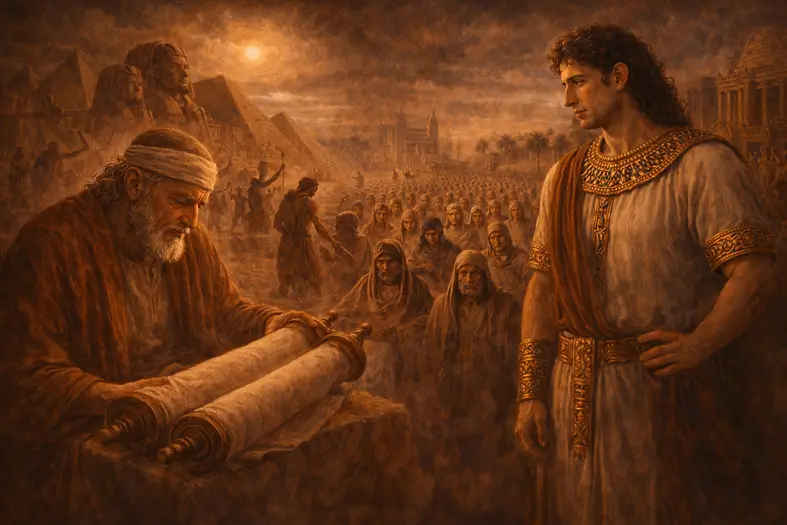
Parshas Vayechi
Parshas Vayechi forces the reader to confront a disquieting truth: the lives of the Avos do not conclude in the Land. Yaakov Avinu dies in Egypt. Yosef remains buried there. Sefer Bereishis ends not with return, but with prolonged displacement.
This is not an oversight. It is instruction.
Vayechi teaches that exile is not merely a punishment to be endured, nor a spiritual collapse to be escaped. It is an arena — morally demanding, spiritually dangerous, yet capable of producing profound Torah greatness. The question is not how quickly exile ends, but how holiness behaves while it lasts.
Ramban reads the descent to Egypt as the prototype for all future exiles.
וַיְהִי כִּי־כָבֵד הָרָעָב בָּאָרֶץ
[“And the famine was severe in the land.”] (Bereishis 47:13)
What happens to the Avos foreshadows what will later happen to the nation. Egypt is not only geography; it is a structural model.
According to Ramban, exile unfolds through three stages:
Vayechi occupies the second stage. The Avos have done nothing wrong, yet exile continues. This teaches that galus is not always corrective. Sometimes it is preparatory.
"מַעֲשֵׂה אָבוֹת סִימָן לַבָּנִים"
[“The deeds of the fathers are a sign for the children.”]
Yaakov’s insistence on burial in Eretz Yisrael affirms that exile does not redefine destiny. One may live fully in galus without accepting it as final. Ramban thus frames exile as a holding space — not for abandonment, but for preservation of identity until return becomes possible.
Rambam shifts the conversation from geography to character. In his philosophical framework, holiness is not achieved by withdrawal from the world, but by ethical mastery within it.
Exile, in this sense, is not spiritually inferior terrain. It is more demanding terrain.
Rambam teaches that true human perfection emerges when a person:
Vayechi illustrates this vividly. Yosef governs Egypt without corruption. Yaakov blesses and teaches while dependent on foreign protection. Holiness does not retreat in exile — it adapts without compromise.
From a Rambamian perspective, exile is where Torah proves its universality. If holiness were possible only in sacred space, it would not be eternal.
Ralbag introduces a further refinement: moral responsibility expands with capacity. The greater one’s influence, the greater one’s ethical burden.
In exile, this principle becomes decisive. Yosef possesses unprecedented power within a corrupt system. His obligation is therefore greater, not lesser. He must feed nations without tyranny, govern wealth without exploitation, and exercise authority without vengeance.
Ralbag teaches that exile strips away excuses. When holiness survives in hostile environments, it reveals not fragility but depth.
Ethical life in exile demands:
Vayechi presents Yosef not as a victim of galus, but as its moral test case.
Taken together, Ramban, Rambam, and Ralbag reveal Vayechi as the Torah’s first manual for Jewish life in exile.
The parsha teaches that exile requires:
Yaakov gathers his children not to explain suffering, but to define responsibility. Yosef prepares redemption not by escaping Egypt, but by ensuring covenantal memory survives within it.
Exile, Vayechi insists, is not where holiness disappears. It is where it is tested.
The Torah warns against two errors:
Vayechi rejects both. Holiness neither dissolves nor becomes optional in galus. It becomes precise.
The righteous are not judged leniently in exile. They are judged more carefully.
Parshas Vayechi does not console. It instructs.
Exile is not a failure of Torah, nor an interruption of covenant. It is a demanding stage in which identity must survive without reinforcement and faith must operate without visibility.
פָּקֹד יִפְקֹד אֱלֹקִים אֶתְכֶם
[“Elokim will surely remember you.”] (Bereishis 50:24)
The Torah closes Bereishis by teaching that redemption is prepared not by fleeing exile, but by living within it without surrendering moral clarity.
Galus is not the absence of holiness.
It is the arena in which holiness proves it belongs everywhere.
📖 Sources


Parshas Vayechi
Parshas Vayechi forces the reader to confront a disquieting truth: the lives of the Avos do not conclude in the Land. Yaakov Avinu dies in Egypt. Yosef remains buried there. Sefer Bereishis ends not with return, but with prolonged displacement.
This is not an oversight. It is instruction.
Vayechi teaches that exile is not merely a punishment to be endured, nor a spiritual collapse to be escaped. It is an arena — morally demanding, spiritually dangerous, yet capable of producing profound Torah greatness. The question is not how quickly exile ends, but how holiness behaves while it lasts.
Ramban reads the descent to Egypt as the prototype for all future exiles.
וַיְהִי כִּי־כָבֵד הָרָעָב בָּאָרֶץ
[“And the famine was severe in the land.”] (Bereishis 47:13)
What happens to the Avos foreshadows what will later happen to the nation. Egypt is not only geography; it is a structural model.
According to Ramban, exile unfolds through three stages:
Vayechi occupies the second stage. The Avos have done nothing wrong, yet exile continues. This teaches that galus is not always corrective. Sometimes it is preparatory.
"מַעֲשֵׂה אָבוֹת סִימָן לַבָּנִים"
[“The deeds of the fathers are a sign for the children.”]
Yaakov’s insistence on burial in Eretz Yisrael affirms that exile does not redefine destiny. One may live fully in galus without accepting it as final. Ramban thus frames exile as a holding space — not for abandonment, but for preservation of identity until return becomes possible.
Rambam shifts the conversation from geography to character. In his philosophical framework, holiness is not achieved by withdrawal from the world, but by ethical mastery within it.
Exile, in this sense, is not spiritually inferior terrain. It is more demanding terrain.
Rambam teaches that true human perfection emerges when a person:
Vayechi illustrates this vividly. Yosef governs Egypt without corruption. Yaakov blesses and teaches while dependent on foreign protection. Holiness does not retreat in exile — it adapts without compromise.
From a Rambamian perspective, exile is where Torah proves its universality. If holiness were possible only in sacred space, it would not be eternal.
Ralbag introduces a further refinement: moral responsibility expands with capacity. The greater one’s influence, the greater one’s ethical burden.
In exile, this principle becomes decisive. Yosef possesses unprecedented power within a corrupt system. His obligation is therefore greater, not lesser. He must feed nations without tyranny, govern wealth without exploitation, and exercise authority without vengeance.
Ralbag teaches that exile strips away excuses. When holiness survives in hostile environments, it reveals not fragility but depth.
Ethical life in exile demands:
Vayechi presents Yosef not as a victim of galus, but as its moral test case.
Taken together, Ramban, Rambam, and Ralbag reveal Vayechi as the Torah’s first manual for Jewish life in exile.
The parsha teaches that exile requires:
Yaakov gathers his children not to explain suffering, but to define responsibility. Yosef prepares redemption not by escaping Egypt, but by ensuring covenantal memory survives within it.
Exile, Vayechi insists, is not where holiness disappears. It is where it is tested.
The Torah warns against two errors:
Vayechi rejects both. Holiness neither dissolves nor becomes optional in galus. It becomes precise.
The righteous are not judged leniently in exile. They are judged more carefully.
Parshas Vayechi does not console. It instructs.
Exile is not a failure of Torah, nor an interruption of covenant. It is a demanding stage in which identity must survive without reinforcement and faith must operate without visibility.
פָּקֹד יִפְקֹד אֱלֹקִים אֶתְכֶם
[“Elokim will surely remember you.”] (Bereishis 50:24)
The Torah closes Bereishis by teaching that redemption is prepared not by fleeing exile, but by living within it without surrendering moral clarity.
Galus is not the absence of holiness.
It is the arena in which holiness proves it belongs everywhere.
📖 Sources


“Exile as an Ethical Arena, Not a Spiritual Failure”
אֶת־ה׳ אֱלֹקֶיךָ תִּירָא
Vayechi presents yiras Hashem as ethical steadiness in the absence of ideal conditions. Exile removes external reinforcement, demanding inner reverence that governs conduct even when spiritual clarity is obscured. Yaakov’s final instructions and Yosef’s restraint reveal fear of Hashem as disciplined loyalty rather than reactive awe.
וְהָלַכְתָּ בִדְרָכָיו
Hashem governs history patiently, allowing redemption to unfold gradually. Yaakov and Yosef emulate this Divine attribute by sustaining covenantal behavior within exile rather than forcing resolution. Vayechi teaches that imitating Hashem includes restraint, moral patience, and fidelity under delay.
וְאָהַבְתָּ לְרֵעֲךָ כָּמוֹךָ
Exile strains communal bonds through fear, competition, and survival pressure. Yosef’s commitment to preserve his family physically and spiritually demonstrates ahavat Yisrael expressed through responsibility rather than sentiment. Vayechi frames unity as an ethical obligation heightened—not relaxed—by exile.
לֹא תִקֹּם
In exile, power imbalances invite moral abuse. Yosef’s refusal to retaliate against his brothers establishes this mitzvah as a safeguard against tyranny within foreign systems. Vayechi teaches that restraint is essential to preserving Torah ethics when external authority is unchecked.
לֹא תַעֲמֹד עַל דַּם רֵעֶךָ
Yosef’s administration during famine exemplifies active responsibility in exile. Preventing societal collapse, starvation, and familial disintegration reflects this mitzvah’s broader scope. Vayechi teaches that exile demands moral intervention, not withdrawal, when lives—physical or existential—are at stake.


“Exile as an Ethical Arena, Not a Spiritual Failure”
Parshas Vayechi concludes Sefer Bereishis with the Avos still in exile, establishing galus as a permanent Torah category rather than a temporary aberration. Yaakov Avinu lives, blesses, and dies in Egypt, while Yosef prepares redemption he will not witness. The parsha emphasizes moral responsibility within displacement: leadership without sovereignty, covenant without land, and holiness without ideal conditions. Vayechi thus functions as the Torah’s first manual for life in exile, teaching that spiritual integrity must operate precisely where reinforcement is weakest.
Lech Lecha introduces exile as a Divine decree rather than a moral collapse. Avraham is told in advance that his descendants will be strangers in a foreign land, framing galus as part of covenantal history. This parsha establishes that exile can coexist with Divine favor, laying the groundwork for Vayechi’s insistence that displacement does not signal abandonment.
Vayeitzei presents Yaakov’s formative years in exile, where spiritual identity must be maintained without protection or familiarity. Yaakov builds a family and preserves covenant under Lavan’s influence, demonstrating that Torah life can endure within morally corrosive environments. This parsha anticipates Vayechi’s model of sustained holiness in galus.
Vayigash depicts Yosef exercising moral leadership at the height of political power in Egypt. His restraint, compassion, and refusal of vengeance establish the ethical framework that defines exile as a test of character rather than faith. This parsha prepares the ethical vision of Vayechi, where holiness must govern conduct even when sovereignty is absent.

Dive into mitzvos, tefillah, and Torah study—each section curated to help you learn, reflect, and live with intention. New insights are added regularly, creating an evolving space for spiritual growth.

Explore the 613 mitzvos and uncover the meaning behind each one. Discover practical ways to integrate them into your daily life with insights, sources, and guided reflection.

Learn the structure, depth, and spiritual intent behind Jewish prayer. Dive into morning blessings, Shema, Amidah, and more—with tools to enrich your daily connection.

Each week’s parsha offers timeless wisdom and modern relevance. Explore summaries, key themes, and mitzvah connections to deepen your understanding of the Torah cycle.