Parshas Vayechi
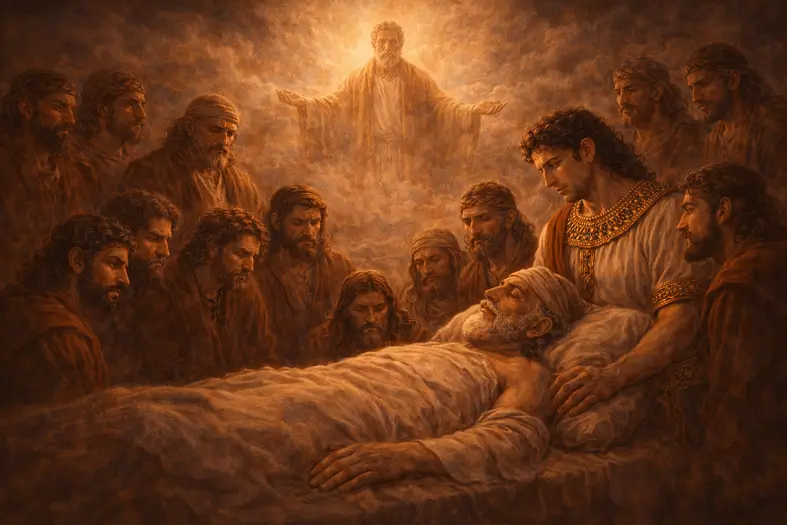
Parshas Vayechi presents a striking paradox. The Torah describes Yaakov Avinu’s final moments in calm, physical detail: he gathers his feet into the bed and is gathered to his people. And yet Chazal declare something radical:
יַעֲקֹב אָבִינוּ לֹא מֵת
[“Yaakov Avinu did not die.”]
This is not poetic exaggeration, nor denial of physical death. It is a precise theological claim. Yaakov’s life possessed a quality of continuity so complete that death introduced no rupture. Vayechi teaches that eternity is not measured by duration, but by alignment — a life lived wholly in service of an unbroken covenant.
Rashi, citing Chazal, explains that Yaakov’s declaration of non-death flows from a singular achievement: מיטתו שלמה — his bed was complete. All of his children remained within the covenant. No strand of his life unraveled at the end.
This is the Torah’s definition of completion. Yaakov’s story is not free of struggle, exile, or suffering. But it is free of fragmentation. Every stage of his life — youth, family, leadership, exile — expresses the same devotion to Hashem.
Chazal contrast Yaakov with Avraham and Yitzchak, whose greatness remains unquestioned, yet whose spiritual legacies encountered rupture. Yaakov’s distinction is not superiority of soul, but continuity of mission.
Yaakov Avinu’s life was:
Death, therefore, introduced no discontinuity. What never fractured could not truly end.
Rav Kook reframes this teaching philosophically. Death, he explains, is the severing of life from its purpose. When life and purpose diverge, mortality asserts itself. But when a person’s inner will aligns fully with eternal values, physical cessation does not constitute existential termination.
Yaakov’s life, Rav Kook teaches, never required purification through death. His struggles refined him within life itself. The years of exile, deception, and suffering were not detours from his mission — they were its instruments.
For Rav Kook, this is why Yaakov’s passing is so understated. There is no drama because nothing collapses. Life continues seamlessly through his children, his covenant, and his destiny.
Eternal life, in this sense, is not miraculous preservation — it is coherence.
The Degel Machaneh Ephraim deepens this idea through a Chassidic lens. A Torah-life, he teaches, does not retreat from the world at death. It remains active wherever Torah continues to be lived.
Yaakov Avinu embodied a life where Torah was not an activity, but an atmosphere. Even in Egypt — the most spiritually corrosive environment — Yaakov remains Yaakov. He blesses, teaches, and shapes destiny until his final breath.
Chassidus emphasizes that Yaakov’s presence did not diminish in exile because it was never dependent on circumstance. His holiness did not rise and fall with location, success, or recognition.
Such a life does not withdraw. It disperses.
The Torah quietly underscores this teaching by contrast. Yosef, though a towering tzaddik, does die. His body must wait for redemption. His holiness is preserved, but delayed.
This contrast reveals a critical distinction:
Both are righteous. But only Yaakov achieves a life so internally unified that death itself introduces no spiritual interruption.
Vayechi teaches that eternity is not granted at the end of life — it is constructed throughout it.
A life achieves continuity when:
Such a life does not conclude. It continues.
“Yaakov Avinu lo met” is not praise; it is diagnosis. Yaakov lived a life so integrated that death could not dismantle it.
Parshas Vayechi thus offers a demanding vision of eternity. Not survival through monuments or memory, but survival through coherence. A life fully aligned with Hashem’s will leaves nothing behind that needs correction.
Death ends bodies.
It does not end lives that never withdrew from their purpose.
Eternity, the Torah teaches, is not bestowed after life ends. It is forged through a life that never fractures — one that remains faithful to its purpose until the very end.
📖 Sources


Parshas Vayechi
Parshas Vayechi presents a striking paradox. The Torah describes Yaakov Avinu’s final moments in calm, physical detail: he gathers his feet into the bed and is gathered to his people. And yet Chazal declare something radical:
יַעֲקֹב אָבִינוּ לֹא מֵת
[“Yaakov Avinu did not die.”]
This is not poetic exaggeration, nor denial of physical death. It is a precise theological claim. Yaakov’s life possessed a quality of continuity so complete that death introduced no rupture. Vayechi teaches that eternity is not measured by duration, but by alignment — a life lived wholly in service of an unbroken covenant.
Rashi, citing Chazal, explains that Yaakov’s declaration of non-death flows from a singular achievement: מיטתו שלמה — his bed was complete. All of his children remained within the covenant. No strand of his life unraveled at the end.
This is the Torah’s definition of completion. Yaakov’s story is not free of struggle, exile, or suffering. But it is free of fragmentation. Every stage of his life — youth, family, leadership, exile — expresses the same devotion to Hashem.
Chazal contrast Yaakov with Avraham and Yitzchak, whose greatness remains unquestioned, yet whose spiritual legacies encountered rupture. Yaakov’s distinction is not superiority of soul, but continuity of mission.
Yaakov Avinu’s life was:
Death, therefore, introduced no discontinuity. What never fractured could not truly end.
Rav Kook reframes this teaching philosophically. Death, he explains, is the severing of life from its purpose. When life and purpose diverge, mortality asserts itself. But when a person’s inner will aligns fully with eternal values, physical cessation does not constitute existential termination.
Yaakov’s life, Rav Kook teaches, never required purification through death. His struggles refined him within life itself. The years of exile, deception, and suffering were not detours from his mission — they were its instruments.
For Rav Kook, this is why Yaakov’s passing is so understated. There is no drama because nothing collapses. Life continues seamlessly through his children, his covenant, and his destiny.
Eternal life, in this sense, is not miraculous preservation — it is coherence.
The Degel Machaneh Ephraim deepens this idea through a Chassidic lens. A Torah-life, he teaches, does not retreat from the world at death. It remains active wherever Torah continues to be lived.
Yaakov Avinu embodied a life where Torah was not an activity, but an atmosphere. Even in Egypt — the most spiritually corrosive environment — Yaakov remains Yaakov. He blesses, teaches, and shapes destiny until his final breath.
Chassidus emphasizes that Yaakov’s presence did not diminish in exile because it was never dependent on circumstance. His holiness did not rise and fall with location, success, or recognition.
Such a life does not withdraw. It disperses.
The Torah quietly underscores this teaching by contrast. Yosef, though a towering tzaddik, does die. His body must wait for redemption. His holiness is preserved, but delayed.
This contrast reveals a critical distinction:
Both are righteous. But only Yaakov achieves a life so internally unified that death itself introduces no spiritual interruption.
Vayechi teaches that eternity is not granted at the end of life — it is constructed throughout it.
A life achieves continuity when:
Such a life does not conclude. It continues.
“Yaakov Avinu lo met” is not praise; it is diagnosis. Yaakov lived a life so integrated that death could not dismantle it.
Parshas Vayechi thus offers a demanding vision of eternity. Not survival through monuments or memory, but survival through coherence. A life fully aligned with Hashem’s will leaves nothing behind that needs correction.
Death ends bodies.
It does not end lives that never withdrew from their purpose.
Eternity, the Torah teaches, is not bestowed after life ends. It is forged through a life that never fractures — one that remains faithful to its purpose until the very end.
📖 Sources


“Yaakov Avinu Lo Met: Eternal Life Through Complete Continuity”
אֶת־ה׳ אֱלֹקֶיךָ תִּירָא
Parshas Vayechi frames yirat Hashem as lifelong alignment rather than episodic awe. Yaakov’s constancy across blessing, exile, leadership, and death reflects reverence that governs every stage of life. This mitzvah is fulfilled not through moments of intensity alone, but through unwavering fidelity that never fractures under changing conditions.
וְהָלַכְתָּ בִדְרָכָיו
Hashem’s ways are marked by consistency and faithfulness. Yaakov mirrors this Divine attribute by living a life whose values do not shift with circumstance. Emulating Hashem here means sustaining the same covenantal posture in prosperity, struggle, exile, and decline—producing a life whose purpose remains intact until the end.
וּבוֹ תִדְבָּק
Yaakov’s greatness is inseparable from transmission. His bond with Hashem is not private or transient; it is embodied in the continuity of his children and students. Vayechi teaches that cleaving to Hashem includes ensuring that attachment survives beyond oneself through relationships, teaching, and inherited mission.
וְשִׁנַּנְתָּם לְבָנֶיךָ
Yaakov’s final acts are instructional. He blesses, rebukes, and defines destinies, demonstrating that Torah continuity is the ultimate measure of life’s completion. This mitzvah anchors the declaration mitato sheleimah: a life that teaches Torah successfully does not terminate at death—it continues wherever that Torah is lived.
כַּבֵּד אֶת־אָבִיךָ וְאֶת־אִמֶּךָ
The continuity of Yaakov’s life is reflected in Yosef’s reverence for him—through care, obedience, and fulfillment of burial wishes. Honoring parents here extends beyond respect to preservation of legacy. Vayechi presents kibbud av va’eim as a conduit through which covenantal life flows uninterrupted from one generation to the next.


“Yaakov Avinu Lo Met: Eternal Life Through Complete Continuity”
Parshas Vayechi presents Yaakov Avinu’s passing in unusually calm and understated terms, immediately followed by Chazal’s striking declaration that “Yaakov Avinu did not die.” The parsha emphasizes mitato sheleimah—that all of Yaakov’s children remained bound to the covenant—revealing that his life ended without rupture or spiritual loss. Yaakov blesses, instructs, and transmits destiny until his final breath, demonstrating a life of complete continuity. Vayechi thus defines eternity not as the suspension of death, but as a life so aligned with its purpose that death introduces no interruption.
Vayeitzei establishes the foundation of Yaakov’s continuity through exile. Leaving Eretz Yisrael alone and vulnerable, Yaakov builds a home, raises a family, and maintains covenantal integrity in a spiritually hostile environment. His years with Lavan demonstrate that Torah identity can remain intact despite displacement, deception, and instability. This parsha frames Yaakov’s later completeness in Vayechi: continuity is forged through sustained faithfulness long before life reaches its conclusion.
Vayishlach reveals Yaakov’s inner consolidation after struggle. His encounter with Esav and the angel marks a transformation from fragmentation to integration, from survival to identity. Yaakov emerges not only renamed Yisrael, but spiritually unified. This parsha shows how Yaakov’s life becomes internally coherent, allowing later generations to inherit a mission that requires no repair—an essential precursor to the declaration of “Yaakov Avinu lo met.”
Vayigash brings Yaakov into Egypt under Divine reassurance, completing the arc of a life that remains covenantally oriented even in exile. Yaakov’s descent is purposeful, not reactive, and his spiritual authority remains intact despite geographic displacement. This parsha prepares the ground for Vayechi’s teaching: Yaakov’s life never surrendered its center, allowing his legacy to pass forward whole and undiminished.

Dive into mitzvos, tefillah, and Torah study—each section curated to help you learn, reflect, and live with intention. New insights are added regularly, creating an evolving space for spiritual growth.

Explore the 613 mitzvos and uncover the meaning behind each one. Discover practical ways to integrate them into your daily life with insights, sources, and guided reflection.

Learn the structure, depth, and spiritual intent behind Jewish prayer. Dive into morning blessings, Shema, Amidah, and more—with tools to enrich your daily connection.

Each week’s parsha offers timeless wisdom and modern relevance. Explore summaries, key themes, and mitzvah connections to deepen your understanding of the Torah cycle.