Each Parsha page on Mitzvah Minute is designed as a guided, three-level journey through the weekly Torah reading—integrating the narrative, the mitzvos, and the classical commentaries into one unified experience.
Begin with the foundations of the Parsha:
This level gives you the storyline, the key mitzvos, and the essential connections between them.
A complete journey through the parsha—moving from clarity and depth to inner connection and real-world meaning, culminating in a way to live its ideas in everyday life.
These sections show how the Parsha speaks to the mind, the heart, and the real world — offering wisdom rooted in enduring Torah.
A complete, structured commentary on the parsha—presented pasuk by pasuk, with chapter and overall summaries for clarity and flow.
This level reveals the structural depth of the Parsha and the classical underpinnings of each theme.
Together, these layers create a complete Parsha journey —
narrative, mitzvah, and commentary — all flowing toward deeper understanding, spiritual insight, and meaningful growth.
Tap the Page Navigation tab on the right side of your screen anytime to access quick-links to the entire Parsha page.
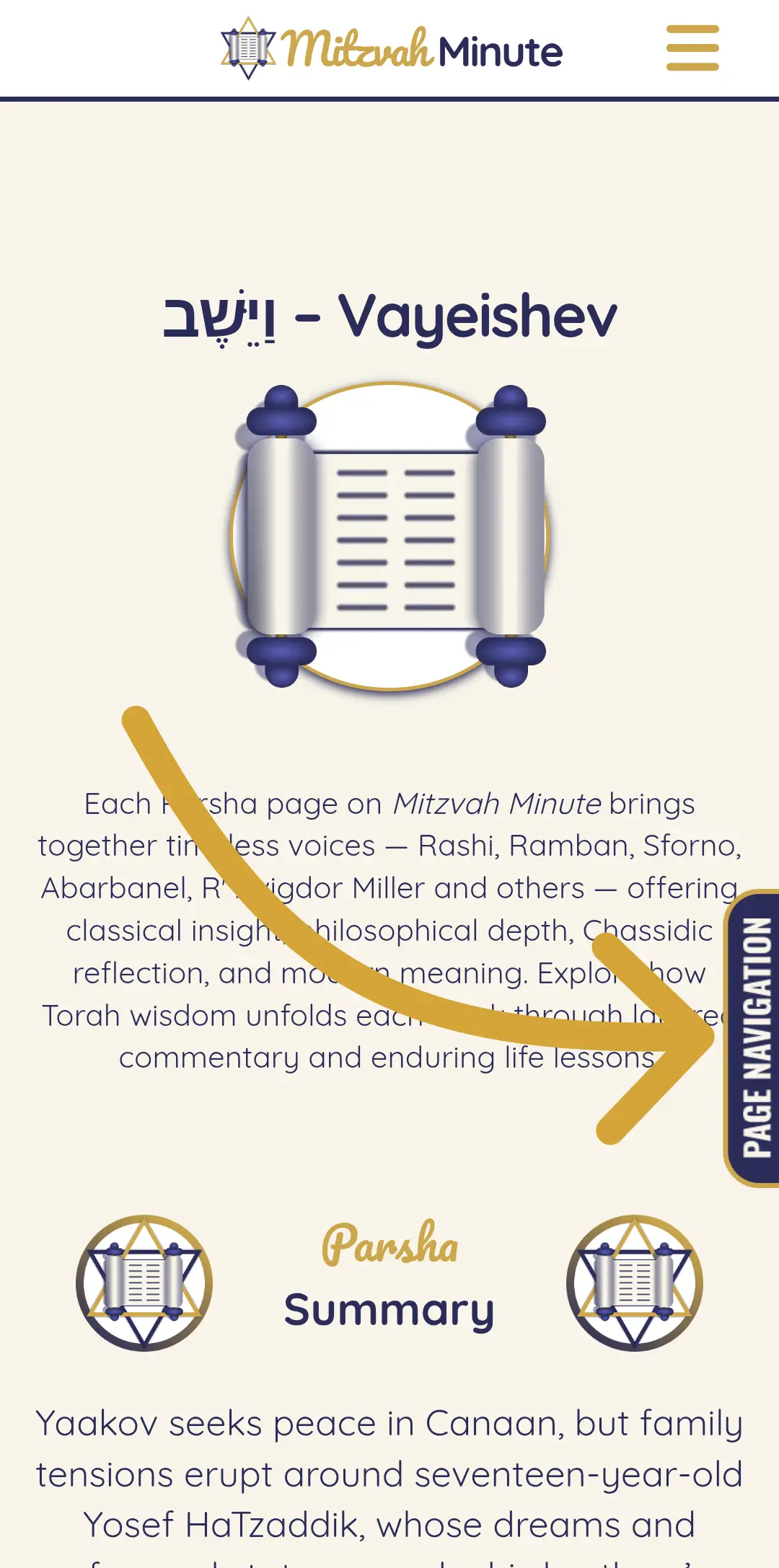
The quick-link panel gives instant access to every section — Parsha Summary, Mitzvos, Divrei Torah, Insights, and Commentaries.
“Every word of Torah and every mitzvah lifts us higher — may your learning bring you closer to Hashem.”

Parshas Tazria traces the fragile boundary between life, body, and holiness. It begins with the birth of a child, where new life enters the world accompanied by a structured process of טומאה — ritual impurity — and טהרה — purification. The mother moves through defined stages, culminating in korbanos that restore her connection to the Mikdash, while the newborn is brought into the covenant through ברית מילה — circumcision on the eighth day. The parsha then shifts from the hidden mystery of creation to the visible surface of the human body, detailing the laws of צרעת — spiritual afflictions that appear on the skin. These marks are examined by the כהן, who determines purity or impurity through a careful process of observation, isolation, and reassessment. What emerges is a system where external signs reflect deeper realities, and where clarity requires patience and discernment. At its core, Tazria presents a unified theme: life itself demands refinement. From birth to blemish, the Torah reveals that holiness is not automatic — it must be guarded, examined, and continually restored.


"Becoming Whole in a Fragmented World"
וּבַיּוֹם הַשְּׁמִינִי יִמּוֹל בְּשַׂר עָרְלָתוֹ
Bris Milah establishes that kedushah — holiness — begins at the very origin of life. Parshas Tazria introduces this mitzvah at birth to teach that identity is not merely developed; it is given. The eighth day represents transcendence beyond nature, embedding the human body itself within covenant. In the broader arc of the parsha, which explores formation, impurity, and restoration, Milah stands as the first act of alignment—declaring that even the physical is directed toward purpose. It reminds us that becoming whole begins not with reinvention, but with uncovering the covenant already inscribed within us.
אָנֹכִי ה׳ אֱלֹקֶיךָ
Tazria’s world is one in which nothing is random—physical conditions reflect spiritual realities. The phenomena of tumah and taharah train a person to see existence as structured by Divine will. Knowing Hashem is not abstract belief but awareness that life is purposeful and responsive. The metzora’s condition, for example, is not merely biological but revelatory. The parsha calls a person to live with da’at Elokim—recognizing that the visible world is constantly communicating something deeper about one’s inner state.
וְאָהַבְתָּ אֵת ה׳ אֱלֹקֶיךָ
Love of Hashem emerges not only from inspiration, but from alignment. Tazria shows that distance from holiness creates fragmentation, while return restores closeness. The process of taharah is not merely technical—it is relational. A person who refines speech, guards conduct, and lives with discipline begins to experience a deeper connection to Hashem. Love, in this sense, is not emotional intensity alone; it is the result of a life that increasingly reflects Divine order.
אֶת ה׳ אֱלֹקֶיךָ תִּירָא
The sudden and visible consequences described in Tazria cultivate yir’ah — reverence. Not fear in the sense of anxiety, but an awareness that actions matter. Nadav and Avihu in Shemini and the metzora in Tazria both reveal that holiness is not casual. The parsha trains a person to live with seriousness—to recognize that speech, behavior, and even subtle moral lapses carry weight. Yir’ah becomes the foundation for a life that does not drift into carelessness.
וְנִקְדַּשְׁתִּי בְּתוֹךְ בְּנֵי יִשְׂרָאֵל
Kiddush Hashem emerges in Tazria as the visible expression of an aligned life. Just as the metzora reveals inner disorder through the body, a person who lives with integrity, restraint, and awareness of Hashem reveals kedushah through presence. Sanctifying Hashem’s Name is not limited to dramatic moments, but is formed through consistent conduct—speech that elevates, behavior that reflects honesty, and a life that carries dignity. Tazria teaches that when the inner world is ordered, the outer world begins to reflect it. Kiddush Hashem, then, is the natural result of becoming whole.
וְהָלַכְתָּ בִּדְרָכָיו
Tazria teaches that holiness is not abstract—it must be embodied. Just as Hashem creates order, separates, and refines, so too a person is called to structure life with clarity and intention. The distinctions between tamei and tahor reflect a Divine pattern of discernment. Emulating Hashem means developing that same capacity: to separate what elevates from what degrades, what builds from what fragments. The parsha becomes a training ground for living with moral and spiritual precision.
לֹא תֵלֵךְ רָכִיל בְּעַמֶּיךָ
At the heart of Tazria is the destructive power of speech. Chazal link tzaraas directly to lashon hara, revealing that words are not neutral—they shape reality. The metzora’s isolation mirrors the social damage caused by careless speech. In modern life, where communication is constant and amplified, this mitzvah becomes even more urgent. Tazria teaches that speech must be treated as a כלי — instrument — that builds or destroys. Guarding it is not restraint; it is responsibility.
וְלֹא תִשָּׂא עָלָיו חֵטְא
Embarrassment is a form of social exposure, and Tazria is deeply concerned with exposure—what becomes visible and how it affects a person. The metzora is publicly identified, but the Torah carefully structures this process to preserve dignity within necessity. From here we learn the gravity of causing shame. In a world where public exposure is easy and often weaponized, this mitzvah reminds us that preserving another person’s dignity is a form of holiness.
לֹא תוֹנוּ אִישׁ אֶת עֲמִיתוֹ
Tazria reveals that words have consequences that extend beyond the moment. While lashon hara addresses speaking about others, this mitzvah addresses how one speaks to them. Hurtful language creates internal and relational damage that may not be immediately visible, but accumulates over time. The metzora embodies this principle: what begins as misuse of speech ultimately manifests outwardly. This mitzvah trains a person to recognize the weight of every interaction. Words can either stabilize or destabilize another person. In a world of constant communication, guarding speech becomes a form of responsibility—ensuring that one’s presence builds rather than erodes those around them.
וְאָהַבְתָּ לְרֵעֲךָ כָּמוֹךָ
Ahavas Yisrael — love of another Jew — stands as the corrective force to the social breakdown described in Tazria. The metzora’s isolation reflects the damage caused when relationships are fractured, often through speech. This mitzvah restores the foundation upon which community is built. Love here is not sentiment alone, but orientation: to see others with generosity, to protect their dignity, and to act in ways that strengthen connection. Tazria teaches that when relationships deteriorate, the individual is affected as well. Ahavas Yisrael rebuilds both the person and the community, reestablishing the conditions in which kedushah can dwell.
הוֹכֵחַ תּוֹכִיחַ אֶת עֲמִיתֶךָ
Tazria does not ignore wrongdoing—it reveals it. But revelation is meant to lead to correction, not condemnation. The role of the Kohen in diagnosing tzaraas models a form of constructive confrontation: clear, measured, and oriented toward restoration. This mitzvah teaches that silence in the face of harm is not kindness. True care requires the courage to guide others back toward alignment, in a way that preserves their humanity.
וְלֹא תָתוּרוּ אַחֲרֵי לְבַבְכֶם וְאַחֲרֵי עֵינֵיכֶם
Tazria is a direct challenge to impulsive living. The laws of purity impose pause, reflection, and structure. They teach that not every instinct should be followed, and not every desire should be acted upon. In a culture that often equates authenticity with expression, this mitzvah introduces a deeper truth: freedom is not doing whatever one feels, but living in alignment with what is right. The discipline of Tazria reshapes instinct into intention.
זֹאת הַחַיָּה אֲשֶׁר תֹּאכְלוּ
Although presented in Shemini, this mitzvah flows directly into Tazria’s broader theme: discernment. Just as one must distinguish between kosher and non-kosher in food, so too one must distinguish within life itself—between what nourishes and what corrupts. Tazria expands this idea from diet to existence. The body, speech, and environment all require evaluation. Living a Torah life means developing refined perception: not everything that appears acceptable is truly sustaining.
וְהִתְוַדּוּ אֶת חַטָּאתָם
The process of purification in Tazria reflects the deeper movement of teshuvah — return. A person becomes aware of misalignment, separates from it, and then re-enters life renewed. Vidui—verbal confession—parallels the misuse of speech that may have caused the condition in the first place. Where speech once damaged, it now repairs. Tazria teaches that no state is final. Through recognition, honesty, and structured return, a person can move from fragmentation back to wholeness.
וַעֲבַדְתֶּם אֵת ה׳ אֱלֹקֵיכֶם
Tefillah — prayer — provides the daily structure through which a person continually returns to alignment. Tazria presents a world of process: separation, reflection, and re-entry. In the absence of the Temple system, tefillah becomes the modern rhythm of that process. Each day, a person steps out of distraction and reorients toward Hashem, restoring clarity and direction. Prayer is not only expression—it is recalibration. Just as the metzora undergoes stages of return, tefillah creates a consistent framework through which a person maintains connection, preventing fragmentation from taking hold.

Rashi reads Parshas Tazria as a fully integrated halachic system in which language, physical סימנים — signs, and priestly authority combine to generate legal reality. What appears to be descriptive—color, texture, bodily condition—is, in his approach, determinative. Every word in the Torah is precise: an extra phrase expands a דין — law, a grammatical form defines a category, and a visual detail becomes a סימן טומאה — sign of impurity — or סימן טהרה — sign of purity. Across the parsha, Rashi consistently binds together three layers: the literal text, the halachic structure derived by Chazal, and the lived human condition expressed through the גוף — body. The result is not a collection of laws, but a coherent diagnostic system in which nothing is incidental and every element participates in a unified framework.
Rashi opens by explaining that the placement of the parsha itself reflects a deeper order. Following the teaching of רבי שמלאי, he notes that just as האדם — man — was created after בהמה חיה ועוף — cattle, beasts, and birds — so too the Torah places the laws of animals before the laws governing man. This is not a stylistic observation, but a structural one: the Torah mirrors creation. Human law is introduced only after the broader system of life has been established, indicating that האדם exists within a hierarchy of creation and is judged within that framework. The סדר — order — of the Torah is therefore itself part of its meaning.
Rashi expands the concept of לידה — birth — beyond its intuitive meaning. From the additional wording כי תזריע, he derives that even a case of מָחוּי — a dissolved or pulpy mass — generates טומאת לידה — the impurity of childbirth. This teaches that the halachic definition of birth is not dependent on a fully formed infant but on the process defined by the Torah. The category is legal, not merely biological. The Torah’s language establishes that even an irregular or incomplete emergence can create the same halachic status for the mother, demonstrating that appearances do not determine דין — law — but rather the precise formulations of the text as interpreted by Chazal.
By comparing טומאת לידה — childbirth impurity — to נדה — menstrual impurity, Rashi explains that the Torah is not drawing a superficial analogy but establishing a shared halachic framework. All the laws that apply to a נדה extend to a yoledes — a woman after childbirth. Crucially, Rashi emphasizes that even in the absence of blood, the opening of the womb itself generates impurity. This reveals that tumah is not defined solely by observable physical discharge, but by the Torah’s classification of states. The comparison to נדה therefore creates a structural unity: different phenomena, but one halachic system governing both.
Rashi carefully maps the progression of the yoledes through distinct halachic stages. First comes טומאה — initial impurity. This is followed by דמי טהרה — blood of purification — during which the woman may still see blood, yet is considered within a state of taharah appropriate to that stage. Nevertheless, she remains restricted from קדש — sacred foods — and entry into the מקדש — Sanctuary. Only after the bringing of the קרבן — offering — does she reach complete טהרה — purity.
Here Rashi highlights a critical distinction: partial purification versus complete restoration. Even after immersion and the passage of time, the Torah still refers to her as טמאה until the kapparah — atonement — is achieved. The decisive act is the קרבן חטאת — sin-offering — which alone enables her to resume full participation in קדשים. The halachic process is therefore graduated and precise, with each stage carrying its own status and limitations.
Rashi repeatedly demonstrates that dikduk — grammatical precision — is itself halachically meaningful. When the Torah writes טהרה without a mappik, it refers to a general category of purification. When it writes טהרהּ with a mappik, it denotes her specific period of purification. This distinction is not stylistic but legal: the form of the word defines the scope of the concept.
Similarly, terms such as שאת, ספחת, and בהרת are not descriptive adjectives but formal halachic categories within the system of נגעים — afflictions. Rashi’s attention to language reveals that the Torah encodes its legal structure within its linguistic form, and precise reading is therefore essential to correct halachic understanding.
In Rashi’s presentation, נגעים — leprous afflictions — operate through a structured system of visual סימנים. These include white hair that has transformed from its original color, spreading of the lesion across the skin, and מחיה — healthy living flesh — appearing within the affliction. Even the notion of depth, expressed as עמוק, is explained not as physical indentation but as visual appearance: whiteness creates the illusion of depth, just as light appears deeper than shadow.
This demonstrates that the Torah establishes a standardized method of visual interpretation. The kohen does not rely on subjective perception but on defined criteria. Even quantitative thresholds are embedded in the text, such as the implication that “hair” refers to at least two hairs. The system is therefore both qualitative and quantitative, translating visual phenomena into fixed halachic categories.
A central principle in Rashi is that tumah and taharah are not merely observed—they are enacted. The סימנים alone do not finalize status; rather, the determination is made על פי כהן — through the declaration of a kohen. The kohen’s pronouncement transforms the observed condition into halachic reality.
At the same time, Rashi introduces an essential limitation: the kohen’s declaration is effective only when it corresponds to the actual halachic facts. If the person is truly טמא — impure — a mistaken declaration of purity does not change his status. Furthermore, the kohen must possess proper visual capacity, as the Torah requires לכל מראה עיני הכהן — that the affliction be fully visible to the kohen’s sight. Thus, the system combines objective criteria with authorized declaration, each dependent on the other.
Rashi sharply distinguishes between הסגר — quarantine — and מוחלט — confirmed impurity. Quarantine represents a state of uncertainty, in which the nega is observed over time to determine its development. If it spreads, the individual becomes a מוחלט — a confirmed metzora. If it remains unchanged, further quarantine may be required. If it diminishes, the person is declared pure.
This staged process shows that halacha here is not instantaneous but procedural. The Torah creates a system in which time itself functions as a diagnostic tool, allowing the סימנים to clarify their meaning through development.
One of Rashi’s most important insights is that identical phenomena can have different halachic meanings depending on context. מחיה — healthy flesh — may be a sign of impurity in one case but not in another. The term מספחת may describe a pure condition in one pasuk and an impure one in another. Hair color also shifts meaning: white hair indicates impurity in skin afflictions, yellow hair indicates impurity in a נתק — scalp or beard affliction — while black hair serves as a sign of purity in that same context.
Similarly, a שחין — boil — and a מכוה — burn — share diagnostic signs, yet they do not combine for the minimum measure required for impurity. The Torah therefore separates them to preserve categorical distinction. Rashi reveals that the halachic system depends not only on recognizing signs but on correctly situating them within their proper category.
Alongside this precision, Rashi preserves the human dimension of the parsha. In explaining the term דותה, he describes the physical weakness and heaviness experienced by a woman during bleeding. The Torah’s language reflects lived bodily experience, not abstract categories alone.
Moreover, the system includes built-in sensitivity: a chosson — bridegroom — is not examined for negaim during his wedding week, and inspection is similarly deferred during a regel — festival. The halachic process therefore recognizes the importance of human dignity and simcha — joy — even within a system of strict diagnostic law.
Across Parshas Tazria, Rashi presents a unified structure in which every component is interdependent. The לשון — language — defines categories, the מראה — appearance — provides סימנים, the process unfolds over time, and the כהן — priest — gives authoritative expression to the result. The גוף becomes a surface through which inner states are revealed, and the Torah translates those revelations into law.
Nothing is redundant, nothing is approximate. Every word, every shade, every procedural step participates in a system of exact alignment between text, halacha, and reality. Through this, Rashi transforms the parsha into a model of precision in which the physical and the spiritual are bound together in a single, coherent halachic vision.
📖 Source
Ramban approaches Parshas Tazria as a unified system in which halachah, human physiology, and Divine governance converge into a single reality. He does not treat the laws of childbirth and נגעים — afflictive marks — as isolated legal categories, but as expressions of how the גוף — body, הנפש — soul, and שכינה — Divine Presence interact. What appears physical is, in truth, a visible manifestation of a deeper order. From the emergence of life in childbirth to the appearance of negaim on skin, hair, and garments, Ramban consistently shows that the Torah is describing a world in which spiritual alignment becomes perceptible, structured, and subject to precise halachic interpretation.
Ramban refines the halachic definition of לידה — birth — with careful conceptual precision. While accepting that even a dissolved form can generate טומאת לידה — childbirth impurity, he limits this to cases where the fetus once possessed צוּרַת אָדָם — human form. Only something that had the potential for בְּרִיַּת נְשָׁמָה — the formation of a human soul — is halachically considered a וָלָד — child.
This establishes a critical principle: halachic status depends not on present appearance alone, but on essential nature. If no human form ever existed, there is no דין לידה — legal category of birth. But if that form was once present—even if now dissolved—the halachic reality remains. Ramban thus anchors the laws of childbirth in ontology, not surface observation, grounding tumah in the nature of life itself rather than its external state.
Ramban develops a deeply integrated view of the yoledes — woman after childbirth — in which physical processes and halachic stages align. The initial period of טומאה — impurity — corresponds to the natural flow of blood following birth, similar to נדה — menstrual impurity. The subsequent period of דמי טהרה — blood of purification — is not a contradiction but a continuation: the body is undergoing ניקיון — cleansing, expelling residual blood and physical byproducts of pregnancy.
Yet Ramban emphasizes a precise halachic distinction within this stage. While she is already within a process of purification, her status is divided across domains of life:
This demonstrates that physical state and halachic status, though related, are not identical. The Torah distinguishes between ordinary life and domains of קדושה — holiness, structuring a gradual return rather than an immediate transition. The process culminates only after the bringing of the קרבן — offering, when she may fully return “אֶל בֵּית ה׳” — to the House of Hashem.
Ramban addresses the doubling of impurity and purification periods for a female child through a combined physiological and conceptual framework. While he acknowledges the position of רבי ישמעאל that male and female development differ in duration (נדה ל), he ultimately explains—according to the חכמים — Sages—that the distinction lies in the nature of the body itself.
The female is associated with a colder and more moisture-based constitution, producing a greater accumulation of residual matter after birth. Consequently, a longer period of ניקיון — cleansing is required. Ramban frames this not as symbolic, but as grounded in observable human experience: conditions of a “cold” nature require longer resolution than those of a “hot” nature.
Here, Ramban integrates natural observation, medical reasoning, and halachic structure into a single explanation. The Torah’s timeframes are thus neither arbitrary nor purely symbolic—they reflect a real alignment between bodily processes and halachic categories.
When Ramban turns to the laws of נגעים — afflictions, he introduces a foundational principle: tzaraas is not a natural disease but a supernatural sign. It appears only when Yisrael exist in a heightened state of closeness to Hashem, serving as a visible indicator of spiritual imbalance.
This reframes the entire מערכת הנגעים — system of afflictions. It is not a medical phenomenon, but a form of Divine communication expressed through the physical world. The appearance of tzaraas on skin, garments, and dwellings reflects a reality in which spiritual disruption becomes externally visible, demanding recognition and response. The physical world thus becomes a medium through which Hashem’s relationship with האדם — man is revealed.
Within this system, the kohen is not a physician but an interpreter. Ramban emphasizes that the Torah effectively addresses this parsha to the kohanim, as they are responsible for identifying, evaluating, and managing the process of tumah and taharah.
This is reflected in the structure of the pesukim themselves. Unlike other areas of halachah that begin with direct instruction to Bnei Yisrael, here the focus shifts immediately to the role of the kohen as the one who sees and determines. Ramban contrasts this with the case of a זב — one with an internal discharge — where the Torah must command disclosure because it is a דְּבַר סֵתֶר — hidden matter (ויקרא טו:ב). By contrast, tzaraas is visible, and once seen, the kohen assumes authority over the process.
The kohen thus stands at the intersection of perception and halachic reality, translating visible signs into legally binding status.
Ramban emphasizes that negaim are not static conditions but evolving processes. The Torah distinguishes between initial appearances—“נֶגַע צָרַעַת” — a lesion of tzaraas—and a fully established state—“צָרַעַת הִיא” — definitive tzaraas.
These stages are not merely descriptive but diagnostic. Early signs indicate entry into the system of negaim, while later stages confirm full halachic status. Ramban explains that the Torah already labels the early stage as belonging to the category in order to signal its trajectory and potential development.
This reflects both halachic and experiential reality: early eruptions can be more significant than later ones, and the Torah responds by initiating a process of observation and isolation before full development occurs. The system is therefore anticipatory and preventative, guiding response through time rather than reacting only after full manifestation.
Ramban develops a nuanced understanding of how negaim appear to the eye. He distinguishes between עמוק — appearing deep — and שפל — appearing low, explaining that these are not physical measurements but visual effects created by the interaction of color and contrast.
Pure whiteness creates the illusion of depth, while mixtures with redness or other tones diminish that perception. As a result, what appears “deep” or “lower” is a function of visual contrast rather than physical indentation. Ramban shows that the Torah’s language corresponds to consistent visual phenomena that can be evaluated systematically.
He further explains that different contexts—such as שחין — inflammation or מכוה — burn—alter the presentation of these visual signs, thereby affecting their halachic classification. The Torah’s descriptions are therefore precise and observable, forming a structured visual system rather than metaphorical imagery.
Ramban clarifies that halachic determination depends not on appearance alone but on process and development over time. In the laws of הסגר — quarantine, a nega may change in shade or intensity and still be declared טהור — pure, provided that it does not spread.
The decisive factor is פשיון — spreading, not merely שינוי מראה — change in appearance. Even when the Torah describes a nega becoming “כֵּהָה” — dimmer, Ramban explains that this refers to a shift within the recognized spectrum of nega-colors rather than a disappearance or resolution.
The halachah therefore evaluates patterns over time, relationships between signs, and the presence or absence of defining indicators. The system is disciplined and structured, requiring careful interpretation rather than intuitive judgment.
In the laws of נתק — scalp afflictions, Ramban distinguishes between different types of hair loss and their halachic implications. A naturally permanent baldness — where hair will not return — is not considered a nega and remains טהור — pure. Only when distinct afflictive signs appear within that area does it enter the halachic system of negaim.
Ramban also explains the Torah’s instruction not to shave the netek. On a peshat level, this prevents irritation or alteration of the affected area, preserving the integrity of the סימנים — diagnostic signs for proper evaluation. The halachic system thus protects its own conditions of assessment, ensuring that human intervention does not distort the process.
Across Parshas Tazria, Ramban presents a single, integrated vision in which the human condition is never merely physical. Birth, impurity, cleansing, affliction, and purification are all stages within a world governed by visible Divine order. The גוף becomes a medium through which deeper truths are revealed, and the Torah provides the precise framework through which those truths are recognized and acted upon.
The kohen stands at the center of this system—not as a healer, but as an interpreter—reading the language of appearance, process, and progression. In Ramban’s vision, purity and impurity are not abstract states but illuminated realities, calling the אדם — human being to awareness, responsibility, and ultimately, restoration of closeness with Hashem.
📖 Source
This section presents Rambam’s worldview as applied to the themes of Parshas Tazria. The focus is not on commentary to specific pesukim, but on the deeper philosophical structures that underlie the parsha’s halachic system—particularly the relationship between body, soul, morality, and Divine order.
Parshas Tazria opens with laws of childbirth and proceeds into the intricate system of נגעים — afflictions known as tzaraas. Rambam’s framework compels us to reject any superficial reading of these phenomena as purely biological or pathological. Instead, they belong to a Divine system in which the body becomes a כלי — instrument — for moral and spiritual formation.
In Moreh Nevuchim (III:27–28), Rambam establishes that the Torah is directed toward two fundamental perfections: שלמות הגוף — perfection of the body, and שלמות הנפש — perfection of the soul. The halachic structures governing purity and impurity are not arbitrary ritual categories; they are carefully designed to discipline human life into order, awareness, and ultimately, higher understanding.
Tzaraas, within this framework, is not an illness but a סימן — a sign. It signals that the האדם has deviated from proper alignment, particularly in areas of conduct that corrupt the integrity of speech, society, and inner character. The הגוף becomes the surface upon which the נפש’s imbalance is made visible.
Rambam, in Hilchos De’os (7:1–3), presents לשון הרע — harmful speech — as one of the most destructive forces in human life. It is not merely a personal failing but a social toxin that erodes trust, dignity, and cohesion. This aligns directly with Chazal’s identification of tzaraas as a consequence of such speech.
From Rambam’s perspective, speech is the defining feature of האדם — the being endowed with דעת — intellect. When speech is corrupted, the very essence of human uniqueness is degraded. The Torah’s response is not simply prohibition but systematized correction.
The metzora — the one afflicted — is removed from society, not as punishment alone, but as a form of structural תיקון — repair. Rambam’s system consistently uses external conditions to guide internal transformation. Isolation forces the individual to confront the misuse of speech and to rebuild the discipline required for reintegration into a moral society.
One of Rambam’s most critical contributions is his demystification of טומאה — ritual impurity. In Moreh Nevuchim (III:47), he emphasizes that these laws are not about physical contamination but about cultivating consciousness.
Tumah creates boundaries. It introduces states in which a person is restricted from entering the מקדש — the Sanctuary — or engaging in certain קדשים — sacred activities. These restrictions are not punitive; they are pedagogical. They teach that access to holiness requires preparation, intentionality, and alignment.
In Parshas Tazria, the transitions between טומאה and טהרה — impurity and purity — create a rhythm of חיים — life. Events such as childbirth, bodily processes, and physical afflictions all generate halachic states that require recognition and response. Rambam would see in this a system that trains a person to live consciously, where even natural experiences are elevated into moments of Divine awareness.
Rambam consistently explains that the Torah employs physical structures to guide intellectual and moral growth. In Moreh Nevuchim (III:32), he describes how the Torah gradually educates humanity, using familiar forms to lead toward deeper truths.
Tzaraas fits this model precisely. It begins subtly—appearing on the skin, then potentially spreading to garments or even houses (as described later in the Torah). This progression reflects a Divine system of escalating signals, giving the individual opportunities to recognize and correct behavior before deeper consequences unfold.
The affliction is therefore not arbitrary; it is structured communication. It reflects Rambam’s broader principle that Hashem governs the world with חכמה — wisdom — embedding meaning into the fabric of human experience.
In Hilchos De’os (1–3), Rambam presents the doctrine of דרך האמצעית — the middle path — as the foundation of proper character. Extremes distort the human personality, while balance creates stability and clarity.
Parshas Tazria, through its detailed regulations, reflects this same principle. The האדם is not allowed to drift into unconscious living. Bodily states, speech patterns, and social interactions are all regulated to maintain equilibrium.
Tzaraas, in this light, represents a breakdown of balance. It is the outward manifestation of inner extremity—whether in arrogance, harmful speech, or disregard for others. The halachic response restores structure, guiding the individual back toward the דרך הישרה — the upright path.
Rambam writes in Hilchos Yesodei HaTorah (2:2) that through contemplating the wisdom embedded in creation, a person comes to אהבת ה׳ — love of Hashem — and יראת ה׳ — awe of Hashem.
Parshas Tazria invites this contemplation not only through the grandeur of creation but through the precision of human life itself. The גוף, with all its processes and vulnerabilities, becomes a site of reflection. The intricate halachic system reveals that nothing in existence is random; everything is governed by Divine wisdom.
When a person recognizes that even their physical state participates in a larger מערכת — system — of meaning, it leads to humility and reverence. The האדם begins to see himself not as autonomous, but as part of a purposeful creation directed toward higher ends.
One might initially perceive the laws of טומאה and טהרה as restrictive. Rambam, however, would argue the opposite: true חירות — freedom — emerges from structure.
Without law, האדם is subject to impulse and confusion. With law, life becomes ordered, intentional, and directed toward purpose. The halachos of Tazria impose distinctions—between pure and impure, permitted and restricted—not to constrain life, but to give it form.
This reflects Rambam’s broader vision in Mishneh Torah and Moreh Nevuchim: that Torah law is the architecture through which human beings achieve their highest potential.
Through Rambam’s lens, Parshas Tazria is not primarily about affliction, impurity, or restriction. It is about transformation. The physical world becomes a language through which Hashem educates האדם.
What begins as a mark on the skin becomes, in Rambam’s philosophy, an invitation to awaken—to move from unconscious existence toward deliberate, refined, and intellectually grounded avodas Hashem.
In this way, Tazria reflects Rambam’s deepest conviction: that the Torah guides האדם from the surface of life into its deepest truths, where knowledge, morality, and Divine awareness converge.
📖 Sources
Ralbag approaches Parshas Tazria as a rigorously ordered system. He is concerned not only with the laws themselves, but with why the Torah arranged these subjects in this sequence and what intellectual and practical ends are served by each category of tumah — ritual impurity, taharah — purification, birth, negaim — afflictions, and the processes of restoration. For Ralbag, the parsha is a study in how the Torah trains man to recognize the relationship between חומר — matter, צורה — form, bodily health, reproduction, social order, and spiritual refinement. The laws are therefore never arbitrary. Their order, distinctions, and procedures are all part of a deliberate educational architecture.
Ralbag opens by asking why these subjects appear in this arrangement at all. In principle, the order established earlier would have suggested beginning with tzaraas, then proceeding through zav, zavah, niddah, and only afterward yoledes because of the issue of דמי טוהר — the blood of purification. Yet the Torah places the laws of childbirth first. Ralbag explains that this is meant to awaken the reader to the underlying purpose of the laws of niddah and zavah in relation to marital separation, reproductive health, and the condition of the child that may be formed from corrupted blood. The Torah, by shifting the expected order, forces the thoughtful reader to ask why, and thereby directs him toward the cause and purpose embedded in the system. He extends this same logic to the later order of the negaim: first general skin afflictions, then boils and burns, then head and beard afflictions, then garments and leather, then houses, and then the other bodily tumos. Each sequence reflects degrees of generality, material substrate, and conceptual instruction.
Ralbag identifies as the first benefit of the parsha a matter of דעת — knowledge: the Torah’s language “אשה כי תזריע וילדה זכר” teaches that the seed of the woman also participates in generation. He then builds the laws of yoledes around a biological and halachic conception of human formation. A woman who gives birth to a male becomes tamei for seven days and then enters forty days of purity; with a female, fourteen days of tumah and eighty days total. But these laws depend on what counts as a true לידה — birth. There is no tumas leidah before the fetus has reached a real stage of formation, which for Ralbag means not before forty days. Even after that point, there remains a further question of completed human form, which affects the laws of דמי טוהר. He therefore rules stringently in doubtful cases and carefully distinguishes between a true human birth and something that emerged from putrefaction or from another species entirely. If what emerged is not truly human, this is not called לידה in the Torah’s sense. Likewise, birth must occur דרך הרחם — דרך מקום שמזרעת, through the womb in the ordinary path of generation. A יוצא דופן — one delivered by abdominal incision, does not generate tumas leidah or days of purification for the mother, even though the child himself may still bear other halachic consequences, such as the obligation of milah. Ralbag further notes that the point at which the head or most of the body emerges is already halachically decisive, since at that stage the child has entered the realm of independent life.
Ralbag repeatedly insists that these tumos are not empty ritual states. In the case of yoledes, niddah, and zavah, he says explicitly that they carry practical benefit for the health of future offspring and for the removal of reproductive harm. That is why the Torah is more severe in certain areas of female reproductive tumah than in zav, despite the latter’s stringency in other respects. Zav reflects, for Ralbag, an intellectual lesson about the absence of form in discharged matter, whereas niddah, zavah, and yoledes also serve a concrete protective role regarding generation and bodily damage. This is why the parsha links reproductive processes and impurity so closely. The laws train man to recognize that the body is not spiritually irrelevant and that the integrity of generation matters both physically and philosophically.
Ralbag’s discussion of milah is sharply philosophical. He explains that the mitzvah of circumcision weakens the force of the sexual organ so that a person should not be drawn after sensual indulgence except for the sake of preserving the species. He cites the moral ruin brought by sexual excess and presents milah as a discipline that protects a person from becoming enslaved to that impulse. Yet the Torah does not destroy the faculty altogether, because the generative power is still necessary and proper within its bounds. The eighth day is chosen because by then the infant has gained some strength, yet still retains enough softness that the act is less difficult, and the parents’ imaginative attachment has not yet become so strong that they will hesitate to fulfill the mitzvah of Hashem. Ralbag also stresses that milah serves as an אות ברית — covenantal sign, by which the bearers of the true Torah are marked and the endurance of Torah society is strengthened.
Ralbag does not leave milah at the level of symbolism. He unfolds the practical structure with precision. The mitzvah is done by day and not by night. The father bears the primary obligation regarding his son, and similarly a master regarding a household-born slave at the proper time. Milah of the eighth day for one certainly obligated can override Shabbos and Yom Tov, but doubtful cases do not. Thus one born מהול — already circumcised in appearance, an androgynous child, one with two foreskins, or one whose obligation is uncertain does not override Shabbos. A nonviable infant does not override Shabbos either. Any qualified person who performs the act fulfills the mitzvah, and failure to circumcise remains a source of karet for the uncircumcised male once he reaches full obligation and dies deliberately uncircumcised. At the same time, סכנת נפשות — danger to life, defers milah, because the mitzvah can be fulfilled later. The pattern is classic Ralbag: the halachic details themselves express the rational calibration of Torah law.
Ralbag explains that the yoledes’ korban is not incidental. Its purpose is to show the gravity of the impurity and that purification is not complete merely through the passage of days. The woman does not bring the korban until the days of purity are completed, because before that point she still lacks more than kapparah. And among the offerings, the חטאת — sin-offering, is what completes the atonement more essentially than the olah. This is why the olah can in some cases still be brought from her estate after death, whereas the chatat cannot function as posthumous atonement. He also notes that Yom Kippur does not replace this korban, because Yom Kippur atones for sins, whereas this offering completes ritual eligibility, including the ability to eat kodashim — sacred offerings. Even where these korbanos are not for sin in the ordinary sense, they mark the completion of a process that ordinary immersion alone does not finalize.
One of Ralbag’s deepest claims is that tzaraas is not rooted in form but in matter. That is why the Torah begins with skin afflictions, then moves to more specific bodily zones, then even extends negaim to garments, leather, and houses. By doing so, the Torah teaches that corruption and putrefaction belong to the material substrate of things. Garments and leather are chosen because they surround the body and are in constant human use through clothing, bedding, and sitting. Houses, though inanimate, can also exhibit this material degradation, and their laws are calibrated differently because a house is constituted by plurality, not by a single unit. This is why, for example, the structure of house-negaim involves multiple stones and a longer process of confinement. The whole sequence teaches that material defect appears across levels of existence, though in different modes. That broader philosophy is also why the purification of the metzora with birds, cedar, hyssop, and scarlet is foreshadowed already by the Torah’s inclusion of garment negaim: the same material logic underlies them all.
Ralbag places great emphasis on the role of the kohen in negaim. The affliction is not halachically impure until the kohen declares it so, and it is not purified until the kohen purifies it. Others may perceive and analyze, but the final juridical status belongs to the kohen. This aligns with the precision of the visual laws: negaim must be seen only when sight is reliable, not at night, not in dim or distorted lighting, not when the viewer’s eyesight is compromised, and not when two afflictions are being examined at once. Even the kohen may not judge his own afflictions. The Torah therefore joins authority with disciplined perception. Halachic reality here depends not on impression but on ordered sight, proper conditions, and authorized judgment.
Ralbag devotes sustained attention to the detailed taxonomy of negaim. He distinguishes the four shades of white and their reddish variants, explains why these appearances count as forms of corrupt material mixture, and notes that the kohen must be expert in them and in their names. He defines the necessary size of the lesion, the minimum hair-signs, and the three principal סימני טומאה — signs of impurity in ordinary skin negaim: white hair, healthy living flesh, and spread after confinement. Each sign has its own conditions. White hair must arise from the affliction itself. מחיה — living flesh, must appear with the required minimum concentration and placement. פשיון — spreading, must be genuine expansion of the same lesion into appropriate adjacent territory and judged by the same kohen over successive viewings. Ralbag is equally careful about what does not count: hidden areas, extreme body contours, regions not apt for that kind of nega, lesions that became pure for another reason and later reappeared, and transitions from one nega-type to another all have distinct rules. He is showing that Torah forces the mind to classify reality with exactness rather than vague moralism.
Ralbag explains that head, beard, baldness, boils, burns, and ordinary skin are separated because they are not materially identical. The Torah’s separate treatment of שחין — boil, and מכוה — burn, reflects different kinds of introduced heat, one arising more from internal corruption and the other from external fire. Their signs differ accordingly, and their confinement period is shorter because the source condition is already evident. Likewise, קרחת — rear baldness, גבחת — frontal baldness, and נתק — scalp or beard hair-loss afflictions, are not collapsed into ordinary skin negaim because the regions themselves have different natures. Some signs apply there, others do not. Negaim do not spread from one category into another as though all skin were one uniform field. Ralbag’s philosophical instinct is clear: halachic distinctions mirror ontological distinctions. Matter is not treated abstractly but according to the kind of bodily site in which it appears.
Ralbag then turns to the prohibition against shaving around a נתק in a way that would prevent recognition of its spread. From this he derives a broader principle: one may not remove the signs of impurity themselves, because doing so closes the door to proper examination. This yields the prohibition against tearing out or destroying סימני טומאה. Yet if the signs disappear on their own, without intent, the law differs. Here again the Torah trains the person not to manipulate religious judgment by tampering with appearances. Purification must emerge from truth, not from concealment.
Ralbag explains the public conduct of the metzora as serving the need to keep others away and to mark his state visibly. The metzora sits outside the camp and must signal impurity. Certain practices apply differently to men and women, but the overarching principle remains that tumah must be made known. He further draws an analogy between the metzora and an אבל — mourner, noting that the laws of torn garments and disheveled hair reveal an aspect of death-like existence, as in the description of Miriam, “אל נא תהי כמת.” The purpose is that the afflicted person should take to heart that such punishment comes because of sin and is akin to social death. At the same time, Ralbag is careful to define the halachic extent of this status: what is true of a מוחלט — confirmed metzora, is not always true of a מוסגר — quarantined one; what applies to sending outside the camp does not necessarily apply to every lesser state; and the impurity can extend in severe ways to tent-presence, bedding, seating, and household contamination. The result is a system that is at once symbolic, juridical, and socially protective.
Ralbag’s account of the metzora’s purification continues the same philosophical line. The birds, living water, cedar, hyssop, scarlet wool, shaving, washing, waiting, and subsequent korbanos are not random ceremonies. They are the structured restoration of one who had entered a state of material corruption and social exclusion. He records the exact laws with care: the birds must be of the proper type, the blood must be over the living water, the sprinkling must be performed in the required manner, shaving must be complete, and many of the acts are specifically bound to the kohen and to daylight. Even after the first shaving and immersion, the metzora is only partially restored: he may reenter the camp but not yet return fully to ordinary domestic life. The second shaving and later offerings complete the process. Ralbag also adds practical medical reasoning in one place, explaining that abstention from marital relations during the seven-day interval is harmful for sufferers of this condition, though he limits that inference carefully. The progression from exclusion to staged reentry reflects his conviction that purification is proportioned to the nature of the defect.
In Ralbag’s hands, Parshas Tazria becomes a unified philosophy of life, generation, matter, and law. The parsha begins with the formation of human life, moves through the vulnerabilities of body and reproduction, traces how material corruption can appear in flesh, hair, garments, and dwellings, and then teaches the exact paths by which the damaged person is judged, separated, and restored. Every stage serves either bodily welfare, moral formation, intellectual awakening, or social protection—and often all four together. The reader is meant to see that Torah law is not a loose spirituality attached to physical life, but an exact and rational order through which Hashem trains man to understand what the body is, what holiness requires, and how refinement comes through disciplined distinctions.
📖 Source
(Baal Shem Tov · Kedushas Levi · Sfas Emes)
At the very opening of the parsha, the Baal Shem Tov reveals that life itself begins with a mystery: who awakens first? “אשה כי תזריע — If a woman gives seed…” is not merely biological—it is the language of the soul.
There are two fundamental movements in the inner life of a Jew:
These are not equal.
When the awakening begins from below—what the Baal Shem Tov calls מיין נוקבין — feminine waters—it draws down מיין דכורין — masculine waters, a flow of רחמים — compassion. The result is זכר — a spiritual state of strength, clarity, and Divine closeness.
But when the process is reversed—when a person waits passively until he is awakened from above—the result is דין — strict judgment. The relationship is reactive, not initiated.
The Kedushas Levi deepens this: although Hashem is always the ultimate source of compassion, He prefers the compassion that is awakened by human effort. When a Jew initiates, when he turns upward on his own, he does not merely receive compassion—he creates it in a stronger, more revealed form.
This is the secret of creation itself:
Hashem desires not passive recipients—but partners.
The Baal Shem Tov then turns to tefillah, exposing a subtle but critical danger.
Sometimes a person feels sudden inspiration—tears, longing, brokenness. But if that awakening came entirely from above, without personal preparation, it can be spiritually unstable. “ותפלתו תהיה לחטאה — his prayer becomes a sin” (תהילים ק״ט:ז׳).
Why?
Because it is not yet his.
True avodah requires that a person prepare himself—through Torah, through reflection, through intentional effort—so that his consciousness becomes clear and grounded. Only then is his prayer called זכר — mature, self-generated, anchored.
Yet even when inspiration comes from above, all is not lost.
The Baal Shem Tov teaches a path of transformation:
When a person realizes, with trembling, that his awakening was not his own—and he cries over that very fact—he converts borrowed inspiration into authentic avodah. The “feminine waters” become “masculine waters.”
Even what begins as passive can be redeemed—if one takes ownership.
“וטמא טמא יקרא — he shall call out: impure, impure.”
The Baal Shem Tov explains: this is not only halachah—it is a spiritual principle. A person must reveal his pain to others so that רבים יבקשו עליו רחמים — the many will pray for him.
Hidden pain isolates.
Revealed pain connects.
And in that connection, something astonishing happens:
The longing of others—their רחמים, their yearning for his healing—becomes a form of תפילה.
What the world calls “loss” becomes, in truth, a gateway to spiritual wealth. The heart that breaks open becomes a vessel that others can fill with compassion.
The loneliness of the metzora becomes the birthplace of communal tefillah.
Why is bris milah performed on the eighth day?
The Kedushas Levi answers: because Hashem wants human beings to complete what He began.
The foreskin is not a flaw—it is an invitation.
Just as Rabbi Akiva taught that human actions perfect creation, so too milah reveals that the highest Divine will is not perfection—but participation. Hashem leaves space for man to act, to finish, to elevate.
And when that action comes from below, it awakens a deeper, more beloved compassion than anything imposed from above.
The eighth day represents transcendence—beyond טבע — nature, beyond the seven-day structure of creation. Through human action, the Jew accesses that which is beyond nature.
Man does not merely live in the world—
he completes it.
The Kedushas Levi introduces a radical idea:
True avodah is not to receive from Hashem—but to give to Him.
The soul—called אשה, the receiver—has the power to become a משפיע — a giver, when it serves Hashem שלא על מנת לקבל פרס — not for reward, but to bring Him תענוג — delight.
In this state, the relationship reverses:
Hashem becomes, כביכול, the recipient.
This is the meaning of “ישראל מפרנסין לאביהם שבשמים” — Israel sustains their Father in Heaven. Not literally—but in the sense that human avodah creates Divine delight.
And this delight surpasses even the praise of angels.
The Kedushas Levi gives a parable:
A trained bird speaking human language astonishes all who hear it—not because speech is rare, but because this creature was not expected to speak.
So too, when physical human beings—clothed in חומר — materiality—rise to serve Hashem with purity, it is a פלא — a wonder that even the angels cannot match.
Every spiritual act mirrors birth itself.
The Kedushas Levi teaches that every mitzvah unfolds in three stages:
Many people live in the first stage—feeling inspired.
Some reach the second—deciding to act.
But only the third is transformation.
The soul of כנסת ישראל — the collective Jewish soul—is described as constantly yearning to give birth to זכר—to acts of avodah that generate Divine flow into the world.
Spiritual life is not measured by what we feel—
but by what we bring into reality.
The Sfas Emes reframes the entire parsha through one central idea:
the purpose of man is to reveal the hidden light בתוך ההסתר — within concealment.
The pasuk “אחור וקדם צרתני — You formed me back and front” teaches:
Man stands between them.
He is created last in action—but first in thought.
He is the אחד המחבר — the one who connects.
When a person lives attached to the פנימיות — inner life-force—he elevates not only himself, but all of creation. Every act becomes a bridge from the physical to the Divine.
This is why milah occurs on the eighth day:
Through removing the external covering, one reveals the פנימיות and cuts away the forces that obscure it.
And even more:
The task of man is to connect the two—
to reveal the infinite within the finite.
The Sfas Emes, citing Avraham Avinu, teaches a breathtaking truth:
“וירא את המקום מרחוק — he saw the place from afar.”
Distance is not a barrier.
It is a כלי — a vessel.
Avraham only understood the depth of the Akeidah after enduring the experience of distance. What seemed like concealment was, in truth, preparation.
Through this, he implanted within every Jew a נקודה פנימית — an inner point—that can find Hashem even in moments of remoteness.
There is no מקום פנוי ממנו — no place empty of Him.
Even the feeling of distance is a form of closeness waiting to be revealed.
Why does the metzora bring both cedar and hyssop?
Because true humility is not ignorance of greatness—it is the recognition that greatness is not one’s own.
The Sfas Emes explains:
But the deeper truth is more subtle:
Even when a person truly possesses greatness, he must see it as entirely sourced in Hashem.
Moshe Rabbeinu knew he was great.
Yet he was עניו מאוד — exceedingly humble—because he knew that his greatness was not self-generated.
Arrogance is not overestimating oneself—
it is misattributing the source.
And therefore:
The Sfas Emes, drawing from the Maharal, describes man as composed of חומר וצורה — matter and form.
If a person lives attached to חומר, he is last—lower than even a mosquito.
If he lives attached to צורה, he is first—the purpose of creation itself.
Man’s task is not to reject the physical—but to infuse it with form, to align action with inner intention.
On Shabbos and Rosh Chodesh, this inner dimension becomes revealed:
the שער הפנימי — inner gate—opens, and one can access deeper connection.
But even during the week, the work remains:
to uncover the hidden light within the ordinary.
In the final movement, the Sfas Emes teaches that man contains all of creation within himself.
When he falls, he falls lower than all.
But when he rises, he elevates all.
Through שכל — intellect and רצון — will, man has the power to complete himself—and through that, to draw קדושה into every level of existence.
This is why:
He is the point where everything converges—
and the place from which everything can be lifted.
Parshas Tazria is not about impurity—it is about beginnings.
It teaches that everything depends on one question:
Will you wait to be awakened—
or will you awaken?
Will you remain a receiver—
or become a giver?
Will you live on the surface—
or reveal the hidden light within?
The Chassidic masters answer with one voice:
The smallest movement from below
awakens worlds above.
And in that moment—
a new creation is born.
📖 Sources
Parshas Tazria confronts us with a striking paradox. It speaks in the language of the body—childbirth, circumcision, and the mysterious affliction of צרעת — tzaraas (spiritual affliction)—yet its true subject is not biology but holiness. What appears to be a collection of technical halachos unfolds, in Rabbi Jonathan Sacks’ reading, as a profound meditation on what it means to be human in the presence of G-d. It is a parsha about creation—not only the creation of life, but the creation of identity, responsibility, and moral order.
At its opening, the Torah situates us at the moment of birth: “אִשָּׁה כִּי תַזְרִיעַ — When a woman conceives” (ויקרא יב:ב). This is not merely the beginning of a life, but the beginning of a covenantal relationship. In Judaism, birth is never neutral. It is charged with meaning, with obligation, with קדושה — holiness. The child who enters the world is not simply a biological organism but a bearer of destiny, and the parent is not merely a caregiver but a partner with G-d in the act of creation.
This theme reaches its most powerful expression in the mitzvah of ברית מילה — circumcision. Here, the Torah inscribes covenant into the human body itself. Nature alone is not sufficient; the human being must actively participate in shaping it. The sign of the covenant is placed precisely at the site of generative power, teaching that even the most instinctive dimensions of life must be guided, disciplined, and elevated. Judaism does not reject the physical—it sanctifies it. The body becomes the medium through which a relationship with G-d is lived and expressed.
Yet Tazria does not end with creation. It turns, sharply, to disruption—with the phenomenon of tzaraas. At first glance, these laws seem disconnected from childbirth and circumcision. But Rabbi Sacks reveals their deep unity. Tzaraas is not a disease in the conventional sense; it is a moral-spiritual condition, most closely associated by Chazal with lashon hara — destructive speech. The affliction appears on the skin, the outermost layer of the body, because it is the visible manifestation of an invisible failure. What was broken internally—trust, dignity, relationship—now becomes externalized and undeniable.
In this way, the parsha moves from the creation of life to the fragility of human connection. Just as the body can be sanctified, it can also become a vehicle for alienation. The metzora — מצורע (one afflicted with tzaraas) is sent into isolation, measure for measure for the social divisions he helped create through speech. Words, in Judaism, are never merely descriptive; they are creative forces. Just as G-d creates the world through speech—“וַיֹּאמֶר אֱלֹקִים — And G-d said”—so too human beings shape their worlds through the language they use. Speech can build relationships, communities, and identities—or it can fracture them beyond repair.
Running through all of Rabbi Sacks’ essays is a single, unifying insight: Judaism is a religion that takes the most natural aspects of human life—birth, desire, communication—and transforms them into sites of covenantal responsibility. The human being is not left to instinct alone, nor is he asked to transcend the physical entirely. Instead, he is called to elevate it. Nature becomes the raw material of holiness.
This vision carries both dignity and danger. To be a partner in creation is to wield immense power. The same forces that bring life into the world can, if misused, bring harm. The same capacity for speech that allows us to connect can also divide. Tazria teaches that holiness lies not in escaping these forces, but in mastering them—channeling them toward life, relationship, and covenant.
In this light, the parsha is not about impurity in any superficial sense. It is about alignment: the alignment of body with soul, of speech with truth, of human creativity with divine purpose. It asks a fundamental question of every אדם — human being: Will you allow your nature to remain merely natural, or will you transform it into something sacred?
The answer to that question, Rabbi Sacks suggests, is the very essence of what it means to live a covenantal life.
“The Covenant Written on the Body”
At the heart of Parshas Tazria lies a radical redefinition of what it means to be human. For Rabbi Jonathan Sacks, the mitzvah of ברית מילה — circumcision is not merely one command among many; it is the foundational act that transforms human biology into covenant. It is the moment where nature meets responsibility, where what is given is reshaped by what is chosen.
The Torah commands that a male child be circumcised on the eighth day—“וּבַיּוֹם הַשְּׁמִינִי — On the eighth day” (ויקרא יב:ג). This detail is not incidental. The number seven represents the natural order—the world created in seven days. The eighth day, by contrast, signifies that which lies beyond nature: the human capacity to partner with G-d in completing creation. Circumcision thus becomes the physical expression of a profound theological claim: that the world, and the human being within it, is intentionally left unfinished.
In many ancient cultures, power was identified with nature. The strongest forces—sexuality, reproduction, survival—were seen as ultimate and unchallengeable. Judaism rejects this vision. It insists that even the most primal drives are not sovereign. They are to be disciplined, directed, and sanctified. By placing the sign of the covenant specifically on the organ of generation, the Torah teaches that desire itself must become part of a higher moral structure.
This is what Rabbi Sacks describes as the “circumcision of desire.” The act is physical, but its meaning is spiritual and ethical. It is not a rejection of the body, but its elevation. The human being does not become holy by withdrawing from the physical world, but by transforming it from within.
This idea reverberates throughout the covenantal framework of Torah:
Circumcision therefore stands as a permanent reminder that freedom is not the same as instinct. To be free, in the Torah’s vision, is to have the ability to shape one’s nature rather than be ruled by it.
Rabbi Sacks often contrasts this with modern assumptions about autonomy. Contemporary culture tends to equate authenticity with self-expression: to be true to oneself is to follow one’s desires without restraint. The Torah offers a different, more demanding vision. True freedom is not the absence of constraint, but the presence of purpose. It is the capacity to align one’s inner drives with a higher calling.
This is why the covenant is marked on the body itself. It cannot be relegated to belief alone or confined to moments of ritual. It is inscribed into identity, into physical existence. From the very beginning of life, the Jewish child is entered into a relationship that calls for responsibility, discipline, and קדושה — holiness.
Yet there is a deeper dimension still. Circumcision is performed not by the individual, but on the individual. It precedes conscious choice. This signals that covenant is not only something we choose—it is also something we inherit. We are born into a story, into a destiny, into a relationship with G-d that both precedes and shapes our choices. The task of a lifetime is to affirm that covenant willingly, to make it one’s own.
In this way, Parshas Tazria reframes the human condition. We are not merely products of biology, nor are we disembodied souls. We are beings in whom the physical and the spiritual meet, and it is precisely in that meeting point that holiness is found.
The eighth day, then, is not just a moment in time. It is a symbol of human potential—the ability to step beyond what is given and participate in what ought to be. It is the Torah’s answer to the question of what it means to be created in the image of G-d: not that we are perfect, but that we are capable of perfecting.
And that capacity begins, quite literally, in the flesh.
“The Birth of Responsibility”
Parshas Tazria opens not only with the fact of birth, but with its complexity. “אִשָּׁה כִּי תַזְרִיעַ — When a woman conceives” (ויקרא יב:ב) introduces a process that is at once biological, emotional, and profoundly theological. For Rabbi Jonathan Sacks, childbirth is never merely the arrival of a new life. It is the emergence of a new moral reality—one that redefines identity, responsibility, and the human relationship with G-d.
At first glance, the laws that follow—periods of טומאה — ritual impurity, followed by korbanos — offerings—seem difficult to understand. Why should the moment of life’s greatest joy be accompanied by a state of impurity? Rabbi Sacks reframes the question entirely. The Torah is not diminishing birth; it is deepening it. Birth is not only a beginning—it is also a confrontation with the fragility and contingency of life itself.
To give birth is to stand at the threshold between life and death. It is an act filled with risk, dependence, and vulnerability. The state of טומאה reflects not sin, but exposure to mortality—the awareness that life is never self-sustaining, but always dependent on G-d. The subsequent korban expresses gratitude, humility, and recognition that the miracle of life is not ours alone.
This leads to one of Rabbi Sacks’ most striking insights: in Judaism, parenthood is not ownership. It is stewardship.
The child who is born does not belong to the parent in an absolute sense. Rather, the parent is entrusted with a life that ultimately belongs to G-d. This transforms the entire meaning of raising a child:
This idea becomes even more complex when Rabbi Sacks addresses the question of maternal identity. In a world shaped by modern medical advances—such as surrogacy—the simple assumption that motherhood is biologically defined becomes deeply challenged. Who is the true mother: the genetic contributor or the gestational carrier?
The Torah’s framework resists reduction. Identity, it suggests, is not a single-layer phenomenon. It is formed through multiple dimensions—biological, relational, and covenantal. Motherhood, like all human identity, exists at the intersection of nature and meaning. It cannot be reduced to genetics alone, nor to experience alone. It is a fusion of both, embedded within a broader moral and spiritual context.
This insight reflects a broader pattern in Rabbi Sacks’ thought: Judaism consistently resists simplistic definitions of the human being. We are not merely bodies, nor merely minds, nor merely souls. We are integrated beings, and our identities emerge through relationships—between parent and child, between human and G-d, between self and community.
Childbirth thus becomes one of the Torah’s most powerful expressions of this integration. It is where the biological and the covenantal meet most vividly. A new life enters the world, but with it comes a new network of obligations, meanings, and possibilities.
There is also a subtle but profound shift that occurs at the moment of birth. Until this point, life is hidden, internal, protected. With birth, it becomes exposed, visible, vulnerable. The child enters a world that must be shaped—through education, through values, through example. The responsibility now falls upon the parent not merely to sustain life, but to guide it toward purpose.
In this sense, childbirth is not the completion of creation, but its beginning.
Rabbi Sacks emphasizes that this is why the Torah surrounds birth with ritual structure. The periods of טומאה and the bringing of korbanos create a framework that acknowledges both the wonder and the weight of what has occurred. Life has been given—but now it must be nurtured, directed, and elevated.
This is the deeper meaning of “תזריע — she conceives.” The root זרע — seed suggests potential. A seed contains within it the possibility of growth, but that growth is not automatic. It requires care, environment, and intention. So too with a child. Birth is the planting, but the future depends on what follows.
Ultimately, Rabbi Sacks presents childbirth as one of the Torah’s most profound theological statements. It reveals a G-d who invites human beings into the act of creation, not as passive recipients but as active participants. Yet that invitation comes with a demand: to recognize that life is sacred, that it carries purpose, and that it calls for responsibility.
To bring a child into the world is to accept a sacred trust—to shape a life that will, in turn, shape the world.
And in that moment, the parent is transformed as well. For just as a child is born, so too is a new identity: one defined not by what one is, but by what one is now responsible to become.
“Words That Build Worlds”
If Part I revealed the sanctification of the body and Part II the sanctification of life, Part III turns to something less tangible yet no less powerful: speech. For Rabbi Jonathan Sacks, the laws of צרעת — tzaraas (spiritual affliction) are not primarily about disease, but about language. They are the Torah’s way of teaching that words are not mere sounds; they are forces that shape reality.
Chazal famously connect tzaraas to לשון הרע — destructive or harmful speech. This association is not incidental. It reflects a deep understanding of the nature of language in Judaism. The Torah begins with speech—“וַיֹּאמֶר אֱלֹקִים — And G-d said”—and through that speech, the world comes into being. Creation itself is linguistic. To speak is, in some sense, to create.
Human beings, created בצלם אלוקים — in the image of G-d, share in this capacity. Our words do not merely describe the world; they help constitute it. They form relationships, establish trust, and create the invisible bonds that hold society together. But that same power can be turned toward destruction.
Lashon hara operates in precisely this destructive mode. It fractures relationships by undermining trust. It diminishes the dignity of others by reducing them to objects of judgment or ridicule. It spreads, often invisibly, eroding the moral fabric of community from within. What makes it particularly dangerous is that it often appears harmless—just conversation, just information, just words. Yet its cumulative effect is devastating.
Rabbi Sacks emphasizes that the Torah’s response is not only prohibition but revelation. Tzaraas makes the invisible visible. The damage caused by speech, which normally remains hidden, is externalized on the skin of the speaker. The body becomes a mirror of the soul’s condition. What was said in private now manifests publicly. The one who created division through words is now separated from the community—מידה כנגד מידה — measure for measure.
This dynamic highlights a fundamental principle: speech is a moral act.
It is not neutral, and it is never without consequence. Every word spoken contributes either to the building or the breaking of human connection. This is why Judaism places such extraordinary emphasis on guarding one’s tongue—not as an ascetic discipline, but as a central pillar of ethical life.
Yet Rabbi Sacks does not present speech only in its negative form. Just as words can destroy, they can also heal.
Positive speech—words of praise, encouragement, gratitude—has the power to restore dignity and strengthen relationships. It affirms the value of others and creates an environment in which trust can flourish. In this sense, speech becomes a כלי — instrument of creation, echoing the divine act of “וַיֹּאמֶר אֱלֹקִים.”
This leads to a striking contrast:
The Torah does not simply demand silence in the face of potential harm. It calls for a transformation of language itself—from a tool of self-expression into a vehicle of moral responsibility.
Rabbi Sacks further notes that Judaism is uniquely a religion of listening as much as speaking. The central declaration of faith begins with “שְׁמַע — Hear” (דברים ו:ד). This is not coincidental. To listen is to make space for another, to recognize that truth is not confined to oneself. It is the necessary counterpart to ethical speech. Without listening, speech becomes self-serving; with listening, it becomes relational.
In this way, speech is revealed as the foundation of society. Laws can regulate behavior, but they cannot create trust. Institutions can organize communities, but they cannot generate connection. It is language—how people speak to and about one another—that ultimately determines whether a society is cohesive or fractured.
Tzaraas, then, is not an archaic or obscure phenomenon. It is a timeless warning. It reminds us that the health of a community depends not only on what its members do, but on how they speak. It exposes the illusion that words are insignificant, showing instead that they carry the power of creation itself.
In the broader arc of Parshas Tazria, this completes a progression. First, the Torah sanctifies the body. Then, it sanctifies life. Now, it sanctifies language. Each domain represents a dimension of human power, and each is placed within the framework of covenantal responsibility.
To be human, in Rabbi Sacks’ vision, is to be entrusted with the ability to create—not only through action, but through speech. And with that ability comes a choice: to use words as instruments of connection and holiness, or as tools of division and harm.
The laws of tzaraas insist that this choice is never inconsequential. Words build worlds. And the world we inhabit is, in no small measure, the one we have spoken into being.
“The Price of Words in a Connected World”
If Part III established that speech is a creative force, Part IV deepens the analysis by confronting a more unsettling truth: speech is not only powerful—it is also inherently social, and therefore inherently dangerous. For Rabbi Jonathan Sacks, lashon hara is not simply a moral failure of individuals; it is woven into the fabric of human society itself. That is precisely what makes it so difficult to eradicate—and so essential to confront.
Human beings are, by nature, social creatures. We bond through conversation, through shared narratives, through the exchange of information about others. Much of what we call “community” is built on these subtle webs of communication. But within that structure lies a profound vulnerability: the same mechanisms that create connection can also generate exclusion, suspicion, and harm.
Gossip, in this sense, is not an anomaly. It is a feature of social life.
Rabbi Sacks draws attention to the uncomfortable reality that people often form bonds by speaking about others. Information—especially negative information—circulates quickly because it captures attention, evokes emotion, and creates a sense of shared knowledge. To speak about someone else can create a feeling of closeness between speaker and listener. But that closeness comes at a cost: it is often built at the expense of a third party’s dignity.
This dynamic explains why lashon hara is so persistent. It is not merely a failure of restraint; it is a distortion of something deeply human—the desire for connection.
The Torah’s response is therefore not simplistic. It does not deny the social nature of speech; it disciplines it. The laws of tzaraas reveal that when speech is misused, the consequences are not only personal but communal. Trust erodes. Relationships fracture. Communities weaken from within.
The punishment of the מצורע — metzora (one afflicted with tzaraas) makes this point with stark clarity. The individual who used speech to create division is sent into isolation—“בָּדָד יֵשֵׁב — he shall dwell alone” (ויקרא יג:מו). This is not merely a penalty; it is a revelation. The metzora experiences, in his own life, the very fragmentation he introduced into others’ lives. Society itself is, in a sense, protecting its moral integrity by removing the source of its corrosion.
Yet Rabbi Sacks does not limit this analysis to the ancient world. He extends it powerfully into the modern context.
In earlier societies, speech was constrained by proximity and consequence. One spoke within a community where words had immediate accountability. Today, however, the reach of speech has expanded dramatically. Through digital communication, social media, and anonymous platforms, words can travel instantly, globally, and often without responsibility.
This transformation has amplified both the power and the danger of speech:
What was once a local ethical issue has become a global one. Lashon hara, in the modern world, can destroy reputations, relationships, and even lives on a scale previously unimaginable.
Rabbi Sacks identifies this as one of the central moral challenges of our time. Technology has outpaced ethical development. We possess tools of communication that magnify human speech, but we have not yet fully internalized the responsibility that must accompany them.
In this context, the message of Parshas Tazria becomes urgently relevant. The Torah’s insistence on the ethical use of speech is not antiquated; it is prophetic. It anticipates a world in which words would carry immense power—and demands that human beings rise to meet that power with discipline and integrity.
This requires a shift in how we understand communication itself. Speech is not merely a right; it is a responsibility. The question is not only “Can I say this?” but “Should I say this?” and “What will this create in the world?”
Rabbi Sacks emphasizes that ethical speech is not about silence, but about intentionality. It is about using language to build rather than to erode, to connect rather than to divide. This does not mean avoiding difficult truths, but it does mean speaking them in ways that preserve dignity and foster understanding.
The challenge, then, is not to withdraw from society, but to elevate it. To transform the culture of speech from one of casual harm to one of conscious creation.
In the broader structure of Tazria, this section completes the movement from individual to collective responsibility. Circumcision sanctifies the individual body. Childbirth sanctifies the creation of life. Speech sanctifies—or endangers—the community itself.
And it is here that the stakes become clearest. A society is not defined only by its laws or its institutions, but by the way its members speak to and about one another. Where speech is careless, community cannot endure. Where speech is elevated, community becomes a מקום קדוש — a sacred space.
The price of words, Rabbi Sacks teaches, is nothing less than the health of the human world we inhabit.
“When the Inner Life Becomes Visible”
Parshas Tazria reaches its most enigmatic and revealing point in the phenomenon of צרעת — tzaraas (spiritual affliction). Unlike ordinary illness, tzaraas does not follow the predictable patterns of medicine. It appears on skin, garments, and even homes. It is diagnosed not by a physician, but by a כהן — Kohen (priest). It leads not to treatment in the conventional sense, but to isolation and reflection. For Rabbi Jonathan Sacks, all of this signals a crucial truth: tzaraas is not a physical disease, but a moral and spiritual condition made visible.
In a world where most ethical failures remain hidden, the Torah introduces a striking exception. The misuse of speech—particularly לשון הרע — destructive speech—is externalized. The damage that is usually confined to the invisible realm of relationships, trust, and dignity now manifests on the body itself. The skin becomes a canvas upon which the inner life is displayed.
This is not punishment in the conventional sense. It is revelation.
Tzaraas exposes what is normally concealed. It collapses the distance between inner and outer, between thought and consequence. The one who has spoken words that divide, diminish, or degrade others can no longer hide behind the invisibility of language. His condition is now public, undeniable, and inescapable.
Rabbi Sacks emphasizes that this reflects a broader principle within Torah thought: Judaism is deeply concerned with the alignment between the internal and the external. A life of integrity is one in which the inner world—intentions, values, beliefs—is consistent with outward behavior. Tzaraas represents a breakdown of that alignment. It is what happens when the inner moral order has been compromised, and the outer world is forced to reflect it.
This is why the metzora — מצורע (one afflicted with tzaraas) undergoes a process of isolation. “בָּדָד יֵשֵׁב — he shall dwell alone” (ויקרא יג:מו). The isolation is not arbitrary; it is deeply symbolic. The metzora has disrupted the social fabric through speech. He has created distance between people—introducing suspicion, distrust, and fragmentation. Now he experiences that distance himself.
This is מידה כנגד מידה — measure for measure in its most precise form.
Yet even here, the Torah’s goal is not retribution, but restoration.
The role of the כהן is central. Unlike a doctor who diagnoses and treats disease, the Kohen discerns states of spiritual dislocation and guides the האדם — person back toward reintegration. The process of purification is gradual, deliberate, and deeply symbolic. It requires recognition, humility, and change. The metzora must confront the reality of what his words have done—not only to others, but to himself.
Rabbi Sacks highlights that this process reflects a profound optimism within Judaism. Even the most damaging misuse of speech is not beyond repair. The externalization of the inner flaw is itself the first step toward healing. Once something is visible, it can be addressed. Once acknowledged, it can be transformed.
There is also a deeper layer to this phenomenon. Tzaraas challenges the modern assumption that the inner and outer worlds are separate. In contemporary thinking, thoughts and words are often treated as intangible, without direct physical consequence. The Torah rejects this division. It insists that the moral and the physical are intertwined—that what we say and think shapes not only relationships, but reality itself.
In this sense, tzaraas serves as a kind of moral pedagogy. It teaches that nothing is truly private in the ethical realm. Every action, every word, leaves an imprint. Most of the time, that imprint is subtle, embedded in the fabric of human interaction. But in the case of tzaraas, the Torah makes it explicit, unmistakable.
The message is both sobering and empowering.
Sobering, because it reveals the extent of human responsibility. There are no insignificant words. There are no harmless expressions of negativity. Everything contributes to the moral atmosphere in which we live.
Empowering, because it affirms that human beings are not passive. We are not victims of circumstance or instinct. We are creators of moral reality. Our inner lives matter, and they shape the world around us.
In the broader structure of Rabbi Sacks’ reading of Tazria, tzaraas completes the arc that began with creation. Birth brings life into the world. Circumcision sanctifies the body. Speech builds or destroys relationships. And tzaraas reveals the consequences when that power is misused.
It is the Torah’s way of insisting that holiness is not only about what we do, but about who we are. Not only about visible actions, but about the unseen world of thought, intention, and speech.
“When the inner life becomes visible,” Rabbi Sacks teaches, we are confronted with a question we cannot avoid: Are we living in alignment with the values we claim to hold?
Tazria does not allow that question to remain theoretical. It places it, quite literally, on the surface—where it can no longer be ignored.
“Completing the World”
Across the full arc of Parshas Tazria, Rabbi Jonathan Sacks reveals a vision of Judaism that is both deeply grounded in the realities of human life and radically elevating in its demands. What begins with the biological facts of existence—birth, the body, the skin—unfolds into a sweeping theology of responsibility. The parsha is not about isolated laws; it is about the transformation of the human condition itself.
A single pattern emerges, repeating across every domain the Torah addresses:
Each stage reflects the same foundational principle: G-d creates the world, but leaves it incomplete. Human beings are invited into that incompleteness—not as passive inhabitants, but as active partners.
This partnership is not abstract. It is inscribed into the most intimate aspects of existence.
Through ברית מילה — circumcision, the body itself becomes a site of covenant. What is natural is not rejected, but refined. Desire is not eliminated, but directed. The human being learns that holiness is achieved not by escaping the physical, but by elevating it.
Through childbirth, the creation of life becomes a shared act between G-d and האדם — the human being. Yet this act does not confer ownership; it confers obligation. To bring a child into the world is to accept the task of shaping a future, of guiding a life toward meaning, dignity, and moral purpose.
Through speech, the Torah reveals one of its most profound insights: that language is a creative force. Just as G-d creates through words, so too do human beings construct or dismantle the worlds they inhabit through the way they speak. Relationships, communities, and societies are all sustained—or undone—by language.
And through צרעת — tzaraas (spiritual affliction), the Torah makes visible what is usually hidden. It shows that the inner life cannot remain detached from the outer. When speech is corrupted, when relationships are fractured, the consequences inevitably surface. The moral order asserts itself, demanding alignment, accountability, and ultimately, repair.
Taken together, these themes form a unified vision of human dignity and danger.
Dignity—because the human being is entrusted with extraordinary power: to create life, to shape identity, to build societies, to partner with G-d in the ongoing work of creation.
Danger—because that same power can be misused. The forces that generate life can also degrade it. The capacity for speech can uplift or destroy. The inner world, if left unchecked, can distort the outer one.
Tazria does not resolve this tension by diminishing human potential. On the contrary, it heightens it. It insists that holiness is found precisely in the tension—in the disciplined use of power, in the conscious elevation of instinct, in the alignment of inner and outer life.
This leads to one of Rabbi Sacks’ most enduring insights: Judaism is not a religion of retreat from the world, but of engagement with it. It does not seek to transcend the human condition, but to transform it. Every aspect of life—biological, emotional, social—is drawn into the orbit of קדושה — holiness.
The covenant, therefore, is not confined to moments of ritual or belief. It is lived in the body, in the home, in the words we speak, and in the relationships we form. It is a continuous call to responsibility—a demand that we take what has been given and shape it toward what ought to be.
In this light, Parshas Tazria becomes a blueprint for human greatness.
Not greatness defined by power or achievement, but by refinement. By the ability to take the raw materials of existence and elevate them. To turn instinct into discipline, speech into connection, life into purpose.
The world, as G-d created it, is full of possibility. But it is through human action—through covenant—that those possibilities are realized.
To live the message of Tazria is to recognize that nothing in life is neutral. Everything can be lifted, or lowered. Everything can be shaped toward קדושה or away from it.
And the choice, Rabbi Sacks teaches, is always ours.
For in the end, to be human is to stand at the threshold of creation—and to decide what kind of world we will help bring into being.
📖 Source
Parshas Tazria presents one of the most difficult terrains in the Torah: the intricate laws of טומאה and טהרה — ritual impurity and purity. At first glance, these laws seem distant, technical, and almost inaccessible to modern sensibilities. They describe conditions that no longer apply in their original form, governed by categories that appear removed from everyday life. Yet for Rav Kook, this very distance signals not irrelevance, but depth.
These laws are not about hygiene or physical states. They are about the structure of reality itself.
Rav Kook reveals that טומאה and טהרה form a comprehensive language through which the Torah describes the relationship between the human being, time, the body, and the Divine presence. They map the points at which life becomes disordered—and the pathways through which that order can be restored. What appears as ritual detail is, in truth, a profound system of spiritual psychology and metaphysics.
At the center of this system lies a bold and unifying premise: holiness is not confined to isolated acts or sacred spaces. It is an all-encompassing condition that must penetrate every dimension of existence. The more expansive the domain of holiness, the more exacting its demands. This is why the Torah’s discussions of purity are so precise—they correspond to systems that seek to unify intellect, emotion, imagination, and physical life into a single harmonious whole.
When that harmony is disrupted, impurity emerges.
Impurity, in Rav Kook’s framework, is not a stain but a signal. It indicates that something within the alignment of life has been fractured—whether in action, character, perception, or purpose. It is the spiritual equivalent of dissonance, a misalignment between האדם and the deeper structure of creation. Purification, therefore, is not simply removal, but restoration: a return to equilibrium between the inner self and the Divine order that sustains all life.
This restoration unfolds across multiple dimensions.
There is the purification of action—correcting what has been done improperly. There is the purification of time—recovering moments that were diverted from their intended purpose. And beyond both, there is the purification of the self—the deeper work of reestablishing closeness to G-d, not merely through correction, but through renewed relationship and aspiration.
In this sense, Parshas Tazria is not about isolated individuals experiencing ritual states. It is about the human condition as a whole.
The laws of childbirth, tzaraas, and bodily states are not random topics placed together. They reflect a unified concern: how life emerges, how it becomes distorted, and how it can be elevated once more. From the moment life enters the world, through the complexities of human behavior, to the breakdowns that require repair—the Torah is charting a complete cycle of existence.
Rav Kook expands this further into the national and historical realm. The experience of purity and impurity is not static across time. It changes depending on the spiritual capacity of the people. In periods of national wholeness—such as when the Temple stood—the demands of purity are heightened, because life itself operates on a more integrated and elevated plane. In exile, when spiritual expression becomes constricted, the system contracts accordingly. What remains is the intellectual core of Torah, while the fuller experiential dimensions of holiness recede.
Yet this contraction is not the end of the story.
Embedded within Tazria is a vision of return—a gradual re-expansion of life toward its original fullness. As the Jewish people return to their land and rebuild their national existence, the dormant layers of holiness begin to reawaken. The aspiration toward purity—physical, emotional, and spiritual—resurfaces as part of a broader movement toward wholeness.
This is the deeper message of the parsha: life is meant to be integrated.
Not divided between sacred and mundane, not fragmented between body and soul, not reduced to isolated domains of meaning. Rather, every aspect of existence is meant to participate in a unified relationship with G-d. The laws of purity are the Torah’s way of preserving that unity—of ensuring that even the most physical dimensions of life remain connected to their spiritual source.
In this light, Tazria becomes not a distant set of ritual laws, but a blueprint for human and national renewal.
It teaches that every breakdown carries within it the possibility of repair. Every impurity is an invitation to realignment. And every dimension of life—time, body, society, and land—can be drawn back into harmony when approached with awareness, discipline, and longing for closeness to G-d.
This introduction opens the path for the five unfolding movements of Rav Kook’s thought: from the purification of time and self, to the expanding demands of holiness, to the definition of human greatness, to the dangers of disconnected religion, and ultimately, to the restoration of holiness within the life of a people in its land.
Tazria, in Rav Kook’s vision, is nothing less than the architecture of a redeemed world.
“Tehar Yoma and Tehar Gavra”
At the opening of Rav Kook’s reading of Parshas Tazria lies a subtle but transformative insight: purification is not a single act, but a process unfolding across two distinct dimensions—time and the self. The Torah’s laws of טומאה and טהרה are not merely about transitioning from impurity to purity; they are about restoring alignment to both the flow of life and the inner being of האדם.
The Torah describes the purification process in stages. After immersion in a mikveh, the individual must still wait until sunset before becoming fully pure: “וְהָעָרֶב שֶׁמֶשׁ וְטָהֵר” (ויקרא כב:ז). On a simple level, this appears procedural. But the Sages, and following them Rav Kook, read this more deeply—not as a statement about the sun, but about the day itself becoming complete, “clean.”
This interpretive move opens an entirely new understanding of purification.
Rav Kook explains that impurity is not only a condition of the person; it is also a distortion of time. When a person sins or deviates from their purpose, they do not merely damage their character—they misuse a portion of their life. Time, which was meant to be directed toward growth and closeness to G-d, becomes fragmented and diminished.
Thus, purification must address two separate realities:
These correspond to what the Sages call:
The first stage of purification—immersion in water—addresses the האדם. Water, in Rav Kook’s framework, represents renewal and transformation. To immerse is to symbolically leave behind a previous state and emerge renewed. It is an act of correction, a turning away from flawed behavior or character traits.
But this alone is not sufficient.
Even after the individual has corrected their actions, something remains incomplete. The day itself—the unit of life in which the misalignment occurred—has not yet been restored. This is why the Torah requires waiting until evening. With sunset, a new day begins. The previous day is now sealed, and its distortion can be retroactively healed. Time itself is purified.
This is the first level: tehar yoma—the restoration of the dimension of time.
Rav Kook deepens this idea with a powerful image drawn from the Torah’s description of Avraham: “בָּא בַּיָּמִים — he came with his days” (בראשית כד:א). A complete life is not merely one that spans many years, but one in which each day is filled, aligned, and purposeful. When we stray, we do not just fall short—we leave parts of our lives underdeveloped, disconnected from their ultimate meaning.
Purification, then, is the reclaiming of those lost moments.
Yet even this is not the final stage.
After immersion and the passage of time, the Torah requires that the individual bring an offering—a קרבן. This act completes the process. The word קרבן itself comes from the root קרב, to draw near. It signifies not merely correction, but reconnection.
This is the second level: tehar gavra—the purification of the person in the fullest sense.
At this stage, the individual does more than repair what was broken. They actively reestablish their relationship with G-d. Through longing, devotion, and conscious return, they transform distance into closeness. Rav Kook emphasizes that this is where true purification occurs—not only in removing impurity, but in restoring intimacy with the Divine.
The progression is precise:
Only when all three are complete does the individual return to a state of full purity.
Rav Kook frames this entire process as a model of תשובה — return. True teshuvah is not a single movement, but a layered transformation. It requires confronting actions, reclaiming time, and renewing the self’s orientation toward G-d.
This has profound implications.
It means that no moment is irretrievably lost. Even time that has been misused can be redeemed. Through conscious return, a person can reintegrate their past into a meaningful whole. What appeared broken can be reassembled into a life of coherence and purpose.
Moreover, Rav Kook introduces a radical idea: at the highest level of purification, even sins themselves can be transformed into merits. When a person returns with depth and sincerity, the very experience of distance becomes the catalyst for a deeper closeness than existed before.
In this sense, impurity is not the opposite of holiness—it is part of the pathway toward it.
Within the broader structure of Tazria, this first movement establishes the foundation for everything that follows. Before addressing society, identity, or national life, the Torah begins with the individual—teaching that repair must occur both within the self and within time itself.
Holiness, Rav Kook shows, is not achieved in a single moment of inspiration. It is built through a process—one that honors the complexity of human life and offers a path for its continual renewal.
To live this teaching is to understand that every day matters, every action matters, and every moment can be brought back into alignment with its ultimate purpose.
For in the end, purity is not simply a state—it is the restoration of a life fully lived in the presence of G-d.
“The Taharah Axiom”
Having established that purification operates on both the level of time and the self, Rav Kook now broadens the lens. The laws of טומאה and טהרה are not only about individual repair—they are part of a much larger system that governs how holiness manifests within the world. At the center of this system lies a foundational principle, what Rav Kook formulates as a kind of spiritual law:
— The more expansive a spiritual framework is, the greater its demand for purity.
This is the “Taharah Axiom.”
Holiness is not static. It exists in degrees, depending on how much of life it seeks to encompass. A limited system—one that addresses only the intellect, for example—requires a correspondingly limited level of purity. But a system that seeks to permeate every dimension of existence—thought, emotion, imagination, and physical action—demands a far more refined and exacting standard.
The Beit HaMikdash embodies this principle in its fullest form.
The Temple was not merely a place of ritual. It was the center of an integrated spiritual universe. Within its service, the highest levels of divine consciousness—prophecy and transcendence—coexisted with the most physical elements of life—offerings of flesh and blood. Between these poles lay the entire spectrum of human experience: emotion, awe, joy, imagination, and devotion.
Because the Temple sought to unify all of these dimensions, it required a correspondingly comprehensive level of taharah. Every detail mattered. Every state of impurity disrupted not just a single aspect of life, but the harmony of the entire system.
This explains why the Torah devotes such attention to laws that, at first glance, seem excessively precise. These laws are not about restriction for its own sake. They are about preserving the integrity of a system that aims to bring all of life into alignment with G-d.
Rav Kook contrasts this with another domain of spiritual life: Torah study.
The Sages teach that Torah may be studied even in a state of ritual impurity. Why? Because Torah, in this context, operates primarily within the realm of the intellect. It engages the mind, illuminating truth without necessarily requiring the full participation of the body or emotional life. As the verse declares, “הֲלוֹא כֹה דְבָרִי כָּאֵשׁ — Is not My word like fire?” (ירמיהו כג:כט). Just as fire cannot become impure, so too the words of Torah remain untouched by impurity.
Here, Rav Kook draws a crucial distinction:
This distinction becomes especially significant when viewed through the lens of history.
In the era of the Temple, Jewish life operated at a high level of integration. The spiritual and physical were deeply intertwined. As a result, the demands of taharah were rigorous and central to daily life.
But with the destruction of the Temple and the long exile that followed, this integration diminished.
The Jewish people were no longer living in a fully realized national-spiritual framework. The dimensions of imagination, emotion, and embodied holiness became constricted. What remained most accessible was the intellectual dimension of Torah. As Rav Kook describes, the fullness of spiritual life contracted into its most enduring core.
This historical shift is reflected in the structure of the Talmud itself. While the Mishnah contains an entire order devoted to the laws of purity—טהרוֹת—the Babylonian Talmud addresses these topics only minimally. The lived reality of exile no longer sustained the conditions necessary for their full expression.
Even Ezra’s enactment requiring immersion before Torah study was eventually repealed. The system had adapted to a diminished state of integration.
Yet Rav Kook does not view this contraction as a permanent condition.
He sees it as part of a larger process—a temporary narrowing that preserves the core until it can expand once more.
With the return of the Jewish people to their land and the beginnings of national renewal, the conditions for a fuller expression of holiness begin to reemerge. The aspiration toward taharah—once the province of a few pious individuals—returns as a collective longing. Not merely as ritual observance, but as a desire to restore wholeness to life itself.
This renewal must take place on multiple levels:
Rav Kook points to movements such as Chassidut as early expressions of this reawakening—efforts to reintegrate emotion and spirituality into Jewish life. While these movements contain great value, they are only part of a broader process that must ultimately encompass all dimensions of existence.
The goal is not a return to the past in a narrow sense, but a reconstitution of life in its full depth.
This is why the Torah demands heightened purity even in contexts such as the military camp: “וְהָיָה מַחֲנֶיךָ קָדוֹשׁ — your camp shall be holy” (דברים כג:טו). Holiness is not limited to sacred spaces; it must permeate even the most practical and demanding areas of life.
In this light, taharah becomes a measure of integration.
The more we seek to bring G-d into every aspect of existence, the more refined we must become. Purity is not a restriction—it is the condition that allows for the presence of holiness in its fullest form.
Within the broader progression of Rav Kook’s thought, this second movement expands the focus from individual repair to systemic vision. It teaches that the goal is not merely to fix isolated moments of misalignment, but to build a life—and ultimately a society—capable of sustaining divine presence in every dimension.
Holiness, then, is not achieved by withdrawing from the world. It is achieved by elevating it—completely.
And the price of that elevation is purity.
“Quantity vs. Quality”
With the foundation of purification and the expanding demands of holiness now established, Rav Kook turns to a deeper and more existential question: What defines the greatness of the human being?
Parshas Tazria introduces the laws of human impurity only after detailing the laws of animals—those that are permitted and forbidden for consumption. At first glance, this ordering seems counterintuitive. Should not humanity, the crown of creation, come first?
The Midrash addresses this directly: just as mankind was created after all other creatures, so too the laws pertaining to mankind are presented after those of animals.
But Rav Kook sees in this ordering not merely a parallel to creation, but a profound challenge to human identity.
The Midrash continues with a striking statement:
If a person is worthy, he is told, “You came before all of creation.” But if not, he is told, “Even the mosquito preceded you.”
This is not rhetorical flourish—it is a radical redefinition of human dignity.
Human superiority is not automatic.
Unlike other creatures, whose roles are fixed within creation, the human being exists in a state of potential. Whether he stands above all creation or below even the most insignificant insect depends entirely on how he lives. The mosquito, though small and seemingly insignificant, fulfills its role within the natural order perfectly. If a human being fails to fulfill his purpose, he forfeits the very basis of his superiority.
To understand this, Rav Kook introduces a distinction between two fundamentally different ways of perceiving the world.
One perspective focuses on quantity—the vast multiplicity and diversity of creation. As the verse declares: “מָה־רַבּוּ מַעֲשֶׂיךָ ה’ — How many are Your works, G-d!” (תהלים קד:כד). This viewpoint is captivated by the richness and abundance of the physical world, the countless forms of life that populate existence.
The second perspective focuses on quality—the depth, purpose, and inner design of creation. “מַה־גָּדְלוּ מַעֲשֶׂיךָ ה’ — How great are Your works, G-d! Your thoughts are very profound” (תהלים צב:ו). This view looks beyond the surface to the underlying wisdom and intention that gives creation its meaning.
These two perspectives correspond to two dimensions of human existence.
On the one hand, the human being is part of the physical world. He is one creature among many, subject to the same biological processes, driven by instinct, participating in the vast network of life. From this perspective—the world of quantity—there is nothing inherently superior about humanity. Indeed, in terms of survival, reproduction, and adaptability, even the mosquito may surpass him.
This is the dimension Rav Kook calls “אחור — the back.”
It represents the culmination of the physical process of creation—the endpoint of a chain that begins with the simplest forms of life and evolves into increasing complexity. From this vantage point, human beings are simply one more link in that chain.
But there is another dimension.
The human being also belongs to the realm of purpose, intention, and divine thought. Before creation unfolded in its physical form, it existed as an idea—as a design rooted in G-d’s will. When a person lives in alignment with that purpose—developing moral awareness, striving for holiness, elevating the physical—they connect to this higher dimension.
This is the dimension Rav Kook calls “פנים — the front.”
Here, human beings are not measured by quantity, but by quality. Not by how many they are, but by what they represent. In this realm, humanity stands at the forefront of creation, embodying its deepest meaning.
The phrase from Tehillim—“אָחוֹר וָקֶדֶם צַרְתָּנִי — You formed me back and front” (תהלים קלט:ה)—captures this duality. The human being exists simultaneously at the end of creation’s physical unfolding and at the beginning of its conceptual design.
This dual identity creates a tension.
At any given moment, a person may live primarily in one dimension or the other:
Human greatness, then, is not a given. It is a choice.
This insight reframes the laws of טומאה and טהרה in a new light. Impurity is not merely a condition to be corrected; it is a reflection of where a person stands within this dual framework. When one lives disconnected from purpose, immersed solely in the physical, impurity emerges as a natural consequence. When one elevates life toward its intended meaning, purity follows.
Thus, the placement of human laws after those of animals is itself a teaching.
It reminds us that humanity is not defined by its position in creation, but by its direction. We are not inherently superior—we become superior by actualizing our potential.
Rav Kook’s message here is both humbling and empowering.
Humbling, because it strips away any automatic claim to greatness. We cannot rely on our status as human beings to guarantee significance.
Empowering, because it affirms that greatness is within reach. It is not reserved for a select few, but available to anyone who chooses to live with purpose, awareness, and alignment with G-d’s will.
Within the broader arc of Tazria, this third movement deepens the entire discussion. After exploring how to repair the self and how to build systems of holiness, Rav Kook now defines what is at stake:
What kind of human being are we becoming?
Are we living as creatures of quantity, immersed in the surface of existence? Or as beings of quality, connected to the depth and purpose of creation?
The answer to that question determines everything.
For in the end, the distance between man and mosquito is not measured in biology—but in meaning.
“The Collapse of Shiloh”
Having defined human greatness as the alignment between physical existence and spiritual purpose, Rav Kook now turns to one of the most sobering implications of that idea: even religion itself can fail—not through overt rebellion, but through a subtle and devastating disconnection from life.
Parshas Tazria opens with the laws of a woman who has given birth and the offerings she must bring. At first glance, these laws appear procedural. Yet Rav Kook uncovers within them a profound insight into the very purpose of Divine service. The offerings brought after childbirth are not merely obligations; they are acts that elevate one of the most complex human experiences—the mixture of pain and joy that accompanies the creation of life.
Childbirth is not a simple moment of happiness. It is a passage through vulnerability, strain, and even suffering. The Torah does not ignore this reality—it transforms it. Through the קרבן, the new mother reconnects her experience to its source, drawing it into a framework of holiness. The offering restores emotional equilibrium, allowing life’s difficulties to be reabsorbed into a larger meaning.
This, Rav Kook explains, is the essence of Temple service:
— to elevate life in all of its dimensions—not only its heights, but also its struggles.
The Beit HaMikdash was never meant to be detached from the human condition. Its role was to sanctify it.
It is precisely this principle that was violated in the tragic episode of Shiloh.
The sons of Eli, who served as כהנים in the Tabernacle, are described in harsh terms by the Navi. At first reading, their behavior appears to involve severe moral transgression. Yet Chazal reinterpret the account, explaining that their primary failure lay in a different domain: they delayed the offering of women who had given birth, forcing them to remain in Shiloh longer than necessary, separated from their husbands.
This reinterpretation is not a minimization—it is a reframing.
Their sin was not merely in what they did, but in what they failed to understand.
They treated the Temple service as a technical system, detached from the lives of the people it was meant to serve. They did not perceive the urgency of the birth-offerings, nor the emotional and relational consequences of their delay. By neglecting the human dimension, they undermined the very purpose of their role.
The Torah describes this failure in the language of intimacy—“as if they had lain with the women.” Not because such an act occurred, but because their insensitivity produced a comparable rupture in the fabric of family life.
Here Rav Kook introduces a critical distinction:
The sons of Eli had reduced the Temple to a system of function without meaning. Their priesthood became an expression of status rather than service. Instead of serving as bridges between the people and G-d, they became barriers.
This is the beginning of spiritual collapse.
Rav Kook emphasizes that the destruction of Shiloh was not the result of a single sin, however serious. It was the result of a deeper moral decay—a breakdown in the alignment between religion and life itself.
When a spiritual system loses its connection to human experience, it cannot endure.
The consequences are profound:
At that point, destruction is not a punishment—it is a necessity. The system must be dismantled so that it can be rebuilt on a foundation of integrity.
This insight carries far beyond the historical episode of Shiloh.
Rav Kook is issuing a timeless warning: religion cannot survive if it becomes disconnected from the realities of human life. Holiness is not sustained through technical precision alone. It requires empathy, sensitivity, and a deep awareness of the האדם standing before G-d.
The birth-offering becomes the test case.
If the Temple cannot respond properly to one of the most fundamental human experiences—the bringing of life into the world—then it has failed in its mission. The מקום that is meant to elevate life has instead become estranged from it.
And once that happens, collapse is inevitable.
Within the broader progression of Tazria, this fourth movement represents a turning point. After defining the individual and his potential, Rav Kook now examines the systems that are meant to support that potential. He shows that even the highest institutions can falter if they lose sight of their purpose.
Holiness is not preserved by structure alone. It is preserved by meaning.
To serve G-d is not merely to perform actions, but to understand what those actions are meant to accomplish—to bring life itself into alignment with the Divine.
When that understanding is lost, even the most sacred system can become hollow.
But when it is preserved, even the most difficult moments of human existence can be transformed into pathways of closeness, dignity, and light.
The lesson of Shiloh, then, is not only about failure. It is about the conditions necessary for renewal.
For only a system that remains connected to life can truly sustain holiness within it.
“Where Holiness Lives”
If Part IV exposed the danger of religion detached from life, Rav Kook now expands the horizon even further. The question is no longer only how religion functions, but where holiness can fully take root. In this final movement, he turns to one of the most far-reaching themes in his thought: the relationship between Torah, the Jewish people, and the Land of Israel.
The Talmud records a striking episode: the arrival of Rabbi Abba Aricha—known simply as Rav—in Babylonia marked a turning point in Jewish history. With his establishment of a great center of learning, Babylonia rose to prominence as the new heart of Torah scholarship.
At first glance, this appears to be a moment of triumph.
But Rav Kook reveals that it is also a moment of profound tension.
The Gemara describes how the waters of the river rose and became murky upon Rav’s arrival. This dual image—rising yet clouded—captures the paradox of the event. On one hand, the rise of Torah in Babylonia represents growth, expansion, and continuity. On the other hand, the murkiness reflects a deeper loss: the displacement of Torah from its natural home in Eretz Yisrael.
This is the central tension of exile.
Torah can flourish outside the Land—but not in its fullest form.
Rav himself embodies this contradiction. He is both the vehicle through which Torah spreads in exile and the one who feels most deeply the pain of that very displacement. His personal suffering mirrors the national condition: growth intertwined with loss, vitality mixed with incompleteness.
It is for this reason that Rav is “tested” upon his arrival.
The three questions posed to him are not technical inquiries. They are symbolic challenges, probing whether Torah can truly detach from its roots.
Each question points to a fundamental principle.
The first asks: Why must tefillin be written on parchment from a kosher animal? The implication is clear. Just as sacred words require a proper physical medium, so too Torah requires an appropriate environment in which to reside. Holiness cannot fully attach itself to an impure or unsuitable vessel.
The second question: How do we know that blood is red? Here, Rav Kook identifies a deeper layer. Blood represents the organic, living bond between a people and its land—a connection forged through history, sacrifice, and shared destiny. This is not merely a spiritual attachment; it is existential, rooted in the very life-force of the nation.
The third question concerns brit milah: Where on the body should circumcision be performed? One might assume that spiritual refinement could take place on a symbolic or abstract level—removing the “orlah” of the heart or ear, as the prophets describe. But the Torah insists that the covenant be inscribed in the physical body, in a מקום producing life.
Here lies Rav Kook’s essential point:
— True holiness must be rooted in the physical.
It cannot exist only in abstraction, intellect, or even emotion. Just as the soul requires a body through which to act in the world, so too the spiritual life of the Jewish people requires a concrete foundation. That foundation is the Land of Israel.
Without it, holiness remains partial.
This does not negate the value of Torah in exile. On the contrary, Rav Kook sees exile as a necessary stage in the refinement of the Jewish people. Removed from their land, the nation develops its intellectual and spiritual capacities. It deepens its understanding of Torah, purifies its intentions, and prepares itself for a future return.
But exile is not the goal—it is preparation.
The danger arises when the provisional becomes permanent, when the flourishing of Torah in exile is mistaken for completeness. The murky waters remind us that something essential is missing. The full integration of life—body, land, nation, and spirit—has yet to be restored.
Rav’s response to his examiner encapsulates this idea through a powerful metaphor. The Hebrew word קרן (keren) can mean either a ray of light or the horn of an animal. A ray illuminates; a horn obstructs. The same force can either reveal or conceal.
So too with love of the Land.
When properly understood, it becomes a source of illumination—elevating the nation, grounding its spiritual aspirations, and enabling the full expression of holiness. But when misunderstood, it can devolve into something materialistic or self-serving, losing its higher purpose.
Exile, then, serves to refine this love—to elevate it from instinct to אידיאל, from attachment to aspiration. Only after this refinement can the return to the Land achieve its true meaning.
Within the broader arc of Tazria, this final movement brings the entire system to its culmination.
Holiness, Rav Kook teaches, is not complete until it is embodied—personally, socially, and nationally.
The Land of Israel is not merely a location. It is the arena in which all dimensions of holiness can converge:
Only there can the full architecture of Tazria be realized.
Thus, the story of Rav’s arrival in Babylonia is not simply historical. It is prophetic.
It reminds us that even in the heights of spiritual achievement, we must remain aware of what is missing. It calls us to move beyond partial expressions of holiness toward a life in which all elements are integrated into a unified whole.
For in the end, holiness does not live in abstraction.
It lives where life itself is rooted, elevated, and aligned with its divine source.
“From Fragmentation to Integration”
Across Rav Kook’s reading of Parshas Tazria, a powerful and unifying vision emerges—one that transforms what initially appears to be a collection of technical laws into a sweeping philosophy of life. The parsha is not about isolated categories of טומאה and טהרה; it is about the restoration of harmony across every dimension of existence.
At its core lies a single, guiding principle:
— Holiness is achieved through integration.
Every failure, every distortion, every state of impurity described in Tazria is ultimately a form of fragmentation—a break in the alignment between the האדם, time, society, and the Divine order. And every process of purification is a movement back toward unity.
Rav Kook builds this vision step by step.
He begins with the individual, revealing that even personal failure is not singular in its impact. When a person strays, he disrupts not only himself, but also the dimension of time in which he lives. Repair, therefore, must occur on two levels: restoring the self and reclaiming the day. Life is not a sequence of disconnected moments, but a continuous flow that must be brought back into coherence.
From there, the scope expands.
Holiness is not confined to the inner life. It exists within systems—within structures that seek to encompass all aspects of existence. The greater the scope of that system, the greater the demand for purity. The Temple represents this ideal in its fullest form: a place where intellect, emotion, imagination, and physical reality converge into a unified service of G-d.
Yet this expansion introduces a critical tension.
The human being, Rav Kook teaches, stands at the intersection of two worlds. He can live as a creature of quantity—defined by physical existence and instinct—or as a being of quality—aligned with purpose and divine intention. His greatness is not given; it is chosen. At every moment, he moves either toward integration or toward fragmentation.
This tension extends beyond the individual into the very structure of religious life.
The episode of Shiloh reveals that even the most sacred systems can collapse when they lose their connection to life. When religion becomes mechanical, detached from human experience, it ceases to elevate and begins to alienate. Holiness cannot survive where empathy, sensitivity, and meaning are absent. Structure without soul is unsustainable.
And so the vision must expand once more—to the level of the nation.
Holiness, in its fullest expression, requires a foundation in the physical world. It cannot remain abstract or disembodied. Just as the soul requires a body, so too the spiritual life of a people requires a concrete setting in which it can unfold. The Land of Israel becomes the מקום where all dimensions of existence—individual, communal, physical, and spiritual—can converge into a single, living reality.
Exile, in this framework, is not merely displacement. It is a stage of refinement—a period in which the inner dimensions of Torah are preserved and deepened. But it is also incomplete. It lacks the full integration that only a restored national life can provide.
This brings Rav Kook’s vision to its culmination.
Tazria is not a parsha about separation—it is a parsha about reunion.
Every law of purity becomes part of this larger movement. Every stage of repair is a step toward a world in which nothing is fragmented, nothing is disconnected, and nothing is outside the sphere of holiness.
This vision carries both a demand and a promise.
The demand is exacting. It requires that we take responsibility not only for our actions, but for the integration of our entire lives. It calls us to elevate not just moments of inspiration, but the full range of human experience—body, emotion, society, and nation.
The promise is profound.
No fragmentation is final. No impurity is permanent. Every break contains within it the possibility of repair. Every exile carries within it the seeds of return. The world, even in its current state, is oriented toward wholeness.
In Rav Kook’s thought, this is the essence of redemption.
Not a departure from the world, but its transformation. Not the rejection of the physical, but its elevation. Not the fragmentation of life into separate domains, but their reunification into a single, harmonious reality centered around G-d.
To live the message of Tazria, then, is to become an agent of that integration.
To take the scattered elements of existence—our time, our actions, our relationships, our national life—and bring them back into alignment. To refuse to accept fragmentation as final. To believe that holiness can, and must, encompass everything.
For in the end, the goal is nothing less than this:
A world in which every part of life reflects its divine source—and every dimension of existence becomes whole.
📖 Source
Parshas Tazria speaks with unusual force to modern life because it refuses to separate the visible from the invisible. It teaches that what is happening inside a person does not remain inside forever. Speech leaves marks. Habits shape identity. Misused time changes the structure of the self. What the Torah describes through tumah, taharah, birth, separation, and return becomes, in our lives, a language for understanding how people are formed, how they become fragmented, and how they can become whole again. That is precisely why this section must be written last in the page’s architecture: it emerges from the full Torah already established above, rather than from vague inspiration.
One of the deepest messages of Tazria is that a person is not defined only by intention, and not even only by isolated actions, but by the kind of self those actions steadily produce. Rabbi Sacks emphasizes that the human being stands at the threshold of creation and must decide what kind of world he will help bring into being. Rav Kook, in a different register, frames impurity as fragmentation and purification as restored alignment. Read together, they yield an intensely contemporary truth: identity is not discovered once; it is formed continuously.
In today’s world, many people experience themselves as divided. A person may be professionally sharp yet spiritually unfocused, publicly polished yet inwardly exhausted, socially connected yet privately alienated. Tazria challenges that split existence. It does not permit the comforting illusion that inner disorder can remain harmless so long as outer life still appears functional. The Torah’s world is one in which the inner life eventually becomes visible. The body, the face, the tone of speech, the quality of relationships, and even one’s presence begin to reveal what has been happening beneath the surface.
That is why this parsha is so relevant to a generation preoccupied with image. Modern culture trains people to curate appearances. Tazria trains a person to ask a different question: not merely how one appears, but what one is becoming. Beneath productivity, beneath branding, beneath spiritual language, beneath even sincere emotion, there remains the most important issue of all—the slow construction of the self. The person formed through discipline, honesty, and reverence becomes internally coherent. The person formed through impulsiveness, carelessness, and self-justification becomes increasingly unstable, even when the instability is not immediately visible.
Tazria is not only about moral drama. It is also about structure. Rashi’s world is precise, procedural, and disciplined. Rambam and Ralbag both show that Torah does not leave transformation to mood. Rav Kook’s language about the repair of time sharpens this even further: when a person falls out of alignment, not only the act but the day itself has been misused, and life requires reordering, not merely regret.
This is one of the most urgent applications for today. Many modern people do not fail for lack of ideals. They fail because their lives are structurally incompatible with their ideals. They want presence, but live in distraction. They want kedushah, but run on overstimulation. They want emotional steadiness, but build days around urgency, interruption, and digital compulsion. They want growth, but rely on inspiration rather than on rhythm.
Tazria speaks into that condition by showing that holiness is sustained through ordered processes. There are stages. There are boundaries. There is waiting. There is reassessment. There is a difference between partial restoration and full restoration. In contemporary terms, that means a serious life cannot be built on occasional intensity alone. It requires repeated patterns that do not depend on how one happens to feel that day.
A person changes when life is structured in a way that keeps truth close at hand. Consistent tefillah, guarded speech, orderly mornings, reduced dependence on the phone, regular Torah learning, honest review of one’s habits, and the refusal to let exhaustion dictate every decision—these are not merely “good practices.” They are the architecture of inner stability. Tazria teaches that confusion thrives where boundaries collapse, while clarity grows where life is given form.
Tazria is profoundly realistic about the inner world. It does not imagine that change is easy, linear, or emotionally neat. The emotional life of modern people is often marked by fatigue, resistance, overstimulation, and a quiet but persistent sense of inadequacy. A person may know what is right and still avoid it. May long for closeness to Hashem and still feel numb. May want purity of speech and still fall into sarcasm, gossip, and reactive language. May recognize fragmentation and yet feel too scattered to begin repairing it.
The Chassidic masters in the source material speak directly to this struggle. They describe spiritual life not as passive waiting, but as movement from below—small awakenings that draw down something greater. They also reject despair. Distance itself can become a path. Hiddenness is not proof of abandonment. The very experience of resistance can become the place where sincerity begins.
That matters deeply now. Many people assume that if growth feels difficult, inconsistent, or emotionally dry, something must be wrong. Tazria says otherwise. Purification is a process because the human being is a process. Repair often begins before it feels triumphant. The first signs of change are often not ecstasy but honesty: recognizing misalignment, admitting harm, becoming less comfortable with one’s own evasions, and developing the courage to name what is not whole.
Even the experience of shame is transformed by the parsha. In modern life, shame often becomes either paralysis or denial. A person either collapses under it or numbs it away. Tazria points toward a third path. Exposure is meant to lead to repair. What becomes visible does not become visible so that a person may be destroyed by it, but so that he can no longer live indefinitely in falsehood. The goal is not humiliation. The goal is return.
Few themes in Tazria feel more contemporary than the moral seriousness of speech. Rabbi Sacks makes this explicit: technology has magnified human language, but moral development has not always kept pace. Words now travel farther, faster, and with less friction than ever before. A careless remark can circulate in seconds. Public mockery has become entertainment. Outrage can be monetized. Entire identities can be shaped by the words of strangers. In that world, Tazria stops sounding remote and starts sounding prophetic.
The parsha insists that speech is never “just speech.” It creates atmosphere. It forms trust or destroys it. It either protects another person’s dignity or weakens it. In family life, workplace culture, friendships, shul life, and online interaction, words become a kind of invisible architecture. They determine whether a space is safe, corrosive, reverent, cynical, generous, or cruel.
This is especially acute in a digital environment built to reward immediacy. The modern person is constantly pushed toward comment, reaction, performance, and exposure. Silence feels unnatural. Restraint feels like absence. Yet Tazria suggests that maturity begins when a person no longer treats expression as automatically virtuous. Not every thought deserves release. Not every irritation deserves language. Not every true statement deserves public expression. Ethical speech is not weakness. It is power under discipline.
A culture formed by this awareness would look very different. Homes would feel lighter. Communities would feel safer. Public discourse would become less performative and more humane. The parsha therefore speaks not only to the individual conscience but to the whole moral ecology in which people live.
Tazria also forces a reconsideration of community. The metzora is not simply “punished”; he is separated because damaged speech damages social life. That idea is profoundly relevant in an age in which loneliness and hyper-connectivity coexist. Many people are surrounded by communication and starved for real encounter. They are seen constantly and known rarely. They have platforms but not relationships, reactions but not trust, visibility but not belonging.
The parsha exposes the fragility of communal life. A community is not sustained by branding, events, or slogans alone. It is sustained by dignity, discipline, and the quality of how people carry one another. Rav Kook’s warning is equally powerful here: even sacred systems can become alienating when they lose contact with life, empathy, and human reality. Structure without soul becomes brittle. Religion without sensitivity becomes distancing rather than elevating.
That is a word not only for institutions, but for ordinary people. To live Tazria today means becoming the kind of person whose presence reduces fragmentation rather than increasing it. Someone whose speech does not inflame every situation. Someone whose seriousness is not harshness. Someone whose standards do not come at the expense of compassion. Someone who understands that holiness is not maintained only by private piety, but by the way one helps shape the emotional and moral environment around him.
Perhaps the most sweeping application of Tazria for today is this: fragmentation is not normal just because it is common. Modern life teaches people to accept scatteredness as inevitable. One can be religious in one compartment, ambitious in another, emotionally chaotic in another, digitally consumed in another, and still imagine that this is simply what life is. Rav Kook challenges that resignation at its root. The world is not meant to remain disjointed. The person is not meant to remain internally split. The movement of Torah is toward integration.
That gives Tazria both its demand and its hope. The demand is that a person take responsibility for more than isolated behaviors. One must take responsibility for the arrangement of life itself—for time, speech, body, relationships, patterns, and atmosphere. The hope is that no fragmentation is final. Disorder can be named. Misused time can be reclaimed. Harmful patterns can be interrupted. A divided life can become more unified. A person can become more whole than he was.
Parshas Tazria therefore does not leave the reader with fear of impurity. It leaves the reader with a vision of human seriousness. Life matters. Speech matters. Structure matters. The hidden life matters. Who a person is becoming matters. And because all of that matters, repair is always meaningful.
In the modern era, that may be the most important application of all: to refuse to live superficially, to refuse to call fragmentation maturity, and to keep believing that a life can be brought back into alignment with its deepest purpose.
Rashi approaches Parshas Tazria as a system of precise spiritual diagnosis — not merely describing ritual impurity, but decoding how inner states become visible through physical סימנים. Throughout these chapters, he consistently bridges three layers: the literal reading of the text, the halachic structure derived by Chazal, and the deeper Midrashic meaning that reveals why these laws take the form they do.
He does not treat נגעים as isolated phenomena, but as part of a tightly ordered framework in which every detail — color, spread, depth, location, and progression — determines status. Terms that appear descriptive are shown to carry legal consequence; grammatical shifts signal halachic distinctions; unusual words become gateways to broader derivations. Rashi’s method is therefore not explanatory alone, but clarifying: he transforms the parsha from a collection of technical rules into a coherent system where language, law, and meaning operate in exact alignment.
Rashi’s commentary on these pesukim is characteristically concise, but within that brevity he establishes a precise halachic and textual map. He moves between Midrash, dikduk, and halachic implication, showing that the parsha of yoledes — a woman after childbirth — is not merely a sequence of laws, but a carefully structured account of how tumah — ritual impurity, taharah — purification, and kapparah — atonement, unfold. In these pesukim, Rashi explains why the Torah places the laws of human birth where it does, what kind of birth generates tumas leidah — childbirth impurity, how the Torah defines the woman’s status during her days of impurity and purification, and which korban — offering — ultimately completes her return to full sacrificial participation. This structure and the required H4/H5 hierarchy, paragraph-first exposition, marker integrity, and non-omission standard are all mandated by the specification.
Speak to the Bnei Yisroel, saying: If a woman conceives seed and gives birth to a male, she shall be tamei — ritually impure — for seven days; as in the days of the separation of her niddah — menstrual impurity — shall she become impure.
Rashi first cites the teaching of רבי שמלאי and explains that just as man’s creation came after בהמה חיה ועוף — cattle, beast, and bird — in מעשה בראשית, so too the Torah places the laws concerning man after the laws of animals, beasts, and birds. Rashi is not merely offering a literary observation. He is showing that the placement of the parsha is itself meaningful. The sequence in Torah reflects the sequence in creation: first the lower living creatures, then man; first their laws, then his. Thus the beginning of Parshas Tazria is framed by a Midrashic principle of order and hierarchy, rooted in ויקרא רבה יד.
Rashi then treats the phrase כי תזריע as extra, since the pasuk could simply have said כי ילדה — if she gives birth. Because the Torah added these words, Rashi derives an inclusion: even if what emerged was מָחוּי — a dissolved or pulpy mass — that had liquefied and become like seed, the mother is still טמאה לידה — impure with the impurity of childbirth. In other words, the halachic category of childbirth impurity is not limited to an ordinary, fully formed birth. The Torah’s additional wording teaches that even a case that resembles seedlike dissolution still carries the status of leidah — birth — for the mother, as derived in נדה כ״ז.
Rashi explains that the Torah compares her impurity to niddah in order to establish that all the regulations of tumah stated regarding a נדה apply as well to טומאת לידה — the impurity of childbirth. He adds a significant halachic point: even if the womb opened without blood, the woman still becomes tamei with childbirth impurity. The comparison to niddah is therefore not narrow or superficial. It creates a full halachic framework, extending the laws of niddah to the condition of yoledes even where one might have thought the absence of blood would change the דין — law — as noted in נדה כ״א.
On the word דותה, Rashi gives two explanations. First, he says it is a term for something that flows from her body, linked to the sense of זב — flowing. Accordingly, the phrase means the days of separation on account of her bodily flow. Then Rashi gives a second interpretation: דותה is related to מדוה — illness or sickness. The woman’s bleeding is called by this term because a woman who sees blood becomes physically weakened; her head and limbs feel heavy upon her. Rashi therefore reads the word both descriptively and experientially: it refers both to the flow itself and to the bodily condition that accompanies it, as brought in נדה ט׳.
And for thirty days and three days she shall remain in the blood of purification; she shall not touch anything holy, and she shall not come into the Mikdash — Sanctuary — until the completion of the days of her purification.
Rashi explains that תשב here means delay, remaining, or staying in a condition, not literal sitting. He supports this from the usages ותשבו בקדש and וישב באלני ממרא, where the sense is dwelling or remaining in place. So here too the Torah means that she remains in this state for the specified days. Rashi is clarifying the language of the pasuk: the verse is describing duration and status, not posture.
Rashi first explains the halachic meaning: even if she sees blood during these days, she is nonetheless טהורה — ritually clean — in the sense intended by the verse. The blood seen during these days does not restore her to the previous status of impurity. This is the Torah’s category of דמי טהרה — blood associated with purification, as stated in ספרא.
Rashi then turns to the grammar of the word טהרה and notes that the final ה does not have a mappik. Therefore the word is not possessive, “her purification,” but an uninflected noun, like טֹהַר. His point is that the phrase means “in blood of purification,” describing a type or state, not yet the individualized phrase “the days of her purification.” This is a dikduki clarification that affects the precision of the verse’s wording.
By contrast, on the words ימי טהרה Rashi notes that the ה does have a mappik, so here the meaning is indeed “the days of her purification.” After distinguishing the noun form in the previous phrase, he now explains the possessive form here. The Torah thus moves from naming the category of טֹהַר — purification — to identifying the specific period that belongs to her.
Rashi explains that בכל קדש includes תרומה — heave-offering — not only more elevated קדשים — sacrificial holy foods. He then explains why: this woman is like a טבולת יום ארוך — one who immersed on an unusually long “day.” She immerses at the end of the first seven days, yet her sun does not fully “set” for her purification until the sunset concluding the fortieth day, because only on the following day does she bring the kapparah offering of her purification, as the Torah states later in verse 6. Rashi’s point is that her status is intermediate for an extended period. She has already immersed, yet full access to holy food is delayed until the entire process reaches completion.
Rashi explains that the phrase לא תגע is not merely a warning about physical contact. It is an אזהרה — prohibition — concerning one who would eat holy things while in a state of impurity, as taught in יבמות ע״ה. In other words, “not touching” here functions in halachic language as a restriction on consumption of sacred food. Rashi therefore reads the pasuk through Chazal’s legal idiom, where touch expresses barred participation in the eating of sancta.
And he shall offer it before Hashem and make atonement for her, and she shall become pure from the source of her blood; this is the law of the woman who gives birth, whether to a male or to a female.
Rashi observes that two offerings were mentioned previously, a lamb and a bird, yet here the Torah says והקריבו in the singular and links that offering to atonement and purification. From this he learns that only one of the two offerings is indispensable for permitting her to eat kodashim — sacred offerings. Which one is it? The חטאת — sin-offering. Rashi proves this from the continuation, וכפר עליה הכהן וטהרה: the offering whose purpose is kapparah is the one on which her purification depends. Thus although both offerings are brought, the decisive offering for restoring her to sacrificial participation is the chatas — sin-offering — as taught in ספרא, תזריע, פרשת יולדת, פרק ג.
Rashi draws out the implication of the word וטהרה. If only now, after the offering, the Torah says “and she shall be clean,” then until this point she is still called טמאה — impure — even though in another sense she had already entered a state of purity. His point is subtle but critical: there is a distinction between partial purification and the complete removal of the halachic designation of tumah. Until the kapparah is brought, the Torah still speaks of her as tamei with respect to full restoration.
And if her hand cannot find enough for a lamb, then she shall take two turtledoves or two young pigeons, one for a burnt-offering and one for a sin-offering; and the kohen — priest — shall make atonement for her, and she shall become pure.
Rashi explains that the pasuk mentions the עולה — burnt-offering — first only in order of mention, not in the order of actual sacrificial procedure. In practice, the חטאת precedes the עולה. That is the rule taught in זבחים צ׳ ע״א in the perek כל התדיר. This continues the thread from the previous pasuk: the chatas is primary in effecting kapparah and purification, and therefore in the actual avodah — sacrificial service — it comes first, even if the verse names the olah before it.
Across these pesukim, Rashi traces the halachic architecture of the yoledes with remarkable economy. He begins by explaining why this parsha appears after the laws of animals, then defines what counts as birth for tumah, then clarifies that childbirth impurity follows the framework of niddah even without blood. From there he distinguishes the stages of her return: days of impurity, days of purification, restriction from קדש — holy foods — and Mikdash access, and finally the decisive role of the חטאת in completing her taharah. Even Rashi’s grammatical comments on טהרה and טהרהּ are part of that larger precision. The entire section presents a carefully graduated movement from leidah through tumah, through interim taharah, and finally through kapparah into full restoration.
In these pesukim, Rashi lays out the basic grammar and halachic structure of נגעי צרעת — leprous afflictions. He explains the terminology of the various appearances, clarifies which visual signs render a person tamei — ritually impure, and repeatedly underscores that the final status of tumah and taharah — purity — depends specifically on the declaration of the kohen — priest. Along the way, he also provides lexical notes, halachic thresholds, and conceptual distinctions between a quarantined ספק — doubtful case — and a מוחלט — confirmed metzora, all in a tightly ordered, marker-faithful way required by the Parsha Page Specification.
If a man shall have in the skin of his flesh a rising, or a scab, or a bright spot, and it becomes in the skin of his flesh an affliction of tzaraas — leprosy, then he shall be brought to Aharon the kohen or to one of his sons the kohanim.
Rashi explains that שאת and ספחת are names of negaim — afflictions — and that these whitenesses are graded, one being whiter than the other. He is identifying the words not as vague descriptions but as formal categories within the system of tzaraas. The Torah is naming distinct appearances, and their whiteness is comparatively ranked, as noted in שבועות ה ע״ב and ספרא, תזריע, פרשת נגעים, Section 1.
Rashi explains that בהרת means bright spots or pale blotches, which he glosses in Old French as taie. He supports this usage from the pasuk בהיר הוא בשחקים in איוב ל״ז, where the word likewise denotes brightness or a visible shining patch. His point is lexical: בהרת is the Torah’s term for a distinct visible whitening on the skin.
Rashi states that it is a גזירת הכתוב — Scriptural decree — that tumas negaim — impurity of afflictions — and their taharah may be determined only על פי כהן — by the mouth of a kohen. The physical sign itself does not independently create the halachic status in practice. Rather, the declaration of the kohen is indispensable. This is one of Rashi’s central principles in the sugya of negaim, drawn from ספרא.
And the kohen shall see the affliction in the skin of the flesh, and the hair in the affliction has turned white, and the appearance of the affliction is deeper than the skin of his flesh; it is an affliction of tzaraas, and the kohen shall see it and declare him impure.
Rashi explains that the hair was originally dark and then turned white within the affliction. He also notes that the minimum implied by שֵׂעָר — hair — is two hairs. Thus the סימן טומאה — sign of impurity — here is not simply the presence of white hair, but a change that occurred within the nega, and the Torah’s plural expression establishes the minimum threshold as two, based on ספרא, תזריע, פרשת נגעים, Chapter 2.
Rashi explains that every white appearance seems deep relative to the surrounding skin, just as a sunlit area appears visually deeper than a shaded one. He is clarifying that the depth here is not necessarily literal depression in the flesh, but visual appearance. The whiteness creates an optical effect of depth, as discussed in שבועות ו ע״ב.
Rashi explains that the kohen says to the person, “טמא אתה” — “You are impure,” because white hair is a סימן טומאה — sign of impurity — by Scriptural decree. Again Rashi emphasizes that the condition becomes halachically operative through the kohen’s pronouncement. The sign is defined by Torah law, and the kohen articulates that status.
And if it is a white bright spot in the skin of his flesh, and its appearance is not deeper than the skin, and its hair has not turned white, then the kohen shall quarantine the affliction for seven days.
Rashi says plainly, “לא ידעתי פירושו” — “I do not know its explanation.” This is itself significant. Rather than forcing an interpretation, Rashi records that the phrase’s meaning is unclear to him. That admission remains part of the integrity of the commentary and may not be omitted.
Rashi explains that the kohen shuts him up in one house and does not inspect him again until the end of the week. Then the signs that emerge over that interval determine his status. The quarantine is therefore not itself the final ruling, but a holding period through which the סימנים — diagnostic signs — become clearer and establish whether he is tamei or not.
And the kohen shall see him on the seventh day, and behold, the affliction has remained in its appearance, the affliction has not spread in the skin, and the kohen shall quarantine him for seven days a second time.
Rashi explains that בעיניו means that it remains in its original appearance and original size. The phrase indicates no visible deterioration and no expansion. It is not only that the nega is still present, but that it stands as it first appeared, unchanged in color and measure.
Rashi infers from the need for a second quarantine that if the affliction had spread during the first week, he would already be a טמא מוחלט — definitively impure metzora. No second confinement would then be necessary. The second week of quarantine therefore applies only to a case that remained stationary after the first observation.
And the kohen shall see him on the seventh day a second time, and behold, the affliction has grown dim and the affliction has not spread in the skin, then the kohen shall declare him pure; it is a mispachas — scab — and he shall wash his garments and become pure.
Rashi explains that כהה means the affliction has become dimmer or paler than it was before. From this he infers the contrast: if it remained in the same appearance or if it spread, he is tamei. The Torah’s statement that it became faint defines the condition for purity by contrast with the unresolved or worsening case.
Rashi explains that מספחת here is the name of a clean affliction. This is important because the same general term can appear later in a context of impurity. Here, however, Rashi makes clear that the Torah is designating a form of nega that is tahor — pure.
Rashi explains that because this person had required quarantine, he had already fallen under the designation of “unclean” in a provisional sense, and therefore now that he is declared clean he must immerse in a mikveh — ritual bath. The washing of garments and restoration to purity reflect that he passed through a halachically serious state even though the final determination is that he is not a confirmed metzora.
But if the mispachas spreads in the skin after he has shown himself to the kohen for his purification, then he shall appear a second time before the kohen.
Rashi explains that once the kohen pronounces him impure, he becomes a מוחלט — confirmed metzora. As such, when he is healed he will require the entire purification process stated later in the section of זאת תהיה: two birds, shaving, and the korban — offering — prescribed there, as noted in מגילה ח ע״ב. Rashi is distinguishing sharply between the earlier quarantined state and the status now created by the kohen’s definitive declaration.
Rashi explains that this מספחת is a true tzaraas, unlike the מספחת of verse 6, which was clean. The same term cannot be read uniformly without context. Here the Torah reveals that the lesion has crossed into the category of impure tzaraas.
Rashi adds a grammatical note: צרעת is a feminine noun, while נגע is masculine. This is part of his close attention to lashon — diction and grammatical form — within the parsha.
And the kohen shall see, and behold, a white rising in the skin, and it has turned the hair white, and there is healthy live flesh within the rising.
Rashi explains מחית as a patch of living flesh that has appeared where part of the whiteness within the שאת has turned back to a flesh-colored appearance. He glosses it in Old French and identifies it as another סימן טומאה — sign of impurity. Thus, white hair without healthy flesh and healthy flesh without white hair can each independently function as signs of impurity. Rashi then adds that although the Torah explicitly mentions מחיה in connection with שאת, this sign applies as well to all the other white appearances and their derivatives. The rule is not confined to one visual type, even though the pasuk introduces it there. This is based on ספרא, תזריע, פרשת נגעים, Section 3, and משנה נגעים ד:ו.
It is an old tzaraas in the skin of his flesh, and the kohen shall declare him impure; he shall not quarantine him, for he is impure.
Rashi explains that this is an old affliction lying beneath the apparently healthy flesh. The wound looks sound on top, but underneath it is moist and diseased. Therefore the kohen must declare it impure and not quarantine it. The Torah says this so that one should not mistakenly think that the appearance of healthy flesh has improved the condition and should lead to purity. On the contrary, in this context that healthy-looking flesh is itself part of the סימן טומאה.
And if the tzaraas spreads greatly in the skin and the tzaraas covers all the skin of the affliction, from his head to his feet, wherever the eyes of the kohen can see.
Rashi explains the phrase simply: from the head of the person until his feet. The Torah is describing total bodily spread across the full visible human frame.
Rashi explains that this excludes a kohen whose eyesight has darkened or become impaired. Since the Torah ties the matter to what the eyes of the kohen can see, the kohen making the determination must possess sound vision. This detail, drawn from ספרא, shows again that the halachic process of negaim depends not only on the existence of signs but on valid priestly ראייה — visual inspection.
Across these pesukim, Rashi builds the diagnostic language of tzaraas with great precision. He defines the names of the negaim, clarifies their visible qualities, and identifies the major signs of impurity: white hair, spreading, and מחיה — living flesh. He also distinguishes between a provisional state requiring הסגר — quarantine — and a definitive state of מוחלט — confirmed impurity — with all the consequences that follow. Throughout, one principle governs the whole section: negaim are not merely seen; they are halachically constituted through the authorized sight and spoken ruling of the kohen. That is why Rashi repeatedly returns to priestly declaration, priestly vision, and the Scriptural decree that makes the kohen’s word decisive in tumah and taharah.
In this stretch of Parshas Tazria, Rashi continues to build the halachic precision of נגעים — leprous afflictions — by showing how apparently familiar סימנים — signs — can change meaning depending on location, visibility, and context. He explains exceptional cases, such as raw flesh appearing on one of the extremities, the distinction between boils and burns, and the special laws of afflictions in places of hair growth. Throughout, Rashi remains focused on exact visual criteria, grammatical nuance, and the Torah’s legal structure: when a sign of tumah — ritual impurity — applies, when it does not, and how the Torah distinguishes between categories that may look similar but are not halachically identical. This section follows the required marker-by-marker structure and non-omission standard of the Parsha Page Specification.
But on the day when live flesh appears in it, he shall become impure.
Rashi asks why the Torah needs to say here that live flesh — בשר חי — healthy flesh — is a sign of impurity, since that was already taught earlier. He answers that this pasuk addresses a special case: when the nega was on one of the twenty-four tips of the limbs, places that do not become tamei through מחיה — healthy flesh — because the entire nega cannot be seen all at once. Since those extremities slope in different directions, they fail the Torah’s requirement of לכל מראה עיני הכהן — that the affliction be visible to the kohen’s full sight. Then, however, the limb changes shape, such as by thickening through fat and becoming broader, so that the sloping surface becomes visible as one area and the healthy flesh can now be seen within it. The Torah teaches that once that visibility is achieved, the healthy flesh does indeed render it tamei, as derived in ספרא and discussed in נגעים פ״ו and קידושין כ״ה.
Rashi explains that the word וביום comes to teach that there are days when the kohen may inspect a nega and days when he may not. From here Chazal taught that a chosson — bridegroom — is given all seven days of his mishteh — wedding celebration — without examination, whether the possible nega is on his body, his garment, or his house. Likewise, during a regel — festival — one is given all the days of the festival without such inspection. The Torah therefore builds not only a law of diagnosis but also a law of timing, allowing joy to take precedence over the immediate inspection of negaim, as taught in נגעים פ״ג, מועד קטן ז׳, ספרא, and בכורות מ״ג.
And the kohen shall see the live flesh and declare him impure; the live flesh is impure; it is tzaraas.
Rashi explains that the phrase means that this flesh is a leprous affliction, and he adds a grammatical point: בשר is a masculine noun, and therefore the Torah says הוא in the masculine. As elsewhere, Rashi’s grammatical note is not incidental; it clarifies exactly how the pasuk is to be read.
And if the flesh has in its skin a boil, and it is healed.
Rashi explains that שחין denotes heat or inflammation. It is called by this name because the flesh became inflamed through an injury caused by a blow, not by fire. This distinguishes it from the case later called מכוה — a burn — which comes from fire. The Torah is therefore defining not just appearance but origin: a שחין is a wound generated by impact and inflammation rather than burning, as taught in חולין ח׳.
Rashi explains that the healing refers to the boil itself: the boil healed, and then in its place another nega emerged. The verse does not mean that everything simply returned to health, but that the original wound closed and a new suspicious lesion appeared where it had been.
And there shall be in the place of the boil a white rising or a bright spot, white and reddish, and it shall be shown to the kohen.
Rashi explains that this means the nega is not a flat, uniform white. Rather, it is mixed and compounded of two appearances: whiteness and redness together. The Torah is thus naming a blended visual sign, not a pure single color.
And the kohen shall see, and behold, its appearance is lower than the skin, and its hair has turned white, and the kohen shall declare him impure; it is an affliction of tzaraas that has erupted in the boil.
Rashi explains that it is not literally deeper or lower in substance. Rather, because of its whiteness, it appears lower and deeper, just as something illuminated by the sun appears deeper than that which is in shade. As above in the earlier pesukim, the Torah’s language of depth refers to visual effect, not physical indentation.
And if it spreads in the skin, then the kohen shall declare him impure; it is an affliction.
Rashi explains that this refers to that שאת — rising — or that בהרת — bright spot. Since those nouns are feminine, the Torah says היא in the feminine. Here again Rashi uses grammar to sharpen the exact reference of the pasuk.
And if the bright spot remains in its place and has not spread, it is the scar of the boil, and the kohen shall declare him pure.
Rashi explains that תחתיה means in its place, not beneath it. The Torah is saying the lesion remained where it was rather than expanded outward.
Rashi explains, following the Targum, that this is the mark or scar left by the inflammation, visible in the flesh. He further explains that every usage of צרבת denotes a shrinking or contracting of skin that has shriveled from heat. He cites the parallel ונצרבו in יחזקאל כ״א, where the sense is withering or shriveling from heat. Thus the phrase means not an active nega of tzaraas but the residual scar-mark of the boil’s inflammation.
Rashi adds the Old French gloss for the word, again underscoring that the term denotes contraction or shrinking. This lexical explanation reinforces his reading of the previous dibbur.
Or if there is in the flesh, in its skin, a burn from fire, and the healed area of the burn becomes a bright spot, reddish-white or white.
Rashi explains that this means when the burned area healed, it turned into a בהרת — bright spot — either mixed reddish-white or plain white. He then states that the signs of impurity and purity for a burn are the same as those for a boil. He immediately asks: if so, why did the Torah separate them into different sections? His answer is that they do not combine with each other for the minimum size of a nega. If half a gris — the minimum measure — appeared in a שחין and half a gris in a מכוה, they are not judged together as one full gris. The Torah therefore separated them to establish non-combination between these categories, as taught in חולין ח׳.
And if a man or a woman has an affliction on the head or in the beard.
Rashi explains that the Torah is distinguishing between a nega in a place of hair growth and a nega in a place of ordinary flesh. The sign of impurity in the first category is yellow hair, while the sign of impurity in the second is white hair. The Torah is therefore not merely listing body locations; it is separating two legal systems of diagnosis, as taught in the Sifra, Braisa d’Rabbi Yishmael 14.
And the kohen shall see the affliction, and behold, its appearance is deeper than the skin, and in it is thin yellow hair; then the kohen shall declare him impure; it is a nesek — scall — an affliction of the head or the beard.
Rashi explains that this means the black hair that had been there turned yellow. As with white hair elsewhere, the key point is transformation: the affliction caused the preexisting hair to change color.
Rashi explains that נתק is the name of an affliction found in a place where hair grows. The Torah is thus introducing a distinct category of nega, not simply another example of the same skin lesion discussed above.
And if the kohen sees the affliction of the nesek, and behold, its appearance is not deeper than the skin, and there is no black hair in it, then the kohen shall quarantine the affliction of the nesek for seven days.
Rashi infers that if there were black hair in it, it would be tahor — pure — and would not even need quarantine, because black hair is a sign of purity in a nesek, as the Torah later states explicitly in verse 37. Thus the absence of black hair is part of what keeps the case open and in need of further inspection.
And the kohen shall see the nesek on the seventh day, and behold, the nesek has not spread, and there was no yellow hair in it, and the appearance of the nesek is not deeper than the skin.
Rashi explains the implication of the verse: if it had spread, or if there had been yellow hair in it, it would be tamei. The Torah describes the clean-side possibility by negating those factors, thereby making plain what would have created impurity.
Then he shall shave himself, but the nesek he shall not shave, and the kohen shall quarantine the nesek for seven days a second time.
Rashi explains that the shaving is done around the nesek. The surrounding hair is removed in order to clarify the area for later inspection.
Rashi explains that one leaves a ring of two hairs immediately around the nesek so that it will be noticeable if the affliction spreads. If it does spread, it will cross beyond those hairs and enter the area that had been shaved. This procedure makes the later development of the nega visually discernible, as taught in נגעים פ״י and ספרא.
And if the nesek spreads at all in the skin after his purification.
Rashi explains that the verse explicitly teaches spreading after release from quarantine, but from the doubled expression פשה יפשה Chazal derive that the same law applies not only after he was declared clean, but also if the spreading occurred at the end of the first week or at the end of the second week. The Torah’s wording therefore extends the rule beyond the most obvious case and includes spread detected at any of those inspection points, as taught in ספרא.
Across these pesukim, Rashi shows that the laws of negaim depend on more than appearance alone. The same sign may matter in one case and not in another, depending on whether the full lesion can be seen, whether the wound arose from a boil or a burn, whether the affected place is ordinary flesh or a site of hair growth, and whether the visible change is white hair, yellow hair, black hair, or healthy flesh. He also makes clear that Torah law distinguishes carefully between categories that might otherwise be merged: a boil and a burn share signs but do not combine, and a nesek follows a different diagnostic system from a lesion on ordinary skin. The result is a highly exact halachic map in which every location, color, and procedural detail matters.
In these pesukim, Rashi completes the Torah’s map of נגעים — leprous afflictions — by clarifying the signs of purity in a נתק — scalp or beard affliction, distinguishing harmless discolorations from true negaim, defining the laws of baldness and frontal baldness, and then turning to the public conduct and isolation of the metzora — leper. He concludes with the opening definitions of נגעי בגדים — afflictions in garments and leather. Throughout, Rashi remains exacting: he explains shades, grammar, legal categories, and the theological-moral implications of the metzora’s separation, all while keeping each discussion within its proper marker. This structure and scope are governed by the Parsha Page Specification and the uploaded Rashi source.
And if in his eyes the nesek — scalp affliction — has remained, and black hair has grown in it, the nesek is healed; it is pure, and the kohen shall declare him pure.
Rashi explains that the verse’s reference to black hair teaches more than black hair alone. From the broader expression ושער — “and hair” — Chazal derive that even yellowish or reddish hair, so long as it is not the halachically disqualifying צהוב — golden-yellow hair — counts here as a sign of purity. Rashi then explains the word צהוב itself: it denotes something with the appearance of gold, and צהוב is akin to זהוב — golden. His point is that the Torah’s problematic hair color is not any color other than black, but specifically the gold-like yellow that marks impurity in a nesek, as taught in ספרא.
Rashi infers from the wording that the kohen’s declaration of purity is effective only when the person is in fact pure. If someone is truly tamei — ritually impure — and the kohen wrongly declares him pure, that declaration does not make him clean. The Torah says טהור הוא — he is pure — and only then וטהרו הכהן — the kohen shall declare him pure. Rashi is therefore qualifying the earlier rule that priestly declaration is decisive: the kohen’s pronouncement must align with the actual halachic facts established by the Torah.
And if a man or a woman has in the skin of their flesh bright spots, white bright spots.
Rashi explains that בהרות means spots. His comment is brief, but it identifies the basic visible phenomenon the pasuk is describing: these are patches or blotches appearing on the skin.
And the kohen shall see, and behold, in the skin of their flesh are dim white spots; it is a bohak — bright discoloration — that has broken out in the skin; it is pure.
Rashi explains that this means their whiteness is not strong or intense, but dim and dull. The Torah is distinguishing these spots from the stronger white shades that characterize impure negaim.
Rashi explains that bohak is a kind of whiteness visible in the flesh of a ruddy person, appearing between reddish spots. He compares it to someone whose body is marked with lentil-like spots, where between one spot and another the flesh gleams with a clear whiteness. In other words, this is a visible lightening of the skin, but not the kind of whiteness that constitutes צרעת — tzaraas. It is a natural-looking brightening, not an impure affliction.
And if a man loses the hair of his head, he is bald; he is pure.
Rashi explains that such a person is pure from the impurity of נתקים — hair-area afflictions — because those laws apply only where hair grows. A bald person is therefore not judged by the signs unique to the head and beard afflictions, but by the standard signs of a nega on the skin of the flesh: white hair, מחיה — healthy living flesh, and spreading. Rashi’s point is not that baldness removes all possibility of negaim, but that it changes the halachic category under which the area is examined, as taught in נגעים פ״י.
And if from the side of his face the hair of his head falls out, he is gibbeiach — front-bald; he is pure.
Rashi explains that the area sloping from the top of the skull toward the face is called גבחת — frontal baldness — and this includes the temples on both sides. By contrast, the area sloping from the crown toward the back of the head is called קרחת — rear baldness. Rashi is defining the Torah’s anatomical terminology with precision so that the categories of the pesukim are clear.
And if there is in the baldness or in the frontal baldness a white-reddish affliction, it is a sprouting tzaraas in his baldness or frontal baldness.
Rashi explains that this means a variegated reddish-white appearance. He then asks how we know that the other valid shades of negaim also apply here. His answer is from the word נגע, which includes the full range of plague-colors applicable to negaim. Thus this case is not limited to the explicitly mentioned reddish-white mixture; the broader category of plague-appearances applies here as well.
And the kohen shall see it, and behold, the raised affliction is white-reddish in his baldness or frontal baldness, like the appearance of tzaraas in the skin of flesh.
Rashi explains that this means it is to be judged like the tzaraas described earlier in the section of עור בשר — the skin of the flesh. What characterizes that earlier section? It can render one impure through four shades of white, and it is judged through up to two weeks of quarantine. This case of baldness is to be treated by that model, and not like the tzaraas of a boil or burn, which are judged through only one week, nor like a נתק in a hairy place, which is not judged by the four white shades of שאת and its subshade, and בהרת and its subshade. Rashi is carefully situating this case within the correct halachic framework and excluding the others.
He is a man afflicted with tzaraas; he is impure; the kohen shall surely declare him impure; his affliction is in his head.
Rashi explains that one might have thought the following laws apply only to נתקים — afflictions in the hair-bearing places of the head. From the inclusive phrase טמא יטמאנו Chazal derive that these rules extend to all kinds of metzoraim. Regarding all of them, the Torah says the coming laws of torn garments and related conduct. Thus the reference to the head does not narrow the דין — law — to this one case.
And the metzora in whom the affliction is, his garments shall be torn, his head shall be unkempt, he shall cover over his lips, and he shall call out, “Impure, impure.”
Rashi explains that פרומים means torn. The metzora’s garments are rent as part of his visible state of mourning and separation.
Rashi explains that this means his hair is allowed to grow long. His head is left overgrown rather than groomed.
Rashi explains that he covers his lips like an אבל — mourner. The metzora adopts an outward mode resembling mourning for the dead.
Rashi explains that שפם is the hair of the lips, the moustache area. This identifies the exact bodily region the pasuk has in mind.
Rashi explains that the metzora must proclaim that he is impure so that others will separate from him. His declaration functions as a public warning, enabling people to avoid contact with him, as taught in ספרא and מועד קטן ה׳.
All the days that the affliction is in him he shall remain impure; he is impure; alone shall he dwell; outside the camp shall his dwelling be.
Rashi explains first that other impure persons may not sit with him. He then cites the teaching of Chazal asking why the metzora is treated differently from other impure people by being made to dwell alone. Their answer is that since he separated, through לשון הרע — evil speech, one person from another, a husband from his wife, and a man from his fellow, he too is separated from everyone. Rashi here moves from halachic isolation to moral measure-for-measure: the metzora’s social exile corresponds to the divisiveness he caused, as taught in ערכין ט״ז.
Rashi explains that this means outside all three camps. The exclusion of the metzora is therefore maximal within the camp structure, extending beyond the lesser exclusions that apply to other forms of tumah, as brought in ספרא and פסחים ס״ז.
Or in the warp or in the woof, of linen or of wool, or in leather, or in anything made of leather.
Rashi explains that this means of flax or of wool. He is clarifying that the warp and woof under discussion are specifically those materials.
Rashi explains that this refers to an untreated skin, one on which no work has yet been done. The Torah’s category of עור here means raw leather.
Rashi explains that this refers to skin that has already been worked into some manufactured form. Thus the Torah includes both unprocessed leather and leather fashioned into an object.
And if the affliction is greenish or reddish in the garment, or in the leather, or in the warp, or in the woof, or in any leather vessel, it is an affliction of tzaraas, and it shall be shown to the kohen.
Rashi explains that ירקרק means the deepest green among greens. The doubled form indicates an intensified or especially pronounced green hue.
Rashi explains that אדמדם means the deepest red among reds. Here too the doubled form conveys an intensified red appearance, as taught in ספרא.
In these pesukim, Rashi completes the perek by tying together several distinct but related systems. He explains how hair that is merely non-golden can signal purity in a nesek, how bohak is a harmless skin brightness rather than tzaraas, and how baldness is judged not by the laws of hair-bearing afflictions but by the rules of ordinary skin negaim. He then broadens the laws of the metzora’s mourning-like conduct and isolation to all forms of confirmed tzaraas, adding Chazal’s moral reading that his solitude answers the separations he caused through speech. Finally, he opens the next subject by defining the materials and colors relevant to garment afflictions. The through-line is characteristic of Rashi: precise language, exact legal boundaries, and a consistent refusal to let superficially similar cases blur into one another.
In these pesukim, Rashi completes the first cycle of נגעי בגדים — afflictions of garments and leather goods — by explaining how the Torah distinguishes between a plague that must be burned, a plague that may yet be re-examined, and a plague that can be torn out locally rather than requiring destruction of the whole article. As throughout the parsha, he combines peshat, Midrash, halachic precision, grammar, and lexical explanation. He also shows that terms that seem purely descriptive often carry legal consequences: whether a garment must be burned, whether only the infected section is removed, and whether a second washing means literal cleansing or immersion. The section below follows the required marker-faithful, dibbur-by-dibbur structure mandated by the Parsha Page Specification.
And he shall see the affliction on the seventh day; if the affliction has spread in the garment, or in the warp, or in the woof, or in the leather, in anything made from the leather for work, it is a fretting tzaraas; the affliction is impure.
Rashi explains that ממארת has the sense of something sharp or piercing, like the phrase סילון ממאיר in יחזקאל כ״ח. He glosses it in Old French accordingly. Then he brings the Midrashic reading: תן בו מארה — place a curse upon it — meaning that one must derive no benefit from it. The practical implication is that such an item is destined for burning and may not be used. Thus Rashi preserves both the linguistic meaning of the word and its halachic-Midrashic force from ספרא.
And he shall burn the garment, or the warp, or the woof, in wool or in linen, or any vessel of leather in which the affliction is, for it is a fretting tzaraas; it shall be burned in fire.
Rashi first gives the straightforward meaning: of wool or of flax. Then he brings the Midrashic explanation. One might have thought the verse means that in order to burn the garment one must bring additional wool fleeces or flax stalks and burn them together with it. Therefore the Torah says היא באש תשרף — it alone shall be burned in fire — and nothing else is needed with it. If so, why mention בצמר או בפשתים? Rashi answers that this excludes the אומריות — hems or borders — if those hems are made of a different material. The burning requirement applies only to the relevant woolen or linen parts, not to an attached hem of another substance. He also explains that אומריות means hems, related to the more familiar word אימרא, following ספרא.
And the kohen shall command, and they shall wash that in which the affliction is, and he shall quarantine it seven days a second time.
Rashi explains that one might have thought only the actual spot of the plague is to be washed. The Torah therefore says not merely “wash the plague,” but wash that in which the plague is — implying that some of the garment itself must be washed together with the afflicted area. Yet one might then think the entire garment requires washing. Therefore the wording later narrows the matter again to the plague. Rashi resolves the tension this way: one washes part of the garment together with the afflicted section. The Torah thus excludes both extremes — washing only the exact spot, and washing the entire article — as taught in ספרא.
And the kohen shall see after the affliction has been washed, and behold, the affliction has not changed its appearance, and the affliction has not spread; it is impure; you shall burn it in fire; it is a pachetes — sunken affliction — in its worn part or in its new part.
Rashi explains that this form means after it has been washed, using a passive verbal sense — an expression of something having been done. His comment is grammatical, clarifying the form of the verse rather than adding a new halachic category.
Rashi explains that this means the affliction has not become dimmer or paler than it had been before. The Torah’s test is whether its visible color weakened. If it did not, that unchanged appearance is itself significant.
Rashi explains the halachic logic of the verse. From here we hear that if the plague neither changed its appearance nor spread, it is impure. Certainly, if it did not change and it also spread, it is impure as well, for spreading is an even stronger sign of severity. But if it changed its color and did not spread, one might be unsure what should be done. Therefore Rashi cites the verse earlier, והסגיר את הנגע, to indicate that such a doubtful case still requires quarantine, according to רבי יהודה. He notes that the Chachamim say otherwise, as explained in Toras Kohanim, and he mentions the matter here in order to make the flow of the pesukim intelligible. In this way Rashi preserves both the verse’s immediate meaning and the relevant halachic dispute from ספרא.
Rashi explains that פחתת is related to a pit or depression, as in באחת הפחתים in שמואל ב י״ז. It therefore means something low-lying: a plague whose appearance is sunken or recessed. The word thus describes the visual character of the affliction as one that seems to sink inward.
Rashi first explains these words according to the Targum as referring to its worn state or its new state. He then expands at length. קרחתו means worn, old parts; this fits the Targum’s contrast between worn and new. Yet the Torah specifically chose the words קרחת and גבחת because they allow a גזירה שוה — verbal analogy — with the terms used earlier regarding a human being. Just as in the case of a person, when the affliction spreads over the whole body he is pure, so too in garments, if the plague spreads over the whole garment it is pure, as taught in נדה י״ט. For this reason the Torah deliberately used these otherwise unusual expressions here. As for their plain interpretation, קרחת denotes the back or later, worn part, and גבחת the front or earlier, newer part, just as גבחת in a person refers toward the face and קרחת toward the back of the head. Thus Rashi preserves both the דרש and the underlying lexical meaning from ספרא.
And if the kohen sees, and behold, the affliction has grown dim after it was washed, then he shall tear it out from the garment or from the leather or from the warp or from the woof.
Rashi explains that one tears out the place of the plague from the garment and burns that removed section. In this case, unlike the previous verse, the entire garment is not destroyed. The afflicted part is excised and burned.
And if it appears again in the garment, or in the warp, or in the woof, or in any vessel of leather, it is a spreading plague; you shall burn in fire that in which the affliction is.
Rashi explains that פרחת describes something that returns and sprouts again. The plague has re-emerged after removal, and that recurring reappearance defines it as a spreading plague.
Rashi explains that here the Torah means the entire garment. This stands in contrast to the prior verse, where only the infected section was torn out and burned. Once the plague reappears after that excision, the whole article must be destroyed.
And the garment, or the warp, or the woof, or any vessel of leather, which you wash and the affliction departs from them, shall be washed a second time and become pure.
Rashi explains that this refers to a case where, when they washed it the first time at the kohen’s instruction, the plague departed from it completely. The removal was total, not partial. This verse therefore addresses an article whose first washing successfully eliminated the affliction altogether.
Rashi explains that here the second washing means immersion in a mikveh — ritual bath — rather than laundering or whitening. He notes that throughout this parsha the Targum usually renders washing-language in the sense of cleansing or whitening, but here it uses the language of dipping, because this second כבוס is not about scrubbing out the stain but about ritual immersion. Rashi adds that wherever כבוס בגדים means immersion, the Targum renders it accordingly. Thus the garment undergoes not merely a second cleaning but a final act of ritual purification.
Rashi’s treatment of these pesukim brings out the exact legal progression of a garment-affliction. A ממארת plague is not merely severe in appearance; it is cursed off from benefit and destined for destruction. Washing does not mean an indiscriminate cleansing of everything, but a precisely defined treatment of the afflicted area together with part of the garment. If the plague dims, the infected section may be removed; if it returns, the whole garment is burned. And if the plague disappears entirely, the final “washing” is not ordinary laundering but immersion, marking ritual completion. Even the unusual words קרחתו and גבחתו are shown by Rashi to carry both lexical meaning and halachic derivation. The result is a carefully layered reading in which language, halachah, and Midrash all converge.
Chapter 13 unfolds as a complete halachic system of נגעים — afflictions that appear on the human body, garments, and materials — governed by precise visual and procedural criteria. In Rashi’s reading, nothing in this system is incidental: the depth of the mark, its color, whether it spreads or fades, whether it returns or disappears — each determines a distinct legal outcome. The kohen does not merely observe but interprets, applying a structured process of quarantine, re-examination, removal, or destruction. Even unusual terms such as פחתת, קרחת, and גבחת are shown to define both physical appearance and legal category, and at times serve as anchors for broader halachic derivations. The chapter therefore presents not a series of cases, but a unified diagnostic framework in which impurity is identified, contained, and resolved through disciplined evaluation and exact criteria.
Across Parshas Tazria, Rashi constructs a vision of Torah as a system of discernment — where holiness depends on the ability to distinguish, define, and respond with precision. Whether addressing the laws of childbirth or the complex structures of נגעים, he consistently shows that the Torah does not leave spiritual states abstract, but renders them measurable through concrete signs and governed processes. His commentary reveals that every word of the text carries weight: a change in expression signals a change in law, a descriptive term encodes a halachic category, and a seemingly redundant phrase opens into Midrashic or legal expansion.
In this way, Rashi transforms the parsha into a disciplined framework of recognition — teaching that impurity is not chaos, but a condition that can be identified, contained, and ultimately resolved through structured תורה. The kohen’s role becomes emblematic of this system: to see clearly, to judge accurately, and to act in accordance with a defined order. Through this lens, Tazria is not only about affliction, but about the restoration of clarity — where the boundaries between pure and impure are drawn with exactness, and where holiness is sustained through the integrity of those distinctions.
📖 Source
Ramban’s commentary on Parshas Tazria unfolds as a unified system that weaves together halachic precision, physiological insight, and a deeply theological worldview. He does not treat the laws of childbirth and negaim as isolated legal categories, but as expressions of how the human body, spiritual state, and Divine presence interact. In Chapter 12, Ramban explores the nature of life formation, impurity, and purification through the lens of both Chazal and philosophical traditions, revealing childbirth as a moment of both physical upheaval and spiritual transition. In Chapter 13, he shifts to the עולם הנגעים — the world of afflictions — where he builds a structured understanding of how tzaraas operates not merely as a disease, but as a Divinely governed system of visible signs, governed by precise visual criteria and interpreted through the authority of the kohen. Across both chapters, Ramban consistently shows that what appears physical is in truth a surface expression of deeper order — where הגוף, הנפש, and שכינה intersect.
If a woman conceives and gives birth to a male, she shall be impure for seven days; as in the days of the impurity of her menstrual affliction shall she be impure.
Ramban begins by citing Rashi’s explanation that the phrase “כִּי תַזְרִיעַ וְיָלְדָה” includes a case of a formed fetus that later dissolved into a liquefied mass, so that even though what emerges is now “as though seed,” the mother is still טְמֵאָה לֵדָה — impure with the impurity of childbirth. Ramban explains the logic of that inclusion very carefully: only something that once possessed צוּרַת אָדָם — human form — is treated as a וָלָד — fetus/child. If it never had human form, or was never fit for בְּרִיַּת נְשָׁמָה — the formation of a living soul-bearing human being — it is not called a child at all. But if, at the time of birth, it is already dissolved, the mother can still become impure provided its form is recognizable. Thus a שָׁפִיר מְרֻקָּם — an embryo whose human features are already formed — certainly conveys impurity, and where the matter is uncertain, the tumah remains at the level of doubt. Ramban says this is exactly the ribui — textual inclusion — learned by Chazal in נדה כז.
Ramban then turns from the halachic inclusion to the implication of the word “תַזְרִיעַ” itself, citing the teaching of Chazal in נדה לא that “אִשָּׁה מַזְרַעַת תְּחִלָּה — יוֹלֶדֶת זָכָר,” if the woman “emits seed” first, she bears a male. He is careful to clarify that Chazal do not mean that the child is literally formed from a female seed in the same sense as male semen. Even though a woman possesses reproductive organs corresponding to those of the male, Ramban writes that either no true seed is produced there at all, or, if something analogous exists, it does not coagulate and does not actively produce anything in the embryo. Therefore, when Chazal say “מַזְרַעַת,” they mean the blood of the womb that gathers at the completion of marital union and joins with the seed of the man. In the view of Chazal, the child is formed from the woman’s blood and the man’s white seed, and both are called “seed” in this broader generative sense.
To anchor that view, Ramban cites the teaching that there are שְׁלֹשָׁה שֻׁתָּפִין בָּאָדָם — three partners in the formation of a person. The man contributes the לֹבֶן — white substance — from which come the גִּידִים — sinews, עֲצָמוֹת — bones, and the white of the eye. The woman contributes the אֹדֶם — red substance — from which come the עוֹר — skin, בָּשָׂר — flesh, דָּם — blood, שֵׂעָר — hair, and the black of the eye. Ramban adds that the physicians too agree with this basic account of formation.
From there Ramban introduces a competing model, that of the Greek philosophers. According to them, the entire body of the fetus is formed from the mother’s blood alone, while the man contributes only the formative power known in their terminology as הִיּוּלִי — hylic/formative elemental force — which imposes form upon matter. Ramban illustrates this through the example of a chicken egg: there is no essential visible difference between an egg fertilized through the male and one generated without that fertilization, except that the former develops into a chick while the latter does not, because it lacks that elemental heat, the formative force they call hylic. If that is so, says Ramban, then “תַזְרִיעַ” would mean not that the woman emits seed as an independent generative substance, but that she causes implanted seed to sprout, like “זֵרוּעֶיהָ תַצְמִיחַ” in ישעיהו סא:יא. Ramban notes that this is also the direction of Onkelos, who translates the verse simply as conception: “אֲרֵי תְעַדֵּי” — if she conceives.
On the phrase “דְּוֺתָהּ,” Ramban again begins from Rashi, who had explained it in two ways: first, as an expression for something flowing from her body, and second, as related to מַדְוֶה — ailment or sickness — because a woman seeing blood experiences heaviness in her head and limbs. Ramban openly objects to the first explanation, saying he does not know from what linguistic root “דְּוֺתָהּ” could mean merely something flowing in לשון הקודש — the Sacred Language. That lexical reservation is important: Ramban is not rejecting the underlying phenomenon, but he is unconvinced by the word’s derivation.
He therefore says that it is possible to accept the second approach, that the word is related to מַדְוֶה — affliction/sickness — especially in light of the Gemara in נדה ט, which describes the woman’s head and limbs as heavy upon her. He adds that this is also the דעת רבי אברהם — the view of Ibn Ezra — who understands “דְּוֺתָהּ” as a noun meaning illness, since the issuing blood is a form of bodily חולי — malaise — in the woman. Yet Ramban immediately qualifies that too: in truth, menstruation is a ניקוי המותרות — a cleansing of bodily excesses. So it is not “sickness” in the simple pathological sense. Still, because it is accompanied by heaviness and distress, one could call it illness in a secondary sense.
Ramban’s own preferred explanation is more precise. He says that “דְּוֺתָהּ” is best understood from the language of מַדְוֶה not as disease proper, but as נֶגַע וְצַעַר — affliction and pain. He supports this from several scriptural usages: “עָלַי לִבִּי דַוָּי” in ירמיהו ח:יח, “הָיָה דָוֶה לִבֵּנוּ” in איכה ה:יז, and the notion of “נֶגַע לְבָבוֹ” in מלכים א ח:לח. In that sense, menstrual flow is indeed a kind of affliction upon the woman, even though it belongs to her natural constitution and regular bodily order. He closes by bringing a parallel usage from תהלים מא:ד, “עַל עֶרֶשׂ דְּוָי,” where the term clearly denotes a condition of pain or weakness. Ramban’s point, then, is not that נִדָּה — menstrual impurity — is unnatural, but that the Torah’s language captures the burden and afflictive character that accompany a natural female process.
And for thirty days and three days she shall remain in the blood of purification; she shall not touch any holy thing, nor come into the Sanctuary, until the days of her purification are completed.
Ramban begins from Rashi’s explanation that “תֵּשֵׁב” does not mean literal sitting, but rather delay or remaining, like “וַתֵּשְׁבוּ בְקָדֵשׁ” and “וַיֵּשֶׁב בְּאֵלוֹנֵי מַמְרֵא.” According to that reading, the verse means that for another thirty-three days the woman must continue to wait before touching קֹדֶשׁ — hallowed things — or entering the מִקְדָּשׁ — Sanctuary, even though with respect to her husband these are already יְמֵי טֹהַר — days of purity. Ramban explains that this is the force of the phrase “בִּדְמֵי טָהֳרָה”: even if she sees no blood at all during these days, she must nevertheless complete the full waiting period because of the childbirth itself.
Ramban then suggests another possible reading of “תֵּשֵׁב,” from the verse “יָמִים רַבִּים תֵּשְׁבִי לִי,” where “sitting” conveys relational status. A woman who lives with her husband can be described as יוֹשֶׁבֶת לוֹ — sitting for him. On that basis, since the Torah first said regarding the initial seven days that she is impure “כִּימֵי נִדַּת דְּוֹתָהּ,” meaning that during those שבעה ימים — seven days — she is forbidden both to her husband and to sacred things, it now teaches that after those seven days she may “sit” for her husband במשך שלושים ושלושה ימים — for thirty-three days — in bloods of purification. That is, she may be permitted to her husband during this period even while she remains barred from touching holy things or entering the Mikdash. Ramban stresses the contrast sharply: she may be with her husband even if she sees blood, yet she may not approach kodashim — sacred things — or the Sanctuary even if she does not see blood.
Ramban then gives what he calls the correct interpretation in his eyes. A woman in her days of menstrual flow is called נִדָּה — one who is set apart or shunned — because in ancient practice people distanced themselves from her. Men and women alike would avoid her; she would dwell alone and not converse with others, because even her speech was regarded as impure to them. Ramban adds the striking claim that even the dust upon which she stepped was considered impure to them like the dust of decayed human bones, and he notes that Chazal mention such notions as well. He goes further and says that even her gaze was held to cause harm, something he says he already discussed in סדר ויצא יעקב at בראשית לא:לה.
On that basis Ramban explains the social practice behind Rachel’s words to Lavan, “כִּי דֶרֶךְ נָשִׁים לִי.” The custom of נִדּוֹת — menstruant women — was to remain in a special tent, and not to walk about or place the sole of the foot upon the ground. This broader social reality, says Ramban, helps explain why the Torah is stricter regarding מוֹשַׁב הַנִּדָּה — what the menstruant sits on — and מִשְׁכָּב — what she lies on — than with mere touch. The Torah treats her seated and lying places with greater severity precisely because her state was one of removal and fixed dwelling apart.
Ramban supports this reading by comparing the metzora — leper — where the Torah says “בָּדָד יֵשֵׁב,” unlike other impure persons of whom it merely says they must go outside the camp. There too, he argues, the language of “sitting” indicates not merely location but restricted movement and social withdrawal, because his odor and breath are harmful. So here as well, “תֵּשֵׁב” teaches that for thirty-three additional days the yoledes — woman after childbirth — remains in the same fixed place of withdrawal in which she sat during the first days of her impurity after childbirth, while the Torah additionally warns her with a לָאו — negative prohibition — not to touch holy things and not to enter the Mikdash. Ramban then concludes the dibbur with the derashah of Toras Kohanim: “תֵּשֵׁב” comes to include a woman who experiences hard labor during the eleven days, that she is pure from זִיבָה — the impurity-status of abnormal flux. One might have thought she would also be pure from נִדָּה — menstrual impurity — so the verse says “דְּוֹתָהּ תִּטְמָא,” preserving that impurity.
Ramban next explains the phrase “בִּדְמֵי טָהֳרָה.” According to Rashi, this means that even if she sees blood during these days, she is nevertheless טְהוֹרָה — pure — by Torah law with respect to the impurity of that blood. Ramban says that Ibn Ezra explains similarly: it is called דַּם טֹהַר — blood of purity — in contrast to menstrual blood, because it does not convey impurity. Ibn Ezra also gives a reason for the Torah’s count: the period after the birth of a male corresponds to the time needed for the male form to be completed in the womb, while the female requires double that time, and he calls this clear and experimentally established.
Ramban, however, gives his own interpretation. In his view, “טָהֳרָה” here means cleanliness or purification in a physical sense, as in “זָהָב טָהוֹר” — pure gold — meaning gold that has been refined and purified. He brings as support the verse “וְיָשַׁב מְצָרֵף וּמְטַהֵר כֶּסֶף… וְזִקַּק אֹתָם,” where purification means refinement and cleansing. Thus, after the Torah commands that the woman who bears a male be impure for seven days like her menstrual state, because it is normal for blood to flow from the womb then, it commands that she remain עוד שלושים ושלושה ימים — a further thirty-three days — in her house in order to cleanse her body. During this time she expels the residue of blood and the corrupted, foul secretions that come from those bloods. Only after that process of bodily cleansing is complete does she become clean from childbirth, from the condition of pregnancy, and from what Ramban calls the state of conception, and then she may come to the House of Hashem.
Ramban then emphasizes that Chazal received as tradition that during these days she is permitted to her husband. The textual basis is that the Torah explicitly likened only the first seven days to “כִּימֵי נִדַּת דְּוֹתָהּ,” whereas here it defined her restriction only toward קֹדֶשׁ — sacred things — and the Mikdash. She is not impure during these days with respect to חולין — ordinary non-sacred matters — nor toward her husband, as the Gemara says in חולין לא, “בַּעְלָהּ חֻלִּין הוּא” — her husband is not a holy object.
Finally Ramban addresses why the period is doubled when a female child is born. One possibility is Ibn Ezra’s explanation in accordance with Rabbi Yishmael, who held in נדה ל that a male is completed on the forty-first day while a female is completed on the eighty-first. But according to the Chachamim — Sages — who say that both male and female are completed on the forty-first day, Ramban offers a different explanation: the nature of the female is cold and moist, and the white fluid in the mother’s womb is more abundant and colder, which is the condition associated with bearing a female. Therefore she requires greater ניקָּיוֹן — cleansing — because of the excess moisture, the foul blood contained within it, and the bodily coldness involved. Ramban closes by saying that, as is known, illnesses of a cold type require a longer period for cleansing and restoration than hot ones.
And he shall offer it before Hashem and make atonement for her, and she shall be purified from the fountain of her blood; this is the law of the woman who gives birth, whether to a male or to a female.
Ramban explains that the verse means the woman brings a כֹּפֶר נַפְשָׁהּ — a ransom or appeasement for her soul — before Hashem so that she may be purified from “מְקוֹר דָּמֶיהָ” — the fountain/source of her blood. In childbirth, he says, the woman’s internal source becomes a מַעְיָן נִרְפָּס — a disturbed spring — and a מָקוֹר מָשְׁחָת — a damaged or tainted source. After she has completed the days of cleansing, or the days corresponding to the formation of the child, whether male or female, she brings this atoning offering so that her source should come to rest and she should become purified. Ramban anchors the whole process in Divine healing: Hashem is “רוֹפֵא כָל בָּשָׂר וּמַפְלִיא לַעֲשׂוֹת” — the One Who heals all flesh and acts wondrously.
Ramban then brings the statement of Chazal in נדה לא that at the moment a woman crouches to give birth, in the intensity of her pain she may impulsively swear, “לֹא אֶזָּקֵק עוֹד לְבַעְלִי” — I will no longer have relations with my husband. But Ramban explains that the primary meaning of this Chazal is not merely to record a passing statement uttered in labor. Rather, because the oath emerges from severe pain, and because in any case it is not truly fit to stand, since the woman is משועבדת לבעלה — bound in marital obligation to her husband — the Torah desired to provide atonement for that inward uprising of spirit and thought that occurred under the force of suffering. The korban is therefore part of the Torah’s compassionate treatment of the yoledes, addressing not only bodily recovery but the agitated inner state produced by childbirth.
Ramban closes with a broad theological note: the thoughts of Hashem are deep and His mercies are abundant, for His desire is לְהַצְדִּיק בְּרִיּוֹתָיו — to vindicate and bring merit to His creatures. The korban of the yoledes is thus not merely ritual procedure, but an expression of Divine rachamim — mercy — that takes account of the woman’s physical rupture, emotional pain, and the inner turbulence that childbirth can awaken.
Chapter 12, in Ramban’s reading, is a profound synthesis of biology, halacha, and spiritual psychology. He begins with the formation of life, presenting both the Chazal model of shared male–female contribution and the philosophical model of form imposed upon matter, demonstrating that the Torah’s language accommodates layered understandings of human creation. From there, he redefines טומאת לידה not as simple impurity, but as a state emerging from physical rupture and transformation, requiring both time and process for restoration. The distinction between the seven initial days and the subsequent days of טהרה reflects a dual reality: continued bodily cleansing alongside restored marital permissibility. Ramban’s treatment of דְּוֹתָהּ reframes menstrual impurity as a natural yet afflictive condition, capturing both its physical and experiential dimensions. The korban of the yoledes then emerges as the culmination of the process — not merely ritual, but an act of spiritual realignment and healing, addressing both the גוף and the סערת הנפש — the inner upheaval of childbirth. The entire chapter thus presents birth as a moment that destabilizes and then gradually restores both body and soul under Divine care.
And Hashem spoke to Moshe and to Aharon, saying.
Ramban explains that this parshah is addressed not only to Moshe but also to Aharon because the authority over נְגָעִים — plagues/afflictions of tzaraas — belongs to the kohen, as the Torah says, “עַל פִּי הַכֹּהֵן יִהְיֶה כָּל רִיב וְכָל נָגַע” (דברים כא:ה). Since the kohen is the one through whom matters of strife and plague are determined, it is fitting that the dibbur here be directed to Aharon as well. Ramban then offers a second possibility in line with Chazal, namely, that Hashem spoke to Moshe so that he would then convey the matter to Aharon, as our Rabbis explain at the beginning of the מכילתא.
Ramban then notes a striking omission in the pasuk: it does not say here, “דַּבֵּר אֶל בְּנֵי יִשְׂרָאֵל.” He explains that this is because the primary practical burden in the matter of tzaraas does not begin with warning Yisrael in the abstract, but with the kohanim, who, upon seeing those who are tamei — impure — will compel them to undergo הֶסְגֵּר — quarantine/confinement — and then the process of purification. In other words, this is a parshah whose immediate implementation lies in the hands of the kohen, who must identify, isolate, and supervise the afflicted person.
To sharpen that point, Ramban compares our parshah to the later section of purification, where the Torah says, “זֹאת תִּהְיֶה תּוֹרַת הַמְּצֹרָע” (להלן יד:א-ב), addressed only “אֶל מֹשֶׁה” and not explicitly to either Bnei Yisrael or the kohanim. There, Ramban explains, no warning is necessary. The metzora — person afflicted with tzaraas — needs no urging to seek purification once healed, and the kohen needs no urging to offer the korbanos — offerings — because that will be done willingly. The structure of the Torah’s address itself therefore reflects the practical psychology of each case: here coercion and supervision are needed, there willingness already exists.
Ramban adds yet another comparison from the parshah of the zav — one who experiences an abnormal bodily discharge — where the Torah does say, “דַּבְּרוּ אֶל בְּנֵי יִשְׂרָאֵל וַאֲמַרְתֶּם אֲלֵהֶם” (להלן טו:ב). Why is that formulation used there? Because zav is a דְּבַר סֵתֶר — a hidden, intimate matter — that others cannot detect on their own. Therefore the Torah must explicitly warn the people that each person is obligated to inform the kohen of his condition. By contrast, tzaraas is visible, and once seen, the kohanim themselves will act.
When a man shall have in the skin of his flesh a rising, or a scab, or a bright spot, and it becomes in the skin of his flesh a plague of tzaraas, then he shall be brought to Aharon the kohen, or to one of his sons the kohanim.
Ramban opens by citing Rashi, who explains that שְׂאֵת, סַפַּחַת, and בַהֶרֶת are the names of the negaim — plague-forms/afflictive marks — and that each is whiter than the next. Ramban then brings Ibn Ezra’s etymological analysis of these terms. According to Ibn Ezra, “שְׂאֵת” is related to burning, connected to verses such as “וְהַמַּשְׂאֵת הֵחֵלָּה” (שופטים כ:מ) and “וַיִּשָּׂאֵם דָּוִד” (שמואל ב ה:כא). Ramban records Ibn Ezra’s further suggestion that this language fits because fire naturally rises upward, so the term שְׂאֵת may describe something elevated or borne upward in connection with burning.
He continues with Ibn Ezra’s reading of “סַפַּחַת,” which comes from the root of attachment, as in “סְפָחֵנִי נָא” (שמואל א ב:לו) and “וְנִסְפְּחוּ עַל בֵּית יַעֲקֹב” (ישעיהו יד:א). On that reading, sapachas denotes a sickness that attaches itself to one place. “בַּהֶרֶת,” in turn, derives from “בָּהִיר הוּא בַּשְּׁחָקִים” (איוב לז:כא), meaning bright or clear, and thus refers to a visible mark or shining sign upon the skin. Ramban preserves the logic of Ibn Ezra’s system: the terms are not arbitrary labels, but are rooted in the phenomenology of the affliction itself.
Ramban then develops the implications of Ibn Ezra’s explanation. If these roots are correct, then שְׂאֵת is the name of the nega produced by the burning of מָרָה יְרוּקָה — a greenish bile or bitter green bodily humor — while בַּהֶרֶת comes from the white fluid, and סַפַּחַת results from a gathering or combination of both of them. In other words, Ibn Ezra’s etymology becomes not only linguistic but quasi-medical: each term points to a distinct bodily source or mixed source of the visible affliction. Ramban records this without collapsing it into his own voice, making clear that this is the explanatory system that follows from Ibn Ezra’s derivation.
Ramban then turns to the interpretation of Chazal, who say in שבועות ו that “אֵין שְׂאֵת אֶלָּא לְשׁוֹן גְּבוֹהָה” — the word שְׂאֵת is fundamentally a term of elevation or height — as in “וְעַל כָּל הַגְּבָעוֹת הַנִּשָּׂאוֹת” (ישעיהו ב:יד). Likewise, “אֵין סַפַּחַת אֶלָּא טְפֵלָה” — sapachas means something secondary, attached, or subsidiary — as in “סְפָחֵנִי נָא.” Ramban thus closes the dibbur by placing Ibn Ezra’s philological-physical reading alongside the דרשת חז״ל — the rabbinic interpretive reading — in which these terms are understood through the language of raised prominence and secondary attachment. Both readings stay anchored in the Torah’s choice of words, but Chazal’s emphasis is on the semantic structure that underlies halachic classification.
And the kohen shall see the affliction in the skin of the flesh, and the hair in the affliction has turned white, and the appearance of the affliction is deeper than the skin of his flesh; it is an affliction of tzaraas, and the kohen shall see it and declare him impure.
Ramban begins with Rashi’s explanation that every white appearance is called “deep,” just as something lit by the sun appears deeper than something in shadow. Ramban notes that this very explanation led Rashi into difficulty later, when the Torah says regarding another baheres — bright white spot — “וְעָמֹק אֵין מַרְאֶהָ מִן הָעוֹר,” that its appearance is not deeper than the skin. Rashi wrote there, “איני יודע פירושו” — I do not know its explanation — because if a baheres is white, and every white appearance is by definition “deep,” then how can the Torah ever say that its appearance is not deep? Ramban first proposes a possible resolution to that difficulty: perhaps the Torah only describes the plague as “deep” when the hair within it has already turned white, but when “וּשְׂעָרָה לֹא הָפַךְ לָבָן” — the hair has not turned white — then it can say that the appearance is not deep. That is because black hair scattered within the white patch interrupts the visual effect of depth, just as a dark element within a sunlit field prevents the eye from perceiving that field as recessed. Hair in its natural state is black, and so it weakens the plague’s appearance of depth; when it turns white or yellow, the entire whiteness shines uninterruptedly and appears deep to the viewer.
Yet Ramban ultimately rejects Rashi’s sweeping claim that “every white appearance is deep.” He argues that this cannot be correct, because Chazal in שבועות ו taught that שְׂאֵת is an expression of גְּבוֹהָה — height or elevation — and se’eis is certainly white, as the Torah itself says later, “שְׂאֵת לְבָנָה,” and as the Mishnah in נגעים פ״א מ״א says, “שְׂאֵת כְּצֶמֶר לָבָן” — se’eis is like white wool — and its secondary shade is like the membrane of an egg. If so, se’eis is very white; according to Rashi it should appear deep, so why do Chazal call it “elevated”? Moreover, the Torah never says regarding se’eis that its appearance is “deep from the skin.” In Toras Kohanim too they say, “מה לשון שאת, מוגבהת” — what is the meaning of se’eis? Raised — like the appearance of shadow, which is higher than the appearance of sunlight. If every white appearance were deep, that would be the opposite of the Toras Kohanim’s model. Ramban briefly suggests that perhaps se’eis is called elevated only relative to baheres: placed side by side, baheres would resemble sunlight and se’eis shadow, even though compared with the surrounding skin both might appear deep. But even that does not satisfy him fully, because the Torah still never says of se’eis that it is deep from the skin.
Ramban therefore offers his own account of the matter. There is a kind of whiteness that dazzles the eyes with a brilliance like sunlight. The eye cannot fully receive such an intense white, and therefore it experiences the color as though it were farther away or recessed, just as sunlit space seems deeper than shadow. Darker color, by contrast, is more easily received and fixed in the eye, whereas brilliant white scatters the כוח הראייה — the power of sight — and seems removed, which is why it appears deep. On this basis Ramban explains that baheres, whose whiteness is intensely bright like snow, weakens the eye the way direct sunlight does, and therefore appears deep — provided there is no black hair within it. If black hair remains, the eye grips onto the blackness and from there extends over the whole plague, no longer “fleeing” from the intensity of the white, and so the sense of depth disappears. Se’eis, however, though white, is not of that dazzling intensity. Its whiteness does not weaken the power of sight, and the eye can spread over it and approach it; therefore it appears near and elevated, much as stars seem raised in the heavens.
Ramban then tests this theory against other negaim in the parshah. In the case of שְׁחִין — an inflammation or boil — the Torah mentions two visual forms: a white se’eis, or a white baheres mixed with redness, and there the verse says “מַרְאֶהָ שָׁפָל” — its appearance is lower — not “deep.” Ramban explains that even though that baheres is strongly white, the redness mixed into it lessens its depth and reduces it to a more modest “lowness.” On the level of plain peshat — simple meaning — Ramban says that this description of being low refers only to the baheres, not to the white se’eis. Yet in the following verse the Torah says of both possibilities, “וְשְׁפָלָה אֵינֶנָּה מִן הָעוֹר וְהִיא כֵהָה” — it is not lower than the skin, and it is dim — because the added redness and the surviving black hair together remove even the appearance of lowness, leaving only a dull patch.
He applies the same distinction to the case of מִכְוָה — a burn. There too the Torah mentions “לְבָנָה אֲדַמְדֶּמֶת אוֹ לְבָנָה” — reddish-white or white — and then says “מַרְאֵהָ עָמֹק” — its appearance is deep — referring, Ramban says, to the pure white, not to the reddish-white. Then the Torah returns and says, “וְהִנֵּה אֵין בַּבַּהֶרֶת שֵׂעָר לָבָן וּשְׁפָלָה אֵינֶנָּה מִן הָעוֹר,” bringing in the language of lowness even in connection with the reddish-white form. Ramban explains that the Torah is teaching that both depth and lowness are signs of impurity. Purity exists only when there is no such lowered or deepened appearance at all, and the mark is merely dim.
Ramban then broadens the discussion beyond the optics of negaim to their medical and Torah significance. The Torah, he says, desired the purity of Yisrael and the cleanliness of their bodies, and therefore it distanced this illness from its very inception. These appearances are not yet complete tzaraas, but they lead toward it. Physicians themselves say in their books that the beharos — bright eruptive spots — are more frightening than the tzaraas itself. That is why the Torah at the outset calls them “נֶגַע צָרַעַת” — a plague of tzaraas — meaning a lesion of a leprous kind, though not yet fully developed tzaraas. Later, after הֶסְגֵּר — quarantine — and after the signs of impurity become complete, the Torah can say “צָרַעַת הִיא” — it is tzaraas — meaning that it has now emerged as actual, full-fledged tzaraas. Sometimes the Torah says, “וְטִמְּאוֹ הַכֹּהֵן נֶגַע צָרַעַת הִיא,” meaning that the kohen must declare him impure immediately because this is a lesion that will certainly become tzaraas and he should already now be separated from the people. Likewise, “וְטִמֵּא הַכֹּהֵן אֹתוֹ נֶגַע הִוא” means that it is a serious lesion that will not heal, but will continue to grow and spread, just as it has already begun to do.
At the close of the passage Ramban returns to Rashi’s statement that white hair is a סימן טומאה — sign of impurity — and that this is a Scriptural decree. Ramban says that this can indeed be understood: it is a גזֵרת עילאה — decree from Above — that has come upon this person, because a plague that does not turn the hair white is only an ugliness in the skin, not a pathological moisture or secretion that will produce illness. The whitening of the hair therefore reveals that the nega is no longer superficial disfigurement alone, but something that has penetrated and become a genuine diseased process, which is why the Torah marks it as a definitive sign of tumah.
And the kohen shall look at him on the seventh day, and behold, if the affliction stands in his sight and the affliction has not spread in the skin, then the kohen shall quarantine him for a second seven days.
Ramban begins with Rashi’s explanation that “עָמַד בְּעֵינָיו” means that the nega — affliction — remained in its original appearance and original size. He supports that linguistic usage from pesukim such as “וְעֵינוֹ כְּעֵין הַבְּדֹלַח” and “כְּעֵין הַקֶּרַח הַנּוֹרָא,” where עַיִן refers to appearance or visual character.
Ramban then notes, however, that Toras Kohanim derives something more precise from the wording. There they taught: from the phrase here one might only know the דין — law — when the plague remains so in the eyes of the kohen himself; how do we know the same applies in the eyes of his student? Therefore Scripture says later, “וְאִם בְּעֵינָיו עָמַד הַנֶּתֶק” (ויקרא יג:לז). According to that derashah, “בְּעֵינָיו” here means in the sight of the aforementioned kohen: the plague has remained where it was, has not changed location, and has not spread as judged by the kohen’s visual assessment.
Ramban adds that this is a normal idiom in Chazal and Tanach. Chazal say “נראה בעיני” — it appears in my eyes — meaning in my judgment, and similarly “וְעַתָּה תִּיקַר נַפְשִׁי בְּעֵינֶיךָ” means in your opinion and thought. The pasuk therefore hints to an important halachic principle: the kohen judges פִשְׂיוֹן — spreading of the affliction — according to what appears to his eyes; he does not need to measure the plague formally. The Torah entrusts the ruling here to the kohen’s trained visual discernment.
And the kohen shall look at him again on the seventh day, and behold, if the affliction is dim and the affliction has not spread in the skin, then the kohen shall pronounce him clean; it is a scab, and he shall wash his garments and be clean.
Ramban cites Rashi’s reading that “כֵּהָה” means the nega has become dimmer than it was before, from which one could infer that if it stayed in its original appearance and did not spread, the person would be tamei — impure. Ramban says that this is indeed the simple sense of the verse. But, he immediately adds, according to the derashah of Chazal that is not the halachah.
He proves this from the Mishnah in נגעים פ״א מ״ג, which states that at the end of the first week one quarantines an unchanged plague, while at the end of the second week one releases an unchanged plague. Toras Kohanim makes the distinction explicit: for garments, if the plague remains unchanged at the end of the first week one quarantines, and if unchanged at the end of the second week one burns; but for a person, if it remains unchanged at the end of the first week one quarantines, and if unchanged at the end of the second week one declares him pure. Ramban also cites מגילה ח, where Chazal say that a מְצֹרָע מֻסְגָּר — a quarantined metzora — is one whose status depends not on his bodily condition but on the passing of days. If purification required the plague specifically to become dimmer, then his purity would depend on bodily change, which contradicts that principle. Ramban notes that Rashi himself explained that Gemara in exactly this way: at the end of the second week, if there is no סימן טומאה — sign of impurity — such as white hair or spreading, the kohen declares him pure even if the nega stands unchanged before his eyes.
Ramban therefore explains the verse differently. Chazal taught that at the end of the second week, whether the plague dimmed from the whiteness of snow to the whiteness of the lime of the Heichal, or to the membrane of an egg, or even strengthened — for example, it had first been like lime and later became bright like snow — and certainly if it remained exactly as it was, as long as it did not spread, the kohen pronounces him pure. Accordingly, “וְהִנֵּה כֵּהָה הַנֶּגַע” means that it changed from one nega-color to another nega-color, such as from snow to lime. Since it did not spread, the Torah teaches “מִסְפַּחַת הִוא” — it is only a secondary scab, not definitive tzaraas. This comes to exclude the thought that because the appearance changed to another one of the valid colors of negaim, it should be treated as a fresh plague requiring a new process from the beginning. The pasuk teaches instead that he is pure.
Ramban adds that the same דין applies even if the appearance intensified, because once the Torah taught that a shift from one nega-color to another is not in itself a sign of impurity, such a change is treated just like remaining unchanged. As long as there is no spreading, the person is pure. If one asks why the Torah mentioned dimming and did not explicitly mention intensification, Ramban answers that the pasuk came to teach the stronger chidush in the other direction: even if the plague dimmed, if it spread it is still tamei.
Ramban then defines “כֵּהָה” precisely. It means that the plague became dimmer but still remains within the spectrum of recognized nega-colors, such as from snow down to the membrane of an egg. In that case it is still a nega. But if it dimmed below the range of the colors of negaim, then it has already healed and there is no nega at all. In such a case, even if what remains were to spread, that spreading would not convey impurity whatsoever, because the affliction has already exited the halachic category of nega. Ramban closes by saying that this whole matter is explained in this manner in Toras Kohanim.
And the kohen shall see, and behold, if there is a white rising in the skin, and it has turned the hair white, and there is healthy live flesh in the rising.
Ramban explains that the pasuk cannot mean that both signs together are required — white hair and מִחְיַת בָּשָׂר חַי — a patch of live raw flesh — before the person is declared impure. That cannot be, because earlier in the parshah the Torah already established that white hair by itself is a סימן טומאה, and likewise live flesh by itself is also a סימן טומאה. Therefore the meaning here must be disjunctive: “וְהִיא הָפְכָה שֵׂעָר לָבָן” or “מִחְיַת בָּשָׂר חַי בַּשְׂאֵת.” Either sign independently renders the se’eis impure.
Ramban then asks why the Torah mentions white hair here in the case of se’eis when it had already mentioned white hair earlier in the case of baheres. He answers that the Torah repeats it in order to teach that white hair is a סימן טומאה in both appearances, both baheres and se’eis. Chazal further explained that this repetition also comes to establish the minimum size for the live flesh mentioned here: it must be large enough to contain white hair, the implied minimum being the space of two hairs. Thus the repetition is not redundant, but halachically productive.
And if the tzaraas breaks out abundantly in the skin, and the tzaraas covers all the skin of the affliction from his head to his feet, to all that the eyes of the kohen can see.
Ramban explains that the spreading of tzaraas is not considered a sign of purity unless it spreads over the entire body, with the exception of those places enumerated by the Sages in the Mishnah in נגעים פ״ח מ״ה, which do not prevent a case of “הפך כולו לבן” — one whose whole body turned white — from being declared pure. Once that is so, Ramban asks, what then is the meaning of the phrase “אֶת כָּל עוֹר הַנֶּגַע,” which sounds as though only the skin of the original affliction needs to be covered?
He answers that the phrase must be read as one continuous description: the tzaraas covered all the skin of the original plague, and indeed from his head to his feet. In other words, the Torah means that both the site of the original nega and the entire rest of the body turned white. But if the whole body turned white while the appearance of the original plague-site changed into בֹּהַק — bohak, a lesser bright patch — or healed, then the person remains impure. The purity of “כולו לבן” applies only when the original plague itself is still present within the total whitening; if that original locus has resolved into something else, the case is not one of purity through total spread.
And if a man or a woman has an affliction on the head or on the beard.
Ramban opens from Rashi’s explanation that the Torah here distinguishes between a nega — affliction — in a place of hair and a nega in the skin of the flesh: in ordinary skin the sign of impurity is white hair, whereas in the head or beard the sign is yellow hair, meaning that the black hair there has turned yellow. Rashi then says, “נֶתֶק הוּא” is the name of the affliction that occurs in a place of hair. Ramban reads Rashi as meaning that the primary difference between נגעי הראש והזקן — afflictions of the head and beard — and נגעי עור בשר — afflictions of ordinary flesh — lies in the סימני טומאה — signs of impurity — of white hair versus yellow hair.
Ramban immediately presses a major difficulty on that reading. How can one say that the nega of the head and beard is simply the regular four appearances of tzaraas with a different hair-sign? Rashi himself later writes on “כְּמַרְאֵה צָרַעַת עוֹר בָּשָׂר” that ordinary skin is judged by the four known appearances — שְׂאֵת וְתוֹלַדְתָּהּ, בַּהֶרֶת וְתוֹלַדְתָּהּ — whereas נְתָקִים — scall-like afflictions in places of hair — are not judged by those four appearances. If so, asks Ramban, by what appearance and by what halachic mechanism are they judged? The Torah, after all, does not spell out their initial visible appearance as it does for ordinary skin, but only gives the concluding signs of determination, namely yellow hair and spreading.
Ramban then reconstructs what he thinks is Rashi’s underlying position. Perhaps Rashi held that the Torah identifies the affliction of the head and beard by its proper name, “נֶתֶק,” and that this name itself denotes the known type of lesion. Just as the Torah explicitly names and describes other negaim as “בַּהֶרֶת לְבָנָה” or “שְׂאֵת לְבָנָה,” so here in the head it names the lesion by the term “נֶתֶק,” and once that name identifies the lesion, the Torah then goes on to specify only its final decisive signs. On that approach, the later parshah of “וְאִישׁ כִּי יִמָּרֵט רֹאשׁוֹ” would mean that when the head becomes bald, it exits the special laws of netakim and returns to the דין of ordinary skin, because once there is no hair it is no longer governed by the category of head-and-beard lesions. Ramban says this appears to be Rashi’s position, but he rejects it.
Ramban’s own view is that while the head or beard still has its normal hair, they are not judged by the appearances of ordinary skin negaim at all. Rather, the impurity of netek begins only after there has been actual detachment of the natural hair from its roots in that place, so that the area becomes smooth and cleared of hair. If, in that bald patch, there then grows thin yellow hair, that is the impure affliction. This, says Ramban, is why it is called “נֶתֶק” — not merely as an arbitrary title, but because the hair has been detached from there. The name describes the condition itself. Accordingly, there must first be ניתוק השער — detachment of the hair — in an area of at least a gris, and only afterward, if the diseased thin yellow hair grows there, does that become a סימן טומאה. But if yellow hair was present before the detachment, it does not count.
Ramban supports this with the Mishnah and related teachings. The Mishnah in נגעים teaches that if a lesion arose in the head or beard and afterward the head or beard became bald, they are pure. It also records a dispute about a head or beard before hair had yet grown, later grew hair, and later became bald: Rabbi Eliezer ben Yaakov declares impure because the beginning and end are impure, while the Chachamim declare pure. Ramban also cites the Mishnah that yellow hair which preceded the netek is pure, with Rabbi Yehudah disagreeing, and Rabbi Eliezer ben Yaakov holding that it neither renders impure nor saves. All of this, says Ramban, shows that the niteikah — the detachment — must precede the yellow hair for the sign to count.
Ramban then explains why the Torah did not mention the detachment explicitly at the very beginning. The verse speaks of a nega in the head or beard with an appearance “deeper than the skin” and with yellow hair. But, as Ramban had already explained earlier regarding visual depth, such depth cannot be perceived while the original black natural hair still sits over the area. Therefore the Torah spoke according to the ordinary human pattern: when these afflictions come in the head, the hair first becomes detached, and then within that detached area the diseased short, thin yellow hair appears. Only afterward does the Torah make the point explicit with the words “נֶתֶק הוּא,” clarifying that impurity applies only when the area is indeed detached.
Ramban then records the view of most commentators, namely, that this affliction called netek does not require the four classic appearances of baheres and se’eis at all, nor any distinct change in the skin of the head. Rather, once the hair is detached in an area the size of a gris in the head or beard, uprooted completely from its root, that itself is the nega; if thin yellow hair then grows there, it is tamei. According to that approach, this is the tzaraas of the head or beard. Ramban notes that the Torah first declares impurity where the appearance is deep and there is yellow hair, then later mentions quarantine where it is not deep, and then impurity by spreading. That implies that whether its appearance is deep like a baheres or not deep and not visually unusual at all, once there is a detached area it becomes impure through yellow hair or spreading.
Still, Ramban says that to him it seems possible that after the place on the head becomes bald, it is not yet a nega until an actual appearance analogous to the classic nega shades emerges there — some form of baheres or se’eis and their toldos — and then that lesion is judged in the head by yellow hair instead of white hair. On this reading, the Torah’s phrase “וְהִנֵּה מַרְאֵהוּ עָמֹק מִן הָעוֹר” hints back to the nega-appearances already described above. The novelty of our parshah would then be not a brand-new visual category, but a new claim: those regular nega appearances in the head do not become tamei until after hair detachment. This both lightens and sharpens the law: it is more lenient because they are not judged by white hair, and more stringent because they are judged by yellow hair. Ramban then links the later verse “וְכִי יִרְאֶה הַכֹּהֵן אֶת נֶגַע הַנֶּתֶק וְהִנֵּה אֵין מַרְאֵהוּ עָמֹק” to the earlier verse about a white baheres whose appearance is not deep, implying that the term “נֶגַע הַנֶּתֶק” still presumes a visible nega within the detached patch. But Ramban admits that this requires further examination in the Tosefta to Maseches Negaim.
He then cites that Tosefta, which says that netakim can convey impurity in every appearance, even white on black or black on white, and that they become impure through thin yellow hair whose appearance is like gold. From this Ramban infers that there must indeed be some kind of visible lesion in the detached area — whether a white lesion in black-scalped skin, or even a black lesion in pale-scalped skin, something like the black morphea mentioned by physicians — because the Torah always speaks of “נֶגַע הַנֶּתֶק,” implying that there is a nega within the detached area, though the Torah did not assign to it fixed shades the way it did for ordinary flesh.
Ramban next explains the function of the later parshah, “וְאִישׁ כִּי יִמָּרֵט רֹאשׁוֹ.” That section teaches that the laws of netakim apply only when the middle of the head is detached and hair remains surrounding the detached patch on every side. But if one becomes bald in the back of the head or at the front edge of the face, and the detachment runs to the outer side so that it is not enclosed by hair, then it is no longer judged by the special signs of head and beard, but by the laws of ordinary skin. Ramban explains the reason: many people naturally lose some hair at the sides of the head, toward the front or back, and that is not a sickness but an ordinary human pattern, like the rest of the body. Only when the hair becomes detached in the middle of a hair-bearing zone is it a nega. He identifies this with the condition his culture called טיני״א and in Arabic אל־סעפ״ה, and says the Torah excluded ordinary frontal or rear balding because that is common among people.
That is why, Ramban says, the Torah later speaks of “נֶגַע לָבָן אֲדַמְדָּם” in baldness and treats it like the rest of the body — “כְּמַרְאֵה צָרַעַת עוֹר בָּשָׂר” — meaning that there it becomes definitively impure through מִחְיָה — raw live flesh — or פִשְׂיוֹן — spreading — like regular skin tzaraas. Chazal note, however, that such baldness does not become impure through white hair. Ramban cites the Mishnah that raw flesh is metamei in karachas or gabachas, unlike white hair, and says Toras Kohanim derives this as well.
Finally, Ramban brings another explanatory school that distinguishes between נתק and מריטה. According to that view, karachas and gabachas refer to hair being uprooted in a way that is not expected to return, such as by a depilatory substance or by natural drying of the bodily moisture. The earlier parshah speaks of netek, where the hair fell away and was cut off, from the language of “וְנָתוּק וְכָרוּת” and “נִתְּקוּ כַּפּוֹת רַגְלֵי הַכֹּהֲנִים.” The later parshah then teaches that if one’s head is made smooth and polished by true uprooting — like “נְחֹשֶׁת מְמֹרָט” or “לְמַעַן הֱיֵה לָהּ בָּרָק מֹרָטָּה” — and the hair is known never to return, that is not netek at all; he is simply a bald person and is pure. But if appearances of negaim emerge in such baldness, then it is judged like ordinary skin by the signs of michyah and pision, except that Chazal exclude white hair because in a permanently depilated scalp any chance regrowth would in any event be weak and white rather than normal black hair. Ramban says that this is the view of the French sages in their פירוש on Maseches Negaim, and that the drift of the Mishnayos and Beraisos there inclines toward their position. According to this, netek corresponds to treatable scalp diseases such as אל־סעפ״ה and related ailments, whereas meritah-based baldness has no remedy at all.
Then he shall shave himself, but the netek — scall-like detached affliction — he shall not shave, and the kohen shall quarantine the netek a second seven days.
Ramban first explains the verse according to peshat — the plain meaning. The Torah warns that one should not pass a razor over the actual place of the netek. Even though there is no hair there now, if he drags a razor over that patch he may scrape and irritate the skin, and that can itself become a cause for new hair to grow there. Ramban says this matches observed human behavior: people with scabby conditions on the head, and others whose hair has fallen out, tend to scratch the place and even make cuts there with a blade. On the level of peshat, then, the Torah is protecting the integrity of the lesion so that its status not be altered by physical interference.
But Ramban then turns to Toras Kohanim, where Chazal ask: what does it mean, “the netek he shall not shave”? Is there any hair there to shave at all, if it is already a netek? Therefore they explain that the prohibition is not about the center of the bald patch alone, but about the area adjacent to it. He shaves outside the lesion, yet leaves a border of two hairs next to the netek so that the kohen can later tell whether there has been פִשְׂיוֹן — spreading. Ramban notes that this is exactly how Onkelos translates the verse: he shaves around the netek, but not that which is with the netek, meaning that he leaves the immediate surrounding hairs intact as a visible measuring line for future inspection.
Ramban then explains the language of the verse itself. The word “וְאֶת” can mean proximity, as in “וַיִּגַּשׁ דָּוִד אֶת הָעָם,” where David came near the people but did not enter into their midst. So here too it can mean that he is not to shave in the zone adjoining the netek. Alternatively, Ramban says, “וְאֶת” can function here like “עִם” — with — with the word “אֲשֶׁר” omitted, so the verse would mean: that which is with the netek he shall not shave. Either way, Ramban’s point is that the Torah preserves the immediate perimeter of the lesion so that the kohen can judge its development accurately.
And if a garment has in it a plague of tzaraas, whether a garment of wool or a garment of linen.
Ramban states a sweeping principle here: negaim in garments are not natural phenomena at all, and the same is true of negaim in houses. This does not belong to the ordinary course of the world. Rather, when Yisrael are שְׁלֵמִים לַה׳ — wholly devoted to Hashem — then the רוח ה׳ — spirit of Hashem — rests upon them continually, preserving their bodies, garments, and homes in good condition. When one of them sins, a visible ugliness appears in his flesh, or garment, or house, to reveal that Hashem has withdrawn from him. Ramban therefore reads these laws not as strange forms of mold or disease, but as signs of a spiritual order in which Divine closeness or distance becomes visible in material life.
That is why, Ramban says, the Torah later states, “וְנָתַתִּי נֶגַע צָרַעַת בְּבֵית אֶרֶץ אֲחֻזַּתְכֶם.” The nega in the house is explicitly described as something Hashem gives, a direct מַכַּת ה׳ — blow or affliction from Hashem — upon that house. Accordingly, these laws apply only in the Land, which is נַחֲלַת ה׳ — the inheritance of Hashem — as the verse says, “כִּי תָבֹאוּ אֶל אֶרֶץ כְּנַעַן אֲשֶׁר אֲנִי נֹתֵן לָכֶם לַאֲחֻזָּה.” Ramban stresses that this is not because house-negaim are a land-dependent mitzvah in the technical halachic sense of חובת קרקע. Rather, the phenomenon itself occurs only in the chosen land, where the Glorious Name dwells.
He then brings Toras Kohanim, which derives that a house does not become tamei until after the Land has been conquered and divided, and each person recognizes his own inherited portion. Ramban explains the reason: only then has their דעת — settled consciousness — become established enough to know Hashem, and only then does the Shechinah dwell among them in that full way. He adds that he thinks the same is true of נִגְעֵי בְּגָדִים — garment negaim — that they too apply only in Eretz Yisrael, and the Torah did not need to exclude Chutz LaAretz explicitly, because such a thing simply never happens there.
Ramban then explains why, in practice, these laws apply only to white garments and not dyed ones. A dye might have produced the discoloration or ugliness naturally, and then it would no longer clearly be אֶצְבַּע אֱלֹהִים — the finger of G-d. Therefore only white garments, whose change cannot be ascribed as easily to artificial coloration, are subject to these negaim. He notes that garments colored בִּידֵי שָׁמַיִם — by Heaven, naturally — can still become tamei according to Rabbi Shimon. Finally, on the level of peshat, Ramban explains why the Torah keeps repeating “הַבֶּגֶד אוֹ הָעוֹר אוֹ הַשְּׁתִי וְהָעֵרֶב” in verse after verse: because the whole matter is miraculous, and the Torah repeats the categories to underscore that this entire domain is outside ordinary natural process. He closes by noting that Chazal have many derashos on those repetitions in Toras Kohanim.
And he shall burn the garment, or the warp or the woof, in wool or in linen, or any כלי עור — leather article — in which the plague is, for it is a fretting tzaraas; in fire it shall be burned.
Ramban begins from Rashi, who explained “מַמְאֶרֶת” from the expression “סִלּוֹן מַמְאִיר” — a pricking brier — and who also brought the Midrashic interpretation: “תֵּן לוֹ מְאֵרָה” — attach a curse to it, meaning that no benefit may be derived from it. Ramban notes that Onkelos also translated it in the direction of painful pricking, rendering it in Aramaic as a term related to thorny or piercing pain. He supports this by citing Aramaic usages where painful thorns are called by related words, such as “כחיזרא בגבבא דעמרא” and “שדי אחיזרי.”
But Ramban says that the true meaning of “מַמְאֶרֶת” is indeed from “מְאֵרָה” — curse. It means that this nega is a Divine curse resting upon the garment and the house, just as he explained above regarding the miraculous nature of garment and house negaim. The Midrash that derives from here that the garment is forbidden בהנאה — for benefit — does not come merely from the dictionary meaning of the word, but from the Torah’s extra expression. Ramban extends this הדין to a house afflicted with negaim as well, deriving it from the verse “וְנָתַץ אֶת הַבַּיִת.”
Ramban then cites a Yerushalmi in Orlah about stones taken from a plagued house and turned into plaster. Some Tannaim say they lose their impurity, while others say they do not. Ramban explains that the two positions track two separate consequences: those who say the stones lose impurity also permit benefit from them, while those who say they do not lose impurity also forbid benefit from them, based on the verse “צָרַעַת מַמְאֶרֶת הִיא” — give it a curse and do not benefit from it. The Yerushalmi then records Rabbi Avahu in the name of Rabbi Yochanan that, generally, the ashes of things that must be burned are permitted, except the ashes of avodah zarah. Rabbi Chiya bar Yosei challenged him from the case of a plagued house, whose ashes are forbidden even though the house is not related to idolatry. Rabbi Yochanan answered that this case is different because the Torah wrote concerning it “נְתִיצָה” — demolition — giving it a special halachic severity. Ramban brings all this to show that “מַמְאֶרֶת” is not just a descriptive adjective but a category carrying the force of Divine curse and prohibition of benefit.
Chapter 13, according to Ramban, establishes the structured system of נגעי צרעת as a uniquely Torah-defined phenomenon governed by precise visual, halachic, and spiritual principles. He begins by situating authority in the kohen, whose role is not only procedural but interpretive, as the התורה entrusts judgment to trained perception rather than measurement. Ramban then develops a sophisticated theory of appearance — explaining depth, brightness, and elevation in negaim through both optical reality and halachic classification — distinguishing between בהרת and שאת and their respective visual effects. He clarifies that סימני טומאה — such as white hair, raw flesh, and spreading — operate independently, and that quarantine functions as a temporal diagnostic system rather than a passive waiting period. The paradox of “כולו לבן טהור” reveals that total spread transforms the nature of the affliction itself, while partial spread confirms impurity. In his analysis of נתקי הראש והזקן, Ramban introduces a separate halachic category rooted in hair detachment and yellow hair, emphasizing process and sequence as essential to classification. Finally, in the section of נגעי בגדים, he presents one of his most foundational ideas: these afflictions are entirely supernatural, occurring only when Yisrael exist in a state of closeness to Hashem, serving as visible indicators of spiritual disruption. Thus, Chapter 13 is not merely a manual of diagnosis, but a complete system in which physical signs, halachic structure, and Divine communication converge into a single, coherent framework.
Ramban’s treatment of Parshas Tazria ultimately reveals a single, continuous system in which the human condition is never merely physical. From the moment of birth to the emergence of negaim in skin, hair, garments, and even dwellings, the Torah describes a world where Hashem’s presence is not abstract but perceptible — where disruption in spiritual alignment manifests outwardly and demands recognition, diagnosis, and response. The kohen stands at the center of this system not as a physician, but as an interpreter of Divine signs, discerning meaning through appearance, process, and progression. What begins in Chapter 12 as the restoration of life after the upheaval of creation expands in Chapter 13 into a broader reality: that all of existence — body, clothing, and environment — can become a canvas for revelation. Ramban thus reframes the entire parsha as a theology of visibility — a world in which purity and impurity are not hidden states, but illuminated truths, calling the אדם to awareness, responsibility, and ultimately, return to closeness with Hashem.
📖 Source
Sforno on Parshas Tazria reads the parsha as a Torah of underlying causes and higher purposes. He consistently looks beneath the halachic surface to explain how the laws of birth, tumah — ritual impurity, purification, and nega’im — afflictions — reflect the body’s condition, the soul’s readiness, and Hashem’s guiding Providence. In his hands, Tazria becomes not merely a catalogue of statuses and סימנים — signs — but a deeply ordered vision of how physical processes, moral failure, spiritual warning, and return to kedushah — holiness — all belong to one coherent Divine system.
Sforno’s commentary on this opening section of Parshas Tazria is characteristically teleological and explanatory. He is not only clarifying the laws of yoledes — a woman after childbirth — but showing the inner logic behind the Torah’s distinctions: how formation, impurity, purification, and korban all reflect the body’s condition and the mind’s orientation. In this unit, Sforno moves from the biological and physical process of birth to the spiritual readiness required to return to the Mikdash and its kedoshim — sacred matters.
When a woman conceives and gives birth to a male, she shall be impure for seven days; as in the days of her menstrual infirmity shall she be impure.
Sforno cites Chazal’s teaching that “אִשָּׁה מַזְרַעַת תְּחִלָּה יוֹלֶדֶת זָכָר” — if the woman emits seed first, she gives birth to a male (נדה לא.). He explains this in physiological terms. The woman’s seed — that is, the moist discharge emitted at times during union — does not itself enter into the formation of a male fetus. Rather, her blood is acted upon by the man’s seed and congeals through it. But when a moist element from her own seed enters into that congealed blood, it leaves an excess of moisture, and the offspring will be female. In other words, Sforno is explaining the Gemara’s teaching through a model in which the degree and kind of moisture present in the formation process affects whether the child is male or female. He therefore reads the phrase “אִשָּׁה כִּי תַזְרִיעַ” not merely as conception, but as a meaningful element in how the birth unfolds.
Sforno explains that during the first seven days after childbirth, the woman is comparable to a niddah — a menstruant woman — with respect to her ritual status. The reason is that in these first seven days the blood of niddah is still flowing in a state that has not yet decayed and has not yet lost the form of its tumah — ritual impurity. The comparison to niddah is therefore exact in this period because the blood retains its original impure character.
And on the eighth day the flesh of his foreskin shall be circumcised.
Sforno explains that by the eighth day, the impure blood of niddah from which the child had been nourished in its mother’s womb has already been digested and broken down. Because that impure blood has now been processed away, the child becomes fit to enter the bris kodesh — holy covenant. In Sforno’s presentation, the timing of milah on the eighth day is not arbitrary. It reflects the point at which the infant has become purified from the residual association with that maternal blood, and is therefore ready for covenantal entry.
And for thirty-three days she shall remain in the blood of purification; she shall not touch any sacred thing, and she shall not enter the sanctuary until the days of her purification are complete.
Sforno explains that although this blood is still blood associated with niddah, it does not come from a present cycle. Rather, it stems from earlier cycles that preceded the pregnancy. By now, however, that blood has already decayed, and the form and tumah — ritual impurity — of those earlier emissions have been lost. That is why these are called “דְּמֵי טָהֳרָה” — bloods of purification. The blood is still bodily discharge, but it no longer bears the same status as fresh menstrual blood, because its character has changed and its earlier impurity has dissipated.
And if she gives birth to a female, she shall be impure for two weeks as in her menstruation, and for sixty-six days she shall remain in the blood of purification.
Sforno explains the doubled period in the briefest but clearest way: “כִּי הַמּוֹתָרוֹת יִרְבּוּ בְּלֵידַת הַנְּקֵבָה” — the excess materials are greater in the birth of a female. His point is that the physical remnants or surplus matter involved in a female birth are more abundant, and therefore the period of tumah and subsequent purification is longer. Even in this short line, Sforno preserves his consistent approach: the halachic distinction reflects an underlying bodily reality.
And if her hand cannot afford a lamb, she shall take two turtledoves or two young doves, one for an עולה — burnt-offering, and one for a חטאת — sin-offering; and the kohen shall effect atonement for her, and she shall become pure.
Sforno explains that during all the days of her flow, all her thoughts were turned toward the affairs of the כלי הזרע — the reproductive organs — and their function. Because her mind was occupied with that physical and reproductive process, she was not in a fitting state to enter the Mikdash or engage with its kodashim — sacred offerings and sacred matters. Her kapparah — atonement — therefore restores her orientation toward kedushah — holiness. Only after bringing that korban can she properly turn again toward the realm of the holy. Sforno is thus not presenting the korban yoledes merely as a technical requirement, but as a transition of consciousness: from bodily preoccupation back to spiritual presence.
Sforno’s teachings in this perek is that the Torah’s laws of yoledes are not arbitrary decrees detached from the human condition. They reflect the physical processes of gestation and birth, the changing status of blood and impurity, and the mother’s movement from absorption in the reproductive realm back toward the world of Mikdash, korban, and kedushah. In that sense, Sforno reads these halachos as a carefully ordered path from biological formation to spiritual reentry.
In this stretch of Parshas Tazria, Sforno presents tzaraas not as an ordinary medical phenomenon but as a spiritually charged system of warning, diagnosis, and return. He repeatedly distinguishes between natural disease and those select appearances that the Torah recognizes as nega’im — afflictions — of tumah — ritual impurity. His דרך — approach — is teleological throughout: these laws exist to awaken a person, direct him toward teshuvah — repentance, and place the kohen at the center not only as halachic authority but as spiritual guide.
When a person shall have on the skin of his flesh a swelling, or a scab, or a bright spot, and it becomes on the skin of his flesh an affliction of tzaraas, he shall be brought to Aharon the kohen or to one of his sons the kohanim.
Sforno explains that, in the majority of cases, such a phenomenon comes when a person has not purified himself from the effects of relations or from contact with the seed associated with a niddah — menstruant woman. He is thus locating the appearance of this nega — affliction — within a realm of impurity that is not merely external, but connected to a failure of purification from bodily defilement.
Sforno explains that these are all kinds of tzaraas whose common appearance is whiteness, as established in the oral tradition in Nega’im 1:1. He sharply distinguishes them from the various skin diseases described by physicians. Aside from conditions such as morphia, albaras, and nesek — which he identifies as corresponding in some way to Torah categories — the stronger diseases described by medicine, those that spread through the whole body and incline toward redness or blackness, are not rendered tamei — ritually impure — by the Torah at all. The Torah’s concern is specifically with the four white appearances counted by Chazal — שאת and its derivative, בהרת and its derivative. These alone come as תוכחות — rebukes — for sin, as Chazal say in Berachos 5a that one who has one of these four appearances has them only as a מזבח כפרה — an altar of atonement. By contrast, the other forms of leprosy spoken of by physicians do not appear among our people as a מזבח כפרה, unless, חס ושלום, the nation were in a condition of extreme corruption like the evil diseases of Egypt, or unless such illness came through sin in conduct regarding food, drink, and the like. In those cases, however, they would not carry tumah — ritual impurity — at all. Sforno’s point is that Torah tzaraas is not simply dermatology; it is a covenantal sign directed toward moral repair.
Sforno notes that one who goes somewhere in order to undergo an effect or receive treatment is not called one who “comes,” but one who is “brought.” That is why the Torah says “וְהוּבָא” — he is brought — to the kohen. He supports this from “תּוּבַל לַמֶּלֶךְ רֵעוֹתֶיהָ מוּבָאוֹת לָךְ” (תהלים מה:טו), from “וְהִגִּישׁוֹ אֲדֹנָיו” (שמות כא:ו), and from “וְהֵבִיא הָאִישׁ אֶת אִשְׁתּוֹ” (במדבר ה:טו). By contrast, where people actively approach judgment on their own initiative, Scripture uses expressions like “וְנִגְּשׁוּ אֶל הַמִּשְׁפָּט” (דברים כה:א), “וְנִקְרַב בַּעַל הַבַּיִת” (שמות כב:ז), and “עַד הָאֱלֹהִים יָבֹא דְבַר שְׁנֵיהֶם” (שמות כב:ח). His linguistic point reinforces the larger theme: the metzora — person afflicted with tzaraas — is being brought into a process that will act upon him.
And the kohen shall see the affliction in the skin of the flesh, and the hair in the affliction has turned white, and the appearance of the affliction is deeper than the skin of his flesh; it is an affliction of tzaraas, and the kohen shall see it and declare him impure.
Sforno observes that the Torah varies its terminology. Sometimes it says “נֶגַע צָרַעַת הוּא,” sometimes “צָרַעַת הִיא,” sometimes “צָרַעַת נוֹשֶׁנֶת הִוא,” and sometimes simply “נֶגַע הוּא.” He explains that tzaraas, like other illnesses, has stages: beginning, intensification, culmination, and, if healing occurs, decline as well. The opening stage is called merely “נֶגַע” — affliction. The next stage of growth is “נֶגַע צָרַעַת.” Its full development is “צָרַעַת.” When it has become old, it is “צָרַעַת נוֹשֶׁנֶת” — old-standing tzaraas. When it is in decline, the Torah says “נִרְפָּא הַנֶּגַע” or “נִרְפָּא הַנֶּתֶק.” Since this kind of illness comes as punishment, as Chazal say in Berachos 5a that it is a מזבח כפרה — an altar of atonement — the periods of הסגר — isolation — are given in order to awaken a person to teshuvah. Sforno anchors that idea in Iyov 36:10: “וַיִּגֶל אָזְנָם לַמּוּסָר וַיֹּאמֶר כִּי יְשֻׁבוּן מֵאָוֶן” — He uncovers their ear to discipline and tells them to return from iniquity. The halachic staging of the disease is therefore also a spiritual staging of rebuke and return.
And if it is a white bright spot in the skin of his flesh, and its appearance is not deeper than the skin, and its hair has not turned white, the kohen shall isolate the affliction seven days.
Sforno addresses the statement of Chazal in Shevuos 6a that every white appearance is called deep, like the appearance of the sun seeming deeper than shadow. Even so, he explains, since normal skin itself is also to some degree white, not every white appearance on skin can be called “deep” relative to the skin. It is only when the whiteness of the nega exceeds the whiteness-boundary of normal skin to such a degree that the relation of the skin’s whiteness to it is like the relation of shadow to sunlight that it is considered עמוק — deeper in appearance — than the skin. He thus preserves both the general principle of white appearing recessed and the Torah’s more specific criterion relative to the normal tone of flesh.
And the kohen shall see him on the seventh day, and behold, the affliction stands in its appearance, the affliction has not spread in the skin, and the kohen shall isolate him a second seven days.
Sforno explains that it is a gezeiras hakasuv — decree of Scripture — that the tumah — ritual impurity — and taharah — purity — of nega’im depend only on the word of a kohen. The reason is that “שִׂפְתֵי כֹהֵן יִשְׁמְרוּ דַעַת” (מלאכי ב:ז): the lips of the kohen preserve knowledge. The kohen is meant to instruct the afflicted person to examine his deeds, to pray for himself, and the kohen too should pray on his behalf. Beyond that spiritual function, because all nega’im come before kohanim, they acquire טביעות עין — trained visual discernment — in the gradations of the appearances, enabling them to distinguish accurately between one affliction and another. The kohen’s role is therefore both pastoral and expert: he awakens the sinner and applies the Torah’s visual discipline with practiced precision.
And if in the place of the boil there is a white swelling or a white bright spot, reddish-white, it shall be shown to the kohen.
Sforno explains that the place of a שחין — boil — is not judged by the same signs that govern ordinary skin on flesh above, and the same is true of the place of a burn from fire. The reason is that natural skin that was destroyed by the boil or the burn never returns exactly as it was before. Instead, something grows there that resembles skin, though true skin itself is not replaced, as stated in the Gemara in Perek בא סימן and as the physicians also record. Thus the site has a different bodily status and cannot simply be judged by the ordinary standards of earlier pesukim. He adds that when a person suffers a נגע צרעת, then after healing the skin appears indistinguishable from the original.
And the kohen shall see the affliction, and behold its appearance is deeper than the skin, and in it is thin yellow hair; the kohen shall declare him impure; it is a nesek, it is tzaraas of the head or the beard.
Sforno explains that a nesek is a form of affliction in a place of hair where some area has had its hair torn away through the force of the disease, not through human action and not through medication. Even if no visible discoloration is present there, Chazal received that this too is a type of tzaraas. It is likewise recognized by physicians as a kind of leprous condition. Sforno then adds a key halachic point: even though in the place of nesek there may be impure appearances and spreading that would normally be decisive in places without hair, black hair in a place of hair saves the person from a conclusive declaration based on both appearance and spread. The black hair is therefore not incidental; it functions as a counter-sign within the hair-bearing area.
And the kohen shall see, and behold on the skin of their flesh are dim white spots; it is bohak that has broken out in the skin; he is pure.
Sforno explains that these dim white spots are beneath the appearance known as קרום ביצה — the membrane of an egg — the threshold taught by the sages, which he cites from Rambam, Hilchos Tum’as Tzaraas 1:11. Since their whiteness falls below that defining measure, they do not enter the category of impure nega’im.
And the garment, if there shall be in it an affliction of tzaraas, in a woolen garment or in a linen garment.
Sforno opens by stating that there is no doubt that this cannot occur naturally in a garment in any way. Such unusual appearances do not arise in cloth unless through human workmanship that places colors into it, intentionally or unintentionally. That could result from some fault in the dyes, in the craftsman’s work, or in the reaction of the dyed garment itself. Therefore the received tradition came to clarify that nega’ei begadim — afflictions of garments — are judged only in white garments that are entirely undyed. Colored garments do not enter this legislation at all. Yet Scripture testifies that at times this can occur as a פלא — wonder — in garments and in houses, in order to awaken the owners concerning sins in their hands.
Sforno then brings the teaching of Chazal in Kiddushin 20a regarding shevi’is — the Sabbatical year. “בֹּא וּרְאֵה כַּמָּה קָשָׁה אֲבָקָהּ שֶׁל שְׁבִיעִית” — come and see how severe even the “dust” or peripheral violation of shevi’is is: a man does business with produce of shevi’is, and in the end he sells his movable goods; if he does not sense the message, in the end he sells his field, and so on. Sforno says that all of this is from Hashem’s compassion upon His people. So too with the nega system: the warning begins earlier and more gently, in a person’s property, in order to awaken him before matters become more severe.
From there Sforno broadens into a profound theological explanation. Chazal taught that the garments of gentiles do not become tamei with nega’im. The reason is that the human species is the intended end within existence, especially among perishable beings, because man alone is prepared to resemble his Creator in both מושכלות — intellectual attainments — and מעשיות — actions — as Hashem testified when He said, “בְּצַלְמֵנוּ כִּדְמוּתֵנוּ” (בראשית א:כו). This is true in each individual through his personal intellect, called צלם אלקים — the image of G-d — and through his power of choice, called דמות אלקים — likeness of G-d — for man alone among creatures possesses free will. When he rouses himself to contemplate the existence of his Creator and His greatness and goodness, that He is “רַב חֶסֶד וֶאֱמֶת” and that through them He performs “צְדָקָה וּמִשְׁפָּט,” and then after recognizing this he walks in His ways and makes His will his own, then he truly resembles his Creator more than any other being. This is the purpose intended by the Creator, as in “וְצַדִּיק יְסוֹד עוֹלָם” (משלי י:כה).
But when a person’s heart turns him away from this and he obeys the bodily appetitive force in all or some of his actions, whether by neglecting his Creator’s will or rebelling against it, then punishment comes upon him, eternal or non-eternal, according to Divine justice, as in “כִּי לֹא אַצְדִּיק רָשָׁע” (שמות כג:ז). If this happens through an error that emerges from him, then he may be disciplined in his wealth or in his body, according to Divine wisdom, in order to awaken his ear, as in “וַיִּגֶל אָזְנָם לַמּוּסָר” (איוב לו:י). By contrast, those who are spiritually asleep and never awakened to know any of this — which Sforno describes as all gentiles and even most of Israel except for select individuals — remain under natural causation and celestial influences like the other species of animals, over whose individual members providence does not rest in the same way.
He then explains why Israel uniquely receives such warnings. When Hashem chose the Jewish people, as in “בְּךָ בָּחַר ה׳ אֱלֹקֶיךָ לִהְיוֹת לוֹ לְעַם סְגֻלָּה” (דברים ז:ו), it was because the hope for the intended purpose is more fittingly and more commonly found among individuals of this nation than among any other. Knowledge of the Creator and His unity is known in part and received by all of Israel from the Avos, as in “נוֹדָע בִּיהוּדָה אֱלֹקִים” (תהלים עו:ב). Therefore He gave them “הַתּוֹרָה” — the contemplative part — and “הַמִּצְוָה” — the practical part — as in “וְהַתּוֹרָה וְהַמִּצְוָה אֲשֶׁר כָּתַבְתִּי לְהוֹרֹתָם” (שמות כד:יב). He also warned that when they incline away from this, He will awaken their ear through afflictions, as in “אִם שָׁמוֹעַ תִּשְׁמַע... כָּל הַמַּחֲלָה אֲשֶׁר שַׂמְתִּי בְמִצְרַיִם לֹא אָשִׂים עָלֶיךָ” (שמות טו:כו).
Finally, Sforno explains that in His compassion, when the majority of Israel is acceptable before Him, Hashem first awakens the individuals through nega’ei begadim — afflictions of garments — and this is why Chazal received that gentile garments are not susceptible to such impurity. If that is not sufficient, He then awakens them through nega’ei batim — afflictions of houses — which also do not arise naturally at all. Therefore it is fitting that neither the garments nor the houses of gentiles become tamei through nega’im, as Chazal taught. Yet when the generations did not rise to the level worthy of this compassion, there is no record among the ancients that nega’ei batim were ever actually found, to the point that some Chazal said they never existed at all. Thus the entire system of garment and house afflictions is, for Sforno, a manifestation of Divine mercy: supernatural rebuke reserved for a people still capable of hearing it.
Across this perek, Sforno’s teachings are clear: tzaraas is not ordinary disease but a precise moral-spiritual instrument. Its forms, stages, signs, and even its administration by the kohen all serve the purpose of awakening a person to self-examination, prayer, and return. When the nega appears on the body, the garment, or the house, it is not merely a stain or symptom, but a call from Hashem — given in justice and in compassion — to recover the human purpose of living in His image.
Across Parshas Tazria, Sforno’s through-line is that the Torah’s laws are purposeful revelations of the inner logic of human life before Hashem. The yoledes — woman after childbirth — moves from the physical reality of gestation and birth back toward the world of Mikdash and korban, while the metzora — person afflicted with tzaraas — is confronted by a merciful but serious summons to examine his deeds and return. Whether Sforno is explaining blood, purification, the role of the kohen, or the פלא — wondrous sign — of nega’im in the body and even in garments, his concern remains the same: to show that the Torah guides man from bodily existence toward moral refinement, spiritual awareness, and restored closeness to the holy.
📖 Source
Abarbanel opens Parshas Tazria not with explanation, but with a carefully constructed framework of inquiry. Before interpreting the pesukim, he identifies a series of fundamental difficulties in the Torah’s presentation of tumah — ritual impurity — particularly regarding the yoledes — woman who gives birth — and the broader sugya of tzara’as. These questions are not incidental; they form the conceptual architecture through which the entire parsha must be understood. Only once the problems are fully articulated can the Torah’s order, logic, and purpose be revealed.
And Hashem spoke to Moshe, saying.
Abarbanel introduces this unit by saying that from “אשה כי תזריע” until the end of the סדר, a series of major questions must be asked. These questions move from the laws of childbirth to the laws of tzara’as, and together they establish the conceptual framework that the rest of his commentary will resolve.
Why, when the Torah wishes to warn about the טומאות בני אדם — impurities of human beings — does it begin with the yoledes? It would have seemed more fitting for the Torah to begin either with the lighter human impurity, namely the zavah, or with the more severe impurity among living human beings, namely tzara’as. Abarbanel is asking why the Torah’s order begins דווקא with childbirth impurity rather than with what seems either structurally lighter or more severe.
Why does the Torah obligate the yoledes, beyond the first seven days in which impure blood emerges, to remain for thirty-three more days in דמי טהרה — blood of purity? If during those days she does not emit blood that is itself מטמא — impure — why should she remain restricted with respect to the Mikdash and kodshim — sacred things? And if one were to say that the total forty days correspond to the period of fetal formation, that too is difficult, because the child has already been formed over nine months. Why should the mother now undergo a period corresponding to formation, especially when those days are called days of purity and cleansing rather than days of impurity?
Why does the Torah require that a woman who gives birth to a female remain for double the time required after the birth of a male? This difficulty exists both with regard to the ימי טומאה — days of impurity — where the mother of a male is tamei for seven days while the mother of a female is tamei for fourteen, and with regard to the later period, where the mother of a male sits in דמי טהרה for thirty-three days while the mother of a female sits for sixty-six. This is all the more difficult according to the opinion that the formation of a male and female child takes the same amount of time, namely forty-one days. What, then, justifies this doubling?
Why does the Torah obligate the yoledes to bring both a חטאת — sin-offering — and an עולה — burnt-offering? The olah seems unnecessary in this setting, and the chatas also appears difficult, since no identifiable sin has yet been found for which she must atone. Abarbanel adds a further structural difficulty: throughout the Torah, the chatas is ordinarily brought before the olah, as was already established earlier, but here the Torah mentions the olah first. Why is that order reversed here, and what exactly is the function of these korbanos in the case of the yoledes?
Why does the Torah command, in the laws of tzara’as, that the afflicted person be brought to the kohen, who alone will declare him tamei — impure — or tahor — pure — whereas nothing similar is said regarding any other illness of the human being? Is this because tzara’as is contagious? Even that would not fully explain the matter, because physicians recognize that there are other contagious illnesses as well. Why, then, did Hashem institute this special procedure דווקא in the case of tzara’as?
Why did the Torah not command any therapeutic regimen for the metzora — person afflicted with tzara’as? One might have expected instructions such as הרקה — purging, הקזה — bloodletting, some remedy beneficial either by its natural property or special quality, or even some wondrous corrective measure, in the way Elisha dealt with Naaman, the general of Aram, to repair the corruption of his bodily constitution. Yet the Torah commands only הסגר — quarantine or confinement. Why does it not prescribe treatment, but only isolation?
Why did the Torah place the entire matter of seeing the nega’im — afflictions — and determining their tumah and taharah into the hands of the kohen? It would seem more appropriate to entrust this to a חכם לב יודע הטבעים — a wise expert in natural science — who could observe and determine the condition according to medical understanding, including whether the affliction has spread. Why is the decisive authority here the kohen rather than the physician or natural scientist?
With regard to the הסגר — quarantine — that the Torah commands the kohen to impose on the sick person, what exactly is its purpose and benefit? If one were to say that it is intended to prevent his illness from spreading to others, that too is difficult, because at that point his impurity has not yet been definitively established, and the Torah has not yet required him to dwell alone. Why, then, must he already be confined? What is the meaning and function of this quarantine at the doubtful stage?
The Torah says in the parsha of נגע צרעת — the affliction of tzara’as — that if the tzara’as spreads and covers the entire skin of the afflicted area, the kohen declares it pure. How can that be? In all other forms of nega’im, spreading is itself a סימן טומאה — sign of impurity. Why, then, in this particular case does complete spreading lead to purification rather than impurity?
Why does the Torah speak of נגע צרעת — an affliction of tzara’as — in garments of wool or linen, in warp or woof, or in leather vessels? These things have no רוח חיות — animating life-force. They are not the kinds of things to which health, illness, or tzara’as would ordinarily apply. All the more so, how can Scripture call such a condition “צרעת ממארת” — a malignant tzara’as — and use expressions such as בקרחתו and בגבחתו, terms that naturally apply to a human being rather than to insensate objects? Abarbanel adds that earlier, in the section of “ביום השמיני,” the Torah listed impure entities but did not mention plant matter or the hide and wool of animals in this way. How, then, does the Torah here declare a garment to be tamei with the language of tzara’as? He notes that the same difficulty applies as well to the tzara’as of houses.
Why does the Torah place the laws of tzara’as in this interrupted order? It discusses the different forms of tzara’as of the human being, then inserts the matter of tzara’as in garments, before it has yet completed the laws of the person’s purification, which only appears later at the beginning of “זאת תהיה תורת המצורע.” It would seem more orderly first to complete the laws of human tzara’as together with its purification, then to discuss tzara’as of garments, and afterward tzara’as of houses. Why, then, are these subjects presented in a staggered and interrupted sequence?
Abarbanel closes this opening framework by stating, “והנני מפרש הפסוקים באופן יותרו השאלות האלו כלם” — he will now explain the pesukim in such a way that all of these questions will be resolved. That closing line makes clear that the questions are not separate notes, but the governing structure of the commentary that follows. Part 2 will therefore not merely explain the pesukim locally; it will begin the work of resolving the first four questions within the marker of 12:1 itself, while the later questions will await the later tzara’as markers where their answers properly belong.
Abarbanel now begins his explanation with a broad structural framing of the Torah’s סדר — order — of tumah — ritual impurity. He explains that after the Torah completed the laws of טומאת הבהמות והעופות — impurity of animals and birds — both with respect to eating and to contact and carrying, it turned to the more serious domain of טומאת האדם — human impurity, both in life and in death. Since these are more severe and more complex, the Torah first completed the more limited category of animals before entering into the more expansive system of human tumah.
Within that system, the Torah chose to begin with the yoledes — a woman who gives birth — and Abarbanel explains that this is not arbitrary but deeply ordered. On the most basic level, it follows the natural progression of human existence, beginning with תחלת האדם — the beginning of a person’s life at birth. At the same time, it introduces a causal foundation for the later discussion of tzara’as, since many cases of tzara’as, Abarbanel explains, originate in improper conditions at the time of conception, specifically when a man is with his wife during נדה — menstruation — or זיבה — abnormal discharge. In such cases, the children born from that union may be predisposed to afflictions such as tzara’as. For this reason, the Torah first establishes the laws of childbirth and blood before turning to the laws of tzara’as.
Abarbanel deepens this by presenting a broader causal structure: there are three primary factors that bring about tzara’as more than other conditions. He identifies these as impure foods, impurity from contact with corpses or carcasses, and conception occurring during a state of menstrual impurity. The Torah, therefore, arranged its sections in accordance with these causes—first the laws of permitted and forbidden foods, then the laws of impurity through contact, then the laws of the yoledes and blood, and only afterward the laws of tzara’as. In this way, the סדר of the Torah reflects a chain of causes rather than a random listing of topics.
ובזה הותרה השאלה הא׳ (Question 1 — Ordering of Tumos)
With this explanation, Abarbanel resolves the first question regarding why the Torah begins with the yoledes.
Abarbanel now turns to the phrase “אשה כי תזריע” — when a woman produces seed — explaining that the Torah speaks here in a generative sense, similar to “והארץ תתן יבולה,” where the “seed” of the woman refers to the emergence of children, both sons and daughters. When she gives birth to a male, she becomes tamei — ritually impure — for שבעת ימים — seven days — in a manner comparable to נדת דותה — the state of menstrual impurity characterized by discomfort and physical burden, as noted by Rashi.
He explains this period through a natural framework. The human body periodically expels excess material once a month, and this cycle corresponds to the changing phases of the moon, which completes its cycle in approximately four weeks. As a result, menstruation generally lasts seven days. This pattern of seven-day cycles also appears in other areas of nature and illness, where changes or turning points often occur on the seventh day. The same principle governs the שבעת ימים following childbirth, during which the body expels residual substances from the process of formation, and the woman experiences a flow of blood from the womb similar to menstrual blood.
After these seven days, the Torah assigns an additional period of שלשים יום ושלשת ימים — thirty-three days — of דמי טהרה — blood of purity. Abarbanel explains that during pregnancy, the normal monthly cycle ceases, and the blood that would have been expelled over nine months is retained within the womb. After birth, this accumulated blood must be released, and these additional days serve as a process of ניקוי — cleansing — of the womb. Although blood may be seen during this time, it is not considered impure blood, but part of a natural purification process.
The total of forty days, combining the initial seven and the subsequent thirty-three, corresponds to the זמן היצירה — time of formation. Abarbanel cites the dispute among Chazal: רבי ישמעאל holds that the formation of a male takes forty-one days and that of a female eighty-one days, while the חכמים maintain that both take forty-one days. He notes that experience supports the view of רבי ישמעאל, since women typically perceive the movement of a male fetus earlier than that of a female. This is explained by the principle that the male is formed from a warmer substance, which develops more quickly, while the female is formed from a cooler substance, which requires more time to reach completion.
From this, Abarbanel derives a symmetry: just as blood and moisture are directed into the womb during the period of formation, so too an equivalent period is required after birth to expel these substances. The forty days, therefore, represent a complete cycle of intake and release. Even when blood appears during the thirty-three days, it is not considered דם נדה — impure blood — but דם טוהר — blood of purification. Practically, during the first seven days the woman is treated like a נדה and is separated, while during the remaining days she remains at home and is not separated from her husband, though she may not enter the Mikdash or partake of kodshim until the completion of her purification.
ובזה הותרה השאלה הב׳ (Question 2 — Additional Days of Blood of Purity)
With this explanation, Abarbanel resolves the second question regarding the extended period of דמי טהרה.
Abarbanel then addresses the distinction between the birth of a male and a female. When the Torah states “ואם נקבה תלד,” it doubles both the days of impurity and the days of purification. He explains that this follows from the same natural principles: the female constitution is colder and more moist, and therefore requires a longer process both for formation and for cleansing. Because of the greater accumulation of moisture in the womb, a longer period is required to remove it.
Thus, the doubling of the time is not arbitrary, but rooted in the underlying טבע — natural constitution — of the female. Conditions associated with colder and more moisture-laden substances require longer periods for purification than those associated with warmer compositions.
ובזה הותרה השאלה הג׳ (Question 3 — Double Duration for Female Birth)
With this, Abarbanel resolves the third question regarding the doubled time for a female birth.
Finally, Abarbanel turns to the korbanos of the yoledes. Upon completion of the days of purification, the woman brings a כבש בן שנתו לעולה — a lamb for an olah — and a בן יונה או תור לחטאת — a bird for a chatas. He first presents the explanation of Chazal, who say that in the pain of childbirth a woman may swear that she will not return to her husband, and therefore requires atonement for that oath. However, Abarbanel emphasizes that according to the פשט — straightforward meaning — the korbanos serve a different function.
The olah represents the woman’s renewed closeness to Hashem after surviving the danger and suffering of childbirth. It expresses gratitude and a desire to draw near. The chatas, by contrast, reflects a more general principle: no suffering occurs without some element of human failing, as Chazal state, “אין יסורין בלא עון” (שבת נ״ה). The suffering of childbirth therefore calls for atonement, even if no specific sin is identified.
This also explains the order of the offerings. Although in practice the chatas is brought first, the Torah mentions the olah first because it reflects the primary intention of the act — drawing close to Hashem — while the chatas serves as a secondary element of atonement. The verse concludes, “וטהרה ממקור דמיה,” meaning that the kohen declares her purified from the source of her blood, namely the womb, and only through this declaration may she fully return to participation in קדשים — sacred matters.
ובזה הותרה השאלה הד׳ (Question 4 — The Korban of the Yoledes)
With this, Abarbanel resolves the fourth question regarding the purpose and order of the korbanos.
In this explanatory section, Abarbanel has resolved the first four foundational questions:
The remaining questions — השאלות ה׳–הי״א — relate to the nature, diagnosis, and structure of tzara’as, and will be addressed in the subsequent markers where those topics are developed.
Abarbanel’s treatment of this opening section reveals that the laws of the yoledes are not an isolated halachic unit, but the structural gateway into the entire מערכת הטומאה — system of ritual impurity — that the Torah is about to unfold. What initially appears as a localized set of laws surrounding childbirth emerges, in his analysis, as the foundation upon which the later discussion of tzara’as is built.
The סדר — order — of the Torah is now fully illuminated. The Torah does not move randomly between topics, but proceeds along a deliberate causal chain. It begins with external factors that influence the human condition, moves into the internal processes of human life, and only then arrives at the visible manifestations of imbalance such as tzara’as. The placement of the yoledes at the beginning of this section is therefore both chronological — marking the beginning of human life — and causal, establishing the conditions that shape what follows.
Within this framework, Abarbanel’s explanation resolves the first four questions in a unified way. Each resolution is not independent, but part of a single conceptual system that connects natural processes, halachic structure, and spiritual meaning.
At the same time, Abarbanel deliberately leaves the remaining questions — השאלות ה׳–הי״א — unresolved at this stage. These questions address:
These are not omissions, but deferred resolutions. Abarbanel signals that they will only be properly answered when the Torah itself turns to the sections that deal explicitly with tzara’as, where their logic can be understood within the appropriate context.
In this way, Abarbanel establishes a methodological principle that governs his entire commentary: the Torah must be read as a structured system, in which questions are raised at one stage and resolved at another, and in which the full meaning of any one section emerges only when it is seen in relation to the whole.
And Hashem spoke to Moshe and to Aharon, saying.
Abarbanel opens this marker by noting that the dibbur — Divine address — comes not only to Moshe, but to Moshe and Aharon together. He explains that this is because Aharon was חכם ונבון — wise and discerning — in the ability to distinguish between one nega — affliction — and another, whether in a person or in a garment. Since this parsha deals with subtle distinctions among appearances that can seem similar externally but differ profoundly in meaning and consequence, the Torah addresses Aharon together with Moshe. The inclusion of Aharon is thus not incidental, but already signals that the laws of nega’im belong to a domain of careful discernment and authoritative designation.
From there Abarbanel turns to the nature of tzara’as itself. He explains that tzara’as is a רוע מזג גדול — a major corruption of the bodily constitution — in a person. Yet a human being cannot directly perceive the inner deterioration of temperament and the putrefaction of the bodily fluids. For that reason, the Torah teaches the אותות והסימנים — signs and indicators — that arise in the body and reveal what is taking place beneath the surface. When the Torah says, “אָדָם כִּי יִהְיֶה בְעוֹר בְּשָׂרוֹ שְׂאֵת אוֹ סַפַּחַת אוֹ בַּהֶרֶת,” it is teaching that the first signs appear in the skin, and through them one may understand that the flesh beneath, and the constitution underlying it, have become corrupted and putrid. The visible mark is therefore not the essence of the illness, but the external disclosure of an inward disorder.
Abarbanel then explains why the Torah specifically says “אָדָם” in this context. These conditions are discerned in a human being because of יושר מזגו ושוויו — the natural uprightness and equilibrium of the human constitution. Precisely because man is, by nature, ordered and balanced, when he departs from that equilibrium his body can become corrupted, the surrounding air can be spoiled, and those near him can be harmed and rendered tamei — ritually impure — through his impurity. This, Abarbanel says, does not apply in the same way to animals, which are not possessed of that same balanced human constitution. The Torah therefore says “אָדָם כי יהיה בעור בשרו” to indicate that this phenomenon belongs specifically to man as man — to the one whose natural state is measured balance, and whose deviation from it produces consequences beyond the merely physical.
This, in turn, explains why the Torah warns so extensively regarding tzara’as and does not do so with respect to other illnesses. Abarbanel insists that the reason is not simply that tzara’as is medically contagious. Other illnesses too can spread, as physicians know. Rather, the Torah’s unique concern here is the realm of טומאה — ritual impurity — for the metzora — person afflicted with tzara’as — is מטמא אחרים — capable of imparting impurity to others. That impurity, Abarbanel adds, is מיוחסת לנפש — attributed to the soul — as the Torah says, “וְלֹא תְטַמְּאוּ אֶת נַפְשֹׁתֵיכֶם.” The entire system of conduct surrounding tzara’as is therefore rooted not merely in pathology, but in tumah. In addition, the illness of tzara’as can spoil the air, something other illnesses do not do in this same sense, and in doing so it threatens the sanctity of the Mikdash and the holiness of the camp. Other diseases neither impart tumah to the nefesh nor corrupt the atmosphere in a way that profanes the sacred order of the מחנה קדוש — holy camp.
Abarbanel next explains why the ראיה — examination — of the affliction is assigned specifically to the kohen. It is not because the kohen is assumed to be expert in natural science or medicine. Rather, the kohen is the one who warns regarding matters of impurity, the one who is authorized to declare the tamei tamei and the tahor tahor. Since the korbanos of the metzora are also brought through the kohen, it follows that the laws and judgments of tzara’as properly stand on his word. Abarbanel anchors this in the verse from Mishneh Torah: “הִשָּׁמֶר בְּנֶגַע הַצָּרַעַת לִשְׁמֹר מְאֹד וְלַעֲשׂוֹת כְּכֹל אֲשֶׁר יוֹרוּ אֶתְכֶם הַכֹּהֲנִים” (דברים כ״ד:ח׳). The kohen’s role here is therefore not medical but covenantal and halachic. He stands as the authoritative guardian of the boundary between tumah and taharah.
With this, Abarbanel explicitly states that three of his earlier questions are resolved: “והותרו בזה ג׳ שאלות הה׳ והו׳ והז׳.” The fifth question asked why tzara’as alone requires presentation before the kohen; the sixth asked why the Torah prescribes no medical therapy but only the system surrounding the metzora; and the seventh asked why the matter was not entrusted to those learned in natural science and medicine. All three are answered by the same יסוד — foundational principle: tzara’as is governed not primarily as an ordinary disease, but as a condition of tumah, spiritual danger, and communal sanctity, whose administration therefore belongs to the kohen and to the holy order he represents.
This opening section establishes the governing theory for the entire marker. Tzara’as is an outward sign of inward corruption, discernible through bodily appearances yet belonging to a deeper system of tumah, sanctity, and human imbalance. Because it affects not only the sufferer but also the air, the camp, and the sacred order of the community, the Torah places its regulation in the hands of the kohen rather than the physician. With that framework in place, Abarbanel is ready to move from the general theory of tzara’as to the specific language of its appearances — שאת, ספחת, and בהרת — and the first diagnostic distinctions that follow from them.
Having established that tzara’as is the external revelation of an inner corruption of the bodily constitution, Abarbanel now turns to the Torah’s precise terminology: שאת — se’eis, ספחת — sapachas, and בהרת — baheres. These are not merely descriptive labels, but categories that express distinct modes of manifestation of the same underlying imbalance.
He first rejects the interpretation of Ibn Ezra (ראב״ע), who explains שאת as deriving from שרפה — burning. Abarbanel argues that this cannot be correct, because burning blackens, whereas שאת is white. Furthermore, if שאת were a product of heat lifting the lesion upward, the Torah would not describe it as appearing עמוק מעור בשרו — deeper than the surrounding skin. Finally, lesions produced by burning are already treated separately under the categories of שחין — boil — and מכוה — burn wound — which arise from a different causal process.
Instead, Abarbanel explains that שאת refers to יתרון בשר או ליחה — an excess of flesh or fluid — that develops in the skin in a way that deviates from the natural order. The term itself connotes elevation or increase, not combustion. ספחת, by contrast, is a ליחה הנספחת — a fluid that attaches itself and clings to the skin, as implied by the verse “סָפְחֵנִי נָא” (שמואל א׳ ב׳:ל״ו), meaning to attach or join. בהרת is an intensification of whiteness, a brightening of the skin, as in “בָּהִיר הוּא בַּשְּׁחָקִים” (איוב ל״ז:כ״א), indicating a heightened presence of white fluid within the skin.
Abarbanel then presents the system of מראות — visual appearances — associated with nega’im. There are ארבעה מראות — four primary appearances — each with a secondary form:
These appearances, he explains, are all manifestations of תגבורת ליחה לבנה — an excess of white fluid within the body. Even when variations in shade or intensity are observed, they are not fundamentally different diseases, but different expressions of the same underlying imbalance.
Abarbanel notes that some have attempted to assign different colors to these categories — for example, that שאת refers to redness that rises upward, ספחת to blackness that gathers, and בהרת to a mixed white or reddish tone. But he rejects this approach and maintains that the more correct understanding is that these appearances all relate primarily to whiteness and to the dominance of white fluid. Other forms of tzara’as — such as those arising from boils or burns — may involve אדומה — redness — or שחורה — blackness — but the primary nega’im described here are rooted in the white imbalance.
He further explains that the term נגע — affliction — reflects the fact that the skin is נגוע בכאב — stricken with distress — while the term צרעת derives from צרת רעתו — the narrowing and affliction of the evil condition itself. When the nega appears on the skin, it signals that the illness originates internally, for the outward manifestation is only the surface expression of an inner corruption.
With these definitions established, Abarbanel turns to the Torah’s first diagnostic ruling. The verse states that the afflicted individual is brought to Aharon the kohen, or to one of his sons. This teaches, Abarbanel explains, that even against his will, the individual must be brought for examination. Ideally, he should be brought before Aharon himself, who is the most expert in this matter, but if that is not possible, one of the kohanim suffices.
The Torah then defines the conditions under which the nega is immediately declared a definite tzara’as. If the kohen observes that the hair within the lesion has turned white — contrary to its natural color — and that the appearance of the lesion is deeper than the surrounding skin, indicating a greater intensity of whiteness, then these two signs together constitute definitive evidence of tzara’as. In such a case, there is no need for further observation. The kohen immediately declares the individual tamei — impure — in a מוחלט — absolute — sense, for the presence of both signs demonstrates that the condition is already fully established.
However, if these two סימנים — indicators — are not both present, even if there is a white בהרת on the skin, the diagnosis is not yet conclusive. If the lesion is not deeper in appearance than the surrounding skin, and the hair has not turned white, then the kohen does not declare impurity immediately. Instead, he enters the realm of ספק — doubt — and initiates a process of examination. The nega is then subject to הסגר — quarantine — for a period of seven days, during which its development will reveal its true nature.
In this section, Abarbanel builds the conceptual bridge from theory to diagnosis. He defines the language of the Torah’s categories — שאת, ספחת, and בהרת — as expressions of underlying bodily imbalance, rejects alternative interpretations that misidentify their nature, and clarifies that all primary nega’im stem from the dominance of white fluid. With that foundation, he establishes the first diagnostic boundary: the distinction between a מוחלט — absolute tzara’as — recognized immediately through definitive signs, and a ספק — doubtful case — requiring observation and quarantine. This transition marks the movement from conceptual understanding to the practical halachic system through which tzara’as is identified and governed.
Having established the distinction between a מוחלט — absolute — case of tzara’as and a ספק — doubtful — case, Abarbanel now turns to the process of הסגר — quarantine — through which uncertainty is resolved. This stage is not incidental, but an essential part of the Torah’s diagnostic system, rooted in the nature of illness and the behavior of the human body.
When the סימנים — defining indicators — are incomplete, the kohen does not immediately declare the person tamei, but instead “וְהִסְגִּיר הַכֹּהֵן אֶת הַנֶּגַע שִׁבְעַת יָמִים” — the kohen confines the affliction for seven days. Abarbanel explains that the choice of seven days reflects the natural rhythm through which the body responds to illness. In most acute conditions, the טבע — natural constitution — will either improve or worsen within a seven-day cycle, often reaching a decisive turning point by the seventh or, at most, the fourteenth day. This is connected, he notes, to the cycles of the bodily forces and their correspondence to broader patterns of time.
The purpose of this confinement is therefore twofold. First, it allows the body’s internal processes to unfold without interference, revealing whether the condition is truly rooted in a deep corruption or merely superficial. Second, it prevents the individual from interacting freely with others during a state of uncertainty, thereby avoiding the risk that, if he is indeed a metzora — one afflicted with tzara’as — he might spread impurity to those around him.
Abarbanel addresses an alternative interpretation that the confinement was intended to prevent the individual’s relatives or associates from administering medicines or treatments that might conceal the signs of the disease. He rejects this explanation, arguing that the Torah does not oppose healing, as it explicitly states “וְרַפֹּא יְרַפֵּא” (שמות כ״א:י״ט). It would therefore be inappropriate to assume that the Torah would deliberately block medical intervention. Rather, the purpose of the הסגר is to allow the טבע itself to act and disclose the true state of the condition.
He then brings the interpretation of the רלב״ג — Ralbag — who explains that confinement strengthens the internal heat of the body by limiting movement, allowing it to gather and overcome the foreign or corrupted heat that causes the affliction. As a result, the illness is either driven outward or intensified, making its nature more clearly visible. If it intensifies under these conditions, this indicates that the underlying corruption is deeply rooted within the body.
After the first period of seven days, the kohen examines the nega. If the affliction remains unchanged — not spreading, but also not diminishing — this indicates a certain persistence that has not yet resolved. In such a case, the kohen confines the individual for a second period of seven days, allowing additional time for the natural processes to clarify the condition.
At the conclusion of the second week, the kohen examines the nega again. If the appearance has כהה — dimmed or weakened — meaning that the whiteness has diminished, and the nega has not spread, the kohen declares the individual tahor — pure. Abarbanel explains that in such a case, the condition is identified as a מספחת — a secondary or superficial attachment — in which the body has merely concentrated excess material in one location and then begun to expel or reduce it. This does not indicate a systemic corruption of the entire body, but a localized and self-resolving condition.
Even in this case of purification, the individual must wash his garments and immerse himself, because during the period of confinement he was considered in a state of potential impurity. From here Abarbanel derives that even a מצורע מוסגר — a quarantined individual — requires purification procedures upon being declared tahor.
However, if after the initial declaration of purity the nega spreads beyond its original boundaries, the individual must return to the kohen for re-evaluation. If the kohen then observes that the affliction has expanded, he declares the individual tamei, for the spreading of the lesion reveals that it is indeed a genuine tzara’as and not a superficial condition. The initial weakening was only temporary, and the underlying corruption has now manifested more fully.
Abarbanel concludes that through this entire explanation, the rationale behind the system of הסגר is clarified, thereby resolving השאלה הח׳ (Question 8). The quarantine is not arbitrary, nor merely procedural; it is grounded in the nature of the human body, the dynamics of illness, and the need to both reveal truth and protect the community from potential impurity.
This section establishes the inner logic of the Torah’s diagnostic process. When the signs of tzara’as are incomplete, the Torah does not rush to judgment but allows time, through structured confinement, for the condition to declare itself. The dual periods of seven days reflect the rhythms of טבע, while the outcomes — persistence, weakening, or spreading — reveal whether the affliction is superficial or systemic. In this way, the Torah’s laws of הסגר function not merely as a precaution, but as a principled method for uncovering the true nature of the nega and safeguarding both the individual and the community.
After completing the framework of initial diagnosis and quarantine, Abarbanel turns to a new presentation in the Torah: “נֶגַע צָרַעַת כִּי תִהְיֶה בָּאָדָם וְהוּבָא אֶל הַכֹּהֵן.” At first glance, this appears to repeat what was already stated. However, Abarbanel explains that this section introduces additional criteria and clarifications that were not previously addressed.
The Torah now describes a case in which a שאת — se’eis — appears on the skin, has turned the hair within it white, and contains מחית בשר חי — living flesh within the lesion. Abarbanel explains that מחיה refers to a moist, living tissue emerging within the affliction, as opposed to dead flesh, which is dry and without fluid. In most wounds, the presence of moisture is a sign of vitality and healing. However, in tzara’as the opposite is true. Because these afflictions are characterized by excessive moisture — תגבורת הליחה — the presence of living, moist flesh indicates an intensification of the disease rather than its resolution.
For this reason, when the kohen observes מחיה within the lesion, he immediately declares the individual tamei without any period of הסגר. This condition is described as צרעת נושנת — an established or long-standing tzara’as — whose severity is already evident. Abarbanel compares this to a known type of persistent affliction, emphasizing that its excessive moisture prevents it from naturally resolving. The סימן — indicator — of מחיה alone is therefore sufficient to establish impurity definitively.
Abarbanel then addresses the seemingly paradoxical case in which tzara’as spreads across the entire body: “וְאִם פָּרוֹחַ תִּפְרַח הַצָּרַעַת… וְכִסְּתָה הַצָּרַעַת אֵת כָּל־עוֹר הַנֶּגַע.” In such a situation, the kohen declares the individual tahor — pure. This appears counterintuitive, as the complete spread of the affliction would seem to indicate maximal severity.
Abarbanel explains that this phenomenon reflects a different underlying process. When the entire body is covered, it indicates that the טבע — natural constitution — has successfully driven the corrupted material outward, expelling it to the external surface. This demonstrates that the internal forces of the body have overcome the imbalance and are in control. The whiteness covering the entire body is therefore not a sign of active corruption, but of the body’s successful attempt to purge the illness. In such a case, there is no longer a localized center of decay, and the individual is declared tahor.
However, if at any point within this fully spread condition there appears once again מחיה — living flesh — this indicates that the process has reversed and that corruption persists within the body. The presence of moist, living tissue within the lesion reveals that the imbalance remains active. In that case, the kohen declares the individual tamei immediately, without further examination, for the סימן of מחיה overrides all other considerations.
If, on the other hand, the lesion returns to a state of dryness and uniform whiteness without any מחיה, this indicates that the body has completed its purging process and that the affliction has resolved. The kohen then declares the individual tahor, recognizing that the internal corruption has been removed.
Through this explanation, Abarbanel resolves השאלה הט׳ (Question 9), which asked why the Torah would declare a person pure when the affliction spreads across the entire body. The answer lies in the distinction between internal corruption and external expulsion: total spread indicates the dominance of the body’s natural forces, not the persistence of disease.
Abarbanel then transitions to a new category of afflictions: those arising from שחין — a boil — and מכוה — a burn. These differ fundamentally from the primary nega’im discussed earlier. Whereas the earlier cases stem from an excess of white fluid, these conditions originate from תגבורת האדומה — an excess of red, heated matter — often associated with burning or inflammation.
The Torah describes a case in which a boil has formed and healed, but in its place appears a שאת לבנה — an intense white elevation — or a בהרת לבנה אדמדמת — a whitish lesion with a reddish tint. Abarbanel explains that the boil itself is not tzara’as; it is the result of the body’s natural process of expelling harmful substances outward. However, if a residual lesion develops at the site of the boil, this may indicate that the expelled material has produced a secondary affliction.
If the kohen observes that the appearance of the lesion is deeper than the surrounding skin and that the hair within it has turned white, he declares the individual tamei immediately, for this indicates that the tzara’as has developed within the site of the boil. The original cause — the heated, inflamed matter — has now given rise to a deeper corruption.
If, however, these defining signs are absent — if the lesion is not deeper than the surrounding skin and the hair has not turned white — the kohen again enters the realm of ספק and confines the individual for seven days. If the lesion spreads, it is declared tzara’as; if it remains contained or diminishes, it is identified as צרבת השחין — a residual mark of the boil — which is not tzara’as and is therefore tahor.
Abarbanel notes that the same principles apply to a מכוה — a burn — as to a boil, since both arise from forms of heat, whether internal or external. The Torah therefore presents their laws separately due to differences in origin, but their diagnostic criteria follow the same structure.
In this section, Abarbanel expands the diagnostic system of tzara’as to include more advanced and complex cases. The presence of מחיה establishes immediate impurity, while total spread paradoxically indicates purification through the body’s successful expulsion of corruption. These principles resolve the apparent contradictions in the Torah’s rulings and reveal a consistent logic rooted in the interaction between internal imbalance and external manifestation. The discussion of boils and burns further refines the system, distinguishing between different sources of affliction while maintaining the same underlying criteria for determining whether a condition constitutes true tzara’as.
After completing the laws of nega’im arising from white fluid and those associated with boils and burns, Abarbanel turns to a distinct category: נתק — a scalp or beard affliction characterized primarily by hair loss. This condition differs in its origin and סימנים — indicators — and therefore requires its own מערכת — system — of diagnosis.
The Torah introduces this section with “אִישׁ אוֹ אִשָּׁה,” and Abarbanel explains that this inclusion is necessary because, although certain aspects — such as the beard — apply only to men, the affliction of the head applies to both men and women. The natures of these afflictions are tied to areas of significant hair growth, and therefore the דין must be stated in a way that encompasses both genders where applicable.
Abarbanel explains that נתק typically arises from תגבורת האדומה — an excess of red or heated matter — rather than from the white fluid associated with earlier nega’im. Its defining feature is the weakening and removal of hair from its roots, which is why it is called נתק — from the root meaning “to detach.” The hair falls away due to the dominance of moisture and imbalance in that region.
The סימנים of this affliction differ accordingly. The Torah identifies two primary indicators: that the appearance of the lesion is עמוק מן העור — deeper than the surrounding skin — and that there is שער צהוב דק — thin yellow hair — present within it. Abarbanel explains that the yellow coloration reflects the influence of corrupted red matter, and the thinness of the hair indicates that the normal growth process has been disrupted. When both of these conditions are present together, the kohen immediately declares the individual tamei, as the affliction is clearly established.
If, however, these defining signs are not both present — if the lesion is not deeper than the surrounding skin or if there is no yellow hair — the kohen enters the realm of ספק and confines the individual for seven days. At the conclusion of this period, the kohen reexamines the lesion. If it has spread and the defining signs remain absent, the process continues with a second stage of evaluation.
At this point, the Torah introduces a unique procedure: “וְהִתְגַּלָּח” — the surrounding area is shaved, but the lesion itself is not shaved. Abarbanel explains that this allows the kohen to observe whether the affliction spreads beyond its original boundary into the newly shaved area during the second period of confinement. This method creates a clear visual distinction between the original lesion and any subsequent expansion.
After the second week, the kohen examines the lesion again. If it has not spread and remains unchanged in its appearance, the individual is declared tahor. The washing of garments that follows reflects the prior state of uncertainty during the period of confinement.
However, if the lesion spreads after the individual has been declared tahor, this becomes a decisive סימן of impurity. Abarbanel emphasizes that in such a case, the kohen does not need to reassess the presence of yellow hair; the fact of spreading alone is sufficient to establish that the condition is indeed tzara’as. This דין is specific to נתק and highlights the distinct nature of its diagnostic process.
Conversely, if black hair grows within the lesion, this indicates healing. The return of normal hair signals that the underlying imbalance has resolved, and the kohen declares the individual tahor. From this, Abarbanel notes that one may infer the opposite: the continued absence of healthy hair supports the diagnosis of impurity.
Abarbanel then turns to cases that resemble tzara’as externally but are not true afflictions of this category. The Torah describes בהרות לבנות — white patches — that appear on the skin but do not possess the defining characteristics of tzara’as. These are identified as בהק — a harmless condition — and are declared tahor. The Torah’s inclusion of these cases ensures that superficial resemblance does not lead to misdiagnosis.
He also discusses baldness, distinguishing between קרחת — baldness at the back of the head — and גבחת — baldness at the front. Although these conditions involve the loss of hair, they are not inherently impure. Hair loss itself is not a sign of tzara’as unless accompanied by the defining indicators of the affliction. Only when a lesion resembling tzara’as appears within these areas does the דין of impurity apply.
Finally, Abarbanel presents the comprehensive דין of the מצורע — the person afflicted with tzara’as — once impurity has been definitively established. The metzora must conduct himself as one in a state of mourning and separation. His garments are torn, his head is left unkempt, and he covers his mouth. These behaviors reflect both the gravity of his condition and its moral-spiritual dimension.
He must also call out “טָמֵא טָמֵא” — declaring his own state of impurity — so that others will distance themselves and avoid becoming impure. He dwells in isolation, outside the camp, until the affliction is removed. The kohen must go out to him to assess his condition, emphasizing that his separation is complete and that his reintegration depends on the restoration of purity.
Abarbanel explains that this entire system reflects not only the physical reality of the illness but also its connection to human behavior and moral failure. The suffering of the metzora is not arbitrary; it is tied to the principle that “אִוֶּלֶת אָדָם תְּסַלֵּף דַּרְכּוֹ” — a person’s own folly can distort his path. The external affliction mirrors an internal disorder, and the process of isolation and eventual purification is both a physical and spiritual restoration.
In this final section, Abarbanel completes the system of tzara’as by addressing specialized cases and clarifying distinctions between true afflictions and superficial similarities. The laws of נתק introduce a unique diagnostic framework, while the discussion of בהק and baldness prevents misclassification. The concluding דין of the metzora reveals the full scope of the Torah’s concern: a condition that affects the body, the soul, and the community. Through isolation, recognition, and eventual purification, the Torah restores both the individual and the sanctity of the collective.
Abarbanel presents Parshas נגעים — afflictions — not as a collection of isolated laws, but as a fully structured system that moves from hidden internal imbalance to visible external סימנים — indicators — and from there to authoritative classification and communal consequence. Tzara’as, in his framework, is not merely a physical illness but a manifestation of רוע מזג — a corruption of the human constitution — that becomes perceptible only through changes in the skin, hair, and bodily appearance. The Torah therefore establishes a precise diagnostic process governed not by physicians but by the כהן — kohen — whose role is to define states of טומאה — ritual impurity — and טהרה — purity — within the sanctified order of the מחנה. Through categories such as שאת, ספחת, and בהרת, through the distinction between מוחלט — absolute — and ספק — doubtful — cases, and through the mechanism of הסגר — quarantine — the Torah allows the טבע — natural process — to reveal whether the condition is superficial or systemic. Even the most paradoxical rulings, such as impurity determined by מחיה — living flesh — and purity declared when the affliction spreads across the entire body, reflect a consistent principle: whether the inner corruption is still active within or has been driven outward and neutralized. The later inclusion of cases such as נתק, בהק, and baldness refines the system further by distinguishing true tzara’as from its imitations, ensuring that diagnosis remains exact and not overextended. The concluding דין of the מצורע — the afflicted individual — completes the structure, showing that tzara’as affects not only the body but the person’s place within the community and the sanctity of the collective. In this way, Abarbanel reveals the parsha as an integrated system of detection, clarification, containment, and restoration, in which the visible surface of the human being becomes the Torah’s instrument for exposing and correcting what lies beneath.
“And the garment in which there will be an affliction of tzara’as…”
Abarbanel approaches the sugya of נגעים — afflictions — as a fully integrated system that spans the human body, garments, and even the environment, but always with a demand for conceptual coherence. In this final marker, he turns sharply to a fundamental philosophical problem: how can the Torah meaningfully speak of צרעת — tzara’as — in objects that lack life, sensation, and biological structure? His method here is characteristically rigorous — he first dismantles existing explanations, testing them against both reason and textual language, and only then constructs his own model, grounded in the interaction between האדם — the human being — and the materials closest to him.
Abarbanel opens by identifying a deep conceptual contradiction in the Torah’s presentation. The very definition of נגע — an affliction — implies a disorder that affects a living organism, something that possesses sensation and natural form. Disease, by its nature, deforms the proper structure of a being that is alive and perceptive. A garment, however, has no sensation, no internal biological system, and no capacity for pain or corruption in the way a living being does. How, then, can the Torah attribute צרעת to a garment, and even describe it as צרעת ממארת — a malignant affliction — a term that implies pain and deterioration, like סילון ממאיר — a painful, festering thorn?
This question is not technical but foundational:
If tzara’as is a form of חולי — illness — then it should be limited to beings that possess life and sensation. Extending it to inanimate objects appears to undermine the very definition of the phenomenon.
Abarbanel next presents the view of the רלב״ג — Ralbag, who attempts to naturalize the phenomenon. According to this approach, tzara’as in garments is not a true illness but a form of physical deterioration: an imbalance of foreign moisture and heat that weakens the material’s internal structure, leading to decay and discoloration. The greenish or reddish appearance reflects a kind of rot or putrefaction, similar to what is observed in decaying organic environments.
Ralbag further explains that unlike the human body, which possesses internal mechanisms for recovery, inanimate objects have no such restorative capacity. Therefore, once this process of decay sets in, the Torah commands destruction — burning the garment — as a way of addressing the irreversible breakdown of its composition.
Abarbanel rejects this explanation sharply. His objection is not merely textual but conceptual: health and illness are categories that apply to living beings, not to garments, plants, or inanimate objects. Tzara’as, as described in the Torah, emerges from the corruption of blood and bodily humors — processes that simply do not exist in a garment. To describe the discoloration of cloth as a “disease” in the same category as human tzara’as is, in his words, דמיונות ורעיון רוח — imaginings and empty speculation — because it imports biological categories into domains where they do not belong.
He then turns to the approach of the רמב״ן — Ramban, who frames tzara’as in garments and houses as entirely supernatural phenomena. According to Ramban, these afflictions are not natural at all but exist only when ישראל — the people of Israel — are spiritually complete and living in close relationship with Hashem. In such a state, Divine presence rests upon them to such a degree that even their garments and homes are maintained in perfection. When a person sins, that Divine protection is withdrawn, and a visible sign — tzara’as — appears on his body, garments, or house to signal that separation.
Ramban further limits this phenomenon geographically, asserting that such afflictions occur only in the Land of Israel, where the Divine presence is uniquely manifest.
Abarbanel challenges this view on several grounds. Most notably, he questions why the Torah does not introduce garment tzara’as with the same formulation used for houses — כי תבואו אל הארץ — “when you come into the land” — if indeed it is limited to that context. Additionally, he raises a structural difficulty: if this phenomenon is purely supernatural and tied to spiritual perfection, why does it apply only to specific materials — wool, linen, warp, woof, and leather — and not to all objects? The selectivity of the law suggests an underlying logic tied to the nature of the materials themselves, which Ramban’s approach does not fully explain.
Abarbanel then presents a third explanation, offered by others, which treats the entire system as symbolic or psychological. According to this view, the laws of tzara’as in garments are part of a broader framework designed to cultivate purity and קדושה — holiness. Anything that appears abnormal, unnatural, or repulsive is rejected by the pure soul and disrupts its proper functioning. Just as dirty clothing or a filthy environment affects a person’s inner state, the imagination — כח המדמה — projects the idea of tzara’as onto these objects.
In this framework, terms like נגע — affliction — and צרעת — tzara’as — are not literal but borrowed language, applied metaphorically to phenomena that resemble disease. Expressions such as בקרחתו or בגבחתו — terms originally used for human baldness — are likewise extended to garments by way of analogy, much like poetic language in Tanach that attributes emotion or action to trees and rivers.
Abarbanel rejects this approach as well. While it acknowledges the symbolic dimension, it fails to account for the Torah’s precise legal structure. The detailed laws governing diagnosis, quarantine, and destruction suggest that the Torah is describing a real phenomenon with concrete consequences, not merely a linguistic or psychological projection. To reduce it to metaphor undermines the seriousness and specificity of the halachic system.
Having dismantled the three primary explanations — naturalistic (Ralbag), supernatural (Ramban), and symbolic (imaginative) — Abarbanel leaves the reader at a critical turning point. None of these frameworks, in his view, adequately explains both the nature of tzara’as and the Torah’s precise, material-specific laws.
He therefore signals that a different path is required — one that will preserve:
This sets the stage for his own explanation, which will seek to unify these elements into a coherent system grounded in the interaction between האדם — the human being — and the objects closest to him.
Having rejected the earlier explanations, Abarbanel now presents his own model, which preserves both the reality of the phenomenon and its connection to the human being. He begins by introducing a fundamental principle: there are certain materials that a person uses which, because of their softness and constant closeness to the body, become susceptible to the influence of the person’s internal condition. These items are not independent systems like living organisms, yet they are not entirely detached either. Rather, they exist in a state of intimate contact, such that the איכויות — qualities — present within the person can extend outward and affect them.
This principle explains why the Torah limits garment tzara’as to specific materials. Not all objects are equally affected by human contact. Materials such as metals, silk, or harder substances possess a structural firmness that resists change from external influence. By contrast, garments made of wool and linen — as well as their foundational components of שתי — warp threads (lengthwise threads) and ערב — woof threads (crosswise threads) — are soft, porous, and constantly in contact with the human body. Likewise, leather items, whether processed or unprocessed, are worn, handled, and used in ways that bring them into direct and sustained proximity with the person.
Because of this closeness, these materials become uniquely capable of absorbing and reflecting the internal state of the wearer.
This explains why the Torah restricts the דין — law — of garment tzara’as to these categories and excludes other materials. The phenomenon is not arbitrary but tied to the degree of interaction between האדם — the human being — and the object.
Abarbanel then applies this principle specifically to the case of the מצורע — the person afflicted with tzara’as. During the period of his illness and confinement, the metzora uses certain garments and items continuously: his clothing, his bedding, his footwear. These are not incidental objects but extensions of his bodily environment.
Because tzara’as reflects a state of internal corruption — expressed through bodily imbalance and decay — that condition can impress itself upon the materials closest to the body. The garments and leather items, due to their softness and permeability, absorb these effects. What appears afterward as discoloration — stains or patches — is therefore not an independent “disease” of the garment but the residual imprint of the metzora’s condition upon it.
This also explains the specific colors identified by the Torah. The appearances of ירקרק — greenish — and אדמדם — reddish — are not arbitrary. They correspond to the kinds of discoloration that emerge when a substance undergoes decay or alteration. However, Abarbanel emphasizes that these are not intense, fully saturated colors, but muted forms — similar to the appearance of dried blood or subtle discoloration — indicating that the garment has been affected by an external condition rather than undergoing a natural internal process of its own.
Chazal further clarify that this law applies primarily to white garments, where such discolorations are visible. Colored garments, even if their color is natural, do not reveal these signs in the same way, and therefore are not subject to the same דין. This reinforces the idea that the Torah’s system is grounded in observable indicators that can reliably reflect the underlying condition.
From here, Abarbanel explains the Torah’s practical concern. After the metzora recovers and becomes טהור — ritually pure — he may wish to return to using the same garments and items he wore during his illness. However, if those garments have absorbed the residual corruption of his previous state, they may pose a danger. The lingering effect could, in theory, reintroduce the condition or at least maintain a connection to the prior impurity.
The Torah therefore establishes a system of inspection and evaluation, not because the garment has its own independent illness, but because it may carry the trace of the metzora’s condition.
This transforms the entire concept of garment tzara’as:
Rather, it is a secondary manifestation, arising from the relationship between the human being and the materials that surround him.
Abarbanel’s approach can now be understood as a unified framework:
In this way, Abarbanel preserves the integrity of the concept of tzara’as as a condition rooted in the human body, while fully explaining why and how it can appear in garments without redefining it as something else.
This completes his positive theory and prepares the ground for the detailed halachic system that follows.
Having established that the נגע — affliction — in garments is a transferred imprint from the מצורע — the afflicted individual — Abarbanel now turns to the halachic process through which such garments are evaluated and judged. The תורה — Torah — requires that the garment be brought before the כהן — kohen — not because the kohen acts as a physician, but because he is the authority who defines states of טומאה — ritual impurity — and טהרה — purity.
The Torah’s concern, Abarbanel explains, is also practical and protective: it does not wish to cause unnecessary financial loss to ישראל — the Jewish people. Therefore, the system does not immediately declare a garment impure upon first appearance of a stain. Instead, it introduces a measured process of observation and verification.
The kohen begins by placing the garment under הסגר — quarantine — for seven days. This period allows the underlying condition to reveal itself. If the stain is merely superficial or temporary, it will not develop further. If, however, the garment has truly absorbed the corrupted qualities of the metzora, the sign will intensify or spread.
If, after the period of quarantine, the kohen observes that the stain has spread — פשה הנגע — this is a decisive indication. The expansion of the mark shows that the underlying corruption is active within the garment’s material. It is no longer a static residue but a condition that has taken hold within the fabric.
At this point, the Torah declares: צרעת ממארת — a malignant affliction — טמא הוא — it is impure.
Abarbanel clarifies that this expression does not mean that the garment itself has independently developed a disease. Rather, it reflects that the same corrupted substance — the “malignant” element that existed in the metzora — has entered and embedded itself within the garment. The garment has become a carrier of that condition.
For this reason, the דין — law — is that the garment must be burned. The burning is not arbitrary destruction but a necessary response to a material that has absorbed and now contains the residue of impurity.
He extends this ruling to כלי עור — leather items — as well. Any item that was used by the metzora during his state and is sufficiently close to the body can absorb this effect. Therefore, if the same signs appear in such items, they are subject to the same דין.
If, however, the kohen observes that the stain has not spread — לא פשה הנגע — the Torah does not immediately declare the garment pure. The absence of spread does not yet prove that the underlying condition has been removed. It may still be present in a latent or weakened form.
Therefore, the Torah commands that the garment be washed — כבוס — and then placed under a second period of quarantine.
This stage serves a different purpose from the first. The first quarantine observes whether the condition develops on its own. The washing now attempts to remove the absorbed impurity. The second quarantine then tests whether that removal was effective.
After the washing and second quarantine, the kohen evaluates the garment again. If the stain has not changed its appearance — לא הפך הנגע את עינו — even if it has not spread, this indicates that the underlying impurity has not been removed. The persistence of the same appearance demonstrates that the corruption remains embedded in the material.
In such a case, the Torah rules that the garment is טמא — impure — and must be burned.
Abarbanel explains the phrase פחתת הוא — it is degraded — as indicating that the garment has become fundamentally compromised. It is no longer a proper vessel for use, having absorbed a corrupting element that cannot be eliminated.
The Torah then uses the expression בקרחתו או בגבחתו, which Abarbanel explains as referring to different sides of the garment. These terms, originally used in the context of human baldness, are applied here by extension to indicate whether the stain appears on the inner side or the outer side of the fabric.
This teaches that the דין — law — does not depend on where the stain appears. Whether it is visible on one side or the other, or even on both, the same evaluation applies. The presence of the sign, not its location, determines the status of the garment.
Abarbanel’s explanation reveals a precise diagnostic sequence:
This process reflects the same underlying principle established earlier: the garment is being tested not for its own independent condition, but for whether it has absorbed and retained the corrupting influence of the metzora.
The Torah’s system ensures that only when that influence is confirmed as persistent and embedded is the garment removed entirely through burning.
Abarbanel now addresses the next stage in the Torah’s diagnostic system: the case in which the stain weakens — כהה הנגע — after the garment has been washed. At first glance, one might assume that a diminished appearance indicates purification. However, Abarbanel stresses that the Torah rejects this assumption. A weakening of the stain does not necessarily mean that the underlying impurity has been removed; it may simply have been reduced in visibility while still remaining embedded within the material.
Therefore, the Torah commands a more precise intervention. Rather than declaring the garment pure, the kohen must remove the affected portion itself. The מקום הנגע — place of the affliction — is torn out from the garment or from the leather item. This act acknowledges that the corruption may be localized, concentrated in a specific area, and therefore potentially removable without destroying the entire object.
The next test occurs after this removal. If, after the affected portion has been cut away, the stain reappears elsewhere in the garment — ואם תשוב ותפרח — this is a critical indicator. Abarbanel explains that such recurrence reveals that the problem was never confined to the isolated section that was removed. Rather, the underlying cause — the absorbed corruption from the metzora — remains present within the broader material.
The Torah describes this as פורחת היא — it is spreading or erupting. This term conveys that the condition has an internal root that continues to express itself outwardly, even after attempts at removal. The impurity is therefore not superficial but systemic within the garment.
In such a case, the דין — law — is decisive: the entire garment or leather item must be burned. It is no longer possible to salvage any part of it, because the corrupting element has permeated its structure.
Abarbanel emphasizes an important implication here. When recurrence occurs, the Torah does not instruct the kohen to remove only the newly affected area. Instead, it mandates the destruction of the entire object. This demonstrates that the halachic judgment is not based solely on what is visible at a given moment, but on what the visible signs reveal about the unseen internal state.
Once it becomes clear that the garment retains the capacity to generate new signs of the affliction, it is treated as wholly compromised.
In contrast, if after washing the stain disappears — meaning that the visible סימן — sign — is fully removed — the Torah does not immediately declare the garment pure. Abarbanel explains that a single washing is not sufficient to establish that the absorbed impurity has been eliminated. The initial washing may remove the visible residue, but a deeper cleansing is still required.
Therefore, the garment must undergo a second washing. This additional stage ensures that any remaining trace of the impurity is fully removed. Only after this second washing can the garment be declared טהור — ritually pure.
Abarbanel notes that this second washing corresponds to a more complete purification process, understood as immersion — טבילה — in a מקוה — ritual bath — which effects a full transition from impurity to purity.
At this stage, the Torah refines its diagnostic and corrective system:
This entire process reinforces Abarbanel’s central principle: the garment does not possess an independent illness. Rather, it reflects the residual imprint of the metzora’s condition. The halachic system therefore operates as a method of testing whether that imprint has been fully removed, partially removed, or remains embedded.
In this way, the Torah’s laws move with precision from observation, to intervention, to final judgment, always guided by the underlying question: has the corruption truly been eradicated, or does it still remain within the material?
Abarbanel now turns from the detailed dinim — laws — back to the Torah’s framing of the section as a whole. The concluding phrase, זאת תורת נגע צרעת בגד — “this is the law of the affliction of tzara’as in a garment” — serves, in his reading, as a boundary marker. It separates the halachic system of garment tzara’as from that of the אדם — the human being — ensuring that the two are not confused or merged.
This is especially important because, in Abarbanel’s model, garment tzara’as is not an independent phenomenon. It is a secondary extension of human tzara’as. By concluding this section explicitly, the Torah clarifies that although the two are related, they remain distinct domains with their own dinim and procedures.
With his explanation now complete, Abarbanel states that this resolves the earlier difficulty — השאלה הי׳ — regarding the very existence of tzara’as in garments. The Torah did not introduce a new category of disease affecting inanimate objects. Rather, it legislated a system for dealing with objects that have absorbed and retained the effects of a human condition.
The garments are therefore treated as an extension of the metzora’s state:
This resolves the conceptual contradiction that opened the discussion: tzara’as remains fundamentally a phenomenon rooted in האדם — the human being — even when it appears in external objects.
Abarbanel then addresses a second structural question — השאלה הי״א — concerning the order of topics in the parsha. Why does the Torah discuss garment tzara’as here, before presenting the laws of the metzora’s purification, and before introducing tzara’as of houses?
According to his explanation, the placement is precise and intentional. Garment tzara’as is directly connected to human tzara’as, as it arises from the garments used during the period of affliction. Therefore, it is appropriate to present its laws immediately after the discussion of tzara’as in the body.
Moreover, there is a practical implication: when a person comes to purify himself from tzara’as, it is not enough to address his own body. He must also address the garments and items he used during his illness. These too may require evaluation and purification. The Torah therefore places this section here to ensure that the process of purification is understood as encompassing both the person and his immediate environment.
Abarbanel then notes that the Torah does not explicitly spell out every possible case within the diagnostic system. However, the structure of the laws allows us to infer how these cases should be judged.
He begins with the scenario of the first הסגר — quarantine. The Torah does not explicitly state what happens if the stain weakens — כהה — after the first quarantine. From the broader structure, Abarbanel deduces that such a case does not lead immediately to tearing or burning. Rather, since the stain has not spread, the garment still requires washing and a second period of quarantine. The Torah’s omission is not a gap but an invitation to apply the established principles consistently.
He then turns to the second stage. After the second quarantine, the Torah explicitly discusses the case where the stain has not changed its appearance — לא הפך את עינו — even if it has not spread. From this, Abarbanel infers that persistence of the stain, even without expansion, is itself a sign of impurity.
Abarbanel develops a broader interpretive principle: the halachic judgment depends not only on whether the stain spreads, but on what its behavior reveals about the underlying condition.
If the stain remains unchanged, this indicates that the impurity has not been removed. If it spreads, this indicates active expansion. Even if the color intensifies without spreading, this too reflects a strengthening of the underlying condition.
From this, he concludes that different observable behaviors carry different weights, but all are interpreted within a unified framework:
He notes that intensification without spreading is not a lesser sign. If anything, it may be equally or even more indicative of impurity, since it reflects a strengthening of the internal condition even without outward expansion.
Abarbanel concludes this marker by reinforcing the coherence of the entire system. What initially appeared as a series of disconnected cases — stains, colors, quarantines, washing, tearing, and burning — is revealed to be a single, unified process governed by consistent principles.
The Torah provides the framework, and through careful analysis, its unstated cases can be understood as natural extensions of what is explicitly written.
In this way, the laws of garment tzara’as are fully integrated into the broader system of נגעים, completing Abarbanel’s explanation of how impurity extends from the person into the world around him, and how the Torah responds with precision, structure, and conceptual unity.
Abarbanel presents Chapter 13 as the systematic unfolding of how hidden internal corruption becomes externally visible and halachically actionable. Beginning with the body, the Torah establishes that tzara’as is not merely a physical condition but a manifestation of deeper imbalance, revealed through precise סימנים — signs — such as שאת, ספחת, and בהרת. The כהן — kohen — functions not as a healer but as the authoritative interpreter of these signs, determining whether the condition is superficial or embedded through a structured process of inspection, quarantine, and reevaluation. This same system then expands outward to garments, where Abarbanel’s central innovation emerges: tzara’as in clothing is not an independent phenomenon but a transferred imprint of the human condition onto materials in constant contact with the body. The diagnostic process — including הסגר, פשיון, כבוס, tearing, and burning — becomes a method of testing whether that imprint is temporary, localized, or fully embedded. Even the most counterintuitive rulings, such as impurity through מחיה and purity through total spread, reflect a consistent principle: whether the corruption remains active within or has been fully externalized. By the end of the chapter, what began as a series of detailed laws is revealed as a coherent system in which the human being, his body, and his environment are all interconnected, and where the Torah provides a precise framework for identifying, containing, and ultimately removing states of imbalance.
Across Parshas Tazria, Abarbanel constructs not merely a commentary but a comprehensive system that unifies birth, bodily states, and tzara’as under a single conceptual framework: the interaction between the internal condition of האדם — the human being — and its external manifestations. His method begins with probing questions that expose structural and philosophical tensions, and proceeds through carefully argued explanations that preserve both the reality of the phenomena and their deeper coherence. Whether in the laws of yoledes — childbirth — or in the intricate system of נגעים, Abarbanel consistently demonstrates that the Torah is not describing isolated cases, but a unified order in which inner imbalance expresses itself outwardly and is then addressed through precise halachic mechanisms. The כהן emerges as the interpreter of this system, translating visible signs into states of טומאה and טהרה, while the Torah’s processes — quarantine, purification, and removal — function as stages of clarification and restoration. In extending tzara’as from the body to garments, Abarbanel completes his model: impurity is not confined to the person but radiates into the environment closest to him, and must therefore be addressed in its full scope. In this way, the parsha becomes a structured vision of how hidden conditions are revealed, how disorder is contained, and how both the individual and his surroundings are returned to a state of balance and alignment within the Divine order.
📖 Source
Parshas Tazria, in the hands of Rav Avigdor Miller, is transformed from a technical discussion of נגעים — afflictions into a sweeping מערכת — a complete educational system for החיים — for life itself. What appears on the surface as a דין — a set of halachic laws governing tzaraas becomes, in his presentation, a carefully constructed תוכנית חינוך — a program of re-education designed by Hakodosh Boruch Hu to rebuild the האדם — the human being from the ground up.
At the center of this system stands the metzora — not merely as a sinner being punished, but as a תלמיד — a student placed into an intensive course of awareness. His exile מִחוּץ לַמַּחֲנֶה — outside the camp (ויקרא י״ג:מ״ו) is not only a social consequence; it is a restructuring of perception. Removed from noise, from society, from routine, he is forced to encounter what he had previously ignored: the gifts of existence, the presence of Hashem, and the consequences of חיים without awareness.
Rav Miller reveals that tzaraas is not primarily about the skin; it is about the eyes, the ears, and the mind. It is about a האדם who walked through a world filled with demonstrations of Hashem and saw nothing, who spoke constantly but never stood in the presence of Hashem, who lived surrounded by miracles and remained untouched by them. The nega — the affliction — is therefore not arbitrary; it is a corrective measure designed to break the illusion of “normal” and replace it with אמת — truth.
This commentary unfolds a single יסוד — foundational principle:
The purpose of life is not merely to live, but לְהוֹדוֹת — to recognize, to acknowledge, and to thank Hashem for everything.
And because that purpose is so easily forgotten, the Torah provides a system that forces a האדם to relearn it. Sometimes gently, through observation of the world; and sometimes, when necessary, through disruption, פחד — fear, and even suffering.
Across the seven booklets, Rav Miller builds a layered progression. The metzora begins as a man who has lost everything — health, dignity, community — and through that loss he is reintroduced to gratitude. From there he is taught fear, the awareness that his actions matter. He is trained in silence, learning that speech must be governed by the presence of Hashem. He comes to recognize his own body as a continuous נס — miracle, and his isolation becomes the crucible in which a new identity is forged.
But the transformation does not end within the האדם. It expands outward, into the world itself. The metzora learns to see: the trees, the grass, the colors, the sky — all of creation becomes a גילוי — a revelation of Hashem. And finally, he confronts the greatest obstacle to all of this: ליצנות — cynicism and mockery, the כוח — force that dissolves awareness and renders all growth impossible.
Thus, the taharah process of the metzora is not merely a ritual; it is a declaration. The two birds, the עץ ארז — cedar branch, and the אזוב — hyssop, the red thread and the blood, all speak the same message: You have a choice. You can live in a world filled with color, meaning, and awareness — or you can be forced to learn through the opposite.
The healed metzora emerges not simply as someone who is permitted to return to society, but as someone who is prepared to live differently. He has learned to walk the streets again — but this time with eyes that see, a mouth that is restrained, and a heart that is full of gratitude.
This commentary will trace that transformation step by step, following the deliberate progression embedded within Rav Avigdor Miller’s teachings:
In doing so, it reveals that Parshas Tazria is not about the metzora alone. It is about every אדם who walks through life and must choose whether to live with awareness of Hashem — or without it.
The opening movement of Rav Avigdor Miller’s teaching on Parshas Tazria begins not with דין — judgment, but with a profound human experience: loss. The metzora is not introduced to us as a halachic category; he is a אדם — a man — whose life has been shattered.
מִחוּץ לַמַּחֲנֶה מוֹשָׁבוֹ — “Outside the camp shall be his dwelling” (ויקרא י״ג:מ״ו).
That single decree uproots everything. Home, family, dignity, routine — all stripped away. A man who had walked the streets of his city for years, perhaps decades, suddenly finds himself cast into silence and isolation. He passes the walls of the city, leaving behind not only people, but a way of life. And in that moment, Rav Miller teaches, begins the first and most essential lesson:
You do not understand life until you lose it.
The metzora lives in what Rav Miller describes as a trap — a מצב — a condition that appears inescapable. Tzaraas in those times was not merely inconvenient; it was often a life-ending מצב. The metzora sits alone, uncertain if he will ever return. Days pass, perhaps weeks, perhaps months. The future is closed.
And then, suddenly — unexpectedly — the nega begins to fade. The kohen is summoned:
וְיָצָא הַכֹּהֵן… וְרָאָה… וְהִנֵּה נִרְפָּא נֶגַע הַצָּרַעַת — “The kohen shall go out… and he shall see… and behold, the affliction of tzaraas has been healed” (ויקרא י״ד:ג׳).
At that moment, something extraordinary occurs. The man who had been as good as dead — חָשׁוּב כְּמֵת (נדרים ס״ד ע״ב) — is restored. Rav Miller emphasizes that this is not merely recovery; it is a form of תחיית המתים — a resurrection.
And that experience becomes the foundation of everything that follows. Because now the metzora knows something he never knew before:
Life is not guaranteed. It is a gift — and a fragile one.
The Torah commands a peculiar ritual: two birds are taken. One is slaughtered; the other is set free —
וְשִׁלַּח אֶת הַצִּפֹּר הַחַיָּה עַל פְּנֵי הַשָּׂדֶה — “He shall send away the living bird upon the open field” (ויקרא י״ד:ז׳).
Rav Miller insists that this is not a symbolic flourish; it is the central message of the taharah process. The metzora watches the bird ascend into the sky, escaping entirely beyond human reach. And in that moment, he sees himself.
נַפְשֵׁנוּ כְּצִפּוֹר נִמְלְטָה מִפַּח יוֹקְשִׁים — “Our soul escaped like a bird from the trap” (תהילים קכ״ד:ז׳).
The contrast is stark and unavoidable:
And the metzora understands:
“I am that bird.”
This realization is not poetic; it is existential. Because not everyone escapes. There are those who remain in the trap. There are those whose illness does not recede. And therefore, the metzora’s recovery is no longer “normal” — it is miraculous.
Rav Miller sharpens this lesson further by shifting focus from the dramatic to the ordinary. The metzora’s greatest mistake, he explains, was not only in speech or behavior — it was in not appreciating the constant miracles of the body.
A person lives for decades with functioning systems:
And never once considers them. Only when something breaks — even briefly — does the illusion collapse.
When a אדם suddenly experiences blockage, dysfunction, or pain, he enters a world of fear and dependency. Doctors, instruments, uncertainty — the illusion of control is shattered. And when the function returns, the experience is not merely relief; it is revelation.
What was once ignored becomes a source of joy.
Now, Rav Miller teaches, the bracha of Asher Yatzar is no longer routine. It becomes a שירה — a song.
גָּאַלְתָּ חַיָּי — “You redeemed my life” (איכה ג׳:נ״ח).
Because the person now understands:
Every normal function is a continuous salvation.
And yet, this awareness is fragile. Most people, Rav Miller notes, recover — and immediately forget. The experience is wasted. The fear dissipates, the memory dulls, and life returns to “normal” — which is to say, to unconsciousness.
This is the tragedy the Torah seeks to prevent. The metzora’s process is not only about healing; it is about preserving the memory of the escape.
He must never again walk through life as if:
Because that illusion is what led him to blindness in the first place.
The lesson expands beyond the body into the fabric of life itself. The metzora, once restored, re-enters society — but now everything is different.
Simple things, previously unnoticed, become sources of profound joy:
Rav Miller emphasizes that the greatest תענוג — pleasure — is not found in extraordinary experiences, but in the ordinary.
“Normal is so much fun.”
The ability to live among people, to be accepted, to participate in life — these are not baseline conditions; they are gifts. The metzora had lost them, and therefore he can now truly possess them.
This idea finds expression in the words of Dovid HaMelech:
אֶתְהַלֵּךְ לִפְנֵי ה׳ בְּאַרְצוֹת הַחַיִּים — “I will walk before Hashem in the lands of the living” (תהילים קט״ז:ט׳).
Chazal explain (יומא ע״א ע״א):
זֶה מְקוֹם שְׁוָקִים — “This refers to a place of markets.”
At first glance, this seems mundane. But Rav Miller reveals its depth. The “land of the living” is not an abstract spiritual realm — it is the bustling street, the marketplace, the place where everything is available.
To walk among stores, to see abundance, to have access to life’s needs — this is חיים — living.
The metzora, once deprived of all of this, now understands what Dovid meant. To walk the streets is itself a privilege. To have access to food, clothing, shelter — this is not trivial; it is a constant chesed Hashem.
And so Part I arrives at its essential יסוד:
The beginning of awareness is gratitude.
Before fear, before restraint, before deep perception — there must be recognition of what one has. And that recognition only comes through contrast: through loss, through deprivation, through the experience of being trapped and then escaping.
The metzora emerges from his ordeal not merely healed, but educated. He carries with him a permanent awareness:
And from that awareness begins the rest of the journey.
Because once a אדם truly understands what he has been given, he is ready for the next stage:
To live not only with gratitude — but with fear, with the awareness that everything can be lost, and that every action matters.
If Part I established gratitude as the foundation of awareness, Part II introduces the force that preserves it: פחד — fear. Not fear as paralysis, but fear as structure; not terror, but awareness that one stands constantly לפני ה׳ — before Hashem.
Rav Avigdor Miller teaches that without fear, gratitude cannot survive. A אדם may momentarily appreciate life after escaping danger — but unless that appreciation is anchored by a sense of consequence, it fades. And therefore the Torah introduces tzaraas not only as an experience of loss, but as a מערכת של יראה — a system that instills פחד in the heart of the nation.
In the ancient world, tzaraas was not an abstract concept learned in a sefer; it was a visible, terrifying reality. People had seen what it could do. They knew that a person afflicted with tzaraas could lose everything — health, dignity, community — and in some cases even his limbs.
And so when Parshas Tazria was read, Rav Miller explains, it was not received passively. It generated a real emotional response:
People were afraid.
Not a vague uneasiness, but a tangible פחד — a trembling at the recognition that actions have consequences, that a אדם who misuses his life can be removed from it.
This fear was not incidental; it was the intended effect. Because without fear, a אדם lives as if nothing matters.
Chazal capture this idea in a striking mashal (ויקרא רבה ט״ו:ד׳). A queen enters the palace of a king for the first time. As she walks through its halls, she sees instruments of punishment hanging on the walls — whips, tools of discipline. Immediately, she trembles.
The king reassures her:
“These are not for you. They are for those who rebel. You are here to eat, to drink, and to rejoice.”
Rav Miller explains that this mashal reflects the experience of Klal Yisroel upon hearing the parshiyos of נגעים — afflictions. When they heard the דין — the laws, they became afraid. And Moshe Rabbeinu responded:
אַל תִּתְיָרְאוּ — “Do not be afraid.”
Not because there is nothing to fear — but because the fear must be understood correctly. The system is not designed to destroy; it is designed to guide.
The mistake, Rav Miller teaches, is to view fear as negative. In truth, fear is the beginning of דעת — awareness.
A אדם who feels no fear:
He moves through life as if he is alone.
But fear introduces a new reality:
You are not alone.
כִּי הָאֱלֹקִים בַּשָּׁמַיִם וְאַתָּה עַל הָאָרֶץ — “For Hashem is in the heavens, and you are on the earth” (קהלת ה׳:א׳).
This is not merely a theological statement; it is a psychological one. It means:
And once that awareness enters a אדם, his entire behavior begins to change.
Rav Miller sharpens this idea with a simple comparison. If a אדם were standing in the presence of a king, or even a political leader, he would immediately regulate his speech. He would choose his words carefully. He would not speak frivolously or disrespectfully.
Why? Because he feels the presence of importance.
But when it comes to Hashem, a אדם often behaves as if no one is present. He speaks freely, without thought, without restraint. This reveals not a lack of knowledge — but a lack of awareness.
Fear is what transforms knowledge into reality.
When a אדם truly feels that Hashem is present, his speech changes, his conduct changes, his entire posture in life changes. He becomes measured, deliberate, aware.
Tzaraas, therefore, is not merely punitive; it is revelatory. It teaches that actions are not neutral. Words are not empty. Life is not ownerless.
The fear it generates is meant to accomplish several things:
Because without fear, even the greatest truths remain abstract.
A אדם may believe in Hashem, may learn Torah, may perform mitzvos — but if he does not feel consequence, he lives as if it does not matter. Fear brings those truths into the present.
And yet, Rav Miller is careful to emphasize that fear is not the end goal. The mashal of the queen makes this clear. The palace is not a place of punishment; it is a place of חיים — life, of eating, drinking, and rejoicing.
Fear exists to preserve that life, not to replace it.
The correct posture is therefore a balance:
Together, they create stability. Without joy, fear becomes oppressive. Without fear, joy becomes reckless.
At this stage, the אדם begins to transition from passive existence to responsible living. He understands:
And therefore he begins to live differently. Not merely reacting to circumstances, but anticipating them. Not merely enjoying life, but guarding it.
This is the discipline of fear — not fear that weakens, but fear that strengthens.
Once a אדם internalizes this פחד — this awareness of standing before Hashem — a new demand emerges.
Because fear alone is not sufficient. It can restrain behavior, but it does not yet refine it.
The next stage must address the most immediate expression of האדם — his mouth.
For it is through speech that awareness is most quickly lost — and most powerfully revealed.
And so the system advances:
From Fear → Awareness
To Speech → Control
The אדם who now lives לפני ה׳ must learn how to speak — or when not to speak — in His presence.
If Part II established that a אדם must live with פחד — with the awareness that he stands constantly לפני ה׳, then Part III confronts the מקום הכשל — the primary point of failure: the mouth.
Rav Avigdor Miller makes a decisive assertion: tzaraas is not fundamentally a disease of the skin; it is a disease of speech. The נגע appears on the outside, but its origin lies within — in the careless, unrestrained use of the faculty that most directly expresses the אדם.
Chazal teach (ערכין ט״ו ע״ב) that tzaraas comes as a result of misuse of speech — lashon hara, devarim beteilim, leitzanus. But Rav Miller pushes deeper:
Why does a אדם speak improperly in the first place?
The answer is not merely weakness or habit. It is absence of awareness.
A אדם speaks freely because he does not feel that he is standing in the presence of Hashem. His words flow not because he has something to say, but because he has never learned to restrain himself. Speech becomes automatic, reflexive, unexamined.
And that itself is the problem.
Shlomo HaMelech gives the corrective in a single instruction:
אַל תְּבַהֵל עַל פִּיךָ — “Do not be hasty with your mouth” (קהלת ה׳:א׳).
This is not merely advice about politeness; it is a demand for a new mode of existence.
וְלִבְּךָ אַל יְמַהֵר לְהוֹצִיא דָבָר לִפְנֵי הָאֱלֹקִים — “Let your heart not rush to bring forth a word before Hashem.”
The key phrase is: לִפְנֵי הָאֱלֹקִים — before Hashem.
Speech is not neutral. Every word is uttered in the presence of Hashem. And therefore, every word must be measured.
Rav Miller explains that the אדם who misuses speech lives with a distorted perception:
This illusion allows the mouth to run freely. Conversation becomes:
Even when not overtly sinful, it reflects a life without awareness.
Because if a אדם truly felt that Hashem was present, he would not speak the same way.
Rav Miller offers a powerful test:
Imagine standing before a figure of authority — a king, a president. Immediately, behavior changes. Words are chosen carefully. Speech becomes deliberate.
Why? Because the presence is felt.
Now apply that same test to daily life. If a אדם speaks casually, carelessly, endlessly — it reveals that he does not feel that he is standing before Hashem.
The mouth reveals the אמת — the truth — of what a אדם believes.
Not what he says he believes, but what he actually experiences.
And therefore, the corrective is not merely to “speak better,” but to learn silence.
Silence is not emptiness; it is awareness. It is the recognition that not every thought must be expressed, that words carry weight, that speech is an act performed לפני ה׳.
Rav Miller reframes silence as a positive כוח — a power:
The אדם who learns to be silent is not diminished; he is elevated. He becomes a person whose words matter because they are not constant.
This insight explains the specific punishment of the metzora. He is isolated, removed from society, and when others approach, he must declare:
טָמֵא טָמֵא יִקְרָא — “Tamei, tamei he shall call out” (ויקרא י״ג:מ״ה).
The very faculty he misused — speech — becomes restricted and transformed. He is no longer free to speak as he wishes. His words are now limited, purposeful, even humiliating.
This is not arbitrary. It is measure for measure:
But Rav Miller goes further. The failure of speech is not isolated; it is connected to a broader failure — the inability to perceive Hashem in the world.
The אדם who speaks constantly:
His mouth is active, but his awareness is dormant.
And therefore, speech becomes both the symptom and the cause of his condition. Because as long as the mouth is unrestrained, the mind cannot become aware.
Part III thus introduces a new stage in the transformation of the אדם:
Awareness must express itself in restraint.
It is not enough to feel that Hashem exists. That awareness must shape behavior — beginning with speech.
The אדם now learns:
He begins to experience what it means to live with a controlled mouth — a mouth that reflects presence, not absence.
Once speech is restrained, something remarkable becomes possible.
Silence creates space. And in that space, the אדם can begin to notice what he had always ignored.
Because the failure of speech was not only moral; it was perceptual. It prevented him from seeing the world correctly.
Now, with the mouth quieted, the אדם is ready for a new revelation:
That his own body — and the entire physical world — are not ordinary at all. They are continuous demonstrations of Hashem’s presence.
And so the progression continues:
From Speech → Control
To Body → Recognition
The אדם who has learned to be silent can finally begin to see.
Once the אדם has passed through the disciplines of gratitude, fear, and control of speech, Rav Avigdor Miller introduces a deeper and more demanding stage: recognition. Not abstract belief, not intellectual acknowledgment — but direct, tangible awareness that the body itself is a continuous גילוי — revelation of Hashem.
Until now, the אדם has learned to restrain himself. Now he must learn to see.
Rav Miller teaches that the greatest tragedy is not that miracles are absent — it is that they are constant and therefore ignored. The אדם lives inside a system of astonishing complexity:
And yet, because these processes are continuous, they are treated as “normal.”
But “normal,” Rav Miller insists, is the greatest concealment. It is the state in which miracles are hidden in plain sight.
A אדם may live fifty years without ever questioning how his body works. He assumes:
But this assumption is an illusion. The systems of the body are delicate, precise, and entirely dependent on Hashem’s רצון — will.
When even a minor disruption occurs — a blockage, a malfunction, a breakdown — the illusion collapses instantly. What was taken for granted becomes urgent, frightening, overwhelming.
And in that moment, Rav Miller explains, the אדם is being shown something he should have known all along:
Every moment of normal function is a נס — a miracle.
The metzora’s experience is therefore not limited to his isolation or his speech. It includes a re-education in the body itself. He learns that his physical existence is not self-sustaining, but continuously sustained.
This transforms his relationship to his own גוף — body:
The אדם who understands this no longer lives passively inside his body; he becomes aware of it as a source of constant revelation.
This awareness naturally leads to gratitude — but of a different kind than in Part I. There, gratitude emerged from contrast — from loss and recovery. Here, gratitude emerges from recognition.
The אדם begins to understand that even without dramatic events, he is constantly receiving חסדים — kindnesses:
These are not baseline conditions; they are ongoing gifts.
And therefore, Rav Miller emphasizes, the brachos a אדם recites must change in meaning.
אשר יצר — the blessing acknowledging the proper functioning of the body — is no longer a routine recitation. It becomes an expression of awareness, a declaration that the אדם recognizes the system in which he lives.
This idea expands beyond the body into the entire physical realm. Rav Miller explains that mitzvos are not detached from the body; they are performed through it and upon it.
The physical world is not a distraction from spirituality — it is the arena in which spirituality is realized.
The גוף becomes a כלי — a vessel — through which awareness is expressed.
At this stage, the אדם undergoes a fundamental shift. He no longer experiences the physical as mundane. Instead, he begins to see:
The body is no longer “just there.” It becomes evidence — a constant, unavoidable testimony to the presence of Hashem.
And this, Rav Miller explains, was the failure of the metzora before his affliction. He lived inside this system and never noticed it. He used his body, benefited from it, relied on it — and never once reflected on its מקור — its source.
That blindness is not neutral; it is a distortion of reality. And therefore, it must be corrected.
Sometimes gently, through learning and reflection.
And sometimes, when necessary, through disruption — through experiences that force the אדם to confront what he has ignored.
The goal of this stage is not occasional awareness, but a new mode of living. The אדם is meant to carry this recognition constantly:
This is not an exercise in thought alone; it is a lived experience.
And yet, even this recognition is incomplete. Because the body, as remarkable as it is, is only part of the system.
The אדם lives not only within himself, but within a world — a vast, intricate, and equally miraculous environment.
If he has learned to recognize the body, he is now ready to extend that awareness outward.
But before that expansion can occur, one more transformation is necessary.
The אדם must confront what happens when he is stripped not only of comfort, but of identity — when he is removed entirely from society and forced to stand alone.
And so the progression continues:
From Body → Recognition
To Isolation → Identity
The אדם who now sees his body as a revelation must learn who he is when everything else is taken away.
Until this point, the אדם has been trained through loss, fear, restraint, and recognition. But Rav Avigdor Miller now brings us to the most penetrating stage of the entire process: בדידות — isolation.
Not merely physical distance, but the dismantling of identity itself.
מִחוּץ לַמַּחֲנֶה מוֹשָׁבוֹ — “Outside the camp shall be his dwelling” (ויקרא י״ג:מ״ו).
This is not only a location; it is a condition. The metzora is removed from every structure that previously defined him:
Everything that once told him who he was is gone.
Rav Miller explains that most people live not as individuals, but as reflections of their environment. A אדם knows himself through:
But when the metzora is expelled, all of that disappears. He is no longer:
He becomes simply: a man alone.
And in that aloneness, a difficult truth emerges:
Much of what he thought was “himself” was only context.
Out in the desolate areas beyond the city, there is no noise, no distraction, no conversation. The constant reinforcement of identity through interaction is gone.
And what replaces it is silence.
This silence is not empty. It is confrontational. It forces the אדם to encounter himself without the filters of society.
There is no one to impress.
No one to respond to.
No one to distract him from his own thoughts.
And therefore, for the first time, he must ask:
Who am I when no one is watching?
But before that question can be answered, the metzora experiences something deeper: pain.
Not only physical or emotional pain, but existential pain — the pain of being cut off from humanity.
He must cover his mouth — עַל שָׂפָם יַעְטֶה (ויקרא י״ג:מ״ה) — signaling his separation.
He must call out: טָמֵא טָמֵא — “Impure, impure!”
People withdraw from him. They avoid him. Even accidental proximity is forbidden.
Rav Miller emphasizes the intensity of this מצב:
He becomes, in effect, invisible — or worse, rejected.
This experience shatters one of the deepest illusions of life: that connection is guaranteed.
A אדם may live his entire life surrounded by people and assume that this is the natural state of existence. But the metzora learns that belonging is not automatic. It is a gift — and it can be withdrawn.
And once that illusion is broken, something new becomes possible.
In isolation, stripped of roles and validation, the אדם begins to encounter his true self.
Without:
He is left with only:
And this is where Rav Miller reveals the purpose of isolation:
It is not to punish — it is to clarify.
The אדם begins to see:
He recognizes how much of his life was lived outwardly, and how little was rooted inwardly.
At first, this isolation is experienced as loneliness — a painful absence of connection. But gradually, it transforms.
Because in the absence of people, another Presence becomes possible.
The אדם who is alone is no longer distracted. He can begin to feel that he is not truly alone — that Hashem is present even in the silence.
This is a turning point:
The אדם begins to live not in relation to others, but in relation to Hashem.
From this point, a new identity begins to form. Not one based on:
But one based on פנימיות — inner reality.
The metzora becomes a אדם defined by:
His identity is no longer constructed externally; it is built internally.
When the metzora is eventually restored, he does not return as the same person. He re-enters society, but now with clarity:
He is no longer dependent on society for his identity. Instead, he brings his identity into society.
Rav Miller’s insight is profound:
A אדם must learn to be alone in order to live properly among others.
Because without that inner foundation, social life becomes:
But with it, social life becomes:
At this stage, the אדם has undergone a complete internal transformation:
Now, he is ready for the next expansion.
Because awareness cannot remain internal. It must extend outward — into the world itself.
The אדם who has learned to see himself correctly is now prepared to see everything correctly.
And so the progression continues:
From Isolation → Identity
To World → Perception
The אדם who has found himself must now learn to see Hashem everywhere.
Having passed through isolation and rebuilt his identity, the אדם now stands ready for the most expansive transformation of all: to see the world itself differently.
Rav Avigdor Miller teaches that the metzora’s journey does not end within himself. It extends outward, into the entire בריאה — creation. The same אדם who once walked the streets in blindness must now learn to walk them with vision.
The world is not scenery. It is a classroom.
Before his affliction, the אדם moved through life as if the world were neutral. Trees, skies, fruits, colors — all were background, unnoticed, irrelevant. His attention was directed inward toward himself or outward toward conversation, distraction, and triviality.
But now, after silence, after isolation, after the breaking of illusion, he is prepared to encounter what was always there:
A world saturated with the presence of Hashem.
The שינוי — transformation — is not in the world; it is in the observer.
Rav Miller anchors this awareness in the words of Shlomo HaMelech:
וַיְדַבֵּר עַל הָעֵצִים מִן הָאֶרֶז אֲשֶׁר בַּלְּבָנוֹן וְעַד הָאֵזוֹב אֲשֶׁר יֹצֵא בַּקִּיר —
“He spoke about the trees, from the cedar in Lebanon to the hyssop that grows from the wall” (מלכים א׳ ה׳:י״ג).
This is not botanical knowledge; it is a method of perception. From the tallest cedar — עץ ארז, towering and majestic — to the smallest moss — אזוב, emerging from a crack in a wall — everything is a demonstration of חכמה — wisdom, of סדר — order, of רצון ה׳ — the will of Hashem.
The אדם is meant to traverse that entire spectrum:
And to see in all of it the same truth.
Rav Miller explains that the metzora’s original failure was not only moral; it was perceptual. He walked past:
And saw nothing.
Not because there was nothing to see — but because he was not looking.
His eyes were open, but his awareness was closed.
And therefore, he was removed from the streets. Because if a אדם cannot walk the world correctly, he cannot remain within it.
Now, as he returns, the metzora becomes a student of the world. Every object becomes a lesson.
He looks at a tree and sees:
He understands that this is not accidental. It is design.
He looks at a seed and realizes:
And he recognizes:
This is not nature acting blindly. This is חכמת הבורא — the wisdom of the Creator.
Rav Miller emphasizes that the אדם must train himself not only to notice large phenomena, but to observe the details:
Each detail is a revelation. Not theoretical, but visible, tangible, undeniable.
The אדם who pays attention begins to experience the world differently. What was once ordinary becomes astonishing.
This awareness extends into another dimension: color.
Rav Miller develops a striking idea: color is not incidental; it is intentional. It is a language through which Hashem communicates.
Color is not only functional; it is pleasurable. It is designed to delight the eye, to engage the mind, to draw the אדם into awareness.
And therefore, ignoring color is not neutrality — it is failure to receive a message.
This idea connects back to the taharah process of the metzora. The red-dyed wool dipped into blood represents a choice:
Rav Miller frames this as a fundamental decision:
Will you learn from the colors of life — or from the redness of suffering?
The אדם who trains himself to see:
Will not need harsher reminders.
One of Rav Miller’s most radical insights is that the street itself becomes a מקום של עבודה — a place of Divine service.
Walking down the street is no longer neutral. It is an opportunity:
The אדם who has been educated by the experience of tzaraas now walks differently. He slows down. He notices. He engages.
He sees:
And in all of it, he perceives Hashem.
Even what appears dull becomes meaningful. A gray sky is no longer merely overcast; it is preparation:
הַמְכַסֶּה שָׁמַיִם בְּעָבִים… הַמֵּכִין לָאָרֶץ מָטָר —
“He covers the heavens with clouds… He prepares rain for the earth” (תהילים קמ״ז:ח׳).
The clouds are not obstruction; they are anticipation. They carry within them the future:
The אדם learns to see not only what is present, but what is being prepared.
At this stage, the transformation is complete in its outward direction. The אדם no longer lives in a concealed world. He lives in a revealed one.
He walks through life not as a consumer of experience, but as a תלמיד — a student.
And yet, Rav Miller warns, even this level of awareness is fragile. There is a כוח — a force — that can dismantle it entirely.
A אדם may see everything clearly, understand deeply, live with awareness — and still lose it all.
That כוח is ליצנות — leitzanus, mockery, cynicism, the attitude that reduces everything to triviality.
Where awareness builds, leitzanus dissolves. Where seriousness creates growth, leitzanus destroys it.
And therefore, the final stage must confront this directly.
From World → Perception
To Leitzanus → Collapse (and warning)
The אדם who has learned to see must now learn how not to lose that vision.
After building a complete system of awareness — gratitude, fear, restraint, recognition, identity, and perception — Rav Avigdor Miller concludes with a sobering truth:
There is a single כוח that can dismantle everything.
That כוח is ליצנות — leitzanus.
Not merely humor, not healthy joy — but cynicism, mockery, and the instinct to reduce everything meaningful into something trivial. If awareness is the construction of a life lived לפני ה׳, then leitzanus is the silent force that dissolves that structure from within.
Leitzanus is not defined by what is said, but by what it does. It takes:
A אדם may hear truth, may be moved by it, may even accept it — and then a single comment, a single joke, can undo it all.
Chazal describe this phenomenon with precision (סוטה מ״ב ע״א):
ליצנות אחת דוחה מאה תוכחות — one act of mockery pushes away a hundred rebukes.
This is not exaggeration. It is a psychological reality. Because awareness requires effort, while leitzanus requires nothing. It is easy, immediate, and destructive.
Throughout the previous stages, the אדם has been trained to:
Leitzanus does the opposite:
It is not merely another flaw; it is the negation of the entire system.
Rav Miller explains that the אדם who falls into leitzanus returns to the very state that produced tzaraas in the first place:
The mouth, which had been disciplined, becomes loose. The mind, which had been focused, becomes distracted. The world, which had been filled with meaning, becomes ordinary again.
And this is the tragedy:
Not that the אדם never learned — but that he learned and then lost it.
Leitzanus is especially dangerous because it does not present itself as a serious problem. It appears harmless, even enjoyable. It disguises itself as:
A אדם who engages in leitzanus often feels sophisticated, not destructive. He believes he is above seriousness, above emotional engagement, above vulnerability.
But in reality, he is cutting himself off from awareness.
Because awareness requires sincerity — and leitzanus makes sincerity impossible.
One of the first casualties of leitzanus is fear. The אדם who once felt that he stood לפני ה׳ now feels nothing.
Fear is replaced by indifference.
Presence is replaced by absence.
And without fear, the entire structure collapses:
The אדם returns to living as if nothing matters.
Leitzanus also destroys perception. The אדם who once saw:
Now sees nothing.
Not because the world has changed — but because his ability to see has been dulled.
The trees become “just trees.”
The sky becomes “just sky.”
Life becomes “just life.”
And the entire classroom of the world is lost.
Rav Miller’s system now circles back to its beginning. The metzora was a אדם who lived without awareness, who misused speech, who failed to perceive Hashem.
Leitzanus recreates that אדם.
It is the pathway back to blindness.
And therefore, the warning is clear: the אדם who has undergone the entire process must guard himself not only from overt failure, but from the subtle erosion of everything he has built.
The corrective to leitzanus is not sadness; it is רצינות — seriousness.
Seriousness means:
It does not eliminate joy; it elevates it. Because joy built on awareness is deeper, more stable, more real.
The אדם who rejects leitzanus is not becoming heavy; he is becoming grounded.
At this final stage, the אדם understands that awareness is not self-sustaining. It must be protected.
He must guard:
Because even after achieving clarity, it can be lost.
And therefore, the עבודה — the lifelong task — is not only to build awareness, but to maintain it.
Rav Miller concludes this progression with an implicit warning:
You have been shown the truth. Now do not lose it.
The metzora’s journey is not only about healing; it is about transformation. But transformation is not permanent unless it is guarded.
Leitzanus stands at the edge of that transformation, waiting to undo it.
With this, the progression reaches its end:
Loss → Gratitude
Fear → Awareness
Speech → Control
Body → Recognition
Isolation → Identity
World → Perception
Leitzanus → Collapse (and warning)
The אדם who has traversed this path has been rebuilt entirely:
And now, he understands the final truth:
All of it can be preserved — or all of it can be lost.
The difference depends on whether he chooses awareness — or allows it to be dissolved.
Rav Avigdor Miller’s presentation of Parshas Tazria is not a commentary on a narrow category of halachah; it is a blueprint for rebuilding the אדם — a comprehensive system designed to transform how a person lives, sees, speaks, and understands himself within the world.
What began as a parsha about נגעים — afflictions — has revealed itself to be a parsha about awareness. Every stage of the metzora’s journey is not incidental, but deliberate — each step forming part of a carefully structured progression that moves a אדם from unconscious existence to conscious חיים לפני ה׳.
The progression now stands complete:
This is not a collection of ideas; it is a system of חיים — a way of living.
The metzora is no longer merely a figure of דין — of judgment. He becomes a model of transformation. His journey reflects what every אדם is meant to achieve — not through suffering, but through awareness.
Because Rav Miller’s underlying message is both powerful and demanding:
A אדם is not meant to drift through life. He is meant to notice it.
To notice:
And to live accordingly.
The system of tzaraas presents a choice — one that extends far beyond the metzora:
The אדם who pays attention, who trains himself to see, to restrain, to appreciate — can live a life of clarity without needing correction.
But the אדם who ignores, who trivializes, who lives without awareness — risks being forced into that awareness through loss.
The final image of this system is simple, yet profound. The אדם walks the same streets, sees the same people, lives in the same world — but he is no longer the same person.
He walks with:
He is not removed from life; he is fully בתוך החיים — within life — but now with awareness.
אֶתְהַלֵּךְ לִפְנֵי ה׳ בְּאַרְצוֹת הַחַיִּים —
“I will walk before Hashem in the lands of the living” (תהילים קט״ז:ט׳).
And so the commentary closes not with an ending, but with a beginning.
Because the journey of the metzora is not meant to remain in the parsha. It is meant to continue in the life of every אדם who reads it.
Every day presents the same opportunity:
The system has been laid out. The path has been shown.
Now the question remains:
Will a אדם live with awareness — or without it?
📖 Sources

Dive into mitzvos, tefillah, and Torah study—each section curated to help you learn, reflect, and live with intention. New insights are added regularly, creating an evolving space for spiritual growth.
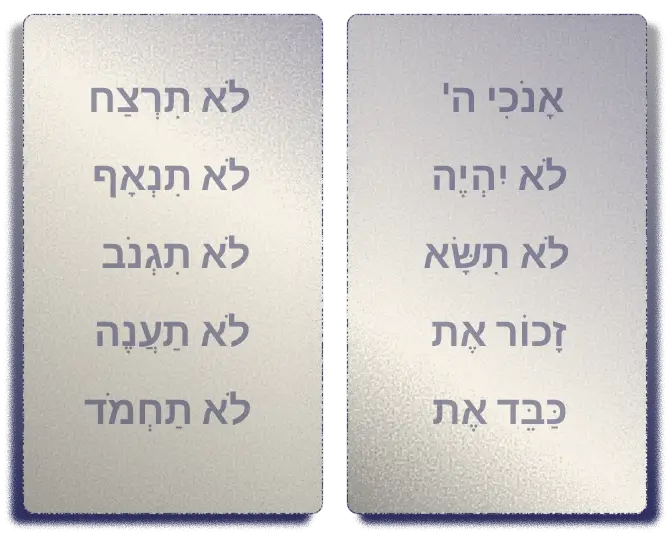
Explore the 613 mitzvos and uncover the meaning behind each one. Discover practical ways to integrate them into your daily life with insights, sources, and guided reflection.

Learn the structure, depth, and spiritual intent behind Jewish prayer. Dive into morning blessings, Shema, Amidah, and more—with tools to enrich your daily connection.
Each week’s parsha offers timeless wisdom and modern relevance. Explore summaries, key themes, and mitzvah connections to deepen your understanding of the Torah cycle.