Each Parsha page on Mitzvah Minute is designed as a guided, three-level journey through the weekly Torah reading—integrating the narrative, the mitzvos, and the classical commentaries into one unified experience.
Begin with the foundations of the Parsha:
This level gives you the storyline, the key mitzvos, and the essential connections between them.
A complete journey through the parsha—moving from clarity and depth to inner connection and real-world meaning, culminating in a way to live its ideas in everyday life.
These sections show how the Parsha speaks to the mind, the heart, and the real world — offering wisdom rooted in enduring Torah.
A complete, structured commentary on the parsha—presented pasuk by pasuk, with chapter and overall summaries for clarity and flow.
This level reveals the structural depth of the Parsha and the classical underpinnings of each theme.
Together, these layers create a complete Parsha journey —
narrative, mitzvah, and commentary — all flowing toward deeper understanding, spiritual insight, and meaningful growth.
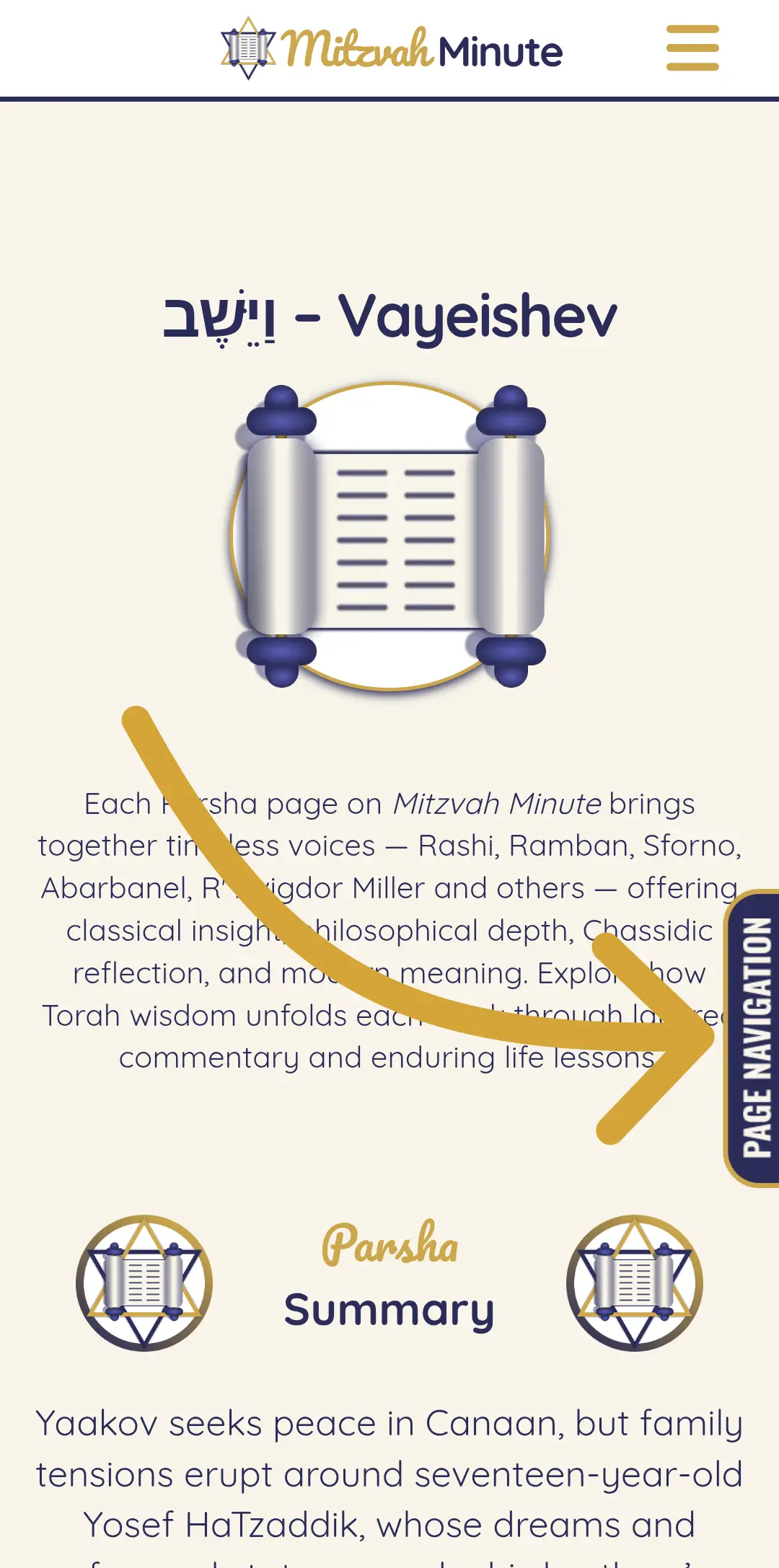
Tap the Page Navigation tab on the right side of your screen anytime to access quick-links to the entire Parsha page.
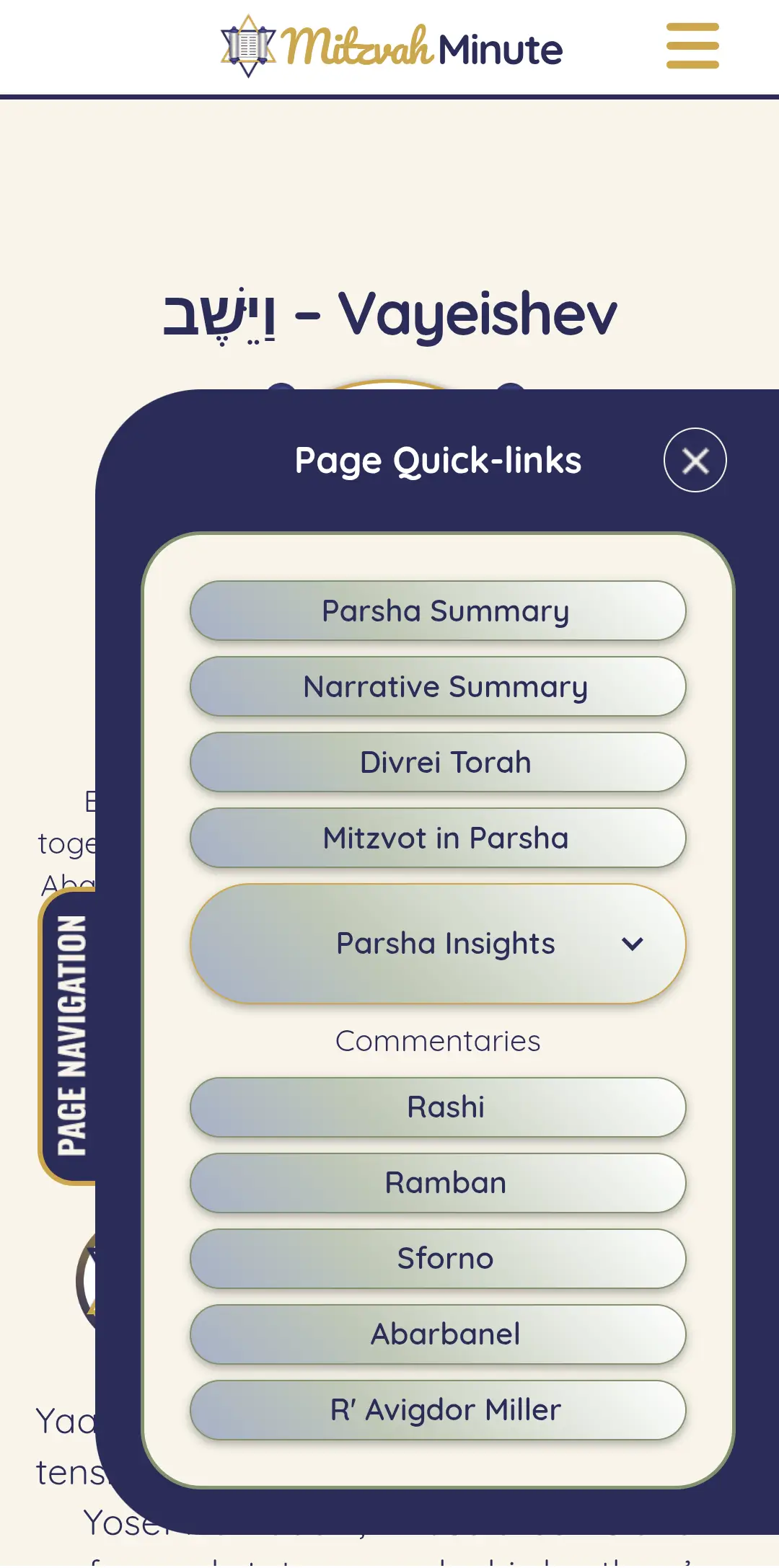
The quick-link panel gives instant access to every section — Parsha Summary, Mitzvos, Divrei Torah, Insights, and Commentaries.
“Every word of Torah and every mitzvah lifts us higher — may your learning bring you closer to Hashem.”

Parshas Acharei Mos unfolds from tragedy into structure, transforming the loss of Nadav and Avihu into a blueprint for holiness. It centers on the avodah of Yom HaKippurim, where the Kohen Gadol enters the Kodesh HaKodashim through precise preparation to achieve kaparah for himself, the Mikdash, and all of Klal Yisrael. From there, the parsha expands outward, establishing that holiness is not confined to sacred space but must govern everyday life—redirecting korbanos to Hashem alone, prohibiting the consumption of blood as the bearer of life, and demanding moral separation from the corrupt practices of Egypt and Canaan. It culminates in the laws of arayos, teaching that the sanctity of the nation depends on boundaries in the most intimate realms, and warning that the land itself responds to moral failure. Acharei Mos thus presents a unified vision: true closeness to Hashem requires disciplined approach, moral structure, and a life ordered by kedushah in every dimension.

"Living Before Hashem — Kedushah Through Atonement, Boundaries, and Moral Clarity"
אֶת־ה׳ אֱלֹקֶיךָ תִּירָא
Acharei Mos opens in the shadow of Nadav and Avihu, where closeness to Hashem without proper awe leads to destruction. Yirah — reverence is not fear in the sense of distance, but awareness of standing before a reality greater than oneself. The restriction placed on Aharon — that he may not enter the Kodesh HaKodashim at all times — teaches that access to holiness is governed by גבול — boundary, and that true closeness is achieved through restraint, preparation, and humility. The parsha reveals that fear of Hashem is not a limitation on spiritual life; it is what makes authentic closeness possible. Without yirah, even devotion becomes dangerous.
וְנִקְדַּשְׁתִּי בְּתוֹךְ בְּנֵי יִשְׂרָאֵל
Acharei Mos moves from the inner chamber of the Mikdash to the structure of daily life, teaching that sanctification of Hashem’s Name is not confined to sacred space. Kiddush Hashem occurs when a life reflects Divine order, moral clarity, and disciplined holiness. The parsha’s insistence that Klal Yisrael not imitate the practices of Egypt and Canaan frames sanctification as distinction — living in a way that visibly expresses a higher allegiance. To sanctify His Name is to carry the holiness of the Kodesh HaKodashim outward, allowing one’s actions, relationships, and choices to become a reflection of Hashem’s presence in the world.
וְלֹא תְחַלְּלוּ אֶת־שֵׁם קׇדְשִׁי
If Kiddush Hashem is the elevation of life, Chilul Hashem is its distortion. Acharei Mos teaches that corruption is not neutral; it reshapes how the Divine is perceived in the world. When moral boundaries collapse — particularly in the realm of arayos — the result is not only personal failure but desecration of holiness itself. The parsha’s warning that the land “vomits out” those who defile it reveals that Chilul Hashem has consequences beyond the individual. It destabilizes the moral environment of an entire society. This mitzvah frames behavior as representation: how one lives becomes a statement about what holiness is.
וְהָלַכְתָּ בִּדְרָכָיו
Acharei Mos presents holiness not only as separation from impurity, but as alignment with Divine order. To walk in Hashem’s ways means that a person’s life reflects the structure, discipline, and moral clarity that the Torah reveals. Just as the avodah of Yom Kippur follows an exact sequence, so too human life must be shaped, not improvised. Emulating His ways is therefore not abstract imitation, but structured living — where actions, relationships, and decisions are guided by תורה rather than impulse. The parsha teaches that kedushah is not achieved only by avoiding sin, but by becoming a person whose life mirrors Divine intention.
וְלֹא־תָתוּרוּ אַחֲרֵי לְבַבְכֶם וְאַחֲרֵי עֵינֵיכֶם
This mitzvah captures one of the central tensions of Acharei Mos: the conflict between desire and structure. The parsha repeatedly warns against adopting the practices of Egypt and Canaan, societies defined by unrestrained appetite. “Following the heart and the eyes” describes a life governed by attraction, impulse, and immediate perception rather than by truth. Acharei Mos teaches that such a life does not remain contained; it expands into a culture of moral confusion. This mitzvah therefore serves as a foundation for all the parsha’s prohibitions. Holiness begins when a person no longer treats desire as authority, but subjects it to the discipline of Torah.
וְהִתְוַדּוּ אֶת־חַטָּאתָם אֲשֶׁר עָשׂוּ
Acharei Mos places vidui — confession at the heart of kapparah. The avodah of Yom HaKippurim is not presented as ritual motion alone, but as a return of the human being to truth through naming sin before Hashem. The parsha shows that wrongdoing is not healed by silence, denial, or vague regret. It is healed when a person stands honestly before Hashem and brings his failure into speech. In that way, confession becomes more than response to sin; it becomes the beginning of restored closeness. The parsha teaches that teshuvah is not merely the removal of guilt, but the reordering of the self before Hashem.
וַעֲבַדְתֶּם אֵת ה׳ אֱלֹקֵיכֶם
In Acharei Mos, the avodah of the Kohen Gadol on Yom Kippur represents the highest form of service — precise, intentional, and directed entirely toward Hashem. After the Mikdash, that structure of service finds expression in tefillah — prayer, the avodah שבלב — service of the heart. This mitzvah carries the inner logic of the parsha forward: that closeness to Hashem is not accidental, but cultivated through consistent, structured turning toward Him. Just as the Kohen Gadol enters the Kodesh HaKodashim with preparation and awareness, so too a person enters tefillah as a moment of encounter. The parsha teaches that avodah is not limited to sacred times and places; it becomes the daily rhythm through which a person lives before Hashem.
שַׁבַּת שַׁבָּתוֹן הוּא לָכֶם
The stillness of Yom Kippur is part of its message. Acharei Mos presents the day as one in which ordinary human activity yields to sacred presence, and that cessation is not empty passivity but spiritual readiness. The suspension of melachah — prohibited labor creates the conditions for inward return, humility, and awe. The parsha teaches that a person cannot enter a day of kapparah while remaining fully absorbed in mastery, productivity, and control. Rest here is itself avodah. It makes space for the soul to stand לפני ה׳ — before Hashem and be purified.
כָּל־מְלָאכָה לֹא תַעֲשׂוּ
This mitzvah deepens the same truth from the side of restraint. Acharei Mos teaches that not every sacred moment is entered through action; some are entered through refusal. The prohibition of melachah marks Yom Kippur as a day that resists the normal human urge to shape the world outwardly. Instead, it redirects a person inward, toward self-examination, confession, and purification. The holiness of the day depends not only on what is performed in the Mikdash, but on what Klal Yisrael refrains from doing. The refusal of labor becomes a declaration that this day belongs to a higher order of life.
וְעִנִּיתֶם אֶת־נַפְשֹׁתֵיכֶם
Acharei Mos frames עינוי — self-affliction not as punishment, but as alignment. The day asks the human being to loosen the grip of the physical in order to recover moral and spiritual clarity. In the broader movement of the parsha, this mitzvah belongs to the discipline of appearing before Hashem: closeness requires humility, and humility requires that a person not be entirely ruled by appetite and comfort. The affliction of Yom Kippur becomes part of the parsha’s larger architecture of kedushah — holiness, in which purification demands that the soul, not the body, set the tone of the day.
כָּל־הַנֶּפֶשׁ אֲשֶׁר לֹא־תְעֻנֶּה בְּעֶצֶם הַיּוֹם הַזֶּה
The abstention from eating and drinking on Yom Kippur expresses the same principle in concrete form. Acharei Mos teaches that there are moments when human life must be disengaged from immediate physical gratification in order to recover its deeper truth. This abstention is not contempt for the body; it is the temporary reordering of priorities. The parsha asks the person to live, for one day, in a way that reveals that he is more than appetite. By withholding food and drink, he enters the day with seriousness, dependence, and longing for purification rather than satisfaction.
וְאֶת־זָכָר לֹא תִשְׁכַּב מִשְׁכְּבֵי אִשָּׁה
Within Acharei Mos, this mitzvah is part of the broader warning not to imitate the corruptive sexual norms of the surrounding nations. The parsha frames these prohibitions as moral boundaries that preserve the created order of human life and prevent the collapse of a holy society into appetite-driven confusion. Its concern is not merely private conduct, but the shaping of a nation whose covenantal life is governed by Divine structure rather than cultural drift. In this sense, the mitzvah belongs to the parsha’s larger message: Kedushah survives only where boundaries are not surrendered to desire.
אִישׁ אִישׁ אֶל־כָּל־שְׁאֵר בְּשָׂרוֹ לֹא תִקְרְבוּ לְגַלּוֹת עֶרְוָה
This mitzvah captures one of Acharei Mos’s deepest insights: collapse begins before the act itself. The Torah therefore legislates not only the final transgression, but the approach that leads toward it. In the logic of the parsha, protective distance is not secondary stringency; it is part of holiness itself. A society falls into abomination gradually, by normalizing proximity, indulging ambiguity, and erasing fences. This mitzvah stands as one of the parsha’s clearest expressions of משמרת — protective guarding. It teaches that Torah preserves holiness not only by forbidding the end, but by sanctifying the path that leads away from it.
כָּל־דָּם לֹא תֹאכֵלוּ
In Acharei Mos, blood is not treated as ordinary substance but as bearer of life. The parsha repeatedly frames blood as belonging on the Mizbeach — altar, where it functions within the system of kapparah, not as something for human consumption. This mitzvah therefore teaches reverence for life itself. To consume blood would be to collapse the distinction between what belongs to sacred service and what belongs to appetite. The parsha uses this law to extend the holiness of the Mikdash outward into eating itself, showing that even food must be governed by awareness that life belongs to Hashem.
וְזָבַחְתָּ מִבְּקָרְךָ וּמִצֹּאנְךָ
Acharei Mos expands the inner logic of the Mikdash into the national life of eating and slaughter. The prohibitions of improper slaughter and blood teach that human nourishment may not be detached from reverence, order, and restraint. Even where an animal is being prepared for consumption, the act must reflect that life is not ownerless and eating is not morally neutral. This mitzvah fits the parsha’s broader movement from sacred service to daily conduct: closeness to Hashem is sustained when even physical life is brought under halachic form.

Rashi understands the opening of the parsha not as background, but as the defining framework for everything that follows. The reference to the death of Nadav and Avihu transforms the command into a living warning: approaching Hashem improperly leads to death. Through the mashal of Rabbi Elazar ben Azaryah, Rashi teaches that a warning anchored in real consequence carries deeper force.
The result is that the entire avodah of Yom HaKippurim is read through this lens of awe and restraint. Entry into the Kodesh HaKodashim — Holy of Holies is not simply restricted; it is existentially dangerous if done incorrectly. Holiness is not casual proximity, but carefully governed closeness.
Rashi emphasizes that “ואל יבא בכל עת” is not merely about frequency, but about manner. The prohibition includes entering in any way that resembles the fatal error of Nadav and Avihu. The consequence—“ולא ימות”—is literal.
At the same time, Rashi explains that access is not denied entirely, but structured. The phrase “כי בענן אראה” teaches two complementary ideas:
Holiness, in Rashi’s reading, is not inaccessible—it is accessible only through exact obedience.
Throughout the Yom HaKippurim service, Rashi consistently reads each phrase as halachically exact. Nothing is descriptive alone; everything is directive.
The avodah becomes a tightly structured system:
Rashi is teaching that kapparah — atonement is not achieved through general intent, but through exact performance. The system itself produces purification when followed without deviation.
Rashi repeatedly highlights that kapparah is inseparable from vidui — verbal confession. The bull atones for Aharon and his household through confession, and the se’ir la’azazel — scapegoat becomes the bearer of כלל ישראל’s sins only after confession is placed upon it.
This establishes a critical principle: korbanos — offerings alone do not achieve atonement. The human act of acknowledging sin is essential. The avodah is therefore not mechanical; it is relational, requiring conscious admission before Hashem.
Rashi presents the lottery of the two goats as a concrete, decisive act, not a symbolic gesture. The גורלות — lots determine identity, and the verbal declaration completes it.
Each goat serves a distinct role:
Rashi clarifies that “יעמד חי” teaches that the goat must remain alive until its dispatch, but that its ultimate fate is death. The process is deliberate and defined, transforming sin into something removed and destroyed.
Rashi carefully defines the legal boundaries of atonement. The bull atones for Aharon and the kohanim, while the goat atones for the people, but both address a specific category: טומאת מקדש וקדשיו — defilement of the Sanctuary and its sacred elements.
At the same time, the Torah expands:
Rashi thus shows that the avodah covers both hidden and willful failure, but within clearly defined halachic categories.
One of Rashi’s most profound insights appears in “השכן אתם בתוך טמאתם.” Even when ישראל are טמאים — impure, the Shechinah still dwells among them.
This creates a dual reality:
Holiness is therefore not fragile withdrawal, but enduring presence that calls for repair.
Rashi explains that the Kohen Gadol does not enter lifnai v’lifnim — the innermost sanctuary in golden garments, because gold recalls the eigel — Golden Calf. The principle of אין קטיגור נעשה סניגור — the accuser cannot become the defender governs the avodah.
Instead, he serves in simple linen garments, like a Kohen hedyot — ordinary priest. This reflects a deeper idea: at the moment of atonement, the Kohen Gadol stands not in grandeur, but in humility and purity.
Rashi notes that not all pesukim follow chronological order. The verse describing Aharon re-entering the Ohel Mo’ed is out of sequence, and the actual סדר העבודה — order of service must be reconstructed.
This teaches that Torah is not always presenting events in linear order, and that halachic truth depends on careful reading and tradition. The avodah itself is fixed and exact, even if the textual presentation requires interpretation.
In Chapter 17, Rashi shifts from the inner avodah to the broader החיים — life of the nation. The same precision now governs korbanos in general:
Rashi reads these laws as a continuation of the same theme: holiness requires structure and boundaries, not spontaneity.
Rashi explains that “לשעירים” refers to shedim — demonic forces. The Torah prohibits directing sacrificial service toward such entities, identifying it as a form of deviation from proper avodah.
This reinforces that not all spiritual expression is valid. True avodah must align with the system defined by Hashem, not with human impulse or external influence.
Rashi concludes the parsha by praising Aharon: “ויעש כאשר צוה” — he performed the avodah exactly as commanded, without self-glorification.
This becomes the unifying thread of Rashi’s approach. Whether in the Kodesh HaKodashim or in the structure of daily life, holiness is preserved through precision, restraint, and obedience. The מערכת — system itself is the כלי — vessel through which closeness to Hashem becomes possible.
The movement from the innermost sanctuary to the laws governing the nation is therefore seamless. In both realms, the same principle holds: true closeness is achieved not by intensity alone, but by disciplined alignment with the will of Hashem.
📖 Source
Ramban understands the opening reference to the death of Nadav and Avihu as essential to the entire structure of the parsha. Their death was not merely a punishment, but a revelation of a fundamental principle: closeness to Hashem without proper command and preparation is inherently dangerous.
Ramban emphasizes that the Mishkan — Sanctuary is a מקום השכינה — dwelling place of the Divine Presence, and therefore it operates under different rules than ordinary space. Nadav and Avihu entered with spiritual desire, yet without commanded structure, and were consumed. The warning to Aharon is therefore not symbolic—it establishes that entry into the Kodesh HaKodashim requires exact alignment with Divine will. Holiness is not defined by intensity of intention, but by obedience to commanded form.
Ramban reads the phrase “כי בענן אראה על הכפרת” as describing the nature of Divine revelation itself. The Shechinah does not appear in open clarity, but within a ענן — cloud, which both reveals and conceals.
This becomes halachically significant. The Kohen Gadol must generate a parallel cloud through the ketores — incense. This is not merely a ritual detail; it recreates the condition under which Divine presence can be encountered. Without this cloud, entry would be exposure to unmediated קדושה — holiness, which is destructive.
Ramban thus frames the ketores as a protective medium. The cloud is not incidental—it is the mechanism that makes encounter possible.
Ramban consistently emphasizes that the avodah of Yom HaKippurim is directed primarily toward the Mikdash itself. The repeated phrase “מטמאת בני ישראל” is not about personal sin alone, but about the impact of sin on the Sanctuary.
Sin creates טומאה — impurity that accumulates within the sacred space. The avodah functions as a purification system, restoring the Mikdash to a state fit for the Shechinah. This explains the layered סדר העבודה — order of service:
Ramban’s key insight is that kapparah is spatial before it is personal. The מקום — place of Divine presence must be cleansed in order for the relationship to be restored.
Ramban develops a profound understanding of the two goats. They are not separate rituals, but a single מערכת — system divided into two expressions. Both originate from the same source and are selected together, emphasizing their conceptual unity.
Yet their functions diverge sharply:
Ramban explains that Azazel is not an independent power, but a symbolic destination representing removal and desolation. The sending of the goat expresses the idea that sin must be both atoned for internally and removed externally.
The system therefore addresses sin in two dimensions: purification within and elimination without.
Ramban deepens the role of vidui — confession beyond verbal admission. When Aharon confesses over the se’ir לעזאזל, the act is described as placing the sins upon the goat—“ונתן אותם על ראש השעיר.”
This is not metaphor alone. Ramban understands vidui as a halachic act of transfer, where the burden of sin is symbolically relocated. The goat becomes the carrier of the nation’s failures, and its dispatch represents their removal from the community.
This transforms vidui into an active process within the avodah, not merely a prerequisite. Speech becomes the mechanism that moves sin from האדם — the person to the ritual system.
Ramban explains that the Kohen Gadol enters lifnai v’lifnim — the innermost chamber wearing בגדי לבן — white garments, rather than his usual golden vestments.
This reflects more than humility. Ramban connects the white garments to a state of simplicity and purity, free from the associations of wealth and sin. Gold recalls the חטא העגל — sin of the Golden Calf, while white represents a return to an unadorned state before corruption.
The avodah of Yom HaKippurim is therefore not only about atonement, but about returning to an earlier, purer condition.
Ramban highlights the remarkable idea that the Shechinah remains among Bnei Yisrael even in a state of טומאה — impurity. This does not minimize the severity of sin; rather, it reveals the persistence of the relationship.
The need for kapparah emerges precisely because Hashem continues to dwell among them. The impurity does not cause abandonment—it creates tension that must be resolved.
This insight reframes the entire avodah: it is not restoring a broken connection, but repairing a strained one.
In Chapter 17, Ramban explains that the prohibition of slaughtering korbanos outside the Mikdash—שחוטי חוץ — is rooted in the need to unify avodah.
Before this command, offerings could be brought in multiple locations. Now, all sacrificial service must be centralized. Ramban explains that this prevents:
The Mikdash becomes the exclusive מקום עבודה — place of service, ensuring that all connection to Hashem flows through a single, defined system.
Ramban gives special attention to the prohibition of consuming blood—דם. He explains that “כי הדם הוא הנפש” teaches that blood represents the life-force itself.
Because life belongs to Hashem, blood is reserved for the Mizbeach — altar, where it serves as the medium of kapparah. Eating blood would be a misuse of that life-force, diverting it from its sacred purpose.
This connects dietary law to the broader theme of the parsha: life, holiness, and atonement are all governed by Divine structure.
In Chapter 18, Ramban turns to the laws of עריות — forbidden relationships, and explains them not only as individual prohibitions, but as the moral foundation of the land itself.
The land of Eretz Yisrael is described as reacting to these violations—“ותקיא הארץ את יושביה.” Ramban explains that the land is uniquely sensitive to moral corruption, particularly in the realm of sexuality, which distorts the יסוד החיים — foundation of life.
These prohibitions are therefore not arbitrary. They preserve the integrity of both the individual and the collective environment. Violating them leads to expulsion, as the land cannot sustain such distortion.
Across the parsha, Ramban reveals a consistent principle: קדושה — holiness is not achieved through unbounded spiritual expression, but through structure, boundaries, and precise alignment with Hashem’s will.
From the avodah of Yom HaKippurim to the prohibitions of שחוטי חוץ and עריות, every command defines a boundary that protects the relationship between Hashem and Yisrael.
The tragedy of Nadav and Avihu, the purification of the Mikdash, the sending of the se’ir לעזאזל, and the moral laws governing the nation all converge into a single system. Holiness is sustained not by intensity alone, but by disciplined adherence to the Divine order.
📖 Source
Parshas Acharei Mos opens with the death of Nadav and Avihu and immediately establishes a system of restricted access: “בְּזֹאת יָבֹא אַהֲרֹן אֶל הַקֹּדֶשׁ” — “With this shall Aharon come into the Sanctuary” (ויקרא ט״ז:ג). Rambam’s framework, especially in Moreh Nevuchim and Mishneh Torah, sees such structures not as limitations, but as essential conditions for אמת — truth and human perfection.
Rambam explains that האדם — the human being — cannot approach the Divine in an unregulated, emotional state. Holiness requires סדר — order, גבול — boundary, and הדרגה — progression. The Kohen Gadol’s entry into the קודש הקדשים — Holy of Holies — only on Yom Kippur, and only through precise avodah, reflects a broader philosophical principle: closeness to Hashem is achieved not through intensity alone, but through disciplined alignment with law.
This aligns with Rambam’s teaching in Hilchos De’os that the דרך האמצעית — the balanced path — is the foundation of character. Just as personality must be structured and balanced, so too spiritual experience must be contained within halachic form. The tragedy of Nadav and Avihu becomes, in Rambam’s lens, not merely a punishment, but a warning against unstructured religious passion.
The central avodah of Yom Kippur in the parsha revolves around כפרה — atonement. Rambam, in Hilchos Teshuvah, defines teshuvah not as ritual appeasement, but as a profound internal process: עזיבת החטא — abandoning sin, חרטה — regret, and קבלה לעתיד — commitment to change.
Within this framework, the korbanos — offerings — of Yom Kippur are not magical mechanisms, but symbolic acts that guide the האדם toward recognition and transformation. In Moreh Nevuchim (III:32), Rambam explains that the Torah employs physical actions as educational tools, gradually shaping human consciousness.
The שעיר המשתלח — the scapegoat — represents this principle with particular clarity. It is not that sins are physically transferred, but that the האדם is led to confront the weight of wrongdoing and its removal from his life. The ציבור — community — collectively participates in a structured acknowledgment of moral failure and renewal.
Thus, kapparah is not merely forgiveness; it is a recalibration of the human mind and will toward truth.
Parshas Acharei Mos transitions from the עבודת יום הכיפורים — Yom Kippur service — to the prohibitions of עריות — forbidden relationships (ויקרא י״ח). Rambam, both in Moreh Nevuchim (III:49) and in Mishneh Torah (Hilchos Issurei Bi’ah), treats these laws as foundational to societal stability and human dignity.
Rambam rejects the notion that these prohibitions are arbitrary. Rather, they form a system that protects the integrity of family structure, prevents exploitation, and cultivates קדושה — holiness — within human relationships. The Torah’s repeated warning not to follow the practices of מצרים — Egypt — and כנען — Canaan — reflects Rambam’s view that moral corruption in these areas leads to the collapse of entire civilizations.
From a philosophical standpoint, Rambam sees unrestrained desire as one of the primary forces that distort human judgment. The regulation of sexuality is therefore not repression, but refinement — a necessary step in achieving שלמות הנפש — perfection of the soul.
The האדם becomes capable of higher intellectual and spiritual pursuits only when his physical drives are governed by law and purpose.
The command “כְּמַעֲשֵׂה אֶרֶץ מִצְרַיִם… לֹא תַעֲשׂוּ” — “Like the practices of Egypt… you shall not do” (ויקרא י״ח:ג) expresses a central Rambam principle: Torah is a system designed to shape an entirely different type of human being.
In Rambam’s worldview, mitzvos are not isolated commands, but parts of an integrated system aimed at building a האדם השלם — the perfected human. This includes:
Parshas Acharei Mos reflects all three dimensions. The עבודת יום הכיפורים refines awareness of Hashem; the laws of עריות refine personal behavior; and the rejection of foreign practices establishes a distinct moral society.
Rambam emphasizes that the Torah’s system is cumulative. Each mitzvah contributes to a larger structure that guides the האדם from instinct-driven existence toward conscious, purposeful living.
A recurring theme in the parsha is the constant awareness of standing לפני ה׳ — before Hashem. Rambam, in Hilchos Yesodei HaTorah (2:2), describes אהבה ויראה — love and awe — as emerging from contemplation of Hashem’s wisdom and creation.
The Kohen Gadol’s entry into the Kodesh HaKodashim embodies יראה — awe — in its highest form. It is not fear in the emotional sense, but a deep recognition of reality: the האדם stands before an infinite and perfect Creator.
This awareness is meant to extend beyond the Mikdash into everyday life. The prohibitions and structures of the parsha train the individual to live with constant consciousness of Hashem’s presence.
In Rambam’s system, this awareness is the foundation of all ethical and religious life. Without it, mitzvos become mechanical; with it, they become pathways to genuine human elevation.
Parshas Acharei Mos, through Rambam’s lens, presents a unified vision: human perfection emerges through disciplined structure, moral restraint, and conscious awareness.
The restrictions of the Mikdash, the processes of kapparah, and the prohibitions of עריות are not limitations imposed on the האדם. They are the very tools through which the האדם is refined.
Rambam teaches that true freedom is not the absence of constraint, but the alignment of the self with truth. The Torah’s system, as reflected in this parsha, guides the האדם toward that alignment — transforming life from instinct and impulse into purpose and clarity.
This is the movement from chaos to סדר, from desire to קדושה, and ultimately, from האדם as he is, to האדם as he is meant to become.
📖 Sources
Ralbag opens by presenting the עבודת יום הכיפורים — Yom Kippur service — not merely as ritual, but as a symbolic system that reflects the structure of human cognition. The Mishkan — Tabernacle — and its כלי קודש — sacred vessels — correspond to levels of the שכל — intellect.
The מזבח הקטורת — incense altar — represents the שכל ההיולאני — the potential intellect, which develops through engagement with the sensory world. The קטורת — incense — signifies the process by which the mind extracts intelligible truth from physical experience, refining perception into understanding. The מנורה — menorah — represents the transition from potential to actual intellect, illuminating the הדרך — path — through which the mind comes to clarity.
At the highest level, the קודש הקדשים — Holy of Holies — and its כרובים — cherubim — correspond to the שכל הנקנה — acquired intellect, and its connection to the שכל הפועל — active intellect. This is the state of intellectual perfection, where knowledge is no longer potential but fully realized.
Thus, the avodah of the Kohen Gadol is not only a service in the Mikdash, but a structured representation of the האדם — human being — ascending from perception to true knowledge.
Ralbag explains that the necessity of כפרה — atonement — is rooted in human psychology. If a person were to believe that his sins could never be forgiven, even after תשובה — repentance — he would fall into יאוש — despair. This despair would lead him to abandon all effort toward תיקון — self-improvement.
For this reason, the Torah establishes a system in which even severe sins can be forgiven when accompanied by שברון הלב — a broken heart, צום — fasting, and תשובה. Yom Kippur becomes the moment in which the האדם regains hope and reorients his life toward טוב — good.
Ralbag emphasizes that this is not only a theological idea, but a necessary condition for moral development. Without the possibility of forgiveness, the human being would lose the motivation to pursue perfection. Therefore, כפרה is not only justice—it is also a system of sustaining human growth.
A striking feature of the avodah is the deliberate use of actions that carry elements of גנאי — degradation. The שעיר המשתלח — scapegoat — is sent to a desolate place and destroyed in a manner devoid of benefit. The פר and שעיר — bull and goat — of certain offerings are burned outside the מחנות — camps, in a diminished state.
Ralbag explains that this serves a powerful philosophical purpose. Sin distances the האדם from Hashem and diminishes his true worth. The degraded treatment of these korbanos reflects the state of the sinner who clings to his wrongdoing.
This symbolism communicates a clear message: a life attached to sin becomes devoid of תועלת — purpose. The האדם is meant to internalize this and be moved toward humility and change. The ritual thus becomes an educational experience, shaping both thought and emotion.
The גורל — lottery — used to determine the roles of the two goats teaches a critical philosophical lesson. Since the two שעירים — goats — are identical, their differing roles are assigned through a process that appears random but is understood as directed by Hashem: “בחיק יוטל את הגורל ומה׳ כל משפטו”.
Ralbag explains that this reinforces the idea that outcomes are ultimately governed by Divine order, even when they appear contingent. By assigning one goat to כפרה על הטומאה — atonement for impurity — and the other to כפרה על כלל העוונות — atonement for all sins, the Torah embeds in the human mind that distinction and judgment come from Hashem.
This deepens the אדם’s awareness that moral reality is not arbitrary, but structured and purposeful.
The repeated טבילות — immersions — of the Kohen Gadol, along with his changes of בגדים — garments — reflect the demand for constant purification. Ralbag explains that these actions symbolize the need to separate from טומאת החומר — the impurity of physicality — and from מרי — rebellion against truth.
The distinction between בגדי לבן — white garments — and בגדי זהב — gold garments — further expresses this idea. The white garments are used for the most elevated parts of the avodah, indicating a stripping away of external honor in favor of pure intellectual and moral clarity.
This reflects Ralbag’s broader view: true greatness lies not in external status, but in internal refinement and alignment with the שכל — intellect.
Ralbag interprets the סדר העבודה — order of the service — as a reflection of the internal order required within the האדם. The sprinkling of blood — הזאות — in specific numbers and locations represents the need to align one’s מחשבות — thoughts, תשוקות — desires, and פעולות — actions.
The distinction between the כהנים — priests — and the עם — people — also reflects different levels of intellectual and moral development. The כהנים, who are more engaged in תורה and understanding, require a different form of כפרה than the general ציבור, whose errors are more frequent and more deeply rooted in material life.
The blending of blood from the פר and שעיר on the מזבח — altar — teaches that while people differ in level, all must ultimately purify the same fundamental human faculties.
Ralbag explains that the prohibition against offering korbanos outside the Mikdash serves a crucial philosophical function: preserving אמונת הייחוד — belief in the oneness of Hashem.
If individuals were permitted to offer sacrifices in multiple locations, even in the name of Hashem, this could lead to fragmentation of belief and ultimately to עבודה זרה — idolatry. By restricting avodah to one מקום — place, and one system, the Torah reinforces the unity and exclusivity of Divine service.
This also explains the proximity of this command to the warnings against idolatrous practices and the offering of sacrifices to שדים — demonic forces. The Torah seeks to uproot any possibility of divided allegiance.
The extensive list of עריות — forbidden relationships — is presented by Ralbag as a structured system aimed at preserving both individual integrity and societal order.
He explains that many of these prohibitions prevent relationships that would undermine the natural purposes of human interaction, particularly the proper use of the כוח ההולדה — procreative faculty. Others prevent confusion of lineage, breakdown of family structure, and social instability.
Ralbag also notes the graded structure of these prohibitions, beginning with the most foundational relationships (parents and siblings) and extending outward. This progression reflects both natural intuition and philosophical reasoning about closeness and distance.
At a deeper level, these laws restrain the האדם from being governed by unchecked desire, which distorts judgment and prevents intellectual and moral perfection.
The timing and structure of Yom Kippur itself carry philosophical meaning. It occurs once a year, emphasizing that complete intellectual and moral alignment is rare and requires focused effort.
The afflictions of the day — עינוי הנפש — weaken the body and allow the שכל — intellect — to become more dominant. Ralbag notes that intellectual perfection is often more attainable when the כוח הגוף — physical power — is diminished, such as in times of restraint or aging.
The date itself, the tenth of the seventh month, alludes to deeper metaphysical structures, including the hierarchy of intellects. The entire day is designed to orient the האדם toward his highest purpose: alignment with truth and the pursuit of perfection.
Ralbag concludes that the entire system of Acharei Mos is internally coherent and philosophically precise. Every פרט — detail — of the avodah, every prohibition, and every structure points toward a unified goal: the perfection of the האדם through knowledge, discipline, and moral refinement.
This is a hallmark of אמת — truth — in Ralbag’s framework: that a system, when examined מכל צד — from every angle — reinforces its own purpose and reveals a consistent underlying wisdom.
Parshas Acharei Mos, in this light, is not only a set of laws, but a complete philosophical system guiding the האדם from חומר — material existence — to שכל — intellectual and spiritual perfection.
📖 Source
(Baal Shem Tov · Kedushas Levi · Sfas Emes)
The parsha opens “אַחֲרֵי מוֹת שְׁנֵי בְנֵי אַהֲרֹן” — “after the death of the two sons of Aharon,” and Chassidus reveals that this was not merely a tragedy, but a disclosure of a profound spiritual principle. The Baal Shem Tov, based on the Zohar, teaches that Nadav and Avihu were not ordinary individuals—they were “two halves of one body,” corresponding to נצח והוד (endurance and splendor), the inner pillars of אמונה ודבקות (faith and attachment to Hashem). Their failure was not lack of holiness, but a misalignment within holiness itself.
The Kedushas Levi deepens this further: the world is structured through צמצום (divine contraction), a system of boundaries through which the light of Hashem flows in measured channels—from Moshe to Aharon, from Aharon to his sons, and onward through generations. Nadav and Avihu sought to leap beyond their מקום (assigned spiritual place), attempting to draw close to Hashem directly, without receiving through the established channels. This was not rebellion—it was a yearning too intense for structure. But in a world built on ordered flow, unbounded ascent leads not to union, but to dissolution.
Holiness, then, is not only passion—it is alignment. The deepest closeness to Hashem comes not from breaking the system, but from inhabiting one’s מקום with total sincerity.
“בְּזֹאת יָבֹא אַהֲרֹן אֶל הַקֹּדֶשׁ” — “With this shall Aharon enter the Sanctuary.” Chassidus reads this not only as instruction, but as a spiritual method. The Baal Shem Tov teaches that to elevate a lower מדרגה (level), one must first descend into it. Like a minister who removes his royal garments to retrieve a lost prince, a person must sometimes leave the purity of his inner state to connect with what is external, broken, or distant.
This applies both outwardly and inwardly. To uplift others, one must enter their world. To refine oneself, one must confront the parts that feel distant from holiness. True elevation is not escape—it is transformation.
The entire purpose of Torah, mitzvos, and even physical life is לברר ניצוצות (to refine sparks of holiness) hidden within the material world. This requires engagement, not withdrawal. The one who never descends cannot truly elevate.
“הַשֹּׁכֵן אִתָּם בְּתוֹךְ טֻמְאֹתָם” — Hashem dwells with them even in their impurity. The Baal Shem Tov reveals a striking contrast: all forms of טומאה (impurity) still allow for Divine presence—but גאווה (arrogance) does not. On arrogance it is said, “אין אני והוא יכולין לדור בעולם” — “He and I cannot dwell together.”
A person who sins but remains humble is still connected; his brokenness leaves space for Hashem. But one who is full of himself leaves no space at all.
This insight reshapes the entire spiritual hierarchy. The Baal Shem Tov would draw close even those who had fallen into sin—if they were humble—while distancing those who were externally righteous but internally inflated. Because humility is not a virtue among others; it is the condition that makes all connection possible.
Hashem does not demand perfection. He asks for openness.
A mitzvah performed “מצות אנשים מלומדה” — mechanically, out of habit — is described as dry. The Baal Shem Tov insists that every mitzvah must be done בלב וברעותא (with heart and inner will). The act alone is not enough; it must be filled with presence. When the action is detached from the heart, it loses its vitality. But when it is performed with inward desire, it becomes alive.
The Sfas Emes sharpens this further. The essence of a mitzvah is not its reason, nor even its benefit, but the acceptance of עול מלכות שמים (the yoke of Heaven). One must act not because the mitzvah makes sense, nor because it brings reward, but because it is the will of Hashem. Even spiritual pleasure in serving Hashem, though real and immense, can subtly become self-serving if it becomes the goal.
True עבודה (service) is לשמה — for its own sake—not for reward, not even for spiritual experience. And yet, paradoxically, the Torah reveals a deeper truth about reward itself. “שכר מצוה מצוה” does not merely mean that a mitzvah earns reward—it means that the mitzvah itself becomes the reward. The inner delight, the connection, the life awakened within the act—that is already eternity touching the present.
From here emerges a further principle: “מצוה גוררת מצוה” — one mitzvah draws another. When a mitzvah is done with truth, it does not end when the act ends. It generates momentum. It reshapes the person. It opens the next opportunity, deepens the next פעולה (action), and draws the person forward into a life of continuous connection.
A mitzvah, then, is not an isolated act. It is a living current of connection. When done with presence and sincerity, it becomes self-generating—drawing the person deeper into רצון השם (the will of Hashem), step after step, act after act, until the entire life becomes a unified flow of avodah.
“אֲשֶׁר יַעֲשֶׂה אֹתָם הָאָדָם וָחַי בָּהֶם” — “which a person shall do and live through them.” Chassidus understands this literally: mitzvos are not obligations placed upon life—they are the very source of life.
The Baal Shem Tov teaches that Torah and mitzvos infuse חיות (vitality) into the body and soul. This is why spiritual activity can feel “heavy”—like a body after nourishment—because it carries real substance. In contrast, empty speech carries no life at all.
The Sfas Emes expands this into a total worldview: every aspect of existence contains a hidden point of holiness. Through mitzvos, a person reconnects each action, each limb, each moment back to its source. Without this connection, even life itself resembles death—“רשעים בחייהם נקראים מתים.”
To “live by them” means to draw life from them—to become a conduit through which Divine vitality flows into the world.
The warnings against the behaviors of Mitzrayim and Canaan are not only about avoiding immorality—they are about rejecting a חיים חיצוניים (purely external life). The Sfas Emes explains that every action has פנימיות וחיצוניות (inner and outer dimensions). The nations engage only with the external; Klal Yisrael is called to reveal the inner.
Even the most physical acts—eating, working, relationships—must become vehicles of קדושה (holiness). The Kedushas Levi emphasizes that even marital intimacy must be reframed—not as self-gratification, but as fulfillment of the Divine will. “בכל דרכיך דעהו” — “In all your ways, know Him.”
Holiness is not found by leaving the world, but by transforming how one lives within it.
The Baal Shem Tov describes a demanding inner avodah: to remove all personal agenda from one’s service, to guard against distraction, to maintain constant awareness, to purify oneself regularly, and to avoid עצבות (sadness), instead serving Hashem with שמחה (joy). These are not isolated practices, but a unified path—a “חוט המשולש” (threefold cord) that cannot be easily broken.
This is a life of attentiveness. Every movement matters. Every thought shapes connection.
The Sfas Emes, building on Chazal, teaches that a person stands at the center of three dimensions: עולם (world), שנה (time), and נפש (soul). One’s inner work does not remain private—it elevates the world and redeems time itself.
“If I am not for myself, who will be for me?” — one must take responsibility for one’s own refinement.
“But if I am only for myself, what am I?” — that refinement must extend outward.
“And if not now, when?” — every moment carries irreplaceable potential.
A person is not small. He is the meeting point of all existence.
Acharei Mos ultimately teaches a single unifying truth: holiness is not found in extraordinary moments alone, but in a constant state of readiness. The Sfas Emes describes this as living in anticipation—always prepared to do the will of Hashem. This orientation transforms every moment into an opportunity, every action into avodah.
Even after the fall from the original height at Sinai, the Torah offers a path back—not through escape, but through תיקון המעשה (refinement of action). Like a rose among thorns, holiness emerges precisely from engagement with the imperfect world.
The journey of Acharei Mos is not from life to death, but from fragmentation to alignment.
From self to service.
From habit to presence.
From distance to דבקות — living, breathing attachment to Hashem in every aspect of existence.
📖 Sources
Parshas Acharei Mos opens in the shadow of tragedy: the death of Nadav and Avihu, and the sudden restriction placed upon entry into the קֹדֶשׁ הַקֳּדָשִׁים — the Holy of Holies. From the outset, the Torah establishes a tension between closeness and danger, access and limitation. Rabbi Jonathan Sacks explains that this is not only a historical moment, but a framing of one of the deepest questions in religious life: how does a human being come close to G-d without being consumed by that closeness?
The answer the Torah develops is not through spontaneous spiritual experience, but through structure—through the avodah — service of the Kohen Gadol on Yom Kippur, through carefully ordered acts of כפרה — atonement and טהרה — purification. Yet beneath the ritual detail lies something far more transformative. This parsha marks a turning point from a model of holiness centered in a place to a model of holiness rooted in the human being.
Rabbi Sacks highlights that the deeper revolution of Acharei Mos emerges most clearly in its aftermath. When the Beis HaMikdash would one day be destroyed, the system described here could have collapsed entirely. Instead, its inner logic was revealed: what the Kohen Gadol enacted once a year in a sacred space becomes, through teshuvah — return, the lifelong calling of every individual. The movement is from dependency to responsibility, from external ritual to internal transformation.
In this sense, Acharei Mos is not only about Yom Kippur. It is about the possibility of renewal after failure. It teaches that even after rupture—after sin, loss, or distance—the path back remains open. Not through dramatic gestures, but through honesty, reflection, and the willingness to change.
The parsha begins with death, but it unfolds into a vision of life: a life in which the human being, aware of their limitations, is nonetheless invited into relationship with G-d. The מקום קדוש — sacred space is no longer confined to the Mishkan. It begins to take shape within the אדם — the human being himself.
The Democratization of Atonement
At the heart of Parshas Acharei Mos lies a system that, at first glance, seems entirely dependent on place, priesthood, and ritual. The Kohen Gadol enters the קֹדֶשׁ הַקֳּדָשִׁים — the Holy of Holies, performs a סדר עבודה — ordered service, and brings about כפרה — atonement for the entire nation. Everything appears centralized, exclusive, and deeply structured around a single moment in time.
Yet Rabbi Jonathan Sacks reveals that embedded within this system is the seed of one of Judaism’s greatest revolutions.
The Torah describes a process of purification that is both precise and elevated, but its deeper message is not about the ritual itself—it is about what the ritual represents. The Kohen Gadol acts not as a replacement for the people, but as a model of what is possible for them. His entry into the inner sanctum is not meant to remain confined to him. It is meant to teach that closeness to G-d is attainable, but only through a process of humility, honesty, and transformation.
This becomes fully visible only later in Jewish history. When the Beis HaMikdash is destroyed and the entire system of korbanos — sacrifices ceases, the question arises: has the path to atonement been lost?
Rabbi Sacks explains that Judaism’s answer is both bold and unprecedented.
Through the teaching of Rabbi Akiva and Chazal, the focus shifts from ritual to relationship. The essence of Yom Kippur is no longer defined by the actions of the Kohen Gadol alone, but by the inner work of every individual. Teshuvah — return becomes the primary vehicle of כפרה — atonement.
This transformation introduces several foundational shifts:
Instead, it becomes an ongoing capacity within every אדם — human being.
What was once concentrated in the קֹדֶשׁ הַקֳּדָשִׁים — Holy of Holies is now distributed into the inner life of the nation. The sacred center moves from geography to consciousness.
Rabbi Sacks emphasizes that this is not a lowering of religious standards—it is a deepening of them. Ritual can be performed without inner change. Teshuvah cannot. It demands introspection, moral courage, and personal responsibility.
In this way, Acharei Mos introduces a quiet but radical idea: the path to G-d is not reserved for the few. It is open to all.
The Kohen Gadol enters once a year.
The individual is invited every day.
And so the parsha that appears to restrict access ultimately expands it. What begins as a highly structured system of avodah — service becomes the foundation for a lifelong relationship between האדם and G-d—one that no destruction can take away.
The Psychology of Choice
At the center of the Yom Kippur avodah — service stands one of the most striking rituals in the Torah: the שני שעירי עזים — two identical goats. They are chosen together, they look the same, and yet their destinies could not be more different. One is designated לה׳ — for G-d, brought as a korban — offering. The other is sent לעזאזל — to Azazel, cast away into the wilderness.
Rabbi Jonathan Sacks explains that this ritual is not only symbolic—it is diagnostic. It reveals something fundamental about the nature of the human being.
Externally, the goats are indistinguishable. Internally, their paths diverge completely. This mirrors a truth about האדם — the human being: we are not singular. We are composed of competing drives, layered identities, and conflicting impulses.
Drawing on both Chazal and contemporary understanding, Rabbi Sacks frames this as a dual structure within the self:
In the language of Torah, this tension can be understood as Esav and Yaakov within the same person. Esav represents the pull of the present, the כוח — force of instinct and desire. Yaakov represents the capacity for reflection, for choosing purpose over impulse.
This duality is not a flaw—it is the condition of being human.
The ritual of the two goats does not eliminate one side. It confronts it. It forces a moment of clarity: two identical starting points, two radically different endings. The question is not what we are made of, but what we choose to become.
Yom Kippur, then, is not only about forgiveness. It is about decision.
Will a person live a life directed לה׳ — toward meaning, discipline, and connection?
Or will they drift לעזאזל — toward chaos, fragmentation, and loss of control?
Rabbi Sacks emphasizes that the power of this moment lies in its honesty. Judaism does not pretend that human beings are purely rational or purely good. It acknowledges the strength of the yetzer — inner drive, both constructive and destructive. But it insists that within that tension lies freedom.
The two goats are the same—until the moment of designation.
So too, a person may stand at a crossroads again and again throughout life. What defines them is not their nature, but their choice.
Teshuvah — return is the act of choosing Yaakov over Esav. Not once, but repeatedly. It is the ongoing decision to align one’s life with purpose rather than impulse.
In this way, the Yom Kippur ritual becomes a mirror. It reflects back to each individual the most important truth of all: you are not locked into who you have been. You are always one decision away from who you can become.
Turning Moments into a Way of Life
One of the most subtle yet powerful transformations in Parshas Acharei Mos is not found in a single act, but in the shift from a moment to a system. Rabbi Jonathan Sacks highlights that Judaism does not build itself on inspiration alone. It builds on the ability to take a singular, elevated experience and translate it into a repeatable structure that can shape a lifetime.
The first Yom Kippur in Jewish history came in the aftermath of the חטא העגל — the sin of the Golden Calf. It was a moment of crisis, followed by forgiveness. Moshe ascended Har Sinai, interceded on behalf of the people, and returned with the second לוחות — tablets, symbolizing restored relationship. It was dramatic, emotional, and unrepeatable.
But the Torah does not leave that moment as a one-time event.
Instead, it establishes Yom Kippur as an annual avodah — service, performed through a precise סדר — order. What was once spontaneous becomes structured. What was once dependent on the leadership of Moshe becomes institutionalized through Aharon and the Kohen Gadol.
Rabbi Sacks explains that this transition reflects a deep truth about religious life: moments inspire, but systems sustain.
Moshe represents charisma—the ability to elevate a nation in a singular moment.
Aharon represents continuity—the ability to preserve that elevation through consistent practice.
The Torah ensures that both are present, but it anchors the future in structure.
Without structure, even the most powerful experiences fade. A person may feel transformed in a moment of clarity or inspiration, but without a framework to carry that change forward, it dissipates. Judaism answers this challenge through halachah — a lived system of practice that turns values into habits, and habits into identity.
This is why the avodah of Yom Kippur is so detailed. Every step, every movement, every transition is defined. Not to limit spirituality, but to preserve it. Structure does not replace meaning—it protects it.
Rabbi Sacks connects this idea to a broader principle: the greatness of a covenantal society lies in its ability to translate vision into daily life. It is not enough to experience closeness to G-d. That closeness must be sustained through consistent action.
This leads to a delicate balance:
Judaism refuses to choose between them. It binds them together.
The fire of the first Yom Kippur is not lost. It is carried forward—year after year—through the disciplined framework of the avodah.
In this way, Acharei Mos teaches that true transformation is not measured by a single moment of greatness, but by the ability to build a life around it.
Not what a person feels once—but what they live, consistently, every day.
Restoring the Self, Not Just the Act
At the center of the Yom Kippur avodah — service stands one of its most enigmatic elements: the שעיר לעזאזל — the scapegoat. After the Kohen Gadol confesses the sins of the nation, the goat is sent away into the wilderness, carrying with it the weight of collective failure. It is a striking image—sin is not only acknowledged, it is removed, distanced, cast out.
Rabbi Jonathan Sacks explains that this ritual addresses a dimension of human failure that goes beyond wrongdoing itself. It speaks to the difference between חטא — sin as an act, and בושה — shame as a state of being.
A person who experiences guilt understands: “I did something wrong.”
A person overwhelmed by shame feels: “I am something wrong.”
This distinction is critical.
Guilt can lead to change. It focuses on behavior, and behavior can be corrected.
Shame, however, attaches failure to identity. It can paralyze, trapping a person in a sense of worthlessness that resists transformation.
The Torah’s system of teshuvah — return does not allow a person to remain defined by their past. It creates a process that separates the individual from their actions. The confession—וידוי — verbal admission—acknowledges responsibility. But the sending away of the scapegoat completes the process by symbolically removing the burden that clings to the self.
This dual process is reflected in two core ideas of Yom Kippur:
Rabbi Sacks emphasizes that both are necessary. Without כפרה, the wrongdoing remains unresolved. Without טהרה, the person remains psychologically and spiritually stained.
The שעיר לעזאזל gives visible expression to something otherwise internal. It allows a person to see their failures carried away, not denied, not ignored, but released. This is not an escape from responsibility—it is the completion of it. After confession, after acknowledgment, the past no longer has the right to define the future.
In this way, the Torah introduces a profound affirmation of human dignity.
A person is never identical with their sin.
Failure is real—but it is not final.
Rabbi Sacks shows that this is one of Judaism’s most powerful contributions to moral psychology. It insists that even after wrongdoing, the self remains intact, capable of renewal. The goal of teshuvah is not only to fix what was done, but to restore who a person is.
The scapegoat, disappearing into the wilderness, becomes a symbol of hope.
What has been carried away need not be carried forever.
The Transforming Power of Vidui
At the heart of the Yom Kippur process stands a deceptively simple act: וידוי — verbal confession. The Kohen Gadol places his hands upon the head of the goat and articulates the sins of the people. Later, each individual is called upon to do the same—to speak, to name, to admit.
Rabbi Jonathan Sacks explains that this moment represents one of the most difficult and defining capacities of the human being: the ability to say, חטאתי — “I have sinned.”
On the surface, this seems straightforward. In reality, it is profoundly rare.
Human beings are naturally inclined to protect their sense of self. When confronted with failure, the instinct is not admission but defense. A person may:
These responses are not signs of weakness—they are deeply embedded psychological defenses. To admit wrongdoing threatens identity. It forces a person to confront a gap between who they believe they are and what they have done.
Yet Judaism places this act at the very center of teshuvah — return.
Rabbi Sacks emphasizes that vidui is not merely a formal requirement. It is transformative. By speaking the truth, a person breaks through layers of denial and distortion. The act of articulation creates clarity. What was vague becomes defined. What was hidden becomes visible.
And once it is visible, it can be changed.
This is why vidui must be spoken. Thought alone is insufficient. Words give form to reality. They force a person to encounter themselves honestly.
The Torah reinforces this culture of honesty by embedding it at every level of leadership and identity. The greatest figures in Tanach do not hide their failures:
Greatness in Judaism is not measured by the absence of failure, but by the willingness to acknowledge it.
Rabbi Sacks further explains that this is only possible because of a foundational belief: G-d forgives. If failure were final, confession would be unbearable. But because teshuvah leads to renewal, honesty becomes an act of courage rather than despair.
Yom Kippur, therefore, creates not only a day of atonement, but a culture of truth.
To say חטאתי is to take responsibility.
To take responsibility is to reclaim agency.
And to reclaim agency is to open the door to change.
In this way, vidui is not the end of the process—it is the beginning.
Building a World of Moral Order
With the transition into Kedoshim, the Torah expands the vision of holiness beyond the sanctuary and into the structure of everyday life. What began in Acharei Mos as a carefully ordered avodah — service performed by the Kohen Gadol now becomes a calling addressed to the entire nation: קדושים תהיו — “You shall be holy.”
Rabbi Jonathan Sacks explains that this shift is nothing less than a redefinition of holiness itself.
Holiness is not limited to sacred spaces, special times, or select individuals. It becomes a framework for society. It enters the marketplace, the home, the field, and the court. It governs relationships between people as much as it governs the relationship between האדם — the human being and G-d.
At its core, קדושה — holiness means separation and distinction. Just as, in creation, G-d separates light from darkness, land from sea, and order from chaos, so too a holy life requires the ability to distinguish:
This is why the laws in Kedoshim appear so diverse. They move rapidly from reverence for parents to honesty in business, from care for the vulnerable to prohibitions against mixtures. At first glance, they seem disconnected. Rabbi Sacks shows that they are unified by a single principle: a world of holiness is a world of boundaries.
A society without distinctions dissolves into confusion. A society with clear moral and spiritual structure becomes a place where dignity can flourish.
This leads to one of the most central ideas of the parsha: ואהבת לרעך כמוך — “Love your fellow as yourself.”
Rabbi Sacks emphasizes that this command does not stand apart from the laws that surround it—it depends on them. Love in the Torah is not an undefined emotion. It is expressed through concrete actions, guided by halachah — a system of lived law that gives form to values.
To love another person means to recognize that they are created בצלם אלקים — in the image of G-d. That recognition demands restraint, responsibility, and respect. It requires a person to act in ways that preserve the dignity of others, even when emotion alone might not.
In this way, holiness becomes the architecture of society.
It is not achieved through withdrawal from the world, but through engagement with it—guided by a disciplined framework that shapes behavior and relationships.
Rabbi Sacks shows that the Torah’s vision is not only to create holy individuals, but to build a holy community. A society where every interaction—business, speech, family life, justice—is infused with awareness of G-d.
The movement that began in Acharei Mos continues here:
From the Kohen Gadol in the קֹדֶשׁ הַקֳּדָשִׁים — Holy of Holies
To the entire nation living lives of קדושה — holiness
Holiness is no longer a place one enters.
It is a way of life one builds.
Why Holiness Requires Law
Among the most famous teachings in the Torah is ואהבת לרעך כמוך — “Love your fellow as yourself.” It is often seen as the foundation of moral life, a call to empathy, compassion, and human connection. Yet Rabbi Jonathan Sacks challenges a common assumption: love alone is not enough to build a just and enduring society.
Love is powerful, but it is also unstable.
Emotion fluctuates. It rises and falls, strengthens and weakens. A society built on feeling alone cannot sustain consistency, fairness, or accountability. People may love those close to them, but struggle to extend that same care to strangers, competitors, or those who are different from them.
This is why the Torah does not present love as a standalone principle. It embeds it within a system of halachah — lived law.
Rabbi Sacks explains that law performs a critical function: it stabilizes moral life. It ensures that values are upheld not only when they are felt, but even when they are difficult.
Together, they form a complete moral framework.
The Torah surrounds the command to love with detailed mitzvos governing speech, business ethics, justice, and interpersonal conduct. These laws are not separate from love—they are its expression. They define what love looks like in practice:
Without these structures, love remains abstract. With them, it becomes actionable.
Rabbi Sacks further highlights that different strands of moral thought emphasize different foundations:
Yet even here, the Torah does not rely on love alone. It binds love to obligation.
This reveals a deeper insight into the nature of קדושה — holiness. Holiness is not merely about what one feels. It is about what one does, consistently, within a defined framework that preserves dignity and order.
A person may feel compassion yet act unfairly.
A system of law ensures that fairness does not depend on mood.
Rabbi Sacks shows that the greatness of the Torah’s vision lies in this integration. It does not ask a person to choose between emotion and discipline. It demands both.
Love gives meaning to the law.
Law gives form to love.
And only together can they sustain a society that is both compassionate and just.
In this way, Kedoshim deepens the teaching of Acharei Mos. The goal is not only to come close to G-d, but to build a world that reflects His values—a world where love is real, because it is lived through action, guided by law, and sustained over time.
Holiness as a Lived Civilization
The vision of Acharei Mos and Kedoshim is not meant to remain in the realm of the individual alone. Rabbi Jonathan Sacks emphasizes that the Torah’s call to קדושה — holiness ultimately demands expression within a society, rooted in a land. The Torah does not seek to create isolated individuals of spiritual greatness. It seeks to build a people whose collective life reflects the presence of G-d.
This is why the parsha repeatedly frames its laws within a geographic and historical context: the land of Egypt that you left, and the land of Canaan to which you are going. These are not incidental references. They establish that holiness must be lived in contrast to surrounding cultures, and that environment matters.
A person can live a moral life in private.
A nation must build a moral structure in public.
Rabbi Sacks explains that many religious traditions focus on personal salvation or individual spirituality. The Torah introduces a different model: covenantal society. The goal is not only that individuals act righteously, but that the entire system of life—economic, legal, familial, and social—embodies Divine values.
This requires a framework that extends beyond personal choice. It requires institutions, norms, and shared responsibility.
In Eretz Yisrael, the mitzvos — commandments become the architecture of civilization:
The land itself becomes part of this system. The Torah describes it as sensitive to moral behavior, a place that “reacts” to the actions of those who dwell within it. This conveys a powerful idea: holiness is not abstract. It is lived, visible, and consequential.
Rabbi Sacks highlights that only within a national framework can the full vision of the Torah emerge. Outside the land, much of Judaism is preserved through personal and communal practice. Within the land, it becomes a complete societal model.
This transforms the meaning of responsibility.
It is not enough for a person to ask, “Am I living correctly?”
The question expands: “Are we building a society that reflects G-d’s will?”
Holiness, then, is no longer a private aspiration. It becomes a shared project.
The movement that began with the Kohen Gadol entering the קֹדֶשׁ הַקֳּדָשִׁים — Holy of Holies now reaches its fullest expression in a nation living together under a covenant. Every מערכת — system of life becomes an opportunity to manifest קדושה.
Rabbi Sacks shows that the Torah’s ambition is vast. It is not to escape the world, but to shape it.
A people, in its land, living by G-d’s law—this is how holiness becomes real.
From Fragmentation to Wholeness
Across the unfolding themes of Acharei Mos and Kedoshim, Rabbi Jonathan Sacks reveals a unifying vision: the Torah does not seek to perfect isolated moments of life—it seeks to integrate the entire human experience into a coherent relationship with G-d.
Human beings are not simple. We live with tension, contradiction, and fragmentation. There is the pull of instinct and the voice of reflection. There are moments of inspiration and periods of distance. There are acts of failure alongside aspirations for growth. Left unstructured, these forces pull a person in different directions, resulting in a life that feels divided.
The Torah’s response is not to eliminate these tensions, but to organize them.
Through teshuvah — return, a person confronts failure without being defined by it. Through vidui — confession, a person transforms denial into honesty. Through halachah — a system of lived law, a person gives consistent shape to their values. Through קדושה — holiness, a person learns to distinguish and elevate every area of life.
Each of these elements addresses a different dimension of the human condition. Together, they form a unified framework.
Rabbi Sacks emphasizes that the goal is not perfection, but integration.
A life of Torah is not built by escaping complexity, but by bringing every part of the self into alignment with purpose.
This integration extends beyond the individual to the collective. A society shaped by Torah does not rely on occasional greatness or exceptional individuals. It builds systems—legal, ethical, communal—that sustain responsibility across generations.
In this way, responsibility becomes the defining feature of covenantal life.
Rabbi Sacks shows that this is the culmination of the parsha’s message. What begins with the Kohen Gadol entering the קֹדֶשׁ הַקֳּדָשִׁים — Holy of Holies ends with every individual living a life of conscious alignment.
Not in a moment.
Not in isolation.
But across the full span of life.
The religious life, then, is not a series of disconnected acts. It is a continuous process of becoming—of shaping oneself, again and again, in response to failure, opportunity, and calling.
A person who lives this way is not divided. They are whole.
And in that wholeness, the האדם — the human being becomes a vessel for קדושה — holiness, carrying the presence of G-d not only in sacred moments, but in the entirety of life.
The Journey of Return
Rabbi Jonathan Sacks reveals that Parshas Acharei Mos is, at its core, a journey—from distance to closeness, from fragmentation to wholeness, from failure to renewal.
It begins with loss. The death of Nadav and Avihu establishes a boundary between האדם — the human being and the קֹדֶשׁ הַקֳּדָשִׁים — Holy of Holies. Access is restricted, mediated, and defined by precise conditions. Holiness appears distant, even dangerous.
Yet as the parsha unfolds, that distance is steadily transformed.
Through the avodah — service of Yom Kippur, the Torah introduces a process by which sin can be confronted, acknowledged, and ultimately removed. Through the ritual of the שני שעירים — two goats, it reveals the inner complexity of the human being and the power of choice. Through וידוי — confession, it demands honesty. Through כפרה — atonement and טהרה — purification, it restores both action and identity.
And then, with Kedoshim, the vision expands outward.
Holiness is no longer confined to a sacred place or a sacred role. It becomes the calling of an entire nation. It enters daily life, shaping relationships, building a society grounded in dignity, justice, and love. It moves from the sanctuary into the structure of human existence itself.
Rabbi Sacks shows that this is the Torah’s enduring answer to crisis. When systems collapse, the essence remains. What once depended on a Kohen Gadol in a sacred space becomes the lifelong responsibility of every individual. The מקום קדוש — sacred space is no longer only geographic—it is internal.
This transformation carries a profound message.
A person is not defined by their failures.
A society is not sustained by moments alone.
Holiness is not found only in separation, but in the way life is lived.
The path to G-d is not closed by distance—it is opened through return.
Teshuvah — return is always possible.
Choice is always present.
Growth is always within reach.
And in that movement—from acknowledging where one is, to choosing where one can go—the relationship between האדם and G-d is not diminished. It is deepened.
What begins with restriction ends with invitation.
Not to perfection.
But to closeness.
📖 Source
Rav Kook approaches Parshas Acharei Mos not as a system of ritual alone, but as a revelation of the deepest structure of reality. Beneath the avodah — service of Yom Kippur lies a sweeping vision of how G-d relates to the world, and how the human being participates in that relationship.
Where other perspectives focus on separation—between good and evil, pure and impure—Rav Kook begins with a broader truth: all forces in existence, even those that appear destructive, emerge from a single Divine source. The task of האדם — the human being is not merely to reject evil, but to understand its place, to refine it, and to restore it to its proper role.
This does not blur moral boundaries. On the contrary, Rav Kook insists on absolute clarity between טוב — good and רע — evil. But he adds a deeper layer: even that which is broken carries within it a hidden potential for תיקון — rectification.
Yom Kippur becomes the moment when this deeper reality is revealed.
On this day, teshuvah — return is not only about correcting individual actions. It is about realigning the entire structure of the self—and, by extension, the world. It is a return to the מקור — source, where all divisions are understood, all contradictions are resolved, and all forces find their place.
The rituals of the parsha—the ox and the goat, the שעיר לעזאזל — goat sent to Azazel, the ketoret — incense rising in a cloud—are not isolated acts. They are expressions of a single, unified vision:
That nothing in existence is outside the reach of redemption.
And that the highest form of closeness to G-d is achieved not by escaping complexity, but by transforming it.
The Ox and the Goat
Rav Kook reveals that the avodah — service of Yom Kippur begins with a fundamental insight into the structure of the human being and the world: not all כוח — power is the same. There are different forms of energy within creation, and each carries its own potential for good or harm.
This is expressed through the two sin-offerings brought on Yom Kippur: the ox and the goat .
The שור — ox represents constructive power. It is the force that builds, cultivates, and develops. The ox tills the land, carries burdens, and enables growth. It symbolizes the האדם acting productively—creating, advancing, and contributing to the world.
The שעיר — goat, by contrast, represents a different kind of כוח — a force that is intense, wild, and destructive. The very nature of the goat is to consume and uproot. It strips the land, devours its foundations, and leaves behind erosion. This is the כוח of breakdown, of dismantling, of raw and unrestrained energy.
At first glance, these forces appear to stand in opposition. One builds; the other destroys.
But Rav Kook teaches that this is not a conflict—it is a system.
Both forms of power are necessary. A world that only builds, without ever dismantling, cannot grow. Structures must sometimes be broken in order to be rebuilt properly. Old patterns must be uprooted so that healthier ones can take their place. Even destruction, when properly directed, serves the purpose of תיקון — rectification.
The problem is not the existence of these forces, but their misuse.
For this reason, the standard חטאת — sin-offering is brought from a goat. Most human failure comes from the misuse of destructive energy—when intensity, impulse, or force is allowed to operate without guidance.
But Yom Kippur reaches deeper.
On this day, we do not seek atonement only for obvious destruction. We seek forgiveness even for the misuse of our constructive כוח. Even actions that appear positive—building, creating, advancing—can cause harm if they are misaligned or insensitive.
This is why Yom Kippur requires two offerings.
Together, they express a profound truth: a person must take responsibility not only for what they break, but also for how they build.
Rav Kook’s vision transforms how we understand accountability. It is not enough to avoid wrongdoing. A person must examine all forms of their כוח—every action, every initiative, every expression of strength—and ask whether it is aligned with its true purpose.
Only then can the full process of כפרה — atonement begin.
Yom Kippur, therefore, is not merely a response to failure. It is a reordering of the self—ensuring that every force within a person, whether constructive or destructive, is returned to its proper place in the service of G-d.
The Goat for Azazel
Rav Kook turns to one of the most striking and difficult elements of the avodah — service of Yom Kippur: the שעיר לעזאזל — the goat sent to Azazel. This ritual appears, at first glance, almost contradictory. The Torah strictly forbids any form of service to foreign or demonic forces, and yet here, a goat is sent into the wilderness, seemingly associated with precisely that realm .
To understand this, Rav Kook explains, one must look deeper into the nature of כפרה — atonement and forgiveness.
There exists a level of understanding that sees reality in clear divisions: good must be embraced, and evil must be rejected. This is the framework within which human life must operate. It is the foundation of moral clarity, of responsibility, and of halachic living.
But beyond this, there is a higher perspective.
At its root, all existence emerges from a single Divine source. Even the forces that appear dark, chaotic, or destructive are not independent powers. They are חלקים — elements within the broader structure of creation. They too serve a role, even if that role is hidden, dangerous, and easily misused.
This does not make evil good.
Rav Kook is explicit: there remains a sharp and absolute boundary between טוב — good and רע — evil. Truth demands that we oppose corruption, impurity, and sin in all their forms. There can be no confusion, no moral compromise, no legitimization of wrongdoing.
Yet, at the highest level of understanding, there is also recognition.
Recognition that even destructive tendencies are part of the Divine order. Recognition that they can be redirected, transformed, and ultimately returned to their proper place. Recognition that nothing in existence is entirely outside the possibility of תיקון — rectification.
This is the meaning of Azazel.
The goat is not offered as a sacrifice to evil. It is sent away—to a barren, desolate place—removed from human society. This act acknowledges the existence of these darker forces, but it refuses to integrate them into החיים — human life.
Instead, it is distanced, contained, and ultimately stripped of its power over the individual.
Rav Kook reveals that this is the highest form of forgiveness. It is not merely the removal of sin, but the reordering of reality itself. A perspective that can hold complexity without confusion. A vision that can acknowledge all forces, yet still maintain absolute clarity in how life must be lived.
The avodah of Yom Kippur thus reaches a level beyond simple correction.
It touches a deeper truth: that even the most distant parts of the human condition can be addressed, transformed, and returned—so long as they are kept outside the framework of what defines a life of קדושה — holiness.
And in that balance—between recognition and separation—the האדם learns how to live with clarity, strength, and integrity before G-d.
Recognition Without Integration
Rav Kook deepens the understanding of the שעיר לעזאזל — the goat sent to Azazel by clarifying a critical principle: recognition of evil does not mean its acceptance within human life.
There is a profound danger in misunderstanding the elevated perspective of Yom Kippur. If one recognizes that even destructive forces have a place within the Divine order, one might mistakenly conclude that they can be integrated into daily living. Rav Kook insists that this is a distortion.
The highest understanding belongs to the realm of truth in its most expansive form. But human life must be guided by clear גבולות — boundaries.
In the world of action, there can be no compromise:
Even if, at a higher level, all forces are understood as part of a unified system, the structure of human society depends on firm separation. Without it, moral clarity dissolves, and האדם loses the ability to distinguish between what elevates and what degrades.
This is why the goat of Azazel is sent specifically to a מקום שמם — desolate place.
It is not destroyed within the Mikdash — Temple. It is not integrated into the avodah. It is removed entirely from the space of human habitation. This physical act reflects a deeper truth: certain forces must exist outside the framework of lived life.
Rav Kook explains that this creates a dual system:
These two levels do not contradict each other—they protect each other.
The higher awareness prevents despair. It teaches that nothing is beyond תיקון — rectification, that even the darkest aspects of existence can ultimately be transformed.
The practical boundary preserves integrity. It ensures that האדם does not fall into confusion, justifying behavior that should be rejected.
Yom Kippur, therefore, operates on both levels at once.
It allows a person to confront the full reality of their inner world—including impulses that feel foreign or destructive—while simultaneously reinforcing that these forces do not define who they are and do not belong within their way of life.
This is the balance Rav Kook is teaching:
To see deeply, without blurring.
To understand broadly, without compromising.
To acknowledge complexity, without losing clarity.
In this way, holiness is not fragile. It is structured, protected, and enduring.
And האדם, guided by this clarity, can move forward with both honesty and strength—aware of all that exists within them, yet firmly aligned with the path of קדושה — holiness.
A Vision That Includes All
Rav Kook now reveals that Yom Kippur is not only a day of correction—it is a revelation of a higher form of ראייה — vision. At this level, כפרה — atonement is no longer understood merely as the removal of sin, but as a deeper realignment of how reality itself is perceived.
Ordinarily, a person relates to the world through distinctions. There is אמת — truth and שקר — falsehood, קדושה — holiness and טומאה — impurity, טוב — good and רע — evil. These distinctions are essential. They guide behavior, define responsibility, and preserve the integrity of human life.
But there exists a higher level of understanding—one that emerges on Yom Kippur.
At this level, a person begins to see that all of existence is part of a unified Divine order. Even those forces that appear fragmented, destructive, or opposed to holiness are not outside the system. They are elements within it—misplaced, misused, or misunderstood, but not independent.
This perspective does not erase distinctions. It deepens them.
Rav Kook explains that true greatness lies in the ability to hold two truths at once:
This is the highest form of forgiveness.
It is not a denial of wrongdoing. It is not an emotional release that ignores consequences. Rather, it is a vision that understands how even failure can be integrated into a larger process of תיקון — rectification.
From this vantage point, sin itself becomes part of a journey.
Not something to justify.
Not something to repeat.
But something that, when confronted honestly, can be transformed.
This is why the avodah of Yom Kippur includes elements that seem paradoxical—like the שעיר לעזאזל. It reflects a level of awareness that can acknowledge the existence of darkness without being threatened by it.
Rav Kook teaches that this level of understanding belongs to the highest source of חסד — Divine kindness. It is a form of compassion that sees the entirety of a person—their strengths, their failures, their intentions, and their potential—and holds them together within a single framework.
In that unity, something remarkable happens.
The divisions that once defined a person begin to heal.
The distance created by failure begins to close.
The האדם is no longer fragmented between who they were and who they aspire to be.
Instead, everything is drawn back toward its source.
Yom Kippur, then, is not only about being forgiven. It is about being re-seen—by G-d and by oneself—within a larger truth.
A truth in which nothing is wasted.
A truth in which everything can be elevated.
A truth in which even the broken becomes part of something whole.
And in that vision, כפרה becomes not just cleansing, but transformation.
Teshuvah That Rewrites the Past
Rav Kook now turns to one of the most remarkable dimensions of Yom Kippur: its relationship to זמן — time. The avodah — service of the day reveals that teshuvah — return is not confined to the present moment. It has the power to reach backward and forward, reshaping the very structure of a person’s life.
Chazal teach that there is a level of teshuvah through which זדונות נעשות זכויות — deliberate sins are transformed into merits (יומא פו ע״ב). At first glance, this seems impossible. How can an action that has already occurred be changed?
Rav Kook explains that Yom Kippur operates from a level that transcends the ordinary flow of time .
In daily life, a person exists within a sequence: past, present, and future. Actions are fixed once they occur. The past cannot be undone; it can only be remembered. But Yom Kippur introduces a different dimension—one in which the inner meaning of a person’s actions can be redefined.
This is hinted to in the Torah’s description of the day as אַחַת בַּשָּׁנָה — “once in the year” (ויקרא ט״ז:ל״ד).
On the surface, this phrase situates Yom Kippur within time—it is a specific day, recurring annually. But at a deeper level, it points to something beyond time. Yom Kippur is “one” in the sense that it contains within it the essence of the entire year. It is not just another day—it is a נקודה פנימית — inner point that touches all moments.
Rav Kook describes three dimensions through which Yom Kippur relates to time:
These are not separate processes. They are expressions of a single reality: that at the deepest level, time is unified.
Teshuvah, then, is not only regret. It is a reorientation of the self so profound that it changes how the past is understood. When a person returns to their true מקור — source, their previous actions are no longer expressions of who they are. They become part of the journey that led them back.
This is what it means for sins to become merits—not that the actions themselves were good, but that they are now integrated into a process of growth and return.
Yom Kippur reveals that a person is not trapped by their history.
This is the depth of כפרה — atonement. It is not only the removal of guilt, but the transformation of identity across time.
In this way, Rav Kook shows that Yom Kippur is not simply a day within the year.
It is the point from which the entire year is seen, shaped, and renewed.
And through teshuvah, the האדם is granted the ability to step beyond time—not to escape it, but to realign it with the deeper truth of who they are meant to become before G-d.
עיצומו של יום — The Inner Power of Yom Kippur
Rav Kook now uncovers a deeper dimension of Yom Kippur: its power does not come only from what a person does, but from what the day itself is.
Chazal teach: עִצּוּמוֹ שֶׁל יוֹם מְכַפֵּר — “the very essence of the day brings atonement” (יומא פ״ה ע״ב). This means that Yom Kippur carries within it an inherent קדושה — holiness that operates beyond human action.
This idea is difficult to grasp. If atonement depends on teshuvah — return, confession, and effort, how can the day itself generate כפרה — atonement?
Rav Kook explains that Yom Kippur reveals the deepest layer of reality—the level at which all of existence is rooted in unity with G-d.
Throughout the year, a person lives within separation:
But on Yom Kippur, a deeper truth becomes accessible.
The day itself radiates a clarity in which all fragmentation is drawn back to its מקור — source. It is a moment when the inner unity of existence is revealed—not as an abstract idea, but as a lived reality.
This is the meaning of עיצומו של יום.
It is not that the day replaces human responsibility. Teshuvah remains essential. A person must still choose to return, to confront, and to change.
But Yom Kippur provides something more.
It creates the conditions in which return becomes possible at its deepest level.
Rav Kook teaches that this explains a striking idea of Chazal: even without the full avodah — Temple service, Yom Kippur still atones. The day itself carries a transformative כוח — power that lifts a person beyond the limitations of their ordinary state.
This power works by reconnecting a person to their פנימיות — inner essence.
Beneath all actions, beneath all failures, there exists a core that remains pure. Yom Kippur reveals that core. It allows a person to experience themselves not only as they have acted, but as they truly are at their deepest level.
From that place, teshuvah changes.
This is why Yom Kippur feels different from all other days. Its קדושה is not only expressed through actions—it is present in the atmosphere, in the awareness it creates, in the clarity it brings.
Rav Kook shows that this is the gift of the day.
Not only the ability to fix what is broken,
but the ability to reconnect to what was never broken.
And in that reconnection, the האדם finds a path back—not only to G-d, but to their own deepest truth.
The Ketoret and the Purification of Thought
Rav Kook concludes with the role of the ketoret — incense, revealing that the final stage of Yom Kippur is not only correction or even transformation—it is refinement.
The ketoret occupies a unique place in the avodah — service of the day. Before the Kohen Gadol — High Priest may enter the קֹדֶשׁ הַקֳּדָשִׁים — Holy of Holies, the inner chamber must be filled with a cloud of incense . This cloud is not incidental. It is the condition that makes entry possible.
Rav Kook explains that the ketoret represents the most refined dimension of human experience: מחשבה — thought and רצון — inner will.
Unlike physical actions, which are concrete and visible, thought is subtle, elusive, and deeply internal. It is the source from which action emerges, but it is also the hardest aspect of the self to purify. A person may correct behavior while still carrying inner confusion, distraction, or impurity.
Yom Kippur demands more.
The ketoret of this day must be דקה מן הדקה — extraordinarily fine, ground to its most refined state. This is not merely a technical detail. It reflects the level of purification required.
On a regular day, the incense corresponds to life within זמן — time. It is part of the daily rhythm of avodah. But on Yom Kippur, when the day itself transcends time, the ketoret must also transcend its usual form.
It must become:
Only then can it correspond to the קדושה — holiness of the day.
Rav Kook connects this to the deeper purpose of Yom Kippur. If teshuvah transforms action, and if the essence of the day restores identity, then the ketoret elevates the inner world from which both emerge.
It purifies:
The cloud of incense that fills the inner chamber symbolizes a state in which the האדם is no longer defined by coarse or fragmented inner impulses. Instead, the inner world becomes unified, clarified, and aligned.
This is why the ketoret precedes entry into the Holy of Holies.
Before a person can stand in the deepest place of closeness to G-d, their פנימיות — inner life must be refined. Not only their actions, not only their identity, but their thoughts themselves must become elevated.
Rav Kook shows that this is the culmination of the process.
And finally, the inner world is purified.
At this point, nothing remains unaddressed.
The האדם stands whole—not only corrected, not only forgiven, but refined.
And in that refinement, the האדם becomes capable of entering a space of absolute closeness—where the presence of G-d is no longer distant, but fully revealed within the depth of the self.
The Unity Beneath All Distinction
Rav Kook reveals that Parshas Acharei Mos is not only about the avodah — service of Yom Kippur, but about the deepest structure of reality itself: a world that appears divided, yet is rooted in unity.
Across the parsha, we encounter distinctions everywhere.
Between the שור — ox and the שעיר — goat
Between טוב — good and רע — evil
Between קדושה — holiness and טומאה — impurity
Between the Mikdash — Temple and the wilderness
These distinctions are real, necessary, and binding. They define how a person must live. They create the framework of halachah — a life of clarity, discipline, and responsibility before G-d.
Yet Rav Kook shows that beneath all of these distinctions lies a deeper truth.
All forces—constructive and destructive, elevated and fallen—emerge from a single מקור — source. Nothing exists outside the Divine will. Even that which appears broken or dark carries within it a hidden role, a potential for תיקון — rectification.
Yom Kippur is the moment when this deeper unity becomes accessible.
It is a day that gathers everything:
And draws it all back toward its origin.
This does not erase difference. It does not blur moral boundaries. Rav Kook insists that life must still be lived with absolute clarity—rejecting evil, pursuing good, and maintaining firm גבולות — boundaries.
But within that structure, a new awareness emerges.
Nothing is outside the process.
Nothing is beyond repair.
Nothing is disconnected from its purpose.
Teshuvah — return, then, is not only about fixing what went wrong. It is about restoring alignment between all parts of the self and their true place within the Divine order.
The avodah of Yom Kippur reflects this journey in full.
From the recognition of conflicting forces,
to the separation of what must be distanced,
to the expansion of vision,
to the transcendence of time,
to the revelation of inner essence,
to the refinement of thought.
At the end of this process, the האדם is no longer fragmented.
The inner and outer worlds align.
The past, present, and future are reconnected.
The forces within are no longer in conflict, but in harmony.
And in that harmony, something profound becomes possible.
The האדם no longer relates to G-d from a place of distance, tension, or fragmentation. Instead, they stand within a unified reality—one in which every part of existence is oriented toward קדושה — holiness.
This is Rav Kook’s final vision.
Not a life of escape.
Not a life of suppression.
But a life in which everything—every כוח, every moment, every layer of the self—is returned to its source.
And in that return, the האדם becomes whole.
📖 Source
Acharei Mos speaks directly into modern life because so much of modern life trains a person to live without boundaries. A person is expected to be constantly available, constantly reactive, constantly consuming, constantly expressing. The world rewards immediacy. It praises access. It treats restraint as weakness and inwardness as absence. Against all of this, Acharei Mos teaches that real kedushah — holiness is not created by intensity alone, but by measured access, disciplined entry, and reverence for what should not be handled casually.
That message lands differently today because people know what it feels like to live spiritually overexposed. A person can feel full of information and empty of clarity. He can be flooded with opinions, entertainment, outrage, temptation, and noise, yet lose contact with his own inner seriousness. Acharei Mos answers that condition by reintroducing a life of gates and thresholds. Not everything should be entered at all times. Not every impulse should be followed. Not every environment is harmless. Not every freedom makes a person freer.
In that sense, the parsha does not narrow life. It restores dignity to it. It reminds a person that holiness begins when he stops living randomly. The one who learns to guard his inner entrances becomes harder to scatter, harder to manipulate, and harder to empty out. He begins to live with a center.
One of the deepest struggles of modern life is fragmentation. A person can be one version of himself in shul, another at work, another online, another in private thought, and another in moments of weakness. Over time, that split becomes exhausting. A person begins to wonder which self is actually real.
Acharei Mos pushes against that split. The avodah of Yom HaKippurim, the vidui — confession, the se’ir la’azazel — scapegoat, and the demand for moral seriousness all point toward one central truth: a person is not meant to remain divided. He is meant to become whole. Sin is not only a legal failure; it is often an experience of inner dislocation. A person feels that his actions, his values, and his deeper self are no longer aligned. Teshuvah matters because it restores that alignment.
That makes this parsha deeply hopeful. It does not describe the human being as trapped inside his past. It describes him as capable of reordering his life. A person may carry shame, inconsistency, regret, or compromise, but he is not identical to those things. He can return. He can become more integrated than he was before. He can become the kind of person whose outer life and inner life begin to match.
In today’s world, that kind of integrity is rare enough to feel radical. To live with one self instead of many selves is already a form of kedushah. It means a person stops treating growth as image management and starts treating it as identity formation. He is no longer asking only, “What did I do?” but also, “Who am I becoming?”
Modern people often admire change but distrust structure. They want meaning, but they do not always want rhythm. They want depth, but they resist repetition. Yet Acharei Mos is built on the opposite assumption: what is most sacred must be protected by system. The Kohen Gadol does not improvise his way into closeness. The day unfolds through order, sequence, preparation, immersion, confession, and exactness. The message is clear: what matters most cannot be left to mood.
That has enormous relevance now. Much of life falls apart not because a person lacks ideals, but because his ideals have no structure strong enough to carry them. A person may sincerely want to live with more Torah, more self-respect, more purity, more honesty, more presence in his relationships, more thoughtfulness in speech. But when those desires remain only emotional, they rise and fall with energy, stress, and atmosphere.
Acharei Mos teaches that serious living requires a framework. A person becomes stronger when his life contains fixed points that do not renegotiate themselves every day. He does not need to feel elevated in order to act with dignity. He does not need perfect inspiration in order to be loyal to what he knows is true. This is one of the great liberations of Torah life: it removes the burden of having to reinvent commitment every morning.
The person shaped by this parsha gradually becomes stable. He lives less from impulse and more from covenant. He becomes someone whose life has form. In a culture addicted to improvisation, that kind of form is not rigidity. It is maturity.
One of the quiet cruelties of modern culture is that it can make repentance feel impossible. Some environments trivialize failure until conscience becomes numb. Other environments weaponize failure until people begin to believe they are permanently stained. Either way, the result is the same: a person stops believing in meaningful return.
Acharei Mos speaks directly into that emotional condition. The parsha is realistic about danger, failure, impurity, and consequence. But it is equally insistent that removal, cleansing, and renewal are possible. The language of kapparah — atonement and taharah — purification means that the Torah does not merely acknowledge wrongdoing; it creates a path through it. This is not sentimental forgiveness. It is hard, honest, and demanding. But it is real.
That matters emotionally because people do not only struggle with sin. They struggle with discouragement. They struggle with the repeated experience of knowing better and still falling short. They struggle with the humiliation of inconsistency. They struggle with the voice that says: if this were real, you would have changed already.
Acharei Mos answers that voice by insisting that return is not fake just because it is repeated. The human being is not healed only through dramatic transformation. Very often he is healed through truthful re-entry: naming what has gone wrong, refusing denial, refusing despair, and standing before Hashem again. There is great emotional strength in that. Not the strength of perfection, but the strength of sincerity.
This gives the parsha unusual tenderness. Beneath its gravity is a profound respect for human struggle. It assumes that people can become impure and still be worthy of Divine closeness. It assumes that brokenness does not cancel belonging. It assumes that a humbled person is not farther from Hashem, but often closer than before.
It is easy to assume that holiness means retreating from the physical world. But Acharei Mos teaches something more demanding: not escape from life, but sanctification within life. The parsha moves from the Kodesh HaKodashim outward into blood, eating, relationships, desire, and the moral atmosphere of society. In other words, holiness is tested precisely where life feels most physical and most ordinary.
That is why the parsha remains so relevant. Most people are not failing because they reject holiness in principle. They are failing because daily life feels spiritually neutral. Work feels practical. entertainment feels harmless. desire feels private. speech feels casual. relationships feel personal rather than covenantal. Acharei Mos refuses all of those assumptions. It teaches that the places a person is most likely to call “just life” are often the very places where kedushah is either protected or lost.
This changes the emotional texture of ordinary existence. Eating is no longer just consumption. Speech is no longer just expression. Relationships are no longer just preference. Desire is no longer just appetite. All of them become sites of avodah — service. Not because life is meant to feel heavy, but because life is meant to matter.
The result is not less humanity, but a more elevated humanity. The physical world does not become the enemy. It becomes the arena in which a person reveals whether he lives only from urge or from something higher. The sanctification of the physical is one of the most demanding and beautiful forms of Torah adulthood.
Acharei Mos does not speak only to the private soul. It speaks to the kind of society a Torah people is meant to build. The parsha’s concern with moral boundaries, with the rejection of foreign practices, and with the warning that the land itself reacts to corruption all point to a larger truth: communities do not remain healthy just because individuals mean well. A society is shaped by what it normalizes, what it jokes about, what it celebrates, and what it refuses to blush at.
That makes the parsha intensely contemporary. Every modern culture catechizes its members. It teaches them what is admirable, what is shameful, what is negotiable, what is inevitable, and what is too exhausting to resist. Over time, people begin to absorb those lessons without noticing. They stop making choices and start inheriting moods.
Acharei Mos calls Klal Yisrael to resist that drift. It teaches that a holy people cannot simply mirror the surrounding environment and hope to remain spiritually intact. Distinction is not extremism here. It is survival. The refusal to copy Mitzrayim or Canaan is not cultural insecurity. It is moral clarity.
In real life, this means a person’s growth is never purely private. The people around him matter. The standards of his community matter. The emotional tone of his home matters. The language that becomes normal in his circle matters. The media atmosphere he breathes matters. Torah does not imagine that a person can remain untouched while living inside a degrading culture. That is why holiness must become communal as well as personal.
A serious Torah society therefore does more than prohibit. It creates an environment in which dignity becomes easier to preserve. It makes loyalty, modesty, restraint, responsibility, and reverence feel livable rather than lonely. In an age of confusion, that itself is a form of chessed — moral kindness.
Perhaps one of the strongest applications of Acharei Mos today is its war against casualness. Casual speech. Casual exposure. Casual indulgence. Casual dishonesty. Casual intimacy. Casual spirituality. The parsha is full of warnings that what is treated casually eventually becomes corrupted.
Modern life often presents casualness as freedom. It lowers the emotional cost of everything. It trains a person not to be shocked, not to be embarrassed, not to be careful, not to be too serious. But Torah understands that a soul can be damaged by what it stops taking seriously. A person begins by relaxing his inner standards and ends by losing his inner response altogether.
Acharei Mos rebuilds seriousness without making life grim. It teaches that awe is healthy. That reverence is strengthening. That limits protect meaning. That distinction is the guardian of dignity. A person who learns not to treat everything lightly becomes harder to flatten. He begins to recover the weight of words, the holiness of the body, the cost of compromise, and the value of self-command.
That seriousness is not meant to make a person harsh. It is meant to make him awake. The opposite of casualness in Torah is not anxiety. It is consciousness.
Rav Kook’s larger vision gives Acharei Mos one final modern resonance. Much of contemporary life feels like disordered energy. People carry talent without direction, emotion without discipline, conviction without humility, freedom without form, and pain without repair. The result is not only sin in the narrow sense. It is inner chaos.
Acharei Mos offers a different possibility: that life can be reordered. That competing forces within the self do not have to remain at war forever. That even destructive energy can be redirected. That the purpose of teshuvah is not only to erase guilt, but to return each part of the person to its proper place. The mind becomes clearer. The will becomes steadier. Desire becomes governed. speech becomes cleaner. Relationships become more truthful. Life becomes less scattered.
That is a very deep form of redemption, and it is not limited to Yom Kippur. It is the ongoing work of living in a way that brings the inner world back under the light of Torah. A person stops feeling pulled in ten different directions and becomes, slowly, someone whose life has order.
This is one of the quiet promises of the parsha: that holiness is not reserved for rare souls or rare moments. It is built whenever a person begins to choose alignment instead of fragmentation, reverence instead of casualness, structure instead of drift, humility over self-inflation, and return over despair. In that sense, Acharei Mos is not only about the avodah of one day. It is about the rebuilding of a human being.
Acharei Mos does not ask a person to become less human. It asks him to become more truthful about what a human being is. A human being is not merely a bundle of urges, moods, and reactions. He is a soul capable of discipline, honesty, reverence, moral courage, and return. He can fall, and he can still come close. He can feel divided, and he can still become whole. He can live in a confused world without surrendering his center.
That is why this parsha remains so alive. It teaches that holiness begins where randomness ends. It grows where life is given form. It deepens where a person stops confusing desire with destiny. And it becomes durable when it moves beyond moments of inspiration into habits of truth.
The person shaped by Acharei Mos becomes recognizable. He is more inwardly ordered. More careful with what he allows into his life. More honest about his failures. More resistant to the moral laziness of his surroundings. More able to sanctify the ordinary. More capable of carrying Hashem-consciousness into the middle of modern existence.
He does not live perfectly. But he no longer lives casually.
And that itself is already the beginning of kedushah.
Rashi approaches Parshas Acharei Mos as a tightly unified system in which awe, precision, and moral responsibility are inseparably bound. The parsha opens in the shadow of the death of Nadav and Avihu, and for Rashi this is not merely historical context but the interpretive key to everything that follows: every instruction of the Yom HaKippurim — Day of Atonement — avodah is framed by the danger of improper closeness to Hashem. The service of the Kohen Gadol — High Priest — is therefore not symbolic or general, but exacting and governed, where each garment, offering, confession, and movement carries halachic definition and existential consequence.
At the same time, Rashi reveals that the parsha does not end in the sanctuary. The same demand for precision that governs the inner avodah extends outward into the life of the nation. The transition from the Kodesh HaKodashim — Holy of Holies — to the prohibitions of עריות — forbidden relationships — is not a shift in topic but a continuation of the same principle: closeness to Hashem requires boundaries, discipline, and awareness. Whether in the innermost sanctuary or in the structure of human relationships, ישראל — the people of Israel — are called to live within a system where holiness is preserved through exact obedience and guarded separation.
In the opening avodah — service of Yom HaKippurim — Day of Atonement, Rashi reads the pesukim with characteristic precision, showing how every phrase is charged with warning, halachic definition, and procedural clarity. He does not treat this section as a general description of the Kohen Gadol’s — High Priest’s — entry into the Kodesh HaKodashim — Holy of Holies, but as a tightly governed system in which death, reverence, kapparah — atonement, vidui — confession, garments, lots, and ketores — incense all take exact form. The memory of Nadav and Avihu remains at the front of the parsha not as background alone, but as the very frame through which the warning to Aharon must be heard.
And Hashem spoke to Moshe after the death of Aharon’s two sons, when they drew near before Hashem and they died.
Rashi asks what the Torah means to add by stating that this command came “after the death of the two sons of Aharon.” To explain this, he brings the mashal — parable — of Rabbi Elazar ben Azaryah: one doctor warns a patient not to eat cold foods and not to sleep in a damp place; a second doctor gives the same warning, but adds, “so that you should not die the way so-and-so died.” The second warning is more forceful because it gives the danger living form. So too here: the Torah does not merely instruct Aharon regarding entry into the Kodesh — Sanctuary; it intensifies the warning by placing it explicitly in the shadow of the death of his sons. Their death is not incidental context, but the element that makes the warning more urgent and more penetrating. Rashi thus reads the phrase as an act of zerizus — heightened urgency and caution — grounded in remembered tragedy.
And Hashem said to Moshe: Speak to Aharon your brother, that he not come at all times into the Holy Place, within the curtain, before the cover that is upon the Ark, so that he not die; for in the cloud I appear upon the cover.
Rashi explains that the warning here means that Aharon must not enter in a way that would bring about his death, as happened to his sons. The phrase is thus heard against the backdrop of Nadav and Avihu: the Torah is saying not only “do not enter at all times,” but “do not enter in the manner that leads to death, as your sons died.” This continues the sharpened warning introduced in the previous pasuk.
Rashi makes the consequence explicit: if he enters the Kodesh HaKodashim — Holy of Holies — at a time other than that which the Torah permits, he will die. The phrase is therefore not rhetorical but literal. The prohibition is inseparable from the danger. It defines the boundary with total seriousness: improper entry into the place of revealed sanctity is mortal.
Rashi gives both peshuto shel mikra — the plain meaning of the verse — and its halachic interpretation. On the level of peshat — straightforward meaning — Hashem says that His revelation is constantly there with the amud he’anan — pillar of cloud. Because the Shechinah — Divine Presence — is revealed there, Aharon must be careful not to make entry into that place into a habit. The issue is not merely technical entry, but reverence before a place of constant revelation.
Rashi then gives the derashah — interpretive halachic reading — that Aharon may enter only when accompanied by a cloud of ketores — incense — on Yom HaKippurim. Thus “for in the cloud I appear” becomes not only a description of Divine manifestation, but a condition of lawful entry: the cloud of incense is part of the avodah that makes entry possible.
With this shall Aharon come into the Holy Place: with a young bull for a sin-offering and a ram for a burnt-offering.
Rashi notes that the gematria — numerical value — of “בזאת” is 410, and sees in this an allusion to the years of the Bayis Rishon — First Temple. This is not the operative halachic meaning of the verse, but a remez — allusive indication — attached to the word. Even here, Rashi preserves the resonant density of Torah language: the word that introduces entry into the holy service also hints to the era of the first Mikdash — Temple.
Rashi immediately qualifies the phrase so that it not be misunderstood. “With this shall Aharon come” does not mean whenever he chooses. Even this prescribed form of entry is limited to Yom HaKippurim, as the end of the parsha states explicitly: “in the seventh month, on the tenth day of the month.” Rashi therefore guards the verse against an overly broad reading. The Torah here describes the manner of entry, but not a standing permission for entry at any time.
He shall wear a holy linen tunic, and linen trousers shall be upon his flesh, and with a linen sash shall he gird himself, and with a linen turban shall he wrap himself; they are holy garments, and he shall immerse his flesh in water and put them on.
Rashi explains that the Kohen Gadol does not serve lifnai v’lifnim — in the innermost sanctuary — in the eight garments in which he serves outside, because those garments contain gold. Since gold recalls the eigel — calf — the principle applies that ein kateigor na’aseh saneigor — the accuser cannot become the defender. Therefore, for the inner avodah he serves not in the eight garments of the High Priest, but in four garments like a Kohen hedyot — ordinary priest — and on this occasion all of them are of linen. Rashi thus presents the clothing not merely as wardrobe, but as theological symbolism embedded in halachic form.
Rashi explains that these garments must come משל הקדש — from consecrated Temple funds. They are not privately supplied garments, but garments of hekdesh — sanctified treasury ownership. This detail draws a sharp contrast between the clothing of the service and the personal offering mentioned earlier, which must come from Aharon himself.
Rashi explains the verb through Targum: it means that he places the turban upon his head. He supports this by comparing the usage to ותנח בגדו in Bereishis 39, which Targum renders with the same root of setting down or placing. Rashi’s point is lexical and exact: the word describes the act of placing the mitznefes — turban — upon the head.
Rashi explains that on that day every change of garments required tevilah — immersion. The Kohen Gadol alternated five times between avodas pnim — inner service — and avodas chutz — outer service — changing from golden garments to white garments and back again. At every change, he required one immersion and two kiddushei yadayim v’raglayim — sanctifications of hands and feet — from the kiyor — laver, one before removing the first set of garments and one after donning the next. Rashi is not content to state merely that he immersed; he unfolds the full procedural system demanded by the phrase.
Aharon shall bring near the bull of the sin-offering that is his, and he shall effect atonement for himself and for his household.
Rashi explains that this is the very bull mentioned above, and the added words “אשר לו” teach that it must come from his own property and not from communal funds. The bull is therefore personally his in a real financial sense. The Torah underscores ownership in order to define the source of the korban — offering — with precision.
Rashi explains that Aharon performs vidui — confession — over the bull for his own sins and for the sins of his household. Kapparah here is therefore not abstract expiation alone, but an enacted confession attached to the korban. The offering becomes the vehicle through which sin is verbally acknowledged before atonement proceeds.
Aharon shall place upon the two goats lots: one lot for Hashem and one lot for Azazel.
Rashi explains the full procedure of the lots. One goat is placed to the right and one to the left. Aharon then places both hands into the kalpi — urn — draws one lot in his right hand and one in his left, and places them upon the goats. The one marked “לה׳” is designated for Hashem, and the one marked “לעזאזל” is sent to Azazel. Rashi here preserves the concrete order of the avodah and shows that the lot is not symbolic alone, but the decisive act of designation.
Rashi explains Azazel as a hard and precipitous mountain, a towering cliff. He connects it to the phrase ארץ גזרה — a cut-off or craggy land — in verse 22. The term therefore does not name a vague destination, but a specific kind of severe and broken terrain suited to the goat’s final dispatch.
Aharon shall bring near the goat upon which the lot for Hashem came up, and he shall make it a sin-offering.
Rashi explains that when the Kohen Gadol places the lot upon the goat, he also gives it verbal designation and says, “לה׳ חטאת” — “For Hashem, as a sin-offering.” The act of assignment is therefore completed through explicit speech. The lot determines; the declaration names.
But the goat upon which the lot for Azazel came up shall be stood alive before Hashem, to effect atonement upon it, to send it to Azazel in the wilderness.
Rashi explains the grammar of the phrase as meaning that the goat shall be made to stand alive by others. But he also asks why the Torah needed to say “alive,” since standing already implies life. His answer is that otherwise one might not know whether “sending it forth” means release to live or dispatch to death. Therefore the Torah says that its standing must be while it is alive, up until the moment of sending. From this, Rashi derives that its eventual sending is to death. The phrase thus defines not only the goat’s status beforehand, but the fatal nature of its final dispatch.
Rashi explains that kapparah is achieved through vidui — confession — upon the goat, as stated later: “והתודה עליו.” The goat is thus the object upon which the confession of Yisrael’s sins is placed. The phrase “to effect atonement upon it” means that the Kohen Gadol uses it as the bearer of confessed iniquity.
Aharon shall bring near the bull of the sin-offering that is his, and he shall effect atonement for himself and for his household; and he shall slaughter the bull of the sin-offering that is his.
Rashi explains that this is the second vidui — confession. Here the confession is for Aharon and for his fellow kohanim — priests — who are all included under the term “his house,” as the verse says, “בית אהרן ברכו את ה׳.” From here Rashi derives that the priests receive atonement through this bull. But he adds an important limitation: the kapparah of the bull extends only to tumas mikdash v’kodashav — defilement of the Sanctuary and its holy things. He supports this from verse 16: “וכפר על הקדש מטמאות...” Thus Rashi defines both the beneficiaries of this atonement and its precise legal scope.
He shall take a full fire-pan of coals of fire from upon the altar, from before Hashem, and his hands full of finely ground incense of spices, and bring it within the curtain.
Rashi explains that “from upon the altar” refers to the outer altar in the courtyard. The coals are not taken from the inner altar, but specifically from the mizbe’ach hachitzon — outer altar.
Rashi explains that “from before Hashem” means from the side of the altar that faces the entrance, namely the western side. The phrase therefore does not merely indicate sacred orientation in general, but identifies the exact side from which the coals are taken.
Rashi asks why the Torah must say that the incense is “fine,” since all incense was already ground fine, as stated in Shemos 30:36: “ושחקת ממנה הדק.” He answers that this teaches that on Yom HaKippurim it had to be even finer than usual. Therefore, on the ערב יום הכפורים — eve of Yom Kippur — the incense was returned to the mortar and beaten again. Rashi thus reads the word not as a generic description, but as a demand for heightened refinement appropriate to the day’s inner avodah.
And he shall place the incense upon the fire before Hashem, and the cloud of the incense shall cover the cover that is upon the testimony, so that he not die.
Rashi explains that “upon the fire” refers specifically to the fire that was already inside the machtah — fire-pan or censer. The ketores — incense — is not placed upon some abstract fire-source, but upon the coals that he has brought within the censer itself. Rashi thus identifies the exact operative setting of the avodah and grounds the pasuk in the concrete action taking place inside the Kodesh HaKodashim — Holy of Holies.
Rashi explains that this phrase establishes liability for death if the ketores is not offered according to its proper regulation. The Torah is not merely stating the purpose of the incense-cloud, but warning that improper performance of this avodah places the Kohen Gadol — High Priest — under penalty of death. The service in the innermost place tolerates no deviation.
He shall take from the blood of the bull and sprinkle with his finger upon the front of the cover eastward, and before the cover he shall sprinkle seven times from the blood with his finger.
Rashi explains that the phrase implies one sprinkling בלבד — alone. Since the next words specify seven sprinklings, this opening hazayah — sprinkling — must refer to a single application. Rashi reads the verse with halachic precision: the singular act here is deliberate and distinct from what follows.
Rashi explains that the total pattern is one sprinkling upward and seven downward. The pasuk therefore sets the full directional structure of the blood application: אחת למעלה — one above, and שבע למטה — seven below.
He shall slaughter the goat of the sin-offering that is for the people, and bring its blood within the curtain, and do with its blood as he did with the blood of the bull, and sprinkle it upon the cover and before the cover.
Rashi explains that the goat for the people atones for Yisrael in the same category for which the bull atones for the kohanim — priests. Just as the bull addresses the relevant realm of impurity and sancta for the priests, so the goat addresses that same realm for כלל ישראל — the people of Israel. Rashi further clarifies that this is specifically the goat upon which the lot “לה׳” — “for Hashem” fell. He therefore identifies both the scope of its kapparah — atonement and the precise goat being referenced.
Rashi explains that this means the same pattern applied to the bull’s blood is now applied to the goat’s blood: one sprinkling upward and seven downward. The Torah’s comparison is exact and procedural.
He shall effect atonement for the holy place because of the impurities of the children of Israel, and because of their transgressions for all their sins; and so shall he do for the Tent of Meeting that dwells with them in the midst of their impurities.
Rashi explains that this refers to those who entered the Mikdash — Sanctuary while in a state of tumah — ritual impurity and never became aware of it afterward. He derives this from the phrase “לכל חטאתם,” since חטאת — sin-offering language implies a transgression committed בשוגג — unwittingly. Thus the kapparah here includes hidden or unresolved impurity-related sin tied to the Sanctuary.
Rashi adds that this phrase includes even those who entered the Mikdash במזיד — deliberately, while in a state of impurity. The pasuk therefore broadens the scope of atonement beyond inadvertent uncleanness to include willful transgression as well.
Rashi explains that just as he sprinkled from the blood of both the bull and the goat in the interior, once upward and seven downward, so too he performs corresponding sprinklings upon the paroches — partition curtain — from the outside, meaning while standing in the Heichal — Sanctuary chamber outside the Holy of Holies. Again the structure remains identical: אחת למעלה — one above, and שבע למטה — seven below. Rashi preserves the precise parallel between the inner and outer applications.
Rashi explains that even though Yisrael are tamei’im — impure, the Shechinah nonetheless dwells among them. The pasuk therefore teaches a profound reality: impurity damages and requires kapparah, yet it does not mean that Hashem abandons His people. His Presence remains among them even within their defilement.
He shall go out to the altar that is before Hashem and effect atonement upon it, and he shall take from the blood of the bull and from the blood of the goat and place it upon the horns of the altar all around.
Rashi explains that this refers to the golden altar, the mizbach hazahav — golden altar — which stands before Hashem in the Heichal. He then asks why the pasuk says “ויצא” — “and he shall go out,” since the Kohen was already in that general area. Rashi answers that when he was sprinkling toward the paroches he was standing inward of the altar, on its more western side. But for the blood applications to the altar’s horns, the Torah required him to move outward, toward the eastern side facing the exit, beginning from the north-eastern corner. The language of “going out” is therefore exact: it describes his shift in position relative to the altar.
Rashi explains that the kapparah of the altar is effected by taking blood from the bull and blood from the goat after they have been mixed together. The atonement of the altar is therefore accomplished through a blended blood-application, not through each blood separately at this stage.
He shall sprinkle upon it from the blood with his finger seven times, and cleanse it and sanctify it from the impurities of the children of Israel.
Rashi explains that after placing the blood with his finger upon the horns of the altar, he then performs seven sprinklings upon its top. The word “עליו” is taken literally here to mean upon it — upon the upper surface of the altar. Rashi thus distinguishes between the earlier applications to the horns and this further stage of sprinkling upon the roof-like top of the altar.
Rashi explains that this cleansing refers to purification from what had happened in the past. The altar is purified from the accumulated defilement previously brought upon it.
Rashi explains that this means sanctifying it for the future. The process therefore has a dual direction: it removes past defilement and prepares the altar in קדושה — sanctity for continued future use.
Aharon shall lean his two hands upon the head of the live goat and confess upon it all the iniquities of the children of Israel and all their transgressions for all their sins, and place them upon the head of the goat, and send it by the hand of a designated man into the wilderness.
Rashi explains that this means a man prepared for the purpose from the previous day. The phrase does not simply mean an available individual, but someone specifically made ready in advance for this mission.
Aharon shall come into the Tent of Meeting and remove the linen garments that he wore when he came into the holy place, and he shall leave them there.
Rashi explains, in the name of Chazal, that this verse is not located in its chronological place. The whole parsha is generally written in the order of the avodah, except for this coming into the Ohel Mo’ed — Tent of Meeting. In actual sequence, this entry occurred only after Aharon had already performed his own olah — burnt offering and that of the people, and after the burning of the eimurim — sacrificial fat-parts of the bull and goat, all of which were done outside while he wore the golden garments. After that, he immersed, sanctified his hands and feet, removed the golden garments, donned the linen garments, and only then entered to remove the spoon and the censer with which he had offered the ketores in the innermost place. Rashi’s point is both textual and procedural: the Torah here departs from chronological order, and the avodah can only be understood correctly if that is recognized.
Rashi explains that after bringing out the censer, he removed the linen garments and then returned to the golden garments for the תמיד של בין הערביים — afternoon continual offering. Rashi then lays out the full סדר העבודות — order of the services for Yom HaKippurim:
Rashi then explains that the order of the pesukim according to the actual sequence of the avodah is as follows: first the sending of the goat into the wilderness, then “ורחץ את בשרו במים” and the rest of the section concerning the burnt offerings and related rites, continuing until “ואחרי כן יבוא אל המחנה,” and only after that does “ובא אהרן” take place. The Torah’s literary order and the ritual order are therefore not fully identical here, and Rashi insists that the reader preserve that distinction.
Rashi explains that “and he shall leave them there” teaches that these four linen garments require genizah — being laid aside permanently. He may not serve in these same four garments on any later Yom Kippur. The garments of this entry are thus single-use for that year’s inner avodah.
He shall wash his flesh in water in a holy place, and put on his garments, and go out and perform his burnt-offering and the burnt-offering of the people, and effect atonement for himself and for the people.
Rashi explains that above, from the earlier phrase “וְרָחַץ אֶת בְּשָׂרוֹ וּלְבֵשָׁם,” we learned that when the Kohen Gadol changed from בגדי זהב — golden garments to בגדי לבן — white linen garments, he required immersion. There, that immersion accompanied his removing the golden garments in which he had performed the תמיד של שחר — morning continual offering, and his donning the linen garments for the avodah unique to the day. Here, however, the Torah teaches the corresponding rule in the opposite direction: when he changes from linen garments back to golden garments, he too requires immersion. Thus this pasuk completes the halachic picture of the transitions between the two forms of dress.
Rashi explains that this means a place sanctified with the kedushas ha’azarah — sanctity of the Temple courtyard. In later Temple practice this immersion took place on the roof of the Beis HaParvah — Parvah chamber. Rashi adds that so too the other four immersions that were a special obligation of the day took place in such a sanctified place. Only the first immersion, performed before he initially entered the Azarah — courtyard for the תמיד של שחר, took place in an unsanctified area. Rashi therefore uses the phrase not merely to indicate reverence, but to define the exact halachic location of the day’s immersions.
Rashi explains that “his garments” means the eight garments in which the Kohen Gadol serves throughout the rest of the year. The Torah is thus marking his return from the special linen garments of the inner avodah to the full regular vestments of the High Priest.
Rashi explains that this means he goes out from the Heichal — Sanctuary chamber into the courtyard, where the mizbach ha’olah — altar of burnt offering stands. The movement is therefore spatially exact: from the interior sanctuary back to the outer sacrificial arena.
Rashi explains that this is the ram for a burnt-offering mentioned earlier in verse 3. The Torah now returns to that offering and identifies this act as the fulfillment of the earlier command.
Rashi explains that this is the ram for a burnt-offering mentioned earlier regarding the people in verse 5, where the Torah says “ומאת עדת בני ישראל” and includes a ram for a burnt-offering. Thus both burnt-offerings named here are not new offerings, but the same ones already specified above.
And the fat of the sin-offering he shall cause to go up in smoke on the altar.
Rashi explains that this refers to the אימורי — sacrificial fat-parts of both the bull and the goat. The phrase is collective, embracing the inner sin-offerings whose blood had already been used for kapparah — atonement.
Rashi explains that this means on the outer altar. It cannot refer to the inner altar, because the Torah explicitly says regarding the inner altar: “לֹא תַעֲלוּ עָלָיו קְטֹרֶת זָרָה וְעֹלָה וּמִנְחָה” (שמות ל:ט). Rashi therefore excludes any misunderstanding and anchors the verse in the correct altar.
And the bull of the sin-offering and the goat of the sin-offering, whose blood was brought in to effect atonement in the holy place, he shall bring out beyond the camp, and they shall burn in fire their hides, their flesh, and their waste.
Rashi explains that this means their blood was brought into the Heichal and also lifnai v’lifnim — to the innermost place, the Holy of Holies. The phrase therefore identifies these offerings by the unique status of their blood-service, which extended into the inner sanctuary itself.
The priest whom they shall anoint and whom they shall consecrate to minister in place of his father shall effect atonement, and he shall put on the linen garments, the holy garments.
Rashi explains that the Yom HaKippurim atonement is valid only when performed by a Kohen Gadol. Because the entire parsha had spoken specifically in terms of Aharon, the Torah must now state explicitly that the same authority belongs to the High Priest who succeeds him. This verse universalizes the avodah beyond Aharon personally while preserving its exclusive attachment to the office of Kohen Gadol.
Rashi explains that had the Torah said only “whom they shall anoint,” one might think the law applies only to a High Priest actually anointed with shemen hamishchah — the anointing oil. Therefore the Torah adds “whom they shall consecrate,” to include also a High Priest distinguished from an ordinary priest through מרובה בגדים — the additional official garments alone, even without anointing. Rashi adds that this was the status of all the High Priests from the days of Yoshiyahu and onward, because in his days the flask of anointing oil was hidden away (הוריות י״ב). Thus the verse includes both modes of High Priestly inauguration.
Rashi explains that this teaches a principle of succession: if the son of the High Priest is worthy and able to fill his father’s place, he takes precedence over all others. The phrase “in place of his father” is therefore not merely descriptive, but legally instructive regarding hereditary preference where fitness is present.
This shall be for you an eternal statute, to effect atonement for the children of Israel from all their sins once a year; and he did as Hashem commanded Moshe.
Rashi explains that when Yom HaKippurim arrived, Aharon indeed performed the avodah in the exact order set forth here. The Torah states this in order to declare the praise of Aharon: he did not wear these garments for his own self-glorification or personal grandeur, but only as one fulfilling the decree of his King. Rashi thus closes the section not merely with procedural compliance, but with a revelation of Aharon’s inner motive. His greatness lay not only in doing the avodah correctly, but in doing it without self-aggrandizement, in pure obedience to Hashem’s command.
Rashi presents Vayikra 16 as a meticulously ordered system of avodah — service — through which the Kohen Gadol enters the Kodesh HaKodashim under strictly defined conditions. Every detail, from the selection of garments to the sequence of offerings, is essential and non-negotiable, rooted in the warning of Nadav and Avihu that improper approach leads to death. Rashi clarifies that the ketores — incense — must precede visibility within the Holy of Holies, forming a protective cloud, and that each stage of the service — the par, the se’ir laHashem, and the se’ir la’azazel — operates as part of a unified atonement process for the Kohen, his household, and all of ישראל. The confessions, the casting of lots, and the dispatching of the scapegoat are not symbolic acts but halachically defined mechanisms that remove sin and restore the קשר — relationship — between ישראל and Hashem. The chapter culminates in the establishment of Yom HaKippurim as an eternal statute, where affliction and cessation from labor align the people with the very process enacted by the Kohen Gadol, creating a national moment of purification governed by exact obedience.
In this section, Rashi moves from the singular avodah — service of Yom HaKippurim into the broader Torah framework of korbanos — offerings, shechutei chutz — slaughtering sacred offerings outside their appointed place, the prohibition of blood, covering the blood of wild animals and birds, and the tumah — ritual impurity generated by eating neveilah — carrion. Even as the subject matter broadens, Rashi’s דרך — approach remains consistent: he defines precisely what the pasuk includes, what it excludes, and what legal consequences follow from each phrase. The result is a tightly structured reading in which terms that might seem general are carefully limited, expanded, or redirected by Torah she’be’al peh — the Oral Torah.
Any man of the house of Israel who slaughters an ox, or a lamb, or a goat in the camp, or who slaughters it outside the camp.
Rashi explains that the pasuk is speaking not about ordinary unconsecrated animals, but about מוקדשין — consecrated animals. His proof is the next pasuk’s language, “להקריב קרבן” — to bring an offering. Since the Torah immediately frames the matter as one of sacrificial presentation, the slaughter under discussion must be slaughter of animals already designated as korbanos.
Rashi explains that “in the camp” means outside the Azarah — Temple forecourt. The Torah is thus measuring the act against the place where sacrificial slaughter belongs. Even though the language says “in the camp,” its practical meaning is outside the sacred court in which the korban should have been brought.
And to the entrance of the Tent of Meeting he did not bring it, to offer an offering to Hashem before the Mishkan of Hashem; blood shall be imputed to that man, he has shed blood, and that man shall be cut off from among his people.
Rashi explains that “blood shall be imputed” means that the act is regarded as though he had shed human blood, thereby becoming guilty with his own life. The Torah does not treat this merely as improper sacrificial procedure; it reckons the act with the severity of bloodshed itself.
Rashi explains that these words come to include another case in the same penalty: one who sprinkles sacrificial blood outside the forecourt. Even if the animal had been properly slaughtered within, the act of זריקת דם — blood application outside is brought under the same liability. Thus the Torah expands the prohibition beyond slaughter outside to the parallel act of sacrificial blood-service outside.
So that the children of Israel may bring their sacrifices that they are sacrificing upon the open field, and bring them to Hashem, to the entrance of the Tent of Meeting, to the Kohen, and slaughter them as peace-offerings to Hashem.
Rashi explains that this means: the sacrifices which they are presently accustomed to slaughter. The Torah is addressing an existing practice and redirecting it, requiring that what had been done habitually in the field now be brought properly to the Mishkan.
And they shall no longer slaughter their sacrifices to the se’irim, after whom they stray; this shall be an eternal statute for them throughout their generations.
Rashi explains that שעירים here means shedim — demons, as in the pasuk “ושעירים ירקדו שם” (ישעיהו י״ג:כ״א). The Torah is therefore prohibiting sacrificial service directed toward demonic forces.
And to them you shall say: Any man from the house of Israel, or from the convert who dwells among them, who offers a burnt-offering or a sacrifice.
Rashi explains that this phrase comes to impose liability upon one who burns sacrificial limbs outside, just as upon one who slaughters outside. Therefore, if one person slaughtered the korban outside and another person brought it up to burn outside, both are liable. The Torah here broadens the prohibition from shechitah — slaughter to העלאה — offering up or burning upon an altar outside the proper place.
And to the entrance of the Tent of Meeting he does not bring it, to make it for Hashem; that man shall be cut off from his people.
Rashi explains כרת — excision here as involving both dimensions: his offspring are cut off, and his own days are shortened. The punishment therefore affects both his continuity and his lifespan.
And any man from the house of Israel, or from the convert who dwells among them, who eats any blood, I shall set My face against the soul that eats the blood, and I shall cut it off from among its people.
Rashi explains that since the next pasuk says that blood makes atonement with the life, one might have thought that liability applies only to the blood of sacrificial animals, since only such blood serves on the mizbe’ach — altar for kapparah — atonement. Therefore the Torah says “כל דם” — any blood, to include the broader prohibition and not limit it to consecrated blood alone.
Rashi explains “My face” here as “פנאי שלי” — My leisure. Hashem says, as it were, that He turns away from all His other affairs to deal with this person specifically. The expression intensifies the gravity of blood-eating by depicting a focused Divine response directed straight at the offender.
For the life of the flesh is in the blood, and I have given it to you upon the altar to effect atonement for your lives, for it is the blood through the life that effects atonement.
Rashi explains that the life of every creature is dependent on its blood, not only the life of sacrificial animals. For that reason Hashem placed blood upon the altar to effect kapparah for human life: תבוא נפש ותכפר על הנפש — let life come and atone for life. Blood is thus prohibited not only because it is biologically vital, but because it has been assigned a sacred function in atonement.
Therefore I said to the children of Israel: no soul among you shall eat blood, and the convert who dwells among you shall not eat blood.
Rashi explains that this additional formulation comes to warn the adults regarding the minors. The Torah’s repetition is not redundant. By saying “no soul among you,” it places responsibility on the grown members of Israel not to permit children to eat blood.
And any man of the children of Israel, or of the convert who dwells among them, who hunts a hunted thing, a beast or bird that may be eaten, he shall pour out its blood and cover it with dust.
Rashi explains that one might have thought this law of covering the blood applies only to animals or birds actually caught now by hunting. Therefore the phrase “ציד” broadens the law to include even geese and chickens already caught earlier and kept domestically. But if so, why does the Torah say “אשר יצוד” at all? Rashi explains that the language of hunting teaches an ethic alongside the law: one should not eat meat except after such a preparatory exertion. The Torah therefore both expands the halachic scope and retains the moral tone of effort preceding meat-eating.
Rashi explains that this excludes unclean animals. The mitzvah of kisui hadam — covering the blood applies only to species fit to be eaten, not to impure creatures.
For the life of all flesh, its blood is with its life; and I said to the children of Israel: the blood of all flesh you shall not eat, for the life of all flesh is its blood; all who eat it shall be cut off.
Rashi explains that the blood stands in place of the life, because the life depends upon it. The phrase means that blood is the life-representative of the creature.
Rashi explains that the life is the blood. He adds a grammatical note: דם — blood and בשר — flesh are masculine nouns, while נפש — soul or life is feminine. Rashi thus clarifies both the conceptual claim and the grammatical form of the pasuk.
And every soul that eats carrion or that which was torn, whether native or convert, shall wash his garments and bathe in water, and be impure until evening, and then become pure.
Rashi explains that the Torah here speaks specifically of נבלת עוף טהור — the carcass of a kosher bird. Such a carcass does not impart impurity through touch, but only at the moment it is swallowed in the beis habeli’ah — gullet or swallowing passage. The pasuk teaches that it conveys impurity through eating. As for the mention of טרפה — a mortally wounded animal, Rashi says it is written here not because a separate category is needed for the basic law, but to generate an exclusion in the derashah. One might have thought that the carcass of a non-kosher bird would also convey impurity in the beis habeli’ah. Therefore the Torah says “טרפה,” teaching that the law applies only to a class of bird in which the category of טרפה exists — namely kosher birds — and thereby excludes impure birds, in whose class this category is not operative.
And if he does not wash and his flesh he does not bathe, then he shall bear his iniquity.
Rashi explains that if, while still bearing this impurity, the person eats kodashim — sacred food or enters the Mikdash — Sanctuary, he becomes liable for this impurity just as for any other state of tumah. The verse therefore points beyond simple neglect of washing to the consequences of remaining in that state while approaching sancta.
Rashi explains that for failure to wash his body before entering the Mikdash or eating sacred food, he is liable to כרת — excision. But for failure to wash his clothes, the liability is only malkos — lashes. The pasuk thus distinguishes between the severity attached to the uncleanness remaining on the person himself and the lesser legal consequence attached to the unwashed garments.
In this perek, Rashi maps the transition from the centralized sanctity of korbanos to the sanctity of blood, food, and bodily purity. He defines which slaughter is forbidden outside, extends liability to blood application and burning outside, clarifies the meaning of כרת, broadens the prohibition of blood beyond sacrificial blood, explains why blood atones, includes children within the warning, expands kisui hadam beyond literal hunting while still preserving its moral implication, defines the impurity of kosher bird-carcasses with precision, and distinguishes the penalties attached to failure of bodily washing and garment washing. Throughout, Rashi shows that these laws are not disconnected prohibitions, but one disciplined Torah vision of life, blood, sanctity, and accountability before Hashem.
With the opening of the arayos — forbidden relations section, Rashi shifts from the avodah-centered and korban-centered laws of the earlier perek to the moral and familial boundaries that define kedushas Yisrael — the holiness of Israel. Yet his method remains the same: every phrase carries legal force, every repetition expands or sharpens the law, and every introductory declaration frames the seriousness of the command. Rashi shows here that these pesukim are not only prohibitions of individual acts, but a rejection of the corrupt social world of Mitzrayim and Kena’an and an affirmation that Yisrael live under the direct gezeirah — decree and reward-judgment of Hashem.
Speak to the children of Israel and say to them: I am Hashem your G-d.
Rashi explains that Hashem is saying: I am the One Who said at Sinai, “אָנֹכִי ה׳ אֱלֹהֶיךָ,” and whose kingship you accepted upon yourselves; now, therefore, accept My decrees. The opening declaration is thus not ornamental. It recalls Kabbalas Malchus — acceptance of Divine kingship — and makes the coming prohibitions a direct consequence of that covenantal submission.
Rashi then brings Rabbi Yehudah HaNasi, who says that it was revealed and known before Hashem that in the days of Ezra they would ultimately rebel in matters of arayos — forbidden relations. Therefore He came upon them here with the force of a decree: “אני ה׳ אלהיכם” means, know Who it is that decrees this upon you — the Judge Who punishes and Who is also faithful to reward. Rashi therefore reads the phrase as both authoritative and anticipatory: a warning against future breach and an affirmation that the Commander is both דיין — Judge and rewarder.
Like the deeds of the land of Egypt in which you dwelt, you shall not do; and like the deeds of the land of Canaan to which I am bringing you, you shall not do; and in their ordinances you shall not walk.
Rashi explains that the deeds of the Egyptians and the Canaanites were more corrupt than those of all the other nations, and the particular district of Egypt in which Yisrael had lived was even more corrupt than the rest. The Torah therefore names not merely foreign lands in general, but the most morally ruined environments, emphasizing what Yisrael must reject.
Rashi explains that this too teaches that those Canaani nations whom Yisrael would dispossess were the most corrupt of them all. The land to which Yisrael are being brought is not morally neutral territory; it is a land occupied by societies whose corruption has reached its peak.
Rashi asks what has been left unsaid by the Torah’s prohibition of their “deeds,” such that it must add “and in their ordinances you shall not walk.” He answers that this refers to their social customs, practices that have become fixed for them like law. He gives examples such as theaters and stadiums. Rabbi Meir, however, explains that these are the דרכי האמורי — practices of the Emorites, the superstitious customs enumerated by Chazal. Rashi therefore preserves both dimensions: either entrenched foreign culture or superstitious pagan practice, both of which Yisrael are forbidden to adopt.
My ordinances you shall do, and My statutes you shall keep, to walk in them; I am Hashem your G-d.
Rashi explains that משפטים — judgments are those matters stated in the Torah that accord with human intuition of justice, the kinds of laws that would have deserved to be stated even had the Torah not stated them. These are rationally apprehensible moral and social norms.
Rashi explains that חוקים — statutes are decrees of the King against which the yetzer hara — evil inclination raises objections, and against which the nations of the world also protest. He gives examples: eating חזיר — swine, wearing שעטנז — a wool-linen mixture, and the purifying power of מי חטאת — the water mixed with the ashes of the Parah Adumah. Therefore the Torah says, “אני ה׳” — I have decreed them upon you, and you are not permitted to exempt yourself from them. Rashi thus preserves the distinction between rational law and supra-rational decree, while insisting that both are equally binding.
Rashi explains that this means one must not remove oneself from their framework. A person may not say: I have learned the wisdom of Yisrael, now I will go learn the wisdom of the nations in order to walk in their ways. The phrase therefore warns not merely against violating the laws, but against exiting the Torah’s intellectual and cultural world in favor of foreign patterns of life.
You shall keep My statutes and My ordinances, which a man shall do and live through them; I am Hashem.
Rashi explains first that this phrase comes to include the additional details of the section that the Torah did not spell out explicitly. The verse is not a simple repetition, but an expansion that brings in the unstated particulars of these laws.
Rashi then gives another explanation: the repetition serves to attach both שמירה — guarding and עשיה — performing to the חוקים, and likewise to the משפטים. In verse 4, the Torah connected עשיה with משפטים and שמירה with חוקים; here it teaches that both verbs apply to both categories. Rashi thus reads the repetition as a precise reconfiguration of the command-language itself.
Rashi explains that this means life in Olam HaBa — the World to Come. For if one says it means life in this world, that cannot be the full meaning, since every person eventually dies. The pasuk therefore promises a higher and enduring life granted through observance.
Rashi explains: I am faithful to pay reward. The closing Divine Name here assures the fulfillment of the promised recompense for observance.
Any man, any man, to any close relation of his flesh, you shall not approach to uncover nakedness; I am Hashem.
Rashi explains that the plural form is used in order to warn women just as men. The prohibition is therefore not addressed only to the male side of the relationship; it applies across the board, and the Torah’s grammar signals that shared inclusion.
Rashi again explains: I am faithful to pay reward. Even at the opening of the specific prohibitions, the Torah frames restraint not only through threat but through the certainty of Divine recompense.
The nakedness of your father and the nakedness of your mother you shall not uncover; she is your mother, you shall not uncover her nakedness.
Rashi explains that this refers to one’s father’s wife. One might have thought it should be taken literally as the father himself, but Rashi rejects that through gezeirah shavah — verbal analogy. The Torah says here “ערות אביך,” and later it says “ערות אביו גלה” regarding one who lies with his father’s wife (ויקרא כ:י״א). Just as there it clearly means the father’s wife, so too here. The phrase is thus a relational designation: to uncover the father’s wife is to uncover the father’s nakedness.
Rashi explains that this comes to include one’s own mother even where she is not one’s father’s wife. The Torah therefore separately prohibits the mother herself, not only under the category of the father’s wife.
The nakedness of your father’s wife you shall not uncover; it is your father’s nakedness.
Rashi explains that this comes to include the prohibition even after the father’s death. The relationship remains forbidden not only during the father’s lifetime, but also once he has died. The repetition is therefore not redundant; it extends the scope of the earlier prohibition.
The nakedness of your sister, the daughter of your father or the daughter of your mother, whether born in the house or born outside, you shall not uncover their nakedness.
Rashi explains that this includes even the daughter of a woman whom one’s father violated by rape. The term is not limited to the daughter of a formally married wife.
Rashi explains that this means whether we would say to the father, “Keep her mother as your wife,” or whether we would say to him, “Divorce her mother,” such as in a case involving a ממזרת — a person born of a union punishable by kareis, or a נתינה — a Givonite woman whose union carries lashes. In either case, the daughter remains included in the prohibition of sisterhood. The Torah’s language therefore embraces both ordinary and legally irregular maternal situations.
The nakedness of your son’s daughter or your daughter’s daughter you shall not uncover their nakedness, for they are your own nakedness.
Rashi explains that the pasuk is speaking of one’s daughter born from an אנוסה — a woman violated by rape. As for one’s daughter and granddaughter born from one’s wife, that prohibition is derived from the later verse of “אשה ובתה” — a woman and her daughter, where the Torah says “לא תגלה,” whether the daughter or granddaughter is from him or from another man. Thus our pasuk is necessary to establish the case of offspring from rape, while the other case is learned elsewhere.
Rashi explains that if even one’s son’s daughter is forbidden, then certainly one’s own daughter born of an אנוסה should be forbidden by kal vachomer — an a fortiori inference. But because אין מזהירין מן הדין — we do not derive formal prohibitions merely from logical inference, Chazal derived the prohibition through a gezeirah shavah in Yevamos based on the expression “הנה — הנה” here and in verse 17. Rashi therefore preserves both the intuitive logic and the formal halachic rule that prevents resting the prohibition on logic alone.
The nakedness of your father’s wife’s daughter, begotten by your father, she is your sister; you shall not uncover her nakedness.
Rashi explains that this teaches one is not liable for union with a paternal sister born from a שפחה — maidservant or a נכרית — non-Jewish woman. For that reason, instead of merely saying “your sister,” the Torah says “the daughter of your father’s wife,” meaning a woman fit for kiddushin — halachically valid marriage. Since a maidservant or a non-Jewish woman is not within that framework of kiddushin, the resulting daughter is excluded from this liability. Rashi thus reads the phrase as a legal limitation defining which paternal sisterhood falls under the pasuk’s prohibition.
The nakedness of your father’s brother you shall not uncover; to his wife you shall not approach; she is your aunt.
Rashi explains that the phrase “the nakedness of your father’s brother” is immediately defined by the continuation of the pasuk itself. What is the uncovering of his nakedness? “אל אשתו לא תקרב” — do not approach his wife. Thus the uncle’s “nakedness” here means the aunt, his wife. The Torah states the relationship through the male relative, but its operative prohibition is union with his wife.
The nakedness of your daughter-in-law you shall not uncover; she is your son’s wife; you shall not uncover her nakedness.
Rashi explains that the phrase “she is your son’s wife” comes to limit the prohibition to a woman with whom the son has אישות — a valid legal marital bond. This excludes a woman raped by the son, as well as a שפחה — maidservant and a נכרית — non-Jewish woman. The Torah is therefore not speaking about every woman connected to the son in any physical sense, but specifically one whose relationship to him has the halachic standing of wifehood.
The nakedness of a woman and her daughter you shall not uncover; her son’s daughter and her daughter’s daughter you shall not take, to uncover her nakedness; they are close kin; it is zimah.
Rashi explains that the Torah forbids this only where the union with the first woman came through נישואין — legal marriage. For that reason the pasuk says “לא תקח” — do not take, the language of formal marital taking. So too regarding the punishment it says, “אשר יקח את אשה ואת אמה” (ויקרא כ:י״ד), again using the term of legal taking. But if one raped a woman, he is permitted to marry her daughter. Rashi thus makes the legal form of the first relationship determinative for this prohibition.
Rashi explains that this means they are קרובות זו לזו — close relatives to one another. The Torah identifies the severity of the prohibition by the internal closeness of the women themselves.
Rashi explains זמה as עצה — counsel or design, following the Targum’s expression עצת חטאין — counsel of sinners. The word indicates that it is the yetzer hara — evil inclination that advises a person toward this sin. Thus the term does not merely denote the act’s wickedness, but the scheming inner counsel that leads to it.
And a woman to her sister you shall not take, to make her a rival, to uncover her nakedness while she is alive.
Rashi explains that this means one may not take both sisters כאחת — at the same time. The prohibition is specifically against simultaneous sister-marriage.
Rashi explains this from the language of צרה — rival wife. The meaning is: do not take one sister in a way that makes the one a rival to the other. The Torah therefore defines not only the formal relationship, but the interpersonal rivalry and affliction embedded in such a union.
Rashi explains that this teaches that even if he divorced his wife, he may not marry her sister so long as the first wife is still alive. The limitation is not merely against simultaneous cohabitation, but against the sister’s marriage during the former wife’s lifetime.
And from your offspring you shall not give to pass over to Molech, and you shall not profane the Name of your G-d; I am Hashem.
Rashi explains that Molech is the name of a specific avodah zarah — idol, and this is the manner of its worship: a father hands his child over to the priests of the idol, they light two great pyres opposite each other, and the child passes on foot between the fires. Rashi therefore identifies both the deity and the distinctive form of its ritual service.
Rashi explains that this phrase refers to the handing over of the child to the priests. The pasuk separates the stages of the idolatrous service, and this clause names the first act of transfer.
Rashi explains that this refers to the passing through the fire itself. Thus the Torah distinguishes between the מסירה — handing over and the actual fiery passage.
And with any animal you shall not give your lying to become defiled with it, and a woman shall not stand before an animal to be mounted by it; it is tevel.
Rashi offers two explanations. First, תבל is an expression associated with קדש — sexual depravity, ervah — nakedness, and ni’uf — adultery, as in the phrase “ואפי על תבליתם.” On this reading it denotes depravity and corruption in the realm of sexual sin.
Rashi then gives another explanation: תבל comes from בלילה — mixing or fusion, meaning the mingling of human seed and animal seed. Thus the term can either denote gross depravity or the confused intermixture itself.
So that the land not vomit you out when you defile it, as it vomited out the nation that was before you.
Rashi brings a mashal — parable. This may be compared to a prince, a refined person, who is given something disgusting to eat; his stomach cannot retain it, and he vomits it out. So too Eretz Yisrael cannot sustain or retain transgressors upon it. Rashi then adds the Targum’s language, ולא תרוקן, from the notion of emptying out: the land empties itself of them. The image is powerful and direct: the land itself rejects sustained moral contamination.
For whoever does any of all these abominations, the souls who do them shall be cut off from among their people.
Rashi explains that the plural “הנפשות” includes both male and female. The Torah’s language here makes clear that both men and women are encompassed in the liability attached to these acts.
You shall keep My charge, not to do any of the abominable statutes that were done before you, and not become defiled through them; I am Hashem your G-d.
Rashi explains that this is a warning to Beis Din — the court. The Torah is not addressing only private observance here, but charging the judicial and communal guardians of Israel with responsibility over these matters.
Rashi explains that if you do not defile yourselves with them, then “אני ה׳ אלהיכם” — I am Hashem your G-d. But if you do defile yourselves, then, as it were, I am no longer your G-d, because you have disqualified yourselves from following after Me. What use is there, then, in such a people? They become deserving of destruction. For that reason Scripture concludes with “אני ה׳ אלהיכם.” Rashi thus turns the closing phrase into both promise and warning: covenantal belonging depends upon refusal to become morally defiled.
Rashi frames Vayikra 18 as the extension of holiness from the Mikdash into the fabric of human life, defining a comprehensive system of prohibited relationships — עריות — that preserve the moral and spiritual integrity of ישראל. The repeated declaration “אני ה׳ אלהיכם” establishes that these laws are not social conventions but Divine decrees that distinguish ישראל from the practices of מצרים and כנען. Rashi emphasizes that these prohibitions represent boundaries that must not be rationalized or blurred, as they are foundational to maintaining קדושה — holiness — within the nation. Each relationship is precisely defined, reinforcing that holiness is achieved through restraint and structure rather than impulse. The chapter concludes with a warning that the land itself cannot tolerate moral corruption; just as previous nations were expelled for these actions, so too ישראל’s presence is contingent upon adherence to these laws. In Rashi’s view, this transforms the laws of עריות into a covenantal condition: the preservation of holiness in private life sustains the very relationship between the people, the land, and Hashem.
In Rashi’s reading, Parshas Acharei Mos forms a single continuum: from the most sacred space to the most personal dimensions of life, the Torah establishes a unified demand for קדושה — holiness — through גבולות — boundaries. The avodah of Yom HaKippurim demonstrates that even the greatest closeness to Hashem is only possible through submission to precise command, while the laws of עריות show that human life itself must be structured by those same limits.
Rashi emphasizes that failure in these areas is not merely individual but existential. When ישראל guard these boundaries, the covenant is affirmed — “אני ה׳ אלהיכם” — I am Hashem your G-d. When they abandon them, that relationship itself is placed in jeopardy, as moral defilement severs the bond between the people and Hashem . The parsha therefore becomes both instruction and warning: holiness is not achieved through aspiration alone, but through disciplined adherence to the system Hashem has set.
In this way, Rashi presents Acharei Mos as a blueprint for living before Hashem — a life in which reverence, restraint, and structure transform both sacred service and everyday existence into expressions of enduring covenantal connection.
📖 Source
Ramban’s commentary on Parshas Acharei Mos unfolds as a sweeping theological and halachic vision of kedushah — holiness — centered on the Mishkan, the avodah of Yom HaKippurim, and the moral boundaries that define Klal Yisrael. Beginning with the sacred service of the Kohen Gadol entering the Kodesh HaKodashim, Ramban develops the idea that closeness to Hashem demands precise structure, humility, and purification. From there, he expands outward into a broader system: the sanctity of blood and korbanos, the rejection of foreign modes of worship, and ultimately the יסודות — foundational principles — of forbidden relationships. Across these sections, Ramban reveals that the Torah is not merely legislating behavior, but constructing a world in which האדם — the human being — lives directly before Hashem, especially within the unique spiritual reality of Eretz Yisrael.
Ramban approaches the opening of Acharei Mos by tightly binding the parsha to the death of Nadav and Avihu and to the structure of the Torah itself. He does not read these pesukim as a detached instruction about the avodah of Yom HaKippurim, but as an immediate, weighty warning born out of tragedy: closeness to Hashem demands exact obedience, proper setting, and proper manner. At the same time, Ramban is attentive to sequence, peshat, debate with Ibn Ezra, and the deeper sod — hidden meaning — embedded in the Torah’s language.
And Hashem spoke to Moshe after the death of the two sons of Aharon, when they drew near before Hashem and died.
Ramban explains that the phrase אחרי מות שני בני אהרן — after the death of the two sons of Aharon — teaches that this warning came immediately after their death. First, Aharon was warned against wine and strong drink so that he should not die, as stated earlier in ויקרא י:ח–ט. Now Moshe is told to warn Aharon further, that he not die through approaching before Hashem in an unauthorized way. Ramban considers it likely that these two warnings were both given on the day after the death of Nadav and Avihu, because on the actual day Aharon was an אונן — a mourner before burial — and רוח הקודש — Divine inspiration — does not rest מתוך עצבות — in a state of sadness, as Chazal say in שבת ל. He notes, however, that although this warning was given then, the Torah first recorded the warnings addressed to כלל ישראל — the entire people — that they not die in their impurity by defiling the Mishkan, as in ויקרא ט״ו:ל״א, and only afterward recorded this warning addressed to the individual, namely Aharon.
Ramban then states his larger principle: in his view, the Torah is written כסדר — in consecutive order. Whenever the Torah places an earlier event later, it explicitly signals that shift. He cites examples such as “וַיְדַבֵּר ה׳ אֶל מֹשֶׁה בְּהַר סִינַי” in ויקרא כ״ה:א and “וַיְהִי בְּיוֹם כַּלּוֹת מֹשֶׁה לְהָקִים אֶת הַמִּשְׁכָּן” in במדבר ז:א. Therefore, the expression אחרי מות here is not incidental. It comes to inform us that this communication was indeed given immediately after the death of Aharon’s sons, even though the Torah recorded it only here.
Ramban then brings the teaching of Chazal in Toras Kohanim, פרשה א:ג, that this language carries an added force of urgency. The warning is not merely “do not enter,” but “do not die as so-and-so died.” Like the mashal — parable — of the physician whose second warning is sharper because it points to a concrete death, so too here: after the death of Aharon’s two sons when they drew near before Hashem, Moshe is told to say to Aharon that he must not enter the Kodesh — the holy place — at all times, lest he die. Ramban understands that according to Chazal, the Torah’s formulation is itself part of the exhortation. The memory of Nadav and Avihu is meant to intensify the warning.
And Hashem said to Moshe: Speak to Aharon your brother, that he not come at all times into the holy place within the veil, before the kapores that is upon the aron, so that he not die; for in the cloud I appear upon the kapores.
Ramban explains that the word אחיך — your brother — is itself meaningful. Moshe is to warn Aharon precisely because he is his brother. Even though Moshe himself is not included in this prohibition of entry, one might have thought that Aharon, Moshe’s brother, would likewise stand outside its force. Therefore the Torah stresses: Aharon your brother is indeed subject to this prohibition. The familial closeness does not grant license. On the contrary, the warning must be delivered to him with full seriousness.
Ramban cites Ibn Ezra, who says that this parsha serves as proof that Aharon’s sons brought the fire of the ketores — incense — into the innermost part of the Sanctuary. Ramban rejects this. In his view, the pesukim that describe their sin consistently define it as הקריבם אש זרה — their offering of strange fire — as stated explicitly in במדבר ג:ד. He argues further that if one wishes to prove from the warning to Aharon here that Nadav and Avihu must have entered too far inside, then by the same logic one should prove from the immediately following warning against wine that they must have entered while intoxicated. That method is unsound. Moreover, Ramban asks: how could it even have entered their minds to go that day into a place where their own father did not enter? Aharon offered ketores on the מזבח הפנימי — inner altar — in the Sanctuary proper. Why would they bring their ketores farther inward than he? Ramban refers back to his earlier remarks on ויקרא י:ב, where he had already hinted to the nature of their sin, and says that the wording of the pesukim points in that direction.
Ramban therefore explains that the word בקרבתם — when they approached — should be read in its plain sense, like ובקרבתם אל המזבח לשרת — when they approach the altar to minister — in שמות מ:ל״ב and ל:כ. That is, Nadav and Avihu died while serving before Hashem. The warning to Aharon thus means that he may serve only in the place where he is commanded and at the time when he is commanded. The issue is not merely geography, but commanded avodah — service — in its proper boundaries. Their death teaches that even sacred service becomes fatal when it breaks the terms Hashem established.
Ramban then offers another possible reading, drawn from the teaching of Chazal in מכילתא, בשלח ויסע. Chazal say that people were speaking perversely about the ketores, saying that Nadav and Avihu died because of it. The Torah therefore clarifies that after the death of Aharon’s two sons in their bringing near with ketores, Hashem told Aharon that he would come even closer than they did before Hashem, and specifically with ketores. If he enters the Kodesh — the holy place — without ketores, he will die, because that is the means by which he must first enter, as the Torah later says: “וְהֵבִיא מִבֵּית לַפָּרֹכֶת” and “וְכִסָּה עֲנַן הַקְּטֹרֶת אֶת הַכַּפֹּרֶת אֲשֶׁר עַל הָעֵדוּת וְלֹא יָמוּת” in ויקרא ט״ז:י״ב–י״ג. On this reading, the phrase כי בענן אראה על הכפרת means that entry is permitted only with the ketores whose cloud rises there over the kapores — ark-cover. Ketores is not what makes entry reckless; ketores, in its commanded form, is what makes entry possible.
Ramban next explains the phrase בכל עת — at all times. Since the Torah had already referred to Yom HaKippurim — the Day of Atonement — when it said in שמות ל:י that Aharon would make atonement upon the horns of the altar once a year, the Torah now states that he may not come into the inner holy place whenever he wishes, but only בזאת — with this procedure. That means on the day when he brings these korbanos — offerings — for atonement. The parsha will later explain with what he enters, as in “וְהֵבִיא מִבֵּית לַפָּרֹכֶת,” then it will specify the day, “בֶּעָשׂוֹר לַחֹדֶשׁ הַשְּׁבִיעִי” in ויקרא ט״ז:כ״ט, and finally it will restate that this avodah is to be done only once each year in ויקרא ט״ז:ל״ד. Ramban is thus reading the opening warning as an introduction to the full Yom HaKippurim order that follows.
With this shall Aharon come into the holy place.
Ramban writes that the secret of בזאת — with this — is analogous to the secret of “זֹאת אוֹת הַבְּרִית אֲשֶׁר הֲקִמֹתִי” in בראשית ט:י״ז, and he notes that he already explained this secret in his commentary to שמות ל״א:י״ג. He does not unfold that sod here, but signals that the word זאת carries deep covenantal meaning and is not merely a technical instruction.
Ramban then cites Vayikra Rabbah כ״א:ו, where Rabbi Yudan explains that the Kohen Gadol — High Priest — enters the Beis Kodshei HaKodashim — the Holy of Holies — with bundles of mitzvos in his hand, meaning with the zechuyos — merits — of כלל ישראל. Chazal connect the word זאת across many pesukim: בזכות התורה — by the merit of Torah, “וְזֹאת הַתּוֹרָה” in דברים ד:מ״ד; בזכות מילה — by the merit of circumcision, “זֹאת בְּרִיתִי” in בראשית י״ז:י; בזכות שבת — by the merit of Shabbos, “אַשְׁרֵי אֱנוֹשׁ יַעֲשֶׂה זֹּאת” in ישעיהו נ״ו:ב; בזכות ירושלים — by the merit of Yerushalayim, “זֹאת יְרוּשָׁלַיִם” in יחזקאל ה:ה; בזכות שבטים — by the merit of the tribes, “וְזֹאת אֲשֶׁר דִּבֶּר לָהֶם אֲבִיהֶם” in בראשית מ״ט:כ״ח; בזכות יהודה — by the merit of Yehudah, “וְזֹאת לִיהוּדָה” in דברים ל״ג:ז; בזכות כנסת ישראל — by the merit of the congregation of Israel, “זֹאת קוֹמָתֵךְ דָּמְתָה לְתָמָר” in שיר השירים ז:ח; בזכות התרומה — by the merit of terumah — the heave-offering, “וְזֹאת הַתְּרוּמָה” in שמות כ״ה:ג; בזכות המעשרות — by the merit of maasros — tithes, “וּבְחָנוּנִי נָא בָּזֹאת” in מלאכי ג:י; and בזכות הקרבנות — by the merit of the offerings, “בְּזֹאת יָבֹא אַהֲרֹן.” Ramban remarks that this Midrash requires lengthy interpretation, but says that it is already explained elsewhere in his writings. Even here, however, the implication is clear: Aharon’s entry into the holiest space is not a private act of priestly privilege, but an entry borne by the covenantal merits and mitzvos of Yisrael.
He shall wear a holy linen tunic, and linen breeches shall be upon his flesh; with a linen sash shall he gird himself, and with a linen turban shall he be attired. They are holy garments. He shall wash his flesh in water and wear them.
In this pasuk, Ramban focuses on the בגדי לבן — white linen garments — of the Kohen Gadol and shows that they are not secondary garments of mere simplicity, but true בגדי קודש — holy garments — with halachic standing, symbolic depth, and even a hidden parallel to the upper realms. He moves from the halachic derivation of their source, to the peshat of their sanctity, to the sod hinted in the image of the one clothed in linen, and finally to the precise language of the verse’s verbs describing how these garments are worn.
Ramban begins with Rashi’s explanation that the phrase קֹדֶשׁ יִלְבָּשׁ means these garments must be משל קודש — from הקדש — the Sanctuary treasury, and not from the Kohen Gadol’s personal property. He then explains that the continuation, בִּגְדֵי קֹדֶשׁ הֵם — they are holy garments — broadens that rule. In Toras Kohanim, פרק א:י, Chazal derive that although at first one might think the verse refers only to these four linen garments worn by the Kohen Gadol on Yom HaKippurim, the phrase בִּגְדֵי קֹדֶשׁ הֵם creates a בנין אב — a general principle — for all priestly vestments. That includes not only the other garments of the Kohen Gadol, namely the eight garments worn during the year, but also the garments of his fellow Kohanim. All of them must be משל קודש — from the funds of the Mikdash treasury. Ramban thus preserves both the halachic expansion and the textual logic that generates it.
On the level of peshat — plain meaning — Ramban explains that just as the Torah said earlier, “וְעָשׂוּ בִגְדֵי קֹדֶשׁ לְאַהֲרֹן אָחִיךָ” in שמות כ״ח:ד regarding the eight golden garments, so too here the Torah is teaching that these four linen garments are likewise בגדי קודש — holy garments. They are not less sacred because they are simpler. Rather, the Torah explicitly informs him that these too possess the status of holy vestments. Ramban then adds that their secret is like the figure called “הָאִישׁ לְבֻשׁ הַבַּדִּים” in יחזקאל ט:ג and דניאל י:ה. That is why the verse emphasizes that they are בגדי קודש. He further cites Vayikra Rabbah כ״א:י״א: “כְּשֵׁרוּת שֶׁל מַעְלָן כָּךְ שֵׁרוּת שֶׁל מַטָּן” — as the service above, so the service below. Just as in the service above there is one clothed in linen, so too in the service below it says, “כְּתֹנֶת בַּד קֹדֶשׁ.” Ramban therefore presents these garments as halachically holy, textually holy, and mystically resonant.
Ramban next turns to the Torah’s repeated verbs: יִלְבָּשׁ — he shall wear, יַחְגֹּר — he shall gird himself, and יִצְנֹף — he shall wrap himself in the turban. Toras Kohanim, אחרי א:י״ד, expounds these repeated expressions in a practical halachic direction. Since later in the parsha the Kohen Gadol will need another set of linen garments בין הערביים — in the afternoon — when he returns to remove the spoon and censer from the Kodesh HaKodashim — Holy of Holies, one might have thought that if he lacks a second set, he may not reuse the garments he wore in the morning. Therefore the Torah multiplies the verbs of dressing, teaching that he may indeed put on those garments again. Ramban records this derashah faithfully as the halachic significance of the verse’s language.
Ramban then cites Rashi on the word יִצְנֹף. Rashi, following Targum Onkelos, explains it as יַחֵת בְּרֵישֵׁהּ — he shall place it upon his head — comparing it to the Targum on “וַתַּנַּח בִּגְדוֹ אֶצְלָהּ” in בראשית ל״ט:ט״ז, where the sense is also one of placing down. Ramban, however, says that Onkelos’ understanding is not clear to him. The word צניפה — wrapping as a turban — means a winding or circling around the head like a צניף — turban. If so, why would Onkelos translate it only as an act of placing, rather than using an Aramaic expression that specifically conveys wrapping? Ramban suggests that perhaps Aramaic simply lacks an exact equivalent for this kind of winding. As evidence, he notes that even the phrase “הַצְּנִיפוֹת וְהָרְדִידִים” in ישעיהו ג:כ״ג is rendered by Yonasan ben Uziel as כִּתְרַיָּא — crown-like head adornments. In other words, both Onkelos and Yonasan appear not to have had a dedicated Aramaic term matching צניף or מצנפת, and therefore relied on approximations or on a form borrowed from לשון הקודש — the Holy Tongue — namely מַצְנַפְתָּא. Ramban’s point is both linguistic and conceptual: the Torah’s word denotes a genuine wrapping, not merely the passive placement of an item on the head.
And Aharon shall place upon the two goats lots: one lot for Hashem and one lot for Azazel.
In this pasuk, Ramban begins with the peshat of עזאזל as a harsh, desolate place, but then opens one of his most charged and mysterious discussions in all of Sefer Vayikra. He preserves the halachic meaning of the pasuk, engages Ibn Ezra’s cryptic hint, cites Chazal who identify the deeper power associated with the שעיר המשתלח — the sent-away goat, and then carefully draws the boundary between a Divine command and anything resembling עבודה זרה — idolatrous worship. The result is a commentary that moves from geography, to Midrash, to sod — hidden meaning — while insisting throughout that the entire avodah remains exclusively an act of obedience to Hashem.
Ramban opens with Rashi’s explanation that עזאזל refers to a harsh and rugged place: a high mountain, a hard precipice, as implied later by the phrase אֶרֶץ גְּזֵרָה — a land cut off. He then cites Toras Kohanim, פרק ב:ח, which derives the matter more precisely. “לעזאזל” means to the hardest place in the mountains. One might have thought it could even be in an inhabited area, so the Torah says הַמִּדְבָּרָה — into the wilderness (ויקרא ט״ז:כ״א). And from where do we know it must be a steep cliff? From אֶל אֶרֶץ גְּזֵרָה (ויקרא ט״ז:כ״ב). According to this approach, Ramban explains that the word לעזאזל means “to the hard place,” from a root of hardness or strength, with the ז doubled, like עִזּוּז וְגִבּוֹר in תהלים כ״ד:ח. At this level, the word is still being read as a description of terrain.
Ramban then turns to Ibn Ezra, who cites Rav Shmuel’s comment that although only the goat of the sin-offering is explicitly said to be “for Hashem,” the goat sent away is also, in some sense, for Hashem. Ramban says there is no need for that formulation, because the sent-away goat is not a קרבן — offering — in the ordinary sense at all, since it is not slaughtered. Yet from here he moves into the deeper layer. He says that if one understands the secret that lies after the word עזאזל, one will know both its secret and the secret of its name, for it has parallels elsewhere in Tanach. Ibn Ezra only hinted — saying that “when you are thirty-three you will know it” — but Ramban says that although Ibn Ezra is rightly discreet, he is not truly revealing anything new by speaking more openly, because Chazal themselves had already disclosed this matter in many places.
Ramban first cites Bereishis Rabbah ס״ה:י. On the pasuk וְנָשָׂא הַשָּׂעִיר עָלָיו (ויקרא ט״ז:כ״ב), the Midrash says: this refers to Esav, as it says הֵן עֵשָׂו אָחִי אִישׁ שָׂעִר in בראשית כ״ז:י״א. And אֶת כָּל עֲוֹנֹתָם is read homiletically as עֲוֹנוֹת תָּם — the sins of the one called תָּם — whole or wholesome — namely Yaakov, as in וְיַעֲקֹב אִישׁ תָּם (בראשית כ״ה:כ״ז). Ramban then says that this becomes even clearer in Pirkei d’Rabbi Eliezer, פרק מ״ו. There Chazal explain that on Yom HaKippurim they gave a kind of שוחד — conciliatory gift — to Samael so that he would not obstruct their korbanos. One lot is for Hashem, and one lot is for Azazel. The lot of הקב״ה is for a sacrificial ascent, and the lot of Azazel is the goat of sin bearing all the sins of Yisrael, as it says וְנָשָׂא הַשָּׂעִיר עָלָיו.
Ramban continues the aggadah in full because it is part of the source’s own unveiling of the matter. When Samael sees that on Yom HaKippurim no sin is found among Yisrael, he testifies before Hashem that there is one nation on earth like the ministering angels in heaven. Just as the angels are barefoot, so Yisrael are barefoot on Yom HaKippurim. Just as the angels do not eat or drink, so Yisrael do not eat or drink on Yom HaKippurim. Just as the angels stand, so Yisrael stand upon their feet. Just as peace reigns among the angels, so peace reigns among Yisrael on that day. And just as the angels are clean from sin, so Yisrael are clean from all sin on Yom HaKippurim. Hashem then hears the testimony about Yisrael from their own קטיגור — prosecutor — and brings atonement for the Mizbei’ach — altar, the Mikdash — Sanctuary, the Kohanim, and all the people, as stated in ויקרא ט״ז:ל״ג. Ramban concludes from this aggadah that Chazal have already disclosed both the name involved and the nature of its activity.
Ramban now states plainly that this is the secret of the matter. In ancient times, idolaters served “other gods,” meaning angelic powers, and offered them sacrifices as a pleasing aroma, as in יחזקאל ט״ז:י״ח–י״ט: “וְשַׁמְנִי וּקְטָרְתִּי נָתַתְּ לִפְנֵיהֶם … לְרֵיחַ נִיחֹחַ.” He tells the reader to contemplate both the written text and the Masoretic tradition. The Torah absolutely forbids attributing divinity to such powers or serving them in any way. However, Hashem commanded that on Yom HaKippurim a goat be sent into the wilderness to the שר — ruling power — over desolate places. That realm of desolation belongs to it, because from the emanation of its power come ruin and devastation. Ramban describes this force as the source of the stars associated with sword, bloodshed, war, quarrel, wounds, plagues, division, and destruction. In summary, he calls it the nefesh — animating force — of the sphere of Ma’adim — Mars. Its allotted nation is Esav, the people associated with sword and war. Among animals its portion is the se’irim — goats or goat-like demons — and among destructive beings are the shedim — demons — called mazikin — damagers — in the language of Chazal, and se’irim in the language of Scripture, as in ויקרא י״ז:ז. This is also bound to Se’ir, the identity and territory of Esav.
Ramban is then emphatic: the intention of the שעיר המשתלח — sent-away goat — is not, Heaven forbid, that it should be a korban from us to that power. Rather, the whole intention is only to do the will of our Creator, Who commanded us so. He gives a mashal — parable. A man prepares a feast for his master, and the master tells him: give one portion to this servant of mine. The host gives nothing to the servant independently, nor does he honor the servant on his own initiative. Everything belongs to the master; the master merely assigns a share to his servant. The host fulfills the command solely for the master’s honor. Moreover, the master, מתוך חמלתו — out of compassion — for the host, wants all his servants to enjoy the feast so that they will speak in praise of the host rather than in condemnation. This is Ramban’s governing model: what appears to be a directed “gift” is in truth entirely subsumed under obedience to Hashem’s command.
This is, says Ramban, the reason for the lots. If the Kohen had verbally designated the goats by saying “one for Hashem” and “one for Azazel,” that would appear as though he were serving Azazel or vowing in its name. Instead, the two goats are first stood before Hashem at the entrance of the Ohel Mo’ed — Tent of Meeting, because both are gifts to Hashem. Hashem then apportions from His own gift the portion assigned to His servant. The Kohen casts the lots, but the actual division comes from Hashem, as in בַּחֵיק יוּטַל אֶת הַגּוֹרָל וּמֵה׳ כָּל מִשְׁפָּטוֹ (משלי ט״ז:ל״ג). Even after the lot, the goat remains standing before Hashem, showing that it is still His, and that our intention in sending it is only to fulfill His will, just as the Torah later says: יָעֳמַד חַי לִפְנֵי ה׳ לְכַפֵּר עָלָיו לְשַׁלַּח אֹתוֹ (ויקרא ט״ז:י׳). For this same reason, Ramban notes, we do not slaughter it ourselves at all, because slaughter would wrongly give it the form of a standard sacrificial act.
Ramban points out that Onkelos is exact in his translation. He renders one lot as לִשְׁמָא דַּה׳ — for the Name of Hashem — but the other simply as לַעֲזָאזֵל, and not “for the name of Azazel.” The first is for the Name of Hashem; the second is for Azazel, but not for the name of Azazel. This linguistic distinction protects the יסוד — fundamental principle — that the entire avodah remains within the service of Hashem and does not cross into any recognition of an independent divine power.
Because of this, Ramban says, Chazal taught in Toras Kohanim, פרק י״ג:ט, on וְאֶת חֻקֹּתַי תִּשְׁמֹרוּ (ויקרא י״ח:ד) that these are matters against which the yetzer hara — evil inclination — protests and the nations of the world challenge: שעטנז — the wool-linen mixture, פרה אדומה — the red heifer, and שעיר המשתלח — the sent-away goat. The nations do not object to korbanos generally, because those are openly אִשֵּׁי ה׳ — fire-offerings to Hashem. But they object to the sent-away goat because they imagine that we act as they do, directing service to another power. They similarly object to the red heifer because it is done outside the camp, and its function resembles that of the sent-away goat: להסיר רוח הטומאה — to remove the spirit of impurity, as hinted in זכריה י״ג:ב, “וְאֶת רוּחַ הַטֻּמְאָה אַעֲבִיר מִן הָאָרֶץ.” On this basis, Ramban says, one can also understand why the one who sends away the goat to Azazel and the one who burns the red heifer must wash their garments, and likewise what Chazal mention in זבחים ק״ד concerning the garment-washing associated with bulls and goats burned outside. The very avodah that removes impurity and accusation leaves a residual need for cleansing in the one who handles it.
Ramban then returns to Ibn Ezra’s hint that the secret becomes clearer when one reaches the later pasuk וְלֹא יִזְבְּחוּ עוֹד אֶת זִבְחֵיהֶם לַשְּׂעִירִם. He adds that the word עזאזל is a compound word, and that there are many such compounds in Scripture. At this point, says Ramban, the matter is fundamentally explained, unless one wants to pursue further questions about the separate intelligences — שכלים נבדלים — and the spirits in relation to korbanos. Such things, he says, are known partly from the study of necromancy and partly from the Torah’s own allusions to one who understands their secret. But he refuses to explain more openly. Were he to do so, he would need to close the mouths of those self-styled philosophers of nature who follow “that Greek,” meaning Aristotle, who denied whatever he could not perceive, and whose תלמידים רשעים — wicked disciples — arrogantly assume that anything beyond their reasoning is false. Ramban thus ends by defending a Torah world that includes metaphysical realities beyond the limits of narrow rationalism.
Ramban begins this pasuk with the straightforward meaning of Azazel as a harsh and broken wilderness cliff, but he does not leave the verse there. He shows that Chazal understood the שעיר המשתלח to engage the prosecuting power associated with Esav, Samael, desolation, and destruction, yet he is equally forceful that the Torah absolutely forbids serving such powers. The entire act is not a gift to another being, but a commanded act performed wholly for Hashem, like a servant distributing his master’s portion at his command. That is why the goats are placed before Hashem, why their designation comes through lots, why Onkelos is careful in his wording, and why the mitzvah belongs among the chokim — Divine statutes — that invite challenge. In Ramban’s hands, the pasuk becomes a revelation of Yom HaKippurim itself: the day when even the מקטרג — accuser — is forced to testify to the purity of Yisrael, and when atonement reaches the Mikdash, the Kohanim, and all of Klal Yisrael.
And he shall go out to the altar that is before Hashem and make atonement upon it.
Ramban explains that the Torah’s three stages of blood application on Yom HaKippurim are not one undifferentiated act of purification, but three distinct kaparos. The הזאות — sprinklings — before the kapores — ark-cover — in the Holy of Holies atone for impurity that affected the innermost sanctuary and its holy things. The sprinklings on the paroches — curtain — in the Ohel Mo’ed atone for impurity that affected the Heichal — Sanctuary chamber — and its holy things, such as the Menorah — candelabrum, the Shulchan — table, the Lechem HaPanim — showbread, and the paroches itself. The applications and sprinklings upon the Mizbei’ach HaPenimi — inner altar — atone for impurity that affected the altar itself and its sacred items, such as the ketores — incense. That is why, says Ramban, the Torah separates these acts and mentions kaparah with respect to each one individually.
Ramban adds that Toras Kohanim, פרשה ד:א–ב, derives this structure explicitly from the later pasuk וְכִלָּה מִכַּפֵּר אֶת הַקֹּדֶשׁ וְאֶת אֹהֶל מוֹעֵד וְאֶת הַמִּזְבֵּחַ (ויקרא ט״ז:כ׳). “אֶת הַקֹּדֶשׁ” refers to lifnai v’lifnim — the innermost sanctuary, “אֹהֶל מוֹעֵד” refers to the Heichal, and “הַמִּזְבֵּחַ” refers to the inner altar. From this Chazal conclude that each is a separate kaparah unto itself. Therefore, if some of the inner applications were given and the blood spilled, a new blood supply must be brought and the inner applications begun again from the start. If the inner applications were completed and only then the blood spilled, one begins again from the outer applications at the paroches. And if the outer applications were completed and the blood then spilled, one begins anew from the altar applications. Ramban preserves this halachic consequence as part of the verse’s own meaning: the division of locations is a division of atonements.
And he shall place them upon the head of the goat.
Ramban notes that this formulation — “and he shall place them upon the head of the goat” — is not used regarding Aharon’s bull, nor the goat offered to Hashem, nor any other ordinary semichah — leaning of hands — in korbanos. The reason is that ordinary korbanos are brought לרצון על אשי ה׳ — for acceptance upon the fire-offerings of Hashem — and therefore they themselves effect pardon and kaparah. This goat is different. Since it is not “for Hashem” in that sacrificial sense, and the one who “receives” it does not atone and cannot grant favor, the goat does not function by appeasing or atoning through sacrificial service. Rather, it only bears away the sins of Yisrael, and the מקטרג — accuser — is compelled to answer “Amen” against his will. The goat’s role is thus not to win favor from its recipient, but to carry away the sins once Yisrael stand cleansed before Hashem.
Ramban continues that when Yisrael are clean from all sin and transgression, then the goat indeed carries away their sin, as is expressed in many pesukim throughout Torah and Nevi’im. This is the meaning of וְנָשָׂא הַשָּׂעִיר עָלָיו — the goat shall bear upon itself. He then explains the famous sign of the לשון של זהורית — crimson thread. It turned white at the moment the goat was sent away and cast down the cliff, when it was broken limb from limb, as mentioned by Chazal in יומא ס״ז. In Ramban’s presentation, this visible whitening corresponds to the reality that the sins have now truly been borne away.
And Aharon shall come into the Tent of Meeting and remove the linen garments that he wore when he came into the holy place, and he shall leave them there.
Ramban first records Chazal’s teaching, cited by Rashi from יומא ל״ב, that this verse is not in its chronological place. The whole parsha is written according to the sequence of the avodah except for this entry, which actually takes place only after Aharon has completed his own olah — burnt offering, the people’s olah, and the burning of the fats of the bull and goat, all of which are done outside in בגדי זהב — golden garments. He then immerses, sanctifies his hands and feet, removes those garments, dons the white garments again, and enters to remove the spoon and the fire-pan with which he had offered the ketores lifnai v’lifnim — within the Holy of Holies. After removing them, he removes the linen garments and then dresses again in the golden garments for the tamid shel bein ha’arbayim — the daily afternoon offering. Ramban cites this whole formulation from Rashi before giving his own explanation.
Ramban then says that this verse truly cries out, “דרשני” — explain me. It is impossible that the Torah would command Aharon to come into the Ohel Mo’ed for no purpose at all, merely to remove his garments there, stand naked in the Heichal of Hashem, and leave the garments there to decay. Therefore, he says, we must understand that “וּבָא אַהֲרֹן אֶל אֹהֶל מוֹעֵד” means he came to perform an avodah the Torah chose not to spell out explicitly, namely the removal of the spoon and the fire-pan. Ramban anchors this directly in the earlier pasuk, “וְנָתַן אֶת הַקְּטֹרֶת עַל הָאֵשׁ לִפְנֵי ה׳ וְכִסָּה עֲנַן הַקְּטֹרֶת” (ויקרא ט״ז:י״ג). There the Torah indicates that he places the ketores on the fire until its cloud rises, and then he leaves immediately, leaving behind the spoon and the pan. Those implements would obviously need to be removed later. This verse, then, refers to that necessary later re-entry to retrieve what he had left there.
Ramban now explains the literary structure of the parsha. The Torah did not begin by listing all the routine avodos done that morning in golden garments, such as the tamid shel shachar — the daily morning offering. Instead it began with the special avodah of Yom HaKippurim in the white garments and set out in sequence all that was done in them: the ketores of the Holy of Holies, the blood service of the bull and the inner goat, and the matter of the sent-away goat. All of these belong to one internal סדר — order — of white-garment service. Once that sequence began, the only act left to complete in those garments was the removal of the spoon and the pan. Scripture therefore mentions “וּבָא אַהֲרֹן אֶל אֹהֶל מוֹעֵד” here, not because it happened here chronologically, but because the Torah’s way is to complete the matter it has begun, even if that means mentioning here something that in time occurred after events that will be stated later. So too here: the Torah finishes the entire unit of avodah done in white garments as one literary whole.
Ramban continues that once Aharon exits after retrieving the spoon and the pan, he removes the linen garments he had worn in the morning when entering the Kodesh — holy place — and leaves them there where he removed them. This teaches that he may not use those garments again on another Yom HaKippurim. The Torah thus completes all that is done in the white garments in one sequence. It then returns and says, “וְרָחַץ אֶת בְּשָׂרוֹ בַמַּיִם … וְלָבַשׁ אֶת בְּגָדָיו,” meaning the regular garments known from his service throughout the year, and from here we learn that he requires a tevillah — immersion — whenever changing from one set of garments to another. Ramban then explains why the Torah next says “וְיָצָא וְעָשָׂה אֶת עֹלָתוֹ”: everything until that point in the white garments belongs to מעשה פנים — the inner service — whereas his ram and the ram of the people are done on the Mizbei’ach HaChitzon — the outer altar. Since the Torah already mentioned the first donning of white garments with required immersion and now mentions the final removal of those garments with required immersion, we learn the principle that every exchange of garments on that day requires immersion.
Ramban then lays out the machlokes — dispute — concerning the exact placement of the immersion associated with removing the spoon and pan. According to Rashi, this immersion and re-entry in white garments took place after the High Priest’s ram and the people’s ram, between the musafim — additional offerings — and the tamid shel bein ha’arbayim. Ramban says this is also the view of all the Geonim, and so too appears to be the plain reading of a Baraisa in Toras Kohanim. However, Ramban reports that in the Yerushalmi, יומא פ״ז ה״ב, Rabbi Yochanan says that all agree that the removal of the spoon and pan is after the tamid shel bein ha’arbayim. Ramban adds that so too wrote “haRav רבי משה,” namely the Rambam, in הלכות עבודת יום הכפורים פ״ב ה״ב, and that this also matches the order taught in the Mishnah in יומא ע׳.
Ramban therefore sets out the סדר according to that view. First comes the special Yom HaKippurim service in the white garments. Then, in the third immersion and golden garments, he performs his ram, the people’s ram, the musafim, the burning of the fats of the sin-offerings, and the tamid shel bein ha’arbayim. Then, with a fourth immersion and white garments, he removes the spoon and pan. Finally, with a fifth immersion and golden garments, he performs the afternoon ketores, the chavitim — the Kohen Gadol’s daily meal-offering cakes, the nesachim — libations, and the lamps. Ramban explains the logic: removing the spoon and pan is not itself an avodah. Therefore it was delayed until after all the essential avodos of the day were complete, so long as the required five immersions were preserved. That is why they interrupted the סדר of the afternoon tamid and removed the spoon and pan between the tamid and the afternoon ketores.
And the bull of the sin-offering and the goat of the sin-offering, whose blood was brought in to effect atonement in the holy place, he shall bring outside the camp, and they shall burn in fire their hides, their flesh, and their waste.
Ramban first cites Ibn Ezra, who understands יוֹצִיא — he shall bring out — as referring back to Aharon mentioned earlier in the parsha, meaning that Aharon would have them brought out by command. Ramban, however, says the more correct explanation is that יוֹצִיא means whoever brings them out is the one intended by the verse. It is not a return to Aharon specifically, but a functional expression: the one who takes them out is the relevant subject of the law. Likewise, “וְשָׂרְפוּ” means those who burn them are the ones under discussion.
Ramban explains why the Torah says “וְשָׂרְפוּ” in the plural and then later reverts to the singular, “וְהַשּׂוֹרֵף אֹתָם.” The plural teaches that multiple people may be involved in the burning. For example, one may bring the fire, another may arrange the woodpile, and another may kindle the fire. Yet not all of them render their garments tamei — ritually impure. Only the one who actually ignites the fire in the bodies of the offerings themselves, once the fire has taken hold of the greater part of them, becomes the “burner” for this halachah. That is why the Torah returns to the singular phrase “וְהַשּׂוֹרֵף אֹתָם” — to identify the specific individual whose garments require washing. Ramban is thus reading the grammar of the pasuk as the source of a precise halachic distinction.
And you shall afflict your souls.
Ramban writes briefly but sharply here. He says that Ibn Ezra already explained that wherever עינוי — affliction — appears in Tanach together with נפש — soul — it means fasting. He adds that this explanation comes “לסתום פיהם של הקראים” — to silence the mouths of the Karaites, whom he denounces strongly. Ramban’s point is that the Torah’s phrase is not vague spiritual discomfort or general self-denial; in Scriptural usage, when joined to “soul,” it refers specifically to צום — fasting.
And the Kohen who shall be anointed, and who shall be consecrated to serve in his father’s stead, shall effect atonement.
Ramban cites Rashi, who explains that one might have thought only a Kohen Gadol — High Priest — anointed with שמן המשחה — the anointing oil — may perform the Yom HaKippurim avodah. Therefore the Torah adds “וַאֲשֶׁר יְמַלֵּא אֶת יָדוֹ,” meaning one who was inducted by wearing the garments, namely a מרובה בגדים — a High Priest installed through the additional garments. Rashi adds that this was the case for all High Priests from the days of Yoshiyahu onward, when the flask of anointing oil was hidden. Ramban quotes this explanation fully.
Ramban then clarifies that Rashi cannot mean that only from Yoshiyahu onward did such a category exist. The Gemara in Horayos י״ג discusses precedence between a Kohen Gadol anointed with oil and one installed through garments, and in Makkos י״א Chazal discuss whether a person in the ir miklat — city of refuge — returns only at the death of all such High Priestly figures or at the death of one of them. Those sugyos show that such types could exist at the same time. Therefore, Ramban explains, Rashi’s intent must be different: at any time, even while anointed High Priests still existed, if a priest had been installed by means of the garments, he was valid for the avodah of Yom HaKippurim. This matters because Chazal teach in Yoma ב׳ that another priest was always prepared as a substitute for Yom HaKippurim, and he was not anointed. If a פסול — disqualification — occurred to the standing Kohen Gadol, this substitute could serve in his place, because ריבוי בגדים — installation by the High Priestly garments — suffices even without anointing. Ramban is therefore defining the verse not as a historical note only, but as an enduring halachic principle of eligibility.
And he did as Hashem commanded Moshe.
Ramban explains that this closing statement means Aharon fulfilled everything he had been commanded. More than that, it testifies to a lifelong obedience: he was careful all his days never to enter מבית לפרכת — within the veil, into the Holy of Holies — except on Yom HaKippurim. And on Yom HaKippurim itself he performed his korbanos exactly as Hashem had commanded Moshe. The verse is therefore not merely a report that one service was performed correctly once. It is a witness to sustained discipline — both in doing what was commanded and in refraining from what was forbidden — throughout Aharon’s life.
Ramban presents the avodah of Yom HaKippurim as the highest expression of structured closeness to Hashem, where access to the Kodesh HaKodashim is granted only through precise סדר — order — and profound humility. The death of Nadav and Avihu establishes that approaching Hashem without commanded structure is dangerous, and therefore every element of the service — the garments, the offerings, the incense, and the sequence — is essential. Ramban emphasizes that the Kohen Gadol does not enter in garments of honor but in simple white garments, reflecting submission and purification rather than grandeur. The sending of the שעיר לעזאזל is understood not as a concession to foreign forces but as part of a Divine decree that removes sin from the people. The entire system reveals that kapparah — atonement — is achieved through a שילוב — integration — of פעולה — action, וידוי — confession, and Divine mercy, all within a framework that acknowledges that האדם can only approach Hashem through commanded structure.
Speak to Aharon and to his sons and to all the children of Yisrael, and say to them: This is the thing that Hashem has commanded, saying.
Ramban explains that because this parsha is a warning that all korbanos — offerings — must be brought only at the Ohel Mo’ed — Tent of Meeting, the Torah addresses both the Kohanim and Yisrael. The Kohanim are warned because they are the ones who perform the actual hakravah — offering service — and therefore they must not offer the korban outside. Yisrael are warned because they must bring their offerings there to Hashem and not offer them outside on their own. The prohibition is therefore shared: the bringing and the offering are both under command.
Ramban then states what he considers the correct interpretation of the whole parsha, following what Chazal mention in חולין טז. While Yisrael were in the desert, בשר תאוה — ordinary meat slaughtered merely for consumption — was forbidden. They were permitted to eat only the meat of shelamim — peace-offerings — whose fat and blood were offered on the mizbei’ach — altar — of Hashem. Therefore the Torah says that whoever slaughters from the three species of domesticated animals from which korbanos are brought — שור וכשב ועז — ox, sheep, and goat — must bring them all to the entrance of the Ohel Mo’ed and make them into זבחי שלמים — peace-offerings. He offers the cheilev — fat — and the blood on Hashem’s altar, and only then may he eat the meat according to its law. If he slaughters them elsewhere, he is liable to kares — excision.
Ramban says that this is also the near meaning of the Torah’s language. At first, in these pesukim, the Torah imposes kares on any slaughter outside, even of chullin — unconsecrated animals — and this is the very prohibition of בשר תאוה. The Torah also gives the reason: they should dedicate them to Hashem, the Kohen should cast the blood on Hashem’s altar, and he should burn the fat there. Afterwards, in פסוקים ח–ט, the Torah adds a separate warning not to make an altar to Hashem outside and offer on it the shelamim mentioned here or an olah — burnt offering — as people once did with consecrated offerings during times when bamot — private altars — were permitted. Rather, they must bring them only to the entrance of the Ohel Mo’ed. In this way, Ramban says, the Torah emptied all slaughter, whether of chullin or kodashim — consecrated offerings — into the Mishkan’s inner system while they were in the desert.
Ramban then explains how this fits with Sefer Devarim. In Devarim י״ב:י–י״א the Torah says that after crossing the Yarden and dwelling in the Land, they are to bring their olos — burnt-offerings — and zevachim — sacrifices — to the place Hashem chooses. It then says, “הִשָּׁמֶר לְךָ פֶּן תַּעֲלֶה עֹלֹתֶיךָ” in פסוקים י״ג–י״ד, preserving the prohibition of שחוטי חוץ — slaughtering consecrated offerings outside — for the time of the Beis HaBechirah — the chosen House, meaning the Mikdash. But there the Torah permits slaughtering ordinary animals, as it says, “רַק בְּכָל אַוַּת נַפְשְׁךָ תִּזְבַּח וְאָכַלְתָּ בָשָׂר.” That means that the restriction stated here in Vayikra — that one may not slaughter unconsecrated animals at all and must instead turn everything into shelamim on Hashem’s altar — would not continue in Eretz Yisrael.
Ramban says that Devarim itself explains the reason: “כִּי יַרְחִיב ה׳ אֱלֹהֶיךָ אֶת גְּבוּלְךָ” in דברים י״ב:כ׳. The initial prohibition applied only in the desert, where it was easy to bring all slaughtered animals to the entrance of the Ohel Mo’ed. But once Hashem would broaden their borders and they would live spread throughout the Land, He permitted בשר תאוה and allowed them to slaughter in their own gates, though not consecrated animals. That, says Ramban, is also why our parsha mentions both one who slaughters “בַּמַּחֲנֶה” and one who slaughters “מִחוּץ לַמַּחֲנֶה.” Even those outside the camp were still close enough to the mizbei’ach in the midbar that they remained obligated to bring the animal to the Ohel Mo’ed. Only later, when the borders widened, would such distance justify the היתר — permission — of ordinary meat.
Ramban concludes that this is the view of Rabbi Yishmael in חולין טז, who says that originally בשר תאוה was forbidden. He says this is the most fitting peshat of the verses. He adds that it also accords with the aggadah in דברים רבה ד:ו, where the Rabbis say that many things were forbidden by Hashem and later permitted elsewhere. As proof, they cite precisely this matter: Hashem forbade Yisrael to slaughter and eat unless they brought the animal to the entrance of the Ohel Mo’ed, as seen from וְאֶל פֶּתַח אֹהֶל מוֹעֵד and from the consequence דָּם יֵחָשֵׁב לָאִישׁ הַהוּא. Later, in Devarim, He permitted it again with “בְּכָל אַוַּת נַפְשְׁךָ תֹּאכַל בָּשָׂר,” in the context of “כִּי יַרְחִיב ה׳ אֱלֹהֶיךָ.” Ramban then notes that Rashi’s reading — that the pesukim speak only of consecrated animals — follows the opinion of the Sage who says בשר תאוה was never forbidden at all, and the Toras Kohanim baraisa cited there is taught according to that view. But the straightening of the verses in their natural form, and the broader way Chazal speak in aggadah and in most places, is as Ramban has explained.
And to the entrance of the Tent of Meeting he did not bring it, to offer it as a korban to Hashem before the Mishkan of Hashem; blood shall be imputed to that man, he has shed blood, and that man shall be cut off from among his people.
Ramban explains that the phrase דָּם יֵחָשֵׁב goes back to the order of Creation in Bereishis. Hashem is saying, in effect: among all living creatures other than man, I made their blood to be as water and their flesh like waste, just as He said after the flood, “כְּיֶרֶק עֵשֶׂב נָתַתִּי לָכֶם אֶת כֹּל” in בראשית ט:ג. Animal life was thus generally placed at man’s disposal for consumption. But if someone slaughters such an animal outside the camp in a case where the Torah forbids it, then that act is no longer ordinary permitted slaughter. It is reckoned to him as though he had shed blood. In other words, what is normally granted to man becomes, under this prohibition, a kind of bloodshed.
And they shall no more slaughter their sacrifices to the se’irim after whom they stray. This shall be an eternal statute for them throughout their generations.
Ramban begins with Rashi’s explanation, drawn from Toras Kohanim, that לשעירים means לשדים — to demons. Rashi supports this from ישעיהו י״ג:כ״א, “וּשְׂעִירִים יְרַקְּדוּ שָׁם.” Ramban then cites Ibn Ezra, who says that demons are called שעירים because seeing them makes a person’s hair stand on end. Ramban suggests a more likely explanation: they are so called because the insane imagine them in the form of goats. He then turns to the word עוֹד — “no more” — and says that it indicates Yisrael had indeed done this in Mitzrayim. The phrase אֲשֶׁר הֵם זֹנִים אַחֲרֵיהֶם means that anyone who seeks them and believes in them is acting as one who betrays his G-d, because he imagines that there exists some force outside the Glorious and Fearful Name that can independently do good or evil. Ramban notes that Ibn Ezra had already hinted at the deeper truth of the word עוֹד, as Ramban himself explained above at ויקרא ט״ז:ח, and that the meaning of the name שעירים is further clarified from there as well.
Ramban adds that they are called שדים because their dwelling is in devastated places — מקום שדוד — such as the wilderness, and because their principal habitation is at the edges of the world, such as the far north laid waste by cold. He then asks the reader to know a broader principle of creation. Just as the original creation of man, animals, plants, and metals was from the four יסודות — elements — combined by Divine power into a dense material body perceptible to the five senses, so too there was a creation from only two elements, fire and air. From these came a body that is not sensed or grasped by the human senses, just as the animal soul is not sensed because of its subtlety. This body is רוחני — spiritual or airy in nature — and because of its delicacy and lightness it can travel swiftly through fire and air.
Ramban continues that just as in ordinary composite beings made of four elements, existence and destruction depend upon the joining and separation of those elements, so too in these beings composed of two elements. When their elements are joined, the creature lives; when they separate, it is as though dead. That is why Chazal say in חגיגה ט״ז that six things were said about sheidim: three like ministering angels and three like human beings. Like angels, they have wings, they fly, and they know what is about to happen — though the Gemara corrects this to say not that they “know” the future intrinsically, but that they hear what is about to occur. Like human beings, they eat and drink, reproduce, and die. Ramban explains the cause of death as the separation of their components, as with all composites. Their ability to fly stems from the lightness of their elemental composition. He compares this even to birds, which can fly because fire and air predominate in them, despite their having some measure of the heavier elements as well. All the more so these beings, which contain nothing of the heavy elements, can fly with extraordinary ease and without fatigue.
Ramban then explains what it means that they “eat.” It means they draw sustenance from moisture and from fiery odors, like the fire in מלכים א י״ח:ל״ח that licked up the water in the trench. This, he says, is the idea behind the burnings that necromancers perform for demons. Their need for such nourishment comes from the dryness produced in their bodies by the fiery quality of the air, and they need replenishment just as man eats to restore what is depleted from him. As for the statement that they hear what is about to happen, Ramban explains that in their flight through the upper air they receive knowledge of impending events from the atmospheric powers, which he calls the princes of the quiver. From there too, “those with wings” can report future events, as is experimentally known through practitioners, and as he says he will explain elsewhere at דברים י״ח:ט. But neither these beings nor those with wings know events far in the future. They can report only that which is near at hand, as experience with such encounters shows.
Ramban concludes by explaining Onkelos on דברים ל״ב:י״ז, “יִזְבְּחוּ לַשֵּׁדִים לֹא אֱלֹהַּ,” which Onkelos translates as offerings to demons “דְּלֵית בְּהוֹן צְרוֹךְ” — in which there is no utility. That means there is no need for them, because they cannot avert an evil decree, they produce no true benefit, and they do not reveal distant future events so that a person could genuinely protect himself. This is also the meaning of the Torah’s phrase לֹא אֱלֹהַּ — not a power, not a ruling force. For אֱלֹהִים is a term of strength and authority, and the verse is saying that sheidim possess no true power or dominion at all. Therefore there is no use in them: they cannot really harm, nor is it in them to do good. Ramban thus acknowledges their existence, but strips them of all ultimate efficacy, leaving only Hashem as the true source of power, benefit, and judgment.
For the life of the flesh is in the blood, and I have given it to you upon the altar to effect atonement for your souls, for the blood, through the life, effects atonement.
Ramban first explains the straightforward meaning of this verse: the Torah forbids blood because Hashem gave it to us to be placed on the Mizbei’ach — altar — for kaparah upon our souls. It is therefore חלק השם — Hashem’s portion — just like cheilev — the forbidden sacrificial fat. If one were to ask, however, why the Torah also forbids the blood of חיה ועוף — wild animals and birds — whose blood is not generally brought on the altar, Ramban says we could answer that Hashem wished to distance us from every kind of blood so that we should never err in the matter, even though He did not do this with cheilev, because permissible and forbidden fats are distinguishable.
Ramban then brings the view of “haRav” in Moreh Nevuchim ג:מ״ו, namely Rambam. According to that explanation, the Kasdim — Chaldeans — despised blood and regarded it as impure, but those who wished to join themselves to demons and receive from them knowledge of the future would eat it. The Torah, whose way is always to destroy the structures of their folly by overturning their assumptions, therefore prohibited blood as food and instead chose it as the means of purification through sprinkling and as that which is cast upon the altar for kaparah. Ramban notes that this would also explain why the Torah says “וְנָתַתִּי פָנַי בַּנֶּפֶשׁ הָאֹכֶלֶת אֶת הַדָּם” in ויקרא י״ז:י, just as it says concerning one who gives his seed to Molech in ויקרא כ׳:ו — because eating blood would lead toward a species of avodah zarah — idolatry. He adds that such language is not used regarding any other mitzvah. Ramban says these words are well reasoned in themselves.
Yet Ramban says the verses themselves do not point to that as the reason. The Torah consistently gives a different rationale: “כִּי נֶפֶשׁ כָּל בָּשָׂר דָּמוֹ בְּנַפְשׁוֹ” in ויקרא י״ז:י״ד, “כִּי נֶפֶשׁ הַבָּשָׂר בַּדָּם הִוא” here in ויקרא י״ז:י״א, and again in Devarim י״ב:כ״ג, “כִּי הַדָּם הוּא הַנָּפֶשׁ וְלֹא תֹאכַל הַנֶּפֶשׁ עִם הַבָּשָׂר.” The repeated Scriptural emphasis is not on pagan practice but on the intrinsic identity between blood and life. Therefore, Ramban says, the proper explanation of the prohibition must come from that יסוד — principle.
Ramban now lays out his own explanation. Hashem created all lower beings for the sake of man, because only man recognizes his Creator. Even so, at first He did not permit man to eat anything except vegetation, as stated in Bereishis א:כ״ט, “הִנֵּה נָתַתִּי לָכֶם אֶת כָּל עֵשֶׂב זֹרֵעַ זֶרַע.” Only after the flood, when the animals were preserved בזכותו של נח — by the merit of Noach — and Noach offered from them korbanos that were accepted with favor, did Hashem permit their slaughter, as in Bereishis ט:ג, “כָּל רֶמֶשׂ אֲשֶׁר הוּא חַי לָכֶם יִהְיֶה לְאָכְלָה.” Thus their גּוּף — body — was permitted for man’s benefit and need, because their life is for man’s sake; but their נפש — life-force — was given to be for man’s kaparah in the korbanos brought before Hashem, not to be eaten. One בעל נפש — living being with a soul — should not eat another soul, because all souls belong to G-d: the soul of man and the soul of the beast are equally His, and “מִקְרֶה אֶחָד לָהֶם … וְרוּחַ אֶחָד לַכֹּל” as Koheles ג:י״ט says.
Ramban then adds a philosophical frame drawn from the Greek investigators as they understood Aristotle. From the Active Intellect there shines a very subtle, bright radiance, and from it emerges the spark that is the animal soul. It is therefore a genuine soul in a certain respect. That is why animals have enough awareness to flee harm, pursue what is pleasurable to them, recognize what is familiar, and develop attachment — as in the love of dogs for their masters and their remarkable recognition of the members of the household; similarly pigeons possess awareness and recognition. Ramban is using this to emphasize that animal life is not empty matter. It has a real nefesh of its own.
Ramban continues with the physiological and moral implication. What one eats becomes integrated into the eater’s body, and they become flesh of one flesh. If a person were to eat the נפש of all flesh, that nefesh would attach itself to his own blood and they would become one in the heart. The result would be a thickening and coarsening of the human soul so that it would draw near to the nature of the animal soul residing in that which was eaten. Blood is especially potent in this regard, because unlike other foods it does not require digestion that changes its substance. Man’s soul would thus become bound up with animal blood. Ramban cites Koheles ג:כ״א, “מִי יוֹדֵעַ רוּחַ בְּנֵי הָאָדָם הָעֹלָה הִיא לְמָעְלָה וְרוּחַ הַבְּהֵמָה הַיֹּרֶדֶת הִיא לְמַטָּה לָאָרֶץ.” Therefore the Torah says “כִּי נֶפֶשׁ כָּל בָּשָׂר דָּמוֹ בְּנַפְשׁוֹ הוּא”: all flesh, whether human or animal, has its soul in the blood, and it is not fitting to mix the soul that is cut off with the soul that endures. Rather, that blood is to be for kaparah upon the altar, לרצון לפני ה׳ — for acceptance before Hashem. That is the meaning of “עַל כֵּן אָמַרְתִּי לִבְנֵי יִשְׂרָאֵל”: because blood is the soul, it is not proper that one soul eat another, and Hashem in His compassion gave the animal soul to man upon the altar so that it should atone for his soul.
Ramban then cites Sifrei on Devarim י״ב:כ״ג, “רַק חֲזַק לְבִלְתִּי אֲכֹל הַדָּם.” Rabbi Yehudah says this teaches that they were steeped in blood. “כִּי הַדָּם הוּא הַנָּפֶשׁ” teaches what caused the prohibition, and “וְלֹא תֹאכַל הַנֶּפֶשׁ עִם הַבָּשָׂר” teaches the prohibition of אבר מן החי — a limb taken from a living animal. Ramban says this Sifrei is both a hint and a proof to what he has explained: the prohibition of blood rests on the reality that blood is life itself, and one life is not to be consumed with another.
For that same reason, Ramban says, the Torah commands further in ויקרא י״ז:י״ג that all blood of חיה ועוף — wild animals and birds — be covered. Their blood is not brought near upon the altar. Even among birds only two species are brought as korbanos, and they are not slaughtered in the ordinary way. But among cattle, most of those commonly found among people may be slaughtered לשם הנכבד — to the Glorious Name — and their blood serves for kaparah, so it is not fitting to cover it. The Torah did not require the covering of the blood of ordinary domesticated animals because there was no chullin — ordinary non-sacrificial slaughter — in the wilderness, and even later, after entry into the Land, the Torah legislates according to the majority, and most such animals stand in relation to sacrificial possibility.
For the life of all flesh, its blood is with its life, and I said to the children of Yisrael: You shall not eat the blood of any flesh, for the life of all flesh is its blood; all who eat it shall be cut off.
Ramban cites Rashi, who explains “דָּמוֹ בְנַפְשׁוֹ הוּא” to mean that its blood stands in the place of its soul, because life depends upon it. Ramban says this is not correct. Rather, it is possible to explain that “בְּנַפְשׁוֹ” here means “בְּגוּפוֹ” — in its body. Thus the verse means that the life of all flesh is its blood in its body. He supports this usage from several places where nefesh can mean the bodily person: “בַּרְזֶל בָּאָה נַפְשׁוֹ” in Tehillim ק״ה:י״ח, “שִׁבְעִים נָפֶשׁ” in Shemos א:ה, and “עַל נֶפֶשׁ מֵת לֹא יָבֹא” in Bamidbar ו:ו. A body possessed of a soul can itself be called nefesh.
Ramban then says that the Torah mentions three expressions about blood, but they are all one reason. First it says, “כִּי נֶפֶשׁ הַבָּשָׂר בַּדָּם הִיא.” Then it reverses the formulation and says, “כִּי נֶפֶשׁ כָּל בָּשָׂר דָּמוֹ בְנַפְשׁוֹ הוּא,” to teach that the blood is the soul and the soul is in the blood, for the two are mingled together, like diluted wine and water, where the water is in the wine and the wine in the water, each being in the other. Then finally the Torah clarifies, “כִּי הַדָּם הוּא הַנָּפֶשׁ” itself, meaning that the two have become one inseparable reality. One does not find blood without life, and not life without blood. Ramban explains this with reference to the רוח — vital breath or spirit — that begins in the heart and serves as the primordial basis for all the animating faculties. From it comes the nutritive principle that produces blood, and the blood in turn generates and sustains it, like חומר וצורה — matter and form — in all embodied beings, where one cannot be found without the other.
Ramban then notes that Chazal in Kerisos ד׳ expound the Torah’s three mentions of kares with regard to blood as three separate applications: one for דם הנפש — the blood with which life departs, one for דם שחיטה — the blood that emerges in slaughter of ordinary animals, and one for דם כיסוי — the blood of beasts and birds that requires covering. Ramban says that this explains why three kares penalties are mentioned, but the reason for the Torah’s changing formulations concerning blood and soul is the one he has just explained: the Torah is teaching the interpenetration and inseparability of blood and life.
Ramban explains that the central theme of this chapter is that all life — נפש — belongs to Hashem, and therefore blood, which represents life, is sacred. The prohibition against slaughtering offerings outside the Mishkan establishes that korbanos must be directed exclusively to Hashem and within the מקום אשר יבחר — the designated place — preventing any drift toward decentralized or idolatrous practices. Ramban further develops that the prohibition of consuming blood is rooted in the idea that the blood is given on the מזבח to atone for the soul; therefore it cannot be used for ordinary consumption. He also explains the Torah’s concern with practices resembling שעירים — goat-like demons — as a rejection of the forms of worship common among the nations. The mitzvos of this chapter establish a system in which life, death, and sustenance are all brought under the authority of Hashem, reinforcing that even the most physical aspects of existence are governed by קדושה and directed toward Divine service.
Speak to the children of Yisrael and say to them: I am Hashem your G-d.
Ramban explains that here, in the laws of arayos — forbidden sexual unions — the Torah says only “דַּבֵּר אֶל בְּנֵי יִשְׂרָאֵל,” because these warnings apply equally to all of Yisrael. Since the Kohanim are not singled out in these laws, they are included together with everyone else. Therefore the Torah speaks to the whole people as one.
Ramban says that the opening “אֲנִי ה׳ אֱלֹהֵיכֶם” is like the opening of the Aseres HaDibros — Ten Commandments — in שמות כ:ב. The meaning of “דַּבֵּר אֶל בְּנֵי יִשְׂרָאֵל וְאָמַרְתָּ אֲלֵהֶם אֲנִי ה׳ אֱלֹהֵיכֶם” is as though it said: “Say to them in My Name, ‘I am Hashem your G-d.’” So too in “קְדֹשִׁים תִּהְיוּ כִּי קָדוֹשׁ אֲנִי ה׳ אֱלֹהֵיכֶם” in ויקרא י״ט:ב — Moshe is speaking the Divine words directly in Hashem’s Name.
Ramban then offers another possibility. Perhaps the reason the Torah does not need to say “כֹּה אָמַר ה׳” is that when Moshe came out from before Hashem without a veil and spoke to Bnei Yisrael what he had been commanded, it was already known to them that רוחו ידבר בו — Hashem’s spirit spoke through him — and His word was on Moshe’s tongue. They knew he was not speaking on his own. Ramban supports this from many places in Mishneh Torah — Devarim — where Moshe likewise speaks in the first person of Hashem. For example: “וְהָיָה אִם שָׁמֹעַ תִּשְׁמְעוּ אֶל מִצְוֹתַי … וְנָתַתִּי מְטַר אַרְצְכֶם … וְנָתַתִּי עֵשֶׂב בְּשָׂדְךָ” in דברים י״א:י״ג–ט״ו. Clearly Moshe is not the one who gives rain and causes grass to grow; it is Hashem. So too in דברים כ״ט:ג–ה, “וְלֹא נָתַן ה׳ לָכֶם לֵב לָדַעַת … וָאוֹלֵךְ אֶתְכֶם בַּמִּדְבָּר,” where Moshe again speaks in a way that transparently conveys the Divine voice. Ramban adds that the phrase “לְאַהֲבָה אֶת ה׳ אֱלֹהֵיכֶם” there has already been explained by him in שמות כ״ד:א.
Like the practice of the land of Egypt … and like the practice of the land of Canaan … you shall not do.
Ramban cites Ibn Ezra, who explains that “כְּמַעֲשֵׂה אֶרֶץ מִצְרַיִם” refers back to the matter of the שעירים — se’irim, demons — mentioned earlier in ויקרא י״ז:ז, while “וּכְמַעֲשֵׂה אֶרֶץ כְּנַעַן” refers to arayos — forbidden unions — because the Canaanites were especially corrupt and sinful in these matters, as the Torah later says, “כִּי אֶת כָּל הַתּוֹעֵבֹת הָאֵל עָשׂוּ אַנְשֵׁי הָאָרֶץ” in ויקרא י״ח:כ״ז.
But according to Chazal in Toras Kohanim, says Ramban, the Mitzrim too were steeped in zimah — sexual depravity — in all the arayos, as well as with males and with animals. Ramban says this is the truth. He adds that there were also male cult prostitutes in the land from ancient times until now, and Scripture testifies about Egypt in harsh language: “בְּנֵי מִצְרַיִם שְׁכֵנַיִךְ גִּדְלֵי בָשָׂר” in יחזקאל ט״ז:כ״ו, and “אֲשֶׁר בְּשַׂר חֲמוֹרִים בְּשָׂרָם וְזִרְמַת סוּסִים זִרְמָתָם” in יחזקאל כ״ג:כ׳. Ramban notes that “בשר” there is a euphemistic term, just as in “זָב מִבְּשָׂרוֹ” in ויקרא ט״ו:ב and “דָּם יִהְיֶה זֹבָהּ בִּבְשָׂרָהּ” in ויקרא ט״ו:י״ט. In other words, the Torah’s warning is not against hypothetical corruption, but against the actual, infamous depravity of both Egypt and Canaan.
My ordinances you shall do, and My statutes you shall keep, to walk in them; I am Hashem your G-d.
Ramban begins with Rashi’s explanation that “מִשְׁפָּטַי” means those matters in the Torah that, even had they not been written, would have been fitting to be written. Toras Kohanim gives examples: theft, arayos, avodah zarah — idolatry, bloodshed, and cursing Hashem.
By way of peshat, however, Ramban says “מִשְׁפָּטַי” should be taken literally: the dinim — laws — stated in Parshas V’eileh HaMishpatim and throughout the Torah. Therefore the verse says “אֲשֶׁר יַעֲשֶׂה אֹתָם הָאָדָם וָחַי בָּהֶם,” because these laws were given for human life, for the settled order of societies, and for peace among people, so that one man not injure or kill another. Ramban notes that Yechezkel repeatedly uses this phrase with reference to mishpatim — “אֲשֶׁר יַעֲשֶׂה אֹתָם הָאָדָם וָחַי בָּהֶם” in יחזקאל כ:י״א, י״ג, כ״א — whereas regarding Shabbos he says separately, “לִהְיוֹת לְאוֹת בֵּינִי וּבֵינֵיהֶם” in יחזקאל כ:י״ב. So too in Nechemyah ט:כ״ט: “וּבְמִשְׁפָּטֶיךָ חָטְאוּ בָם אֲשֶׁר יַעֲשֶׂה אָדָם וְחָיָה בָהֶם.”
Ramban then brings Chazal’s teaching in Yoma פ״ה: “וָחַי בָּהֶם” — and he shall live by them — ולא שימות בהם — and not die by them. From here we learn that pikuach nefesh overrides Shabbos and the mitzvos. This is the halachic derashah of the verse.
He then cites the Midrashic reading from Toras Kohanim, פרשה ט:י: “וָחַי בָּהֶם” means life in Olam HaBa — the World to Come. For if you say it refers only to life in this world, does not every man die in the end? According to that reading, “אֲשֶׁר יַעֲשֶׂה אֹתָם הָאָדָם” returns not only on mishpatim, but also on chukosai — My statutes.
Ramban now develops the matter further. A person’s life through mitzvos depends on his preparation and intention in performing them. One who fulfills mitzvos שלא לשמן — not for their own sake — but in order to receive reward, will live by them in this world with long life, wealth, possessions, and honor. On this it says, “בִּשְׂמֹאלָהּ עֹשֶׁר וְכָבוֹד” in משלי ג:ט״ז, which Chazal in Shabbos ס״ג explain as referring to those who stand on the “left” of Torah, meaning those who engage in it not purely for its own sake.
Similarly, those who observe mitzvos in order to merit Olam HaBa — serving Hashem out of yirah — fear — are saved thereby from the judgments of the wicked, and their souls rest in goodness. But those who engage in mitzvos out of ahavah — love — as is proper, while still living within the affairs of this world, like the blessings promised in Parshas Im Bechukosai — “וְהִשִּׂיג לָכֶם דַּיִשׁ אֶת בָּצִיר” in ויקרא כ״ו:ה — will merit good life in this world according to the normal course of nature, and in Olam HaBa their merit remains whole and undiminished.
Finally, Ramban describes those who leave aside all worldly concerns and pay no attention to this world, as if they were not embodied beings at all, and whose entire thought and intention are directed only toward their Creator, as was the case with Eliyahu. Such people, through the cleaving of their soul to the Glorious Name, will live forever in both body and soul. Ramban says this is seen in the Scriptural account of Eliyahu and known by tradition, and similarly reflected in the Midrashim regarding Chanoch and those בני העולם הבא — people of the World to Come — who stand in Techiyas HaMeisim — the resurrection of the dead. Therefore Scripture speaks of reward for mitzvos in varied expressions such as “לְמַעַן יַאֲרִיכוּן יָמֶיךָ” in שמות כ:י״ב, “לְמַעַן תִּחְיֶה” in דברים ט״ז:כ׳, and “וְהַאֲרַכְתָּ יָמִים” in דברים כ״ב:ז, because the language of “life” includes all these different kinds and levels of life, each according to the person’s spiritual state.
Any man, any man: to any close relative of his flesh you shall not approach to uncover nakedness; I am Hashem.
Ramban opens by saying that the reason for the prohibition of arayos among שאר בשר — close flesh-relatives — is not stated explicitly in the Torah. He cites “haRav,” the Rambam in Moreh Nevuchim ג:מ״ט, who explains that the purpose is to reduce marital relations, make them less central, and suffice with little. Since the women prohibited among a wife’s relatives and among one’s own relatives are constantly with a person, often in his house and in private settings, Rambam understands the Torah to forbid precisely those women who are most available. Ramban adds that Ibn Ezra writes similarly: because man’s desire is like that of animals, it was impossible to forbid all women, so the Torah forbade those found with him at all times.
Ramban rejects this as a very weak explanation. He asks: would the Torah really impose kares merely because these women are sometimes found near him, while at the same time allowing a man to marry many wives, even by the hundreds and thousands? If availability were the whole issue, why would it be so terrible for a man to marry only his daughter, something permitted to Bnei Noach according to Sanhedrin נ״ח, or to marry two sisters, as Yaakov Avinu did? Indeed, says Ramban sharply, one might have thought that no marriage could be more fitting than to marry one’s daughter to one’s elder son so that the inheritance remains in the house and the family multiplies there, for “לָשֶׁבֶת יְצָרָהּ” — the world was created to be inhabited. Since these questions remain standing, Ramban says we have no received tradition giving the reason, but by logic it appears that this matter touches one of the secrets of creation bound up with the soul, part of the secret of ibbur — transmigration or soul-configuration — to which he has already alluded elsewhere.
Ramban then adds a broader principle. Mishgal — sexual union — is held at a distance and treated with reserve in the Torah except where it serves the preservation of the species. Therefore, where no offspring can result — as with male intercourse or relations with an animal — it is forbidden. Likewise, where the union is not good for sustaining life and will not be successful, the Torah forbids it. This, he says, is the meaning of “אֶל כָּל שְׁאֵר בְּשָׂרוֹ” and “כִּי אֶת שְׁאֵרוֹ הֶעֱרָה” in ויקרא כ׳:י״ט: the Torah distances the act on account of the closeness of flesh. The word שאר is related to what remains or is closely connected, like “הַנִּשְׁאָר בְּצִיּוֹן” in ישעיהו ד:ג. Therefore the Torah later says “שַׁאֲרָה הֵנָּה זִמָּה הִוא” in ויקרא י״ח:י״ז, meaning that such unions are not true marriage or fit אישות — marital union — because they will not succeed; rather they are זמה — indecency — mere lustful thought. Ramban concludes that arayos belong to the category of chukim — royal decrees — where the King, Who is wise in the governance of His kingdom, knows the need and benefit of the commandment though He does not reveal the full reason except to His wise counselors.
The nakedness of your father and the nakedness of your mother you shall not uncover; she is your mother; you shall not uncover her nakedness.
Ramban cites Rashi, who explains “עֶרְוַת אָבִיךָ” as a reference to one’s father’s wife, while “וְעֶרְוַת אִמְּךָ” includes one’s actual mother even if she is not one’s father’s wife. Rashi then reads the next pasuk, “עֶרְוַת אֵשֶׁת אָבִיךָ,” as extending the prohibition of the father’s wife even after the father’s death. Rashi similarly interprets “עֶרְוַת אֲחִי אָבִיךָ” later in the parsha as meaning the wife of the father’s brother. Ramban says this is indeed true according to the straightforward sense of the pesukim.
But Ramban notes that in Sanhedrin נ״ד Chazal conclude that “עֶרְוַת אָבִיךָ” and “עֶרְוַת אֲחִי אָבִיךָ” can refer literally to the males themselves, in order to create double liability when committed בשוגג — unintentionally. Ramban wonders at this reading. If so, why does the Torah not similarly warn against a son or a brother in addition to their wives? Perhaps, he suggests, the Torah was more protective of the honor of elders. Still, he argues that every pasuk in this parsha ordinarily carries one warning, not two warnings packed into a single lav — prohibition. Just as the verses about sisters and daughters each constitute one prohibition, so too here.
Ramban therefore says that the correct peshat is that “עֶרְוַת אָבִיךָ וְעֶרְוַת אִמְּךָ” is one lav and one warning forbidding intercourse with one’s mother, because by coming to her one uncovers both the nakedness of his father and the nakedness of his mother. That is why the verse concludes “אִמְּךָ הִוא” — she is your mother — meaning that with her you have done two evils: uncovered the nakedness of mother and father. After forbidding the father’s nakedness insofar as it is the mother, the Torah then returns in the next pasuk to forbid the father’s wife even where she is not the mother: “עֶרְוַת אֵשֶׁת אָבִיךָ לֹא תְגַלֵּה עֶרְוַת אָבִיךָ הִיא.” Likewise, “עֶרְוַת אֲחִי אָבִיךָ” later means, as the verse itself explains, “אֶל אִשְׁתּוֹ לֹא תִקְרָב,” and for this reason that later pasuk does not begin with an additional “וְאֶל.”
The nakedness of your sister, daughter of your father or daughter of your mother, whether born in the house or born outside, you shall not uncover their nakedness.
Ramban cites Rashi’s explanation that “מוֹלֶדֶת בַּיִת” and “מוֹלֶדֶת חוּץ” mean whether Beis Din would say to the father “keep her mother” or “send away her mother,” such as where the mother is a mamzeres or a nesinah. Ramban says this cannot be correct, because it would imply that a sister born from one of the severe forbidden unions would not be included in the prohibition, whereas all sisters are included and punished with kares, except for a sister born from a שפחה — bondwoman — or a נכרית — non-Jewish woman. He expresses surprise at Rashi, especially since the Gemara in Yevamos כ״ג explicitly discusses this. Rav Pappa says that in חייבי לאוין — unions prohibited only by a lav — kiddushin still takes effect, as seen from Devarim כ״א:ט״ו, “כִּי תִהְיֶיןָ לְאִישׁ שְׁתֵּי נָשִׁים,” one beloved and one hated, meaning beloved or hated in the halachic quality of their marriages. And Rava says that the phrase “מוֹלֶדֶת בַּיִת אוֹ מוֹלֶדֶת חוּץ” includes even cases where the court says “הוֹצֵא” — remove her from your house — namely cases of חייבי כריתות or מיתות בית דין where kiddushin does not take hold, and yet the daughter is still called “אֲחוֹתְךָ.” Only a sister from a bondwoman or a non-Jewish woman falls outside the prohibition, because the child takes the mother’s status.
By way of peshat, Ramban explains the pasuk differently. “מוֹלֶדֶת בַּיִת” means born from marriage, when the man brought the woman into his house as a wife. “מוֹלֶדֶת חוּץ” means born from an encounter outside — he found the woman outside, seized her, lay with her, and she bore him a daughter. The Torah is saying that both are forbidden. In the case of a maternal sister, Ramban says the Torah needed to mention both marriage and zenus, because even though in either case she is the daughter of one’s mother and not one’s father, one might have thought that true sibling respect applies only to one born from marriage, but not to one born from promiscuity, where everything might seem hefker — ownerless or morally unframed. לכן הוצרך הכתוב להזהיר על הכל — therefore the Torah had to warn concerning all of them.
Ramban adds that with regard to one’s paternal sister the Torah gives another pasuk later, “עֶרְוַת בַּת אֵשֶׁת אָבִיךָ מוֹלֶדֶת אָבִיךָ” in ויקרא י״ח:י״א, which refers to a father’s daughter born from lawful marriage. This extra verse was needed because once the Torah first said generally “בַת אָבִיךָ” and then specified for the mother’s daughter “מוֹלֶדֶת בַּיִת” and “מוֹלֶדֶת חוּץ,” one might have thought that a father’s daughter born from zenus would be permitted, perhaps because the Torah is less concerned with paternal offspring born outside marriage, especially since such children may not be known to the father. Therefore the Torah later clarifies with “בַּת אֵשֶׁת אָבִיךָ מוֹלֶדֶת אָבִיךָ,” showing that the earlier “בַת אָבִיךָ” already referred to the father’s daughter not born from his lawful wife. Also, since among Bnei Noach the prohibition of sibling relations applies through the mother and not through the father, Sanhedrin נ״ח, the Torah explains that in Yisrael all are equal in prohibition.
Finally, Ramban says that the correct peshat of the verse accords with what Chazal say in Yevamos כ״ב: one who has relations with his sister, and she is also the daughter of his father’s wife who is not his mother, is liable both משום אחותו — as his sister — and משום בת אשת אביו — as the daughter of his father’s wife. The Gemara asks: once “בַת אָבִיךָ” is already written here, why is “בַּת אֵשֶׁת אָבִיךָ” needed later? The answer is to impose separate liabilities. Ramban notes that the Torah often doubles lavin in this way to create liability under each distinct name, and he points out that even with sheratzim — creeping creatures — the Torah repeats multiple prohibitions under a single general matter in order to impose lashes on every count.
The nakedness of a woman and her daughter you shall not uncover; her son’s daughter and her daughter’s daughter you shall not take to uncover her nakedness; they are near kin; it is zimah.
Ramban begins with Onkelos, who translates זִמָּה הִיא as “עֵצַת חֶטְאִין הִיא” — it is a counsel of sinners. Rashi explains that one’s yetzer — evil inclination — counsels him to sin. Ramban says he does not understand this, because in every arayah — forbidden relationship — and indeed in every aveirah — transgression — the yetzer counsels a person to sin. Why should this term be singled out here?
Ramban therefore explains that the word זִמָּה is derived from “כַּאֲשֶׁר זָמַם” in Devarim י״ט:י״ט — a plotted or purposed thought. A proper design is called מְזִמָּה, as in Iyov מ״ב:ב, “וְלֹא יִבָּצֵר מִמְּךָ מְזִמָּה.” But licentiousness carried in thought and secrecy is called זִמָּה, as in Iyov ל״א:ט–י״א, “אִם נִפְתָּה לִבִּי עַל אִשָּׁה … כִּי הִיא זִמָּה,” and similarly in Yechezkel כ״ג:כ״ט and Yirmiyahu י״ג:כ״ז. It denotes illicit conduct thought of and enacted both in secret and in public.
Ramban then gives what he sees as the specific meaning here. The Torah uses זִמָּה in the case of a woman and her daughter, and likewise later with a woman and her mother in ויקרא כ׳:י״ד, in order to disgrace and condemn the matter. When a man lies with one of them, who is his wife, he will think of the other because of their closeness and similarity. Thus his lying with both of them becomes a single corrupt imaginative field — a true זִמָּה. Ramban connects this to Chazal’s teaching in Nedarim כ׳ about “בְּנֵי תֵּשַׁע מִדּוֹת” — children conceived under corrupt inner conditions — cited from Yechezkel כ׳:ל״ח. That is why the Torah phrases the prohibition as “עֶרְוַת אִשָּׁה וּבִתָּהּ,” and likewise “וְאִישׁ אֲשֶׁר יִקַּח אֶת אִשָּׁה וְאֶת אִמָּהּ” in ויקרא כ׳:י״ד, rather than simply saying “the nakedness of your wife’s daughter” or “your wife’s mother.” The Torah is emphasizing the pair together, because the corruption lies in the intermingling of the two in thought.
Ramban explains further that at the beginning of the parsha the Torah prohibited one’s own relatives with “אִישׁ אִישׁ אֶל כָּל שְׁאֵר בְּשָׂרוֹ לֹא תִקְרְבוּ,” and gave the reason there in forms such as “כִּי עֶרְוָתְךָ הֵנָּה.” Now, when it prohibits a wife’s relatives, it says “שַׁאֲרָה הֵנָּה” — they are near kin to each other. That means they too are forbidden because they are fleshly kin one to another, and one’s lying with both of them becomes zimah in exactly the way Ramban described. He then cites Yechezkel כ״ב:י״א, “וְאִישׁ אֶת כַּלָּתוֹ טִמֵּא בְזִמָּה,” explaining that one who lies with his daughter-in-law defiles her to her husband, for even when she is later with her husband she will think of his father because of their resemblance. Likewise, the Torah calls lying with an animal “תֶּבֶל הוּא” in ויקרא י״ח:כ״ג because it confuses human and animal seed, and it says the same of lying with a daughter-in-law in ויקרא כ׳:י״ב because father and son become mixed in relation to her as if one man, and she lies with both of them together in thought.
And a woman to her sister you shall not take, to be a rival to her, to uncover her nakedness beside her in her lifetime.
Here, says Ramban, the Torah explicitly gives the reason for the prohibition. It is not proper for a man to take one woman in addition to her sister “לִצְרֹר” — so as to make them rivals one to another. Sisters are fitting to love one another, not to become צרות — rival wives. This is why the Torah spells out the rationale here.
Ramban adds that the Torah does not say this in the case of a woman and her daughter or a woman and her mother, because those are direct שאר — fleshly kinship prohibitions — and are therefore forbidden even after the death of the first woman. In contrast, the prohibition of sisters is bounded by “בְּחַיֶּיהָ” — during her lifetime.
And to a woman in the separation of her impurity you shall not approach to uncover her nakedness.
Ramban says the Torah forbids a niddah for the same broad reason he mentioned earlier: the Torah permitted marital union only for the sake of קיום הזרע — the preservation of seed and human continuation. Since the child is formed wholly or mostly from the woman’s blood, as he already explained on ויקרא י״ב:ב, and since no child is formed from menstrual blood at all, this union stands outside the Torah’s permitted purpose. How could a child be formed from this blood, he asks, when it is a deadly substance that would kill any living thing that drank or consumed it? When the womb contains much menstrual blood, pregnancy will not occur, because that blood has no formative power whatsoever. Even if conception were to begin from other blood and the embryo then draw nourishment from menstrual blood, that nourishment would kill it.
Ramban continues that physicians also observed that even if the fetus is nourished from excellent blood, if some menstrual blood becomes mixed into it, it will sour that nourishment and produce boils, inflammations, and eruptions in the child. According to Chazal in Tanchuma Metzora א, if even a little of that blood remains in the body, the child will become a metzora — afflicted with tzaraas. From every one of these angles, says Ramban, it is fitting that the Torah distance intercourse with a niddah.
He then adds what he presents as an actual tested phenomenon, one of the wonders of the Creator. If a menstruant woman at the beginning of her flow gazes for a prolonged time into a polished iron mirror, red spots like drops of blood will appear in the mirror. The harmful nature within her produces a blemishing effect, and the corruption of the air attaches to the mirror. Ramban compares her here to an אפעה — a viper — that kills with its gaze. Certainly, then, he says, such a condition is harmful to the man who lies with her, because her body and thought attach themselves to him, and his to her. Therefore the Torah says in ויקרא ט״ו:כ״ד, “וּתְהִי נִדָּתָהּ עָלָיו,” because her harmful state is a clinging evil. That is why the Torah consistently calls it “טֻמְאָה” — impurity — as in “טֻמְאַת הַנִּדָּה” in Yechezkel ל״ו:י״ז, like the impurity of a sheretz — creeping thing — or a metzora, where the impurity is within the body itself. Ramban suggests that this may also explain the verse in ויקרא כ׳:י״ח, “אֶת מְקֹרָהּ הֶעֱרָה וְהִיא גִּלְּתָה אֶת מְקוֹר דָּמֶיהָ,” for that destructive spring ought to remain closed, not opened so that its harmful waters are drawn forth. Therefore the holy seed is forbidden to her for all her days of impurity until she immerses in water, for then she becomes purified even in thought and fully clean.
And to your fellow’s wife you shall not give your lying for seed, to become impure through her.
Ramban first cites Ibn Ezra, who divides sexual intercourse into three categories: for procreation, for relieving bodily fluids, and for animal-like lust. Thus, says Ibn Ezra, the verse’s phrase “לְזָרַע” means that even intercourse aimed at procreation is forbidden with another man’s wife. Ramban says it is also possible that “לְזָרַע” mentions the reason for the prohibition, because the child’s identity would become uncertain and from that would come great and evil abominations for both parties. Yet he notes that the Torah does not mention this phrase in the punishment section in ויקרא כ׳, because liability already begins with the act itself even without emission of seed. Similarly, the sotah passage says “וְשָׁכַב אִישׁ אֹתָהּ שִׁכְבַת זָרַע” in Bamidbar ה׳:י״ג because jealousy arises especially on account of seed, and the same wording appears with שפחה חרופה — the designated bondwoman — in ויקרא י״ט:כ׳ because the prohibition there relates to producing offspring from her.
Ramban then gives what he sees as the correct explanation. Because another man’s wife is absolutely forbidden, and “לֹא יִנָּקֶה כָּל הַנֹּגֵעַ בָּהּ” as Mishlei ו suggests, the Torah needed to say “לְזָרַע.” Had it said merely “לֹא תִתֵּן שְׁכָבְתְּךָ,” it might have sounded as though the Torah here, in a section dealing with kareis-level prohibitions, was warning even against forms of physical closeness such as embracing and kissing. Therefore it had to mention “שְׁכָבְתְּךָ לְזָרַע” to make clear that it is warning here about actual sexual intercourse. That is also why the Torah uses similar phrasing in the case of שפחה חרופה, who in this respect resembles an eishes ish — married woman. Likewise, in the punishment section the Torah says of adultery, “אֲשֶׁר יִנְאַף אֶת אֵשֶׁת רֵעֵהוּ” in ויקרא כ׳:י׳, and not merely “יִשְׁכַּב,” because the prohibition there is not about mere lying beside her. Ramban further notes that the Torah does not say here “לְגַלּוֹת עֶרְוָתָהּ,” because that language is reserved for שאר בשר — close kin — and for niddah, where the prohibition is specifically bound up with the act of “uncovering,” as he explained above. Chazal, he adds, derive from the language concerning eishes ish to exclude intercourse with an אבר מת — non-viable organ — and with שפחה חרופה they say that one is liable only if he completes the act of intercourse, as explained in Yevamos נ״ה.
And from your seed you shall not give to pass to Molech, and you shall not profane the Name of your G-d; I am Hashem.
In this pasuk, Ramban explains the identity of Molech, disputes Rashi’s description of its service, analyzes the halachic structure of liability, and then pushes further into the pesukim of Nevi’im to argue that this avodah involved actual death by fire. He also explains why this sin is called a חילול השם — desecration of Hashem’s Name — and a defilement of the Mikdash. As throughout this section, Ramban moves from peshat to halachic analysis, then to prophetic proof, and finally to a deeper derech ha’emes — esoteric truth — about Yisrael as זרע הקודש — holy seed.
Ramban explains that Molech is an avodah zarah — idolatry — whose very name is Molech. The Torah mentions it with the definite article, because it was something already known to them from Mitzrayim. He cites Ibn Ezra, who says it may be identical with Milcom, the abomination of Bnei Amon, as in מלכים ב כ״ג:י״ג. Ramban says this indeed appears likely, since מלכים א י״א:ז says, “אָז יִבְנֶה שְׁלֹמֹה בָּמָה לִכְמוֹשׁ שִׁקֻּץ מוֹאָב וּלְמֹלֶךְ שִׁקֻּץ בְּנֵי עַמּוֹן.” Thus Molech was both a known cult and likely associated with the Ammonite Milcom.
Ramban then cites Rashi, who explains that the service of Molech consisted of handing one’s child over to the priests; the priests would light two large fires, and the child would pass on foot between them. According to Rashi, “לֹא תִתֵּן” refers to handing the child over to the priests, and “לְהַעֲבִיר לַמֹּלֶךְ” refers to passing through the fire. Ramban rejects this. The Gemara in Sanhedrin ס״ד says explicitly that if one merely made the child pass ברגל — on foot — he is exempt. Rather, it must be “כמשוורתא דפוריא,” meaning passage through the actual fire. Ramban adds that the Torah mentions both “giving” and “passing in fire” because liability exists only when both elements are present: the child must be handed over to the priests and then passed through the fire, as explained in Sanhedrin. He also objects to Rashi’s formulation that the priests pass the child through the fire, for the Gemara’s language does not support that, and furthermore, how could the father incur the death penalty for an act of idolatrous service performed by others? The verse in דברים י״ח:י, “מַעֲבִיר בְּנוֹ וּבִתּוֹ בָּאֵשׁ,” indicates that the father himself does the act.
Ramban therefore explains the matter as follows. The father himself hands the child over to the priests in the name of their abomination, and this is the meaning of “נָתַן לַמֹּלֶךְ” in ויקרא כ׳:ג, comparable to sacrificial language such as “וּנְתָנָם אֶל הַכֹּהֵן” in ויקרא ט״ו:י״ד. Perhaps the priests would perform some act of waving or presentation before the idol and then return the child to the father. The father would then take him and pass him through the flames. Ramban cites the Yerushalmi, Sanhedrin פ״ז ה״י: one is not liable unless he hands the child to the priests, then takes him back, and then himself passes him through the fire. At this stage, Ramban notes, the child was not simply burned up immediately, for the Gemara says that one who passes himself through is exempt, implying he is alive after the act, and Rashi himself explained it that way.
Yet despite all that, Ramban says that the pesukim strongly indicate that the child in fact became food for the fire. Yechezkel כ״ג:ל״ז says, “וְגַם אֶת בְּנֵיהֶן אֲשֶׁר יָלְדוּ לִי הֶעֱבִירוּ לָהֶם לְאָכְלָה,” and later in the same context, “וּבְשַׁחֲטָם אֶת בְּנֵיהֶם לְגִלּוּלֵיהֶם” (שם פסוק ל״ט). These verses indicate that they passed the child through the fire until he was burned or died in it, and that this was called his slaughter. Thus, when Chazal said “כמשוורתא דפוריא,” Ramban understands them to mean that they passed the child repeatedly through the flames until he died in the burning fire. According to Torah law, liability begins from the first passage, once the fire takes hold of him, such as when one limb is seized by the flame. That is why the Gemara needed to say that one who passes himself through is exempt — because the חיוב begins while he is still alive — but the child was indeed consumed by the fire, for this was their korban to Molech.
Ramban adds that the expression “מעביר באש” can mean placing something in fire so that the fire takes hold of it, though it is not immediately reduced to ash, as in the kashering of gentile vessels in במדבר ל״א:כ״ג, “תַּעֲבִירוּ בָּאֵשׁ,” and as in what is said of Bnei Amon, “וְהֶעֱבִיר אוֹתָם בַּמַּלְבֵּן,” meaning he burned them as bricks are fired in a kiln. Thus “מַעֲבִיר בְּנוֹ וּבִתּוֹ בָּאֵשׁ” in דברים י״ח:י means placing the child in fire so that the flames take hold, not mere symbolic transit. Ramban says this fits Chazal’s gezeirah shavah in Sanhedrin ס״ד: just as the “ha’avarah” there is by fire, so too the Molech ha’avarah here is by fire; and just as here it is to Molech, there too it is to Molech. The proof is from Yoshiyahu in מלכים ב כ״ג:י, who defiled Tophes so that no man might “להעביר … באש למלך,” and similarly Menasheh in דברי הימים ב ל״ג:ו. Ramban further notes that regarding Achaz, מלכים ב ט״ז:ג says “וְגַם אֶת בְּנוֹ הֶעֱבִיר בָּאֵשׁ,” while דברי הימים ב כ״ח:ג says “וַיַּבְעֵר אֶת בָּנָיו בָּאֵשׁ,” showing that this ha’avarah was actual burning. Chazal even say that Achaz sought to do this to Chizkiyahu, but his mother anointed him with salamandra oil and saved him.
Ramban then distinguishes Molech from other related cults. The burning of children to Adrammelech and Anammelech in מלכים ב י״ז:ל״א may have been another idol whose service was complete burning, like an olah — burnt offering. Likewise, this may also have been done for Baal, as in Yirmiyahu י״ט and ל״ב, where the text speaks both of burning children as olos to Baal and of passing them to Molech in Gei Ben Hinnom. Ramban suggests either that Baal and Molech were closely related cultic titles, both expressions of mastery and lordship, or that their services differed: Molech through fiery passing, the gods of Sepharvaim through total burning, and Baal through slaughter and then burning as offerings. He adds that some explained “מעביר בנו ובתו באש” as a form of kishuf — sorcery — since in דברים י״ח:י it appears among divination practices, and Menasheh’s deeds in דברי הימים ב ל״ג:ו and מלכים ב י״ז:י״ז connect this act with קסמים and ניחושים. Still, once Scripture explicitly says “להעביר … באש למלך” in מלכים ב כ״ג:י, the words of Chazal stand confirmed that the whole matter here is Molech by fire. Ramban allows that perhaps the cult also served as a false prophetic rite in their delusion, with dreams of falsehood and lying divination, which is why the Torah places Molech adjacent to ov and yidoni in ויקרא כ׳:ו and alongside deceptive future-tellers in דברים י״ח.
Ramban finally explains why the verse says, “וְלֹא תְחַלֵּל אֶת שֵׁם אֱלֹהֶיךָ,” and why the parallel parsha in ויקרא כ׳:ג adds “לְמַעַן טַמֵּא אֶת מִקְדָּשִׁי וּלְחַלֵּל אֶת שֵׁם קָדְשִׁי.” Perhaps, he says, the sense is that this act defiles the holy people sanctified to Hashem’s Name, whom He commanded, “וְהִתְקַדִּשְׁתֶּם וִהְיִיתֶם קְדֹשִׁים” (ויקרא י״א:מ״ד), and profanes His Name by committing before Him such a grave sin. So too Amos ב׳:ז says of severe sins, “לְמַעַן חַלֵּל אֶת שֵׁם קָדְשִׁי.” Ramban also suggests a more concrete meaning: if one offers his seed to Molech and then comes into the Mikdash of Hashem to bring a korban, he defiles the Mikdash, because his offerings are impure and abominable, and he himself is permanently defiled by the evil he has done, as the Torah says regarding ov and yidoni, “לְטָמְאָה בָהֶם” (ויקרא י״ט:ל״א), and Yechezkel says, “וּבְגִלּוּלֵיהֶם טִמְּאוּהָ” (יחזקאל ל״ו:י״ח). It is also a chilul Hashem because the nations hear that he honored Molech with his child and then brings an animal offering to Hashem. This is precisely the charge of Yechezkel כ״ג:ל״ז–ל״ט: after giving their children to idols, “וַיָּבֹאוּ אֶל מִקְדָּשִׁי בַּיּוֹם הַהוּא לְחַלְּלוֹ.”
On the level of derech ha’emes, Ramban says that Yisrael are זרע הקודש — holy seed — born in the house of Hashem, and this is the meaning of “אֲשֶׁר יָלְדוּ לִי” in Yechezkel. One who offers that seed to Molech thereby defiles Hashem’s sanctuary and profanes His great Name, like the expression “וְלֹא יְחַלֵּל זַרְעוֹ בְּעַמָּיו” in ויקרא כ״א:ט״ו. Therefore the Torah says about this sinner with unique force, “וַאֲנִי אֶתֵּן אֶת פָּנַי בָּאִישׁ הַהוּא” and “וְשַׂמְתִּי אֲנִי אֶת פָּנַי בָּאִישׁ הַהוּא” in ויקרא כ׳:ג, ה. Ramban ends with, “וְהַמַּשְׂכִּיל יָבִין” — the discerning person will understand.
Ramban reads this pasuk as far more than a prohibition of one idolatrous rite. Molech is a known avodah zarah, likely linked to Milcom, whose service required both handing over the child and passing him through the fire. Ramban disputes Rashi’s formulation, insists that the father himself performs the decisive act, and marshals pesukim from Nevi’im to argue that this rite culminated in actual death by fire. He then explains that this sin is called a defilement of the Mikdash and a chilul Hashem because it corrupts the holy people, pollutes any subsequent korban brought to Hashem, and publicly joins devotion to an idol with service in the Mikdash. On the deepest level, because Yisrael are זרע הקודש born “to” Hashem, giving one’s child to Molech is a direct profanation of Hashem’s sanctuary and Name.
And with a male you shall not lie as one lies with a woman; it is an abomination.
Ramban says that the reason for the prohibitions of a male and of an animal is well known. They are abhorrent acts and are not part of קיום המינין — the preservation of the species — because neither man with man nor man with animal can produce offspring. That alone marks them as outside the Torah’s permitted framework for marital union.
Ramban then cites Ibn Ezra, who argues from the phrase of Lot’s daughter, “הֵן שָׁכַבְתִּי אֶמֶשׁ אֶת אָבִי” in בראשית י״ט:ל״ד, that “לֹא תִשְׁכַּב” here warns both the active participant and the passive one. Ramban objects. If that were so, why would the woman not already be included in “וּבְכָל בְּהֵמָה לֹא תִתֵּן שְׁכָבְתְּךָ,” since women are ordinarily included in the Torah’s warnings? Rather, he explains that Lot’s daughters used the active expression because they were the ones who lay with him in order to draw forth seed from him. Since, as is known, seed emerges either from the motion of the whole body or from the nearby veins through bodily agitation, had they not lain with him, no seed would have emerged from him at all, because in his drunkenness he was like a silent stone. Ramban’s point is that the expression there cannot serve as the grammatical proof Ibn Ezra wants.
And with any animal you shall not give your lying … Do not become defiled through all these … And the Land became defiled, and I visited its sin upon it, and the Land vomited out its inhabitants.
Ramban says that Scripture is especially severe with arayos because of the Land. Through these sins the Land becomes defiled and vomits out the souls who commit them. Yet this raises a question: arayos are חובת הגוף — obligations upon the person — and do not seem dependent on the Land. Why then should the Land itself react? Ramban says that the secret of the matter lies in the pasuk, “בְּהַנְחֵל עֶלְיוֹן גּוֹיִם … כִּי חֵלֶק ה׳ עַמּוֹ” in דברים ל״ב:ח–ט.
He explains that Hashem created everything and placed the powers of the lower world in the higher realms. Over every nation in its own land He appointed a known star or mazal — constellation or celestial influence — as known through astrology, and above them stand angelic princes, as in “וְשַׂר מַלְכוּת פָּרַס” and “שַׂר יָוָן” in דניאל י. These are even called “kings.” Hashem is the G-d of gods and Lord of lords over the whole world. But Eretz Yisrael, which Ramban calls the center of the inhabited world, is uniquely the inheritance of Hashem’s Name. Over it He did not appoint any angelic ruler, governor, or intermediary power, for He gave it directly to His people who proclaim His unity, זרע אוהביו — the seed of His beloved ones. This is the meaning of “וִהְיִיתֶם לִי סְגֻלָּה” in שמות י״ט:ה and “וִהְיִיתֶם לִי לְעָם וְאָנֹכִי אֶהְיֶה לָכֶם לֵאלֹהִים” in ירמיהו י״א:ד: you are not to be placed under any other powers at all.
Ramban continues that Hashem sanctified the people dwelling in His Land through the holiness of arayos and through the abundance of mitzvos, so that they would belong to His Name. Therefore the Torah says in ויקרא כ׳:כ״ב, “וְלֹא תָקִיא אֶתְכֶם הָאָרֶץ,” and again in כ׳:כ״ד, “וָאֹמַר לָכֶם אַתֶּם תִּירְשׁוּ אֶת אַדְמָתָם … אֲנִי ה׳ אֱלֹהֵיכֶם אֲשֶׁר הִבְדַּלְתִּי אֶתְכֶם מִן הָעַמִּים.” That means Hashem separated Yisrael from all the nations over whom He gave princes and other powers by giving them the Land where He Himself will be their G-d. Therefore the Land, which is the inheritance of the Glorious Name, spits out all who defile it and cannot tolerate idol worshippers or those guilty of arayos. Ramban notes that this parsha deliberately mentioned Molech in order to join avodah zarah — idolatry — with arayos in this principle of defilement.
Outside the Land, says Ramban, although everything still belongs to Hashem, its purity is not complete because of the heavenly ministers who hold sway there, and the nations go astray after their princes and worship them as well. That is why Scripture says, “אֱלֹהֵי כָל הָאָרֶץ יִקָּרֵא” in ישעיהו נ״ד:ה — He is the G-d over all the powers everywhere — and in the end He will punish the heavenly host above and the kings below, as in ישעיהו כ״ד:כ״א. Ramban interprets דניאל ד:י״ד, “בִּגְזֵרַת עִירִין פִּתְגָמָא,” to mean that the decree on Nevuchadnezzar came through the heavenly watchers whose emanations stir worldly powers, though the ultimate decree is still from the Most High, as Daniel later tells him, “וּגְזֵרַת עִלָּאָה הִיא.” Thus Hashem is G-d of gods everywhere, but He is uniquely the G-d of Eretz Yisrael, which is His own inheritance.
This, says Ramban, explains such expressions as “אֱלֹהֵי נֵכַר הָאָרֶץ” in דברים ל״א:ט״ז — foreign gods in the Land of Hashem are especially foreign there — and “מִשְׁפַּט אֱלֹהֵי הָאָרֶץ” in מלכים ב י״ז:כ״ו. The Cutheans were not punished in their own land by lions when they served their idols, but when they came into Hashem’s Land and acted the same way there, lions were sent among them. From here Chazal teach in the Sifra that Eretz Yisrael is unlike other lands: it cannot sustain sinners. The Sifrei on “וְאֵין עִמּוֹ אֵל נֵכָר” teaches that no prince of the nations has permission to rule over Yisrael, which is why Chazal say in Kesubos ק״י that one who dwells outside the Land is like one who has no G-d, citing “לָתֵת לָכֶם אֶת אֶרֶץ כְּנַעַן לִהְיוֹת לָכֶם לֵאלֹהִים” and David’s cry, “כִּי גֵרְשׁוּנִי … לֵאמֹר לֵךְ עֲבֹד אֱלֹהִים אֲחֵרִים” in שמואל א כ״ו:י״ט. Ramban also brings the Tosefta’s formulation: so long as you are in Eretz Kena’an, I am your G-d; outside it, כביכול, it is as though that direct relation is lacking.
From this same idea, Ramban explains the Sifrei on דברים י״א:י״ז–י״ח: even after exile, Yisrael are to remain marked by mitzvos so that when they return they will not be new to them. This is compared to a king who sends his wife back to her father’s house but tells her to keep wearing her ornaments so they will not be strange when she returns. Thus mitzvos performed in galus preserve identity, but “עִקַּר כָּל הַמִּצְוֹת” — the primary fulfillment of all mitzvos — belongs to those dwelling in the Land of Hashem. Therefore the Sifrei says that dwelling in Eretz Yisrael is equivalent to all the mitzvos in the Torah. Ramban then explains the wicked claim rebuked in Yechezkel כ׳:ל״ב — that once the Master has sold the servant, perhaps the servant is no longer bound — and says this is why Yaakov Avinu, upon returning to the Land, told his household, “הָסִירוּ אֶת אֱלֹהֵי הַנֵּכָר” in בראשית ל״ה:ב.
Ramban then applies this to the lives of the Avos. Rachel died on the road just as they were entering the Land, and this, he says, was arranged by Hashem so that Yaakov would not dwell in Eretz Yisrael with two sisters, since she was the one married to him in the prohibited sisterhood. It appears to Ramban that Binyamin had already been conceived before they entered Shechem, and Yaakov did not touch her in the Land at all because of this matter. He adds that Yirmiyahu ט״ז:י״ח speaks of defiling “אַרְצִי” and “נַחֲלָתִי” with abominations, and says that once one’s eyes are opened, this principle can be seen in many places throughout Tanach. He then cites Ibn Ezra approvingly from פרשת וילך, that although Hashem is one and unchanging, the difference lies in the recipients and in the local mode of reception, hence “מִשְׁפַּט אֱלֹהֵי הָאָרֶץ,” and Yaakov’s command to remove foreign gods upon entering the Land. Ramban warns not to object from “מִיכָאֵל שַׂרְכֶם,” because Michael is not a ruling prince over Israel but a ministering angel who seeks mercy for them. He closes by hinting to an even deeper secret concerning “הָאָרֶץ” in Bereishis and in “וְזָכַרְתִּי אֶת הָאָרֶץ” in ויקרא כ״ו:מ״ב, and to the teaching that the heavenly Beis HaMikdash is aligned with the earthly one.
Ramban concludes that although the Canaanites were punished for arayos and Chazal teach in Sanhedrin נ״ו that בני נח were warned about these matters from Adam and Noach onward, the Torah here does not emphasize their warning but rather the Land’s reaction: the Land itself abhors these abominations. Egypt too did all these acts, yet Mitzrayim did not vomit them out, nor do the other lands vomit out their peoples. The whole difference is the superiority and holiness of Eretz Yisrael. Therefore “וַתָּקִא הָאָרֶץ” means either that from the time its iniquity was visited and the decree against the Canaanites was issued, it is as though the Land had already vomited them out, or “וַתָּקִא” refers to a heavenly removal above, like “סָר צִלָּם מֵעֲלֵיהֶם” in במדבר י״ד:ט.
For whoever does any of all these abominations — the souls that do them shall be cut off from the midst of their people.
In this pasuk, Ramban turns from the fact of kares — excision — to its inner structure. He explains that the Torah uses different formulations for kares because there are different kinds of loss: sometimes the punishment strikes the body and lifespan, sometimes the soul after separation from the body, and in the most severe cases both body and soul are cut off. From there he uses the very language of kares as proof for the enduring existence of the soul, and he closes by explaining why so many of the gravest punishments in Torah cluster around arayos — forbidden sexual relationships.
Ramban opens by citing Rashi’s explanation that kares means two things: זרעו נכרת — his offspring is cut off — and ימיו נכרתים — his days are shortened. Ramban then says that throughout the Torah there are three distinct expressions of kares. One is “וְנִכְרַת הָאִישׁ הַהוּא,” such as in ויקרא י״ז:ד, ט. A second is “וְנִכְרְתוּ הַנְּפָשׁוֹת הָעוֹשׂוֹת,” as here, or “וְנִכְרְתָה הַנֶּפֶשׁ הַהִוא מִלְּפָנַי” in ויקרא כ״ב:ג. A third is the doubled form, “הִכָּרֵת תִּכָּרֵת הַנֶּפֶשׁ הַהִוא עֲוֹנָה בָהּ” in במדבר ט״ו:ל״א. On Yom HaKippurim, the Torah says “וְהַאֲבַדְתִּי” in ויקרא כ״ג:ל, and the Sifra explains that this teaches kares means אבדן — destruction.
Ramban explains the first type as follows. If a person eats cheilev — forbidden fat — or blood, and he is otherwise a tzaddik — righteous person — whose merits outweigh his sins, but his desire overcame him and he stumbled in that aveirah, then his days will be shortened and he will die before old age, which Ramban identifies here as sixty years. Yet his soul is not destroyed. He still has a portion in Olam HaNeshamos — the World of Souls — according to his good deeds, because he was fundamentally righteous, and he will also have a portion in Olam HaBa — the World to Come after resurrection. This is the form of kares alluded to by “וְנִכְרַת הָאִישׁ הַהוּא”: the person is cut off in bodily life, but not in the enduring destiny of the soul.
The second type applies where, together with that grave sin, a person’s sins now outweigh his merits. In that case, the punishment of kares reaches the soul after it separates from the body, and it is cut off from life in the World of Souls. This is what the Torah hints at with “וְנִכְרְתָה הַנֶּפֶשׁ הַהִוא מִלְּפָנַי” and “וְהַאֲבַדְתִּי אֶת הַנֶּפֶשׁ הַהִוא.” Such people do not necessarily suffer bodily kares at all. They may live long lives, even into old age and hoary years, as Koheles ז:ט״ו says, “וְיֵשׁ רָשָׁע מַאֲרִיךְ בְּרָעָתוֹ.” Ramban links this to the words of Chazal in Rosh HaShanah י״ז regarding those whose sins outweigh their merits, including the category Rav Pappa identifies there as one guilty in an arayah — forbidden sexual union. They descend to Gehinom, are judged for twelve months, and afterward “גופם כלה ונשמתם נשרפת,” their bodies are consumed and their souls burned, and the wind scatters them beneath the feet of the righteous.
Then there is a third and more severe kares, in which both body and soul are cut off. This is the doubled expression “הִכָּרֵת תִּכָּרֵת,” which Chazal in Shevuos י״ג interpret as “הִכָּרֵת” in this world and “תִּכָּרֵת” in the World to Come. Ramban explains that such a person dies young and his soul has no share in the life of resurrection and no portion in Olam HaBa. Ramban notes that this doubled language appears in the Torah specifically in the context of idolatry and blasphemy. Chazal further expound “כִּי דְבַר ה׳ בָּזָה” as one who casts off the yoke and perverts Torah, and “וְאֶת מִצְוָתוֹ הֵפַר” as one who breaks the covenant of circumcision. Ramban stresses that this double kares does not apply to all who are liable for kares in the Torah, but only to those derived from that specific verse and to the utterly wicked and deniers of the יסוד — fundamental principle — whom Chazal count among those who have no portion in the World to Come, as reflected in ישעיהו ס״ו:כ״ד, “כִּי תוֹלַעְתָּם לֹא תָמוּת וְאִשָּׁם לֹא תִכְבֶּה.”
Ramban then adds that not every kares includes ערירות — childlessness — and not every sinner’s seed is cut off. That element applies only where the Torah explicitly says ערירים. It is possible, he says, that all arayos are compared to one another in this respect, but with other chiyuvei kares like cheilev and blood, we do not have such a rule. He then cites Ibn Ezra, who distinguished between “וְהַאֲבַדְתִּי” and “וְנִכְרְתָה” but said he could not explain the difference. Ramban paraphrases his thought: perhaps the destroyed soul is permanently lost while the cut-off soul is concealed or suspended.
Ramban now says that the Torah’s very language of kares in relation to the soul is a great source of confidence in the soul’s continued existence after death and in the giving of reward in the World of Souls. For when the Torah says “וְנִכְרְתָה הַנֶּפֶשׁ הַהִוא” or “וְנִכְרְתָה … מִלְּפָנַי,” it teaches that the soul that sins is the one cut off because of its sin, whereas other souls remain before Hashem in the supernal radiance. That is why the Torah says “עֲוֹנָה בָהּ” — the iniquity within it causes its cutting-off.
Ramban explains the matter further. The human soul is “נֵר ה׳” — the lamp of Hashem — breathed into man from the mouth of the Most High, as in בראשית ב:ז, “וַיִּפַּח בְּאַפָּיו נִשְׁמַת חַיִּים.” Because it is not a composite thing, it does not naturally decompose as physical composites do. Rather, its proper state is enduring existence, like the separate intelligences. Therefore the Torah does not need to promise that the soul will continue as a reward for mitzvos, because that is already its fitting condition. Instead, the Torah warns that through sin the soul can become defiled and cut off from its proper existence. That is why the Torah uses the metaphor of kares — cutting off — like a branch cut from the tree whose roots sustained it. This is also the meaning of the Sifrei’s phrase, “מִקֶּרֶב עַמָּהּ — ועמּהּ שלום,” from among its people — while its people remain in peace. The cutting-off of the sinful soul points to the continued peaceful existence of the souls that did not sin.
Ramban then reconnects this to a larger principle he already established earlier: the Torah’s promises of reward and warnings of punishment are miraculous in nature, part of the hidden nissim — miracles — through which the covenant operates. Therefore the Torah warns here of kares, which is a miraculous intervention against the soul’s natural endurance, rather than needing to promise that the soul will exist, since that is its natural state.
Ramban notes that there are thirty-six sins in the Torah liable to kares, as taught in Kerisos ב, and many of them concern forbidden sexual relations, meaning prohibited acts of intercourse. Likewise, of the court-imposed capital punishments, sixteen are in matters of bi’ah — illicit sexual relations — while in the area of forbidden foods there is no death penalty at all. The reason, says Ramban, why such great punishments as misas beis din — judicial death — and kares are concentrated in the realm of bi’ah is that גילוי עריות — sexual immorality — is exceedingly despised by the Torah, as this entire parsha shows and as many pesukim elsewhere show as well. Chazal always speak of the three cardinal sins as עבודה זרה וגילוי עריות ושפיכות דמים — idolatry, sexual immorality, and bloodshed — and notably place arayos immediately after avodah zarah and before bloodshed. This accords with their statement in Sanhedrin ק״ו: “אֱלֹהֵיהֶם שֶׁל אֵלּוּ שׂוֹנֵא זִמָּה הוּא” — the G-d of these people hates licentiousness. Ramban adds that there is also a great secret of creation in this matter. He then cites Rambam in Moreh Nevuchim ג:מ״א, who explains that because man’s urge for sexual union is so strong and causes so many stumblings, strong punishment was needed to discipline it. Ramban says that this too is true.
Ramban reads this pasuk as an opening into the Torah’s full doctrine of kares. Sometimes kares means shortened life while the soul remains destined for reward; sometimes it means that the soul itself is cut off after death; and in the most severe cases, body and soul are both lost from their proper future. The Torah’s language of cutting-off itself proves, for Ramban, that the soul naturally endures and that only sin can sever it from the life that is fitting to it. He then explains why so many of the Torah’s most severe punishments gather around arayos: because the Torah abhors zimah in a uniquely intense way, because Chazal rank it immediately after avodah zarah, and because there is in it a deep secret bound up with the very order of creation.
Ramban frames the prohibitions of arayos as the foundation of societal and spiritual integrity, emphasizing that these laws are not merely moral guidelines but structural boundaries embedded within creation itself. He contrasts the corrupt practices of Egypt and Canaan with the expected conduct of Klal Yisrael, who are commanded to live according to the משפטים — ordinances — and חוקים — statutes — of Hashem. Ramban develops at length that Eretz Yisrael possesses a unique קדושה, being directly under Hashem’s governance without intermediary forces, and therefore it cannot tolerate sexual immorality or idolatry. The Land itself reacts, becoming defiled and expelling those who violate these boundaries. He further explains the concept of כרת — excision — as affecting both body and soul, demonstrating the severity of these transgressions. Through this chapter, Ramban reveals that holiness is preserved through restraint and גבול — boundaries — and that the moral conduct of האדם is inseparably tied to the spiritual condition of the Land and the presence of Hashem within it.
By the end of these passages, Ramban has built a unified framework linking avodah, kedushas ha’aretz — the holiness of the Land — and the moral discipline of האדם. The Yom HaKippurim service teaches that access to the Divine requires exact order and purification; the laws of korbanos and blood establish that life itself belongs to Hashem; and the prohibitions of arayos reveal the boundaries that preserve the integrity of creation. All converge into one central idea: Eretz Yisrael is not simply a מקום — a place — but the direct domain of Hashem, intolerant of corruption and responsive to human conduct. In this system, mitzvos are not isolated commands but expressions of a single covenantal reality, where האדם, the Land, and the Divine Presence are bound together in a relationship that demands both precision and קדושה.
📖 Source
Sforno reads Parshas Acharei Mos as a unified spiritual system that moves from the inner sanctum of Divine encounter to the outer boundaries of human conduct. Beginning with the avodah of Yom HaKippurim, he frames the עבודת כהן גדול — service of the High Priest as a disciplined ascent toward standing “לפני ה׳” — before Hashem, requiring preparation, restraint, confession, and precise obedience to commanded order. This inner עבודת הקודש — sacred service establishes the model: closeness to Hashem is not achieved through intensity alone, but through alignment, גבול — boundary, and readiness. From there, the parsha expands outward into the life of the nation, showing how holiness must be preserved not only in the Mikdash but in daily living.
Across the subsequent perakim, Sforno reveals that the same principles governing entry into the Kodesh HaKodashim — Holy of Holies also govern the structure of society. The laws of שחוטי חוץ — external slaughter, blood, and forbidden relationships are not isolated prohibitions, but extensions of the same goal: to distance Klal Yisrael from רוח הטומאה — forces of impurity, from unrestrained physicality, and from patterns that corrupt both individual and land. The parsha thus unfolds as a progression — from purification, to separation, to preservation — teaching that the presence of the שכינה — Divine Presence depends on a people who guard both their inner world and their external conduct with equal care.
Sforno’s commentary on the avodah of Yom HaKippurim in Parshas Acharei Mos reads the parsha as a carefully ordered movement toward standing before Hashem. He is consistently attentive to purpose, sequence, and spiritual readiness: why the procedure unfolds in a certain order, why the כהן גדול — High Priest wears these garments, why confession precedes entry, and why the nation must add שביתה — cessation from labor and עינוי — self-denial to the day’s sacrificial service. Throughout, Sforno presents the avodah not as ritual detail alone, but as a disciplined path by which both Kohen Gadol and nation become fit to appear before the King.
And Hashem spoke to Moshe after the death of Aharon’s two sons, when they drew near before Hashem and died.
Sforno explains that the term וידבר ordinarily refers to the overall act or continuity of speech, whereas the more particular verbal instruction is often introduced by אמירה — specific saying. Accordingly, the flow from “וַיְדַבֵּר ה׳ אֶל מֹשֶׁה” into the next pasuk’s “וַיֹּאמֶר” is natural: the Torah first introduces the broader Divine address, and then records the particular instruction to be delivered to Aharon. Because the Torah lengthened the opening here with the phrase “אַחֲרֵי מוֹת,” it did not repeat the expected “וַיֹּאמֶר אֵלָיו,” but instead restated the Divine speaker and Moshe the listener in a slightly different form.
Sforno then records a second possibility from some of Chazal in Toras Kohanim (תורת כהנים א:ג): that there were in fact two distinct Divine addresses here. On that reading, one warning told Aharon not to enter whenever he wished, “וְלֹא יָמוּת” — lest he die; the second came specifically after the death of his sons, to intensify the warning through their example. Nadav and Avihu died because they pushed beyond what they had been commanded in bringing ketores — incense, and this memory was meant to sharpen Aharon’s vigilance never to enter beyond the exact גבול — boundary of the command.
And Hashem said to Moshe: Speak to Aharon your brother, that he not come at all times into the Sanctuary within the curtain, before the cover that is upon the Ark, so that he not die; for in the cloud I shall appear upon the cover.
Sforno explains that “כִּי בֶּעָנָן אֵרָאֶה” refers, in this generation, to Hashem’s speaking with Moshe through that clouded revelation. In future generations, it will serve as the mode through which those prepared for nevuah — prophecy are called. He connects this with Shmuel’s experience in the Heichal, “וּשְׁמוּאֵל שֹׁכֵב בְּהֵיכַל ה׳... וַיִּקְרָא ה׳ אֶל שְׁמוּאֵל” (שמואל א ג:ג-ד). The cloud is thus not merely concealment, but the form in which Divine encounter becomes possible for the one properly prepared.
With this shall Aharon come into the Sanctuary: with a young bull for a חטאת — sin-offering, and a ram for an עולה — burnt-offering.
Sforno understands “בְּזֹאת” as describing the preparation by which entry becomes possible: designation of the פר — bull as a חטאת — sin-offering, designation of the אַיִל — ram as an עולה — burnt-offering, and the donning of the special בגדי בד — linen garments. These garments are plain white linen, without color and without decorative artistry, fitting the solemnity and purity of the moment.
He further notes an important sequence. The Kohen Gadol does not delay his inner entry until after the עולה — burnt-offering has been brought. Rather, once the חטאת — sin-offering has been slaughtered, he may already enter in order to burn the ketores — incense. The avodah therefore proceeds according to spiritual readiness, not merely according to what might have seemed like the broader public order of offerings.
He shall wear a sacred linen tunic, and linen breeches shall be upon his flesh, and with a linen sash shall he gird himself, and with a linen turban shall he wrap himself; they are sacred garments, and he shall bathe his flesh in water and put them on.
Sforno explains that these garments are called בגדי קודש — sacred garments because this is the kind of clothing in which malachim — angels appear to prophets. He points to the expression “לְבוּשֵׁי הַבַּדִּים” in Yechezkel and Daniel (יחזקאל ט:ג; דניאל יב:ו-ז). The Kohen Gadol’s clothing thus corresponds to the mode of higher revelation: stripped of ornament, marked by purity, and suited to encounter with the Divine presence.
And from the congregation of the children of Yisrael he shall take two goats for a חטאת — sin-offering, and one ram for an עולה — burnt-offering.
Sforno distinguishes the functions of the two goats. The first goat is for sins committed inadvertently in the Mikdash — Sanctuary precincts. The second, the שעיר המשתלח — sent-away goat, serves for the rest of the ציבור’s sins. Since the ציבור — community at large is, in the ordinary course, largely associated with states of טומאה — ritual impurity, it would not be fitting for them to bring such offerings individually at that moment. Were they to do so in impurity and enter sacred space, they would defile the one acting on their behalf. That is why this second goat operates outside the holy precincts, even though the one who escorts it becomes tamei — ritually impure, as stated later in the parsha.
And Aharon shall place upon the two goats lots: one lot for Hashem and one lot for Azazel.
Sforno explains that the use of a גורל — lot, especially when performed by one who is close to Hashem, is akin to seeking a דבר האלקים — Divine determination. He cites “בַּחֵיק יוּטַל אֶת הַגּוֹרָל וּמֵה׳ כָּל מִשְׁפָּטוֹ” (משלי טז:לג). The lot does not create uncertainty in Heaven; rather, it reveals in this world what has already been judged above. In this avodah, the lot manifests that the distinction between the goats is not human improvisation, but Divine assignment.
And Aharon shall bring near the goat upon which the lot for Hashem came up, and he shall make it a חטאת — sin-offering.
Sforno emphasizes that it is the lot itself which confers the status of חטאת upon the goat. He cites the teaching of Chazal, “הַגּוֹרָל עוֹשֶׂה חַטָּאת וְאֵין הַשֵּׁם עוֹשֶׂה חַטָּאת” (יומא מ). Mere verbal designation is insufficient here. The sanctification of role is not determined by what one calls the animal, but by the Divine sorting expressed through the גורל.
And Aharon shall bring near the bull of the חטאת — sin-offering that is his, and he shall effect atonement for himself and for his household, and he shall slaughter the bull of the חטאת — sin-offering that is his.
Sforno explains, following the received tradition in Yoma (יומא לו:), that the two references to kapparah — atonement for Aharon refer to verbal atonement through viduy — confession. That is why they occur before the actual slaughter of the חטאת. The process of purification begins not with the knife, but with confession. The avodah requires first the truthful articulation of sin and only afterward the sacrificial act that gives formal expression to that cleansing.
And he shall take a full fire-pan of burning coals from upon the altar from before Hashem, and his hands full of finely ground incense spices, and he shall bring it within the curtain.
Sforno explains the inner logic of this moment. As soon as the חטאת — sin-offering has been slaughtered and the viduy — confession has removed his sin, the Kohen Gadol becomes ready to stand in the light of the King’s face. Since Hashem has said, “כִּי בֶּעָנָן אֵרָאֶה,” the Kohen is now fit for encounter. At that point, it is proper to honor the King with ketores — incense, just as the daily ketores follows the תמיד — continual offering at the place where Hashem says “אֲשֶׁר אִוָּעֵד לָכֶם שָׁמָּה” (שמות כט:מב).
Sforno adds that this is precisely where Aharon’s sons erred. They brought incense “אֲשֶׁר לֹא צִוָּה אֹתָם” — that which had not been commanded to them. Incense is not merely a lofty act; it is an act of honor that is valid only within the commanded order of readiness and encounter.
And he shall slaughter the goat of the חטאת — sin-offering that is for the people, and bring its blood within the curtain, and do with its blood as he did with the blood of the bull, and sprinkle it upon the cover and before the cover.
Sforno explains that only after the Kohen Gadol has completed his own atonement through his חטאת does the people’s atonement proceed. Then the ציבור too becomes fit to appear before the King. What might initially appear as self-concern on the part of the Kohen Gadol is, in truth, the necessary moral order of representation. He cites “הִתְקוֹשְׁשׁוּ וָקֹשּׁוּ” (צפניה ב:א), interpreted in Sanhedrin as a call to correct oneself before correcting others. The representative of the nation must first attain integrity in order to bring the nation into Divine presence.
And Aharon shall come into the Tent of Meeting, and shall remove the linen garments that he wore when he entered the Sanctuary, and shall leave them there.
Sforno explains that these garments must be left there because they were brought before Hashem and thereby attained an added קדושה — sanctity. Since they have already served in that elevated moment of inner service, it is no longer fitting, even for the Kohen Gadol, to wear them after the hour of that special stature has passed. Their sanctity is tied to their completed mission, and therefore they are set aside permanently.
And he shall bathe his flesh in water in a holy place, and put on his garments, and go out and perform his עולה — burnt-offering and the people’s עולה — burnt-offering, and effect atonement for himself and for the people.
Sforno explains that this washing takes place after the Kohen Gadol has leaned his hands upon the שעיר המשתלח — sent-away goat. That act belongs to the sequence of the sin-offering service and must precede the return to the later stage of avodah.
Sforno states that the עולה — burnt-offering comes only after personal atonement and the people’s atonement through the two חטאות — sin-offerings. He includes here even the sent-away goat within the category of חטאת, because the Torah had already called the pair “שְׁנֵי שְׂעִירֵי עִזִּים לְחַטָּאת” (ויקרא טז:ה). Both of these sin-offering procedures therefore precede the people’s עולה, in keeping with the general rule that a חטאת precedes an עולה, as received in Chazal.
Here Sforno adds a further layer: the kapparah associated with the עולה addresses הרהורי הלב — improper thoughts of the heart. This corresponds to the state required of “נְקִיֵּי כַפַּיִם וּבָרֵי לֵבָב” — clean hands and pure heart. The חטאת removes sin and restores fitness; the עולה elevates further by addressing the inward world of thought and intention.
And it shall be for you an eternal statute: in the seventh month, on the tenth of the month, you shall afflict your souls, and no labor shall you do, the native and the convert who dwells among you.
Sforno explains that even though there is a Mikdash — Sanctuary for avodah — sacrificial service, still the day requires more than Temple ritual. It also demands שביתה — cessation from melachah — labor and עינוי — self-denial through fasting. The atonement of the day is therefore not exhausted by what the Kohen Gadol does in the Mikdash; it also depends on the participation of each individual through sacred restraint.
For on this day he shall effect atonement for you, to purify you; from all your sins, before Hashem shall you be purified.
Sforno explains why these additional elements of שביתה and עינוי are necessary alongside the avodah. If the entire burden of kapparah — atonement rested only upon the Kohen Gadol’s service, then the result would be merely a reduction in the severity of the sin. That is the basic meaning of כפרה in this context: diminishing the weight of wrongdoing and preparing it for pardon. The individual must therefore ready himself through inner preparation and self-affliction in order to become fit for selichah — forgiveness.
Sforno then sharpens the distinction. Full טהרה — purification and complete forgiveness happen only “לִפְנֵי ה׳” — before Hashem Himself. This comes through personal viduy — confession and teshuvah — repentance, for only Hashem knows whether the repentance is genuine and whether the sinner has truly resolved not to return to that sin under similar circumstances. The avodah opens the way; complete cleansing depends upon the sincere inner return known fully only to Hashem.
It is a שבת שבתון — complete rest for you, and you shall afflict your souls; it is an eternal statute.
Sforno explains that this phrase underscores the uniqueness of Yom HaKippurim. An ordinary Shabbos is honored through eating and drinking, whereas a fast day seeks Divine favor through abstention. He invokes the rebuke of Yeshayah, “הֵן בְּיוֹם צוֹמְכֶם תִּמְצְאוּ חֵפֶץ” (ישעיהו נח:ג), to show that fasting too has its own demanded spiritual orientation. Here, however, the self-denial of the day itself becomes the highest fulfillment of the Shabbos ideal. By refraining from bodily indulgence for the sake of kapparah and closeness to Hashem, the Jew observes שבת at its loftiest potency.
Sforno adds that this remains true even when there is no Beis HaMikdash — Temple and no sacrificial service. The day does not lose its force. The obligations of שביתה — cessation from labor and עינוי — fasting remain permanently in place, because Yom HaKippurim’s sanctity is not dependent solely on the standing Temple service.
And the Kohen shall effect atonement, the one whom he shall anoint and the one whose hand he shall fill to serve in place of his father, and he shall wear the linen garments, the sacred garments.
Sforno explains that even a Kohen Gadol who has not been anointed with the שמן המשחה — sacred anointing oil, but who serves by virtue of wearing the בגדי כהן גדול — High Priest’s garments, may effect the people’s atonement. The conditions in the pasuk are therefore not to be read as absolute cumulative requirements. The capacity to perform this avodah can continue even when the anointing oil is no longer present, as indeed was the case in later generations.
And this shall be for you an eternal statute, to effect atonement for the children of Yisrael from all their sins once in the year; and he did as Hashem commanded Moshe.
Sforno concludes that the day itself possesses an enduring power of kapparah — atonement, even when there is no Mikdash and no avodah. He cites Chazal’s formulation, “תְּשׁוּבָה תּוֹלָה וְיוֹם הַכִּפּוּרִים מְכַפֵּר” (יומא פו), that teshuvah suspends punishment and Yom HaKippurim completes the atonement. The enduring statute is therefore not only the ritual order of the Temple era, but the lasting spiritual reality that this day itself remains a Divine gift of return, cleansing, and renewed standing before Hashem.
Across this perek, Sforno presents Yom HaKippurim as a movement from restraint to readiness, from confession to encounter, and from ritual procedure to inward purification. The Kohen Gadol may enter only in commanded order; the ketores is offered only after sin has been addressed; the people’s kapparah follows the Kohen’s own moral preparation; and even the Temple avodah is not enough without personal שביתה, עינוי, וידוי, and תשובה — cessation, self-denial, confession, and repentance. In Sforno’s reading, the day’s deepest promise is that while the avodah reduces and processes sin, complete purification comes only “לִפְנֵי ה׳ תִּטְהָרוּ” — before Hashem, through sincere return known in truth to Him alone.
Sforno’s commentary on this perek of Parshas Acharei Mos presents the laws of שחוטי חוץ — bringing slaughter outside the Mikdash, blood, and forbidden carcasses as part of a broader campaign of spiritual separation. He reads these pesukim not only as ritual legislation, but as a deliberate effort to distance Klal Yisrael from רוח הטומאה — the spirit of impurity, from the world of שדים — demons, and from habits that degrade the soul by binding it to the coarser, more animal side of life. His approach is teleological throughout: each prohibition protects holiness, purifies human aspiration, and redirects man away from destructive invisible forces and toward avodas Hashem.
Speak to Aharon and to his sons and to all the children of Yisrael, and say to them: This is the matter that Hashem has commanded, saying.
Sforno explains that when the Torah had already said, “וְהִזַּרְתֶּם אֶת בְּנֵי יִשְׂרָאֵל מִטֻּמְאָתָם” (ויקרא טו:לא), that warning did not refer only to ordinary ritual impurity. It also implied that Bnei Yisrael were to be separated from the defilement associated with רוח הטומאה — the spirit of impurity and with שדים — demons. This section therefore develops that earlier warning and shows that the Torah’s concern is not merely legal status, but spiritual environment and the unseen influences that attach themselves to impurity.
And to the entrance of the Tent of Meeting he did not bring it, to offer an offering to Hashem before the Mishkan of Hashem, blood shall be considered for that man; he has spilled blood, and that man shall be cut off from among his people.
Sforno explains that one who slaughters outside the proper framework is regarded as though the relationship between man and animal had reverted to what it was before the Mabul — Flood, when mankind had not yet been permitted to kill animals for food. “דָּם יֵחָשֵׁב” thus means that this act is treated not as regulated use of animal life under Divine sanction, but as simple bloodshed. Once slaughter is detached from the Divine order that governs permitted use, man’s taking of animal life becomes morally akin to the pre-deluge condition in which such killing was forbidden.
And they shall no longer slaughter their sacrifices to the satyrs after whom they stray. This shall be for them an eternal statute throughout their generations.
Sforno explains that the prohibition against sacrificing to שעירים — satyr-like demonic beings applies even where those beings were not regarded as deities in any formal sense. People did not necessarily worship them as gods. Rather, they desired their companionship, hoping that these demons would serve them, assist them in worldly matters, or act as messengers to distant lands. Sforno points to references in Chazal to Yosef Shida and to a demon found in the house of Rav Ashi, showing that the phenomenon of שדים was treated by Chazal as something real and not merely imaginary.
He then develops at great length what these beings are. Chazal called them מזיקים — destructive forces. They eat and drink, reproduce and die, and yet they see without themselves being seen. Sforno understands this to mean that they must be composed of exceedingly fine, nearly invisible material. Since they eat and drink, their nourishment too must come from some exceedingly subtle substance. The closest analogue in our world is the vaporous and finest element of blood, from which there emerges the force that bears the vital principle of life. That force, carried within the blood, is what Scripture sometimes calls נפש — life-force, as in “כִּי הַדָּם הוּא הַנָּפֶשׁ” (דברים יב:כג).
Because that finest aspect of blood is nourishment for demons, one who offers blood to them wins their affection. One who eats blood also acquires a disposition inclined to their nature, and they in turn are drawn to him. Since many people desired the assistance of demons in obtaining pleasurable but ultimately useless experiences — the kind of misdirected craving rooted, in Sforno’s language, in the appetite awakened by the eating from the עץ הדעת — Tree of Knowledge — they would present blood as an offering to demons and would eat it themselves in order to attach themselves to them. Some would even eat near pools of blood, imagining that the שעירים would dance there and that such conduct would draw these beings into companionship with them.
Sforno says that when Hashem sanctified His people and sought to distance them from pursuing worthless pleasure, He also distanced them from demons and their fellowship, since these beings are in truth מזיקים — destructive forces, exactly as Chazal described them. For that reason the Torah forbade blood and punished its consumption with כרת — spiritual excision, just as death had been decreed for eating from the Tree of Knowledge. The Torah gives the reason: “כִּי נֶפֶשׁ הַבָּשָׂר בַּדָּם הִוא” (ויקרא יז:יא), for the life-force is borne in that subtle, vaporous aspect of the blood. Yet Hashem adds, “וַאֲנִי נְתַתִּיו לָכֶם עַל הַמִּזְבֵּחַ” (ויקרא יז:יא): not because blood is something beloved or needed by Him, but because, as the bearer of the creature’s life-force, it can provide כפרה — atonement for human life. Just as the blood corresponds to the sinner’s life, the burning of the animal’s other limbs corresponds to the limbs of the one seeking atonement. Blood on the מזבח — altar is therefore not tribute to a hidden power, but a Divinely assigned medium of expiation.
And any man of the children of Yisrael, or of the convert who sojourns among them, who traps a hunted beast or bird that may be eaten, he shall pour out its blood and cover it with earth.
Sforno explains that hunted animals generally dwell in desolate places, places that are predisposed to the presence of demons, as in “וְשָׁכְנוּ שָׁם בְּנוֹת יַעֲנָה וּשְׂעִירִים יְרַקְּדוּ שָׁם” (ישעיהו יג:כא). Therefore the Torah forbids leaving such blood exposed in those locations and commands that it be covered with earth. כסוי הדם — covering the blood — removes the possibility that the blood remain available to nourish demons or to facilitate association with them. The mitzvah is thus not only procedural; it is a deliberate distancing from spiritually dangerous companionship.
For the life of all flesh — its blood, it is with its life; and I said to the children of Yisrael: You shall not eat the blood of any flesh, for the life of all flesh is its blood; all who eat it shall be cut off.
Sforno explains that the נפש — life-force of every creature is its blood, meaning the subtle blood-vapor that bears the חיוניות — animating power. This picks up the conceptual framework he established earlier: the finest, almost intangible element in blood is the carrier of life, and because it is the finest among perishable substances it is especially suited as nourishment for demons and for people who seek their fellowship.
On the phrase “בְּנַפְשׁוֹ,” Sforno clarifies that the blood contains within it the כח החיוני — vital force that it bears. It is precisely because of this subtle life-bearing quality that blood becomes so spiritually dangerous when misused. The same refined aspect that makes it the bearer of life also makes it the fitting food for demons and those drawn to them.
Sforno then adds a second reason. Even if בני נח — the descendants of Noach had been permitted such blood, the Torah prohibited it to Yisrael already in Parshas Tzav (ויקרא ז:כו), because the blood carries the living essence of the animal while it is alive. One who consumes it is pulled back toward the animal’s own nature. Thus beyond the danger of attachment to demons, blood also coarsens the human person by restoring within him a more בהמי — animalistic temperament. The Torah seeks to protect Yisrael from absorbing that layer of animality more deeply into themselves.
And every person who eats a נבֵלָה — carcass, or טְרֵפָה — mortally wounded animal, whether native or convert, shall wash his garments and bathe in water and remain impure until evening, and then he shall become pure.
Sforno explains that after the Torah addressed the prohibition of blood, which draws a person toward the fellowship of demons, it turns to one who eats נבֵלָה — an animal that died without proper slaughter, or טְרֵפָה — an animal torn or mortally damaged. Such a person becomes fit for רוח טומאה — a spirit of impurity to rest upon him. Sforno connects this to the Torah’s prohibition of “וְדוֹרֵשׁ אֶל הַמֵּתִים” (דברים יח:יא), which Chazal explain as one who starves himself and sleeps in a cemetery so that a spirit of impurity may rest upon him. A people seeking השראת השכינה — the indwelling of holiness — must avoid foods and conditions that make them receptacles for the opposite. Carcasses are thus not only physically forbidden or defiling; they are spiritually aligned with the realm of death and impurity.
But if he does not wash, and his flesh he does not bathe, then he shall bear his iniquity.
Sforno explains that this burden of guilt corresponds to the degree of impurity he has brought upon himself. There are varying levels of such contamination. The seriousness of the punishment depends on how far that impurity is then carried forward — whether he merely remains in that state, whether he touches sacred things, whether he eats קדש — consecrated food, or whether he contaminates טהרות — items kept in purity even in ordinary חולין — non-sacred contexts. The punishment therefore matches the practical and spiritual extent of the tumah that he has allowed to remain active upon him.
In Sforno’s reading, this entire section of Acharei Mos is a sustained effort to detach Yisrael from hidden corrupting influences and to preserve a nation fit for holiness. Blood is forbidden because it bears life in its subtlest form and therefore becomes a point of attachment either for demons or for man’s own descent into animality. Covering blood, avoiding offerings to שעירים, and refraining from נבֵלָה and טְרֵפָה all serve one purpose: to keep Klal Yisrael away from רוח הטומאה and from destructive companionship, and to orient them instead toward kapparah, kedushah, and life in the presence of Hashem.
In this perek, Sforno reads the arayos — forbidden relationships not merely as a legal catalogue of prohibited unions, but as a carefully constructed system meant to protect human generation, preserve kedushah — holiness in the realm of seed and family, and prevent society from descending from proximity into indulgence and from indulgence into national corruption. He explains both the logic of the prohibitions and the psychology that makes them necessary. The parsha, in his reading, is not only about acts, but about the conditions that produce acts, the fences that prevent them, and the national consequences when those fences collapse.
Any man, any man, to any close relative of his flesh, you shall not come near to uncover nakedness; I am Hashem.
Sforno begins by noting that logic might have suggested the opposite conclusion. One might think that offspring produced from close relatives would be especially balanced and superior, because the פועל והמתפעל — active and receptive parties are close in temperament and constitution. He points to the example of Amram and Yocheved, who, though she was his aunt, produced Moshe, Aharon, and Miriam, and he further cites the praise of Chazal for one who marries his sister’s daughter, with the blessing drawn from “אָז תִּקְרָא וַה׳ יַעֲנֶה” (ישעיהו נח:ט; יבמות סב-סג).
Yet Sforno says that such reasoning holds true only in the rare case where both parties are motivated solely by the desire to fulfill the will of their Creator. In reality, most of humanity is driven in these matters by taavah — desire and physical indulgence, as suggested by “הֵן בְּעָווֹן חוֹלָלְתִּי וּבְחֵטְא יֶחֱמַתְנִי אִמִּי” (תהלים נא:ז). Since close relatives live in constant proximity and the hirhur — thought and desire between them can easily become intense, if such unions were treated as permitted, the relationship would often become one of pleasure alone rather than covenantal purpose. The result would be promiscuity without boundary, and the land would fill with zimah — licentiousness.
This is why the Torah speaks in the language of “לְגַלּוֹת עֶרְוָה” — uncovering nakedness. Sforno explains that in most cases the immediate object sought is the pleasure of exposure itself, the gratification that begins even before the act. The Torah therefore attacks the matter at its root. He then explains the system of relationship categories. The Torah counts degrees of kinship from the vantage point of the man, and in the case of a woman, from the vantage point of her husband. That is why it forbids one’s father’s sister, who is in the first degree relative to the father, while permitting the daughter of one’s brother, who is of the second degree. It also forbids one’s father’s wife, brother’s wife, and uncle’s wife even after their husbands have died, despite the absence of blood relation, because they are regarded according to the standing of their husbands. Sforno concludes that this appears to be the governing principle behind all of the arayos legislation.
The nakedness of a woman and her daughter you shall not uncover; her son’s daughter and her daughter’s daughter you shall not take, to uncover her nakedness; they are her close kin; it is zimah.
Sforno defines zimah very sharply. It is a union born from nothing but sinful thought and lustful intention. The act is not framed by higher purpose, covenant, or constructive human building, but by the impulse of hirhur aveirah — sinful desire alone. That is what makes this category not merely prohibited, but morally degraded.
And a woman to her sister you shall not take, to make them rivals, to uncover her nakedness beside her in her lifetime.
Sforno explains that if not for the issue of rivalry, the Torah would not have had reason to forbid one’s wife’s sister on the grounds of blood relation, since she is not יוצאת ירך — a direct bodily extension of the wife, and the wife herself is fully permitted. The prohibition here is therefore not based on genetic nearness but on social and emotional destruction: the two sisters would become צרות — rivals. That is why the Torah forbids this relationship only during the lifetime of the first sister. After her death, the prohibition no longer applies. This distinguishes it from the other arayos, whose prohibition rests on a different principle.
And from your seed you shall not give to pass through to Molech, and you shall not profane the Name of your G-d; I am Hashem.
Sforno explains that the disgrace of Molech worship lies in the contrast it creates with avodas Hashem — service of Hashem. To Hashem one offers animals, but to Molech one offers a human being, specifically one’s son. This implies that the worshipper considers Molech greater, chas veshalom, than Hashem, since he gives to Molech his dearest possession and does not do so for Hashem. That is itself a chilul Hashem — desecration of the Divine Name.
On the words “אֲנִי ה׳,” Sforno explains that Hashem has not changed from His oath to Avraham, “לִהְיוֹת לְךָ לֵאלֹהִים וּלְזַרְעֲךָ אַחֲרֶיךָ” (בראשית יז:ז). Since this chapter has been speaking about arayos in order to prepare and purify the זרע — seed, so that it be worthy for the Divine Name and the Shechinah — Divine Presence to rest upon it, the Torah then turns to Molech, whose worshippers imagined that sacrificing one child would secure success for the rest. Hashem declares the opposite: this service is not a preparation for blessing but a desecration of His Name, and it causes the Shechinah to depart from the remainder of that seed rather than rest upon it.
Do not defile yourselves through all these, for through all these the nations whom I am sending away from before you became defiled.
Sforno explains that the warning applies even to mere proximity that leads toward uncovering nakedness. The tumah — defilement begins before the full act. The Torah is therefore not only prohibiting consummated transgression, but already forbidding the closeness that is ordered toward it.
He adds that the nations of Canaan did not begin with actual illicit relations. Their corruption began with mere closeness and physical familiarization. Their initial fall was not in the final עבירה — transgression, but in the tolerated nearness that prepared the עבירה. This is why the Torah warns Yisrael already at the stage of approach.
And the land became defiled, and I visited its iniquity upon it, and the land vomited out its inhabitants.
Sforno explains that from that initial stage of mere proximity the nations progressed to actual גילוי עריות — forbidden sexual relations, and thus the land became defiled in actuality. What begins in tolerated contact ends in concrete abomination. The contamination of the land is therefore the result of a moral progression from lesser breach to greater one.
And you shall keep My statutes and My ordinances, and you shall not do any of all these abominations, the native and the convert who dwells among you.
Sforno explains “אֶת חֻקֹּתַי” here as the obligation not to approach the forbidden relations in order to uncover nakedness. The chok — statute includes the preventive restraint that stands before the act.
He explains “וְאֶת מִשְׁפָּטַי” as the obligation to punish the guilty offenders. Society must not leave these violations unaddressed. משפט — judgment here is the enforcement dimension that preserves the moral order.
Sforno explains that by observing both the preventative statutes and the judicial punishments, the nation will not come to engage in any of these abominations at all. In other words, the avoidance of the acts depends on maintaining both private discipline and public enforcement.
For all these abominations the men of the land who were before you did, and the land became defiled.
Sforno explains that the nations reached all of these abominations because they did not guard themselves against the initial approach, nor did they punish those who violated the laws once the acts occurred. They moved from evil to evil, from relatively lesser sin into more grievous corruption. He warns that the same process will happen to Yisrael if they fail to keep all these statutes and ordinances and leave punishment only to Hashem. The Torah therefore urges not laxity but careful preservation of the whole system, because moral collapse unfolds by stages.
So that the land not vomit you out when you defile it, as it vomited out the nation that was before you.
Sforno explains that if Yisrael abstains from these abominations, the land will not cast them out in that same severe way in which it is now expelling the earlier nations. He adds that this protection extends even with respect to other sins: preserving oneself from these corruptions prevents the land from disgorging the people in that absolute manner. The avoidance of these abominations stabilizes the nation’s very tenure in the land.
For whoever does any of all these abominations, the souls who do them shall be cut off from among their people.
Sforno explains that the reason the land will spit out the people even if they violate only one of these laws is that every single one of them is independently severe enough to warrant כרת — spiritual excision. Each individual עבירה in this category is not a minor breach but a matter grave enough to separate the deliberate offender from the future of the Jewish people. The collective consequence in the land reflects the seriousness of each פרט — individual prohibition.
And you shall keep My charge, so as not to do from the statutes of the abominations that were done before you, and you shall not be defiled by them; I am Hashem your G-d.
Sforno explains that this pasuk commands not only observance of the core prohibitions, but also the keeping of the protective guards that prevent one from stumbling into them. He identifies these as mitzvos functioning as a סייג — protective fence, including the laws of forbidden foods and the restrictions of טומאת נדה וזבה ויולדת — the impurity states of a menstruant, a zavah, and a woman after childbirth, and similar laws. These are all part of the Divine משמרת — guard-duty that keeps a person from reaching the actual abominations.
The governing concern, Sforno says, is that one not become spiritually defiled through these matters. The Torah’s fences are not secondary embellishments. They are essential protections against the tumah that begins before the act and eventually overtakes the person and the nation if ignored.
Sforno presents the arayos in Acharei Mos as a complete moral structure: a logic of forbidden relationships, a psychology of desire, a warning against mere proximity, an insistence on judicial enforcement, and a demand for protective fences. His central claim is that societies do not collapse into these abominations all at once. They begin with tolerated closeness, proceed to indulgence, and end in full-scale corruption that defiles both people and land. The Torah therefore guards the seed, the home, the nation, and the Shechinah all at once by legislating both the act and the boundaries that prevent the act.
Sforno’s commentary on Acharei Mos presents the parsha as a complete architecture of holiness, beginning with the highest point of encounter and extending into the most practical dimensions of life. The avodah of Yom HaKippurim establishes that kapparah — atonement is a process: confession precedes offering, purification precedes encounter, and even the most sacred service must be accompanied by personal שביתה and עינוי — cessation and self-denial. True cleansing is completed only “לפני ה׳ תטהרו” — before Hashem, through sincere teshuvah — repentance known fully to Him.
From there, Sforno shows how the Torah builds protective layers around that holiness. The prohibitions of blood, improper slaughter, and forbidden foods distance a person from coarseness, from destructive unseen influences, and from regression into purely animal existence. The laws of arayos — forbidden relationships then establish the final boundary: guarding the integrity of human creation itself. He emphasizes that moral collapse does not begin with overt transgression, but with tolerated proximity, lack of restraint, and failure to enforce boundaries. When these systems erode, both society and land become defiled.
In total, Sforno presents Acharei Mos as a single continuum: from the Kohen Gadol entering the Kodesh HaKodashim to the individual guarding his most private conduct. The same principle governs all — that closeness to Hashem depends on discipline, structure, and separation from what degrades. When these are upheld, the Shechinah rests among the people; when they are abandoned, the very land itself rejects them.
📖 Source
Abarbanel approaches Parshas Acharei Mos as a carefully constructed system that spans the full range of avodas Hashem — from the most exalted encounter in the קדש הקדשים (Holy of Holies) to the most personal dimensions of human behavior. He begins with a series of penetrating questions, treating the parsha not as a list of mitzvos, but as a structured design requiring explanation. Through this method, he reveals that the avodah of Yom HaKippurim is not a collection of rituals, but a precisely ordered process of כפרה (atonement), purification, and elevation. From there, he expands outward, showing how the Torah builds protective systems around that holiness: regulating what a person brings as offerings, what he consumes, and how he relates to life itself. Finally, the parsha culminates in the laws of עריות (forbidden relationships), where the Torah establishes the ultimate boundary of קדושה within human existence. For Abarbanel, these sections are not separate topics—they form a single continuum, in which closeness to Hashem depends on structure, separation, and alignment with a unified Divine system.
“And Hashem spoke to Moshe after the death of the two sons of Aharon, when they drew near before Hashem and died.”
Abarbanel begins by noting that this parsha, which addresses the avodah of יום הכפורים — Yom Kippur, is not a simple directive but a subject that requires deep and careful analysis. Because it describes the most sacred avodah performed on the most sacred day, it must be approached through a deliberate and structured method.
He therefore first presents the entire avodah in its full sequence and order, as indicated by the pesukim and clarified by Chazal. He then raises the central questions that arise from this system—questions that touch on the nature of the korbanos, the structure of the avodah, and the meaning of its details. Only after establishing both the structure and the difficulties does he return to the pesukim themselves, explaining them in a way that resolves those questions.
This method is essential to his approach. The Torah’s presentation here is layered and complex, and Abarbanel understands that without first seeing the whole system, one cannot properly understand any of its individual parts.
Abarbanel emphasizes that Yom Kippur is uniquely sacred—יום קדוש לאלהינו, a day set apart entirely for Hashem. Because of this, its avodah is entrusted specifically to the כהן גדול — Kohen Gadol, the most sanctified representative of the nation.
For this reason, the Torah consistently attributes the service to Aharon: “בזאת יבא אהרן אל הקדש,” “ונתן אהרן,” and “והקריב אהרן.” This repetition teaches that the avodah is not merely technical, but representative of the entire people, and therefore requires the highest level of קדושה — sanctity.
At the same time, Abarbanel notes that this role is not purely personal but institutional. If the Kohen Gadol were unable to perform the avodah due to פסול — disqualification or טומאה — ritual impurity, another Kohen appointed in his place would serve, as indicated by the pasuk “וכפר הכהן אשר ימשח ואשר יכהן תחת אביו.” The avodah is thus bound to the office of supreme sanctity, even though it is ideally carried out by the Kohen Gadol himself.
Abarbanel then establishes a foundational structural principle: the עבודת יום הכפורים — service of Yom Kippur — is composed of three distinct categories, each serving a different purpose within the day.
First, there is העבודה התמידית — the continual service, consisting of the daily korbanos, the תמיד של שחר ושל בין הערבים — the morning and afternoon offerings. These maintain the regular rhythm of the Mikdash and ensure that even on the holiest day, the ongoing covenantal service continues uninterrupted.
Second, there is עבודת המוסף — the additional offerings of the day, which reflect the sanctity of Yom Kippur as a mo’ed — appointed sacred time. These include the par, ayil, and seven lambs, along with the accompanying offerings, and are expanded further when Yom Kippur coincides with Shabbos.
Third, and most central, is העבודה המיוחדת לכפרה — the service uniquely designated for atonement. This includes the par of the Kohen Gadol as a חטאת — sin-offering, his ayil as an עולה — burnt offering, and the two שעירי עזים — goats of the nation, one offered as a sin-offering and the other sent לעזאזל — to Azazel, into the wilderness. These elements define the essential purpose of the day: כפרה וסליחה — atonement and forgiveness.
Through this division, Abarbanel shows that Yom Kippur is not a single act of atonement, but a layered system in which continuity, sanctity of time, and purification of sin all operate together within a unified structure.
Before describing the detailed sequence of the avodah, Abarbanel highlights the extraordinary physical and spiritual burden placed upon the Kohen Gadol on this day. His experience begins even before the avodah itself, as he is separated, restricted, and carefully prepared to avoid any possibility of impurity.
He does not sleep the night before, lest impurity occur. He eats sparingly, so that sleep—and the risks associated with it—are minimized. He then fasts the entire day, and from morning until evening he stands continuously in avodah, without rest.
This reveals that Yom Kippur is not only a day of ritual performance, but a day of total human engagement in Divine service. The Kohen Gadol embodies this completely, uniting physical discipline, mental focus, and spiritual intensity in the service of the entire nation.
With the method of explanation established, the unique sanctity of the day clarified, and the structure of the avodah defined, Abarbanel now turns to present the full סדר העבודה — the complete step-by-step order of the Yom Kippur service in all its detail.
Having established the framework of the day, Abarbanel now lays out the complete סדר העבודה — the ordered sequence of the Yom Kippur service — as it unfolds from beginning to end. This presentation follows both the pesukim and the received tradition of Chazal, especially as detailed in מסכת יומא.
The avodah begins already on the night of Yom Kippur. The כהן גדול — Kohen Gadol is not permitted to sleep, lest he become impure through a nocturnal occurrence. For this same reason, he is prevented from eating excessively on the ערב יום הכפורים — eve of Yom Kippur, since heavy eating leads to sleep and potential impurity. This reveals the intensity of preparation required even before the avodah itself begins.
From the earliest light of morning, the Kohen Gadol immerses himself in a טבילה — ritual immersion, removes his ordinary garments, and dons the שמונה בגדים — the eight priestly garments made of gold, which include the חושן — breastplate, אפוד — ephod, מעיל — robe, and ציץ — forehead plate, along with the other garments. He then performs קדוש ידים ורגלים — sanctification of hands and feet from the כיור — laver, and proceeds immediately to begin the day’s avodah.
The first act is the קרבן תמיד של שחר — the morning continual offering. He slaughters it, receives its blood, and sprinkles it upon the מזבח העולה — the outer altar. This offering precedes all others and establishes the baseline of the day’s service. He then enters the היכל — Sanctuary to offer the קטורת — incense upon the מזבח הזהב — golden altar, prepares the מנורה — menorah by arranging its lamps, and completes the associated offerings of the תמיד, including the burning of its limbs, the מנחה — meal offering, and the נסכים — libations.
After completing the regular daily service, the Kohen Gadol begins the עבודת המוסף — the additional offerings of Yom Kippur. He offers part of these korbanos, including the פר — bull and the שבעה כבשים — seven lambs. If Yom Kippur coincides with Shabbos, he also performs the additional offerings of Shabbos at this stage.
He then transitions into a new phase of the avodah. After sanctifying his hands and feet again, he removes the בגדי זהב — golden garments, immerses once more, and dons בגדי לבן — white linen garments. These garments are not the standard linen garments of a regular Kohen, nor even those worn by the Kohen Gadol throughout the year. Rather, they are uniquely crafted from fine linen threads, representing a distinct level of purity and simplicity.
Now dressed in white, he approaches his פר — his personal bull, which stands between the אולם — entrance hall and the מזבח — altar. Placing both hands upon its head, he performs וידוי — confession, confessing his own sins and those of his household. He then proceeds to the eastern side of the עזרה — courtyard, near the northern side of the altar, where the שני שעירי עזים — two goats of the nation are brought.
These two goats must be identical in appearance, height, and value, and are taken together. Lots — גורלות — are cast upon them: one designated “לה׳” — for Hashem, and the other “לעזאזל” — for Azazel. The goat designated for Hashem is positioned for slaughter, while the goat for Azazel is marked with a לשון של זהורית — a strip of red wool and set aside for later dispatch.
The Kohen Gadol then returns to his bull, performs a second וידוי — confession, this time on behalf of the כהנים — the priests, including himself and his household. He slaughters the bull, collects its blood in a כלי זהב — golden vessel, and hands it to another Kohen to stir continuously so that it does not coagulate.
At this point, the avodah reaches one of its most sacred moments. The Kohen Gadol is given a מחתה — fire-pan filled with coals from the outer altar, and a כף — ladle filled with finely ground incense. Taking a double handful of the incense, he places it into the ladle, carries the fire-pan in his right hand and the ladle in his left, and enters the קדש הקדשים — Holy of Holies.
As he enters, attendants lift the פרוכת — curtain before him. Inside, he places the fire-pan between the בדי הארון — poles of the Ark. In later generations, when the Ark was no longer present, he places it upon a designated stone in its place. He then carefully transfers the incense from the ladle into his hands and from his hands onto the coals, ensuring that none remains in the ladle. The incense rises as smoke, filling the chamber.
This act of הקטרת הקטורת — offering of incense within the Holy of Holies is described by Chazal as the most difficult avodah performed in the Mikdash, as it requires extreme precision and control under the most intense conditions.
The Kohen Gadol remains there briefly until the chamber fills with smoke, and then exits, walking backward so that his face remains oriented toward the מקום הקדש — the sacred place. Only after exiting does he recite a תפלה קצרה — short prayer, offering supplication for the welfare of the nation, including its sustenance and leadership.
He then takes the blood of the bull and re-enters the קדש הקדשים a second time. There, he performs הזאות — sprinklings of the blood upon and before the כפורת — covering of the Ark: one upward and seven downward, counting carefully in a precise formula to ensure accuracy. He exits and places the vessel in the היכל.
Next, he slaughters the שעיר לה׳ — the goat designated for Hashem, collects its blood, and enters the קדש הקדשים a third time, performing the same pattern of sprinklings as with the bull. He then exits again and places its blood alongside the first.
He proceeds to perform additional sprinklings in the היכל, applying the blood of the bull and the goat separately upon the פרוכת — curtain, again one upward and seven downward. After this, he mixes the two bloods together and applies them to the קרנות מזבח הזהב — the corners of the golden altar, followed by additional sprinklings upon its surface. The remaining blood is poured at the יסוד מערבי — western base of the outer altar, from where it flows into the נחל קדרון — Kidron Valley.
The Kohen Gadol then returns to the שעיר המשתלח — the goat sent to Azazel. Placing his hands upon it, he performs וידוי on behalf of all of ישראל — the entire nation, confessing their sins. The goat is then sent into the wilderness with an appointed איש עתי — designated man, who ultimately casts it from a high place, causing it to be torn apart.
Meanwhile, the fats of the bull and goat whose blood was brought into the inner sanctum are offered upon the altar, while their remaining bodies are taken outside the מחנה — camp to be burned. Those involved in these processes become impure and require purification.
Once it is confirmed that the goat has reached the wilderness, the Kohen Gadol proceeds to the עזרת נשים — the women’s courtyard, where he reads from the ספר תורה — Torah scroll, specifically from the section of Acharei Mos and from the section of the additional offerings in Parshas Pinchas. He recites blessings over the reading, including multiple ברכות — blessings.
He then returns again to immerse, changes back into בגדי זהב — golden garments, and completes the remaining offerings of the day, including the איל העם — ram of the people and his own ram, both as burnt offerings. He then offers the קרבן תמיד של בין הערבים — the afternoon continual offering, which concludes the סדר הקרבנות — order of sacrifices.
Afterward, he immerses yet again, changes back into בגדי לבן — white garments, and enters the קדש הקדשים a fourth time, this time only to remove the fire-pan and ladle that had been left there from the incense service. He exits, immerses once more, and dons the golden garments again.
He then performs the final daily avodah: offering the afternoon incense upon the golden altar and preparing the menorah, as on any regular day. After completing these acts, he sanctifies his hands and feet, removes the priestly garments, and returns to his ordinary clothing. The special white garments used for the Yom Kippur service are then set aside permanently and never used again.
Finally, the people accompany the Kohen Gadol to his home, and he celebrates a יום טוב — festive occasion, marking his safe completion of the avodah and his emergence from the sacred space in peace.
Having presented the full סדר העבודה — the complete structure and sequence of the Yom Kippur avodah — Abarbanel will now step back and reorganize this entire system into a conceptual framework, identifying the distinct categories of service that underlie the day.
After presenting the full סדר העבודה — the detailed chronological order of the Yom Kippur service — Abarbanel now steps back and reorganizes the entire system into a conceptual framework. Rather than viewing the avodah as a long sequence of actions, he identifies within it שבע עבודות — seven distinct categories of service, each defined by its own purpose and character.
He notes that these categories are not arranged according to the order in which they occur during the day, but according to their conceptual significance. In doing so, he reveals that the avodah is not merely a progression of acts, but a structured system composed of distinct layers of Divine service.
The first category is עבודת העולות — the burnt offerings. These include all the עולות — offerings entirely consumed on the מזבח — altar, whether brought by the Kohen Gadol himself or on behalf of the ציבור — the community. As Abarbanel explains, these total twelve עולות in the standard case: the פר — bull and איל — ram of the מוסף — additional offering, the איל — ram of the Kohen Gadol, the שני כבשים — two lambs of the תמיד — continual offerings, and the שבעה כבשים — seven lambs of the מוסף. If Yom Kippur coincides with Shabbos, two additional lambs are added, bringing the total to fourteen. These offerings represent elevation and complete dedication, as they are wholly burned upon the altar.
The second category is עבודת החטאות — the sin-offerings. Abarbanel identifies three distinct חטאות offered on this day. The first is the פר של כהן גדול — the bull of the Kohen Gadol, brought as a sin-offering for himself, as indicated by the pasuk “בפר בן בקר לחטאת.” The second is the שעיר של מוסף — the goat of the additional offering, which is eaten by the Kohanim on the night following Yom Kippur. The third is the שעיר החטאת — the goat whose blood is brought into the קדש — inner sanctuary; this offering is not eaten but burned entirely outside the מחנה — camp. These three חטאות reflect different dimensions of atonement and purification.
The third category is the שעיר המשתלח לעזאזל — the goat sent to Azazel. This goat stands apart from all other offerings. It is not slaughtered upon the מזבח, nor is its blood offered. Rather, it is sent alive into the wilderness, bearing the confessed sins of the people. Abarbanel treats this not as a variation of the חטאת, but as its own distinct avodah, with its own meaning and function.
The fourth category is עבודת הקטורת — the incense service performed לפני ולפנים — within the Holy of Holies. Abarbanel emphasizes that the Kohen Gadol enters the קדש הקדשים four separate times on this day: first to offer the קטורת — incense, then to sprinkle the blood of the bull, then the blood of the goat, and finally to remove the utensils used for the incense. This repeated entry underscores the centrality and uniqueness of the inner service.
The fifth category is עבודת ההזאות — the sprinkling of blood. These sprinklings occur in multiple locations: within the קדש הקדשים, in the היכל — sanctuary before the פרוכת — curtain, and upon the מזבח הזהב — golden altar. Each set of sprinklings follows a precise pattern and contributes to the process of purification and atonement.
The sixth category is חלוף הבגדים — the changing of garments. Throughout the day, the Kohen Gadol alternates between בגדי זהב — golden garments and בגדי לבן — white garments. This transition is not incidental but forms an integral part of the avodah, reflecting shifts between different modes of service and levels of sanctity.
The seventh category is הטבילות והרחיצות — the immersions and sanctifications. The Kohen Gadol immerses himself five times and performs קדוש ידים ורגלים — sanctification of hands and feet ten times over the course of the day. Although these acts are preparatory in nature, Abarbanel includes them among the avodos of the day, since they are essential to enabling the service and form a structured and repeated component of the overall system.
Abarbanel concludes that although some of these elements—particularly the changing of garments and the immersions—are technically preparatory rather than primary acts of avodah, they must nevertheless be counted among the עבודות of the day. This is because they are inseparable from the execution of the service and are performed in a fixed and meaningful structure.
Having organized the entire avodah into its seven conceptual categories, Abarbanel now turns to the next stage of his method: raising the fundamental questions that arise from this system. These questions will probe the logic, structure, and meaning of the avodah, and will guide the interpretation of the pesukim that follows.
Having established both the סדר העבודה — the full order of the service — and its division into שבע עבודות — seven conceptual categories, Abarbanel now advances to the central engine of his method: the formulation of questions. These are not minor difficulties, but foundational inquiries that probe the structure, logic, and meaning of the entire avodah.
He notes that these questions span all the categories previously identified, and that even where some elements have already been mentioned, there is no deficiency in revisiting them, for the order of analysis requires that the system be examined from multiple angles.
The first set of questions concerns עבודת העולות — the burnt offerings, and their internal structure.
The first question is why the תמידין — the daily continual offerings — consist specifically of two כבשים — lambs, rather than a פר — bull, איל — ram, or שעיר — goat, as is found in the מוספים — additional offerings described in Parshas Pinchas. What determines this distinction in species and form between the daily and additional offerings?
The second question addresses the composition of the מוסף יום הכפורים — the additional offering of Yom Kippur. Why does it consist of a single פר, a single איל, seven כבשים, and one שעיר לחטאת — sin-offering goat, all presented within a unified structure? What underlying principle governs this particular combination?
The third question focuses specifically on the number of lambs. Why are there seven כבשים in the מוסף, alongside only one פר, one איל, and one שעיר? Why is there not a parallel numerical structure among the offerings?
The next set of questions concerns עבודת החטאות — the sin-offerings, and their varied forms.
The fourth question asks why the חטאת of the כהן גדול — Kohen Gadol is a פר — bull, whereas the חטאת of the ציבור — community is a שעיר — goat. This seems inconsistent with earlier sections of the Torah, where the offerings of the Kohen Gadol and the community are treated similarly. Additionally, in some cases the community brings both a פר and a שעיר. What accounts for this variation?
The fifth question asks why there is a need for an additional שעיר לחטאת on Yom Kippur beyond the one brought as part of the מוסף. If both serve as sin-offerings addressing similar forms of impurity, why is one not sufficient?
The sixth question explores the differing treatments of these חטאות. The שעיר of the מוסף is eaten by the Kohanim, while the שעיר whose blood is brought into the inner sanctum is entirely burned outside the מחנה. Similarly, the פר of the Kohen Gadol is burned. What accounts for these differing halachic treatments within offerings of the same general category?
Abarbanel then turns to the שעיר המשתלח — the goat sent to Azazel, raising some of the most difficult and philosophically charged questions in the entire avodah.
The seventh question asks how it is possible that the Torah commands sending a goat “לעזאזל.” Whether understood as a reference to celestial forces or to destructive spiritual agents, it would seem inappropriate to direct any form of offering or ritual toward anything other than Hashem, as the Torah states “זובח לאלהים יחרם בלתי לה׳ לבדו.” How can this practice be reconciled with the exclusivity of Divine service?
The eighth question addresses the requirement that the two goats be identical in appearance, height, and value, and that their designation be determined by lot. This creates the appearance that the two paths—one for Hashem and one for Azazel—are of equal standing. Why is such symmetry required, rather than simply designating one goat verbally?
The ninth question examines the process of וידוי — confession. Why are the sins of ישראל confessed over the goat sent to Azazel, rather than over the goat offered as a חטאת whose blood enters the קדש הקדשים? Furthermore, why does the פר of the Kohen Gadol receive two confessions, while the goat for Azazel receives only one, and the goat for Hashem receives none?
The next group of questions concerns עבודת הקטורת — the incense service, particularly its role on Yom Kippur.
The tenth question asks what the essential meaning of the קטורת is. Why is this act of placing spices upon fire to produce ascending smoke so central, both in the daily avodah and in the most sacred moment of Yom Kippur?
The eleventh question examines the specific procedure required on Yom Kippur, where the incense is placed upon the coals only after entering the קדש הקדשים. Why is this done inside, rather than preparing it beforehand in the היכל, as might seem more efficient? The insistence of Chazal on this procedure, even to the point of administering an oath to the Kohen Gadol, underscores its importance—what is at stake in this distinction?
The twelfth question addresses why the Kohen Gadol does not remove the empty ladle immediately after offering the incense, but instead leaves it inside, requiring a later re-entry into the קדש הקדשים. Why introduce an additional entry, given the restriction of “ואל יבא בכל עת אל הקדש”?
The following questions relate to עבודת ההזאות — the sprinkling of blood.
The thirteenth question asks why the blood is treated differently in different locations. In the קדש הקדשים and before the פרוכת, the blood of the bull and goat are applied separately, whereas on the מזבח הזהב they are mixed. Why is there not a uniform approach?
The fourteenth question focuses on the direction of the sprinklings. Before the פרוכת and upon the כפורת, the pattern is one upward and seven downward, whereas on the מזבח הזהב the pattern differs. What accounts for this variation?
The fifteenth question examines the counting formula used during the sprinklings—“אחת, אחת ואחת, אחת ושתים…”—rather than a straightforward numerical count. Why is this unusual method employed?
Abarbanel next addresses חלוף הבגדים — the changing of garments.
The sixteenth question asks why the avodah of Yom Kippur is not performed entirely in בגדי זהב — golden garments, which are described as “לכבוד ולתפארת” — for honor and splendor, and which include the most sacred elements such as the חושן and הציץ. The explanation given by Chazal—that the gold recalls the sin of the עגל — Golden Calf—seems insufficient, since many of the כלי המקדש — Temple vessels used on Yom Kippur are themselves made of gold. What, then, is the deeper reason for preferring בגדי לבן — white garments?
The seventeenth question asks why, if white garments are preferred, the entire avodah is not performed in them. Why is the service divided between white and golden garments?
The eighteenth question extends this further: why are the changes between garments interwoven throughout the day, rather than grouping all the golden service together and all the white service together? What necessitates this alternating structure?
The final set of questions concerns הטבילות והרחיצות — the immersions and sanctifications.
The nineteenth question asks why so many טבילות — immersions and רחיצות — washings are required. Their number does not seem to correspond directly to the number of avodos performed, so what governs their frequency?
The twentieth question addresses the numerical imbalance: there are five immersions but ten sanctifications of hands and feet. Why is there not a one-to-one correspondence?
The twenty-first question asks why קדוש ידים ורגלים — sanctification of hands and feet is required when the Kohen Gadol has already immersed his entire body. Are the hands and feet not included in the immersion?
These twenty-one questions form the foundation of Abarbanel’s inquiry into the avodah of Yom Kippur. Some relate to the structure of the korbanos, others to the symbolic meaning of the rituals, and others to apparent inconsistencies in the halachic details.
Abarbanel now signals that he will proceed to explain the pesukim themselves, and within that explanation he will address these questions. He also notes that additional textual difficulties may arise in the course of interpretation, and those too will be addressed in their proper place.
Abarbanel now turns to ביאור הפסוקים — the explanation of the pesukim themselves, beginning with the opening verses of the parsha, where he will begin resolving the first set of these foundational questions.
Having laid out the full structure of the avodah and articulated the twenty-one foundational questions, Abarbanel now turns to the pesukim themselves. His approach here is not to offer isolated explanations, but to read the pesukim in a way that gradually resolves the questions he has raised. Each clarification is therefore part of a broader system, and the resolutions will emerge progressively across the parsha.
The Torah introduces the avodah of Yom Kippur with the phrase “אחרי מות שני בני אהרן” — after the death of the two sons of Aharon. Abarbanel explains that this is not merely a chronological marker, but a thematic introduction. The deaths of נדב ואביהוא — Nadav and Avihu establish the central principle that governs the entire avodah: that approach to the Divine must be precisely commanded and carefully structured.
This begins to address the deeper concern underlying several earlier questions—particularly those regarding the incense service and entry into the קדש הקדשים — Holy of Holies (Questions 10–12). The error of Nadav and Avihu was not in their desire to serve, but in introducing an unauthorized act of closeness. The avodah of Yom Kippur is therefore presented as the corrective: a fully commanded path of entry, defined by exact procedure and limitation.
The Torah is thus not merely recounting a past event, but establishing a boundary. Only through the prescribed סדר העבודה — ordered service may the Kohen Gadol enter before Hashem.
The next directive, “ואל יבא בכל עת אל הקדש” — that Aharon may not enter at all times into the sanctuary, further reinforces this principle. Abarbanel explains that this prohibition defines the very nature of the קדש הקדשים — it is not a place of regular access, even for the Kohen Gadol. Entry is limited to specific conditions, at a specific time, and in a specific manner.
This directly develops the earlier concern regarding multiple entries into the קדש הקדשים (Question 12). The Torah’s warning establishes that each entry is itself a controlled and necessary component of the avodah. The fact that the Kohen Gadol enters multiple times is therefore not a contradiction of the prohibition, but an expression of it: each entry is independently defined and justified within the commanded structure.
The restriction of access is thus not merely a limitation, but a defining feature of the sanctity of the המקום — place itself.
The Torah then provides the counterpoint to the prohibition: “בזאת יבא אהרן אל הקדש” — with this shall Aharon enter the sanctuary. Abarbanel emphasizes that this phrase introduces not a single act, but an entire system. The word “בזאת” refers to the complete סדר העבודה — the totality of conditions, offerings, garments, and procedures that together constitute the permissible mode of entry.
This begins to resolve several earlier questions simultaneously. It clarifies why the avodah is composed of multiple categories and repeated actions: the entry is not enabled by any single element, but by the integration of all of them into a unified system. The multiplicity of korbanos, the סדר ההזאות — order of sprinklings, and the sequence of actions all become necessary components of a single structured approach.
Thus, what initially appears as complexity is revealed as coherence. The avodah is not fragmented, but cumulative.
The Torah specifies that the Kohen Gadol enters with a פר — bull as a חטאת and an איל — ram as an עולה. Abarbanel explains that these offerings establish a hierarchy within the avodah. The חטאת addresses purification and removal of sin, while the עולה represents elevation and complete dedication.
This begins to address the earlier question regarding the differing forms of חטאות (Question 4). The Kohen Gadol, as the central agent of the avodah, requires a more substantial offering—a פר rather than a שעיר—because his role encompasses a higher level of responsibility and representation. His atonement must therefore be more comprehensive.
At the same time, the presence of both a חטאת and an עולה reflects the dual nature of the day: it is not only about removing sin, but about ascending toward closeness with Hashem.
The Torah next commands that the Kohen Gadol wear בגדי לבן — white linen garments when entering the קדש הקדשים. Abarbanel explains that these garments represent simplicity, purity, and humility. Unlike the בגדי זהב — golden garments, which signify honor and majesty, the white garments strip away external grandeur and emphasize inner sanctity.
This begins to resolve the earlier questions regarding the preference for white garments (Questions 16–18). The avodah of Yom Kippur, particularly the entry into the inner sanctum, is not an expression of glory, but of purification and submission. The absence of gold is therefore not merely to avoid association with the עגל — Golden Calf, but to align the Kohen Gadol with the essential nature of the day.
At the same time, the continued use of golden garments in other parts of the avodah reflects the dual structure of the day, in which both majesty and humility have their place. The alternation between garments is thus not arbitrary, but expressive of different dimensions of service.
The Torah requires that the Kohen Gadol immerse himself before donning the white garments. Abarbanel explains that this immersion is not merely for the removal of impurity, but for transition. Each immersion marks a shift from one mode of avodah to another.
This begins to address the earlier questions regarding the number and structure of immersions and sanctifications (Questions 19–21). The multiplicity of immersions reflects the layered nature of the avodah. Each stage requires a reorientation of the Kohen Gadol, both physically and spiritually.
The subsequent קדוש ידים ורגלים — sanctification of hands and feet further refines this transition, focusing specifically on the limbs that perform the avodah. Even after full immersion, these require additional preparation, emphasizing the precision and intentionality required at every stage.
At this stage, Abarbanel transitions from the structured presentation of the avodah and its underlying questions into the direct explanation of the pesukim themselves. From this point onward, the resolution of the questions unfolds organically within the interpretation of the verses, as each element of the avodah is clarified in its proper place.
Having established that “בזאת יבא אהרן אל הקדש” refers not to a single act but to the entirety of the סדר העבודה — the complete system of the Yom Kippur avodah, Abarbanel now deepens this principle and extends it across the remaining elements of the parsha. What initially appeared as a collection of disparate actions is now revealed as a single integrated structure in which each component is necessary and interdependent.
Abarbanel emphasizes that the avodah must be understood as a unified whole. The multiplicity of korbanos, the סדר ההזאות — order of sprinklings, the עבודת הקטורת — incense service, and the alternation of garments are not independent acts, but components of a single system of כפרה — atonement.
This completes and strengthens the earlier resolution of the structural questions regarding the korbanos (Questions 1–3). The presence of multiple offerings—daily, additional, and unique to the day—is not redundant, but cumulative. Each type of korban addresses a different dimension: continuity of service, sanctity of time, and purification from sin. Only together do they form a complete process.
Thus, the asymmetry in number and type among the offerings is not a deficiency, but an expression of differentiated purpose within a unified system.
Abarbanel further explains that the avodah operates through multiple layers of כפרה, each corresponding to a different subject.
The פר of the Kohen Gadol addresses his own purification and that of his household. The שעיר לה׳ — the goat for Hashem addresses the impurity of the Mikdash and its sancta caused by ישראל. The שעיר המשתלח — the goat sent to Azazel addresses the sins of the people themselves, removing them from the community entirely.
This resolves the earlier questions regarding the multiplicity and differentiation of חטאות (Questions 4–6), as well as the unique role of the שעיר המשתלח (Questions 7–9). The offerings are not duplicative, but functionally distinct. Each one addresses a different domain of impurity or sin, and therefore requires its own form and procedure.
The confession performed over the שעיר המשתלח is therefore appropriate, as it bears the sins of the people away, while the inner offerings purify the sacred space that has been affected by those sins.
Abarbanel addresses the conceptual difficulty of the שעיר המשתלח by clarifying that it is not an offering directed to any independent force. Rather, it is part of the Divine command, designed to symbolize the removal of sin from the domain of holiness.
The designation “לעזאזל” does not imply service to another power, but the sending away of impurity to a מקום שממה — desolate place, outside the boundaries of the inhabited and sanctified world. The use of גורלות — lots, and the requirement that the two goats be identical, underscore that both goats originate from a single source and serve complementary roles within one Divine system.
This resolves the earlier concern regarding the apparent duality between “לה׳” and “לעזאזל” (Question 7), as well as the requirement of equivalence between the goats (Question 8). The symmetry does not indicate equality of destination, but unity of origin and purpose.
Abarbanel now deepens the understanding of the קטורת — incense, explaining that it represents the most refined form of avodah. Unlike korbanos that involve physical substance and consumption, the incense rises as fragrance, intangible and ascending.
This explains why the קטורת must be offered specifically בתוך הקדש הקדשים — within the Holy of Holies (Questions 10–11). The inner sanctum represents the highest level of closeness, and therefore requires a form of avodah that corresponds to that level of subtlety and elevation.
The requirement that the incense be placed upon the coals only after entering further reinforces that the avodah must originate within the space of ultimate sanctity. It cannot be prepared externally and then brought in; its very formation must occur before Hashem.
The additional entry to remove the utensils (Question 12) is thus not an excess, but a necessary completion of the process, ensuring that no element of the avodah remains improperly situated within the sacred space.
Abarbanel explains that the סדר ההזאות — order of sprinklings reflects a progression from the innermost sanctity outward. The separate applications of the blood of the פר and the שעיר within the קדש הקדשים and before the פרוכת preserve the distinction between their respective functions.
Only when the avodah reaches the מזבח הזהב — golden altar are the bloods combined, representing the convergence of their effects within the broader system of purification.
This resolves the earlier question regarding the differing treatment of the blood (Question 13). The variation is not arbitrary, but reflects the spatial and conceptual progression of the avodah.
Similarly, the pattern of one upward and seven downward sprinklings expresses a movement from unity to multiplicity, from the singular source to its manifestation in the world. The counting formula ensures that this pattern is preserved with precision (Questions 14–15).
Abarbanel now completes the explanation of the alternating garments. The בגדי זהב — golden garments represent majesty, visibility, and the public dimension of avodah. They are used for offerings performed on the outer altar and within the היכל.
In contrast, the בגדי לבן — white garments represent simplicity, humility, and inwardness. They are reserved for entry into the קדש הקדשים and for acts of the most intimate closeness to Hashem.
This fully resolves the earlier questions regarding the garments (Questions 16–18). The avodah requires both modes. It cannot be performed entirely in gold, nor entirely in white, because it encompasses both external service and inner approach. The alternation is therefore essential, not incidental.
Finally, Abarbanel explains that the multiple immersions and sanctifications are not excessive, but necessary markers of transition. Each immersion corresponds to a shift between categories of avodah, particularly between garments and between levels of sanctity.
This completes the resolution of the final questions (Questions 19–21). The difference between immersions and sanctifications reflects their distinct purposes: immersion transforms the entire state of the Kohen Gadol, while קדוש ידים ורגלים prepares the specific limbs engaged in the avodah.
Abarbanel concludes that the avodah of Yom Kippur is a precisely ordered and deeply integrated system. Its complexity is not a burden but a necessity, reflecting the multiple dimensions of כפרה — atonement, purification, and elevation.
What began as a series of questions is now revealed as a coherent structure. Each element—korbanos, garments, incense, sprinklings, and procedures—plays a defined role within a unified whole. Through this system, the Kohen Gadol enters the קדש הקדשים not arbitrarily, but in a manner that is fully aligned with the will of Hashem.
Through this unfolding explanation, Abarbanel demonstrates that what first appeared as a complex and fragmented סדר העבודה is, in truth, a precise and unified system. The resolutions to the earlier questions emerge within the flow of the pesukim, as each component of the avodah reveals its role within the greater structure of כפרה, טהרה, and קרבת ה׳.
“From the congregation of the Children of Israel he shall take two goat sin-offerings and one ram for a burnt-offering.”
This pasuk introduces the korbanos of Yom Kippur that come from the כלל ישראל, forming the foundation for Abarbanel’s broader analysis of the day’s avodah. From this point, he expands beyond the immediate verse to explain the entire system of offerings brought on this day—how they function, what they represent, and why they are structured as they are.
Abarbanel develops this marker across several parts, each building a deeper layer of understanding. The flow is intentional and cumulative:
Each part is not a separate commentary, but a layer of a single unified system. Abarbanel is showing that Yom Kippur is not just a day of ritual, but a complete model of:
Abarbanel opens by situating the avodah of Yom Kippur within a broader system of korbanos. He explains that the offerings associated with this day belong to three distinct categories:
This classification is not merely technical—it establishes that Yom Kippur is not an isolated ritual system, but rather a convergence of ongoing, cyclical, and redemptive structures within the עבודת הקרבנות.
From here, Abarbanel introduces a critical methodological principle:
the meaning of these korbanos can be understood through two interpretive paths (שני דרכים).
He notes that he has explained these ideas elsewhere in different forms, but emphasizes that there is no contradiction. Rather, each explanation emerges from a different conceptual angle, and the shifting context justifies multiple layers of interpretation. This prepares the reader for a multi-dimensional reading, where symbolic meaning is not singular, but structured across parallel frameworks.
He then proceeds to develop the first path.
In the first interpretive framework, Abarbanel presents the korbanos as a symbolic reflection of the cosmic structure of creation, particularly the relationship between the heavenly realms and the physical world.
He begins with the two daily lambs (תמידין). These correspond to the continuous motion of the heavens, which generate the cycle of day and night. One lamb offered in the morning parallels the emergence of day, and the second offered toward evening parallels the onset of night. Their identity as כבשים (lambs) reflects the idea that these cosmic forces “subdue” and govern the world, shaping all processes within it.
The accompanying מנחה and נסכים—grain, oil, and wine—represent the material sustenance that flows from these heavenly motions. These are the essential elements of human nourishment, indicating that all physical productivity is ultimately rooted in the structure established by the upper spheres.
All of these offerings are עולה כליל לה׳, completely consumed, expressing that the heavens themselves belong entirely to Hashem. As the verse states, “לְךָ יוֹם אַף לְךָ לָיְלָה”—both day and night are His domain.
Abarbanel then extends this framework to the מוספים of sacred times, particularly Yom Kippur. These offerings correspond to deeper layers of cosmic order:
All of these are brought as עולות, fully offered to Hashem, emphasizing that the entire celestial system—despite its grandeur—is ultimately subordinate to Him and part of the created order.
In contrast, the שעיר חטאת (sin-offering goat) represents the lower world, the realm in which sin, deficiency, and moral failure exist. Unlike the עולה, it is not entirely consumed on the altar but is eaten by the כהנים, reflecting its association with imperfection and human involvement.
Abarbanel further explains that this distinction clarifies why the language of “אשה לה׳” is used for burnt offerings but not for sin offerings. The עולה, which is entirely elevated, reflects harmony with the Divine. The חטאת, however, addresses failure and deviation, and thus carries a fundamentally different symbolic tone.
He also notes an important exception: the שעיר of ראש חודש is explicitly described as “חטאת לה׳.” This is to counter any mistaken belief that it is offered to the moon, as was practiced by other nations. The Torah emphasizes that even this offering is directed solely to Hashem.
Through this entire framework, Abarbanel presents the korbanos of Yom Kippur as a map of reality itself:
These symbolic correspondences are not abstract philosophy alone. They are meant to lead a person toward recognition of the Divine order in creation, deepening awareness of Hashem as the ultimate source and sustainer of all existence.
In the second interpretive path, Abarbanel shifts from the cosmic framework to a deeply Torah-centered and historical reading, where the korbanos no longer represent the structure of the universe, but rather the life, identity, and destiny of עם ישראל.
He begins again with the תמידין, but now reinterprets them not as celestial motion, but as a symbol of the Jewish people themselves. Drawing on the verse “שֶׂה פְזוּרָה יִשְׂרָאֵל” (ירמיהו נ׳:י״ז), Chazal understand the lamb as a representation of Israel. The two daily offerings, brought morning and evening, reflect a constant prayer that Hashem’s רחמים (compassion) should accompany the nation at all times.
These korbanos are communal, purchased from the שקלים, reinforcing that they represent not individuals, but the collective soul of Israel. The accompanying מנחה and נסכים—grain, wine, and oil—now signify a prayer that Hashem should bless the people with sustenance: דגן, תירוש, ויצהר. Thus, what in the first path symbolized cosmic productivity now becomes a covenantal relationship of blessing between Hashem and His people.
Abarbanel then turns to the מוספים of Yom Kippur, interpreting each element as rooted in זכות אבות (the merit of the Patriarchs):
The פר (bull) corresponds to Avraham, who is described as running to prepare cattle for his guests (“וְאֶל הַבָּקָר רָץ אַבְרָהָם”). The bull, a source of strength and abundance, reflects Avraham’s expansive chesed and generative spiritual power.
The איל (ram) corresponds to Yitzchak, evoking the ram offered at the Akeidah in his place. It represents mesirus nefesh (self-sacrifice) and unwavering submission to Hashem’s will.
The שעיר (goat) is associated with Yaakov, recalling the goats used in the episode of the blessings (“שְׁנֵי גְּדָיֵי עִזִּים”). Unlike Avraham and Yitzchak, whose legacies branch outward, Yaakov’s identity becomes entirely unified as ישראל, the singular nation that emerges from him.
Abarbanel further develops this structure numerically:
He then turns to the seven lambs, which Chazal interpret as corresponding to the foundational figures of the nation:
Avraham and Sarah, Yitzchak and Rivkah, Yaakov, Rachel, and Leah. These seven represent the complete spiritual architecture of Israel’s beginnings.
Alternatively, Abarbanel suggests that the seven lambs may correspond to the early lineage of leadership within Israel: Levi, Kehos, Amram, Moshe, Aharon, Elazar, and Itamar—those who established the structure of priesthood and spiritual service. In both readings, the number seven reflects completion and totality within the nation’s sacred history.
All of these offerings are brought as עולות, fully elevated, expressing the קדושה (holiness) and דבקות (attachment to Hashem) of the Avos and foundational figures. Their lives are presented as entirely oriented toward the Divine, forming the spiritual merit upon which Israel stands.
Finally, Abarbanel returns to the שעיר חטאת of the מוסף, explaining its practical role. This offering atones specifically for טומאת מקדש וקדשיו (defilement of the Mikdash and its sanctities). He notes that, although it is listed among the מוספים, Chazal teach that it is brought immediately after the תמיד, because atonement must precede elevation. Before one can ascend through offerings of closeness, one must first address the possibility of sin.
He also explains why such a sin-offering is not brought daily, but specifically on ראש חודש and מועדים. On these occasions, large numbers of people gather in the Mikdash, increasing the likelihood that someone may inadvertently enter in a state of impurity or partake of sacred offerings improperly. The שעיר חטאת serves as a safeguard, providing communal atonement for these likely errors.
Through this second path, Abarbanel transforms the korbanos into a portrait of Israel’s identity and relationship with Hashem:
If the first path revealed the order of the universe, this second path reveals the story of the nation within that universe—a people sustained by רחמים, rooted in their ancestors, and continually seeking closeness to Hashem through both elevation and atonement.
Having established the meaning of the עולה system through both the cosmic and covenantal frameworks, Abarbanel now turns to the second category of Yom Kippur avodah: the חטאות. Here, the focus shifts from structure and symbolism to the mechanism of kapparah itself—how sin is addressed, what different offerings correspond to, and why their forms vary.
He begins by addressing a well-known teaching of Chazal: that the פר of the Kohen Gadol comes to atone for the sin of the עגל הזהב. While acknowledging this view, Abarbanel raises several difficulties that prevent it from serving as a complete explanation.
First, the sin of the Golden Calf occurred in the wilderness generations earlier—why should its atonement be the defining function of the Kohen Gadol’s offering in all future generations? Second, the Kohen Gadol confesses not only for himself but for his household and the כהנים, yet they were not collectively responsible for that sin. Third, even if the פר corresponds to that sin, what then is the role of the accompanying איל (ram)?
Because of these difficulties, Abarbanel proposes a different understanding. The Kohen Gadol’s חטאת is not tied to a single historical event, but to a universal reality: “אין אדם בארץ אשר יעשה טוב ולא יחטא”—no person is free of sin. As the Kohen Gadol prepares to enter לפני ולפנים, he must first secure his own kapparah, lest his sins hinder him in that most sacred space.
Within this framework, the korbanos of the Kohen Gadol once again reflect זכות אבות:
Notably, there is no corresponding שעיר for Yaakov in the Kohen Gadol’s personal offering. Abarbanel explains that Yaakov represents not an individual merit alongside the others, but the totality of Israel itself. His merit is not invoked for the individual Kohen Gadol, but rather belongs to the כלל, and will appear in the communal framework of the שעירים.
Abarbanel then broadens the discussion to the general pattern of חטאות brought by the ציבור, addressing why different contexts require different offerings.
Chazal suggest that ציבור offerings of goats may allude to earlier sins, such as the sale of Yosef (associated with a goat) or idolatrous practices involving שעירים. However, Abarbanel rejects these explanations as insufficient, since they would imply that later generations are continually atoning for sins they did not commit.
Instead, he offers a conceptual principle: the שעיר חטאת represents the יצר הרע, the internal force that leads a person to sin. The term “שעיר” is linked to youthfulness (צעיר), reflecting that the inclination toward wrongdoing emerges early in life, before the full development of moral clarity.
This understanding allows Abarbanel to explain a broader halachic pattern:
From here, Abarbanel addresses one of the central features of the Yom Kippur avodah: the presence of two communal sin-offering goats.
He explains that these correspond to two fundamentally different categories of sin:
The distinction is profound. Just as there is a vast difference between inadvertent error and deliberate violation, so too there is a corresponding difference in the nature and treatment of their korbanos.
Through this analysis, Abarbanel resolves the earlier questions concerning the structure of חטאות:
The result is a coherent system in which each korban is precisely aligned with the type of sin, the identity of the sinner, and the level of responsibility involved.
In this way, the חטאות of Yom Kippur are not arbitrary rituals, but a finely calibrated framework of kapparah—one that recognizes the complexity of human failure and responds to it with equal precision.
Abarbanel now turns to the most enigmatic element of the Yom Kippur avodah: the two identical goats, one designated “לה׳” and the other “לעזאזל.” This section stands at the conceptual center of the parsha, and Abarbanel develops it through layered symbolic readings that ultimately converge into a unified vision.
He begins with a striking parallel: the two goats correspond to Yaakov and Esav. They are brothers, born of the same parents, emerging from the same source—yet their destinies diverge completely. This is reflected in the halachic requirement that the goats be equal in appearance, value, and selection, emphasizing their shared origin and initial equivalence.
The very term “שעיר” evokes Esav, who is described as “איש שעיר.” At the same time, Abarbanel notes a linguistic relationship between “שעיר” (with a ש) and “צעיר” (with a צ)—the younger one—hinting at Yaakov. Thus, even at the level of language, the two goats encode the dual identity of these brothers.
The decisive moment is the גורל (lottery). Though the goats are identical, their fates are not determined by inherent difference, but by Divine decree:
“בַּחֵיק יוּטַל אֶת הַגּוֹרָל וּמֵה׳ כָּל מִשְׁפָּטוֹ” — the outcome is from Hashem.
Yet Abarbanel is not satisfied with leaving the symbolism at the level of the Avos. He deepens the interpretation further: the two goats represent not just two individuals, but two potential states of כלל ישראל itself.
Both goats come “מאת עדת בני ישראל”—they are drawn from the same collective source. Both are placed לפני ה׳—they stand equally before the Divine. The difference lies not in their origin, but in their outcome, which reflects the moral and spiritual state of the nation.
If Israel remains faithful—walking in the ways of Hashem—then:
But if they turn away—becoming rebellious and corrupt—then:
This reading transforms the ritual into a prophetic vision. The שעיר המשתלח is not a mysterious offering to an external force—it is a dramatic enactment of ישראל’s potential fate.
The role of the וידוי (confession) now becomes clear. The Kohen Gadol places his hands upon the live goat and confesses the sins of the people. This is not transferring sin to another entity, but symbolically declaring:
These actions, these corruptions—they do not belong to the true identity of Israel. They are foreign to its essence. They are aligned instead with the path of Esav, of estrangement from Hashem.
Thus, the sins are “placed” upon the goat and sent away—not as a metaphysical transaction, but as a moral and psychological act, impressing upon the people the reality of what sin represents: a movement away from their true spiritual home.
Abarbanel then develops an even deeper national-historical dimension.
The pasuk states that the goat “shall stand alive before Hashem… to send it to Azazel.” From this he derives a remarkable idea: even when Israel is sent into exile—when they become, in a sense, the “שעיר המשתלח”—they are never destroyed.
They remain “חי לפני ה׳”—alive before Hashem. Their identity, their covenant, and their connection endure even in the wilderness of exile.
The sending of the goat to a “ארץ גזרה” (a decreed land) becomes a symbol of גלות—a land emptied of its true spiritual life when Israel is removed from it. The “איש עתי” who leads the goat away is interpreted as a historical agent of exile, such as a conquering power through whom Divine judgment is enacted.
Yet embedded within this exile is also a promise:
the very suffering and displacement become a form of כפרה, leading ultimately to גאולה. The exile itself purifies, and in the end, Israel returns.
Through this section, Abarbanel resolves the fundamental questions surrounding the שעיר המשתלח:
The answer is that this is not a standard korban at all. It is a living parable:
If the earlier sections described the structure of the world and the nation, this section reveals the drama of destiny—the possibility that lies before Israel at every moment: to be drawn inward toward Hashem, or cast outward into distance.
And yet, even in that distance, the covenant remains—and the path back is never closed.
Abarbanel now turns to the final layers of the Yom Kippur avodah—the most inward and conceptually refined עבודות of the day. Having explained the korbanos and the שעירים, he now addresses the קטורת (incense), the הזאות (blood applications), the repeated language of כפרה, and the garments of the Kohen Gadol, revealing a unified system centered on אמונה, דבקות, and spiritual structure.
Abarbanel explains that the Mikdash itself encodes a spiritual hierarchy:
The קטורת, offered on this inner altar, represents pure, refined belief. Its components symbolize the internal faculties of a person:
When these elements combine properly—when the mind and heart are aligned and guided by Torah—the result is the rising ענן הקטורת, symbolizing true אמונה ascending upward.
This explains a critical halachic detail: the קטורת must be placed on the fire inside, near the Aron, not prepared outside. Abarbanel emphasizes that authentic belief cannot originate independently of Torah—it must be anchored in it and emerge from it.
This is why the Kohen Gadol is required to bring both the מחתה and the כף together and not separate them prematurely. The heart and mind must function in unity, both directed by Torah. Any deviation—any attempt to construct belief detached from Divine instruction—leads to distortion, what the Torah calls קטורת זרה, false belief.
Thus, the קטורת is the highest עבודה of the day because it represents not action, but inner alignment with truth.
Abarbanel next explains the intricate system of blood applications throughout the Mikdash.
The פר (Kohen Gadol’s offering) and the שעיר (the people’s offering) have their blood brought into the קודש הקדשים, the place of the שכינה, תורה, and נבואה. This signifies that in the most essential relationship with Hashem—faith, revelation, and attachment—there is no distinction between individual and community. “כעם ככהן”—all stand equally in the realm of ultimate truth.
This unity is reflected in the identical pattern of הזאות:
The upward motion expresses that all influence originates from Hashem, while the downward multiplicity reflects the many ways that influence is received in the world.
However, in the היכל, the pattern changes. There, the blood of the פר and the שעיר is not mixed, because in the domains represented by the היכל—wealth (שולחן) and wisdom (מנורה)—people are not equal. Each person achieves according to their capacity.
Yet on the מזבח הקטורת, the blood is mixed, because in the realm of אמונה, all of Israel is equal. Every Jew is equally obligated in belief and equally connected to its truth.
Abarbanel also explains the counting formula used during the הזאות—“אחת ואחת, אחת ושתים…”—as a profound metaphysical statement. Each number acknowledges that even when multiplicity appears, everything ultimately flows from the One Divine source. Even intermediary forces—whether spiritual or cosmic—operate only through His influence.
Thus, the הזאות map out the flow of Divine shefa (influence) from unity above into multiplicity below, while affirming that all multiplicity remains rooted in the One.
Abarbanel then addresses the repeated use of the term “וכפר” throughout the parsha. Rather than viewing this as redundant, he explains that each instance refers to a distinct stage in a structured process:
Thus, כפרה is not a single moment, but a culmination of multiple coordinated actions, each contributing to the final state of atonement.
Finally, Abarbanel explains the transition between the Kohen Gadol’s golden garments and his white linen garments (בגדי לבן).
Throughout the year, the Kohen Gadol wears garments of gold and precious stones to express the honor and elevated nature of the avodah, ensuring that the service is not perceived as lowly or degrading.
But on Yom Kippur, when entering לפני ולפנים, everything changes.
The Kohen Gadol stands not as a representative of grandeur, but as a servant before the King. Therefore:
This reflects two essential ideas:
First, humility. Before Hashem, even the greatest must strip away all external status.
Second, purity. White garments symbolize a state cleansed of sin, echoing the verse: “אם יהיו חטאיכם כשנים כשלג ילבינו.”
In the innermost מקום, there is no place for gold, grandeur, or distinction—only simplicity, clarity, and absolute submission.
With this, Abarbanel completes his explanation of the avodah:
Taken together, these elements move beyond ritual into a complete vision of spiritual life:
A person must refine their actions, align their inner world, recognize the source of all existence, and approach Hashem not with external greatness—but with truth, humility, and clarity.
This completes Abarbanel’s exposition on this marker, bringing together cosmos, nation, sin, and return into a single, integrated עבודת היום.
“And this shall be for you as an eternal statute, to atone for the Children of Israel from all their sins once each year.”
Abarbanel explains that the Torah is now teaching something crucial about Yom Kippur across history. Even though the full עבודת יום הכפורים — Yom Kippur service — would one day cease during גלות — exile and after the destruction of the Beis HaMikdash, two elements would still remain forever as a חקת עולם — eternal statute. The first is עינוי הנפש — afflicting the soul, and the second is איסור מלאכה — the prohibition of labor. These continue even when the Mikdash service is no longer possible.
Abarbanel explains that עינוי הנפש includes the five well-known forms of abstention received through the mesorah: אכילה ושתיה — eating and drinking, רחיצה — washing, סיכה — anointing, נעילת הסנדל — wearing shoes, and תשמיש המטה — marital relations. He notes especially that these are all bodily enjoyments, and therefore they are forbidden on this holy day in order to humble the נפש הבהמית — the animal soul, and rebuke it for being drawn after material pleasure. This affliction corresponds to the וידוי וחרטה — confession and remorse — that the Kohen Gadol embodied on that day.
The second lasting institution is the prohibition of מלאכה — labor. Abarbanel explains that because this day is uniquely designated for מלאכת השמים — the work of Heaven — and for עבודת הקדש — sacred service — no other labor should be done on it. A person should not be occupied with ordinary worldly work on a day when all thought should be directed toward תשובה — repentance, תחנה — supplication, and the search for כפרה וסליחה — atonement and forgiveness.
He sharpens the point with a powerful image: how can a person do ordinary labor on a day when his life hangs in the balance, not knowing whether he will be written for life or for death? The mind must be entirely free for spiritual reckoning. Abarbanel adds that this obligation applies both to the אזרח — native-born Jew and to the גר — convert, because the convert entered the covenant on condition of keeping this day as well, so that Hashem may atone for his sins too. He further notes that one sinner can bring harm upon the wider ציבור — community, echoing the principle that the wicked person’s misfortune can affect those around him.
Abarbanel then explains the Torah’s reason: “כי ביום הזה יכפר עליכם לטהר אתכם” — “For on this day He shall atone for you to purify you.” He offers two closely connected readings. One is that Hashem will atone on this day, and therefore the people are commanded to afflict themselves as servants standing brokenhearted before their Master, because “לב נשבר ונדכה אלקים לא תבזה” — “A broken and crushed heart, Elokim will not despise.” The second is that the day itself is the appointed instrument of kapparah, and therefore it demands a posture of humility and inward turning.
He then explains the reason for the prohibition of labor through the continuation of the pasuk: “לפני ה׳ תטהרו” — “Before Hashem you shall be purified.” Abarbanel understands this to mean that when a person stands all day before Hashem, cleaving to Him and distancing himself from physical work, then purification becomes possible. Not by doing labor, but by withdrawing from it and remaining inwardly present before Hashem, does the day achieve its purpose.
Abarbanel next explains the phrase “שבת שבתון הוא לכם ועניתם את נפשותיכם.” Yom Kippur is both מנוחה — rest — and ענוי — affliction, but in different dimensions of the person. It is שבת שבתון — complete rest — for the body, because all bodily labor ceases. At the same time, it is affliction for the soul, because the soul is pained by regret over sin. This is what makes the day so distinctive. Throughout the year, a person typically gives rest and satisfaction to the body while burdening the soul through sin and spiritual neglect. On Yom Kippur, the order is reversed: the body is restrained and rested, while the soul undergoes honest distress and purification. This inversion is itself part of the eternal statute of the day.
Abarbanel then clarifies that while in Eretz Yisrael, kapparah on Yom Kippur does not come through affliction and cessation of labor alone, but also through the avodah performed by the Kohen Gadol. Thus the Torah says, “וכפר הכהן אשר ימשח אותו” — the atonement also comes through the service of the anointed Kohen. If the Kohen Gadol cannot serve due to tumah, then the one who fills his place, “אשר ימלא את ידו לכהן תחת אביו,” serves in his stead. Abarbanel identifies this as the סגן הכהנים — the deputy Kohen. He is the one who can step in and wear the בגדי הבד — linen garments — designated for the special avodah of this day.
From here Abarbanel draws a larger distinction. In the Land, kapparah comes through the combination of עינוי הנפש, איסור מלאכה, and the Mikdash service. Outside the Land, when the Temple service is absent, the observance of Yom Kippur through affliction and cessation of labor remains sufficient as the enduring means of atonement assigned to the nation.
Finally, Abarbanel explains the phrase “אחת בשנה” through a vivid mashal. Yom Kippur functions like a comprehensive רפואת מנע — preventative treatment — administered by a physician to someone he loves at a set time each year, so that the body remains healthy and harmful humors do not gain strength. In the same way, this one annual day serves as a total spiritual purging, cleansing Israel from accumulated sin before it overwhelms them.
He concludes by noting that Aharon, the holy servant of Hashem, indeed performed the entire Yom Kippur avodah in the Mishkan exactly as Hashem commanded Moshe. The pasuk therefore closes not only with law, but with fulfillment: the statute was not merely given; it was carried out in full.
Abarbanel presents Chapter 16 as a meticulously structured system governing the avodah of Yom HaKippurim, built upon precision, sequence, and internal logic. What initially appears as a complex series of actions—korbanos (offerings), garments, immersions, incense, and sprinklings—is revealed to be a unified process of כפרה (atonement) that progresses from preparation to encounter. The Kohen Gadol does not enter the קדש הקדשים arbitrarily, but through a carefully ordered transition from external service to inner sanctity, reflected in the alternation between בגדי זהב (golden garments) and בגדי לבן (white garments). Each element serves a defined role: the korbanos address sin, the incense creates concealment and reverence, and the sprinklings enact purification. The repeated immersions and sanctifications mark shifts between states of avodah, reinforcing that entry into deeper holiness requires transformation. In Abarbanel’s reading, the entire chapter forms a single integrated system, demonstrating that closeness to Hashem is achieved not through spontaneity, but through disciplined alignment with Divine structure.
“And Hashem spoke to Moshe, saying.”
Abarbanel opens this marker by linking it directly to the avodah of Yom Kippur that was described just before. Since the Torah had just spoken at length about the קרבנות — offerings — of that day, and especially about the blood that the Kohen Gadol brought לפני ולפנים — into the innermost sanctuary, and also applied in the Heichal and upon the Mizbei’ach, the Torah now turns to a related subject: the status of blood outside the framework of the Mikdash. The transition is therefore deliberate. Having shown the highest use of blood in avodah, the Torah now warns that blood may not be treated casually, misused, or directed toward any illegitimate purpose.
But before entering the pesukim themselves, Abarbanel pauses and lays out the major questions that must be resolved if the parsha is to be understood properly. These questions are not side comments. They form the structure through which the whole marker will be read.
Abarbanel’s first question is why this mitzvah is introduced with the command that Moshe should speak specifically to Aharon, his sons, and all בני ישראל. In truth, every mitzvah was taught by Moshe first to Aharon, then to his sons, and then to all Israel. Why then does the Torah explicitly spell out that sequence here, when it usually does not? Since this mitzvah applies to all of Israel, why is this unusual formulation highlighted דווקא in this parsha?
His second question concerns the phrase “דם יחשב לאיש ההוא דם שפך”. If the Torah means the blood of the slaughtered animal, what exactly is the sin? After all, every animal that is slaughtered necessarily has its blood spilled, and that alone is not a crime. But if the Torah means the blood of a human being, then who is this murdered person, and which person is being accused of bloodshed? The verse sounds severe, but its meaning is not obvious at all.
The third question addresses the broader rationale for the prohibition of blood. Abarbanel reviews the famous dispute between the Rambam and the Ramban. The Rambam explains that blood was associated with idolatrous and demonic practices, especially among those who sought contact with shedim, while the Ramban objects that the pesukim themselves repeatedly explain the prohibition through the language of נפש — life-force — not through the issue of shedim. Yet Abarbanel is equally troubled in the other direction: how could the Ramban minimize the force of the verse “ולא יזבחו עוד את זבחיהם לשעירים”, which clearly points to the danger of demonic worship? This question therefore is not only about the mitzvah itself, but also about how the two great approaches should be evaluated.
His fourth question concerns the phrase “חקת עולם תהיה זאת להם לדורותם.” How can this law be described as permanent, if later the Torah explicitly permits ordinary non-sacrificial slaughter after entry into the Land — “כי ירחיב ה׳ אלקיך את גבולך… וזבחת מבקרך ומצאנך… ואכלת בשעריך”? If the present mitzvah requires slaughter to be tied to the Mishkan, then it would appear to be temporary rather than eternal. In what sense, then, can the Torah call it a lasting statute?
The fifth question notes a textual asymmetry. In the law of שחוטי חוץ — slaughter outside the proper sacred framework, the Torah speaks only about “איש איש מבית ישראל” and does not mention the גר — convert. Yet later, when speaking about offering a korban outside the Mikdash and when speaking about the prohibition of eating blood, the Torah does explicitly include “ומן הגר הגר בתוכם.” Why is the ger omitted in the first case and included in the later ones?
The sixth question follows this linguistic pattern further. In the prohibition of שחוטי חוץ and in the prohibition of bringing offerings outside the Mikdash, the Torah speaks in the language of איש — “דם יחשב לאיש ההוא,” “ונכרת האיש ההוא.” But when it turns to the eating of blood, it consistently shifts to the language of נפש — “ונתתי פני בנפש האוכלת את הדם,” “כל נפש מכם לא תאכל דם.” Why does the Torah choose איש in one setting and נפש in the other? What distinction is being signaled by that change in language?
The seventh question is the deepest and most philosophical. The Torah here uses several different formulations about blood and soul: at times it says “נפש הבשר בדם היא,” which suggests that the blood bears the soul; elsewhere it says “דמו בנפשו הוא,” which sounds as though the soul bears the blood; and elsewhere it states “הדם הוא הנפש,” which makes them sound identical. Abarbanel notes that this language could be misread as endorsing an old philosophical error that equates the soul entirely with the blood. How are these verses to be understood correctly, and how can their changing formulations be reconciled?
After setting the questions, Abarbanel signals the direction of the פתרון — resolution. This parsha follows Yom Kippur because the Torah has just emphasized the holiest uses of blood in divine service: the blood placed לפני ולפנים, in the Heichal, and upon the Mizbei’ach. From there, the Torah turns to warn that blood must remain set apart for Hashem and may not be diverted toward idolatrous or degraded uses. At the same time, it will also address the separate issue of eating blood, which belongs to a different category and must not be confused with the first. This opening signal is crucial, because it hints already that the parsha actually contains more than one mitzvah-framework, and that careful distinction will be the key to resolving the questions.
With the seven questions now in place and the connection to the Yom Kippur avodah established, Abarbanel is ready to begin the first major explanation of the marker: the prohibition of slaughter and blood-use in the field in a way that opens the door to עבודת השעירים — service of the demons. From that point, he will distinguish it sharply from the separate prohibition of eating blood, and the whole structure of the parsha will begin to clarify.
“And Hashem spoke to Moshe, saying.”
Abarbanel begins the resolution by returning to the opening formulation: Moshe is commanded to speak to Aharon, his sons, and all בני ישראל. This, he explains, is not redundant. It reflects the structure of the mitzvah itself.
Since the Torah has just described the עבודת יום הכפורים — Yom Kippur service — and especially the handling of the דם — blood — in its highest form, it now establishes how that same blood must be treated in all other contexts. Therefore:
This resolves the first question. The Torah highlights all three groups here because this mitzvah governs the relationship between slaughter, blood, and avodah, which involves both the מקריבים — those who offer — and the עם — the nation that participates in the system.
Abarbanel now explains the phrase “איש איש מבית ישראל”. This formulation is intentional. The Egyptians, among whom Israel had lived, were accustomed to serving שעירים — demonic forces, offering sacrifices in open areas and gathering around spilled blood. Because Israel had emerged from that environment, the Torah directs this warning specifically to them.
The Torah therefore emphasizes:
For this reason, the גר — convert is not mentioned here. Abarbanel explains that those who came from outside, having been steeped in such practices, may still be drawn to them by habit. The Torah therefore directs this warning primarily and explicitly to Israel, establishing the core identity standard first.
The Torah specifies שור, כשב, או עז — ox, sheep, or goat, the three types of animals used for korbanos — offerings. Abarbanel explains that this is not incidental. The prohibition concerns precisely those animals that could become offerings.
If a person slaughters one of these animals:
and does not bring it to the entrance of the אהל מועד — Tent of Meeting — to be offered to Hashem, then the act is not neutral. It enters into a dangerous category.
The Torah is not speaking here about ordinary eating alone, but about how and where slaughter occurs, especially when it is detached from the framework of the Mikdash.
Abarbanel now addresses one of the most difficult phrases: “דם יחשב לאיש ההוא דם שפך.”
He rejects the simple reading that this refers merely to the act of slaughtering an animal, since that is permitted. Instead, he explains that the issue is what follows from that slaughter.
When a person slaughters an animal in the field and leaves its blood there, it becomes a מקום מכשול — a place of spiritual stumbling. People may gather around that blood and eat there, engaging in practices associated with עבודת השעירים — demonic worship, as was done in Egypt.
Therefore, the Torah considers the one who slaughtered the animal to be responsible not only for his act, but for what it enables. It is as if he has caused others to sin and brought them into a מצב של כרת — a state of spiritual excision.
In this sense:
It is as though he has shed the blood of those who are led astray through his act. This resolves the second question in a profound way: the “blood” here is not merely physical, but the consequence of leading others into idolatrous behavior.
At this point, Abarbanel establishes a crucial יסוד — foundation. This first mitzvah is not about eating blood at all.
Rather, it is about:
This is supported by the Torah’s later language:
The concern is that spilled blood in open areas becomes a focal point for these practices. Therefore, the Torah requires that slaughter of these animals be brought into the domain of the Mikdash, where:
This reframes the entire mitzvah: it is not a restriction on slaughter per se, but a protection against misdirected religious instinct.
The Torah then gives its explicit reason:
“ולא יזבחו עוד את זבחיהם לשעירים אשר הם זונים אחריהם” — “They shall no longer offer their sacrifices to the demons after which they stray.”
Abarbanel emphasizes that this is the central purpose of the mitzvah. The בני ישראל had been accustomed in Egypt to practices involving:
The Torah therefore redirects that instinct:
Here, Abarbanel sides with the Rambam on this specific point: the Torah is actively uprooting practices tied to שדים — demonic forces. This is not speculative—it is stated explicitly in the verse.
At the same time, he will later argue that this explanation applies only to this mitzvah, and not to the prohibition of eating blood, which has a different basis.
With this, Abarbanel has established the first major layer of the parsha:
The next step will be to distinguish this mitzvah from a second, separate prohibition — אכילת הדם — eating blood — and to show that the Torah gives each of them its own independent reason. That distinction will resolve several of the remaining questions and clarify the structure of the entire parsha.
“And Hashem spoke to Moshe, saying.”
Abarbanel now presents the central יסוד — foundation — that unlocks the entire parsha. The Torah here is not presenting one unified prohibition, but two distinct mitzvos, each with its own nature, purpose, and reasoning.
The first mitzvah concerns שחיטת חוץ — slaughter outside the sacred framework, and the associated danger of gathering around spilled blood in a manner tied to עבודת השעירים — demonic worship. The second mitzvah, introduced later, concerns אכילת הדם — the eating of blood, which belongs to a completely different conceptual category.
Abarbanel insists that these two must not be merged. The Torah itself separates them, assigns each its own language, and gives each its own explanation. This distinction is the key to resolving the earlier questions.
At this point, Abarbanel critiques both major approaches.
The Rambam understands that both the prohibition of slaughter in the field and the prohibition of eating blood share a single root: distancing Israel from idolatrous practices involving demons. According to this view, both mitzvos function as a unified response to those practices.
The Ramban, on the other hand, rejects that framework and explains both prohibitions from the perspective of נפש — the life-force, emphasizing that the Torah repeatedly states that the blood carries the soul.
Abarbanel argues that both positions fail to account for the full structure of the pesukim. The Rambam extends the explanation of שעירים — demonic worship too far, applying it even where the Torah itself gives a different reason. The Ramban, conversely, minimizes the explicit verse “ולא יזבחו עוד את זבחיהם לשעירים”, which clearly identifies that concern as central—at least for part of the parsha.
The resolution, therefore, is not to choose between them, but to recognize that each is correct in a different domain.
This resolves the third question, as both approaches are true, but each addresses a different mitzvah within the parsha.
Abarbanel now clarifies that the first mitzvah—the prohibition of slaughtering animals in a way detached from the Mishkan—is directed toward one specific danger: the continuation of practices learned in Egypt.
When blood is spilled in the open:
Therefore, the Torah commands that such animals be brought to the Mishkan, where:
The verse “ולא יזבחו עוד את זבחיהם לשעירים” gives the explicit reason. This mitzvah is designed to uproot a specific religious distortion: the redirection of sacrificial instinct toward illegitimate spiritual forces.
After completing the first mitzvah, the Torah introduces a second command: the prohibition of eating blood.
Abarbanel emphasizes that this is a separate mitzvah entirely. Its purpose is not tied to the prevention of demonic worship, but to a different principle altogether—one rooted in the nature of the נפש — life-force — carried within the blood.
This is why the Torah shifts its language and focus when introducing this prohibition:
The Torah therefore gives a different explanation:
“כי נפש הבשר בדם היא” — “For the life of the flesh is in the blood.”
This marks a transition from a mitzvah about religious behavior in the world to a mitzvah about the structure of life and the human soul itself.
This distinction also resolves the question of “חקת עולם” — an eternal statute.
At first glance, the prohibition of slaughter outside the Mishkan appears temporary, since later the Torah permits בשר תאוה — ordinary meat consumption once the people enter the Land. Abarbanel therefore explains that the phrase “חקת עולם” does not refer to the technical requirement of bringing all slaughter to the Mishkan.
Rather, it refers to the underlying goal:
That principle remains eternal, even if the specific form of the mitzvah changes over time.
This resolves the fourth question, since “an eternal statute” refers to the underlying principle, not to the specific form of the practice, which may change.
Abarbanel now resolves the shift between the Torah’s use of איש — man and נפש — soul.
In the first mitzvah:
In the second mitzvah:
This linguistic shift reflects a deeper conceptual division: the first mitzvah governs external religious conduct, while the second governs the inner constitution of the human being.
This resolves the sixth question, as the term “man” refers to external action, while “soul” reflects the inner nature of the person.
This same framework explains why the גר — convert is not mentioned in the first prohibition but is included in the later ones.
The first mitzvah addresses a specific historical danger tied to Israel’s past in Egypt. It speaks primarily to the identity and responsibility of בני ישראל as a nation emerging from that environment.
The later prohibitions, however:
Therefore, they apply equally to the גר, who is fully included in the covenantal and spiritual framework of Israel.
This resolves the fifth question, as the initial prohibition addresses Israel’s specific historical context, while the later prohibitions apply universally and therefore include the convert.
With this distinction firmly established, Abarbanel has now resolved the structural core of the parsha. The Torah presents two mitzvos, each with its own logic, language, and purpose.
He will now proceed to explain the second mitzvah in full depth: why the Torah prohibits the eating of blood, and how the various formulations—“נפש הבשר בדם היא,” “דמו בנפשו הוא,” and “הדם הוא הנפש”—can all be understood correctly without confusion.
“And Hashem spoke to Moshe, saying.”
Abarbanel now turns fully to the second mitzvah: איסור אכילת הדם — the prohibition of eating blood. Having already established that this mitzvah is distinct from the prohibition of slaughter tied to עבודת השעירים, he explains that the Torah provides multiple layers of reasoning for this prohibition. These reasons are not competing explanations, but complementary perspectives, each illuminating a different aspect of the relationship between blood and נפש — the life-force.
The first reason is that the blood is the vehicle of the נפש החיונית — the life-force that animates the body. The Torah states: “כי נפש הבשר בדם היא… ואני נתתיו לכם על המזבח לכפר על נפשותיכם” — “For the life of the flesh is in the blood… and I have given it to you upon the altar to atone for your souls.” This teaches that the blood carries and distributes vitality throughout the body, flowing from the heart into all the limbs as the medium of life.
Because of this, the blood is uniquely suited for כפרה — atonement. In the korban, the animal’s body corresponds to the person’s body, and its blood—carrying the life-force—corresponds to the human נפש החיונית. The offering thus becomes a symbolic substitution, a נפש תחת נפש — life-force in place of life-force. Since the blood is designated for this sacred purpose on the מזבח — altar, it cannot be reduced to ordinary consumption. Its role is not nourishment, but spiritual service.
The second reason concerns the effect of consuming blood on the person who eats it. Abarbanel explains that what a person eats becomes part of him. Ordinary food undergoes stages of digestion and refinement before it becomes integrated into the human body. Blood, however, is already fully processed within the animal. When consumed, it is absorbed more directly and merges with the person’s own blood.
This leads to a coarsening of both the body and the נפש החיונית — life-force. The person’s inner nature begins to incline toward בהמיות — animalistic tendencies, as the life-force becomes aligned with that of the animal rather than remaining refined and elevated. Abarbanel describes this as a dimming of the אור השכל — the light of intellect — within the person. The individual becomes more driven by instinct and desire, and less guided by clarity and higher awareness.
For this reason, the Torah says: “כל נפש מכם לא תאכל דם” — “No soul among you shall eat blood.” The prohibition is directed specifically at the נפש, because it is the inner human condition that is affected.
The third reason is more immediate and experiential. While the נפש itself is not visible, its presence is recognized through the blood. When we observe a living being, we do not perceive its soul directly; we perceive the blood that carries its life.
Therefore, the Torah can say: “כי נפש כל בשר דמו הוא” — “For the life of all flesh—its blood is it.” This does not mean that blood and soul are identical in essence, but that the blood is so closely bound to the life-force that it represents it in practical terms. It is the tangible expression of life within the body.
If a person were to eat both the flesh and the blood of an animal, it would be as though he consumed the animal in its full vitality—both its גוף — body and its נפש — life-force. This resembles, in a certain sense, the prohibition of אבר מן החי — eating from a living animal, which is considered deeply degrading. The Torah therefore forbids the consumption of blood because it represents the life itself in its most immediate form.
With these explanations, Abarbanel resolves the varying expressions used by the Torah. At times the Torah states “נפש הבשר בדם היא”, indicating that the blood carries the soul. At other times it says “דמו בנפשו הוא”, describing the blood as bound together with the soul. Elsewhere it declares “הדם הוא הנפש”, speaking of them as if they are one.
Abarbanel explains that each formulation reflects a different perspective. From one angle, the blood is the carrier of the life-force; from another, it is inseparably attached to it; and from a practical standpoint, it represents it so directly that the Torah can speak of them as one. All of these are true within their respective frameworks, and none imply that the soul is reducible to a physical substance.
This resolves the seventh question, as each expression reflects a different perspective, and they are complementary rather than contradictory.
This also clarifies why the Torah consistently uses the term נפש — soul in this section. The prohibition of eating blood is not about external action alone, but about the inner structure of the human being. It concerns the preservation of the person’s life-force, refinement, and spiritual integrity. Therefore, the Torah speaks in the language of נפש rather than איש, which was used earlier for actions and behavior in the world.
Finally, Abarbanel notes that after completing the discussion of blood, the Torah turns to the related prohibition of נבילה — an improperly slaughtered carcass and טרפה — a mortally injured animal. These are sources of טומאה — ritual impurity, and one who eats from them must wash his garments, immerse his body, and remain impure until evening.
If he neglects these requirements and enters the Mikdash or consumes sacred offerings, he bears liability. This concluding section reinforces the broader theme: what a person takes into himself—physically and spiritually—has direct consequences for his state of purity and his relationship with הקדש — the sacred.
With this, Abarbanel completes his explanation of the marker. He has distinguished between the two mitzvos, resolved the conceptual and textual questions, and clarified both the external dangers of misdirected avodah and the internal transformation caused by what a person consumes. The parsha emerges as a unified system governing both human action and the inner life of the נפש.
In Chapter 17, Abarbanel shifts from the inner structure of avodah to the regulation of what a person brings into himself—both physically and spiritually. The Torah establishes that all offerings must be brought to the Mikdash, removing the possibility of private or decentralized worship and thereby uprooting any resemblance to idolatrous systems. This centralization ensures that avodah remains aligned with the Divine will rather than human invention. The prohibition of consuming blood is then developed not merely as a ritual restriction, but as a statement about the nature of life itself: the דם (blood) represents the נפש (life-force), and its consumption distorts the proper relationship between body and soul. Abarbanel explains that the Torah’s language here reflects an inner concern—the preservation of the human being’s spiritual integrity. The chapter concludes with the laws of נבילה and טרפה, reinforcing that what a person consumes affects his state of טומאה (impurity) and his relationship with קדושה. In total, Chapter 17 extends the system of Acharei Mos inward, governing not only action but the internal composition of the אדם.
Abarbanel opens this section by presenting a structured series of questions that frame the entire parsha of עריות (forbidden relationships). These questions are not incidental; they reveal that the parsha is built as a deliberate system, linking prior prohibitions, cultural influence, and the moral structure demanded of Israel.
Why does the Torah introduce these prohibitions with the formulation “כמעשה ארץ מצרים… וכמעשה ארץ כנען,” when such introductory comparisons are not used elsewhere in the Torah’s mitzvos? What is unique about these prohibitions that they are specifically tied to the practices of Egypt and Canaan?
Why is there an apparent repetition in the pesukim: first, “את מצותי תשמרו ואת חקותי תשמרו ללכת בהם,” and then again, “ושמרתם את חקותי ואת משפטי אשר יעשה אותם האדם וחי בהם”? Additionally, why is the phrase “אני ה׳” repeated multiple times?
What is the role of the general statement “איש איש אל כל שאר בשרו לא תקרבו לגלות ערוה”? It appears unnecessary, since the Torah immediately proceeds to enumerate each forbidden relationship individually. To which prohibition does this opening statement correspond?
Why does the Torah say “ערות אביך וערות אמך לא תגלה”—if the intent is to prohibit relations with one’s mother, why mention the father? And if it refers to the father’s wife who is not one’s mother, that is already stated explicitly later?
Why does the Torah not explicitly forbid relations with one’s own daughter, yet explicitly forbids a granddaughter (בת בנו או בת בתו)? Why must this be derived rather than stated clearly as in the other prohibitions?
Why does the Torah later state “ערות בת אשת אביך מולדת אביך,” implying a prohibition of a sister, when the prohibition of a sister was already stated earlier? What new element is being introduced?
Why is the prohibition of Molech inserted within the section of עריות? These belong to different categories—idolatry, forbidden relationships, and bloodshed—so why are they interwoven here?
Why does the Torah repeat the warning about defilement—“אל תטמאו בכל אלה…” and again “כי כל התועבות האלה עשו…”—followed by another warning not to be expelled from the land? What is added by this repetition?
Abarbanel begins by explaining that this parsha does not stand in isolation, but directly continues the themes of the previous section. The Torah had just warned against practices associated with Egypt, particularly those involving improper service and corruption tied to blood and idolatrous rites. Now, it turns to the corruption characteristic of Canaan, which was especially steeped in immoral relationships.
Accordingly, the Torah states: just as you must not follow the practices of Egypt—where you lived—so too you must not follow the practices of Canaan—where you are going. A person is naturally influenced either by his place of origin or by his current environment. The Torah therefore warns against both forces of influence, directing Israel instead toward a third path: the path of Hashem’s mitzvos.
This is the meaning of “את מצותי תעשו ואת חקותי תשמרו ללכת בהם אני ה׳ אלקיכם.” One must not shape behavior based on surrounding cultures, but based on Divine instruction.
The Torah then explains the consequence of these paths. The practices of Egypt and Canaan ultimately lead to destruction—either spiritual or societal collapse—whereas adherence to mitzvos leads to true life. Thus, “וחי בהם” refers not merely to physical survival, but to enduring spiritual life—חיי הנפש—as rendered by Onkelos: “ויחי בהון לחיי עלמא.”
This resolves the first question, as the reference to Egypt and Canaan establishes the cultural and moral context of the prohibitions.
This also resolves the second question, as the apparent repetition emphasizes the contrast between destructive human systems and the life-giving system of Torah.
Abarbanel now turns to the foundational pasuk that introduces the entire system of עריות. Before addressing the individual prohibitions, he pauses to define the language and structure of this opening statement, showing that it serves as a conceptual gateway to everything that follows.
The term “שאר בשרו” does not simply mean “flesh,” but refers to the enduring relational bond that connects individuals within a family structure. It is that shared identity through which a person’s existence continues across generations. Likewise, the term “ערוה” is rooted in the idea of exposure—something that is inherently meant to remain concealed, particularly within the intimate domain of relationships.
With these definitions in place, Abarbanel presents three distinct ways to understand the role of this pasuk.
First, it may function as a general prohibition, a comprehensive heading that forbids all forms of forbidden relationships in principle, before the Torah proceeds to detail each specific case. In this reading, the pasuk establishes the category, and the subsequent pesukim unfold its applications.
Second, it may serve as a protective boundary, not prohibiting only the act itself, but even the approach that could lead to it. “לא תקרבו” is understood literally—not to come close—warning that excessive familiarity and physical closeness can erode boundaries and ultimately lead to transgression.
Third, and most structurally significant, Abarbanel suggests that the pasuk introduces a threefold classification of עריות. The Torah is not merely listing prohibitions, but organizing them into conceptual categories based on the nature of the violation.
Some relationships are forbidden because they violate the integrity of the individual himself—these are relationships that collapse the natural boundaries of one’s own identity. Others are forbidden because they violate the honor of the father, representing a breakdown in the generational hierarchy rooted in paternal structure. Still others are forbidden because they violate the honor of the mother, reflecting a disruption in the maternal dimension of that same hierarchy.
The opening phrase—“איש איש אל כל שאר בשרו”—addresses the individual himself. The phrase “ערות אביך” corresponds to prohibitions rooted in the honor of the father. And “ערות אמך” introduces those rooted in the honor of the mother. In this way, the Torah encodes the entire system within its opening formulation before unfolding the details.
With this framework established, the Torah begins its detailed enumeration, starting with the most severe and foundational prohibition: that of one’s mother. “אמך היא לא תגלה ערותה” emphasizes that this relationship represents the most immediate and absolute form of closeness, and therefore the greatest violation when breached.
At the same time, the Torah’s phrasing—“ערות אביך וערות אמך”—can be understood as referring to a single prohibition expressed from two relational perspectives. The act is one, but it constitutes a violation both of the mother and of the father, whose dignity is bound up in that relationship.
This resolves the fourth question, since the verse refers to one prohibited act viewed through both parental relationships, rather than introducing an unnecessary duplication.
Alternatively, Abarbanel notes that the opening pasuk may not be a direct prohibition at all, but a fence around the prohibition, warning against the kinds of proximity that could lead to it. In this reading, the Torah first establishes distance, and only then defines the specific acts that are forbidden.
These layered interpretations are not mutually exclusive. Rather, they reflect multiple dimensions of the same system: a general prohibition, a preventative safeguard, and a conceptual classification all embedded within a single pasuk.
This resolves the third question, as the opening statement is not redundant, but functions as a general heading, a protective fence, and a conceptual framework for the entire parsha.
From here, the Torah proceeds to unfold the detailed structure of forbidden relationships, beginning with the closest and most severe, and gradually moving outward through the network of familial connections.
Abarbanel now continues through the סדר העריות, moving beyond the initial core prohibitions and expanding the system across the broader structure of familial relationships. What emerges is not a random list, but a carefully ordered progression—from the most direct and severe relationships outward to more extended forms of kinship—each defined by its place within the structure introduced earlier.
After addressing the primary prohibitions, the Torah turns to “ערות בת אשת אביך מולדת אביך”. At first glance, this appears redundant, as the prohibition of a sister has already been stated. Abarbanel explains that this pasuk introduces a critical qualification: the earlier prohibition could be understood broadly, but here the Torah clarifies that liability applies specifically to a sister born within a halachically recognized union—“בת אשת אביך,” one fit for קידושין. This excludes a case where the father’s child is born from a prohibited or non-halachic relationship, such as a שפחה, where the halachic status differs.
This resolves the sixth question, as the apparent repetition is in fact a necessary clarification, refining the scope of the prohibition rather than restating it.
The Torah then moves to the prohibitions involving the father’s sister and the mother’s sister, reflecting relationships that, while one step removed, still represent a direct extension of parental identity. These relationships are not merely distant relatives; they carry the same conceptual weight as the parental figures themselves, and their violation reflects a breakdown in that generational structure.
From there, the Torah addresses the wife of the paternal uncle, clarifying that the prohibition is not the uncle himself, but the relational bond formed through marriage—“דודתך היא.” This highlights that the system of עריות includes not only blood relations, but also relational extensions created through marital ties.
The Torah continues with the daughter-in-law—“ערות כלתך”, emphasizing the inversion of generational roles that such a relationship would entail. The daughter-in-law is bound within the structure of the family as an extension of the son, and therefore becomes part of the same prohibited network.
Abarbanel notes that certain relationships are not explicitly listed in the Torah itself but are nevertheless prohibited through the framework established by Chazal, referred to as שניות לעריות. These function as extensions of the Torah’s system, preserving its integrity by safeguarding its boundaries even where the Torah itself does not enumerate every possible case.
This resolves the fifth question, as the daughter is indeed included in the Torah’s system of prohibitions, even though her case is derived rather than stated separately.
The Torah then turns to a structurally significant prohibition: “ערות אשה ובתה… את בת בנה ואת בת בתה לא תקח.” Here, the prohibition is not only about the individual relationship, but about the combination of relationships. Whether one marries the woman first or the daughter first, the second relationship becomes prohibited. Abarbanel emphasizes that these are treated as a single unit—“שארה הנה”—because they form one continuous familial identity.
The phrase “זמה היא” is understood not merely as a moral failing, but as a deliberate corruption—a calculated distortion of the natural structure of relationships. It reflects not just the act itself, but the breakdown of the system the Torah is preserving.
The Torah then addresses “ואשה אל אחותה לא תקח לצרור”, introducing a nuanced limitation. The prohibition applies specifically during the lifetime of the first wife—“בחייה”—because the concern is the creation of rivalry and tension within a living relational system. After death, the prohibition no longer applies, as the dynamic of conflict is no longer present. However, divorce does not remove the prohibition, since the relational tension may still persist while both remain alive.
This formulation also teaches a broader principle: while this specific case is time-dependent, most other prohibitions of עריות are absolute and not contingent on circumstance. The Torah signals this distinction through its precise language.
Through this progression, Abarbanel demonstrates that the Torah is systematically mapping out the structure of prohibited relationships, moving from direct lineage to extended family, and from simple prohibitions to more complex relational configurations. Each step deepens the framework introduced at the beginning, showing that עריות are not isolated laws, but an integrated system governing the integrity of familial identity.
Having established the structure of familial עריות, the Torah now introduces a set of prohibitions that, at first glance, appear to move beyond that system. Abarbanel addresses this transition directly, showing that these laws are not a departure, but an extension of the same underlying framework governing human intimacy and moral order.
The Torah begins with “ואל אשה בנדת טומאתה לא תקרב”, prohibiting relations with a woman in a state of נדה. Abarbanel explains that this placement is deliberate. Just as certain relationships are forbidden based on inherent structure, so too this relationship is governed by time-bound restriction. There are periods of prohibition and periods of permissibility. This parallels earlier cases, such as the prohibition of marrying two sisters, which applies only during the lifetime of one of them. In both instances, the Torah establishes that not all prohibitions are absolute; some are defined by context and condition.
The Torah then turns to “ואל אשת עמיתך לא תתן שכבתך לזרע”, the prohibition of adultery. Here, too, Abarbanel notes a structural similarity. Like נדה, this relationship has a defined boundary: it is prohibited during the lifetime of the husband, but becomes permitted upon his death. The Torah thus places these laws together to highlight a shared principle—relationships governed not only by identity, but by status and circumstance.
At this point, however, the Torah introduces a seemingly unrelated prohibition: “ומזרעך לא תתן להעביר למולך.” Abarbanel identifies this as a critical moment in the structure of the parsha, raising the question of why a law associated with עבודה זרה appears in the midst of laws of עריות.
He offers two complementary explanations.
First, the Torah is continuing its earlier warning against adopting the corrupt practices of the land of Canaan. Just as the people of Canaan were steeped in immoral relationships, they were also deeply entrenched in the worship of Molech. These practices are therefore grouped together not because they are identical in category, but because they represent the defining corruptions of that society.
Second, Abarbanel explains that the worship of Molech itself reflects a profound distortion of human continuity. By offering one’s children to the fire, a person is effectively destroying his own seed. This act parallels other forms of prohibited relations that involve the misuse or corruption of reproductive power, such as relations with animals or same-sex relations. In each case, the natural purpose of human procreation is undermined, and the continuity of life is disrupted.
In this sense, the inclusion of Molech within the parsha is not incidental, but conceptually precise. It belongs alongside the prohibitions of עריות because it represents another form of corruption of the same fundamental force—the transmission of life and identity.
The Torah then proceeds to prohibit male same-sex relations and relations with animals, completing the broader category of sexual prohibitions that extend beyond the immediate family structure. These laws, too, reflect a breakdown of natural boundaries, not within the family, but within the broader order of creation.
This resolves the seventh question, as the inclusion of Molech is now understood not as an interruption, but as an integral component of the Torah’s unified treatment of moral and societal corruption.
Through this section, Abarbanel shows that the parsha is expanding its scope. What began as a system of familial boundaries now becomes a comprehensive framework governing all forms of human intimacy and creative power, ensuring that they remain aligned with the order intended by the Torah.
Having completed the structural presentation of the prohibitions, Abarbanel now steps back to address a deeper question: what is the underlying reason for the Torah’s system of עריות? This section gathers multiple approaches—philosophical, social, and structural—and weaves them into a unified understanding of why these relationships are so severely restricted.
Abarbanel first presents the position of the Rambam, who explains that the Torah seeks to limit and discipline physical desire. Intimate relationships are not rejected, but they are tightly bounded so that they do not become dominant forces in a person’s life. The specific relationships listed as עריות are precisely those that are most readily available—those who are constantly present within a person’s home and environment. Because of their accessibility, they pose the greatest risk of overindulgence and moral collapse. The Torah therefore establishes absolute prohibitions, reinforced by severe consequences such as כרת and capital punishment, to ensure that these boundaries are never breached.
At the same time, Abarbanel highlights another dimension within the Rambam’s approach: the role of בושת (modesty and shame). Certain relationships—particularly those between direct ancestors and descendants—represent such a profound violation of natural human dignity that they must be entirely removed from the realm of possibility. The Torah’s prohibitions thus preserve not only moral discipline, but the basic structure of human dignity itself.
Abarbanel then brings the view of Ibn Kaspi, who emphasizes the role of jealousy and social instability. Many of the prohibited relationships would naturally generate intense rivalry, conflict, and even violence within families. By prohibiting these relationships, the Torah protects the internal peace of the household and prevents destructive competition over intimate bonds. Relationships such as a woman and her daughter, or two sisters, would inevitably lead to emotional and social breakdown if permitted within the same family structure.
He then cites the opinion of Ibn Ezra, who suggests that the severity of עריות is tied to the land itself—that such relationships are uniquely defiling within the land of Canaan. Abarbanel rejects this explanation, arguing that moral corruption is not geographically bound. The same behaviors are inherently destructive regardless of location. The Torah’s prohibitions are therefore universal in nature, not dependent on a particular land.
Returning to his own framework, Abarbanel shows that these explanations converge on a single idea: the Torah is preserving the integrity of human structure—biological, emotional, and societal. עריות are not forbidden arbitrarily; they are prohibited because they collapse the boundaries that define identity, family, and continuity.
This leads directly into the Torah’s closing warnings. The land itself is described as becoming defiled—“ותטמא הארץ”—to the extent that it can no longer sustain its inhabitants. The imagery of the land “vomiting out” its inhabitants reflects a system that rejects those who violate its moral order.
At first glance, the Torah appears to repeat this warning multiple times. Abarbanel explains that these are not redundant statements, but a layered warning. The first describes the historical reality: the nations of Canaan were expelled because of these practices. The second warns Israel that they are subject to the same standard. But the Torah then adds an even more severe consequence—beyond national exile, there is also כרת, the spiritual severing of the individual soul from its source.
Thus, the warning is twofold: the land will reject the nation, and the individual soul will face its own form of removal.
This resolves the eighth question, as the repeated warnings are not duplicative, but progressive—moving from historical precedent, to national consequence, to personal spiritual consequence.
The section concludes with the affirmation “אני ה׳ אלקיכם”, emphasizing that the ultimate purpose of these laws is not merely avoidance of sin, but alignment with Hashem. The true reward is not only survival or stability, but דבקות (cleaving to the Divine)—living in a way that reflects and connects to the source of life itself.
With this, Abarbanel completes his explanation of the parsha, presenting עריות not as isolated prohibitions, but as a comprehensive system designed to preserve the sanctity, stability, and purpose of human life.
You shall not give your lying with an animal to become impure through it…
Abarbanel opens this section by shifting from the prohibitions of עריות (forbidden relationships) to a seemingly different topic—ערלה (orlah — the prohibition of eating fruit from a tree during its first three years). However, he explains that this transition is not incidental. Rather, it reflects a deeper thematic continuation: the Torah’s consistent effort to distance Klal Yisrael from the practices and mindset of עבודה זרה (idolatry).
He brings the explanation of the Rambam in the Moreh Nevuchim (III:37), who writes that in ancient idolatrous cultures, there were specific rituals performed at the time of planting trees. These practices were believed to hasten the development of fruit, allowing it to emerge earlier than its natural time. People would engage in various symbolic or ritual acts, convinced that these actions would manipulate nature and produce faster results.
In response to this, the Torah commands that for the first three years, the fruit of a tree is considered ערלה — closed off, sealed, and forbidden, and may not be eaten at all. The effect of this mitzvah is profound: since a person cannot benefit from the fruit during those years, there is no incentive to engage in those idolatrous practices to accelerate its growth. The mitzvah thus functions as a direct barrier against adopting those behaviors.
Abarbanel explains further that the Torah does not merely prohibit the fruit—it reorients the entire experience of its development. In the fourth year, the fruit becomes קדש הלולים לה׳ — sanctified for praise to Hashem, meaning it is brought to Yerushalayim and consumed in a holy context. This replaces the idolatrous setting, where such fruit would have been used in pagan rituals, with a framework of קדושה (holiness). Only in the fifth year does the fruit become fully permitted for personal consumption, as the Torah states: “להוסיף לכם תבואתו” — to increase its yield for you, emphasizing that true blessing comes from Hashem alone, not from manipulative rituals.
At this point, Abarbanel introduces a broader classification of mitzvos that relate to the land, dividing them into three distinct categories based on their purpose:
The first two categories are inherently tied to Eretz Yisrael, as they depend on the sanctity of the land and its agricultural structure. However, the third category—mitzvos designed to uproot idolatrous influence—has a broader conceptual scope. Because their purpose is to shape behavior and belief, they can apply even outside the Land.
This leads Abarbanel to address an important question: if ערלה belongs to this third category, why does the Torah introduce it with the phrase “וכי תבואו אל הארץ” — “when you come into the Land”?
He explains that this is not because the mitzvah is inherently dependent on the land, but because of the psychological reality of the people. In the desert, there are no trees, no agriculture, and no immediate temptation to engage in such practices. But once they enter the land, where fruit-bearing trees are abundant and desirable, there will be a strong urge to plant and benefit from them quickly. Precisely at that moment—when desire is strongest—the Torah issues its command, warning them not to follow the practices of the Canaanite nations, who sought to manipulate the natural process through idolatrous means.
Thus, the mitzvah of ערלה is not simply agricultural law. It is a carefully designed system that:
In this way, Abarbanel frames ערלה as the foundation for everything that follows in this section. The Torah is not only prohibiting specific actions—it is dismantling an entire worldview and replacing it with one rooted in אמונה (faith) and קדושה (holiness).
Having established that the mitzvah of ערלה (orlah — the prohibition of eating fruit during the first three years) is designed to uproot idolatrous influence, Abarbanel now explains why the Torah immediately follows with a series of seemingly unrelated prohibitions. These mitzvos are not random additions. Rather, they are all directly connected to the specific practices that idolaters performed at the time of planting trees in order to hasten fruit production.
He describes that the ancient nations would engage in a variety of ritual acts—each rooted in superstition and עבודה זרה—in an attempt to manipulate nature. Some would spill blood at the roots of the tree, believing that this would stimulate growth. Others would carefully choose auspicious times based on astrology, aligning their planting with the movements of the stars and the moon. There were also physical rituals: certain practitioners would cut or shape their hair and beards in distinctive ways, or even injure themselves, believing that these acts would activate natural forces. In more extreme cases, they would involve immoral behavior, including using a young woman in the planting process, as part of their ritual system.
Abarbanel emphasizes that these practices were not marginal—they were embedded in the cultural and religious systems of the Canaanite nations. Therefore, once the Torah introduces the mitzvah of ערלה as a preventative measure, it immediately proceeds to explicitly prohibit the individual acts that formed the core of those rituals.
The Torah’s commands in this section must now be read through that lens:
Abarbanel stresses that although each of these mitzvos is general and permanent, applying to many areas of life, they are specifically placed here because of their shared context. They were all part of the same system of idolatrous behavior tied to planting and fertility, and the Torah is dismantling that system piece by piece.
This explains both the selection of these mitzvos and their placement. The Torah is not simply listing laws—it is responding directly to a known cultural reality. First, it removes the incentive for idolatrous action through ערלה. Then, it explicitly forbids the actions themselves. Together, these create a complete framework: both the motivation and the behavior are addressed.
In this way, the Torah replaces a worldview that seeks to control nature through ritual and superstition with one that recognizes that all growth, blessing, and success come solely from Hashem.
Having established that these mitzvos are grouped here because of their connection to idolatrous planting practices, Abarbanel now turns to clarify how each prohibition functions within that system. His goal is not only to explain what each mitzvah means in general, but why it appears specifically in this context.
He begins with לא תאכלו על הדם — do not eat upon the blood, explaining that in this setting it refers to produce associated with blood rituals. Idolaters would spill blood at the roots of trees as part of their planting rites, believing that this would stimulate growth. The Torah therefore prohibits benefiting from such produce. At the same time, Abarbanel notes that Chazal expand this mitzvah far beyond this case, deriving additional halachos—such as not eating before davening and not judging capital cases after eating—but here its placement is tied to those agricultural rituals.
He then addresses לא תנחשו ולא תעוננו — do not practice divination or time-based superstition. These prohibitions target those who would attempt to determine auspicious times for planting based on omens, astrology, or celestial patterns. Abarbanel points out that although the Torah elsewhere prohibits consulting an אוב (medium) or ידעוני (spiritist), those are not mentioned here. This is because the Torah is focusing specifically on practices related to planting, not all forms of forbidden knowledge-seeking. The prohibition here is against manipulating time and nature through superstition.
Next, he explains לא תקיפו פאת ראשכם ולא תשחית את פאת זקנך — do not round the corners of your head or destroy the corners of your beard. These acts were associated with idolatrous priests, who would adopt distinctive grooming patterns as part of their ritual identity. Abarbanel notes the shift in language—from plural (“לא תקיפו”) to singular (“לא תשחית”)—and explains that this reflects the halachic reality: both men and women are included in the prohibition of rounding the head, but the destruction of the beard applies specifically to men. Even so, these mitzvos are mentioned here because they were part of the ritual practices performed at the time of planting.
He then turns to ושרט לנפש לא תתנו בבשרכם וכתובת קעקע לא תתנו בכם — do not make cuts in your flesh or inscribe tattoos. These acts of self-injury were not expressions of mourning alone; in idolatrous contexts, they were performed to awaken or draw down natural forces. Abarbanel connects this to the behavior of the prophets of Baal, who cut themselves in an attempt to bring down fire (מלכים א י״ח). The Torah therefore prohibits these acts entirely, removing any association between physical self-harm and spiritual or natural influence.
The most striking case is אל תחלל את בתך להזנותה — do not profane your daughter through immoral conduct. Abarbanel explains that even this prohibition is connected to the same system. Idolaters would involve a young woman in the planting process, believing that her presence or actions would contribute to fertility and growth. The Torah therefore forbids such behavior outright. He then interprets the continuation—ולא תזנה הארץ ומלאה הארץ זמה—as a statement of consequence: these actions do not produce the intended result. The land will not respond to such rituals, and instead, the only outcome will be moral corruption, as such behavior becomes normalized in society.
At this point, Abarbanel brings the interpretation of Chazal (סנהדרין ע״ו), who derive from this pasuk that one may not marry off his young daughter to an elderly man. This reading highlights another dimension of the mitzvah: beyond its connection to idolatrous practice, it also addresses the protection of dignity and proper relationships within society.
Abarbanel emphasizes that all of these prohibitions are general and ongoing, applying in many contexts beyond agriculture. Yet their placement here is deliberate. The Torah is responding to a specific cultural system in which all of these acts were interconnected, forming a ritual framework intended to control and accelerate natural processes.
Thus, this section is not merely a collection of laws. It is a systematic dismantling of an idolatrous worldview, addressing each component in turn:
By prohibiting each of these, the Torah removes every avenue through which a person might attempt to influence nature through illegitimate means, reinforcing instead that all growth and success come solely from Hashem.
After dismantling the idolatrous practices connected to planting, Abarbanel now explains the Torah’s next move: it does not leave a vacuum. Instead, it replaces false systems with true foundations of emunah (faith)—namely, Shabbos, the Mikdash, and proper sources of spiritual knowledge.
The Torah states: “את שבתותי תשמורו ומקדשי תיראו אני ה׳” — “My Sabbaths you shall observe, and My Sanctuary you shall revere; I am Hashem.” Abarbanel explains that this comes directly in response to the behaviors just described. Why turn to empty rituals, superstition, and false beliefs in order to influence the natural world? The Torah redirects the person to Shabbos, which testifies to חידוש העולם — the creation of the world. Through Shabbos, one recognizes that Hashem alone is the Creator, the One who governs all processes of nature, growth, and success. There is no need—and no possibility—of manipulating these processes through idolatrous means.
Similarly, מקדשי תיראו — reverence for the Mikdash (Sanctuary) stands in contrast to idolatrous temples. Instead of seeking out places associated with עבודה זרה, a person is directed toward the מקום קדוש (holy place) where Hashem’s presence is revealed. This reinforces that holiness is not created through human ritual invention, but is defined and established by Hashem.
The Torah then continues: “אל תפנו אל האובות ואל הידעונים” — “Do not turn to mediums or spiritists.” Abarbanel explains that this introduces a related but distinct problem. Until now, the Torah has addressed attempts to manipulate natural processes—such as the growth of fruit. Here, it turns to the desire to access hidden knowledge, specifically knowledge of the future.
He clarifies why these practices are mentioned here, even though earlier the Torah prohibited ניחוש (divination) and עוננות (astrological timing). Those earlier prohibitions dealt with manipulating events through perceived auspicious times. Here, the Torah addresses those who seek knowledge itself through impure means—consulting spirits or engaging in occult practices. Abarbanel adds that these practices are inherently מטמא — defiling, as they often involve contact with human remains or impure substances.
At this point, the Torah provides the proper alternative:
“מפני שיבה תקום והדרת פני זקן” — “You shall rise before the aged and honor the face of the elder.”
Abarbanel explains that this is not merely a mitzvah of respect. It is a directive regarding where one should seek guidance and knowledge. Instead of turning to forbidden sources, a person should turn to:
These are the authentic channels through which truth is transmitted. They provide real knowledge, grounded in Torah, rather than illusion and impurity.
He further explains the phrase “ויראת מאלהיך” — “and you shall fear your G-d” in this context. There is a natural tendency for younger people to dismiss or mock the elderly. The Torah therefore emphasizes that honoring them is not only a social courtesy, but a matter of יראת שמים (fear of Heaven). Failing to respect those who carry wisdom is ultimately a failure to recognize Hashem’s order in the world.
Abarbanel thus shows that this section forms a complete progression:
Through this, the Torah replaces an entire system of superstition and illusion with one rooted in אמת (truth), קדושה (holiness), and proper human structure.
Abarbanel now turns to a subtle but highly structured feature of this section: the varying use of Divine expressions such as “אני ה׳”, “אני ה׳ אלקיכם”, and “ויראת מאלהיך”. These are not stylistic variations. Rather, each formulation is precisely chosen to reflect the specific purpose and message of the mitzvah it accompanies.
He begins by explaining that in the context of ערלה, the Torah states:
“אני ה׳ אלקיכם” — “I am Hashem your G-d.”
This is tied directly to the promise “להוסיף לכם תבואתו” — that Hashem will increase the produce. The Torah is emphasizing that the true source of agricultural blessing is Hashem alone. There is no need to turn to idolatrous systems or imagined forces. The inclusion of “אלקיכם” underscores that He is your personal source of sustenance and influence, not the false deities of the nations.
Following this, the Torah lists a series of prohibitions associated with idolatrous practices. Abarbanel notes that “אני ה׳” does not appear after each individual prohibition, but rather comes at the end of the group. This is deliberate. Since these acts are interconnected and form a single system of עבודה זרה, the Torah seals them collectively with “אני ה׳”, indicating that Hashem, in His essential holiness, rejects all of these practices as a unified whole. The Name here reflects His transcendent, sanctified nature, which stands in opposition to impurity and distortion.
When the Torah states:
“אל תפנו אל האובות ואל הידעונים… אני ה׳ אלקיכם”,
Abarbanel explains that the addition of “אלקיכם” highlights a different dimension. Because Hashem dwells among the people and oversees them, it is inappropriate for them to defile themselves through impure practices. This is not only a rejection of idolatry, but a violation of their relationship with Hashem as their G-d who is present within their midst.
In contrast, regarding Shabbos and the Mikdash, the Torah states:
“אני ה׳” without adding “אלקיכם.”
Here, the emphasis is on Hashem as Creator and Master of all existence. Shabbos testifies to creation, and reverence for the Mikdash affirms His sovereignty over the world. The focus is not on the personal relationship, but on His universal power and authority.
Abarbanel then explains the phrase:
“ויראת מאלהיך” — “and you shall fear your G-d”,
which appears in the context of honoring elders. This formulation is used where the action depends on inner attitude rather than external enforcement. A person might outwardly appear respectful while inwardly mocking or dismissing the elderly. Therefore, the Torah invokes fear of Hashem, who knows the hidden thoughts of the heart. This ensures that the mitzvah is fulfilled with sincerity.
He adds that this pattern appears in other mitzvos as well, such as “ולפני עור לא תתן מכשול ויראת מאלהיך”—where the wrongdoing can be concealed from others but is fully known to Hashem. The message is that even when human systems cannot detect the violation, Hashem’s awareness remains absolute.
Through this analysis, Abarbanel demonstrates that the closing phrases of each mitzvah are part of a precise structure:
This resolves a broader question: why the Torah varies these expressions instead of using a single formula throughout. The answer is that each phrase is carefully aligned with the nature of the mitzvah it accompanies.
In this way, Abarbanel reveals that even the concluding words of each command are part of the Torah’s deliberate design, reinforcing the deeper meaning and purpose of the mitzvos within this section.
Abarbanel now brings this entire section to its conclusion by turning from idolatrous practices and theological foundations to their practical social implications. If the Torah has rejected false systems of belief and behavior, it must also shape how a society built on אמת (truth) and קדושה (holiness) treats those within it—especially the vulnerable.
The Torah states:
“וכי יגור אתך גר בארצכם לא תונו אותו” — “When a convert (ger — a newcomer or convert) dwells with you in your land, you shall not oppress him.”
Abarbanel offers a striking interpretation. The oppression referred to here is not limited to monetary wrongdoing. Rather, in this context, it refers to verbal and emotional harm—specifically, humiliating or mocking the ger. Having just described the false practices and corrupt behaviors of the Canaanite nations, there is a risk that Bnei Yisrael might look down upon those who come from such backgrounds. They might ridicule the ger for the actions of his ancestors or for the culture he has left behind.
The Torah therefore commands: do not do this. Once a person has entered into the covenant, he is no longer defined by his past. He must not be shamed or diminished because of where he came from.
This is reinforced by the next phrase:
“כאזרח מכם יהיה לכם הגר” — “The ger shall be like a native among you.”
Abarbanel explains that this is not merely a legal statement, but a demand for a shift in perception. The ger must be seen fully as part of Klal Yisrael, not as an outsider who carries his previous identity with him.
The Torah then provides the reason:
“כי גרים הייתם בארץ מצרים אני ה׳ אלקיכם” — “For you were strangers in the land of Egypt; I am Hashem your G-d.”
Abarbanel explains that this is more than historical memory. When Bnei Yisrael were in Mitzrayim, Hashem placed His Name upon them and watched over them even in their state as strangers. Now, those who join them are under that same Divine relationship. The ger is not outside the system—he is fully בתוך (within) the covenantal structure.
The Torah then transitions to another form of injustice:
“לא תעשו עול במשפט” — “Do not commit injustice in judgment.”
Abarbanel notes that this command has already appeared earlier. However, there it addressed the general system of justice. Here, it is specifically directed toward how one treats the ger within that system. The Torah warns against bias, unfair treatment, or exploitation in legal or commercial interactions involving the ger.
This expands further into the realm of commerce:
“במדה במשקל ובמשורה” — “in measure, in weight, and in volume.”
Abarbanel explains that the Torah lists these separately because they correspond to different types of transactions:
The Torah then commands:
“מאזני צדק אבני צדק איפת צדק והין צדק יהיה לכם” — “You shall have just scales, just weights, a just ephah, and a just hin.”
Each term reinforces the demand for absolute integrity in all forms of exchange. There is no room for subtle manipulation, whether in weighing, measuring, or pouring. Justice must be precise and consistent.
The section concludes with:
“אני ה׳ אלקיכם אשר הוצאתי אתכם מארץ מצרים” — “I am Hashem your G-d who took you out of the land of Egypt.”
Abarbanel explains that this closing statement ties everything together. The Exodus was not merely a historical event—it was the foundation of a new moral and spiritual order. Having been redeemed, Bnei Yisrael are expected to build a society governed by צדק (justice) and יושר (integrity). To act unjustly, especially toward the vulnerable, is to contradict the very purpose of that redemption.
Thus, this final section completes the structure of the entire marker:
The Torah’s message is clear: a life rooted in Hashem is not expressed only in belief or ritual, but in how one treats others—with dignity, fairness, and truth.
Abarbanel presents Chapter 18 as the final and most comprehensive boundary of קדושה, addressing the structure of human relationships and the preservation of moral order. The Torah begins by distinguishing ישראל from the practices of מצרים and כנען, framing the prohibitions of עריות as a rejection of surrounding cultures and their distorted systems. These laws are not isolated restrictions, but a coherent framework that defines the limits necessary for maintaining the integrity of the family, society, and creation itself. Abarbanel expands this further by linking the chapter to broader systems of behavior: distancing from idolatrous practices, rejecting superstition, and grounding life in emunah through mitzvos such as ערלה, שבת, and reverence for the Mikdash. The chapter culminates in a warning that moral corruption does not remain contained—it defiles both the individual and the land, leading to expulsion just as it did for previous nations. Thus, Chapter 18 completes the parsha’s architecture, establishing that holiness must extend beyond ritual and into the most private dimensions of human existence, where the ultimate test of alignment with Hashem is found.
In Abarbanel’s reading, Parshas Acharei Mos emerges as a complete architecture of holiness, moving from the inner sanctum outward into every dimension of life. The avodah of Yom Kippur demonstrates that true closeness to Hashem is achieved only through precision, order, and submission to Divine command. The subsequent mitzvos—governing offerings, consumption, and distance from idolatrous practices—extend that same principle into daily life, shaping both action and inner state. The laws of עריות then define the final boundary, guarding the integrity of human creation itself and ensuring that קדושה is preserved not only in the Mikdash, but within the האדם (human being) and the society he builds. Across all three chapters, Abarbanel shows that the Torah is not merely prohibiting or commanding—it is constructing a world. A world in which every layer, from thought to action, from private conduct to national life, is aligned with the presence of Hashem. When this structure is upheld, the Shechinah rests among the people; when it is broken, both the individual and the land itself become defiled.
📖 Source
Rav Avigdor Miller approaches Parshas Acharei Mos not as a collection of isolated teachings, but as a unified system for how a Jew is meant to live. Across the seven booklets, a single idea emerges and develops: קְדֹשִׁים תִּהְיוּ — “You shall be holy” is not an introduction to mitzvos, but a command in its own right, demanding a total transformation of the person.
Kedusha, as Rav Miller explains, is not achieved through external appearance or occasional inspiration. It is built through a disciplined life — a life of conscious restraint, of guarding one’s thoughts, of redefining pleasure, and of striving to resemble Hashem Himself. The parsha is teaching not only what to do, but how to become.
The foundation of this system is the principle of prishus — separation from what is unnecessary. This is not withdrawal from the world, but mastery within it. A person lives, works, eats, and engages with the world, but he is not controlled by it. He chooses what enters his life and, even more importantly, what enters his mind.
From there, Rav Miller expands the vision. A person who clears away excess gains something far greater: clarity of thought, the ability to fill his mind with Torah ideals, and the capacity to experience the true pleasures that Hashem placed into the world. What begins as restraint becomes the gateway to happiness — not fleeting excitement, but steady, accessible joy.
Ultimately, the goal of all of this is higher still. “כִּי קָדוֹשׁ אֲנִי” — “Because I am holy.” A Jew is meant to live with the awareness that his life is a process of becoming like Hashem, refining his middos, elevating his actions, and living with purpose. Kedusha is the perfection of the human being.
What follows is not a summary of individual lectures, but a synthesized progression — a single unfolding path. From self-control, to mental clarity, to true happiness, to avodas Hashem, and finally to a life of greatness — Rav Miller’s teachings guide a person step by step into what it means to live as a kadosh.
The beginning of kedusha is not found in lofty ideas or grand achievements, but in something much more basic and demanding: the ability to say no. Rav Avigdor Miller teaches that when the Torah commands קְדֹשִׁים תִּהְיוּ — “You shall be holy,” Chazal explain this as פְּרוּשִׁים תִּהְיוּ — “you shall be abstainers.” Holiness begins with separation, with learning how to hold oneself back even from what is permitted.
This is a crucial shift in how a person understands avodas Hashem. Many assume that kedusha means adding more — more mitzvos, more practices, more visible acts of religiosity. But here the Torah reveals that kedusha begins with subtraction. It is the discipline of limiting oneself, of not indulging every desire simply because it is allowed. The command is not only to do what is right, but to refrain from what is unnecessary.
This restraint is not an optional stringency for the few; it is the foundation for every Jew. A person who never trains himself to abstain becomes a slave to his habits. When the appetite is always satisfied, it grows stronger and more demanding. Over time, the ability to resist weakens, and the line between the permissible and the forbidden becomes dangerously thin. Without self-control in the permitted, there is little protection against the forbidden.
Rav Miller emphasizes that this training applies to all areas of life. In eating, a person learns not to consume everything placed before him simply because it is enjoyable. In speech, he learns to hold back from unnecessary words, from idle chatter that leads to negativity. In sight, he trains his eyes not to wander toward everything that attracts attention. In spending, he resists the urge to acquire simply because something is available.
These are not isolated practices, but a unified discipline. Each act of restraint strengthens the same inner faculty — the ability to govern oneself. A person who practices saying “no” in small matters builds the capacity to stand firm in greater challenges. Over time, this creates a new kind of individual: someone who is not driven by impulse, but guided by choice.
At the same time, Rav Miller carefully defines the boundaries of this avodah. True prishus never causes harm. To deny oneself what is necessary for health, or to withhold kindness and communication from others in the name of restraint, is not kedusha but failure. The goal is not deprivation, but refinement — separating from excess while fully embracing what is right and needed.
What emerges is a powerful redefinition of holiness. Kedusha is not something distant or abstract. It begins in the ordinary moments of life, in the quiet decisions where no one is watching. Each time a person chooses not to indulge, not to react, not to follow every impulse, he is building kedusha within himself.
This is the first step in Rav Miller’s system: to become a person who is in control. From that foundation, everything else can be built.
Once a person begins the work of restraint, Rav Avigdor Miller reveals that the next stage of kedusha lies deeper still — in the mind. Prishus is not only about controlling behavior; it is about protecting and shaping the inner world of thought. A person’s greatest asset is not what he owns or what he does, but what occupies his mind.
The Chovos Halevavos teaches that a person comes into this world for one central purpose: to fill his mind with awareness of Hashem — וְאָהַבְתָּ אֵת ה׳ אֱלֹקֶיךָ בְּכָל לְבָבְךָ, to love Hashem with all your heart and mind. But this is only possible if the mind is available. If it is already crowded with distractions, trivialities, and constant involvement in the physical world, then there is no space left for higher thoughts.
Rav Miller illustrates this with a powerful image: the mind is like a magnificent palace, an expensive chamber where only the most valuable furnishings belong. No one would rent a luxurious space and fill it with junk. And yet, that is exactly what people do with their minds — they fill them with small concerns, fleeting pleasures, arguments, and unnecessary interests. The result is that when greatness seeks to enter, there is no room.
Prishus, therefore, becomes a tool of mental clarity. By stepping back from what is unnecessary, a person begins to clear space within himself. And that space is not meant to remain empty. It is meant to be filled deliberately, with the most precious “furniture” available — thoughts of Torah and emunah.
Rav Miller urges a person to actively place into his mind the great foundations of existence:
These are not abstract ideas to be visited occasionally. They are meant to become fixed, living realities in a person’s consciousness. A person walking down the street, waiting in line, or moving through his day has countless opportunities to fill his mind with these thoughts — if the space is available.
This is why simplicity so often leads to greatness. Rav Miller points to the insight of Chazal that Torah emerges from those who are less distracted by material involvement. It is not merely a matter of economic circumstance, but of mental capacity. When a person’s attention is not divided among countless pursuits, he can devote himself fully to what matters.
The danger, then, is not only in doing too much, but in thinking too much about the wrong things. Even permitted involvement, when it dominates the mind, becomes a barrier to kedusha. A person may be living a proper life externally, yet internally he is occupied with trivial concerns that leave no room for growth.
The avodah of this stage is therefore subtle but profound: to become aware of what fills one’s mind, and to begin choosing differently. To reduce the noise, to step away from unnecessary mental involvement, and to replace it with thoughts that elevate.
In this way, kedusha moves from behavior into consciousness. A person is no longer only controlling what he does — he is shaping who he is, by shaping what he thinks.
At this stage, Rav Avigdor Miller introduces a surprising and transformative idea: prishus — abstinence — is not a path away from happiness, but the only path toward it. What most people call “pleasure” is, in truth, the greatest barrier to real enjoyment.
Human beings are constantly in pursuit of happiness. They chase experiences, entertainment, travel, indulgence — always searching for something that will finally satisfy them. “This will be enjoyable,” they say. “Over there is where life is.” But again and again, the result is disappointment. The excitement fades, the experience passes, and a sense of emptiness remains.
Rav Miller explains that the problem is not that happiness is unattainable. On the contrary, the Torah teaches that this world is fundamentally good: וַיַּרְא אֱלֹקִים… וְהִנֵּה טוֹב מְאֹד — Hashem created a world that is “very good.” The issue is that people are searching for pleasure in the wrong places, while ignoring the vast, constant enjoyment that surrounds them at every moment.
The pursuit of artificial pleasures dulls a person’s sensitivity. When the mind is trained to seek stimulation — something new, something exciting, something different — it loses the ability to appreciate what is simple and always present. The result is a tragic exchange: a person sacrifices real, lasting enjoyment for fleeting thrills that never satisfy.
Prishus restores that sensitivity. By stepping away from excess, a person begins to rediscover the genuine pleasures that Hashem embedded into the fabric of existence. These are not rare or expensive experiences; they are constant and accessible:
These are not minor pleasures; they are the foundation of a happy life. Yet most people pass through them without awareness, because their minds are occupied with something else — with what they don’t have, or what they think they need in order to feel satisfied.
Rav Miller reveals a deep principle: the greatest pleasures in life are free, but they require attention. The more a person trains himself to remove the clutter of unnecessary desires, the more he becomes capable of enjoying what is already present.
This is not a lowering of expectations; it is a higher level of living. The porush is not deprived — he is enriched. While others are dependent on external conditions for their happiness, he carries it within him, because he knows how to see, how to notice, and how to appreciate.
And this shift changes everything. Life is no longer a search for enjoyment; it becomes an ongoing experience of it. The world, as Hashem created it, is revealed to be full of goodness — not occasionally, but constantly.
In this way, prishus becomes not only a discipline, but a gateway. By stepping back from false pleasures, a person opens himself to the true pleasures that were there all along.
After redefining physical pleasure, Rav Avigdor Miller reveals an even deeper truth: the greatest joy available to a person is not found in the body at all, but in the soul — in the experience of serving Hashem.
However, this level of happiness is not automatically accessible. A person whose mind is filled with artificial pleasures, constant stimulation, and material preoccupation loses the ability to taste spiritual joy. Just as a person who fills himself with junk cannot appreciate wholesome food, so too a person saturated with superficial pleasures cannot feel the delight of avodas Hashem.
Prishus, therefore, does more than restore appreciation for the physical world — it opens the door to an entirely higher dimension of happiness.
Rav Miller describes that there is a real, tangible pleasure in tefillah — prayer. When a person stands before Hashem and speaks to Him, it is not meant to be a burden or routine, but an encounter. Like someone reunited with a loved one after a long absence, the opportunity to speak, to express, to connect becomes a source of deep emotional satisfaction. The tears of Rabbi Akiva, shed during tefillah, were not tears of pain but of joy — an overflowing sense of closeness.
Similarly, there is a unique joy in learning Torah. When a person understands a new idea, when a difficult concept becomes clear, it is not merely intellectual success — it is an experience of delight. Chazal teach that “divrei Torah mesamchin es haleiv” — words of Torah gladden the heart. This is not metaphorical; it is a real form of happiness that one who has trained his mind can feel.
Even the simplest mitzvos become sources of fulfillment when approached with awareness. Acts that might appear ordinary — preparing a meal, helping another person, fulfilling daily responsibilities — are transformed when a person recognizes that he is acting as a messenger of Hashem. To give, to serve, to build — these are not tasks, but privileges. They carry within them a quiet but powerful joy.
What prevents people from experiencing this is not a lack of opportunity, but a lack of capacity. When the mind is conditioned to seek pleasure only in excitement and novelty, it cannot perceive the subtle and profound satisfaction of spiritual living. Avodas Hashem requires a refined sensitivity — one that is cultivated through prishus.
This creates a striking reversal. What the world often views as restrictive — a life of discipline, of limits, of restraint — is in truth the only path to the deepest and most enduring happiness. And what the world pursues as enjoyment often leads only to restlessness and dissatisfaction.
The person who has learned to separate from excess begins to discover that the greatest pleasures are not dependent on circumstance. They are found in connection — connection to Hashem, to Torah, and to a life of meaning.
At this stage, kedusha is no longer merely about control or clarity. It becomes a life filled with inner richness. A person is no longer just avoiding what is wrong or unnecessary; he is actively experiencing what is most valuable.
This is the beginning of a new kind of life — one where serving Hashem is not only an obligation, but the greatest joy a person can know.
At this stage, Rav Avigdor Miller reveals the deeper motivation behind everything that has come before. The command קְדֹשִׁים תִּהְיוּ — “You shall be holy” is immediately followed by its reason: כִּי קָדוֹשׁ אֲנִי ה׳ — “Because I am holy.” This is not a poetic addition; it is the foundation of the entire avodah.
A person might ask: What does Hashem’s holiness have to do with me? He is infinite, perfect, beyond all comparison — how can that serve as a reason for human behavior? Rav Miller explains that to the mind of Torah, the answer is self-evident. The human being is created with a natural drive to emulate greatness. When one recognizes true perfection, he instinctively desires to resemble it.
This is a universal principle. People imitate those they admire. In the world, individuals model themselves after figures of influence, power, or prestige. But these are only shadows of the real ideal. The Torah directs that instinct toward its true object: Hashem Himself. When a person becomes aware — even faintly — of Hashem’s perfection, he is drawn to become like Him.
Kedusha, then, is not imitation in external form, but in essence. It means striving toward completeness — what Sforno describes as שְׁלֵמִים תִּהְיוּ, becoming whole and perfected in one’s character, behavior, and thinking. A kadosh is not someone who appears different, but someone who is different — internally refined, aligned with truth, and living with purpose.
This idea sheds light on one of the most powerful moments in human history. When the nachash tempted Chava with the words וִהְיִיתֶם כֵּאלֹקִים — “you will be like G-d,” it was not a trivial lure. It was the deepest aspiration of the human soul — to resemble the Divine. The desire itself was not false; it was misdirected. Instead of achieving greatness through discipline and growth, it was sought through a shortcut.
The Torah now restores that aspiration to its proper path. “Be like Me,” says Hashem — not through rebellion, but through refinement. Through self-control, through clarity of mind, through the pursuit of truth, a person becomes more aligned with the Divine image within him.
This transforms the entire concept of kedusha. It is no longer merely about avoiding excess or cultivating awareness; it becomes a life mission. Every act of restraint, every disciplined thought, every moment of avodas Hashem is part of a greater process — becoming more like Hashem.
And this is what gives the avodah its depth and dignity. A person is not simply improving himself for personal benefit. He is participating in the highest calling imaginable: shaping himself in the direction of perfection.
Even if that perfection can never be fully attained, the striving itself defines a person’s greatness. To live with that aspiration — to measure oneself against the standard of Hashem’s middos — elevates every part of life.
At this stage, kedusha becomes identity. It is no longer something a person does; it is what he is becoming.
With the foundation of restraint, the clarity of mind, the rediscovery of true pleasure, and the aspiration to emulate Hashem, Rav Avigdor Miller now defines the practical balance that a Jew must achieve: to live fully in this world, yet remain inwardly independent of it.
The Torah does not demand withdrawal from life. A person must work, earn a living, eat, maintain a home, and function responsibly. Avoiding the world entirely is not kedusha; it is dysfunction. Without structure and activity, a person becomes vulnerable to idleness, confusion, and even failure. Life must be lived — but it must be lived correctly.
The challenge is not involvement, but attachment.
Rav Miller teaches that a person must learn to engage with the world without allowing it to take hold of his mind. The danger is not in owning things, but in being owned by them. When a person becomes emotionally invested in possessions, experiences, and comforts, they begin to occupy his thoughts, shape his priorities, and ultimately define his identity.
This is where the earlier avodah of prishus becomes essential. A person who has trained himself to limit excess develops a new relationship with the physical world. He uses what he needs, appreciates what he has, but does not revolve around it. His involvement is functional, not consuming.
This principle applies across every area of life. A person may own a home, but his happiness is not dependent on its size or appearance. He may earn money, but it does not dominate his thoughts. He may eat and enjoy, but food is not the center of his existence. He participates, but he is not absorbed.
Rav Miller expresses this with a simple but powerful idea: do not “get involved.” The world constantly invites a person to become engrossed — to invest his emotions, his attention, and his identity into what is temporary. But the avodah of kedusha is to remain above that pull. To walk through the world with awareness, using it as a tool, not as a master.
This does not diminish life; it elevates it. When a person is not consumed by external involvement, he gains a remarkable freedom. His mind remains clear, his priorities remain intact, and his inner world is not constantly disturbed by changing circumstances.
He becomes stable.
This stability allows everything that came before to endure. Without it, even a person who has achieved moments of clarity or inspiration can quickly lose them, pulled back into the noise and demands of the world. But one who maintains this balance preserves his growth and continues building upon it.
At this stage, kedusha becomes sustainable. It is no longer a series of efforts, but a way of living. A person moves through life normally, yet differently — grounded, focused, and inwardly free.
He is in the world, but the world is no longer in him.
At the culmination of Rav Avigdor Miller’s system, all the elements of kedusha converge into a single, defining orientation: a life lived with purpose. Not a life of passing experiences, but a life of planting — of building something that endures.
Once a person has learned restraint, cleared his mind, rediscovered true pleasure, connected to avodas Hashem, and established independence from the pull of the world, he is no longer living reactively. He is no longer chasing, responding, or being carried along. He becomes intentional.
And with that shift, every action takes on a new significance.
Rav Miller emphasizes that life is not a collection of moments to be consumed, but an opportunity to produce something lasting. Each thought of Hashem, each act of self-control, each mitzvah performed with awareness — all of it becomes part of a growing structure. A person is not merely passing through the world; he is building within it.
This is the meaning of “planting in this world.” Just as a seed placed in the ground does not disappear but develops into something far greater, so too every meaningful act generates results beyond what can be immediately seen. The effort invested in refining oneself, in serving Hashem, in living with clarity — all of it continues, grows, and endures.
In contrast, a life centered on pleasure-seeking leaves nothing behind. Experiences come and go, leaving no lasting impact. Even the strongest impressions fade, and a person is left with little to show for his time. Rav Miller’s system redirects a person away from consumption and toward creation.
This does not require dramatic actions. On the contrary, it is built through consistency in the smallest areas:
Over time, these accumulate into something substantial. A person develops not only habits, but a self — a refined, purposeful identity rooted in Torah and awareness of Hashem.
And this perspective changes how a person experiences his life. He is no longer measuring success by what he has gained externally, but by what he has built internally. The focus shifts from immediate results to enduring growth.
This is also what gives life direction. When a person understands that every action has lasting significance, he no longer drifts. He becomes careful, thoughtful, and deliberate. His choices matter — not only for the moment, but for what they create.
In this way, kedusha reaches its full expression. It is no longer only about avoiding, refining, or even experiencing — it is about producing. A person becomes a builder of a life that continues beyond itself.
He walks through the world not as a consumer of experiences, but as someone planting seeds of eternity in every step.
Rav Avigdor Miller’s teachings on Parshas Acharei Mos reveal that kedusha is not a single trait or isolated practice, but a complete way of living. It is a system that begins with the smallest acts of self-control and unfolds into a life of clarity, joy, and purpose.
It starts with learning to say no — to step back from what is unnecessary and to gain mastery over one’s impulses. From there, it moves inward, teaching a person to guard his mind, to clear it of distraction, and to fill it with the great and enduring truths of Torah. With that clarity comes a transformation in how one experiences the world: false pleasures lose their hold, and real, constant enjoyment becomes visible.
As a person grows, he discovers that the highest happiness is not physical at all, but spiritual — found in tefillah, Torah, and living as a servant of Hashem. This leads to a deeper realization: the purpose of all this effort is to become like Hashem, to refine oneself in the direction of perfection.
At the same time, Rav Miller teaches the balance that sustains it all — to live fully in this world without becoming owned by it. To use what is necessary, but to remain inwardly free. And from that place of stability, a person begins to live with intention, planting actions that carry lasting significance.
All of these elements come together into one unified life. A life in which a person is in control, clear in thought, capable of true happiness, connected to Hashem, and building something enduring.
“Kedoshim tihiyu” is therefore not a distant ideal. It is a practical, daily avodah — a path that unfolds step by step, choice by choice. And the more a person walks that path, the more he becomes what the Torah is asking him to be:
A person who lives in this world, but rises above it — steady, aware, and filled with purpose, serving Hashem with genuine joy.
📖 Sources

Dive into mitzvos, tefillah, and Torah study—each section curated to help you learn, reflect, and live with intention. New insights are added regularly, creating an evolving space for spiritual growth.
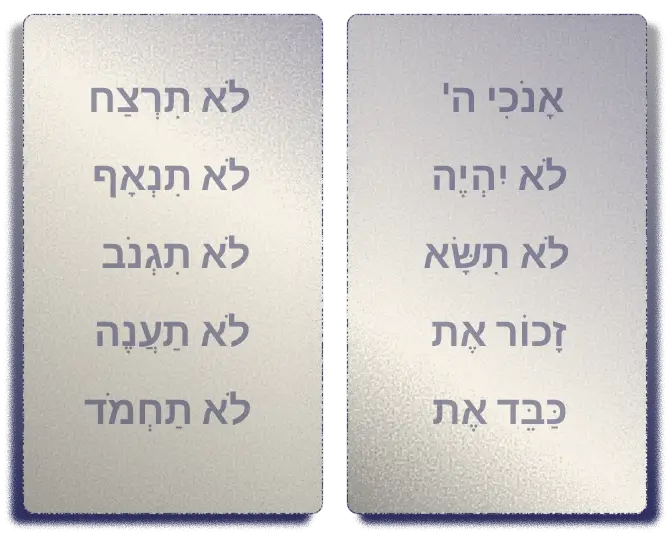
Explore the 613 mitzvos and uncover the meaning behind each one. Discover practical ways to integrate them into your daily life with insights, sources, and guided reflection.
Learn the structure, depth, and spiritual intent behind Jewish prayer. Dive into morning blessings, Shema, Amidah, and more—with tools to enrich your daily connection.
Each week’s parsha offers timeless wisdom and modern relevance. Explore summaries, key themes, and mitzvah connections to deepen your understanding of the Torah cycle.