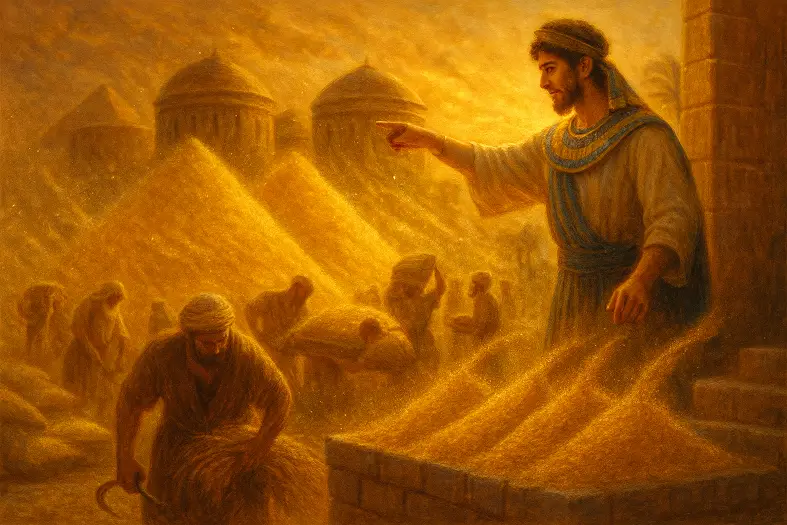
Feeding the World With Fear of Heaven
Parshas Mikeitz introduces one of the most remarkable economic systems in Tanach: Yosef’s grain-storage policy. On the surface, it appears to be a shrewd administrative plan — a national food-security program in anticipation of famine. But beneath the political brilliance lies a far deeper Torah truth: Yosef uses power as chesed, shaping a system not for dominance, but for life-preservation.
Yosef rises from the dungeon not merely as a strategist, but as a tzaddik, someone whose leadership flows from humility, faith, and a vision of responsibility that transcends self-interest. He understands that famine does not only test governments — it tests souls. And he knows that the way a nation responds to scarcity is a revelation of its moral character.
This essay explores the inner meaning of Yosef’s grain policy through Ralbag, Ramban, Rav Sacks, and Chassidus — and how we, too, can practice chesed even when our own resources feel tight.
Pharaoh entrusts Yosef with a monumental task:
prepare an empire for a famine that will devastate the region.
The Torah says:
וַיִּצְבֹּ֥ר יוֹסֵ֛ף בָּר֖ כְּחוֹ֣ל הַיָּ֑ם
[“Yosef gathered grain like the sand of the sea.”]
— Bereishis 41:49
But the brilliance of Yosef’s policy is not only the quantity —
it is the method.
Ralbag notes that Yosef stores the grain locally, city by city:
וַיִּצְבֹּ֥ר בָּר֖ כְּחוֹ֣ל הַיָּ֑ם… בֶּעָרִֽים
[“He collected the grain… in the cities.”]
— Bereishis 41:48
Ralbag explains:
In other words, Yosef understands the psychology of scarcity.
He knows that chesed is not only what you give —
it is how you give it.
He designs a system that preserves dignity and prevents panic. A leader concerned only with efficiency might centralize; Yosef decentralizes, because his goal is not merely to survive famine — it is to preserve society.
Chassidic masters explain that Yosef is called:
יְוֹסֵף הַצַּדִּיק
[“Yosef the Righteous.”]
Why?
Because the defining quality of a tzaddik is nurture — sustaining others physically and spiritually.
Yosef’s economic policy becomes an act of cosmic chesed. When he gathers grain, he is also gathering sparks, elevating physicality toward holiness. When he feeds the hungry, he is releasing hidden light that lies dormant within creation.
Chassidus teaches:
הַמְּפַרְנֵס אֶת הַבְּרִיּוֹת — מְפַרְנֵס נִיצוֹצוֹת
[“One who sustains lives sustains the Divine sparks within them.”]
Through this lens:
He is a pipeline of Divine shefa, channeling Hashem’s blessing into a starving world.
His grain policy becomes a spiritual mission:
to uphold life so that the world can fulfill its purpose.
Rav Sacks זצ״ל identifies Yosef as the paradigm of ethical power.
He notes that Yosef wields absolute authority — second only to Pharaoh — yet his leadership remains humble, restrained, and humane.
The Torah says:
בִּלְעָדָ֑י אֱלֹקִים יַעֲנֶ֕ה אֶת־שְׁלוֹם֖ פַּרְעֹֽה
[“It is not me — G-d will answer Pharaoh.”]
— Bereishis 41:16
Yosef never confuses his position with his identity.
He views power not as entitlement, but as stewardship.
Modern economies often weaponize scarcity. Yosef sanctifies it. Rav Sacks calls this “the moral economics of Torah leadership.”
Power becomes holy when it elevates rather than exploits.
Ramban reveals yet another layer beneath Yosef’s grain policy. The famine does not occur in a vacuum. It becomes the mechanism through which:
Yosef’s administrative plan is part of a covenantal choreography.
Ramban teaches that Hashem uses natural events — famine, politics, economics — to move the story of Israel forward. Yosef’s grain strategy saves Egypt, but more importantly, it saves the emerging nation of Israel and places them exactly where Hashem intends them to be.
Yosef becomes a partner in Divine destiny — a leader whose earthly work aligns with heavenly design.
What makes Yosef’s grain policy more than shrewd economics is the ethic beneath it.
Yosef could have taxed excessively, hoarded power, or used famine to strengthen his political standing. Instead, he focuses on preserving life and protecting dignity.
His chesed is not sentimental.
It is structured, disciplined, and far-sighted.
Yosef transforms an empire by feeding it — not ruling it by fear.
Yosef teaches that true giving does not come from surplus.
It comes from responsibility.
Many people say:
But Yosef acts during scarcity.
He gives when times are tough.
He shares from what must be saved carefully.
That kind of giving carries Yosef HaTzaddik's light.
It is chesed that honors Heaven.
Yosef stands at the intersection of economics, ethics, and emunah.
He builds storage systems, but he also builds hope.
He nourishes bodies, but he also nourishes nations.
He structures policy, but he also shapes destiny.
His grain plan teaches us that:
And perhaps the greatest lesson:
Give not from luxury, but from loyalty.
Give not from ease, but from purpose.
Give not from abundance, but from faith.
This is Yosef’s way. And it can be ours.
📖 Sources


Feeding the World With Fear of Heaven
Parshas Mikeitz introduces one of the most remarkable economic systems in Tanach: Yosef’s grain-storage policy. On the surface, it appears to be a shrewd administrative plan — a national food-security program in anticipation of famine. But beneath the political brilliance lies a far deeper Torah truth: Yosef uses power as chesed, shaping a system not for dominance, but for life-preservation.
Yosef rises from the dungeon not merely as a strategist, but as a tzaddik, someone whose leadership flows from humility, faith, and a vision of responsibility that transcends self-interest. He understands that famine does not only test governments — it tests souls. And he knows that the way a nation responds to scarcity is a revelation of its moral character.
This essay explores the inner meaning of Yosef’s grain policy through Ralbag, Ramban, Rav Sacks, and Chassidus — and how we, too, can practice chesed even when our own resources feel tight.
Pharaoh entrusts Yosef with a monumental task:
prepare an empire for a famine that will devastate the region.
The Torah says:
וַיִּצְבֹּ֥ר יוֹסֵ֛ף בָּר֖ כְּחוֹ֣ל הַיָּ֑ם
[“Yosef gathered grain like the sand of the sea.”]
— Bereishis 41:49
But the brilliance of Yosef’s policy is not only the quantity —
it is the method.
Ralbag notes that Yosef stores the grain locally, city by city:
וַיִּצְבֹּ֥ר בָּר֖ כְּחוֹ֣ל הַיָּ֑ם… בֶּעָרִֽים
[“He collected the grain… in the cities.”]
— Bereishis 41:48
Ralbag explains:
In other words, Yosef understands the psychology of scarcity.
He knows that chesed is not only what you give —
it is how you give it.
He designs a system that preserves dignity and prevents panic. A leader concerned only with efficiency might centralize; Yosef decentralizes, because his goal is not merely to survive famine — it is to preserve society.
Chassidic masters explain that Yosef is called:
יְוֹסֵף הַצַּדִּיק
[“Yosef the Righteous.”]
Why?
Because the defining quality of a tzaddik is nurture — sustaining others physically and spiritually.
Yosef’s economic policy becomes an act of cosmic chesed. When he gathers grain, he is also gathering sparks, elevating physicality toward holiness. When he feeds the hungry, he is releasing hidden light that lies dormant within creation.
Chassidus teaches:
הַמְּפַרְנֵס אֶת הַבְּרִיּוֹת — מְפַרְנֵס נִיצוֹצוֹת
[“One who sustains lives sustains the Divine sparks within them.”]
Through this lens:
He is a pipeline of Divine shefa, channeling Hashem’s blessing into a starving world.
His grain policy becomes a spiritual mission:
to uphold life so that the world can fulfill its purpose.
Rav Sacks זצ״ל identifies Yosef as the paradigm of ethical power.
He notes that Yosef wields absolute authority — second only to Pharaoh — yet his leadership remains humble, restrained, and humane.
The Torah says:
בִּלְעָדָ֑י אֱלֹקִים יַעֲנֶ֕ה אֶת־שְׁלוֹם֖ פַּרְעֹֽה
[“It is not me — G-d will answer Pharaoh.”]
— Bereishis 41:16
Yosef never confuses his position with his identity.
He views power not as entitlement, but as stewardship.
Modern economies often weaponize scarcity. Yosef sanctifies it. Rav Sacks calls this “the moral economics of Torah leadership.”
Power becomes holy when it elevates rather than exploits.
Ramban reveals yet another layer beneath Yosef’s grain policy. The famine does not occur in a vacuum. It becomes the mechanism through which:
Yosef’s administrative plan is part of a covenantal choreography.
Ramban teaches that Hashem uses natural events — famine, politics, economics — to move the story of Israel forward. Yosef’s grain strategy saves Egypt, but more importantly, it saves the emerging nation of Israel and places them exactly where Hashem intends them to be.
Yosef becomes a partner in Divine destiny — a leader whose earthly work aligns with heavenly design.
What makes Yosef’s grain policy more than shrewd economics is the ethic beneath it.
Yosef could have taxed excessively, hoarded power, or used famine to strengthen his political standing. Instead, he focuses on preserving life and protecting dignity.
His chesed is not sentimental.
It is structured, disciplined, and far-sighted.
Yosef transforms an empire by feeding it — not ruling it by fear.
Yosef teaches that true giving does not come from surplus.
It comes from responsibility.
Many people say:
But Yosef acts during scarcity.
He gives when times are tough.
He shares from what must be saved carefully.
That kind of giving carries Yosef HaTzaddik's light.
It is chesed that honors Heaven.
Yosef stands at the intersection of economics, ethics, and emunah.
He builds storage systems, but he also builds hope.
He nourishes bodies, but he also nourishes nations.
He structures policy, but he also shapes destiny.
His grain plan teaches us that:
And perhaps the greatest lesson:
Give not from luxury, but from loyalty.
Give not from ease, but from purpose.
Give not from abundance, but from faith.
This is Yosef’s way. And it can be ours.
📖 Sources


"The Economics of Chesed: Yosef’s Grain Policy"
Yosef repeatedly attributes all wisdom, strategy, and success to Hashem:
“בִּלְעָדָי — It is not from me.”
His entire economic policy is grounded in the awareness that human power is only a vessel for Divine guidance. This mitzvah underlies Yosef’s humility in leadership and his refusal to claim credit for salvation.
By sustaining the world during famine, Yosef transforms governance into spiritual service. His management of scarcity becomes an expression of love for Hashem, recognizing that supporting life is a fulfillment of His will. Loving Hashem means loving His creations.
Yosef rises from the dungeon to the palace with unwavering integrity. His humility before Pharaoh and his ethical administration create a massive Kiddush Hashem: a righteous Jew governing the mightiest empire with justice and compassion.
With total power and no oversight, Yosef avoids exploitation, corruption, or self-enrichment. By refusing to use scarcity for personal gain, he prevents chillul Hashem and shows that spiritual responsibility outweighs political power.
Yosef’s policy ultimately ensures the survival of his brothers and father. Even before they recognize him, he works to sustain them physically and spiritually. His chesed toward family — despite past wounds — reflects the deepest form of Ahavas Yisrael.
Yosef’s stewardship extends beyond his own people. He feeds Egypt and surrounding nations, living out the Torah’s ethic of compassion toward the vulnerable and the outsider. Providing food during famine becomes an act of universal chesed.
Famine places every society in a condition of vulnerability. Yosef’s system avoids exploitation, predation, and abuse of power. Instead of taking advantage of the weak, he builds structures that protect them, embodying the Torah’s prohibition against oppression.
Despite having every opportunity to repay his brothers for selling him, Yosef refuses to let bitterness shape policy. His stewardship is grounded not in vengeance but in responsibility — a model of restraint and moral clarity.
Yosef sustains those who wronged him.
A lesser leader may have weaponized scarcity to punish old enemies; Yosef uses the famine to heal the future. His refusal to carry resentment becomes the foundation for national survival.
Yosef’s grain system mirrors the Torah’s ethic: food is never entirely private property. Even in the royal storehouses, Yosef preserves access, fairness, and the dignity of those in need. The spirit of pe’ah — sharing sustenance — becomes national policy.
The famine magnifies the need for equitable distribution. Yosef ensures resources reach all levels of society, embodying the Torah’s expectation that those with abundance must support those without.
Although the Torah’s formal tzedakah obligations will be commanded generations later, Yosef lives their essence. His entire administration is an act of massive, sustained tzedakah — feeding nations and preserving life during unprecedented crisis.
Famine is precisely the moment when leaders are tempted to ration compassion. Yosef does the opposite. He provides generously, consistently, and with foresight, fulfilling the Torah’s obligation not to harden one’s heart in times of scarcity.
Yosef administers rations, taxation, storage, and distribution — all systems vulnerable to corruption. His integrity reflects the mitzvah demanding absolute honesty in economic dealings.
Yosef’s fairness ensures no region, class, or group is cheated during crisis. Pharaoh praises his wisdom, but the Torah recognizes this as righteousness: economics rooted in justice, not politics.


"The Economics of Chesed: Yosef’s Grain Policy"
Yosef interprets Pharaoh’s dreams and immediately designs a national system to preserve life. His storage policy — gathering grain in every city — reflects not only administrative brilliance but a deeply moral vision: leadership as chesed, power as responsibility, and planning as a sacred act of sustaining others.
Yosef’s rise to power begins with the suffering and humility of his earlier years. The compassion he will later show in feeding the world is rooted in his experience of deprivation. His sensitivity toward hunger, vulnerability, and injustice begins in the pit and the prison.
The famine becomes the catalyst for the family’s reunification and the unfolding of covenantal destiny. Yosef uses his economic authority not to punish but to preserve, ensuring Yaakov’s family survives and setting the stage for the birth of the Jewish nation in Egypt. His policy becomes part of Hashem’s providential design.

Dive into mitzvos, tefillah, and Torah study—each section curated to help you learn, reflect, and live with intention. New insights are added regularly, creating an evolving space for spiritual growth.

Explore the 613 mitzvos and uncover the meaning behind each one. Discover practical ways to integrate them into your daily life with insights, sources, and guided reflection.

Learn the structure, depth, and spiritual intent behind Jewish prayer. Dive into morning blessings, Shema, Amidah, and more—with tools to enrich your daily connection.

Each week’s parsha offers timeless wisdom and modern relevance. Explore summaries, key themes, and mitzvah connections to deepen your understanding of the Torah cycle.