"Torah and Eidut"

Mitzvah Minute Logo Icon

Yehudah and Yosef as Two Incomplete Paths — and Why Yaakov Says Shema as They Unite

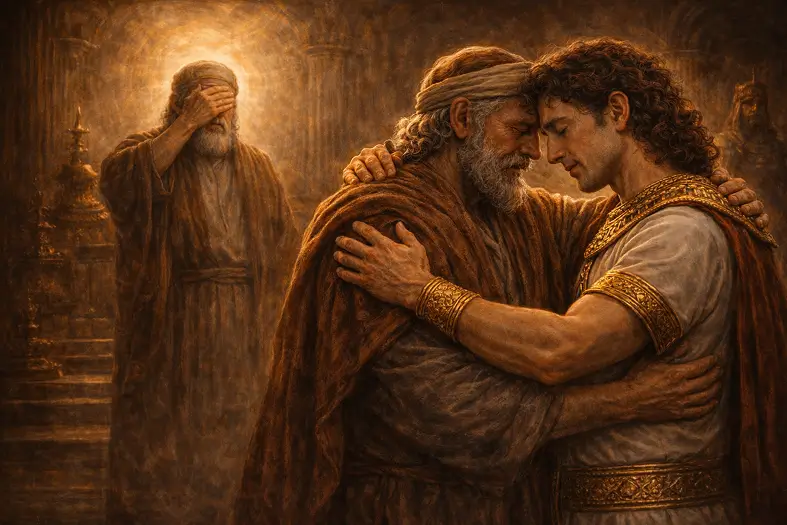
Yosef embracing Yaakov and Yaakov reciting Shema
Torah and Eidut explores Parshas Vayigash as the meeting of two incomplete spiritual paths. Yehudah embodies inward holiness and covenantal responsibility; Yosef represents outward ethical engagement within the world. Drawing on Rav Kook, Rashi, and Chassidic thought, this essay shows why neither path can redeem alone. Yaakov’s recitation of Shema while Yosef weeps is not emotional detachment, but spiritual synthesis at the threshold of exile—affirming that Jewish survival depends on uniting inner faith with outward responsibility.

"Torah and Eidut"

Yehudah and Yosef as Two Incomplete Paths — and Why Yaakov Says Shema as They Unite

Introduction — When Wholeness Requires More Than One Path

Parshas Vayigash is often read as a story of reconciliation between brothers. In truth, it is a drama of incomplete ideals finally drawn together. Yehudah and Yosef do not merely represent personalities or tribes; they embody two spiritual paths that cannot redeem the world alone. Yehudah carries Torah — inward sanctity, rooted identity, covenantal depth. Yosef carries eidut — outward responsibility, engagement with power, moral presence within the world. Each path is necessary. Each path, by itself, is insufficient.

The Torah makes this tension explicit at the moment of reunion. Yosef weeps. Yaakov recites Shema. This juxtaposition is not emotional mismatch. It is spiritual synthesis. At the threshold of exile, the Torah teaches that redemption requires not collapse into feeling, nor retreat into abstraction, but the unification of inward holiness and outward responsibility — Torah and eidut — into a single, integrated life.

I. Rav Kook — Two Sacred but Partial Truths

Rav Kook identifies Yosef and Yehudah as bearers of distinct, sacred missions. Yosef’s path is universal, ethical, and outward-facing. Yehudah’s is inward, covenantal, and identity-preserving. Neither is wrong. Both are incomplete alone.

Yosef’s greatness lies in:

  • Moral integrity within foreign systems
  • Engagement with political and economic power
  • Preservation of life across civilizations

Yehudah’s greatness lies in:

  • Responsibility rooted in relationship
  • Teshuvah expressed through self-sacrifice
  • Leadership grounded in Torah identity

Rav Kook warns that when these paths separate, disaster follows. Yosef without Yehudah becomes ethical but unanchored. Yehudah without Yosef becomes holy but insular. Redemption requires their reunion.

II. Torah Without Eidut — Holiness That Cannot Reach the World

Torah, when isolated from engagement, risks becoming self-enclosed. Yehudah’s earlier failure with Yosef was not cruelty alone; it was the absence of outward responsibility. The brothers preserved internal cohesion at the cost of ethical consequence.

Torah without eidut can result in:

  • Moral blindness to the outsider
  • Retreat from responsibility beyond the camp
  • Preservation of purity at the expense of life

The Torah insists that inward sanctity must eventually bear outward witness. Holiness that does not touch the world cannot redeem it.

III. Eidut Without Torah — Responsibility Without Rootedness

Yosef’s path, too, carries danger. He thrives in Egypt, masters its systems, and sustains its people. Yet Rav Kook notes that Yosef’s excellence risks detachment from covenantal depth. Without Torah as anchor, eidut becomes vulnerable to assimilation.

Eidut without Torah risks:

  • Ethical universalism without identity
  • Responsibility detached from covenant
  • Success that erodes memory

Yosef’s brilliance must be reunited with Yehudah’s rootedness for Israel to survive exile intact.

IV. Integration — The Moment Yehudah Approaches Yosef

The turning point of Vayigash is not Yosef’s revelation, but Yehudah’s approach:

“וַיִּגַּשׁ אֵלָיו יְהוּדָה”
[“And Yehudah approached him”] (Bereishis 44:18)

This approach collapses the distance between Torah and eidut. Yehudah speaks responsibility into Yosef’s world of power. Yosef recognizes that ethical governance without relational accountability cannot heal the past.

This is the beginning of synthesis:

  • Torah speaks within systems
  • Eidut answers to covenant
  • Power submits to responsibility

Only then can Yosef reveal himself.

V. Why Yosef Weeps — Emotion as Completion of Eidut

Yosef’s tears are not weakness. They are the moment his outward mission reconnects with inner belonging. Until now, Yosef has governed with restraint, vision, and control. Weeping marks the return of relationship.

Yosef’s weeping signifies:

  • Release of isolation
  • Reunion with covenantal family
  • Completion of ethical mission through belonging

Emotion, here, is not loss of clarity. It is restoration of wholeness.

VI. Why Yaakov Says Shema — Not Detachment, but Alignment

Rashi records that at the moment Yosef falls upon him weeping, Yaakov recites:

“שְׁמַע יִשְׂרָאֵל ה׳ אֱלֹקֵינוּ ה׳ אֶחָד”

This is not emotional coldness. Rav Kook and the Chassidic masters explain that Yaakov is doing something more demanding than weeping: he is aligning cosmic unity with lived reality.

Yaakov recognizes that this reunion signals:

  • The descent into exile
  • The survival of identity within foreign power
  • The necessity of unity between inner and outer life

Shema is not escape from emotion. It is the sanctification of it.

VII. Shema as Spiritual Synthesis

Shema declares unity not only of Hashem, but of life itself. At this moment, Yaakov affirms that Torah and eidut are not competing paths, but facets of one truth.

Shema accomplishes three things:

  • It binds emotion to faith
  • It anchors relationship in covenant
  • It prepares Israel for exile without fragmentation

Yaakov teaches that unity must be affirmed precisely when life becomes complex.

VIII. Chassidus — Holding Two Truths Without Collapse

Chassidic thought emphasizes that spiritual maturity lies in integration, not simplification. The tzaddik does not flee the world, nor dissolve into it. He holds opposites in service of Hashem.

Yehudah and Yosef together model:

  • Inner devotion with outward action
  • Identity without isolation
  • Responsibility without assimilation

Their reunion is the blueprint for Jewish survival across history.

IX. Application — Living Integrated Judaism Today

Modern Jewish life constantly pulls these paths apart. Some retreat into inward holiness; others engage outwardly while losing depth. Vayigash demands a higher synthesis.

The Torah asks:

  • Are we rooted in Torah while engaged with the world?
  • Are we responsible without surrendering identity?
  • Do our emotions serve unity or fragmentation?

Yaakov’s Shema teaches that unity must be affirmed consciously, again and again.

Conclusion — Unity at the Edge of Exile

Parshas Vayigash teaches that redemption does not come from choosing between Torah and responsibility, emotion and faith, inward sanctity and outward engagement. It comes from refusing to let them separate.

Yehudah and Yosef are each incomplete alone. Together, they form Israel’s enduring mission. Yosef weeps because belonging has returned. Yaakov recites Shema because unity has been restored.

At the edge of exile, the Torah offers its most demanding teaching: wholeness is not found in purity or power alone, but in their sanctified union.

This is not detachment.
This is synthesis.
And this is how Israel survives history whole.

📖 Sources

  • Full sources available on the Mitzvah Minute Parshas Vayigash page under insights and commentaries.

Organized by:
Boaz Solowitch
December 20, 2025
Mitzvah Minute Logo Icon

Connections

Mitzvah Minute Logo Icon

Mitzvah Links

Mitzvah 1

To know there is a G‑d
A Siddur
Learn this Mitzvah

Mitzvah 1

1
To know there is a G‑d

Mitzvah 3

To know that He is One
A Siddur
Learn this Mitzvah

Mitzvah 3

3
To know that He is One

Mitzvah 4

To love Him
A Siddur
Learn this Mitzvah

Mitzvah 4

4
To love Him

Mitzvah 6

To sanctify His Name
A Siddur
Learn this Mitzvah

Mitzvah 6

6
To sanctify His Name

Mitzvah 7

Not to profane His Name
A Siddur
Learn this Mitzvah

Mitzvah 7

7
Not to profane His Name

Mitzvah 11

To emulate His ways
A Siddur
Learn this Mitzvah

Mitzvah 11

11
To emulate His ways

Mitzvah 12

To cleave to those who know Him
A Siddur
Learn this Mitzvah

Mitzvah 12

12
To cleave to those who know Him

Mitzvah 13

To love other Jews
A Siddur
Learn this Mitzvah

Mitzvah 13

13
To love other Jews

Mitzvah 15

Not to hate fellow Jews
A Siddur
Learn this Mitzvah

Mitzvah 15

15
Not to hate fellow Jews

Mitzvah 16

To reprove wrongdoers
A Siddur
Learn this Mitzvah

Mitzvah 16

16
To reprove wrongdoers

Mitzvah 17

Not to embarrass others
A Siddur
Learn this Mitzvah

Mitzvah 17

17
Not to embarrass others

Mitzvah 22

To learn Torah and teach it
A Siddur
Learn this Mitzvah

Mitzvah 22

22
To learn Torah and teach it

Mitzvah 76

To say the Shema twice daily
A Siddur
Learn this Mitzvah

Mitzvah 76

76
To say the Shema twice daily

Mitzvah 584

Respect your father and mother
A Siddur
Learn this Mitzvah

Mitzvah 584

584
Respect your father and mother

Mitzvah 591

Appoint a king from Israel
A Siddur
Learn this Mitzvah

Mitzvah 591

591
Appoint a king from Israel
The Luchos - Ten Commandments
View Mitzvah Notes

Mitzvah Reference Notes

"x" close page navigation button

Mitzvah Reference Notes

"Torah and Eidut"

Mitzvah #1 — To Know There Is a G-d (Exodus 20:2)

אָנֹכִי ה׳ אֱלֹקֶיךָ

Yaakov’s recitation of Shema presupposes conscious knowledge of Hashem at the threshold of exile. Rav Kook frames this mitzvah not as abstract belief but as lived awareness that unifies inner faith with outer responsibility. The essay shows that without da’at Elokim, Torah collapses into inward piety and eidut into moral activism untethered from covenant.

Mitzvah #3 — To Know That He Is One (Deuteronomy 6:4)

שְׁמַע יִשְׂרָאֵל ה׳ אֱלֹקֵינוּ ה׳ אֶחָד

This mitzvah stands at the heart of the essay. Yaakov proclaims Divine unity precisely as Yosef and Yehudah reunite, affirming that fragmentation—between holiness and responsibility—is a theological failure. Unity here is not simplicity but synthesis: Torah and eidut bound within one Divine truth.

Mitzvah #4 — To Love Him (Deuteronomy 6:5)

וְאָהַבְתָּ אֵת ה׳ אֱלֹקֶיךָ

Chassidus reads Yaakov’s Shema not as emotional withdrawal but as disciplined love expressed through spiritual alignment. Loving Hashem means choosing integration over expression, restraint over release. The essay frames this mitzvah as devotion that harmonizes inward sanctity with outward obligation.

Mitzvah #6 — To Sanctify His Name (Leviticus 22:32)

וְנִקְדַּשְׁתִּי בְּתוֹךְ בְּנֵי יִשְׂרָאֵל

Yosef’s ethical governance in Egypt exemplifies Kiddush Hashem through public responsibility. Rav Kook identifies Yosef as the archetype of sanctifying Hashem’s Name within worldly systems. Eidut is not secondary holiness—it is its public manifestation.

Mitzvah #7 — Not to Profane His Name (Leviticus 22:32)

וְלֹא תְחַלְּלוּ אֶת שֵׁם קָדְשִׁי

The essay warns that Torah divorced from responsibility—or responsibility detached from Torah—becomes chilul Hashem. Fragmentation misrepresents Divine unity. This mitzvah anchors the essay’s insistence that holiness must appear coherent within lived reality.

Mitzvah #11 — To Emulate His Ways (Deuteronomy 28:9)

וְהָלַכְתָּ בִּדְרָכָיו

Hashem sustains both spiritual truth and worldly order simultaneously. Emulating His ways therefore requires integration. Yehudah models inward covenantal loyalty; Yosef models outward moral stewardship. Their reunion reflects halicha bidrachav as wholeness, not specialization.

Mitzvah #12 — To Cleave to Those Who Know Him (Deuteronomy 10:20)

וּבוֹ תִדְבָּק

Yaakov’s insistence on Torah continuity in exile, and Yehudah’s role as spiritual emissary, reflect this mitzvah’s demand for attachment to Torah carriers. Rav Kook emphasizes that eidut without spiritual cleaving leads to assimilation; this mitzvah safeguards continuity.

Mitzvah #13 — To Love Other Jews (Leviticus 19:18)

וְאָהַבְתָּ לְרֵעֲךָ כָּמוֹךָ

The reunion of Yosef and his brothers restores relational unity as a religious value. Love here is covenantal responsibility, not sentiment. The essay shows that unity emerges when Torah and eidut serve relationship rather than ideology.

Mitzvah #15 — Not to Hate Fellow Jews (Leviticus 19:17)

לֹא תִשְׂנָא אֶת אָחִיךָ בִּלְבָבֶךָ

Residual resentment threatens unity even after reconciliation. Yosef’s restraint and Yehudah’s accountability neutralize hidden hatred. The mitzvah underscores the essay’s claim that unspoken division corrodes holiness.

Mitzvah #16 — To Reprove Wrongdoers (Leviticus 19:17)

הוֹכֵחַ תּוֹכִיחַ אֶת עֲמִיתֶךָ

Yehudah’s confrontation exemplifies rebuke rooted in responsibility rather than dominance. Torah mandates moral speech that seeks repair. The essay positions this mitzvah as the bridge between inward truth and outward engagement.

Mitzvah #17 — Not to Embarrass Others (Leviticus 19:17)

וְלֹא תִשָּׂא עָלָיו חֵטְא

Yosef’s clearing of the room prior to revelation establishes dignity as a halachic value. Truth must emerge without humiliation. This mitzvah governs eidut, ensuring that public responsibility does not violate inner sanctity.

Mitzvah #22 — To Learn Torah and Teach It (Deuteronomy 6:7)

וְשִׁנַּנְתָּם לְבָנֶיךָ

Yehudah’s path presumes Torah as inner compass. Rav Kook stresses that Torah learning sustains identity amid engagement. The essay frames Torah study as existential anchoring, not academic insulation.

Mitzvah #76 — To Say the Shema Twice Daily (Devarim 6:7)

וְדִבַּרְתָּ בָּם בְּשִׁבְתְּךָ בְּבֵיתֶךָ וּבְלֶכְתְּךָ בַדֶּרֶךְ וּבְשָׁכְבְּךָ וּבְקוּמֶךָ

Yaakov’s recitation of Shema at the moment of reunion with Yosef is not a withdrawal from emotion, but the halachic expression of spiritual mastery. At the threshold of exile, Shema becomes an act of synthesis: affirming Divine unity precisely when human longing is fulfilled. This moment embodies Rav Kook’s vision that Torah consciousness does not negate feeling, but orders it — binding love, loss, destiny, and faith into a single declaration of Hashem’s oneness.

Mitzvah #584 — To Honor Father and Mother (Exodus 20:12)

כַּבֵּד אֶת אָבִיךָ וְאֶת אִמֶּךָ

Yaakov’s central role, and the family’s reconstitution around him, reassert filial honor as foundational to national continuity. This mitzvah grounds unity in generational fidelity, reinforcing the essay’s warning against progress that erases origin.

Mitzvah #591 — To Appoint a King from Israel (Deuteronomy 17:15)

שׂוֹם תָּשִׂים עָלֶיךָ מֶלֶךְ

Chazal trace kingship to Yehudah. The essay demonstrates that legitimate leadership requires Torah-rooted integrity joined with Yosef-like administrative mastery. Malchut emerges only when inward holiness and outward governance unite.

Parsha Links

וַיִּגַּשׁ – Vayigash

Haftarah: Ezekiel 37:15-28
A Siddur
Learn this Parsha

וַיִּגַּשׁ – Vayigash

וַיִּגַּשׁ – Vayigash

וַיְחִי – Vayechi

Haftarah: Kings I 2:1-12
A Siddur
Learn this Parsha

וַיְחִי – Vayechi

וַיְחִי – Vayechi
The Luchos - Ten Commandments
View Parsha Notes
"x" close page navigation button

Parsha Reference Notes

"Torah and Eidut"

Parshas Vayigash (Bereishis 44:18–47:27)

Vayigash stages the encounter between two sacred but incomplete paths. Yehudah approaches Yosef—“וַיִּגַּשׁ אֵלָיו יְהוּדָה”—bringing Torah-rooted responsibility into Yosef’s world of power and outward moral engagement. This approach collapses the false divide between inward holiness and public responsibility. Yosef’s weeping marks the reintegration of relationship into ethical governance, while Yaakov’s recitation of Shema affirms unity at the very moment the family prepares to enter exile. The parsha teaches that redemption requires synthesis: Torah that speaks within systems, and eidut anchored in covenant.

Parshas Vayechi (Bereishis 47:28–50:26)

Vayechi confirms that the unification achieved in Vayigash must endure over time. Yaakov’s blessings assign Yehudah kingship and Yosef material strength, preserving both paths while preventing their separation. Yosef’s continued restraint and care after Yaakov’s death demonstrates outward responsibility governed by inward fidelity. Read together, Vayigash and Vayechi establish the enduring model for life in exile: inward sanctity and outward engagement must remain bound, or both will fracture.

Across Vayigash and Vayechi, the Torah insists that Jewish wholeness depends on integration. Yehudah’s Torah and Yosef’s eidut are not alternatives but complements, and Yaakov’s Shema sanctifies their reunion by affirming unity precisely where complexity intensifies. Redemption is sustained not by choosing one path, but by holding both together in covenantal harmony.

Mitzvah Minute
Mitzvah Minute Logo

Learn more.

Dive into mitzvos, tefillah, and Torah study—each section curated to help you learn, reflect, and live with intention. New insights are added regularly, creating an evolving space for spiritual growth.

Luchos
Live a commandment-driven life

Mitzvah

Explore the 613 mitzvos and uncover the meaning behind each one. Discover practical ways to integrate them into your daily life with insights, sources, and guided reflection.

Learn more

Mitzvah #

5

To fear Him
The Luchos - Ten Commandments
Learn this Mitzvah

Mitzvah Highlight

Siddur
Connection through Davening

Tefillah

Learn the structure, depth, and spiritual intent behind Jewish prayer. Dive into morning blessings, Shema, Amidah, and more—with tools to enrich your daily connection.

Learn more

Tefillah

COMING SOON.
A Siddur
Learn this Tefillah

Tefillah Focus

A Sefer Torah
Study the weekly Torah portion

Parsha

Each week’s parsha offers timeless wisdom and modern relevance. Explore summaries, key themes, and mitzvah connections to deepen your understanding of the Torah cycle.

Learn more

וָאֵרָא – Va’eira

Haftarah: Ezekiel 28:25 - 29:21
A Sefer Torah
Learn this Parsha

Weekly Parsha