
Each Parsha page on Mitzvah Minute is designed as a guided, three-level journey through the weekly Torah reading—integrating the narrative, the mitzvos, and the classical commentaries into one unified experience.
Begin with the foundations of the Parsha:
This level gives you the storyline, the key mitzvos, and the essential connections between them.
A complete journey through the parsha—moving from clarity and depth to inner connection and real-world meaning, culminating in a way to live its ideas in everyday life.
These sections show how the Parsha speaks to the mind, the heart, and the real world — offering wisdom rooted in enduring Torah.
A complete, structured commentary on the parsha—presented pasuk by pasuk, with chapter and overall summaries for clarity and flow.
This level reveals the structural depth of the Parsha and the classical underpinnings of each theme.
Together, these layers create a complete Parsha journey —
narrative, mitzvah, and commentary — all flowing toward deeper understanding, spiritual insight, and meaningful growth.
Tap the Page Navigation tab on the right side of your screen anytime to access quick-links to the entire Parsha page.
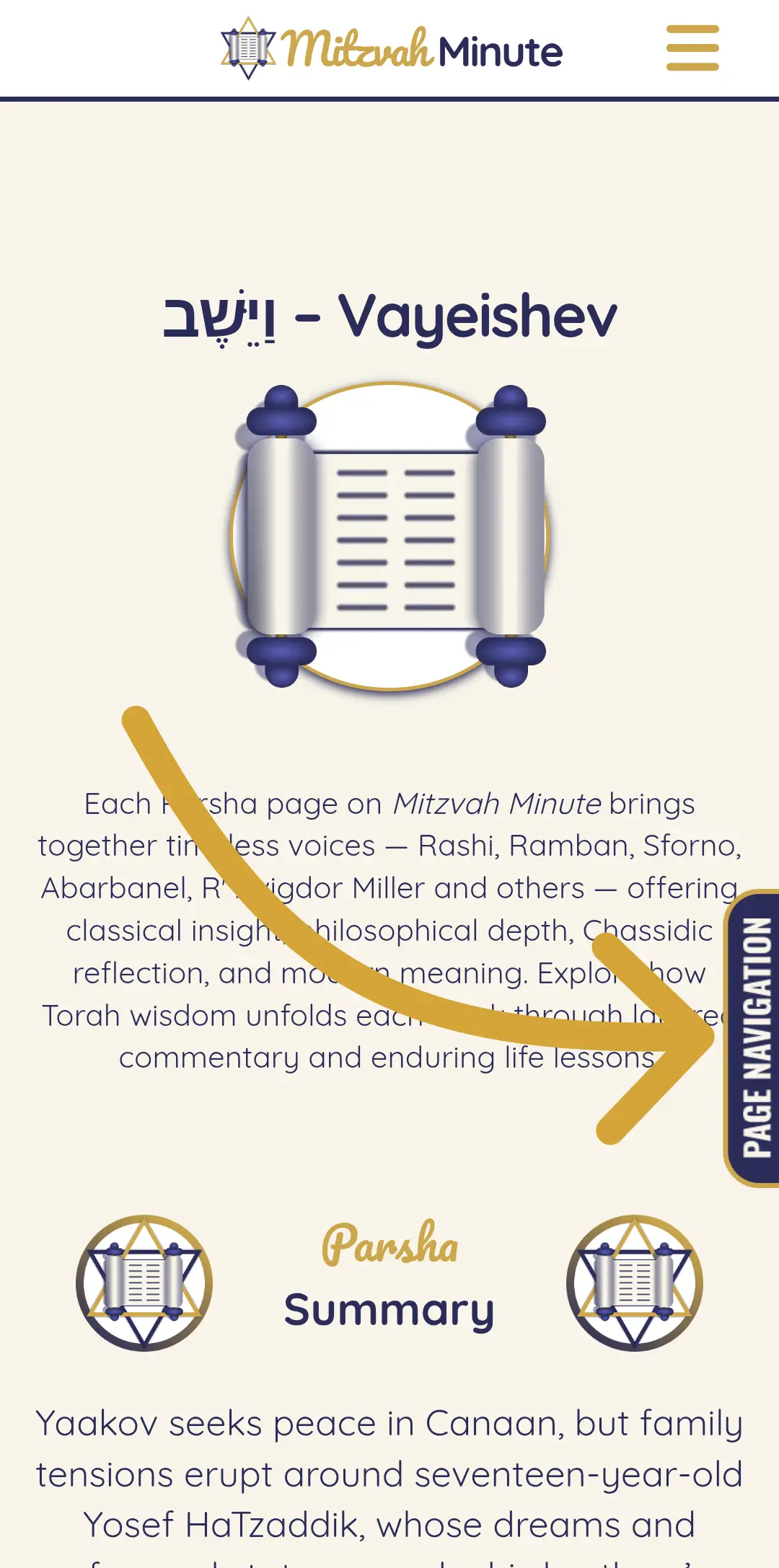
The quick-link panel gives instant access to every section — Parsha Summary, Mitzvos, Divrei Torah, Insights, and Commentaries.
“Every word of Torah and every mitzvah lifts us higher — may your learning bring you closer to Hashem.”

Parshas Behar presents a vision of life in Eretz Yisroel shaped by cycles of restraint, trust, and return. The land itself must observe שְׁמִטָּה — the sabbatical year, and after seven cycles, יוֹבֵל — the Jubilee restores people and property to their original place. Ownership is redefined: כִּי־לִי הָאָרֶץ — the land belongs to Hashem, and Bnei Yisroel live upon it as stewards. The parsha builds a society where business must be honest, wealth cannot become permanent power, and those who fall into poverty are supported, redeemed, and ultimately restored. At its core, Behar teaches that freedom, dignity, and stability come not from control, but from living within Hashem’s structure—where even land, labor, and livelihood are directed toward קדושה — holiness.

"A World That Returns — Ownership, Dignity, and Divine Order"
וְשָׁבְתָה הָאָרֶץ שַׁבָּת לַה׳
שמיטה — the Sabbatical year reframes the relationship between האדם — the human being and הארץ — the land. The field that sustained life for six years must now rest, not out of exhaustion but מתוך ציווי — through Divine command. This rest reveals that productivity is not the source of blessing; Hashem is. Parshas Behar teaches that stepping back is not loss but alignment. The land rests, and through that rest, the האדם — person relearns his place within a world that belongs to Hashem.
שָׂדְךָ לֹא תִזְרָע
The prohibition against agricultural labor defines the גבול — boundary of human mastery. For six years, effort defines success. In the seventh, restraint becomes the avodah — service. This mitzvah trains a person to stop not when he is finished, but when Hashem commands. It is an act of discipline that reshapes identity, teaching that האדם — the individual is not sustained by control alone but by obedience to a higher order.
וְכַרְמְךָ לֹא תִזְמֹר
זמירה — pruning, the act of refining growth, is prohibited during שמיטה. Even improvement is paused. This reveals a deeper truth: not every moment is meant for optimization. The world does not need constant intervention to function. By stepping back from shaping growth, a person acknowledges that development itself flows from Hashem. The restraint becomes a form of אמונה — faith expressed through non-action.
אֵת סְפִיחַ קְצִירְךָ לֹא תִקְצוֹר
The prohibition is not against eating, but against harvesting כדרך הבעלים — in the manner of an owner. Produce may be taken, but not possessed. This transforms the act of gathering from acquisition into participation. The field no longer reflects dominance, but dependence. A person eats not as the master of the land, but as one who receives from Hashem’s world.
וְאֶת עִנְּבֵי נְזִירֶךָ לֹא תִבְצֹר
The vineyard, often a symbol of cultivation and pride, becomes unclaimed. Gathering is limited to what is needed, not what can be secured. This mitzvah removes the instinct to accumulate. It replaces it with an awareness that abundance is not meant to be stored beyond its purpose. The אדם — person learns to receive without enclosing, to benefit without owning.
וְנָטַשְׁתָּהּ וַאֲכָלוּ אֶבְיֹנֵי עַמֶּךָ
הפקר — making produce ownerless, is the heart of שמיטה. The field opens equally to the עני — poor, the עשיר — wealthy, and even the בהמה — animal. Ownership dissolves into access. Parshas Behar constructs a society where sustenance is not mediated by power, but by Divine provision. The אדם — individual becomes a steward rather than a possessor.
וְסָפַרְתָּ לְךָ שֶׁבַע שַׁבְּתוֹת שָׁנִים
Time itself becomes structured through counting. שבע שבתות שנים — seven cycles of seven years, create a rhythm that carries the nation forward. קדושה — holiness enters time not randomly, but through measured progression. This mitzvah teaches that growth is not chaotic. It is built through cycles, discipline, and awareness of direction.
וְקִדַּשְׁתֶּם אֵת שְׁנַת הַחֲמִשִּׁים שָׁנָה
יובל — the Jubilee year is not a continuation of the cycle, but a transcendence of it. After seven structured cycles, a new level emerges. Sanctification here reflects a reality beyond human effort. The אדם — person lives within systems, but is ultimately lifted by moments of Divine elevation that reset and redefine existence.
וְהַעֲבַרְתָּ שׁוֹפַר תְּרוּעָה
The שופר — ram’s horn, transforms freedom into a public reality. This is not private change, but הכרזה — proclamation. The sound awakens the nation to a new state of existence. Freedom is not silent; it must be heard. This mitzvah reveals that spiritual truths require expression in the world to become lived reality.
לֹא תִזְרָעוּ
יובל extends the discipline of שמיטה. Even at the height of renewal, labor pauses. The אדם — individual is reminded that freedom is not the ability to do more, but the ability to step back when commanded. The rhythm of restraint continues, reinforcing that even renewal belongs to Hashem.
וּבְכָל אֶרֶץ אֲחֻזַּתְכֶם גְּאֻלָּה תִּתְּנוּ לָאָרֶץ
גאולה — redemption, applies not only to people but to land. Property is not permanently alienated. It retains a connection to its original family. This mitzvah protects identity across generations. The land is not merely economic; it is relational, tied to משפחה — family and destiny.
כִּי לִי הָאָרֶץ
Ownership is redefined at its core. The אדם — person may possess, but not absolutely. The land belongs to Hashem. This mitzvah removes the illusion of permanence. Every transaction exists within a higher truth: human control is temporary, while Divine ownership is eternal.
וְאִישׁ כִּי יִמְכֹּר בֵּית מוֹשַׁב עִיר חוֹמָה
The Torah distinguishes between land and urban property. A בית עיר חומה — house in a walled city, reflects stability and structure. Its redemption window is limited, preserving societal order. This mitzvah shows that Torah law balances ideals with practical realities, protecting both identity and infrastructure.
וְכִי תִמְכְּרוּ מִמְכָּר לַעֲמִיתֶךָ
Commerce is not outside קדושה — holiness. Transactions must reflect יושר — uprightness. The marketplace becomes an extension of avodas Hashem — service of Hashem. This mitzvah teaches that financial interactions are not neutral; they shape the moral fabric of society.
אַל תּוֹנוּ אִישׁ אֶת אָחִיו
אונאה — monetary harm, corrupts trust. The Torah demands fairness not only in intention but in outcome. A person must measure his dealings with precision. This mitzvah builds a society where value is not manipulated for gain, but aligned with truth.
וְלֹא תוֹנוּ אִישׁ אֶת עֲמִיתוֹ
דברים אונאה — verbal harm, reaches where money cannot. Words can diminish, shame, and destabilize. This mitzvah brings יראת שמים — awe of Heaven into the hidden realm of speech. What is ללב מסור — entrusted to the heart, is judged by Hashem. A Torah society protects dignity not only in action, but in language.
לֹא תִרְדֶּה בוֹ בְּפָרֶךְ
A עברי עבד — Hebrew servant, is never a slave in essence. He remains an עבד ה׳ — servant of Hashem. This mitzvah limits power, ensuring that authority does not erase dignity. Even in dependence, identity is preserved. The אדם — individual is never reduced to a function.
אֶת כַּסְפְּךָ לֹא תִתֵּן לוֹ בְּנֶשֶׁךְ
ריבית — interest, transforms another’s need into personal gain. The Torah forbids this dynamic, demanding that support be life-giving rather than exploitative. Wealth is not an instrument of dominance, but a כלי — tool for sustaining others. This mitzvah protects the fabric of the community from quiet forms of harm.

Rashi opens with a precise question: why does the Torah emphasize “בהר סיני” specifically by שמיטה — the Sabbatical year, when all mitzvos were given at Sinai? He answers that שמיטה teaches the structure of all mitzvos. Just as it was given with כללות — general principles, פרטות — specific details, and דקדוקים — precise laws, so too every mitzvah was transmitted at Sinai in its full form.
Rashi sharpens the point. שמיטה was not repeated in detail in ערבות מואב — the plains of Moav. From this absence, we learn that its full system had already been given at Sinai. שמיטה becomes the proof-text: every mitzvah Moshe received came complete, and later repetition was review, not expansion.
On “שבת לה׳,” Rashi clarifies that this is ה׳ לשם — for the sake of Hashem, not that Hashem “needs” rest. Just as שבת בראשית — the weekly Shabbos is observed לשם ה׳, so too the land’s rest is an act of directed avodah — service.
The farmer’s cessation is therefore intentional. Work stops not because of agricultural necessity, but to realign the land—and the one who works it—under the command of Hashem.
Rashi defines the prohibited acts with halachic precision. “לא תזמר” refers specifically to זמירה — pruning, the cutting of vine branches, tied linguistically to זמורה — a vine-branch. This is not general maintenance, but a defined act of cultivation.
He then defines categories of growth:
These distinctions matter. שמיטה is not only about refraining from planting; it is about redefining the status of all produce—what is naturally grown, what is restricted, and how it must be treated.
Rashi asks what “לא תקצור” prohibits. It cannot mean taking produce entirely, because the Torah later permits eating. Rather, it forbids harvesting כדרך קציר — in the manner of an owner who asserts control.
The produce must be הפקר — ownerless. Once released, the former owner may partake, but only equally, not as a בעל הבית — exclusive owner.
Rashi reinforces this through the pasuk’s inclusivity. One might have thought שמיטה produce is reserved for the poor, based on “ואכלו אביוני עמך.” Therefore, the Torah says “לך” — even the owner may eat. It also includes servant, worker, resident, and even גויים — non-Jews.
שמיטה dismantles hierarchy. Access replaces possession.
Rashi reads carefully: “שבת הארץ לכם לאכלה.” The Torah does not say “תבואת הארץ”—the produce of the land—but “שבת הארץ”—the Sabbatical state of the land. From here he derives that only produce treated through שבות — Sabbatical release may be eaten.
Rashi presents שמור — guarded produce as excluded from the Torah’s permitted “לאכלה” framework, because the produce was not treated with proper שביתת הארץ — Sabbatical release.. According to Rashi’s reading, the Torah’s permission of eating is tied to produce that entered the שמיטה system properly, not produce held back as private property. Proper release is what makes it fit for consumption.
Rashi compares בהמה — domesticated animals and חיה — wild animals. From this, he derives the law of ביעור — removal. As long as wild animals can still find a given species in the field, one may keep it at home. Once it disappears from the field, it must be removed from the house.
This creates a moving boundary. Even permitted possession remains conditional, tied to what exists in the open field. Ownership never fully returns.
On “שבתת שנים,” Rashi explains that the Torah speaks of cycles of שמיטות — Sabbatical cycles, not consecutive years of rest. Each שמיטה arrives בזמנה — in its proper time.
He then notes a striking halachah from “והיו לך”: even if שמיטות were not properly observed, יובל — the Jubilee year still arrives at the end of forty-nine years.
The system of sacred time proceeds by structure, not by human perfection.
Rashi explains that “והעברת שופר” is לשון הכרזה — a language of proclamation, not merely carrying or sounding a horn. Like “ויעבירו קול במחנה,” it means to spread a public announcement.
The timing—ביום הכפורים — teaches another law. The תקיעת שופר of יובל overrides Shabbos throughout the land, unlike ראש השנה, where Shabbos override applies only in בית דין — the court.
יובל is not symbolic. It is a nationwide redefinition of reality, declared aloud.
Rashi explains דרור — freedom as the ability to dwell wherever one wishes, without restriction. This applies to all עבדים — servants, including the נרצע — one whose ear was pierced to extend his service.
This is not merely release from labor. It is restoration of identity. The servant returns to his family, and each person returns to his ancestral place. Freedom is defined as belonging restored.
Rashi asks why the Torah repeats that the fiftieth year is יובל. He answers that one might think its קדושה — sanctity extends into the following year until Yom Kippur. The repetition teaches that only the fiftieth year itself carries this status.
At the same time, the Torah allows for consecutive sanctity: the forty-ninth year as שמיטה and the fiftieth as יובל. Time becomes layered with קדושה, yet precisely bounded.
Rashi teaches that produce of יובל has קדושה — sanctity like הקדש — consecrated property. When exchanged, its קדושה transfers to its דמים — monetary value. Yet the original produce remains קדוש — holy as well.
In Rashi’s presentation, the קדושה — sanctity is not removed from the original produce merely because its value also becomes sanctified. Interaction with the physical world becomes a vehicle for carrying קדושה forward.
Rashi explains “כי לי הארץ” as a response to potential resentment. One should not begrudge the return of land, because it is not truly his.
Human beings are גרים ותושבים — strangers and residents with Hashem. Ownership exists, but it is held within a higher claim. יובל enforces this truth by undoing permanence.
Rashi explains that land is not sold permanently. Its value is based on the number of crop years remaining until יובל. “במספר שני תבואות”—the buyer purchases years of produce, not the land itself.
From here:
Any imbalance becomes אונאת ממון — monetary wrongdoing.
Rashi further explains the mechanics of גאולה — redemption. The seller calculates how many years the buyer already used and returns the remaining value—העודף — the surplus.
Even when a son redeems the field, it returns in יובל to the original ancestral line. The system ensures that loss is temporary and restoration is built in.
Rashi notes that selling ancestral land is not ordinary commerce. “כי ימוך”—it is permitted only under עוני דוחק — the pressure of poverty.
Even then, “מאחזתו” teaches that one should not sell everything. The Torah guides restraint even in hardship. Economic life is governed by dignity, not desperation alone.
Rashi distinguishes between two warnings. Earlier, the Torah forbids אונאת ממון — financial deception. Here, it forbids אונאת דברים — verbal harm.
This includes giving advice that appears helpful but is self-serving. Because such actions are hidden, the Torah adds “ויראת מאלקיך”—fear of Hashem.
Rashi formulates a principle: any matter that is מסור ללב — entrusted to the heart is judged by Hashem alone. Ethics extend beyond visible behavior into inner intention.
Rashi connects observance of שמיטה directly to security in the land. Failure to observe it leads to exile, as the land makes up its missed Sabbaths.
Conversely, the Torah promises that the sixth year will produce enough for multiple years. The blessing extends further—“ואכלתם לשבע”—the food satisfies beyond its natural measure, even בתוך המעיים — within the body itself.
שמיטה becomes a test of ביטחון — trust. One releases control and experiences Hashem’s provision both materially and internally.
Rashi presents Parshas Behar as a single system. שמיטה reshapes produce and ownership. יובל reshapes time, freedom, and identity. Laws of sale define value as time-bound. Laws of אונאה refine ethical conduct in both action and intention.
All of it rests on one principle: human ownership is temporary, while Hashem’s ownership is absolute. Through rest, release, proclamation, and return, the Torah trains a person to live within that reality.
📖 Source
Ramban begins Parshas Behar by treating “בהר סיני” as the key to the entire parsha. He does not read שמיטה — the Sabbatical year and יובל — the Jubilee year as isolated agricultural laws. He reads them as part of the renewed ברית — covenant after the עגל — Golden Calf. The first covenant had been broken when the לוחות — Tablets were shattered. When Hashem forgave Klal Yisroel and gave the second לוחות, a second covenant was formed, now with stronger conditions, oaths, and the תוכחה — rebuke that follows.
This is why Ramban places Behar exactly here. After the Mishkan was completed and Hashem spoke to Moshe from the אהל מועד — Tent of Meeting, Moshe now gives the mitzvos of שמיטה and יובל as part of the renewed covenant made “בהר סיני.” These laws are not merely about how to farm Eretz Yisroel. They are תנאי הארץ — conditions of the land. Klal Yisroel holds the land only within a covenantal relationship with Hashem.
Ramban accepts the Chazal that שמיטה teaches something about all mitzvos, but he explains it differently than Rashi. The כלל — general principle of שמיטה already appeared in Parshas Mishpatim: “והשביעית תשמטנה ונטשתה” — in the seventh year, release it and abandon it. Here in Behar, the Torah gives the פרטות — details and דקדוקים — precise laws. From this, Ramban explains, שמיטה itself shows that the mitzvos were given at Sinai with both their general principles and their detailed structure.
This point gives Behar its deep Torah architecture. The Torah is not a loose set of ideals later filled in by details. The כלל and פרט belong together from Sinai. שמיטה becomes the example because it appears first in general form and then returns here as a complete legal and covenantal system.
On “ושבתה הארץ שבת לה׳,” Ramban goes beyond the simple meaning of rest for Hashem’s sake. He says Chazal are awakening us to a גדול סוד — great secret. Just as Shabbos is the seventh day of Creation, שמיטה is the seventh year in the cycle of the land. The six days of Creation hint to ימות עולם — the days of world history, and the seventh day hints to the future rest of עולם הבא — the World to Come. שמיטה carries that same pattern in years.
This explains why the Torah treats שמיטה with such severity. Neglecting it is not like ignoring an ordinary agricultural rule. Ramban says that one who denies שמיטה fails to acknowledge both מעשה בראשית — the work of Creation and עולם הבא — the World to Come. The land’s rest carries the Torah’s view of history: six units of labor move toward a seventh unit of holy rest.
Ramban connects יובל — the Jubilee year to the same hidden structure. In יובל, fields return, servants return, and each person goes back to his family and ancestral holding. This is not only a social reset. It reflects a deeper return built into creation itself.
This is why Ramban links יובל to the opening of the Torah, from “בראשית” through “ויכולו.” Just as creation moves toward Shabbos, the cycles of years move toward יובל. The fiftieth year stands beyond the ordinary sevenfold cycle. Ramban hints that this relates to the fifty שערי בינה — gates of understanding, all given to Moshe except one. He speaks carefully here, because the matter belongs to the hidden wisdom of Torah.
On “שש שנים תזרע שדך,” Ramban explains that the Torah first describes the six years of work in order to frame the seventh year of rest. He also brings the Yerushalmi that “six years you shall sow” teaches: six years, but not the seventh. Planting in שמיטה therefore violates both an עשה — positive commandment and a לא תעשה — negative commandment.
Ramban then brings the Mechilta’s teaching: when Yisroel does Hashem’s will, they observe one שמיטה in seven years. When they do not, they end up experiencing repeated forced “rests” through failed labor and disrupted planting. The rhythm of שמיטה will exist either way. It can come as holy obedience, or it can return as frustration and loss.
Ramban gives a deep halachic treatment of ספיחים — aftergrowths and ענבי נזירך — grapes of the untended vine. He first explains Rashi’s view: the owner may not harvest produce as his private crop; it must be הפקר — ownerless and available to all. Ramban then clarifies that, according to Torah law, guarded produce is not automatically forbidden in essence. The prohibition is on guarding, gathering, and treating the produce as private property.
Ramban’s own reading is that the Torah speaks in parallel: field and vineyard, reaping and gathering, aftergrowth and untended grapes. The produce grows without ordinary labor, and the owner may not harvest it alone for himself. It must remain part of the year’s שבתון לארץ — complete rest for the land. Whatever emerges from that rest belongs to the shared system of שמיטה: owner, poor, animal, and wild beast.
He then carefully distinguishes between the Torah-level law and the rabbinic decree of ספיחים. According to the Chachamim, ספיחים are forbidden by דברי סופרים — rabbinic law because people might secretly plant during שמיטה and claim the produce grew on its own. But produce that is not normally planted, or grows in places where suspicion does not apply, is outside that decree. Ramban’s concern is halachic clarity: שמיטה must not become private ownership in disguise, but its laws must also be defined accurately.
Ramban explains ביעור — removal of seventh-year produce with great care. It does not mean the fruits must be destroyed or become forbidden in benefit. Rather, when the time of ביעור arrives, the owner must remove the produce from private control and make it הפקר — ownerless for the poor and for everyone. He compares this to “בערתי הקדש מן הבית,” where removal means taking something out of private possession and placing it where it belongs.
This is why Ramban rules like Rabbi Yosei, that both poor and rich may eat after ביעור once the produce has been properly released. The issue is not destruction. The issue is control. שמיטה demands that produce never remain locked inside private ownership when the Torah requires release.
Ramban brings the Tosefta’s model of דין בית — court administration of שמיטה produce. Court agents would collect produce, place it in storehouses, and distribute it to each household according to need before Shabbos. Figs, olives, and grapes were gathered and processed by workers hired by דין בית, not by private owners acting for themselves.
This shows that שמיטה is not chaos and not abandonment without order. It is release from private ownership into a Torah-governed public structure. The produce is not stolen from the landowner; it is returned to its proper covenantal status.
On “והיתה שבת הארץ לכם לאכלה,” Ramban explains that the resting of the land itself becomes food for everyone. The Torah first commands that the land rest, and then teaches that what emerges from that rest is “לכם לאכלה” — for you to eat. The food is permitted because it comes through שביתה — rest, not through שימור — guarding.
Ramban uses this to explain the dispute between Beis Shammai and Beis Hillel about a field improved during שמיטה. Beis Shammai treat the fruit more severely, while Beis Hillel hold the fruits themselves are not forbidden. According to Ramban, the Torah’s main demand is that produce come through rest and openness, not through private control.
Ramban reads “והארץ לא תמכר לצמיתות כי לי הארץ” as the inner reason for יובל. He considers whether this is a direct prohibition on selling or buying land permanently, but his preferred reading is that the pasuk gives the reason for the whole system. Land cannot be treated as ordinary property because “כי לי הארץ” — the land is Mine.
The Torah is training both seller and buyer not to resent the return of land. “כי גרים ותושבים אתם עמדי” means that Klal Yisroel are real residents, but not absolute owners. Their ownership is held under Hashem’s ownership. Ramban also closes this point with דרך האמת — the inner truth, hinting that “כי לי הארץ” has a hidden meaning connected to the deeper structure of יובל.
Ramban disagrees with Rashi’s placement of “ובכל ארץ אחוזתכם גאולה תתנו לארץ.” He does not read it mainly as an introduction to the later laws of redeeming fields. He says it still belongs to יובל. The Torah commands Klal Yisroel to give גאולה — redemption to the land itself, because Hashem wants His land released from those holding it.
This is a powerful shift. Redemption is not only for the poor seller. It is for the land. Eretz Yisroel cannot remain trapped in permanent human possession, because Hashem did not give it away as a final transfer. יובל redeems the land back into its Divine order.
Ramban explains that the sale of a house in a walled city is painful and embarrassing. Therefore, the Torah gives the seller a full year to redeem it. But if he does not redeem it within that year, the house remains with the buyer permanently and does not return in יובל. This stands in contrast to ancestral fields, because city houses are not the same form of נחלה — inheritance-rooted land.
By contrast, the houses and cities of the Leviim have special protection. Since the Leviim did not receive fields and vineyards like the other shevatim, their cities are their אחוזה — ancestral possession. Ramban explains that even when Levi property is bought through גאולה — redemption, it still returns in יובל. The Torah protects the structure of Shevet Levi so their inheritance cannot be permanently removed.
On “וחי אחיך עמך,” Ramban explains that the Torah commands one to sustain his brother so he can live with him. This is a מצות עשה — positive commandment to support someone whose hand has begun to fail. Ramban also derives from here that פיקוח נפש — saving life is commanded as a positive mitzvah.
Ramban then brings the famous teaching of Ben Peturi and Rabbi Akiva: if two people are in the desert and only one has enough water to survive, Ben Peturi taught that both should drink and die rather than one see the death of his friend. Rabbi Akiva taught from “וחי אחיך עמך” that your life comes first. The same phrase creates both compassion and halachic order. One must sustain another, but the Torah also defines the limits of self-sacrifice.
Ramban connects “וחי אחיך עמך” to the prohibition of ריבית — interest. The lender must not profit from the borrower’s collapse. Chazal also derive that קצוצה ריבית — fixed Torah-level interest must be returned, just as stolen property must be returned. The point is not only that interest is forbidden; it is that the borrower must be restored to life with you.
In Ramban’s reading, the laws of poverty are not charity after disaster. They are early intervention. First one strengthens the faltering person. Then one refuses to take interest. Then one protects the dignity of the servant if poverty deepens. The Torah builds a ladder of rescue before a Jew is swallowed by economic failure.
Ramban reads the laws of the Hebrew servant through the same covenantal lens. A Jew may be sold because of poverty, but he may not be treated as a slave in essence. He remains an עבד ה׳ — servant of Hashem. Human servitude is limited because Hashem’s claim comes first.
This is why the Torah compares him to a שכיר — hired worker and תושב — resident. He must be treated with dignity: with you in food, with you in drink, and with you in clean clothing. His service cannot erase his identity. The master receives labor, not ownership of the person.
When the Torah speaks of a Jew sold to a גר תושב — resident alien or to the family of a stranger, Ramban examines the language carefully. He questions readings that make the phrase refer directly to idolatry itself and instead works through the structure of the pasuk. But the halachic and spiritual point remains urgent: after he is sold, גאולה תהיה לו — he must have redemption.
The Torah does not allow Klal Yisroel to abandon him because he fell low. Redemption must follow him even there. The Jew in foreign service remains bound to his family, his people, and Hashem.
At the end of the parsha, Ramban explains why the Torah warns against אלילים — idols, then commands Shabbos observance and reverence for the Mikdash. These warnings are directed especially toward the Jew sold into a foreign environment. He may think: my master worships זרה עבודה — idolatry, so I will follow him; my master desecrates Shabbos, so I will follow him. The Torah therefore anchors him in the central signs of Jewish identity.
Ramban adds that these are אבות — main principles that teach the rule for all mitzvos. Even in exile-like conditions, under pressure, and in another person’s domain, a Jew remains bound to Hashem. Shabbos, Mikdash, and rejection of idolatry protect his identity when everything around him pulls the other way.
Ramban presents Behar as one great system of return. Torah returns to Sinai through כלל and פרט. The land returns to Hashem through שמיטה and יובל. Produce returns from private control to shared access. Fields return to ancestral families. The poor person is returned to stability. The servant is returned to dignity. Even the Jew sold into foreign hands must be returned before he is lost.
All of this flows from one covenantal truth: Eretz Yisroel is not held by power, wealth, or permanent human claim. It is held under Hashem’s ברית — covenant. When Klal Yisroel lives by that covenant, land, time, livelihood, and identity all become forms of avodas Hashem — service of Hashem.
📖 Source
Parshas Behar begins with שמיטה — the Sabbatical year, when the land rests in the seventh year. On the surface, this is a law about agriculture. In Rambam’s world, it is also a training in דעת — clear spiritual understanding. A person does not become whole only by believing true ideas. He becomes whole when those ideas shape how he lives, works, owns, gives, and limits himself.
The land of Eretz Yisroel is productive, but it is not ownerless. It belongs to Hashem. The Jew may plant, harvest, buy, sell, build, and succeed, but he must always know that his ownership is not absolute. שמיטה — the Sabbatical year turns this truth into lived practice. For six years, a person works the land. In the seventh year, he steps back and lets the land rest before Hashem.
This fits Rambam’s broader view of Torah. Mitzvos do not only command actions. They train the mind and refine the person. The Torah builds a human being who can live in the world without worshiping the world.
The laws of יובל — the Jubilee year deepen this idea. Fields return to their ancestral families. Hebrew servants go free. Economic life is reset. The Torah does not erase property, labor, or commerce. It gives them boundaries.
For Rambam, true freedom is not the absence of obligation. True freedom is the ability to live under the rule of אמת — truth. A person enslaved to wealth, land, status, or fear is not fully free, even if no one controls him. Behar teaches that Torah freedom comes through accepting Hashem’s order.
This is why the parsha places economic law inside a larger spiritual frame. Buying and selling land is not merely business. It must reflect the truth that “the land is Mine.” Human beings are גרים ותושבים — strangers and residents before Hashem. They live in His world, with real responsibility, but never with unlimited control.
Rambam consistently treats ממון — money and property as tools for avodas Hashem, not as the measure of a person. Behar applies that worldview with great force. A field may be sold, but not forever. A person may fall into poverty, but he may not be treated as disposable. A servant may work, but he may not be crushed.
The Torah’s economic system does not allow a person’s financial condition to define his inner worth. Poverty is a real hardship, but it is not a lower spiritual identity. Wealth is a real blessing, but it is not a license for domination.
This is especially clear in the command to support a struggling brother before he collapses. The Torah does not wait until a person is fully broken. It commands intervention while he can still stand. Rambam’s halachic world sees צדקה — charity not as emotional generosity alone, but as structured responsibility. Compassion must become law, because human dignity cannot depend only on mood.
Rambam’s דרך האמצעית — the balanced middle path is not weakness or compromise. It is disciplined moral clarity. Behar teaches this balance in the world of ownership. The Torah does not demand that people abandon normal economic life. It also does not allow economic life to become absolute.
A person must work, but also stop. He may own, but also release. He may profit, but not exploit. He may hire, but not degrade. He may lend, but not with נשך — interest that bites into another Jew’s vulnerability.
This is the Rambam’s ethical discipline applied to society. Torah does not only shape private character. It builds a community where desire, money, and power are governed by halachah — Torah law. The balanced person becomes the foundation for a balanced society.
Behar refuses to leave אמונה — faith in the realm of thought alone. The test of belief is not only how a person davens, but how he sells land, speaks to a buyer, treats a worker, helps the poor, and handles financial pressure.
The laws of אונאה — monetary overreaching and verbal harm show this clearly. A Jew may not take advantage of another in price, and he may not wound him with speech. Rambam’s world is rational and legal, but it is not cold. Law trains the person to recognize that another human being is not an object in his financial system.
The marketplace becomes a place of yiras Shamayim — awe of Heaven. A person can serve Hashem not only in shul, but also through honest pricing, restrained speech, fair labor, and quiet support of someone who is slipping.
The promise of blessing during שמיטה — the Sabbatical year is not a call to passivity. The Torah does not praise laziness. It commands six years of work and one year of sacred restraint. Rambam’s worldview would not read this as an escape from effort. It is effort placed under Hashem’s rule.
A Jew works because the world was created with order and purpose. He rests because the world does not belong to him. This rhythm protects a person from two errors: thinking everything depends on him, and thinking nothing depends on him.
Behar teaches the mature form of בטחון — trust in Hashem. It is not panic, and it is not irresponsibility. It is disciplined obedience. The person does what Torah requires and accepts that the final blessing comes from Hashem.
The laws of the Hebrew servant carry a deep philosophical message. A Jew may become economically dependent, but he remains a servant of Hashem. No human master may erase that identity. The Torah therefore limits servitude, protects dignity, and commands release.
This reflects a major Rambam principle: the human being is meant to serve the true Master, not become owned by another person’s power. Even when halachah — Torah law recognizes social and financial realities, it refuses to let those realities become ultimate.
The servant’s freedom in יובל — the Jubilee year is therefore more than legal release. It restores the person to his proper place before Hashem. The Torah’s economic laws are built around the truth that every Jew belongs first to Hashem.
Parshas Behar presents a world where holiness enters ownership, labor, speech, lending, poverty, land, and freedom. This is deeply aligned with Rambam’s understanding of Torah. Human perfection is not achieved by escaping ordinary life. It is achieved when ordinary life is governed by truth, discipline, and knowledge of Hashem.
The parsha teaches that society becomes holy when its systems reflect Hashem’s ownership of the world. Land must rest. Wealth must be limited by justice. The poor must be supported before they fall. Speech must not wound. Servants must not be crushed. Freedom must return.
For Rambam, this is Torah as formation. Behar builds a person who can live in the physical world without becoming owned by it. It builds a society where law trains compassion, property submits to Hashem, and freedom means living under the truth.
📖 Sources
Ralbag understands שמיטה — the Sabbatical year as more than agricultural rest. The Torah commands the seventh year as a kind of parallel to Shabbos, but not an identical one. On Shabbos, a person stops from all מלאכה — creative labor, because the day points directly to Hashem as Creator. By contrast, שמיטה — the Sabbatical year does not forbid every form of labor for a full year. That would not be possible for human life. Instead, it restricts the work of the land, and through that restraint it teaches a deeper structure within creation.
For Ralbag, the seventh year points toward the existence of higher separate intellects that receive their being from Hashem. This reflects his philosophical system in which the created order is guided by spiritual causes beneath Hashem, while Hashem remains the highest cause above all. שמיטה — the Sabbatical year therefore becomes a lived sign that the world is not random. The motion, order, and influence within creation come through a structured chain of causes, all dependent on Hashem.
This is why the parsha’s law is not only social or agricultural. It trains Klal Yisroel to see the physical world as ordered from above. The land rests, not because land has no purpose, but because the land itself must testify that human work is not the highest force in existence.
Ralbag connects the count of seven שמיטות — Sabbatical cycles to the count of seven weeks after Pesach that leads to the fiftieth day. Just as seven weeks lead toward a sanctified fiftieth day, seven cycles of seven years lead toward יובל — the Jubilee year. The number pattern is not accidental. It reflects a movement from the lower order of created forces toward a higher source.
The seventh year is sanctified because it points to a noble mover above other movers in creation. The seven שמיטות — Sabbatical cycles point to the higher status of these movers over those that serve them. The fiftieth year then points beyond all of them to Hashem Himself, the highest cause above the entire order.
This explains why יובל — the Jubilee year has a fuller form of release than שמיטה — the Sabbatical year. In שמיטה — the Sabbatical year, the land becomes free in relation to produce, and loans are released. In יובל — the Jubilee year, this freedom reaches a higher level: ancestral fields return, people return to their families, and all newly created human control over land is removed. The fiftieth year teaches that no created authority is ultimate. True ownership and true rule belong only to Hashem.
Ralbag explains that the shofar is sounded on the tenth day of the seventh month in the יובל — Jubilee year because it awakens those who are spiritually asleep. The sound is not merely ceremonial. It calls people to pay attention to the philosophical truth that the Torah is teaching through the year itself.
The tenth day also has significance in Ralbag’s structure. When the separate intellects are counted in another way, Hashem is represented as the tenth, the source from whom the rest receive their influence. The shofar therefore points to the rule of the higher causes over the lower order, while also directing the mind toward the ultimate Source above them all.
This preserves Ralbag’s rationalist tone. The Torah does not only move the emotions. It educates the mind. A person hears the shofar and is meant to awaken to the truth that the world has hierarchy, order, and dependence. No power stands by itself. All influence flows from Hashem.
Ralbag sees deep meaning in the fact that the produce of שמיטה — the Sabbatical year becomes shared. During that year, the usual private control over the field’s produce is weakened. This reflects the general and shared flow of benefit that comes through the higher movers. Since their influence is not private property, the land’s produce also becomes open in a broader way.
This same idea explains שמיטת כספים — cancellation of debts. A lender normally has power over a borrower. In the Sabbatical year, that private control is removed, because the year teaches that blessing is not meant to be seen only through individual mastery. It is part of a larger order of shared influence.
In יובל — the Jubilee year, this reaches its fullest form. All newly created human control over ancestral land ends. Each person returns to his אחוזה — ancestral holding and to his משפחה — family. This teaches that no person truly owns another’s permanent place in creation. Human transactions are real, but they are limited by the higher truth that Hashem’s rule stands above every sale, debt, and act of control.
Ralbag does not leave Behar in the realm of abstract philosophy. He also emphasizes the practical benefit of these laws for the poor. שמיטה — the Sabbatical year helps the poor and distressed by giving them access to the produce of the year. שמיטת כספים — cancellation of debts relieves people from crushing financial pressure. יובל — the Jubilee year prevents a person’s family from being permanently erased from its land and future.
This has a powerful social effect. A poor person does not become hopeless. Even if he sold his land, he knows that יובל — the Jubilee year will return him to his אחוזה — ancestral holding. That hope gives him strength to work, gather, rebuild, and care for his needs. Without such hope, people can become discouraged and stop trying because they believe there is no way back.
For Ralbag, this is part of the Torah’s wisdom. The law protects society from permanent collapse. It does not merely punish wrongdoing or regulate ownership. It preserves the possibility of renewal. The Torah creates a social order where failure does not become final.
Ralbag explains that the Torah discusses the sale of land before the sale of a person because that is the proper order when a person falls into distress. If a man becomes poor, he should sell his property before selling himself. The Torah’s order reflects moral priority. A person’s body and dignity are greater than his land.
The laws of גאולה — redemption of sold land also fit the same principle. Even before יובל — the Jubilee year arrives, the original owner is given the ability to redeem his field. The sale is real, but it is not absolute. The Torah preserves a path back.
This is one of Behar’s major philosophical lessons in Ralbag’s reading. Economic law must be arranged in a way that protects human dignity. Ownership has force, but it does not swallow the person. The Torah builds limits into the system so that the poor remain people with a future, a family, and a place.
Ralbag gives a practical explanation for the stricter law of a house in a walled city. A בית מושב עיר חומה — dwelling house in a walled city can be redeemed only within one year, and it does not return in יובל — the Jubilee year. He explains that this supports the stability of the city.
If such a house returned automatically in יובל — the Jubilee year, the buyer might not invest in repairing or maintaining it. The house could weaken, collapse, and damage the settlement. The Torah therefore protects the upkeep of these important walled places by giving the buyer a stronger long-term stake after the redemption period passes.
This shows Ralbag’s practical side. The Torah’s law is not only symbolic. It also protects social order, urban stability, and the physical health of the community. The same parsha that limits ownership also knows when stable ownership serves the public good.
Ralbag explains that after discussing land sales, the Torah turns to a person who sells himself. Here too the order matters. If a person must sell himself, he should prefer being sold to a Jew before being sold to a גר צדק — righteous convert, and certainly before being sold to a גר תושב — resident alien, or to an idolater.
Ralbag’s concern is spiritual influence. A person in servitude becomes exposed to the habits, beliefs, and character of his master. If the master has lower beliefs or corrupt middos — character traits, the servant may learn from him and fall into bad ways. This is even more concerning with a גר תושב — resident alien, who does not fully believe in Toras Moshe, and even more with an idolater.
The Torah therefore structures the laws of servitude to reduce spiritual danger. Poverty is already a hardship. The Torah does not want financial pressure to become a doorway into corrupted belief, degraded character, or distance from avodas Hashem — service of Hashem.
Ralbag sees the prohibition against נשך ותרבית — interest and increase as a necessary protection for the community. Taking interest from a struggling brother damages קיבוץ המדינה — the social bond of the state or community. It also damages the lender’s character.
A lender who profits from another person’s pressure becomes trained in greed. He begins to search for opportunities to make money from another’s weakness, lack of judgment, or need. Over time, he may develop strategies and schemes to get others to borrow so that he can profit from them.
For Ralbag, this is not only a financial issue. It is a moral danger. Money can train the soul in cruelty when it is detached from responsibility. Behar therefore forbids interest because a Torah society cannot allow one person’s distress to become another person’s business model.
Ralbag explains that the Torah mentions the עבד כנעני — Canaanite servant, who does not go free in יובל — the Jubilee year, alongside the עבד עברי — Hebrew servant, who does go free, in order to complete the explanation of this topic. The contrast teaches why this freedom is given specifically to Yisroel.
Klal Yisroel receives this freedom because they are drawn toward avodas Hashem — service of Hashem. Freedom is not merely personal independence. It is the ability to live as servants of Hashem rather than as property of another human being. The release of the עבד עברי — Hebrew servant therefore helps direct him back toward his proper purpose.
This is an important point in Ralbag’s understanding of Behar. Freedom is not only social relief. It is spiritual alignment. A Jew must not be permanently held under another person’s control, because his deepest identity is to serve Hashem.
Ralbag explains that the parsha’s closing warning against עבודה זרה — idol worship is connected to the mitzvos that came before it. The laws of שמיטה — the Sabbatical year and יובל — the Jubilee year guide a person away from giving divine status to anything other than Hashem.
He gives a philosophical example. Some philosophers thought that Hashem is only the mover of the sphere of the fixed stars. In Ralbag’s view, this gives divine status to something that is not truly divine. The Torah corrects this error through the sanctification of the fiftieth year and the sanctification of the tenth day. These structures teach that Hashem stands above all separate intellects and is the source from whom all the others receive.
The warning against עבודה זרה — idol worship therefore fits the whole parsha. Behar trains a person not to absolutize any created power. Not land, not wealth, not masters, not celestial movers, and not any spiritual force beneath Hashem. Everything is dependent. Only Hashem is ultimate.
Ralbag also connects the parsha’s closing commands to guard Shabbos and revere the Mikdash — Sanctuary to this same idea. Shabbos teaches Hashem’s role as Creator and the true Source of existence. The Mikdash — Sanctuary directs the nation toward proper knowledge of Hashem and away from false worship.
These commands are not separate add-ons at the end of the parsha. They complete the philosophical arc. שמיטה — the Sabbatical year, יובל — the Jubilee year, the shofar, the release of land, the freeing of servants, the rejection of עבודה זרה — idol worship, Shabbos, and Mikdash all teach one truth: every level of existence depends on Hashem, and Jewish life must be shaped around that knowledge.
Ralbag concludes by identifying eight תועלות — practical benefits that emerge from the parsha. These benefits show how the parsha turns deep philosophical truth into specific mitzvos and social order.
First, the Torah commands שביתת הארץ — resting the land and trees in שמיטה — the Sabbatical year. This includes refraining from planting, harvesting, pruning, and gathering grapes in the normal agricultural manner. The benefit has already been explained: it trains the nation to recognize the higher order above human labor.
Second, the Torah commands the sanctification of יובל — the Jubilee year after forty-nine years. This includes proclaiming freedom in the land, returning each person to his אחוזה — ancestral holding and משפחה — family, resting the land from work, and sounding the shofar on the tenth of the seventh month. These mitzvos reveal the fuller freedom and release that belong to the fiftieth year.
Third, the Torah forbids אונאה — overreaching or mistreatment in buying and selling, including harm through words. Ralbag says the benefit is clear: it repairs and protects קיבוץ המדינה — the social bond of the community. A stable society cannot be built on exploitation.
Fourth, the Torah gives the laws of one who sells his ancestral field and one who sells a house in a walled city. These laws balance the reality of sale with the deeper need to preserve family holdings, social stability, and the upkeep of important settled places.
Fifth, the Torah warns not to alter the cities of the Leviim from their intended structure. A field may not be turned into a מגרש — open area around the city, a מגרש — open area may not be turned into a field, and neither may be turned into a city in a way that violates its assigned purpose. The benefit is the preservation of the proper order of those cities.
Sixth, the Torah forbids taking נשך ותרבית — interest and increase from a brother. Ralbag explains that this prevents social harm and also protects a person’s middos — character traits. Interest can train a person to pursue money through another’s weakness and to develop corrupt financial habits.
Seventh, the Torah explains the laws of a Jew sold to another Jew, to a גר צדק — righteous convert, or to a non-Jew, as well as the laws of a non-Jew sold to a Jew. These laws preserve human dignity, protect spiritual direction, and clarify the limits of servitude.
Eighth, the Torah forbids setting up a מצבה — pillar and bowing on an אבן משכית — figured stone, even for worship of Hashem. This closes the parsha by guarding the nation from forms of worship that can slide toward distorted religious practice.
Ralbag reads Parshas Behar as a complete system of Torah wisdom. Its laws of land, debt, servitude, interest, cities, Shabbos, Mikdash, and עבודה זרה — idol worship all train the mind toward one truth: no created power is ultimate. Human ownership is real, but limited. Social hierarchy is real, but restrained. Poverty is real, but not permanent. Freedom is real, but it reaches its purpose only when it directs a Jew back to avodas Hashem — service of Hashem.
Behar therefore joins philosophy and halachah — Torah law. It teaches the structure of creation, the dependence of all powers on Hashem, and the need for a just society where land, money, and authority remain under the rule of Torah.
📖 Source
(Baal Shem Tov · Kedushas Levi · Sfas Emes)
Parshas Behar begins with the earth. Not only the soil of Eretz Yisroel, but the earthiness inside a person — the body, the marketplace, the field, the years of labor, the places where life feels ordinary and heavy. The Baal Shem Tov teaches that הארץ — the land hints to ארציות — earthliness, the material side of man. Behar does not run away from that earthliness. It teaches how it can rest, awaken, and return to Hashem.
The Sfas Emes sees this as the deep secret of שמיטה — the Sabbatical year. Every created thing contains a hidden חיות — life-force from Hashem. The world is like a coal. The fire is already inside, but it can remain covered. A person’s task is to breathe Torah into the world, to uncover the flame hidden within the field, the fruit, the business deal, the spoken word, and even the body itself. מות וחיים ביד לשון — life and death are in the hand of the tongue. Speech can awaken the coal, or it can cover it further. The question is whether a person uses the breath Hashem placed inside him to reveal the inner fire of creation.
This is why שמיטה — the Sabbatical year is tied to הר סיני — Mount Sinai. Torah was not given only for the beis midrash. It was given so that holiness could enter the land itself. תורה שבכתב — the Written Torah descends from Sinai, and תורה שבעל פה — the Oral Torah draws that light into the lived world of Eretz Yisroel, into planting, buying, selling, resting, eating, and speaking. שמיטה — the Sabbatical year brings an אור למעלה מן הזמן — a light above time, into time itself.
The Kedushas Levi explains that the land does not rest because it is tired. A field may benefit from lying fallow, but that is not the Torah’s point. ושבתה הארץ שבת לה׳ — the land rests as a Shabbos for Hashem. Its rest is not agricultural strategy. It is obedience, devotion, and return.
This same idea appears by Shabbos. Moshe Rabbeinu had already sought rest for Klal Yisroel in Mitzrayim, but once Hashem commanded Shabbos, rest became something higher. It was no longer only relief from labor. It became a way of belonging to Hashem. So too in שמיטה — the Sabbatical year. The land pauses not because man has figured out better farming, but because the field belongs to Hashem before it belongs to the farmer.
The Sfas Emes deepens this further. When Klal Yisroel keeps שמיטה willingly, the land becomes שבת לה׳ — a Shabbos for Hashem. When they do not, the land still returns to Hashem, but through exile and loss. The same truth can be revealed in two ways: through loving surrender, or through being forced to learn that nothing was ours. שמיטה asks us to choose the first way. It asks us to say freely, before anything is taken from us: the land is Yours, the blessing is Yours, the strength is Yours, and I am Yours.
The Midrash calls those who keep שמיטה גיבורי כח — mighty in strength. The Sfas Emes asks why. They are not acting. They are stopping. But that is exactly their greatness. They see their fields open, their vineyards untended, their income uncertain, and they remain silent. Their silence is not weakness. It is a deep act of מלכות שמים — accepting Hashem’s kingship.
This is one of the central Chassidic themes of Behar: sometimes the deepest avodah — service of Hashem is not doing more, but surrendering more. A person may feel that stopping means losing opportunity, reducing action, or becoming smaller. The Sfas Emes teaches the opposite. טוב מעט ביראת ה׳ — a little with fear of Hashem is better than much without it. When a person gives up some outer activity in order to stand before Hashem with יראה — awe, that smallness becomes a vessel for berachah.
This is the answer to וכי תאמרו מה נאכל — “What will we eat?” The question is real. The Torah does not mock it. But the answer is that blessing does not always come through more movement. Sometimes it comes through restraint. וצויתי את ברכתי — “I will command My blessing” means that when a Jew stops because Hashem commanded him to stop, the stopping itself becomes the opening for blessing.
The Sfas Emes brings the Noam Elimelech that the very question “What will we eat?” causes Hashem to command the blessing. At first this seems strange. The One Who gives life can surely give food. But not every generation is worthy of open miracles, so Hashem gives the blessing in a form that still touches nature.
Yet the Sfas Emes insists that nature and miracle are not opposites. The greatest miracle is nature itself. נס — miracle also means elevation, a lifted form of Hashem’s conduct. Nature has an order, and miracles have an order. For Klal Yisroel, both can reveal the same Hashem. When emunah — faith is clear, the Jew does not need to escape nature to find Hashem. He finds Hashem in nature, and then even nature becomes lifted.
This is why שבת — Shabbos and שמיטה — the Sabbatical year are the sources of blessing. The Zohar teaches that all blessing flows from the seventh. The seventh day has no manna, yet all blessing depends on it. So too, the seventh year is not empty. It is the quiet root from which the other years receive life. ביטול — self-nullification is not the collapse of the world. It is קיומו של עולם — what allows the world to endure.
The Baal Shem Tov brings Behar’s laws of buying and selling into the heart of avodas Hashem. When the Torah says not to wrong another in business, it is not treating commerce as a spiritual interruption. משא ומתן — business dealings can themselves be תורה ועבודה — Torah and service of Hashem.
If a person learns the Mishnah about exchanging a cow for a donkey לשם שמים — for the sake of Heaven, that learning is precious before Hashem. But if he actually exchanges a cow for a donkey and conducts the deal according to Torah, that can be even greater. He has brought Torah into the act itself.
This means a Jew can be involved in Torah even while engaged in merchandise. A fair measure, an honest scale, a clean transaction, and refusal to cheat are not merely “ethical behavior.” They are a form of cleaving to Hashem inside the marketplace. The world was created for His honor, and every detail can reveal that honor when it is governed by Torah.
The Sfas Emes explains that the prohibition of אונאה — wronging another, especially through speech, stands beside שמיטה because both depend on אחדות — unity. שמיטה is not only a private mitzvah. It belongs to Klal Yisroel as one people in one land. It applies in its full form when the people are settled together. It is bound to יובל — Jubilee, to Beis Din, and to the shared life of the nation.
Speech is therefore central. The Midrash links “life and death are in the hand of the tongue” with the warning not to wrong another. A harsh tongue breaks unity. A soft tongue preserves it. Torah was given when ויחן שם ישראל — Klal Yisroel camped as one heart. The power that brings us close to Torah is the same power that allows שמיטה and יובל to stand: the ability to live as one people under Hashem.
This is why the Beis Hamikdash was destroyed through שנאת חנם — baseless hatred, and through the neglect of שמיטה and יובל. These are not separate failures. They all point to one root: when people forget that they belong to Hashem together, the land can no longer reveal its holiness through them.
A central movement in Behar is the movement between עבד — servant and בן — child. The Sfas Emes teaches that both are necessary. A בן — child is drawn naturally after his father. He feels closeness, love, and inner belonging. An עבד — servant obeys even when the inner feeling is hidden. He accepts the King’s command and bends his will.
שבת — Shabbos carries the taste of בן — child. Its inner light is opened like a treasure from the King’s storehouse. The weekdays carry the work of עבד — servant. There is concealment, struggle, and the need to force the yetzer into service. But the Jew needs both. אהבה — love draws the neshamah upward. יראה — awe disciplines the body and its desires. That is why we ask Hashem to unite our hearts לאהבה וליראה — for love and awe together.
The same pattern appears in שמיטה and יובל. שמיטה frees a person from slavery to nature and makes him an עבד ה׳ — servant of Hashem. יובל rises higher, toward בנים — children, freedom, and return. The fiftieth year hints to the fiftieth gate, the hidden שער הנ׳ — fiftieth gate of understanding. Yet even the highest freedom returns to service. The greater one’s closeness to the King, the deeper one’s humility before the King.
The Sfas Emes reads ארץ — land as related to רצון — desire. ובכל ארץ אחוזתכם גאולה תתנו לארץ — “In all the land of your possession, you shall give redemption to the land” becomes a teaching about inward longing. When a Jew carries a constant רצון — desire to cleave to Hashem, the inner point opens, and redemption begins.
This is not only national. It is personal. Every person has an אחיזה — holding in the Source of life. Even when that point is covered by habit, labor, fear, or failure, it is not gone. The Baal Shem Tov’s teaching on the “seven paths” begins with painful honesty. A person may be on the wrong path and not know it. He may know it and still not pray. But when he knows he needs help and turns to Hashem, that itself creates a ייחוד — unification above.
Behar is therefore a parsha of return. The field returns. The land returns. The servant returns. The ancestral holding returns. The hidden point within a Jew also returns. Nothing holy is truly lost when the desire to return is still alive.
Behar does not leave redemption in the field alone. וכי ימוך אחיך — when your brother falls, והחזקת בו — you must strengthen him. The Sfas Emes teaches that if your brother’s hand has weakened “with you,” then the help he needs is somehow placed with you. Hashem gives the needs of creation each day, both in body and soul, but He gives them through people. No one person holds all wholeness alone.
This applies to money, wisdom, rebuke, and encouragement. If one person can strengthen another and does not, he withholds the good that was entrusted to him. Even תוכחה — rebuke, when given properly, belongs to this same world of responsibility. If a person sees what his friend needs and can help him return, that help was placed with him for a reason.
This is a very tender part of Behar. Redemption is not only a dramatic national sound of the shofar. Sometimes it is one Jew noticing another Jew before he falls too far.
The Baal Shem Tov’s tradition explains that the Leviim represent the ממוצע — the intermediary, the level of דעת — holy awareness and רוח — spirit. גאולת עולם תהיה ללויים — the Leviim have eternal redemption because they carry the power to connect worlds. They stand between inner awareness and outer action, between the hidden spirit and the revealed life of the people.
In the larger Chassidic reading of Behar, this is not a side point. It is the structure of the whole parsha. The Jew is asked to become a bridge. He takes the hidden fire of Torah and brings it into land. He takes the holiness of Sinai and brings it into commerce. He takes Shabbos and brings it into the week. He takes Yovel and brings it into history. He takes speech and turns it into life.
The Baal Shem Tov also points to the pasuk in Behar that speaks of Hashem taking us out of Mitzrayim “to be Elokim to you,” together with Rashi’s teaching that one who dwells in Eretz Yisroel lives under Hashem in a unique way. This belongs deeply to Behar. The land is not merely property. It is the place where ownership itself is broken open and returned to Hashem.
That is why Behar speaks so much about sale, redemption, fields, houses, servants, interest, and return. The land trains a Jew to know that he is both גר — a stranger and תושב — a resident with Hashem. He lives here fully, but never as an absolute owner. He works the land, but the land is Hashem’s. He buys and sells, but the Torah governs the sale. He holds property, but יובל reminds him that the deepest holding belongs to the original gift of Hashem.
The Baal Shem Tov points to the Zohar on Behar, that the three Avos repaired the חטא אדם הראשון — sin of Adam HaRishon through the three severe areas of sin. In the flow of Behar, this widens the whole parsha. The land’s return is part of the world’s repair. The honesty of commerce, the refusal of ribis — interest, the support of a weakened brother, the holiness of Eretz Yisroel, and the return of יובל — Jubilee are all pieces of a larger tikkun — repair.
The world fell when desire became detached from Hashem. Behar repairs that by teaching desire how to return. The field desires its Source. The Jew desires his Father. The servant desires freedom that leads back to service. The nation desires a unity that can receive Torah again.
Parshas Behar teaches that holiness is not only found in spiritual height. It is found in the courage to let the land rest, the humility to admit that blessing comes from Hashem, the honesty of a scale, the softness of a tongue, the silence of a farmer, the help given to a falling brother, and the longing of a Jew to return to his Source.
The field is a coal. The marketplace is a coal. The body is a coal. The spoken word is a coal. The world looks quiet, but hidden inside it is the fire of Torah. Behar asks a Jew to breathe carefully, speak gently, act honestly, stop when Hashem says stop, and trust that the deepest life is not produced by owning more. It is revealed by returning more.
When the land rests for Hashem, the Jew learns how to rest for Hashem. When the field returns, the heart learns how to return. And when the hidden fire is uncovered, even the earth itself becomes a place where Hashem’s light can be seen.
📖 Sources
Parshas Behar unfolds a vision of society that is as bold as it is enduring: a world in which freedom, property, power, and time itself are shaped by a higher moral order. At its center stands the proclamation of Yovel — Jubilee year: [וּקְרָאתֶם דְּרוֹר בָּאָרֶץ — “You shall proclaim liberty in the land”] (ויקרא כה:י). This is not merely a legal institution. It is a declaration about the nature of reality. Freedom is not the absence of constraint. It is the presence of responsibility under the sovereignty of G-d.
Rabbi Jonathan Sacks reveals that Behar is not an economic program in the conventional sense. It does not advocate a single political system, nor does it collapse into ideology. Instead, it sets the moral boundaries within which any economy must operate. Markets may generate wealth, but they also generate inequality. Governments may protect order, but they can also accumulate dangerous power. Behar responds not by abolishing these forces, but by framing them within a covenant: a system in which dignity, independence, and human worth remain non-negotiable.
At the heart of this vision lies a radical idea: there is no absolute ownership. The Torah declares, [כִּי לִי הָאָרֶץ — “For the land is Mine”] (ויקרא כה:כג), and likewise teaches that the people themselves are servants of G-d alone. This transforms the entire structure of society. Land cannot be permanently sold. People cannot be permanently enslaved. Wealth cannot be used without moral limits. What we possess is not ours in the ultimate sense. It is entrusted to us. We are שׁוֹמְרִים — guardians, trustees — responsible for using what we have in a way that upholds human dignity and reflects G-d’s will.
From this foundation emerges a society that holds together values that often stand in tension. Freedom and equality are both affirmed, yet neither is allowed to destroy the other. The Torah recognizes that inequality will arise in any free system, but it refuses to let inequality become permanent. Through the rhythms of Shemittah — sabbatical year and Yovel — Jubilee year, it periodically resets the system, restoring people to their land, their independence, and their dignity. This is not forced equality, but restored possibility. It ensures that no one is trapped forever by circumstance.
Yet Behar reaches deeper still. It teaches that a just society cannot be created through laws alone. It must be sustained by identity and belief. People must see one another as brothers — אַחִים — bound by shared responsibility. They must internalize the truth that wealth is a trust, not a possession. And they must live with an awareness that history itself is moral, that the choices of a society shape its future.
This is the enduring voice of Behar. It speaks not only to ancient Israel, but to every age in which freedom risks becoming inequality, power risks becoming exploitation, and wealth risks losing its purpose. It calls for a society that is not only prosperous, but just; not only free, but faithful; not only efficient, but humane. It asks a question that remains as urgent now as it was then: will we use what we are given to build a world worthy of the One to whom it all belongs?
At the foundation of Parshas Behar lies a quiet but revolutionary truth: nothing we possess is truly ours. The Torah states with striking clarity, [כִּי לִי הָאָרֶץ — “For the land is Mine”] (ויקרא כה:כג). This is not a poetic idea. It is a legal and moral principle that reshapes how we understand property, power, and wealth. Human beings may acquire, build, and create, but ownership in the absolute sense belongs only to G-d. We are not masters of what we hold. We are שׁוֹמְרִים — guardians, entrusted with resources that must be used in alignment with a higher will.
Rabbi Sacks shows that this idea stands at the center of the Torah’s social vision. It explains why land in Eretz Yisroel cannot be sold permanently, and why a person cannot be reduced to permanent slavery. If the land belongs to G-d, no individual can claim it absolutely. If human beings belong to G-d, no person can claim ownership over another. Freedom is not granted by society. It is built into the structure of creation itself.
This transforms wealth from a right into a responsibility. In modern terms, property is often seen as an extension of personal freedom — the right to do as one wishes with what one owns. Behar introduces a different model. What we possess is held בְּנֶאֱמָנוּת — in trust. The condition of that trust is moral use. Wealth cannot be used to degrade others, trap them in cycles of dependency, or strip them of dignity. Instead, it must be directed toward sustaining life, restoring independence, and strengthening the fabric of society.
This is why the Torah’s concept of צדקה — tzedakah cannot be translated simply as “charity.” It is at once justice and kindness. In a secular framework, giving to others is optional — an act of generosity. In the Torah’s framework, it is an obligation rooted in reality itself. If what we have is entrusted to us by G-d, then sharing it with those in need is not an act of benevolence. It is an act of justice.
Rabbi Sacks illustrates this through a powerful human example: individuals who lived with the awareness that their wealth was not their own, but a tool placed in their hands to elevate others. Their greatness did not lie in what they accumulated, but in what they gave. This reflects the deeper message of Behar. The question that defines a life is not “What have I gained?” but “What have I done with what I was given?”
Seen in this light, freedom itself takes on a new meaning. It is not the freedom to possess without limit. It is the freedom to act responsibly within the awareness that everything ultimately belongs to G-d. When a person lives this way, wealth no longer becomes a burden of ownership but an opportunity for purpose. One walks through life more lightly, because nothing is held with absolute claim. And one walks more meaningfully, because everything is used in service of something greater.
Behar thus begins not with economic policy, but with a redefinition of reality. The world is not ours to own. It is ours to elevate.
Parshas Behar confronts one of the most enduring tensions in human society: the pull between freedom and equality. A free economy generates creativity, initiative, and growth, but over time it also produces inequality. Some succeed more than others. Wealth accumulates unevenly. Debt grows. Power concentrates. Left unchecked, the very system that creates opportunity can slowly erode it, trapping individuals in cycles of dependence and loss of dignity.
Rabbi Sacks shows that the Torah does not deny this reality, nor does it attempt to eliminate it entirely. Instead, it introduces a system that preserves freedom while preventing inequality from becoming permanent. This is the role of Shemittah — שמיטה, sabbatical year and Yovel — יובל, Jubilee year. These are not acts of economic intervention in the modern sense. They are covenantal resets built into the structure of time itself.
Every seventh year, debts are released and Hebrew servants regain their freedom. Every fiftieth year, ancestral land returns to its original owners. These cycles do not abolish the market. They allow it to function. But they ensure that no one is lost within it forever. A person may fall, but he is not defined by that fall. A family may lose its land, but it is not erased from its inheritance. The system restores not equality of outcome, but equality of possibility.
This distinction is critical. The Torah’s concern is not to make everyone the same, but to ensure that everyone retains the ability to stand independently. Poverty is not only a lack of resources. It is a loss of freedom. When a person becomes trapped in debt or stripped of land, he loses the capacity to act as a free agent. He becomes dependent on others in ways that can lead to shame and humiliation. Behar responds by restoring autonomy — the ability to earn, to build, and to live with dignity.
Underlying this system is a deeper truth: economic structures cannot be morally neutral. Markets are powerful tools, but they must remain servants, not masters. When they cease to serve human dignity, they must be recalibrated. The Torah does this not through constant regulation, but through periodic renewal — a reminder that the system itself answers to something higher.
This is why the Torah places these laws beyond human negotiation. The land belongs to G-d. People belong to G-d. Therefore, no system — political or economic — can legitimately strip individuals of their basic freedom. These are not granted rights. They are inherent. They flow from the relationship between האדם — the human being and the Creator.
In this vision, liberty is not simply the ability to act without restraint, and equality is not the flattening of all differences. Liberty is the protection of human dignity. Equality is the assurance that no one is permanently excluded from that dignity. The Torah holds these values together, not by eliminating their tension, but by embedding that tension within a moral framework that renews itself across time.
Behar thus offers an economics of dignity. It affirms the creative power of freedom, while insisting that freedom must be shared. It allows wealth to be created, but refuses to let wealth define human worth. And it ensures that every individual, no matter how far he has fallen, can one day return — to his land, his standing, and his place within the covenant.
Parshas Behar introduces a model of change that runs against the instincts of history. Societies often seek transformation through rupture — sudden, sweeping revolutions that promise immediate justice. Yet again and again, such revolutions have led not to freedom, but to violence, instability, and new forms of oppression. Rabbi Sacks shows that the Torah offers a fundamentally different path: not revolution, but evolution — not coercion, but education — not imposed change, but transformation that grows through time.
At the center of this idea stands a striking paradox. The Torah clearly rejects slavery as an ideal. Human beings are created בְּצֶלֶם אֱלֹקִים — in the image of G-d, and therefore deserve freedom and dignity. Yet the Torah does not abolish slavery outright. Instead, it regulates and limits it, reshaping it from a permanent identity into a temporary condition. A Hebrew servant must be treated not as property, but as a hired worker. He goes free in the seventh year, or at the latest, in the Jubilee year.
This is not compromise. It is strategy. The Torah recognizes a fundamental truth about human nature: deep social change cannot be forced without destroying the very freedom it seeks to create. As the Rambam — רבי משה בן מימון — teaches in Moreh Nevuchim — Guide for the Perplexed, human beings cannot move instantly from one extreme to another. Growth, whether in individuals or societies, unfolds gradually.
Instead of commanding an impossible leap, the Torah begins a process. It removes everything that defines slavery as permanent and dehumanizing. It embeds within society constant reminders of freedom — Shabbos, Shemittah — שמיטה, and Yovel — יובל. It reshapes how people think, how they see one another, and how they understand themselves. Over time, this reorientation leads to a moral realization: that slavery is not simply limited — it is wrong.
History confirms this path. Revolutions inspired by abstract philosophy often sought to impose ideal societies overnight, yet they descended into terror and tyranny. By contrast, movements shaped by the moral vision of Tanach advanced freedom more steadily and sustainably. They worked with the grain of human nature, not against it. They allowed people to grow into the truth, rather than forcing it upon them.
This same principle appears in the Torah’s treatment of time. Individuals count days — as in the counting of the Omer. But leaders must count years. The counting toward Yovel is entrusted to the Beis Din — בית דין, the court, because leadership demands a long horizon. A wise leader is not defined by immediate results, but by the ability to foresee consequences and build for a future not yet visible.
Rabbi Sacks traces this pattern across Jewish history. From Moshe preparing the people to teach their children, to the prophets warning of future moral dangers, to Rabban Yochanan ben Zakkai preserving Torah life through Yavneh, Jewish leadership has always been guided by long-term vision. The question was never only what would happen today, but what would endure for generations.
Behar thus teaches that freedom is not achieved in a moment. It is cultivated. It requires patience, memory, discipline, and foresight. It depends on the slow shaping of a society in which people come, of their own accord, to recognize the dignity of others.
True change is not the product of force. It is the result of time aligned with truth.
Parshas Behar builds a society not only through laws, but through relationships. Its language returns again and again to a single word: אָחִיךָ — “your brother.” When someone falls into poverty, the Torah does not describe him as a stranger to be managed, but as family to be restored. “If your brother becomes poor… you shall strengthen him.” This is not economics alone. It is identity. A society cannot sustain justice unless its members see one another as bound together in responsibility.
Rabbi Sacks explains that this is the psychological foundation beneath the legal system of Behar. Laws such as Shemittah — שמיטה, sabbatical year and Yovel — יובל, Jubilee year can create structures of fairness, but they cannot generate care on their own. For that, a deeper bond is required. The Torah creates that bond through the idea of covenantal family. The Jewish people are not merely a nation. They are descendants of one shared story — Avraham, Yitzchok, and Yaakov — and therefore carry a shared obligation to one another.
This transforms how we understand responsibility. Helping another is not an act of generosity toward an outsider. It is an act of loyalty within a family. When a person loses his land, falls into debt, or becomes dependent, the response is not detached assistance, but restoration. The goal is not to sustain dependency, but to return him to standing — to ensure that he can once again live with dignity and independence among his brothers.
Yet the Torah does not allow this inward focus to become closed or insular. Alongside the repeated call to protect “your brother,” it places an equally powerful demand: care for the גר — stranger, the outsider who does not share your origin but shares your space. The Torah commands love of the stranger not once, but repeatedly, grounding it in memory: “You know the soul of the stranger, for you were strangers in the land of Egypt.”
This creates a dual movement of responsibility. Inwardly, there is אחווה — brotherhood, a deep bond of shared identity that generates mutual care. Outwardly, there is מוסר — moral responsibility, extending dignity and protection to those beyond the circle. A just society cannot choose between these two. If it cares only for its own, it becomes tribal and indifferent. If it dissolves all boundaries, it loses the structure that sustains obligation. The Torah insists on both.
Rabbi Sacks highlights that this combination is rare and difficult. Many societies achieve cohesion by excluding the outsider. Others pursue universal ideals but weaken the bonds that hold communities together. Behar charts a middle path. It builds a strong internal identity while insisting that this identity must serve a moral purpose beyond itself. The memory of suffering in Egypt becomes the engine of compassion, ensuring that power never forgets vulnerability.
In this light, the laws of Behar are not only about land and labor. They are about the kind of people we become. A society shaped by these laws learns to see every individual — whether brother or stranger — as bearing dignity that cannot be ignored.
Responsibility begins with those closest to us, but it does not end there. It expands outward, guided by memory, sustained by identity, and grounded in the awareness that every human being stands before G-d.
Parshas Behar introduces a way of living in time that is unlike any other. It is not merely a system of counting days or years. It is a structure that shapes how a people remembers its past, lives its present, and builds its future. Through the rhythms of Shabbos — שבת, Shemittah — שמיטה, and Yovel — יובל, the Torah creates what Rabbi Sacks calls a chronological imagination: the ability to see time not as a sequence of moments, but as a moral landscape unfolding across generations.
At first glance, the mitzvos of counting in Behar seem technical. The years leading to the Jubilee must be counted carefully, just as the days of the Omer are counted between Pesach and Shavuos. Yet the Torah makes a subtle distinction. The counting of days is entrusted to individuals. The counting of years is entrusted to the Beis Din — בית דין, the court acting on behalf of the entire nation. This distinction reveals a deeper truth: individuals live in the present, but leaders must think across time.
To live only in the present is to be shaped by immediacy — by needs, pressures, and opportunities that demand quick response. But to build a society that endures, one must think beyond the moment. Leadership requires foresight — the ability to anticipate consequences, to imagine what will be decades from now, and to act today in light of that future. As Chazal teach, חכם — a wise person is one who sees what is yet to come.
Rabbi Sacks traces this long-term vision as a defining feature of Jewish history. From the very beginning, Moshe prepares the people not only to leave Egypt, but to tell the story of that liberation to their children. The Torah embeds memory into identity, ensuring that each generation carries forward the lessons of the past. Later, the prophets warn not only about present failures, but about future consequences. Leaders such as Ezra, Nechemiah, and Rabban Yochanan ben Zakkai act with extraordinary foresight, preserving the spiritual and intellectual foundations that would sustain the Jewish people across exile and dispersion.
This capacity to think across time becomes the secret of endurance. Civilizations rise and fall when they focus only on immediate success. Wealth, power, and security can erode the very values that created them. The Torah anticipates this danger. It teaches that the greatest challenge is not survival in hardship, but faithfulness in success. Without memory, prosperity leads to forgetfulness. Without foresight, strength leads to decline.
The cycles of Behar counter this risk. Shemittah interrupts the relentless drive of productivity, reminding society that the land ultimately belongs to G-d. Yovel restores balance across generations, preventing inequality from becoming fixed and irreversible. These are not only economic resets. They are acts of collective memory and future-building. They train a people to step back from the present and see life within a larger arc.
In a culture that often prioritizes immediacy — rapid change, instant communication, short-term gain — this vision stands in sharp contrast. The Torah calls for patience, continuity, and responsibility across time. It asks leaders to build not for themselves, but for those who will come after them.
Behar teaches that a free society is not sustained by wealth alone, nor by power alone, but by the ability to live within sacred time. A people that remembers its past and plans for its future can withstand the pressures of the present. It can grow without losing itself. And it can carry its values forward, generation after generation, with clarity and purpose.
Parshas Behar closes with a shift in tone that is both sobering and essential. After building a vision of freedom, dignity, and responsibility, the Torah reminds us that these ideals are not self-sustaining. They depend on how a society responds to its own experiences. Events do not speak for themselves. They must be interpreted. And it is here that the Torah introduces a profound and unsettling idea: history itself responds to how we read it.
Rabbi Sacks highlights the concept of קֶרִי — keri, often translated as “chance” or “happenstance.” In the Tochachah — תוכחה, the section of rebuke, the Torah warns of a dangerous mindset: seeing events as random, disconnected, and meaningless. When a society begins to interpret its setbacks as coincidence rather than consequence, it loses the ability to grow. It no longer asks what must change. It no longer hears the moral dimension of reality.
This is not a claim about superstition. It is a claim about responsibility. The Torah does not ask us to see every event as punishment. It asks us to see every event as significant. There is a difference between randomness and refusal to reflect. When a society encounters difficulty and responds with indifference — attributing everything to chance — it closes itself off from correction. The result is repetition. What is not learned returns, often with greater force.
In this sense, blessing and curse are not arbitrary rewards and punishments. They are descriptions of how a moral universe unfolds. When a people lives in alignment with justice, responsibility, and dignity, it builds structures that sustain life and continuity. When it abandons those principles, it creates instability, fragmentation, and decline. The Torah gives this reality language: ברכה — blessing and קללה — curse.
Speech plays a central role in this process. How we speak about events shapes how we understand them, and how we understand them shapes how we respond. Words are not passive reflections. They are active forces. A culture that speaks in terms of meaning, responsibility, and growth cultivates resilience. A culture that speaks in terms of randomness and inevitability weakens its own capacity to change.
This returns us to the broader vision of Behar. A society built on freedom and dignity requires more than laws and institutions. It requires a shared language — a way of interpreting life that keeps moral awareness alive. Without that, even the most carefully constructed system can unravel.
Rabbi Sacks teaches that the power of a curse lies not only in the event itself, but in the refusal to see its message. The danger is not suffering alone. It is the loss of meaning within suffering. When meaning disappears, responsibility fades, and with it, the possibility of renewal.
Behar therefore ends with a call to awareness. Freedom is sustained not only by what we build, but by how we understand what happens to us. A people that listens to its history, that reflects on its path, and that responds with growth rather than indifference, can transform even difficulty into direction.
The covenant is not only lived through action. It is lived through interpretation. And the words we choose determine whether we walk through history blindly, or with eyes open to its call.
Parshas Behar presents a vision of freedom that is at once powerful and demanding. It affirms the value of human initiative, the dignity of ownership, and the creativity of the market. Yet it refuses to allow any of these to stand alone. Freedom without responsibility becomes exploitation. Wealth without purpose becomes corruption. Power without limits becomes tyranny. Behar weaves these forces into a higher structure, one that binds them to the sovereignty of G-d and the dignity of האדם — the human being.
At the heart of this vision is a simple but transformative truth: nothing we have is ultimately ours. The land belongs to G-d. Human beings belong to G-d. What we possess is entrusted to us, to be used in a way that reflects that reality. From this flows an entire moral order — one in which economic life is guided by justice, social life by responsibility, and personal life by purpose.
Through the cycles of Shemittah — שמיטה, sabbatical year and Yovel — יובל, Jubilee year, the Torah builds renewal into time itself. It ensures that inequality never becomes permanent, that failure never becomes identity, and that dignity can always be restored. Through the language of brotherhood and the command to care for the גר — stranger, it creates a society rooted in both strong internal bonds and moral openness. Through its insistence on long-term thinking, it trains leaders to build not for the moment, but for generations. And through its warning against קֶרִי — seeing life as mere chance, it demands that a society remain morally awake to the meaning of its own history.
Rabbi Sacks shows that Behar is not a set of isolated laws, but a unified vision of what a covenantal society looks like. It is a society in which freedom is preserved, but never detached from responsibility. In which wealth is created, but never divorced from dignity. In which power exists, but always under restraint. It is a society that understands that its success will be measured not only by what it produces, but by what it protects — the vulnerable, the fallen, and the future itself.
This vision remains as urgent today as it was at Sinai. In a world of expanding markets, growing inequality, and shifting moral frameworks, Behar speaks with clarity. It reminds us that no system, however efficient, can endure without a moral core. It calls on us to see our lives not as a pursuit of possession, but as a mission of stewardship.
A free society is not one in which everyone owns whatever they can acquire. It is one in which every person stands with dignity, every resource is used with purpose, and every generation builds with the next in mind.
Such a society does not arise on its own. It is chosen, shaped, and sustained — in the presence of G-d.
📖 Source
Parshas Behar reveals a vision of redemption that unfolds not only in the soul of the individual, but in the life of a nation and the fabric of the world itself. Rav Kook reads its mitzvos not merely as laws governing land, labor, and ownership, but as stages in a redemptive process — a gradual return of humanity, society, and the land to their original harmony under the sovereignty of G-d.
At the center of this vision stand two great institutions: Shemittah — שמיטה, the sabbatical year, and Yovel — יובל, the Jubilee year. These are not interruptions of normal life. They are revelations of a deeper reality. For six years, the world operates within effort, competition, and economic structure. But in the seventh and fiftieth cycles, a different truth emerges. The land rests. Ownership loosens. Social hierarchies soften. The nation is reminded that beneath the surface of struggle lies a world shaped by unity, dignity, and Divine order.
Rav Kook sees these cycles as glimpses of a higher world — echoes of Gan Eden — גן עדן, the Garden of Eden, before labor became burden and existence became fractured. Shemittah restores a measure of that state, allowing humanity to experience חיים טבעיים — natural, harmonious living, where one receives from the land without domination or strain. Yovel expands this even further, restoring not only the relationship between האדם — the human being and the land, but also the relationship between people themselves. Slaves are freed, land is returned, and society moves toward reconciliation.
Yet this vision does not unfold all at once. Rav Kook emphasizes that redemption advances gradually — קמעא קמעא, little by little. The Torah does not demand a world already perfected. It guides a world in the process of becoming. Institutions such as slavery are not ideal, but transitional. Economic systems are not ultimate, but developmental. Even halachic responses, such as the hetter mechirah — temporary sale permit, emerge within this framework as tools that allow the nation to survive, grow, and ultimately reach a higher level of observance and sanctity.
Underlying everything is the holiness of Eretz Yisrael — ארץ ישראל, the Land of Israel. For Rav Kook, this holiness is not dependent solely on the mitzvos performed within it. It is intrinsic. The land itself carries קדושה — sanctity, and dwelling within it connects the nation to a deeper spiritual reality. Even when conditions are incomplete — when the land is under foreign control, or when its mitzvos cannot be fully observed — its holiness remains. Settlement itself becomes a redemptive act.
Behar, in Rav Kook’s vision, is therefore not only about law. It is about direction. It shows where the world is moving: toward freedom without coercion, labor without curse, society without division, and a land fully alive with holiness. It teaches that even within an imperfect present, every step taken in alignment with Torah becomes part of a larger unfolding redemption.
The question is not whether the world has reached that state. The question is whether we are moving toward it.
The Torah commands that the Jubilee year be proclaimed with the blast of the shofar on Yom Kippur: [וּקְרָאתֶם דְּרוֹר בָּאָרֶץ — “You shall proclaim freedom in the land”] (ויקרא כה:י). Rav Kook sees in this detail a profound insight into the nature of freedom. Yovel does not begin with economics. It begins with כפרה — atonement. The liberation of society is inseparable from its moral and spiritual repair.
At first glance, the timing is puzzling. The Jubilee year, like every year, begins on Rosh Hashanah. Why, then, is its formal proclamation delayed until Yom Kippur? Rav Kook explains that Yovel is not simply a reset of property and status. It is a process of reconciliation. During the days between Rosh Hashanah and Yom Kippur, a remarkable transition takes place. Slaves are no longer working, yet they have not yet returned home. They sit together, freed from labor but still within their former frameworks, celebrating in a state of suspended transition.
This interim period allows something deeper to occur. Freedom is not imposed suddenly, nor does it erupt through conflict. Instead, it is absorbed gradually, in an atmosphere of dignity and shared humanity. The Torah describes a scene in which former slaves and their masters participate in a process that softens division rather than intensifying it. The masters are commanded to send their servants away with gifts, and the servants depart not in bitterness, but in restored standing.
In this way, Yovel avoids the path of violent revolution. Societies that build themselves on exploitation often face upheaval, rebellion, and cycles of revenge. The Torah offers a different model. It embeds justice within the structure of time, allowing inequities to be corrected as part of an orderly and humane system. The result is not rupture, but healing.
Yom Kippur becomes the moment of culmination. The day on which individuals seek forgiveness from G-d becomes the day on which society itself seeks reconciliation. The blast of the shofar announces not only personal renewal, but national restoration. Freedom emerges not as a reaction to injustice, but as a fulfillment of a higher moral order.
Rav Kook teaches that true liberty cannot be separated from inner transformation. A society may change its structures, but if resentment, division, and imbalance remain, those structures will eventually fail. Yovel therefore begins with the repair of the heart. Only when a people undergoes a process of teshuvah — תשובה, return, can its social order be renewed in a lasting way.
This is the deeper meaning of the Jubilee. It is not merely the return of land or the release of servants. It is the restoration of harmony — between אדם לחברו — one person and another, and between אדם למקום — the human being and G-d. Freedom is not simply granted. It is achieved through a process that unites justice with compassion and structure with spirit.
Yovel teaches that a nation is healed not by force, but by return — a return to its values, its purpose, and its source.
The Torah states regarding a non-Jewish slave: [לְעוֹלָם בָּהֶם תַּעֲבֹדוּ — “You may have them serve you forever”] (ויקרא כה:מו). At first glance, this appears to affirm a permanent institution. Rav Kook reveals that the opposite is true. The Torah is describing not an ideal state, but a stage within a larger moral process. Slavery, even in its most refined form, is temporary — a framework meant to guide humanity toward something higher.
Rav Kook explains that the Torah’s system of servitude assumes masters who are upright and morally developed. Within such a system, a slave is not abandoned to his own destructive impulses, but placed under the influence of a person capable of guiding and elevating him. This is not exploitation. It is, in its ideal form, a structure of moral responsibility. For individuals who are not yet ready to live with full independence, such a framework can serve as a form of protection and development.
Yet this structure is not meant to endure. It exists only as long as humanity remains in a morally incomplete state. The prophets describe a future in which [מָלְאָה הָאָרֶץ דֵּעָה אֶת ה׳ — “the earth will be filled with knowledge of G-d”] (ישעיהו יא:ט). In that world, the need for coercive frameworks will disappear. People will no longer require external control to guide their behavior. Instead, they will act מתוך הכרה — מתוך awareness, מתוך רצון — מתוך will, aligned with truth.
This transformation changes not only the existence of slavery, but the very nature of service. Rav Kook envisions a future in which what once appeared as servitude becomes voluntary participation in a higher good. The prophet describes a time when individuals from all nations will seek connection to holiness, saying that they wish to walk alongside those who live in the presence of G-d. This is not subjugation. It is aspiration. Service becomes a path of elevation, not a condition of constraint.
Even within the present, Rav Kook identifies signs of this transition. When a person demonstrates readiness to contribute to the collective good — as in the case of a mitzvah de-rabim — מצוה דרבים, a communal mitzvah — the framework of servitude can be lifted. This is not an exception to the rule, but a revelation of its purpose. The goal of the system is to produce individuals who no longer require it.
This reframes how we understand the Torah’s approach. It does not seek to impose perfection on an unprepared world. It builds structures that guide the world toward perfection. Slavery, in this sense, is not endorsed. It is transformed from within, until it becomes unnecessary.
Rav Kook teaches that true freedom is not simply the absence of external constraint. It is the presence of inner alignment. As long as a person is driven by selfish impulse — אנוכיות — self-centeredness, he is not truly free, even if no one rules over him. When a person recognizes that his fulfillment is bound up with the טוב הכללי — the good of the whole, he rises above the need for external frameworks.
The future envisioned by Behar is therefore not a world without service, but a world in which service itself is elevated. What begins as constraint becomes choice. What begins as structure becomes harmony. Humanity moves from being ruled, to ruling itself, to serving G-d מתוך חירות — מתוך true freedom.
This is the direction of history as Rav Kook sees it: not the abolition of structure, but its refinement, until it becomes an expression of the highest human and Divine unity.
The mitzvah of Shemittah — שמיטה, the sabbatical year, opens a window into a reality that lies beyond the present condition of the world. For six years, the land is worked through effort, planning, and labor. But in the seventh year, that rhythm is interrupted. The land rests. Human control withdraws. What emerges is not absence, but revelation — a glimpse of how the world was meant to be.
Rav Kook traces this vision back to the beginning of creation. Humanity was originally placed in Gan Eden — גן עדן, the Garden of Eden, where sustenance came without struggle and existence unfolded in harmony. Only after the חטא — sin of Adam did labor become burden, as the Torah declares: [בְּזֵעַת אַפֶּיךָ תֹּאכַל לֶחֶם — “By the sweat of your brow you shall eat bread”] (בראשית ג:יט). Agricultural work, in its present form, is not the ideal. It is a response to a fallen state.
Shemittah allows humanity to step, however briefly, beyond that condition. During this year, we do not impose ourselves upon the land through cultivation and control. Instead, we receive from it directly, partaking of what grows naturally. This shift is not only physical. It is spiritual. The האדם — human being learns to live without domination, to recognize that sustenance ultimately comes from G-d, not from human mastery.
This transformation extends beyond the relationship between people and the land. It reshapes the relationship between people themselves. Economic competition is reduced. The barriers created by ownership and commerce soften. The Torah commands that the produce of the land be available to all, human and animal alike, as long as it is present in the field. This cultivates a sense of אחווה — shared existence, in which the boundaries between “mine” and “yours” recede, and the unity of creation becomes more visible.
In this way, Shemittah becomes a taste of the future. Chazal describe a time when the earth will yield its bounty effortlessly, when human life will be refined, and even labor will be transformed into something elevated and joyful. Rav Kook explains that the sabbatical year foreshadows this world. It is not the final state, but a glimpse — a moment in which the deeper nature of reality becomes perceptible.
At the same time, the Torah does not ask us to remain in that state permanently. The return to six years of labor is necessary. The task of humanity is not to escape the world, but to elevate it. Rav Kook teaches that science, technology, and human creativity are not in opposition to holiness. They are tools for redemption. Through them, the curse of labor can be gradually refined, until working the land is no longer toil, but expression.
This process unfolds in stages. First, humanity redeems its own condition, lifting labor from burden to meaningful activity. Then, the world itself is elevated, as the land responds with greater abundance and harmony. Ultimately, even this is surpassed by a level beyond Gan Eden — a reality so elevated that it transcends all forms of labor and cultivation.
Shemittah stands at the threshold of this journey. It reminds us that the present is not the final state. The struggle, effort, and division that characterize human life are not permanent. They are part of a process moving toward wholeness.
By stepping back from control, even for a single year, humanity learns to see the world differently. The land is no longer an object to be exploited, but a partner in a shared existence. Life is no longer defined by effort alone, but by the capacity to receive, to trust, and to recognize the deeper blessing that underlies all creation.
Shemittah is not a pause in the system. It is a revelation of what the system is meant to become.
The mitzvah of Shemittah — שמיטה, the sabbatical year, presents one of the most demanding challenges in the rebuilding of Jewish life in Eretz Yisrael — ארץ ישראל. When the early agricultural settlements began to take root, the command to let the land lie fallow threatened not only economic stability, but the very survival of the Yishuv — the Jewish community in the Land. Rav Kook approached this crisis not as a contradiction, but as part of a larger process of redemption.
The solution that emerged, the hetter mechirah — היתר מכירה, temporary sale permit, allowed the land to be sold to a non-Jew for the duration of the sabbatical year, enabling continued agricultural work under certain conditions. Rav Kook did not see this as an ideal. He saw it as a hora’at sha’ah — הוראת שעה, a temporary ruling, born of necessity and directed toward a higher goal.
Initially, Rav Kook himself was inclined toward stringency. From afar, the arguments for strict observance appeared compelling. But upon arriving in the Land and witnessing the fragile state of the settlements, his perspective changed. He saw that full cessation of agricultural activity would endanger lives, collapse the economic foundation of the community, and potentially halt the entire process of Jewish return to the Land.
Beyond the immediate danger, Rav Kook perceived a deeper risk. A rigid ruling that rendered settlement impossible would suggest that Torah cannot sustain national life in the modern world. This would lead not to greater observance, but to rejection. The התורה — Torah must be seen as a source of life, capable of guiding a nation in all conditions, not as a force that undermines its very existence.
Rav Kook therefore defended the hetter mechirah through a combination of halachic reasoning and redemptive vision. On the halachic level, he drew upon multiple mitigating factors:
Yet Rav Kook deliberately refrained from presenting the hetter as a fully systematized, permanent solution. He left aspects understated, ensuring that it would remain a temporary measure rather than becoming entrenched. His goal was not to weaken Shemittah, but to protect it — to create the conditions under which it could one day be observed in its full sanctity.
This approach reflects a broader principle in Rav Kook’s thought: redemption unfolds gradually — קמעא קמעא, step by step. Just as the physical return to the Land develops over time, so too does the spiritual capacity to live fully within its mitzvos. The hetter mechirah becomes part of this process — not an endpoint, but a bridge.
Rav Kook further emphasized the ethical dimension of this ruling. Farmers who chose to observe Shemittah fully were to be supported and respected. At the same time, those who adopted personal stringencies were cautioned not to do so at the expense of others’ livelihoods. A stringency that causes harm to another Jew undermines the very purpose of Torah.
In this light, the hetter mechirah reflects a deep balance between ideal and reality. It preserves the trajectory toward holiness while responding to the needs of the present. It affirms that Torah is not detached from life, but guides life through all its stages.
Shemittah represents a world redeemed. The hetter mechirah acknowledges a world still in the process of becoming. Between them lies the path of redemption itself — a path that moves forward carefully, preserving what is essential while building toward what is ultimate.
At the heart of Rav Kook’s reading of Parshas Behar lies a foundational principle: the holiness of Eretz Yisrael — ארץ ישראל is not dependent on circumstance, nor is it limited to the performance of mitzvos within it. Its קדושה — sanctity is intrinsic. It exists prior to, and beyond, the fulfillment of mitzvos ha-teluyos ba’aretz — מצוות התלויות בארץ, the land-dependent commandments.
This principle emerges in response to a powerful objection. If, through mechanisms such as the hetter mechirah — היתר מכירה, the land is temporarily sold and certain agricultural mitzvos are not observed in full, does the land not lose its holiness? And if its holiness is diminished, does the very purpose of settling the land not collapse?
Rav Kook rejects this premise entirely. He argues that it rests on a misunderstanding of the nature of holiness. The sanctity of Eretz Yisrael is not merely a function of the mitzvos performed within it. Rather, those mitzvos are expressions of a deeper reality. The land itself carries inherent holiness, and dwelling within it connects a person to that holiness, regardless of the extent to which all its mitzvos can be fulfilled in a given moment.
To illustrate this, Rav Kook draws a parallel to the mitzvah of תלמוד תורה — Torah study. While it is true that Torah study teaches a person how to fulfill mitzvos, its value is not limited to that function. There is an intrinsic קדושה in the act of learning itself. Even when studying areas of Torah that have no immediate practical application, the act remains profoundly meaningful. As Chazal teach, one who studies the laws of a korban — sacrifice, is considered as if he offered it (מנחות קי.). The value lies not only in outcome, but in the connection itself.
So too with Eretz Yisrael. The mitzvah of יישוב הארץ — settling the Land, is not merely a means to fulfill agricultural laws. It is itself a primary expression of holiness. In fact, Chazal state that dwelling in the Land is שקולה כנגד כל המצוות — equivalent to all the mitzvos of the Torah. This remains true even in times of exile, foreign rule, or incomplete observance.
Rav Kook reinforces this through the story of sages who sought to leave the Land in order to study Torah elsewhere. Upon reaching the border, they turned back, overcome with the recognition that living in the Land itself carries a value that cannot be replaced. Even when conditions are difficult, even when the Land is not fully in Jewish hands, its sanctity persists.
This understanding reframes the entire discussion of Shemittah and the hetter mechirah. The temporary adjustments made in halachic practice do not undermine the holiness of the Land. On the contrary, they support the ongoing presence of the Jewish people within it, which is itself the foundation of that holiness.
Rav Kook teaches that the Land is not merely a location where mitzvos are performed. It is a living reality that shapes the spiritual identity of the nation. Its קדושה operates on multiple levels — revealed and hidden, practical and essential. Even when the revealed level is limited, the deeper sanctity remains intact.
In this light, the return to Eretz Yisrael is not dependent on perfect conditions. It is itself a step in the redemptive process. Just as Torah study retains its value even when incomplete, so too dwelling in the Land retains its holiness even when its mitzvos are not fully realized.
The Land calls to the people, and the people respond. That relationship is not contingent. It is essential. And through it, the process of redemption continues to unfold, steadily revealing the full depth of the Land’s holiness.
Parshas Behar, as illuminated by Rav Kook, is not a portrait of a perfected world. It is a map of how the world becomes perfected. Every institution in the parsha — Shemittah — שמיטה, Yovel — יובל, the structure of labor, the framework of society, and the sanctity of Eretz Yisrael — ארץ ישראל — reflects a reality in motion, advancing step by step toward its ultimate form.
Yovel reveals that true freedom is not born from upheaval, but from reconciliation. Society is not repaired through force, but through a process that heals division and restores dignity. Slavery, in Rav Kook’s vision, is not an eternal structure but a temporary stage, guiding humanity toward a future in which all service is voluntary and aligned with the knowledge of G-d. Shemittah opens a window into that future, allowing humanity to experience a world in which labor is no longer burden, the land gives without struggle, and the divisions between people soften into shared existence.
Yet Rav Kook insists that this future does not arrive all at once. Redemption unfolds קמעא קמעא — little by little. The challenges of the present require responses that preserve both life and direction. The hetter mechirah — היתר מכירה stands as an example of this balance: a temporary measure that sustains the nation while keeping its eyes fixed on the full realization of Shemittah’s holiness. The goal is never abandoned, but the path toward it is carefully built.
Underlying everything is the enduring קדושה — sanctity of the Land. Eretz Yisrael is not holy because of what we achieve within it. It is holy because of what it is. Dwelling in the Land, even under imperfect conditions, connects the nation to a deeper spiritual reality and advances the process of redemption itself. The mitzvos performed there are expressions of this holiness, not its source.
Rav Kook’s vision of Behar is therefore both grounded and elevated. It acknowledges the realities of a developing world — moral weakness, economic struggle, incomplete observance — while revealing the inner direction guiding all of it. History is not static. It is moving toward a state in which humanity, society, and the world are aligned with their Divine purpose.
The task of the present is not to escape imperfection, but to move through it with clarity. Each step taken in accordance with Torah — each act of justice, each effort to build, each commitment to holiness — becomes part of a larger unfolding. The world is being shaped, gradually, into a place where freedom is complete, labor is elevated, and the presence of G-d is fully revealed.
Behar teaches that redemption is not a moment. It is a process. And every generation is called to advance it.
📖 Source
Parshas Behar speaks into one of the most modern struggles of all: the feeling that life depends entirely on control. People build careers, homes, savings, routines, reputations, and plans. Much of that effort is healthy and necessary. The Torah does not ask a person to stop working or to float through life without responsibility. For six years, the field is worked. The farmer plants, harvests, builds, and plans.
But then comes שמיטה — the Sabbatical year. The land rests. The owner steps back. The field that once felt like “mine” becomes open. The produce that once proved success now teaches humility. Behar tells a person: work hard, but do not become owned by your work. Build, but do not forget Who owns the world.
This is deeply relevant in a generation where identity is often tied to productivity. People feel valuable when they are busy, successful, needed, visible, and ahead. Behar gives a quieter identity. A Jew is not first a producer, owner, earner, or achiever. He is an עבד ה׳ — servant of Hashem. That identity remains when the field is full and when the field is resting.
The Torah does not rely on inspiration alone. שמיטה — the Sabbatical year comes on a fixed cycle. יובל — the Jubilee year comes after seven cycles. The shofar is sounded. Land returns. Servants go free. The system moves forward even when people feel ready and even when they do not.
This speaks to real life. A person cannot build a Torah life only on emotion. Some mornings feel inspired; others feel heavy. Some weeks feel clear; others feel scattered. Behar teaches the dignity of structure. Shabbos, tefillah — prayer, learning times, honest business habits, family responsibilities, and acts of צדקה — charity create a life that does not depend only on mood.
There is something comforting in this. Torah does not expect a person to feel elevated at every moment. It gives him a rhythm strong enough to carry him when feeling is weak. The system itself becomes a form of mercy. It protects the person from drifting, from overworking, from forgetting others, and from forgetting Hashem.
Modern life often trains people to hold tighter. More control, more access, more updates, more ownership, more certainty. Behar teaches a different freedom. The land rests. Produce is released. Debts are lifted. Servants return home. Fields go back to their families. Again and again, the Torah says that freedom comes through release.
This does not mean carelessness. It means that a person learns not to grip the world as if everything will collapse without him. בטחון — trust in Hashem is not laziness. It is disciplined faith. A person works during the years of work and stops when Hashem commands him to stop. He acts with responsibility, but he does not pretend to be the Master of the world.
This is an emotional avodah — inner service. It is hard to release control. It is hard to stop checking, planning, comparing, and protecting every outcome. Behar understands that resistance. The farmer who leaves his field open is not doing something small. He is allowing Torah to reshape his nervous system. He is learning that Hashem’s world can continue even when he steps back.
Behar is not only about land. It is about people. When a brother begins to collapse financially, the Torah does not wait until he is broken. “וְהֶחֱזַקְתָּ בּוֹ” — you shall strengthen him. Help comes early, before dignity is lost, before desperation takes over, before the person feels there is no way back.
This is one of the strongest messages for today. Many people around us are “falling” long before anyone notices. A person may still be showing up, smiling, paying bills, answering messages, and looking fine, while quietly carrying pressure. Behar trains a community to notice weakness before it becomes collapse.
That applies to money, but not only to money. A person can be emotionally slipping, spiritually tired, socially isolated, or overwhelmed by family strain. The Torah’s model is not pity from above. It is restoration. The goal is not to make the helper feel generous. The goal is to help the other person stand.
Behar also speaks to the way people wound each other with words. אונאת דברים — verbal harm can be hidden behind jokes, advice, comments, reminders, and “honesty.” A person can embarrass someone, pressure him, shame him, or make him feel small while appearing perfectly normal on the outside.
This may be even more urgent in a digital world. Messages are fast. Comments are public. Tone is easy to misread. People react before they think. A sharp line can travel farther than intended and remain longer than expected. Behar brings yiras Shamayim — awe of Heaven into speech because the deepest wounds are often known only to the heart and to Hashem.
A Torah home, workplace, school, and community are built through words that protect dignity. Not every truth must be said in a damaging way. Not every frustration deserves expression. Not every weakness in another person needs to be named. Behar teaches that speech is also part of ownership: a person does not own another person’s inner world.
Behar closes with warnings that protect Jewish identity under pressure. A Jew may be working in another person’s domain, surrounded by other values, other beliefs, and other habits. The Torah still reminds him of Shabbos, Mikdash — Sanctuary, and rejection of עבודה זרה — idolatry. His surroundings do not define him.
This is strikingly modern. A person today lives inside many environments at once: workplace culture, online culture, entertainment culture, social media culture, consumer culture. These worlds do not always attack Torah directly. Often they simply absorb attention, shape desire, and slowly redefine what feels normal.
Behar gives a person an inner anchor. A Jew can engage the world without becoming swallowed by it. He can work, earn, communicate, create, and participate, while still knowing where he belongs. His identity is not built by trends, feeds, status, or approval. It is built by Torah, by Klal Yisroel, and by the quiet knowledge that he stands before Hashem.
The great movement of Behar is return. Land returns. Servants return. Families return to their ancestral places. Produce returns from private control to shared access. The poor person is helped back to stability. The Jew under pressure is called back to his identity.
That is the application for today. A person can always return from the places where life became too tight, too owned, too pressured, too distracted, or too absorbed. Behar does not shame the struggle. It builds a path back.
The modern world often asks, “How much can I acquire?” Behar asks, “What kind of person am I becoming?” The answer is found in a life of holy structure, honest work, protected dignity, restrained speech, faithful belonging, and trust in Hashem. Freedom begins when a person remembers that the world’s owner is Hashem, and everything that happens within it is according to His will.
Rashi presents Parshas Behar as a single unfolding system, beginning with שמיטה — the Sabbatical year and expanding outward into ownership, time, responsibility, and identity. What begins as a law of the land becomes a framework for all mitzvos: just as שמיטה was given at Har Sinai with כללות — general principles, פרטות — specific details, and דקדוקים — precise laws, so too every mitzvah carries that full structure from Sinai. From there, Rashi shows how שמיטה reshapes the relationship between a person and his property, between wealth and responsibility, and ultimately between a Jew and Hashem. The land rests, ownership loosens, and society is reoriented around shared access and Divine command. This leads naturally into יובל — the Jubilee year, where time itself resets, fields return, servants go free, and the structure of life is restored to its original order.
Rashi opens Parshas Behar by showing that שמיטה — the Sabbatical year is not only an agricultural mitzvah. It becomes the model for how all mitzvos were given at Har Sinai, with their כללות — general principles, פרטות — specific details, and דקדוקים — precise laws. From there, Rashi explains how שמיטה reshapes ownership, produce, access, and equality, leading into the counting of יובל — the Jubilee year and its shofar proclamation. Source text follows the uploaded Rashi file.
And Hashem spoke to Moshe on Har Sinai, saying.
Rashi asks why the Torah connects שמיטה — the Sabbatical year specifically to Har Sinai. After all, all mitzvos were said at Sinai. What makes שמיטה the place where the Torah emphasizes “בְּהַר סִינַי”?
Rashi answers from תורת כהנים that שמיטה teaches about all mitzvos. Just as שמיטה was given at Sinai with its כללות — general principles, פרטות — specific details, and דקדוקים — precise laws, so too every mitzvah was given at Sinai with its full structure and detail.
Rashi then adds, “ונראה לי” — it appears to me, explaining the logic of this teaching more sharply. We do not find שמיטת קרקעות — the resting of the land repeated in ערבות מואב — the plains of Moav in משנה תורה — Devarim. Since it was not repeated there in detail, we learn that its complete system was already given at Sinai. The Torah therefore uses שמיטה as the proof-text for all mitzvos: every Divine command spoken to Moshe was given from Sinai with its full principles and details, and later repeated in ערבות מואב.
Speak to Bnei Yisroel and say to them: When you come into the land that I give you, the land shall rest, a Shabbos to Hashem.
Rashi explains that “שבת לה׳” means לשם ה׳ — for the sake of Hashem. The land’s rest is not described as a rest “for Hashem” in the simple sense, but as a rest done in honor of Hashem and because of His command.
Rashi compares this to שבת בראשית — the weekly Shabbos, where the Torah also says “שבת לה׳” (שמות כ:י). There too, the meaning is not that Hashem needs rest, but that Shabbos is observed for Hashem’s sake. So too here, שמיטה — the Sabbatical year is a sacred rest directed toward Hashem (ספרא).
But in the seventh year, there shall be a complete Shabbos rest for the land, a Shabbos to Hashem; your field you shall not sow, and your vineyard you shall not prune.
Rashi explains that “יִּהְיֶה לָאָרֶץ” — it shall be for the land, refers to the places of agricultural labor: the שדות — fields and כרמים — vineyards. The Torah is defining the rest of שמיטה — the Sabbatical year as a rest that applies to the working land itself.
Rashi explains that זמירה — pruning means cutting the branches of the vine. The word is connected to זמורה — a vine-branch, because pruning is the cutting of those branches.
Rashi notes that the Targum translates this as “לָא תִכְסָח” — you shall not cut. He then supports this meaning from similar language in Tanach: “קוֹצִים כְּסוּחִים” — cut thorns (ישעיהו ל״ג), and “שְׂרֻפָה בָאֵשׁ כְּסוּחָה” — burned with fire, cut down (תהלים פ׳). Rashi is showing that the Torah’s prohibition is not general vineyard care only, but the specific agricultural act of cutting and trimming vine-branches.
The aftergrowth of your harvest you shall not reap, and the grapes of your guarded vines you shall not gather; it shall be a year of complete rest for the land.
Rashi explains that ספיח — aftergrowth refers to produce that grows on its own, even though the field was not planted that year. It grows from seed that fell into the ground during the earlier harvest. That naturally growing produce is called ספיח.
Rashi explains that “לֹא תִקְצוֹר” — you shall not reap, does not mean that one may never take any of this produce. Rather, one may not harvest it as an owner, “להיות מחזיק בו כשאר קציר” — to take possession of it like an ordinary harvest.
The produce must instead be הפקר — ownerless, available to everyone. Once it is treated as הפקר, the owner may also take from it, but only like everyone else, not as the exclusive בעל הבית — owner.
Rashi explains that “נְזִירֶךָ” refers to grapes that you separated from other people. The word is connected to the idea of being מנזר — set apart or withheld. These are grapes from which you held people back and did not declare them הפקר — ownerless.
Rashi explains that “לֹא תִבְצֹר” — you shall not gather, applies to those grapes that were guarded and withheld from others. Those grapes you may not gather as your own. You may gather only from what was made מופקר — ownerless and open to all (ספרא).
And the Shabbos produce of the land shall be for you to eat: for you, for your servant, for your maidservant, for your hired worker, and for your resident who lives with you.
Rashi clarifies that although the Torah forbids certain acts of harvesting and gathering, the produce itself is not forbidden in אכילה — eating or הנאה — benefit. The issur — prohibition is not that שמיטה produce may not be used. The issur is acting toward it like a private owner.
Therefore, the Torah says the produce is “לָכֶם לְאָכְלָה” — for you to eat. The point is that everyone must be equal in it: the owner, his hired worker, and his resident. שמיטה removes the ordinary posture of possession and replaces it with shared access.
Rashi reads the wording carefully. The Torah does not say “תבואת הארץ” — the produce of the land shall be for you to eat. It says “שבת הארץ” — the Shabbos of the land shall be for you to eat.
From this, Rashi explains that only produce treated through שבות — Sabbatical release may be eaten. This means produce that was handled according to שמיטה and made available to all. But produce that was שמור — guarded and kept privately may not be eaten (ספרא).
Rashi explains why the Torah says “לְךָ וּלְעַבְדְּךָ וְלַאֲמָתֶךָ” — for you, for your servant, and for your maidservant. In שמות כ״ג:י״א, the Torah says, “וְאָכְלוּ אֶבְיֹנֵי עַמֶּךָ” — the poor of your people shall eat. One might have thought that שמיטה produce is permitted only to the poor and forbidden to the wealthy.
Therefore, this pasuk says “לְךָ” — for you, meaning even the owner and the wealthy may eat. It also says “לְעַבְדְּךָ וְלַאֲמָתֶךָ” — for your servant and maidservant, including those of lower status. Rashi’s point is that שמיטה produce is not limited to one class. It is open to all, as long as no one treats it as private property (ספרא).
Rashi explains that “לִשְׂכִירְךָ וּלְתוֹשָׁבְךָ” — your hired worker and your resident, comes to include even גויים — non-Jews. The availability of שמיטה produce extends beyond the owner’s household and beyond Jewish social categories, because the produce has been released from private ownership (ספרא).
And for your animal and for the wild beast that is in your land, all its produce shall be for eating.
Rashi asks why the Torah must mention בהמה — domesticated animal if it already mentions חיה — wild animal. If wild animals may eat from the field, then certainly domesticated animals, whose food is your responsibility, may eat.
Rashi answers that the Torah mentions both in order to compare them. It makes בהמה — domesticated animal like חיה — wild animal. As long as wild animals can still eat produce from the field, you may feed your animals from the produce stored in your house. But once that produce is no longer available to the wild animals in the field, you must remove it from your house for your animals as well.
This is the law of ביעור — removal of שמיטה produce from private storage once that species is no longer available in the field. Rashi’s wording preserves the equality: “כלה לחיה מן השדה, כלה לבהמתך מן הבית” — when it has ended for the wild animal in the field, end it for your animal from the house (ספרא; תענית ו׳).
You shall count for yourself seven Sabbaths of years, seven years seven times; and the days of the seven Sabbaths of years shall be for you forty-nine years.
Rashi explains that “שַׁבְּתֹת שָׁנִים” means שמיטות שנים — Sabbatical cycles of years. One might have thought that the Torah means to make seven consecutive years into שמיטה and then observe יובל — the Jubilee year immediately afterward.
Therefore, the pasuk says “שֶׁבַע שָׁנִים שֶׁבַע פְּעָמִים” — seven years, seven times. This teaches that each שמיטה — Sabbatical year must come בזמנה — in its proper time, after six working years. The count is not seven straight years of rest, but seven cycles of seven years (ספרא).
Rashi explains that the phrase “וְהָיוּ לְךָ” teaches that even if the שמיטות — Sabbatical years were not properly observed, one still observes יובל — the Jubilee year at the end of forty-nine years. The arrival of יובל depends on the count reaching forty-nine years, not on whether every שמיטה was fully kept (ספרא).
Rashi then gives the פשוטו של מקרא — plain meaning of the verse. On the level of פשט — plain meaning, the Torah is simply saying that the total count of the seven שמיטה cycles equals forty-nine years.
You shall cause a shofar blast to pass through, in the seventh month, on the tenth of the month; on Yom Kippur you shall cause the shofar to pass through all your land.
Rashi explains that “וְהַעֲבַרְתָּ” is לשון הכרזה — a language of proclamation. It is like the verse “וַיַּעֲבִירוּ קוֹל בַּמַּחֲנֶה” — they caused a voice to pass through the camp (שמות ל״ו:ו׳), meaning they announced publicly.
Rashi therefore rejects the idea that “וְהַעֲבַרְתָּ” means physically carrying the shofar around. It means causing the shofar sound and its message to be proclaimed publicly throughout the land (ראש השנה ל״ד).
Rashi asks: once the Torah says “בְּיוֹם הַכִּפֻּרִים” — on Yom Kippur, do we not already know that it is “בֶּעָשׂוֹר לַחֹדֶשׁ” — on the tenth of the month? Why does the pasuk mention both?
Rashi answers that the extra phrase teaches a halachah about תקיעה — shofar blowing. The יובל shofar blown on the tenth of the month overrides Shabbos “בְּכָל אַרְצְכֶם” — throughout all your land. By contrast, the shofar of ראש השנה — Rosh Hashanah does not override Shabbos throughout the land. It overrides Shabbos only in בית דין — the court (ספרא; ראש השנה כ״ט).
You shall sanctify the fiftieth year, and proclaim freedom in the land for all its inhabitants; it shall be a Jubilee for you, and each man shall return to his ancestral possession, and each man shall return to his family.
Rashi explains that “וְקִדַּשְׁתֶּם” means that at the entrance of the year, בית דין — the court sanctifies the fiftieth year. They declare, “מְקֻדֶּשֶׁת הַשָּׁנָה” — the year is sanctified. יובל — the Jubilee year is not only marked by events later in the year; it begins with a formal declaration of kedushah — sanctity by בית דין (ספרא; ראש השנה ח׳; ראש השנה כ״ד).
Rashi explains that “דְּרוֹר” — freedom is proclaimed for עבדים — servants. This includes both a נרצע — a servant whose ear was pierced because he chose to remain in service, and a servant whose six years of service have not yet ended from the time he was sold. יובל releases both.
Rashi then brings the teaching of רבי יהודה, who explains the language of דרור. It is like “כִּמְדַיַּר בֵּי דַיְרָא” — one who may dwell wherever he wishes. A free person may live in any place he wants and is not under the control of others. דרור therefore means full personal liberty, not merely release from labor (ספרא; ראש השנה ט׳).
Rashi explains that this year is separated from all other years by having its own special name. The Torah names it יובל — Jubilee, because of the תקיעת שופר — shofar blowing that marks it. Its identity is bound to the shofar, which publicly announces the year’s sanctity and freedom.
Rashi explains that “וְשַׁבְתֶּם אִישׁ אֶל אֲחֻזָּתוֹ” means that the fields return to their original owners. The pasuk is not saying only that each person physically returns to his land. It is teaching the law that sold ancestral fields go back to the family that originally owned them.
Rashi explains that this phrase includes the נרצע — the pierced servant. Even though his service had been extended beyond the normal six-year term, יובל sends him back to his family. The freedom of יובל reaches even the servant who had entered a longer state of servitude (קידושין ט״ו).
It is a Jubilee; the fiftieth year shall be for you. You shall not sow, and you shall not reap its aftergrowth, and you shall not gather its guarded grapes.
Rashi asks why the Torah repeats that the fiftieth year is יובל — Jubilee. This was already stated in the previous pasuk.
He explains that the repetition teaches a boundary. Since the Torah says earlier, “וְקִדַּשְׁתֶּם” — you shall sanctify the fiftieth year, one might think that because יובל is sanctified from its beginning, and the freeing of servants begins only on Yom Kippur, the kedushah — sanctity of יובל should continue until the tenth of Tishrei of the fifty-first year. Therefore, the Torah says here, “יוֹבֵל הִוא שְׁנַת הַחֲמִשִּׁים שָׁנָה” — it is יובל, the fiftieth year. Only the fiftieth year has this status, not any part of the fifty-first (ראש השנה ח׳; ספרא).
Rashi explains that “נְזִרֶיהָ” refers to grapes that were guarded and kept privately. These may not be gathered. However, one may gather from grapes that were made מופקר — ownerless and open to everyone.
Rashi notes that the same law stated regarding שמיטה — the Sabbatical year is also stated regarding יובל — the Jubilee year. This means two consecutive years may both have kedushah — sanctity: the forty-ninth year as שמיטה, and the fiftieth year as יובל.
For it is a Jubilee; it shall be holy for you. From the field you shall eat its produce.
Rashi explains that the produce of יובל — the Jubilee year has kedushah — sanctity. This kedushah attaches to its דמים — exchange value, like הקדש — Temple property. If one exchanges יובל produce for something else, the kedushah transfers to the item received in exchange.
One might think that once the kedushah transfers to the money or exchanged item, the original produce becomes חולין — ordinary, non-sacred produce. Therefore, the Torah says “תִּהְיֶה” — it shall be. Rashi explains: “בַּהֲוָיָתָהּ תְּהֵא” — it remains in its original status. The kedushah stays on the produce even after its value also becomes sanctified (ספרא; סוכה מ׳).
Rashi explains that “מִן הַשָּׂדֶה” teaches that what is in the house may be eaten only because that same produce is still available in the field. As long as the חיה — wild animal can still eat that species in the field, a person may eat from what he stored at home.
But once that species is no longer available in the field for the חיה, one must be מבער — remove it from the house. Just as this rule was said regarding שמיטה — the Sabbatical year, it is also said regarding יובל — the Jubilee year (ספרא).
In this Jubilee year, each man shall return to his ancestral possession.
Rashi asks why the Torah repeats this law. It already said earlier, “וְשַׁבְתֶּם אִישׁ אֶל אֲחֻזָּתוֹ” — each man shall return to his ancestral possession.
Rashi explains that the repetition includes a specific case. If a man sold his field, and then his son stood up and redeemed it, the field still returns to the father in יובל — the Jubilee year. Even though the son redeemed it, יובל restores the field to the original seller, because the ancestral holding returns to its proper family root (ספרא).
And when you sell something to your fellow, or buy from the hand of your fellow, you shall not wrong one another.
Rashi first explains that according to פשוטו — the plain meaning, the pasuk means exactly what it says: when selling or buying, one may not wrong another person.
Rashi then brings the דרשה — Midrashic teaching. From “וְכִי תִמְכְּרוּ מִמְכָּר לַעֲמִיתֶךָ” — when you sell, sell to your fellow, Chazal learn that when a person sells, he should sell to a fellow Jew. From “אוֹ קָנֹה מִיַּד עֲמִיתֶךָ” — or buy from the hand of your fellow, Chazal learn that when a person buys, he should buy from a fellow Jew (ספרא).
Rashi explains that “אַל תּוֹנוּ” refers here to אונאת ממון — monetary wronging. This means cheating someone financially, especially in the context of buying and selling. The pasuk warns that commerce must be honest and fair (בבא מציעא נ״ח).
According to the number of years after the Jubilee you shall buy from your fellow; according to the number of crop years he shall sell to you.
Rashi explains that the plain meaning of the pasuk is coming to settle the verse in its context. The Torah has just warned against אונאה — overcharging or underpaying in money matters. Here it explains how that warning applies to the sale of land.
When a person sells or buys land, both sides must know how many years remain until יובל — the Jubilee year. Since the buyer will return the field in יובל, the price is really based on the number of crop years the buyer will receive before the field goes back. If only a few years remain and the seller charges a high price, the buyer has been wronged. If many years remain and the buyer pays too little, the seller has been wronged. Therefore, the field must be bought according to the time remaining and the produce it can be expected to yield.
Rashi explains that this is the meaning of “בְּמִסְפַּר שְׁנֵי תְבוּאֹת יִמְכָּר לָךְ” — according to the number of years of produce, he shall sell to you. The sale price follows the number of crop years that the field will remain in the buyer’s hand.
Rashi then brings the דרשת רבותינו — the teaching of Chazal. From here, they derive that one who sells his field may not redeem it in fewer than two years. The field must remain with the buyer for two full years, from day to day, even if there are three crops during those two years, such as where the seller sold it with standing grain already in the field.
Rashi adds that even in this דרשה, the word “שְׁנֵי” does not leave its plain meaning. It still means years, not merely crops. The phrase means “מספר שנים של תבואות” — a number of crop-producing years, not years of שדפון — crop-blight. Since the smallest plural of “שנים” — years is two, Chazal derive the minimum two-year period before redemption (ספרא; ערכין כ״ט).
According to the greater number of years, you shall increase its purchase price; and according to the fewer number of years, you shall decrease its purchase price, because he is selling you a number of crops.
Rashi explains that when many years remain until יובל — the Jubilee year, “תַּרְבֶּה מִקְנָתוֹ” means that the seller may sell the field for a higher price. Since the buyer will receive more years of produce, the land is worth more.
Rashi explains that when fewer years remain until יובל, “תַּמְעִיט מִקְנָתוֹ” means that the buyer should reduce the price. Since the buyer will receive fewer crop years before returning the field, the sale price must be lower.
You shall not wrong one another, and you shall fear your G-d, for I am Hashem your G-d.
Rashi explains that this pasuk is not repeating the earlier warning about אונאת ממון — monetary wronging. Here the Torah warns against אונאת דברים — verbal wronging. A person may not upset, pain, or provoke his fellow with words.
Rashi gives another example: one may not give another person עצה שאינה הוגנת לו — advice that is not truly proper for him, when the advice is really shaped by the benefit of the one giving it. The adviser may make it sound helpful, but if it serves his own interest and harms the other person, it falls under this warning.
Rashi then explains why the pasuk says “וְיָרֵאתָ מֵּאֱלֹקֶיךָ” — you shall fear your G-d. A person might say, “Who knows whether I intended harm?” Since intention is hidden, other people may not be able to prove what was in his heart. Therefore, the Torah invokes fear of Hashem. Hashem knows a person’s thoughts.
Rashi concludes with a broader rule. Any matter that is מסור ללב — given over to the heart, where no one can know the truth except the person himself, is marked by the phrase “וְיָרֵאתָ מֵּאֱלֹקֶיךָ” — you shall fear your G-d. The Torah places hidden motives under the eye of Hashem (ספרא; בבא מציעא נ״ח).
You shall perform My statutes, and guard My judgments, and do them; and you shall dwell securely upon the land.
Rashi explains that the Torah links keeping these mitzvos with dwelling securely in the land because the sin of neglecting שמיטה — the Sabbatical year causes exile. The Torah later says, “אָז תִּרְצֶה הָאָרֶץ אֶת שַׁבְּתֹתֶיהָ” and “וְהִרְצָת אֶת שַׁבְּתֹתֶיהָ” — then the land will make up its Sabbaths (ויקרא כ״ו).
Rashi adds that the seventy years of גלות בבל — the Babylonian exile corresponded to the seventy שמיטות — Sabbatical years that were not kept. The land’s rest is not a minor detail. It is tied to Klal Yisroel’s ability to remain securely in Eretz Yisroel.
The land shall give its fruit, and you shall eat to satisfaction, and you shall dwell securely upon it.
Rashi explains that “וִישַׁבְתֶּם לָבֶטַח עָלֶיהָ” means that they will not have to worry about a שנת בצורת — year of drought. The Torah promises not only produce, but also security from anxiety over famine and scarcity.
Rashi explains that “וַאֲכַלְתֶּם לָשֹׂבַע” means the food will be blessed even בתוך המעיים — inside the stomach. The berachah — blessing is not only that much food will exist, but that what is eaten will satisfy and nourish beyond its ordinary measure (ספרא).
And if you will say, “What shall we eat in the seventh year? Behold, we will not sow, and we will not gather in our produce.”
Rashi explains that “וְלֹא נֶאֱסֹף” means that the produce will not be gathered into the house. The concern is not only that they will not plant. It is also that they will not bring home the usual harvest in the ordinary way of ownership.
Rashi explains that “תְּבוּאָתֵנוּ” — our produce, refers to produce such as wine, fruits of the tree, and ספיחין — aftergrowths that grow on their own. Even without planting, certain produce still grows, but during שמיטה — the Sabbatical year it cannot be gathered as private produce in the normal manner (פסחים נ״א).
I will command My blessing for you in the sixth year, and it will produce crop for the three years.
Rashi explains that “לִשְׁלֹשׁ הַשָּׁנִים” — for the three years, means that the sixth year’s crop must support part of the sixth year, the entire seventh year, and part of the eighth year.
The count begins from Nisan of the sixth year and extends until Rosh Hashanah, then covers the seventh year, and continues into the eighth year. In the eighth year, they will plant in Marcheshvan but will not harvest until Nisan. Until that new crop arrives, they must still rely on the blessing of the sixth year.
You shall sow in the eighth year, and you shall eat from the old crop until the ninth year; until its crop comes in, you shall eat the old.
Rashi explains that “עַד הַשָּׁנָה הַתְּשִׁיעִת” means until Sukkos of the ninth year. That is when the crop of the eighth year is brought into the house. During the summer, the produce remains in the fields and in the granaries. In Tishrei, at the time of אסיף — ingathering, it is brought into the house.
Rashi adds that sometimes the sixth year must produce enough for four years. This happens in the sixth year before the seventh שמיטה — Sabbatical year of the יובל cycle, when they refrain from working the land for two consecutive years: the forty-ninth year, which is שמיטה, and the fiftieth year, which is יובל — the Jubilee year. However, this pasuk, which speaks only of enough produce for three years, refers to ordinary שמיטה years.
The land shall not be sold permanently, for the land is Mine; for you are strangers and residents with Me.
Rashi explains that this phrase gives a לאו — negative commandment regarding the return of fields to their owners in יובל — the Jubilee year. The buyer may not hold back the field and refuse to return it. The sale is never absolute against the Torah’s law of return (ספרא).
Rashi explains that “לִצְמִתֻת” means לפסיקה — severance, meaning a final, permanent sale. The Torah forbids selling the land as a מכירה פסוקה עולמית — a sale cut off forever. Since the land returns in יובל, no sale of ancestral land can erase the original ownership permanently.
Rashi explains that Hashem says, “כִּי לִי הָאָרֶץ” — for the land is Mine, to tell the seller or buyer not to be resentful about this law. “אַל תֵּרַע עֵינְךָ בָהּ” — do not begrudge it, because the land is not truly yours. Human ownership in Eretz Yisroel is real, but it remains under Hashem’s ultimate ownership (ספרא).
And in all the land of your possession, you shall grant redemption for the land.
Rashi explains that “בְּכֹל אֶרֶץ אֲחֻזַּתְכֶם” comes to include בתים — houses and עבד עברי — a Hebrew servant in the law of גאולה — redemption. This matter is explained in the first perek of Kiddushin (קידושין כ״א).
According to פשוטו — the plain meaning, Rashi explains that this pasuk connects to the next section. One who sells his ancestral field may redeem it after two years, either by himself or through his relative. The buyer may not prevent the redemption. “גְּאֻלָּה תִּתְּנוּ לָאָרֶץ” means that the Torah requires room for the land to be redeemed.
If your brother becomes poor and sells some of his ancestral possession, his redeemer who is close to him shall come and redeem what his brother sold.
Rashi explains that the phrase “כִּי יָמוּךְ אָחִיךָ” teaches that a person is not permitted to sell his field unless he is under the pressure of poverty. Selling ancestral land is not treated as an ordinary business choice. It is allowed only because of דוחק עוני — the pressure of need (ספרא).
Rashi explains that “מֵאֲחֻזָּתוֹ” means some of his ancestral possession, but not all of it. The Torah teaches דרך ארץ — practical proper conduct: even in poverty, a person should leave some field for himself and not sell everything he owns.
Rashi explains that when the relative redeems the sale of his brother, the buyer cannot prevent it. The Torah gives the family redeemer the right to restore the field.
And if a man has no redeemer, but his own means become sufficient and he finds enough for his redemption.
Rashi asks: Is there any Jew who has no גואלים — relatives who can redeem for him? Every person in Klal Yisroel has some family connection.
Therefore, Rashi explains that the pasuk means he has no relative able to redeem his sale. The lack is not the absence of family, but the absence of a גואל — redeemer with the means to redeem the field (קידושין כ״א).
He shall calculate the years of his sale, return the surplus to the man to whom he sold it, and return to his ancestral possession.
Rashi explains the calculation used when the seller redeems his field. The seller calculates how many years remained until יובל — the Jubilee year at the time of the sale, and for how much he sold the field. Since the buyer would have had to return the field in יובל, he did not really buy the land forever. He bought the use of a number of crop years.
If the buyer already used the field for three or four years, the value of those years is deducted from the original purchase price. The buyer then receives the remaining value. This is what the Torah means by “וְהֵשִׁיב אֶת הָעֹדֵף” — he shall return the surplus: the seller returns to the buyer the excess purchase money beyond the value of the crops the buyer already enjoyed.
Rashi explains that “לָאִישׁ אֲשֶׁר מָכַר לוֹ” means to the man to whom this original seller sold the field. The repayment goes to the buyer who bought it from him, not to some later holder who may now possess the field after another sale (ספרא; ערכין ל׳).
But if his means are not enough to restore it to him, then what he sold shall remain in the hand of the buyer until the Jubilee year; it shall go out in the Jubilee, and he shall return to his ancestral possession.
Rashi explains that the phrase “דֵּי הָשִׁיב לוֹ” teaches that the seller cannot redeem the field לחצאין — in halves or in parts. He must have enough money to restore the proper redemption amount. Partial redemption is not allowed (ספרא; ערכין ל׳).
Rashi explains that “עַד שְׁנַת הַיּוֹבֵל” means until the Jubilee year, but not into the Jubilee year at all. Not even a moment of that year must pass before the field returns, because יובל — the Jubilee year releases fields at its very beginning. This differs from שמיטה — the Sabbatical year regarding debts, where the release takes effect at the end of the year (ספרא; ערכין כ״ח).
If a man sells a dwelling house in a walled city, its redemption shall be until the completion of the year of its sale; for days shall its redemption be.
Rashi explains that this refers to a house located inside a city that has had a wall from the days of Yehoshua bin Nun. The law of בתי ערי חומה — houses in walled cities depends on that historical status from the time of the original conquest of Eretz Yisroel (ספרא).
Rashi explains why the Torah needed to specify the redemption period for this kind of house. By a field, the seller may redeem it only after two years have passed, and from then onward he may redeem it whenever he wants. During the first two years, he cannot redeem it.
Here, by a house in a walled city, the law is the opposite. If he wants to redeem it during the first year, he may redeem it. After that first year, he can no longer redeem it.
Rashi explains that “וְהָיְתָה גְּאֻלָּתוֹ” refers specifically to the גאולה — redemption of the house. The Torah is defining the house’s redemption window, not the field laws discussed earlier.
Rashi explains that “יָמִים” here means a full year. The days of a complete year can be called “יָמִים” — days. Rashi compares this to the phrase “תֵּשֵׁב הַנַּעֲרָה אִתָּנוּ יָמִים” — let the girl remain with us for days, which means a year (בראשית כ״ד).
But if it is not redeemed by the completion of a full year, then the house that is in the city that has a wall shall be established permanently for the buyer, for his generations; it shall not go out in the Jubilee.
Rashi explains that once the first year passes without redemption, the house leaves the power of the seller and stands in the power of the buyer. “לַצְּמִיתֻת” means permanently. Unlike ancestral fields, this house does not return automatically in יובל — the Jubilee year.
Rashi explains that although the written word appears as “לֹא” — not, the מסורה — transmitted reading is “לוֹ” — to it. Chazal explain that the law applies even if the city does not currently have a wall, as long as it had a wall earlier. The phrase is read as “אֲשֶׁר לוֹ חֹמָה” — that has a wall.
Rashi then notes the textual difficulty. עיר — city is feminine, so if the Torah simply meant “it has a wall,” it should have written “לָהּ” rather than “לוֹ.” However, since the written text needed to preserve “לֹא” inside it, the מסורה fixed the reading as “לוֹ,” because the sound of one can fall upon the other. Rashi’s point is that the written and read forms together teach the halachah and preserve the textual form.
Rashi cites Rav Safra, who explains that if יובל — the Jubilee year occurs during that first year after the sale, the house still does not go out in יובל. Since the seller still has the special one-year redemption period, יובל does not remove the house from the buyer during that year (ערכין ל״א).
But the houses of the open villages, which have no wall around them, shall be considered like the field of the land; it shall have redemption, and in the Jubilee it shall go out.
Rashi explains “בָּתֵּי הַחֲצֵרִים” according to the Targum as “פַּצְחִין” — open towns, meaning cities or settlements without a surrounding wall. These are not בתי ערי חומה — houses of walled cities, but homes in open places.
Rashi supports this meaning from Tanach. The term חצר — unwalled settlement appears often in Sefer Yehoshua, as in “הֶעָרִים וְחַצְרֵיהֶם” — the cities and their open settlements (יהושע י״ג). It also appears in “בְּחַצְרֵיהֶם וּבְטִירֹתָם” — in their open settlements and fortified places (בראשית כ״ה).
Rashi explains that these houses are treated like שדות — fields. Just as fields may be redeemed until יובל — the Jubilee year, so too houses in unwalled towns may be redeemed until יובל. If they are not redeemed before then, they go out in יובל and return to their original owners (ערכין ל״ג).
Rashi explains that “גְּאֻלָּה תִּהְיֶה לוֹ” means the seller may redeem the house immediately if he wants. In this respect, the seller of a house in an unwalled town has even stronger rights than the seller of a field, because fields cannot be redeemed until two years have passed from the sale (ערכין ל״ג).
Rashi explains that “וּבַיֹּבֵל יֵצֵא” means the house goes out in יובל — the Jubilee year for free. No payment is needed then, because יובל itself restores the property to its original owner.
And the cities of the Levi’im, the houses of the cities of their possession, shall have an eternal right of redemption for the Levi’im.
Rashi explains that “עָרֵי הַלְוִיִּם” refers specifically to the forty-eight cities given to the Levi’im, as described in the Torah. These cities are the special inheritance of the Levi’im. If Levi’im built another city for themselves, or if a Levi owned a house in a regular Yisroel city, that property would not have this special law.
Rashi explains that “גְּאֻלַּת עוֹלָם” means that Levi’im may redeem their property immediately and forever. If they sold a field from the fields given to them within the two thousand amos — cubits around their cities, they may redeem it even before two years have passed. This is different from an ordinary Yisroel field, which cannot be redeemed before two years.
The same applies if Levi’im sold a house in a walled city. They may redeem it forever, and it does not become permanently acquired by the buyer after one year the way a house in a walled city does for an ordinary Yisroel (ערכין ל״ג).
And that which will be redeemed from the Levi’im, the sale of a house and the city of his possession shall go out in the Jubilee, because the houses of the cities of the Levi’im are their possession among Bnei Yisroel.
Rashi gives two explanations of this phrase.
First, Rashi explains “יִגְאַל” here as a term of מכירה — sale. According to this reading, if someone buys a house or city from the Levi’im, that sale goes out in יובל — the Jubilee year and returns to the Levi who sold it. It does not become permanently acquired like other houses in walled cities that belong to Yisroelim.
Rashi then gives another explanation. Since the previous pasuk says the Levi’im have גאולת עולם — eternal redemption, one might think this applies only when a Yisroel buys a house in the cities of the Levi’im. But if one Levi buys from another Levi, perhaps the house becomes permanently acquired. Therefore, the Torah says “וַאֲשֶׁר יִגְאַל מִן הַלְוִיִּם” — even one who redeems from the Levi’im. This teaches that even a Levi redeeming from another Levi has the right of גאולת עולם — eternal redemption (ספרא).
According to Rashi’s second explanation above, this phrase begins a separate mitzvah. It means that if the Levi did not redeem the house, the sold house still goes out in יובל — the Jubilee year. It does not become permanently acquired after one year like the house of an ordinary Yisroel.
Rashi explains why Levi’im have this special law. They did not receive a regular inheritance of fields and vineyards. Their inheritance was their cities to live in and the מגרשים — open land around those cities. Therefore, these houses and city lands take the place of ordinary fields for them.
Because these cities are their אחוזה — ancestral possession, they must have redemption like fields. The Torah protects the inheritance of the Levi’im so that it should not be removed from them permanently.
But the field of the open land of their cities shall not be sold, because it is an eternal possession for them.
Rashi explains that this does not mean a Levi can never make any sale at all. Rather, it means it may not be sold through a מכר גזבר — sale by the Temple treasurer as an absolute sale.
If a בן לוי — Levi consecrated his field to הקדש — Temple property and did not redeem it, and the גזבר — Temple treasurer sold it, it still does not go to the Kohanim in יובל the way a consecrated field of a Yisroel does. By a Yisroel, the Torah says that if the field was not redeemed and the treasurer sold it to another person, it is not redeemed again and goes to the Kohanim in יובל (ויקרא כ״ז). But a Levi may redeem his field forever. His מגרש — open land around the city remains protected as his eternal inheritance (ספרא).
If your brother becomes poor and his hand falters with you, you shall strengthen him, whether a convert or a resident, and he shall live with you.
Rashi explains that “וְהֶחֱזַקְתָּ בּוֹ” means one must support him before he falls completely. Do not leave him alone until he descends and collapses, because then it will be much harder to raise him. Rather, strengthen him from the moment of “מוטת היד” — when his means begin to falter.
Rashi gives a mashal — analogy. This is like a heavy load on a donkey. As long as the load is still on the donkey’s back, one person can grab it and steady it. Once it falls to the ground, even five people may not be able to lift it back up. So too with a struggling person: help given early can save him from collapse (ספרא).
Rashi explains that “גֵּר וְתוֹשָׁב” means even if the person is a גר — convert or a תושב — resident alien, one must support him. Rashi then defines תושב — resident alien as one who accepted upon himself not to worship עבודה זרה — idolatry, even though he still eats נבילות — non-kosher carcasses and has not accepted all the mitzvos (ספרא).
Do not take from him interest or increase; you shall fear your G-d, and your brother shall live with you.
Rashi explains that נשך — interest and תרבית — increase are treated by Chazal as one matter. They both refer to the prohibition of taking interest. However, the Torah uses two terms so that one who violates this prohibition transgresses two לאוין — negative commandments (בבא מציעא ס׳).
Rashi explains why the Torah says “וְיָרֵאתָ מֵּאֱלֹקֶיךָ” — you shall fear your G-d by the prohibition of ריבית — interest. A person’s mind is drawn after interest, because he feels that his money would otherwise remain idle. Because of that, he may convince himself that taking interest is permitted. Therefore, the Torah warns him to fear Hashem.
Rashi also gives another case. A person may claim that the money belongs to a non-Jew in order to lend it to a Jew with interest. Since this deception is מסור ללבו — given over to his heart and מחשבתו — his private thought, only he knows the truth of what he is doing. Therefore, the Torah says “וְיָרֵאתָ מֵּאֱלֹקֶיךָ,” because Hashem knows what is hidden in the heart (בבא מציעא ס״א).
I am Hashem your G-d, Who brought you out of the land of Mitzrayim, to give you the land of Canaan, to be your G-d.
Rashi explains that Hashem says, “אֲשֶׁר הוֹצֵאתִי” — Who brought you out, because at יציאת מצרים — the Exodus from Egypt, Hashem distinguished between a בכור — firstborn and one who was not a firstborn. That distinction was hidden from human eyes, but revealed to Hashem.
So too, Hashem knows the truth about one who lends money to a Jew with ריבית — interest and claims that the money belongs to a non-Jew. Even if the matter is hidden from people, Hashem knows and will punish the lender who hides behind a false claim (בבא מציעא ס״א).
Rashi gives another explanation. Hashem brought Klal Yisroel out of Mitzrayim on condition that they accept His mitzvos, even when those mitzvos feel difficult. The prohibition of ריבית may feel hard because the lender sees his money as unused, but leaving Mitzrayim means accepting Hashem’s commands even when they challenge a person’s desire or logic (ספרא).
Rashi explains that Hashem gave Klal Yisroel Eretz Canaan as a reward for accepting His mitzvos. The gift of the land is tied to the nation’s willingness to live under Hashem’s commandments.
Rashi explains that “לִהְיוֹת לָכֶם לֵאלֹקִים” teaches the special bond between dwelling in Eretz Yisroel and living under Hashem’s presence. Whoever dwells in Eretz Yisroel, Hashem is to him as G-d. Whoever leaves it is regarded as though he worships עבודה זרה — idolatry (ספרא; כתובות ק״י).
If your brother becomes poor with you and is sold to you, you shall not work him with slave labor.
Rashi explains that “עֲבֹדַת עָבֶד” means עבודה של גנאי — degrading labor, work that makes him visibly recognizable as a slave. The Torah does not forbid all work, but it forbids humiliating work that strips him of dignity.
Rashi gives examples. The master may not have him carry his clothing after him to the bathhouse, and may not have him put on his shoes for him. These are not merely tasks; they are forms of public humiliation that mark the servant as socially lowered (ספרא).
Like a hired worker, like a resident, he shall be with you; until the Jubilee year he shall work with you.
Rashi explains that the servant may be employed in ordinary work, such as עבודת קרקע — field labor or מלאכת אומנות — skilled craft. The master must treat him like other hired workers, not like a degraded slave.
Rashi explains that “עַד שְׁנַת הַיֹּבֵל” teaches that if יובל — the Jubilee year arrives before the servant’s six years of service are completed, יובל releases him. The Jubilee overrides the remaining term and sends him free.
He shall go out from you, he and his children with him; he shall return to his family, and to the ancestral possession of his fathers he shall return.
Rashi cites רבי שמעון, who asks: if the servant sold himself, who sold his children? Why does the Torah say that his children leave with him?
Rashi explains that the pasuk teaches that the master is obligated in מזונות — food support for the servant’s children. The children are not slaves, but since their father is in the master’s service, the master must provide for them as well (קידושין כ״ב).
Rashi explains that “אֶל אֲחֻזַּת אֲבֹתָיו” means he returns to כבוד אבותיו — the dignity of his fathers. People may not degrade him because he had been a servant. When he leaves, his earlier honor and standing must be restored (ספרא; מכילתא).
Rashi explains that “אֲחֻזַּת” here means חזקת — status. The servant returns not only to land or family location, but to his original social standing.
For they are My servants, whom I brought out of the land of Mitzrayim; they shall not be sold as slaves are sold.
Rashi explains Hashem’s words “כִּי עֲבָדַי הֵם” as “שטרי קודם” — My document came first. Hashem’s claim upon Klal Yisroel precedes any human claim. A Jew may enter servitude, but he never becomes the ultimate possession of another human being, because he already belongs to Hashem (ספרא).
Rashi explains that a Jewish servant may not be sold in the humiliating manner of slaves. The seller may not announce publicly, “Here is a slave for sale,” and may not stand him on the auction-stone. The Torah forbids turning his sale into a spectacle of degradation (ספרא).
You shall not rule over him with crushing labor, and you shall fear your G-d.
Rashi explains that “בְּפָרֶךְ” means giving him unnecessary work only to afflict him. The master may not say, “Warm this cup for me,” when he does not need it, or “Hoe under the vine until I come,” when the servant has no way of knowing when the master will return.
Rashi adds that this is a matter given over to the heart. The master might say, “No one knows whether I truly need this work or not; I will claim it is necessary.” Therefore, the Torah says “וְיָרֵאתָ” — fear Hashem. Hashem knows whether the command was needed or was only meant to cause distress (ספרא).
Your male servant and female servant whom you may have shall be from the nations around you; from them you may acquire a male servant and a female servant.
Rashi explains the Torah’s flow as answering a possible question. If a Jew may not rule harshly over a Jewish servant, and if the nations inside Eretz Yisroel may not be kept alive because of “לֹא תְחַיֶּה כָּל נְשָׁמָה” — do not keep alive any soul, then whom may a person use for servitude?
The Torah answers that servants may be taken from the surrounding nations. The limits placed on Jewish servitude do not erase the institution of servitude altogether; they define who may be acquired and how.
Rashi explains that “מֵאֵת הַגּוֹיִם” means that the surrounding nations may be servants to you. These are the nations from outside the specific forbidden peoples within Eretz Yisroel.
Rashi explains that “אֲשֶׁר סְבִיבֹתֵיכֶם” means the nations around you, but not those within the borders of your land. Regarding the nations within the land, the Torah already said, “לֹא תְחַיֶּה כָּל נְשָׁמָה” — you shall not keep alive any soul (ספרא).
And also from the children of the residents who live with you, from them you may acquire, and from their families who are with you, whom they fathered in your land; they shall be for you as a possession.
Rashi explains that this refers to תושבים — resident aliens who came from the lands around Eretz Yisroel to marry women in your land and had children there. The child follows the father’s nationality. Since the father is from outside the forbidden nations of Canaan, the child is not included in “לֹא תְחַיֶּה כָּל נְשָׁמָה” — do not keep alive any soul.
Therefore, such a person may be acquired as a servant. Rashi is defining the halachic status of these children: although born in the land, they are not classified with the prohibited Canaanite nations because their national identity follows the father (ספרא; קידושין ס״ז).
Rashi explains that “מֵהֶם תִּקְנוּ” means “אוֹתָם תִּקְנוּ” — them you may acquire. The phrase identifies these specific people as permitted for acquisition.
You may hold them as a possession for your children after you, to inherit as a possession forever; with them you may work, but over your brothers, Bnei Yisroel, one over another, you shall not rule with crushing labor.
Rashi explains that “וְהִתְנַחַלְתֶּם” means that you may hold them as a נחלה — possession for the needs of your children after you. It does not mean “you shall bequeath them” in the direct causative sense.
Rashi proves this from the grammar. If the Torah meant “give them as an inheritance to your children,” it should have written “וְהִנְחַלְתֶּם” — you shall cause them to inherit. Instead it says “וְהִתְנַחַלְתֶּם,” a reflexive form, like “וְהִתְחַזַּקְתֶּם” — you shall take hold or strengthen yourselves in possession.
Rashi explains that the words “אִישׁ בְּאָחִיו” come to include leaders as well. A נשיא — prince may not rule harshly over his people, and a מלך — king may not rule harshly over his servants. The prohibition of פרך — crushing labor applies not only in private servitude, but also to public authority and leadership.
If the hand of a resident alien with you becomes wealthy, and your brother becomes poor with him, and he is sold to a resident alien with you or to the stock of the family of a stranger.
Rashi explains that “גֵּר וְתוֹשָׁב” here means one person: a stranger who is also a resident among you. The Targum renders it “ערל תותב” — an uncircumcised resident. The end of the pasuk proves this, because it says “לְגֵר תּוֹשָׁב” without the connecting vav.
Rashi explains that the word “עִמָּךְ” teaches why the resident alien became wealthy. What caused him to prosper? His closeness and connection with you. His wealth grew through attachment to Klal Yisroel (ספרא).
Rashi explains that the word “עִמּוֹ” teaches why your brother became poor. What caused his decline? His closeness and connection with the resident alien. He learned from his deeds, and that intimacy brought him down spiritually and materially (ספרא).
Rashi explains that “מִשְׁפַּחַת גֵּר” refers to a גוי — non-Jew. But when the pasuk adds “לְעֵקֶר” — to the root or stock, it teaches an even lower case: the Jew sold himself to עבודה זרה — idolatry itself, to serve it.
Rashi clarifies that this does not mean he sold himself to worship the idol as a deity. Rather, he became a servant for its needs, such as chopping wood or drawing water for idol service (ספרא; בבא קמא קי״ג).
After he has been sold, he shall have redemption; one of his brothers shall redeem him.
Rashi explains that “גְּאֻלָּה תִּהְיֶה לוֹ” means he should be redeemed immediately. Do not allow him to become fully נטמע — assimilated or swallowed into the non-Jewish environment. The urgency is not only economic; it is spiritual and communal (ספרא; קידושין כ׳).
He shall calculate with his buyer from the year he was sold to him until the Jubilee year; the money of his sale shall be according to the number of years; like the days of a hired worker shall he be with him.
Rashi explains that the calculation runs only until יובל — the Jubilee year, because the buyer never truly acquired him beyond that point. The entire purchase was only for his labor until יובל, since the Torah later says that if he is not redeemed earlier, he goes out in the Jubilee year.
Rashi emphasizes that the Torah is speaking about a non-Jew who is under Jewish jurisdiction. Even so, one may not deal with him through עקיפין — crooked methods, because doing so would create חילול השם — desecration of Hashem’s Name. Therefore, when the Jewish servant comes to be redeemed, the calculation must be exact and honest.
Rashi gives the method. If there were twenty years from the sale until יובל, and the non-Jew bought him for twenty maneh, then each year of labor is worth one maneh. If the servant stayed with him for five years and then comes to be redeemed, the buyer deducts five maneh for the five years already worked, and the servant pays the remaining fifteen maneh. This is the meaning of “וְהָיָה כֶּסֶף מִמְכָּרוֹ בְּמִסְפַּר שָׁנִים” — the sale price is calculated by the number of years (ספרא; קידושין ט״ז; בבא קמא קי״ג).
Rashi explains that the calculation must be made like the rate of a שכיר — hired worker. Each year is counted according to what that year’s labor was worth, as though he had hired himself for one maneh per year. The buyer deducts only the amount properly due for the years already served.
If there are still many years, according to them he shall return the money of his redemption from the money of his purchase.
Rashi explains that “אִם עוֹד רַבּוֹת בַּשָּׁנִים” means if there are still many years remaining until יובל — the Jubilee year. The redemption price is measured by the time left until יובל, because the original purchase only covered his labor until that point.
Rashi explains that “לְפִיהֶן” means everything follows the calculation he already explained above. The remaining years determine how much of the original purchase price must be returned for redemption.
And if few years remain until the Jubilee year, he shall calculate for him; according to his years he shall return his redemption.
Rashi has no comment on this pasuk in the uploaded source.
Like a hired worker, year by year, he shall be with him; he shall not rule over him with crushing labor before your eyes.
Rashi explains that “לְעֵינֶיךָ” means that you are watching. The Torah is warning the Jewish observer not to stand by while the non-Jewish master rules over the Jewish servant with פרך — crushing labor.
It is not enough to say that the master is not Jewish and therefore the matter is outside your responsibility. If this harsh treatment is happening “לְעֵינֶיךָ” — before your eyes, you may not look on unconcernedly (ספרא).
And if he is not redeemed through these, he shall go out in the Jubilee year, he and his children with him.
Rashi explains that “בְּאֵלֶּה” means through these relatives mentioned earlier. He may be redeemed by them, but he is not released by the ordinary completion of six years, as a Jewish servant sold to a Jewish master would be. His release comes through redemption or through יובל — the Jubilee year (קידושין ט״ו).
Rashi explains that even the non-Jewish master who acquired this Jewish servant is obligated in מזונות — food support for the servant’s children. This parallels Rashi’s earlier teaching by a Jewish master: the children were not sold as servants, but the master still must provide for them.
For Bnei Yisroel are servants to Me; they are My servants, whom I brought out of the land of Mitzrayim; I am Hashem your G-d.
Rashi explains this phrase as “שטרי קודם” — My document came first. Hashem’s claim upon Bnei Yisroel precedes every human claim. Even when a Jew becomes a servant, he remains first and essentially a servant of Hashem.
Rashi explains that Hashem says “אֲנִי ה׳ אֱלֹקֵיכֶם” because whoever enslaves Bnei Yisroel below is considered, as it were, to be enslaving Hashem above. Since Klal Yisroel are Hashem’s servants, domination over them is not merely a human social matter. It touches their bond with Hashem Himself (ספרא).
You shall not make idols for yourselves; and a carved image or pillar you shall not set up for yourselves; and a figured stone you shall not place in your land to prostrate upon it, for I am Hashem your G-d.
Rashi explains that this warning is placed here because of the Jew who was sold to a non-Jew. Such a person might say: since my master is immoral, I will be like him; since my master worships עבודה זרה — idolatry, I will be like him; since my master desecrates Shabbos, I will be like him. Therefore, the Torah immediately warns him not to make idols, and then continues with Shabbos and Mikdash reverence.
Rashi then explains that the parshiyos of Behar are arranged in a moral sequence. First the Torah warns about שמיטה — the Sabbatical year. If a person is greedy for money and becomes suspect regarding שמיטה produce, he will eventually have to sell his movable property. That is why the Torah places next to it “וְכִי תִמְכְּרוּ מִמְכָּר” — when you sell a sale, referring to something passed from hand to hand.
If he still does not repent, he will eventually sell his ancestral field. If he still does not repent, he will sell his house. If he still does not repent, he will borrow with ריבית — interest. These later stages are more severe than the earlier ones. If he still does not repent, he will sell himself as a servant. If he still does not repent, it will not be enough that he is sold to a Jew; he will even be sold to a non-Jew. This is why the Torah now warns him not to imitate the master’s idolatry or way of life (קידושין כ׳).
Rashi explains that “מַשְׂכִּית” is a language of כיסוי — covering, similar to “וְשַׂכֹּתִי כַפִּי” — I will cover you with My hand (שמות ל״ג). An אבן משכית — figured stone pavement is called this because people cover the ground with stone flooring.
Rashi explains that the Torah forbids placing such a stone in order to prostrate upon it, even if one is bowing to Hashem. This is because השתחוואה — prostration involves פישוט ידים ורגלים — stretching out the hands and feet, the fullest form of bowing.
The Torah forbids performing that kind of prostration on stone pavement outside the Mikdash — the Temple. Such worship belongs only in the Mikdash setting (מגילה כ״ב).
You shall guard My Shabbosos, and you shall fear My Mikdash; I am Hashem.
Rashi explains “אֲנִי ה׳” to mean that Hashem is נאמן לשלם שכר — faithful to pay reward. The command to guard Shabbos and show reverence for the Mikdash is not only an obligation. It stands under Hashem’s promise that He faithfully rewards those who keep His mitzvos.
Rashi’s commentary reveals that Behar is not a collection of isolated laws, but a continuous moral descent and recovery. A person who ignores שמיטה begins to unravel — first in his money, then in his property, then in his dignity, until he may even sell himself, ultimately to a non-Jew. Yet even there, the Torah surrounds him with protections: he must not be degraded, he must be redeemed, and he must never forget that he is “עבדי הם” — servants of Hashem. The closing mitzvos warn him not to imitate the ways of his master, not to fall into עבודה זרה — idolatry, and to hold onto Shabbos and Mikdash reverence as anchors of identity. Through this, Rashi shows that Behar is about more than land and labor. It is about remembering who truly owns the land, who truly owns the person, and how a life aligned with Hashem remains intact even when everything else begins to fall apart.
📖 Source
Ramban reads Parshas Behar not as a collection of agricultural laws, but as the unfolding of a renewed ברית — covenant between Hashem and Klal Yisroel after the עגל — Golden Calf. The mitzvos of שמיטה — the Sabbatical year and יובל — the Jubilee year become the framework through which the land itself reflects this relationship. Eretz Yisroel is not simply inherited; it is held under spiritual conditions that bind עבודה — human effort, מנוחה — sacred rest, and אמונה — faith in Hashem’s mastery over time, land, and livelihood. Through this lens, Behar becomes a parsha of structure and return: land returns, people return, and history itself moves toward a higher שַׁבָּת — Shabbos alignment with Hashem.
Ramban opens Parshas Behar by treating the words בְּהַר סִינַי — at Har Sinai as the key to the whole parsha. The parsha is not only about שמיטה — the Sabbatical year and יובל — the Jubilee year. It is about covenant, forgiveness after the עגל — Golden Calf, and the way Eretz Yisroel is given to Klal Yisroel with binding spiritual conditions. Ramban reads the parsha as part of the second covenant, given with the second לוחות — Tablets, where the mitzvos of the land become part of Klal Yisroel’s renewed relationship with Hashem.
Hashem spoke to Moshe at Har Sinai, saying.
Ramban begins with the famous question brought by Rashi from תורת כהנים — Toras Kohanim: “What does שמיטה — the Sabbatical year have to do with Har Sinai? Were not all the mitzvos said at Sinai?” The answer given there is that just as שמיטה — the Sabbatical year was said with its כללות — general principles, פרטות — details, and דקדוקים — precise laws at Sinai, so too all mitzvos were said with their general principles, details, and precise laws at Sinai.
Rashi explains that since שמיטת קרקעות — the resting of the land is not repeated in ערבות מואב — the plains of Moav, we know that all its principles and details were already given at Sinai. The Torah therefore mentions Har Sinai here to teach that every command spoken to Moshe at Sinai was given with its full structure there, and later repeated in ערבות מואב — the plains of Moav.
Ramban rejects this explanation strongly. He says it is not correct, because many mitzvos are like שמיטה — the Sabbatical year and are not repeated in ערבות מואב — the plains of Moav. From those mitzvos alone, we cannot prove that their principles and details were all given specifically at Sinai; perhaps some were given at Sinai, and others in the אהל מועד — Tent of Meeting. Ramban also asks why mitzvos that were repeated in ערבות מואב — the plains of Moav should be compared to שמיטה — the Sabbatical year. It would be more logical to say the opposite: mitzvos repeated in ערבות מואב were repeated because only their general principles were given at Sinai, and their details were later explained there.
Ramban therefore explains the ברייתא — teaching of Toras Kohanim differently. The general laws of שמיטה — the Sabbatical year were already stated in Parshas Mishpatim: “וְהַשְּׁבִיעִת תִּשְׁמְטֶנָּה וּנְטַשְׁתָּהּ וְאָכְלוּ אֶבְיֹנֵי עַמֶּךָ” — “In the seventh year you shall let it rest and abandon it, and the poor of your people shall eat” (שמות כ״ג:י״א). That was שמיטה — the Sabbatical year in כלל — general form. Here, in Behar, the Torah returns to the same mitzvah and gives its full פרטות — details and דקדוקים — precise laws. Therefore, שמיטה itself shows that both the כלל — general law and the פרט — detailed law were given at Sinai.
At the end of the larger section, the Torah says, “אֵלֶּה הַמִּצְוֹת אֲשֶׁר צִוָּה ה׳ אֶת מֹשֶׁה אֶל בְּנֵי יִשְׂרָאֵל בְּהַר סִינָי” — “These are the mitzvos that Hashem commanded Moshe to Bnei Yisroel at Har Sinai” (ויקרא כ״ז:ל״ד). Ramban explains that this closing pasuk compares all mitzvos to שמיטה — the Sabbatical year. Just as שמיטה was given both in כלל — general principle and פרט — detail at Sinai, so too all mitzvos were given in that form at Sinai.
Ramban then brings the end of Toras Kohanim. On “אֵלֶּה הַמִּצְוֹת” — “These are the mitzvos,” Chazal teach that no prophet may introduce a new Torah law from now on. On “אֲשֶׁר צִוָּה ה׳ אֶת מֹשֶׁה” — “which Hashem commanded Moshe,” they teach that the שליח — messenger was worthy of the One who sent him. On “אֶת מֹשֶׁה אֶל בְּנֵי יִשְׂרָאֵל” — “Moshe to Bnei Yisroel,” they teach that the merit of Yisroel caused this revelation. On “בְּהַר סִינַי” — “at Har Sinai,” they teach that all the mitzvos were said from Sinai.
According to Ramban, ערבות מואב — the plains of Moav has a different role. It was not the original place where Torah details were created. It was where Moshe was commanded to explain the Torah again to the next generation. This, Ramban says, is כפתור ופרח — beautifully exact and fully fitting.
Ramban then turns to why this parsha is written here. Ibn Ezra explains that this section belongs to the covenant of Parshas Mishpatim, when Klal Yisroel said “נַעֲשֶׂה וְנִשְׁמָע” — “we will do and we will hear” (שמות כ״ד:ז׳). According to Ibn Ezra, the Torah places it here to connect the conditions of the land. Just as the Torah said that forbidden relationships can cause the land to vomit out its inhabitants (ויקרא י״ח:כ״ח), so too the תוכחה — rebuke later says that exile comes because of failure to observe the שבתות הארץ — Sabbaths of the land (ויקרא כ״ו:ל״ד). Therefore, the Torah first explains שמיטה — the Sabbatical year and יובל — the Jubilee year.
Ramban agrees that שמיטה — the Sabbatical year and יובל — the Jubilee year are תנאי הארץ — conditions of the land, but he does not accept Ibn Ezra’s placement. Ramban says the parsha is written here in exact order. The phrase בְּהַר סִינַי — at Har Sinai refers to Moshe’s ascent to receive the second לוחות — Tablets, not the earlier covenant before the first לוחות — Tablets.
Ramban lays out the sequence. During the first forty days, Moshe wrote ספר הברית — the Book of the Covenant, including “all the words of Hashem and all the judgments,” and he sprinkled the דם הברית — blood of the covenant on the people (שמות כ״ד:ח׳). When Klal Yisroel sinned with the עגל — Golden Calf and the לוחות — Tablets were broken, it was as though that covenant had been broken before Hashem.
When Hashem became reconciled with Moshe through the second לוחות — Tablets, He commanded a new covenant: “הִנֵּה אָנֹכִי כֹּרֵת בְּרִית” — “Behold, I am making a covenant” (שמות ל״ד:י׳). Hashem repeated there the severe mitzvos that had been said in Parshas Mishpatim at the first covenant, and said, “כְּתָב לְךָ אֶת הַדְּבָרִים הָאֵלֶּה כִּי עַל פִּי הַדְּבָרִים הָאֵלֶּה כָּרַתִּי אִתְּךָ בְּרִית וְאֶת יִשְׂרָאֵל” — “Write these words, for according to these words I have made a covenant with you and with Yisroel” (שמות ל״ד:כ״ז).
This second covenant was stricter. Hashem wanted it to stand with אָלוֹת — curses and שבועות — oaths, and to include all the original mitzvos and judgments, just as the first covenant included “all the words of Hashem and all the judgments” (שמות כ״ד:ג׳). That is why, after the תוכחות — rebukes, the Torah says, “אֵלֶּה הַחֻקִּים וְהַמִּשְׁפָּטִים וְהַתּוֹרֹת אֲשֶׁר נָתַן ה׳ בֵּינוֹ וּבֵין בְּנֵי יִשְׂרָאֵל בְּהַר סִינַי בְּיַד מֹשֶׁה” — “These are the statutes, judgments, and teachings that Hashem placed between Himself and Bnei Yisroel at Har Sinai through Moshe” (ויקרא כ״ו:מ״ו). Ramban reads this as referring back to the entire covenantal structure first given in Parshas Mishpatim and now renewed in this second covenant.
In the first ספר הברית — Book of the Covenant, שמיטה — the Sabbatical year appeared only in general form: “וְהַשְּׁבִיעִת תִּשְׁמְטֶנָּה וּנְטַשְׁתָּהּ” — “In the seventh year you shall let it rest and abandon it” (שמות כ״ג:י״א). Now, in this second covenant, שמיטה — the Sabbatical year is given with its פרטות — details, דקדוקים — precise laws, and עונשים — punishments.
Ramban then connects this to the Mishkan. At the time of the first covenant, during the first forty days, Moshe was commanded about the משכן — Tabernacle. After Hashem forgave Klal Yisroel and commanded a second covenant, Moshe came down and commanded them everything Hashem had told him at Har Sinai, including the building of the משכן — Tabernacle. He gathered all Klal Yisroel and said, “אֵלֶּה הַדְּבָרִים אֲשֶׁר צִוָּה ה׳ לַעֲשֹׂת אֹתָם” — “These are the things Hashem commanded to do” (שמות ל״ה:א׳).
Klal Yisroel accepted the command with joy. They immediately brought the donations, built the משכן — Tabernacle, and completed it. Once the משכן was established, Hashem immediately called to Moshe from the אהל מועד — Tent of Meeting: “וַיִּקְרָא אֶל מֹשֶׁה וַיְדַבֵּר ה׳ אֵלָיו מֵאֹהֶל מוֹעֵד” — “He called to Moshe, and Hashem spoke to him from the Tent of Meeting” (ויקרא א׳:א׳). Hashem then commanded him regarding the קרבנות — offerings and all of תורת כהנים — the priestly Torah of Sefer Vayikra. Moshe taught it immediately to Aharon, his sons, and all Bnei Yisroel.
After completing those commands, Moshe told them that Hashem had also commanded him at Har Sinai to explain שמיטה — the Sabbatical year and יובל — the Jubilee year, and to make with them a ברית חדשה — new covenant concerning all the mitzvos and judgments, with אָלָה — curse and שבועה — oath. This time, Moshe did not need to slaughter offerings and sprinkle half the blood on the people and half on the מזבח — altar, as he had done at the first covenant. Instead, they accepted the first covenant again through these curses and oaths.
This is the meaning of “אֲשֶׁר נָתַן ה׳ בֵּינוֹ וּבֵין בְּנֵי יִשְׂרָאֵל בְּהַר סִינַי” — “that Hashem placed between Himself and Bnei Yisroel at Har Sinai” (ויקרא כ״ו:מ״ו). Hashem Himself gave them this second covenant, because He forgave them on these conditions, as Ramban explains at the end of Ki Sisa.
Ramban adds that the covenant of ערבות מואב — the plains of Moav worked the same way. There too, Klal Yisroel accepted the Torah through אָלוֹת — curses and קללות — curses, as the Torah says: “אֵלֶּה דִבְרֵי הַבְּרִית אֲשֶׁר צִוָּה ה׳ אֶת מֹשֶׁה לִכְרֹת אֶת בְּנֵי יִשְׂרָאֵל בְּאֶרֶץ מוֹאָב מִלְּבַד הַבְּרִית אֲשֶׁר כָּרַת אִתָּם בְּחֹרֵב” — “These are the words of the covenant that Hashem commanded Moshe to make with Bnei Yisroel in the land of Moav, besides the covenant that He made with them at Chorev” (דברים כ״ח:ס״ט).
Ramban closes by affirming that Chazal spoke truthfully when they said that שמיטה — the Sabbatical year and יובל — the Jubilee year are among the תנאי הארץ — conditions of the land. The תוכחה — rebuke later makes this clear when it says the land will receive its missed שבתות — Sabbatical rests during exile (ויקרא כ״ו:ל״ד–ל״ה). According to Ramban, these mitzvos are therefore not merely agricultural laws. They are central terms of the second covenant, the renewed bond between Hashem, Klal Yisroel, Torah, and Eretz Yisroel.
Speak to Bnei Yisroel and say to them: When you come into the land that I give you, the land shall rest, a Shabbos for Hashem.
Ramban begins by citing Rashi, who explains שַׁבָּת לַה׳ — a Shabbos for Hashem as meaning “for the sake of Hashem,” just as the Torah says by שבת בראשית — the Shabbos of Creation. Ramban says this is not the full intent of Chazal in תורת כהנים — Toras Kohanim. All Shabbosim and all מועדים — festivals are for Hashem, yet the Torah does not usually call them “לַה׳.” Instead, by the festivals the Torah says “יִהְיֶה לָכֶם שַׁבָּתוֹן” — “it shall be a rest for you” (ויקרא כ״ג:כ״ד), and by Yom Kippur it says “שַׁבַּת שַׁבָּתוֹן הוּא לָכֶם” — “it is a Shabbos of complete rest for you” (ויקרא כ״ג:ל״ב).
The wording of the ברייתא — teaching in Toras Kohanim is that just as the Torah says שַׁבָּת לַה׳ — a Shabbos for Hashem by שבת בראשית — the Shabbos of Creation, so too it says שַׁבָּת לַה׳ — a Shabbos for Hashem by the seventh year. Ramban explains that by שבת בראשית — the Shabbos of Creation, the phrase means that Hashem ceased and rested on that day, and therefore a person may not do מלאכה — creative labor. Chazal are teaching that the same language applies to שמיטה — the Sabbatical year because it is the seventh within the cycle of years, just as Shabbos is the seventh within the cycle of days.
Ramban then says that Chazal are awakening us here to a סוד גדול — great secret from the secrets of the Torah. Ibn Ezra had already hinted to it when he wrote that שַׁבָּת לַה׳ — a Shabbos for Hashem is like the day of Shabbos, and that the secret of ימות עולם — the days of the world is hinted here. Ramban says he will reveal only what he is permitted to say, and only in the language he is permitted to use; if the reader is worthy, he will understand more deeply.
Ramban refers back to what he explained in Bereishis. The six days of Creation hint to ימות עולם — the days of the world, meaning the whole unfolding of existence. The seventh day hints to the future time that is fully שַׁבָּת לַה׳ אֱלֹקֶיךָ — a Shabbos for Hashem your G-d. This is the time Chazal describe in the Mishnah: on the seventh day in the Mikdash, the Leviim would say “מִזְמוֹר שִׁיר לְיוֹם הַשַׁבָּת,” which refers to לעתיד לבוא — the future era, “a day that is entirely Shabbos and rest for eternal life” (תמיד ז:ד).
The days of Creation hint to what Hashem created at the beginning. The years of the שמיטה — Sabbatical cycle hint to what will happen through all the days of world history. Because of this, the Torah treats שמיטה — the Sabbatical year with unusual severity. It is not treated like an ordinary לאו — negative commandment. The Torah makes failure to observe שמיטה a cause of גלות — exile, just as forbidden relationships can cause the land to expel its inhabitants.
Ramban points to the repeated language in the תוכחה — rebuke: “אָז תִּרְצֶה הָאָרֶץ אֶת שַׁבְּתֹתֶיהָ” — “Then the land will appease its Shabbos-rests” (ויקרא כ״ו:ל״ד), “כָּל יְמֵי הָשַּׁמָּה תִּשְׁבֹּת” — “all the days of its desolation it shall rest” (ויקרא כ״ו:ל״ה), and “וְהָאָרֶץ תֵּעָזֵב מֵהֶם וְתִרֶץ אֶת שַׁבְּתֹתֶיהָ” — “the land will be abandoned by them and will appease its Shabbos-rests” (ויקרא כ״ו:מ״ג). Chazal likewise teach that exile comes for עינוי הדין — delaying justice, עיוות הדין — corrupting justice, and שמיטת הארץ — neglecting the land’s Sabbatical rest (אבות ה:ט).
The reason is that one who denies שמיטה — the Sabbatical year denies more than an agricultural law. He fails to acknowledge מעשה בראשית — the work of Creation and עולם הבא — the World to Come. שמיטה carries the pattern of Creation itself: six followed by seven, labor followed by holy rest, history moving toward its final Shabbos.
Ramban then connects this to the נביא — prophet Yirmiyahu, who harshly rebuked Klal Yisroel for not freeing עבדים — servants in the seventh year. The pasuk says, “אָנֹכִי כָּרַתִּי בְרִית אֶת אֲבוֹתֵיכֶם” and continues with the command “מִקֵּץ שֶׁבַע שָׁנִים” — after seven years each man must release his brother (ירמיה ל״ד:י״ג–י״ד). Ramban explains that the seventh year of a servant and יובל — the Jubilee year are bound to the same hidden structure.
He adds that יובל — the Jubilee year is also known from the opening section of the Torah, from “בְּרֵאשִׁית” until “וַיְכֻלּוּ.” In יובל — the Jubilee year, everything returns: every person to his ancestral holding and every person to his family. Ramban calls this a מוסד מוסד — a firm foundation, and says that the believer should be silent. The matter is deep, and not everything may be spoken openly.
This is why the Torah says here “וְשָׁבְתָה הָאָרֶץ שַׁבָּת” — “the land shall rest a Shabbos,” and later “וּקְרָאתֶם דְּרוֹר בָּאָרֶץ” — “you shall proclaim freedom in the land” (ויקרא כ״ה:י׳). For Ramban, הארץ — the land here also hints to ארץ החיים — the land of life, which is already alluded to in the first pasuk of the Torah. This is the land about which Hashem later says, “וְהָאָרֶץ אֶזְכֹּר” — “I will remember the land” (ויקרא כ״ו:מ״ב).
Ramban closes this hidden discussion by suggesting that perhaps Chazal hinted to this when they said that fifty שערי בינה — gates of understanding were created in the world, and all were given to Moshe except one (ראש השנה כ״א). Each שמיטה — Sabbatical cycle is one gate of one house. Moshe was shown all existence from beginning to end, except for the holy יובל — Jubilee, the fiftieth gate.
Six years you shall sow your field, and six years you shall prune your vineyard, and you shall gather its produce.
Ramban first explains that this is the Torah’s normal style of speech. The Torah often describes the six days or six years of work before commanding rest on the seventh. It says, “שֵׁשֶׁת יָמִים תַּעֲבֹד וְעָשִׂיתָ כָּל מְלַאכְתֶּךָ” — “Six days you shall work and do all your labor” (שמות כ׳:ט׳), and “שֵׁשֶׁת יָמִים תַּעֲשֶׂה מַעֲשֶׂיךָ וּבַיּוֹם הַשְׁבִיעִי תִּשְׁבֹּת” — “Six days you shall do your work, and on the seventh day you shall rest” (שמות כ״ג:י״ב). The phrase “six years you shall sow” is therefore not only a command to work; it sets up the seventh year as the year of rest.
Ramban then brings the way of Chazal in Yerushalmi Kilayim (ח:א). The phrase “שֵׁשׁ שָׁנִים תִּזְרַע” — “six years you shall sow” teaches: six years, and not the seventh. This is a לאו הבא מכלל עשה — a prohibition derived from a positive command, which has the force of an עשה — positive commandment. Therefore, one who plants during שמיטה — the Sabbatical year violates both this עשה — positive commandment and the explicit לא תעשה — negative commandment not to sow in the seventh year.
Ramban then cites a מדרש אגדה — homiletic teaching from the Mechilta. Rabbi Yishmael says that when Yisroel does the will of Hashem, they observe one שמיטה — Sabbatical rest in one seven-year cycle, as the Torah says, “שֵׁשׁ שָׁנִים תִּזְרַע” — “six years you shall sow.” But when they do not do the will of Hashem, they end up keeping four “Sabbatical rests” in one seven-year cycle.
The Midrash explains how this happens. A person plows one year but cannot sow until the next year. Then again, he plows one year and cannot sow until the following year. Instead of one holy year of rest chosen through obedience, the person experiences repeated forced interruptions. Ramban preserves this Midrash to show that the rhythm of שמיטה — the Sabbatical year will assert itself. When Klal Yisroel accepts it as Torah, it becomes one ordered year of holy rest. When they resist it, the same pattern returns through frustration, loss, and disorder.
The aftergrowth of your harvest you shall not reap, and the grapes of your untended vine you shall not gather; it shall be a year of complete rest for the land.
Ramban begins by citing Rashi. סְפִיחַ — aftergrowth means grain that grew on its own, even though a person did not plant it. It grew from seed that fell into the ground during the previous harvest. The Torah says לֹא תִקְצוֹר — you shall not reap it, meaning that the owner may not harvest it as his private crop. Rather, it must be הפקר — ownerless and open to everyone.
Rashi also explains עִנְּבֵי נְזִירֶךָ — grapes of your separated vine as grapes that the owner withheld from other people and did not make ownerless. The Torah says לֹא תִבְצֹר — you shall not gather them, meaning that a person may gather only from what has been made הפקר — ownerless. Ramban explains that Rashi’s point assumes that if someone guarded his field and fruits during שמיטה — the Sabbatical year, the fruits themselves do not become forbidden. Rashi writes this as well in Yevamos and Sukkah, and Ramban says this is true according to Torah law, with clear proofs.
Ramban then explains the Toras Kohanim. The ברייתא — teaching says that “וְאֶת עִנְּבֵי נְזִירֶךָ לֹא תִבְצֹר” teaches: from what is שמור — guarded in the land, you may not gather; but from what is מופקר — ownerless, you may gather. According to Ramban, Rashi understands this to mean that grapes kept in their state of נזירות — separation may not be gathered. First the owner must make everything ownerless, and then he may gather together with the poor.
Ramban then gives what he calls the correct explanation of the pasuk. עִנְּבֵי נְזִירֶךָ — grapes of your untended vine parallels סְפִיחַ קְצִירְךָ — aftergrowth of your harvest. Likewise, לֹא תִבְצֹר — you shall not gather parallels לֹא תִקְצוֹר — you shall not reap. The entire parsha repeats the same law in two settings: the field and the vineyard. It first says “תִּזְרַע שָׂדֶךָ” — you shall sow your field and “תִזְמֹר כַּרְמֶךָ” — you shall prune your vineyard (ויקרא כ״ה:ג׳). Then it says “שָׂדְךָ לֹא תִזְרָע” — your field you shall not sow and “כַרְמְךָ לֹא תִזְמֹר” — your vineyard you shall not prune (ויקרא כ״ה:ד׳). The same pattern appears in Mishpatim: “וְשֵׁשׁ שָׁנִים תִּזְרַע אֶת אַרְצֶךָ וְהַשְּׁבִיעִית תִּשְׁמְטֶנָּה וּנְטַשְׁתָּהּ... כֵּן תַּעֲשֶׂה לְכַרְמְךָ” — “Six years you shall sow your land, and in the seventh you shall release it and abandon it… so shall you do to your vineyard” (שמות כ״ג:י״א).
According to Ramban, סְפִיחַ קציר — harvest aftergrowth means produce that grows by itself in the field, without intentional חרישה — plowing or זריעה — sowing. It is called סְפִיחַ because it is “attached” to last year’s harvest, from the root of “וְנִסְפְּחוּ עַל בֵּית יַעֲקֹב” — “they shall join themselves to the house of Yaakov” (ישעיהו י״ד:א׳).
The vine that was not worked, dug around, or pruned is called נזיר — separated, because the owner separated himself from it as though it were not his. Ramban connects this to “אֲשֶׁר נָזֹרוּ מֵעָלַי בְּגִלּוּלֵיהֶם” — “who separated themselves from Me through their idols” (יחזקאל י״ד:ה׳), and “וְיִנָּזְרוּ מִקָּדְשֵׁי בְנֵי יִשְׂרָאֵל” — “they shall separate themselves from the sacred things of Bnei Yisroel” (ויקרא כ״ב:ב׳). Onkelos translates it as שִׁבְקָךְ — what you left, meaning grapes left for thorns and briers.
Ramban adds that perhaps there was a common usage in Klal Yisroel: an uncultivated vineyard, left unpruned and unworked until thorns grew in it, was called נזיר — separated. It was like the vineyard of a נזיר — Nazirite, who is forbidden wine, fresh grapes, and dried grapes, and therefore does not work his vineyard. Similar language appears regarding long hair, “גָּזִּי נִזְרֵךְ וְהַשְׁלִיכִי” — “cut off your hair and cast it away” (ירמיהו ז׳:כ״ט), where the hair is named after the נזיר — Nazirite.
The general meaning is that these grapes grow without עבודת הכרם — vineyard labor. The Torah is saying that what grows on its own in the field may not be reaped privately, and grapes that grow in the vineyard without work may not be gathered privately. The לאוין — negative commands mean that a person may not harvest them alone for himself. Instead, the year must be a שבתון לארץ — complete rest for the land from planting and pruning, and whatever the land produces in its rest, whether סְפִיחַ — aftergrowth or נזיר — untended vine produce, is for all of you together: for the owner, the poor, the animal, and the beast.
Ramban then returns to explain the ברייתות — teachings in Toras Kohanim, because their plain reading can mislead. On the later pasuk, “הֵן לֹא נִזְרָע וְלֹא נֶאֱסֹף אֶת תְּבוּאָתֵנוּ” — “Behold, we will not sow, and we will not gather our produce” (ויקרא כ״ה:כ׳), Toras Kohanim asks: if they do not sow, what are they gathering? Rabbi Akiva answers that from here Chazal found support that ספיחין — aftergrowths are forbidden in the seventh year. This teaching also appears in Pesachim.
But Toras Kohanim continues that the Chachamim disagree. They hold that ספיחין — aftergrowths are not forbidden by Torah law, only by דברי סופרים — rabbinic law. According to them, the question “what will we eat?” means: You told us not to sow, and the food we gather we cannot store permanently, because You told us to remove it through ביעור — removal when it is no longer available in the field. What then will we eat after the time of ביעור — removal?
Ramban explains that according to the Chachamim, the prohibition of ספיחין — aftergrowths is rabbinic. Chazal forbade them because of חשד — suspicion, lest people plant during שמיטה — the Sabbatical year and claim the produce grew by itself. This is why the Yerushalmi says in the name of Rabbi Yannai that all ספיחין — aftergrowths are forbidden except those that grow in specific kinds of fields where suspicion does not apply: a שדה בור — uncultivated field, a שדה ניר — plowed field being prepared, a שדה כרם — vineyard field, and a שדה זרע — seeded field where the owner does not want those plants to remain.
Ramban explains each exception. In a שדה בור — uncultivated field, the owner does not pay attention to what grows there. In a שדה ניר — plowed field, he wants to prepare the field, not grow produce. In a שדה כרם — vineyard field, the concern is that the crop might harm or forbid the vineyard. In a שדה זרע — seeded field, the owner does not want the aftergrowth to remain. Since the owner would not be suspected of planting these for use, Chazal did not include them in the decree of ספיחין — aftergrowths.
Ramban then explains that when Toras Kohanim says, “אֵת סְפִיחַ קְצִירְךָ לֹא תִקְצוֹר” teaches that ספיחין — aftergrowths are forbidden in שמיטה — the Sabbatical year, that follows Rabbi Akiva’s view, where “לֹא תִקְצוֹר” is read as a broad prohibition. According to the Chachamim, however, the pasuk means that one may not make them into a private harvest for himself or a private vintage for himself. Rather, he must treat them as הפקר — ownerless.
Similarly, “לֹא נֶאֱסֹף אֶת תְּבוּאָתֵנוּ” — “we will not gather our produce” means that they cannot gather fruits and aftergrowths into their homes as private stored produce. Since the fruits must be left open to the poor, animals, and livestock, and since ביעור — removal applies, the people ask what they will eat afterward.
Ramban then defines which ספיחין — aftergrowths are forbidden. The forbidden ספיחין are those that grow during the forbidden time. For grain, this means produce that reached one-third growth during the seventh year. For vegetables, anything that sprouted during the seventh year is forbidden according to Rabbi Akiva by Torah law, and according to the Chachamim by rabbinic law, except for the field-cases mentioned in the Yerushalmi.
But vegetables that grew in the sixth year and were picked in the seventh year are different. They have קדושת שביעית — seventh-year sanctity for all its laws: they may not be destroyed, used improperly, brought as korbanos — offerings, used for commerce, or kept beyond the time of ביעור — removal. Even if they grew completely in the sixth year, vegetable status follows לקיטה — picking, both for maaser — tithing and for שמיטה — the Sabbatical year. Still, they are not forbidden as ספיחין — aftergrowths, because they did not sprout in the seventh year. Even if they added growth in the seventh year, they are not treated as forbidden ספיחין.
Ramban connects this to Mishnayos in Sheviis. One Mishnah discusses a person who says to a worker, “Here is an issar; gather vegetables for me today” (שביעית ח:ד). Another teaches that one should not gather vegetables from a field and sell them in the market, but he may gather and have his son sell through him (שביעית ז:ג). Another lists plants such as הפיגם — rue and הירבוזין — wild vegetables, which may be purchased from anyone in the seventh year because such items are not normally guarded (שביעית ט:א).
Ramban then brings an additional view. Some say that all plants like these, which people do not normally plant and which grow on their own in mountains and rivers, have no prohibition of ספיחין — aftergrowths at all, even if they sprouted in the seventh year. Chazal decreed only on things people normally plant, so that people should not come to plant them secretly. Ramban says this appears correct from the Yerushalmi, and this is the meaning of ספיחין wherever Chazal discuss them.
Ramban then returns to the Torah-level law. A person may not guard his field and lock it before the poor during שמיטה — the Sabbatical year, even if he plans to declare the produce ownerless at the time of picking. The field must remain open and available to the poor the entire year. The Mechilta teaches this from “וְאָכְלוּ אֶבְיֹנֵי עַמֶּךָ” — “the poor of your people shall eat” (שמות כ״ג:י״א). If someone says, “Why must I leave it open? I will bring it into my house and distribute it to the poor,” the Torah says “וְהַשְּׁבִיעִית תִּשְׁמְטֶנָּה וּנְטַשְׁתָּהּ” — “in the seventh year you shall release it and abandon it” (שמות כ״ג:י״א). This teaches that the field must be left open, even with breaches, though Chazal later fenced this rule for תיקון עולם — social order.
Ramban clarifies that Chazal’s fence was not meant to allow the owner to guard his field and collect the produce against Torah law. They only limited people from breaking breaches into fields and vineyards for the sake of public order. More than that, Chazal decreed not to buy produce from a guarded field or from someone suspected of guarding. This is why the Mishnah says that certain wild plants may be bought from anyone in the seventh year because similar plants are not guarded (שביעית ט:א).
Ramban then cites Sukkah. One may not hand over payment for שביעית — seventh-year produce to an עם הארץ — unlearned person beyond the value of food for three meals. This is only when buying from הפקר — ownerless produce. But if one buys from שמור — guarded produce, even a tiny amount is forbidden. The reason is that when produce is normally brought from הפקר, or it is known to have come from an ownerless place, the purchase itself is permitted. Still, giving too much money creates concern that the seller will use the money for forbidden commerce with שביעית — seventh-year produce. But when produce is of a kind normally guarded, even a small purchase creates concern that the produce was guarded, and one may not buy it from him. Very tiny amounts were not included in the decree, because people gather such small items everywhere even in ordinary years.
Ramban then explains the Gemara in Yevamos. If a non-Jew sells fruit in the market and says, “These fruits are ערלה — fruit of a tree’s first three years,” or “These are from עזיקה — a fenced and guarded orchard,” his words are not accepted, because he only intends to praise his merchandise. Rashi, citing earlier authorities, explains עזיקה — fenced produce as fruit from an enclosed orchard in the seventh year. If we believed him, it would be forbidden to buy from him in a city mostly populated by Yisroel. Perhaps he is a tenant working for a Jew and guarding the Jew’s field, or perhaps he picked from a Jew’s field and is selling it, or perhaps the produce belongs to a Jew and the non-Jew is selling it for him, or perhaps a non-Jew’s acquisition in Eretz Yisroel does not remove the laws of שמיטה — the Sabbatical year, and Chazal treated his produce like Jewish produce.
Still, Ramban stresses that Chazal did not forbid guarded field produce to everyone in all cases. They forbade buying it from the one who guarded it. That is why Toras Kohanim teaches: “וְאֶת עִנְּבֵי נְזִירֶךָ לֹא תִבְצֹר” — from what is guarded in the land you may not gather, but from what is ownerless you may gather.
Ramban then explains another דרשה — teaching from Toras Kohanim: “לֹא תִבְצֹר” — you may not harvest grapes in the normal way of harvesters. From here Chazal said that figs of the seventh year may not be cut in the regular מוקצה — drying area, and grapes may not be pressed in the regular גת — winepress, but may be pressed in an עריבה — trough. The Torah says “נְזִירֶךָ” — your separated vine, not “הנזיר” — the separated vine, to teach that you may not harvest them like your own private נזיר — separated vineyard. Instead, you harvest with the poor, in the way they harvest, and treat the produce as הפקר — ownerless.
Ramban also cites Toras Kohanim on the next pasuk: “וְהָיְתָה שַׁבַּת הָאָרֶץ לָכֶם לְאָכְלָה” — “the Shabbos-produce of the land shall be for you to eat” (ויקרא כ״ה:ו׳). Chazal read: from what rests in the land you may eat, but not from what is guarded. From here they said regarding a field that was improved during שמיטה — the Sabbatical year: Beis Shammai say its fruits may not be eaten, while Beis Hillel say they may be eaten (שביעית ד:ב).
Ramban explains the dispute. Since the Torah says that produce of שבות — rest is for eating, but not produce of שימור — guarding, Beis Shammai hold that the fruits themselves become forbidden. Beis Hillel hold that the fruits do not become forbidden. The Torah comes to forbid us from guarding, so that the produce should come to us through שביתה — rest, not through private control.
Ramban concludes that the rules about not cutting figs in the regular drying place and not pressing grapes in the regular winepress are גדר ואסמכתא — a rabbinic fence with Scriptural support. Their purpose is to prevent people from guarding and gathering the fruits privately, thereby stealing them from the poor. This, Ramban says, is the true meaning of the ברייתות — teachings here. It is a good and clear path through the sugyos — Talmudic discussions in both Bavli and Yerushalmi, and a wise learner will understand and find it.
The Shabbos-produce of the land shall be for you to eat: for you, for your male servant, for your maidservant, for your hired worker, and for your resident who lives with you.
Ramban explains that after the Torah said, “שַׁבַּת שַׁבָּתוֹן יִהְיֶה לָאָרֶץ” — “it shall be a complete Shabbos-rest for the land” (ויקרא כ״ה:ד׳), it now explains what that rest produces for people. The שביתה — resting mentioned earlier will itself become “לָכֶם לְאָכְלָה” — for you to eat. Meaning, all of you will live from what the land brings forth on its own during its rest: the owner, the servant, the animal, and the wild beast.
Ramban also gives a second reading. Perhaps the year itself is called שַׁבַּת הָאָרֶץ — the Shabbos of the land, just as the seventh day is called “שַׁבַּת ה׳” — the Shabbos of Hashem or simply “Shabbos.” If so, the phrase “שַׁבַּת הָאָרֶץ לָכֶם לְאָכְלָה” means the produce of the Shabbos-year shall be for you to eat. The year itself cannot be eaten; rather, its produce is what becomes food.
And for your animal and for the wild beast that is in your land, all its produce shall be to eat.
Ramban first cites Rashi from תורת כהנים — Toras Kohanim. If the wild beast may eat from שמיטה — seventh-year produce, then certainly one’s domestic animal may eat, since its food is the owner’s responsibility. Why, then, does the Torah say “וְלִבְהֶמְתְּךָ” — “and for your animal”? It comes to compare the domestic animal to the wild beast. As long as the wild beast can eat that species in the field, the owner may feed his animal from what is stored in the house. Once that food is gone for the wild beast in the field, the owner must remove it from his house for his animal as well.
Ramban says Rashi did not explain what this “removal” means. It refers to ביעור שביעית — removal of seventh-year produce, the law Chazal mention in many places. This does not mean that after the time of ביעור — removal the fruits become forbidden in benefit or eating and must be destroyed. Chazal did not list פירות שביעית — seventh-year fruits among the items that must be burned or buried. Rather, ביעור — removal means that the owner must remove them from his private control and declare them הפקר — ownerless for the poor and for everyone.
Ramban compares this to “בִּעַרְתִּי הַקֹּדֶשׁ מִן הַבַּיִת” — “I have removed the sacred portion from the house” (דברים כ״ו:י״ג). There too, removal does not mean destruction. It means taking the sacred portions out of one’s private control and giving them where they belong.
Ramban then explains the Mishnah in Sheviis. Rabbi Yehudah says that after ביעור — removal, the poor may eat but not the rich. Rabbi Yosei says both poor and rich may eat after ביעור, and the halachah follows Rabbi Yosei. Ramban explains that “poor” means people who gathered from other people’s ownerless fields. “Rich” means the original field owners, who gathered from their own fields after making them ownerless. Rabbi Yehudah forbids those owners from eating after ביעור by rabbinic law because of חשד — suspicion, lest people think they never truly made the produce ownerless. Rabbi Yosei permits them, and Ramban rules like him.
Ramban then brings the Tosefta, which describes how בית דין — the court originally handled seventh-year produce. שלוחי בית דין — court agents would go around the entrances of the cities. If someone had gathered שמיטה — seventh-year produce, they would take it from him, give him food for three meals, and place the rest into the city storehouse.
When figs ripened, בית דין — the court hired workers to gather them and make them into דבילה — pressed fig cakes. When olives ripened, בית דין hired workers to harvest them, press them in the בית הבד — olive press, place the oil in barrels, and bring it to the city storehouse. When grapes ripened, בית דין hired workers to harvest them, press them in the גת — winepress, place the wine in barrels, and bring it to the city storehouse. Every ערב שבת — Friday afternoon, they would distribute from the storehouse to each family according to its needs.
The Tosefta then teaches that when the time of ביעור — removal arrived, Rabbi Yehudah said the poor may eat after ביעור but not the rich. Rabbi Yosei said both poor and rich may eat. Rabbi Shimon said the rich may eat from the storehouse after ביעור. The Tosefta also teaches that if a person has פירות שביעית — seventh-year produce when the time of ביעור comes, he distributes some to neighbors, relatives, and acquaintances, then brings the rest outside and places it at the doorway of his house. He announces, “אחינו בית ישראל” — “Our brothers, the House of Yisroel, whoever needs to take should come and take.” After that, he may bring the produce back into his house and continue eating until it is finished.
From all this, Ramban says, we learn clearly that ביעור — removal means removing the produce from one’s private ownership and declaring it ownerless. The enactments of בית דין — the court were rabbinic systems built around that law. At first, each city had an אוצר בית דין — court storehouse. When produce began to appear, the court took it from those who brought it and stored it. When the proper harvest time arrived for that species, בית דין hired workers to gather, press, and prepare the produce in the normal way, and then place it in the storehouse.
Produce already stored in אוצר בית דין — the court storehouse does not require another ביעור — removal, because it has already been removed from private homes. Both poor and rich may receive it from בית דין and eat it after the time of ביעור. The whole system and effort of בית דין was because of חשד — suspicion, so people should not hoard שמיטה produce or do business with it.
When there is no city storehouse and no בית דין managing distribution, the person who gathered from הפקר — ownerless produce must remove the produce from his house at the time of ביעור. He declares it ownerless at the doorway, and afterward he may continue eating it forever, until it is gone.
Ramban explains that this is why Chazal say שמיטה — seventh-year produce can forbid a mixture of its own kind even in the smallest amount regarding ביעור. Since the produce can become permitted through ביעור — removal from the house, it has a מתיר — a way to become permitted, as discussed in Nedarim.
Ramban then cites Rashi in Pesachim, who writes that ביעור means making the produce ownerless in a place where people and animals walk. Ramban suggests that Rashi may have thought the produce must be made ownerless even for animals and beasts, to fulfill the pesukim, “וְאָכְלוּ אֶבְיֹנֵי עַמֶּךָ” — “the poor of your people shall eat” (שמות כ״ג:י״א), and “וְלִבְהֶמְתְּךָ וְלַחַיָּה אֲשֶׁר בְּאַרְצֶךָ” — “for your animal and for the wild beast in your land” (ויקרא כ״ה:ז׳). Ramban says Rashi overstated this point, because the produce is not forbidden to eat at all after proper ביעור.
Ramban notes that the Tosefta compares ביעור שביעית — removal of seventh-year produce to ביעור מעשר שני — removal of second tithe. This comparison shows that ביעור does not create a separate eating prohibition. It is an act of removal from one’s possession, not destruction of the food.
Ramban then disagrees with Rabbi Moshe, meaning Rambam, and many other sages, who hold that ביעור makes the produce completely forbidden and requires burning, scattering to the wind, or throwing into the sea. Ramban says this is not correct, based on the sources he has explained. However, if a person kept the produce in his house after the time of ביעור in order to eat it, then it becomes completely forbidden to eat. This is the case where שמיטה produce forbids a mixture by נותן טעם — giving taste after ביעור, because it no longer has a מתיר — permitted remedy.
Ramban adds that perhaps this later prohibition is rabbinic. Perhaps even the entire law of ביעור is a rabbinic stringency, and the ברייתות — teachings in Toras Kohanim are אסמכתא — Scriptural supports for rabbinic law.
On this basis, Ramban explains two Mishnayos. The Mishnah about pickling three kinds of vegetables in one barrel can be understood well if ביעור is not simple destruction. The Mishnah about three regions of Eretz Yisroel for שמיטה can also be understood. Areas conquered by עולי בבל — those who returned from Bavel, until Keziv, may not be eaten without ביעור and may not be worked. Areas conquered earlier by עולי מצרים — those who came from Mitzrayim, from Keziv until the river and Amanah, may be eaten but may not be worked. Ramban sees from here that Chazal were more lenient regarding eating after the time of ביעור than regarding working the land.
Ramban then cites a Yerushalmi. A man suspected of violating שמיטה — the seventh year told his wife to separate חלה — dough offering. She challenged him: “You are suspected regarding שמיטה, and you tell me to separate חלה?” He answered that חלה is Torah law, while שמיטה is rabbinic from Rabban Gamliel and his colleagues. Ramban explains that this unworthy man was suspected of keeping שמיטה produce and eating it after ביעור. He was saying that eating טבל — untithed produce is a Torah prohibition, while ביעור and the prohibition of eating שמיטה produce after ביעור were from Rabban Gamliel and his colleagues. Or perhaps ביעור itself is Torah law, but the eating prohibition after failing to do ביעור is rabbinic, and this man was only careful not to eat Torah-level prohibitions.
Ramban says that because Chazal recorded this man’s words, it seems there may be truth in the legal point, even though the man himself was not righteous. Or perhaps there is no proof, because that wicked man may have relied on Rabbi Shimon’s opinion that the Torah speaks of two releases, and that שמיטה nowadays is rabbinic, even though חלה remains Torah law.
You shall pass a shofar-blast in the seventh month, on the tenth of the month; on Yom Kippur you shall pass the shofar throughout all your land.
Ramban begins by citing Rashi. Since the Torah already says “בְּיוֹם הַכִּפּוּרִים” — on Yom Kippur, we already know it is the tenth day of the month. Why, then, does the Torah also say “בֶּעָשׂוֹר לַחֹדֶשׁ” — on the tenth of the month? Rashi explains that this teaches that the shofar-blowing of Yom Kippur in the יובל — Jubilee year overrides Shabbos throughout the land, while the shofar-blowing of Rosh Hashanah overrides Shabbos only in בית דין — court.
Ramban says Rashi, because of his great mastery of Talmud, sometimes quotes ברייתות — early rabbinic teachings in brief form. For Rashi, the full sugya — Talmudic discussion is clear like a set table. But for readers who do not know the sugya, the wording can mislead.
The Gemara in Rosh Hashanah teaches clearly that, by Torah law, all shofar-blowing is permitted on Shabbos. This includes the shofar of Rosh Hashanah, the shofar of Yom Kippur in יובל — Jubilee, and even optional shofar-blowing. Blowing shofar is חכמה — a skilled act, but not מלאכה — prohibited labor. Therefore, by Torah law, they used to blow shofar on Shabbos everywhere, both on Rosh Hashanah and on Yom Kippur of יובל.
The limitation that shofar is blown only in בית דין — court was an enactment of Rabban Yochanan ben Zakkai after the destruction of the Beis HaMikdash. Chazal were concerned that since everyone is obligated in shofar and not everyone knows how to blow properly, a person might carry the shofar to an expert to learn and thereby carry four amos in a רשות הרבים — public domain. Rabban Yochanan ben Zakkai therefore allowed shofar on Shabbos only in בית דין, where the presence of judges prevents this concern. Ramban stresses that this enactment has no root in the literal meaning of this pasuk.
According to Ramban, when Toras Kohanim says the Yom Kippur shofar “overrides Shabbos,” it means that the shofar is blown on every Yom Kippur of יובל — Jubilee, whether that Yom Kippur falls on Shabbos or on a weekday. In both cases, Yom Kippur has the severity of Shabbos regarding מלאכה — prohibited labor, including הוצאה — carrying, and every other מלאכה.
Ramban adds that Rashi still wished to teach a true halachic point: the shofar of Yom Kippur in יובל — Jubilee is blown everywhere. The phrase “בְּכָל אַרְצְכֶם” — throughout all your land teaches that every individual is obligated in the shofar, and the blowing is not limited to בית דין the way the counting of years is.
You shall sanctify the fiftieth year, and proclaim liberty throughout the land for all its inhabitants. It shall be a Jubilee for you; each man shall return to his ancestral holding, and each man shall return to his family.
Ramban first cites Rashi, who explains that the fiftieth year is separated from all other years by receiving a special name. Its name is יובל — Jubilee, named for the תקיעת שופר — shofar-blowing. This also follows many commentators, who connect יובל to phrases such as “בִּמְשֹׁךְ הַיּוֹבֵל” — when the ram’s horn is drawn out (שמות י״ט:י״ג), and “שׁוֹפְרוֹת הַיּוֹבְלִים” — ram’s horns (יהושע ו׳:ד׳).
Ramban does not find this explanation clear. The difficulty is the phrase “תִּהְיֶה לָכֶם” — it shall be for you. What would it mean to say that the year “shall be a shofar-blowing for you,” and then “you shall return”? Ramban considers a possible way to defend the explanation: perhaps the Torah means that this year is called by the name יובל — Jubilee, and it will become known to everyone through the shofar-blowing that reminds them of its meaning, that each person returns to his ancestral holding and to his family. Similarly, the later phrase “יוֹבֵל הִוא שְׁנַת הַחֲמִשִּׁים שָׁנָה תִּהְיֶה לָכֶם” — “it shall be a Jubilee, the fiftieth year shall be for you” could mean that the year is known by this name because one may not sow or reap in it.
Still, Ramban rejects that approach. He argues that “שׁוֹפְרוֹת הַיּוֹבְלִים” means horns of rams, as Targum Yonasan translates it, and as the Gemara says: in Arabic, a ram is called יובלא. But the shofar of Yom Kippur in the יובל — Jubilee year does not have to be specifically a ram’s horn. All shofaros are valid for it, and according to the Mishnah and all the Tannaim, the preferred mitzvah is with the horn of wild goats. If so, Ramban asks, why would the year itself be called “the year of the ram”?
Ramban then cites Ibn Ezra, who explains יובל as a term of sending forth. Ramban develops this further. In his view, the Torah does not call the year יובל because of the shofar-blowing. It calls it יובל because of דְּרוֹר — liberty. The word יובל does not appear in the first pasuk that commands the shofar. It appears only after the Torah says, “וּקְרָאתֶם דְּרוֹר בָּאָרֶץ” — you shall proclaim liberty throughout the land. This means that all are free to live wherever they wish.
Therefore, “יוֹבֵל הִוא” means this is a year in which every person is brought back to his ancestral holding and to his family. Ramban connects the word to movement and bringing, as in “יוּבַל שַׁי לַה׳ צְבָאוֹת” — a gift shall be brought to Hashem (ישעיהו י״ח:ז׳), “וְעַל יוּבַל יְשַׁלַּח שָׁרָשָׁיו” — by a stream it sends forth its roots (ירמיהו י״ז:ח׳), and “פְּלָגִים יִבְלֵי מָיִם” — channels carrying water (ישעיהו ל׳:כ״ה). He also connects it to יְבוּל — produce, as in “וְנָתְנָה הָאָרֶץ יְבוּלָהּ” — the land will give its produce (ויקרא כ״ו:ד׳), because produce is what the land brings forth.
Ramban also notes an Aramaic parallel. The phrase “וְהוֹלֵךְ מְהֵרָה” — carry it quickly (במדבר י״ז:י״א) is translated as “וְאוֹבֵל בִּפְרִיע,” using the same root of bringing or carrying. Thus “יוֹבֵל הִוא תִּהְיֶה לָכֶם” means: it is a year of bringing back, and it shall be so for all of you, because each person comes back to his ancestral holding and family.
Ramban then explains the later phrase, “יוֹבֵל הִוא שְׁנַת הַחֲמִשִּׁים שָׁנָה תִּהְיֶה לָכֶם” — “it is a Jubilee, the fiftieth year shall be for you” (ויקרא כ״ה:י״א). The fiftieth year is for יובל — return and restoration, not for anything else. Therefore, they may not sow and may not reap. It is קדש — holy, and every person returns to his ancestral holding. It becomes יובל for all of them, exactly as its name indicates.
Ramban closes with דרך האמת — the inner truth. דְּרוֹר — liberty is related to “דּוֹר הֹלֵךְ וְדוֹר בָּא” — one generation goes and another generation comes (קהלת א׳:ד׳). יובל — Jubilee means that each being returns to the יובל — source, where its roots are. This, Ramban says, “shall be for you.”
For it is Jubilee; it shall be holy for you. From the field you shall eat its produce.
Ramban cites Rashi, who explains “מִן הַשָּׂדֶה תֹּאכְלוּ” — from the field you shall eat to mean: because that species still exists in the field, you may eat what is stored in the house. But once it is gone for the wild beast in the field, you must remove it from the house, just as by שמיטה — the Sabbatical year.
Ramban says that if this is the plain meaning, the pasuk does not read smoothly. It would mean: do not sow and do not reap, because it is יובל — Jubilee and holy for you; from the field you shall eat its produce, not from the house. Ibn Ezra explains more simply that “from the field you shall eat” means from what the field produces by itself, all of you may eat, just as the Torah said by שמיטה.
Ramban gives his own reading. The Torah is saying: you may not reap and may not gather in this year, because it is יובל — Jubilee and it is holy for you. Instead, “מִן הַשָּׂדֶה תֹּאכְלוּ” means that you bring the produce from the field and eat it by going out to gather and eat together with the poor, the needy, the wild beast, and the domestic animal. This is not a normal season of harvesting, gathering, and storing in houses and storehouses like other years.
Ramban then explains the Toras Kohanim. From this phrase Chazal taught the law of one who pickled three kinds of vegetables in one barrel. Rabbi Elazar says they may be eaten only as long as the first of those species still remains in the field. Rabbi Yehoshua says they may be eaten as long as even the last species remains in the field. Rabban Gamliel says that when any one species is gone from the field, that species must be removed from the house, and the halachah follows him. Rabbi Shimon says all vegetables are considered one category for ביעור — removal.
Ramban explains that this whole derashah comes from the fact that the Torah did not say “מִן הַשָּׂדֶה תָּבִיאוּ וְתֹאכְלוּ” — from the field you shall bring and eat. Instead, it places eating next to the field: “מִן הַשָּׂדֶה תֹּאכְלוּ” — from the field you shall eat. This hints that eating in the house depends on that species still being available in the field.
Ramban says this may only be an אסמכתא — Scriptural support for a rabbinic law. That would explain why Rabbi Yehoshua is lenient and allows the whole mixture as long as the last species remains in the field, and why Rabban Gamliel is lenient regarding taste absorbed in the mixture. Ramban refers back to what he explained earlier about ביעור — removal.
Still, Ramban adds that according to Rabban Gamliel, it is possible that the mitzvah of ביעור — removal is Torah law. Even then, absorbed taste is treated as already removed, because once the taste was absorbed at the beginning, it no longer stands as an independent item requiring ביעור.
When you sell something to your fellow, or buy from your fellow’s hand, do not wrong one another.
Ramban begins by citing Rashi, who explains אַל תּוֹנוּ — do not wrong as אונאת ממון — monetary overcharging or underpaying. Rashi then reads the following pesukim as the plain explanation of this warning. When a person sells or buys land, both sides must know how many years remain until יובל — Jubilee. Since the land will return to its original owner in יובל, the price must depend on the number of productive years left. If only a few years remain and the seller charges a high price, the buyer has been wronged. If many years remain and the buyer will benefit from many crops, the buyer must pay according to that longer time.
Rashi explains that this is the meaning of “בְּמִסְפַּר שְׁנֵי תְבוּאֹת יִמְכָּר לָךְ” — according to the number of crop-years he shall sell to you. The sale is measured by the number of years in which the buyer will have the field’s produce. Rashi also brings the derashah — halachic teaching that the seller may not redeem his field before two years have passed, even if three crops grow in those two years. Still, Rashi says this does not remove the pasuk from its plain meaning. The land is sold by years of crops, not years of crop failure, and the minimum of “years” is two.
Ramban says that Rashi’s reading truly fits the pasuk well. The difficulty is that Chazal teach that אונאה — overcharging law does not apply to land, based on “אוֹ קָנֹה מִיַּד עֲמִיתֶךָ” — or buy from your fellow’s hand. This phrase teaches that the special laws of אונאה apply to something transferred from hand to hand, meaning movable property, not land. If so, how can this pasuk, in both its plain reading and its derashah according to Rashi, be about אונאה in land?
Ramban says that, because of this, we must bend the pesukim away from the simplest flow and read each part as standing on its own. The first pasuk says: when you sell or buy movable property, something transferred from hand to hand, “אַל תּוֹנוּ אִישׁ אֶת אָחִיו” — do not wrong one another. Then the Torah returns to land and says that fields must be bought and sold according to the number of years after יובל — Jubilee, increasing or reducing the price according to the remaining years, because the land will return in יובל. This is a warning connected to יובל, that the people should always observe its structure. Then the Torah later says, “וְלֹא תוֹנוּ אִישׁ אֶת עֲמִיתוֹ” — do not wrong one another (ויקרא כ״ה:י״ז), referring to אונאת דברים — verbal hurt.
Ramban then offers another approach. He suggests that one who intentionally overcharges another person violates a לאו — negative commandment whether the sale involves movable property or land. The Torah itself speaks about land when it warns, “אַל תּוֹנוּ אִישׁ אֶת אָחִיו” — do not wrong one another, and commands that sales be made according to the years until יובל.
What Chazal excluded from land is not the prohibition itself, but the special monetary remedies of אונאה. Chazal established that if the overcharge is one-sixth, the extra money must be returned, and if it is more than one-sixth, the sale is canceled. That special law applies to movable property, not land. By land, even more than one-sixth can be considered מחילה — waived, just as in movable property an overcharge of less than one-sixth is waived. Still, it remains forbidden to deceive intentionally.
Ramban explains the pesukim according to this approach. The plural phrase “וְכִי תִמְכְּרוּ מִמְכָּר” — when you sell a sale includes both land sales and movable-property sales. The phrase “אוֹ קָנֹה מִיַּד עֲמִיתֶךָ” — or buy from your fellow’s hand singles out movable goods transferred hand to hand. The Torah then says about all of them, “אַל תּוֹנוּ” — do not wrong. Since movable property is singled out, Chazal derived that it has an added law: payment is returned, or the sale is canceled. But the basic prohibition applies to all transactions.
Ramban says this is correct according to the midrashim Chazal received through the Torah’s hints. He then adds that perhaps the hand-to-hand derashah is only an אסמכתא — Scriptural support. The basic לאו — prohibition applies to both land and movable property, while the money-return rule was a received tradition applying only to movable property. This fits the idea that land is “worth any price,” since value depends heavily on people’s judgment.
Ramban compares this to another rule. Chazal excluded purchases from a private householder from ordinary אונאה remedies. If someone buys utensils from a householder, he has no אונאה claim, because householders do not usually sell their personal items unless the price is especially worthwhile to them. If Chazal can exclude those cases from the return-payment rules, they can also exclude land.
Ramban then offers one more way to understand the pasuk. The Torah may be warning both buyer and seller to know the number of years until יובל and to inform each other honestly. No one may deceive the other about the count of years, or mislead the buyer into thinking the land is being sold permanently. Both must know that the sale lasts only until יובל. Even in land, אונאה applies when the error concerns measure or number, even less than one-sixth. All the more so, one must be careful in movable property.
You shall do My statutes and keep My ordinances and perform them, and you shall dwell securely upon the land.
Ramban explains that the Torah mentions חוקים — statutes because of שמיטה — the Sabbatical year and יובל — Jubilee, which were discussed earlier and belong to the category of חוקים. Their full reason is not obvious from human logic. The Torah mentions משפטים — ordinances because of the civil laws tied to יובל: the return of sold fields, the return of servants, and the laws of אונאה — monetary wronging.
The Torah then says, “וִישַׁבְתֶּם עַל הָאָרֶץ לָבֶטַח” — you shall dwell securely upon the land. Ramban explains that this promise answers the fear created by שמיטה and יובל. Chazal teach that exile comes for neglecting שמיטה — the Sabbatical year and יובל — Jubilee (אבות ה:ט). Observing these mitzvos therefore protects the people’s secure dwelling in the land.
The Torah then repeats, “וְנָתְנָה הָאָרֶץ פִּרְיָהּ... וִישַׁבְתֶּם לָבֶטַח עָלֶיהָ” — the land will give its fruit, and you will dwell securely upon it (ויקרא כ״ה:י״ט). Ramban explains that this means Klal Yisroel will not need to leave Eretz Yisroel during the seventh year to live somewhere else because of lack of bread. The land itself will provide enough, and their security will be within the land, not outside it.
If you will say: What will we eat in the seventh year? Behold, we will not sow, and we will not gather our produce.
Ramban explains that the pasuk is written in a reversed order. Its meaning is: if you will say in the seventh year, “What will we eat?” The real worry is not the seventh year itself, but the eighth year. Since שמיטה — the Sabbatical year and יובל — Jubilee begin in Tishrei, the people can eat from the sixth-year produce through much of the seventh year, as they do in ordinary years, until after the harvest around Shavuos and even later, until the grain is processed.
Therefore, Ramban explains that “וְעָשָׂת אֶת הַתְּבוּאָה לִשְׁלֹשׁ הַשָּׁנִים” — it will produce for three years is primarily speaking about יובל — Jubilee. The sixth year will produce enough for the שמיטה year, the יובל year, and the year after יובל, because throughout those years they will still be eating old produce.
The Torah promises that if Klal Yisroel fears during the seventh year and asks what they will eat, Hashem will command His ברכה — blessing in the sixth year. That blessing will add enough produce to cover the following years, including both שמיטה — the Sabbatical year and יובל — Jubilee.
When the Torah says “וּזְרַעְתֶּם אֵת הַשָּׁנָה הַשְּׁמִינִת” — you shall sow in the eighth year, Ramban explains that they should sow normally, in the usual rhythm of the land. They should not rush to plow, plant, or harvest out of panic, because they will continue eating the old produce until the new crop comes into the house at the usual gathering season, around Sukkos.
Ramban then cites Toras Kohanim. One teaching says “לִשְׁלֹשׁ הַשָּׁנִים” — for three years means the sixth, seventh, and the year after the seventh. Another teaching says it means the seventh year, the יובל — Jubilee year, and the year after יובל.
The land shall not be sold permanently, for the land is Mine; for you are strangers and residents with Me.
Ramban first cites Rashi, who explains that this pasuk creates a לאו — negative commandment against holding back fields from returning to their original owners in יובל — Jubilee. The buyer may not keep the field permanently.
Ramban asks that, if so, the Torah should have warned the buyer directly: “Do not buy permanently.” Perhaps, he says, the pasuk means, “The land shall not be sold to you permanently.” Similar language appears by the Hebrew servant: “לֹא יִמָּכְרוּ מִמְכֶּרֶת עָבֶד” — they shall not be sold as slaves (ויקרא כ״ה:מ״ב), which warns the buyer to release him in יובל.
Ramban then offers another possible reading. The pasuk may warn the seller not to sell the land permanently, saying, “I am selling it to you forever, even after יובל.” Even though such a condition has no legal power and the land returns in יובל anyway, the Torah may still forbid seller and buyer from framing the sale as permanent. Ramban notes that Rambam explains it this way.
The reason is practical and psychological. If buyer and seller know from the beginning that the sale lasts only until יובל, returning the land will feel natural. But if the buyer thinks he bought it forever, returning it will feel very difficult. Such an act resembles the rule that when the Torah says not to do something, the act has no legal effect, but the person still violates the King’s command.
Ramban’s own preferred view is that this pasuk is not a lashes-level negative commandment. Rather, it gives the reason for יובל. The Torah says: keep יובל among yourselves and do not resent it, because “כִּי לִי הָאָרֶץ” — the land is Mine. Hashem does not want the land sold permanently like ordinary property.
Ramban explains Toras Kohanim this way. “לִצְמִיתוּת” means permanently. “כִּי לִי הָאָרֶץ” teaches: do not look resentfully at its return. “כִּי גֵרִים וְתוֹשָׁבִים אַתֶּם” teaches: do not make yourselves the main owners. “אַתֶּם עִמָּדִי” teaches: it is enough for the servant to be like his Master. When the land is Mine, it is yours.
Ramban closes with דרך האמת — the inner truth. “כִּי לִי הָאָרֶץ” is like “וְיִקְחוּ לִי תְּרוּמָה” — they shall take for Me a contribution (שמות כ״ה:ב׳). This is the hidden meaning behind Chazal’s phrase that it is enough for the servant to be like his Master, because יובל has a cosmic meaning beyond land law. The wise person will understand.
In all the land of your possession, you shall grant redemption for the land.
Ramban cites Rashi, who explains that “בְּכֹל” — in all includes houses and an עבד עברי — Hebrew servant. Rashi also explains the plain meaning as connected to the next section: one who sells a field may redeem it after two years, either himself or through a relative, and the buyer cannot stop him.
Ramban disagrees. He says it does not seem correct that the Torah would first state a general rule of redemption in the יובל section, and only afterward explain the separate case of “כִּי יָמוּךְ אָחִיךָ” — when your brother becomes poor.
Ramban’s own explanation is that this pasuk still belongs to יובל. The Torah says: in all the land that Hashem gives you as an אחוזה — ancestral possession, you must give this גאולה — redemption of יובל. The word גאולה here means release from the hand of those holding it, like “גָּאַל ה׳ עַבְדּוֹ יַעֲקֹב” — Hashem redeemed His servant Yaakov (ישעיהו מ״ח:כ׳), and “וְגָאַלְתִּי אֶתְכֶם בִּזְרוֹעַ נְטוּיָה” — I will redeem you with an outstretched arm (שמות ו׳:ו׳).
So too, Hashem says: give redemption to the land, because I want to redeem My land from those holding it. I did not give it to them as their permanent ancestral portion.
Ramban explains why this was necessary after “כִּי לִי הָאָרֶץ” — the land is Mine. Since the whole earth belongs to Hashem, the Torah clarifies that יובל applies specifically in the land of Klal Yisroel’s אחוזה — possession, not outside Eretz Yisroel. The word “וּבְכֹל” teaches that it applies throughout all areas of Jewish possession, including עבר הירדן — the other side of the Yarden, and not only the western land where the Beis HaMikdash stands.
If a man sells a dwelling house in a walled city, its redemption shall be until the completion of the year of its sale; its redemption shall be for a year.
Ramban explains the reason for the law of a house in a walled city. Selling one’s home is very painful and embarrassing. Therefore, the Torah gives the seller one year to redeem it.
A field is different. Man depends on the field, because his bread and livelihood come from it. Therefore, the Torah wants the field to return in יובל — Jubilee. The field is not only property; it is the source of ongoing life.
A house in a walled city is treated differently. After a full year, the seller has already given up hope, moved his dwelling, and lived in another house. At that point, losing the original house no longer damages his livelihood in the same way. Therefore, if he does not redeem it within the year, it becomes permanently confirmed to the buyer.
But houses in open villages are different. They serve the fields. They protect the farmland and house those who work the land. Because their purpose is tied to agriculture and livelihood, their law follows the law of the field: they may be redeemed and return in יובל.
And if one redeems from the Leviim, then the sold house and the city of his possession shall go out in the Jubilee, for the houses of the cities of the Leviim are their possession among Bnei Yisroel.
Ramban first explains the pasuk according to its plain meaning. The Torah had already said that the Leviim have גאולת עולם — an everlasting right of redemption (ויקרא כ״ה:ל״ב). This means they may redeem immediately and at any later time. But the Torah had not yet explained whether their relatives may also redeem for them, or whether יובל — Jubilee applies to their property. Therefore, the Torah now says that if the redeemer is the Levi himself, or a close Levi relative, the house and city of his possession still go out in יובל from the buyer. Their redemption is calculated like the redemption of an ordinary Yisroel field, where the seller counts the years from the sale and returns the remaining value (ויקרא כ״ה:כ״ז).
Ramban then brings Chazal’s reading in Arachin: the pasuk speaks about a Levi who bought from another Levi. According to this, Ramban explains that in earlier times, when a person needed to sell his field, the closest relative with inheritance priority would come and buy it. This was called גאולה — redemption, as Yirmiyahu was told, “קְנֵה לְךָ אֶת שָׂדִי... כִּי לְךָ מִשְׁפַּט הַגְּאֻלָּה לִקְנוֹת” — “Buy my field… for you have the right of redemption to buy it” (ירמיהו ל״ב:ז׳). The same idea appears in the story of Boaz (רות ד׳).
Ramban adds that this likely functioned as a דין קדימה — right of first refusal, similar to what Chazal later established through דינא דבר מצרא — the law giving a neighboring landowner priority to buy. If another person wished to buy instead, they would make a קנין סודר — symbolic acquisition with a cloth from the first redeemer, like Boaz did (רות ד׳:ח׳).
According to this reading, the Torah teaches that when a Levi redeems the inheritance of another Levi, meaning he buys it through the law of redemption, that sale also goes out in יובל. יובל applies to Levi property even when the buyer is another Levi and even when the purchase was through family redemption.
Ramban explains why this had to be stated. If the Torah only spoke about a regular sale, it would be obvious that Leviim are part of Klal Yisroel and their land returns like everyone else’s. But since the Torah strengthened the Leviim with גאולת עולם — everlasting redemption, one might think that when another Levi redeems the property, it stays within Shevet Levi and need not return in יובל. One might especially think this when the buyer is a close redeemer whom the law itself gave priority to buy. Therefore, the Torah teaches that even this redemption returns in יובל.
Ramban adds that from the Leviim we learn the same principle for Yisroelim as well. He also suggests another possibility: perhaps Leviim are not allowed to sell their cities to Yisroelim through an ordinary sale at all. If so, every purchase of Levi property is called גאולה — redemption.
If your brother becomes poor and his hand falters with you, you shall strengthen him; a stranger and resident shall live with you.
Ramban explains that “וָחַי עִמָּךְ” — he shall live with you means that you must enable him to live with you. This is a מצות עשה — positive commandment to support and sustain him. Ramban adds that from here we learn that פיקוח נפש — saving life is itself commanded as a positive mitzvah.
Ramban then cites the famous teaching of Ben Peturi. If two people are walking in the desert and one has a flask of water, and if he alone drinks it he will reach civilization, but if both drink they will both die, Ben Peturi taught that both should drink and die rather than one see the death of his friend. Rabbi Akiva then came and taught from “וְחֵי אָחִיךָ עִמָּךְ” — your brother shall live with you: your life comes before the life of your friend.
Ramban notes that the Torah repeats “וְחֵי אָחִיךָ עִמָּךְ” in the next pasuk to strengthen and warn further. Chazal also darshen it regarding ריבית — interest: return the interest to him so that he can live with you. This commands the return of ריבית קצוצה — fixed interest, like the Torah commands by theft, “וְהֵשִׁיב אֶת הַגְּזֵלָה אֲשֶׁר גָּזָל” — he shall return the stolen item that he stole (ויקרא ה׳:כ״ג).
Ramban then explains Onkelos. Onkelos reads “גֵּר וְתוֹשָׁב וָחַי עִמָּךְ” as one continuous command: the גר — stranger and תושב — resident shall dwell, settle, and live with you. But according to Chazal in Bava Metzia, the meaning is that you must strengthen your poor brother, and also strengthen a גר — stranger and תושב — resident, so that each one can live with you.
Do not take from him interest or increase; you shall fear your G-d, and your brother shall live with you.
Ramban first cites Rashi, who explains that Chazal made נֶשֶׁךְ — interest and תַרְבִּית — increase into one legal category. The Torah uses both terms so that a person who charges interest violates two לאוין — negative commandments.
Ramban then explains the plain meaning. נֶשֶׁךְ — biting interest is when someone lends one hundred and requires the borrower to give five shekels every year. It is called נֶשֶׁךְ because its end is like the bite of a snake: it swells and grows.
תַרְבִּית — increase is different. It is when someone lends money until a fixed date, and at that time the borrower returns the loan plus a fixed increase, such as five shekels. It does not keep increasing after that point. Therefore it is not called “biting,” because it does not continue growing, but it is still forbidden as an increase.
Ramban explains that this distinction also fits the next pasuk: “אֶת כַּסְפְּךָ לֹא תִתֵּן לוֹ בְּנֶשֶׁךְ וּבְמַרְבִּית לֹא תִתֵּן אָכְלֶךָ” — do not give him your money with interest, and do not give your food for increase (ויקרא כ״ה:ל״ז). Money is usually lent with נֶשֶׁךְ — yearly interest, where the borrower pays a set amount each year. Food is usually lent until harvest, and then the borrower repays from his granary with a fixed added amount.
He shall be with you like a hired worker and like a resident; until the Jubilee year he shall work with you.
Ramban explains that the poor Jew who sold himself may not live in the master’s house like a slave. He must be treated like a שכיר — hired worker, meaning someone hired year by year to do the work of free people. The master may not impose crushing labor on him.
He may also be treated like a תושב — resident settler. People who come to live in another land often work for the head of the household with whom they are staying, in a way that is agreeable to them. Ramban compares this to Yaakov with Lavan, when Lavan said, “הֲכִי אָחִי אַתָּה וַעֲבַדְתַּנִי חִנָּם הַגִּידָה לִּי מַה מַּשְׂכֻּרְתֶּךָ” — “Because you are my brother, should you serve me for nothing? Tell me what your wages shall be” (בראשית כ״ט:ט״ו).
Ramban then cites Toras Kohanim. “כְּשָׂכִיר” teaches that just as a hired worker must be paid on the same day, as it says “בְּיוֹמוֹ תִתֵּן שְׂכָרוֹ” — on that day you shall give his wages (דברים כ״ד:ט״ו), so too this servant must be treated with that dignity. “כְּתוֹשָׁב” teaches that just as a resident must be allowed to live “בַּטּוֹב לוֹ” — where it is good for him, and must not be wronged (דברים כ״ג:י״ז), so too this servant must not be wronged.
The phrase “יִהְיֶה עִמָּךְ” — he shall be with you teaches עִמָּךְ — with you in food, with you in drink, and with you in clean clothing. His service cannot erase his dignity.
If the hand of a stranger or resident with you becomes strong, and your brother becomes poor with him, and he is sold to a stranger or resident with you, or to the root of a stranger’s family.
Ramban cites Rashi from Toras Kohanim. Rashi explains that “מִשְׁפַּחַת גֵּר” — the family of a stranger refers to a gentile, while “לְעֵקֶר” refers to someone sold to the idol itself, not to worship it, but to serve it by cutting wood and drawing water.
Ramban questions this reading, because if so, the pasuk should have said “לְעֵקֶר וּמִשְׁפַּחַת גֵּר” — to the idol and to the family of a stranger. He explains that an idol may be called עֵקֶר — uprooting because a person is obligated to uproot and destroy idolatry.
Still, Ramban says Onkelos is correct. Onkelos translates “לְעֵקֶר” as “לְאַרְמַאי” — to a gentile. According to Ramban, the pasuk speaks of a Jew sold either to a גר תושב — resident alien who lives among us, or to עֵקֶר מִשְׁפַּחַת גֵּר — the stock, root, or head of the stranger’s family, meaning the gentile himself. Ramban connects עֵקֶר to “עִקַּר שָׁרְשׁוֹהִי” — the stump of its roots (דניאל ד׳:י״ב).
The Torah says “מִשְׁפַּחַת גֵּר” because the גר — stranger or תושב — resident who became wealthy among us caused the Jew beside him to become poor and be sold to the root of that family. The pasuk then commands that this Jew must have גאולה — redemption. Ramban says this is a positive mitzvah on all of Klal Yisroel to redeem him, and afterward the Torah gives the relatives first priority.
The reason is clear: he must not become assimilated and learn from their ways. In other sales of a Jewish servant, redemption by relatives is optional. Here it is an obligation. Therefore, the Torah later says, “כִּי לִי בְנֵי יִשְׂרָאֵל עֲבָדִים עֲבָדַי הֵם” — for Bnei Yisroel are servants to Me; they are My servants (ויקרא כ״ה:נ״ה). Even though the גר תושב — resident alien and the gentile family are not obligated in יובל — Jubilee, they may not acquire Hashem’s servants as permanent servants.
You shall not make idols for yourselves; a carved image or pillar you shall not set up for yourselves; and a prostration stone you shall not place in your land to bow upon it, for I am Hashem your G-d.
Ramban cites Toras Kohanim, which explains that this pasuk speaks to the Jew who sold himself to a gentile. He should not say: since my master worships עבודה זרה — idolatry, I will worship עבודה זרה as well. Since my master is immoral, I will be immoral as well. Since my master desecrates Shabbos, I will desecrate Shabbos as well. Therefore, the Torah says, “לֹא תַעֲשׂוּ לָכֶם אֱלִילִם” — do not make idols for yourselves, “אֶת שַׁבְּתֹתַי תִּשְׁמֹרוּ” — keep My Shabbosim, and “וּמִקְדָּשִׁי תִּירָאוּ” — revere My Mikdash.
Ramban explains that the Torah mentions עבודה זרה — idolatry, Shabbos, and מורא המקדש — reverence for the Mikdash because these are central examples. The servant sold to a gentile must be careful with them, and he must come to the Mikdash on the festivals and treat it with awe. The same warning applies to all mitzvos, but these are אבות — main principles that teach the rule for all.
Ramban notes that some texts of Toras Kohanim read “הזכיר כאן” — Scripture mentioned here, rather than “הזהיר כאן” — Scripture warned here. If that is the correct reading, Chazal are hinting that all mitzvos are included within Shabbos and the Mikdash. The wise person will understand.
Across Parshas Behar, Ramban reveals a single unifying thread: everything belongs to Hashem, and everything must eventually return to its proper place. Fields return in יובל — Jubilee, wealth is regulated through צדק — justice, servants retain their dignity and are redeemed, and even one who falls into foreign hands must be brought back before he is lost. שמיטה — the Sabbatical year and יובל — the Jubilee year are not only social systems; they are expressions of a deeper order in creation, where cycles of possession give way to cycles of release, and control yields to recognition of Hashem’s ownership. Through these mitzvos, Klal Yisroel lives inside a structure that constantly restores balance — between people, between wealth and responsibility, and between האדם — the human being and הארץ — the land — all under the sovereignty of Hashem.
📖 Source
Sforno reads Parshas Behar as a Torah vision of ordered freedom. The land rests so the farmer can turn back toward Hashem. Fields return so ownership does not become absolute. Business must be honest because both buyer and seller stand before Hashem. Poverty must be met with support, servitude with dignity, and exile with continued loyalty. For Sforno, Behar teaches that a Torah society is not built only by belief, but by a full system of land, money, time, and human responsibility shaped around Hashem.
Sforno reads Parshas Behar as a Torah structure of freedom, purpose, and honest ownership. Shemitah is not only a rest for land. It turns the farmer away from serving the soil and back toward serving Hashem. Yovel is not only an economic reset. It teaches that land, people, and power are never absolute possessions. Even business laws become part of this vision, because a society shaped by kedushah — holiness must also be shaped by honesty.
Hashem spoke to Moshe on Har Sinai, saying.
Sforno explains that the Torah usually does not mention the place where a mitzvah was commanded. It only does so when something new happened in that place. Here, the Torah says “בְּהַר סִינַי” because Shemitah had already been stated in general form in Parshas Mishpatim: “וְהַשְּׁבִיעִת תִּשְׁמְטֶנָּה וּנְטַשְׁתָּהּ” — the seventh year must be released and abandoned, so the poor can eat from its produce (שמות כג:יא). Now the Torah reveals that all the detailed laws of Shemitah were already explained to Moshe at Sinai.
This becomes a model for all mitzvos. Even when the Torah gives only a short written statement, the full explanation was also given at Sinai. Sforno connects this to Toras Kohanim, which asks: “מָה עִנְיַן שְׁמִטָּה אֵצֶל הַר סִינַי?” — what is the connection between Shemitah and Har Sinai? The answer is that just as Shemitah was given with its general rules, details, and explanations at Sinai, so too all mitzvos were given with their general rules, details, and explanations at Sinai (תורת כהנים א:א).
Sforno then explains why Moshe placed this parsha here. At this point, Moshe thought Klal Yisroel would soon enter Eretz Yisroel, as he later said, “נֹסְעִים אֲנַחְנוּ אֶל הַמָּקוֹם” — we are traveling to the place (במדבר י:כט). Therefore, he warned them now about Shemitas Karka — the resting of the land, because failure to keep it would cause exile from the land. The Torah later says, “אָז תִּרְצֶה הָאָרֶץ אֶת שַׁבְּתֹתֶיהָ” — then the land will be appeased for its Sabbaths (ויקרא כו:לד), and Divrei HaYamim records that this happened “עַד רָצְתָה הָאָרֶץ אֶת שַׁבְּתוֹתֶיהָ” — until the land had been appeased for its Sabbaths (דברי הימים ב לו:כא).
Speak to Bnei Yisroel and say to them: When you come to the land that I am giving you, the land shall rest, a Sabbath for Hashem.
Sforno explains that “הָאָרֶץ” refers specifically to the main land of Eretz Yisroel west of the Yarden, called “גְּלִיל הַגּוֹיִם” in Toras Kohanim. The mitzvah is being presented as a law tied to the kedushah — holiness and agricultural structure of the land itself.
Sforno explains that “the land shall rest” refers to the parts of the land prepared for עבודת האדמה — agricultural work. The mitzvah is focused on cultivated farmland, the soil that people normally work, plant, and harvest.
Sforno explains that the entire year must become “שַׁבָּת לַה׳” — a Sabbath for Hashem. The farmer stops serving the soil, so that the year can be directed toward avodas Hashem — service of Hashem. This follows the same pattern as Shabbos Bereishis — the weekly Shabbos, where the Torah says, “שַׁבָּת לַה׳ אֱלֹקֶיךָ” (שמות כ:י). Just as weekly Shabbos redirects a person from labor to Hashem, Shemitah redirects the whole farming year toward Hashem.
For six years you shall sow your field, and for six years you shall prune your vineyard, and you shall gather its produce.
Sforno explains that this pasuk reveals the special strength of Eretz Yisroel. A person can plant the same field for six straight years, even though ordinary farming practice usually requires leaving land fallow every other year. Chazal refer to this agricultural pattern in Bava Basra 36a. The Torah is teaching that the land can produce beyond the normal pattern because it is the land Hashem gives to Klal Yisroel.
Sforno adds that the land will continue producing in a way unlike ordinary soil. Normally, if one plants the same plot year after year, the land loses its strength and does not continue giving properly. Eretz Yisroel is different. Its produce can still be gathered after six continuous years of work.
But in the seventh year there shall be a complete Sabbath for the land, a Sabbath for Hashem; your field you shall not sow, and your vineyard you shall not prune.
Sforno explains that Shemitah requires stopping not only direct planting and pruning, but also מכשירי עבודת האדמה — preparatory agricultural work. This includes acts that improve or prepare growth, such as treating saplings, smearing figs, piercing figs, and similar practices mentioned by Chazal in Avodah Zarah 50b. “שַׁבַּת שַׁבָּתוֹן” means the land rests fully, even from supporting actions that serve cultivation.
Sforno returns to the purpose of the year. Even farmers, when they stop working the land during that year, should be awakened to seek Hashem in some way. Shemitah is not empty idleness. Its rest is meant to create inner movement toward Hashem.
You shall count for yourself seven Sabbaths of years, seven years seven times, and the days of the seven Sabbaths of years shall be for you forty-nine years.
Sforno explains that the count toward Yovel — Jubilee is not made by counting simple lunar years of twelve months each. Rather, the years include both ordinary years and leap years according to the calendar established by Chazal. This allows the forty-nine-year cycle to align with forty-nine solar years.
This matters because Shemitah and Yovel are tied to plowing, planting, and harvesting. Agriculture follows the seasons, and the seasons follow the solar year. Therefore, the Yovel count must remain aligned with the agricultural cycle, just as Shemitah clearly does.
You shall sound a shofar blast in the seventh month, on the tenth of the month; on Yom Kippur you shall sound the shofar throughout all your land.
Sforno explains that the shofar of Yovel expresses joy over freedom. It announces the release of avadim — servants and the return of fields to their original owners. The sound of the shofar is not only a legal signal. It is the sound of restored liberty and restored inheritance.
You shall sanctify the fiftieth year, and proclaim freedom in the land for all its inhabitants; it shall be Yovel for you, and each man shall return to his inheritance, and each man shall return to his family.
Sforno explains that if Klal Yisroel properly proclaims freedom for one another, they too will be free from subjugation to other nations. This is the opposite of the warning in Yirmiyahu, where Hashem says that because they did not proclaim freedom for their brothers, He would proclaim “freedom” for them to the sword, plague, and famine: “אַתֶּם לֹא שְׁמַעְתֶּם אֵלַי לִקְרֹא דְרוֹר אִישׁ לְאָחִיו... הִנְנִי קֹרֵא לָכֶם דְּרוֹר... אֶל הַחֶרֶב אֶל הַדֶּבֶר וְאֶל הָרָעָב” (ירמיהו לד:יז).
For Sforno, Yovel teaches that freedom inside Klal Yisroel affects their freedom from outside powers. When they honor the liberty of others, Hashem protects their own liberty.
It shall be Yovel, the fiftieth year, for you; you shall not sow, and you shall not harvest its aftergrowth, and you shall not gather its separated grapes.
Sforno explains that the field becomes free from the buyers who had held it. But even when it returns to its original owners, it is still not fully “enslaved” to them during that year. They may not use it in the ordinary way of owners by sowing, harvesting, and working it.
Yovel therefore limits both sides. The buyer must release the field, and the returning owner must also recognize that the field is not his to dominate in that year. The land returns, but its sacred rest remains.
For it is Yovel; it shall be holy for you. From the field you may eat its produce.
Sforno explains that although the owners may not sow, harvest normally, or gather all the produce to themselves as in ordinary years, they are still allowed to eat from the field’s fruit. The pasuk already prohibited harvesting in the owner-like way: “וְלֹא תִקְצְרוּ אֶת סְפִיחֶיהָ וְלֹא תִבְצְרוּ” (ויקרא כה:יא). But the Torah did not prohibit the owners from eating the produce.
They may eat like everyone else, just as in Shemitah. The owner loses exclusive control, not the right to partake. קדושה — holiness does not mean the produce is removed from human use. It means the use must follow Hashem’s order.
In this Yovel year, each man shall return to his inheritance.
Sforno explains that the returning owners may take possession of the land again as their ancestral holding. They may use it for ownership-related purposes, such as building houses, dovecotes, sheep pens, fences, and similar structures.
However, this permission does not include agricultural work or guarding the fruits for themselves. The land returns to its family, but its Yovel rest still controls how it may be used.
When you sell something to your fellow, or buy from your fellow, do not wrong one another.
Sforno explains that in any sale, there must be no ona’ah — monetary wronging or deception. This applies to both seller and buyer. He cites Chazal’s example that a seller may not remove dust or inferior particles from the top of a storage bin to make the merchandise appear cleaner than it truly is. That is considered geneivas da’as — misleading another person’s perception (בבא מציעא ס.).
Sforno explains that the warning also applies when the seller does not know the true value of the item. Even if the item was already in the seller’s possession and he had time to show it to a merchant or relative, the buyer may not take advantage of his lack of knowledge. The Torah demands honesty from both sides of a transaction.
Sforno notes that Chazal say there is no standard ona’ah — overcharging law for land in the usual sense (בבא מציעא נו.). Still, this pasuk matters for land sales connected to Yovel. Even if the land’s price itself is not subject to the same ona’ah rules, one may not deceive another about the number of productive years remaining before Yovel.
For example, one may not make the buyer think there are more usable years than there truly are, especially if some of those years cannot be worked. The sale must honestly reflect the remaining years of benefit.
According to the number of years after Yovel you shall buy from your fellow; according to the number of years of produce he shall sell to you.
Sforno explains that the buyer must pay based on the true number of years he will possess the land. There may be no ona’ah in the counting of years. Chazal teach that anything measured by size, weight, or number must be corrected even if the error is less than the normal amount of ona’ah (בבא מציעא נו.). Here too, the number of years must be accurate.
Sforno explains that it is not proper to purchase a field during the Yovel year itself. If someone bought it then, the returning owner might barely hold it for any time at all before it is sold again. That would make it as if he never truly returned to his אחוזה — ancestral holding. Yovel is meant to restore meaningful possession, not only create a technical transfer.
Sforno explains that the sale is based on years of actual produce, not years ruined by blight, drought, or crop failure. This follows the logic of land rental and sharecropping, where payment is tied to usable agricultural benefit. The field is being sold according to harvest years, not merely calendar years.
According to the greater number of years you shall increase its purchase price, and according to the smaller number of years you shall decrease its purchase price, for he is selling you a number of harvests.
Sforno explains that when many years remain until Yovel, the buyer pays more than he would pay for a simple yearly rental. This is because a long-term buyer can benefit from the land in ways a renter cannot. He can build sheep pens, dovecotes, fences, and other structures, because there is enough time for those improvements to be worthwhile.
The price therefore reflects more than yearly produce. It reflects the broader usable value of holding the land for many years.
Sforno explains that when only a few years remain, the buyer pays less. He should not calculate the price as though he were renting year by year at the same rate, and certainly not as though he were buying for many years. The reason is stated by the Torah: “כִּי מִסְפַּר תְּבוּאֹת הוּא מֹכֵר לָךְ” — he is selling you a number of harvests.
When the buyer holds the land only briefly, he can mainly benefit from its crops. He cannot use it in a way that weakens the land before returning it to the original owner. Sforno cites Chazal’s rule that one who receives another person’s field for only a few years may not plant flax, because flax weakens the soil (בבא מציעא קט:). The land must be returned in a proper condition, close to the way it was received.
You shall not wrong one another, and you shall fear your G-d, for I am Hashem your G-d.
Sforno explains that the repeated warning against ona’ah — wronging another person includes more than financial cheating. It also includes harmful speech, geneivas da’as — misleading another person’s mind, and bad advice. Even where there is no monetary loss at all, a person may not distort another person’s understanding or treat him unfairly through words.
Sforno explains that Hashem is the G-d of both the buyer and the seller. Since both stand before Hashem, He is exacting about the ona’ah — wronging of either side. The Torah does not protect one party at the expense of the other. It demands honesty because both people belong before Hashem.
You shall perform My statutes, and you shall guard My laws and perform them, and you shall dwell securely upon the land.
Sforno explains that “My statutes” refers here to the laws of Shemitah — the seventh-year rest of the land and Yovel — the Jubilee year. These laws are called chukos because they establish a Divine order for time, land, and ownership beyond ordinary human economics.
Sforno explains that “My laws” refers to the social laws of selling and buying property in relation to Yovel, including all the rules that prevent ona’ah — wronging or deception. The Torah is joining the holiness of Shemitah and Yovel with the honesty of business dealings.
Sforno explains that if Klal Yisroel keeps these laws, they will remain safely on the land and will not be exiled from it. This is the opposite of the later warning, “וְתִרֶץ אֶת שַׁבְּתֹתֶיהָ בָּהְשַׁמָּה מֵהֶם” — the land will appease its Sabbaths while desolate from them (ויקרא כו:לד). It is also the opposite of the warning, “בַּעֲוֹן בִּצְעוֹ קָצַפְתִּי” — I was angered because of his unjust gain (ישעיהו נז:יז). For Sforno, security in the land depends on both Shemitah faithfulness and honest dealing.
The land will give its fruit, and you will eat to satisfaction, and you will dwell securely upon it.
Sforno explains that “you will eat to satisfaction” does not only mean there will be much food. It means the produce will be richly nourishing. He compares this to the מן — manna, where the same עומר — measure was enough for an adult and a child alike, because the food carried the nourishment each person needed.
Sforno cites Chazal’s phrase, “אוֹכֵל קִמְעָא וּמִתְבָּרֵךְ בְּמֵעָיו” — a person eats a small amount and it is blessed in his body (תורת כהנים, בחוקתי א:ז). In this way, the produce of the sixth year will be enough for the seventh year as well. The blessing is not only in quantity, but in quality.
Sforno explains that Klal Yisroel will dwell securely because they will not suffer the shame of hunger among the nations. They will not need to travel to other lands to buy grain. The land itself will provide enough, so they will remain in dignity on their own land.
And if you will say, “What shall we eat in the seventh year? Behold, we will not sow and we will not gather our produce.”
Sforno explains that this question arises when people doubt Hashem’s promise. They cannot trust that a smaller amount of food can be enough because of its higher quality. They ask, “What shall we eat?” because they look only at visible quantity and do not believe that the food itself can be blessed in its nourishment.
I will command My blessing for you in the sixth year, and it will produce a crop for three years.
Sforno explains that if the people cannot trust the hidden quality of the produce, Hashem will bless the visible quantity as well. The crop will be produced in a way that satisfies the eye. People will see enough food in front of them and will recognize that the amount itself is sufficient.
The land shall not be sold permanently, for the land is Mine, for you are strangers and residents with Me.
Sforno explains that this law applies to cultivated land, meaning land used for agricultural work. Since the land itself stands under Hashem’s ownership, human sale cannot erase its deeper belonging.
Sforno explains that “the land is Mine” refers to the specific region of Eretz Yisroel proper. This land is called Hashem’s land, and it is not included in the general statement, “וְהָאָרֶץ נָתַן לִבְנֵי אָדָם” — the earth He gave to mankind (תהלים קטו:טז). In this special land, Klal Yisroel are “גֵּרִים וְתוֹשָׁבִים” — strangers and residents with Hashem. They live there and hold it, but never as absolute owners independent of Him.
In all the land of your inheritance, you shall provide redemption for the land.
Sforno explains that this law applies within the proper boundaries of Eretz Yisroel. Outside the land, there is no law of Shemitin — Sabbatical cycles and Yovlos — Jubilee cycles in this sense. The redemption of the land belongs to the land of inheritance itself.
If your brother becomes poor and his hand falters with you, you shall strengthen him, whether convert or resident, and he shall live with you.
Sforno explains that “you shall strengthen him” means you must help raise him back up. The goal is not only to give temporary relief. It is to keep him standing and restore his ability to live.
Do not take from him interest or increase; you shall fear your G-d, and your brother shall live with you.
Sforno explains that the proper way to help a struggling brother is to lend without נשך — interest and תרבית — increase. This is the fitting way to raise him up. A loan meant to restore another Jew cannot become a tool that makes his burden heavier.
Sforno explains that this obligation applies when Hashem has given a person enough resources to live himself and also lend to his brother. He cites Chazal’s teaching, “חַיֶּיךָ קוֹדְמִים לְחַיֵּי חֲבֵרְךָ” — your life comes before your fellow’s life (בבא מציעא סב.). The Torah commands support, but it also recognizes order: one must help another when he has the ability to do so without destroying his own life.
I am Hashem your G-d, Who took you out of the land of Mitzrayim to give you the land of Canaan, to be your G-d.
Sforno explains that Hashem’s purpose in being the G-d of Klal Yisroel must be realized among all of them. Therefore, the social order must allow everyone to live with one another. A Torah society must be arranged so people can help one another reach Hashem’s intended purpose.
This means economic responsibility is not separate from avodas Hashem — service of Hashem. If Hashem is to be “לָכֶם לֵאלֹקִים” — your G-d, the people must build a society where one Jew can support another with dignity.
He shall be with you like a hired worker and like a resident; until the Yovel year he shall work with you.
Sforno explains that a Jewish servant acquired for six years must be treated like a yearly hired worker. If his labor was acquired until Yovel, he must be treated like a long-term resident worker. In both cases, the Torah does not allow him to be treated as a degraded slave. His labor may be contracted, but his dignity remains.
For they are My servants, whom I took out of the land of Mitzrayim; they shall not be sold as slaves are sold.
Sforno explains that even if this person sold himself and seemed to acquire a new master, he remains Hashem’s servant. One might have thought that because he chose or entered a state of servitude, he could now be treated with full subjugation. The Torah says no. Since he is already an עבד ה׳ — servant of Hashem, he has no power to sell himself into absolute slavery.
After he has been sold, redemption shall be for him; one of his brothers shall redeem him.
Sforno cites Chazal, who explain that one may not say: since this Jew sold himself and even became like a priest for avodah zarah — foreign worship, “I will push down the stone after it has already fallen.” In other words, one may not abandon him because he has fallen so low. The Torah therefore says that even after he was sold, geulah — redemption must be available to him (קידושין כ.).
His fall does not cancel his brotherhood. The more degraded his situation becomes, the more the Torah insists that redemption still belongs to him.
He shall calculate with his buyer from the year he was sold to him until the Yovel year, and the money of his sale shall be according to the number of years; like the days of a hired worker shall it be with him.
Sforno explains that even though the non-Jewish buyer is under Jewish authority, and even though the sale was not proper according to halachah — Torah law, the Jew may not be redeemed by force or unfair pressure. One may not seize him and leave without paying properly.
The buyer must be compensated fairly. Even when rescuing a fallen Jew from a wrong situation, the Torah does not permit dishonesty toward the one who bought him.
If there are still many years, according to them he shall return the money of his redemption from the money of his purchase.
Sforno explains that when a servant has already spent a long time in the house of his master, his work becomes more valuable. He learns the household, understands what is expected, and becomes better at the labor than he was at the start.
Still, if many years remain until the end of the contract, the redemption payment is calculated according to the original purchase price divided by the years remaining. Chazal describe this as a case where his value increased, yet the calculation still follows “כֶּסֶף מִקְנָתוֹ” — the money of his purchase (קידושין כ.).
If few years remain until the Yovel year, he shall calculate for him according to his years; he shall return the money of his redemption.
Sforno explains that if only a few years remain, the years of strong labor already given may be worth more than the proportional value of the original sale. In that case, the redemption calculation takes into account the proper value of the years already served. Chazal describe this as “נִתְמַעֵט כַּסְפּוֹ כְּפִי שָׁנָיו” — his money is reduced according to his years (קידושין כ.).
You shall not make idols for yourselves; a carved image or pillar you shall not establish for yourselves, and a prostration stone you shall not place in your land to bow upon it, for I am Hashem your G-d.
Sforno explains that even if Klal Yisroel becomes subjugated to the nations, like the Jew who sold himself to non-Jews, they must not exchange their honor for something useless. They must not think that exile or servitude cancels their bond to Hashem.
He cites Chazal’s teaching that many people erred during exile and argued to the prophets: if a master sold his servant, or a husband divorced his wife, does one still have a claim on the other? In other words, they claimed that if Hashem had “sold” them into exile, He no longer had authority over them (סנהדרין קה.).
The prophets answered with a deeper truth. Hashem calls Dovid “עַבְדִּי” — My servant, and He also calls Nevuchadnetzar “עַבְדִּי” — My servant. If a servant acquires property, to whom does the servant belong, and to whom does the property belong? Everything remains under Hashem. Even after every form of subjugation, Klal Yisroel remains Hashem’s servants.
Sforno explains that this phrase means Klal Yisroel remains Hashem’s possession even in days of servitude. This is why the Torah later says, “וְאַף גַּם זֹאת לֹא מְאַסְתִּים” — even despite all this, I did not reject them (ויקרא כו:מד). Even when Jewish history falls very low, Hashem does not despise or abandon His people permanently, because He remains “ה׳ אֱלֹקֵיכֶם” — Hashem your G-d.
You shall guard My Shabbosos, and you shall fear My Mikdash; I am Hashem.
Sforno explains that Shabbos must be kept even during exile and servitude. This is true even though Shabbos rest reminds a person of freedom, and exile feels like the opposite of freedom. A Jew remains bound to Hashem’s Shabbos in every condition.
Sforno explains that even after the Beis HaMikdash is destroyed, Klal Yisroel must show awe toward the holy places of exile: batei knessiyos — synagogues and batei midrashos — study halls. Yechezkel calls them a “מִקְדָּשׁ מְעָט” — small sanctuary (יחזקאל יא:טז), and Chazal explain that this refers to synagogues and study halls (מגילה כט.).
Sforno’s Behar begins at Har Sinai and ends in exile, but its message remains one: Klal Yisroel belongs to Hashem in every condition. Shemitah and Yovel reveal that land is never fully human property. The laws of buying, selling, lending, and servitude reveal that people may never be treated as tools. Even when a Jew falls into poverty, foreign service, or exile, his bond to Hashem is not broken. Shabbos remains binding, batei knessiyos — synagogues and batei midrashos — study halls remain a מקדש מעט — small sanctuary, and the dignity of a Jew remains rooted in being an עבד ה׳ — servant of Hashem.
📖 Source
Abarbanel approaches Parshas Behar not as a collection of agricultural laws, but as a unified system that reveals how Torah structures reality—through the land, through society, and through the inner life of the האדם — human being. He opens by identifying deep textual tensions—repetition, placement, and shifting language—and then rebuilds the parsha from its foundation, showing that every detail is deliberate. שמיטה — the Sabbatical year and יובל — the Jubilee year emerge as far more than economic resets. They become frameworks that teach זכר למעשה בראשית — remembrance of Creation, זכר למתן תורה — remembrance of Sinai, and the shaping of human חיים — life itself. From there, Abarbanel expands outward and inward at once: the land reflects emunah — faith, time reflects purpose, and society reflects responsibility. As the parsha progresses into laws of גאולה — redemption and the support of the poor, he reveals a continuous thread—everything belongs to Hashem, and therefore no אדם — person can be permanently dispossessed, abandoned, or reduced. The structure of Behar becomes a system of restoration: of land, of dignity, of time, and of the human being in his relationship with Hashem.
Hashem spoke to Moshe at Har Sinai, saying.
Abarbanel opens this marker by framing the entire section from וידבר ה׳ אל משה בהר סיני — “Hashem spoke to Moshe at Har Sinai” until וכי ימוך אחיך עמך — “When your brother becomes impoverished with you” as one large unit. His method is to first gather the textual and structural difficulties, then explain the pesukim in a way that resolves them all. This is classic Abarbanel: the Torah’s order, repeated phrases, changes of language, and placement of mitzvos all need explanation.
Abarbanel begins with Rashi’s famous question: why does the Torah say that the mitzvah of שמיטה — the Sabbatical year was spoken בהר סיני — at Har Sinai? Were not all mitzvos given from Sinai? If so, why is Sinai mentioned specifically here? Abarbanel adds that the answer given by Chazal is not enough for the level of פשט — plain meaning that he is seeking.
If שמיטה — the Sabbatical year contains two parts, שמיטת קרקעות — release of the land and שמיטת כספים — cancellation of debts, why does the Torah here mention only the laws of the land? Why does it not mention debt-release until later, in Parshas Re’eh?
If שמיטה — the Sabbatical year and יובל — the Jubilee year share one basic kind and reason, as the Moreh, Ramban, and other mefarshim understand, why does the Torah use לשון שבת — language of rest seven times by Shemitah, but not even once by Yovel?
Why does יובל — the Jubilee year require תקיעת שופר — shofar-blowing to announce its arrival, while שמיטה — the Sabbatical year has no such announcement? Seemingly, in the sixth year they should also sound the shofar to announce that the next year will be Shemitah, so that servants go free and all people may benefit from the produce in the field.
Why does the Torah use לשון קדושה — language of holiness by יובל — the Jubilee year, saying וקדשתם — “you shall sanctify,” and קדש תהיה לכם — “it shall be holy to you,” but not by שמיטה — the Sabbatical year? If holiness means stopping work of the land, then both Shemitah and Yovel should have been described with holiness.
Why does the Torah say three times that יובל היא תהיה לכם — “it shall be a Jubilee for you”? One time should have been enough. Abarbanel notes that only the first mention includes דרור — freedom, while the other mentions focus on different elements: not planting, not harvesting, and the year’s holiness.
Why does the Torah twice say that each person returns to his אחוזה — ancestral holding? First it says ושבתם איש אל אחוזתו — “you shall return, each man to his holding,” and later it says תשובו איש אל אחוזתו — “you shall return, each man to his holding.” Abarbanel notes that Rashi answers this on the level of דרש — derash, but Abarbanel is seeking the פשט — plain explanation.
Why does the Torah place the mitzvah of הונאה — monetary overreaching, “When you sell something to your fellow or buy from your fellow, do not wrong one another,” at the end of the Yovel section? It seems to be an independent mitzvah.
Why does the Torah repeat the warning against הונאה — wronging another person? It first says אל תונו איש את אחיו — “do not wrong one another,” and then says ולא תונו איש את עמיתו — “do not wrong one’s fellow.” Rashi is therefore forced to explain the second phrase as הונאת דברים — verbal wronging, but Abarbanel wants to understand the flow of the pesukim.
Why does the Torah double the warning to observe mitzvos? It says ועשיתם את חקותי — “you shall perform My statutes,” and then again ועשיתם אותם — “you shall perform them.” This seems like an unnecessary repetition.
Why does the Torah twice say וישבתם לבטח — “you shall dwell securely”? First it says וישבתם על הארץ לבטח — “you shall dwell securely upon the land,” and then again וישבתם לבטח עליה — “you shall dwell securely upon it.”
The Torah says וזרעתם את השנה השמינית — “you shall plant in the eighth year,” and then says they will eat old produce until the ninth year. But in the Yovel cycle, the eighth year after the seventh Shemitah would be the Yovel year itself, following the forty-ninth year. If so, how can the Torah say they will plant then?
Why does the Torah say והארץ לא תמכר לצמיתות כי לי הארץ — “the land shall not be sold permanently, for the land is Mine” only after discussing planting and harvesting? This principle seems to belong earlier, when the Torah first discusses the sale of land.
Why does the Torah say ובכל ארץ אחוזתכם גאולה תתנו לארץ — “in all the land of your holding, you shall give redemption to the land”? Abarbanel asks why this belongs here, since it does not seem to be part of the mitzvah of יובל — the Jubilee year itself.
After laying out his fourteen questions, Abarbanel now begins his resolution. His approach is not to answer each question in isolation, but to reconstruct the historical and textual flow of the Torah in a way that dissolves the questions at their root.
Abarbanel first presents the approach of the ראב״ע — Ibn Ezra, who applies the principle אין מוקדם ומאוחר בתורה — “there is no strict chronological order in the Torah.” According to this view, the covenant described later in Sefer Vayikra (in the section of בחוקותי — Bechukosai) is actually the same covenant mentioned earlier in Parshas Mishpatim. At that earlier moment, Moshe entered into a ברית — covenant between Hashem and the people, and within that covenant, the mitzvah of שמיטה — the Sabbatical year was already given.
According to Ibn Ezra, the Torah mentions Shemitah here not because it was first given here, but because of thematic connection to the land. Earlier, the Torah warned that because of עריות — forbidden relationships, the land would “vomit out” its inhabitants. Now, the Torah adds that the land can also expel them because of neglecting its שבתות — Sabbaths, meaning the Shemitah cycles. Therefore, Shemitah is placed here to complete that idea.
Abarbanel then presents the position of the רמב״ן — Ramban, who rejects this non-chronological approach. Ramban holds that the Torah’s order is meaningful. He explains that during the first forty days Moshe spent on Har Sinai, he received the לוחות — tablets and wrote the ספר הברית — the Book of the Covenant, which included many mitzvos, among them the general idea of Shemitah, as hinted in the pasuk ובשביעית תשמטנה ונטשתה.
However, after the sin of the עגל — Golden Calf, that original covenant was, in effect, disrupted. When Hashem forgave the people and gave the לוחות שניות — second tablets, He commanded Moshe to establish a renewed covenant, as it says הנה אנכי כורת ברית — “Behold, I am establishing a covenant.” At that point, Moshe gathered the people, commanded them regarding the משכן — Mishkan, and after its completion, Hashem spoke to him from the אהל מועד — Tent of Meeting.
From there, Moshe was commanded in the entire system of קרבנות — offerings, כהונה — priesthood, טהרה — ritual purity, and all laws necessary to preserve the קדושה — holiness of the Mikdash and those who serve within it. Only afterward, according to Ramban, did Hashem return to expand and specify the mitzvos of Shemitah and Yovel, now as part of a renewed covenant.
Abarbanel accepts that Ramban’s explanation preserves order and structure, and he considers it compelling. However, he points out that even Ramban’s approach leaves a difficulty unresolved. If the mitzvos given earlier in Vayikra were spoken from the אהל מועד — Tent of Meeting, why would the Torah now return to mitzvos that were given earlier at Har Sinai? The Torah should have maintained chronological order and listed Sinai mitzvos first, followed by those given later.
Furthermore, Abarbanel questions the idea that the covenant here is entirely new. The original covenant at Sinai was eternal. What appears here is not a new covenant replacing the first, but rather a set of ברכות וקללות — blessings and curses, consequences tied to the observance or neglect of mitzvos.
Abarbanel therefore establishes a crucial distinction: there is a difference between what Moshe received and when he taught it.
Moshe Rabbeinu — our teacher Moshe received all mitzvos at Har Sinai, including their כללים ופרטים ודקדוקים — general principles, details, and fine points, as Chazal teach in Toras Kohanim. However, Moshe did not teach all mitzvos to Bnei Yisroel immediately or in one continuous transmission.
When Moshe descended with the first tablets and saw the עגל — Golden Calf, he shattered the tablets and became occupied with judging the sinners, securing forgiveness, and eventually receiving the second tablets. After Hashem’s forgiveness, the first command Moshe gave the people was the construction of the Mishkan.
Once the Mishkan was built and the שכינה — Divine Presence rested upon it, Moshe was commanded in all matters relating to the Mishkan: offerings, the consecration of Aharon and his sons, the dedication of the מזבח — altar, and all laws of purity governing what may be eaten and who may enter the Mikdash. This included laws of טומאה — impurity, such as נדה — menstrual impurity, מצורע — leprosy, זב and זבה — bodily discharges, all to ensure that no impure person would enter the Mikdash and desecrate it.
The Torah then continues with laws that preserve the sanctity of the people themselves: עריות — forbidden relationships, distancing from עבודה זרה — idolatry, and the broader call of קדושים תהיו — “you shall be holy.” These mitzvos collectively establish the קדושה — holiness of the nation, ensuring they are worthy to approach the Mishkan.
It then returns to laws concerning the כהנים — Kohanim, warning them against impurity, instructing them in proper conduct with קדשים — sacred offerings, and ensuring that those who serve in the Mikdash are physically and spiritually complete. The Torah proceeds further to describe מועדי ה׳ — the festivals, the lighting of the מנורה — Menorah, the לחם הפנים — showbread, and even includes the narrative of the blasphemer to warn against חילול ה׳ — desecration of Hashem’s Name.
All of these mitzvos share a common thread: they are directly related to the Mishkan, its sanctity, its service, or the spiritual purity required to approach it. Therefore, they were taught at that time, immediately after the Mishkan was established.
At this point, Abarbanel explains, Moshe turns to a different category of mitzvos—those that are not about the Mikdash, not about the Kohanim, and not directly about ritual purity or the sanctity of the people in relation to the Mishkan. Rather, they are mitzvos that relate to the ארץ — the Land itself.
These include שמיטה — the Sabbatical year, יובל — the Jubilee year, מכירת אחוזות — the sale of ancestral land, and דיני עבדים — the laws of Hebrew servants. These are משפטי הארץ — laws governing the land and society within it.
These mitzvos had indeed been given earlier at Har Sinai, but Moshe had not yet taught them to the people, because they were not immediately relevant during the wilderness period and were not tied to the Mishkan system. Now, as the Torah transitions to matters connected to the land, Moshe introduces these previously received mitzvos.
This is why the pasuk says בהר סיני — “at Har Sinai.” The Torah is signaling that although these mitzvos are being taught now, they were originally given earlier at Sinai.
The question of why Shemitah is singled out as being from Har Sinai is now resolved. It is not because Shemitah is unique in origin, but because this section is being introduced out of chronological sequence. The Torah is clarifying that these mitzvos were received earlier, at Sinai, even though they are being taught now.
Abarbanel further explains that the Torah focuses here on שמיטת קרקעות — the release of the land, because this mitzvah is fundamentally tied to the land itself. Since this entire section deals with the laws of the land, it is appropriate to emphasize the aspect of Shemitah that belongs to the land.
שמיטת כספים — cancellation of debts, while related, is not inherently a land-based mitzvah. It emerges as an extension of economic life connected to the land but is not its primary expression. Therefore, it is mentioned later in a different context.
Abarbanel now presents his first and primary explanation, rooted in פשוטו של מקרא — the plain meaning of the pesukim. In this approach, the mitzvos of שמיטה — the Sabbatical year and יובל — the Jubilee year are not only agricultural or social systems, but symbolic structures designed to embed foundational beliefs into the life of the nation.
He begins with a broad principle: Hashem performed two great acts of חסד — kindness toward the world.
The first is החידוש הכולל — the total creation of existence, in which Hashem brought all beings into existence and gave each its טבע — nature and structure.
The second is התורה האלקית — the Divine Torah, given to Yisroel to bring them to שלמות נפשית — spiritual perfection.
The mitzvos of שמיטה and יובל are designed to serve as living reminders of these two יסודות — foundations: Creation and Revelation.
Abarbanel explains that שמיטה — the Sabbatical year corresponds to שבת בראשית — the original Shabbos of Creation.
Just as the Torah teaches that ששת ימים עשה ה׳ את השמים ואת הארץ — “in six days Hashem made the heavens and the earth,” and on the seventh day He rested, so too the land is worked for six years and rests on the seventh.
This is why the Torah repeatedly uses the term שבת — rest in the context of Shemitah. The repetition is intentional and precise. The land itself observes a cycle mirroring Creation. The seventh year becomes a שבת הארץ — “a Sabbath of the land,” a living testimony that the world was created and is sustained by Hashem.
Abarbanel emphasizes that this is not merely symbolic language. The structure of Shemitah is meant to instill awareness that the world has a Creator, and that all natural productivity is dependent on Him.
The Torah uses לשון שבת — language of Shabbos repeatedly in Shemitah because its purpose is to recall Creation. Just as Shabbos in the weekly cycle reminds a person of Creation, Shemitah in the yearly cycle does so on a national, agricultural scale.
In contrast, Abarbanel explains that יובל — the Jubilee year corresponds not to Creation, but to מתן תורה — the giving of the Torah.
Just as the Torah was given after ספירת העומר — counting forty-nine days, culminating in the fiftieth day, so too the cycle of Yovel is built on counting שבע שבתות שנים — seven cycles of seven years, reaching the fiftieth year.
Just as the Torah was given with קול שופר — the sound of the shofar, as it says וקול שופר חזק מאד — “the sound of the shofar was very strong,” so too the Yovel year is announced with תקיעת שופר — shofar blasts.
Just as at Har Sinai the people were commanded וקדשתם היום ומחר — “you shall sanctify yourselves today and tomorrow,” so too the Torah says regarding Yovel וקדשתם את שנת החמשים שנה — “you shall sanctify the fiftieth year.”
The shofar belongs to the experience of מתן תורה — Revelation, not Creation. Therefore, it appears in Yovel, which commemorates Sinai, but not in Shemitah, which commemorates Creation.
Similarly, קדושה — holiness in the sense of a commanded sanctification of people appears by Yovel because it parallels Sinai, where the people were commanded to sanctify themselves. By contrast, although the seventh day of Creation is called holy, that holiness is inherent to the day itself, not a commanded sanctification placed upon the people. Therefore, Shemitah does not emphasize לשון קדושה in the same way.
Abarbanel now sharpens the distinction. Shemitah is rooted in זכר למעשה בראשית — remembrance of Creation, and therefore uses the language of שבת — rest, reflecting the seventh day.
Yovel, however, is rooted in זכר למתן תורה — remembrance of Sinai, and therefore its defining features are counting, shofar, and sanctification, not the language of שבת.
This fully resolves the contrast between the two systems.
Abarbanel adds that during Shemitah, the produce of the land becomes הפקר — ownerless and available to all. The Torah says that the produce is for you, your servant, your maidservant, your animals, and the wild animals.
This reflects the nature of Creation itself. Just as the natural world provides for all creatures equally, so too in Shemitah, human ownership recedes, and the הארץ — land provides equally for all.
Abarbanel explains why the Torah repeats three times יובל היא תהיה לכם — “it shall be a Jubilee for you.” Each repetition corresponds to a distinct obligation of the Yovel year.
Each of these is an independent dimension of the Yovel year, and therefore the Torah repeats the phrase to signal the threefold structure.
The repetition is not redundant. It highlights three distinct obligations: freedom, agricultural rest, and land restoration.
Abarbanel explains that the Torah’s repetition of returning to one’s אחוזה — holding refers to two different returns.
The first refers to עבדים — servants returning to their original families and homes.
The second refers to קרקעות — land returning to its ancestral ownership.
The repetition reflects two different domains: personal freedom and property restoration.
Abarbanel deepens the meaning: at Har Sinai, Bnei Yisroel became בני חורין — free people, no longer slaves to Mitzrayim. The Yovel year recreates this condition.
Thus, Yovel reestablishes the ideal condition of the nation as it stood at Sinai.
Abarbanel explains that the shofar of Yovel is sounded on יום הכפורים — Yom Kippur, which he describes as ראש השנה לשמטין וליובלות — the new year for Shemitah and Yovel cycles.
Just as, according to one view, Creation began in the seventh month, and just as Yom Kippur brings כפרה — atonement to the entire nation, so too Yovel releases debts, servants, and land, restoring everything to its proper state.
Abarbanel explains why the mitzvah of הונאה — wronging another in business appears here. Since land sales in this system are not permanent, but based on the number of years until Yovel, pricing must reflect the number of crop cycles remaining.
The Torah therefore warns that neither buyer nor seller should deceive the other, because the value of land is determined by its remaining productive years.
The mitzvah is directly connected to the Yovel system of land valuation and sale.
Abarbanel offers multiple readings. One explanation is that both buyer and seller are warned, each from their own position of potential advantage.
Another explanation is that the repetition emphasizes that, when pricing is done correctly according to years until Yovel, there is inherently no deception.
He also suggests a deeper application: in Shemitah and Yovel, people might pressure servants to remain by emotional persuasion, saying “I love my master.” The Torah warns not to manipulate another person in such a way.
The repetition reflects different dimensions of wrongdoing: financial, interpersonal, and even emotional manipulation.
Abarbanel explains that the Torah distinguishes between חוקים — statutes, whose reasons are not understood, and משפטים — laws, whose logic is accessible.
If a person trains himself to observe חוקים — even without understanding, he will certainly be able to observe משפטים — which are rational.
The repetition teaches a progression: commitment to the supra-rational leads to mastery of the rational.
The Torah first promises וישבתם על הארץ לבטח — secure dwelling in the land, meaning they will not be exiled.
It then says וישבתם לבטח עליה — secure dwelling upon it, meaning they will not need to leave the land in search of sustenance, because the הארץ — land will provide abundance.
The first refers to political security, the second to economic security.
Abarbanel explains that the concern “What will we eat?” applies especially to the Yovel cycle, where multiple years may lack planting and harvesting.
The Torah promises that the sixth year will produce enough for three years, such that the people will eat from it until the produce of the ninth year arrives.
The phrase וזרעתם את השנה השמינית — “you will plant in the eighth year” does not describe the actual act of planting in Yovel, but expresses that the abundance will be as if they had planted and harvested in that year. The הארץ — land will produce such abundance that it will sustain them continuously.
Abarbanel explains that the prohibition against permanently selling land stems from a fundamental truth: כי לי הארץ — “the land is Mine.”
Bnei Yisroel are described as גרים ותושבים — sojourners and residents with Hashem. A person cannot permanently sell land that does not truly belong to him.
This principle is brought here to ground the entire system of Yovel, explaining why land must ultimately return.
Abarbanel explains that this phrase refers to the system of Yovel itself, in which land is “redeemed” by returning to its original owner. It is not introducing a separate mitzvah, but reinforcing the structure already described.
It emphasizes that the Yovel system is fundamentally a process of restoring land to its original, rightful state.
This completes הדרך הא׳ — the first way, in which Shemitah and Yovel are understood as structured reminders of Creation and Revelation, resolving all fourteen questions within the framework of the plain meaning of the Torah.
Abarbanel now turns from the national-symbolic meaning of שמיטה — the Sabbatical year and יובל — the Jubilee year to a deeply personal dimension. In this approach, these mitzvos are not only about the land or history, but about the human being—his time, his life, and his purpose.
He begins with a fundamental insight: a wise person should be more concerned about the loss of his זמן — time than the loss of his ממון — wealth. A person’s years are the path through which he achieves שלמות — spiritual completion. As Chazal teach, יפה שעה אחת בתשובה ומעשים טובים — “one hour of repentance and good deeds is more precious than an entire lifetime.” The implication is clear: time is the true currency of life.
Human life, Abarbanel emphasizes, is limited—ימי שנותינו — the days of our years are few in comparison to the perfection a person is meant to attain. Therefore, it is essential that a person not waste his time, but instead invest it in עבודה — meaningful service of Hashem.
To engrave this awareness into human consciousness, the תורה — Torah structures reality around the number seven.
Abarbanel explains that the creation of the world in שבעה ימים — seven days serves as a model for human life. The human lifespan is understood as roughly שבעים שנה — seventy years. The seven days of creation correspond to the seventy years of a person’s life.
This pattern of sevens appears throughout Torah life:
All of these, Abarbanel explains, serve as reminders that human life itself is structured, finite, and purposeful.
Within this framework, שמיטה — the Sabbatical year becomes a model of the human lifespan.
The six years of working the land correspond to the active years of a person’s life, when he labors, builds, produces, and engages in the world.
The seventh year, when the land rests, corresponds to the final stage of life.
Abarbanel explains that this stage reflects the last portion of a person’s life—either the years of זקנה — old age or the transition to קבר — the grave. At that stage, a person is no longer engaged in building the material world. Instead, his focus shifts toward his נשמה — soul and its connection to Hashem.
This is why the Torah says שבת שבתון יהיה לארץ — “a complete rest shall be for the land.” It is not only about agriculture. It is a reminder that life itself moves toward a stage where physical striving ceases and spiritual attachment becomes central.
Abarbanel deepens the idea further. During Shemitah, the produce of the land is available to all—to the owner, the servant, the maidservant, the animals, and even the wild creatures.
This reflects a profound truth about human existence. After a person’s passing, his possessions—his wealth, his property—no longer belong to him. They become available to others, to those who did not labor for them.
The Shemitah year teaches that material ownership is temporary. What endures is not what a person owns, but what he becomes.
Abarbanel now explains that יובל — the Jubilee year extends this model.
Just as there are cycles of seven years leading to the fiftieth year, so too a person’s life is divided into stages. The early years of childhood are not years of productivity. The later years of old age are not meant for material striving. The central span—approximately fifty years—is the primary period of human labor and accomplishment.
When a person reaches the stage corresponding to the fiftieth year, he enters a different mode of existence.
The Torah expresses this through the mitzvos of Yovel:
This reflects a life stage in which a person withdraws from material pursuits and turns inward, preparing his soul.
Abarbanel explains that the תקיעת שופר — sounding of the shofar in Yovel represents an awakening.
The shofar is sounded in the seventh month, when a person approaches the symbolic seventy years of life. It calls the individual to recognize that time is limited, that his life is moving toward its conclusion, and that he must now prepare.
The day chosen is יום הכפורים — Yom Kippur, the day of כפרה — atonement, when a person cleanses himself of sin and returns to Hashem.
The Torah commands וקראתם דרור בארץ — “you shall proclaim freedom in the land.” Abarbanel explains that this freedom is not only social or economic.
It reflects the liberation of the body from the burdens of labor and the liberation of the soul from material entanglement. The body becomes free from its toil, and the soul prepares to return to its מקור — source.
Abarbanel interprets the double expression of return in a deeply personal way.
ושבתם איש אל אחוזתו — “each man shall return to his holding” refers to the גוף — body, which returns to the earth.
ואיש אל משפחתו תשובו — “each man shall return to his family” refers to the נשמה — soul, which returns to its spiritual root.
Thus, Yovel becomes a metaphor for the ultimate return of the human being—body to earth, soul to its origin.
Abarbanel notes that the term יובל — Jubilee itself hints to בליה — wearing away or decay. It reflects the natural decline of the physical body and the fading of material strength.
Yet this is not a negative process. It is the transition from material life to spiritual completion.
When the Torah commands that in Yovel one does not plant or harvest, Abarbanel reads this as a directive about life itself.
There is a time to work, build, and create. But there is also a time to step back, to cease striving, and to focus on preparing for what lies beyond.
The later years of life are not meant for continued material accumulation, but for reflection, refinement, and spiritual readiness.
In this second approach, Abarbanel transforms שמיטה and יובל into a living philosophy of time.
Shemitah teaches that life is structured, finite, and purposeful.
Yovel teaches that life culminates in release, return, and spiritual completion.
Together, they train a person to value his time, to use it wisely, and to understand that the ultimate measure of life is not what one acquires, but what one becomes before Hashem.
Abarbanel now presents his deepest and most expansive explanation. In this third way, שמיטה — the Sabbatical year and יובל — the Jubilee year are not only reminders of Creation or models of human life, but reflections of the structure of reality itself—how the world exists, and how it will ultimately cease.
He begins with a foundational principle: everything in existence—both the lower world and the higher realms—is subject to הפסד — cessation. Nothing in creation is eternal except the Creator Himself. All created beings were brought into existence with a defined nature and a limited duration, and when that span is complete, they cease.
This is not only true of individual beings in the physical world, where decay and death are obvious, but also applies, according to Abarbanel, to the entire cosmos.
Abarbanel notes that many philosophers denied this idea. They held that the heavenly bodies are eternal and unchanging. However, חכמי התורה — the sages of Torah firmly upheld that even the heavens are not eternal.
This belief, Abarbanel argues, is not speculative. It is rooted in Torah, Nevi’im, Kesuvim, and the teachings of Chazal.
From the Torah itself, Abarbanel draws a powerful inference. The world was created in ששת ימי בראשית — six days of Creation, followed by a seventh day of cessation.
Following the teaching of Ramban, Abarbanel explains that these six days correspond to ששת אלפים שנה — six thousand years of world existence, with the seventh corresponding to a state of cessation.
The Torah says כי ששת ימים עשה ה׳ את השמים ואת הארץ — “for in six days Hashem made the heavens and the earth.” The implication is that the structure of existence itself is defined by a cycle of activity followed by cessation.
This pattern is not limited to the weekly cycle. It reflects the architecture of time itself.
Abarbanel then brings support from the words of the נביאים — prophets and כתובים — writings.
ישעיהו — Isaiah says: שמים כעשן נמלחו וארץ כבגד תבלה — “the heavens will dissolve like smoke and the earth will wear out like a garment.”
The תהילים — Psalms state: המה יאבדו ואתה תעמוד — “they will perish, but You will endure,” and כלם כבגד יבלו — “all of them will wear out like clothing.”
These are not poetic exaggerations. They are declarations that the entire created order is temporary.
Abarbanel then cites statements of חז״ל — the Sages.
רב קטינא teaches: שיתא אלפי שני הוי עלמא וחד חרב — “the world exists for six thousand years, and one [thousand] is חרב — desolate.”
The תנא דבי אליהו teaches a similar structure: six thousand years of existence followed by a period of cessation, modeled after the seven days of Creation.
The Sages describe the seventh millennium as יום שכולו שבת — “a day that is entirely Shabbos,” a state of cessation and rest.
These teachings confirm that the pattern of six and seven is not symbolic alone—it reflects the destiny of the world itself.
Abarbanel now introduces a critical distinction. There are two types of הפסד — cessation that will occur in the world.
The first is הפסד חלקי — partial cessation.
In this stage, the heavens and the earth remain in existence, but life within the world ceases. The processes of growth, change, and generation stop. The earth becomes desolate.
This corresponds to the seventh millennium, the period described by Chazal as וחד חרב — “one [thousand years] of desolation.”
Abarbanel explains that this stage is symbolized by שמיטה — the Sabbatical year.
Just as in Shemitah, the land remains but is not worked, and its productive processes cease, so too in this stage of the world, existence continues, but the flow of life is suspended.
The second form is הפסד מוחלט — complete cessation.
In this stage, not only do life processes cease, but the entire structure of existence—both heavens and earth—returns to העדר מוחלט — absolute non-existence.
This is not destruction within existence, but the undoing of existence itself. The world returns to the state it was in before Creation.
Abarbanel explains that this stage is symbolized by יובל — the Jubilee year.
Just as Yovel comes after cycles of seven Shemitah years, marking a deeper reset, so too after cycles of existence, there will be a complete dissolution of all created reality.
With this framework, the mitzvos take on a cosmic dimension.
שמיטה — Shemitah represents a temporary suspension within existence. The world remains, but its processes pause.
יובל — Yovel represents a total return. Everything reverts to its original state, as if the world itself is being reset.
The Torah thus encodes, within agricultural laws, a profound teaching about the destiny of the universe.
Abarbanel explains that the phrase תשובו איש אל אחוזתו — “each man shall return to his holding” now takes on a deeper meaning.
It is not only about land returning to its original owner. It reflects the idea that all things return to their source.
Just as land returns to its original משפחה — family, so too all existence returns to its מקור — origin.
Abarbanel emphasizes that the world was created יש מאין — from nothing. Its ultimate destiny is to return אל העדר — to non-existence.
He supports this with the words of רב סעדיה גאון, who writes that just as the world was brought into existence within defined limits, so too its power and activity are bounded. When those limits are reached, existence itself ceases, and the world returns to its prior state of absence.
In this third approach, Abarbanel presents שמיטה and יובל as mirrors of cosmic truth.
Shemitah reflects a stage in which existence pauses but remains.
Yovel reflects a stage in which existence itself dissolves and returns to its source.
Together, they teach that all created reality is finite, dependent, and ultimately transient, and that only Hashem — the Creator — is eternal.
This completes the full explanation of Abarbanel’s first marker on Parshas Behar, integrating all three דרכים — interpretive paths into a unified understanding of the mitzvos.
If your brother becomes impoverished and sells part of his ancestral holding, his redeemer who is close to him shall come and redeem what his brother sold.
After explaining שמיטה — the Sabbatical year and יובל — the Jubilee year, Abarbanel now explains the Torah’s next subject: גאולה — redemption of ancestral property. The Torah teaches that if a person becomes poor and sells his שדה — field or כרם — vineyard, whether he sells all of it or part of it, the sale is not final in the ordinary sense. Even before יובל — the Jubilee year returns the land to him, a close relative may redeem it.
Abarbanel explains that this גואל — redeemer is a wealthy relative who pays the buyer the value of the land and removes it from the buyer’s control in order to return it to the original seller. He is called the גואל — redeemer because he redeems the אחוזה — ancestral holding from the hand of the buyer. The Torah’s phrase גואלו הקרוב אליו — “his redeemer who is close to him” means the relative closest to him by family connection, who has the legal right and financial ability to perform this redemption.
Abarbanel then explains that if the seller has no wealthy relative who can redeem the field, or if the relative does not wish to redeem it, the seller himself may later redeem it if his financial situation improves. Even though he was poor when he sold the field, he may later gain money through profit, inheritance, or some other means.
The buyer cannot argue that the Torah only allowed redemption through a relative and not through the seller himself. Abarbanel rejects that reading. The seller himself may redeem his ancestral holding, and the Torah commands that he calculate with the buyer according to the years that remain until יובל — the Jubilee year.
Abarbanel explains that the value is calculated by dividing the purchase price across the number of crop years between the sale and יובל — the Jubilee year. Since the buyer only purchased the remaining תבואות — productive crop years, the seller pays back the value of the remaining years and returns to his אחוזה — ancestral holding.
He cites Chazal, who learn from here that the original seller cannot redeem the land immediately. The land must remain in the buyer’s hand for two full years before the seller may redeem it. After that point, the seller may redeem according to the proportional value of the remaining years.
The buyer also cannot prevent redemption by claiming that the sale was made on condition that it would not be redeemed. The Torah gives the seller the right to return to his holding once the proper calculation is made.
If the seller has no redeemer and does not himself obtain enough money to redeem the land, the sale remains in the buyer’s hand until יובל — the Jubilee year. At יובל, the buyer leaves the field, and the original seller returns to his holding without payment. The land goes back חנם אין כסף — freely, with no money owed.
Abarbanel clarifies that this law applies to ancestral land outside the walled city: a שדה — field or כרם — vineyard. These are the true forms of אחוזה — ancestral holding tied to the land.
The Torah now distinguishes this from a בית מושב עיר חומה — a residential house in a walled city. Abarbanel notes that these three words are linked together, like the phrase זאת תורת נגע צרעת בגד צמר — “this is the law of the tzaraas affliction of a woolen garment.” The phrase means a fixed house for living, not a movable tent, located in a city surrounded by a wall.
Abarbanel explains that a house in a walled city does not follow the law of a field. A field may not be redeemed until after two years, and afterward it may be redeemed at any point until יובל — the Jubilee year. A walled-city house is different. The seller may redeem it only until the end of one full year.
Abarbanel explains שנה תמימה — a complete year as a full solar year of 365 days and a quarter. He notes that the simple word שנה — year could refer to a lunar year of 355 days, but שנה תמימה — complete year means the fuller measure. The phrase ימים תהיה גאולתו — “its redemption shall be days” means that throughout those days, on any day he chooses within the year, the seller may redeem the house.
If the year passes and he does not redeem it, the house becomes permanently established in the buyer’s hand. It does not return in יובל — the Jubilee year.
Abarbanel explains the reason for this distinction. The land under a house is small, and a house is mainly purchased as shelter from winter cold, rain, and summer heat. It is similar to acquiring clothing or the fabric of a tent. Strictly speaking, such a sale should not have a redemption period at all.
Still, because the house rests on land that cannot be moved, and the land remains permanently, the Torah grants the seller one year to redeem it. But if he does not redeem it within that year, the sale becomes permanent. Abarbanel adds that such houses usually did not last more than fifty years, which further explains why they do not return at יובל.
Abarbanel then explains the unusual spelling of the phrase אשר לא חומה — “which has no wall,” which is written with an א — aleph but read with a ו — vav.
It is written לא — “no,” with an aleph, to teach that if the city once had a wall when Bnei Yisroel entered the land, but the wall later fell, it is still treated as an עיר חומה — walled city.
It is read לו — “to it,” with a vav, because the actual meaning concerns houses that truly belong to a walled city.
Abarbanel then explains בתי החצרים — houses of open settlements. These are villages or rural clusters of homes outside walled cities, used by farmers who live near their fields because it would be too far to travel constantly from the city to their agricultural work.
The Torah says they are על שדה הארץ יחשב — “considered with the field of the land.” Abarbanel explains that על here means עם — “with,” like the phrase ויבאו האנשים על הנשים — “the men came with the women.” These houses are treated with the field because they serve the work of the land. Therefore, they have גאולה — redemption and they return at יובל, unlike houses in walled cities.
Abarbanel then explains the special law of the houses of the לויים — Leviim. Their houses do not follow the ordinary law of houses in walled cities.
If a regular Yisroel sells a house in one city, he can live in another city. But the Leviim have only their designated forty-eight cities. If they sell their houses to Yisroelim and the sale becomes permanent, their portion among Bnei Yisroel is reduced. Therefore, the Torah gives them גאולת עולם — perpetual redemption. Even after the first year has passed, a Levi may redeem his house until יובל, and at יובל it returns automatically.
Abarbanel cites Rashi and says that his explanation is correct. The pasuk speaks about a Yisroel buyer who purchased from a Levi. One might think that if a Levi bought from another Levi, the house would become permanent after a year like a regular walled-city house. Therefore, the Torah says ואשר יגאל מן הלוים — “that which is redeemed from the Leviim,” teaching that even when the buyer is also a Levi, the redemption remains גאולת עולם — perpetual redemption.
The same is true of their אחוזה — holding and the sale of their houses: they go out at יובל and do not become permanent like houses of walled cities sold by Yisroelim.
Abarbanel explains the Torah’s reason: the houses of the Leviim’s cities are their אחוזה — holding within Bnei Yisroel. Since they do not have an ordinary tribal land inheritance like the other tribes, their cities and houses are their inheritance. Therefore, they cannot be sold permanently.
The Torah also says that שדה מגרש עריהם — the field of the open land around their cities may not be sold. Abarbanel explains that מגרש — open city-land refers to the two thousand amos in every direction around the Levite cities. Since the Leviim have no other land inheritance, this area must remain protected. It has redemption, and at יובל it returns.
If your brother becomes impoverished and his hand falters with you, you shall strengthen him, whether a convert or a resident, and he shall live with you.
After the Torah commanded שמיטה — the Sabbatical year, יובל — the Jubilee year, and גאולת האחוזות — redemption of ancestral holdings, Abarbanel explains that the Torah now turns again to the poor. All the earlier mitzvos were already directed toward the needs and benefit of the poor, but now the Torah addresses the person whose poverty becomes more personal and immediate. He has fallen from his property and his holding, and now he lacks basic support for his daily life.
Abarbanel reads ומטה ידו — “his hand falters” as a picture of decline: he has gone down lower and lower in his poverty. Since he is עמך — with you, meaning in your city, the rule of עניי עירך קודמין — the poor of your city come first applies. The Torah therefore says not to abandon him or leave him alone, but to strengthen him.
This obligation applies whether he is a ישראל — Jew, a גר — convert who joined Klal Yisroel, or a תושב — resident who accepted the שבע מצות בני נח — seven Noachide commandments. Since he is עמך — with you, he must not be left to collapse. וחי עמך — “he shall live with you” means that through your help he should live and not die.
Abarbanel explains that strengthening him means giving practical help. One should lend him from his own money and also give צדקה — charity from his resources. But when lending him anything, one may not take נשך ותרבית — interest and increase.
He explains why interest is called נשך — biting interest. It is like the bite of a snake. At first the damage is not felt, but later it reaches the heart and can kill, like the bite of a poisonous serpent. So too, interest may appear small at first, but it grows until it destroys the poor person.
Abarbanel explains that the Torah adds fear of Hashem because poverty can come to anyone. A person should remember that he, his son, or his grandson may also become poor. The גלגל — wheel of fortune turns in the world. Therefore, the poor man remains אחיך עמך — your brother with you, and you must treat him with that awareness.
Abarbanel distinguishes between money and food. את כספך — your money refers to lending coins. אכלך — your food refers to lending wheat, wine, oil, or other basic food items. In both cases, one may not charge interest, because the borrower is poor and may struggle even to repay the principal, certainly not the added interest.
Instead, the Torah’s spirit is הענק תעניקהו ונתון תתן לו — give generously and give him as a gift through צדקה — charity. Hashem says, “I am Hashem your G-d Who took you out of Mitzrayim,” because Bnei Yisroel themselves were once pressured, crushed, and terribly poor there. Hashem brought them to a good and broad land, נחלה בלי מצרים — an inheritance without narrow limits, and He did not give it to them with interest. He gave it in order to be their G-d.
Abarbanel now shows that the Torah describes poverty in stages. First, the poor man sells his field or vineyard. Second, if his poverty grows worse, he sells his house. Third, if his poverty grows further, he gives משכונות — collateral for loans of money or food. Fourth, if his poverty becomes even deeper, he sells himself as a servant, or he steals and is sold because of his theft.
The Torah now gives two protections for this final stage. First, the master may not make him do עבודת עבד — slave labor, as though he were an absolute slave. Rather, כשכיר כתושב — like a hired worker or resident, he remains with you in dignity. He must not be ruled over בפרך — with crushing labor.
Second, he may serve only until יובל — the Jubilee year. If his six years finish earlier, he leaves in the seventh year. If not, he leaves at Yovel. Even if he was נרצע — pierced servant who said אהבתי את אדני — “I love my master,” he still leaves at Yovel.
Abarbanel explains that the Torah restores his dignity. The servant returns to his family, and the ancestral land he sold also returns to him. Therefore, the master has no right to degrade him with lifelong slave labor, harshness, or shame.
The reason is כי עבדי הם — “they are My servants.” Hashem took them out of Mitzrayim, so no Jew may hold another Jew as his own permanent slave. To treat him that way is a חילול כבודי — desecration of Hashem’s honor, because it is like stealing Hashem’s own servant.
Again the Torah says ויראת מאלהיך — “you shall fear your G-d,” because Hashem lowers and raises people. The master or one of his descendants may one day be in the same position.
Abarbanel explains that the Torah now answers a practical question: if a Jew may not be treated as a permanent slave, who may do such labor? The Torah permits acquiring servants from the surrounding nations, such as Amon, Moav, Aram, and the Pelishtim. These nations are not included in the command לא תחיה כל נשמה — “do not let any soul live,” but they are included in the laws of nations that may become tributary, as the Torah says והיה אם שלום תענך ופתחה לך וגו׳ — “if it answers you with peace and opens to you,” then ויהיו לך למס ועבדוך — “they shall be tributary to you and serve you.”
From them, one may acquire עבד ואמה — male and female servants for long-term servitude. Their children may also be inherited by one’s own children. But regarding אחיכם בני ישראל — your brothers, Bnei Yisroel, it is never proper for one brother to rule over another בפרך — with crushing labor.
Abarbanel then explains why the Torah discusses a Jew sold to a גר ותושב — convert or resident. Since many גרים ותושבים — converts and residents lived among Bnei Yisroel, they might purchase Jewish servants and rule over them harshly, claiming that they are not obligated in the mitzvos like native Jews. Therefore, the Torah warns about this case specifically.
If the גר ותושב — convert or resident becomes wealthy while living with you, and your Jewish brother becomes poor “with him,” meaning through his circumstances, and is sold to him or to עקר משפחת גר — a member rooted in a convert’s family, the Torah commands that the Jew must have redemption.
Abarbanel explains עקר — root as a person whose inner root is still attached to עבודה זרה — idolatry. Chazal say that גר — convert refers to one who converted for the sake of Hashem, while עקר — root refers to one whose heart remains attached to idolatry, because his original root still remains within him.
Since a Jew has been sold under the authority of such a buyer, the law requires that one of his relatives try to redeem him. The Torah lists דודו — his uncle, בן דודו — his cousin, or another relative from his flesh. Abarbanel notes that the Torah does not mention his father, because it is unlikely that a father with the ability to redeem his son would allow him to be sold in the first place.
If the servant himself later gains money, whether through profit or inheritance, he may redeem himself. He then calculates with his buyer according to the years remaining until יובל — the Jubilee year, as explained earlier. The buyer may not treat him בעקיפין — through crookedness or manipulation. Rather, he must be with him כשכיר שנה בשנה — like a yearly hired worker.
Abarbanel explains that the buyer cannot claim that the earlier years were not useful, or that the servant did not yet know how to work. Such claims are ignored. Every year he served counts as a year of service. Whether the years were many or few, the buyer may not rule over him בפרך לעיניך — with crushing labor before your eyes. If you see this happen, it is a disgrace to you.
If no one redeems him, he leaves at יובל — the Jubilee year, together with his children if they were born in the buyer’s house. This is because לי בני ישראל עבדים — “Bnei Yisroel are servants to Me.” Since they are Hashem’s servants, a גר — convert, תושב — resident, or עקר — idolatrous-rooted buyer has no right to rule over them harshly.
Abarbanel then explains the placement of the next pesukim. If a Jew remains with a גר or עקר, that buyer may command him to make אלילים — idols, establish a מצבה — idolatrous pillar, place an אבן משכית — prostration stone, or desecrate Shabbos. Therefore, the Torah immediately says לא תעשו לכם אלילים ופסל ומצבה לא תקימו וגו׳ — “do not make idols for yourselves; do not establish a carved image or pillar.”
According to Abarbanel, the connection is direct. The Jew sold to such a household may be pressured into all these תועבות — abominations. Therefore, the Torah warns Bais Din and Klal Yisroel not to allow the sale or situation to become a cause of these sins.
When the Torah says לא תעשו — “do not make,” לא תקימו — “do not establish,” and לא תתנו — “do not place,” Abarbanel explains that it can mean: do not become the cause of this and do not allow it in your land. If Bais Din and Yisroel allow Jewish servants to remain under such buyers, they become a cause of these violations.
Abarbanel explains that the Jew sold to a גר or עקר may also fail to guard Shabbos properly and may stop going to the Mikdash to bow before Hashem. Therefore, the Torah adds את שבתותי תשמורו — “guard My Shabbosos,” and ואת מקדשי תיראו — “fear My Mikdash.”
Abarbanel also offers another reading: these final warnings may be addressed directly to the Jew sold to the גר or עקר. Even while living with him, he must not follow his idolatrous practices, must not worship פסילים — idols, must not desecrate Shabbos, and must still go up to the Mikdash three times a year.
He further suggests that את שבתותי תשמורו — “guard My Shabbosos” may refer not only to weekly Shabbos, but also to the שמיטות ויובלות — Shemitah and Yovel years mentioned above. Even if a Jewish servant is נרצע — pierced and remains with a גר, he must fear Hashem and keep His mitzvos, כי זה כל האדם — “for this is the whole purpose of man.”
Across Parshas Behar, Abarbanel reveals a single unfolding idea expressed through multiple layers of Torah. At the level of the עולם — world, שמיטה and יובל reflect the structure of Creation and the eventual cessation of existence, reminding that all reality is finite and dependent on Hashem. At the level of חיי האדם — human life, they mirror the span of a person’s years, teaching that time is limited and must be directed toward עבודה — meaningful service. At the level of the ארץ — the Land and society, they establish a system where ownership is never absolute, where land returns, where debts release, and where dignity is restored. This leads directly into the laws of poverty, loans, and servitude, where the Torah commands not only economic fairness but active responsibility—והחזקת בו — “you shall strengthen him,” ensuring that one’s brother can live. The parsha closes with a final synthesis: כי לי בני ישראל עבדים — “Bnei Yisroel are My servants.” No person belongs to another, no possession is ultimate, and no מצב — condition is permanent. Everything moves toward return—of land, of האדם, and ultimately of all existence to its מקור — source.
📖 Source
Parshas Behar is not merely a collection of agricultural laws or economic regulations. In the hands of Rav Avigdor Miller, it becomes a sweeping program for reshaping how a person thinks about life itself. The Torah here is not only telling a Jew what to do with his land; it is teaching him how to look at the world, how to relate to his possessions, how to understand his place among people, and how to live every moment with awareness of Hashem.
The mitzvos of Shmittah and Yovel create a dramatic disruption in what feels stable. Fields are released, ownership dissolves, families are uprooted and restored, and the entire structure of society is shaken. Rav Miller describes this as a kind of national “earthquake,” not in the ground but in the mind. It is a deliberate upheaval designed to break the illusion that anything here is permanent. A man who spent decades building, planting, investing, and settling must suddenly face a truth he would rather ignore: nothing here is really his.
From that foundation, Rav Miller unfolds a far broader teaching. The lesson of Yovel is not only about land; it is about existence. A person lives with the quiet assumption that his home is his, his success is his, his relationships define his security. Behar comes and dismantles that assumption. The Torah forces a Jew to confront that he is only a גֵּר — a visitor, a temporary resident in a place that belongs entirely to Hashem. And once that truth begins to settle in, everything changes: what he values, what he fears, what he works for, and what he carries with him beyond this world.
But Rav Miller does not leave this idea as an abstract principle. He translates it into lived experience. The mezuzah on the door becomes a reminder of the true Landlord. A man’s house becomes a temporary station. Even in the midst of family, community, and crowds, a person must learn to feel that he stands alone with Hashem. This is not loneliness in the ordinary sense; it is clarity. It is the recognition that all relationships, all surroundings, and all structures are passing, while the relationship with Hashem is the only enduring reality.
At the same time, Parshas Behar turns inward. It teaches that the most valuable possession a person has is not his land, not his money, but his mind and his identity. The dangers are not only external losses but internal erosion — the subtle ways a person can become shaped by influences that pull him away from Torah thinking. The Torah warns about losing oneself among the nations, not only through oppression, but through comfort, familiarity, and quiet assimilation. A Jew must guard not only where he lives, but how he thinks.
And then Rav Miller brings the teaching into the most immediate realm of all — speech. The Torah’s warning against hurting another Jew expands into a powerful insight: words are not small things. They build worlds or destroy them. A person’s tongue can wound more deeply than financial harm, leaving marks that never fully fade. But that same power can be used to give life, to strengthen others, to create homes filled with warmth, and to elevate every interaction into avodas Hashem.
Seen together, these teachings form a single, unified vision. Parshas Behar trains a person to live in this world without becoming owned by it. It teaches him to recognize that he is a tenant, to act with purpose, to guard his inner world, to remain rooted among his people, and to use his speech as a force of creation. It is not only a parsha about land; it is a guide for how to walk through life with clarity, discipline, and constant awareness that every step is taken in the presence of Hashem.
Rav Avigdor Miller begins with a scene that turns Parshas Behar into something vivid and unforgettable. The Torah’s mitzvah of Yovel was not a quiet legal reset; it was a national upheaval. On Yom Kippur of the fiftieth year, a shofar blast rang out across Eretz Yisroel, and with that sound, an entire society was shaken. It was not an earthquake in the ground, but it felt like one. Homes were emptied, families packed up their belongings, roads filled with wagons and children, and the entire land became a moving, restless place.
For nearly fifty years, people had lived on their properties, invested in them, beautified them, and built their lives there. Fields had been cultivated, homes expanded, and identities formed around what a person “owned.” And then, with one blast of the shofar, everything reversed. The land returned to its original owners. Those who had lived in comfort found themselves leaving. Those who had been displaced returned. The entire nation entered a state of upheaval.
Rav Miller emphasizes that this could not have been random. Such a sweeping disturbance, such a public drama, had a purpose. The Torah itself tells us the reason: “כִּי לִי הָאָרֶץ — the land is Mine.” The message was not subtle. It was meant to be seen, felt, and absorbed by every member of the nation. Not only the thinkers, not only the scholars, but even the simplest people, those who might never stop to reflect, were forced to ask: What is happening here? Why is everyone moving?
And the answer was made clear. No one owns anything. The land has a Landlord.
This was not a lesson that could be taught once and remembered forever. Human nature resists it. A man comes into a place, builds a home, plants trees, raises children, and over time, he forgets. The memory that this land was once not his fades away. He begins to feel rooted, permanent, secure. The longer he remains, the deeper that illusion becomes. And so the Torah instituted a dramatic interruption — once every fifty years — to shatter that illusion and force it out of the heart.
Rav Miller sharpens the point with a simple observation about human thinking. A person may say with his mouth, “Of course I know I won’t live forever.” But in his inner world, he lives as if permanence is possible. He builds as if he will remain. He invests as if this is his final destination. The Yovel comes to uproot that quiet assumption and replace it with a felt awareness: you are not here to stay.
To bring this idea into everyday life, Rav Miller gives a striking mashal. A man once built a strong, expensive fence around his property, placing in its center a large metal emblem bearing his initial — a bold declaration of ownership meant to endure for generations. But it did not endure even for him. Not long after, he passed away, and the house changed hands. The initial remained on the gate, but the man it represented was gone. What was meant as a symbol of permanence became instead a silent reminder of how quickly ownership dissolves.
That is the quiet tragedy of forgetting the lesson of Behar. A person invests himself into what cannot last, thinking it will define him, anchor him, and remain with him. The Torah intervenes and declares otherwise. You are not a בעל הבית — an owner. You are a גר ותושב — a visitor and a temporary resident.
This understanding does not demand that a person abandon normal life. Rav Miller is clear: a person may build, plant, decorate, and live comfortably. A man can have a home, a garden, even a beautiful one. But there is a condition that must never be forgotten. All of it is temporary. All of it belongs to Hashem. The difference is not in what a person possesses, but in how he understands it.
And because we no longer experience the national upheaval of Yovel, the Torah gave us smaller, constant reminders. The mezuzah on the doorpost stands as a daily declaration. Each time a person passes through his doorway, he is meant to remember: this house is not truly mine. The presence of Hashem rests here, and I am living in His space. Even a document of ownership, even years of payment and effort, do not change that underlying truth.
This is the foundation upon which everything else in Rav Miller’s understanding of Behar is built. Before a person can think about purpose, about speech, about identity, or about Klal Yisroel, he must first internalize this reality. The world is not his. His home is not his. His life here is not permanent.
It all belongs to Hashem.
Once a person accepts that he is not an owner but a visitor, Rav Avigdor Miller takes the next step. Being a visitor is not only a limitation; it defines a purpose. A visitor is not settled, not rooted, and therefore not here for comfort alone. He is here to accomplish something and to move on.
To explain this, Rav Miller brings the teaching of the Chovos Halevavos, who lists a series of contemplations a person must think about if he wants to succeed in life. The culmination of those reflections is this: a person must regularly think about his condition of being a גר — a temporary resident in this world. Not occasionally, not as a passing thought, but as a deliberate exercise. A person is expected to sit and consider, again and again, that he is passing through and does not belong here permanently.
Rav Miller explains that this awareness is not meant to weaken a person’s involvement in life, but to sharpen it. When a person knows he is only passing through, he begins to ask the right question: If I am here temporarily, what am I here to do?
He illustrates this with a powerful mashal. Imagine a businessman who travels to a distant country, a place where the language is foreign, the customs are strange, and nothing feels like home. He did not come to settle there. He came for one reason — to conduct business and to take back as much value as he can to his real home. He may need to rent a place, eat meals, and even spend some time observing his surroundings, but none of that is his purpose. His focus remains clear: acquire what is valuable and bring it back.
That, Rav Miller says, is the model for a Jew in this world. This world is not the destination; it is the place of acquisition. A person is here to gather what can be taken with him beyond this life. And what are those valuables? Not property, not comfort, not reputation — but Torah, mitzvos, tzedakah, and thoughts of Hashem. These are the only things that can be “exported” from this world into the next.
To make this concrete, Rav Miller recounts the behavior of a man who saw his business collapsing during difficult times. Instead of trying to preserve what was already slipping away, he quickly took a significant sum and gave it to tzedakah. His reasoning was simple and profound: if this money is going to be lost anyway, let me make sure I at least send it ahead, where it will remain mine forever. He understood that the real success of his time in this world was not measured by what he held onto here, but by what he carried forward.
This perspective transforms how a person lives. It does not demand that he withdraw from the world. Rav Miller explicitly acknowledges that a person must live normally. He must have a home, provide for his family, and maintain his health. The businessman in the foreign land still needs to eat and sleep. He may even beautify his surroundings. There is nothing inherently wrong with building a comfortable life.
But everything changes when a person remembers that he is only a tenant.
Rav Miller gives another vivid image. A person standing in a train station may conduct business, make deals, and occupy himself productively. But he must always be listening for the call: “All aboard.” When the time comes, he cannot refuse to leave. He cannot claim permanence. And so, even while he is active and engaged, he keeps one awareness constantly before him — this is temporary, and I must be ready to go.
That awareness creates a different kind of life. A person still works, builds, and invests, but his priorities shift. He measures success not by how firmly he is established here, but by how much he has prepared for where he is going. He does not cling to what cannot last; he focuses on what can endure.
This is the deeper lesson of Yovel. The great upheaval every fifty years was not only to remind people that they do not own the land. It was to remind them why they are here at all. The movement, the displacement, the sudden loss of stability — all of it was a national demonstration that life is not about settling permanently. It is about using the time wisely before the journey continues.
A person who lives with this awareness becomes focused. He is no longer distracted by the illusion of permanence. He understands that every moment is an opportunity to acquire something real, something lasting. And even while he lives within the structures of this world, he carries within him a quiet clarity: I am only passing through, and I have work to do.
After establishing that a person is a visitor in this world, Rav Avigdor Miller takes the idea to its deepest and most demanding place. It is not only that we are temporary residents. It is that even while we are here, surrounded by people, we are in truth alone — alone with Hashem.
The possuk says: “כִּי גֵרִים וְתוֹשָׁבִים אַתֶּם עִמָּדִי — you are sojourners with Me.” Rav Miller, following the understanding brought by the Chovos Halevavos, emphasizes that the word עִמָּדִי — “with Me” — is not incidental. It defines the entire experience of life. A person is not merely a stranger in the world; he is a stranger together with Hashem, meaning that in the most essential sense, there is no one else.
This is part of the meaning of “ה׳ אֶחָד — Hashem is One.” Not only that Hashem is the only power, but that for you, in your lived experience, there is no enduring reality besides your relationship with Him. Everything else is passing. Everything else is temporary. A person walks through life thinking he is surrounded by relationships that define him — family, friends, community — and those relationships are real in their obligations. But they are not permanent in their essence.
Rav Miller brings the words of Dovid Hamelech, who says: “תָּעִיתִי כְּשֶׂה אֹבֵד — I am wandering like a lost sheep.” This is a striking statement. Dovid was not a weak or isolated man. He was powerful, surrounded by loyal followers, admired and respected. And yet, he described himself as lost and alone.
Why? Because Dovid understood the truth of existence. He would look around at the people closest to him and say, “אֵין לִי מַכִּיר — there is no one who truly knows me.” Not because people did not care, but because every human connection is temporary and limited. People pass through each other’s lives like ships in the night. They appear close, they travel alongside one another for a time, and then they disappear.
This is not meant to weaken relationships. Rav Miller is emphatic about that. A person must fulfill every obligation — to parents, to spouse, to children, to friends. One must live fully within the framework of Torah life. But alongside that, a person must not lose sight of the deeper truth: all of these relationships are part of a temporary arrangement designed by Hashem. They are real in their purpose, but they are not the core of one’s existence.
The core is that a person stands alone with Hashem.
To internalize this, Rav Miller urges a person to actively train his mind. When a person finds himself alone — in a quiet room, when the house is empty, when the noise of life pauses — he should not rush to fill the silence. That moment is an opportunity. It is a chance to feel the reality that it is just him and Hashem, without distraction.
But even more than that, Rav Miller teaches that this awareness should not be limited to quiet moments. Even in the busiest places, a person can cultivate this clarity. A man standing in a crowded street, surrounded by thousands of people, can remind himself: none of this defines me. None of this remains. It is only me and Hashem.
He gives a vivid image of a person packed into a crowded subway, holding onto a strap, pressed among strangers. At that very moment, instead of being absorbed into the noise and motion, he can close his eyes and think: I am alone with Hashem. All of this movement, all of these people, all of their concerns — they are like a passing dream. The only enduring presence here is Hashem.
This is not imagination. Rav Miller insists it is the truth.
Moshe Rabbeinu expressed this idea in his tefillah: “ה׳ מָעוֹן אַתָּה הָיִיתָ לָנוּ — Hashem, You have been our dwelling place.” A person may think he lives in a house, in a city, in a country. But in reality, he lives within Hashem. Hashem is the only true place. Everything else is temporary space within that greater reality.
That is why Chazal refer to Hashem as “הַמָּקוֹם — the Place.” Not because He exists in a place, but because all places exist within Him. A person does not truly live in his home; he lives in Hashem. His home is only a temporary setting for his avodah.
This awareness reshapes a person’s entire inner world. It removes the illusion that security comes from surroundings. It replaces it with a deeper security — the knowledge that the only constant in life is Hashem Himself.
And that is the second great lesson of Yovel. The first is that nothing belongs to you. The second is that no one ultimately belongs to you either. All that remains, through every change and every movement, is your relationship with Hashem.
A person who lives with this awareness is never truly lost. Even in a world full of people, he knows exactly where he stands.
After teaching that a person is only a visitor, and even that he walks through life alone with Hashem, Rav Avigdor Miller turns to a danger that is more subtle than losing land or comfort. A person can understand that he is temporary, and still lose the most important thing he has. Not his home, not his money — but his mind.
Parshas Behar speaks about a Jew who becomes impoverished and is sold to a non-Jew. When he is redeemed, the Torah says that he returns “to his family.” But Rav Miller points out a striking difference. When a Jewish servant goes free in the Yovel, the Torah says “וְשָׁב אֶל מִשְׁפַּחְתּוֹ — he returns to his family.” But when a Jew is redeemed from a non-Jew, the Torah omits that phrase. It simply says that he goes out.
Why the difference?
Rav Miller explains that something has happened to this person. Living among the nations, even for a time, has an effect. Not necessarily outward — he may still look like the same Jew — but inwardly, something has shifted. The atmosphere, the values, the subtle impressions of that environment have entered into him. And so, although he physically leaves, there is a question: has he fully returned?
From here Rav Miller builds a central idea. The most precious possession a person has is not external at all. It is his inner world — his thoughts, his attitudes, his Torah way of thinking. That is what must be guarded most carefully.
He gives a powerful mashal. Imagine a man who leaves his money lying out in the open, unguarded, accessible to anyone who passes by. It would be considered foolish. No one would behave that way with something valuable. And yet, Rav Miller says, people often treat their minds with less care than they treat their money. They allow ideas, influences, and impressions to enter freely, without question, without protection.
The world is filled with forces that shape how a person thinks. Books, conversations, surroundings, cultural attitudes — all of these leave marks. A person may believe he is simply observing, simply listening, simply passing through, but the mind absorbs. And slowly, without noticing, a person’s way of thinking can begin to drift away from Torah.
That is the danger Behar is warning about. Not only losing land, not only becoming materially entangled, but becoming mentally absorbed into a different world.
Rav Miller stresses that this does not mean a person must withdraw completely. Just as earlier he made clear that a person may live normally, here too the point is not isolation but awareness. A person lives in the world, works in the world, interacts with others — but he must know what he is protecting.
The Jewish home becomes a central place of that protection. It is not merely a place to live; it is an environment that shapes the mind. The tone of the home, what is spoken, what is valued, what is admired — all of it builds or weakens the inner world of the people who live there. A home can become a מקום תורה — a place of Torah — or it can slowly take on the tone of the outside world.
And because the mind is so easily influenced, Rav Miller emphasizes vigilance. A person must pay attention to what he allows himself to see, to hear, to think about. Not out of fear alone, but out of recognition that this is his most valuable asset. Everything else may come and go, but the state of a person’s mind accompanies him always.
This also explains why the Torah is so concerned with where a person places himself. It is not only about physical location; it is about the environment of ideas and values that surround him. A Jew is meant to live within a framework that constantly reinforces Torah thinking, not one that erodes it.
The lesson here flows directly from the earlier parts. If a person is only a visitor, then he must be careful about what he picks up along the way. If he is alone with Hashem, then his inner world must remain aligned with that relationship. The mind becomes the place where that relationship is either strengthened or weakened.
And so, Parshas Behar teaches not only how to view property, but how to guard identity. A person may lose land and regain it. He may move from place to place. But if he loses clarity of thought, if his mind becomes shaped by values that are not Torah, then something far more precious has been compromised.
A person who understands this lives with a different kind of care. He watches not only what he owns, but what he becomes.
After teaching a person to see himself as a visitor, to live with purpose, and to guard his inner world, Rav Avigdor Miller brings the message of Parshas Behar to a national dimension. The Torah does not only warn the individual about losing himself. It warns Klal Yisroel about a deeper danger — the possibility of becoming lost among the nations.
The possuk says, “וַאֲבַדְתֶּם בַּגּוֹיִם — you will be lost among the nations.” Rav Miller reads these words with great seriousness. Being lost does not only mean destruction. It can also mean disappearance — a quiet fading away, a loss of identity so gradual that it is barely noticed.
A person might assume that the danger comes primarily from hostility. When a Jew is surrounded by enemies, mocked, rejected, or persecuted, he feels separate. The distance is clear, and the boundaries are sharp. But Rav Miller explains that there is another form of danger, one that may be even more subtle. When a Jew is comfortable among the nations, when he is accepted, respected, and feels at home, that is when the lines can begin to blur.
In such an environment, a person no longer feels like a visitor. He begins to feel settled. The awareness that “this is not my place” fades, and in its place comes a sense of belonging that can quietly reshape identity. Without intending it, a person begins to adopt the attitudes, values, and assumptions of the society around him.
Rav Miller points to historical examples where entire Jewish communities disappeared in this way. Not through force, but through absorption. Over time, they became indistinguishable from their surroundings, until only faint traces of their Jewish identity remained. This is what it means to be “lost among the nations.”
The danger is not only external. It connects directly to the inner world discussed earlier. When a person’s thinking begins to align more with the surrounding culture than with Torah, the process of being lost has already begun. It may not show outwardly at first, but the foundation has shifted.
Because of this, Rav Miller emphasizes the importance of attachment to Klal Yisroel. A Jew must know where he belongs. Not merely in a geographic sense, but in identity, in loyalty, and in admiration. He must see himself as part of a nation defined by Torah, connected across generations, bound by shared purpose.
This attachment is not limited to one group or one expression. Rav Miller stresses the importance of respecting and valuing all those who are committed to Torah. When a person recognizes the worth of every segment of Klal Yisroel, he strengthens his connection to the whole. That connection becomes a safeguard against being drawn away.
At the same time, this does not contradict the earlier teaching that a person stands alone with Hashem. Both truths exist together. A person is alone in his ultimate relationship with Hashem, but he is also part of a nation whose role is to live differently from the surrounding world. That belonging reinforces his identity and keeps him anchored.
The lesson of Behar, then, extends beyond the individual’s mindset into the life of the nation. Just as a person must not feel permanent in his home, Klal Yisroel must not feel fully at home among the nations. The discomfort, the sense of being different, even the challenges of living as a distinct people — all of these serve a purpose. They remind a Jew that his place is not defined by where he happens to live, but by who he is.
A person who understands this lives with a quiet vigilance. He can engage with the world, work within it, and interact with others, but he does not allow himself to become absorbed. He carries within him a steady awareness: I belong to Klal Yisroel, and my identity is shaped by Torah, not by the environment around me.
That awareness protects him from the most subtle form of loss — the loss of himself.
After teaching how a person relates to the world, to his purpose, to his inner life, and to his nation, Rav Avigdor Miller brings the message of Parshas Behar into the most immediate and constant realm of all — the way a person speaks.
The Torah, in this parsha, repeats a warning: “וְלֹא תֹונוּ אִישׁ אֶת עֲמִיתוֹ — do not aggrieve one another.” At first glance, it seems to repeat the prohibition against cheating in business. But Chazal reveal that the second warning introduces an entirely different prohibition — not harming someone’s money, but harming his feelings through words.
Rav Miller seizes on this distinction and expands it into a sweeping principle. There are two ways to hurt another person: through his possessions and through his person. And the Torah teaches that hurting a person with words is even more severe than taking his money.
To make this clear, he offers a vivid comparison. Imagine two shopkeepers. One is dishonest in business. He manipulates the scale, overcharges, and must be watched carefully. But he speaks kindly and treats customers with respect. The other is perfectly honest. He would never take a penny that is not his. But his tongue is sharp. He answers harshly, embarrasses people, and speaks without sensitivity.
Which one is worse?
Rav Miller answers, following the Gemara, that the one who hurts with words is committing the greater wrongdoing. Taking money, as serious as it is, affects something external. But words penetrate the person himself. They strike the heart, the mind, and the sense of dignity.
He explains why this is so severe. First, the Torah adds a special warning in this context: “וְיָרֵאתָ מֵאֱלֹקֶיךָ — you shall fear Hashem.” That extra emphasis teaches that this area requires particular caution. A person may justify his words, dismiss them, or fail to notice their impact. The Torah therefore warns: be especially aware. Hashem is attentive to how you speak to others.
Second, words are not superficial. They are felt in the body itself. A harsh comment, an embarrassing remark, a cutting tone — these create real pain. The possuk says that there are words that pierce like a sword. The wound is not visible, but it is deeply real.
And third, money can be returned. If a person steals, he can repay. But words cannot be undone. Even if a person apologizes and is forgiven, the memory remains. The effect lingers. A person may carry the echo of a hurtful comment for years, even a lifetime. Rav Miller notes how deeply such moments are engraved in memory, how they resurface long after the words were spoken.
This makes speech one of the most powerful tools a person has. It can damage in a way that cannot be fully repaired. But that same power can be used in the opposite direction.
Rav Miller does not leave the teaching in the realm of caution alone. He turns it into a positive calling. If words have the ability to wound deeply, then they also have the ability to heal, to strengthen, and to build. A kind word, a compliment, an expression of appreciation — these can lift a person, restore confidence, and create connection.
In this sense, speech becomes a form of avodas Hashem. It is not only about avoiding harm, but about actively doing good. A person can make his home into a place of warmth through the way he speaks. He can shape his relationships, influence his children, and elevate every interaction simply by choosing his words carefully.
This idea also ties back to everything that came before. A person who knows he is a visitor, who understands his purpose, who guards his mind, and who remains rooted in Klal Yisroel, will naturally begin to speak differently. His words will reflect awareness. They will reflect restraint. They will reflect a sense that every interaction matters.
Rav Miller presents speech as a daily opportunity. Not in rare moments, but in the ordinary flow of life — in the home, in the street, in business, in passing conversations. Every word carries weight. Every word leaves an impression.
A person can go through life speaking casually, without thought, leaving behind a trail of unnoticed damage. Or he can recognize the power placed in his mouth and use it to create something lasting.
In the world of Behar, where nothing material truly belongs to a person, one of the few things he truly carries with him is what he builds through his actions — and through his words.
Rav Avigdor Miller’s understanding of Parshas Behar gathers into a single, demanding clarity. The Torah is not only regulating land, commerce, or social order. It is dismantling the illusion that a person lives for this world and belongs to it.
The drama of Yovel declares that nothing here is permanent. A person builds, settles, and grows attached — and then everything shifts. The land returns, homes change hands, and the structure of life is shaken. That upheaval is not a punishment; it is a lesson. The world has a Landlord. A person is not a בעל הבית — an owner — but a גר — a visitor passing through.
Once that truth is accepted, the rest follows. A visitor must have a mission. Life becomes an opportunity to acquire what can endure — Torah, mitzvos, tzedakah, and awareness of Hashem. Everything else, no matter how solid it appears, is left behind. The question is no longer how firmly a person can establish himself here, but how much he can carry with him when he leaves.
And even as he moves through life, surrounded by people and activity, a deeper awareness must take root. A person stands alone with Hashem. Relationships are real and obligations are binding, but they are temporary. The only constant, the only enduring presence, is Hashem Himself. To live with that awareness is to walk through the world with clarity instead of illusion.
From there, the focus turns inward. The most valuable possession a person has is not external. It is his mind, his way of thinking, his inner alignment with Torah. That is what must be guarded most carefully. A person may lose land and regain it, move from place to place, but if his thinking is shaped by influences that pull him away from Torah, he has lost something far more precious.
On a broader level, this extends to Klal Yisroel as a whole. A Jew must never forget where he belongs. The danger of being “lost among the nations” is not only in hostility, but in comfort. When a person feels fully at home in a world not defined by Torah, the boundaries begin to dissolve. Remaining connected to Klal Yisroel, valuing it, and identifying with it, protects against that quiet loss.
And finally, the Torah brings the entire teaching into the simplest and most constant arena — speech. Words reveal what a person has understood. They can wound in ways that cannot be undone, or they can build, strengthen, and give life. A person who lives with awareness of Hashem, of purpose, and of identity will naturally speak with care. His words become an extension of his avodah.
Taken together, these teachings form a single path. A person lives in a world that is not his, for a time that is limited, with a mission that is defined, under the presence of Hashem at every moment. He guards his mind, anchors himself among his people, and uses his speech to build rather than destroy.
This is the life Behar demands. Not withdrawal from the world, but a different way of standing within it — aware that everything belongs to Hashem, and that every moment is a privilege and an opportunity to do mitzvos and live a life aligned with Torah and Hashem’s will.
📖 Sources

Dive into mitzvos, tefillah, and Torah study—each section curated to help you learn, reflect, and live with intention. New insights are added regularly, creating an evolving space for spiritual growth.
Explore the 613 mitzvos and uncover the meaning behind each one. Discover practical ways to integrate them into your daily life with insights, sources, and guided reflection.
Learn the structure, depth, and spiritual intent behind Jewish prayer. Dive into morning blessings, Shema, Amidah, and more—with tools to enrich your daily connection.
Each week’s parsha offers timeless wisdom and modern relevance. Explore summaries, key themes, and mitzvah connections to deepen your understanding of the Torah cycle.