“The Failure to See a Fellow Jew’s Innocence: Lessons from the Sale of Yosef”
All the brothers needed was one different reading of Yosef’s intentions — one ounce of favorable judgment — and Jewish history might have changed. Instead, negative interpretation hardened into certainty, certainty into hatred, and hatred into a sale that plunged us into centuries of exile. The Chafetz Chaim teaches that dan l’kaf zechus is not a nicety; it is a lifeline that protects families and nations. In Vayeishev, we see what happens when that lifeline is cut.
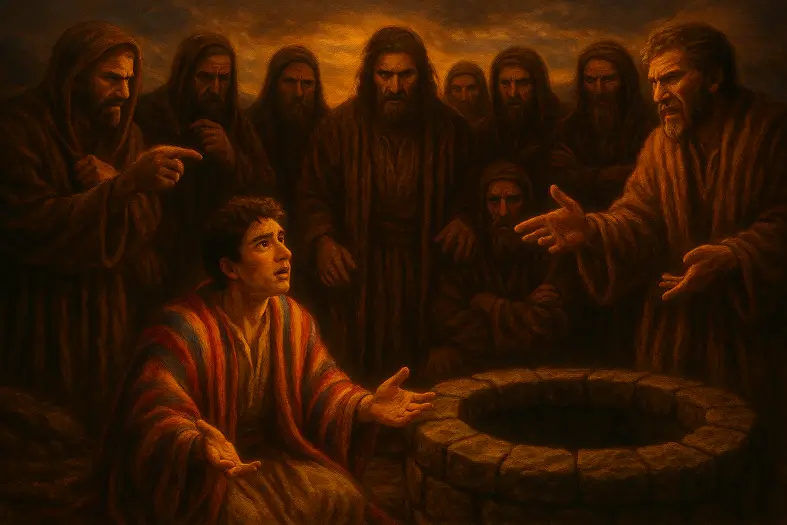
Parshas Vayeishev introduces the first great collapse within the emerging nation of Yisrael. The brothers see Yosef’s behavior — his youthful dreams, his leadership instincts, his reports to Yaakov — and fill the gaps with suspicion, resentment, and fear. Chazal teach:
כָּל הַדָּן אֶת חֲבֵירוֹ לְכַף זְכוּת — דָּנִין אוֹתוֹ לְזְכוּת
“He who judges his fellow favorably is judged favorably” (Shabbos 127b).
The Shevatim choose the opposite. They interpret every action in the worst possible light — and catastrophe follows.
The Torah records Yosef’s “dibasam ra’ah” (37:2), but how the brothers interpreted it determined everything that came next. Instead of asking, “What concern for us motivates Yosef?” they assume, “He wants to replace us.”
Instead of seeing dreams as Divine messages, they call them delusions of power.
Where suspicion replaces dialogue, sin multiplies.
The Chafetz Chaim explains that lashon hara is not only speech—it begins in the heart with failed judgment (Hil. Lashon Hara 3:7). Before a word is spoken, a verdict is rendered internally:
Once those negative assumptions calcify, rechilus (spreading harmful interpretation) and sin’as chinam follow like dominoes.
The Shevatim never grant Yosef even one dan l’kaf zechus — not once do they attempt to understand his motives through the lens of sibling loyalty or sincere spiritual concern.
Judgment without charity becomes
violence dressed as righteousness.
Ramban notes the underlying dilemma: the brothers believe Yosef threatens their role as future leaders of Yisrael. With no benefit of the doubt, the dreams become “evidence” of danger.
Abarbanel sees something deeper: each brother interprets Yosef from his own insecurities. What they fear in themselves, they project onto him.
Their judgment is not truth — it is self-defense.
Had they spoken to Yosef openly —
Had they asked Yaakov for clarity —
Had they paused, even once…
Galus Mitzrayim would not have been born.
Ironically, Yosef later embodies the very virtue denied to him:
Where they saw evil intentions, Yosef sees Divine intentions.
He becomes the corrective lens through which judgment is healed.
Most interpersonal breakdowns begin like Vayeishev:
Modern technology accelerates these misreadings — and multiplies lashon hara at light speed. The mitzvah to judge favorably becomes a survival strategy for Jewish unity.
Practical avodah from the Chafetz Chaim:
✔ If a deed can be interpreted positively → assume positive
✔ If unclear → suspend judgment until you clarify
✔ If concern is needed → address it privately and humbly
Every favorable interpretation is a brick in the Beis HaMikdash.
Every negative assumption is a stone removed from its foundation.
The story of Yosef and his brothers is not only history — it is mussar.
The first national tragedy began with a failure of imagination:
they could not imagine Yosef meant well.
The Torah asks us to do differently.
To widen our empathy.
To assume righteousness.
To let love interpret ambiguity.
Judging favorably is not naïve —
it is holy realism about the Jewish soul.
📖 Sources


“The Failure to See a Fellow Jew’s Innocence: Lessons from the Sale of Yosef”
All the brothers needed was one different reading of Yosef’s intentions — one ounce of favorable judgment — and Jewish history might have changed. Instead, negative interpretation hardened into certainty, certainty into hatred, and hatred into a sale that plunged us into centuries of exile. The Chafetz Chaim teaches that dan l’kaf zechus is not a nicety; it is a lifeline that protects families and nations. In Vayeishev, we see what happens when that lifeline is cut.
Parshas Vayeishev introduces the first great collapse within the emerging nation of Yisrael. The brothers see Yosef’s behavior — his youthful dreams, his leadership instincts, his reports to Yaakov — and fill the gaps with suspicion, resentment, and fear. Chazal teach:
כָּל הַדָּן אֶת חֲבֵירוֹ לְכַף זְכוּת — דָּנִין אוֹתוֹ לְזְכוּת
“He who judges his fellow favorably is judged favorably” (Shabbos 127b).
The Shevatim choose the opposite. They interpret every action in the worst possible light — and catastrophe follows.
The Torah records Yosef’s “dibasam ra’ah” (37:2), but how the brothers interpreted it determined everything that came next. Instead of asking, “What concern for us motivates Yosef?” they assume, “He wants to replace us.”
Instead of seeing dreams as Divine messages, they call them delusions of power.
Where suspicion replaces dialogue, sin multiplies.
The Chafetz Chaim explains that lashon hara is not only speech—it begins in the heart with failed judgment (Hil. Lashon Hara 3:7). Before a word is spoken, a verdict is rendered internally:
Once those negative assumptions calcify, rechilus (spreading harmful interpretation) and sin’as chinam follow like dominoes.
The Shevatim never grant Yosef even one dan l’kaf zechus — not once do they attempt to understand his motives through the lens of sibling loyalty or sincere spiritual concern.
Judgment without charity becomes
violence dressed as righteousness.
Ramban notes the underlying dilemma: the brothers believe Yosef threatens their role as future leaders of Yisrael. With no benefit of the doubt, the dreams become “evidence” of danger.
Abarbanel sees something deeper: each brother interprets Yosef from his own insecurities. What they fear in themselves, they project onto him.
Their judgment is not truth — it is self-defense.
Had they spoken to Yosef openly —
Had they asked Yaakov for clarity —
Had they paused, even once…
Galus Mitzrayim would not have been born.
Ironically, Yosef later embodies the very virtue denied to him:
Where they saw evil intentions, Yosef sees Divine intentions.
He becomes the corrective lens through which judgment is healed.
Most interpersonal breakdowns begin like Vayeishev:
Modern technology accelerates these misreadings — and multiplies lashon hara at light speed. The mitzvah to judge favorably becomes a survival strategy for Jewish unity.
Practical avodah from the Chafetz Chaim:
✔ If a deed can be interpreted positively → assume positive
✔ If unclear → suspend judgment until you clarify
✔ If concern is needed → address it privately and humbly
Every favorable interpretation is a brick in the Beis HaMikdash.
Every negative assumption is a stone removed from its foundation.
The story of Yosef and his brothers is not only history — it is mussar.
The first national tragedy began with a failure of imagination:
they could not imagine Yosef meant well.
The Torah asks us to do differently.
To widen our empathy.
To assume righteousness.
To let love interpret ambiguity.
Judging favorably is not naïve —
it is holy realism about the Jewish soul.
📖 Sources


"Judging Favorably: How Charity of Interpretation Could Have Saved the Twelve Tribes"
13. To love other Jews — Leviticus 19:18
Ahavas Yisrael means assuming a fellow Jew’s innocence whenever possible. Had the Shevatim looked at Yosef with this mitzvah in mind, they would have searched for a positive reading of his dreams and reports instead of treating him as a threat.
15. Not to hate fellow Jews — Leviticus 19:17
Inner resentment is itself an issur, even before any action. The brothers’ growing animosity toward Yosef, nurtured in silence, shows how unchecked hatred poisons perception and makes a favorable judgment feel impossible.
16. To reprove wrongdoers — Leviticus 19:17
Instead of plotting, the Torah demands direct, respectful tochachah. If the brothers had spoken openly with Yosef or with Yaakov, their concerns could have been clarified rather than exploding into betrayal.
21. Not to bear a grudge — Leviticus 19:18
Old hurts and jealousies make dan l’kaf zechus almost impossible. The brothers’ stored grievances about favoritism, the ketonet passim, and Yosef’s dreams created a backlog of grudges that distorted every new event.
17. Not to embarrass others — Leviticus 19:17
Publicly degrading a fellow Jew is a severe violation. Plotting to kill or sell Yosef, and later sitting to eat while he cries from the pit, reflects a collapse of this mitzvah at the level of thought, word, and deed.
19. Not to gossip about others — Leviticus 19:16
The Chafetz Chaim roots lashon hara in how we interpret behavior. Repeating the most negative reading of Yosef’s actions — rather than investigating or judging favorably — is exactly what this mitzvah forbids.
20. Not to take revenge — Leviticus 19:18
Seeing Yosef as a rival, the brothers turn hurt into “justice.” Selling him is framed as payback for imagined offenses. The mitzvah bans such retaliatory thinking, demanding that we separate wounded ego from moral judgment.
501. Not to insult or harm anybody with words — Leviticus 25:17
Verbal cruelty, sharp comments, and labels that define a person as “enemy” or “threat” all violate this prohibition. The brothers’ speech about Yosef — “this dreamer” — shows how language cements negative judgment and opens the door to worse sins.
22. To learn Torah and teach it — Deuteronomy 6:7
The whole sugya of dan l’kaf zechus, lashon hara, and rechilus in Chazal and the Chafetz Chaim is part of this mitzvah. A family or community that regularly learns these halachos trains itself to read others with charity, preventing a “Vayeishev collapse.”
25. Not to follow the whims of your heart or what your eyes see — Numbers 15:39
First impressions, jealousy, and fear are unreliable guides. The brothers’ eyes see favoritism; their hearts feel threatened — and they treat those feelings as truth. This mitzvah calls for disciplined thinking: slow down, question your assumptions, and align your inner reading with Torah.
75. To repent and confess wrongdoings — Numbers 5:7
True teshuvah for failed judgment is not only regretting harsh thoughts; it means admitting, “I misread you,” repairing relationships, and rebuilding trust. Yosef’s story culminates when the brothers finally confront their error — a living model of this mitzvah in action.


"Judging Favorably: How Charity of Interpretation Could Have Saved the Twelve Tribes"
Cross-Parsha Themes of Favorable Judgment & Avoiding Misjudgment
Misjudgment of Hashem’s command fuels the first sin. Ambiguity interpreted negatively leads to catastrophe — a paradigm for the danger of false assumptions.
Avraham grants Lot the benefit of the doubt repeatedly, separating peacefully to avoid friction. Dan l’kaf zechus prevents conflict.
Assumptions and jealousy fracture relationships. Hashem intervenes to clarify truth and repair trust.
Misread intentions — Rivkah’s silence, Yaakov’s disguise — amplify suspicion and resentment. A warning that hidden motives often breed worst-case narratives.
The central case study:
Negative interpretation replaces sibling trust. Lashon hara, hatred, and sin by omission cascade into the sale of Yosef and the birth of national exile.
Yosef models dan l’kaf zechus:
He reframes past harm through Divine intention, restoring unity and dignity while protecting his brothers from shame.
Source parsha for₁:
Negative speech begins with negative assumption. This parsha makes explicit the spiritual and social collapse that lashon hara causes — the fate Yosef narrowly avoids.
The Torah’s definitive paradigm:
Even holy people must check assumptions. Miriam’s sincere misreading becomes a global cautionary tale.
Whenever judgment fails — Korach’s jealousy, the Spies’ fear, complaints in the camp — national progress halts.
Division = delay in redemption.
Where we interpret generously, families and communities are built.
Where we interpret maliciously, destruction begins.
Dan l’kaf zechus isn’t theoretical —
it is the difference between Yosef and sinas chinam, between Vayeishev and Vayigash, between exile and geulah.

Dive into mitzvos, tefillah, and Torah study—each section curated to help you learn, reflect, and live with intention. New insights are added regularly, creating an evolving space for spiritual growth.

Explore the 613 mitzvos and uncover the meaning behind each one. Discover practical ways to integrate them into your daily life with insights, sources, and guided reflection.

Learn the structure, depth, and spiritual intent behind Jewish prayer. Dive into morning blessings, Shema, Amidah, and more—with tools to enrich your daily connection.

Each week’s parsha offers timeless wisdom and modern relevance. Explore summaries, key themes, and mitzvah connections to deepen your understanding of the Torah cycle.